Broadband Country
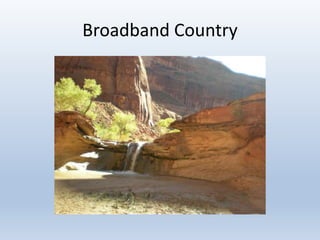
Broadband Country
Springdale APA Conference
Kelleigh Cole
Governor’s Office of Economic Development
Emery Polelonema
Six County AOG
John M. Janson
AICP
Session Intent
• Explore our reliance on Broadband
• Understand Broadband trends in Utah
• Attain a Rural and Tribal Perspective
• Discuss possible government roles
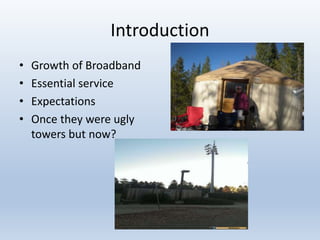
Introduction
• Growth of Broadband
• Essential service
• Expectations
• Once they were ugly
towers but now?
What is Broadband?
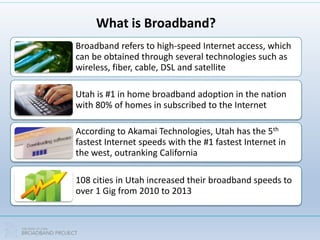
Broadband refers to high-speed Internet access, which
can be obtained through several technologies such as
wireless, fiber, cable, DSL and satellite
Utah is #1 in home broadband adoption in the nation
with 80% of homes in subscribed to the Internet
According to Akamai Technologies, Utah has the 5th
fastest Internet speeds with the #1 fastest Internet in
the west, outranking California
108 cities in Utah increased their broadband speeds to
over 1 Gig from 2010 to 2013
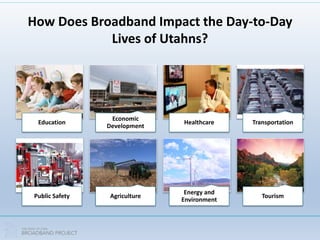
How Does Broadband Impact the Day-to-Day
Lives of Utahns?
Education
Economic
Development
Healthcare Transportation
Public Safety Agriculture
Energy and
Environment
Tourism
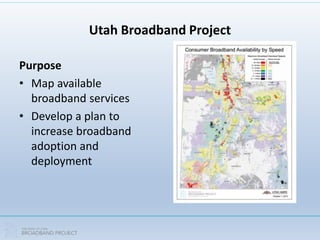
Utah Broadband Project
Purpose
• Map available
broadband services
• Develop a plan to
increase broadband
adoption and
deployment
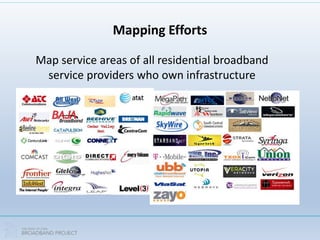
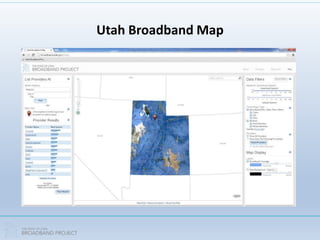
Mapping Efforts
Map service areas of all residential broadband
service providers who own infrastructure
Utah Broadband Map
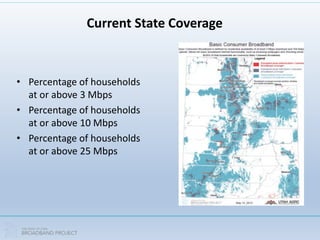
Current State Coverage
• Percentage of households
at or above 3 Mbps
• Percentage of households
at or above 10 Mbps
• Percentage of households
at or above 25 Mbps
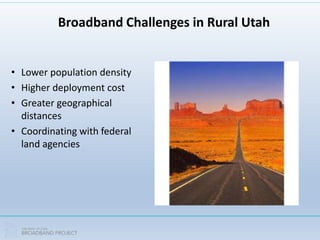
Broadband Challenges in Rural Utah
• Lower population density
• Higher deployment cost
• Greater geographical
distances
• Coordinating with federal
land agencies
2011 Utah Broadband Adoption Survey Results
Utah’s rural communities do not have a lower
broadband adoption rate than their non-rural
counterparts
Many of Utah’s rural communities are able to
identify multiple broadband options in their area
Utah’s rural communities do not pay higher prices
for Internet service than their non-rural
counterparts, and are even willing to pay more for
broadband services
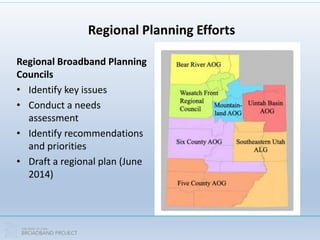
Regional Planning Efforts
Regional Broadband Planning
Councils
• Identify key issues
• Conduct a needs
assessment
• Identify recommendations
and priorities
• Draft a regional plan (June
2014)
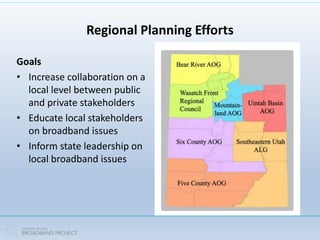
Regional Planning Efforts
Goals
• Increase collaboration on a
local level between public
and private stakeholders
• Educate local stakeholders
on broadband issues
• Inform state leadership on
local broadband issues
Rural and Tribal Perspectives
• Tribal Outreach – 8 Tribes in Utah
• Rural Area Constituents – Micro Communities
matter
• Q1: Do you have suggestions on how different
stakeholders can work together to improve
broadband adoption?
• Q2: Has it become a basic necessity, essential
for everyone?
Talking Points – Reaching Out
• Know your people – who, where, & how can
we interact
• Communicate both directions e.g. tribal forum
tested listening skills
• Persistent Collaboration with Trust &
Cooperation
• Identify what both parties need e.g. ARA
$32M
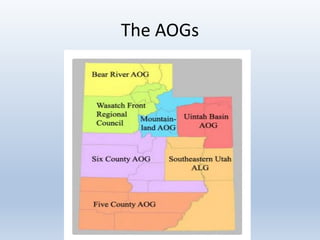
The AOGs
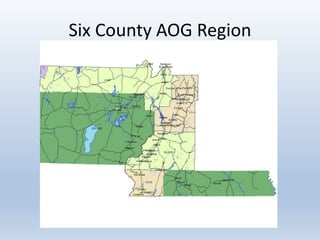
Six County AOG Region
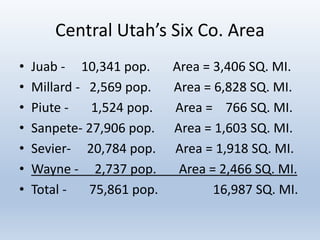
Central Utah’s Six Co. Area
• Juab - 10,341 pop. Area = 3,406 SQ. MI.
• Millard - 2,569 pop. Area = 6,828 SQ. MI.
• Piute - 1,524 pop. Area = 766 SQ. MI.
• Sanpete- 27,906 pop. Area = 1,603 SQ. MI.
• Sevier- 20,784 pop. Area = 1,918 SQ. MI.
• Wayne - 2,737 pop. Area = 2,466 SQ. MI.
• Total - 75,861 pop. 16,987 SQ. MI.
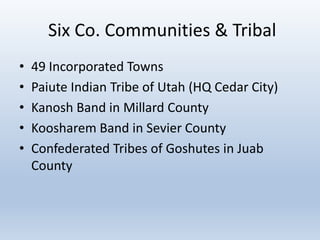
Six Co. Communities & Tribal
• 49 Incorporated Towns
• Paiute Indian Tribe of Utah (HQ Cedar City)
• Kanosh Band in Millard County
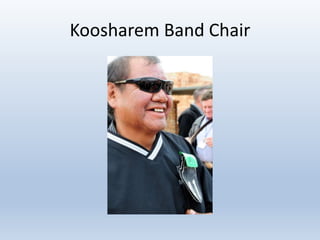
• Koosharem Band in Sevier County
• Confederated Tribes of Goshutes in Juab
County
Navajo Nation BB Project
• Navajo Tribal Utility Authority (NTUA) data
center
• The Navajo Nation leverage a $32 million
American Recovery and Reinvestment Act
grant in 2010
• Expanded broadband Internet across its land
in New Mexico, Arizona and Utah
Navajo Nation BB Project
• Some stakeholders lost out due to lack of
cooperation
• Pro-Action by Navajo Nation
• Need for collaboration across State Lines
• Share of info on successful projects
• NNBB Project will connect Page AZ
What do we need to do from Utah side?
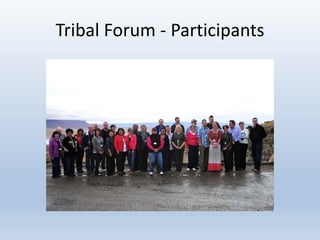
Tribal Forum - Participants
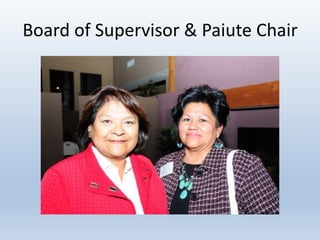
Board of Supervisor & Paiute Chair
Koosharem Band Chair
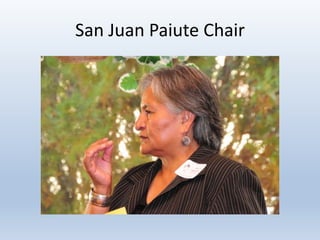
San Juan Paiute Chair
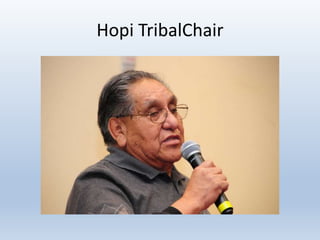
Hopi TribalChair
PITU Econ. Dir & Sevier Co. Comm.
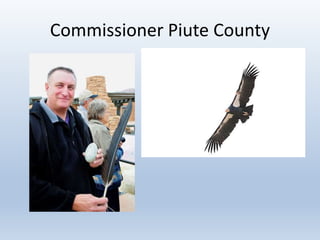
Commissioner Piute County
Is there a new government role?
• Google, UTOPIA, Partnerships
• Infrastructure means:
– Overhead cable and fiber
– Underground
– Wireless
• Should government begin to facilitate
Broadband infrastructure?
• If so, how?
How can government facilitate
Broadband infrastructure ?
Local Government. Increase coordination,
communication, and collaboration through such
techniques as:
• Create an electronic list of local providers, districts, and
utilities – use UBAC resources
• Hold a providers (wired and wireless) meeting to
determine lead time needs for trench coordination and
potential cost sharing policies. Consider inviting, blue
stakes, trench and wire/fiber installation companies,
and any agencies/departments that build significant
projects.
Government options
• Coordinate with City departments, developers, and districts
on major projects. Set up a reporting schedule and project
mapping system.
• Request fiber build schedules from providers. Consider
cost sharing policies.
• Request project schedules for UDOT and/or County roads
• Review permitting processes to expedite broadband
deployment. Evaluate public structures for potential
wireless service installations. Modify zoning laws
• Consider regular coordination meetings to improve
communication
• Consider partnerships that do not limit competition
Government options
• Make a plan!!!
• Add an element to your General Plan
– Infrastructure needs assessment
– System problems
– Plan to address deficiencies and encourage more
infrastructure
Broadband Country
• Yes, it is here
• Yes, we want it everywhere in the ol’ Country
of the Red, White and Blue
• Thank you!

Broadband APA Conference

  • 1.
  • 2.
    Broadband Country Springdale APAConference Kelleigh Cole Governor’s Office of Economic Development Emery Polelonema Six County AOG John M. Janson AICP
  • 3.
    Session Intent • Exploreour reliance on Broadband • Understand Broadband trends in Utah • Attain a Rural and Tribal Perspective • Discuss possible government roles
  • 4.
    Introduction • Growth ofBroadband • Essential service • Expectations • Once they were ugly towers but now?
  • 5.
    What is Broadband? Broadbandrefers to high-speed Internet access, which can be obtained through several technologies such as wireless, fiber, cable, DSL and satellite Utah is #1 in home broadband adoption in the nation with 80% of homes in subscribed to the Internet According to Akamai Technologies, Utah has the 5th fastest Internet speeds with the #1 fastest Internet in the west, outranking California 108 cities in Utah increased their broadband speeds to over 1 Gig from 2010 to 2013
  • 6.
    How Does BroadbandImpact the Day-to-Day Lives of Utahns? Education Economic Development Healthcare Transportation Public Safety Agriculture Energy and Environment Tourism
  • 7.
    Utah Broadband Project Purpose •Map available broadband services • Develop a plan to increase broadband adoption and deployment
  • 8.
    Mapping Efforts Map serviceareas of all residential broadband service providers who own infrastructure
  • 9.
  • 10.
    Current State Coverage •Percentage of households at or above 3 Mbps • Percentage of households at or above 10 Mbps • Percentage of households at or above 25 Mbps
  • 11.
    Broadband Challenges inRural Utah • Lower population density • Higher deployment cost • Greater geographical distances • Coordinating with federal land agencies
  • 12.
    2011 Utah BroadbandAdoption Survey Results Utah’s rural communities do not have a lower broadband adoption rate than their non-rural counterparts Many of Utah’s rural communities are able to identify multiple broadband options in their area Utah’s rural communities do not pay higher prices for Internet service than their non-rural counterparts, and are even willing to pay more for broadband services
  • 13.
    Regional Planning Efforts RegionalBroadband Planning Councils • Identify key issues • Conduct a needs assessment • Identify recommendations and priorities • Draft a regional plan (June 2014)
  • 14.
    Regional Planning Efforts Goals •Increase collaboration on a local level between public and private stakeholders • Educate local stakeholders on broadband issues • Inform state leadership on local broadband issues
  • 15.
    Rural and TribalPerspectives • Tribal Outreach – 8 Tribes in Utah • Rural Area Constituents – Micro Communities matter • Q1: Do you have suggestions on how different stakeholders can work together to improve broadband adoption? • Q2: Has it become a basic necessity, essential for everyone?
  • 16.
    Talking Points –Reaching Out • Know your people – who, where, & how can we interact • Communicate both directions e.g. tribal forum tested listening skills • Persistent Collaboration with Trust & Cooperation • Identify what both parties need e.g. ARA $32M
  • 17.
  • 18.
  • 19.
    Central Utah’s SixCo. Area • Juab - 10,341 pop. Area = 3,406 SQ. MI. • Millard - 2,569 pop. Area = 6,828 SQ. MI. • Piute - 1,524 pop. Area = 766 SQ. MI. • Sanpete- 27,906 pop. Area = 1,603 SQ. MI. • Sevier- 20,784 pop. Area = 1,918 SQ. MI. • Wayne - 2,737 pop. Area = 2,466 SQ. MI. • Total - 75,861 pop. 16,987 SQ. MI.
  • 20.
    Six Co. Communities& Tribal • 49 Incorporated Towns • Paiute Indian Tribe of Utah (HQ Cedar City) • Kanosh Band in Millard County • Koosharem Band in Sevier County • Confederated Tribes of Goshutes in Juab County
  • 21.
    Navajo Nation BBProject • Navajo Tribal Utility Authority (NTUA) data center • The Navajo Nation leverage a $32 million American Recovery and Reinvestment Act grant in 2010 • Expanded broadband Internet across its land in New Mexico, Arizona and Utah
  • 22.
    Navajo Nation BBProject • Some stakeholders lost out due to lack of cooperation • Pro-Action by Navajo Nation • Need for collaboration across State Lines • Share of info on successful projects • NNBB Project will connect Page AZ What do we need to do from Utah side?
  • 23.
    Tribal Forum -Participants
  • 24.
    Board of Supervisor& Paiute Chair
  • 25.
  • 26.
  • 27.
  • 28.
    PITU Econ. Dir& Sevier Co. Comm.
  • 29.
  • 30.
    Is there anew government role? • Google, UTOPIA, Partnerships • Infrastructure means: – Overhead cable and fiber – Underground – Wireless • Should government begin to facilitate Broadband infrastructure? • If so, how?
  • 31.
    How can governmentfacilitate Broadband infrastructure ? Local Government. Increase coordination, communication, and collaboration through such techniques as: • Create an electronic list of local providers, districts, and utilities – use UBAC resources • Hold a providers (wired and wireless) meeting to determine lead time needs for trench coordination and potential cost sharing policies. Consider inviting, blue stakes, trench and wire/fiber installation companies, and any agencies/departments that build significant projects.
  • 32.
    Government options • Coordinatewith City departments, developers, and districts on major projects. Set up a reporting schedule and project mapping system. • Request fiber build schedules from providers. Consider cost sharing policies. • Request project schedules for UDOT and/or County roads • Review permitting processes to expedite broadband deployment. Evaluate public structures for potential wireless service installations. Modify zoning laws • Consider regular coordination meetings to improve communication • Consider partnerships that do not limit competition
  • 33.
    Government options • Makea plan!!! • Add an element to your General Plan – Infrastructure needs assessment – System problems – Plan to address deficiencies and encourage more infrastructure
  • 34.
    Broadband Country • Yes,it is here • Yes, we want it everywhere in the ol’ Country of the Red, White and Blue • Thank you!