Industry Agenda
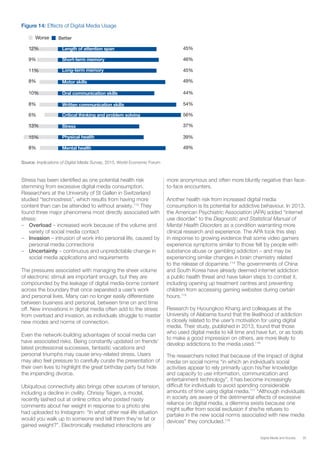
Digital Media and Society
Implications in a
Hyperconnected Era
January 2016
World Economic Forum Shaping the Future Implications of Digital Media for Society
project report
Prepared in collaboration with Willis Towers Watson
© WORLD ECONOMIC FORUM, 2016 – All rights reserved.
No part of this publication may be reproduced or
transmitted in any form or by any means, including
photocopying and recording, or by any information
storage and retrieval system.
REF 181215
3Digital Media and Society
Contents Preface
5 Executive Summary
8 Introduction
9 Methodology
10 Section 1: User Behaviour,
Preferences and Concerns
20 Section 2: User Engagement
26 Section 3: Impact of Digital Media
on Individuals, Organizations and
Society
26 Benefits and Opportunities
31 Downsides and Risks
38 Section 4: Outlook and Call to
Action
42 Project Contributors
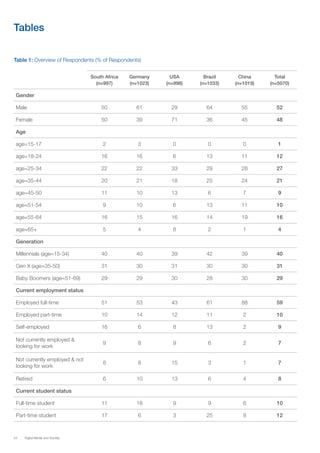
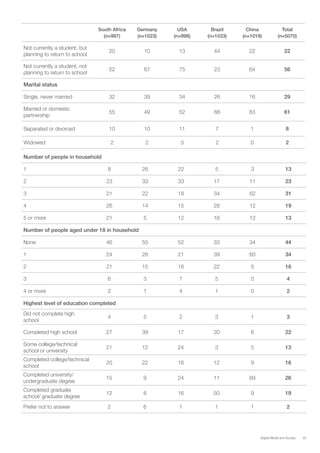
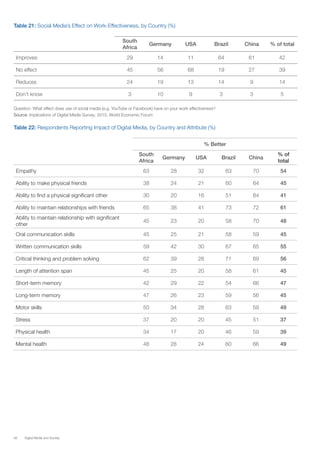
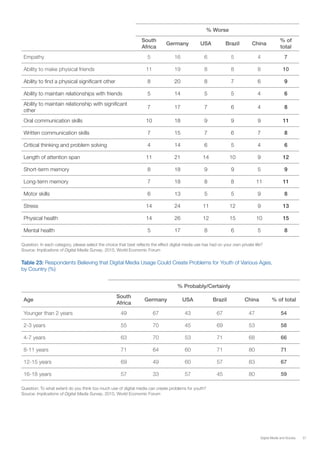
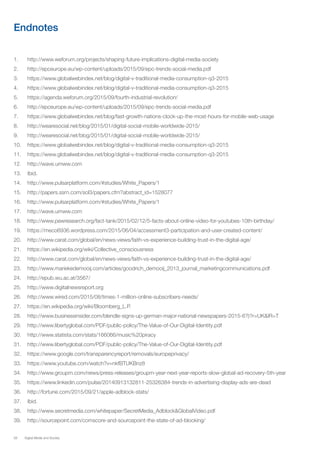
44 Tables
58 Endnotes
We need only look to our own experience – at home, in
public spaces and at work – to see that technological
innovation and digitization are fundamentally reshaping our
public, private and professional lives. The Fourth Industrial
Revolution is upon us, and the Media, Entertainment
and Information (MEI) Industries are at the core of this
transformation; they provide the digital tools, services,
applications and content we engage with, increasingly
anytime and anywhere.
The emerging digital MEI offerings are the main driver to
smartphone, tablet and other connected device adoption,
as well as to our changing relationship with many other
elements of daily life, such as health, consumer products
and mobility. Around the world, people now spend more
time using laptop computers and smartphones than they
do in other daily activities, and our “connected time” is on
the rise. This is referred to by the World Economic Forum
as hyperconnectivity, and it will continue to affect how we
interact with one other, how we learn and work, in ways that
are both profound and impactful.
MEI businesses have greatly benefited from the digital
transformation of their industry, but the challenges of
content and service congestion and of rapidly evolving
end-user needs and preferences cannot be ignored. No
individual, enterprise or government can afford to be
unaware of the implications that the growing use of digital
media, entertainment and information content and services
(“digital media”) will have on industry and society. MEI
enterprises must continue to innovate to keep pace with
the emerging media consumer who continually challenges
industry business models and offerings. At the same time,
we must begin planning for how our increased connection
to digital media is and will continue to change the very fabric
of our society.
With this Digital Media and Society report, the World
Economic Forum strives to raise general awareness,
catalyse further discussion and stimulate action from
its readers. Much can be done by decision-makers in
both the public and private sectors to foster the positive
implications of increased digital media use and to recognize
and address its potentially unfavourable impacts. However,
as much as public-private cooperation can improve the
lives of citizens, in the context of hyperconnectivity much
of this responsibility lies in the hands of the individual. As
such, the report has been designed to speak to all types of
readers. Whether the reader is a parent, a senior company
executive or a government policy-maker, this study provides
facts, figures and supporting evidence to all its claims, and
includes tangible recommendations to all stakeholders for
action.
We hope this collective effort by an extensive group
of organizations and individuals will stimulate further
consideration of, and research into, the implications of ever-
increasing digital media use in our lives. Through action,
partnership or further research, the ultimate objectives of the
World Economic Forum are to ensure that an increasingly
connected lifestyle remains an asset to business, individuals
and society rather than a liability, and that all stakeholders
benefit from our work and insights.
Sarita Nayyar
Managing Director
World Economic
Forum USA
5Digital Media and Society
Executive Summary
Innovations in technology, particularly in digital media,
increasingly are changing the way people use Media,
Entertainment & Information (MEI) services. More than
this, the very fabric of daily life is being altered. People
are interacting and connecting with each other in different
ways. Their sensibilities and psychologies are changing.
Blurring boundaries between private and professional lives,
and the hunger for immediate information are driving online
connection time. Trust in individuals’ relationship with digital
media has become an increasingly prominent issue. In some
ways, new generations are leading the evolution in changing
behaviour, but in others, older generations are “catching up”
surprisingly quickly.
The World Economic Forum’s Shaping the Future
Implications of Digital Media for Society project
was launched to provide insights on today’s media,
entertainment and information consumer, as well as on
the broader impact of digital media use on individuals,
organizations and the larger society.1
As part of that project,
the Digital Media and Society report aims to highlight
opportunities in digital media that can be encouraged
and nurtured. The report also signals potentially negative
consequences that need to be tackled – individuals and
families can address some; others require the attention of
institutions, from schools to corporations, and states to
national governments.
Digital Media and Society is based on evidence collected
through desk research, project workshops, expert interviews
and an online survey. Although the scope is large, it is not
intended to be comprehensive. Rather, the report presents
a broad picture of developments in digital media and their
implications, in order to raise awareness, spark further
discussion and stimulate the MEI industry and policy-makers
to cooperate in two crucial ways: by cultivating the positive
implications of digital media use and by addressing, and
then re-dressing, its potentially negative impacts.
Definitions
For the purposes of the Digital Media and Society report,
digital media is defined as products and services that
come from the media, entertainment and information
industry and its subsectors. It includes digital platforms
(e.g. websites and applications), digitized content
(e.g. text, audio, video and images) and services (e.g.
information, entertainment and communication) that can
be accessed and consumed through different digital
devices.
People’s online behaviours shape their digital identities.
Individuals may show different behaviour patterns in
different contexts (e.g. private versus professional), which
may be described as different digital personae.
User behaviour, preferences and concerns
People are spending more and more time online. Consider
these approximate figures for 2015:2
–– 3 billion internet users
–– 2 billion active social media users
–– More than 1.6 billion mobile social accounts
While laptops and desktops are still most commonly
used, mobile devices are gaining fast on them, causing
a significant change in people’s engagement with digital
media. Growth in mobile encounters is particularly strong in
emerging countries, where consumers are leapfrogging from
“no digital use” straight to “mobile use”.
Increased online connection time appears to be driven
mainly by work or information seeking, followed by
social and entertainment needs, based on findings from
the five countries surveyed for this report. Digital media
consumption for private and professional motives is more
and more integrated, with individuals using digital media
to move seamlessly back and forth between work and
personal activities.
6 Digital Media and Society
Sharing content has become a very important element of
using digital media, with users most likely to share content
that entertains, informs or inspires. Digital media also has
made it possible for billions of online media consumers to
participate in content creation. One-third of respondents
to the Implications of Digital Media Survey conducted in
October 2015 for this report, say they post written content,
pictures or videos on social media sites either daily or a few
times each week.
The main characteristics of today’s consumption patterns
can be summarized as follows:
–– Mobile: People now spend an average of two hours
daily on the mobile web, one-third of their total online
time, with Millennials and digital media users in emerging
countries emerging countries leading the mobile
revolution.3
The obvious advantages are that mobile
usage is less dependent on place and time, and devices
are more affordable than laptops/personal computers
(PCs).
–– Social and interactive: Social networking is by far the
most popular online activity, clocking in at an average of
1.8 hours or 30% of daily online time.4
–– Flexible and personalized: Users can have a more
active role and more control over the digital media
offerings they use and engage, compared with
traditional media. User accounts and cookies allow
for customization of content displayed based on user
characteristics and usage patterns.
–– Fast, instant and convenient: Fast internet and new
technologies (hardware and software) allow for easier
access and use, and enriched content.
–– More content: As content creation and distribution
become simpler, a greater amount of content and
services are becoming available. Content is more
diverse, but consumption is potentially focused
more on breadth than depth, as capacity is limited.
The importance of content filtering, curation and
recommendation has grown.
–– Collective: The possibility to connect, share,
recommend and communicate creates a collective
experience that shapes not only behaviours and
preferences, but also a collective consciousness of
shared beliefs, ideas and moral attitudes.
–– Fragmented and multi-channel: The huge number
of channels and creators makes content ever more
fragmented. Users access multiple platforms from
multiple devices. Adapting content to these multiple
platforms becomes imperative.
–– The higher the usage of digital media, the higher the
willingness to pay: Increased connection and use of
digital media should tip the revenue scale in industry’s
favour, but innovation in creating better user experiences
is crucial, as it is clearly evident that traditional digital
advertising is losing its appeal and efficacy.
But new consumption patterns, along with the presence of
more players and creators in the market, bring challenges.
Consumer trust is at risk because of fundamental
concerns about:
–– Truthfulness of content, given its volume, the large
number of creators and sources, and need for more
clarity around filtering mechanisms.
–– Integrity of the company/consumer value exchange.
–– Security of personal data and digital identities from
cybercrime, given the significance of this information to a
consumer’s professional, financial and social well-being.
User engagement
Engaging consumers through digital media requires much
more than simply “pushing” marketing content or services
at them. Consumers have become savvy at ignoring
ubiquitous display advertisements and more and more are
using ad-blocking software.
Instead, engagement requires providing valuable content
that meets user needs for information, convenience and
entertainment, stimulates content sharing and “pulls” in
consumers. For any brand or service, critical elements of
this engagement strategy include:
–– Entering into a conversation with consumers through
social media
–– Engaging employees to advocate the company through
their social media activities
–– Exhibiting socially responsible behaviour, particularly
regarding use and control of users’ personal data.
The impact of digital media on individuals,
organizations and society
The greater use of digital media today is changing people’s
everyday lives and the way they connect and collaborate
in the broader societal context, at work and in civil society.
This project’s research into five countries from different
regions concludes that this is a global phenomenon. Much
of the impact of this heightened use is beneficial to both
individuals and society. Digital media has empowered
people so that they no longer are passive bystanders or
recipients in the transformations wrought by the digital
revolution, but are actively shaping digital media and its
meaning for society.
The benefits to both individuals and society of increased
digital media usage include the following:
–– Assists social interaction and empowers individuals,
connecting the like-minded across vast distances, as
well as connecting those usually separated by social,
economic, cultural, political, religious and ideological
boundaries
–– Offers the means to increase civic participation and
facilitates the creation of communities with a common
interest or cause
–– Enhances flexibility for workers and employers,
boosting productivity and enabling greater work-life
integration
–– Facilitates education and life-long learning to build
and source skills
7Digital Media and Society
The main risks of higher digital media consumption include
the following:
–– Can be used with harmful intentions to spread
propaganda and mobilize followers
–– Influences human decision making as a result
of content filtering mechanisms that can target
specific information to certain people with potentially
discriminatory effects. This can happen through
information sharing or manipulation of information,
for example, during an electoral process (“digital
gerrymandering”)
–– Potential for near term inequality due to the
disruptions in labour markets and different skill
requirements brought about by digital technology
–– Changes in social skills and sense of empathy as
children and adults spend more time online. Facilitates
bullying, harassment and social defamation, reflecting
threats and patterns seen in the offline world
–– May impact mental and physical health if screen
time is excessive. The harm includes stress, greater
vulnerability to addictive behaviour, and less time spent in
physical activity. Can pose health and developmental
risks for young children if usage is not monitored
Outlook and call to action
The report’s research suggests that action from diverse
social players will make it more likely for people to take
advantage of more-frequent use of digital media even as
they mitigate related risks:
–– Public and private sectors should partner for
multistakeholder collaboration to drive action on
the effects noted in this report. The World Economic
Forum can facilitate public-private collaboration. Both
regulators and industry can engage with academia
and non-governmental organizations (NGOs) to
incorporate research findings and initiatives in creating
and implementing new socially responsible MEI industry
offerings or public policies.
–– The public sector can help to update, promote and
enforce evidence-based standards and regulations
in order to facilitate the benefits of digital media and
innovative solutions to mitigate the negative effects. It
can also facilitate the creation of social institutions
and programmes that assist individuals and the private
sector in making digital culture healthier at home, in
education, at work and in public life. For example, the
European Commission’s DG Connect group has a
directorate dedicated to digital society, trust and security
– every governmental body should establish similar
resources for their country or region. However, any
model of guidance and support should be adaptable to
changes in the marketplace and user behaviour.
–– The private sector, principally industry, should
consider the implications for individuals when
designing platforms and services or creating
content. The private sector can deepen efforts to build
trust with consumers, for example, by becoming more
transparent about how personal data are used and
showing a corporate ethos of accountability and social
responsibility. An effective tool is sponsoring public and
non-profit organizations that help to promote beneficial
use of digital media. From an employer’s perspective,
organizations should forge a strategy to integrate digital
media and technology into workflows, and should be
proactive in addressing the opportunities and pitfalls
that increased connectivity brings to the business and
employees.
–– Finally, individuals are encouraged to enhance
their digital literacy and skills, and use digital media
responsibly. Individuals thus can protect themselves and
others, especially those who are vulnerable. Individuals
can also get involved with civic organizations and
NGOs on digital media issues that have an impact on
their lives.
8 Digital Media and Society
Introduction
The digitization of the Media, Entertainment & Information
(MEI) industry has established new opportunities for
consuming, sharing and creating media content through a
growing number of devices and platforms – at any time and
from any place. Today’s media content and advertising are
distributed online and disseminated through social networks
and digital platforms. As engaging with digital media grows
easier, so does the time dedicated to content, platforms
and services. New platforms and changing consumption
patterns affect an individual’s everyday life and social
interactions, alter how work is done, and impact learning
and civic action.
Changing digital media consumption patterns and their
impact on society are direct consequences of the fourth
industrial revolution.5
The World Economic Forum is
committed to helping organizations in both the private and
public sectors to navigate through this transformational
change. The Shaping the Future Implications of Digital
Media for Society project is one of many initiatives from
the Forum to stimulate multistakeholder collaboration in
addressing some of the implications on society of this fourth
industrial revolution. More specifically, the project looks at
one of the MEI industry’s roles in this revolution.
The objective of Digital Media and Society, a report that is
part of the Forum’s project, is to provide insights on today’s
emerging MEI consumer, focusing on the factors that shape
an individual’s behaviour and preferences for digital media
usage. Additionally, the report links those developments
to broader impacts on the individual, organizations and
society, highlighting the opportunities and benefits, as well
as the risks and potential downside.
After a “wild childhood”, it is now time for digital media’s
“coming of age”. Industry, the public sector, and the
individual must assume responsibility for fostering the
opportunities offered by digital media, while helping to
mitigate the negative effects on individuals, organizations
and society.
9Digital Media and Society
Methodology
The evidence presented in this report was collected
through desk research, expert interviews, sessions at World
Economic Forum events and an online survey conducted
in October 2015 across the USA, Germany, South Africa,
Brazil and China, with a representative sample of about
1,000 digital media users in each country. Opinions and
additional supporting evidence have been provided through
a project blog series.
Project sessions
See Section 4: Outlook and Call to Action and Project Contributors for details
Jakarta, Indonesia 19 April 2015
World Economic Forum on East Asia
“Analogue Hearts and Digital Minds: The Impact of Digital Media on Human Behaviour”
New York, USA 13 May 2015
MEI Industry Spring Strategy Meeting
“Exploring the Drivers behind Changing Media Consumption Habits”
Geneva, Switzerland 12 August 2015
Young Global Leaders (YGL) and Alumni Annual Summit
“Digital Changes in Society”
Dalian, People’s Republic of China 10 September 2015
Annual Meeting of the New Champions 2015
“China’s Media Society: Impacts of Changing Media Consumption Patterns in China”
Project videos
Expert interviews conducted for the project were filmed and extracts of these interviews are featured in a series of videos
focusing on the different topics covered in the report.
Blog series
A number of project-related articles were published on the World Economic Forum’s Agenda Blog. They can be
accessed through the Shaping the Future Implications of Digital Media for Society project website on weforum.org.
NB: All opinions expressed in the project videos and blog series are those of the interviewees and authors respectively.
The World Economic Forum is an independent and neutral platform dedicated to generating debate on the key topics
that shape global, regional and industry agendas.
Implications of Digital Media Survey
The Forum conducted an online survey in October 2015, in collaboration with comScore and Willis Towers Watson, with
a representative sample of 5,070 digital media users aged 15-69 years drawn from:
–– Brazil (1,033 participants)
–– People’s Republic of China (1,019 participants)
–– Germany (1,023 participants)
–– South Africa (997 participants)
–– USA (998 participants)
See Table 1 for an overview of demographic characteristics
Segmentations used in Implications of Digital Media Survey
Generation
Millennials: reported age between 15 and 34 (born 1981-2000)
Generation X: reported age between 35 and 50 (born 1965-1980)
Baby Boomers: reported age between 51 and 69 (born 1947-1964)
Sporadic users versus frequent users
Sporadic users: the sample who reported spending less time than average per week consuming digital media
Frequent users: the sample who reported spending more time than average per week consuming digital media
While it cannot be comprehensive, this report offers a broad
picture of relevant developments in digital media and their
wider implications. The aim is to raise awareness, spark
further discussion and stimulate the Media, Entertainment
& Information (MEI) industry as well as policy-makers to
collaborate on cultivating the positive implications of digital
media and discouraging the negative.
10 Digital Media and Society
User attention is focused on key devices, platforms and
formats
What are the dimensions of digital media usage and how are
consumption patterns changing?
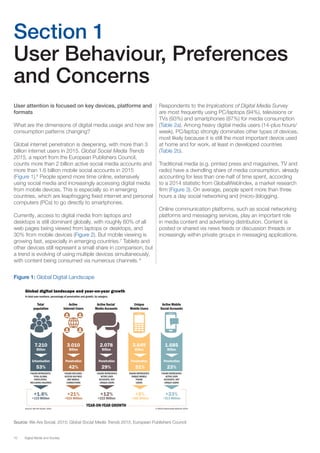
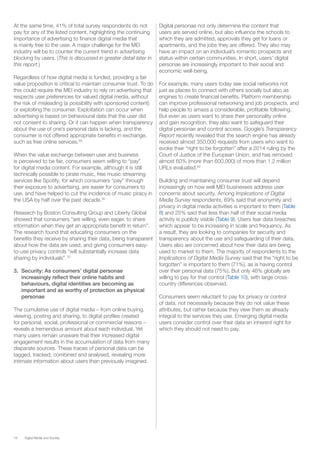
Global internet penetration is deepening, with more than 3
billion internet users in 2015. Global Social Media Trends
2015, a report from the European Publishers Council,
counts more than 2 billion active social media accounts and
more than 1.6 billion mobile social accounts in 2015
(Figure 1).6
People spend more time online, extensively
using social media and increasingly accessing digital media
from mobile devices. This is especially so in emerging
countries, which are leapfrogging fixed internet and personal
computers (PCs) to go directly to smartphones.
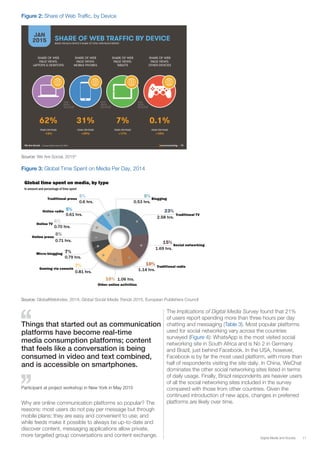
Currently, access to digital media from laptops and
desktops is still dominant globally, with roughly 60% of all
web pages being viewed from laptops or desktops, and
30% from mobile devices (Figure 2). But mobile viewing is
growing fast, especially in emerging countries.7
Tablets and
other devices still represent a small share in comparison, but
a trend is evolving of using multiple devices simultaneously,
with content being consumed via numerous channels. 8
Section 1
User Behaviour, Preferences
and Concerns
Respondents to the Implications of Digital Media Survey
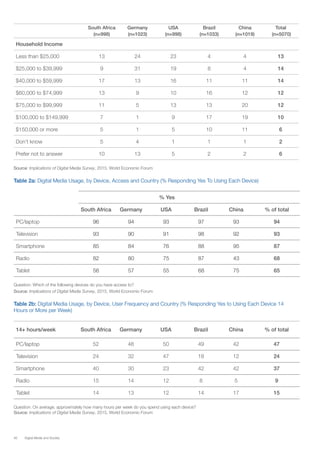
are most frequently using PC/laptops (94%), televisions or
TVs (93%) and smartphones (87%) for media consumption
(Table 2a). Among heavy digital media users (14-plus hours/
week), PC/laptop strongly dominates other types of devices,
most likely because it is still the most important device used
at home and for work, at least in developed countries
(Table 2b).
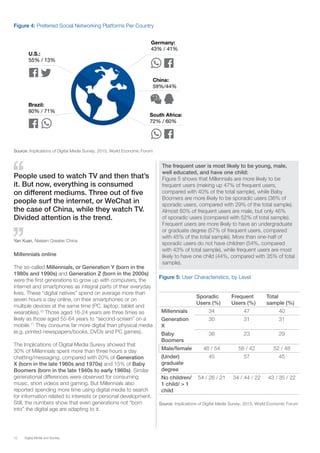
Traditional media (e.g. printed press and magazines, TV and
radio) have a dwindling share of media consumption, already
accounting for less than one-half of time spent, according
to a 2014 statistic from GlobalWebIndex, a market research
firm (Figure 3). On average, people spent more than three
hours a day social networking and (micro-)blogging.
Online communication platforms, such as social networking
platforms and messaging services, play an important role
in media content and advertising distribution. Content is
posted or shared via news feeds or discussion threads or
increasingly within private groups in messaging applications.
Figure 1: Global Digital Landscape
4
GLOBALSOCIALMEDIATRENDS
2015Video usage and revenues are growing exponentially around the world.
Publishers should drive strategies and tactics to leverage this inexorable trend
WNMNWORLD NEWSMEDIA NETWORK
GLOBAL SOCIAL MEDIA TRENDS
Social media is one of the fastest growing categories of media, and
is quickly becoming the most important way to expose publishers’
brands and content to both active readers and potential readers.
Global digital landscape and year-on-year growth
In total user numbers, percentage of penetration and growth, by category
Source: We Are Social, 2015 © World Newsmedia Network 2015
FIGURE REPRESENTS
TOTAL GLOBAL
POPULATION,
INCLUDING CHILDREN
FIGURE INCLUDES
ACCESS VIA FIXED
AND MOBILE
CONNECTIONS
FIGURE REPRESENTS
ACTIVE USER
ACCOUNTS, NOT
UNIQUE USERS
FIGURE REPRESENTS
UNIQUE MOBILE
PHONE
USERS
FIGURE REPRESENTS
ACTIVE USER
ACCOUNTS, NOT
UNIQUE USERS
Total
population
YEAR-ON-YEAR GROWTH
Active
Internet Users
Active Social
Media Accounts
Unique
Mobile Users
Active Mobile
Social Accounts
7.210
Billion
53%
+1.6% +21% +12% +5% +23%
42% 29% 51% 23%
Urbanisation
+115 Million +525 Million +222 Million +185 Million +313 Million
Penetration Penetration Penetration Penetration
3.010
Billion
2.078
Billion
3.649
Billion
1.685
Billion
Source: We Are Social, 2015; Global Social Media Trends 2015, European Publishers Council
11Digital Media and Society
We Are Social @wearesocialsg • 19
JAN
2015 SHARE OF WEB TRAFFIC BY DEVICE
SHARE OF WEB
PAGE VIEWS:
LAPTOPS & DESKTOPS
SHARE OF WEB
PAGE VIEWS:
MOBILE PHONES
SHARE OF WEB
PAGE VIEWS:
TABLETS
SHARE OF WEB
PAGE VIEWS:
OTHER DEVICES
• Source: StatCounter, Q1 2015
BASED ON EACH DEVICE’S SHARE OF TOTAL WEB PAGES SERVED
YEAR-ON-YEAR: YEAR-ON-YEAR: YEAR-ON-YEAR: YEAR-ON-YEAR:
62% 31% 7% 0.1%
-13% +39% +17% +18%
18
GLOBAL SOCIAL MEDIA TRENDS 2015
The largest chunk of time is still spent on watching traditional
television, or 23 percent of the day (2.58 hours), according to
GWI, while a growing amount of time is spent on online tele-
vision, or 6 percent (.61 hours). Meanwhile, 10 percent of the
media users’ time is spent on radio, and another 5 percent (.61
hours) on online radio. and another 10 percent on non-social
networking Internet.
Over time, the number of hours spent online, on social net-
work and on micro-blogging sites like Twitter have increased.
In 2014, the average global user spent more than six hours
online, compared to 5.5 hours in 2012. Almost two hours were
spent on social networking and almost an hour was spent
on micro-blogging in 2014, compared to just an hour and
a half spent on social networking and less than an hour on
micro-blogging in 2012. The steady growth of contributions
from social media platforms is prominently driven by Face-
book use, followed by YouTube, according to GWI. The mix of
percentage of time spent on various online activities varies by
country, according to the GWI study.
Social networking is the No. 1 activity online in every country,
followed by either micro-blogging or online press. The most
prolific social networking countries by percentage of time
spent are Japan, the Netherlands, Germany, France, Ireland,
Australia, Sweden, Poland, the United Kingdom, South Korea
and Spain.
The most popular countries for micro-blogging, by percentage
of online time spent, are the Netherlands, Poland, South Af-
rica, India, Turkey, Brazil and Saudi Arabia. The most prolific
users of online press are France, Sweden, the UK, South Korea,
Singapore, Taiwan, the United States, Argentina, Turkey, Indo-
nesia and the Philippines.
The number of hours spent on social media varies by country.
Those users from Thailand, Saudi Arabia, Brazil, the Philip-
pines, Indonesia, Malaysia, the United Arab Emirates,
Turkey, Mexico and Argentina are by far the biggest users of
social networking. Those from Thailand, Saudi Arabia, Brazil,
the Philippines, Indonesia, Malaysia, the United States, Mexi-
co and Argentina are the most rabid users of micro-blogging,
according to GWI.
Traditional press
5%
0.6 hrs.
1.06 hrs.
1.14 hrs.
1.69 hrs.
2.58 hrs.
0.53 hrs.
0.61 hrs.
0.70 hrs.
0.71 hrs.
0.79 hrs.
0.81 hrs.
5%
6%
6%
7%
7%
10%
10%
15%
5%
23%Online radio
Online TV
Online press
Micro-blogging
Gaming via console
Blogging
Traditional TV
Social networking
Traditional radio
Other online activities
Global time spent on media, by type
In amount and percentage of time spent
Source: GlobalWebIndex, 2014 © World Newsmedia Network 2015
Global time spent on social networks,
2012-2014
In average number of hours spent per day
Source: GlobalWebIndex, 2014 © World Newsmedia Network 2015
Total time
spent online
Time spent on
social networking
Time spent on
micro-blogging
7 hours
6
5
4
3
2
1
0
2012 2013 2014
Continued on page 25
Figure 2: Share of Web Traffic, by Device
Source: We Are Social, 20159
Figure 3: Global Time Spent on Media Per Day, 2014
Source: GlobalWebIndex, 2014; Global Social Media Trends 2015, European Publishers Council
Why are online communication platforms so popular? The
reasons: most users do not pay per message but through
mobile plans; they are easy and convenient to use; and
while feeds make it possible to always be up-to-date and
discover content, messaging applications allow private,
more targeted group conversations and content exchange.
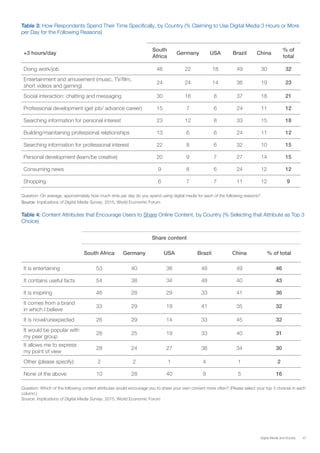
The Implications of Digital Media Survey found that 21%
of users report spending more than three hours per day
chatting and messaging (Table 3). Most popular platforms
used for social networking vary across the countries
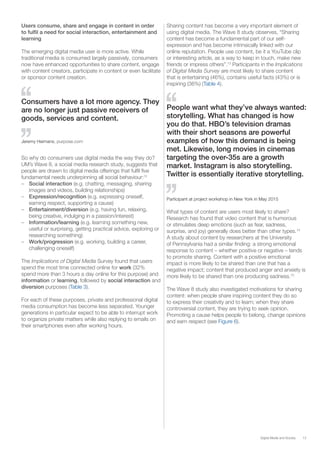
surveyed (Figure 4): WhatsApp is the most visited social
networking site in South Africa and is No 2 in Germany
and Brazil, just behind Facebook. In the USA, however,
Facebook is by far the most used platform, with more than
half of respondents visiting the site daily. In China, WeChat
dominates the other social networking sites listed in terms
of daily usage. Finally, Brazil respondents are heavier users
of all the social networking sites included in the survey
compared with those from other countries. Given the
continued introduction of new apps, changes in preferred
platforms are likely over time.
Things that started out as communication
platforms have become real-time
media consumption platforms; content
that feels like a conversation is being
consumed in video and text combined,
and is accessible on smartphones.
Participant at project workshop in New York in May 2015
12 Digital Media and Society
Figure 4: Preferred Social Networking Platforms Per Country
Source: Implications of Digital Media Survey, 2015, World Economic Forum
Millennials online
The so-called Millennials, or Generation Y (born in the
1980s and 1990s) and Generation Z (born in the 2000s)
were the first generations to grow up with computers, the
internet and smartphones as integral parts of their everyday
lives. These “digital natives” spend on average more than
seven hours a day online, on their smartphones or on
multiple devices at the same time (PC, laptop, tablet and
wearables).10
Those aged 16-24 years are three times as
likely as those aged 55-64 years to “second-screen” on a
mobile.11
They consume far more digital than physical media
(e.g. printed newspapers/books, DVDs and PC games).
The Implications of Digital Media Surevy showed that
30% of Millennials spent more than three hours a day
chatting/messaging, compared with 20% of Generation
X (born in the late 1960s and 1970s) and 15% of Baby
Boomers (born in the late 1940s to early 1960s). Similar
generational differences were observed for consuming
music, short videos and gaming. But Millennials also
reported spending more time using digital media to search
for information related to interests or personal development.
Still, the numbers show that even generations not “born
into” the digital age are adapting to it.
The frequent user is most likely to be young, male,
well educated, and have one child:
Figure 5 shows that Millennials are more likely to be
frequent users (making up 47% of frequent users,
compared with 40% of the total sample), while Baby
Boomers are more likely to be sporadic users (36% of
sporadic users, compared with 29% of the total sample).
Almost 60% of frequent users are male, but only 46%
of sporadic users (compared with 52% of total sample).
Frequent users are more likely to have an undergraduate
or graduate degree (57% of frequent users, compared
with 45% of the total sample). More than one-half of
sporadic users do not have children (54%, compared
with 43% of total sample), while frequent users are most
likely to have one child (44%, compared with 35% of total
sample).
Sporadic
Users (%)
Frequent
Users (%)
Total
sample (%)
Millennials 34 47 40
Generation
X
30 31 31
Baby
Boomers
36 23 29
Male/female 46 / 54 58 / 42 52 / 48
(Under)
graduate
degree
45 57 45
No children/
1 child/ > 1
child
54 / 26 / 21 34 / 44 / 22 43 / 35 / 22
Source: Implications of Digital Media Survey, 2015, World Economic Forum
Figure 5: User Characteristics, by Level
People used to watch TV and then that’s
it. But now, everything is consumed
on different mediums. Three out of five
people surf the internet, or WeChat in
the case of China, while they watch TV.
Divided attention is the trend.
Yan Xuan, Nielsen Greater China
13Digital Media and Society
Users consume, share and engage in content in order
to fulfil a need for social interaction, entertainment and
learning
The emerging digital media user is more active. While
traditional media is consumed largely passively, consumers
now have enhanced opportunities to share content, engage
with content creators, participate in content or even facilitate
or sponsor content creation.
So why do consumers use digital media the way they do?
UM’s Wave 8, a social media research study, suggests that
people are drawn to digital media offerings that fulfil five
fundamental needs underpinning all social behaviour:12
–– Social interaction (e.g. chatting, messaging, sharing
images and videos, building relationships)
–– Expression/recognition (e.g. expressing oneself,
earning respect, supporting a cause)
–– Entertainment/diversion (e.g. having fun, relaxing,
being creative, indulging in a passion/interest)
–– Information/learning (e.g. learning something new,
useful or surprising, getting practical advice, exploring or
researching something)
–– Work/progression (e.g. working, building a career,
challenging oneself)
The Implications of Digital Media Survey found that users
spend the most time connected online for work (32%
spend more than 3 hours a day online for this purpose) and
information or learning, followed by social interaction and
diversion purposes (Table 3).
For each of these purposes, private and professional digital
media consumption has become less separated. Younger
generations in particular expect to be able to interrupt work
to organize private matters while also replying to emails on
their smartphones even after working hours.
Sharing content has become a very important element of
using digital media. The Wave 8 study observes, “Sharing
content has become a fundamental part of our self-
expression and has become intrinsically linked with our
online reputation. People use content, be it a YouTube clip
or interesting article, as a way to keep in touch, make new
friends or impress others”.13
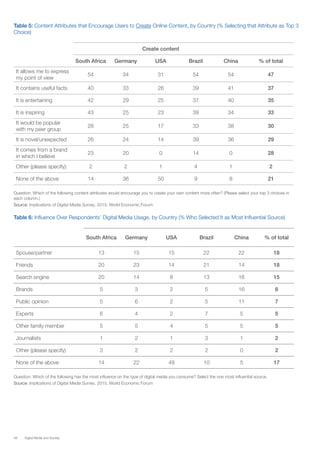
Participants in the Implications
of Digital Media Survey are most likely to share content
that is entertaining (46%), contains useful facts (43%) or is
inspiring (36%) (Table 4).
Consumers have a lot more agency. They
are no longer just passive receivers of
goods, services and content.
Jeremy Heimans, purpose.com
People want what they’ve always wanted:
storytelling. What has changed is how
you do that. HBO’s television dramas
with their short seasons are powerful
examples of how this demand is being
met. Likewise, long movies in cinemas
targeting the over-35s are a growth
market. Instagram is also storytelling.
Twitter is essentially iterative storytelling.
Participant at project workshop in New York in May 2015
What types of content are users most likely to share?
Research has found that video content that is humorous
or stimulates deep emotions (such as fear, sadness,
surprise, and joy) generally does better than other types.14
A study about content by researchers at the University
of Pennsylvania had a similar finding: a strong emotional
response to content – whether positive or negative – tends
to promote sharing. Content with a positive emotional
impact is more likely to be shared than one that has a
negative impact; content that produced anger and anxiety is
more likely to be shared than one producing sadness.15
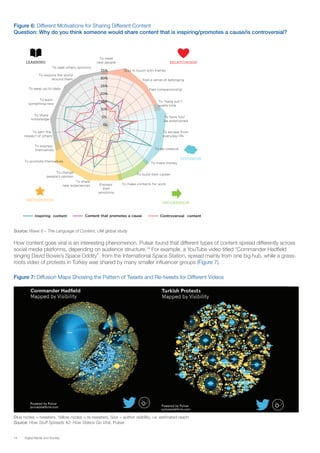
The Wave 8 study also investigated motivations for sharing
content: when people share inspiring content they do so
to express their creativity and to learn; when they share
controversial content, they are trying to seek opinion.
Promoting a cause helps people to belong, change opinions
and earn respect (see Figure 6).
14 Digital Media and Society
Q: Now we would like you to think about why other people share the kinds of content you said you like. Why do you think someone would share content that…
Base: Global - Value that type of content
RELATIONSHIP
DIVERSION
PROGRESSION
RECOGNITION
LEARNING
To meet
new people
Stay in touch with friends
Feel a sense of belonging
Feel companionship
To “hang out”/
waste time
To have fun/
be entertained
To escape from
everyday life
To be creative
To make money
To build their career
To make contacts for work
To seek others opinions
Express
their
emotions
To share
new experiences
To change
people’s opinion
To promote themselves
To express
themselves
To explore the world
around them
To keep up-to-date
To learn
something new
To share
knowledge
To earn the
respect of others
Inspiring content Content that promotes a cause Controversial content
0
5%
10%
15%
20%
25%
30%
35%
Figure 6: Different Motivations for Sharing Different Content
Question: Why do you think someone would share content that is inspiring/promotes a cause/is controversial?
Source: Wave 8 – The Language of Content, UM global study
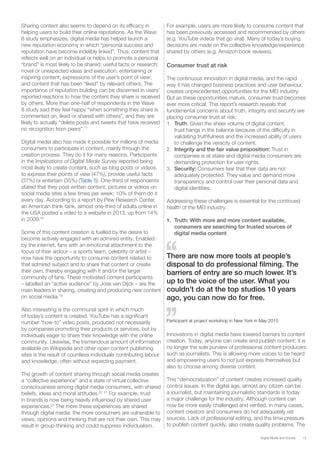
How content goes viral is an interesting phenomenon. Pulsar found that different types of content spread differently across
social media platforms, depending on audience structure.16
For example, a YouTube video titled “Commander Hadfield
singing David Bowie’s Space Oddity”, from the International Space Station, spread mainly from one big hub, while a grass-
roots video of protests in Turkey was shared by many smaller influencer groups (Figure 7).
Figure 7: Diffusion Maps Showing the Pattern of Tweets and Re-tweets for Different Videos
Blue nodes = tweeters. Yellow nodes = re-tweeters. Size = author visibility, i.e. estimated reach
Source: How Stuff Spreads #2: How Videos Go Viral, Pulsar
15Digital Media and Society
Sharing content also seems to depend on its efficacy in
helping users to build their online reputations. As the Wave
8 study emphasizes, digital media has helped launch a
new reputation economy in which “personal success and
reputation have become indelibly linked”. Thus, content that
reflects well on an individual or helps to promote a personal
“brand” is most likely to be shared: useful facts or research;
novel or unexpected ideas and execution; entertaining or
inspiring content; expressions of the user’s point of view;
and content that has been “liked” by relevant others. The
importance of reputation building can be discerned in users’
reported reactions to how the content they share is received
by others. More than one-half of respondents in the Wave
8 study said they feel happy “when something they share is
commented on, liked or shared with others”, and they are
likely to actually “delete posts and tweets that have received
no recognition from peers”.17
Digital media also has made it possible for millions of media
consumers to participate in content, mainly through the
creation process. They do it for many reasons. Participants
in the Implications of Digital Media Survey reported being
most likely to create content, such as blog posts or videos,
to express their points of view (47%), provide useful facts
(37%) or entertain (35%) (Table 5). One-third of respondents
stated that they post written content, pictures or videos on
social media sites a few times per week; 10% of them do it
every day. According to a report by Pew Research Center,
an American think-tank, almost one-third of adults online in
the USA posted a video to a website in 2013, up from 14%
in 2009.18
Some of this content creation is fuelled by the desire to
become actively engaged with an admired entity. Enabled
by the internet, fans with an emotional attachment to the
focus of their ardour – a sports team, celebrity or artist –
now have the opportunity to consume content related to
that admired subject and to share that content or create
their own, thereby engaging with it and/or the larger
community of fans. These motivated content participants
– labelled an “active audience” by Jose van Dijck – are the
main leaders in sharing, creating and producing new content
on social media.19
Also interesting is the communal spirit in which much
of today’s content is created. YouTube has a significant
number “how-to” video posts, produced not necessarily
by companies promoting their products or services, but by
individuals eager to share their knowledge with the online
community. Likewise, the tremendous amount of information
available on Wikipedia and other open content publishing
sites is the result of countless individuals contributing labour
and knowledge, often without expecting payment.
The growth of content sharing through social media creates
a “collective experience” and a state of virtual collective
consciousness among digital media consumers, with shared
beliefs, ideas and moral attitudes.20 21
For example, trust
in brands is now being heavily influenced by shared user
experiences.22
The more these experiences are shared
through digital media, the more consumers are vulnerable to
views, opinions and thinking that are not their own. This may
result in group-thinking and could suppress individualism.
For example, users are more likely to consume content that
has been previously accessed and recommended by others
(e.g. YouTube videos that go viral). Many of today’s buying
decisions are made on the collective knowledge/experience
shared by others (e.g. Amazon book reviews).
Consumer trust at risk
The continuous innovation in digital media, and the rapid
way it has changed business practices and user behaviour,
creates unprecedented opportunities for the MEI industry.
But as these opportunities mature, consumer trust becomes
ever more critical. This report’s research reveals that
fundamental concerns about truth, integrity and security are
placing consumer trust at risk:
1. Truth: Given the sheer volume of digital content,
trust hangs in the balance because of the difficulty in
validating truthfulness and the increased ability of users
to challenge the veracity of content.
2. Integrity and the fair value proposition: Trust in
companies is at stake and digital media consumers are
demanding protection for user rights.
3. Security: Consumers fear that their data are not
adequately protected. They value and demand more
transparency and control over their personal data and
digital identities.
Addressing these challenges is essential for the continued
health of the MEI industry.
1. Truth: With more and more content available,
consumers are searching for trusted sources of
digital media content
There are now more tools at people’s
disposal to do professional filming. The
barriers of entry are so much lower. It’s
up to the voice of the user. What you
couldn’t do at the top studios 10 years
ago, you can now do for free.
Participant at project workshop in New York in May 2015
Innovations in digital media have lowered barriers to content
creation. Today, anyone can create and publish content; it is
no longer the sole purview of professional content producers
such as journalists. This is allowing more voices to be heard
and empowering users to not just express themselves but
also to choose among diverse content.
This “democratization” of content creates increased quality
control issues. In the digital age, almost any citizen can be
a journalist, but maintaining journalistic standards is today
a major challenge for the industry. Although content can
now be more easily challenged and verified, in many cases,
content creators and consumers do not adequately vet
sources. Lack of professional editing, and the time pressure
to publish content quickly, also create quality problems. The
16 Digital Media and Society
ease of creation has increased the risk of unethical online
behaviour, with the posting and sharing of content designed
to deceive, defame or misinform. However, users are better
equipped to use digital media platforms to draw attention to
misinformation, challenge myths and educate others.
The large amount of content available has made curating
and distributing a much bigger challenge. Users themselves
have become an important mechanism for distribution.
Rather than rely on the judgement of editors or decision-
makers in the traditional media ecosystem, many users
today are choosing to obtain more content from their social
and professional networks, or to rely on others for reviews or
recommendations. In particular, entry barriers to publishing
become lower, while creators still rely on professional
support for larger scale publishing.
According to the 2015 Edelman Trust Barometer, search
engines are now the most trusted source of content for
users, especially Millennials, while journalists are trusted
less than family and friends. The trend towards a “collective
experience”, as described in the previous section, is also
a result of the digital media user’s dependency on seeking
truth from groups of other users.
present to different users or are ineffective in screening out
inaccurate content. If the MEI industry does not innovate in
products and services to help users to assess the validity
of content sources or to access verified content, consumer
trust in the entire MEI ecosystem may be eroded.
2.	 Integrity and the fair value proposition: Users are
willing to pay for products and services that fulfil
their needs; the higher the perceived value, the
greater the willingness to pay
Because digital media offers more content than can be
reasonably consumed, much of it for free, a consumer’s
willingness to pay remains a key challenge for industry.
Several studies on consumer readiness to pay for Facebook
(in exchange for privacy or no advertising), for example,
found little appetite for it.24
Inherent to social media’s
existence is the exchange of non-monetary value. For
Facebook, this is access and use of behavioural information
for advertising purposes in exchange for free utilization
of a robust social networking tool for the end user. News
has also proved difficult to monetize in the digital space;
according to Reuters Institute’s Digital News Report 2015,
few of those not already paying would be prepared to pay
anything for online news.25
But the idea of consumer reluctance to pay ignores the
success of many digital media content providers. As in any
marketplace, consumers of digital media are willing to pay
for products that fulfil their needs and offer good perceived
value.
I don’t need to believe in anything
anymore because it has a user rating of
4.6. So the whole notion of trust is now
earned largely by collective experience
rather than the symbols of faith.
Sanjay Nazerali, Dentsu Aegis Network
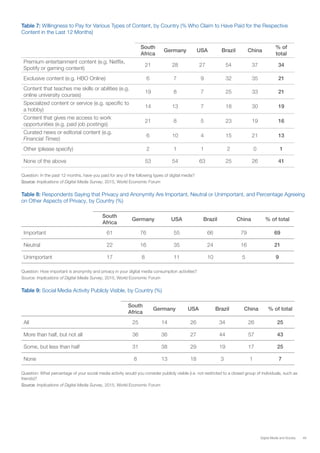
The Implications of Digital Media Survey has similar findings.
A user’s spouse and friends (each chosen by 18% of
respondents) have the most influence on digital media
consumption), while search engines are selected by 15% as
being more influential than any other source (Table 6). Those
close to the user could have more insight into the type of
content the user might find interesting, certainly more than
could an editor or executive in a traditional media company;
however, individuals could also receive less diverse
information, or others in the user’s network could distribute
unverified, harmful or inaccurate content. Interestingly,
the survey yielded substantial cross-country differences
– especially among those choosing none as the most
influential source In the USA, almost one-half of the sample
said so, in China only 5%. This underlines the relevance of
culturally specific norms, in this case most likely regarding
individualism versus collectivism.23
Given today’s immense task of sifting through copious
amounts of content in order to decide what to distribute,
MEI distributors are turning to artificial intelligence
and automation. But, consumer trust depends on the
transparency and effectiveness of algorithms to do this job.
This trust is at risk as evidence becomes available on how
algorithms are structurally biased in the information they
17Digital Media and Society
Digital media users have shown that they see value in, and
are willing to pay for:
–– Unique and high-quality content, such as that offered by
HBO or The New York Times (NYT). The NYT recently
surpassed 1 million digital subscribers despite the
relative ease of circumventing its paywall.26
–– Content that satisfies a burning need, such as
Bloomberg’s sale of business information to the trades,
or demand in a niche market (professional and hobbies,
for example).27
–– A unique offering that fills a newly created need or gives
consumers the flexibility to buy fragmented content, such
as iTunes, which offers songs rather than albums, or
Blendle, a Dutch start-up that gives consumers the ability
to buy individual newspaper or magazine articles rather
than full subscriptions.28
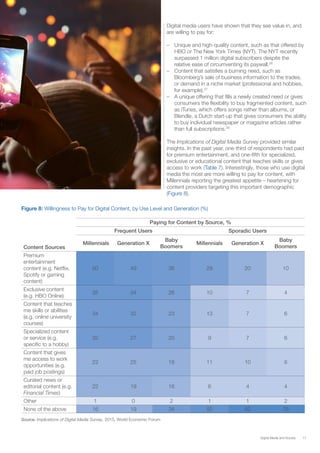
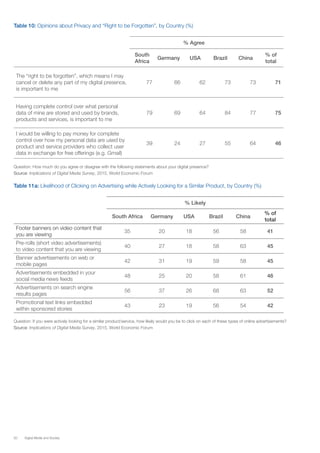
The Implications of Digital Media Survey provided similar
insights. In the past year, one-third of respondents had paid
for premium entertainment, and one-fifth for specialized,
exclusive or educational content that teaches skills or gives
access to work (Table 7). Interestingly, those who use digital
media the most are more willing to pay for content, with
Millennials reporting the greatest appetite – heartening for
content providers targeting this important demographic
(Figure 8).
Figure 8: Willingness to Pay for Digital Content, by Use Level and Generation (%)
  Paying for Content by Source, %
  Frequent Users Sporadic Users
 
 Millennials Generation X
Baby
Boomers
Millennials Generation X
Baby
BoomersContent Sources
Premium
entertainment
content (e.g. Netflix,
Spotify or gaming
content)
50 49 36 29 20 10
Exclusive content
(e.g. HBO Online)
35 34 26 10 7 4
Content that teaches
me skills or abilities
(e.g. online university
courses)
34 32 23 13 7 6
Specialized content
or service (e.g.
specific to a hobby)
32 27 20 9 7 6
Content that gives
me access to work
opportunities (e.g.
paid job postings)
22 25 18 11 10 6
Curated news or
editorial content (e.g.
Financial Times)
22 19 16 6 4 4
Other 1 0 2 1 1 2
None of the above 16 19 34 52 62 76
Source: Implications of Digital Media Survey, 2015, World Economic Forum
18 Digital Media and Society
At the same time, 41% of total survey respondents do not
pay for any of the listed content, highlighting the continuing
importance of advertising to finance digital media that
is mainly free to the user. A major challenge for the MEI
industry will be to counter the current trend in advertising
blocking by users. (This is discussed in greater detail later in
this report.)
Regardless of how digital media is funded, providing a fair
value proposition is critical to maintain consumer trust. To do
this could require the MEI industry to rely on advertising that
respects user preferences for valued digital media, without
the risk of misleading (a possibility with sponsored content)
or exploiting the consumer. Exploitation can occur when
advertising is based on behavioural data that the user did
not consent to sharing. Or it can happen when transparency
about the use of one’s personal data is lacking, and the
consumer is not offered appropriate benefits in exchange,
such as free online services.29
When the value exchange between user and business
is perceived to be fair, consumers seem willing to “pay”
for digital media content. For example, although it is still
technically possible to pirate music, free music-streaming
services like Spotify, for which consumers “pay” through
their exposure to advertising, are easier for consumers to
use, and have helped to cut the incidence of music piracy in
the USA by half over the past decade.30
Research by Boston Consulting Group and Liberty Global
showed that consumers “are willing, even eager, to share
information when they get an appropriate benefit in return”.
The research found that educating consumers on the
benefits they receive by sharing their data, being transparent
about how the data are used, and giving consumers easy-
to-use privacy controls “will substantially increase data
sharing by individuals”. 31
3.	 Security: As consumers’ digital personae
increasingly reflect their online habits and
behaviours, digital identities are becoming as
important and as worthy of protection as physical
personae
The cumulative use of digital media – from online buying,
viewing, posting and sharing, to digital profiles created
for personal, social, professional or commercial reasons –
reveals a tremendous amount about each individual. Yet
many users remain unaware that their increased digital
engagement results in the accumulation of data from many
disparate sources. These traces of personal data can be
tagged, tracked, combined and analysed, revealing more
intimate information about users than previously imagined.
Digital personae not only determine the content that
users are served online, but also influence the schools to
which they are admitted, approvals they get for loans or
apartments, and the jobs they are offered. They also may
have an impact on an individual’s romantic prospects and
status within certain communities. In short, users’ digital
personae are increasingly important to their social and
economic well-being.
For example, many users today see social networks not
just as places to connect with others socially but also as
engines to create financial benefits. Platform membership
can improve professional networking and job prospects, and
help people to amass a considerable, profitable following.
But even as users want to share their personality online
and gain recognition, they also want to safeguard their
digital personae and control access. Google’s Transparency
Report recently revealed that the search engine has already
received almost 350,000 requests from users who want to
evoke their “right to be forgotten” after a 2014 ruling by the
Court of Justice of the European Union, and has removed
almost 60% (more than 600,000) of more than 1.2 million
URLs evaluated.32
Building and maintaining consumer trust will depend
increasingly on how well MEI businesses address user
concerns about security. Among Implications of Digital
Media Survey respondents, 69% said that anonymity and
privacy in digital media activities is important to them (Table
8) and 25% said that less than half of their social media
activity is publicly visible (Table 9). Users fear data breaches
which appear to be increasing in scale and frequency. As
a result, they are looking to companies for security and
transparency about the use and safeguarding of their data.
Users also are concerned about how their data are being
used to market to them. The majority of respondents to the
Implications of Digital Media Survey said that the “right to be
forgotten” is important to them (71%), as is having control
over their personal data (75%). But only 46% globally are
willing to pay for that control (Table 10), with large cross-
country differences observed.
Consumers seem reluctant to pay for privacy or control
of data, not necessarily because they do not value these
attributes, but rather because they view them as already
integral to the services they use. Emerging digital media
users consider control over their data an inherent right for
which they should not need to pay.
19Digital Media and Society
20 Digital Media and Society
Section 2
User Engagement
Engaging and influencing the digital consumer requires
a novel approach
With the initial digitization of the MEI industry, marketers
applied the same approach to reach consumers as they
did for traditional media channels like print and television.
Digital advertising offered new forms of engagement,
but the underlying model of “pushing” messages out to
consumers in a recognized advertisement format did not
significantly change. Publishers have historically designed
webpages with more regard for the advertiser than the
digital media user, something referred to as Advertising
1.0 by Johnny Ryan of PageFair, a tech start-up exploring
the growing issue of advertisement blocking.33
According
to Ryan, industry – publishing in particular – must move to
Advertising 2.0, which focuses on the end user experience
and revisits the quality of digital advertising. Despite a
slowdown in advertising growth over the past few years,
Advertising 1.0 has historically been successful, generating
billions of dollars for the advertising industry and satisfying
brands.34
But digital media consumption patterns are evolving:
content sharing has become effortless and popular;
consumers have become more invested in sharing and
creating content that enhances their online reputations;
and technology has enabled both the blocking of display
advertising and the collection of more detailed information
about user interests. Marketers who master the art of
communicating to consumers through meaningful content,
targeted in a non-invasive and personalized manner, stand a
better chance of fruitfully engaging the end user.
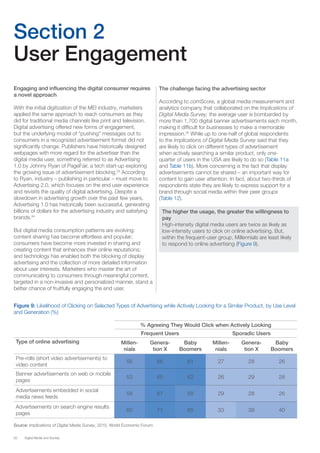
The higher the usage, the greater the willingness to
pay
High-intensity digital media users are twice as likely as
low-intensity users to click on online advertising. But,
within the frequent-user group, Millennials are least likely
to respond to online advertising (Figure 9).
The challenge facing the advertising sector
According to comScore, a global media measurement and
analytics company that collaborated on the Implications of
Digital Media Survey, the average user is bombarded by
more than 1,700 digital banner advertisements each month,
making it difficult for businesses to make a memorable
impression.35
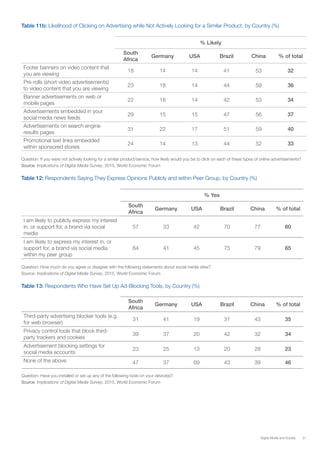
While up to one-half of global respondents
to the Implications of Digital Media Survey said that they
are likely to click on different types of advertisement
when actively searching a similar product, only one-
quarter of users in the USA are likely to do so (Table 11a
and Table 11b). More concerning is the fact that display
advertisements cannot be shared – an important way for
content to gain user attention. In fact, about two-thirds of
respondents state they are likely to express support for a
brand through social media within their peer groups
(Table 12).
Figure 9: Likelihood of Clicking on Selected Types of Advertising while Actively Looking for a Similar Product, by Use Level
and Generation (%)
  % Agreeing They Would Click when Actively Looking
  Frequent Users Sporadic Users
Type of online advertising Millen-
nials
Genera-
tion X
Baby
Boomers
Millen-
nials
Genera-
tion X
Baby
Boomers
Pre-rolls (short video advertisements) to
video content
56 66 61 27 28 26
Banner advertisements on web or mobile
pages
53 65 62 26 29 28
Advertisements embedded in social
media news feeds
58 67 58 29 28 26
Advertisements on search engine results
pages
60 71 65 33 39 40
Source: Implications of Digital Media Survey, 2015, World Economic Forum
21Digital Media and Society
11SECRET MEDIA | ADBLOCK AND THE GLOBAL VIDEO MARKET
Unmonetized Video Time Due To Adblock: Global
The top 28 countries for adblocked video time
Germany 62%
Austria 53%
Canada 43%
United Kingdom 42%
Greece 42%
Spain 41%
Poland 40%
Portugal 39%
New Zealand 38%
Australia 38%
Finland 38%
Sweden 37%
Ireland 37%
Romania 36%
Croatia 35%
Norway 34%
France 33%
Belgium 30%
Denmark 29%
Colombia 28%
Israel 26%
Italy 26%
Chile 26%
Mexico 26%
United States 25%
Ukraine 25%
Argentina 23%
Ecuador 23%
Russia 22%
MA Morocco 20%
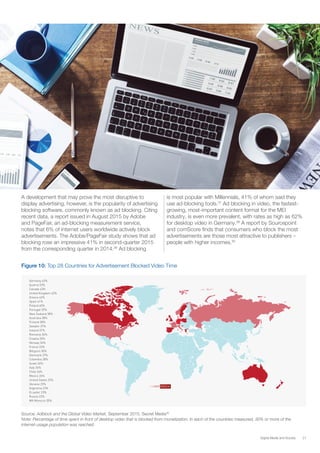
A development that may prove the most disruptive to
display advertising, however, is the popularity of advertising
blocking software, commonly known as ad blocking. Citing
recent data, a report issued in August 2015 by Adobe
and PageFair, an ad-blocking measurement service,
notes that 6% of internet users worldwide actively block
advertisements. The Adobe/PageFair study shows that ad
blocking rose an impressive 41% in second-quarter 2015
from the corresponding quarter in 2014.36
Ad blocking
is most popular with Millennials, 41% of whom said they
use ad-blocking tools.37
Ad blocking in video, the fastest-
growing, most-important content format for the MEI
industry, is even more prevalent, with rates as high as 62%
for desktop video in Germany.38
A report by Sourcepoint
and comScore finds that consumers who block the most
advertisements are those most attractive to publishers –
people with higher incomes.39
Figure 10: Top 28 Countries for Advertisement Blocked Video Time
Source: Adblock and the Global Video Market, September 2015, Secret Media40
Note: Percentage of time spent in front of desktop video that is blocked from monetization. In each of the countries measured, 30% or more of the
internet-usage population was reached.
22 Digital Media and Society
But why are consumers blocking digital advertisements?
Research conducted in 2015 by the Interactive Advertising
Bureau, a global non-profit group for the online advertising
industry, concluded that the rise in ad blocking by
consumers is mainly due to a general antipathy towards
advertising, as well as user concern about how their viewing
behaviour is being tracked and used by third parties.41
Indeed, the Implications of Digital Media Survey found that
35% of respondents worldwide have installed third-party
ad-blocking tools, and 34% have activated privacy control
settings on digital browsers to block third-party trackers and
cookies (Table 13). Users in the USA are least likely to block
advertisements or activate privacy controls – 69% of USA
respondents had no privacy or ad-blocking tools installed,
but German and Chinese users are most likely to use
advertising and privacy controls..
customer engagement and loyalty, because loyal customers
can be expected to share compelling content with others in
their networks and act as multipliers.
It is essential, however, to create and publish content in
ways that maintain consumer trust. Based on a survey
conducted in the United Kingdom and the USA on
consumer attitudes towards sponsored content and “native
advertising” on news sites, Reuters Institute’s Digital News
Report 2015 found that one-third or more respondents feel
disappointed or deceived after reading an article later found
to have been sponsored; and more than one-quarter are
less positive about the news brand due to the sponsored
content or native advertising.43
The promise and perils of using consumer data for
targeted marketing
Several issues have the potential to undermine the trust that
digital media users have in the industry, as discussed earlier
in this report. One issue pertains to the way consumer data
are used, analysed and sold. Data generated by individuals
intentionally through their use of digital media can help
businesses to develop products and services that are better
aligned to consumer needs, giving users access to more
desirable products and services at a lower cost.44
But data
also can be used to undermine the credibility of digital
media players. Consider the case reported in early 2015 of
a cancer patient, who, after using Google to research his
disease, subsequently was fed advertisements from funeral
directors via his Facebook account – blurring the boundary
between personal data privacy and the creation of relevant,
targeted advertisements.45
More insightful and less intrusive
approaches to collecting and using consumer viewership
data are essential to build consumer trust.
I think ad blockers themselves are not
going to help the industry, they’re not
going to help the user, because the
quality of content won’t be there, but
I do think the industry needs to make
sure that it focuses on the creativity and
quality of its advertising.
Mark Thompson, The New York Times
These findings highlight three emerging consumer
psychological traits that seem to be fairly consistent across
geography and demographics: a desire to be in control of
the messaging to which individuals are exposed, where
“pulling” this messaging to one’s screen is preferred to
having it “pushed” by marketers; a rejection of having online
behaviour tracked without fully understanding how that data
are ultimately used; and a growing awareness of personal
data’s business and commercial value to businesses.
Engaging digital media users through content marketing
In reaction to the decreasing effectiveness and reach of
traditional display advertising “pushed” to consumers, more
companies are turning towards content marketing to “pull”
customers into brands. By developing valuable content (as
opposed to “clickbaits”, sensationalist headlines or images
to attract click-throughs), marketers hope to not only attract
users but also encourage them to share that content.
Paid advertising certainly is not going away anytime soon,
but the new marketing model emphasizes the creation of
content that, because of the value it delivers, enables a
brand to “earn” media (i.e. obtain publicity that is free and
not gained through advertising). The goal is to encourage
consumers themselves to become the conduit for the
company’s marketing messages.
The 2015 Edelman Trust Barometer found that content
produced by a company that a user patronizes is more
trusted than content produced by a journalist or an NGO.42
This finding underlines the importance for brands to develop
23Digital Media and Society
A brand’s visibility on social media is important for
engaging consumers – especially those aged 16-24
years
Becoming part of the conversation through innovative
messaging is quickly becoming the industry’s norm for
effective marketing. A brand’s visibility and engagement
strategy on social media platforms has proved important
to draw in the emerging digital media consumer, especially
in the age group of 16-24 years. The Internet Advertising
Bureau’s Mediascope Europe study in 2013 found that
32% of this age group is more likely to buy a product from a
brand they follow on a social networking site than one they
do not. Moreover, 83% of those in this age group have liked
or become a friend of a brand online, while 76% have visited
a brand’s fan page.46
The Implications of Digital Media
Survey showed that 64% of Millennials, 69% of Generation
X and 61% of Baby Boomer respondents are likely to
express support for a brand through social media within
their peer groups (the global average is 65%).
Engaging consumers through employee advocacy
Another marketing strategy that can help to curtail the
impact of ad blocking is employee advocacy. Employee
advocacy does not depend on the advertising sector
because it grows corporate brand value through employee
networks, mainly on social media platforms that can
be influenced by creative employee enablement and
evangelization. In other words, employee advocacy is word-
of-mouth marketing through corporate assets.
This strategy has influenced a shift in the attitude of
businesses towards their employees’ social media use. A
growing number of companies have realized the massive
potential of employee networks; they have started to move
away from compliance management towards enabling their
employees to create conversations on social media about
the company and the brand.47
The importance of corporate social responsibility (CSR)
in engaging digital media consumers
Evidence of social responsibility by media and entertainment
brands significantly influences consumer choice, shows the
Implications of Digital Media Survey. A leading concern is
corporate transparency, particularly related to a company’s
efforts to educate customers on storage and use of their
personal data and to provide them full control to decide –
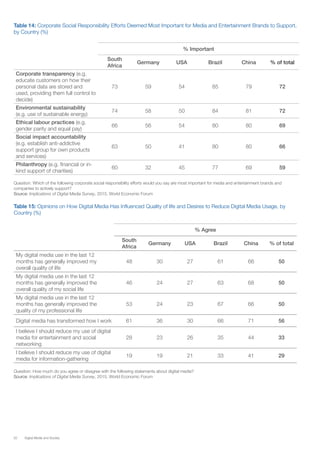
72% of respondents worldwide consider it most important,
along with environmental sustainability, among possible
CSR activities (Table 14). As digital media continues to
become an integral aspect of people’s lives, CSR’s influence
on consumer choice is likely to continue to grow.
However, contradicting a general belief that Millennials are
enthusiastic supporters of corporate transparency and
involvement in social and environmental issues (“Corporate
Social Responsibility is Millennials’ New Religion” says one
headline), the Implications of Digital Media Survey found that
Generation X and Baby Boomers respondents place greater
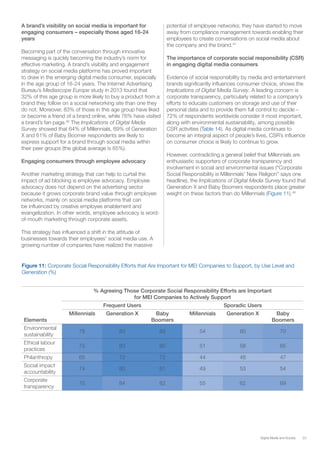
weight on these factors than do Millennials (Figure 11).48
Elements
% Agreeing Those Corporate Social Responsibility Efforts are Important
for MEI Companies to Actively Support
Frequent Users Sporadic Users
Millennials Generation X Baby
Boomers
Millennials Generation X Baby
Boomers
Environmental
sustainability
76 83 83 54 60 70
Ethical labour
practices
75 83 80 51 58 65
Philanthropy 65 72 72 44 48 47
Social impact
accountability
74 80 81 49 53 54
Corporate
transparency
75 84 82 55 62 69
Figure 11: Corporate Social Responsibility Efforts that Are Important for MEI Companies to Support, by Use Level and
Generation (%)
24 Digital Media and Society24 Digital Media and Society
Best practices: winning over the emerging
media consumer
Much can be learned from successful examples of digital
engagement within the MEI industry. Authenticity and user
control, transparency, service accountability and emotional
story-telling are all important attributes for digital media
consumers in choosing services and platforms, as well as
the content to consume, share and participate in. Consider
the following illustrations of best practices.
The New York Times
Finding healthy revenue models while garnering consumer
trust and fulfilling customer preferences is a challenge.
The New York Times (NYT) was tested by the industry’s
digitization, but managed to stay relevant to its customer
base, acquire new consumers and innovate. Several
factors contributed to the NYT’s digital success, but one
in particular has strengthened its brand identity through
effective segmentation – the NYT manages to serve the right
content, in the right format, to each of its reader segments.
This is such a strong value proposition in today’s world of
overloaded news content that the company has managed
to charge a fee for the service. Of the NYT’s 33 different
newsletters, subscribers open 70%, which is a great
example of how important relevancy is to heightened user
engagement and ultimately trust.49
Netflix
Effective segmentation brings more precise data on
consumption patterns and preferences. Industry players that
employ personal usage data to provide the right benefits
to consumers, will be the best placed to charge for their
services while simultaneously building loyalty. Netflix owes
much of its success to its proprietary content algorithm,
whose function is clearly visible to its users.50
In fact, this
algorithm generated the data and Intel required for Netflix
to design and produce the perfect television series for its
viewers, allowing Netflix to make the decision to invest $100
million in 26 episodes (two full seasons) of House of Cards –
a strong sign of service accountability.
LinkedIn
Digital businesses that manage to instil a sense of
authenticity in their brand will ultimately attract the most
users. This reflects user tendencies to value products
and services that help them to build and protect online
reputations. LinkedIn is a good example: 400 million people
are currently on LinkedIn, which equates to approximately
one in three of the world’s professionals.51
The service is
fundamentally free, with only 39% of its user base paying for
the premium service. A key selling feature of LinkedIn is its
ability to build authentic online identities that can essentially
be certified by public verification through peer and manager
reviews, endorsements and news feed engagement.
MasterCard and WestJet
Authenticity in the way businesses tap into user emotions
is paramount in customer engagement strategies that drive
participation in content and ultimately the shareability of
brand messaging. With its A Mother’s Day to Remember
campaign in 2014, MasterCard was able to generate brand
visibility by establishing an emotional tie with a subject of
global relevance, our mothers.52
In doing so, MasterCard
had no need to actually advertise anything. Authenticity in
the company’s gesture was enough to imprint MasterCard
as trustworthy and genuine organization.
WestJet, a Canadian domestic airline, used a similar
strategy in 2013 with its Christmas Miracle campaign,
pushing the brand to international stardom with more than
42 million YouTube views (and counting).53
Such authenticity
in the search for an emotional bond with the user is
increasingly becoming the norm in digital content creation
and marketing strategy. Interestingly, both the MasterCard
and WestJet campaigns highlight the benefit of physical
user participation in successfully engaging consumers
digitally.
Facebook
With currently more than 1.5 billion monthly active users,
Facebook is the most popular social network worldwide.
The company has much influence on a significant part of
the world’s population and thus Facebook’s responsibility
for respecting user rights and preferences is of utmost
importance. On its mission “to give people the power to
share and make the world more open and connected”,
corporate transparency and social responsibility form
an important cornerstone. Facebook has an extensive
Data Policy and has done much in past years to make
it more comprehensible and to give users more control
of their privacy settings, e.g. the “privacy check-up” and
“ad preferences” tools.54, 55, 56
Facebook also issues a
Government Requests Report on how requests received
from governments are handled. 57
25Digital Media and Society
26 Digital Media and Society
Section 3
Impact of Digital Media on
Individuals, Organizations
and Society
The increased use of digital media is changing people’s
everyday lives and the way they connect and collaborate
in the broader societal context, at work and in civil society.
Much of the impact of this heightened use is beneficial to
both individuals and society. It is enabling unprecedented
levels of communication, social interaction and community
building across boundaries of time, place and social
context. It is enabling individuals and speeding up the
democratization of knowledge. New learning methods are
possible (as has been evidenced by the World Economic
Forum’s New Vision for Education project), as are ways of
working, which are providing better opportunities to people
in under-served communities and regions. 58
But not all the impacts of increased use of digital media are
positive. Research indicates that when humans excessively
use digital media it can negatively influence their cognitive
and behavioural development and even their mental and
physical health. Hyperconnectivity, the increasing digital
interconnection of people and things, has the potential
to change patterns of social interaction, as face-to-face
time may be substituted by online interaction. In addition,
greater technology enablement of work (and the resulting
fragmentation of jobs) threatens the security of jobs
traditionally considered as skilled in the developed world.
Whether individuals see the impact of increased digital
media use as positive or negative depends greatly on
where they live. The Implications of Digital Media Survey
showed that only about one-quarter of respondents from
Germany and the USA think that digital media has improved
the quality of their social, professional and overall lives. By
contrast, about two-thirds of respondents in Brazil and
China believe this. Respondents in South Africa are roughly
split on the question (Table 15).
However, despite believing that digital media has improved
their lives, a higher percentage of respondents in Brazil
and China also believes they should reduce usage (33-
44%). Meanwhile, only one-fifth and one-quarter of users in
Germany and the USA, respectively, think they should do so
(Table 15). These country differences are enlightening, even
after accounting for cultural differences in survey response
patterns.
Clearly, it is important to understand the opportunities and
the risks in increased digital media usage, so that both
industry and users can learn how best to exploit the benefits
while mitigating the negative effects.
Benefits and Opportunities
1.	 Digital media facilitates social interaction and
empowers people
Digital media connects people in ways never before
possible, enabling users to maintain friendships across time
and distance. It enables those who are socially isolated
or somehow set apart from their immediate physical
community to connect with like-minded or like-situated
people. Digital media also facilitates interaction across
social, economic, cultural, political, religious and ideological
boundaries, allowing for enhanced understanding.
Many people access social media platforms to express
empathy and receive support from friends and family,
including in times of emotional distress. This enriches
people’s relationships and their ability to stay in touch, and
the ability of friends and family to identify and help loved
ones in need. According to a 2015 survey by Pew Research
Center, the use of social technology is linked to having a
greater number of close confidants, as well as a larger, more
diverse social circle. Another Pew survey showed that 57%
of teens state they have made a new friend online, and 83%
state that social media makes them feel more connected
and informed about their friends’ lives.59
Social media can help to deepen relationships and facilitate
the formation of support networks – 68% of teen social
media users have received support on these platforms
during tough times.
A study by Vaughan Bell and colleagues found that
adolescents’ use of social networking sites enhances
existing friendships and the quality of relationships for
those who use digital social networks to deal with social
challenges. Those who use online social networks to avoid
social difficulties, however, tend to exhibit reduced well-
being.60
27Digital Media and Society
By facilitating social interaction, digital media also appears
to lower stress for at least some users. A separate Pew
Research Center survey in 2015 of 1,801 American adults
concluded that digital media users do not have higher levels
of stress than others.61
This makes sense, especially for
those who perform knowledge work and are aided by the
greater access that digital media provides to colleagues and
information. Moreover, Pew researchers found that digital
media actually mitigated stress for women who use Twitter,
email and cell phone picture sharing to build relationships.62
The same study did find, however, that digital media makes
some people more aware of stressful events in others’ lives,
resulting in higher reported levels of tension. (Other findings
on the negative impact of digital media consumption on
stress are discussed later in this report.)
2.	 Digital media gives people a voice, increases
civic participation and facilitates the creation of
communities
While traditional media has long been central to informing
the public and focusing public attention on particular
subjects, digital media is helping to amplify the response to
humanitarian crises and to support those afflicted by these
crises. During the Arab Spring of 2011-2012, digital media
served as a vehicle to mobilize resources, organize protests
and draw global attention to the events.63, 64
Through digital
media, users around the world collected $2 million in just
two days for victims of the Nepal earthquake of 2015.65
Refugees fleeing the war in Syria have cited Google Maps
and Facebook groups as sources of information that helped
them to not only plan travel routes but to also avoid human
traffickers.66
Digital media has also enhanced information sharing across
the world, giving people much greater access to facts,
figures, statistics, and similar, allowing that information
to circulate much faster. This not only enables people to
respond in real time as events unfold, but also helps to
expose political corruption and unfair business practices.
For example, when a pharmaceutical company made plans
to raise the price of a particular drug by more than 5,000%,
outrage spread quickly through digital media, forcing the
company to reverse direction.67
Digital media is also allowing people around the world to
build communities, organize action and make their voices
heard on a multitude of issues. Through online petitions
and charities, people across the cybersphere can act on
causes about which they care. Change.org, which helps
individuals to start petitions and advance their causes, has
enabled more than 123 million users to attain their own
goals on almost 15,000 issues in 196 countries, according
to its website.68
Avaaz.org is another example of a platform
with the goal of enabling people to take action on pressing
global, regional and national issues, from corruption and
poverty to conflict and climate change.69
Through the site
Witness.org, thousands of activists and citizens around the
world have been trained and supported to use video safely,
ethically and effectively to expose human-rights abuses and
fight for change.70
For refugees currently coming to Europe,
websites and applications such as refugees-welcome.
net, refugee-action.org.uk and workeer.de are helping
coordination of action among people who are physically
dispersed.
Similarly, digital media is helping people to support chosen
causes financially. According to a report by Blackbaud, a
non-profit software and services provider, online giving is
growing, particularly in response to humanitarian disasters.71
Websites such as #GivingTuesday, YouCaring.com,
JustGiving.com and DonorsChoose.com are funnelling
donations from millions of donors to the causes of their
choice. Of course, the ease with which individuals and
organizations can build and disseminate communications on
different issues and crises also creates the risk of weakening
long-term support as users are bombarded with information
or requests for help on more issues than they can handle.
Additionally, an instrument for a good cause can also be
used for a bad one (see discussion on downsides and risks
later in the report).
28 Digital Media and Society
Studies examining the impact of digital media on civic
engagement have had mixed findings. Exploring the effects
of social networking sites on offline behaviour, a 2015 meta-
study by Shelley Boulianne of Grant MacEwan University in
Canada found that while the correlation between the use of
social networking sites and election-campaign participation
is weak, the relationship with civic engagement is stronger.72
However, research indicates that messages on social
media can significantly influence voting patterns. A study
of the impact of certain messages posted on Facebook
and promoted by friends on Election Day during the 2010
elections in the USA “increased turnout directly by about
60,000 voters and indirectly by another 280,000 voters
through social contagion, for a total of 340,000 additional
votes”.73
This suggests that online political mobilization
works, but it raises the issue of potential manipulation of
digital media users and their political action, even when
considering that digital media platforms give the opportunity
to identify and challenge instances of manipulation.
This report’s research into the impact of digital media on
civic participation also reveals mixed findings. While a
majority of respondents to the Implications of Digital Media
Survey in China and Brazil say that digital media has had
an overall positive effect on their civic participation, a less-
robust percentage of respondents in South Africa, and even
smaller percentages in the USA and Germany say this is so
(Table 16).
Similarly, respondents in Brazil (47%) and China (36%) are
more likely to have taken action on a political or social issue
because of something read on a social networking site, than
are respondents from South Africa (22%), Germany (25%) or
the USA (12%) (Table 17). Across the five countries, about
one out of five respondents uses social networking sites to
share political information or encourage action on political
issues a few times per week (Table 18).
2.	 Digital media is changing how work gets done,
boosting productivity and enhancing flexibility for
workers and employers
Digitization of content and data, as well as new digital
communication technologies, have opened up novel
opportunities for where, when, how and by whom work
gets done. This is changing the nature of the employment
relationship. Many jobs now can be done anywhere, at any
time, facilitated by the availability of digital data, high speed
internet, and better messaging, audio and video technology.
A Pew Research Center study of American adults in 2014
found that among full- and part-time workers, 21% work
outside their workplace every day or almost every day, and
59% does that at least occasionally.74
Digitization is a major enabler of this trend, with one-half
reporting that the internet and mobile are “very important”
to allowing them to do their job remotely, and another 24%
saying that these tools are “somewhat important”.
This same study also found that 46% of employed internet
users feel their productivity has increased because of their
use of the internet, email and mobile or smartphones; only
7% feel less productive. Half of internet-using workers say
these technologies have expanded the number of people
outside their company with whom they communicate; 39%
state it allows them more flexibility in the hours they work;
and 35% say it has increased the number of hours they
work.
These findings echo results from the Implications of Digital
Media Survey, in which respondents rate digital media as
having an even bigger positive effect on their work lives than
on their private or public lives, with particular benefits to
their ability to find work, do work, develop professionally and
collaborate with colleagues (Table 19).
Although social networking sites like Twitter, Facebook
and LinkedIn were not identified as important tools for
online workers in the 2014 Pew Research Center study,
professional communication and collaboration platforms
have high future potential. For example, the Royal Bank
We see job opportunities in the freelance
and “gig” economies in roles that you
wouldn’t have been able to previously
see 15-20 years ago – anything from
marketing to executive roles to medical.
Sara Sutton Fell, flexjobs.com
29Digital Media and Society
of Scotland recently introduced “Facebook at Work”
to “encourage collaboration and allow employees to
communicate faster and more efficiently” as it stimulates
non-hierarchical communication and discussion.75
Slack, one of the most highly valued start-ups in recent
times, with currently 1.7 million daily active users,
exemplifies how virtually all knowledge, information and
data related to work can be managed within one platform.
Its users claim to have cut email volume by almost half,
improved transparency and offline culture significantly, and
increased overall productivity by one-third.76
Workers demand the same usability and features of their
private communication tools for their professional ones.
The Implications of Digital Media Survey results mirror these
findings: almost 70% of participants agree that the use of
digital media for work-related purposes has already grown
significantly and that it will continue to do so in the future
(Table 20).
The changes in work that digitization and digital media have
facilitated bring several advantages for workers, employers
and society at large. Beyond enhanced productivity, the
greater flexibility afforded by digital media allows for better
work-life integration – a critical element in enabling workers
to effectively juggle multiple roles as workers and caregivers.
On a larger scale, higher work flexibility is helping to equalize
and globalize work opportunities for people living in remote
areas, those who are less mobile, or living in countries with
less developed or struggling economies.
Organizations can and should use digital media to
communicate and engage with employees. Social
enterprise tools are well suited for developing community
within a company. Yet only 56% of employers use digital
media to communicate with employees on topics such as
organizational culture, team building or innovation, a Willis
Towers Watson study found.77
Managers, still one of the most important drivers of
sustainable employee engagement, should be enabled
to use social business and collaboration tools to intensify
employee productivity and engagement.
Talent platforms, like Upwork, Topcoder and Tongal, are
facilitating the placement of free agents with companies,
and giving them additional options for getting work done.
In the emerging “gig economy”, workers might no longer
hold full-time jobs with fixed job descriptions, but could be
employed for particular tasks for a defined period of time.
Even as digitization enables the greater democratization
of work, it also places a premium on certain types of work
(particularly those involved in the development, manipulation
and leverage of technology and data). A McKinsey &
Company study suggests that employers worldwide face
a potential shortage of 38-40 million skilled workers and
a potential surplus of 90-95 million low-skill workers by
2020.78
These “friction points” give rise to new ways of accessing
talent and getting work done. In 2011, more than 22% of
the global workforce could be classified as contingent (i.e.
not employees in the traditional sense).79
In 2014, one in
three Americans in the workforce was freelance, according
to a recent survey by Freelancers Union.80
Moreover,
according to Workforce 2020, a global study by Oxford
Economics and SAP, one finding (which allows multiple
choices) shows that an impressive 83% of company-
respondents use: contingent workers (41%, i.e. independent
contractors, part-timers, or temporary or leased employees),
consultants (34%), intermittent employees (35%) or interns
(40%).81
This represents real change for employers as well as
workers, permitting work and talent to flow in and
out of organizations, boosting agility, productivity and
competitiveness. As more work moves outside the
traditional employment relationship, organizations inevitably
will need to become more flexible, collaborative, interlinked
and permeable to allow tasks to be accomplished by the
most capable talent – whether this be a full- or part-time
employee, a freelancer or an employee of an outsourcer.
41% of companies have contingent
employees
30 Digital Media and Society
Work has gone from being largely
aggregated into jobs to increasingly
being dispersed outside the organization.
Talent is moving in and out of
organizations much more freely.
Ravin Jesuthasan, Willis Towers Watson
Such a shift has implications for the broader society. A
recent analysis by McKinsey & Company suggests that
talent platforms like those mentioned above could boost
global gross domestic product (GDP) by $2.7 trillion by 2025
(Figure 12). The highest share of the gain would come from
greater labour-force participation of currently inactive people
and more hours for part-timers. The rest of the gain would
result from higher employment due to more and faster
job matches and higher productivity as a result of better
matches, all achieved through online talent platforms.82
4.	 Digital media can facilitate education and life-long
learning to build and source the skills of the future
The World Economic Forum’s New Vision for Education
project identifies critical skills for the 21st century, and
explores ways to address any gaps through digital
platforms.84
Source: Connecting Talent with Opportunity in the Digital Age, McKinsey & Company, June 201583
Figure 12: Potential of Talent Platforms for Global GDP Growth
The labour market increasingly demands higher-order
skills, i.e. non-routine analytical and interpersonal skills.
Literacy in information and communications technology,
and competencies such as creative problem-solving and
collaboration are among the most important. In addition,
character qualities such as adaptability, and social and
cultural awareness need to be developed. Building
digital skills from an early age provides opportunities
to successfully navigate life, improve employability and
participate in society – which can help make the world a
better, more equal place. Increased use of digital media is
helping this process.
31Digital Media and Society
Employees need to be more flexible to adapt to changing
requirements and continuously learn and develop new
skills. Global Talent 2021, a study by Oxford Economics
in collaboration with Willis Towers Watson, among others,
identified digital skills, agile thinking skills, interpersonal and
communication skills, and global operating skills as the most
important competencies for the future.85
Digital leadership (enabling execution of the digital strategy)
based on digital acumen is essential. Managers and
leaders need the right knowledge and skills to recognize
and anticipate digital trends, understand implications
for business and leverage technology to stay abreast.
However, only 19% of leaders are viewed as strong in digital
leadership and management, a Harvard Business Review
study published in 2015 found, so a need exists to develop
such skills.86
Digital media and technology can help to close skill gaps
by supporting teaching and self-education. Learning
resources can be made available to a broader audience at
lower cost and higher quality. Digital media can be used
to facilitate life-long learning, e.g. through embedding
learning technology in widely used platforms or using digital
media for communication (e.g. teaching, mentoring and
coaching) between students and educators. Digital media
also is increasingly used for attracting and sourcing talent,
especially young, digitally savvy workers. Diverse cross-
industry talent pools might be another way to meet the
need for new skills while offering growth opportunities to
employees.87
I’m a big believer that we absolutely
need technical literacy across all ages.
And that starts with our education
system. We don’t need everybody to
become a computer scientist, but we
need everybody to understand the
computational systems that are shaping
their lives.
danah boyd, Data & Society Research Institute/Microsoft Research
Downsides and Risks
1.	 Digital media can be used by communities with
harmful intentions to spread propaganda and to
mobilize followers
Digital media offers opportunities to spread information
and organize action for good causes, but can also be used
to disseminate maleficent content and propaganda, and
be used, for example, by extremist groups to recruit and
mobilize followers. Young adults and children are vulnerable,
especially if they lack a stable social support network.
Many platforms such as Google, YouTube, Facebook
and Twitter constantly update their terms of service and
community standards to disapprove or forbid “threats of
violence”, “violent or gory content”, “terrorist activity” or
“organized criminal activity”.88
Numerous social media
training sessions have been held on counter speech and
the number of NGOs and community and student groups
that promote positive speech against extremism have
increased.89
However, strong and consistent global internet
governance is yet to be implemented in a common effort by
all digital media stakeholders.
As citizens use social media for political discussions,
questions arise about which statements are appropriate
within a framework of global norms and values, and which
should be prohibited. Progressive discourse in one context
could be considered offensive in another. International
standards can provide guidance (e.g., the United Nations’
compilation of international standards for freedom of opinion
and expression).90
Online freedom of expression has broad global support,
shows a World Economic Forum survey in 2014 on values,
beliefs and attitudes of internet users worldwide.91
Of the survey’s more than 11,000 respondents, 70% said
they can express themselves freely online and almost 60%
said it is okay for people to state their ideas on the internet,
even if extreme. At the same time, however, more than
70% of respondents said they are very careful about what
they do or say on the internet; almost 40% think that their
government tries to prevent people from accessing some
information on the internet.
Challenging questions remain: How free is the internet,
and how free should it be to safeguard human rights?
Where should the line be drawn between free speech
and preventing harm, given that communication in global
social networks traverses national and cultural borders with
different norms and values? What roles does government,
industry and civil society play in this context?
32 Digital Media and Society
2.	 By selecting what information reaches which users,
digital media can alter human decisions and pose
risks to civil society
Far more content is available through digital media than any
user could possibly sift through. Algorithms deployed by
search engines, social media platforms and other industry
participants filter this vast amount of information to make it
manageable for consumers. People now have more tools
to curate content. However, given the growing importance
of digital media as a source of information about everything
from social issues and politics to job opportunities, there
needs to be transparency regarding how content is filtered
and which content and advertisements are shown to which
users. In some cases, filtering mechanisms have been
shown to contain biases that can have a discriminatory
effect.
For example, researchers from Carnegie Mellon University
and the International Computer Science Institute recently
conducted a series of experiments to examine how digital
profiles influence the advertisements Google displays on
third-party websites. They found that Google’s transparency
tool, called “ads settings”, allows consumers to view and
edit the interests Google has inferred about them, but
does not always reflect potentially sensitive information
being used to target the consumers. “Ads settings” gives
information about some user profile features and provide
some choice on ads, but these choices could lead to
seemingly discriminatory ads. For example, they showed
that Google is more likely to recommend high-level executive
job postings to male rather than female job-seekers.92,93
The researchers noted that browsing sites aimed at people
with substance abuse problems, for example, triggered
a rash of advertisements for rehabilitation programmes,
but Google’s transparency page did not change.94
They
concluded that the lack of transparency about how systems
like Google use consumer data to influence the information
to which consumers are exposed – and potentially the
decisions they make – is a major concern from a societal
standpoint. In a similar example, a White House report in
2014 on the impact of Big Data on human decisions and
outcomes concludes, “Data analytics have the potential to
eclipse longstanding civil rights protections in how personal
information is used in housing, credit, employment, health,
education and the marketplace.”95
Sources of news and information in the digital age are
another issue. Another Pew survey in 2015, which examines
where Americans get their news, found that a majority of
Millennials (61%) and half of Generation X-ers (51%) get their
political news on Facebook.96
This has become a concern
because separate research indicates that the majority of
these users do not understand that Facebook selectively
screens content.97
As social networking platforms increasingly become online
intermediaries content published outside those platforms are
at risk of marginalization since some platforms and content
can be sponsored while others not. Critics worry that “filter
bubbles” make it more likely for individuals to be exposed
to content with which they already agree and less likely to
be exposed to dissenting points of view. However, argues a
2014 paper by a New York University researcher, because
social media creates connections across people who are
outside each other’s intimate social circles, it actually helps
to expose users to more heterogeneous views.98
Researchers from Stanford University observe that
individuals are more likely to engage with content that
contradicts their own views when it is socially endorsed.99
Indeed, the 20,000 global online news consumers surveyed
by Reuters Institute for its Digital News Report 2015 said
that search services and social media “help them find more
diverse news and lead them to click on brands they do not
normally use”.100
Of course, consumers of news have always been subject
to the judgement of others via curation. In traditional media,
editors and others historically have made those decisions,
without much transparency or public oversight. Nikki Usher,
an assistant professor at George Washington University’s
School of Media and Public Affairs, argues that algorithms
can be useful antidotes to these black-box decisions.
Humans build them, after all, and the good ones, according
to Usher, continually refine their suggestions to provide
consumers with new content beyond their main interests.101
Other concerns pertain to digital media’s impact on civic
participation and inclusion. Digital media enables speedy
coordination of action, but social mass movements are
complex and it is difficult to create sustainable structures
for action.102
A risk also exists that somewhat loose and
transitory virtual communities replace more robust and
enduring physical ones, and that “clicktivism” might not
have as much impact as real-world action. Moreover, with
information and discussion moving online, the views and
needs of those without access to digital media are less
represented.
‘I share therefore I am’. So over time,
people actually narrow the stream of
information that they share on social
media. They call it the ‘spiral of silence’.
Sherry Turkle, Massachusetts Institute of Technology.
33Digital Media and Society
3. The transformation of work brought about by digital
media may increase inequality and lower productivity
Despite the productivity gains and opportunities of digital
media to actually bridge economic gaps and reduce
inequality, potential downsides still exist to the newly
emerging work paradigm. As digital media transforms
work by increasing fragmentation, and demand for various
skill-sets rises and falls, the likelihood is very real of rising
inequality in the near term as the global economy adjusts to
these new realities.103
First, digital media and related technology may drive near-
term inequality as innovations like talent platforms increase
the productivity and rewards of highly skilled workers while
simultaneously cutting the cost of low-skilled work. Talent
could turn increasingly to platforms like Topcoder to access
opportunities that offer compensation and development
potential that are much greater than those offered through
traditional employment. At the same time, companies
might turn to platforms like Taskrabbit to access workers
to perform discrete activities at the lowest possible cost.
Highly skilled workers benefit from these more flexible work
structures, but lower-skilled employees could be hurt in the
short-term.
Second, digital media has the potential to diminish work
effectiveness and productivity. The multiple platforms and
vast quantities of information and content at their fingertips
may distract workers and disrupt work. In addition, as more
people work remotely, valuable face-to-face time is reduced,
which can weaken understanding and collaboration, and
potentially hinder innovation. Finally, because digital media
facilitates greater information-sharing, it has the potential to
compromise intellectual property.
It remains to be seen whether the positive effects
will outweigh the negative. Considering the wealth of
contributing factors, it is likely that different demographics
and different social levels will be influenced differently.
About two-thirds of respondents in China and Brazil to
the Implications of Digital Media Survey stated that using
social media enhances their work-effectiveness, but only
11% of those surveyed in the USA believe this (Table 21). In
Germany and South Africa, opinions are roughly evenly split
on whether social media usage reduces or improves work-
effectiveness.
5. Digital media use can change social skills – online
does not replace offline
For interacting with other people, online is not the same as
offline. Face-to-face interaction and communication require
– and hone – a finely tuned ability to read and understand
others. It promotes a sense of social connection, which
is essential to the give-and-take functioning of families,
communities and workplaces.
Yet a growing number of people spend more time engaged
with digital media than in actual conversation. Most
teenagers send hundreds of texts a day and 44% never
“unplug”, even while playing a sport, notes Sherry Turkle,
a psychologist and director of the Initiative on Technology
and Self programme at the Massachusetts Institute of
Technology. With relatively little time available for actual
conversation, this generation of young people struggles
to listen or make eye contact or read body language.104
Figure 13: The Pros and Cons of “New Work”
Cons Pros
– Risk shifted to workers
– Employers stop training
– Death of the career
– Commoditization of jobs
– Rush to lowest cost
– Worker exploitation
– Transportability of skills
– On-demand training through multiple
channels
– Boundary-less careers
– Precise work-worker matching
– Rewards segmented to match the needs
of individual workers
– Worker empowerment
Source: Adapted from Lead The Work: Navigating a World Beyond Employment, Lead The Work: Navigating a World Beyond
Employment. Boudreau, Jesuthasan and Creelman. Wiley, 2015
Case study: Uber
Uber’s car-sharing service is an example of how digital
platforms can transform who does the work and how,
creating both winners and losers. The creation of apps
that allow more efficient connection between drivers
and passengers has made it easier and cheaper for
consumers to get rides where and when they need.
But the new apps have also disrupted the market for
skilled cab drivers. Digital tools like mapping apps put
knowledge into the hands of novice drivers that previously
had to be accumulated through years of experience. The
ability of lower-skilled entrants to compete with highly
skilled and experienced drivers effectively transfers that
knowledge premium from one group of workers to the
other.
Source: Adapted from Lead The Work: Navigating a World Beyond
Employment, Lead The Work: Navigating a World Beyond
Employment. Boudreau, Jesuthasan and Creelman. Wiley, 2015
34 Digital Media and Society
Of concern is whether the recent trend of taking “selfies”
and posting status updates about one’s life nurtures
narcissism. Studies have produced mixed findings. One
study associates higher narcissism with students’ motives
for using Twitter; more narcissistic students are likely to say
they posted updates to attract followers and gain admiration
on the site.105
One possible impact of excessive digital media consumption
is changing levels of empathy in society – perhaps a result
of the fewer hours that such consumption leaves for face-
to-face communication. A 2010 study by researcher Sara
Konrath found a 40% decline in empathy among college
students over the past 30 years, with most of the decline
occurring after 2000. The study specifically looked at four
different types of empathy and found that the biggest drops
are in empathic concern or concern for the misfortunes of
others, and in perspective taking, which requires an ability
to imagine other people’s points of view.106
Support for this
finding comes from a range of experiments that explore
commonplace everyday situations for college students –
for example, sitting together over a meal but having their
phones out. In such a situation, research shows that not
only does the conversation become about topics that are
less personal and more generic, but the level of empathic
connection among the participants also declines.
Interestingly, this finding is at odds with results of the
Implications of Digital Media Survey, in which only
7% of respondents feel that digital media has had a
negative impact on their empathy levels (here defined
as “understanding another’s situation or feelings, and
experiencing a sense of their emotional state”), while 54%
think it actually has had a positive impact (Table 22). The
discrepancy in findings might reflect the difference between
asking people about their empathic capacity and studying
their measured performance on tests. But the discrepancy
might also indicate that the definition of empathy is actually
being transformed, and the capacity that respondents
labelled “empathy” is distinct from either empathic concern
or perspective taking.
Indeed, a recent study from California State University
shows a difference between real-world and virtual empathy,
although they correlate.107
Whether empathy is negatively
affected depends on what is being done online, for example,
when (non-verbal) communication is lacking, as in video
gaming. But online activities can also improve time spent in
face-to-face communication. However, the study did find
that real-world empathy has a stronger relationship with
social support. In other words, “a hug feels six times more
supportive than an emoji”, as The Wall Street Journal put it
in an article on the topic.108
Regarding the impact of digital media on our most important
social connections, 61% of respondents to the Implications
of Digital Media Survey view digital media as helpful to
maintaining already existing relationships with friends, and
45% believe it is helpful in forming new ones (Table 22).
5.	 Digital media consumption may facilitate bullying,
harassment and social defamation
Linked to the question of empathy is that of hurtful
behaviours online. Digital media has reduced the potential
costs, and increased the ease of engaging in behaviours
that harm either others or ourselves Hate speech, “internet
trolling” and cyberbullying are serious issues.
In a global YouGov survey sponsored by Vodafone, of
more than 4,700 teenagers worldwide, one-half of the
respondents stated that cyberbullying was worse than
face-to-face bullying and 43% thought cyberbullying is
now a worse problem among teenagers than drug abuse.
About one-fifth of the total sample reported having been
cyberbullied. Of those, 41% stated cyberbullying made them
feel depressed and 18% said it had made them consider
suicide. The survey also found that 40% of students who
were bullied online did not tell their parents because of
feelings of shame or fear.109
Recent research by the Net Children Go Mobile project
found that cyberbullying is now more common than bullying
in person – 12% have been bullied online versus 10%
offline, according to a survey in 2013-2014 of children aged
9-16 years drawn from seven European countries.110
Of the
surveyed children, 17% said they had been bothered or
upset by something on the internet. Beyond cyberbullying,
online risks include seeing negative content or receiving
negative messages, such as hate messages, sexual content
and self-harm sites.
However, it should be noted that digital media is not
the “root” of cyberbullying, but more of an “instrument”.
Cyberbullying is mostly related to real-world issues and
personal emotional or psychological problems. Often, offline
and online bullying are connected. Used in a beneficial way,
digital media can enable people to express rejection of
malicious behaviour and victims can find support online,
e.g., with organisations like the International Bullying
Prevention Association, and the European Network Against
Bullying in Learning and Leisure Environments.
6.	 Excessive digital media consumption may increase
vulnerability to addiction and harm mental and
physical health
Excessive digital media consumption poses a number
of risks to user health and well-being. While a higher
percentage of respondents in the Implications of Digital
Media Survey feel that digital media is positively, rather than
negatively, affecting various aspects of their lives, they are
the least positive about impacts on their physical health,
stress and attention span. (Figure 14, Table 22)
Before describing all potentially negative effects on mental
and physical health, it should be noted that their occurrence
is largely dependent on the way digital media is being used.
The internet can be an asset for individuals and healthcare
practitioners, as many content services have been provided
to prevent or cure health problems (for example, the UK
Mental Health Foundation or the US National Institute for
Health).111 112
35Digital Media and Society
Figure 14: Effects of Digital Media Usage
What effec has digital media had on
your personal life?
Length of attention span
Short-term memory
Long-term memory
Motor skills
Oral communication skills
Written communication skills
Critical thinking and problem solving
Stress
Physical health
Mental health
BetterWorse
45%
46%
45%
49%
44%
54%
56%
37%
39%
49%
12%
9%
11%
8%
10%
8%
6%
13%
15%
8%
Source: Implications of Digital Media Survey, 2015, World Economic Forum
Stress has been identified as one potential health risk
stemming from excessive digital media consumption.
Researchers at the University of St Gallen in Switzerland
studied “technostress”, which results from having more
content than can be attended to without anxiety.113
They
found three major phenomena most directly associated with
stress:
–– Overload – increased work because of the volume and
variety of social media contact
–– Invasion – intrusion of work into personal life, caused by
personal media connections
–– Uncertainty – continuous and unpredictable change in
social media applications and requirements
The pressures associated with managing the sheer volume
of electronic stimuli are important enough, but they are
compounded by the leakage of digital media-borne content
across the boundary that once separated a user’s work
and personal lives. Many can no longer easily differentiate
between business and personal, between time on and time
off. New innovations in digital media often add to the stress
from overload and invasion, as individuals struggle to master
new modes and norms of connection.
Even the network-building advantages of social media can
have associated risks. Being constantly updated on friends’
latest professional successes, fantastic vacations and
personal triumphs may cause envy-related stress. Users
may also feel pressure to carefully curate the presentation of
their own lives to highlight the great birthday party but hide
the impending divorce.
Ubiquitous connectivity also brings other sources of tension,
including a decline in civility. Chrissy Teigen, a model,
recently lashed out at online critics who posted nasty
comments about her weight in response to a photo she
had uploaded to Instagram: “In what other real-life situation
would you walk up to someone and tell them they’re fat or
gained weight?”. Electronically mediated interactions are
more anonymous and often more bluntly negative than face-
to-face encounters.
Another health risk from increased digital media
consumption is its potential for addictive behaviour. In 2013,
the American Psychiatric Association (APA) added “internet
use disorder” to the Diagnostic and Statistical Manual of
Mental Health Disorders as a condition warranting more
clinical research and experience. The APA took this step
in response to growing evidence that some video gamers
experience symptoms similar to those felt by people with
substance abuse or gambling addiction – and may be
experiencing similar changes in brain chemistry related
to the release of dopamine.114
The governments of China
and South Korea have already deemed internet addiction
a public health threat and have taken steps to combat it,
including opening up treatment centres and preventing
children from accessing gaming websites during certain
hours.115
Research by Hyoungkoo Khang and colleagues at the
University of Alabama found that the likelihood of addiction
is closely related to the user’s motivation for using digital
media. Their study, published in 2013, found that those
who used digital media to kill time and have fun, or as tools
to make a good impression on others, are more likely to
develop addictions to the media used.116
The researchers noted that because of the impact of digital
media on social norms “in which an individual’s social
activities appear to rely primarily upon his/her knowledge
and capacity to use information, communication and
entertainment technology”, it has become increasingly
difficult for individuals to avoid spending considerable
amounts of time using digital media.117
“Although individuals
in society are aware of the detrimental effects of excessive
reliance on digital media, a dilemma exists because one
might suffer from social exclusion if she/he refuses to
partake in the new social norms associated with new media
devices” they concluded.118
Digital media also appears to have some association
with depression, although causality is unclear. One large
longitudinal study of Americans aged 14-24 years found that
heavy use of the internet and video games is associated
with an increase in depression. But the study from the
University of Pennsylvania concluded that intensive digital
media use might be a symptom of depression rather than
its cause.119
The researchers found that moderate internet
use, especially for acquiring information, is most strongly
associated with healthy development. Two other studies
that examine the relationship between social networking
and depression in youth also found that the quality of social
networking interactions, but not the quantity of use, is
associated with depression.120
Increased digital media use also has an impact on cognition.
It has been shown to lower recall rates for information
people believe they can access easily online, although it
also effectively extends human cognition through external
resources.121
A study conducted by the Statistic Brain
Research Institute in 2015 found that the average human
attention span has decreased by 31% since 2000, from
12 seconds to 8.25.122
A study published in 2004 found
that early television exposure is associated with attention
problems at age seven.123
However, it is unclear whether this
is due specifically to increased use of digital media.
The use of digital media has implications for physical health
as well. According to Vaughan Bell and others, as well as
Kathlyn Mills, from University College London, no evidence
currently exists from neuroscience studies to indicate that
typical internet use harms the adolescent brain. 124 125 126
Of
concern, however, is that time spent on digital technology
displaces time that could be spent on physical activity. As
Bell notes, “Low levels of physical activity associated with
the passive use of digital technology have been linked to
obesity and diabetes”.127
Finally, increased digital media use is cutting into user
downtime, which is critical to allow the brain to synthesize
information, make connections between ideas and develop
a sense of self. When downtime and solitude are possible,
many digital media users turn to their devices rather than
risk boredom, cutting off an opportunity for restorative and
creative thought.128
Children, especially, lose out cognitively
and emotionally, if they are always given a screen to
stimulate them. A capacity for boredom and solitude is
a signal development of childhood, and central to a later
capacity for relationship, as Sherry Turkle attests.129
7.	 Benefits of digital media for young children
are limited, when used extensively and without
guidelines
So far, baby bouncers and potty training devices with tablet
holders still face protest by concerned parents.130
But
children are being exposed to digital media at younger and
younger ages. A 2015 study by a research firm, Childwise,
found that 73% of British children under the age of five are
using a tablet or computer compared with just 23% in 2012.
By the time they are six years old, more than 40% are using
a device every day.131
This can be problematic because children are the most
vulnerable to the negative impacts of digital media overuse.
First, according to the American Academy of Pediatrics,
numerous studies have indicated that excessive new media
use can lead to attention problems, school difficulties,
sleep and eating disorders and obesity.132
For example, a
2011 study by Michelle Garrison and colleagues found that
violent content and evening media use were associated
with increased sleep problems for children aged three to five
years.133
Second, it is harmful to children if interaction with parents
and others is replaced by interaction with digital media.
Research has shown that brain development depends
on social interaction with others during a critical period
in early life. Going without that early social interaction
has irreversible effects that create social and cognitive
impairments throughout life.134
In addition, healthy
neurological development requires the engagement of all
sensory systems, but heavy digital media consumption
favours the visual and auditory systems over the vestibular,
proprioceptive, tactile and attachment systems, creating
possibly permanent imbalances.135
36 Digital Media and Society
37Digital Media and Society
Third, the overuse of digital media can delay language
development. Research has shown that very young
children (aged 9-18 months) do not learn language by
watching educational videos without active interaction with
another person.136 137
Interpersonal interaction seems to
be a fundamental component of language development.
Interestingly, while a 2013 study similarly found that canned
content delivered through digital devices was ineffective in
teaching language to young children (aged 24-30 months),
it also found that live interactions between a child and an
adult conducted over a digital device such as a tablet or
smartphone did enable the child to learn new words.138
Fourth, uncontrolled time spent on digital media often
displaces time spent on academics, lowering academic
achievement. Studies show that most teenagers multitask
between entertainment and academic work, both inside
and outside the classroom. A 2010 survey published by
the Kaiser Family Foundation found that almost one-third
of the 8-18 years age group surveyed reported watching
TV, texting, listening to music or using some other
medium “most of the time” that they do homework.139
Such multitasking has been found to diminish students’
understanding and memory of content and to make it harder
for them to transfer their learning to new contexts.140
Finally, while digital media offers children access to a huge
wealth of information, not all information can be trusted.
Digital media makes it easier to disseminate inaccurate
as well as accurate information, and much that is online is
potentially harmful to younger demographics.
This study’s research confirms a sense of unease about
children’s growing exposure to, and consumption of, digital
media. Among respondents to the Implications of Digital
Media Survey, 71% believe that digital media can create
problems for youth (Table 23). Interestingly, respondents are
more concerned about the negative impacts of digital media
on the 4-15 years age group – particularly the 8-11 years
group – than on the under-4 years group. To the extent that
this reflects respondents’ beliefs that children aged below
four years do not have access to digital media, their concern
about children’s exposure to digital media could be lower
than warranted.
Social Media’s impact on individuals, organizations
and society
Social media platforms – ranging from WeChat to Twitter
– offer both opportunities and challenges in the ways
people communicate and interact in various types of
relationships. The Impact of Digital Content: Opportunities
and Risks of Creating and Sharing Information Online,
a white paper by the World Economic Forum’s Global
Agenda Council on Social Media, examines how social
media is transforming the way that humans build
communities, act collectively and individually, and
transform social networks into integral communication
institutions.141
The report explores the use and
transformation of social media by building a discussion
around the current impact of different platforms, the
“business” of social media, and the ethical and legal
implications for stakeholders when sharing and using
information online. The paper ends with a review of
future trajectories for social media tools and networks,
and how they have the potential to influence individuals,
organizations and society.
38 Digital Media and Society
Section 4
Outlook and Call to Action
Multistakeholder dialogue identifies need for
future action
Since the inception of the Shaping the Future Implications
of Digital Media for Society project at the World Economic
Forum’s Annual Meeting in 2015, the MEI industry team
has brought together experts from the private and public
sectors in a series of sessions to explore the ways in which
digital media has disrupted online consumer patterns and is
affecting human behaviour and society. The sessions helped
to highlight the intended and unintended consequences
of increased digital media use. They also helped to identify
several actions for stakeholders to mitigate the negative,
and further exploit the positive, impacts of digital media use:
“The Analogue Hearts and Digital Minds: The Impact of
Digital Media on Human Behaviour” project workshop at the
World Economic Forum on East Asia in April 2015 focused
on identifying the consumption patterns of the contemporary
Asian digital media consumer and the social implications of
excessive digital media use, including change of behaviour,
habits and human psychology. Early education of children
by parents was identified as a main driver of responsible
digital media use. Participants also discussed the many
benefits of greater connectivity across the region, including
better access to information, economic opportunity and
financial inclusion.
01
01: Participants in the
project workshop at the
World Economic Forum
on East Asia in April 2015
Technology is needed that not only
serves individual users but also
addresses the rise of societal issues
such as social isolation, cyberbullying,
addiction and other recent developments.
World Economic Forum on East Asia, Jakarta, Indonesia April 2015
To better analyse the implications of increasing digital media
use, the MEI industry Strategy Officers met with special
guests as well as the Global Agenda Councils on the Future
of Media, Entertainment & Information and on Social Media,
in a project workshop during the MEI Industry Spring
Strategy Meeting in May 2015. They explored the drivers
behind and impact of changing media consumption habits.
Among the main points of discussion were: a growing need
for engaging digital content to enable participation from
users, the link between higher digital connection and lower
empathy levels, and the potential loss of human connection
in spending excessive time online.
39Digital Media and Society
01
02
03
01: Panellists in the project workshop at the MEI
Industry Spring Strategy Meeting in May 2015
02: Participants in the project workshop at the World
Economic Forum’s Young Global Leaders’ Summit,
August 2015
03: Panellists during the project workshop at the
Annual Meeting of the New Champions in Dalian, China
September 2015
Regarding the human implications of
increased use of digital media and
increased personalization, the challenge
for both industry and the public sector
will be to make sure that such trends do
not ultimately disrupt healthy societal
dynamics.
MEI Industry Spring Strategy Meeting, New York, USA May 2015
Improving work-life balance is the No 1
reason for people to work remotely. While
only 20% of work in the USA is done
remotely today, this number could be
increased to 50%.
Young Global Leaders’ Summit, Geneva, Switzerland August 2015
The explosion of content, its accessibility
and the multifaceted views that the
internet exposes individuals to, has
made the typical content consumer
cautious about the source of information,
the validity of the information and the
authoritative power of the source. This
reality has put a strain on trust in the
content ecosystem.
Annual Meeting of the New Champions, Dalian, China September
2015
At the Digital Changes in Society session during the Forum’s
Young Global Leaders’ Summit in August 2015, participants
discussed how the changing digital technology landscape is
having an impact on the workplace, as well as other aspects
of society. Participants discussed the opportunities provided
by digital technology and platforms to better match labour
supply and demand and increase productivity, as well as the
opportunities for individuals to increase work flexibility and
work-life balance.
At the session on China’s New Media Society at the
Annual Meeting of the New Champions in Dalian, China,
in September 2015, the need for multistakeholder
collaboration on issues such as data privacy was deemed
imperative to ensure the safety of the digital media
consumer. Discussions also focused on the promise of
digital media for cross-cultural communication, cultural
diversity and transparency.
40 Digital Media and Society
Through this ongoing dialogue between the MEI industry
partners and engaged stakeholders such as NGOs,
academia and civil society, ideas have been collected to
address some concerns and to promote the benefits of
increased digital media use. In addition, this dialogue has
pointed the way towards future research and discussion
needed to create maximum value for the MEI industry,
digital media users, and society overall.
The power of multistakeholder collaboration –
a call to action
The research presented suggests that action from all
sectors of society can help to ensure that humans make the
most of increasing use of digital media while mitigating the
related risks:
Multistakeholder collaboration
The public and private sectors should partner together
to drive action on the impacts of digital media
hyperconnectivity noted in this report. The Forum can
facilitate this public-private collaboration. Both regulators
and industry can engage with academia and NGOs to
incorporate research findings and initiatives in designing and
creating new socially responsible MEI industry offerings and
updating current public policies.
Multistakeholder collaboration will be critical to moving
forward in several key areas:
–– Creating and building on standards that improve and
redefine the digital user experience.
–– Building on existing standards and regulations for
personal data privacy and security by supporting
initiatives that help companies, the public sector and
consumers to better understand how data can be
collected and used to create social, economic and
personal outcomes in ways that protect privacy, e.g.,
Facebook’s Data Drive Economy Roundtable series.142
–– Establishing and reinforcing governance on making
digital media an instrument for freedom of speech and
expression, while simultaneously preventing hateful,
harmful speech or propaganda.
–– Establishing and reinforcing governance around
content to prevent cybercrime and safeguard citizens,
especially minors.
–– Educating children about digital citizenship, including
internet safety and ethical codes of conduct for using
digital media and technology.
–– Recognizing the implications of work fragmentation
for social safety nets, and creating more flexible
regulatory frameworks that accommodate a diversity
of company-worker relationships.
–– Providing equal and facilitated access to digital media
for all citizens.
The public sector
Public institutions can help to update standards and
regulations, as well as promote and enforce them, based
on scientific evidence in order to enable the beneficial
use of digital media and prevent the negative effects. This
should be done maintaining a flexible and innovation-friendly
framework.
The public sector can also facilitate the creation of more
social institutions and programmes, such as education and
awareness campaigns, designed to support both citizens
and the private sector to address or foster the influences
mentioned in this report. The European Commission’s DG
Connect group has a directorate dedicated to digital society,
trust and security, for example. Governmental bodies
should set up similar resources for their countries or regions.
However, any model of guidance and support should be
flexible, and be able to develop quickly in step with changes
in the marketplace and user behaviour.
The private sector/MEI industry
The private sector, principally industry, should consider
the implications on individuals when designing
platforms and services or creating content. Industry
best practices and self-regulation are the optimal way to
create innovative solutions in a fast-evolving environment.
Examples of possible actions: restricting minors’ access to
harmful content, enabling free expression and participation,
accepting feedback and starting discourse with users.
In addition, the private sector can step up efforts to build
trust with consumers by, among other ways, being more
transparent about how personal data are used and showing
a corporate ethos of accountability and social responsibility.
One effective measure is to sponsor public and non-
profit organizations that help to promote beneficial use
of digital media. The CEO Coalition is an example of an
initiative where private action is facilitated by a public
body.143
Company signatories to the Coalition, a cooperative
voluntary intervention designed to respond to challenges of
young Europeans going online, has committed to actions,
including age-appropriate privacy settings, wider use of
content classification and better availability and use of
parental controls. Industry could also support NGOs and
social enterprises, such as iZ HERO Lab, a social enterprise
based in South Korea and Singapore, dedicated to
educating children and parents on responsible digital media
usage.
From an employer’s perspective, organizations should
develop strategies to integrate digital media into workflows
and should act proactively on the opportunities and pitfalls
their businesses and employees encounter because of
increased connectivity.
Children need mentors to navigate
through digital media use and to use
digital media for developing the right
skills.
Annual Meeting of the New Champions, Dalian, China September
2015
41Digital Media and Society
The forward-thinking employer
Digital media now touches almost every aspect of a
typical organization, from how talent is sourced and
deployed, to how, where and when work gets done,
and how the business connects with employees and
customers. Given these fundamental changes, employers
are recommended to:
–– Use digital media (including talent platforms) to more
accurately and flexibly match an individual’s skills
to a specific business need, rather than think solely
in terms of traditional jobs. This will create a more
flexible, collaborative and productive environment for
better business results.
–– Take a more nuanced approach to how work should
be conducted. Recognize when collaboration and
personal interaction are needed, versus when it may
be optimal for work to be performed independently
and remotely.
–– Use social media tools to build communication and
engagement within the organization.
–– Source and build digital skills and develop digital
leadership.
–– Encourage employees not only to turn on, but also
to turn off. Employers that expect employees to be
accessible through digital media 24/7 run the risk of
decreased productivity and burnout.
Individuals and civil society
–– Finally, individuals are encouraged to build digital
literacy and skills and to use digital media responsibly.
That means making use of digital media’s many benefits
and avoiding the harmful aspects – protecting both
oneself and others, especially those unable to protect
themselves.
–– In addition, individuals can get involved with civic
organizations and NGOs to help make a difference
on digital media issues. Thousands of NGOs and
associations promote the helpful use of digital media and
the prevention of its negative effects. Their objectives
range from developing digital skills and caring for
people who have had negative online experiences, to
enabling flexible work arrangements and supporting civic
participation and community building.
The responsible individual and parent
Much can, and should, be done collaboratively across
stakeholders to increase the positive impacts of digital
media use. It is also imperative that individuals use digital
media responsibly. Based on this report’s research,
individuals are recommended to:
–– Protect their digital identities by being careful about
what they share online and by being aware of the
terms and conditions of platforms and applications.
–– Ensure sufficient time offline for human connection,
healthy physical activity and the necessary
“downtime”, in order to prevent information overload
and stress.
–– Prepare for the coming “gig economy”, taking greater
care in managing professional lives, reputations and
professional development.
–– Make use of the abundant opportunities to learn and
develop, maintain beneficial relationships, make life
entertaining and meaningful, care for others, and
contribute to societal welfare.
Because digital media use poses special risks to children,
parents must not only educate their children but also
manage their digital media use. Research findings suggest
the following guidelines for parents:
–– Monitor children’s digital media engagement and ensure
they get: adequate physical activity, lots of face-to-face
communication, uninterrupted time for academic work,
downtime for free thinking, and even some alone time for
self-reflection. This is crucial for cognitive, emotional and
social development.
–– Install content filters, parental controls and usage
restriction software on devices used by children in order
to mitigate overuse and protect them from harmful
online content. Avoid digital media in children’s sleep
environments.
–– Consider fewer top-down restrictions on use (which
children will evade) and focus more on education,
guidance and communication about managing online
risks and building digital literacy.
42 Digital Media and Society
Project Contributors
World Economic Forum Project Team
Claudio Cocorocchia, Project Lead, Content lead for the
Media, Entertainment & Information Industries, Switzerland
Diana El-Azar, Project Sponsor, Member of the Executive
Committee,Switzerland
Anne-Marie Jentsch, Project Manager, Media, Entertainment
& Information Industries (on secondment from Willis Towers
Watson), Switzerland
Mengyu Annie Luo, Project Sponsor, Head of Media,
Entertainment & Information Industries, USA
Anna Sophia O’Neil, Project Coordinator, Media,
Entertainment & Information Industries, USA
Lena Woodward, Project Associate, Media, Entertainment &
Information Industries, Switzerland
Project Advisers
Tom Davenport, Senior Consultant, Research and Innovation
Center, Willis Towers Watson, USA
Anne Huisman, Senior Consultant, Executive
Compensation, Willis Towers Watson, Netherlands
Ravin Jesuthasan, Managing Director and Global Practice
Leader, Willis Towers Watson, USA
Amy Johnson, Research Analyst, Research and Innovation
Center, Willis Towers Watson, USA
Anne Randhava, Analyst, Communication and Change
Management, Willis Towers Watson, USA
Steering Committee Members
Olivier Oullier, Professor of Behavioural and Brain Sciences,
Aix Marseille University, France (2011 - 2015)
Irene Braam, Vice-President, Government Relations, and
Head, Brussels Liaison Office, Bertelsmann, Belgium
Anne Hunter, Senior Vice-President, Global Marketing
Strategy, comScore, USA
Sanjay Nazerali, Global Chief Strategy Officer, Dentsu Aegis
Network, United Kingdom
Ozge Bulut Marasli, Executive Vice-President, Strategy,
Dogan TV Holding, Turkey
Kevin King, Global Practice Chair, Edelman Digital, Edelman,
USA
Sarah Wynn-Williams, Director, Global Public Policy,
Facebook, USA
Rob Norman, Chief Digital Officer, Global, GroupM, USA
Idalia Cruz, Director, Strategy, Media, Grupo Salinas, Mexico
Yuhyun Park, Founder, iZ HERO Lab, Singapore
Christophe Nicolas, Group Chief Information Officer,
Kudelski Group, and Senior Vice-President and Head,
Kudelski Security, Switzerland
Sherry Turkle, Professor of the Social Studies of Science
and Technology, Massachusetts Institute of Technology
(MIT), USA
Karen Willenberg, Director, Regulatory and Legal Affairs,
Electronic Media Network (M-Net), South Africa (2004-2015)
Rishad Tobaccowala, Chief Strategist, Publicis Group, USA
Steven Schwartz, Global Managing Director, Reuters News
Agency, Thomson Reuters, USA (2011-2015)
Ravin Jesuthasan, Managing Director and Global Practice
Leader, Willis Towers Watson, USA
Sam Gregory, Programme Director, WITNESS, USA
Session Contributors
Jakarta, Indonesia 19 April 2015
World Economic Forum on East Asia
“Analogue Hearts and Digital Minds: The Impact of Digital
Media on Human Behaviour”
Rohana Rozhan, Chief Executive Officer, Astro Malaysia
Holdings, Malaysia
Yobie Benjamin, Co-Founder, Avegant Corporation, USA
Dick van Motman, Chairman and Chief Executive Officer,
Dentsu Aegis Network South East Asia, Singapore
Raymond Siva, Managing Director, Edelman, Malaysia
Gloria Ai, Founder and Anchor, iAsk Media, People’s
Republic of China
Seungjoon Chang, Vice-President, Maekyung Media Group,
Republic of Korea
Hu Yong, Professor of Journalism and Communication,
Peking University, People’s Republic of China
Rajnesh Singh, Regional Director, Asia-Pacific, The Internet
Society (ISOC), Singapore
Ranjana Singh, Chairwoman, Indonesia and Vietnam, WPP,
Indonesia
New York, USA 13 May 2015
MEI Industry Spring Strategy Meeting
“Exploring the Drivers behind Changing Media Consumption
Habits”
Sanjay Nazerali, Global Chief Strategy Officer, Dentsu Aegis
Network, United Kingdom
Bernadette Aulestia, Executive Vice President, Domestic
Network Distribution, HBO, USA
Sherry Turkle, Professor of the Social Studies of Science
and Technology, Massachusetts Institute of Technology
(MIT), USA
Chris Altcheck, Chief Executive Officer and Co-Founder,
Mic, USA
Robert Osher, President, Sony Pictures Digital Production
Division (2008-2015), Sony Pictures Entertainment, USA
43Digital Media and Society
Geneva, Switzerland 12 August 2015
Young Global Leaders (YGL) and Alumni Annual Summit
“Digital Changes in Society”
Brian A. Wong, Vice-President; Special Assistant to the
Chairman, Alibaba Group, People’s Republic of China
Sara Sutton Fell, Founder and Chief Executive Officer,
FlexJobs, USA
Yuhyun Park, Founder, iZ HERO Lab, Singapore
Brian Forde, Director, Digital Currency, Massachusetts
Institute of Technology (MIT) Media Laboratory, USA
Sam Gregory, Programme Director, WITNESS, USA
Dalian, People’s Republic of China 10 September 2015
Annual Meeting of the New Champions 2015
“China’s Media Society: Impacts of Changing Media
Consumption Patterns in China”
Li Ruigang, Founding Chairman, China Media Capital
(CMC), People’s Republic of China
Robert Grove, Chief Executive Officer, North Asia, Edelman,
Hong Kong SAR
Yan Xuan, President, Greater China, Nielsen, People’s
Republic of China
Yuen-Ying Chan, Director and Professor, Journalism and
Media Studies Centre, University of Hong King, Hong Kong
SAR
Ravin Jesuthasan, Managing Director and Global Practice
Leader, Willis Towers Watson, USA
Interviewees
Olivier Oullier, Professor of Behavioural and Brain Sciences,
Aix Marseille University, France (2011-2015)
Shahrzad Rafati, Founder and Chief Executive Officer,
BroadbandTV Corp, Canada
danah boyd, Founder, Data & Society Research Institute and
Principal Researcher, Microsoft Research, USA
Sanjay Nazerali, Global Chief Strategy Officer, Dentsu Aegis
Network, United Kingdom
Robert Grove, Chief Executive Officer, North Asia, Edelman,
Hong Kong SAR
Sara Sutton Fell, Founder and Chief Executive Officer,
FlexJobs, USA
Ronaldo Lemos, Co-Founder and Executive Director,
Institute for Technology & Science, Brazil
Yuhyun Park, Founder, iZ HERO Lab, Singapore
Sonia Livingstone, Professor of Social Psychology,
Department of Media and Communications, London School
of Economics and Political Science, United Kingdom
Jonas Prising, Chief Executive Officer, ManpowerGroup,
USA
Sherry Turkle, Professor of the Social Studies of Science
and Technology, Massachusetts Institute of Technology
(MIT), USA
Yan Xuan, President, Greater China, Nielsen, People’s
Republic of China
Jeremy Heimans, Co-Founder and Chief Executive Officer,
Purpose, USA
Mark Thompson, President and Chief Executive, The New
York Times, USA
Dave Duarte, Chief Executive Officer, Treeshake, South
Africa
Farida Vis, Director, Visual Social Media Lab and Faculty
Research Fellow, University of Sheffield, United Kingdom
Stephane Kasriel, Chief Executive Officer, Upwork, USA
Ravin Jesuthasan, Managing Director and Global Practice
Leader, Willis Towers Watson, USA
Sam Gregory, Programme Director, WITNESS, USA
Blog Contributors
Dries Buytaert, Founder and Project Lead, Drupal, USA; Co-
Founder and Chief Technology Officer, Acquia, USA)
Rishad Tobaccowala, Chief Strategist, Publicis Group, USA
Tom Davenport, Senior Consultant, Research and Innovation
Center, Willis Towers Watson, USA
Ravin Jesuthasan, Managing Director and Global Practice
Leader, Willis Towers Watson, USA
George Zarkadakis, Digital Lead, Communications and
Change Management Practice, Willis Towers Watson,
United Kingdom
Sam Gregory, Programme Director, WITNESS, USA
BPS Research Digest Series
Christian Jarrett, Editor, Research Digest, The British
Psychological Society, United Kingdom
Parenting for a Digital Future Series
Zorana Milicevic, Researcher, Writer and Project Manager,
Kulturis, Serbia
Sonia Livingstone, Professor of Social Psychology,
Department of Media and Communications, London School
of Economics and Political Science, United Kingdom
Emrys Shoemaker, PhD Candidate, Department of
International Development, London School of Economics,
United Kingdom
Michael Dezuanni, Associate Professor and Deputy Director,
Children and Youth Research Centre, Queensland University
of Technology, Australia
Anna Whateley, Lecturer, Queensland University of
Technology, Australia
Andreas Hepp, Professor of Media and Communication
Studies, University of Bremen, Germany
Anthea Edalere-Henderson, Faculty Member, Caribbean
Institute of Media and Communication (CARIMAC),
University of the West Indies, Jamaica
44 Digital Media and Society
Tables
Table 1: Overview of Respondents (% of Respondents)
South Africa
(n=997)
Germany
(n=1023)
USA
(n=998)
Brazil
(n=1033)
China
(n=1019)
Total
(n=5070)
Gender
Male 50 61 29 64 55 52
Female 50 39 71 36 45 48
Age
age=15-17 2 3 0 0 0 1
age=18-24 16 16 6 13 11 12
age=25-34 22 22 33 29 28 27
age=35-44 20 21 18 25 24 21
age=45-50 11 10 13 6 7 9
age=51-54 9 10 6 13 11 10
age=55-64 16 15 16 14 19 16
age=65+ 5 4 8 2 1 4
Generation
Millennials (age=15-34) 40 40 39 42 39 40
Gen X (age=35-50) 31 30 31 30 30 31
Baby Boomers (age=51-69) 29 29 30 28 30 29
Current employment status
Employed full-time 51 53 43 61 88 59
Employed part-time 10 14 12 11 2 10
Self-employed 16 6 8 13 2 9
Not currently employed &
looking for work
9 8 9 6 2 7
Not currently employed & not
looking for work
8 8 15 3 1 7
Retired 6 10 13 6 4 8
Current student status
Full-time student 11 18 9 9 6 10
Part-time student 17 6 3 25 8 12
45Digital Media and Society
South Africa
(n=997)
Germany
(n=1023)
USA
(n=998)
Brazil
(n=1033)
China
(n=1019)
Total
(n=5070)
Not currently a student, but
planning to return to school
20 10 13 44 22 22
Not currently a student, not
planning to return to school
52 67 75 23 64 56
Marital status
Single, never married 32 39 34 26 16 29
Married or domestic
partnership
55 49 52 66 83 61
Separated or divorced 10 10 11 7 1 8
Widowed 2 2 3 2 0 2
Number of people in household
1 8 26 22 5 3 13
2 23 33 33 17 11 23
3 21 22 18 34 62 31
4 26 14 15 28 12 19
5 or more 21 5 12 16 12 13
Number of people aged under 18 in household
None 46 55 52 33 34 44
1 24 26 21 39 60 34
2 21 15 16 22 5 16
3 6 3 7 5 0 4
4 or more 2 1 4 1 0 2
Highest level of education completed
Did not complete high
school
4 5 2 3 1 3
Completed high school 27 39 17 20 6 22
Some college/technical
school or university
21 12 24 3 5 13
Completed college/technical
school
20 22 16 12 9 16
Completed university/
undergraduate degree
15 9 24 11 69 26
Completed graduate
school/ graduate degree
12 8 16 50 9 19
Prefer not to answer 2 6 1 1 1 2
46 Digital Media and Society
South Africa
(n=998)
Germany
(n=1023)
USA
(n=998)
Brazil
(n=1033)
China
(n=1019)
Total
(n=5070)
Household Income
Less than $25,000 13 24 23 4 4 13
$25,000 to $39,999 9 31 19 8 4 14
$40,000 to $59,999 17 13 16 11 11 14
$60,000 to $74,999 13 9 10 16 12 12
$75,000 to $99,999 11 5 13 13 20 12
$100,000 to $149,999 7 1 9 17 19 10
$150,000 or more 5 1 5 10 11 6
Don’t know 5 4 1 1 1 2
Prefer not to answer 10 13 5 2 2 6
Source: Implications of Digital Media Survey, 2015, World Economic Forum
Table 2a: Digital Media Usage, by Device, Access and Country (% Responding Yes To Using Each Device)
% Yes
  South Africa Germany USA Brazil China % of total
PC/laptop 96 94 93 97 93 94
Television 93 90 91 98 92 93
Smartphone 85 84 76 88 95 87
Radio 82 80 75 87 43 68
Tablet 56 57 55 68 75 65
Question: Which of the following devices do you have access to?
Source: Implications of Digital Media Survey, 2015, World Economic Forum
Table 2b: Digital Media Usage, by Device, User Frequency and Country (% Responding Yes to Using Each Device 14
Hours or More per Week)
14+ hours/week South Africa Germany USA Brazil China % of total
PC/laptop 52 48 50 49 42 47
Television 24 32 47 18 12 24
Smartphone 40 30 23 42 42 37
Radio 15 14 12 8 5 9
Tablet 14 13 12 14 17 15
Question: On average, approximately how many hours per week do you spend using each device?
Source: Implications of Digital Media Survey, 2015, World Economic Forum
47Digital Media and Society
Table 3: How Respondents Spend Their Time Specifically, by Country (% Claiming to Use Digital Media 3 Hours or More
per Day for the Following Reasons)
+3 hours/day
South
Africa
Germany USA Brazil China
% of
total
Doing work/job 46 22 18 49 30 32
Entertainment and amusement (music, TV/film,
short videos and gaming)
24 24 14 36 19 23
Social interaction: chatting and messaging 30 16 8 37 18 21
Professional development (get job/ advance career) 15 7 6 24 11 12
Searching information for personal interest 23 12 8 33 15 18
Building/maintaining professional relationships 13 6 6 24 11 12
Searching information for professional interest 22 8 6 32 10 15
Personal development (learn/be creative) 20 9 7 27 14 15
Consuming news 9 8 6 24 12 12
Shopping 6 7 7 11 12 9
Question: On average, approximately how much time per day do you spend using digital media for each of the following reasons?
Source: Implications of Digital Media Survey, 2015, World Economic Forum
Table 4: Content Attributes that Encourage Users to Share Online Content, by Country (% Selecting that Attribute as Top 3
Choice)
 
Share content
South Africa Germany USA Brazil China % of total
It is entertaining 53 40 38 48 49 46
It contains useful facts 54 38 34 48 40 43
It is inspiring 46 28 29 33 41 36
It comes from a brand
in which I believe
33 29 19 41 35 32
It is novel/unexpected 26 29 14 33 45 32
It would be popular with
my peer group
28 25 19 33 40 31
It allows me to express
my point of view
28 24 27 36 34 30
Other (please specify): 2 2 1 4 1 2
None of the above 10 28 40 9 5 16
Question: Which of the following content attributes would encourage you to share your own content more often? (Please select your top 3 choices in each
column.)
Source: Implications of Digital Media Survey, 2015, World Economic Forum
48 Digital Media and Society
Table 5: Content Attributes that Encourage Users to Create Online Content, by Country (% Selecting that Attribute as Top 3
Choice)
  Create content
South Africa Germany USA Brazil China % of total
It allows me to express
my point of view
54 34 31 54 54 47
It contains useful facts 40 33 26 39 41 37
It is entertaining 42 29 25 37 40 35
It is inspiring 43 25 23 39 34 33
It would be popular
with my peer group
28 25 17 33 38 30
It is novel/unexpected 26 24 14 39 36 29
It comes from a brand
in which I believe
23 20 0 14 0 28
Other (please specify): 2 2 1 4 1 2
None of the above 14 36 50 9 8 21
Question: Which of the following content attributes would encourage you to create your own content more often? (Please select your top 3 choices in
each column.)
Source: Implications of Digital Media Survey, 2015, World Economic Forum
Table 6: Influence Over Respondents’ Digital Media Usage, by Country (% Who Selected It as Most Influential Source)
  South Africa Germany USA Brazil China % of total
Spouse/partner 13 15 15 22 22 18
Friends 20 23 14 21 14 18
Search engine 20 14 8 13 16 15
Brands 5 3 2 5 16 8
Public opinion 5 6 2 5 11 7
Experts 6 4 2 7 5 5
Other family member 5 5 4 5 5 5
Journalists 1 2 1 3 1 2
Other (please specify) 3 2 2 2 0 2
None of the above	 14 22 49 10 5 17
Question: Which of the following has the most influence on the type of digital media you consume? Select the one most influential source.
Source: Implications of Digital Media Survey, 2015, World Economic Forum
49Digital Media and Society
Table 7: Willingness to Pay for Various Types of Content, by Country (% Who Claim to Have Paid for the Respective
Content in the Last 12 Months)
 
South
Africa
Germany USA Brazil China
% of
total
Premium entertainment content (e.g. Netflix,
Spotify or gaming content)
21 28 27 54 37 34
Exclusive content (e.g. HBO Online) 6 7 9 32 35 21
Content that teaches me skills or abilities (e.g.
online university courses)
19 8 7 25 33 21
Specialized content or service (e.g. specific to
a hobby)
14 13 7 18 30 19
Content that gives me access to work
opportunities (e.g. paid job postings)
21 8 5 23 19 16
Curated news or editorial content (e.g.
Financial Times)
6 10 4 15 21 13
Other (please specify) 2 1 1 2 0 1
None of the above 53 54 63 25 26 41
Question: In the past 12 months, have you paid for any of the following types of digital media?
Source: Implications of Digital Media Survey, 2015, World Economic Forum
Table 8: Respondents Saying that Privacy and Anonymity Are Important, Neutral or Unimportant, and Percentage Agreeing
on Other Aspects of Privacy, by Country (%)
South
Africa
Germany USA Brazil China % of total
Important 61 76 55 66 79 69
Neutral 22 16 35 24 16 21
Unimportant 17 8 11 10 5 9
Question: How important is anonymity and privacy in your digital media consumption activities?
Source: Implications of Digital Media Survey, 2015, World Economic Forum
Table 9: Social Media Activity Publicly Visible, by Country (%)
South
Africa
Germany USA Brazil China % of total
All 25 14 26 34 26 25
More than half, but not all 36 36 27 44 57 43
Some, but less than half 31 38 29 19 17 25
None 8 13 18 3 1 7
Question: What percentage of your social media activity would you consider publicly visible (i.e. not restricted to a closed group of individuals, such as
friends)?
Source: Implications of Digital Media Survey, 2015, World Economic Forum
50 Digital Media and Society
Table 10: Opinions about Privacy and “Right to be Forgotten”, by Country (%)
  % Agree
 
South
Africa
Germany USA Brazil China
% of
total
The “right to be forgotten”, which means I may
cancel or delete any part of my digital presence,
is important to me
77 66 62 73 73 71
Having complete control over what personal
data of mine are stored and used by brands,
products and services, is important to me
79 69 64 84 77 75
I would be willing to pay money for complete
control over how my personal data are used by
product and service providers who collect user
data in exchange for free offerings (e.g. Gmail)
39 24 27 55 64 46
Question: How much do you agree or disagree with the following statements about your digital presence?
Source: Implications of Digital Media Survey, 2015, World Economic Forum
Table 11a: Likelihood of Clicking on Advertising while Actively Looking for a Similar Product, by Country (%)
% Likely
South Africa Germany USA Brazil China
% of
total
Footer banners on video content that
you are viewing
35 20 18 56 58 41
Pre-rolls (short video advertisements)
to video content that you are viewing
40 27 18 58 63 45
Banner advertisements on web or
mobile pages
42 31 19 59 58 45
Advertisements embedded in your
social media news feeds
48 25 20 58 61 46
Advertisements on search engine
results pages
56 37 26 68 63 52
Promotional text links embedded
within sponsored stories
43 23 19 56 54 42
Question: If you were actively looking for a similar product/service, how likely would you be to click on each of these types of online advertisements?
Source: Implications of Digital Media Survey, 2015, World Economic Forum
51Digital Media and Society
Table 11b: Likelihood of Clicking on Advertising while Not Actively Looking for a Similar Product, by Country (%)
% Likely
South
Africa
Germany USA Brazil China % of total
Footer banners on video content that
you are viewing
18 14 14 41 53 32
Pre-rolls (short video advertisements)
to video content that you are viewing
23 18 14 44 59 36
Banner advertisements on web or
mobile pages
22 18 14 42 53 34
Advertisements embedded in your
social media news feeds
29 15 15 47 56 37
Advertisements on search engine
results pages
31 22 17 51 59 40
Promotional text links embedded
within sponsored stories
24 14 13 44 52 33
Question: If you were not actively looking for a similar product/service, how likely would you be to click on each of these types of online advertisements?
Source: Implications of Digital Media Survey, 2015, World Economic Forum
Table 12: Respondents Saying They Express Opinions Publicly and within Peer Group, by Country (%)
  % Yes
South
Africa
Germany USA Brazil China % of total
I am likely to publicly express my interest
in, or support for, a brand via social
media
57 33 42 70 77 60
I am likely to express my interest in, or
support for, a brand via social media
within my peer group
64 41 45 75 79 65
Question: How much do you agree or disagree with the following statements about social media sites?
Source: Implications of Digital Media Survey, 2015, World Economic Forum
Table 13: Respondents Who Have Set Up Ad-Blocking Tools, by Country (%)
  South
Africa
Germany USA Brazil China % of total
Third-party advertising blocker tools (e.g.
for web browser)
31 41 19 31 43 35
Privacy control tools that block third-
party trackers and cookies
39 37 20 42 32 34
Advertisement blocking settings for
social media accounts
23 25 13 20 28 23
None of the above 47 37 69 43 39 46
Question: Have you installed or set up any of the following tools on your device(s)?
Source: Implications of Digital Media Survey, 2015, World Economic Forum
52 Digital Media and Society
Table 14: Corporate Social Responsibility Efforts Deemed Most Important for Media and Entertainment Brands to Support,
by Country (%)
% Important
South
Africa
Germany USA Brazil China % of total
Corporate transparency (e.g.
educate customers on how their
personal data are stored and
used, providing them full control to
decide)
73 59 54 85 79 72
Environmental sustainability
(e.g. use of sustainable energy)
74 58 50 84 81 72
Ethical labour practices (e.g.
gender parity and equal pay)
66 56 54 80 80 69
Social impact accountability
(e.g. establish anti-addictive
support group for own products
and services)
63 50 41 80 80 66
Philanthropy (e.g. financial or in-
kind support of charities)
60 32 45 77 69 59
Question: Which of the following corporate social responsibility efforts would you say are most important for media and entertainment brands and
companies to actively support?
Source: Implications of Digital Media Survey, 2015, World Economic Forum
Table 15: Opinions on How Digital Media Has Influenced Quality of life and Desires to Reduce Digital Media Usage, by
Country (%)
% Agree
South
Africa
Germany USA Brazil China % of total
My digital media use in the last 12
months has generally improved my
overall quality of life
48 30 27 61 66 50
My digital media use in the last 12
months has generally improved the
overall quality of my social life
46 24 27 63 68 50
My digital media use in the last 12
months has generally improved the
quality of my professional life
53 24 23 67 66 50
Digital media has transformed how I work 61 36 30 66 71 56
I believe I should reduce my use of digital
media for entertainment and social
networking
28 23 26 35 44 33
I believe I should reduce my use of digital
media for information-gathering
19 19 21 33 41 29
Question: How much do you agree or disagree with the following statements about digital media?
Source: Implications of Digital Media Survey, 2015, World Economic Forum
53Digital Media and Society
Table 16: Reported Influence of Digital Media on Civic Participation, by Country (%)
% Better
  South Africa Germany USA Brazil China % of total
Amount of civic
participation
39 29 23 62 70 49
Quality of civic
participation
40 29 23 64 65 48
Amount of
community
involvement
48 29 27 69 63 50
Quality of
community
involvement
50 32 26 69 62 50
Feeling of
personal
empowerment
57 20 28 67 62 49
% Worse
  South Africa Germany USA Brazil China % of Total
Amount of civic
participation
4 14 4 5 4 6
Quality of civic
participation
5 15 4 6 5 7
Amount of
community
involvement
6 14 5 5 5 7
Quality of
community
involvement
5 14 5 5 5 7
Feeling of
personal
empowerment
4 14 5 4 6 6
Question: In each category, please select the choice that best reflects the effect digital media use has had on your public life?
Source: Implications of Digital Media Survey, 2015, World Economic Forum
Table 17: How Social Media Sites Have Influenced Civic Participation Action Taken (%)
South Africa Germany USA Brazil China % of total
Yes 22 25 12 47 36 30
No 69 61 77 42 54 59
Not sure/Don’t know 9 14 11 11 10 11
Question: In the last 12 months, has there been a time when you decided to TAKE ACTION (e.g. start a petition or create content) involving a political or
social issue because of something you read on a social networking site?
Source: Implications of Digital Media Survey, 2015, World Economic Forum
54 Digital Media and Society
Table 18: Respondents Using Social Networking Sites for Social or Political Action a Few Times per Week, by Country (%)
% A few times per week
 
South
Africa
Germany USA Brazil China % of total
Post links to political stories or articles for
others to read
13 10 8 28 21 17
Post your own thoughts or comments on
political or social issues
15 12 10 29 20 18
Encourage others to take action on a political
or social issue that is important to you
11 9 8 28 21 17
Re-post content related to political or social
issues that was originally posted by someone
else
14 11 9 31 24 19
“Like” or promote material related to political
or social issues that others have posted
17 14 12 30 31 23
Question: How often do you use social networking sites to…?
Source: Implications of Digital Media Survey, 2015, World Economic Forum
Table 19: Respondents Saying Digital Media Reduces, Improves or Has No Effect on Their Effectiveness at Work, by
Country (%)
% Better
South Africa Germany USA Brazil China % of total
Ability to find work 65 40 35 73 71 61
Ability to do your work 71 40 37 79 78 66
Ability to learn and
develop professionally
77 46 38 80 77 68
Ability to maintain
balance between work
and personal life
58 28 33 73 74 59
Building relationships
with professional
contacts
69 40 39 80 71 63
Ability to collaborate with
colleagues
70 39 38 79 76 65
Ability to collaborate with
stakeholders outside
your work organization
60 39 26 61 74 58
55Digital Media and Society
% Worse
South Africa Germany USA Brazil China % of total
Ability to find work 3 12 4 2 2 4
Ability to do your work 4 14 5 3 2 5
Ability to learn and
develop professionally
2 13 4 3 2 4
Ability to maintain
balance between work
and personal life
8 19 6 5 3 7
Building relationships
with professional
contacts
2 12 4 2 4 5
Ability to collaborate with
colleagues
3 13 4 2 3 4
Ability to collaborate with
stakeholders outside
your work organization
3 12 5 3 2 4
Question: In each category, please select the choice that best reflects the effect digital media use has had on your professional life?
Source: Implications of Digital Media Survey, 2015, World Economic Forum
Table 20: How Digital Media Use for Work-Related Purposes Has Changed in the Past Three Years, and How It Is
Predicted to Change in the Next Three Years, by Country (%)
Change in past three years
South
Africa
Germany USA Brazil China % of total
Greater 79 58 43 82 69 69
Same 15 32 45 11 27 25
Less 4 8 5 5 3 4
Don’t know 2 3 7 1 1 2
Predicted change in next three years
South
Africa
Germany USA Brazil China % of total
Greater 78 53 42 80 71 68
Same 17 37 45 16 26 26
Less 3 6 4 2 3 3
Don’t know 2 4 10 2 2 3
Question: Compared with three years ago, is your use of digital media for work-related purposes….Thinking ahead three years, do you think your use of
digital media for work-related purposes will be…?
Source: Implications of Digital Media Survey, 2015, World Economic Forum
56 Digital Media and Society
Table 21: Social Media’s Effect on Work-Effectiveness, by Country (%)
South
Africa
Germany USA Brazil China % of total
Improves 29 14 11 64 61 42
No effect 45 56 68 19 27 39
Reduces 24 19 13 14 9 14
Don’t know 3 10 9 3 3 5
Question: What effect does use of social media (e.g. YouTube or Facebook) have on your work effectiveness?
Source: Implications of Digital Media Survey, 2015, World Economic Forum
Table 22: Respondents Reporting Impact of Digital Media, by Country and Attribute (%)
% Better
South
Africa
Germany USA Brazil China
% of
total
Empathy 63 28 32 63 70 54
Ability to make physical friends 38 24 21 60 64 45
Ability to find a physical significant other 30 20 16 51 64 41
Ability to maintain relationships with friends 65 38 41 73 72 61
Ability to maintain relationship with significant
other
45 23 20 58 70 48
Oral communication skills 45 25 21 58 59 45
Written communication skills 59 42 30 67 65 55
Critical thinking and problem solving 62 39 28 71 69 56
Length of attention span 45 25 20 58 61 45
Short-term memory 42 29 22 54 66 47
Long-term memory 47 26 23 59 56 45
Motor skills 50 34 28 63 59 49
Stress 37 20 20 45 51 37
Physical health 34 17 20 46 59 39
Mental health 48 28 24 60 66 49
57Digital Media and Society
% Worse
South
Africa
Germany USA Brazil China
% of
total
Empathy 5 16 6 5 4 7
Ability to make physical friends 11 19 8 8 8 10
Ability to find a physical significant other 8 20 8 7 6 9
Ability to maintain relationships with friends 5 14 5 5 4 6
Ability to maintain relationship with significant
other
7 17 7 6 4 8
Oral communication skills 10 18 9 9 9 11
Written communication skills 7 15 7 6 7 8
Critical thinking and problem solving 4 14 6 5 4 6
Length of attention span 11 21 14 10 9 12
Short-term memory 8 18 9 9 5 9
Long-term memory 7 18 8 8 11 11
Motor skills 6 13 5 5 9 8
Stress 14 24 11 12 9 13
Physical health 14 26 12 15 10 15
Mental health 5 17 8 6 5 8
Question: In each category, please select the choice that best reflects the effect digital media use has had on your own private life?
Source: Implications of Digital Media Survey, 2015, World Economic Forum
Table 23: Respondents Believing that Digital Media Usage Could Create Problems for Youth of Various Ages,
by Country (%)
% Probably/Certainly
Age
South
Africa
Germany USA Brazil China % of total
Younger than 2 years 49 67 43 67 47 54
2-3 years 55 70 45 69 53 58
4-7 years 63 70 53 71 68 66
8-11 years 71 64 60 71 80 71
12-15 years 69 49 60 57 83 67
16-18 years 57 33 57 45 80 59
Question: To what extent do you think too much use of digital media can create problems for youth?
Source: Implications of Digital Media Survey, 2015, World Economic Forum
58 Digital Media and Society
Endnotes
1.	 http://www.weforum.org/projects/shaping-future-implications-digital-media-society
2.	 http://epceurope.eu/wp-content/uploads/2015/09/epc-trends-social-media.pdf
3.	 https://www.globalwebindex.net/blog/digital-v-traditional-media-consumption-q3-2015
4.	 https://www.globalwebindex.net/blog/digital-v-traditional-media-consumption-q3-2015
5.	 https://agenda.weforum.org/2015/09/fourth-industrial-revolution/
6.	 http://epceurope.eu/wp-content/uploads/2015/09/epc-trends-social-media.pdf
7.	 https://www.globalwebindex.net/blog/fast-growth-nations-clock-up-the-most-hours-for-mobile-web-usage
8.	 http://wearesocial.net/blog/2015/01/digital-social-mobile-worldwide-2015/
9.	 http://wearesocial.net/blog/2015/01/digital-social-mobile-worldwide-2015/
10.	 https://www.globalwebindex.net/blog/digital-v-traditional-media-consumption-q3-2015
11.	 https://www.globalwebindex.net/blog/digital-v-traditional-media-consumption-q3-2015
12.	 http://wave.umww.com
13.	 Ibid.
14.	 http://www.pulsarplatform.com/#studies/White_Papers/1
15.	 http://papers.ssrn.com/sol3/papers.cfm?abstract_id=1528077
16.	 http://www.pulsarplatform.com/#studies/White_Papers/1
17.	 http://wave.umww.com
18.	 http://www.pewresearch.org/fact-tank/2015/02/12/5-facts-about-online-video-for-youtubes-10th-birthday/
19.	 https://meco6936.wordpress.com/2015/06/04/accessment3-participation-and-user-created-content/
20.	 http://www.carat.com/global/en/news-views/faith-vs-experience-building-trust-in-the-digital-age/
21.	 https://en.wikipedia.org/wiki/Collective_consciousness
22.	 http://www.carat.com/global/en/news-views/faith-vs-experience-building-trust-in-the-digital-age/
23.	 http://www.mariekedemooij.com/articles/goodrich_demooij_2013_journal_marketingcommunications.pdf
24.	 http://epub.wu.ac.at/3567/
25.	 http://www.digitalnewsreport.org
26.	 http://www.wired.com/2015/08/times-1-million-online-subscribers-needs/
27.	 https://en.wikipedia.org/wiki/Bloomberg_L.P.
28.	 http://www.businessinsider.com/blendle-signs-up-german-major-national-newspapers-2015-6?)?r=UK&IR=T
29.	 http://www.libertyglobal.com/PDF/public-policy/The-Value-of-Our-Digital-Identity.pdf
30.	 http://www.statista.com/stats/166066/music%20piracy
31.	 http://www.libertyglobal.com/PDF/public-policy/The-Value-of-Our-Digital-Identity.pdf
32.	 https://www.google.com/transparencyreport/removals/europeprivacy/
33.	 https://www.youtube.com/watch?v=nkfBTUKBnz8
34.	 http://www.groupm.com/news/press-releases/groupm-year-next-year-reports-slow-global-ad-recovery-5th-year
35.	 https://www.linkedin.com/pulse/20140913132811-25326384-trends-in-advertising-display-ads-are-dead
36.	 http://fortune.com/2015/09/21/apple-adblock-stats/
37.	 Ibid.
38.	 http://www.secretmedia.com/whitepaper/SecretMedia_Adblock&GlobalVideo.pdf
39.	 http://sourcepoint.com/comscore-and-sourcepoint-the-state-of-ad-blocking/
59Digital Media and Society
40.	 http://www.secretmedia.com/whitepaper/SecretMedia_Adblock&GlobalVideo.pdf
41.	 http://adage.com/article/digitalnext/ad-blocking-unnecessary-internet-apocalypse/300470/
42.	 http://www.edelman.com/insights/intellectual-property/2015-edelman-trust-barometer/
43.	 http://www.digitalnewsreport.org
44.	 http://www.libertyglobal.com/PDF/public-policy/The-Value-of-Our-Digital-Identity.pdf
45.	 http://www.dailymail.co.uk/sciencetech/article-2989768/Facebook-slammed-advertising-funeral-directors-CANCER-
patient-Promotions-appeared-sufferer-Googled-disease.html
46.	 http://www.iabuk.net/research/library/mediascope-europe-the-connected-life-of-digital-natives
47.	 http://www.smarpshare.com
48.	 http://www.chicagobusiness.com/article/20140325/OPINION/140329895/corporate-social-responsibility-is-
millennials-new-religion
49.	 http://digiday.com/publishers/5-things-learned-ny-times-2014/
50.	 http://www.smh.com.au/entertainment/tv-and-radio/netflixs-algorithm-matches-content-to-eyeballs-and-is-rewriting-
the-tv-rulebook-20150731-gintcf.html
51.	 https://press.linkedin.com/about-linkedin
52.	 https://vimeo.com/105633579
53.	 source: https://www.youtube.com/watch?v=zIEIvi2MuEk
54.	 https://www.facebook.com/about/privacy
55.	 https://www.facebook.com/help/443357099140264
56.	 https://www.facebook.com/help/239377769603639
57.	 https://govtrequests.facebook.com/
58.	 http://www3.weforum.org/docs/WEFUSA_NewVisionforEducation_Report2015.pdf
59.	 http://www.pewinternet.org/2015/08/06/teens-technology-and-friendships/
60.	 https://assets.documentcloud.org/documents/2401429/technology.pdf
61.	 http://www.pewinternet.org/2015/01/15/social-media-and-stress/
62.	 http://www.pewinternet.org/2015/01/15/social-media-and-stress/
63.	 http://journalistsresource.org/studies/international/global-tech/research-arab-spring-internet-key-studies
64.	 http://onlinelibrary.wiley.com/doi/10.1111/j.1460-2466.2012.01628.x/full
65.	 https://research.facebook.com/blog/382753905228438/visualizing-crisis-relief-in-nepal/
66.	 http://www.huffingtonpost.com/entry/facebook-google-maps-refugees-migrants_55f1aca8e4b03784e2783ea4
67.	 http://www.cnbc.com/2015/09/22/drug-ceo-will-lower-price-of-daraprim-after-hike-sparked-outrage.html
68.	 https://www.change.org
69.	 https://www.avaaz.org
70.	 https://witness.org
71.	 http://www.forbes.com/www.forbes.com/sites/nextavenue/2012/11/26/6-mistakes-to-avoid-when-giving-to-charity/
72.	 http://journalistsresource.org/studies/politics/digital-democracy/social-media-influence-politics-participation-
engagement-meta-analysis
73.	 http://www.nature.com/nature/journal/v489/n7415/full/nature11421.html
74.	 http://www.pewinternet.org/2014/12/30/technologys-impact-on-workers/
75.	 http://www.rbs.com/news/2015/october/rbs-becomes-first-bank-in-the-world-to-launch-facebook-at-work.html
76.	 ttp://uk.businessinsider.com/slack-survey-shows-it-reduces-work-email-2015-10?r=US&IR=T
77.	 https://www.towerswatson.com/en/Insights/IC-Types/Survey-Research-Results/2013/12/2013-2014-change-and-
communication-roi-study
78.	 http://www.mckinsey.com/insights/employment_and_growth/the_world_at_work
60 Digital Media and Society
79.	 http://cxcglobal.com/whitepapers/Aberdeen_-_contingent_labor_workforce.pdf
80.	 https://www.freelancersunion.org/blog/2014/09/12/how-many-freelancers-are-there-america-53-million/
81.	 http://2020workforce.com/2014/09/17/the-workforce-of-the-future-will-be-increasingly-flexible/
82.	 http://www.mckinsey.com/insights/employment_and_growth/connecting_talent_with_opportunity_in_the_digital_age
83.	 http://www.mckinsey.com/insights/employment_and_growth/connecting_talent_with_opportunity_in_the_digital_age
84.	 http://www.weforum.org/projects/new-vision-education
85.	 https://www.towerswatson.com/en/Insights/IC-Types/Survey-Research-Results/2012/07/Global-Talent-2021
86.	 https://hbr.org/resources/pdfs/comm/RedHat/RedHatReportMay2015.pdf
87.	 https://towerswatson.com/en-MY/Insights/Newsletters/Global/emphasis/2014/consider-a-diverse-cross-industry-
talent-pool
88.	 http://journalistsresource.org/studies/society/social-media/social-media-violent-extremism-isis-online-speech-
research-review#sthash.aHRRdVR6.dpuf
89.	 http://www.bostonmagazine.com/news/blog/2014/03/24/online-trolls-harvard-talk-susan-benesch/
90.	 http://www.ohchr.org/EN/Issues/FreedomOpinion/Pages/Standards.aspx
91.	 http://www3.weforum.org/docs/WEF_InternetTrustBubble_Report2_2014.pdf
92.	 http://www.technologyreview.com/news/539021/probing-the-dark-side-of-googles-ad-targeting-system/
93.	 http://www.degruyter.com/view/j/popets.2015.1.issue-1/popets-2015-0007/popets-2015-0007.xml
94.	 http://www.technologyreview.com/news/539021/probing-the-dark-side-of-googles-ad-targeting-system/
95.	 Ibid.
96.	 http://www.journalism.org/2015/06/01/millennials-political-news/
97.	 http://social.cs.uiuc.edu/papers/pdfs/Eslami_Algorithms_CHI15.pdf
98.	 http://smapp.nyu.edu/papers/SocialMediaReduces.pdf
99.	 http://crx.sagepub.com/content/41/8/1042
100.	 http://www.digitalnewsreport.org
101.	 http://www.cjr.org/analysis/whos_afraid_of_a_big_bad_algorithm.php
102.	 http://jia.sipa.columbia.edu/social-movements-governments-digital-age-evaluating-complex-landscape/
103.	 http://www.mckinsey.com/insights/business_technology/four_fundamentals_of_workplace_automation
104.	 http://www.ft.com/intl/cms/s/0/fc76fce2-67b3-11e5-97d0-1456a776a4f5.html
105.	 http://digest.bps.org.uk/2014/02/student-narcissists-prefer-twitter-more.html
106.	 http://www.nytimes.com/2010/06/27/fashion/27StudiedEmpathy.html?_r=0
107.	 http://www.csudh.edu/psych/Virtual_empathy_-_Positive_and_negative_impacts_of_going_online_upon_empathy_
in_young_adults.pdf
108.	 http://www.wsj.com/articles/is-technology-making-people-less-sociable-1431093491
109.	 http://www.vodafone.com/content/index/media/vodafone-group-releases/2015/groudbreaking_global_survey.html
110.	 http://netchildrengomobile.eu/ncgm/wp-content/uploads/2013/07/NCGM_FinalReport_Country_DEF.pdf
111.	 http://www.mentalhealth.org.uk/help-information/mental-health-a-z/I/internet/
112.	 http://www.ncbi.nlm.nih.gov/pmc/articles/PMC4052222/
113.	 http://www.tandfonline.com/doi/abs/10.1080/1369118X.2012.710245
114.	 http://www.ncbi.nlm.nih.gov/pubmed/21499141?dopt=AbstractPlus
115.	 http://www.businessinsider.com/south-korea-online-gaming-addiction-rehab-centers-2015-3?r=UK&IR=T
116.	 http://www.sciencedirect.com/science/article/pii/S0747563213001842
117.	 Ibid.
118.	 Ibid.
119.	 http://www.jahonline.org/article/S1054-139X(12)00790-2/abstract?cc=y=
61Digital Media and Society
120.	 http://psycnet.apa.org/journals/ppm/1/2/72/
121.	 http://scholar.harvard.edu/files/dwegner/files/sparrow_et_al._2011.pdf
122.	 http://www.statisticbrain.com/attention-span-statistics/
123.	 http://pediatrics.aappublications.org/content/113/4/708
124.	 https://assets.documentcloud.org/documents/2401429/technology.pdf
125.	 http://www.sciencedirect.com/science/article/pii/S1364661314001065
126.	 http://www.sciencedirect.com/science/article/pii/S1364661314001065
127.	 https://assets.documentcloud.org/documents/2401429/technology.pdf
128.	 http://www.nytimes.com/2015/09/27/opinion/sunday/stop-googling-lets-talk.html
129.	 http://www.huffingtonpost.com/nell-minow/the-vital-role-of-convers_b_8392726.html
130.	 http://www.dailymail.co.uk/news/article-2521556/Fisher-Price-withdraw-baby-bouncy-seat-iPad-holder.html
131.	 http://www.childwise.co.uk/uploads/3/1/6/5/31656353/childwise_press_release_-_tablets.pdf
132.	 https://www.aap.org/en-us/advocacy-and-policy/aap-health-initiatives/pages/media-and-children.aspx
133.	 http://www.ncbi.nlm.nih.gov/pubmed/21708803
134.	 http://www.sciencemag.org/content/337/6100/1357.abstract?sid=2fd70c08-7fa4-4156-9af5-1b067a1807a8
135.	 http://www.sensomotorische-integratie.nl/CrisRowan.pdf
136.	 http://www.pnas.org/content/100/15/9096.long
137.	 http://pss.sagepub.com/content/early/2010/09/27/0956797610384145.abstract
138.	 http://onlinelibrary.wiley.com/doi/10.1111/cdev.12166/abstract
139.	 http://kff.org/other/event/generation-m2-media-in-the-lives-of/
140.	 http://www.slate.com/articles/health_and_science/science/2013/05/multitasking_while_studying_divided_attention_
and_technological_gadgets.html
141.	 World Economic Forum, The Impact of Digital Content: Opportunities and Risks of Creating and Sharing Information
Online, 2016, http://www3.weforum.org/docs/GAC16/Social_Media_Impact_Digital.pdf
142.	 http://thedatadriveneconomy.com
143.	 http://ec.europa.eu/digital-agenda/self-regulation-and-stakeholders-better-internet-kids
World Economic Forum
91–93 route de la Capite
CH-1223 Cologny/Geneva
Switzerland
Tel.: 	+41 (0) 22 869 1212
Fax: +41 (0) 22 786 2744
contact@weforum.org
www.weforum.org
The World Economic Forum
– committed to improving
the state of the world – is the
International Organization for
Public-Private Cooperation.
The Forum engages the
foremost political, business
and other leaders of society
to shape global, regional
and industry agendas.

Wefusa digital mediaandsociety_report2016

  • 1.
    Industry Agenda Digital Mediaand Society Implications in a Hyperconnected Era January 2016 World Economic Forum Shaping the Future Implications of Digital Media for Society project report Prepared in collaboration with Willis Towers Watson
  • 2.
    © WORLD ECONOMICFORUM, 2016 – All rights reserved. No part of this publication may be reproduced or transmitted in any form or by any means, including photocopying and recording, or by any information storage and retrieval system. REF 181215
  • 3.
    3Digital Media andSociety Contents Preface 5 Executive Summary 8 Introduction 9 Methodology 10 Section 1: User Behaviour, Preferences and Concerns 20 Section 2: User Engagement 26 Section 3: Impact of Digital Media on Individuals, Organizations and Society 26 Benefits and Opportunities 31 Downsides and Risks 38 Section 4: Outlook and Call to Action 42 Project Contributors 44 Tables 58 Endnotes We need only look to our own experience – at home, in public spaces and at work – to see that technological innovation and digitization are fundamentally reshaping our public, private and professional lives. The Fourth Industrial Revolution is upon us, and the Media, Entertainment and Information (MEI) Industries are at the core of this transformation; they provide the digital tools, services, applications and content we engage with, increasingly anytime and anywhere. The emerging digital MEI offerings are the main driver to smartphone, tablet and other connected device adoption, as well as to our changing relationship with many other elements of daily life, such as health, consumer products and mobility. Around the world, people now spend more time using laptop computers and smartphones than they do in other daily activities, and our “connected time” is on the rise. This is referred to by the World Economic Forum as hyperconnectivity, and it will continue to affect how we interact with one other, how we learn and work, in ways that are both profound and impactful. MEI businesses have greatly benefited from the digital transformation of their industry, but the challenges of content and service congestion and of rapidly evolving end-user needs and preferences cannot be ignored. No individual, enterprise or government can afford to be unaware of the implications that the growing use of digital media, entertainment and information content and services (“digital media”) will have on industry and society. MEI enterprises must continue to innovate to keep pace with the emerging media consumer who continually challenges industry business models and offerings. At the same time, we must begin planning for how our increased connection to digital media is and will continue to change the very fabric of our society. With this Digital Media and Society report, the World Economic Forum strives to raise general awareness, catalyse further discussion and stimulate action from its readers. Much can be done by decision-makers in both the public and private sectors to foster the positive implications of increased digital media use and to recognize and address its potentially unfavourable impacts. However, as much as public-private cooperation can improve the lives of citizens, in the context of hyperconnectivity much of this responsibility lies in the hands of the individual. As such, the report has been designed to speak to all types of readers. Whether the reader is a parent, a senior company executive or a government policy-maker, this study provides facts, figures and supporting evidence to all its claims, and includes tangible recommendations to all stakeholders for action. We hope this collective effort by an extensive group of organizations and individuals will stimulate further consideration of, and research into, the implications of ever- increasing digital media use in our lives. Through action, partnership or further research, the ultimate objectives of the World Economic Forum are to ensure that an increasingly connected lifestyle remains an asset to business, individuals and society rather than a liability, and that all stakeholders benefit from our work and insights. Sarita Nayyar Managing Director World Economic Forum USA
  • 5.
    5Digital Media andSociety Executive Summary Innovations in technology, particularly in digital media, increasingly are changing the way people use Media, Entertainment & Information (MEI) services. More than this, the very fabric of daily life is being altered. People are interacting and connecting with each other in different ways. Their sensibilities and psychologies are changing. Blurring boundaries between private and professional lives, and the hunger for immediate information are driving online connection time. Trust in individuals’ relationship with digital media has become an increasingly prominent issue. In some ways, new generations are leading the evolution in changing behaviour, but in others, older generations are “catching up” surprisingly quickly. The World Economic Forum’s Shaping the Future Implications of Digital Media for Society project was launched to provide insights on today’s media, entertainment and information consumer, as well as on the broader impact of digital media use on individuals, organizations and the larger society.1 As part of that project, the Digital Media and Society report aims to highlight opportunities in digital media that can be encouraged and nurtured. The report also signals potentially negative consequences that need to be tackled – individuals and families can address some; others require the attention of institutions, from schools to corporations, and states to national governments. Digital Media and Society is based on evidence collected through desk research, project workshops, expert interviews and an online survey. Although the scope is large, it is not intended to be comprehensive. Rather, the report presents a broad picture of developments in digital media and their implications, in order to raise awareness, spark further discussion and stimulate the MEI industry and policy-makers to cooperate in two crucial ways: by cultivating the positive implications of digital media use and by addressing, and then re-dressing, its potentially negative impacts. Definitions For the purposes of the Digital Media and Society report, digital media is defined as products and services that come from the media, entertainment and information industry and its subsectors. It includes digital platforms (e.g. websites and applications), digitized content (e.g. text, audio, video and images) and services (e.g. information, entertainment and communication) that can be accessed and consumed through different digital devices. People’s online behaviours shape their digital identities. Individuals may show different behaviour patterns in different contexts (e.g. private versus professional), which may be described as different digital personae. User behaviour, preferences and concerns People are spending more and more time online. Consider these approximate figures for 2015:2 –– 3 billion internet users –– 2 billion active social media users –– More than 1.6 billion mobile social accounts While laptops and desktops are still most commonly used, mobile devices are gaining fast on them, causing a significant change in people’s engagement with digital media. Growth in mobile encounters is particularly strong in emerging countries, where consumers are leapfrogging from “no digital use” straight to “mobile use”. Increased online connection time appears to be driven mainly by work or information seeking, followed by social and entertainment needs, based on findings from the five countries surveyed for this report. Digital media consumption for private and professional motives is more and more integrated, with individuals using digital media to move seamlessly back and forth between work and personal activities.
  • 6.
    6 Digital Mediaand Society Sharing content has become a very important element of using digital media, with users most likely to share content that entertains, informs or inspires. Digital media also has made it possible for billions of online media consumers to participate in content creation. One-third of respondents to the Implications of Digital Media Survey conducted in October 2015 for this report, say they post written content, pictures or videos on social media sites either daily or a few times each week. The main characteristics of today’s consumption patterns can be summarized as follows: –– Mobile: People now spend an average of two hours daily on the mobile web, one-third of their total online time, with Millennials and digital media users in emerging countries emerging countries leading the mobile revolution.3 The obvious advantages are that mobile usage is less dependent on place and time, and devices are more affordable than laptops/personal computers (PCs). –– Social and interactive: Social networking is by far the most popular online activity, clocking in at an average of 1.8 hours or 30% of daily online time.4 –– Flexible and personalized: Users can have a more active role and more control over the digital media offerings they use and engage, compared with traditional media. User accounts and cookies allow for customization of content displayed based on user characteristics and usage patterns. –– Fast, instant and convenient: Fast internet and new technologies (hardware and software) allow for easier access and use, and enriched content. –– More content: As content creation and distribution become simpler, a greater amount of content and services are becoming available. Content is more diverse, but consumption is potentially focused more on breadth than depth, as capacity is limited. The importance of content filtering, curation and recommendation has grown. –– Collective: The possibility to connect, share, recommend and communicate creates a collective experience that shapes not only behaviours and preferences, but also a collective consciousness of shared beliefs, ideas and moral attitudes. –– Fragmented and multi-channel: The huge number of channels and creators makes content ever more fragmented. Users access multiple platforms from multiple devices. Adapting content to these multiple platforms becomes imperative. –– The higher the usage of digital media, the higher the willingness to pay: Increased connection and use of digital media should tip the revenue scale in industry’s favour, but innovation in creating better user experiences is crucial, as it is clearly evident that traditional digital advertising is losing its appeal and efficacy. But new consumption patterns, along with the presence of more players and creators in the market, bring challenges. Consumer trust is at risk because of fundamental concerns about: –– Truthfulness of content, given its volume, the large number of creators and sources, and need for more clarity around filtering mechanisms. –– Integrity of the company/consumer value exchange. –– Security of personal data and digital identities from cybercrime, given the significance of this information to a consumer’s professional, financial and social well-being. User engagement Engaging consumers through digital media requires much more than simply “pushing” marketing content or services at them. Consumers have become savvy at ignoring ubiquitous display advertisements and more and more are using ad-blocking software. Instead, engagement requires providing valuable content that meets user needs for information, convenience and entertainment, stimulates content sharing and “pulls” in consumers. For any brand or service, critical elements of this engagement strategy include: –– Entering into a conversation with consumers through social media –– Engaging employees to advocate the company through their social media activities –– Exhibiting socially responsible behaviour, particularly regarding use and control of users’ personal data. The impact of digital media on individuals, organizations and society The greater use of digital media today is changing people’s everyday lives and the way they connect and collaborate in the broader societal context, at work and in civil society. This project’s research into five countries from different regions concludes that this is a global phenomenon. Much of the impact of this heightened use is beneficial to both individuals and society. Digital media has empowered people so that they no longer are passive bystanders or recipients in the transformations wrought by the digital revolution, but are actively shaping digital media and its meaning for society. The benefits to both individuals and society of increased digital media usage include the following: –– Assists social interaction and empowers individuals, connecting the like-minded across vast distances, as well as connecting those usually separated by social, economic, cultural, political, religious and ideological boundaries –– Offers the means to increase civic participation and facilitates the creation of communities with a common interest or cause –– Enhances flexibility for workers and employers, boosting productivity and enabling greater work-life integration –– Facilitates education and life-long learning to build and source skills
  • 7.
    7Digital Media andSociety The main risks of higher digital media consumption include the following: –– Can be used with harmful intentions to spread propaganda and mobilize followers –– Influences human decision making as a result of content filtering mechanisms that can target specific information to certain people with potentially discriminatory effects. This can happen through information sharing or manipulation of information, for example, during an electoral process (“digital gerrymandering”) –– Potential for near term inequality due to the disruptions in labour markets and different skill requirements brought about by digital technology –– Changes in social skills and sense of empathy as children and adults spend more time online. Facilitates bullying, harassment and social defamation, reflecting threats and patterns seen in the offline world –– May impact mental and physical health if screen time is excessive. The harm includes stress, greater vulnerability to addictive behaviour, and less time spent in physical activity. Can pose health and developmental risks for young children if usage is not monitored Outlook and call to action The report’s research suggests that action from diverse social players will make it more likely for people to take advantage of more-frequent use of digital media even as they mitigate related risks: –– Public and private sectors should partner for multistakeholder collaboration to drive action on the effects noted in this report. The World Economic Forum can facilitate public-private collaboration. Both regulators and industry can engage with academia and non-governmental organizations (NGOs) to incorporate research findings and initiatives in creating and implementing new socially responsible MEI industry offerings or public policies. –– The public sector can help to update, promote and enforce evidence-based standards and regulations in order to facilitate the benefits of digital media and innovative solutions to mitigate the negative effects. It can also facilitate the creation of social institutions and programmes that assist individuals and the private sector in making digital culture healthier at home, in education, at work and in public life. For example, the European Commission’s DG Connect group has a directorate dedicated to digital society, trust and security – every governmental body should establish similar resources for their country or region. However, any model of guidance and support should be adaptable to changes in the marketplace and user behaviour. –– The private sector, principally industry, should consider the implications for individuals when designing platforms and services or creating content. The private sector can deepen efforts to build trust with consumers, for example, by becoming more transparent about how personal data are used and showing a corporate ethos of accountability and social responsibility. An effective tool is sponsoring public and non-profit organizations that help to promote beneficial use of digital media. From an employer’s perspective, organizations should forge a strategy to integrate digital media and technology into workflows, and should be proactive in addressing the opportunities and pitfalls that increased connectivity brings to the business and employees. –– Finally, individuals are encouraged to enhance their digital literacy and skills, and use digital media responsibly. Individuals thus can protect themselves and others, especially those who are vulnerable. Individuals can also get involved with civic organizations and NGOs on digital media issues that have an impact on their lives.
  • 8.
    8 Digital Mediaand Society Introduction The digitization of the Media, Entertainment & Information (MEI) industry has established new opportunities for consuming, sharing and creating media content through a growing number of devices and platforms – at any time and from any place. Today’s media content and advertising are distributed online and disseminated through social networks and digital platforms. As engaging with digital media grows easier, so does the time dedicated to content, platforms and services. New platforms and changing consumption patterns affect an individual’s everyday life and social interactions, alter how work is done, and impact learning and civic action. Changing digital media consumption patterns and their impact on society are direct consequences of the fourth industrial revolution.5 The World Economic Forum is committed to helping organizations in both the private and public sectors to navigate through this transformational change. The Shaping the Future Implications of Digital Media for Society project is one of many initiatives from the Forum to stimulate multistakeholder collaboration in addressing some of the implications on society of this fourth industrial revolution. More specifically, the project looks at one of the MEI industry’s roles in this revolution. The objective of Digital Media and Society, a report that is part of the Forum’s project, is to provide insights on today’s emerging MEI consumer, focusing on the factors that shape an individual’s behaviour and preferences for digital media usage. Additionally, the report links those developments to broader impacts on the individual, organizations and society, highlighting the opportunities and benefits, as well as the risks and potential downside. After a “wild childhood”, it is now time for digital media’s “coming of age”. Industry, the public sector, and the individual must assume responsibility for fostering the opportunities offered by digital media, while helping to mitigate the negative effects on individuals, organizations and society.
  • 9.
    9Digital Media andSociety Methodology The evidence presented in this report was collected through desk research, expert interviews, sessions at World Economic Forum events and an online survey conducted in October 2015 across the USA, Germany, South Africa, Brazil and China, with a representative sample of about 1,000 digital media users in each country. Opinions and additional supporting evidence have been provided through a project blog series. Project sessions See Section 4: Outlook and Call to Action and Project Contributors for details Jakarta, Indonesia 19 April 2015 World Economic Forum on East Asia “Analogue Hearts and Digital Minds: The Impact of Digital Media on Human Behaviour” New York, USA 13 May 2015 MEI Industry Spring Strategy Meeting “Exploring the Drivers behind Changing Media Consumption Habits” Geneva, Switzerland 12 August 2015 Young Global Leaders (YGL) and Alumni Annual Summit “Digital Changes in Society” Dalian, People’s Republic of China 10 September 2015 Annual Meeting of the New Champions 2015 “China’s Media Society: Impacts of Changing Media Consumption Patterns in China” Project videos Expert interviews conducted for the project were filmed and extracts of these interviews are featured in a series of videos focusing on the different topics covered in the report. Blog series A number of project-related articles were published on the World Economic Forum’s Agenda Blog. They can be accessed through the Shaping the Future Implications of Digital Media for Society project website on weforum.org. NB: All opinions expressed in the project videos and blog series are those of the interviewees and authors respectively. The World Economic Forum is an independent and neutral platform dedicated to generating debate on the key topics that shape global, regional and industry agendas. Implications of Digital Media Survey The Forum conducted an online survey in October 2015, in collaboration with comScore and Willis Towers Watson, with a representative sample of 5,070 digital media users aged 15-69 years drawn from: –– Brazil (1,033 participants) –– People’s Republic of China (1,019 participants) –– Germany (1,023 participants) –– South Africa (997 participants) –– USA (998 participants) See Table 1 for an overview of demographic characteristics Segmentations used in Implications of Digital Media Survey Generation Millennials: reported age between 15 and 34 (born 1981-2000) Generation X: reported age between 35 and 50 (born 1965-1980) Baby Boomers: reported age between 51 and 69 (born 1947-1964) Sporadic users versus frequent users Sporadic users: the sample who reported spending less time than average per week consuming digital media Frequent users: the sample who reported spending more time than average per week consuming digital media While it cannot be comprehensive, this report offers a broad picture of relevant developments in digital media and their wider implications. The aim is to raise awareness, spark further discussion and stimulate the Media, Entertainment & Information (MEI) industry as well as policy-makers to collaborate on cultivating the positive implications of digital media and discouraging the negative.
  • 10.
    10 Digital Mediaand Society User attention is focused on key devices, platforms and formats What are the dimensions of digital media usage and how are consumption patterns changing? Global internet penetration is deepening, with more than 3 billion internet users in 2015. Global Social Media Trends 2015, a report from the European Publishers Council, counts more than 2 billion active social media accounts and more than 1.6 billion mobile social accounts in 2015 (Figure 1).6 People spend more time online, extensively using social media and increasingly accessing digital media from mobile devices. This is especially so in emerging countries, which are leapfrogging fixed internet and personal computers (PCs) to go directly to smartphones. Currently, access to digital media from laptops and desktops is still dominant globally, with roughly 60% of all web pages being viewed from laptops or desktops, and 30% from mobile devices (Figure 2). But mobile viewing is growing fast, especially in emerging countries.7 Tablets and other devices still represent a small share in comparison, but a trend is evolving of using multiple devices simultaneously, with content being consumed via numerous channels. 8 Section 1 User Behaviour, Preferences and Concerns Respondents to the Implications of Digital Media Survey are most frequently using PC/laptops (94%), televisions or TVs (93%) and smartphones (87%) for media consumption (Table 2a). Among heavy digital media users (14-plus hours/ week), PC/laptop strongly dominates other types of devices, most likely because it is still the most important device used at home and for work, at least in developed countries (Table 2b). Traditional media (e.g. printed press and magazines, TV and radio) have a dwindling share of media consumption, already accounting for less than one-half of time spent, according to a 2014 statistic from GlobalWebIndex, a market research firm (Figure 3). On average, people spent more than three hours a day social networking and (micro-)blogging. Online communication platforms, such as social networking platforms and messaging services, play an important role in media content and advertising distribution. Content is posted or shared via news feeds or discussion threads or increasingly within private groups in messaging applications. Figure 1: Global Digital Landscape 4 GLOBALSOCIALMEDIATRENDS 2015Video usage and revenues are growing exponentially around the world. Publishers should drive strategies and tactics to leverage this inexorable trend WNMNWORLD NEWSMEDIA NETWORK WNMNWORLD NEWSMEDIA NETWORK GLOBAL SOCIAL MEDIA TRENDS Social media is one of the fastest growing categories of media, and is quickly becoming the most important way to expose publishers’ brands and content to both active readers and potential readers. Global digital landscape and year-on-year growth In total user numbers, percentage of penetration and growth, by category Source: We Are Social, 2015 © World Newsmedia Network 2015 FIGURE REPRESENTS TOTAL GLOBAL POPULATION, INCLUDING CHILDREN FIGURE INCLUDES ACCESS VIA FIXED AND MOBILE CONNECTIONS FIGURE REPRESENTS ACTIVE USER ACCOUNTS, NOT UNIQUE USERS FIGURE REPRESENTS UNIQUE MOBILE PHONE USERS FIGURE REPRESENTS ACTIVE USER ACCOUNTS, NOT UNIQUE USERS Total population YEAR-ON-YEAR GROWTH Active Internet Users Active Social Media Accounts Unique Mobile Users Active Mobile Social Accounts 7.210 Billion 53% +1.6% +21% +12% +5% +23% 42% 29% 51% 23% Urbanisation +115 Million +525 Million +222 Million +185 Million +313 Million Penetration Penetration Penetration Penetration 3.010 Billion 2.078 Billion 3.649 Billion 1.685 Billion Source: We Are Social, 2015; Global Social Media Trends 2015, European Publishers Council
  • 11.
    11Digital Media andSociety We Are Social @wearesocialsg • 19 JAN 2015 SHARE OF WEB TRAFFIC BY DEVICE SHARE OF WEB PAGE VIEWS: LAPTOPS & DESKTOPS SHARE OF WEB PAGE VIEWS: MOBILE PHONES SHARE OF WEB PAGE VIEWS: TABLETS SHARE OF WEB PAGE VIEWS: OTHER DEVICES • Source: StatCounter, Q1 2015 BASED ON EACH DEVICE’S SHARE OF TOTAL WEB PAGES SERVED YEAR-ON-YEAR: YEAR-ON-YEAR: YEAR-ON-YEAR: YEAR-ON-YEAR: 62% 31% 7% 0.1% -13% +39% +17% +18% 18 GLOBAL SOCIAL MEDIA TRENDS 2015 The largest chunk of time is still spent on watching traditional television, or 23 percent of the day (2.58 hours), according to GWI, while a growing amount of time is spent on online tele- vision, or 6 percent (.61 hours). Meanwhile, 10 percent of the media users’ time is spent on radio, and another 5 percent (.61 hours) on online radio. and another 10 percent on non-social networking Internet. Over time, the number of hours spent online, on social net- work and on micro-blogging sites like Twitter have increased. In 2014, the average global user spent more than six hours online, compared to 5.5 hours in 2012. Almost two hours were spent on social networking and almost an hour was spent on micro-blogging in 2014, compared to just an hour and a half spent on social networking and less than an hour on micro-blogging in 2012. The steady growth of contributions from social media platforms is prominently driven by Face- book use, followed by YouTube, according to GWI. The mix of percentage of time spent on various online activities varies by country, according to the GWI study. Social networking is the No. 1 activity online in every country, followed by either micro-blogging or online press. The most prolific social networking countries by percentage of time spent are Japan, the Netherlands, Germany, France, Ireland, Australia, Sweden, Poland, the United Kingdom, South Korea and Spain. The most popular countries for micro-blogging, by percentage of online time spent, are the Netherlands, Poland, South Af- rica, India, Turkey, Brazil and Saudi Arabia. The most prolific users of online press are France, Sweden, the UK, South Korea, Singapore, Taiwan, the United States, Argentina, Turkey, Indo- nesia and the Philippines. The number of hours spent on social media varies by country. Those users from Thailand, Saudi Arabia, Brazil, the Philip- pines, Indonesia, Malaysia, the United Arab Emirates, Turkey, Mexico and Argentina are by far the biggest users of social networking. Those from Thailand, Saudi Arabia, Brazil, the Philippines, Indonesia, Malaysia, the United States, Mexi- co and Argentina are the most rabid users of micro-blogging, according to GWI. Traditional press 5% 0.6 hrs. 1.06 hrs. 1.14 hrs. 1.69 hrs. 2.58 hrs. 0.53 hrs. 0.61 hrs. 0.70 hrs. 0.71 hrs. 0.79 hrs. 0.81 hrs. 5% 6% 6% 7% 7% 10% 10% 15% 5% 23%Online radio Online TV Online press Micro-blogging Gaming via console Blogging Traditional TV Social networking Traditional radio Other online activities Global time spent on media, by type In amount and percentage of time spent Source: GlobalWebIndex, 2014 © World Newsmedia Network 2015 Global time spent on social networks, 2012-2014 In average number of hours spent per day Source: GlobalWebIndex, 2014 © World Newsmedia Network 2015 Total time spent online Time spent on social networking Time spent on micro-blogging 7 hours 6 5 4 3 2 1 0 2012 2013 2014 Continued on page 25 Figure 2: Share of Web Traffic, by Device Source: We Are Social, 20159 Figure 3: Global Time Spent on Media Per Day, 2014 Source: GlobalWebIndex, 2014; Global Social Media Trends 2015, European Publishers Council Why are online communication platforms so popular? The reasons: most users do not pay per message but through mobile plans; they are easy and convenient to use; and while feeds make it possible to always be up-to-date and discover content, messaging applications allow private, more targeted group conversations and content exchange. The Implications of Digital Media Survey found that 21% of users report spending more than three hours per day chatting and messaging (Table 3). Most popular platforms used for social networking vary across the countries surveyed (Figure 4): WhatsApp is the most visited social networking site in South Africa and is No 2 in Germany and Brazil, just behind Facebook. In the USA, however, Facebook is by far the most used platform, with more than half of respondents visiting the site daily. In China, WeChat dominates the other social networking sites listed in terms of daily usage. Finally, Brazil respondents are heavier users of all the social networking sites included in the survey compared with those from other countries. Given the continued introduction of new apps, changes in preferred platforms are likely over time. Things that started out as communication platforms have become real-time media consumption platforms; content that feels like a conversation is being consumed in video and text combined, and is accessible on smartphones. Participant at project workshop in New York in May 2015
  • 12.
    12 Digital Mediaand Society Figure 4: Preferred Social Networking Platforms Per Country Source: Implications of Digital Media Survey, 2015, World Economic Forum Millennials online The so-called Millennials, or Generation Y (born in the 1980s and 1990s) and Generation Z (born in the 2000s) were the first generations to grow up with computers, the internet and smartphones as integral parts of their everyday lives. These “digital natives” spend on average more than seven hours a day online, on their smartphones or on multiple devices at the same time (PC, laptop, tablet and wearables).10 Those aged 16-24 years are three times as likely as those aged 55-64 years to “second-screen” on a mobile.11 They consume far more digital than physical media (e.g. printed newspapers/books, DVDs and PC games). The Implications of Digital Media Surevy showed that 30% of Millennials spent more than three hours a day chatting/messaging, compared with 20% of Generation X (born in the late 1960s and 1970s) and 15% of Baby Boomers (born in the late 1940s to early 1960s). Similar generational differences were observed for consuming music, short videos and gaming. But Millennials also reported spending more time using digital media to search for information related to interests or personal development. Still, the numbers show that even generations not “born into” the digital age are adapting to it. The frequent user is most likely to be young, male, well educated, and have one child: Figure 5 shows that Millennials are more likely to be frequent users (making up 47% of frequent users, compared with 40% of the total sample), while Baby Boomers are more likely to be sporadic users (36% of sporadic users, compared with 29% of the total sample). Almost 60% of frequent users are male, but only 46% of sporadic users (compared with 52% of total sample). Frequent users are more likely to have an undergraduate or graduate degree (57% of frequent users, compared with 45% of the total sample). More than one-half of sporadic users do not have children (54%, compared with 43% of total sample), while frequent users are most likely to have one child (44%, compared with 35% of total sample). Sporadic Users (%) Frequent Users (%) Total sample (%) Millennials 34 47 40 Generation X 30 31 31 Baby Boomers 36 23 29 Male/female 46 / 54 58 / 42 52 / 48 (Under) graduate degree 45 57 45 No children/ 1 child/ > 1 child 54 / 26 / 21 34 / 44 / 22 43 / 35 / 22 Source: Implications of Digital Media Survey, 2015, World Economic Forum Figure 5: User Characteristics, by Level People used to watch TV and then that’s it. But now, everything is consumed on different mediums. Three out of five people surf the internet, or WeChat in the case of China, while they watch TV. Divided attention is the trend. Yan Xuan, Nielsen Greater China
  • 13.
    13Digital Media andSociety Users consume, share and engage in content in order to fulfil a need for social interaction, entertainment and learning The emerging digital media user is more active. While traditional media is consumed largely passively, consumers now have enhanced opportunities to share content, engage with content creators, participate in content or even facilitate or sponsor content creation. So why do consumers use digital media the way they do? UM’s Wave 8, a social media research study, suggests that people are drawn to digital media offerings that fulfil five fundamental needs underpinning all social behaviour:12 –– Social interaction (e.g. chatting, messaging, sharing images and videos, building relationships) –– Expression/recognition (e.g. expressing oneself, earning respect, supporting a cause) –– Entertainment/diversion (e.g. having fun, relaxing, being creative, indulging in a passion/interest) –– Information/learning (e.g. learning something new, useful or surprising, getting practical advice, exploring or researching something) –– Work/progression (e.g. working, building a career, challenging oneself) The Implications of Digital Media Survey found that users spend the most time connected online for work (32% spend more than 3 hours a day online for this purpose) and information or learning, followed by social interaction and diversion purposes (Table 3). For each of these purposes, private and professional digital media consumption has become less separated. Younger generations in particular expect to be able to interrupt work to organize private matters while also replying to emails on their smartphones even after working hours. Sharing content has become a very important element of using digital media. The Wave 8 study observes, “Sharing content has become a fundamental part of our self- expression and has become intrinsically linked with our online reputation. People use content, be it a YouTube clip or interesting article, as a way to keep in touch, make new friends or impress others”.13 Participants in the Implications of Digital Media Survey are most likely to share content that is entertaining (46%), contains useful facts (43%) or is inspiring (36%) (Table 4). Consumers have a lot more agency. They are no longer just passive receivers of goods, services and content. Jeremy Heimans, purpose.com People want what they’ve always wanted: storytelling. What has changed is how you do that. HBO’s television dramas with their short seasons are powerful examples of how this demand is being met. Likewise, long movies in cinemas targeting the over-35s are a growth market. Instagram is also storytelling. Twitter is essentially iterative storytelling. Participant at project workshop in New York in May 2015 What types of content are users most likely to share? Research has found that video content that is humorous or stimulates deep emotions (such as fear, sadness, surprise, and joy) generally does better than other types.14 A study about content by researchers at the University of Pennsylvania had a similar finding: a strong emotional response to content – whether positive or negative – tends to promote sharing. Content with a positive emotional impact is more likely to be shared than one that has a negative impact; content that produced anger and anxiety is more likely to be shared than one producing sadness.15 The Wave 8 study also investigated motivations for sharing content: when people share inspiring content they do so to express their creativity and to learn; when they share controversial content, they are trying to seek opinion. Promoting a cause helps people to belong, change opinions and earn respect (see Figure 6).
  • 14.
    14 Digital Mediaand Society Q: Now we would like you to think about why other people share the kinds of content you said you like. Why do you think someone would share content that… Base: Global - Value that type of content RELATIONSHIP DIVERSION PROGRESSION RECOGNITION LEARNING To meet new people Stay in touch with friends Feel a sense of belonging Feel companionship To “hang out”/ waste time To have fun/ be entertained To escape from everyday life To be creative To make money To build their career To make contacts for work To seek others opinions Express their emotions To share new experiences To change people’s opinion To promote themselves To express themselves To explore the world around them To keep up-to-date To learn something new To share knowledge To earn the respect of others Inspiring content Content that promotes a cause Controversial content 0 5% 10% 15% 20% 25% 30% 35% Figure 6: Different Motivations for Sharing Different Content Question: Why do you think someone would share content that is inspiring/promotes a cause/is controversial? Source: Wave 8 – The Language of Content, UM global study How content goes viral is an interesting phenomenon. Pulsar found that different types of content spread differently across social media platforms, depending on audience structure.16 For example, a YouTube video titled “Commander Hadfield singing David Bowie’s Space Oddity”, from the International Space Station, spread mainly from one big hub, while a grass- roots video of protests in Turkey was shared by many smaller influencer groups (Figure 7). Figure 7: Diffusion Maps Showing the Pattern of Tweets and Re-tweets for Different Videos Blue nodes = tweeters. Yellow nodes = re-tweeters. Size = author visibility, i.e. estimated reach Source: How Stuff Spreads #2: How Videos Go Viral, Pulsar
  • 15.
    15Digital Media andSociety Sharing content also seems to depend on its efficacy in helping users to build their online reputations. As the Wave 8 study emphasizes, digital media has helped launch a new reputation economy in which “personal success and reputation have become indelibly linked”. Thus, content that reflects well on an individual or helps to promote a personal “brand” is most likely to be shared: useful facts or research; novel or unexpected ideas and execution; entertaining or inspiring content; expressions of the user’s point of view; and content that has been “liked” by relevant others. The importance of reputation building can be discerned in users’ reported reactions to how the content they share is received by others. More than one-half of respondents in the Wave 8 study said they feel happy “when something they share is commented on, liked or shared with others”, and they are likely to actually “delete posts and tweets that have received no recognition from peers”.17 Digital media also has made it possible for millions of media consumers to participate in content, mainly through the creation process. They do it for many reasons. Participants in the Implications of Digital Media Survey reported being most likely to create content, such as blog posts or videos, to express their points of view (47%), provide useful facts (37%) or entertain (35%) (Table 5). One-third of respondents stated that they post written content, pictures or videos on social media sites a few times per week; 10% of them do it every day. According to a report by Pew Research Center, an American think-tank, almost one-third of adults online in the USA posted a video to a website in 2013, up from 14% in 2009.18 Some of this content creation is fuelled by the desire to become actively engaged with an admired entity. Enabled by the internet, fans with an emotional attachment to the focus of their ardour – a sports team, celebrity or artist – now have the opportunity to consume content related to that admired subject and to share that content or create their own, thereby engaging with it and/or the larger community of fans. These motivated content participants – labelled an “active audience” by Jose van Dijck – are the main leaders in sharing, creating and producing new content on social media.19 Also interesting is the communal spirit in which much of today’s content is created. YouTube has a significant number “how-to” video posts, produced not necessarily by companies promoting their products or services, but by individuals eager to share their knowledge with the online community. Likewise, the tremendous amount of information available on Wikipedia and other open content publishing sites is the result of countless individuals contributing labour and knowledge, often without expecting payment. The growth of content sharing through social media creates a “collective experience” and a state of virtual collective consciousness among digital media consumers, with shared beliefs, ideas and moral attitudes.20 21 For example, trust in brands is now being heavily influenced by shared user experiences.22 The more these experiences are shared through digital media, the more consumers are vulnerable to views, opinions and thinking that are not their own. This may result in group-thinking and could suppress individualism. For example, users are more likely to consume content that has been previously accessed and recommended by others (e.g. YouTube videos that go viral). Many of today’s buying decisions are made on the collective knowledge/experience shared by others (e.g. Amazon book reviews). Consumer trust at risk The continuous innovation in digital media, and the rapid way it has changed business practices and user behaviour, creates unprecedented opportunities for the MEI industry. But as these opportunities mature, consumer trust becomes ever more critical. This report’s research reveals that fundamental concerns about truth, integrity and security are placing consumer trust at risk: 1. Truth: Given the sheer volume of digital content, trust hangs in the balance because of the difficulty in validating truthfulness and the increased ability of users to challenge the veracity of content. 2. Integrity and the fair value proposition: Trust in companies is at stake and digital media consumers are demanding protection for user rights. 3. Security: Consumers fear that their data are not adequately protected. They value and demand more transparency and control over their personal data and digital identities. Addressing these challenges is essential for the continued health of the MEI industry. 1. Truth: With more and more content available, consumers are searching for trusted sources of digital media content There are now more tools at people’s disposal to do professional filming. The barriers of entry are so much lower. It’s up to the voice of the user. What you couldn’t do at the top studios 10 years ago, you can now do for free. Participant at project workshop in New York in May 2015 Innovations in digital media have lowered barriers to content creation. Today, anyone can create and publish content; it is no longer the sole purview of professional content producers such as journalists. This is allowing more voices to be heard and empowering users to not just express themselves but also to choose among diverse content. This “democratization” of content creates increased quality control issues. In the digital age, almost any citizen can be a journalist, but maintaining journalistic standards is today a major challenge for the industry. Although content can now be more easily challenged and verified, in many cases, content creators and consumers do not adequately vet sources. Lack of professional editing, and the time pressure to publish content quickly, also create quality problems. The
  • 16.
    16 Digital Mediaand Society ease of creation has increased the risk of unethical online behaviour, with the posting and sharing of content designed to deceive, defame or misinform. However, users are better equipped to use digital media platforms to draw attention to misinformation, challenge myths and educate others. The large amount of content available has made curating and distributing a much bigger challenge. Users themselves have become an important mechanism for distribution. Rather than rely on the judgement of editors or decision- makers in the traditional media ecosystem, many users today are choosing to obtain more content from their social and professional networks, or to rely on others for reviews or recommendations. In particular, entry barriers to publishing become lower, while creators still rely on professional support for larger scale publishing. According to the 2015 Edelman Trust Barometer, search engines are now the most trusted source of content for users, especially Millennials, while journalists are trusted less than family and friends. The trend towards a “collective experience”, as described in the previous section, is also a result of the digital media user’s dependency on seeking truth from groups of other users. present to different users or are ineffective in screening out inaccurate content. If the MEI industry does not innovate in products and services to help users to assess the validity of content sources or to access verified content, consumer trust in the entire MEI ecosystem may be eroded. 2. Integrity and the fair value proposition: Users are willing to pay for products and services that fulfil their needs; the higher the perceived value, the greater the willingness to pay Because digital media offers more content than can be reasonably consumed, much of it for free, a consumer’s willingness to pay remains a key challenge for industry. Several studies on consumer readiness to pay for Facebook (in exchange for privacy or no advertising), for example, found little appetite for it.24 Inherent to social media’s existence is the exchange of non-monetary value. For Facebook, this is access and use of behavioural information for advertising purposes in exchange for free utilization of a robust social networking tool for the end user. News has also proved difficult to monetize in the digital space; according to Reuters Institute’s Digital News Report 2015, few of those not already paying would be prepared to pay anything for online news.25 But the idea of consumer reluctance to pay ignores the success of many digital media content providers. As in any marketplace, consumers of digital media are willing to pay for products that fulfil their needs and offer good perceived value. I don’t need to believe in anything anymore because it has a user rating of 4.6. So the whole notion of trust is now earned largely by collective experience rather than the symbols of faith. Sanjay Nazerali, Dentsu Aegis Network The Implications of Digital Media Survey has similar findings. A user’s spouse and friends (each chosen by 18% of respondents) have the most influence on digital media consumption), while search engines are selected by 15% as being more influential than any other source (Table 6). Those close to the user could have more insight into the type of content the user might find interesting, certainly more than could an editor or executive in a traditional media company; however, individuals could also receive less diverse information, or others in the user’s network could distribute unverified, harmful or inaccurate content. Interestingly, the survey yielded substantial cross-country differences – especially among those choosing none as the most influential source In the USA, almost one-half of the sample said so, in China only 5%. This underlines the relevance of culturally specific norms, in this case most likely regarding individualism versus collectivism.23 Given today’s immense task of sifting through copious amounts of content in order to decide what to distribute, MEI distributors are turning to artificial intelligence and automation. But, consumer trust depends on the transparency and effectiveness of algorithms to do this job. This trust is at risk as evidence becomes available on how algorithms are structurally biased in the information they
  • 17.
    17Digital Media andSociety Digital media users have shown that they see value in, and are willing to pay for: –– Unique and high-quality content, such as that offered by HBO or The New York Times (NYT). The NYT recently surpassed 1 million digital subscribers despite the relative ease of circumventing its paywall.26 –– Content that satisfies a burning need, such as Bloomberg’s sale of business information to the trades, or demand in a niche market (professional and hobbies, for example).27 –– A unique offering that fills a newly created need or gives consumers the flexibility to buy fragmented content, such as iTunes, which offers songs rather than albums, or Blendle, a Dutch start-up that gives consumers the ability to buy individual newspaper or magazine articles rather than full subscriptions.28 The Implications of Digital Media Survey provided similar insights. In the past year, one-third of respondents had paid for premium entertainment, and one-fifth for specialized, exclusive or educational content that teaches skills or gives access to work (Table 7). Interestingly, those who use digital media the most are more willing to pay for content, with Millennials reporting the greatest appetite – heartening for content providers targeting this important demographic (Figure 8). Figure 8: Willingness to Pay for Digital Content, by Use Level and Generation (%)   Paying for Content by Source, %   Frequent Users Sporadic Users    Millennials Generation X Baby Boomers Millennials Generation X Baby BoomersContent Sources Premium entertainment content (e.g. Netflix, Spotify or gaming content) 50 49 36 29 20 10 Exclusive content (e.g. HBO Online) 35 34 26 10 7 4 Content that teaches me skills or abilities (e.g. online university courses) 34 32 23 13 7 6 Specialized content or service (e.g. specific to a hobby) 32 27 20 9 7 6 Content that gives me access to work opportunities (e.g. paid job postings) 22 25 18 11 10 6 Curated news or editorial content (e.g. Financial Times) 22 19 16 6 4 4 Other 1 0 2 1 1 2 None of the above 16 19 34 52 62 76 Source: Implications of Digital Media Survey, 2015, World Economic Forum
  • 18.
    18 Digital Mediaand Society At the same time, 41% of total survey respondents do not pay for any of the listed content, highlighting the continuing importance of advertising to finance digital media that is mainly free to the user. A major challenge for the MEI industry will be to counter the current trend in advertising blocking by users. (This is discussed in greater detail later in this report.) Regardless of how digital media is funded, providing a fair value proposition is critical to maintain consumer trust. To do this could require the MEI industry to rely on advertising that respects user preferences for valued digital media, without the risk of misleading (a possibility with sponsored content) or exploiting the consumer. Exploitation can occur when advertising is based on behavioural data that the user did not consent to sharing. Or it can happen when transparency about the use of one’s personal data is lacking, and the consumer is not offered appropriate benefits in exchange, such as free online services.29 When the value exchange between user and business is perceived to be fair, consumers seem willing to “pay” for digital media content. For example, although it is still technically possible to pirate music, free music-streaming services like Spotify, for which consumers “pay” through their exposure to advertising, are easier for consumers to use, and have helped to cut the incidence of music piracy in the USA by half over the past decade.30 Research by Boston Consulting Group and Liberty Global showed that consumers “are willing, even eager, to share information when they get an appropriate benefit in return”. The research found that educating consumers on the benefits they receive by sharing their data, being transparent about how the data are used, and giving consumers easy- to-use privacy controls “will substantially increase data sharing by individuals”. 31 3. Security: As consumers’ digital personae increasingly reflect their online habits and behaviours, digital identities are becoming as important and as worthy of protection as physical personae The cumulative use of digital media – from online buying, viewing, posting and sharing, to digital profiles created for personal, social, professional or commercial reasons – reveals a tremendous amount about each individual. Yet many users remain unaware that their increased digital engagement results in the accumulation of data from many disparate sources. These traces of personal data can be tagged, tracked, combined and analysed, revealing more intimate information about users than previously imagined. Digital personae not only determine the content that users are served online, but also influence the schools to which they are admitted, approvals they get for loans or apartments, and the jobs they are offered. They also may have an impact on an individual’s romantic prospects and status within certain communities. In short, users’ digital personae are increasingly important to their social and economic well-being. For example, many users today see social networks not just as places to connect with others socially but also as engines to create financial benefits. Platform membership can improve professional networking and job prospects, and help people to amass a considerable, profitable following. But even as users want to share their personality online and gain recognition, they also want to safeguard their digital personae and control access. Google’s Transparency Report recently revealed that the search engine has already received almost 350,000 requests from users who want to evoke their “right to be forgotten” after a 2014 ruling by the Court of Justice of the European Union, and has removed almost 60% (more than 600,000) of more than 1.2 million URLs evaluated.32 Building and maintaining consumer trust will depend increasingly on how well MEI businesses address user concerns about security. Among Implications of Digital Media Survey respondents, 69% said that anonymity and privacy in digital media activities is important to them (Table 8) and 25% said that less than half of their social media activity is publicly visible (Table 9). Users fear data breaches which appear to be increasing in scale and frequency. As a result, they are looking to companies for security and transparency about the use and safeguarding of their data. Users also are concerned about how their data are being used to market to them. The majority of respondents to the Implications of Digital Media Survey said that the “right to be forgotten” is important to them (71%), as is having control over their personal data (75%). But only 46% globally are willing to pay for that control (Table 10), with large cross- country differences observed. Consumers seem reluctant to pay for privacy or control of data, not necessarily because they do not value these attributes, but rather because they view them as already integral to the services they use. Emerging digital media users consider control over their data an inherent right for which they should not need to pay.
  • 19.
  • 20.
    20 Digital Mediaand Society Section 2 User Engagement Engaging and influencing the digital consumer requires a novel approach With the initial digitization of the MEI industry, marketers applied the same approach to reach consumers as they did for traditional media channels like print and television. Digital advertising offered new forms of engagement, but the underlying model of “pushing” messages out to consumers in a recognized advertisement format did not significantly change. Publishers have historically designed webpages with more regard for the advertiser than the digital media user, something referred to as Advertising 1.0 by Johnny Ryan of PageFair, a tech start-up exploring the growing issue of advertisement blocking.33 According to Ryan, industry – publishing in particular – must move to Advertising 2.0, which focuses on the end user experience and revisits the quality of digital advertising. Despite a slowdown in advertising growth over the past few years, Advertising 1.0 has historically been successful, generating billions of dollars for the advertising industry and satisfying brands.34 But digital media consumption patterns are evolving: content sharing has become effortless and popular; consumers have become more invested in sharing and creating content that enhances their online reputations; and technology has enabled both the blocking of display advertising and the collection of more detailed information about user interests. Marketers who master the art of communicating to consumers through meaningful content, targeted in a non-invasive and personalized manner, stand a better chance of fruitfully engaging the end user. The higher the usage, the greater the willingness to pay High-intensity digital media users are twice as likely as low-intensity users to click on online advertising. But, within the frequent-user group, Millennials are least likely to respond to online advertising (Figure 9). The challenge facing the advertising sector According to comScore, a global media measurement and analytics company that collaborated on the Implications of Digital Media Survey, the average user is bombarded by more than 1,700 digital banner advertisements each month, making it difficult for businesses to make a memorable impression.35 While up to one-half of global respondents to the Implications of Digital Media Survey said that they are likely to click on different types of advertisement when actively searching a similar product, only one- quarter of users in the USA are likely to do so (Table 11a and Table 11b). More concerning is the fact that display advertisements cannot be shared – an important way for content to gain user attention. In fact, about two-thirds of respondents state they are likely to express support for a brand through social media within their peer groups (Table 12). Figure 9: Likelihood of Clicking on Selected Types of Advertising while Actively Looking for a Similar Product, by Use Level and Generation (%)   % Agreeing They Would Click when Actively Looking   Frequent Users Sporadic Users Type of online advertising Millen- nials Genera- tion X Baby Boomers Millen- nials Genera- tion X Baby Boomers Pre-rolls (short video advertisements) to video content 56 66 61 27 28 26 Banner advertisements on web or mobile pages 53 65 62 26 29 28 Advertisements embedded in social media news feeds 58 67 58 29 28 26 Advertisements on search engine results pages 60 71 65 33 39 40 Source: Implications of Digital Media Survey, 2015, World Economic Forum
  • 21.
    21Digital Media andSociety 11SECRET MEDIA | ADBLOCK AND THE GLOBAL VIDEO MARKET Unmonetized Video Time Due To Adblock: Global The top 28 countries for adblocked video time Germany 62% Austria 53% Canada 43% United Kingdom 42% Greece 42% Spain 41% Poland 40% Portugal 39% New Zealand 38% Australia 38% Finland 38% Sweden 37% Ireland 37% Romania 36% Croatia 35% Norway 34% France 33% Belgium 30% Denmark 29% Colombia 28% Israel 26% Italy 26% Chile 26% Mexico 26% United States 25% Ukraine 25% Argentina 23% Ecuador 23% Russia 22% MA Morocco 20% A development that may prove the most disruptive to display advertising, however, is the popularity of advertising blocking software, commonly known as ad blocking. Citing recent data, a report issued in August 2015 by Adobe and PageFair, an ad-blocking measurement service, notes that 6% of internet users worldwide actively block advertisements. The Adobe/PageFair study shows that ad blocking rose an impressive 41% in second-quarter 2015 from the corresponding quarter in 2014.36 Ad blocking is most popular with Millennials, 41% of whom said they use ad-blocking tools.37 Ad blocking in video, the fastest- growing, most-important content format for the MEI industry, is even more prevalent, with rates as high as 62% for desktop video in Germany.38 A report by Sourcepoint and comScore finds that consumers who block the most advertisements are those most attractive to publishers – people with higher incomes.39 Figure 10: Top 28 Countries for Advertisement Blocked Video Time Source: Adblock and the Global Video Market, September 2015, Secret Media40 Note: Percentage of time spent in front of desktop video that is blocked from monetization. In each of the countries measured, 30% or more of the internet-usage population was reached.
  • 22.
    22 Digital Mediaand Society But why are consumers blocking digital advertisements? Research conducted in 2015 by the Interactive Advertising Bureau, a global non-profit group for the online advertising industry, concluded that the rise in ad blocking by consumers is mainly due to a general antipathy towards advertising, as well as user concern about how their viewing behaviour is being tracked and used by third parties.41 Indeed, the Implications of Digital Media Survey found that 35% of respondents worldwide have installed third-party ad-blocking tools, and 34% have activated privacy control settings on digital browsers to block third-party trackers and cookies (Table 13). Users in the USA are least likely to block advertisements or activate privacy controls – 69% of USA respondents had no privacy or ad-blocking tools installed, but German and Chinese users are most likely to use advertising and privacy controls.. customer engagement and loyalty, because loyal customers can be expected to share compelling content with others in their networks and act as multipliers. It is essential, however, to create and publish content in ways that maintain consumer trust. Based on a survey conducted in the United Kingdom and the USA on consumer attitudes towards sponsored content and “native advertising” on news sites, Reuters Institute’s Digital News Report 2015 found that one-third or more respondents feel disappointed or deceived after reading an article later found to have been sponsored; and more than one-quarter are less positive about the news brand due to the sponsored content or native advertising.43 The promise and perils of using consumer data for targeted marketing Several issues have the potential to undermine the trust that digital media users have in the industry, as discussed earlier in this report. One issue pertains to the way consumer data are used, analysed and sold. Data generated by individuals intentionally through their use of digital media can help businesses to develop products and services that are better aligned to consumer needs, giving users access to more desirable products and services at a lower cost.44 But data also can be used to undermine the credibility of digital media players. Consider the case reported in early 2015 of a cancer patient, who, after using Google to research his disease, subsequently was fed advertisements from funeral directors via his Facebook account – blurring the boundary between personal data privacy and the creation of relevant, targeted advertisements.45 More insightful and less intrusive approaches to collecting and using consumer viewership data are essential to build consumer trust. I think ad blockers themselves are not going to help the industry, they’re not going to help the user, because the quality of content won’t be there, but I do think the industry needs to make sure that it focuses on the creativity and quality of its advertising. Mark Thompson, The New York Times These findings highlight three emerging consumer psychological traits that seem to be fairly consistent across geography and demographics: a desire to be in control of the messaging to which individuals are exposed, where “pulling” this messaging to one’s screen is preferred to having it “pushed” by marketers; a rejection of having online behaviour tracked without fully understanding how that data are ultimately used; and a growing awareness of personal data’s business and commercial value to businesses. Engaging digital media users through content marketing In reaction to the decreasing effectiveness and reach of traditional display advertising “pushed” to consumers, more companies are turning towards content marketing to “pull” customers into brands. By developing valuable content (as opposed to “clickbaits”, sensationalist headlines or images to attract click-throughs), marketers hope to not only attract users but also encourage them to share that content. Paid advertising certainly is not going away anytime soon, but the new marketing model emphasizes the creation of content that, because of the value it delivers, enables a brand to “earn” media (i.e. obtain publicity that is free and not gained through advertising). The goal is to encourage consumers themselves to become the conduit for the company’s marketing messages. The 2015 Edelman Trust Barometer found that content produced by a company that a user patronizes is more trusted than content produced by a journalist or an NGO.42 This finding underlines the importance for brands to develop
  • 23.
    23Digital Media andSociety A brand’s visibility on social media is important for engaging consumers – especially those aged 16-24 years Becoming part of the conversation through innovative messaging is quickly becoming the industry’s norm for effective marketing. A brand’s visibility and engagement strategy on social media platforms has proved important to draw in the emerging digital media consumer, especially in the age group of 16-24 years. The Internet Advertising Bureau’s Mediascope Europe study in 2013 found that 32% of this age group is more likely to buy a product from a brand they follow on a social networking site than one they do not. Moreover, 83% of those in this age group have liked or become a friend of a brand online, while 76% have visited a brand’s fan page.46 The Implications of Digital Media Survey showed that 64% of Millennials, 69% of Generation X and 61% of Baby Boomer respondents are likely to express support for a brand through social media within their peer groups (the global average is 65%). Engaging consumers through employee advocacy Another marketing strategy that can help to curtail the impact of ad blocking is employee advocacy. Employee advocacy does not depend on the advertising sector because it grows corporate brand value through employee networks, mainly on social media platforms that can be influenced by creative employee enablement and evangelization. In other words, employee advocacy is word- of-mouth marketing through corporate assets. This strategy has influenced a shift in the attitude of businesses towards their employees’ social media use. A growing number of companies have realized the massive potential of employee networks; they have started to move away from compliance management towards enabling their employees to create conversations on social media about the company and the brand.47 The importance of corporate social responsibility (CSR) in engaging digital media consumers Evidence of social responsibility by media and entertainment brands significantly influences consumer choice, shows the Implications of Digital Media Survey. A leading concern is corporate transparency, particularly related to a company’s efforts to educate customers on storage and use of their personal data and to provide them full control to decide – 72% of respondents worldwide consider it most important, along with environmental sustainability, among possible CSR activities (Table 14). As digital media continues to become an integral aspect of people’s lives, CSR’s influence on consumer choice is likely to continue to grow. However, contradicting a general belief that Millennials are enthusiastic supporters of corporate transparency and involvement in social and environmental issues (“Corporate Social Responsibility is Millennials’ New Religion” says one headline), the Implications of Digital Media Survey found that Generation X and Baby Boomers respondents place greater weight on these factors than do Millennials (Figure 11).48 Elements % Agreeing Those Corporate Social Responsibility Efforts are Important for MEI Companies to Actively Support Frequent Users Sporadic Users Millennials Generation X Baby Boomers Millennials Generation X Baby Boomers Environmental sustainability 76 83 83 54 60 70 Ethical labour practices 75 83 80 51 58 65 Philanthropy 65 72 72 44 48 47 Social impact accountability 74 80 81 49 53 54 Corporate transparency 75 84 82 55 62 69 Figure 11: Corporate Social Responsibility Efforts that Are Important for MEI Companies to Support, by Use Level and Generation (%)
  • 24.
    24 Digital Mediaand Society24 Digital Media and Society Best practices: winning over the emerging media consumer Much can be learned from successful examples of digital engagement within the MEI industry. Authenticity and user control, transparency, service accountability and emotional story-telling are all important attributes for digital media consumers in choosing services and platforms, as well as the content to consume, share and participate in. Consider the following illustrations of best practices. The New York Times Finding healthy revenue models while garnering consumer trust and fulfilling customer preferences is a challenge. The New York Times (NYT) was tested by the industry’s digitization, but managed to stay relevant to its customer base, acquire new consumers and innovate. Several factors contributed to the NYT’s digital success, but one in particular has strengthened its brand identity through effective segmentation – the NYT manages to serve the right content, in the right format, to each of its reader segments. This is such a strong value proposition in today’s world of overloaded news content that the company has managed to charge a fee for the service. Of the NYT’s 33 different newsletters, subscribers open 70%, which is a great example of how important relevancy is to heightened user engagement and ultimately trust.49 Netflix Effective segmentation brings more precise data on consumption patterns and preferences. Industry players that employ personal usage data to provide the right benefits to consumers, will be the best placed to charge for their services while simultaneously building loyalty. Netflix owes much of its success to its proprietary content algorithm, whose function is clearly visible to its users.50 In fact, this algorithm generated the data and Intel required for Netflix to design and produce the perfect television series for its viewers, allowing Netflix to make the decision to invest $100 million in 26 episodes (two full seasons) of House of Cards – a strong sign of service accountability. LinkedIn Digital businesses that manage to instil a sense of authenticity in their brand will ultimately attract the most users. This reflects user tendencies to value products and services that help them to build and protect online reputations. LinkedIn is a good example: 400 million people are currently on LinkedIn, which equates to approximately one in three of the world’s professionals.51 The service is fundamentally free, with only 39% of its user base paying for the premium service. A key selling feature of LinkedIn is its ability to build authentic online identities that can essentially be certified by public verification through peer and manager reviews, endorsements and news feed engagement. MasterCard and WestJet Authenticity in the way businesses tap into user emotions is paramount in customer engagement strategies that drive participation in content and ultimately the shareability of brand messaging. With its A Mother’s Day to Remember campaign in 2014, MasterCard was able to generate brand visibility by establishing an emotional tie with a subject of global relevance, our mothers.52 In doing so, MasterCard had no need to actually advertise anything. Authenticity in the company’s gesture was enough to imprint MasterCard as trustworthy and genuine organization. WestJet, a Canadian domestic airline, used a similar strategy in 2013 with its Christmas Miracle campaign, pushing the brand to international stardom with more than 42 million YouTube views (and counting).53 Such authenticity in the search for an emotional bond with the user is increasingly becoming the norm in digital content creation and marketing strategy. Interestingly, both the MasterCard and WestJet campaigns highlight the benefit of physical user participation in successfully engaging consumers digitally. Facebook With currently more than 1.5 billion monthly active users, Facebook is the most popular social network worldwide. The company has much influence on a significant part of the world’s population and thus Facebook’s responsibility for respecting user rights and preferences is of utmost importance. On its mission “to give people the power to share and make the world more open and connected”, corporate transparency and social responsibility form an important cornerstone. Facebook has an extensive Data Policy and has done much in past years to make it more comprehensible and to give users more control of their privacy settings, e.g. the “privacy check-up” and “ad preferences” tools.54, 55, 56 Facebook also issues a Government Requests Report on how requests received from governments are handled. 57
  • 25.
  • 26.
    26 Digital Mediaand Society Section 3 Impact of Digital Media on Individuals, Organizations and Society The increased use of digital media is changing people’s everyday lives and the way they connect and collaborate in the broader societal context, at work and in civil society. Much of the impact of this heightened use is beneficial to both individuals and society. It is enabling unprecedented levels of communication, social interaction and community building across boundaries of time, place and social context. It is enabling individuals and speeding up the democratization of knowledge. New learning methods are possible (as has been evidenced by the World Economic Forum’s New Vision for Education project), as are ways of working, which are providing better opportunities to people in under-served communities and regions. 58 But not all the impacts of increased use of digital media are positive. Research indicates that when humans excessively use digital media it can negatively influence their cognitive and behavioural development and even their mental and physical health. Hyperconnectivity, the increasing digital interconnection of people and things, has the potential to change patterns of social interaction, as face-to-face time may be substituted by online interaction. In addition, greater technology enablement of work (and the resulting fragmentation of jobs) threatens the security of jobs traditionally considered as skilled in the developed world. Whether individuals see the impact of increased digital media use as positive or negative depends greatly on where they live. The Implications of Digital Media Survey showed that only about one-quarter of respondents from Germany and the USA think that digital media has improved the quality of their social, professional and overall lives. By contrast, about two-thirds of respondents in Brazil and China believe this. Respondents in South Africa are roughly split on the question (Table 15). However, despite believing that digital media has improved their lives, a higher percentage of respondents in Brazil and China also believes they should reduce usage (33- 44%). Meanwhile, only one-fifth and one-quarter of users in Germany and the USA, respectively, think they should do so (Table 15). These country differences are enlightening, even after accounting for cultural differences in survey response patterns. Clearly, it is important to understand the opportunities and the risks in increased digital media usage, so that both industry and users can learn how best to exploit the benefits while mitigating the negative effects. Benefits and Opportunities 1. Digital media facilitates social interaction and empowers people Digital media connects people in ways never before possible, enabling users to maintain friendships across time and distance. It enables those who are socially isolated or somehow set apart from their immediate physical community to connect with like-minded or like-situated people. Digital media also facilitates interaction across social, economic, cultural, political, religious and ideological boundaries, allowing for enhanced understanding. Many people access social media platforms to express empathy and receive support from friends and family, including in times of emotional distress. This enriches people’s relationships and their ability to stay in touch, and the ability of friends and family to identify and help loved ones in need. According to a 2015 survey by Pew Research Center, the use of social technology is linked to having a greater number of close confidants, as well as a larger, more diverse social circle. Another Pew survey showed that 57% of teens state they have made a new friend online, and 83% state that social media makes them feel more connected and informed about their friends’ lives.59 Social media can help to deepen relationships and facilitate the formation of support networks – 68% of teen social media users have received support on these platforms during tough times. A study by Vaughan Bell and colleagues found that adolescents’ use of social networking sites enhances existing friendships and the quality of relationships for those who use digital social networks to deal with social challenges. Those who use online social networks to avoid social difficulties, however, tend to exhibit reduced well- being.60
  • 27.
    27Digital Media andSociety By facilitating social interaction, digital media also appears to lower stress for at least some users. A separate Pew Research Center survey in 2015 of 1,801 American adults concluded that digital media users do not have higher levels of stress than others.61 This makes sense, especially for those who perform knowledge work and are aided by the greater access that digital media provides to colleagues and information. Moreover, Pew researchers found that digital media actually mitigated stress for women who use Twitter, email and cell phone picture sharing to build relationships.62 The same study did find, however, that digital media makes some people more aware of stressful events in others’ lives, resulting in higher reported levels of tension. (Other findings on the negative impact of digital media consumption on stress are discussed later in this report.) 2. Digital media gives people a voice, increases civic participation and facilitates the creation of communities While traditional media has long been central to informing the public and focusing public attention on particular subjects, digital media is helping to amplify the response to humanitarian crises and to support those afflicted by these crises. During the Arab Spring of 2011-2012, digital media served as a vehicle to mobilize resources, organize protests and draw global attention to the events.63, 64 Through digital media, users around the world collected $2 million in just two days for victims of the Nepal earthquake of 2015.65 Refugees fleeing the war in Syria have cited Google Maps and Facebook groups as sources of information that helped them to not only plan travel routes but to also avoid human traffickers.66 Digital media has also enhanced information sharing across the world, giving people much greater access to facts, figures, statistics, and similar, allowing that information to circulate much faster. This not only enables people to respond in real time as events unfold, but also helps to expose political corruption and unfair business practices. For example, when a pharmaceutical company made plans to raise the price of a particular drug by more than 5,000%, outrage spread quickly through digital media, forcing the company to reverse direction.67 Digital media is also allowing people around the world to build communities, organize action and make their voices heard on a multitude of issues. Through online petitions and charities, people across the cybersphere can act on causes about which they care. Change.org, which helps individuals to start petitions and advance their causes, has enabled more than 123 million users to attain their own goals on almost 15,000 issues in 196 countries, according to its website.68 Avaaz.org is another example of a platform with the goal of enabling people to take action on pressing global, regional and national issues, from corruption and poverty to conflict and climate change.69 Through the site Witness.org, thousands of activists and citizens around the world have been trained and supported to use video safely, ethically and effectively to expose human-rights abuses and fight for change.70 For refugees currently coming to Europe, websites and applications such as refugees-welcome. net, refugee-action.org.uk and workeer.de are helping coordination of action among people who are physically dispersed. Similarly, digital media is helping people to support chosen causes financially. According to a report by Blackbaud, a non-profit software and services provider, online giving is growing, particularly in response to humanitarian disasters.71 Websites such as #GivingTuesday, YouCaring.com, JustGiving.com and DonorsChoose.com are funnelling donations from millions of donors to the causes of their choice. Of course, the ease with which individuals and organizations can build and disseminate communications on different issues and crises also creates the risk of weakening long-term support as users are bombarded with information or requests for help on more issues than they can handle. Additionally, an instrument for a good cause can also be used for a bad one (see discussion on downsides and risks later in the report).
  • 28.
    28 Digital Mediaand Society Studies examining the impact of digital media on civic engagement have had mixed findings. Exploring the effects of social networking sites on offline behaviour, a 2015 meta- study by Shelley Boulianne of Grant MacEwan University in Canada found that while the correlation between the use of social networking sites and election-campaign participation is weak, the relationship with civic engagement is stronger.72 However, research indicates that messages on social media can significantly influence voting patterns. A study of the impact of certain messages posted on Facebook and promoted by friends on Election Day during the 2010 elections in the USA “increased turnout directly by about 60,000 voters and indirectly by another 280,000 voters through social contagion, for a total of 340,000 additional votes”.73 This suggests that online political mobilization works, but it raises the issue of potential manipulation of digital media users and their political action, even when considering that digital media platforms give the opportunity to identify and challenge instances of manipulation. This report’s research into the impact of digital media on civic participation also reveals mixed findings. While a majority of respondents to the Implications of Digital Media Survey in China and Brazil say that digital media has had an overall positive effect on their civic participation, a less- robust percentage of respondents in South Africa, and even smaller percentages in the USA and Germany say this is so (Table 16). Similarly, respondents in Brazil (47%) and China (36%) are more likely to have taken action on a political or social issue because of something read on a social networking site, than are respondents from South Africa (22%), Germany (25%) or the USA (12%) (Table 17). Across the five countries, about one out of five respondents uses social networking sites to share political information or encourage action on political issues a few times per week (Table 18). 2. Digital media is changing how work gets done, boosting productivity and enhancing flexibility for workers and employers Digitization of content and data, as well as new digital communication technologies, have opened up novel opportunities for where, when, how and by whom work gets done. This is changing the nature of the employment relationship. Many jobs now can be done anywhere, at any time, facilitated by the availability of digital data, high speed internet, and better messaging, audio and video technology. A Pew Research Center study of American adults in 2014 found that among full- and part-time workers, 21% work outside their workplace every day or almost every day, and 59% does that at least occasionally.74 Digitization is a major enabler of this trend, with one-half reporting that the internet and mobile are “very important” to allowing them to do their job remotely, and another 24% saying that these tools are “somewhat important”. This same study also found that 46% of employed internet users feel their productivity has increased because of their use of the internet, email and mobile or smartphones; only 7% feel less productive. Half of internet-using workers say these technologies have expanded the number of people outside their company with whom they communicate; 39% state it allows them more flexibility in the hours they work; and 35% say it has increased the number of hours they work. These findings echo results from the Implications of Digital Media Survey, in which respondents rate digital media as having an even bigger positive effect on their work lives than on their private or public lives, with particular benefits to their ability to find work, do work, develop professionally and collaborate with colleagues (Table 19). Although social networking sites like Twitter, Facebook and LinkedIn were not identified as important tools for online workers in the 2014 Pew Research Center study, professional communication and collaboration platforms have high future potential. For example, the Royal Bank We see job opportunities in the freelance and “gig” economies in roles that you wouldn’t have been able to previously see 15-20 years ago – anything from marketing to executive roles to medical. Sara Sutton Fell, flexjobs.com
  • 29.
    29Digital Media andSociety of Scotland recently introduced “Facebook at Work” to “encourage collaboration and allow employees to communicate faster and more efficiently” as it stimulates non-hierarchical communication and discussion.75 Slack, one of the most highly valued start-ups in recent times, with currently 1.7 million daily active users, exemplifies how virtually all knowledge, information and data related to work can be managed within one platform. Its users claim to have cut email volume by almost half, improved transparency and offline culture significantly, and increased overall productivity by one-third.76 Workers demand the same usability and features of their private communication tools for their professional ones. The Implications of Digital Media Survey results mirror these findings: almost 70% of participants agree that the use of digital media for work-related purposes has already grown significantly and that it will continue to do so in the future (Table 20). The changes in work that digitization and digital media have facilitated bring several advantages for workers, employers and society at large. Beyond enhanced productivity, the greater flexibility afforded by digital media allows for better work-life integration – a critical element in enabling workers to effectively juggle multiple roles as workers and caregivers. On a larger scale, higher work flexibility is helping to equalize and globalize work opportunities for people living in remote areas, those who are less mobile, or living in countries with less developed or struggling economies. Organizations can and should use digital media to communicate and engage with employees. Social enterprise tools are well suited for developing community within a company. Yet only 56% of employers use digital media to communicate with employees on topics such as organizational culture, team building or innovation, a Willis Towers Watson study found.77 Managers, still one of the most important drivers of sustainable employee engagement, should be enabled to use social business and collaboration tools to intensify employee productivity and engagement. Talent platforms, like Upwork, Topcoder and Tongal, are facilitating the placement of free agents with companies, and giving them additional options for getting work done. In the emerging “gig economy”, workers might no longer hold full-time jobs with fixed job descriptions, but could be employed for particular tasks for a defined period of time. Even as digitization enables the greater democratization of work, it also places a premium on certain types of work (particularly those involved in the development, manipulation and leverage of technology and data). A McKinsey & Company study suggests that employers worldwide face a potential shortage of 38-40 million skilled workers and a potential surplus of 90-95 million low-skill workers by 2020.78 These “friction points” give rise to new ways of accessing talent and getting work done. In 2011, more than 22% of the global workforce could be classified as contingent (i.e. not employees in the traditional sense).79 In 2014, one in three Americans in the workforce was freelance, according to a recent survey by Freelancers Union.80 Moreover, according to Workforce 2020, a global study by Oxford Economics and SAP, one finding (which allows multiple choices) shows that an impressive 83% of company- respondents use: contingent workers (41%, i.e. independent contractors, part-timers, or temporary or leased employees), consultants (34%), intermittent employees (35%) or interns (40%).81 This represents real change for employers as well as workers, permitting work and talent to flow in and out of organizations, boosting agility, productivity and competitiveness. As more work moves outside the traditional employment relationship, organizations inevitably will need to become more flexible, collaborative, interlinked and permeable to allow tasks to be accomplished by the most capable talent – whether this be a full- or part-time employee, a freelancer or an employee of an outsourcer. 41% of companies have contingent employees
  • 30.
    30 Digital Mediaand Society Work has gone from being largely aggregated into jobs to increasingly being dispersed outside the organization. Talent is moving in and out of organizations much more freely. Ravin Jesuthasan, Willis Towers Watson Such a shift has implications for the broader society. A recent analysis by McKinsey & Company suggests that talent platforms like those mentioned above could boost global gross domestic product (GDP) by $2.7 trillion by 2025 (Figure 12). The highest share of the gain would come from greater labour-force participation of currently inactive people and more hours for part-timers. The rest of the gain would result from higher employment due to more and faster job matches and higher productivity as a result of better matches, all achieved through online talent platforms.82 4. Digital media can facilitate education and life-long learning to build and source the skills of the future The World Economic Forum’s New Vision for Education project identifies critical skills for the 21st century, and explores ways to address any gaps through digital platforms.84 Source: Connecting Talent with Opportunity in the Digital Age, McKinsey & Company, June 201583 Figure 12: Potential of Talent Platforms for Global GDP Growth The labour market increasingly demands higher-order skills, i.e. non-routine analytical and interpersonal skills. Literacy in information and communications technology, and competencies such as creative problem-solving and collaboration are among the most important. In addition, character qualities such as adaptability, and social and cultural awareness need to be developed. Building digital skills from an early age provides opportunities to successfully navigate life, improve employability and participate in society – which can help make the world a better, more equal place. Increased use of digital media is helping this process.
  • 31.
    31Digital Media andSociety Employees need to be more flexible to adapt to changing requirements and continuously learn and develop new skills. Global Talent 2021, a study by Oxford Economics in collaboration with Willis Towers Watson, among others, identified digital skills, agile thinking skills, interpersonal and communication skills, and global operating skills as the most important competencies for the future.85 Digital leadership (enabling execution of the digital strategy) based on digital acumen is essential. Managers and leaders need the right knowledge and skills to recognize and anticipate digital trends, understand implications for business and leverage technology to stay abreast. However, only 19% of leaders are viewed as strong in digital leadership and management, a Harvard Business Review study published in 2015 found, so a need exists to develop such skills.86 Digital media and technology can help to close skill gaps by supporting teaching and self-education. Learning resources can be made available to a broader audience at lower cost and higher quality. Digital media can be used to facilitate life-long learning, e.g. through embedding learning technology in widely used platforms or using digital media for communication (e.g. teaching, mentoring and coaching) between students and educators. Digital media also is increasingly used for attracting and sourcing talent, especially young, digitally savvy workers. Diverse cross- industry talent pools might be another way to meet the need for new skills while offering growth opportunities to employees.87 I’m a big believer that we absolutely need technical literacy across all ages. And that starts with our education system. We don’t need everybody to become a computer scientist, but we need everybody to understand the computational systems that are shaping their lives. danah boyd, Data & Society Research Institute/Microsoft Research Downsides and Risks 1. Digital media can be used by communities with harmful intentions to spread propaganda and to mobilize followers Digital media offers opportunities to spread information and organize action for good causes, but can also be used to disseminate maleficent content and propaganda, and be used, for example, by extremist groups to recruit and mobilize followers. Young adults and children are vulnerable, especially if they lack a stable social support network. Many platforms such as Google, YouTube, Facebook and Twitter constantly update their terms of service and community standards to disapprove or forbid “threats of violence”, “violent or gory content”, “terrorist activity” or “organized criminal activity”.88 Numerous social media training sessions have been held on counter speech and the number of NGOs and community and student groups that promote positive speech against extremism have increased.89 However, strong and consistent global internet governance is yet to be implemented in a common effort by all digital media stakeholders. As citizens use social media for political discussions, questions arise about which statements are appropriate within a framework of global norms and values, and which should be prohibited. Progressive discourse in one context could be considered offensive in another. International standards can provide guidance (e.g., the United Nations’ compilation of international standards for freedom of opinion and expression).90 Online freedom of expression has broad global support, shows a World Economic Forum survey in 2014 on values, beliefs and attitudes of internet users worldwide.91 Of the survey’s more than 11,000 respondents, 70% said they can express themselves freely online and almost 60% said it is okay for people to state their ideas on the internet, even if extreme. At the same time, however, more than 70% of respondents said they are very careful about what they do or say on the internet; almost 40% think that their government tries to prevent people from accessing some information on the internet. Challenging questions remain: How free is the internet, and how free should it be to safeguard human rights? Where should the line be drawn between free speech and preventing harm, given that communication in global social networks traverses national and cultural borders with different norms and values? What roles does government, industry and civil society play in this context?
  • 32.
    32 Digital Mediaand Society 2. By selecting what information reaches which users, digital media can alter human decisions and pose risks to civil society Far more content is available through digital media than any user could possibly sift through. Algorithms deployed by search engines, social media platforms and other industry participants filter this vast amount of information to make it manageable for consumers. People now have more tools to curate content. However, given the growing importance of digital media as a source of information about everything from social issues and politics to job opportunities, there needs to be transparency regarding how content is filtered and which content and advertisements are shown to which users. In some cases, filtering mechanisms have been shown to contain biases that can have a discriminatory effect. For example, researchers from Carnegie Mellon University and the International Computer Science Institute recently conducted a series of experiments to examine how digital profiles influence the advertisements Google displays on third-party websites. They found that Google’s transparency tool, called “ads settings”, allows consumers to view and edit the interests Google has inferred about them, but does not always reflect potentially sensitive information being used to target the consumers. “Ads settings” gives information about some user profile features and provide some choice on ads, but these choices could lead to seemingly discriminatory ads. For example, they showed that Google is more likely to recommend high-level executive job postings to male rather than female job-seekers.92,93 The researchers noted that browsing sites aimed at people with substance abuse problems, for example, triggered a rash of advertisements for rehabilitation programmes, but Google’s transparency page did not change.94 They concluded that the lack of transparency about how systems like Google use consumer data to influence the information to which consumers are exposed – and potentially the decisions they make – is a major concern from a societal standpoint. In a similar example, a White House report in 2014 on the impact of Big Data on human decisions and outcomes concludes, “Data analytics have the potential to eclipse longstanding civil rights protections in how personal information is used in housing, credit, employment, health, education and the marketplace.”95 Sources of news and information in the digital age are another issue. Another Pew survey in 2015, which examines where Americans get their news, found that a majority of Millennials (61%) and half of Generation X-ers (51%) get their political news on Facebook.96 This has become a concern because separate research indicates that the majority of these users do not understand that Facebook selectively screens content.97 As social networking platforms increasingly become online intermediaries content published outside those platforms are at risk of marginalization since some platforms and content can be sponsored while others not. Critics worry that “filter bubbles” make it more likely for individuals to be exposed to content with which they already agree and less likely to be exposed to dissenting points of view. However, argues a 2014 paper by a New York University researcher, because social media creates connections across people who are outside each other’s intimate social circles, it actually helps to expose users to more heterogeneous views.98 Researchers from Stanford University observe that individuals are more likely to engage with content that contradicts their own views when it is socially endorsed.99 Indeed, the 20,000 global online news consumers surveyed by Reuters Institute for its Digital News Report 2015 said that search services and social media “help them find more diverse news and lead them to click on brands they do not normally use”.100 Of course, consumers of news have always been subject to the judgement of others via curation. In traditional media, editors and others historically have made those decisions, without much transparency or public oversight. Nikki Usher, an assistant professor at George Washington University’s School of Media and Public Affairs, argues that algorithms can be useful antidotes to these black-box decisions. Humans build them, after all, and the good ones, according to Usher, continually refine their suggestions to provide consumers with new content beyond their main interests.101 Other concerns pertain to digital media’s impact on civic participation and inclusion. Digital media enables speedy coordination of action, but social mass movements are complex and it is difficult to create sustainable structures for action.102 A risk also exists that somewhat loose and transitory virtual communities replace more robust and enduring physical ones, and that “clicktivism” might not have as much impact as real-world action. Moreover, with information and discussion moving online, the views and needs of those without access to digital media are less represented. ‘I share therefore I am’. So over time, people actually narrow the stream of information that they share on social media. They call it the ‘spiral of silence’. Sherry Turkle, Massachusetts Institute of Technology.
  • 33.
    33Digital Media andSociety 3. The transformation of work brought about by digital media may increase inequality and lower productivity Despite the productivity gains and opportunities of digital media to actually bridge economic gaps and reduce inequality, potential downsides still exist to the newly emerging work paradigm. As digital media transforms work by increasing fragmentation, and demand for various skill-sets rises and falls, the likelihood is very real of rising inequality in the near term as the global economy adjusts to these new realities.103 First, digital media and related technology may drive near- term inequality as innovations like talent platforms increase the productivity and rewards of highly skilled workers while simultaneously cutting the cost of low-skilled work. Talent could turn increasingly to platforms like Topcoder to access opportunities that offer compensation and development potential that are much greater than those offered through traditional employment. At the same time, companies might turn to platforms like Taskrabbit to access workers to perform discrete activities at the lowest possible cost. Highly skilled workers benefit from these more flexible work structures, but lower-skilled employees could be hurt in the short-term. Second, digital media has the potential to diminish work effectiveness and productivity. The multiple platforms and vast quantities of information and content at their fingertips may distract workers and disrupt work. In addition, as more people work remotely, valuable face-to-face time is reduced, which can weaken understanding and collaboration, and potentially hinder innovation. Finally, because digital media facilitates greater information-sharing, it has the potential to compromise intellectual property. It remains to be seen whether the positive effects will outweigh the negative. Considering the wealth of contributing factors, it is likely that different demographics and different social levels will be influenced differently. About two-thirds of respondents in China and Brazil to the Implications of Digital Media Survey stated that using social media enhances their work-effectiveness, but only 11% of those surveyed in the USA believe this (Table 21). In Germany and South Africa, opinions are roughly evenly split on whether social media usage reduces or improves work- effectiveness. 5. Digital media use can change social skills – online does not replace offline For interacting with other people, online is not the same as offline. Face-to-face interaction and communication require – and hone – a finely tuned ability to read and understand others. It promotes a sense of social connection, which is essential to the give-and-take functioning of families, communities and workplaces. Yet a growing number of people spend more time engaged with digital media than in actual conversation. Most teenagers send hundreds of texts a day and 44% never “unplug”, even while playing a sport, notes Sherry Turkle, a psychologist and director of the Initiative on Technology and Self programme at the Massachusetts Institute of Technology. With relatively little time available for actual conversation, this generation of young people struggles to listen or make eye contact or read body language.104 Figure 13: The Pros and Cons of “New Work” Cons Pros – Risk shifted to workers – Employers stop training – Death of the career – Commoditization of jobs – Rush to lowest cost – Worker exploitation – Transportability of skills – On-demand training through multiple channels – Boundary-less careers – Precise work-worker matching – Rewards segmented to match the needs of individual workers – Worker empowerment Source: Adapted from Lead The Work: Navigating a World Beyond Employment, Lead The Work: Navigating a World Beyond Employment. Boudreau, Jesuthasan and Creelman. Wiley, 2015 Case study: Uber Uber’s car-sharing service is an example of how digital platforms can transform who does the work and how, creating both winners and losers. The creation of apps that allow more efficient connection between drivers and passengers has made it easier and cheaper for consumers to get rides where and when they need. But the new apps have also disrupted the market for skilled cab drivers. Digital tools like mapping apps put knowledge into the hands of novice drivers that previously had to be accumulated through years of experience. The ability of lower-skilled entrants to compete with highly skilled and experienced drivers effectively transfers that knowledge premium from one group of workers to the other. Source: Adapted from Lead The Work: Navigating a World Beyond Employment, Lead The Work: Navigating a World Beyond Employment. Boudreau, Jesuthasan and Creelman. Wiley, 2015
  • 34.
    34 Digital Mediaand Society Of concern is whether the recent trend of taking “selfies” and posting status updates about one’s life nurtures narcissism. Studies have produced mixed findings. One study associates higher narcissism with students’ motives for using Twitter; more narcissistic students are likely to say they posted updates to attract followers and gain admiration on the site.105 One possible impact of excessive digital media consumption is changing levels of empathy in society – perhaps a result of the fewer hours that such consumption leaves for face- to-face communication. A 2010 study by researcher Sara Konrath found a 40% decline in empathy among college students over the past 30 years, with most of the decline occurring after 2000. The study specifically looked at four different types of empathy and found that the biggest drops are in empathic concern or concern for the misfortunes of others, and in perspective taking, which requires an ability to imagine other people’s points of view.106 Support for this finding comes from a range of experiments that explore commonplace everyday situations for college students – for example, sitting together over a meal but having their phones out. In such a situation, research shows that not only does the conversation become about topics that are less personal and more generic, but the level of empathic connection among the participants also declines. Interestingly, this finding is at odds with results of the Implications of Digital Media Survey, in which only 7% of respondents feel that digital media has had a negative impact on their empathy levels (here defined as “understanding another’s situation or feelings, and experiencing a sense of their emotional state”), while 54% think it actually has had a positive impact (Table 22). The discrepancy in findings might reflect the difference between asking people about their empathic capacity and studying their measured performance on tests. But the discrepancy might also indicate that the definition of empathy is actually being transformed, and the capacity that respondents labelled “empathy” is distinct from either empathic concern or perspective taking. Indeed, a recent study from California State University shows a difference between real-world and virtual empathy, although they correlate.107 Whether empathy is negatively affected depends on what is being done online, for example, when (non-verbal) communication is lacking, as in video gaming. But online activities can also improve time spent in face-to-face communication. However, the study did find that real-world empathy has a stronger relationship with social support. In other words, “a hug feels six times more supportive than an emoji”, as The Wall Street Journal put it in an article on the topic.108 Regarding the impact of digital media on our most important social connections, 61% of respondents to the Implications of Digital Media Survey view digital media as helpful to maintaining already existing relationships with friends, and 45% believe it is helpful in forming new ones (Table 22). 5. Digital media consumption may facilitate bullying, harassment and social defamation Linked to the question of empathy is that of hurtful behaviours online. Digital media has reduced the potential costs, and increased the ease of engaging in behaviours that harm either others or ourselves Hate speech, “internet trolling” and cyberbullying are serious issues. In a global YouGov survey sponsored by Vodafone, of more than 4,700 teenagers worldwide, one-half of the respondents stated that cyberbullying was worse than face-to-face bullying and 43% thought cyberbullying is now a worse problem among teenagers than drug abuse. About one-fifth of the total sample reported having been cyberbullied. Of those, 41% stated cyberbullying made them feel depressed and 18% said it had made them consider suicide. The survey also found that 40% of students who were bullied online did not tell their parents because of feelings of shame or fear.109 Recent research by the Net Children Go Mobile project found that cyberbullying is now more common than bullying in person – 12% have been bullied online versus 10% offline, according to a survey in 2013-2014 of children aged 9-16 years drawn from seven European countries.110 Of the surveyed children, 17% said they had been bothered or upset by something on the internet. Beyond cyberbullying, online risks include seeing negative content or receiving negative messages, such as hate messages, sexual content and self-harm sites. However, it should be noted that digital media is not the “root” of cyberbullying, but more of an “instrument”. Cyberbullying is mostly related to real-world issues and personal emotional or psychological problems. Often, offline and online bullying are connected. Used in a beneficial way, digital media can enable people to express rejection of malicious behaviour and victims can find support online, e.g., with organisations like the International Bullying Prevention Association, and the European Network Against Bullying in Learning and Leisure Environments. 6. Excessive digital media consumption may increase vulnerability to addiction and harm mental and physical health Excessive digital media consumption poses a number of risks to user health and well-being. While a higher percentage of respondents in the Implications of Digital Media Survey feel that digital media is positively, rather than negatively, affecting various aspects of their lives, they are the least positive about impacts on their physical health, stress and attention span. (Figure 14, Table 22) Before describing all potentially negative effects on mental and physical health, it should be noted that their occurrence is largely dependent on the way digital media is being used. The internet can be an asset for individuals and healthcare practitioners, as many content services have been provided to prevent or cure health problems (for example, the UK Mental Health Foundation or the US National Institute for Health).111 112
  • 35.
    35Digital Media andSociety Figure 14: Effects of Digital Media Usage What effec has digital media had on your personal life? Length of attention span Short-term memory Long-term memory Motor skills Oral communication skills Written communication skills Critical thinking and problem solving Stress Physical health Mental health BetterWorse 45% 46% 45% 49% 44% 54% 56% 37% 39% 49% 12% 9% 11% 8% 10% 8% 6% 13% 15% 8% Source: Implications of Digital Media Survey, 2015, World Economic Forum Stress has been identified as one potential health risk stemming from excessive digital media consumption. Researchers at the University of St Gallen in Switzerland studied “technostress”, which results from having more content than can be attended to without anxiety.113 They found three major phenomena most directly associated with stress: –– Overload – increased work because of the volume and variety of social media contact –– Invasion – intrusion of work into personal life, caused by personal media connections –– Uncertainty – continuous and unpredictable change in social media applications and requirements The pressures associated with managing the sheer volume of electronic stimuli are important enough, but they are compounded by the leakage of digital media-borne content across the boundary that once separated a user’s work and personal lives. Many can no longer easily differentiate between business and personal, between time on and time off. New innovations in digital media often add to the stress from overload and invasion, as individuals struggle to master new modes and norms of connection. Even the network-building advantages of social media can have associated risks. Being constantly updated on friends’ latest professional successes, fantastic vacations and personal triumphs may cause envy-related stress. Users may also feel pressure to carefully curate the presentation of their own lives to highlight the great birthday party but hide the impending divorce. Ubiquitous connectivity also brings other sources of tension, including a decline in civility. Chrissy Teigen, a model, recently lashed out at online critics who posted nasty comments about her weight in response to a photo she had uploaded to Instagram: “In what other real-life situation would you walk up to someone and tell them they’re fat or gained weight?”. Electronically mediated interactions are more anonymous and often more bluntly negative than face- to-face encounters. Another health risk from increased digital media consumption is its potential for addictive behaviour. In 2013, the American Psychiatric Association (APA) added “internet use disorder” to the Diagnostic and Statistical Manual of Mental Health Disorders as a condition warranting more clinical research and experience. The APA took this step in response to growing evidence that some video gamers experience symptoms similar to those felt by people with substance abuse or gambling addiction – and may be experiencing similar changes in brain chemistry related to the release of dopamine.114 The governments of China and South Korea have already deemed internet addiction a public health threat and have taken steps to combat it, including opening up treatment centres and preventing children from accessing gaming websites during certain hours.115 Research by Hyoungkoo Khang and colleagues at the University of Alabama found that the likelihood of addiction is closely related to the user’s motivation for using digital media. Their study, published in 2013, found that those who used digital media to kill time and have fun, or as tools to make a good impression on others, are more likely to develop addictions to the media used.116 The researchers noted that because of the impact of digital media on social norms “in which an individual’s social activities appear to rely primarily upon his/her knowledge and capacity to use information, communication and entertainment technology”, it has become increasingly difficult for individuals to avoid spending considerable amounts of time using digital media.117 “Although individuals in society are aware of the detrimental effects of excessive reliance on digital media, a dilemma exists because one might suffer from social exclusion if she/he refuses to partake in the new social norms associated with new media devices” they concluded.118
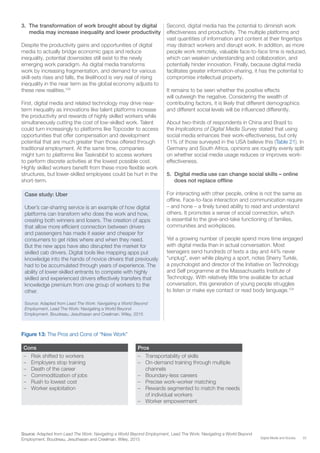
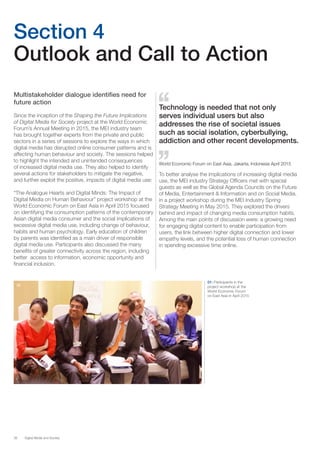
  • 36.
    Digital media alsoappears to have some association with depression, although causality is unclear. One large longitudinal study of Americans aged 14-24 years found that heavy use of the internet and video games is associated with an increase in depression. But the study from the University of Pennsylvania concluded that intensive digital media use might be a symptom of depression rather than its cause.119 The researchers found that moderate internet use, especially for acquiring information, is most strongly associated with healthy development. Two other studies that examine the relationship between social networking and depression in youth also found that the quality of social networking interactions, but not the quantity of use, is associated with depression.120 Increased digital media use also has an impact on cognition. It has been shown to lower recall rates for information people believe they can access easily online, although it also effectively extends human cognition through external resources.121 A study conducted by the Statistic Brain Research Institute in 2015 found that the average human attention span has decreased by 31% since 2000, from 12 seconds to 8.25.122 A study published in 2004 found that early television exposure is associated with attention problems at age seven.123 However, it is unclear whether this is due specifically to increased use of digital media. The use of digital media has implications for physical health as well. According to Vaughan Bell and others, as well as Kathlyn Mills, from University College London, no evidence currently exists from neuroscience studies to indicate that typical internet use harms the adolescent brain. 124 125 126 Of concern, however, is that time spent on digital technology displaces time that could be spent on physical activity. As Bell notes, “Low levels of physical activity associated with the passive use of digital technology have been linked to obesity and diabetes”.127 Finally, increased digital media use is cutting into user downtime, which is critical to allow the brain to synthesize information, make connections between ideas and develop a sense of self. When downtime and solitude are possible, many digital media users turn to their devices rather than risk boredom, cutting off an opportunity for restorative and creative thought.128 Children, especially, lose out cognitively and emotionally, if they are always given a screen to stimulate them. A capacity for boredom and solitude is a signal development of childhood, and central to a later capacity for relationship, as Sherry Turkle attests.129 7. Benefits of digital media for young children are limited, when used extensively and without guidelines So far, baby bouncers and potty training devices with tablet holders still face protest by concerned parents.130 But children are being exposed to digital media at younger and younger ages. A 2015 study by a research firm, Childwise, found that 73% of British children under the age of five are using a tablet or computer compared with just 23% in 2012. By the time they are six years old, more than 40% are using a device every day.131 This can be problematic because children are the most vulnerable to the negative impacts of digital media overuse. First, according to the American Academy of Pediatrics, numerous studies have indicated that excessive new media use can lead to attention problems, school difficulties, sleep and eating disorders and obesity.132 For example, a 2011 study by Michelle Garrison and colleagues found that violent content and evening media use were associated with increased sleep problems for children aged three to five years.133 Second, it is harmful to children if interaction with parents and others is replaced by interaction with digital media. Research has shown that brain development depends on social interaction with others during a critical period in early life. Going without that early social interaction has irreversible effects that create social and cognitive impairments throughout life.134 In addition, healthy neurological development requires the engagement of all sensory systems, but heavy digital media consumption favours the visual and auditory systems over the vestibular, proprioceptive, tactile and attachment systems, creating possibly permanent imbalances.135 36 Digital Media and Society
  • 37.
    37Digital Media andSociety Third, the overuse of digital media can delay language development. Research has shown that very young children (aged 9-18 months) do not learn language by watching educational videos without active interaction with another person.136 137 Interpersonal interaction seems to be a fundamental component of language development. Interestingly, while a 2013 study similarly found that canned content delivered through digital devices was ineffective in teaching language to young children (aged 24-30 months), it also found that live interactions between a child and an adult conducted over a digital device such as a tablet or smartphone did enable the child to learn new words.138 Fourth, uncontrolled time spent on digital media often displaces time spent on academics, lowering academic achievement. Studies show that most teenagers multitask between entertainment and academic work, both inside and outside the classroom. A 2010 survey published by the Kaiser Family Foundation found that almost one-third of the 8-18 years age group surveyed reported watching TV, texting, listening to music or using some other medium “most of the time” that they do homework.139 Such multitasking has been found to diminish students’ understanding and memory of content and to make it harder for them to transfer their learning to new contexts.140 Finally, while digital media offers children access to a huge wealth of information, not all information can be trusted. Digital media makes it easier to disseminate inaccurate as well as accurate information, and much that is online is potentially harmful to younger demographics. This study’s research confirms a sense of unease about children’s growing exposure to, and consumption of, digital media. Among respondents to the Implications of Digital Media Survey, 71% believe that digital media can create problems for youth (Table 23). Interestingly, respondents are more concerned about the negative impacts of digital media on the 4-15 years age group – particularly the 8-11 years group – than on the under-4 years group. To the extent that this reflects respondents’ beliefs that children aged below four years do not have access to digital media, their concern about children’s exposure to digital media could be lower than warranted. Social Media’s impact on individuals, organizations and society Social media platforms – ranging from WeChat to Twitter – offer both opportunities and challenges in the ways people communicate and interact in various types of relationships. The Impact of Digital Content: Opportunities and Risks of Creating and Sharing Information Online, a white paper by the World Economic Forum’s Global Agenda Council on Social Media, examines how social media is transforming the way that humans build communities, act collectively and individually, and transform social networks into integral communication institutions.141 The report explores the use and transformation of social media by building a discussion around the current impact of different platforms, the “business” of social media, and the ethical and legal implications for stakeholders when sharing and using information online. The paper ends with a review of future trajectories for social media tools and networks, and how they have the potential to influence individuals, organizations and society.
  • 38.
    38 Digital Mediaand Society Section 4 Outlook and Call to Action Multistakeholder dialogue identifies need for future action Since the inception of the Shaping the Future Implications of Digital Media for Society project at the World Economic Forum’s Annual Meeting in 2015, the MEI industry team has brought together experts from the private and public sectors in a series of sessions to explore the ways in which digital media has disrupted online consumer patterns and is affecting human behaviour and society. The sessions helped to highlight the intended and unintended consequences of increased digital media use. They also helped to identify several actions for stakeholders to mitigate the negative, and further exploit the positive, impacts of digital media use: “The Analogue Hearts and Digital Minds: The Impact of Digital Media on Human Behaviour” project workshop at the World Economic Forum on East Asia in April 2015 focused on identifying the consumption patterns of the contemporary Asian digital media consumer and the social implications of excessive digital media use, including change of behaviour, habits and human psychology. Early education of children by parents was identified as a main driver of responsible digital media use. Participants also discussed the many benefits of greater connectivity across the region, including better access to information, economic opportunity and financial inclusion. 01 01: Participants in the project workshop at the World Economic Forum on East Asia in April 2015 Technology is needed that not only serves individual users but also addresses the rise of societal issues such as social isolation, cyberbullying, addiction and other recent developments. World Economic Forum on East Asia, Jakarta, Indonesia April 2015 To better analyse the implications of increasing digital media use, the MEI industry Strategy Officers met with special guests as well as the Global Agenda Councils on the Future of Media, Entertainment & Information and on Social Media, in a project workshop during the MEI Industry Spring Strategy Meeting in May 2015. They explored the drivers behind and impact of changing media consumption habits. Among the main points of discussion were: a growing need for engaging digital content to enable participation from users, the link between higher digital connection and lower empathy levels, and the potential loss of human connection in spending excessive time online.
  • 39.
    39Digital Media andSociety 01 02 03 01: Panellists in the project workshop at the MEI Industry Spring Strategy Meeting in May 2015 02: Participants in the project workshop at the World Economic Forum’s Young Global Leaders’ Summit, August 2015 03: Panellists during the project workshop at the Annual Meeting of the New Champions in Dalian, China September 2015 Regarding the human implications of increased use of digital media and increased personalization, the challenge for both industry and the public sector will be to make sure that such trends do not ultimately disrupt healthy societal dynamics. MEI Industry Spring Strategy Meeting, New York, USA May 2015 Improving work-life balance is the No 1 reason for people to work remotely. While only 20% of work in the USA is done remotely today, this number could be increased to 50%. Young Global Leaders’ Summit, Geneva, Switzerland August 2015 The explosion of content, its accessibility and the multifaceted views that the internet exposes individuals to, has made the typical content consumer cautious about the source of information, the validity of the information and the authoritative power of the source. This reality has put a strain on trust in the content ecosystem. Annual Meeting of the New Champions, Dalian, China September 2015 At the Digital Changes in Society session during the Forum’s Young Global Leaders’ Summit in August 2015, participants discussed how the changing digital technology landscape is having an impact on the workplace, as well as other aspects of society. Participants discussed the opportunities provided by digital technology and platforms to better match labour supply and demand and increase productivity, as well as the opportunities for individuals to increase work flexibility and work-life balance. At the session on China’s New Media Society at the Annual Meeting of the New Champions in Dalian, China, in September 2015, the need for multistakeholder collaboration on issues such as data privacy was deemed imperative to ensure the safety of the digital media consumer. Discussions also focused on the promise of digital media for cross-cultural communication, cultural diversity and transparency.
  • 40.
    40 Digital Mediaand Society Through this ongoing dialogue between the MEI industry partners and engaged stakeholders such as NGOs, academia and civil society, ideas have been collected to address some concerns and to promote the benefits of increased digital media use. In addition, this dialogue has pointed the way towards future research and discussion needed to create maximum value for the MEI industry, digital media users, and society overall. The power of multistakeholder collaboration – a call to action The research presented suggests that action from all sectors of society can help to ensure that humans make the most of increasing use of digital media while mitigating the related risks: Multistakeholder collaboration The public and private sectors should partner together to drive action on the impacts of digital media hyperconnectivity noted in this report. The Forum can facilitate this public-private collaboration. Both regulators and industry can engage with academia and NGOs to incorporate research findings and initiatives in designing and creating new socially responsible MEI industry offerings and updating current public policies. Multistakeholder collaboration will be critical to moving forward in several key areas: –– Creating and building on standards that improve and redefine the digital user experience. –– Building on existing standards and regulations for personal data privacy and security by supporting initiatives that help companies, the public sector and consumers to better understand how data can be collected and used to create social, economic and personal outcomes in ways that protect privacy, e.g., Facebook’s Data Drive Economy Roundtable series.142 –– Establishing and reinforcing governance on making digital media an instrument for freedom of speech and expression, while simultaneously preventing hateful, harmful speech or propaganda. –– Establishing and reinforcing governance around content to prevent cybercrime and safeguard citizens, especially minors. –– Educating children about digital citizenship, including internet safety and ethical codes of conduct for using digital media and technology. –– Recognizing the implications of work fragmentation for social safety nets, and creating more flexible regulatory frameworks that accommodate a diversity of company-worker relationships. –– Providing equal and facilitated access to digital media for all citizens. The public sector Public institutions can help to update standards and regulations, as well as promote and enforce them, based on scientific evidence in order to enable the beneficial use of digital media and prevent the negative effects. This should be done maintaining a flexible and innovation-friendly framework. The public sector can also facilitate the creation of more social institutions and programmes, such as education and awareness campaigns, designed to support both citizens and the private sector to address or foster the influences mentioned in this report. The European Commission’s DG Connect group has a directorate dedicated to digital society, trust and security, for example. Governmental bodies should set up similar resources for their countries or regions. However, any model of guidance and support should be flexible, and be able to develop quickly in step with changes in the marketplace and user behaviour. The private sector/MEI industry The private sector, principally industry, should consider the implications on individuals when designing platforms and services or creating content. Industry best practices and self-regulation are the optimal way to create innovative solutions in a fast-evolving environment. Examples of possible actions: restricting minors’ access to harmful content, enabling free expression and participation, accepting feedback and starting discourse with users. In addition, the private sector can step up efforts to build trust with consumers by, among other ways, being more transparent about how personal data are used and showing a corporate ethos of accountability and social responsibility. One effective measure is to sponsor public and non- profit organizations that help to promote beneficial use of digital media. The CEO Coalition is an example of an initiative where private action is facilitated by a public body.143 Company signatories to the Coalition, a cooperative voluntary intervention designed to respond to challenges of young Europeans going online, has committed to actions, including age-appropriate privacy settings, wider use of content classification and better availability and use of parental controls. Industry could also support NGOs and social enterprises, such as iZ HERO Lab, a social enterprise based in South Korea and Singapore, dedicated to educating children and parents on responsible digital media usage. From an employer’s perspective, organizations should develop strategies to integrate digital media into workflows and should act proactively on the opportunities and pitfalls their businesses and employees encounter because of increased connectivity. Children need mentors to navigate through digital media use and to use digital media for developing the right skills. Annual Meeting of the New Champions, Dalian, China September 2015
  • 41.
    41Digital Media andSociety The forward-thinking employer Digital media now touches almost every aspect of a typical organization, from how talent is sourced and deployed, to how, where and when work gets done, and how the business connects with employees and customers. Given these fundamental changes, employers are recommended to: –– Use digital media (including talent platforms) to more accurately and flexibly match an individual’s skills to a specific business need, rather than think solely in terms of traditional jobs. This will create a more flexible, collaborative and productive environment for better business results. –– Take a more nuanced approach to how work should be conducted. Recognize when collaboration and personal interaction are needed, versus when it may be optimal for work to be performed independently and remotely. –– Use social media tools to build communication and engagement within the organization. –– Source and build digital skills and develop digital leadership. –– Encourage employees not only to turn on, but also to turn off. Employers that expect employees to be accessible through digital media 24/7 run the risk of decreased productivity and burnout. Individuals and civil society –– Finally, individuals are encouraged to build digital literacy and skills and to use digital media responsibly. That means making use of digital media’s many benefits and avoiding the harmful aspects – protecting both oneself and others, especially those unable to protect themselves. –– In addition, individuals can get involved with civic organizations and NGOs to help make a difference on digital media issues. Thousands of NGOs and associations promote the helpful use of digital media and the prevention of its negative effects. Their objectives range from developing digital skills and caring for people who have had negative online experiences, to enabling flexible work arrangements and supporting civic participation and community building. The responsible individual and parent Much can, and should, be done collaboratively across stakeholders to increase the positive impacts of digital media use. It is also imperative that individuals use digital media responsibly. Based on this report’s research, individuals are recommended to: –– Protect their digital identities by being careful about what they share online and by being aware of the terms and conditions of platforms and applications. –– Ensure sufficient time offline for human connection, healthy physical activity and the necessary “downtime”, in order to prevent information overload and stress. –– Prepare for the coming “gig economy”, taking greater care in managing professional lives, reputations and professional development. –– Make use of the abundant opportunities to learn and develop, maintain beneficial relationships, make life entertaining and meaningful, care for others, and contribute to societal welfare. Because digital media use poses special risks to children, parents must not only educate their children but also manage their digital media use. Research findings suggest the following guidelines for parents: –– Monitor children’s digital media engagement and ensure they get: adequate physical activity, lots of face-to-face communication, uninterrupted time for academic work, downtime for free thinking, and even some alone time for self-reflection. This is crucial for cognitive, emotional and social development. –– Install content filters, parental controls and usage restriction software on devices used by children in order to mitigate overuse and protect them from harmful online content. Avoid digital media in children’s sleep environments. –– Consider fewer top-down restrictions on use (which children will evade) and focus more on education, guidance and communication about managing online risks and building digital literacy.
  • 42.
    42 Digital Mediaand Society Project Contributors World Economic Forum Project Team Claudio Cocorocchia, Project Lead, Content lead for the Media, Entertainment & Information Industries, Switzerland Diana El-Azar, Project Sponsor, Member of the Executive Committee,Switzerland Anne-Marie Jentsch, Project Manager, Media, Entertainment & Information Industries (on secondment from Willis Towers Watson), Switzerland Mengyu Annie Luo, Project Sponsor, Head of Media, Entertainment & Information Industries, USA Anna Sophia O’Neil, Project Coordinator, Media, Entertainment & Information Industries, USA Lena Woodward, Project Associate, Media, Entertainment & Information Industries, Switzerland Project Advisers Tom Davenport, Senior Consultant, Research and Innovation Center, Willis Towers Watson, USA Anne Huisman, Senior Consultant, Executive Compensation, Willis Towers Watson, Netherlands Ravin Jesuthasan, Managing Director and Global Practice Leader, Willis Towers Watson, USA Amy Johnson, Research Analyst, Research and Innovation Center, Willis Towers Watson, USA Anne Randhava, Analyst, Communication and Change Management, Willis Towers Watson, USA Steering Committee Members Olivier Oullier, Professor of Behavioural and Brain Sciences, Aix Marseille University, France (2011 - 2015) Irene Braam, Vice-President, Government Relations, and Head, Brussels Liaison Office, Bertelsmann, Belgium Anne Hunter, Senior Vice-President, Global Marketing Strategy, comScore, USA Sanjay Nazerali, Global Chief Strategy Officer, Dentsu Aegis Network, United Kingdom Ozge Bulut Marasli, Executive Vice-President, Strategy, Dogan TV Holding, Turkey Kevin King, Global Practice Chair, Edelman Digital, Edelman, USA Sarah Wynn-Williams, Director, Global Public Policy, Facebook, USA Rob Norman, Chief Digital Officer, Global, GroupM, USA Idalia Cruz, Director, Strategy, Media, Grupo Salinas, Mexico Yuhyun Park, Founder, iZ HERO Lab, Singapore Christophe Nicolas, Group Chief Information Officer, Kudelski Group, and Senior Vice-President and Head, Kudelski Security, Switzerland Sherry Turkle, Professor of the Social Studies of Science and Technology, Massachusetts Institute of Technology (MIT), USA Karen Willenberg, Director, Regulatory and Legal Affairs, Electronic Media Network (M-Net), South Africa (2004-2015) Rishad Tobaccowala, Chief Strategist, Publicis Group, USA Steven Schwartz, Global Managing Director, Reuters News Agency, Thomson Reuters, USA (2011-2015) Ravin Jesuthasan, Managing Director and Global Practice Leader, Willis Towers Watson, USA Sam Gregory, Programme Director, WITNESS, USA Session Contributors Jakarta, Indonesia 19 April 2015 World Economic Forum on East Asia “Analogue Hearts and Digital Minds: The Impact of Digital Media on Human Behaviour” Rohana Rozhan, Chief Executive Officer, Astro Malaysia Holdings, Malaysia Yobie Benjamin, Co-Founder, Avegant Corporation, USA Dick van Motman, Chairman and Chief Executive Officer, Dentsu Aegis Network South East Asia, Singapore Raymond Siva, Managing Director, Edelman, Malaysia Gloria Ai, Founder and Anchor, iAsk Media, People’s Republic of China Seungjoon Chang, Vice-President, Maekyung Media Group, Republic of Korea Hu Yong, Professor of Journalism and Communication, Peking University, People’s Republic of China Rajnesh Singh, Regional Director, Asia-Pacific, The Internet Society (ISOC), Singapore Ranjana Singh, Chairwoman, Indonesia and Vietnam, WPP, Indonesia New York, USA 13 May 2015 MEI Industry Spring Strategy Meeting “Exploring the Drivers behind Changing Media Consumption Habits” Sanjay Nazerali, Global Chief Strategy Officer, Dentsu Aegis Network, United Kingdom Bernadette Aulestia, Executive Vice President, Domestic Network Distribution, HBO, USA Sherry Turkle, Professor of the Social Studies of Science and Technology, Massachusetts Institute of Technology (MIT), USA Chris Altcheck, Chief Executive Officer and Co-Founder, Mic, USA Robert Osher, President, Sony Pictures Digital Production Division (2008-2015), Sony Pictures Entertainment, USA
  • 43.
    43Digital Media andSociety Geneva, Switzerland 12 August 2015 Young Global Leaders (YGL) and Alumni Annual Summit “Digital Changes in Society” Brian A. Wong, Vice-President; Special Assistant to the Chairman, Alibaba Group, People’s Republic of China Sara Sutton Fell, Founder and Chief Executive Officer, FlexJobs, USA Yuhyun Park, Founder, iZ HERO Lab, Singapore Brian Forde, Director, Digital Currency, Massachusetts Institute of Technology (MIT) Media Laboratory, USA Sam Gregory, Programme Director, WITNESS, USA Dalian, People’s Republic of China 10 September 2015 Annual Meeting of the New Champions 2015 “China’s Media Society: Impacts of Changing Media Consumption Patterns in China” Li Ruigang, Founding Chairman, China Media Capital (CMC), People’s Republic of China Robert Grove, Chief Executive Officer, North Asia, Edelman, Hong Kong SAR Yan Xuan, President, Greater China, Nielsen, People’s Republic of China Yuen-Ying Chan, Director and Professor, Journalism and Media Studies Centre, University of Hong King, Hong Kong SAR Ravin Jesuthasan, Managing Director and Global Practice Leader, Willis Towers Watson, USA Interviewees Olivier Oullier, Professor of Behavioural and Brain Sciences, Aix Marseille University, France (2011-2015) Shahrzad Rafati, Founder and Chief Executive Officer, BroadbandTV Corp, Canada danah boyd, Founder, Data & Society Research Institute and Principal Researcher, Microsoft Research, USA Sanjay Nazerali, Global Chief Strategy Officer, Dentsu Aegis Network, United Kingdom Robert Grove, Chief Executive Officer, North Asia, Edelman, Hong Kong SAR Sara Sutton Fell, Founder and Chief Executive Officer, FlexJobs, USA Ronaldo Lemos, Co-Founder and Executive Director, Institute for Technology & Science, Brazil Yuhyun Park, Founder, iZ HERO Lab, Singapore Sonia Livingstone, Professor of Social Psychology, Department of Media and Communications, London School of Economics and Political Science, United Kingdom Jonas Prising, Chief Executive Officer, ManpowerGroup, USA Sherry Turkle, Professor of the Social Studies of Science and Technology, Massachusetts Institute of Technology (MIT), USA Yan Xuan, President, Greater China, Nielsen, People’s Republic of China Jeremy Heimans, Co-Founder and Chief Executive Officer, Purpose, USA Mark Thompson, President and Chief Executive, The New York Times, USA Dave Duarte, Chief Executive Officer, Treeshake, South Africa Farida Vis, Director, Visual Social Media Lab and Faculty Research Fellow, University of Sheffield, United Kingdom Stephane Kasriel, Chief Executive Officer, Upwork, USA Ravin Jesuthasan, Managing Director and Global Practice Leader, Willis Towers Watson, USA Sam Gregory, Programme Director, WITNESS, USA Blog Contributors Dries Buytaert, Founder and Project Lead, Drupal, USA; Co- Founder and Chief Technology Officer, Acquia, USA) Rishad Tobaccowala, Chief Strategist, Publicis Group, USA Tom Davenport, Senior Consultant, Research and Innovation Center, Willis Towers Watson, USA Ravin Jesuthasan, Managing Director and Global Practice Leader, Willis Towers Watson, USA George Zarkadakis, Digital Lead, Communications and Change Management Practice, Willis Towers Watson, United Kingdom Sam Gregory, Programme Director, WITNESS, USA BPS Research Digest Series Christian Jarrett, Editor, Research Digest, The British Psychological Society, United Kingdom Parenting for a Digital Future Series Zorana Milicevic, Researcher, Writer and Project Manager, Kulturis, Serbia Sonia Livingstone, Professor of Social Psychology, Department of Media and Communications, London School of Economics and Political Science, United Kingdom Emrys Shoemaker, PhD Candidate, Department of International Development, London School of Economics, United Kingdom Michael Dezuanni, Associate Professor and Deputy Director, Children and Youth Research Centre, Queensland University of Technology, Australia Anna Whateley, Lecturer, Queensland University of Technology, Australia Andreas Hepp, Professor of Media and Communication Studies, University of Bremen, Germany Anthea Edalere-Henderson, Faculty Member, Caribbean Institute of Media and Communication (CARIMAC), University of the West Indies, Jamaica
  • 44.
    44 Digital Mediaand Society Tables Table 1: Overview of Respondents (% of Respondents) South Africa (n=997) Germany (n=1023) USA (n=998) Brazil (n=1033) China (n=1019) Total (n=5070) Gender Male 50 61 29 64 55 52 Female 50 39 71 36 45 48 Age age=15-17 2 3 0 0 0 1 age=18-24 16 16 6 13 11 12 age=25-34 22 22 33 29 28 27 age=35-44 20 21 18 25 24 21 age=45-50 11 10 13 6 7 9 age=51-54 9 10 6 13 11 10 age=55-64 16 15 16 14 19 16 age=65+ 5 4 8 2 1 4 Generation Millennials (age=15-34) 40 40 39 42 39 40 Gen X (age=35-50) 31 30 31 30 30 31 Baby Boomers (age=51-69) 29 29 30 28 30 29 Current employment status Employed full-time 51 53 43 61 88 59 Employed part-time 10 14 12 11 2 10 Self-employed 16 6 8 13 2 9 Not currently employed & looking for work 9 8 9 6 2 7 Not currently employed & not looking for work 8 8 15 3 1 7 Retired 6 10 13 6 4 8 Current student status Full-time student 11 18 9 9 6 10 Part-time student 17 6 3 25 8 12
  • 45.
    45Digital Media andSociety South Africa (n=997) Germany (n=1023) USA (n=998) Brazil (n=1033) China (n=1019) Total (n=5070) Not currently a student, but planning to return to school 20 10 13 44 22 22 Not currently a student, not planning to return to school 52 67 75 23 64 56 Marital status Single, never married 32 39 34 26 16 29 Married or domestic partnership 55 49 52 66 83 61 Separated or divorced 10 10 11 7 1 8 Widowed 2 2 3 2 0 2 Number of people in household 1 8 26 22 5 3 13 2 23 33 33 17 11 23 3 21 22 18 34 62 31 4 26 14 15 28 12 19 5 or more 21 5 12 16 12 13 Number of people aged under 18 in household None 46 55 52 33 34 44 1 24 26 21 39 60 34 2 21 15 16 22 5 16 3 6 3 7 5 0 4 4 or more 2 1 4 1 0 2 Highest level of education completed Did not complete high school 4 5 2 3 1 3 Completed high school 27 39 17 20 6 22 Some college/technical school or university 21 12 24 3 5 13 Completed college/technical school 20 22 16 12 9 16 Completed university/ undergraduate degree 15 9 24 11 69 26 Completed graduate school/ graduate degree 12 8 16 50 9 19 Prefer not to answer 2 6 1 1 1 2
  • 46.
    46 Digital Mediaand Society South Africa (n=998) Germany (n=1023) USA (n=998) Brazil (n=1033) China (n=1019) Total (n=5070) Household Income Less than $25,000 13 24 23 4 4 13 $25,000 to $39,999 9 31 19 8 4 14 $40,000 to $59,999 17 13 16 11 11 14 $60,000 to $74,999 13 9 10 16 12 12 $75,000 to $99,999 11 5 13 13 20 12 $100,000 to $149,999 7 1 9 17 19 10 $150,000 or more 5 1 5 10 11 6 Don’t know 5 4 1 1 1 2 Prefer not to answer 10 13 5 2 2 6 Source: Implications of Digital Media Survey, 2015, World Economic Forum Table 2a: Digital Media Usage, by Device, Access and Country (% Responding Yes To Using Each Device) % Yes   South Africa Germany USA Brazil China % of total PC/laptop 96 94 93 97 93 94 Television 93 90 91 98 92 93 Smartphone 85 84 76 88 95 87 Radio 82 80 75 87 43 68 Tablet 56 57 55 68 75 65 Question: Which of the following devices do you have access to? Source: Implications of Digital Media Survey, 2015, World Economic Forum Table 2b: Digital Media Usage, by Device, User Frequency and Country (% Responding Yes to Using Each Device 14 Hours or More per Week) 14+ hours/week South Africa Germany USA Brazil China % of total PC/laptop 52 48 50 49 42 47 Television 24 32 47 18 12 24 Smartphone 40 30 23 42 42 37 Radio 15 14 12 8 5 9 Tablet 14 13 12 14 17 15 Question: On average, approximately how many hours per week do you spend using each device? Source: Implications of Digital Media Survey, 2015, World Economic Forum
  • 47.
    47Digital Media andSociety Table 3: How Respondents Spend Their Time Specifically, by Country (% Claiming to Use Digital Media 3 Hours or More per Day for the Following Reasons) +3 hours/day South Africa Germany USA Brazil China % of total Doing work/job 46 22 18 49 30 32 Entertainment and amusement (music, TV/film, short videos and gaming) 24 24 14 36 19 23 Social interaction: chatting and messaging 30 16 8 37 18 21 Professional development (get job/ advance career) 15 7 6 24 11 12 Searching information for personal interest 23 12 8 33 15 18 Building/maintaining professional relationships 13 6 6 24 11 12 Searching information for professional interest 22 8 6 32 10 15 Personal development (learn/be creative) 20 9 7 27 14 15 Consuming news 9 8 6 24 12 12 Shopping 6 7 7 11 12 9 Question: On average, approximately how much time per day do you spend using digital media for each of the following reasons? Source: Implications of Digital Media Survey, 2015, World Economic Forum Table 4: Content Attributes that Encourage Users to Share Online Content, by Country (% Selecting that Attribute as Top 3 Choice)   Share content South Africa Germany USA Brazil China % of total It is entertaining 53 40 38 48 49 46 It contains useful facts 54 38 34 48 40 43 It is inspiring 46 28 29 33 41 36 It comes from a brand in which I believe 33 29 19 41 35 32 It is novel/unexpected 26 29 14 33 45 32 It would be popular with my peer group 28 25 19 33 40 31 It allows me to express my point of view 28 24 27 36 34 30 Other (please specify): 2 2 1 4 1 2 None of the above 10 28 40 9 5 16 Question: Which of the following content attributes would encourage you to share your own content more often? (Please select your top 3 choices in each column.) Source: Implications of Digital Media Survey, 2015, World Economic Forum
  • 48.
    48 Digital Mediaand Society Table 5: Content Attributes that Encourage Users to Create Online Content, by Country (% Selecting that Attribute as Top 3 Choice)   Create content South Africa Germany USA Brazil China % of total It allows me to express my point of view 54 34 31 54 54 47 It contains useful facts 40 33 26 39 41 37 It is entertaining 42 29 25 37 40 35 It is inspiring 43 25 23 39 34 33 It would be popular with my peer group 28 25 17 33 38 30 It is novel/unexpected 26 24 14 39 36 29 It comes from a brand in which I believe 23 20 0 14 0 28 Other (please specify): 2 2 1 4 1 2 None of the above 14 36 50 9 8 21 Question: Which of the following content attributes would encourage you to create your own content more often? (Please select your top 3 choices in each column.) Source: Implications of Digital Media Survey, 2015, World Economic Forum Table 6: Influence Over Respondents’ Digital Media Usage, by Country (% Who Selected It as Most Influential Source)   South Africa Germany USA Brazil China % of total Spouse/partner 13 15 15 22 22 18 Friends 20 23 14 21 14 18 Search engine 20 14 8 13 16 15 Brands 5 3 2 5 16 8 Public opinion 5 6 2 5 11 7 Experts 6 4 2 7 5 5 Other family member 5 5 4 5 5 5 Journalists 1 2 1 3 1 2 Other (please specify) 3 2 2 2 0 2 None of the above 14 22 49 10 5 17 Question: Which of the following has the most influence on the type of digital media you consume? Select the one most influential source. Source: Implications of Digital Media Survey, 2015, World Economic Forum
  • 49.
    49Digital Media andSociety Table 7: Willingness to Pay for Various Types of Content, by Country (% Who Claim to Have Paid for the Respective Content in the Last 12 Months)   South Africa Germany USA Brazil China % of total Premium entertainment content (e.g. Netflix, Spotify or gaming content) 21 28 27 54 37 34 Exclusive content (e.g. HBO Online) 6 7 9 32 35 21 Content that teaches me skills or abilities (e.g. online university courses) 19 8 7 25 33 21 Specialized content or service (e.g. specific to a hobby) 14 13 7 18 30 19 Content that gives me access to work opportunities (e.g. paid job postings) 21 8 5 23 19 16 Curated news or editorial content (e.g. Financial Times) 6 10 4 15 21 13 Other (please specify) 2 1 1 2 0 1 None of the above 53 54 63 25 26 41 Question: In the past 12 months, have you paid for any of the following types of digital media? Source: Implications of Digital Media Survey, 2015, World Economic Forum Table 8: Respondents Saying that Privacy and Anonymity Are Important, Neutral or Unimportant, and Percentage Agreeing on Other Aspects of Privacy, by Country (%) South Africa Germany USA Brazil China % of total Important 61 76 55 66 79 69 Neutral 22 16 35 24 16 21 Unimportant 17 8 11 10 5 9 Question: How important is anonymity and privacy in your digital media consumption activities? Source: Implications of Digital Media Survey, 2015, World Economic Forum Table 9: Social Media Activity Publicly Visible, by Country (%) South Africa Germany USA Brazil China % of total All 25 14 26 34 26 25 More than half, but not all 36 36 27 44 57 43 Some, but less than half 31 38 29 19 17 25 None 8 13 18 3 1 7 Question: What percentage of your social media activity would you consider publicly visible (i.e. not restricted to a closed group of individuals, such as friends)? Source: Implications of Digital Media Survey, 2015, World Economic Forum
  • 50.
    50 Digital Mediaand Society Table 10: Opinions about Privacy and “Right to be Forgotten”, by Country (%)   % Agree   South Africa Germany USA Brazil China % of total The “right to be forgotten”, which means I may cancel or delete any part of my digital presence, is important to me 77 66 62 73 73 71 Having complete control over what personal data of mine are stored and used by brands, products and services, is important to me 79 69 64 84 77 75 I would be willing to pay money for complete control over how my personal data are used by product and service providers who collect user data in exchange for free offerings (e.g. Gmail) 39 24 27 55 64 46 Question: How much do you agree or disagree with the following statements about your digital presence? Source: Implications of Digital Media Survey, 2015, World Economic Forum Table 11a: Likelihood of Clicking on Advertising while Actively Looking for a Similar Product, by Country (%) % Likely South Africa Germany USA Brazil China % of total Footer banners on video content that you are viewing 35 20 18 56 58 41 Pre-rolls (short video advertisements) to video content that you are viewing 40 27 18 58 63 45 Banner advertisements on web or mobile pages 42 31 19 59 58 45 Advertisements embedded in your social media news feeds 48 25 20 58 61 46 Advertisements on search engine results pages 56 37 26 68 63 52 Promotional text links embedded within sponsored stories 43 23 19 56 54 42 Question: If you were actively looking for a similar product/service, how likely would you be to click on each of these types of online advertisements? Source: Implications of Digital Media Survey, 2015, World Economic Forum
  • 51.
    51Digital Media andSociety Table 11b: Likelihood of Clicking on Advertising while Not Actively Looking for a Similar Product, by Country (%) % Likely South Africa Germany USA Brazil China % of total Footer banners on video content that you are viewing 18 14 14 41 53 32 Pre-rolls (short video advertisements) to video content that you are viewing 23 18 14 44 59 36 Banner advertisements on web or mobile pages 22 18 14 42 53 34 Advertisements embedded in your social media news feeds 29 15 15 47 56 37 Advertisements on search engine results pages 31 22 17 51 59 40 Promotional text links embedded within sponsored stories 24 14 13 44 52 33 Question: If you were not actively looking for a similar product/service, how likely would you be to click on each of these types of online advertisements? Source: Implications of Digital Media Survey, 2015, World Economic Forum Table 12: Respondents Saying They Express Opinions Publicly and within Peer Group, by Country (%)   % Yes South Africa Germany USA Brazil China % of total I am likely to publicly express my interest in, or support for, a brand via social media 57 33 42 70 77 60 I am likely to express my interest in, or support for, a brand via social media within my peer group 64 41 45 75 79 65 Question: How much do you agree or disagree with the following statements about social media sites? Source: Implications of Digital Media Survey, 2015, World Economic Forum Table 13: Respondents Who Have Set Up Ad-Blocking Tools, by Country (%)   South Africa Germany USA Brazil China % of total Third-party advertising blocker tools (e.g. for web browser) 31 41 19 31 43 35 Privacy control tools that block third- party trackers and cookies 39 37 20 42 32 34 Advertisement blocking settings for social media accounts 23 25 13 20 28 23 None of the above 47 37 69 43 39 46 Question: Have you installed or set up any of the following tools on your device(s)? Source: Implications of Digital Media Survey, 2015, World Economic Forum
  • 52.
    52 Digital Mediaand Society Table 14: Corporate Social Responsibility Efforts Deemed Most Important for Media and Entertainment Brands to Support, by Country (%) % Important South Africa Germany USA Brazil China % of total Corporate transparency (e.g. educate customers on how their personal data are stored and used, providing them full control to decide) 73 59 54 85 79 72 Environmental sustainability (e.g. use of sustainable energy) 74 58 50 84 81 72 Ethical labour practices (e.g. gender parity and equal pay) 66 56 54 80 80 69 Social impact accountability (e.g. establish anti-addictive support group for own products and services) 63 50 41 80 80 66 Philanthropy (e.g. financial or in- kind support of charities) 60 32 45 77 69 59 Question: Which of the following corporate social responsibility efforts would you say are most important for media and entertainment brands and companies to actively support? Source: Implications of Digital Media Survey, 2015, World Economic Forum Table 15: Opinions on How Digital Media Has Influenced Quality of life and Desires to Reduce Digital Media Usage, by Country (%) % Agree South Africa Germany USA Brazil China % of total My digital media use in the last 12 months has generally improved my overall quality of life 48 30 27 61 66 50 My digital media use in the last 12 months has generally improved the overall quality of my social life 46 24 27 63 68 50 My digital media use in the last 12 months has generally improved the quality of my professional life 53 24 23 67 66 50 Digital media has transformed how I work 61 36 30 66 71 56 I believe I should reduce my use of digital media for entertainment and social networking 28 23 26 35 44 33 I believe I should reduce my use of digital media for information-gathering 19 19 21 33 41 29 Question: How much do you agree or disagree with the following statements about digital media? Source: Implications of Digital Media Survey, 2015, World Economic Forum
  • 53.
    53Digital Media andSociety Table 16: Reported Influence of Digital Media on Civic Participation, by Country (%) % Better   South Africa Germany USA Brazil China % of total Amount of civic participation 39 29 23 62 70 49 Quality of civic participation 40 29 23 64 65 48 Amount of community involvement 48 29 27 69 63 50 Quality of community involvement 50 32 26 69 62 50 Feeling of personal empowerment 57 20 28 67 62 49 % Worse   South Africa Germany USA Brazil China % of Total Amount of civic participation 4 14 4 5 4 6 Quality of civic participation 5 15 4 6 5 7 Amount of community involvement 6 14 5 5 5 7 Quality of community involvement 5 14 5 5 5 7 Feeling of personal empowerment 4 14 5 4 6 6 Question: In each category, please select the choice that best reflects the effect digital media use has had on your public life? Source: Implications of Digital Media Survey, 2015, World Economic Forum Table 17: How Social Media Sites Have Influenced Civic Participation Action Taken (%) South Africa Germany USA Brazil China % of total Yes 22 25 12 47 36 30 No 69 61 77 42 54 59 Not sure/Don’t know 9 14 11 11 10 11 Question: In the last 12 months, has there been a time when you decided to TAKE ACTION (e.g. start a petition or create content) involving a political or social issue because of something you read on a social networking site? Source: Implications of Digital Media Survey, 2015, World Economic Forum
  • 54.
    54 Digital Mediaand Society Table 18: Respondents Using Social Networking Sites for Social or Political Action a Few Times per Week, by Country (%) % A few times per week   South Africa Germany USA Brazil China % of total Post links to political stories or articles for others to read 13 10 8 28 21 17 Post your own thoughts or comments on political or social issues 15 12 10 29 20 18 Encourage others to take action on a political or social issue that is important to you 11 9 8 28 21 17 Re-post content related to political or social issues that was originally posted by someone else 14 11 9 31 24 19 “Like” or promote material related to political or social issues that others have posted 17 14 12 30 31 23 Question: How often do you use social networking sites to…? Source: Implications of Digital Media Survey, 2015, World Economic Forum Table 19: Respondents Saying Digital Media Reduces, Improves or Has No Effect on Their Effectiveness at Work, by Country (%) % Better South Africa Germany USA Brazil China % of total Ability to find work 65 40 35 73 71 61 Ability to do your work 71 40 37 79 78 66 Ability to learn and develop professionally 77 46 38 80 77 68 Ability to maintain balance between work and personal life 58 28 33 73 74 59 Building relationships with professional contacts 69 40 39 80 71 63 Ability to collaborate with colleagues 70 39 38 79 76 65 Ability to collaborate with stakeholders outside your work organization 60 39 26 61 74 58
  • 55.
    55Digital Media andSociety % Worse South Africa Germany USA Brazil China % of total Ability to find work 3 12 4 2 2 4 Ability to do your work 4 14 5 3 2 5 Ability to learn and develop professionally 2 13 4 3 2 4 Ability to maintain balance between work and personal life 8 19 6 5 3 7 Building relationships with professional contacts 2 12 4 2 4 5 Ability to collaborate with colleagues 3 13 4 2 3 4 Ability to collaborate with stakeholders outside your work organization 3 12 5 3 2 4 Question: In each category, please select the choice that best reflects the effect digital media use has had on your professional life? Source: Implications of Digital Media Survey, 2015, World Economic Forum Table 20: How Digital Media Use for Work-Related Purposes Has Changed in the Past Three Years, and How It Is Predicted to Change in the Next Three Years, by Country (%) Change in past three years South Africa Germany USA Brazil China % of total Greater 79 58 43 82 69 69 Same 15 32 45 11 27 25 Less 4 8 5 5 3 4 Don’t know 2 3 7 1 1 2 Predicted change in next three years South Africa Germany USA Brazil China % of total Greater 78 53 42 80 71 68 Same 17 37 45 16 26 26 Less 3 6 4 2 3 3 Don’t know 2 4 10 2 2 3 Question: Compared with three years ago, is your use of digital media for work-related purposes….Thinking ahead three years, do you think your use of digital media for work-related purposes will be…? Source: Implications of Digital Media Survey, 2015, World Economic Forum
  • 56.
    56 Digital Mediaand Society Table 21: Social Media’s Effect on Work-Effectiveness, by Country (%) South Africa Germany USA Brazil China % of total Improves 29 14 11 64 61 42 No effect 45 56 68 19 27 39 Reduces 24 19 13 14 9 14 Don’t know 3 10 9 3 3 5 Question: What effect does use of social media (e.g. YouTube or Facebook) have on your work effectiveness? Source: Implications of Digital Media Survey, 2015, World Economic Forum Table 22: Respondents Reporting Impact of Digital Media, by Country and Attribute (%) % Better South Africa Germany USA Brazil China % of total Empathy 63 28 32 63 70 54 Ability to make physical friends 38 24 21 60 64 45 Ability to find a physical significant other 30 20 16 51 64 41 Ability to maintain relationships with friends 65 38 41 73 72 61 Ability to maintain relationship with significant other 45 23 20 58 70 48 Oral communication skills 45 25 21 58 59 45 Written communication skills 59 42 30 67 65 55 Critical thinking and problem solving 62 39 28 71 69 56 Length of attention span 45 25 20 58 61 45 Short-term memory 42 29 22 54 66 47 Long-term memory 47 26 23 59 56 45 Motor skills 50 34 28 63 59 49 Stress 37 20 20 45 51 37 Physical health 34 17 20 46 59 39 Mental health 48 28 24 60 66 49
  • 57.
    57Digital Media andSociety % Worse South Africa Germany USA Brazil China % of total Empathy 5 16 6 5 4 7 Ability to make physical friends 11 19 8 8 8 10 Ability to find a physical significant other 8 20 8 7 6 9 Ability to maintain relationships with friends 5 14 5 5 4 6 Ability to maintain relationship with significant other 7 17 7 6 4 8 Oral communication skills 10 18 9 9 9 11 Written communication skills 7 15 7 6 7 8 Critical thinking and problem solving 4 14 6 5 4 6 Length of attention span 11 21 14 10 9 12 Short-term memory 8 18 9 9 5 9 Long-term memory 7 18 8 8 11 11 Motor skills 6 13 5 5 9 8 Stress 14 24 11 12 9 13 Physical health 14 26 12 15 10 15 Mental health 5 17 8 6 5 8 Question: In each category, please select the choice that best reflects the effect digital media use has had on your own private life? Source: Implications of Digital Media Survey, 2015, World Economic Forum Table 23: Respondents Believing that Digital Media Usage Could Create Problems for Youth of Various Ages, by Country (%) % Probably/Certainly Age South Africa Germany USA Brazil China % of total Younger than 2 years 49 67 43 67 47 54 2-3 years 55 70 45 69 53 58 4-7 years 63 70 53 71 68 66 8-11 years 71 64 60 71 80 71 12-15 years 69 49 60 57 83 67 16-18 years 57 33 57 45 80 59 Question: To what extent do you think too much use of digital media can create problems for youth? Source: Implications of Digital Media Survey, 2015, World Economic Forum
  • 58.
    58 Digital Mediaand Society Endnotes 1. http://www.weforum.org/projects/shaping-future-implications-digital-media-society 2. http://epceurope.eu/wp-content/uploads/2015/09/epc-trends-social-media.pdf 3. https://www.globalwebindex.net/blog/digital-v-traditional-media-consumption-q3-2015 4. https://www.globalwebindex.net/blog/digital-v-traditional-media-consumption-q3-2015 5. https://agenda.weforum.org/2015/09/fourth-industrial-revolution/ 6. http://epceurope.eu/wp-content/uploads/2015/09/epc-trends-social-media.pdf 7. https://www.globalwebindex.net/blog/fast-growth-nations-clock-up-the-most-hours-for-mobile-web-usage 8. http://wearesocial.net/blog/2015/01/digital-social-mobile-worldwide-2015/ 9. http://wearesocial.net/blog/2015/01/digital-social-mobile-worldwide-2015/ 10. https://www.globalwebindex.net/blog/digital-v-traditional-media-consumption-q3-2015 11. https://www.globalwebindex.net/blog/digital-v-traditional-media-consumption-q3-2015 12. http://wave.umww.com 13. Ibid. 14. http://www.pulsarplatform.com/#studies/White_Papers/1 15. http://papers.ssrn.com/sol3/papers.cfm?abstract_id=1528077 16. http://www.pulsarplatform.com/#studies/White_Papers/1 17. http://wave.umww.com 18. http://www.pewresearch.org/fact-tank/2015/02/12/5-facts-about-online-video-for-youtubes-10th-birthday/ 19. https://meco6936.wordpress.com/2015/06/04/accessment3-participation-and-user-created-content/ 20. http://www.carat.com/global/en/news-views/faith-vs-experience-building-trust-in-the-digital-age/ 21. https://en.wikipedia.org/wiki/Collective_consciousness 22. http://www.carat.com/global/en/news-views/faith-vs-experience-building-trust-in-the-digital-age/ 23. http://www.mariekedemooij.com/articles/goodrich_demooij_2013_journal_marketingcommunications.pdf 24. http://epub.wu.ac.at/3567/ 25. http://www.digitalnewsreport.org 26. http://www.wired.com/2015/08/times-1-million-online-subscribers-needs/ 27. https://en.wikipedia.org/wiki/Bloomberg_L.P. 28. http://www.businessinsider.com/blendle-signs-up-german-major-national-newspapers-2015-6?)?r=UK&IR=T 29. http://www.libertyglobal.com/PDF/public-policy/The-Value-of-Our-Digital-Identity.pdf 30. http://www.statista.com/stats/166066/music%20piracy 31. http://www.libertyglobal.com/PDF/public-policy/The-Value-of-Our-Digital-Identity.pdf 32. https://www.google.com/transparencyreport/removals/europeprivacy/ 33. https://www.youtube.com/watch?v=nkfBTUKBnz8 34. http://www.groupm.com/news/press-releases/groupm-year-next-year-reports-slow-global-ad-recovery-5th-year 35. https://www.linkedin.com/pulse/20140913132811-25326384-trends-in-advertising-display-ads-are-dead 36. http://fortune.com/2015/09/21/apple-adblock-stats/ 37. Ibid. 38. http://www.secretmedia.com/whitepaper/SecretMedia_Adblock&GlobalVideo.pdf 39. http://sourcepoint.com/comscore-and-sourcepoint-the-state-of-ad-blocking/
  • 59.
    59Digital Media andSociety 40. http://www.secretmedia.com/whitepaper/SecretMedia_Adblock&GlobalVideo.pdf 41. http://adage.com/article/digitalnext/ad-blocking-unnecessary-internet-apocalypse/300470/ 42. http://www.edelman.com/insights/intellectual-property/2015-edelman-trust-barometer/ 43. http://www.digitalnewsreport.org 44. http://www.libertyglobal.com/PDF/public-policy/The-Value-of-Our-Digital-Identity.pdf 45. http://www.dailymail.co.uk/sciencetech/article-2989768/Facebook-slammed-advertising-funeral-directors-CANCER- patient-Promotions-appeared-sufferer-Googled-disease.html 46. http://www.iabuk.net/research/library/mediascope-europe-the-connected-life-of-digital-natives 47. http://www.smarpshare.com 48. http://www.chicagobusiness.com/article/20140325/OPINION/140329895/corporate-social-responsibility-is- millennials-new-religion 49. http://digiday.com/publishers/5-things-learned-ny-times-2014/ 50. http://www.smh.com.au/entertainment/tv-and-radio/netflixs-algorithm-matches-content-to-eyeballs-and-is-rewriting- the-tv-rulebook-20150731-gintcf.html 51. https://press.linkedin.com/about-linkedin 52. https://vimeo.com/105633579 53. source: https://www.youtube.com/watch?v=zIEIvi2MuEk 54. https://www.facebook.com/about/privacy 55. https://www.facebook.com/help/443357099140264 56. https://www.facebook.com/help/239377769603639 57. https://govtrequests.facebook.com/ 58. http://www3.weforum.org/docs/WEFUSA_NewVisionforEducation_Report2015.pdf 59. http://www.pewinternet.org/2015/08/06/teens-technology-and-friendships/ 60. https://assets.documentcloud.org/documents/2401429/technology.pdf 61. http://www.pewinternet.org/2015/01/15/social-media-and-stress/ 62. http://www.pewinternet.org/2015/01/15/social-media-and-stress/ 63. http://journalistsresource.org/studies/international/global-tech/research-arab-spring-internet-key-studies 64. http://onlinelibrary.wiley.com/doi/10.1111/j.1460-2466.2012.01628.x/full 65. https://research.facebook.com/blog/382753905228438/visualizing-crisis-relief-in-nepal/ 66. http://www.huffingtonpost.com/entry/facebook-google-maps-refugees-migrants_55f1aca8e4b03784e2783ea4 67. http://www.cnbc.com/2015/09/22/drug-ceo-will-lower-price-of-daraprim-after-hike-sparked-outrage.html 68. https://www.change.org 69. https://www.avaaz.org 70. https://witness.org 71. http://www.forbes.com/www.forbes.com/sites/nextavenue/2012/11/26/6-mistakes-to-avoid-when-giving-to-charity/ 72. http://journalistsresource.org/studies/politics/digital-democracy/social-media-influence-politics-participation- engagement-meta-analysis 73. http://www.nature.com/nature/journal/v489/n7415/full/nature11421.html 74. http://www.pewinternet.org/2014/12/30/technologys-impact-on-workers/ 75. http://www.rbs.com/news/2015/october/rbs-becomes-first-bank-in-the-world-to-launch-facebook-at-work.html 76. ttp://uk.businessinsider.com/slack-survey-shows-it-reduces-work-email-2015-10?r=US&IR=T 77. https://www.towerswatson.com/en/Insights/IC-Types/Survey-Research-Results/2013/12/2013-2014-change-and- communication-roi-study 78. http://www.mckinsey.com/insights/employment_and_growth/the_world_at_work
  • 60.
    60 Digital Mediaand Society 79. http://cxcglobal.com/whitepapers/Aberdeen_-_contingent_labor_workforce.pdf 80. https://www.freelancersunion.org/blog/2014/09/12/how-many-freelancers-are-there-america-53-million/ 81. http://2020workforce.com/2014/09/17/the-workforce-of-the-future-will-be-increasingly-flexible/ 82. http://www.mckinsey.com/insights/employment_and_growth/connecting_talent_with_opportunity_in_the_digital_age 83. http://www.mckinsey.com/insights/employment_and_growth/connecting_talent_with_opportunity_in_the_digital_age 84. http://www.weforum.org/projects/new-vision-education 85. https://www.towerswatson.com/en/Insights/IC-Types/Survey-Research-Results/2012/07/Global-Talent-2021 86. https://hbr.org/resources/pdfs/comm/RedHat/RedHatReportMay2015.pdf 87. https://towerswatson.com/en-MY/Insights/Newsletters/Global/emphasis/2014/consider-a-diverse-cross-industry- talent-pool 88. http://journalistsresource.org/studies/society/social-media/social-media-violent-extremism-isis-online-speech- research-review#sthash.aHRRdVR6.dpuf 89. http://www.bostonmagazine.com/news/blog/2014/03/24/online-trolls-harvard-talk-susan-benesch/ 90. http://www.ohchr.org/EN/Issues/FreedomOpinion/Pages/Standards.aspx 91. http://www3.weforum.org/docs/WEF_InternetTrustBubble_Report2_2014.pdf 92. http://www.technologyreview.com/news/539021/probing-the-dark-side-of-googles-ad-targeting-system/ 93. http://www.degruyter.com/view/j/popets.2015.1.issue-1/popets-2015-0007/popets-2015-0007.xml 94. http://www.technologyreview.com/news/539021/probing-the-dark-side-of-googles-ad-targeting-system/ 95. Ibid. 96. http://www.journalism.org/2015/06/01/millennials-political-news/ 97. http://social.cs.uiuc.edu/papers/pdfs/Eslami_Algorithms_CHI15.pdf 98. http://smapp.nyu.edu/papers/SocialMediaReduces.pdf 99. http://crx.sagepub.com/content/41/8/1042 100. http://www.digitalnewsreport.org 101. http://www.cjr.org/analysis/whos_afraid_of_a_big_bad_algorithm.php 102. http://jia.sipa.columbia.edu/social-movements-governments-digital-age-evaluating-complex-landscape/ 103. http://www.mckinsey.com/insights/business_technology/four_fundamentals_of_workplace_automation 104. http://www.ft.com/intl/cms/s/0/fc76fce2-67b3-11e5-97d0-1456a776a4f5.html 105. http://digest.bps.org.uk/2014/02/student-narcissists-prefer-twitter-more.html 106. http://www.nytimes.com/2010/06/27/fashion/27StudiedEmpathy.html?_r=0 107. http://www.csudh.edu/psych/Virtual_empathy_-_Positive_and_negative_impacts_of_going_online_upon_empathy_ in_young_adults.pdf 108. http://www.wsj.com/articles/is-technology-making-people-less-sociable-1431093491 109. http://www.vodafone.com/content/index/media/vodafone-group-releases/2015/groudbreaking_global_survey.html 110. http://netchildrengomobile.eu/ncgm/wp-content/uploads/2013/07/NCGM_FinalReport_Country_DEF.pdf 111. http://www.mentalhealth.org.uk/help-information/mental-health-a-z/I/internet/ 112. http://www.ncbi.nlm.nih.gov/pmc/articles/PMC4052222/ 113. http://www.tandfonline.com/doi/abs/10.1080/1369118X.2012.710245 114. http://www.ncbi.nlm.nih.gov/pubmed/21499141?dopt=AbstractPlus 115. http://www.businessinsider.com/south-korea-online-gaming-addiction-rehab-centers-2015-3?r=UK&IR=T 116. http://www.sciencedirect.com/science/article/pii/S0747563213001842 117. Ibid. 118. Ibid. 119. http://www.jahonline.org/article/S1054-139X(12)00790-2/abstract?cc=y=
  • 61.
    61Digital Media andSociety 120. http://psycnet.apa.org/journals/ppm/1/2/72/ 121. http://scholar.harvard.edu/files/dwegner/files/sparrow_et_al._2011.pdf 122. http://www.statisticbrain.com/attention-span-statistics/ 123. http://pediatrics.aappublications.org/content/113/4/708 124. https://assets.documentcloud.org/documents/2401429/technology.pdf 125. http://www.sciencedirect.com/science/article/pii/S1364661314001065 126. http://www.sciencedirect.com/science/article/pii/S1364661314001065 127. https://assets.documentcloud.org/documents/2401429/technology.pdf 128. http://www.nytimes.com/2015/09/27/opinion/sunday/stop-googling-lets-talk.html 129. http://www.huffingtonpost.com/nell-minow/the-vital-role-of-convers_b_8392726.html 130. http://www.dailymail.co.uk/news/article-2521556/Fisher-Price-withdraw-baby-bouncy-seat-iPad-holder.html 131. http://www.childwise.co.uk/uploads/3/1/6/5/31656353/childwise_press_release_-_tablets.pdf 132. https://www.aap.org/en-us/advocacy-and-policy/aap-health-initiatives/pages/media-and-children.aspx 133. http://www.ncbi.nlm.nih.gov/pubmed/21708803 134. http://www.sciencemag.org/content/337/6100/1357.abstract?sid=2fd70c08-7fa4-4156-9af5-1b067a1807a8 135. http://www.sensomotorische-integratie.nl/CrisRowan.pdf 136. http://www.pnas.org/content/100/15/9096.long 137. http://pss.sagepub.com/content/early/2010/09/27/0956797610384145.abstract 138. http://onlinelibrary.wiley.com/doi/10.1111/cdev.12166/abstract 139. http://kff.org/other/event/generation-m2-media-in-the-lives-of/ 140. http://www.slate.com/articles/health_and_science/science/2013/05/multitasking_while_studying_divided_attention_ and_technological_gadgets.html 141. World Economic Forum, The Impact of Digital Content: Opportunities and Risks of Creating and Sharing Information Online, 2016, http://www3.weforum.org/docs/GAC16/Social_Media_Impact_Digital.pdf 142. http://thedatadriveneconomy.com 143. http://ec.europa.eu/digital-agenda/self-regulation-and-stakeholders-better-internet-kids
  • 64.
    World Economic Forum 91–93route de la Capite CH-1223 Cologny/Geneva Switzerland Tel.: +41 (0) 22 869 1212 Fax: +41 (0) 22 786 2744 contact@weforum.org www.weforum.org The World Economic Forum – committed to improving the state of the world – is the International Organization for Public-Private Cooperation. The Forum engages the foremost political, business and other leaders of society to shape global, regional and industry agendas.