Newton’s Laws
Physics 1425 lecture 6
Michael Fowler, UVa.
Newton Extended Galileo’s Picture of
Motion to Include Forces
Galileo said:
• Natural horizontal motion is at constant velocity
unless a force acts: a push from behind will cause
acceleration, friction will cause negative
acceleration (that is, deceleration).
• Natural vertical motion is constant downward
acceleration…
Newton Said They’re the Same Thing!
• The “natural vertical motion” is at constant
acceleration because there’s a constant force
acting – the force of gravity!
• Without that force, vertical motion would be
at constant velocity.
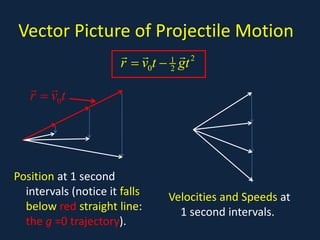
• Look again at the path of a projectile: without
gravity, it would be a straight line.
Vector Picture of Projectile Motion
Position at 1 second
intervals (notice it falls
below red straight line:
the g =0 trajectory).
Velocities and Speeds at
1 second intervals.
2
1
0 2
r v t gt
= −
  
0
r v t
=
 
Newton’s First Law of Motion
• Newton’s First Law is that an object continues to
move at constant velocity unless acted on by
external forces.
• Unlike Galileo’s horizontal motion law, this
applies for motion in any direction.
• (This was hard to accept, because forces were
considered to arise only from contact, a push or
pull, and this “force of gravity” seemed magical.)
Relating Change in Velocity to Force
• This can only be done experimentally: Newton
did many experiments.
• Care must be taken to make sure forces like
friction, etc., are negligibly small.
• Take two objects made of the same material
(iron, say) one twice the volume of the other,
apply the same force.
• The one with twice the stuff accelerates at half
the rate.
Force and Acceleration I
• Many experiments lead to the conclusion that
a given force (such as a spring extended by a
measured amount) accelerates an object in
the direction of the force at a rate inversely
proportional to the “amount of stuff” in the
object.
• This amount of stuff is called the mass, or
inertial mass, of the object: it measures the
object’s resistance to being accelerated: the
object’s inertia. It is denoted by m.
Force and Acceleration II
• It is also found that doubling the force (pulling
with two identical springs, for example)
doubles the acceleration.
• The bottom line is:
1. Acceleration is proportional to applied force
(and of course in the same direction).
2. Acceleration is inversely proportional to
mass.
Units for Force
• We already have a unit for mass, the kg, and
acceleration, m/s2.
• We define the magnitude of the unit force as
that force which accelerates one kilogram at
one meter per second per second.
• This unit force is one Newton.
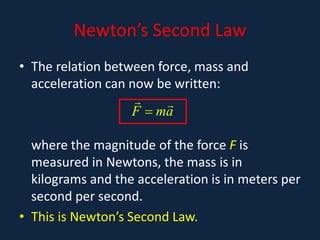
Newton’s Second Law
• The relation between force, mass and
acceleration can now be written:
where the magnitude of the force F is
measured in Newtons, the mass is in
kilograms and the acceleration is in meters per
second per second.
• This is Newton’s Second Law.
F ma
=
 
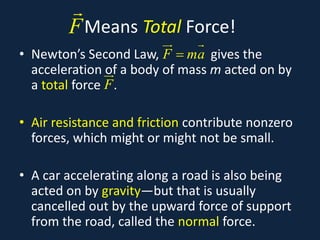
Means Total Force!
• Newton’s Second Law, gives the
acceleration of a body of mass m acted on by
a total force .
• Air resistance and friction contribute nonzero
forces, which might or might not be small.
• A car accelerating along a road is also being
acted on by gravity—but that is usually
cancelled out by the upward force of support
from the road, called the normal force.
F

F ma
=
 
F

Inertial Frames of Reference
• Recall a frame of reference is a set of axes, like
three perpendicular rulers, to measure
position, plus a clock to track time, so motion
can be precisely described.
• An inertial frame is one in which Newton’s
First Law is obeyed.
• If frame A is inertial, and frame B is moving at
constant velocity relative to frame A, then
frame B is also inertial.
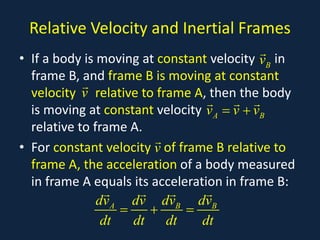
Relative Velocity and Inertial Frames
• If a body is moving at constant velocity in
frame B, and frame B is moving at constant
velocity relative to frame A, then the body
is moving at constant velocity
relative to frame A.
• For constant velocity of frame B relative to
frame A, the acceleration of a body measured
in frame A equals its acceleration in frame B:
B
v

v

A B
v v v
= +
  
v

A B B
dv dv dv dv
dt dt dt dt
= + =
   
Relative Acceleration and Noninertial Frames
• If frame A is inertial, and frame B is
accelerating with respect to frame A, then
frame B is noninertial.
• Examples: inside an accelerating car; on a
rotating carousel.
• A body in an accelerating car will only stay at
rest relative to the car if acted on by some
force (the seat, for example).
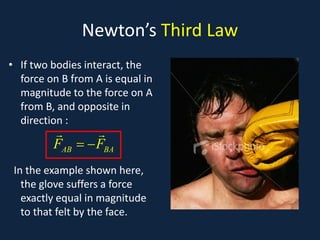
Newton’s Third Law
• If two bodies interact, the
force on B from A is equal in
magnitude to the force on A
from B, and opposite in
direction :
In the example shown here,
the glove suffers a force
exactly equal in magnitude
to that felt by the face.
AB BA
F F
= −
 
Action and Reaction
• Newton’s Third Law is often stated as “action
equals reaction”.
• The action is body A pushing on body B.
• The reaction is the inevitable opposite force:
B pushing back on A.
• Very Important! The action and the
reaction always act on different bodies!
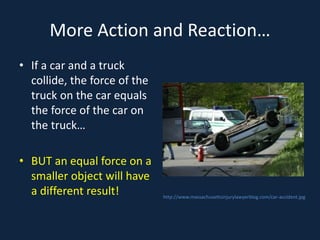
More Action and Reaction…
• If a car and a truck
collide, the force of the
truck on the car equals
the force of the car on
the truck…
• BUT an equal force on a
smaller object will have
a different result! http://www.massachusettsinjurylawyerblog.com/car-accident.jpg
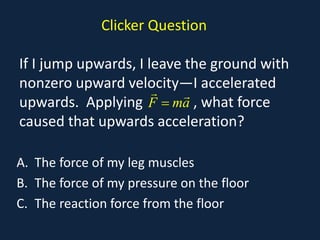
Clicker Question
If I jump upwards, I leave the ground with
nonzero upward velocity—I accelerated
upwards. Applying , what force
caused that upwards acceleration?
A. The force of my leg muscles
B. The force of my pressure on the floor
C. The reaction force from the floor
F ma
=
 
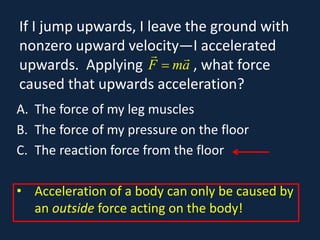
If I jump upwards, I leave the ground with
nonzero upward velocity—I accelerated
upwards. Applying , what force
caused that upwards acceleration?
A. The force of my leg muscles
B. The force of my pressure on the floor
C. The reaction force from the floor
• Acceleration of a body can only be caused by
an outside force acting on the body!
F ma
=
 

Newton's law

  • 1.
    Newton’s Laws Physics 1425lecture 6 Michael Fowler, UVa.
  • 2.
    Newton Extended Galileo’sPicture of Motion to Include Forces Galileo said: • Natural horizontal motion is at constant velocity unless a force acts: a push from behind will cause acceleration, friction will cause negative acceleration (that is, deceleration). • Natural vertical motion is constant downward acceleration…
  • 3.
    Newton Said They’rethe Same Thing! • The “natural vertical motion” is at constant acceleration because there’s a constant force acting – the force of gravity! • Without that force, vertical motion would be at constant velocity. • Look again at the path of a projectile: without gravity, it would be a straight line.
  • 4.
    Vector Picture ofProjectile Motion Position at 1 second intervals (notice it falls below red straight line: the g =0 trajectory). Velocities and Speeds at 1 second intervals. 2 1 0 2 r v t gt = −    0 r v t =  
  • 5.
    Newton’s First Lawof Motion • Newton’s First Law is that an object continues to move at constant velocity unless acted on by external forces. • Unlike Galileo’s horizontal motion law, this applies for motion in any direction. • (This was hard to accept, because forces were considered to arise only from contact, a push or pull, and this “force of gravity” seemed magical.)
  • 6.
    Relating Change inVelocity to Force • This can only be done experimentally: Newton did many experiments. • Care must be taken to make sure forces like friction, etc., are negligibly small. • Take two objects made of the same material (iron, say) one twice the volume of the other, apply the same force. • The one with twice the stuff accelerates at half the rate.
  • 7.
    Force and AccelerationI • Many experiments lead to the conclusion that a given force (such as a spring extended by a measured amount) accelerates an object in the direction of the force at a rate inversely proportional to the “amount of stuff” in the object. • This amount of stuff is called the mass, or inertial mass, of the object: it measures the object’s resistance to being accelerated: the object’s inertia. It is denoted by m.
  • 8.
    Force and AccelerationII • It is also found that doubling the force (pulling with two identical springs, for example) doubles the acceleration. • The bottom line is: 1. Acceleration is proportional to applied force (and of course in the same direction). 2. Acceleration is inversely proportional to mass.
  • 9.
    Units for Force •We already have a unit for mass, the kg, and acceleration, m/s2. • We define the magnitude of the unit force as that force which accelerates one kilogram at one meter per second per second. • This unit force is one Newton.
  • 10.
    Newton’s Second Law •The relation between force, mass and acceleration can now be written: where the magnitude of the force F is measured in Newtons, the mass is in kilograms and the acceleration is in meters per second per second. • This is Newton’s Second Law. F ma =  
  • 11.
    Means Total Force! •Newton’s Second Law, gives the acceleration of a body of mass m acted on by a total force . • Air resistance and friction contribute nonzero forces, which might or might not be small. • A car accelerating along a road is also being acted on by gravity—but that is usually cancelled out by the upward force of support from the road, called the normal force. F  F ma =   F 
  • 12.
    Inertial Frames ofReference • Recall a frame of reference is a set of axes, like three perpendicular rulers, to measure position, plus a clock to track time, so motion can be precisely described. • An inertial frame is one in which Newton’s First Law is obeyed. • If frame A is inertial, and frame B is moving at constant velocity relative to frame A, then frame B is also inertial.
  • 13.
    Relative Velocity andInertial Frames • If a body is moving at constant velocity in frame B, and frame B is moving at constant velocity relative to frame A, then the body is moving at constant velocity relative to frame A. • For constant velocity of frame B relative to frame A, the acceleration of a body measured in frame A equals its acceleration in frame B: B v  v  A B v v v = +    v  A B B dv dv dv dv dt dt dt dt = + =    
  • 14.
    Relative Acceleration andNoninertial Frames • If frame A is inertial, and frame B is accelerating with respect to frame A, then frame B is noninertial. • Examples: inside an accelerating car; on a rotating carousel. • A body in an accelerating car will only stay at rest relative to the car if acted on by some force (the seat, for example).
  • 15.
    Newton’s Third Law •If two bodies interact, the force on B from A is equal in magnitude to the force on A from B, and opposite in direction : In the example shown here, the glove suffers a force exactly equal in magnitude to that felt by the face. AB BA F F = −  
  • 16.
    Action and Reaction •Newton’s Third Law is often stated as “action equals reaction”. • The action is body A pushing on body B. • The reaction is the inevitable opposite force: B pushing back on A. • Very Important! The action and the reaction always act on different bodies!
  • 17.
    More Action andReaction… • If a car and a truck collide, the force of the truck on the car equals the force of the car on the truck… • BUT an equal force on a smaller object will have a different result! http://www.massachusettsinjurylawyerblog.com/car-accident.jpg
  • 18.
    Clicker Question If Ijump upwards, I leave the ground with nonzero upward velocity—I accelerated upwards. Applying , what force caused that upwards acceleration? A. The force of my leg muscles B. The force of my pressure on the floor C. The reaction force from the floor F ma =  
  • 19.
    If I jumpupwards, I leave the ground with nonzero upward velocity—I accelerated upwards. Applying , what force caused that upwards acceleration? A. The force of my leg muscles B. The force of my pressure on the floor C. The reaction force from the floor • Acceleration of a body can only be caused by an outside force acting on the body! F ma =  