www.csrajivbajaj.com
THOUGHT OF THE DAY
THOUGHT OF THE DAY
“What you get by achieving your goals is not as important as
what you become by achieving your goals..”
Law Updates:
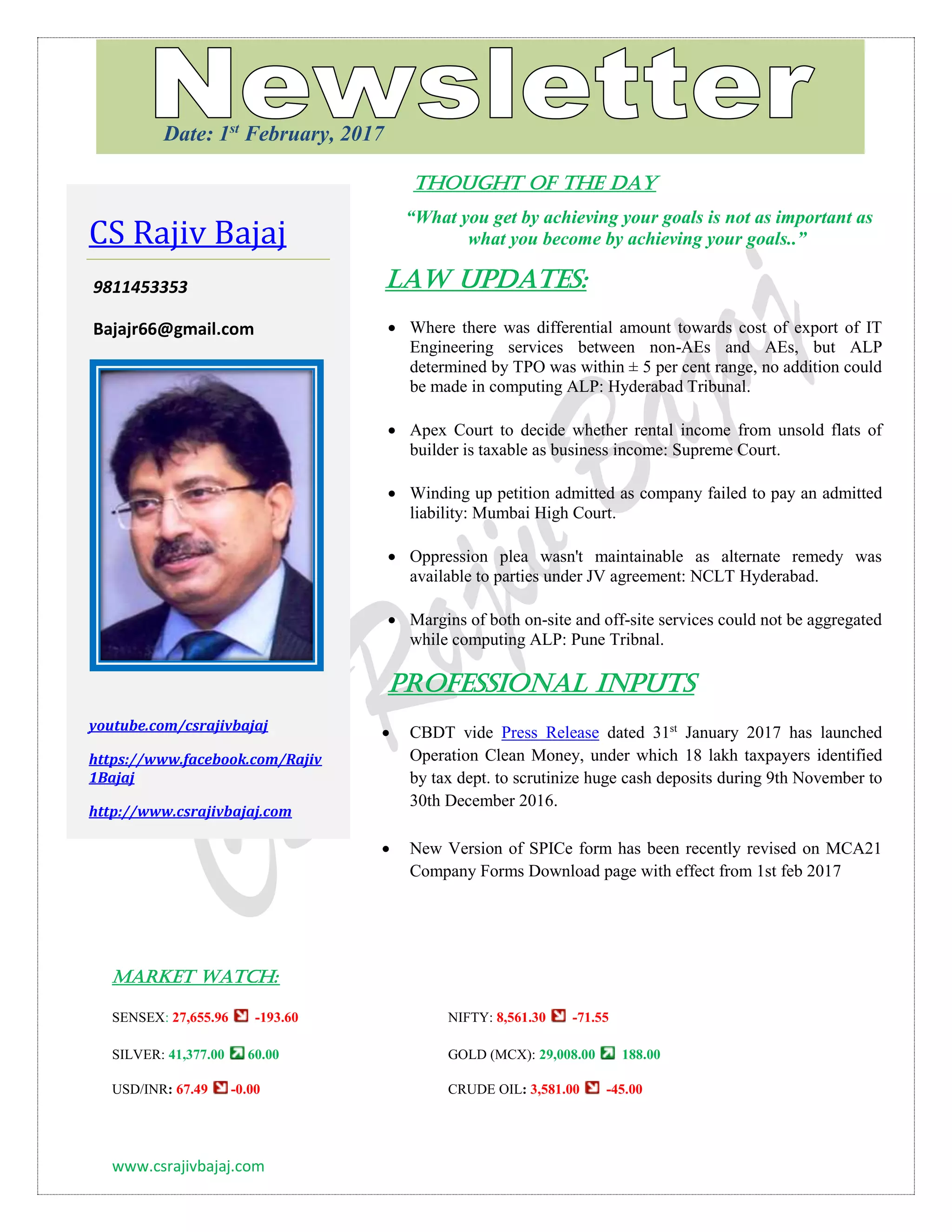
 Where there was differential amount towards cost of export of IT
Engineering services between non-AEs and AEs, but ALP
determined by TPO was within ± 5 per cent range, no addition could
be made in computing ALP: Hyderabad Tribunal.
 Apex Court to decide whether rental income from unsold flats of
builder is taxable as business income: Supreme Court.
 Winding up petition admitted as company failed to pay an admitted
liability: Mumbai High Court.
 Oppression plea wasn't maintainable as alternate remedy was
available to parties under JV agreement: NCLT Hyderabad.
 Margins of both on-site and off-site services could not be aggregated
while computing ALP: Pune Tribnal.
Professional INPUTS
 CBDT vide Press Release dated 31st
January 2017 has launched
Operation Clean Money, under which 18 lakh taxpayers identified
by tax dept. to scrutinize huge cash deposits during 9th November to
30th December 2016.
 New Version of SPICe form has been recently revised on MCA21
Company Forms Download page with effect from 1st feb 2017
MARKET WATCH:
SENSEX: 27,655.96 -193.60 NIFTY: 8,561.30 -71.55
SILVER: 41,377.00 60.00 GOLD (MCX): 29,008.00 188.00
USD/INR: 67.49 -0.00 CRUDE OIL: 3,581.00 -45.00
CS Rajiv Bajaj
9811453353
Bajajr66@gmail.com
youtube.com/csrajivbajaj
https://www.facebook.com/Rajiv
1Bajaj
http://www.csrajivbajaj.com
Date: 1st
February, 2017
www.csrajivbajaj.com
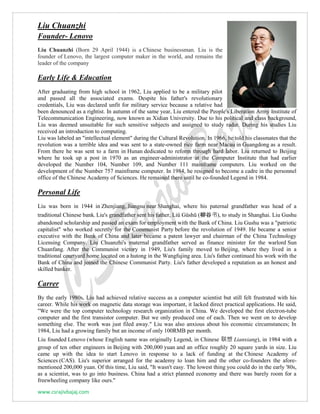
Liu Chuanzhi
Founder- Lenovo
Liu Chuanzhi (Born 29 April 1944) is a Chinese businessman. Liu is the
founder of Lenovo, the largest computer maker in the world, and remains the
leader of the company
Early Life & Education
After graduating from high school in 1962, Liu applied to be a military pilot
and passed all the associated exams. Despite his father's revolutionary
credentials, Liu was declared unfit for military service because a relative had
been denounced as a rightist. In autumn of the same year, Liu entered the People's Liberation Army Institute of
Telecommunication Engineering, now known as Xidian University. Due to his political and class background,
Liu was deemed unsuitable for such sensitive subjects and assigned to study radar. During his studies Liu
received an introduction to computing.
Liu was labeled an "intellectual element" during the Cultural Revolution. In 1966, he told his classmates that the
revolution was a terrible idea and was sent to a state-owned rice farm near Macau in Guangdong as a result.
From there he was sent to a farm in Hunan dedicated to reform through hard labor. Liu returned to Beijing
where he took up a post in 1970 as an engineer-administrator at the Computer Institute that had earlier
developed the Number 104, Number 109, and Number 111 mainframe computers. Liu worked on the
development of the Number 757 mainframe computer. In 1984, he resigned to become a cadre in the personnel
office of the Chinese Academy of Sciences. He remained there until he co-founded Legend in 1984.
Personal Life
Liu was born in 1944 in Zhenjiang, Jiangsu near Shanghai, where his paternal grandfather was head of a
traditional Chinese bank. Liu's grandfather sent his father, Liǔ Gǔshū (柳谷书), to study in Shanghai. Liu Gushu
abandoned scholarship and passed an exam for employment with the Bank of China. Liu Gushu was a "patriotic
capitalist" who worked secretly for the Communist Party before the revolution of 1949. He became a senior
executive with the Bank of China and later became a patent lawyer and chairman of the China Technology
Licensing Company. Liu Chuanzhi's maternal grandfather served as finance minister for the warlord Sun
Chuanfang. After the Communist victory in 1949, Liu's family moved to Beijing, where they lived in a
traditional courtyard home located on a hutong in the Wangfujing area. Liu's father continued his work with the
Bank of China and joined the Chinese Communist Party. Liu's father developed a reputation as an honest and
skilled banker.
Carrer
By the early 1980s, Liu had achieved relative success as a computer scientist but still felt frustrated with his
career. While his work on magnetic data storage was important, it lacked direct practical applications. He said,
"We were the top computer technology research organization in China. We developed the first electron-tube
computer and the first transistor computer. But we only produced one of each. Then we went on to develop
something else. The work was just filed away." Liu was also anxious about his economic circumstances; In
1984, Liu had a growing family but an income of only 100RMB per month.
Liu founded Lenovo (whose English name was originally Legend, in Chinese 联想 Lianxiang), in 1984 with a
group of ten other engineers in Beijing with 200,000 yuan and an office roughly 20 square yards in size. Liu
came up with the idea to start Lenovo in response to a lack of funding at the Chinese Academy of
Sciences (CAS). Liu's superior arranged for the academy to loan him and the other co-founders the afore-
mentioned 200,000 yuan. Of this time, Liu said, "It wasn't easy. The lowest thing you could do in the early '80s,
as a scientist, was to go into business. China had a strict planned economy and there was barely room for a
freewheeling company like ours."

Newsletter dated 1st February , 2017

  • 1.
    www.csrajivbajaj.com THOUGHT OF THEDAY THOUGHT OF THE DAY “What you get by achieving your goals is not as important as what you become by achieving your goals..” Law Updates:  Where there was differential amount towards cost of export of IT Engineering services between non-AEs and AEs, but ALP determined by TPO was within ± 5 per cent range, no addition could be made in computing ALP: Hyderabad Tribunal.  Apex Court to decide whether rental income from unsold flats of builder is taxable as business income: Supreme Court.  Winding up petition admitted as company failed to pay an admitted liability: Mumbai High Court.  Oppression plea wasn't maintainable as alternate remedy was available to parties under JV agreement: NCLT Hyderabad.  Margins of both on-site and off-site services could not be aggregated while computing ALP: Pune Tribnal. Professional INPUTS  CBDT vide Press Release dated 31st January 2017 has launched Operation Clean Money, under which 18 lakh taxpayers identified by tax dept. to scrutinize huge cash deposits during 9th November to 30th December 2016.  New Version of SPICe form has been recently revised on MCA21 Company Forms Download page with effect from 1st feb 2017 MARKET WATCH: SENSEX: 27,655.96 -193.60 NIFTY: 8,561.30 -71.55 SILVER: 41,377.00 60.00 GOLD (MCX): 29,008.00 188.00 USD/INR: 67.49 -0.00 CRUDE OIL: 3,581.00 -45.00 CS Rajiv Bajaj 9811453353 Bajajr66@gmail.com youtube.com/csrajivbajaj https://www.facebook.com/Rajiv 1Bajaj http://www.csrajivbajaj.com Date: 1st February, 2017
  • 2.
    www.csrajivbajaj.com Liu Chuanzhi Founder- Lenovo LiuChuanzhi (Born 29 April 1944) is a Chinese businessman. Liu is the founder of Lenovo, the largest computer maker in the world, and remains the leader of the company Early Life & Education After graduating from high school in 1962, Liu applied to be a military pilot and passed all the associated exams. Despite his father's revolutionary credentials, Liu was declared unfit for military service because a relative had been denounced as a rightist. In autumn of the same year, Liu entered the People's Liberation Army Institute of Telecommunication Engineering, now known as Xidian University. Due to his political and class background, Liu was deemed unsuitable for such sensitive subjects and assigned to study radar. During his studies Liu received an introduction to computing. Liu was labeled an "intellectual element" during the Cultural Revolution. In 1966, he told his classmates that the revolution was a terrible idea and was sent to a state-owned rice farm near Macau in Guangdong as a result. From there he was sent to a farm in Hunan dedicated to reform through hard labor. Liu returned to Beijing where he took up a post in 1970 as an engineer-administrator at the Computer Institute that had earlier developed the Number 104, Number 109, and Number 111 mainframe computers. Liu worked on the development of the Number 757 mainframe computer. In 1984, he resigned to become a cadre in the personnel office of the Chinese Academy of Sciences. He remained there until he co-founded Legend in 1984. Personal Life Liu was born in 1944 in Zhenjiang, Jiangsu near Shanghai, where his paternal grandfather was head of a traditional Chinese bank. Liu's grandfather sent his father, Liǔ Gǔshū (柳谷书), to study in Shanghai. Liu Gushu abandoned scholarship and passed an exam for employment with the Bank of China. Liu Gushu was a "patriotic capitalist" who worked secretly for the Communist Party before the revolution of 1949. He became a senior executive with the Bank of China and later became a patent lawyer and chairman of the China Technology Licensing Company. Liu Chuanzhi's maternal grandfather served as finance minister for the warlord Sun Chuanfang. After the Communist victory in 1949, Liu's family moved to Beijing, where they lived in a traditional courtyard home located on a hutong in the Wangfujing area. Liu's father continued his work with the Bank of China and joined the Chinese Communist Party. Liu's father developed a reputation as an honest and skilled banker. Carrer By the early 1980s, Liu had achieved relative success as a computer scientist but still felt frustrated with his career. While his work on magnetic data storage was important, it lacked direct practical applications. He said, "We were the top computer technology research organization in China. We developed the first electron-tube computer and the first transistor computer. But we only produced one of each. Then we went on to develop something else. The work was just filed away." Liu was also anxious about his economic circumstances; In 1984, Liu had a growing family but an income of only 100RMB per month. Liu founded Lenovo (whose English name was originally Legend, in Chinese 联想 Lianxiang), in 1984 with a group of ten other engineers in Beijing with 200,000 yuan and an office roughly 20 square yards in size. Liu came up with the idea to start Lenovo in response to a lack of funding at the Chinese Academy of Sciences (CAS). Liu's superior arranged for the academy to loan him and the other co-founders the afore- mentioned 200,000 yuan. Of this time, Liu said, "It wasn't easy. The lowest thing you could do in the early '80s, as a scientist, was to go into business. China had a strict planned economy and there was barely room for a freewheeling company like ours."