YouTeach: Framing
Kelsey Fogg, Cole McInvale, Mary Landon
Montgomery
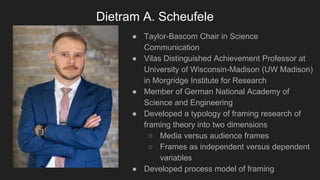
Dietram A. Scheufele
● Taylor-Bascom Chair in Science
Communication
● Vilas Distinguished Achievement Professor at
University of Wisconsin-Madison (UW Madison)
in Morgridge Institute for Research
● Member of German National Academy of
Science and Engineering
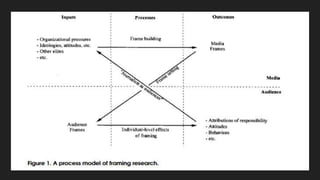
● Developed a typology of framing research of
framing theory into two dimensions
○ Media versus audience frames
○ Frames as independent versus dependent
variables
● Developed process model of framing
Key Terms
● Framing
● Second-level agenda
setting
● Frame setting
● Frame Building
● Media effects
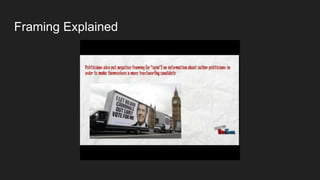
Framing Explained
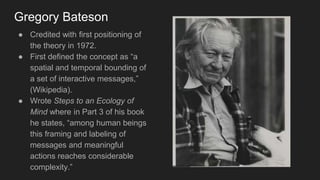
Gregory Bateson
● Credited with first positioning of
the theory in 1972.
● First defined the concept as “a
spatial and temporal bounding of
a set of interactive messages,”
(Wikipedia).
● Wrote Steps to an Ecology of
Mind where in Part 3 of his book
he states, “among human beings
this framing and labeling of
messages and meaningful
actions reaches considerable
complexity.”
Framing
● comprises a set of concepts and theoretical perspectives on how
individuals, groups, and societies, organize, perceive, and
communicate about reality.
● framing is a schema of interpretation, a collection of anecdotes and
stereotypes, that individuals rely on to understand and respond to
events.[2] In other words, people build a series of mental "filters"
through biological and cultural influences. They then use these filters
to make sense of the world. The choices they then make are
influenced by their creation of a frame.
Second Level Agenda Setting
● Concerned with the salience of issue attributes
● Describes the impact of the salience of characteristics of media coverage on
audiences’ interpretation of these news stories.
Frame Setting
● How media framing influences an audience (wikipedia)
● Individual-level effects of framing; and alink between
individual frames and media frames (i.e., journalists’ and
elites’ susceptibility to framing processes). (text)
Frame Building
● How frames create societal discourse about an issue and
how different frames are adopted by journalists
(wikipedia)
● Processes that influence the creation or changes of
frames applied by journalists (text)
Media Effects
● Measurable effects that result from media influence or a media
message.
● Whether that media message has an effect on any of its audience
members is contingent on many factors, including audience
demographics and psychological characteristics. These effects can be
positive or negative, abrupt or gradual, short-term or long-lasting. Not
all effects result in change: some media messages reinforce an
existing belief
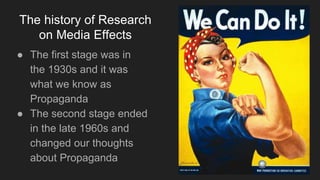
The history of Research
on Media Effects
● The first stage was in
the 1930s and it was
what we know as
Propaganda
● The second stage ended
in the late 1960s and
changed our thoughts
about Propaganda
The history of Research
on Media Effects
● The third stage began in the
1970s and led our focus
towards cognitive effects
● The fourth and current stage
pointed out that media has
little effect and instead we
use it to frame our view and
image of reality
Media Frames Versus Individual
Frames
● Media Frames: a central organized
storyline that provides meaning to a
strip of events
● Individual Frames: mentally stored
clusters of ideas that guide
individuals processing of
information
○ Global and Long-term political
views
○ Short-term issue related frames
Frames as Independent and Dependent Variables
● Dependent Variables: the direct outcome of the way
mass media frames an issue
● Independent Variables: Interested in the effects of
framing
Media Frames as Dependent Variables
● 5 Factors
○ Social norms and values
○ Organisational pressures and constraints
○ Pressures of interest groups
○ Journalistic routines
○ Ideological or political orientation of journalists
Media Frames as Independent Variables
● Can be classified into two groups:
○ The first group defined media frames as an independent
variable having an impact on attitudes, opinions or
individual frames
○ The second group of studies has conceptualized and
measured media frames as the independent variable and
individual frames as the dependent variable
Individual Frames as Dependent Variables
● Studies of frames as dependent variables examine the role of the various
factors in influencing the creation/modification of frames.
● At the media level, the focus of framing as a dependent variable shows the
journalists’ framing of a particular topic may be influenced by several social-
structural or organizational variables, as well as individual or ideological
variables.
● At the audience level, framing as a dependent variable examines mostly the
direct outcomes of the way mass media frames the issue.
Individual Frames as Independent Variables
● Compared to dependent variables, studies in which frames serve as
independent variables are interested in the effects of framing.
● In looking at media frames the outcome is usually directly linked to audience
frames
● In the case of individual frames, researchers ask two questions:
1. Does individual framing of issues influence evaluations of issues or political
actors?
2. Does the way individuals frame issues for themselves have an impact on
willingness to engage in political action or participation?
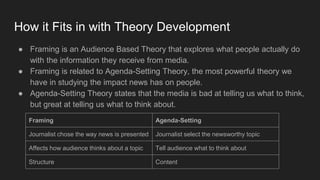
How it Fits in with Theory Development
● Framing is an Audience Based Theory that explores what people actually do
with the information they receive from media.
● Framing is related to Agenda-Setting Theory, the most powerful theory we
have in studying the impact news has on people.
● Agenda-Setting Theory states that the media is bad at telling us what to think,
but great at telling us what to think about.
Framing Agenda-Setting
Journalist chose the way news is presented Journalist select the newsworthy topic
Affects how audience thinks about a topic Tell audience what to think about
Structure Content
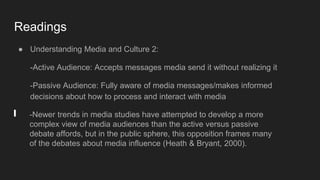
Readings
● Understanding Media and Culture 2:
-Active Audience: Accepts messages media send it without realizing it
-Passive Audience: Fully aware of media messages/makes informed
decisions about how to process and interact with media
-Newer trends in media studies have attempted to develop a more
complex view of media audiences than the active versus passive
debate affords, but in the public sphere, this opposition frames many
of the debates about media influence (Heath & Bryant, 2000).
References
● (2015, February 18). Retrieved November 5, 2019, from
https://youtu.be/htgP3bnMbLI.
● Scheufele, Dietram A. (n.d.). Retrieved November 5, 2019, from
https://lsc.wisc.edu/facstaff/scheufele-dietram/.
● Framing (social sciences). (2019, October 10). Retrieved November 5, 2019,
from https://en.wikipedia.org/wiki/Framing_(social_sciences)
● Wikipedia

You teach_framing

  • 1.
    YouTeach: Framing Kelsey Fogg,Cole McInvale, Mary Landon Montgomery
  • 2.
    Dietram A. Scheufele ●Taylor-Bascom Chair in Science Communication ● Vilas Distinguished Achievement Professor at University of Wisconsin-Madison (UW Madison) in Morgridge Institute for Research ● Member of German National Academy of Science and Engineering ● Developed a typology of framing research of framing theory into two dimensions ○ Media versus audience frames ○ Frames as independent versus dependent variables ● Developed process model of framing
  • 3.
    Key Terms ● Framing ●Second-level agenda setting ● Frame setting ● Frame Building ● Media effects
  • 4.
  • 5.
    Gregory Bateson ● Creditedwith first positioning of the theory in 1972. ● First defined the concept as “a spatial and temporal bounding of a set of interactive messages,” (Wikipedia). ● Wrote Steps to an Ecology of Mind where in Part 3 of his book he states, “among human beings this framing and labeling of messages and meaningful actions reaches considerable complexity.”
  • 6.
    Framing ● comprises aset of concepts and theoretical perspectives on how individuals, groups, and societies, organize, perceive, and communicate about reality. ● framing is a schema of interpretation, a collection of anecdotes and stereotypes, that individuals rely on to understand and respond to events.[2] In other words, people build a series of mental "filters" through biological and cultural influences. They then use these filters to make sense of the world. The choices they then make are influenced by their creation of a frame.
  • 7.
    Second Level AgendaSetting ● Concerned with the salience of issue attributes ● Describes the impact of the salience of characteristics of media coverage on audiences’ interpretation of these news stories.
  • 8.
    Frame Setting ● Howmedia framing influences an audience (wikipedia) ● Individual-level effects of framing; and alink between individual frames and media frames (i.e., journalists’ and elites’ susceptibility to framing processes). (text)
  • 9.
    Frame Building ● Howframes create societal discourse about an issue and how different frames are adopted by journalists (wikipedia) ● Processes that influence the creation or changes of frames applied by journalists (text)
  • 10.
    Media Effects ● Measurableeffects that result from media influence or a media message. ● Whether that media message has an effect on any of its audience members is contingent on many factors, including audience demographics and psychological characteristics. These effects can be positive or negative, abrupt or gradual, short-term or long-lasting. Not all effects result in change: some media messages reinforce an existing belief
  • 11.
    The history ofResearch on Media Effects ● The first stage was in the 1930s and it was what we know as Propaganda ● The second stage ended in the late 1960s and changed our thoughts about Propaganda
  • 12.
    The history ofResearch on Media Effects ● The third stage began in the 1970s and led our focus towards cognitive effects ● The fourth and current stage pointed out that media has little effect and instead we use it to frame our view and image of reality
  • 13.
    Media Frames VersusIndividual Frames ● Media Frames: a central organized storyline that provides meaning to a strip of events ● Individual Frames: mentally stored clusters of ideas that guide individuals processing of information ○ Global and Long-term political views ○ Short-term issue related frames
  • 14.
    Frames as Independentand Dependent Variables ● Dependent Variables: the direct outcome of the way mass media frames an issue ● Independent Variables: Interested in the effects of framing
  • 15.
    Media Frames asDependent Variables ● 5 Factors ○ Social norms and values ○ Organisational pressures and constraints ○ Pressures of interest groups ○ Journalistic routines ○ Ideological or political orientation of journalists
  • 16.
    Media Frames asIndependent Variables ● Can be classified into two groups: ○ The first group defined media frames as an independent variable having an impact on attitudes, opinions or individual frames ○ The second group of studies has conceptualized and measured media frames as the independent variable and individual frames as the dependent variable
  • 17.
    Individual Frames asDependent Variables ● Studies of frames as dependent variables examine the role of the various factors in influencing the creation/modification of frames. ● At the media level, the focus of framing as a dependent variable shows the journalists’ framing of a particular topic may be influenced by several social- structural or organizational variables, as well as individual or ideological variables. ● At the audience level, framing as a dependent variable examines mostly the direct outcomes of the way mass media frames the issue.
  • 18.
    Individual Frames asIndependent Variables ● Compared to dependent variables, studies in which frames serve as independent variables are interested in the effects of framing. ● In looking at media frames the outcome is usually directly linked to audience frames ● In the case of individual frames, researchers ask two questions: 1. Does individual framing of issues influence evaluations of issues or political actors? 2. Does the way individuals frame issues for themselves have an impact on willingness to engage in political action or participation?
  • 20.
    How it Fitsin with Theory Development ● Framing is an Audience Based Theory that explores what people actually do with the information they receive from media. ● Framing is related to Agenda-Setting Theory, the most powerful theory we have in studying the impact news has on people. ● Agenda-Setting Theory states that the media is bad at telling us what to think, but great at telling us what to think about. Framing Agenda-Setting Journalist chose the way news is presented Journalist select the newsworthy topic Affects how audience thinks about a topic Tell audience what to think about Structure Content
  • 21.
    Readings ● Understanding Mediaand Culture 2: -Active Audience: Accepts messages media send it without realizing it -Passive Audience: Fully aware of media messages/makes informed decisions about how to process and interact with media -Newer trends in media studies have attempted to develop a more complex view of media audiences than the active versus passive debate affords, but in the public sphere, this opposition frames many of the debates about media influence (Heath & Bryant, 2000).
  • 22.
    References ● (2015, February18). Retrieved November 5, 2019, from https://youtu.be/htgP3bnMbLI. ● Scheufele, Dietram A. (n.d.). Retrieved November 5, 2019, from https://lsc.wisc.edu/facstaff/scheufele-dietram/. ● Framing (social sciences). (2019, October 10). Retrieved November 5, 2019, from https://en.wikipedia.org/wiki/Framing_(social_sciences) ● Wikipedia