An Overview
For regular students
By
Enigmatic Students
Table of content
 Introduction
 How do they work
 How do they earn
Introduction
News is information about current events.
Humans exhibit a nearly universal desire to learn and share news, which they satisfy
talking to each other and sharing information. Technological and social
often driven by government communication have increased the speed with which
news can spread, as well as influenced its content
We Covered the World
And made it a Global Village 
Team Structure
of NEWS Channel
News Anchor
Reporter/ENG
Web Master / Social Media Manager
News Director
News Writer / Editor
Camera Operator
Broadcast Technician& Engineers
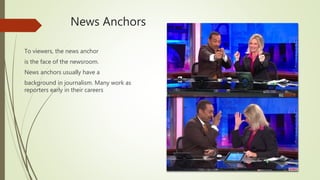
News Anchors
To viewers, the news anchor
is the face of the newsroom.
News anchors usually have a
background in journalism. Many work as
reporters early in their careers
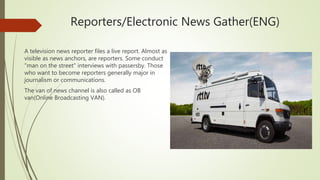
Reporters/Electronic News Gather(ENG)
A television news reporter files a live report. Almost as
visible as news anchors, are reporters. Some conduct
"man on the street" interviews with passersby. Those
who want to become reporters generally major in
journalism or communications.
The van of news channel is also called as OB
van(Online Broadcasting VAN).
Web master
Although viewers generally don't even know
what he or she looks like, a news broadcast's
webmaster or social media manager often
represents its public face. He or she is
responsible for maintaining the website,
blogging and posting stories on social
networking sites like Facebook and Twitter. This
person interacts with viewers in a way that on-
air personalities often do not.
News Writer / Editor
Television news writers and editors create scripts
for anchors, write teases used to promote stories
and produce content for the website. They must
be able to capture viewers' attention with the
intent of keeping them from changing channels or
encouraging them to tune in at a later time.
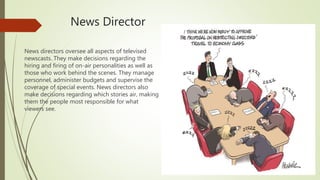
News Director
News directors oversee all aspects of televised
newscasts. They make decisions regarding the
hiring and firing of on-air personalities as well as
those who work behind the scenes. They manage
personnel, administer budgets and supervise the
coverage of special events. News directors also
make decisions regarding which stories air, making
them the people most responsible for what
viewers see.
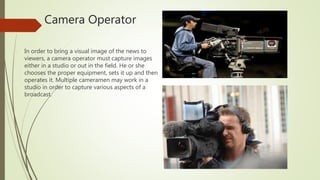
Camera Operator
In order to bring a visual image of the news to
viewers, a camera operator must capture images
either in a studio or out in the field. He or she
chooses the proper equipment, sets it up and then
operates it. Multiple cameramen may work in a
studio in order to capture various aspects of a
broadcast.
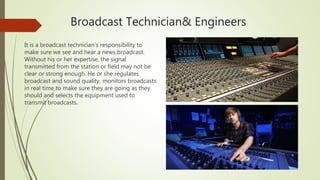
Broadcast Technician& Engineers
It is a broadcast technician's responsibility to
make sure we see and hear a news broadcast.
Without his or her expertise, the signal
transmitted from the station or field may not be
clear or strong enough. He or she regulates
broadcast and sound quality, monitors broadcasts
in real time to make sure they are going as they
should and selects the equipment used to
transmit broadcasts.
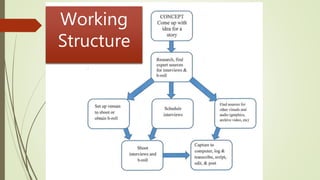
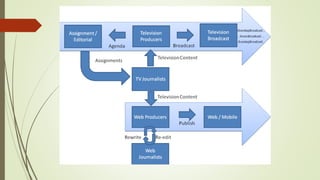
Working Structure
Working
Structure
How do they earn??
Ad revenue:
 A major chunk of money earned by TV channels comes from selling
advertisement spots. The ad spot rates are directly proportional to the GRPs and
TRPs. In effect higher GRPs (higher eyeballs) higher ad revenue.
Subscription:
 When an end user subscribes for a particular channel either on cable or DTH or
IPTV then the operator typically pays a subscription fee to the channel. This
might not be applicable for free to air or smaller channel breaking into the
market. Note that this is applicable over and above the carriage fee paid by
channel to operators.
Content royalty fee:
 TV channels generally own the content format of the shows produced by them.
So if other channels would also like to produce the shows in the same format
then they would pay a royalty fee. For example let’s say XYZ channel in US
launched program 1 and ABC in Philippines was now produce program 2 in the
same format as 1 then ABC would pay a royalty fee to XYZ provided XYZ owns
the content format.
THANK YOU

News channels ,an overview

  • 1.
    An Overview For regularstudents By Enigmatic Students
  • 2.
    Table of content Introduction  How do they work  How do they earn
  • 3.
  • 4.
    News is informationabout current events. Humans exhibit a nearly universal desire to learn and share news, which they satisfy talking to each other and sharing information. Technological and social often driven by government communication have increased the speed with which news can spread, as well as influenced its content
  • 5.
    We Covered theWorld And made it a Global Village 
  • 7.
  • 8.
    News Anchor Reporter/ENG Web Master/ Social Media Manager News Director News Writer / Editor Camera Operator Broadcast Technician& Engineers
  • 9.
    News Anchors To viewers,the news anchor is the face of the newsroom. News anchors usually have a background in journalism. Many work as reporters early in their careers
  • 10.
    Reporters/Electronic News Gather(ENG) Atelevision news reporter files a live report. Almost as visible as news anchors, are reporters. Some conduct "man on the street" interviews with passersby. Those who want to become reporters generally major in journalism or communications. The van of news channel is also called as OB van(Online Broadcasting VAN).
  • 11.
    Web master Although viewersgenerally don't even know what he or she looks like, a news broadcast's webmaster or social media manager often represents its public face. He or she is responsible for maintaining the website, blogging and posting stories on social networking sites like Facebook and Twitter. This person interacts with viewers in a way that on- air personalities often do not.
  • 12.
    News Writer /Editor Television news writers and editors create scripts for anchors, write teases used to promote stories and produce content for the website. They must be able to capture viewers' attention with the intent of keeping them from changing channels or encouraging them to tune in at a later time.
  • 13.
    News Director News directorsoversee all aspects of televised newscasts. They make decisions regarding the hiring and firing of on-air personalities as well as those who work behind the scenes. They manage personnel, administer budgets and supervise the coverage of special events. News directors also make decisions regarding which stories air, making them the people most responsible for what viewers see.
  • 14.
    Camera Operator In orderto bring a visual image of the news to viewers, a camera operator must capture images either in a studio or out in the field. He or she chooses the proper equipment, sets it up and then operates it. Multiple cameramen may work in a studio in order to capture various aspects of a broadcast.
  • 15.
    Broadcast Technician& Engineers Itis a broadcast technician's responsibility to make sure we see and hear a news broadcast. Without his or her expertise, the signal transmitted from the station or field may not be clear or strong enough. He or she regulates broadcast and sound quality, monitors broadcasts in real time to make sure they are going as they should and selects the equipment used to transmit broadcasts.
  • 16.
  • 17.
  • 19.
  • 20.
    Ad revenue:  Amajor chunk of money earned by TV channels comes from selling advertisement spots. The ad spot rates are directly proportional to the GRPs and TRPs. In effect higher GRPs (higher eyeballs) higher ad revenue.
  • 21.
    Subscription:  When anend user subscribes for a particular channel either on cable or DTH or IPTV then the operator typically pays a subscription fee to the channel. This might not be applicable for free to air or smaller channel breaking into the market. Note that this is applicable over and above the carriage fee paid by channel to operators.
  • 22.
    Content royalty fee: TV channels generally own the content format of the shows produced by them. So if other channels would also like to produce the shows in the same format then they would pay a royalty fee. For example let’s say XYZ channel in US launched program 1 and ABC in Philippines was now produce program 2 in the same format as 1 then ABC would pay a royalty fee to XYZ provided XYZ owns the content format.
  • 23.