Physiology & Characteristics of
The Normal Newborn
By
Dr. Muhsinath. A. R
DEFINITION
A healthy infant born at term b/w 38-42 wks should
have average birth wt, cries immediately following
birth, establishes independent rhythmic respiration &
quickly adapts to the changed envt.
HISToRY
 MATERNAL HISTORY
 Age, parity, medical disorders, menstrual history
 PREGNANCY PROBLEMS
 Present & past, drugs, IUFD, pre-eclampsia, IUGR,
prematurity.
 LABOUR & DELIVERY HISTORY
 Duration, anaesthesia.
Physiology of the newborn
(1) Temperature control
 Heat production ;
 basal metabolism, Shivering, chemical thermogensis
 Heat loss ;
 radiation, evaporation, convection, conduction
 Neonate ;
 subcut.fat tissue, body surface area, amniotic fluid
 Neutral thermal environment
 Infant heat regulation mechanism has not fully
developed. His temp rapidly reflect to the envt..
(2) Respirations
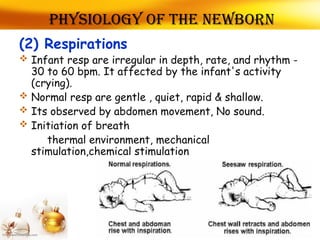
 Infant resp are irregular in depth, rate, and rhythm -
30 to 60 bpm. It affected by the infant's activity
(crying).
 Normal resp are gentle , quiet, rapid & shallow.
 Its observed by abdomen movement, No sound.
 Initiation of breath
thermal environment, mechanical
stimulation,chemical stimulation
Physiology of the newborn
(3) Blood Pressure
 The average blood pressure is 72/42. (45-60/25-
40)mmhg.
 A drop in systolic BP of about 15 mm Hg the 1st
hour
after birth is common.
 The newborn's BP may be taken with a Doppler blood
pressure device.
 This greatly improves accuracy.
Physiology of the newborn
(4) Pulse
 The normal pulse is 120 to 140 (bpm).
 The rate may rise to 160 bpm when the infant
is crying
 It drop to 100 bpm when the infant is
sleeping.
 The apical pulse is considered the most
accurate
Physiology of the newborn
Physiology of NEWBORN
INFANT'S HEAD
 The newborn infant's head represents
one-fourth of his total body length. Its
circumference is equal to that of his
abdomen or chest. The average size is
13" to 14" inch (33-35 cm). The head is
shaped or molded as it is forced through
the birth canal in vertex presentations.
Molding
 During delivery, for the large head to pass
through the small birth canal, the skull bones
may actually overlap in a process referred to
as molding. -disappears a few hours after
birth.
Fontanels
 The infant's skull is separated into six bones
one from another along the suture lines
Where more than two bones come together,
the space is called a fontanel.
 This is the unossified space or soft spot
between the cranial bones of the skull in an
infant. The infant's pulse is sometimes visible
there.
Fontanels
The anterior fontanel
 Its is located at the intersection of the
sutures of the two parietal bones and the
frontal bones.
 It is diamond-shaped and strongly pulsatile.
 It normally closes at 9 to 18 months of age.
The posterior fontanel
 Its located at the junction of the sutures of
the 2 parietal bones and 1 occipital bone.
 It is small, triangular shaped, and less
pulsatile.
 It normally closes at 1 1/2
to 3 months of age.
Fontanels
Large fontanels:
-Hypothyroidism, chromosomal abnormalities
Bulging fontanels:
-Increased ICP, Meningitis, Hydrocephalus
Decreased fontanels:
-Dehydration
Small fontanels:
-Hyperthyroidism, microcephaly, craniosyntosis
Increased ICP:
- Bulging ,separation of suture lines, prominent veins of the
scalp
Cephalohematoma
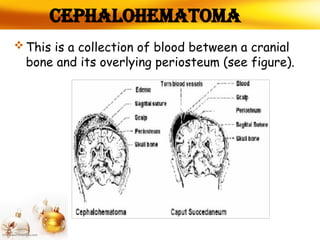
 This is a collection of blood between a cranial
bone and its overlying periosteum (see figure).
Cephalohematoma cont….
 Caused by pressure of the fetal head against
the maternal pelvis-labour
 It varies in size
 firm to the touch and tends to increase in size
from 1 to 3 days
 then become softer and more fluctuant
Caput Succedaneum
 Its abnormal collection of fluid under the
scalp on top of the skull that may or may not
cross the suture lines, depending on size.
Pressure on the presenting part of the fetal
head against the cervix during labor may
cause edema. This will be absorbed within 2 or
3 days.
NEWBORN INFANT'S EYES AND EARS
EYES :
• (1) Color: At birth, the iris color is usually
grayish-blue or brown in dark.
• A gradual deposition of pigment produces the
final eye color -3 to 6 months or one year
EYES cont…..
• (2) Pupils: The pupils do react to light
• (3) Lacrimal apparatus : is small and
nonfunctioning at birth until 1 to 3 months of
age.
• (4)Examined for :
A) congenital cataract ,
B) Brash fields spots : in the iris small white or
grayish/brown spots -Down syndrome
C) Sub conjunctival haemorrhage
Ears
 Ears to be folded and creased. A line drawn
through the inner and outer canthi of the eye
should come to the top notch of the ear
where it joins the scalp (see figure )-responds
to sound at birth.
Physiology
&
CHARACTERISTICS
OF THE
NEWBORN INFANT'S SKIN
skin
CYANOSIS:
• peripheral circulatory cyanosis : due to drugs
(nitrates)
• Acrocyanosis(harmless cyanosis): bluish hands
& feet's- cold stress (following birth)
• Central cyanosis: is caused by low oxygen
saturation , due to congenital heart & lung
disease
skin (cont…..)
 Mongolian spots
 Cavernous hemangioma
 Erythema toxicum
 Lanugo /vellous hair
 Pustular melanosis
 Vernix Caseosa
 Milia
 Hemangioma
Vernix Caseosa
• This is a soft, white, cheesy, yellowish cream
on the infant's skin at birth (see figure). It is
caused by the secretions of the sebaceous
glands of the skin
• These are tiny sebaceous retention cysts. They
appear as small white or yellow dots and are
common on the nose, forehead, and cheeks of the
infant. Its pin head size and opalescent. Its is
due to blocked sweat and oil glands -disappear a
few weeks.
MILLIA
Mongolian spot
• These are blue-black colorations on the
infant's lower back, buttocks, and anterior
trunk. It disappear in early childhood.
• it is a benign self involuting tumor of endothelial
cells (the cells that line blood vessels). -appears
during the 1ST
days or wks of life and will have
resolved at the latest by age 10. It is the most
common tumor.
Hemangioma
Pustular melanosis
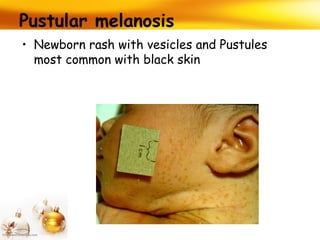
• Newborn rash with vesicles and Pustules
most common with black skin
Erythema toxicum
• A rash is a change in the color or
texture of the skin. A skin rash can be
flat, bumpy, scaly, red, skin-colored, or
slightly lighter or darker than skin color.
Vellous hair
• Vellous hairs are short, fine, light colored,
and barely noticed, as compared with terminal
hair.Vellus hair is usually less than 2 mm long
and the follicles are not connected to
sebaceous glands
Physiology of the newborn skin (cont…..)
 JAUNDICE:
yellow discoloration
 PALLOR:
due to anaemia, asphyxia, shock, edema
 PETECHIAE:
small, blue-red dots on the infants-grain
 PLETHORA:
seen in polycythemia infants
 STROKE BITES:
present small reddened areas on eyelids, mild
forehead, nape of the neck
 HEMANGIOMA:
strawberry mark, characterised by a dark or bright
red raised, rough surface
(6) Digestive
 Bowel musculature ; weak
 Mouth
 Stomach: capacity - 1 to 2 ounces (30 to 60 ml) at
birth
- digestion of simple CHO, proteins, limit fat
digestion
 Meconium passage ; 10hr after birth
> 24hr
The first stools after birth and for three to four
days afterwards are called meconium.
 Transitional stool ; the first 4ds-2wk
Physiology of the newborn
CHARACTERISTICS OF THE NEWBORN
CIRCULATORY SYSTEM
• Blood Coagulation: the first few days of life, the
prothrombin level decreases and clotting time in
all infants is prolonged. This process is most acute
b/w the 2nd
& 5th
PN days
• Blood Flow: umbilical blood stops flowing at birth,
sudden pressure differences occur within the
circulatory system. These differences cause the
blood flowing to the lungs and liver to increase
and the blood flowing through the bypass channels
to decrease.
(7) ENDOCRINE SYSTEM
 Vaginal discharge and/ blding : may occur in
female infants. This discharge is white mucoid
in color. The entire process terminates in one
to two days.
 Enlargement of the mammary glands : may
occur in both sexes. This is particularly
noticeable about the 3 day of life. Breast
secretion may also occur. Swelling usually
subsides in 2 to3weeks.
Physiology of the newborn
(8) Urinary system
 Immature nephron 106
 GFR ; 25% of adult value
 Low tubular concentration function
 Urination ; the 1st
day 15ml
10th day 100-300ml
 Urinary sys. work-up ; after 2days
 Urate excretion
Physiology of the newborn
(9) nervous system
 Normal primitive reflex
 Moro reflex
 tonic neck reflex
 grasp reflex
 rooting reflex
 sucking reflex
 stepping reflex
 traction reflex
 Crawling reflex
 Erp’s palsy
Stepping reflex
Moro reflex
Rooting reflex
The infant turns his head to the side when the side of
his face is touched.
Grasping reflex
Asymmetric tonic neck reflex
The infant assumes a fencer's position. His
arm and leg on one side is extended, the opposite
side is flexed. His head is turned toward
extended side.
NEWBORN REFLEX APPEARANCE & DISAPPERANCE
REFLEX APPEARANCE DISAPPERANCE
Blinking NEWBORN Persist into adulthood
Moro NEWBORN 3-6 month
Grasp NEWBORN 3-4month
Stepping NEWBORN (birth) 1-2month
Tonic neck NEWBORN 3-4month
Sneeze NEWBORN Persist into adulthood
Rooting Birth 4-6month
Gag NEWBORN Persist into adulthood
Cough NEWBORN Persist into adulthood
Babin skin NEWBORN 12month
neurological development is
depent on GESTATIONAL AGE
Charecter ≤36 Weeks 37-28 Weeks ≥ 39 Weeks
Sole creases 1-2 transferse
creases: post ¾ sole
smooth
Multiple creases,
Anterior 2/3 of heel
smooth
Entire sole
covered with
creases
Breast Nodule 2mm 4mm 7mm
Scalp hair Fine Fine Coarse, silky
Ear lobe No cartilage Moderate Stiff ear lope,
thick cartilage
Testes and
Scrotum
Testes partially
descended scrotum
small and few rugae
- Testes fully
descended
scrotum – normal
size prominent
rugae
Hematology
 Blood vol. - 85ml/kg
 Hb% - 19.3 g/dl(18-20)gm%
 WBC - 9000-30000/mm3
 Platelets - nl – prolongation (the first2-3ds)
 Metabolic acidosis
 RBC – 6 to 8 million/cumm
 platelets – 3,50,000/cumm
 Sedimentation rate – markedly elevated
 Clotting power poor – b/c Deficient of vit-k
Physiology of the newborn
NEWBORN INFANT ASSESSMENT
Physical examination
of the newborn
• Initial exam ;
– every 30min after birth or until stabilized
• Second exam ;
– within 24hr of birth
Physical examination(1)
• Vital sign
• weight, length, head circumference
• Gestational age
• General appearance
state of consciousness
muscle tone
activity
obvious anomalies/injuries
Physical examination(2)
• Skin texture of skin
vernix
lanugo
milia
erythema toxicum
hemangioma/nevi
dermal sinus
jaundice
-smooth, flexible, good skin, warm,
turgor
Physical examination(3)
• Head caput succedaneum
cephal hematoma
molding/skull fracture
fontanelles(ant.20mm)
suture line/craniosynostosis
craniotabes
Physical examination(4)
• Eye labyrinthine(neck) reflex
leukokoria
pupillary reflex(G.A 30wk)
subconjunctival hemorrhage
leukokoria
Physical examination(5)
• Ear
placement & deformation
low-set, posteriorly rotated ear
preauricular skin tag
gross hearing( handclap)
• Nose
patency of each naris
non-functional nasolacrimal ducts
for 1-5days(50%)
Physical examination(6)
• Neck relatively short
goiter/cystic hygroma
congenital torticollis redundant
skin/webbing
branchial cleft rests
Mouth
• retention cysts Ebstein pearls
• natal teeth
• frenulum
Cleft palate/cleft lip
Physical examination(7)
• Chest pectus carinatum/excavatum
witch’s milk/engorgement
accessory nipple
shield-shaped chest
diaphragmatic breathing
heart murmur(1;12 CHD)
sinus bradycardia
Physical examination(8)
• Abdomen weak abdominal wall
diastasis recti
umbilical hernia
schaphoid abdomen
liver (palpable 2 finger)
spleen tip
lower pole of left kidney
Umbilical hernia
Physical examination(9)
• Abdomen
visible gastric,bowel patterns
abdominal mass(1/1000.benign)
renal pathology ; 55% of mass
omphaloceles
omphalitis
• Genitalia imperforated anus
clear white mucus in vagina
transitory hydrocele
Hydrocele/Inguinal hernia
Physical examination(10)
• Musculoskeletal
positional deformation
congenital dislocation of hip
fetal neuromuscular dis.
• Neurologic exam
Apgar score
sign 0 1 2
Heart rate absent Below 100 Over 100
Resp.effort absent Slow,irregular Good crying
Muscle tone limp Some flexion Active motion
Response
to catheter in
nostril
No response grimace Cough/sneeze
color Blue, pale Body pink,
ext.blue
Complete pink
CHANGES DURING THE 1ST
WEEK
• POSITION:
– the feet are less dorsiflexed ,
– Hands are less elenched.
• WT:
– 4th
& 5th
day-10% loss,
– 25-30 gm /day
• SKIN:
– pinkish to pale
– Become dry & scaly
– Slight yellow-60% baby
• HEAD:
– Moulding& caput- disappear
• TEMPRATURE : Varition occur
• ABDOMEN:
• Cord – dry, falls-5th
-7th
day
• STOOL:
• Meconiun :
– 3-4times, 2-3 days-12 hrs
– 3rd
-4th
day –changing stool –yellowish brown
– Bottle feeding-hard , pale in colour
– No of stool passed- 2-3 times /24 hrs
• URINE:
– DURING 1ST
WEEK-60ml/24 hrs
– U/O increase to 200-300 ml/day by the 7th
day
CHANGES DURING THE 1ST WEEK
BIBLIOGRAPHY
• Susan scott ricci
• D.c dutta
• Lowdermilk, perry
• Dorothy R marlow
newborn physiology,characteristics classification.ppt

newborn physiology,characteristics classification.ppt

  • 1.
    Physiology & Characteristicsof The Normal Newborn By Dr. Muhsinath. A. R
  • 2.
    DEFINITION A healthy infantborn at term b/w 38-42 wks should have average birth wt, cries immediately following birth, establishes independent rhythmic respiration & quickly adapts to the changed envt.
  • 3.
    HISToRY  MATERNAL HISTORY Age, parity, medical disorders, menstrual history  PREGNANCY PROBLEMS  Present & past, drugs, IUFD, pre-eclampsia, IUGR, prematurity.  LABOUR & DELIVERY HISTORY  Duration, anaesthesia.
  • 4.
    Physiology of thenewborn (1) Temperature control  Heat production ;  basal metabolism, Shivering, chemical thermogensis  Heat loss ;  radiation, evaporation, convection, conduction  Neonate ;  subcut.fat tissue, body surface area, amniotic fluid  Neutral thermal environment  Infant heat regulation mechanism has not fully developed. His temp rapidly reflect to the envt..
  • 5.
    (2) Respirations  Infantresp are irregular in depth, rate, and rhythm - 30 to 60 bpm. It affected by the infant's activity (crying).  Normal resp are gentle , quiet, rapid & shallow.  Its observed by abdomen movement, No sound.  Initiation of breath thermal environment, mechanical stimulation,chemical stimulation Physiology of the newborn
  • 6.
    (3) Blood Pressure The average blood pressure is 72/42. (45-60/25- 40)mmhg.  A drop in systolic BP of about 15 mm Hg the 1st hour after birth is common.  The newborn's BP may be taken with a Doppler blood pressure device.  This greatly improves accuracy. Physiology of the newborn
  • 7.
    (4) Pulse  Thenormal pulse is 120 to 140 (bpm).  The rate may rise to 160 bpm when the infant is crying  It drop to 100 bpm when the infant is sleeping.  The apical pulse is considered the most accurate Physiology of the newborn
  • 8.
    Physiology of NEWBORN INFANT'SHEAD  The newborn infant's head represents one-fourth of his total body length. Its circumference is equal to that of his abdomen or chest. The average size is 13" to 14" inch (33-35 cm). The head is shaped or molded as it is forced through the birth canal in vertex presentations.
  • 9.
    Molding  During delivery,for the large head to pass through the small birth canal, the skull bones may actually overlap in a process referred to as molding. -disappears a few hours after birth.
  • 10.
    Fontanels  The infant'sskull is separated into six bones one from another along the suture lines Where more than two bones come together, the space is called a fontanel.  This is the unossified space or soft spot between the cranial bones of the skull in an infant. The infant's pulse is sometimes visible there.
  • 11.
  • 12.
    The anterior fontanel Its is located at the intersection of the sutures of the two parietal bones and the frontal bones.  It is diamond-shaped and strongly pulsatile.  It normally closes at 9 to 18 months of age.
  • 13.
    The posterior fontanel Its located at the junction of the sutures of the 2 parietal bones and 1 occipital bone.  It is small, triangular shaped, and less pulsatile.  It normally closes at 1 1/2 to 3 months of age.
  • 14.
    Fontanels Large fontanels: -Hypothyroidism, chromosomalabnormalities Bulging fontanels: -Increased ICP, Meningitis, Hydrocephalus Decreased fontanels: -Dehydration Small fontanels: -Hyperthyroidism, microcephaly, craniosyntosis Increased ICP: - Bulging ,separation of suture lines, prominent veins of the scalp
  • 15.
    Cephalohematoma  This isa collection of blood between a cranial bone and its overlying periosteum (see figure).
  • 16.
    Cephalohematoma cont….  Causedby pressure of the fetal head against the maternal pelvis-labour  It varies in size  firm to the touch and tends to increase in size from 1 to 3 days  then become softer and more fluctuant
  • 17.
    Caput Succedaneum  Itsabnormal collection of fluid under the scalp on top of the skull that may or may not cross the suture lines, depending on size. Pressure on the presenting part of the fetal head against the cervix during labor may cause edema. This will be absorbed within 2 or 3 days.
  • 18.
    NEWBORN INFANT'S EYESAND EARS EYES : • (1) Color: At birth, the iris color is usually grayish-blue or brown in dark. • A gradual deposition of pigment produces the final eye color -3 to 6 months or one year
  • 19.
    EYES cont….. • (2)Pupils: The pupils do react to light • (3) Lacrimal apparatus : is small and nonfunctioning at birth until 1 to 3 months of age. • (4)Examined for : A) congenital cataract ,
  • 20.
    B) Brash fieldsspots : in the iris small white or grayish/brown spots -Down syndrome C) Sub conjunctival haemorrhage
  • 21.
    Ears  Ears tobe folded and creased. A line drawn through the inner and outer canthi of the eye should come to the top notch of the ear where it joins the scalp (see figure )-responds to sound at birth.
  • 22.
  • 23.
    skin CYANOSIS: • peripheral circulatorycyanosis : due to drugs (nitrates) • Acrocyanosis(harmless cyanosis): bluish hands & feet's- cold stress (following birth) • Central cyanosis: is caused by low oxygen saturation , due to congenital heart & lung disease
  • 24.
    skin (cont…..)  Mongolianspots  Cavernous hemangioma  Erythema toxicum  Lanugo /vellous hair  Pustular melanosis  Vernix Caseosa  Milia  Hemangioma
  • 25.
    Vernix Caseosa • Thisis a soft, white, cheesy, yellowish cream on the infant's skin at birth (see figure). It is caused by the secretions of the sebaceous glands of the skin
  • 26.
    • These aretiny sebaceous retention cysts. They appear as small white or yellow dots and are common on the nose, forehead, and cheeks of the infant. Its pin head size and opalescent. Its is due to blocked sweat and oil glands -disappear a few weeks. MILLIA
  • 27.
    Mongolian spot • Theseare blue-black colorations on the infant's lower back, buttocks, and anterior trunk. It disappear in early childhood.
  • 28.
    • it isa benign self involuting tumor of endothelial cells (the cells that line blood vessels). -appears during the 1ST days or wks of life and will have resolved at the latest by age 10. It is the most common tumor. Hemangioma
  • 29.
    Pustular melanosis • Newbornrash with vesicles and Pustules most common with black skin
  • 30.
    Erythema toxicum • Arash is a change in the color or texture of the skin. A skin rash can be flat, bumpy, scaly, red, skin-colored, or slightly lighter or darker than skin color.
  • 31.
    Vellous hair • Velloushairs are short, fine, light colored, and barely noticed, as compared with terminal hair.Vellus hair is usually less than 2 mm long and the follicles are not connected to sebaceous glands
  • 32.
    Physiology of thenewborn skin (cont…..)  JAUNDICE: yellow discoloration  PALLOR: due to anaemia, asphyxia, shock, edema  PETECHIAE: small, blue-red dots on the infants-grain  PLETHORA: seen in polycythemia infants  STROKE BITES: present small reddened areas on eyelids, mild forehead, nape of the neck  HEMANGIOMA: strawberry mark, characterised by a dark or bright red raised, rough surface
  • 33.
    (6) Digestive  Bowelmusculature ; weak  Mouth  Stomach: capacity - 1 to 2 ounces (30 to 60 ml) at birth - digestion of simple CHO, proteins, limit fat digestion  Meconium passage ; 10hr after birth > 24hr The first stools after birth and for three to four days afterwards are called meconium.  Transitional stool ; the first 4ds-2wk Physiology of the newborn
  • 34.
    CHARACTERISTICS OF THENEWBORN CIRCULATORY SYSTEM • Blood Coagulation: the first few days of life, the prothrombin level decreases and clotting time in all infants is prolonged. This process is most acute b/w the 2nd & 5th PN days • Blood Flow: umbilical blood stops flowing at birth, sudden pressure differences occur within the circulatory system. These differences cause the blood flowing to the lungs and liver to increase and the blood flowing through the bypass channels to decrease.
  • 35.
    (7) ENDOCRINE SYSTEM Vaginal discharge and/ blding : may occur in female infants. This discharge is white mucoid in color. The entire process terminates in one to two days.  Enlargement of the mammary glands : may occur in both sexes. This is particularly noticeable about the 3 day of life. Breast secretion may also occur. Swelling usually subsides in 2 to3weeks. Physiology of the newborn
  • 36.
    (8) Urinary system Immature nephron 106  GFR ; 25% of adult value  Low tubular concentration function  Urination ; the 1st day 15ml 10th day 100-300ml  Urinary sys. work-up ; after 2days  Urate excretion Physiology of the newborn
  • 37.
    Physiology of thenewborn (9) nervous system  Normal primitive reflex  Moro reflex  tonic neck reflex  grasp reflex  rooting reflex  sucking reflex  stepping reflex  traction reflex  Crawling reflex  Erp’s palsy
  • 38.
  • 39.
  • 40.
    Rooting reflex The infantturns his head to the side when the side of his face is touched.
  • 41.
  • 42.
    Asymmetric tonic neckreflex The infant assumes a fencer's position. His arm and leg on one side is extended, the opposite side is flexed. His head is turned toward extended side.
  • 43.
    NEWBORN REFLEX APPEARANCE& DISAPPERANCE REFLEX APPEARANCE DISAPPERANCE Blinking NEWBORN Persist into adulthood Moro NEWBORN 3-6 month Grasp NEWBORN 3-4month Stepping NEWBORN (birth) 1-2month Tonic neck NEWBORN 3-4month Sneeze NEWBORN Persist into adulthood Rooting Birth 4-6month Gag NEWBORN Persist into adulthood Cough NEWBORN Persist into adulthood Babin skin NEWBORN 12month
  • 44.
    neurological development is depenton GESTATIONAL AGE Charecter ≤36 Weeks 37-28 Weeks ≥ 39 Weeks Sole creases 1-2 transferse creases: post ¾ sole smooth Multiple creases, Anterior 2/3 of heel smooth Entire sole covered with creases Breast Nodule 2mm 4mm 7mm Scalp hair Fine Fine Coarse, silky Ear lobe No cartilage Moderate Stiff ear lope, thick cartilage Testes and Scrotum Testes partially descended scrotum small and few rugae - Testes fully descended scrotum – normal size prominent rugae
  • 45.
    Hematology  Blood vol.- 85ml/kg  Hb% - 19.3 g/dl(18-20)gm%  WBC - 9000-30000/mm3  Platelets - nl – prolongation (the first2-3ds)  Metabolic acidosis  RBC – 6 to 8 million/cumm  platelets – 3,50,000/cumm  Sedimentation rate – markedly elevated  Clotting power poor – b/c Deficient of vit-k Physiology of the newborn
  • 46.
  • 47.
    Physical examination of thenewborn • Initial exam ; – every 30min after birth or until stabilized • Second exam ; – within 24hr of birth
  • 48.
    Physical examination(1) • Vitalsign • weight, length, head circumference • Gestational age • General appearance state of consciousness muscle tone activity obvious anomalies/injuries
  • 49.
    Physical examination(2) • Skintexture of skin vernix lanugo milia erythema toxicum hemangioma/nevi dermal sinus jaundice -smooth, flexible, good skin, warm, turgor
  • 50.
    Physical examination(3) • Headcaput succedaneum cephal hematoma molding/skull fracture fontanelles(ant.20mm) suture line/craniosynostosis craniotabes
  • 51.
    Physical examination(4) • Eyelabyrinthine(neck) reflex leukokoria pupillary reflex(G.A 30wk) subconjunctival hemorrhage
  • 52.
  • 53.
    Physical examination(5) • Ear placement& deformation low-set, posteriorly rotated ear preauricular skin tag gross hearing( handclap) • Nose patency of each naris non-functional nasolacrimal ducts for 1-5days(50%)
  • 54.
    Physical examination(6) • Neckrelatively short goiter/cystic hygroma congenital torticollis redundant skin/webbing branchial cleft rests
  • 55.
    Mouth • retention cystsEbstein pearls • natal teeth • frenulum
  • 56.
  • 57.
    Physical examination(7) • Chestpectus carinatum/excavatum witch’s milk/engorgement accessory nipple shield-shaped chest diaphragmatic breathing heart murmur(1;12 CHD) sinus bradycardia
  • 58.
    Physical examination(8) • Abdomenweak abdominal wall diastasis recti umbilical hernia schaphoid abdomen liver (palpable 2 finger) spleen tip lower pole of left kidney
  • 59.
  • 60.
    Physical examination(9) • Abdomen visiblegastric,bowel patterns abdominal mass(1/1000.benign) renal pathology ; 55% of mass omphaloceles omphalitis • Genitalia imperforated anus clear white mucus in vagina transitory hydrocele
  • 61.
  • 62.
    Physical examination(10) • Musculoskeletal positionaldeformation congenital dislocation of hip fetal neuromuscular dis. • Neurologic exam
  • 63.
    Apgar score sign 01 2 Heart rate absent Below 100 Over 100 Resp.effort absent Slow,irregular Good crying Muscle tone limp Some flexion Active motion Response to catheter in nostril No response grimace Cough/sneeze color Blue, pale Body pink, ext.blue Complete pink
  • 65.
    CHANGES DURING THE1ST WEEK • POSITION: – the feet are less dorsiflexed , – Hands are less elenched. • WT: – 4th & 5th day-10% loss, – 25-30 gm /day • SKIN: – pinkish to pale – Become dry & scaly – Slight yellow-60% baby • HEAD: – Moulding& caput- disappear • TEMPRATURE : Varition occur • ABDOMEN: • Cord – dry, falls-5th -7th day
  • 66.
    • STOOL: • Meconiun: – 3-4times, 2-3 days-12 hrs – 3rd -4th day –changing stool –yellowish brown – Bottle feeding-hard , pale in colour – No of stool passed- 2-3 times /24 hrs • URINE: – DURING 1ST WEEK-60ml/24 hrs – U/O increase to 200-300 ml/day by the 7th day CHANGES DURING THE 1ST WEEK
  • 67.
    BIBLIOGRAPHY • Susan scottricci • D.c dutta • Lowdermilk, perry • Dorothy R marlow