New Technologies in
Liver Laparoscopic Surgery
Eric Vibert, MD, PhD
Centre Hepato-Biliaire, Paul Brousse Hospital (AP-HP)
Drawbacks of Laparoscopy in Liver Surgery
•No palpation of the liver surface for subcapsular tumor
•More difficult tumoral margin visualization
•Less degree of freedom of laparoscopic instruments
•No palpation of the liver surface for subcapsular tumor
•More difficult tumoral margin visualization
170 patients operated by laparotomy for HCC who had received ICG (0.5 mg/kg) at least 48 hours before liver surgery
Intraop. detection of 21 new spots in 19 patients  14 HCC (8.2%) and 7 False-Positive
Low specificity in severe cirrhosis
Macroscopic vascular (or duct bile) invasion
40 patients operated by laparotomy / Detection of new superficial metastases in 5/40 (12% of patients)
New lesion in 2/30 pts operated
for CRLM in Paul Brousse
(Unpublished data)
Fluorescent Fusion images on lap normal image
Bile Duct Vizualisation and Anatomical Resection
With the courtesy of T. Ishizawa and M. Terazawa
Injection of 5 mg of ICG at least 3 hours
before surgery to enhanced bile duct
more than normal liver
Injection of 1.5 mg of ICG during surgery
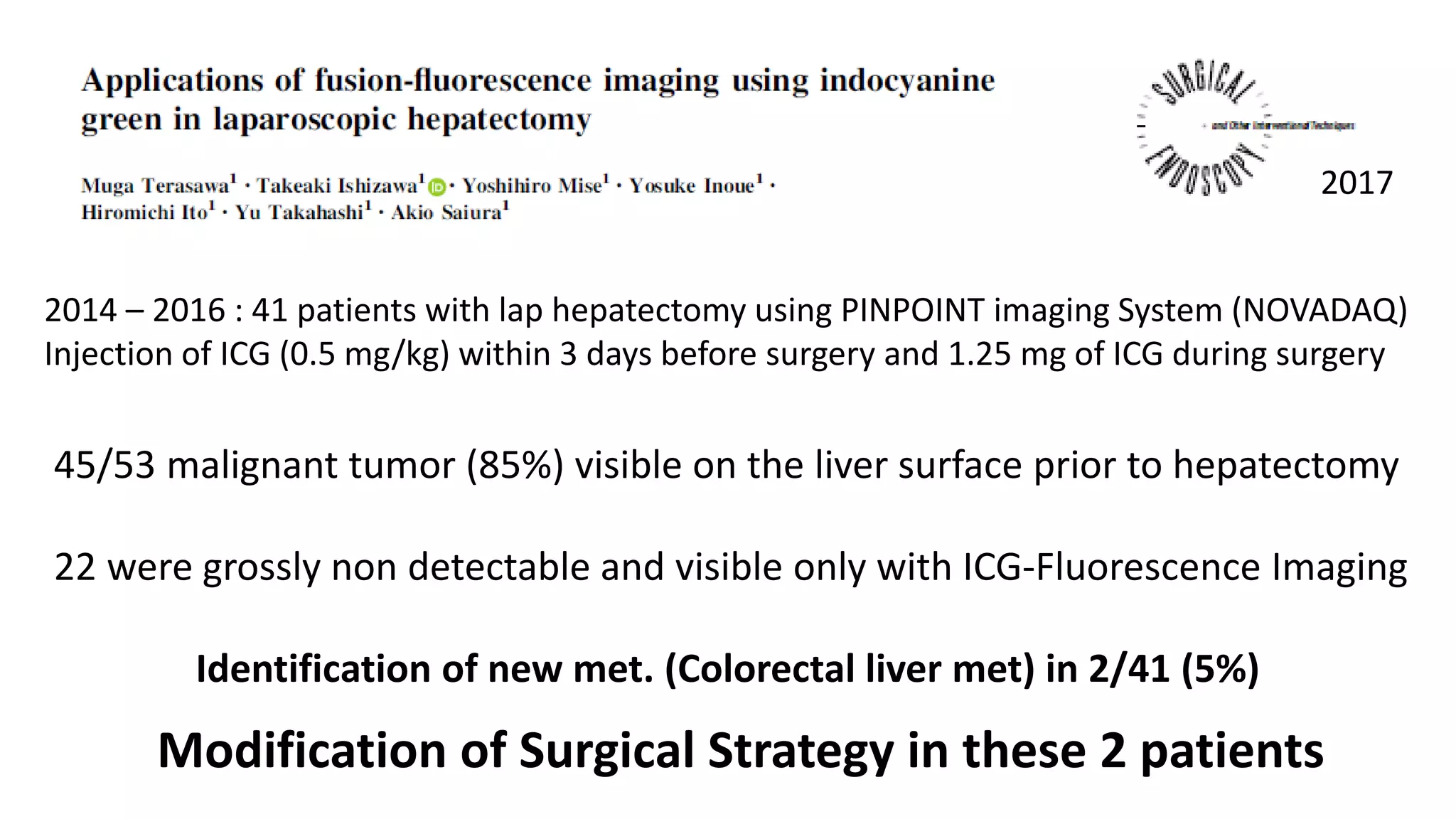
2014 – 2016 : 41 patients with lap hepatectomy using PINPOINT imaging System (NOVADAQ)
Injection of ICG (0.5 mg/kg) within 3 days before surgery and 1.25 mg of ICG during surgery
45/53 malignant tumor (85%) visible on the liver surface prior to hepatectomy
22 were grossly non detectable and visible only with ICG-Fluorescence Imaging
Identification of new met. (Colorectal liver met) in 2/41 (5%)
2017
Modification of Surgical Strategy in these 2 patients
With the courtesy of T. Ishizawa and M. Terasawa
5-ALA : Natural Precusor of Heme that could be accumulated in Cancer… Less sensible but more specific than ICG
Arginine-Glycine-
Aspartic Acid
(RGD) is ligand of
tumoral integrin
NanoParticule Loaded with RGD and ICG
gGlu-HMRG was topically applied to 103 freshly resected specimen
Features of CRLM
Impact the recurrence
Intra-Operative Pathological Analysis
With the courtesy of B. Gayet and D. Fuks
VizioBot – Confocal MiniProbe
Persee Protocol – IMM
MaunaKea Technology
Proof of Concept
After ICG Injection
Proof of concept in 6 patients with HCC (n=4) and ICC (n=2)
Low Fluo
Heterogenous
and Low Fluo
HCC
ICC
High Fluo
High Fluo
Potential Drawbacks of Laparoscopy in Liver
•No palpation of the liver surface for subcapsular tumor
•More difficult tumoral margin visualization
•Less degree of freedom of laparoscopic instruments
Synergic Robot : Comanipulation or Cobot…
The « Cobot » is manipulated by the surgeon on the surgical field
Stabilize the gesture and decreased tremor
Also usefull for stabilization of 3D Camera
The cobot knows in real time where is the tip of instrument and
could be become resistante to avoid dangerous area of the field
Achille Robot Develloped by B. Gayet and ISIR Lab
Smartphone of the Expert Surgeon… or Pathologist
Advices….
Streaming
The Future of Lap Liver Laparoscopy
• Additionally to Robotic and Intra Operative Enhanced Reality
• Improvement of guided fluorescent liver surgery with new probe
• Microscopic IntraOperative Analysis of margin using Confocal Microscopy
• Potential alternative to Robotic Surgery using Synergic Robot
• Improvement of Intra-Operative Communication
Computer-Brain Interface… one day wireless

New Technologies in Liver Laparoscopic Surgery

  • 1.
    New Technologies in LiverLaparoscopic Surgery Eric Vibert, MD, PhD Centre Hepato-Biliaire, Paul Brousse Hospital (AP-HP)
  • 2.
    Drawbacks of Laparoscopyin Liver Surgery •No palpation of the liver surface for subcapsular tumor •More difficult tumoral margin visualization •Less degree of freedom of laparoscopic instruments
  • 3.
    •No palpation ofthe liver surface for subcapsular tumor •More difficult tumoral margin visualization
  • 4.
    170 patients operatedby laparotomy for HCC who had received ICG (0.5 mg/kg) at least 48 hours before liver surgery Intraop. detection of 21 new spots in 19 patients  14 HCC (8.2%) and 7 False-Positive Low specificity in severe cirrhosis
  • 5.
    Macroscopic vascular (orduct bile) invasion
  • 6.
    40 patients operatedby laparotomy / Detection of new superficial metastases in 5/40 (12% of patients) New lesion in 2/30 pts operated for CRLM in Paul Brousse (Unpublished data)
  • 7.
    Fluorescent Fusion imageson lap normal image
  • 8.
    Bile Duct Vizualisationand Anatomical Resection With the courtesy of T. Ishizawa and M. Terazawa Injection of 5 mg of ICG at least 3 hours before surgery to enhanced bile duct more than normal liver Injection of 1.5 mg of ICG during surgery
  • 9.
    2014 – 2016: 41 patients with lap hepatectomy using PINPOINT imaging System (NOVADAQ) Injection of ICG (0.5 mg/kg) within 3 days before surgery and 1.25 mg of ICG during surgery 45/53 malignant tumor (85%) visible on the liver surface prior to hepatectomy 22 were grossly non detectable and visible only with ICG-Fluorescence Imaging Identification of new met. (Colorectal liver met) in 2/41 (5%) 2017 Modification of Surgical Strategy in these 2 patients
  • 10.
    With the courtesyof T. Ishizawa and M. Terasawa
  • 11.
    With the courtesyof T. Ishizawa and M. Terasawa
  • 12.
    With the courtesyof T. Ishizawa and M. Terasawa
  • 13.
    5-ALA : NaturalPrecusor of Heme that could be accumulated in Cancer… Less sensible but more specific than ICG
  • 14.
    Arginine-Glycine- Aspartic Acid (RGD) isligand of tumoral integrin NanoParticule Loaded with RGD and ICG
  • 15.
    gGlu-HMRG was topicallyapplied to 103 freshly resected specimen Features of CRLM Impact the recurrence
  • 16.
    Intra-Operative Pathological Analysis Withthe courtesy of B. Gayet and D. Fuks VizioBot – Confocal MiniProbe Persee Protocol – IMM MaunaKea Technology
  • 17.
  • 18.
    Proof of conceptin 6 patients with HCC (n=4) and ICC (n=2) Low Fluo Heterogenous and Low Fluo HCC ICC High Fluo High Fluo
  • 19.
    Potential Drawbacks ofLaparoscopy in Liver •No palpation of the liver surface for subcapsular tumor •More difficult tumoral margin visualization •Less degree of freedom of laparoscopic instruments
  • 22.
    Synergic Robot :Comanipulation or Cobot… The « Cobot » is manipulated by the surgeon on the surgical field Stabilize the gesture and decreased tremor Also usefull for stabilization of 3D Camera The cobot knows in real time where is the tip of instrument and could be become resistante to avoid dangerous area of the field Achille Robot Develloped by B. Gayet and ISIR Lab
  • 24.
    Smartphone of theExpert Surgeon… or Pathologist Advices…. Streaming
  • 25.
    The Future ofLap Liver Laparoscopy • Additionally to Robotic and Intra Operative Enhanced Reality • Improvement of guided fluorescent liver surgery with new probe • Microscopic IntraOperative Analysis of margin using Confocal Microscopy • Potential alternative to Robotic Surgery using Synergic Robot • Improvement of Intra-Operative Communication
  • 26.