New Sepsis Guidelines
Dr maria hamid
Resident medicine
SKBZ/CMH Muzaffarabad
INTRODUCTION — Sepsis is a clinical syndrome that complicates severe
infection. It is characterized by the cardinal signs of inflammation (vasodilation,
leukocyte accumulation, increased microvascular permeability) occurring in
tissues that are remote from the infection.
 Sepsis — Sepsis is the clinical syndrome that results from a dysregulated inflammatory
response to an infection.. Diagnostic criteria for sepsis include infection (documented or
suspected) and some of the following
 General variables
 Temperature >38.3 or <36ºC
 Heart rate >90 beats/min or more than two standard deviations above the normal value for
age
 Tachypnea, respiratory rate >20 breaths/min
 Altered mental status
 Significant edema or positive fluid balance (>20 mL/kg over 24 hours)
 Hyperglycemia (plasma glucose >140 mg/dL or 7.7 mmol/L) in the absence of diabetes
 Inflammatory variables
 Leukocytosis (WBC count >12,000 microL –1 ) or leukopenia (WBC count <4000 microL –1 )
 Normal WBC count with greater than 10 percent immature forms
 Plasma C-reactive protein more than two standard deviations above the
normal value
 Plasma procalcitonin more than two standard deviations above the normal
value
 Hemodynamic variables
 Arterial hypotension (systolic blood pressure SBP <90 mmHg, MAP <70 mmHg,
or an SBP decrease >40 mmHg in adults or less than two standard deviations
below normal for age)
 Organ dysfunction variables
 Arterial hypoxemia (arterial oxygen tension [PaO 2 ]/fraction of inspired
oxygen [FiO 2 ] <300)
 Acute oliguria (urine output <0.5 mL/kg/hr for at least two hours despite
adequate fluid resuscitation)
 Creatinine increase >0.5 mg/dL or 44.2 micromol/L
 Coagulation abnormalities (international normalized ratio [INR] >1.5 or activated
partial thromboplastin time [aPTT] >60 seconds)
 Ileus (absent bowel sounds)
 Thrombocytopenia (platelet count <100,000 microL –1 )
 Hyperbilirubinemia (plasma total bilirubin >4 mg/dL or 70 micromol/L)
 Tissue perfusion variables
 Hyperlactatemia (>1 mmol/L)
 Decreased capillary refill or mottling
 Septic shock — Septic shock is defined as sepsis-induced hypotension
persisting despite adequate fluid resuscitation, which may be defined as
infusion of 30 mL/kg of crystalloids .
Risk Factors
 Bacteremia – Patients with bacteremia often develop systemic consequences of infection..
 Advanced age (≥65 years) – The incidence of sepsis is disproportionately increased in older adult patients and age is
an independent predictor of mortality due to sepsis..
 Immunosuppression – Comorbidities that depress host-defense (eg, neoplasms, renal failure, hepatic failure, AIDS)
and immunosuppressant medications are common among patients with sepsis, severe sepsis, or septic shock.
 Diabetes and cancer – Diabetes and some cancers may alter the immune system, result in an elevated risk for
developing sepsis, and increase the risk of nosocomial sepsis.
 Community acquired pneumonia
 Genetic factors. Genetic studies of susceptibility to infection have initially focused on defects of antibody
production, or a lack of T cells, phagocytes, natural killer cells, or complement. Recently, genetic defects have
been identified that impair recognition of pathogens by the innate immune system, increasing susceptibility to
specific classes of microorganisms
Surviving sepsis guidelines
1. For hospitals and health systems, we recommend using a performance improvement program for
sepsis, including sepsis screening for acutely ill, high-risk patients and standard operating
procedures for treatment.
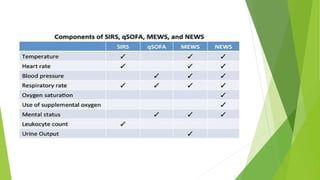
2. We recommend against using qSOFA {BP<100,GCS <13,R/R22}.compared with SIRS, NEWS, or
MEWS as a single-screening tool for sepsis or septic shock.{NEW,Strong recommendation}
Modified early warning system news{Mews]
National early warning system news{news}
Quick Sepsis related Organ Failure Assessment
3. For adults suspected of having sepsis,
we suggest measuring blood lactate.
Weak; low quality of evidence
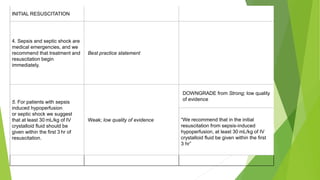
INITIAL RESUSCITATION
4. Sepsis and septic shock are
medical emergencies, and we
recommend that treatment and
resuscitation begin
immediately.
Best practice statement
5. For patients with sepsis
induced hypoperfusion
or septic shock we suggest
that at least 30 mL/kg of IV
crystalloid fluid should be
given within the first 3 hr of
resuscitation.
Weak; low quality of evidence
DOWNGRADE from Strong; low quality
of evidence
“We recommend that in the initial
resuscitation from sepsis-induced
hypoperfusion, at least 30 mL/kg of IV
crystalloid fluid be given within the first
3 hr”
6. For adults with septic
shock, we suggest using
capillary refill time to guide
resuscitation as an
adjunct to other measures
of perfusion.
Weak; low quality of evidence NEW
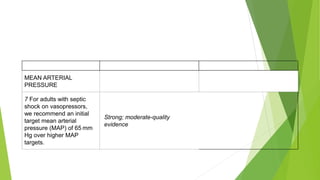
MEAN ARTERIAL
PRESSURE
7 For adults with septic
shock on vasopressors,
we recommend an initial
target mean arterial
pressure (MAP) of 65 mm
Hg over higher MAP
targets.
Strong; moderate-quality
evidence
ADMISSION TO
INTENSIVE CARE
7. For adults with sepsis
or septic shock who
require ICU admission, we
suggest admitting the
patients to the ICU within
6 hr.
Weak; low quality of evidence
INFECTION
8. For adults with
suspected sepsis or septic
shock but unconfirmed
infection, we recommend
continuously re-evaluating
and searching for
alternative diagnoses and
discontinuing empiric
antimicrobials if an
alternative cause of illness
is demonstrated or
strongly suspected.
Best practice statement
9.For adults with possible septic shock or a high likelihood for sepsis, we recommend administering
antimicrobials immediately, ideally within 1 hr of recognition.
10 For adults with possible sepsis without
shock, we recommend rapid assessment
of the likelihood of infectious versus
noninfectious causes of acute illness.
Best practice statement
11. For adults with a low
likelihood of infection and
without shock, we suggest
deferring antimicrobials
while continuing to closely
monitor the patient.
Weak; very low quality of
evidence
NEW from previous:
“We recommend that
administration of IV antimicrobials
should be initiated as soon as
possible after recognition and
within 1 hr for both a) septic
shock and b) sepsis without
shock“
Strong
recommendation; moderate
quality of evidence
12. For adults with sepsis or septic
shock at high risk for MRSA, we
recommend using empiric antimicrobials
with MRSA coverage over using
antimicrobials without MRSA coverage.
Best practice statement
17. For adults with sepsis or septic
shock at high risk for MRSA, we
recommend using empiric antimicrobials
with MRSA coverage over using
antimicrobials without MRSA coverage.
Best practice statement
13 For adults with sepsis or septic
shock at low risk for MRSA, we suggest
against using empiric antimicrobials with
MRSA coverage, as compared with using
antimicrobials without MRSA coverage.
Weak; low quality of evidence
14. For adults with
sepsis or septic
shock and high risk for
multidrug resistant
(MDR) organisms, we
suggest using two
antimicrobials with gram-
negative coverage for
empiric treatment over
one gram-negative
agent.
Weak; very low quality of
evidence
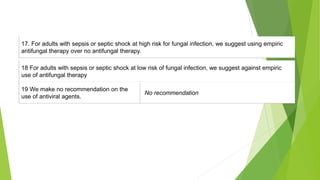
17. For adults with sepsis or septic shock at high risk for fungal infection, we suggest using empiric
antifungal therapy over no antifungal therapy.
18 For adults with sepsis or septic shock at low risk of fungal infection, we suggest against empiric
use of antifungal therapy
19 We make no recommendation on the
use of antiviral agents.
No recommendation
20. For adults with
sepsis or septic shock,
we recommend
optimising dosing
strategies of
antimicrobials based on
accepted
pharmacokinetic/pharma
codynamic (PK/PD)
principles and specific
drug properties.
Best practice statement
21. For adults with sepsis or septic shock,
we recommend rapidly identifying or
excluding a specific anatomical diagnosis
of infection that requires emergent source
control and implementing any required
source control intervention as soon as
medically and logistically practical.
Best practice statement
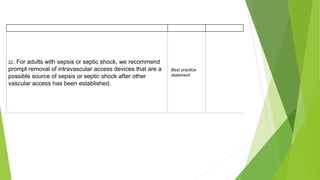
22. For adults with sepsis or septic shock, we recommend
prompt removal of intravascular access devices that are a
possible source of sepsis or septic shock after other
vascular access has been established.
Best practice
statement
23 For adults with an initial
diagnosis of sepsis or septic
shock and adequate source
control, we suggest using shorter
over longer duration of
antimicrobial therapy.
Weak; very low quality of evidence
25. For adults with septic
shock, we recommend
using norepinephrine as
the first-line agent over
other vasopressors.
Strong
Dopamine. High-quality evidence
Vasopressin. Moderate-quality
evidence
Epinephrine. Low quality of
evidence
Selepressin. Low quality of
evidence
Angiotensin II. Very low-quality
evidence
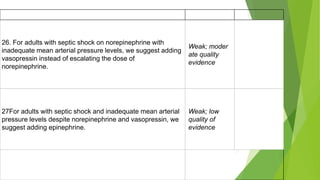
26. For adults with septic shock on norepinephrine with
inadequate mean arterial pressure levels, we suggest adding
vasopressin instead of escalating the dose of
norepinephrine.
Weak; moder
ate quality
evidence
27For adults with septic shock and inadequate mean arterial
pressure levels despite norepinephrine and vasopressin, we
suggest adding epinephrine.
Weak; low
quality of
evidence
28. For adults with septic
shock and cardiac dysfunction
with persistent hypoperfusion
despite adequate volume status
and arterial blood pressure, we
suggest against using
levosimendan.
Weak; low quality of evidence NEW
. 29For adults with septic shock,
we suggest starting vasopressors
peripherally to restore mean
arterial pressure rather than
delaying initiation until a central
venous access is secured.
Weak; very low quality of evidence NEW
VENTILATION
30. For adults with sepsis-
induced hypoxemic
respiratory failure, we
suggest the use of high
flow nasal oxygen over
noninvasive ventilation.
Weak; low quality of evidence NEW
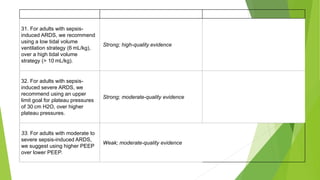
31. For adults with sepsis-
induced ARDS, we recommend
using a low tidal volume
ventilation strategy (6 mL/kg),
over a high tidal volume
strategy (> 10 mL/kg).
Strong; high-quality evidence
32. For adults with sepsis-
induced severe ARDS, we
recommend using an upper
limit goal for plateau pressures
of 30 cm H2O, over higher
plateau pressures.
Strong; moderate-quality evidence
33. For adults with moderate to
severe sepsis-induced ARDS,
we suggest using higher PEEP
over lower PEEP.
Weak; moderate-quality evidence
 34. When using recruitment maneuvers, we recommend against using
incremental PEEP titration/strategy.
 [Strong; moderate-quality evidence]
 35. For adults with sepsis-induced moderate-severe ARDS, we recommend
using prone ventilation for greater than 12 hr daily.
 [Strong; moderate-quality evidence]
ADDITIONAL THERAPIES
36. For adults with septic
shock and an ongoing
requirement for vasopressor
therapy we suggest using IV
corticosteroids.
Weak; moderate-quality evidence
UPGRADE from Weak
recommendation , low quality of
evidence
“We suggest against using IV
hydrocortisone to treat septic
shock patients if adequate fluid
resuscitation and vasopressor therapy
are able to restore hemodynamic
stability (see goals for Initial
Resuscitation). If this is not achievable,
we suggest IV hydrocortisone at a dose
of 200 mg/day.”
37 For adults with sepsis
or septic shock we recommend
using a restrictive (over liberal)
transfusion strategy.
Strong; moderate-quality evidence
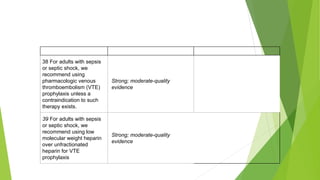
38 For adults with sepsis
or septic shock, we
recommend using
pharmacologic venous
thromboembolism (VTE)
prophylaxis unless a
contraindication to such
therapy exists.
Strong; moderate-quality
evidence
39 For adults with sepsis
or septic shock, we
recommend using low
molecular weight heparin
over unfractionated
heparin for VTE
prophylaxis
Strong; moderate-quality
evidence
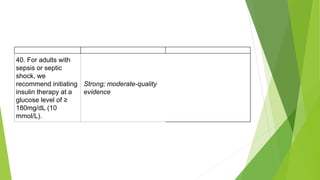
40. For adults with
sepsis or septic
shock, we
recommend initiating
insulin therapy at a
glucose level of ≥
180mg/dL (10
mmol/L).
Strong; moderate-quality
evidence
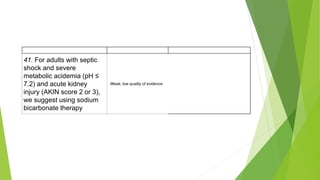
41. For adults with septic
shock and severe
metabolic acidemia (pH ≤
7.2) and acute kidney
injury (AKIN score 2 or 3),
we suggest using sodium
bicarbonate therapy
Weak; low quality of evidence
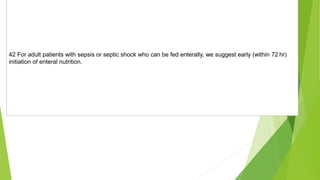
42 For adult patients with sepsis or septic shock who can be fed enterally, we suggest early (within 72 hr)
initiation of enteral nutrition.
LONG-TERM OUTCOMES AND GOALS OF CARE
43. For adults with sepsis
or septic shock, we
recommend discussing
goals of care and
prognosis with patients
and families over no such
discussion.
Best practice statement
44. For adults with
sepsis or septic
shock, we
recommend that the
principles of palliative
care (which may
include palliative care
consultation based
on clinician
judgement) be
integrated into the
treatment plan, when
appropriate, to
address patient and
family symptoms and
suffering.
Best practice statement
45 For adults with sepsis or septic
shock and their families, we
recommend screening for economic
and social support (including
housing, nutritional, financial, and
spiritual support), and make
referrals where available to meet
these needs.
Best practice statement
46. For adults with sepsis
or septic shock and their
families, we recommend the
clinical team provide the
opportunity to participate in
shared decision making in post-
ICU and hospital discharge
planning to ensure discharge
plans are acceptable and
feasible.
Best practice statement
47. For adults with sepsis
and septic shock, we
recommend reconciling
medications at both ICU and
hospital discharge.
Best practice statement
48 For adult survivors of
sepsis and septic
shock and their families,
we recommend including
information about the ICU
stay, sepsis and related
diagnoses, treatments,
and common impairments
after sepsis in the written
and verbal hospital
discharge summary.
Best practice statement
49 For adults with sepsis
or septic shock who
developed new
impairments, we
recommend hospital
discharge plans include
follow-up with clinicians
able to support and
manage new and long-
term sequelae.
Best practice statement
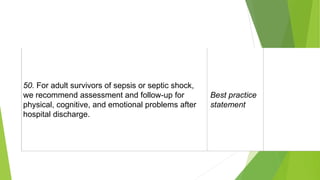
50. For adult survivors of sepsis or septic shock,
we recommend assessment and follow-up for
physical, cognitive, and emotional problems after
hospital discharge.
Best practice
statement

New sepsis guidelines.pptx...mmmmmmmmmmm

  • 1.
    New Sepsis Guidelines Drmaria hamid Resident medicine SKBZ/CMH Muzaffarabad
  • 2.
    INTRODUCTION — Sepsisis a clinical syndrome that complicates severe infection. It is characterized by the cardinal signs of inflammation (vasodilation, leukocyte accumulation, increased microvascular permeability) occurring in tissues that are remote from the infection.
  • 3.
     Sepsis —Sepsis is the clinical syndrome that results from a dysregulated inflammatory response to an infection.. Diagnostic criteria for sepsis include infection (documented or suspected) and some of the following  General variables  Temperature >38.3 or <36ºC  Heart rate >90 beats/min or more than two standard deviations above the normal value for age  Tachypnea, respiratory rate >20 breaths/min  Altered mental status  Significant edema or positive fluid balance (>20 mL/kg over 24 hours)  Hyperglycemia (plasma glucose >140 mg/dL or 7.7 mmol/L) in the absence of diabetes  Inflammatory variables  Leukocytosis (WBC count >12,000 microL –1 ) or leukopenia (WBC count <4000 microL –1 )
  • 4.
     Normal WBCcount with greater than 10 percent immature forms  Plasma C-reactive protein more than two standard deviations above the normal value  Plasma procalcitonin more than two standard deviations above the normal value  Hemodynamic variables  Arterial hypotension (systolic blood pressure SBP <90 mmHg, MAP <70 mmHg, or an SBP decrease >40 mmHg in adults or less than two standard deviations below normal for age)  Organ dysfunction variables  Arterial hypoxemia (arterial oxygen tension [PaO 2 ]/fraction of inspired oxygen [FiO 2 ] <300)
  • 5.
     Acute oliguria(urine output <0.5 mL/kg/hr for at least two hours despite adequate fluid resuscitation)  Creatinine increase >0.5 mg/dL or 44.2 micromol/L  Coagulation abnormalities (international normalized ratio [INR] >1.5 or activated partial thromboplastin time [aPTT] >60 seconds)  Ileus (absent bowel sounds)  Thrombocytopenia (platelet count <100,000 microL –1 )  Hyperbilirubinemia (plasma total bilirubin >4 mg/dL or 70 micromol/L)  Tissue perfusion variables  Hyperlactatemia (>1 mmol/L)  Decreased capillary refill or mottling
  • 6.
     Septic shock— Septic shock is defined as sepsis-induced hypotension persisting despite adequate fluid resuscitation, which may be defined as infusion of 30 mL/kg of crystalloids .
  • 7.
    Risk Factors  Bacteremia– Patients with bacteremia often develop systemic consequences of infection..  Advanced age (≥65 years) – The incidence of sepsis is disproportionately increased in older adult patients and age is an independent predictor of mortality due to sepsis..  Immunosuppression – Comorbidities that depress host-defense (eg, neoplasms, renal failure, hepatic failure, AIDS) and immunosuppressant medications are common among patients with sepsis, severe sepsis, or septic shock.  Diabetes and cancer – Diabetes and some cancers may alter the immune system, result in an elevated risk for developing sepsis, and increase the risk of nosocomial sepsis.  Community acquired pneumonia  Genetic factors. Genetic studies of susceptibility to infection have initially focused on defects of antibody production, or a lack of T cells, phagocytes, natural killer cells, or complement. Recently, genetic defects have been identified that impair recognition of pathogens by the innate immune system, increasing susceptibility to specific classes of microorganisms
  • 8.
    Surviving sepsis guidelines 1.For hospitals and health systems, we recommend using a performance improvement program for sepsis, including sepsis screening for acutely ill, high-risk patients and standard operating procedures for treatment. 2. We recommend against using qSOFA {BP<100,GCS <13,R/R22}.compared with SIRS, NEWS, or MEWS as a single-screening tool for sepsis or septic shock.{NEW,Strong recommendation} Modified early warning system news{Mews] National early warning system news{news} Quick Sepsis related Organ Failure Assessment
  • 10.
    3. For adultssuspected of having sepsis, we suggest measuring blood lactate. Weak; low quality of evidence
  • 11.
    INITIAL RESUSCITATION 4. Sepsisand septic shock are medical emergencies, and we recommend that treatment and resuscitation begin immediately. Best practice statement 5. For patients with sepsis induced hypoperfusion or septic shock we suggest that at least 30 mL/kg of IV crystalloid fluid should be given within the first 3 hr of resuscitation. Weak; low quality of evidence DOWNGRADE from Strong; low quality of evidence “We recommend that in the initial resuscitation from sepsis-induced hypoperfusion, at least 30 mL/kg of IV crystalloid fluid be given within the first 3 hr”
  • 12.
    6. For adultswith septic shock, we suggest using capillary refill time to guide resuscitation as an adjunct to other measures of perfusion. Weak; low quality of evidence NEW
  • 13.
    MEAN ARTERIAL PRESSURE 7 Foradults with septic shock on vasopressors, we recommend an initial target mean arterial pressure (MAP) of 65 mm Hg over higher MAP targets. Strong; moderate-quality evidence
  • 14.
    ADMISSION TO INTENSIVE CARE 7.For adults with sepsis or septic shock who require ICU admission, we suggest admitting the patients to the ICU within 6 hr. Weak; low quality of evidence
  • 15.
    INFECTION 8. For adultswith suspected sepsis or septic shock but unconfirmed infection, we recommend continuously re-evaluating and searching for alternative diagnoses and discontinuing empiric antimicrobials if an alternative cause of illness is demonstrated or strongly suspected. Best practice statement
  • 16.
    9.For adults withpossible septic shock or a high likelihood for sepsis, we recommend administering antimicrobials immediately, ideally within 1 hr of recognition. 10 For adults with possible sepsis without shock, we recommend rapid assessment of the likelihood of infectious versus noninfectious causes of acute illness. Best practice statement
  • 17.
    11. For adultswith a low likelihood of infection and without shock, we suggest deferring antimicrobials while continuing to closely monitor the patient. Weak; very low quality of evidence NEW from previous: “We recommend that administration of IV antimicrobials should be initiated as soon as possible after recognition and within 1 hr for both a) septic shock and b) sepsis without shock“ Strong recommendation; moderate quality of evidence
  • 18.
    12. For adultswith sepsis or septic shock at high risk for MRSA, we recommend using empiric antimicrobials with MRSA coverage over using antimicrobials without MRSA coverage. Best practice statement
  • 19.
    17. For adultswith sepsis or septic shock at high risk for MRSA, we recommend using empiric antimicrobials with MRSA coverage over using antimicrobials without MRSA coverage. Best practice statement 13 For adults with sepsis or septic shock at low risk for MRSA, we suggest against using empiric antimicrobials with MRSA coverage, as compared with using antimicrobials without MRSA coverage. Weak; low quality of evidence
  • 20.
    14. For adultswith sepsis or septic shock and high risk for multidrug resistant (MDR) organisms, we suggest using two antimicrobials with gram- negative coverage for empiric treatment over one gram-negative agent. Weak; very low quality of evidence
  • 21.
    17. For adultswith sepsis or septic shock at high risk for fungal infection, we suggest using empiric antifungal therapy over no antifungal therapy. 18 For adults with sepsis or septic shock at low risk of fungal infection, we suggest against empiric use of antifungal therapy 19 We make no recommendation on the use of antiviral agents. No recommendation
  • 22.
    20. For adultswith sepsis or septic shock, we recommend optimising dosing strategies of antimicrobials based on accepted pharmacokinetic/pharma codynamic (PK/PD) principles and specific drug properties. Best practice statement
  • 23.
    21. For adultswith sepsis or septic shock, we recommend rapidly identifying or excluding a specific anatomical diagnosis of infection that requires emergent source control and implementing any required source control intervention as soon as medically and logistically practical. Best practice statement
  • 24.
    22. For adultswith sepsis or septic shock, we recommend prompt removal of intravascular access devices that are a possible source of sepsis or septic shock after other vascular access has been established. Best practice statement
  • 25.
    23 For adultswith an initial diagnosis of sepsis or septic shock and adequate source control, we suggest using shorter over longer duration of antimicrobial therapy. Weak; very low quality of evidence
  • 26.
    25. For adultswith septic shock, we recommend using norepinephrine as the first-line agent over other vasopressors. Strong Dopamine. High-quality evidence Vasopressin. Moderate-quality evidence Epinephrine. Low quality of evidence Selepressin. Low quality of evidence Angiotensin II. Very low-quality evidence
  • 27.
    26. For adultswith septic shock on norepinephrine with inadequate mean arterial pressure levels, we suggest adding vasopressin instead of escalating the dose of norepinephrine. Weak; moder ate quality evidence 27For adults with septic shock and inadequate mean arterial pressure levels despite norepinephrine and vasopressin, we suggest adding epinephrine. Weak; low quality of evidence
  • 28.
    28. For adultswith septic shock and cardiac dysfunction with persistent hypoperfusion despite adequate volume status and arterial blood pressure, we suggest against using levosimendan. Weak; low quality of evidence NEW
  • 29.
    . 29For adultswith septic shock, we suggest starting vasopressors peripherally to restore mean arterial pressure rather than delaying initiation until a central venous access is secured. Weak; very low quality of evidence NEW
  • 30.
    VENTILATION 30. For adultswith sepsis- induced hypoxemic respiratory failure, we suggest the use of high flow nasal oxygen over noninvasive ventilation. Weak; low quality of evidence NEW
  • 31.
    31. For adultswith sepsis- induced ARDS, we recommend using a low tidal volume ventilation strategy (6 mL/kg), over a high tidal volume strategy (> 10 mL/kg). Strong; high-quality evidence 32. For adults with sepsis- induced severe ARDS, we recommend using an upper limit goal for plateau pressures of 30 cm H2O, over higher plateau pressures. Strong; moderate-quality evidence 33. For adults with moderate to severe sepsis-induced ARDS, we suggest using higher PEEP over lower PEEP. Weak; moderate-quality evidence
  • 32.
     34. Whenusing recruitment maneuvers, we recommend against using incremental PEEP titration/strategy.  [Strong; moderate-quality evidence]  35. For adults with sepsis-induced moderate-severe ARDS, we recommend using prone ventilation for greater than 12 hr daily.  [Strong; moderate-quality evidence]
  • 33.
    ADDITIONAL THERAPIES 36. Foradults with septic shock and an ongoing requirement for vasopressor therapy we suggest using IV corticosteroids. Weak; moderate-quality evidence UPGRADE from Weak recommendation , low quality of evidence “We suggest against using IV hydrocortisone to treat septic shock patients if adequate fluid resuscitation and vasopressor therapy are able to restore hemodynamic stability (see goals for Initial Resuscitation). If this is not achievable, we suggest IV hydrocortisone at a dose of 200 mg/day.”
  • 34.
    37 For adultswith sepsis or septic shock we recommend using a restrictive (over liberal) transfusion strategy. Strong; moderate-quality evidence
  • 35.
    38 For adultswith sepsis or septic shock, we recommend using pharmacologic venous thromboembolism (VTE) prophylaxis unless a contraindication to such therapy exists. Strong; moderate-quality evidence 39 For adults with sepsis or septic shock, we recommend using low molecular weight heparin over unfractionated heparin for VTE prophylaxis Strong; moderate-quality evidence
  • 36.
    40. For adultswith sepsis or septic shock, we recommend initiating insulin therapy at a glucose level of ≥ 180mg/dL (10 mmol/L). Strong; moderate-quality evidence
  • 37.
    41. For adultswith septic shock and severe metabolic acidemia (pH ≤ 7.2) and acute kidney injury (AKIN score 2 or 3), we suggest using sodium bicarbonate therapy Weak; low quality of evidence
  • 38.
    42 For adultpatients with sepsis or septic shock who can be fed enterally, we suggest early (within 72 hr) initiation of enteral nutrition.
  • 39.
    LONG-TERM OUTCOMES ANDGOALS OF CARE 43. For adults with sepsis or septic shock, we recommend discussing goals of care and prognosis with patients and families over no such discussion. Best practice statement
  • 40.
    44. For adultswith sepsis or septic shock, we recommend that the principles of palliative care (which may include palliative care consultation based on clinician judgement) be integrated into the treatment plan, when appropriate, to address patient and family symptoms and suffering. Best practice statement
  • 41.
    45 For adultswith sepsis or septic shock and their families, we recommend screening for economic and social support (including housing, nutritional, financial, and spiritual support), and make referrals where available to meet these needs. Best practice statement
  • 42.
    46. For adultswith sepsis or septic shock and their families, we recommend the clinical team provide the opportunity to participate in shared decision making in post- ICU and hospital discharge planning to ensure discharge plans are acceptable and feasible. Best practice statement 47. For adults with sepsis and septic shock, we recommend reconciling medications at both ICU and hospital discharge. Best practice statement
  • 43.
    48 For adultsurvivors of sepsis and septic shock and their families, we recommend including information about the ICU stay, sepsis and related diagnoses, treatments, and common impairments after sepsis in the written and verbal hospital discharge summary. Best practice statement 49 For adults with sepsis or septic shock who developed new impairments, we recommend hospital discharge plans include follow-up with clinicians able to support and manage new and long- term sequelae. Best practice statement
  • 44.
    50. For adultsurvivors of sepsis or septic shock, we recommend assessment and follow-up for physical, cognitive, and emotional problems after hospital discharge. Best practice statement