The New Republic
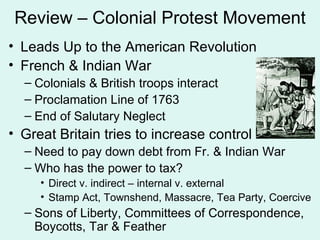
Review – Colonial Protest Movement Leads Up to the American Revolution French & Indian War Colonials & British troops interact Proclamation Line of 1763 End of Salutary Neglect Great Britain tries to increase control Need to pay down debt from Fr. & Indian War Who has the power to tax? Direct v. indirect – internal v. external Stamp Act, Townshend, Massacre, Tea Party, Coercive Sons of Liberty, Committees of Correspondence, Boycotts, Tar & Feather
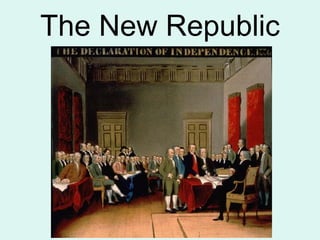
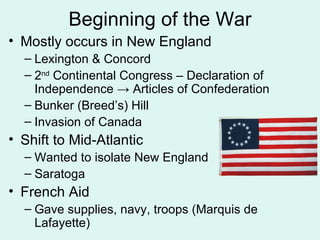
Beginning of the War Mostly occurs in New England Lexington & Concord 2 nd  Continental Congress – Declaration of Independence  ->  Articles of Confederation Bunker (Breed’s) Hill Invasion of Canada Shift to Mid-Atlantic Wanted to isolate New England Saratoga  French Aid Gave supplies, navy, troops (Marquis de Lafayette)
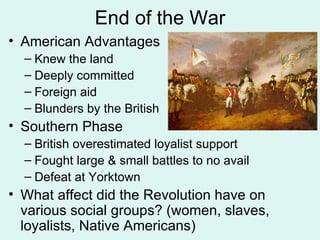
End of the War American Advantages Knew the land Deeply committed Foreign aid Blunders by the British Southern Phase British overestimated loyalist support Fought large & small battles to no avail Defeat at Yorktown What affect did the Revolution have on various social groups? (women, slaves, loyalists, Native Americans)
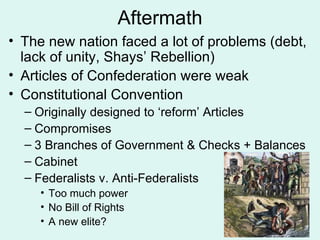
Aftermath The new nation faced a lot of problems (debt, lack of unity, Shays’ Rebellion) Articles of Confederation were weak Constitutional Convention Originally designed to ‘reform’ Articles Compromises 3 Branches of Government & Checks + Balances Cabinet Federalists v. Anti-Federalists Too much power No Bill of Rights A new elite?
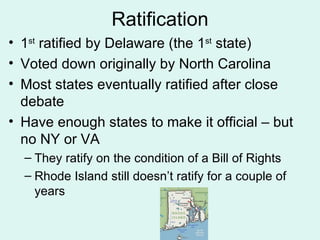
Ratification 1 st  ratified by Delaware (the 1 st  state) Voted down originally by North Carolina Most states eventually ratified after close debate Have enough states to make it official – but no NY or VA They ratify on the condition of a Bill of Rights Rhode Island still doesn’t ratify for a couple of years
Early Republic Two visions for America Strong central government Modest central government Economic implications The Federalist – Alexander Hamilton Had power at 1 st ‘enlightened’ ruling class Wanted to fund & assume the debt – done to gain support of the wealthy Bank of the United States Report on Manufacturing: excise taxes & tariffs DC becomes the capital
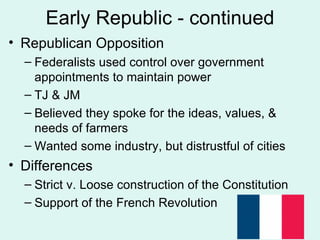
Early Republic - continued Republican Opposition Federalists used control over government appointments to maintain power TJ & JM Believed they spoke for the ideas, values, & needs of farmers Wanted some industry, but distrustful of cities Differences Strict v. Loose construction of the Constitution Support of the French Revolution
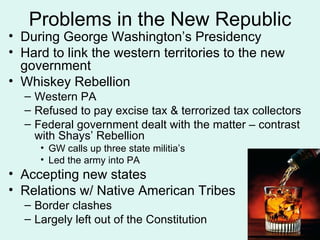
Problems in the New Republic During George Washington’s Presidency Hard to link the western territories to the new government Whiskey Rebellion Western PA Refused to pay excise tax & terrorized tax collectors Federal government dealt with the matter – contrast with Shays’ Rebellion GW calls up three state militia’s  Led the army into PA Accepting new states Relations w/ Native American Tribes Border clashes Largely left out of the Constitution
Foreign Relations in the New Republic Great Britain doesn’t send an ambassador for a while Great Britain goes for war w/ the ‘new’ France Federalists like Great Britain Republicans like France Need to stay neutral Citizen Genet Jay’s Treaty Negotiate w/ Great Britain trading regulations & sovereignty Pickney’s Treaty
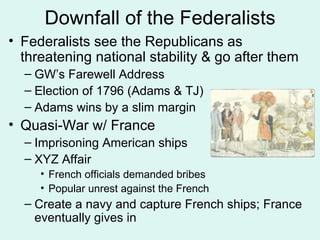
Downfall of the Federalists Federalists see the Republicans as threatening national stability & go after them GW’s Farewell Address Election of 1796 (Adams & TJ) Adams wins by a slim margin Quasi-War w/ France Imprisoning American ships XYZ Affair French officials demanded bribes Popular unrest against the French Create a navy and capture French ships; France eventually gives in
Downfall – continued Success in dealing with France gave the Federalists confidence to deal with the Republicans Alien & Sedition Acts Created new obstacles for foreigners who wished to become citizens (many of these people would vote for Republicans) Throw people in jail for speaking against the government Adams didn’t enforce the Acts very much but they still had a negative effect VA & Kentucky Resolutions – ideas of John Locke; states can ignore the federal government
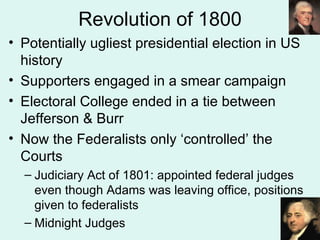
Revolution of 1800 Potentially ugliest presidential election in US history Supporters engaged in a smear campaign Electoral College ended in a tie between Jefferson & Burr Now the Federalists only ‘controlled’ the Courts Judiciary Act of 1801: appointed federal judges even though Adams was leaving office, positions given to federalists Midnight Judges

New Republic

  • 1.
  • 2.
    Review – ColonialProtest Movement Leads Up to the American Revolution French & Indian War Colonials & British troops interact Proclamation Line of 1763 End of Salutary Neglect Great Britain tries to increase control Need to pay down debt from Fr. & Indian War Who has the power to tax? Direct v. indirect – internal v. external Stamp Act, Townshend, Massacre, Tea Party, Coercive Sons of Liberty, Committees of Correspondence, Boycotts, Tar & Feather
  • 3.
    Beginning of theWar Mostly occurs in New England Lexington & Concord 2 nd Continental Congress – Declaration of Independence -> Articles of Confederation Bunker (Breed’s) Hill Invasion of Canada Shift to Mid-Atlantic Wanted to isolate New England Saratoga French Aid Gave supplies, navy, troops (Marquis de Lafayette)
  • 4.
    End of theWar American Advantages Knew the land Deeply committed Foreign aid Blunders by the British Southern Phase British overestimated loyalist support Fought large & small battles to no avail Defeat at Yorktown What affect did the Revolution have on various social groups? (women, slaves, loyalists, Native Americans)
  • 5.
    Aftermath The newnation faced a lot of problems (debt, lack of unity, Shays’ Rebellion) Articles of Confederation were weak Constitutional Convention Originally designed to ‘reform’ Articles Compromises 3 Branches of Government & Checks + Balances Cabinet Federalists v. Anti-Federalists Too much power No Bill of Rights A new elite?
  • 6.
    Ratification 1 st ratified by Delaware (the 1 st state) Voted down originally by North Carolina Most states eventually ratified after close debate Have enough states to make it official – but no NY or VA They ratify on the condition of a Bill of Rights Rhode Island still doesn’t ratify for a couple of years
  • 7.
    Early Republic Twovisions for America Strong central government Modest central government Economic implications The Federalist – Alexander Hamilton Had power at 1 st ‘enlightened’ ruling class Wanted to fund & assume the debt – done to gain support of the wealthy Bank of the United States Report on Manufacturing: excise taxes & tariffs DC becomes the capital
  • 8.
    Early Republic -continued Republican Opposition Federalists used control over government appointments to maintain power TJ & JM Believed they spoke for the ideas, values, & needs of farmers Wanted some industry, but distrustful of cities Differences Strict v. Loose construction of the Constitution Support of the French Revolution
  • 9.
    Problems in theNew Republic During George Washington’s Presidency Hard to link the western territories to the new government Whiskey Rebellion Western PA Refused to pay excise tax & terrorized tax collectors Federal government dealt with the matter – contrast with Shays’ Rebellion GW calls up three state militia’s Led the army into PA Accepting new states Relations w/ Native American Tribes Border clashes Largely left out of the Constitution
  • 10.
    Foreign Relations inthe New Republic Great Britain doesn’t send an ambassador for a while Great Britain goes for war w/ the ‘new’ France Federalists like Great Britain Republicans like France Need to stay neutral Citizen Genet Jay’s Treaty Negotiate w/ Great Britain trading regulations & sovereignty Pickney’s Treaty
  • 11.
    Downfall of theFederalists Federalists see the Republicans as threatening national stability & go after them GW’s Farewell Address Election of 1796 (Adams & TJ) Adams wins by a slim margin Quasi-War w/ France Imprisoning American ships XYZ Affair French officials demanded bribes Popular unrest against the French Create a navy and capture French ships; France eventually gives in
  • 12.
    Downfall – continuedSuccess in dealing with France gave the Federalists confidence to deal with the Republicans Alien & Sedition Acts Created new obstacles for foreigners who wished to become citizens (many of these people would vote for Republicans) Throw people in jail for speaking against the government Adams didn’t enforce the Acts very much but they still had a negative effect VA & Kentucky Resolutions – ideas of John Locke; states can ignore the federal government
  • 13.
    Revolution of 1800Potentially ugliest presidential election in US history Supporters engaged in a smear campaign Electoral College ended in a tie between Jefferson & Burr Now the Federalists only ‘controlled’ the Courts Judiciary Act of 1801: appointed federal judges even though Adams was leaving office, positions given to federalists Midnight Judges