1
w w w . a s i a n h h m . c o m
Associate Partner
ISSUE 55 2022 www.asianhhm.com
IMPLICATIONS
OF COVID-19 ON
HEART HEALTH
A DIGITAL
REVOLUTION
IN PATHOLOGY
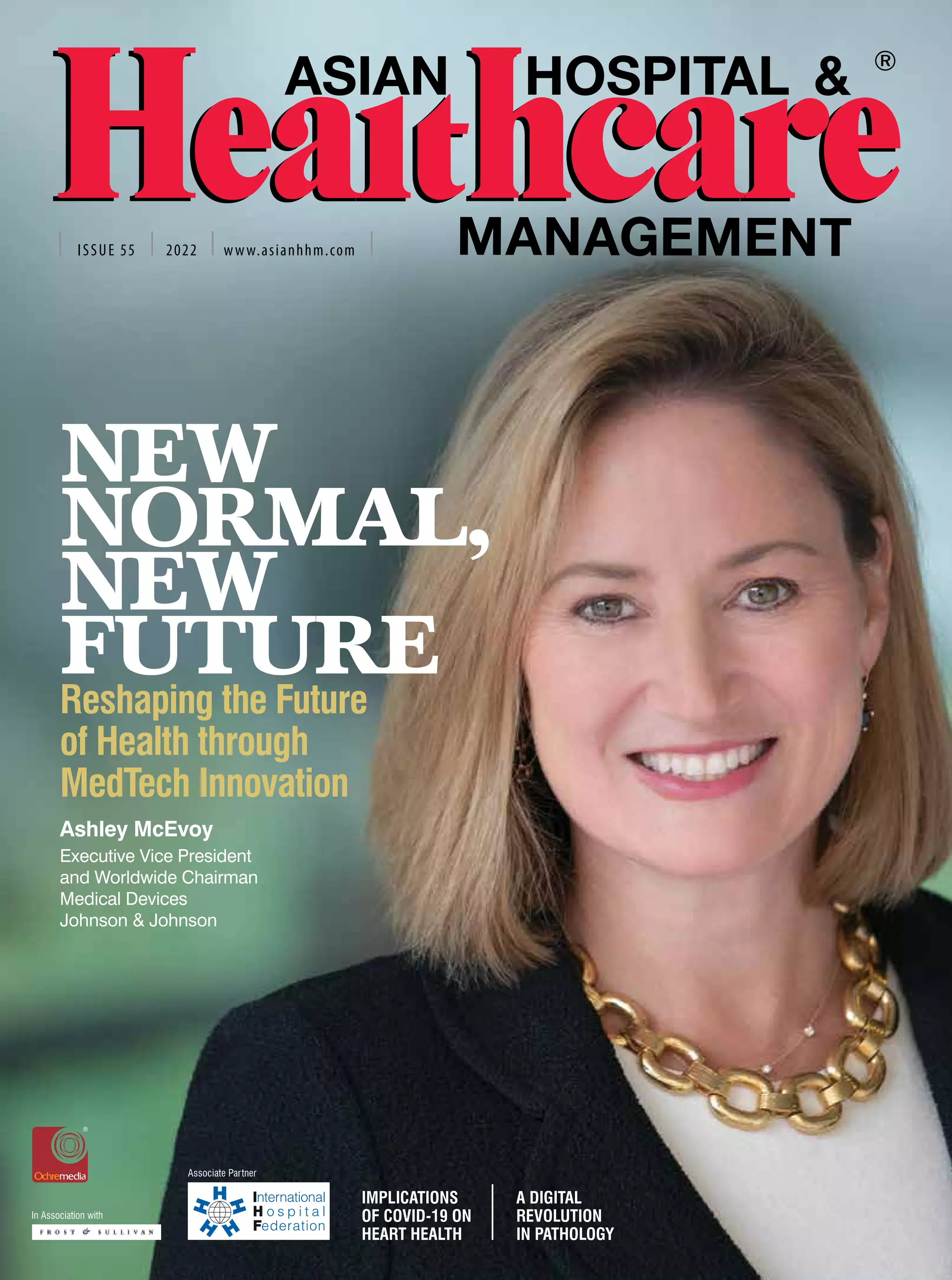
NEW
NORMAL,
NEW
FUTURE
Reshaping the Future
of Health through
MedTech Innovation
Ashley McEvoy
Executive Vice President
and Worldwide Chairman
Medical Devices
Johnson & Johnson
2
w w w . a s i a n h h m . c o m
M u l t i - A p p l i c a t i o n L a s e r S y s t e m
Dynamis Pro
www.fotona.com
87048/14
The Highest Performance, Best Made Laser Systems in the World
Committed to designing, manufacturing and delivering:
• TightSculpting®
• Fotona 4D®
Laser Face Lifting
• SmoothEyeTM
• HAIRestartTM
• Acne and Acne Scar Revision
• Permanent Hair Reduction
• Pigmented Lesions Removal
• Scar Revision
• Skin Resurfacing
• NightLase®
• Onychomycosis Treatment
• Vascular and Endovascular Treatments
• Hyperhidrosis Treatment
• Laser Lipolysis
• Laser Podiatry
Combining the power of the industry’s highest performance Er:YAG
and Nd:YAG lasers for applications in aesthetics and dermatology,
as well as an additional surgical QCW Nd:YAG laser.
1
w w w . a s i a n h h m . c o m
Foreword
MedTech Innovations
Shaping the future of healthcare
extend and expand this adoption to improve the health
outcomes across regions and populations. However,
this increased demand calls for a careful evaluation of
the shift to digital infrastructure and proper regulations
in place to ensure the industry is better prepared for
managing health emergencies.
MedTech companies would do well to innovate and
develop advanced diagnostics & monitoring tools with
a focus on agility, affordability and effective outcomes.
Asia-Pacific will become the second-largest regional
market for MedTech, contributing 35 percent of the
growth over the next two years, according to McKinsey
& Company. Driving MedTech innovation calls for
collaborations and partnerships between MedTech and
healthcare organisations and the region has the potential
to guide the world towards digitisation of MedTech for
enhanced care delivery.
This issue features an interview with Ashley McEvoy,
Executive Vice President and, Worldwide Chairman,
Medical Devices, Johnson & Johnson. Ashley shared her
views on how the pandemic has changed the shape of
healthcare and MedTech in the Asia-Pacific region. She
also talks about how collaborations and partnerships will
drive MedTech innovation in the future.
Hope you find this issue insightful. Please also use
this as an opportunity to share your perspectives for the
upcoming special issue ‘Executives Special’. Write to
me - prasanthi@ochre-media.com.
Prasanthi Sadhu
Editor
Healthcare is shifting from the traditional provider-centric,
in-patient setting to patient-centric, virtual consultations
with increased remote care monitoring. This transition
has prompted the need for MedTech industry to relook
at the products they develop and enhance value in care
delivery.
The COVID-19 pandemic has increased the use of
digital health technologies, and the need to develop
innovative devices or systems that support virtual
health. The last couple of years have seen increased
use of wearables, mobile and app-based technologies
along with data and analytics have been transforming
healthcare delivery.
Advancements in healthcare technologies like
Artificial Intelligence (AI), Virtual Reality and Augmented
Reality 3D-printing, robotics and nanotechnology are
shaping the future of healthcare. This technology boom
is helping address disease and medical conditions
through provision of cheaper, faster and more effective
solutions for diseases.
The pandemic has forced organisations to rethink
their strategic planning understanding the need to
go the digital route and patients have understood the
importance of teleconsultations and the advantages
mobile health applications bring forth.
From increasing productivity to driving operational
efficiency with automation of mundane tasks and gaining
a 360-degree perspective through 3D rendering, the
likes of Robotic Process Automation AI, 3D systems and
the cloud are in focus for the medical devices industry.
The pandemic has created a need for loosening
regulations in offering clearances to address the
medical device demand-supply needs of the sector.
MedTech companies and healthcare organisations have
to collaborate and work in sync for implementation of
digital technologies. There lies a huge opportunity to
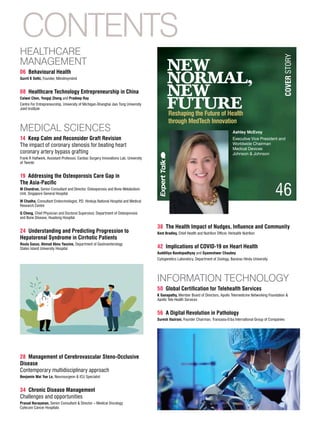
CONTENTS
HEALTHCARE
MANAGEMENT
06 Behavioural Health
Gurrit K Sethi, Founder, Miindmymiind
08 Healthcare Technology Entrepreneurship in China
Caiwei Chen, Yongqi Zheng and Pradeep Ray
Centre For Entrepreneurship, University of Michigan-Shanghai Jiao Tong University
Joint Institute
MEDICAL SCIENCES
14 Keep Calm and Reconsider Graft Revision
The impact of coronary stenosis for beating heart
coronary artery bypass grafting
Frank R Halfwerk, Assistant Professor, Cardiac Surgery Innovations Lab, University
of Twente
19 Addressing the Osteoporosis Care Gap in
The Asia-Pacific
M Chandran, Senior Consultant and Director, Osteoporosis and Bone Metabolism
Unit, Singapore General Hospital
M Chadha, Consultant Endocrinologist, P
.D. Hinduja National Hospital and Medical
Research Centre
Q Cheng, Chief Physician and Doctoral Supervisor, Department of Osteoporosis
and Bone Disease, Huadong Hospital
24 Understanding and Predicting Progression to
Hepatorenal Syndrome in Cirrhotic Patients
Roula Sasso, Ahmad Abou Yassine, Department of Gastroenterology
Staten Island University Hospital
38 The Health Impact of Nudges, Influence and Community
Kent Bradley, Chief Health and Nutrition Officer, Herbalife Nutrition
42 Implications of COVID-19 on Heart Health
Audditiya Bandopadhyay and Gyaneshwer Chaubey
Cytogenetics Laboratory, Department of Zoology, Banaras Hindu University
INFORMATION TECHNOLOGY
50 Global Certification for Telehealth Services
K Ganapathy, Member Board of Directors, Apollo Telemedicine Networking Foundation &
Apollo Tele Health Services
56 A Digital Revolution in Pathology
Suresh Vazirani, Founder Chairman, Transasia-Erba International Group of Companies
COVER
STORY
46
NEW
NORMAL,
NEW
FUTURE
Reshaping the Future of Health
through MedTech Innovation
Ashley McEvoy
Executive Vice President and
Worldwide Chairman
Medical Devices
Johnson & Johnson
28 Management of Cerebrovascular Steno-Occlusive
Disease
Contemporary multidisciplinary approach
Benjamin Wai Yue Lo, Neurosurgeon & ICU Specialist
34 Chronic Disease Management
Challenges and opportunities
Prasad Narayanan, Senior Consultant & Director – Medical Oncology
Cytecare Cancer Hospitals
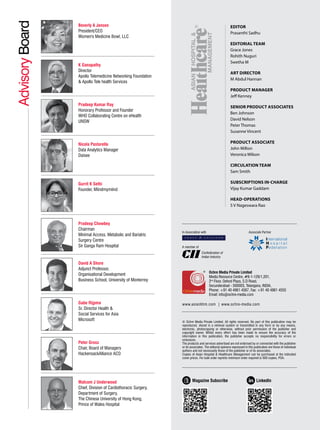
Advisory
Board Beverly A Jensen
President/CEO
Women's Medicine Bowl, LLC
K Ganapathy
Director
Apollo Telemedicine Networking Foundation
& Apollo Tele health Services
Pradeep Kumar Ray
Honorary Professor and Founder
WHO Collaborating Centre on eHealth
UNSW
Nicola Pastorello
Data Analytics Manager
Daisee
Gurrit K Sethi
Founder, Miindmymiind
Pradeep Chowbey
Chairman
Minimal Access, Metabolic and Bariatric
Surgery Centre
Sir Ganga Ram Hospital
David A Shore
Adjunct Professor,
Organisational Development
Business School, University of Monterrey
Gabe Rijpma
Sr. Director Health &
Social Services for Asia
Microsoft
Peter Gross
Chair, Board of Managers
HackensackAlliance ACO
Malcom J Underwood
Chief, Division of Cardiothoracic Surgery,
Department of Surgery,
The Chinese University of Hong Kong,
Prince of Wales Hospital
EDITOR
Prasanthi Sadhu
EDITORIAL TEAM
Grace Jones
Rohith Nuguri
Swetha M
ART DIRECTOR
M Abdul Hannan
PRODUCT MANAGER
Jeff Kenney
SENIOR PRODUCT ASSOCIATES
Ben Johnson
David Nelson
Peter Thomas
Susanne Vincent
PRODUCT ASSOCIATE
John Milton
Veronica Wilson
CIRCULATION TEAM
Sam Smith
SUBSCRIPTIONS IN-CHARGE
Vijay Kumar Gaddam
HEAD-OPERATIONS
S V Nageswara Rao
© Ochre Media Private Limited. All rights reserved. No part of this publication may be
reproduced, stored in a retrieval system or transmitted in any form or by any means,
electronic, photocopying or otherwise, without prior permission of the publisher and
copyright owner. Whilst every effort has been made to ensure the accuracy of the
information in this publication, the publisher accepts no responsibility for errors or
omissions.
The products and services advertised are not endorsed by or connected with the publisher
or its associates. The editorial opinions expressed in this publication are those of individual
authors and not necessarily those of the publisher or of its associates.
Copies of Asian Hospital & Healthcare Management can be purchased at the indicated
cover prices. For bulk order reprints minimum order required is 500 copies, POA.
Ochre Media Private Limited
Media Resource Centre, #9-1-129/1,201,
2nd
Floor, Oxford Plaza, S.D Road,
Secunderabad - 500003, Telangana, INDIA,
Phone: +91 40 4961 4567, Fax: +91 40 4961 4555
Email: info@ochre-media.com
www.asianhhm.com | www.ochre-media.com
A member of
Confederation of
Indian Industry
In Association with Associate Partner
Magazine Subscribe LinkedIn
Blackmagic Design is a leader in video for the medical industry, and
now you can create your own streaming videos with ATEM Mini. Simply
connect up to 4 HDMI cameras, computers or even technical equipment.
Then push the buttons on the panel to switch video sources just like a
professional broadcaster! You can even add titles, picture in picture
overlays and mix audio! Then live stream to Zoom, Skype or YouTube!
Create Training and Educational Videos
ATEM Mini’s includes everything you need. All the buttons are positioned on
the front panel so it’s very easy to learn. There are 4 HDMI video inputs for
connecting cameras and computers, plus a USB output that looks like a webcam
so you can connect to Zoom or Skype. ATEM Software Control for Mac and PC
is also included, which allows access to more advanced “broadcast” features!
Use Professional Video Effects
ATEM Mini is really a professional broadcast switcher used by television
stations. This means it has professional effects such as a DVE for picture in
picture effects commonly used for commentating over a computer slide show.
There are titles for presenter names, wipe effects for transitioning between
sources and a green screen keyer for replacing backgrounds with graphics!
Live Stream Training and Conferences
The ATEM Mini Pro model has a built in hardware streaming engine for live
streamingviaitsethernetconnection.ThismeansyoucanlivestreamtoYouTube,
Facebook and Twitch in much better quality and with perfectly smooth motion.
You can even connect a hard disk or flash storage to the USB connection and
record your stream for upload later!
Monitor all Video Inputs!
With so many cameras, computers and effects, things can get busy fast! The
ATEM Mini Pro model features a “multiview” that lets you see all cameras, titles
and program, plus streaming and recording status all on a single TV or monitor.
There are even tally indicators to show when a camera is on air! Only ATEM Mini
is a true professional television studio in a small compact design!
SRP is Exclusive of Taxes. ATEM Mini for use in training, conferencing and teaching purposes only.
Learn more at www.blackmagicdesign.com
Introducing ATEM Mini Pro
The compact television studio that lets you
create presentation videos and live streams!
ATEM Mini.......US$295
ATEM Mini Pro.......US$495
ATEM Mini Pro ISO.......US$795
6 ASIAN HOSPITAL & HEALTHCARE MANAGEMENT ISSUE - 55, 2022
BEHAVIOURAL
HEALTH
Our behaviours define what we consume and how. The
pandemic has had deep rooted effects on our psyches
and this is bound to impact consumer behaviours. We all
need to closely watch the changes wrought about during
this time and re-strategise what we do and how, as we
reach out to strengthen and expand our businesses.
Gurrit K Sethi, Founder, Miindmymiind
W
e are all defined by our
behaviours, quite literally
so. Our behaviour affects
how we engage with not only the
external world, but also reflects on
how we engage with ourselves. It is
this engagement that drives the world
around us… Yet we hardly ever consider
this fact. Ain’t this true?
I am neither a behavioural health
expert, nor a mental health expert.
However, there are many who practice
without many credentials. In fact, the
rulings and regulations around the
required credentials for counselling
in India is still nascent. But since I
have been a business professional, and
worked through people behaviours
and also suffered business behaviours,
and because I now work in the mental
health and well-being space, I am taking
the liberty of expressing the opinions of
a minion from this field.
As per Wikipedia, the word
‘behaviours’ extends itself to not just
individuals and human beings but also
to all other living beings, systems or
artificial entities in conjunction with
themselves or their environment. How
we react or our mannerisms, as they
play out have been ensconced under
the apparel of behavioural sciences.
This ‘science’ of behavioural sciences is
studied not only with respect to human
beings, but also cultures, systems
etc. So much so that a lot of research
today happens on the behavioural side
of economics as well. Ironically our
behaviour’s are being studied for their
effects on the growth of economy, and
for many business professionals, for how
to use these behaviours for economic
gains for the business.
To understand what created these
behaviours, I researched various
elements of our environment that
surrounds us. And hence I came upon
the need to understand culture and if
it shaped our behaviours. The discovery
that both cultures and behaviours do
get driven and impacted by each other
came upon with some apprehension.
It is so said that human behaviour is
affected by both genetic inheritance
as well as experience. This is quite a
deep-seated aspect. And a very critical
part of our mental frameworks. This
leads to the belief that to support our
behavioural health, it is important to
understand the culture to which one
belongs and, maybe, similar aspects
need to be applied to the behaviours of
other abstracts of our environment –
our work culture especially. The culture
and employee behaviours impact
productivity of the organization.
Many studies ascertain that work life
imbalances and work stress impact
mental health of the employees and
this leads to loss of productivity. The
WHO statistics to this effect are
overwhelming. And these ‘effects and
loss of productivity can definitely be
minimized by the right interventions.
If we look at the world as one large
community and one large economy,
it is invariably driven by basic human
instincts and colored by the effects of
the various cultures. These in turn
are determined by the geography, the
resource availability, the climate and
many other natural factors and how
overcoming challenges arising of these
for survival have evolved over centuries.
As the world got knitted together,
not just by the expanse of the earth,
but more through transportation and
communication channels. As a result,
new patterns of expected behaviours have
evolved. Many of us in the corporate
world undergo trainings on managing
cultural diversity for better work output.
As the global communities have come
together to expand the economic gains, it
is imperative to understand the different
cultures of different geographies, and
HEALTHCARE MANAGEMENT
7
w w w . a s i a n h h m . c o m
to keep the sensitivities in mind as we
connect across different countries. Each
place has its own unique way of living
and environment driven by resources
and other elements of this environment.
One thing is for sure, communication
is key, and, if one looks deeper, the key
aspects and strains of human behaviour
do remain the same, albeit with some
differences
But one thing remains sacrosanct
through all of this: behaviours are the
defining factors for humans, systems
andcultures–foroutput,endresult,and
the final product. It is well understood
that the environment affects, rather
shapes these behaviours and vice versa.
And, thus it becomes important to
understand the environment to be able
toshapethebehaviours.Especiallywhen
we all exist in such a volatile, uncertain,
complex, ambiguous (VUCA) world!
This is true not just for our day
to day living, as behaviours add to
the quality of it, but also true for our
business environments, our political
environments as well as the social
fabric which is an essential core of our
survival. The ongoing pandemic has
made our already VUCA world more
so. The effects of these on people’s
health, homes, and other behaviours are
telling.
There is an increased focus on
behavioural and mental health today.
This heightened focus has been driven
by the widened need supply gap hugely
as a key after effect of the pandemic.
There are an enormous number of
mental health start-ups that have
sprung up across varied geographies
– some serious players, some fly by
night operators. The need of the hour
today is not just better regulations and
governance by the respective authorities
but by our own selves as well to
recognize our issues well in advance and
nip the evil in the bud.
Awareness about mental health and
mental well-being needs to be given due
importance by educators, employers,
and by each one of us. While we all
look out for developmental anomalies
and mental disease evidences, the focus
needs to also shift to creating strong
mental frameworks in the first place.
With strong mental frameworks
driven right through our developmental
years, we will all be better equipped to
handle our emotional ups and downs
largely motivated by our VUCA world.
Perhaps a focus on creating a mentally
strong human force actually leads to a
less toxic and a less VUCA world.
While we work around the above
challenges through research-based
methodologies, let us all focus on
looking after our behavioural health
today and give it the requisite attention
– recognize and understand our own
pain points, address those pain points
by seeking professional help, in time.
Ironically enough, the same can be said
for systems, businesses etc.
Let me conclude by saying that
if health is wealth, our behaviours are
the cornerstones or the tombstones of
everything around us, be these of our
lives, our health, our work or the overall
economy.
Gurrit K Sethi, Founder, MIINDMYMIIND, contributes to healthcare
by bringing to life new concepts which enhance accessibility, helps
providers re-engineer businesses, works with Global Challenges
Forum (a Swiss Foundation) on sustainable health initiatives. An
avid traveller and voracious reader, these attributes provide her with
incisive insights about people and systems and what drives them.
AUTHOR
BIO
HEALTHCARE MANAGEMENT
8 ASIAN HOSPITAL & HEALTHCARE MANAGEMENT ISSUE - 55, 2022
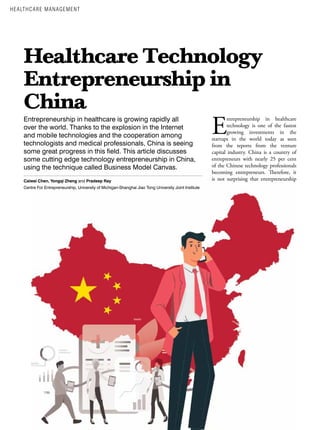
Healthcare Technology
Entrepreneurship in
China
Entrepreneurship in healthcare is growing rapidly all
over the world. Thanks to the explosion in the Internet
and mobile technologies and the cooperation among
technologists and medical professionals, China is seeing
some great progress in this field. This article discusses
some cutting edge technology entrepreneurship in China,
using the technique called Business Model Canvas.
Caiwei Chen, Yongqi Zheng and Pradeep Ray
Centre For Entrepreneurship, University of Michigan-Shanghai Jiao Tong University Joint Institute
E
ntrepreneurship in healthcare
technology is one of the fastest
growing investments in the
startups in the world today as seen
from the reports from the venture
capital industry. China is a country of
entrepreneurs with nearly 25 per cent
of the Chinese technology professionals
becoming entrepreneurs. Therefore, it
is not surprising that entrepreneurship
HEALTHCARE MANAGEMENT
9
w w w . a s i a n h h m . c o m
in healthcare technology is growing
rapidly in China. The Centre For
Entrepreneurship (CFE) at the
University of Michigan-Shanghai
Jiao Tong University Joint Institute
(UM-SJTU JI) is a premier institution
in Asia training engineering students
for entrepreneurship through courses
and practicum projects in collaboration
with local startups and the corporate
businesses. Since the Business Model
Canvas (BMC) is the de-facto standard
method of presenting and validating
entrepreneurship ideas, this article
uses BMC to analyse healthcare
entrepreneurship in China through case
studies in projects that CFE has been
involved in.
Thearticlestartswithanintroduction
of BMC followed by two case studies;
one involving the Haiyang Group,
the largest private sector aged care
provider in China (that started with the
entrepreneurial vision of the founder and
CEO Mr. Max Xu) and a new startup
called MiDIVI (led by Chen Liang) that
is involved in the deployment of cutting-
edge Mixed Reality (MR) application
in surgery in China. The case studies
discuss the business model of each of
these sectors using BMC, followed by
brief comments from the leader of each
company.
Business Model Canvas1
Business model canvas (BMC) is a
systematic way to present the developing
plan of a company’s product with
nine building blocks. BMC helps the
company in keeping the major decisions
consistent with the product positioning.
At the initiation stage of an idea, it is
done with guesses, which enables the
company to clarify the whole developing
strategy. Then later during validation
1 A. Ostenwalder and Y. Pigneur, Business Model Genera-
tion. USA: Wiley, 2010. ISBN: 9780470876411.
phase, the company can evaluate and
improve its plan based on BMC.
Value propositions are the core values
of a product, namely how it provides
a solution to the problems from each
specific Customer Segment.
• The Customer Segments describe the
target customer groups, to whom the
Value Propositions are designed for.
Channels indicate through which media
the product will reach the Customer
Segments, and how each of them is
integrated.
• Customer Relationships refer to
the strategies to get, keep and grow
customersbased ondesignated Customer
Segments.
• Revenue Streams are strategies the
company adopts to gain profit from
each Customer Segment. These include
the major revenue sources and pricing
model.
• Key Resources include the most
important things to keep the BMC
HEALTHCARE MANAGEMENT
10 ASIAN HOSPITAL & HEALTHCARE MANAGEMENT ISSUE - 55, 2022
suppliers and Haiyang is the only single
company in China which covers three
pension models which is institutional
pension, community pension and home
pension. The main customer segment is
the elderly who need to be taken care of
but lack all-day-long face-to-face care.
These “new Chinese seniors” are more
open to digital technologies and are
also concerned about their own health.
Channels for Haiyang can be divided
into two parts: healthcare applications or
programmes which can be downloaded
directly online, and specialised wearable
electronic devices which can be bought
from both online and physical stores.
In order to strengthen customer
relationship, Haiyang provides multiple
high-quality products and makes good
connection between customers and
caregivers. The revenue streams can
be formed in two parts: direct earning
from multiple telehealth products and
funds from investment cooperation.
models in pension industry. Their main
product is Continuing Care Home-
based Community (CCHC), which is
a smart pension model supported by
multiple digital technologies. Haiyang
group is now the largest private sector
aged care provider in China and it has
been a partner of UM-SJTU JI CFE led
by Pradeep Ray in the recently concluded
project (2019-2021)“Digital Health for
the Elderly” that led to the publication
of the book “Digital Methods and Tools
for Healthy Ageing”, (2021) eds Pradeep
Ray, Siaw Teng Liaw and Artur Serrano,
published by IET (UK).
1 Analysis based on BMC
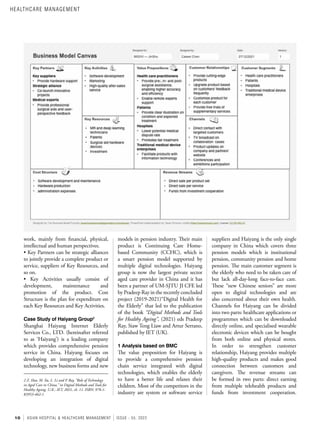
The value proposition for Haiyang is
to provide a comprehensive pension
chain service integrated with digital
technologies, which enables the elderly
to have a better life and relaxes their
children. Most of the competitors in the
industry are system or software service
work, mainly from financial, physical,
intellectual and human perspectives.
• Key Partners can be strategic alliances
to jointly provide a complete product or
service, suppliers of Key Resources, and
so on.
• Key Activities usually consist of
development, maintenance and
promotion of the product. Cost
Structure is the plan for expenditure on
each Key Resources and Key Activities.
Case Study of Haiyang Group2
Shanghai Haiyang Internet Elderly
Services Co., LTD. (hereinafter referred
to as ‘Haiyang’) is a leading company
which provides comprehensive pension
service in China. Haiyang focuses on
developing an integration of digital
technology, new business forms and new
2 Z. Hao, M. Xu, L. Li and P. Ray, “Role of Technology
in Aged Care in China,” in Digital Methods and Tools for
Healthy Ageing. U.K.: IET, 2021, ch. 11. ISBN: 978-1-
83953-462-1.
HEALTHCARE MANAGEMENT
11
w w w . a s i a n h h m . c o m
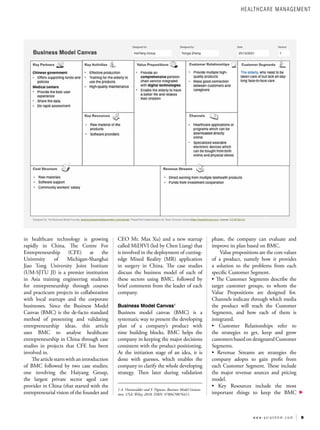
Raw material of the products and
software providers are the key resources
for Haiyang. Chinese government
and medical centers are Haiyang’s key
partners. The former offers supporting
funds and policies and the later provide
the best user experience, share the data
and do rapid assessment. Key activities
of Haiyang include effective production,
training for the elderly to use the
products and high-quality maintenance.
The cost mainly goes to three areas:
raw materials, software support, and
community workers’ salary.
2 Interview excerpts
UM-SJTU JI CFE team interviewed the
CEO of Haiyang Group, Max Xu (Chao
Xu) in 2021 as he has been an award-
winning entrepreneur and the founder
of the Haiyang group. In his view the
nine building blocks of BMC is ranked
in the following order (from important
to less important): value proposition,
revenue streams, customer relationship,
key partners, customer segments,
channels, key activities, cost and key
resources. Apart from the elements in
BMC, he believes that people in the core
entrepreneurial team are also important
for a start-up. The whole team should
have a clear division of work, avoid
homogeneity, and be brave to face
failure.
Case Study of MiDIVI
MiDIVI is a digital health technology
startup in Shanghai, China and MiDIVI
has been a partner of the UM-SJTU JI
Centre For Entrepreneurship (CFE) in
offering practicum courses like VX423
for which Caiwei Chen was an intern
in this company in 2021. One main
product of MiDIVI, Jinshu, is a surgery
navigation system integrating medical
image processing and Mixed Reality
(MR) technique based on MR goggle
— Microsoft HoloLens. It is supposed
to assist Healthcare Practitioners (HCPs)
before, during and after operations,
currently supporting percutaneous
puncture biopsy (PPB) for cardiothoracic
surgery and neurosurgery department,
to name a few. Jinshu consists of three
parts, the MiDIVI smart holographic
cloud platform (MSHCP) on personal
computer, the J-MRview on HoloLens,
and J-control on an iPad.
1 Analysis Based on BMC
The value propositions of Jinshu vary
with customer segments.
For HCPs, Jinshu provides assistance
throughout the whole surgery process.
Before surgery, MSHCP builds a 3D
hologram model of operative field from
2D images (such as CT images), then
generate the preoperative plan (such
as to determine the precise position of
puncture) with deep learning algorithm.
During surgery, J-MRview superimposes
the hologram model on real-time view
according to predefined feature points on
the patient’s body. Following the model
HCPs can precisely position the surgical
tools without further measurement.
HCPs can also ask remote experts for
help using the meeting module. After
surgery, HCPs can review the recorded
operation video filmed by HoloLens.
For patients, Jinshu clearly illustrates
their conditions and the expected
operation procedure with the 3D
holograms. Besides, more accurate
surgery lead to better therapeutic effect.
For hospitals, Jinshu helps to lower
surgical error rate and thus prevent
potential medical disputes. Besides, the
remote guiding module promotes fair
treatment through the society, equalising
accessibility to high level medical
resources for people from all segments of
society.
For traditional medical device
enterprises, Jinshu as a representative of
information technology advancement
facilitates the growth of their
competitiveness in the market.
Thefirststeptobuildstrongcustomer
relationships is to get customers, which
closely relies on the chosen channels. In
general, customers are obtained through
direct contact with targeted customers.
Since the products apply promising
technology advancement, collaboration
cases with medical departments are
reported by local satellite television
channel, while collaborative projects are
propagated on partners’ websites. Besides
MiDIVI actively attends conferences
and exhibitions to present its ideas.
To keep and grow customers,
products are continuously upgraded
in response to clients’ feedback. Since
MiDIVI is a relatively small enterprise,
it is possible to tailor project for specific
needs, providing better customer
experience. Beyond the cutting-edge
products, free trials of supplementary
services (such as a remote meeting
module) are also offered to current
customers.
Key activities include software
development, marketing and after-sales
service, each corresponds to several Key
resources.
MiDIVI focuses on developing
medical image processing algorithm
and operational navigation application.
Jinshu also incorporates surgery
aid devices based on HoloLens
and the optical measurement and
electromagnetic (OME) tracking device
from NDI.
For research and development
(R&D), MR and deep learning
technicians are major human resources.
To protect intellectual property and to
distinguish from competitors, patents
are also of key importance.
The particularity of medical devices
segment leads to a special financial
resource structure. Sale and application
of medical devices is strictly controlled
by government because they are closely
related to human life and health. For
the same reason, the productisation
commonly takes more than one year, and
licensing takes even longer. Therefore,
financing, instead of profiting from
common trade, is the vital R&D funds.
MiDIVI being one of the small
and medium-sized enterprises (SMEs),
marketing is a crucial part to obtain
customers and expand market share.
Consistent with Channels, MiDIVI
HEALTHCARE MANAGEMENT
12 ASIAN HOSPITAL & HEALTHCARE MANAGEMENT ISSUE - 55, 2022
provides demonstrations to investors
and employ online media to promote
products like Jinshu.
Key partners are mainly of three
types. First, companies such as Microsoft
and NDI are key suppliers that provide
MiDIVI with necessary hardware.
Second, strategic alliance is set up with
Jingteng Tech, to name a few, with
whom projects are co-launched to make
the most of each company’s strength.
Third, several medical experts provide
both professional surgical aids and
practical suggestions as users.
The revenue streams include direct
sale and investment. There are two
possible ways for Jinshu’s sale. Hospitals
usually purchase the whole set of device
and service, while some medical device
companies may pay for cloud service on
use basis. Yet as described, there are strict
restraints on the transactions. Currently
the expenditure is mainly covered by
investor funding.
AsanITproduct,thecoststructureof
Jinshu consists of software development
and maintenance. To take the remote
meeting module as an example, R&D
expenses include purchase of resources
such as software development kit.
Hardware production also takes a
considerable portion. Apart from
HoloLens and OME tracking device,
surgical tools and human anatomical
models are needed for simulation and
tests. In addition, there are expenses of
administration, including rent, business
trip and consumables.
2 Interview excerpts
UM-SJTU JI CFE team interviewed the
CTO of MiDIVI, Chen Liang in 2021
as he has been an entrepreneur and the
founder of the MiDIVI. Chen Liang
believes that the value proposition is
the most important element among the
nine building blocks. He regards it as
the origin which makes an entrepreneur
clear about his goal and decides the eight
rest elements. From the perspective of
MiDIVI, the value proposition should
include both the innovation of product
and business. The former needs to solve
the pain of doctors and patients and the
latter means to put ideas into practice.
Besides, Chen Liang thinks that it is
hard to conclude any element in BMC
as a less important one. He would rather
describe it as a dynamic process and
judgement should be made on how to
allocate people and one’s energy during
different periods.
Conclusion and future
Entrepreneurship in healthcare
technology is now booming all over
the world. This article has provided a
brief overview of healthcare technology
entrepreneurship in China through two
case studies; one large group (Haiyang)
and one new startup (MiDIVI), using a
Caiwei Chen is a member of the
University of Michigan (UM)-Shanghai
Jiao Tong University (SJTU) Joint Institute
(JI) Center For Entrepreneurship (CFE)
and chairs the IEEE Technology and
Engineering Management Society (TEMS)
student branch in JI. She is interested in
interdisciplinary development in business
field, with major interest in entrepreneur-
ship and business analytics.
Yongqi Zheng is the current treasurer of
the IEEE-Technology and Engineering
Management Society (TEMS) Student
Branch at the University of Michigan-
Shanghai JiaoTong University Joint
Institute. He is a member of the UM-SJTU
JI CFE and particularly particularly inter-
ested in industrial engineering, product
innovation and entrepreneurship.
Pradeep Kumar Ray is the
Founder Director of the Centre For
Entrepreneurship (CFE) at the University
of Michigan-Shanghai Jiao Tong University
Joint Institute and is currently lead-
ing an international research initiative
called Technology Entrepreneurship for
Sustainable Development (TESD) involv-
ing more than twenty partners from all
over the world. He is the founder of the
WHO Collaborating Centre on eHealth
in the University of New South Wales
(UNSW)-Australia (2013).
AUTHOR
BIO
conceptual model called Business Model
Canvas (BMC), now extensively used for
modelling and validating startups. BMC
is also used to teach entrepreneurship
to students all over the world and these
case studies would help summarise
startup ideas. However, students of
entrepreneurship also learn (while
doing projects) that much more details
need to be added to the BMC for a real
startup business and that is the subject
of courses like VX420 (Entrepreneurship
Basics) taught in the UM-SJTU JI.
More research is needed to fill the gaps
in BMC as discussed in the forthcoming
book “Technology Entrepreneurship for
Sustainable Development” by Springer
in 2022 with Pradeep Ray and Rajib
Shaw as co-editors.
HEALTHCARE MANAGEMENT
13
w w w . a s i a n h h m . c o m
Local partners. Global solutions.
www.international-assistance-group.com
netiag@netiag.com + 33 1 55 30 09 10
MEDICAL & TRAVEL ASSISTANCE • ROADSIDE ASSISTANCE • COST CONTAINMENT • TPA • SECURITY SERVICES
A world of possibilities.
Step up.
Creating a world-class solution to effective medical assistance and controlling costs
needs more than a ‘one-size-fits-all’ approach. Clients vary and so do the challenges.
The essence is having a broad mix with experienced people behind them.
That is why we exist and excel.
In a changing world, International Assistance Group has been federating assistance companies since 1992. We have
grown from a small non-profit association into the world’s largest alliance of independent assistance companies and
accredited providers. We make global world-class solutions a reality. That’s because we vet and select companies with
local expertise, skills and knowledge delivering quality services 24/7.
Creating a world-class solution to effective medical assistance and controlling costs
needs more than a ‘one-size-fits-all’ approach. Clients vary and so do the challenges.
The essence is having a broad mix with experienced people behind them.
That is why we exist and excel.
In a changing world, International Assistance Group has been federating assistance companies since 1992. We have
grown from a small non-profit association into the world’s largest alliance of independent assistance companies and
accredited providers. We make global world-class solutions a reality. That’s because we vet and select companies with
local expertise, skills and knowledge delivering quality services 24/7.
Creating a world-class solution to effective medical assistance and controlling costs
needs more than a ‘one-size-fits-all’ approach. Clients vary and so do the challenges.
The essence is having a broad mix with experienced people behind them.
That is why we exist and excel.
In a changing world, International Assistance Group has been federating assistance companies since 1992. We have
grown from a small non-profit association into the world’s largest alliance of independent assistance companies and
accredited providers. We make global world-class solutions a reality. That’s because we vet and select companies with
local expertise, skills and knowledge delivering quality services 24/7.
Creating a world-class solution to effective medical assistance and controlling costs
needs more than a ‘one-size-fits-all’ approach. Clients vary and so do the challenges.
The essence is having a broad mix with experienced people behind them.
That is why we exist and excel.
In a changing world, International Assistance Group has been federating assistance companies since 1992. We have
grown from a small non-profit association into the world’s largest alliance of independent assistance companies and
accredited providers. We make global world-class solutions a reality. That’s because we vet and select companies with
local expertise, skills and knowledge delivering quality services 24/7.
Creating a world-class solution to effective medical assistance and controlling costs
needs more than a ‘one-size-fits-all’ approach. Clients vary and so do the challenges.
The essence is having a broad mix with experienced people behind them.
That is why we exist and excel.
In a changing world, International Assistance Group has been federating assistance companies since 1992. We have
grown from a small non-profit association into the world’s largest alliance of independent assistance companies and
accredited providers. We make global world-class solutions a reality. That’s because we vet and select companies with
local expertise, skills and knowledge delivering quality services 24/7.
14 ASIAN HOSPITAL & HEALTHCARE MANAGEMENT ISSUE - 55, 2022
KEEP
CALM AND
RECONSIDER
GRAFT
REVISION
Preoperative angiography in combination with
intraoperative graft flow measurements may improve
durability of coronary artery bypass grafts. However,
native coronary flow might impair bypass graft flow
based on stenoses’ severity, leading to inferior long-term
outcomes. Intraoperative routine snaring of a coronary
artery detects significant competitive flow, possibly
intercepting unnecessary perioperative graft revisions.
Frank R Halfwerk, Assistant Professor, Cardiac Surgery Innovations Lab
University of Twente
The impact of coronary stenosis
for beating heart coronary artery
bypass grafting
be overestimated and impacts short and
long-term outcomes of CABG.
A heart lung machine takes over
the heart’s pumping function and
gas transfer of the lungs during heart
surgery. Major drawbacks, however, are
a systemic inflammatory response, acute
kidney injury or brain infarctions. For
coronary artery bypass graft (CABG)
improves symptoms, quality of life and
survival in these patients. A stenosis
with a diameter reduction < 50 per
cent is considered a mild stenosis, 50
– 70 per cent as moderate, and > 70
per cent as severe. Unfortunately, the
degree of coronary stenosis can easily
The heart, inadequate blood supply,
and revascularisation
The coronary arteries supply the heart
itself with oxygen and nutrients. Severe
narrowing of these coronaries (stenosis)
might lead to chest pain or a heart attack.
Myocardial revascularisation by either
percutaneous coronary intervention or
MEDICAL SCIENCES
15
w w w . a s i a n h h m . c o m
CABG, the heart lung machine can be
abandoned by performing off-pump
coronary artery bypass grafting where
the heart keeps beating during surgery.
Intraoperative choices and
challenges lead to postoperative
complications
Patients’ own arteries from the chest or
lower arm can be used to create these
coronary bypasses. These arterial grafts
have excellent long-term functionality,
and low redo revascularisation rates.
Arterial grafts require proper handling to
avoid early technical failure. Competitive
flow from native coronaries that are
not narrowed enough impacts long
term success of the coronary bypass.
Detection of competitive flow for arterial
grafts as early as possible after making
the anastomosis might predict the long-
term patency.
Intraoperative assessment of graft
flow can be measured with transit
time flow measurements (TTFM).
European guidelines on myocardial
revascularisation suggest routine use
of intraoperative bypass graft flow
assessment. Unfortunately, this quality
control technique is not always used, nor
handled upon adequately during surgery.
The first signs of a failed graft are heart
rhythm changes, postoperative new onset
of chest pain and a potential myocardial
infarction might occur. Often, the
patient already left the operating theatre,
and bypass graft revision is not possible,
or should be considered for another
surgical procedure.
Cut-off values for TTFM to
indicate graft failure are still debated,
and are not uniform between clinical
studies. In a recent study conducted
at Thoraxcentrum Twente of Medisch
Spectrum Twente (Netherlands),
preoperative angiography findings were
combined with intraoperative TTFM in
50 CABG patients without the use of a
heart lung machine (off-pump CABG).
All patients had significant coronary
artery disease as established by heart
team discussion between a cardiologist
and heart surgeon.
Temporary closing of a severely
narrowed coronary artery
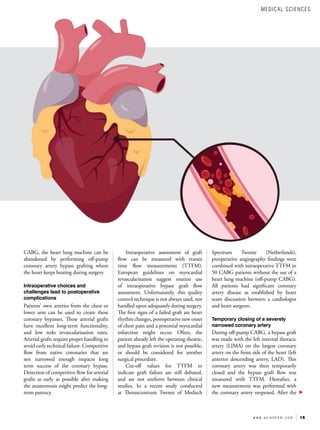
During off-pump CABG, a bypass graft
was made with the left internal thoracic
artery (LIMA) on the largest coronary
artery on the front side of the heart (left
anterior descending artery, LAD). This
coronary artery was then temporarily
closed and the bypass graft flow was
measured with TTFM. Hereafter, a
new measurement was performed with
the coronary artery reopened. After the
MEDICAL SCIENCES
16 ASIAN HOSPITAL & HEALTHCARE MANAGEMENT ISSUE - 55, 2022
This increase might indicate an open,
and functional anastomosis affected
by competitive flow from the native
coronary artery. Here, surgical graft
revision will not likely improve baseline
TTFM values such as mean graft flow
or graft patency, resulting in a useless or
even harmful procedure.
Is snaring safe?
Snaring the LAD is a widespread method
to obtain a bloodless operative field, and
is well tolerated by patients. Indeed, this
technique is comparable to intracoronary
shunting regarding postoperative heart
enzyme rise. Atherosclerotic plaques or
calcified coronary arteries make shunting
technically more tough. Prolonged
snaring might induce blood vessel injury,
and arrhythmias, but are reversible up to
20-30 minutes of snaring.
Patient-specific decision making
before and during surgery
Patient-specific decision making
is performed daily in heart team
discussion between cardiac surgeons and
cardiologists according to international
guidelines. Here patient characteristics
determine decision making for a surgical,
percutaneous or conservative treatment.
Combining patient characteristics with
procedural characteristics could further
tailor treatment and thus improve
outcomes for patients.
Professional information for
decision making is scattered. Direct
comparison between competing
treatments or diagnosis modalities is
often lacking. For assessing coronary
artery stenosis, visual eyeballing by a
cardiologist is most common, although
high intra-and inter-observer variability
exists for many years with low
concordance around clinical relevant
cut-off points. Some centres use
quantitative coronary analysis (QCA)
with 2D or 3D reconstruction using
cardiac angiography to analyse degree
of stenosis for research purposes, but are
rarely used for heart team discussions.
To predict graft patency, it is no match
initial bypass graft, arterial grafts were
placed to other parts of the heart.
As expected, higher values of
bypass graft flow were observed with
the coronary artery snared, effectively
preventing any competitive flow.
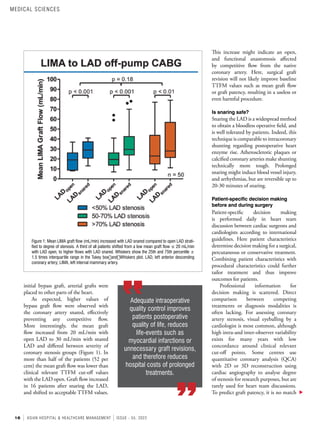
More interestingly, the mean graft
flow increased from 20 mL/min with
open LAD to 30 mL/min with snared
LAD and differed between severity of
coronary stenosis groups (Figure 1). In
more than half of the patients (52 per
cent) the mean graft flow was lower than
clinical relevant TTFM cut-off values
with the LAD open. Graft flow increased
in 16 patients after snaring the LAD,
and shifted to acceptable TTFM values.
Adequate intraoperative
quality control improves
patients postoperative
quality of life, reduces
life-events such as
myocardial infarctions or
unnecessary graft revisions,
and therefore reduces
hospital costs of prolonged
treatments.
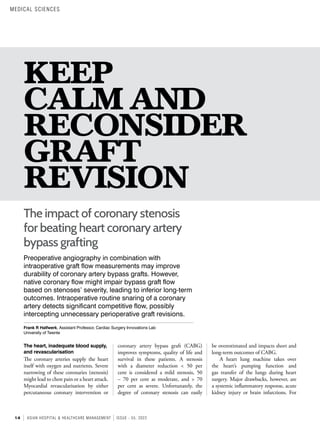
Figure 1: Mean LIMA graft flow (mL/min) increased with LAD snared compared to open LAD strati-
fied to degree of stenosis. A third of all patients shifted from a low mean graft flow ≤ 20 mL/min
with LAD open, to higher flows with LAD snared. Whiskers show the 25th and 75th percentile ±
1.5 times interquartile range in the Tukey box‐and‐Whiskers plot. LAD, left anterior descending
coronary artery; LIMA, left internal mammary artery.
MEDICAL SCIENCES
Four
powerFul
doses
per year
Every issue of AHHM magazine is a powerful
dose of information and knowledge – filled with
original and undiluted content. Written by the
best brains in hospital and healthcare industry,
the magazine offers timely business insights and
articles on cutting-edge technologies.
Subscribe now to get your doses regularly.
Email: subscriptions@asianhhm.com
Tel: +91 40 4961 4567
Fax +91 40 4961 4555
www.asianhhm.com
18 ASIAN HOSPITAL & HEALTHCARE MANAGEMENT ISSUE - 55, 2022
compared to functional assessment
using the more invasive fractional flow
reserve (FFR). Here, clinical cut-off
values are also debated and might even
differ between percutaneous coronary
intervention or CABG. Future studies
Frank R Halfwerk is Assistant Professor and leads the Cardiac Surgery
Innovations Lab at the University of Twente and is Technical Physician in
cardiothoracic surgery at Thoraxcentrum Twente, Medisch Spectrum in
Enschede, the Netherlands. His focus is on personalized treatments for
patients with predictable surgical outcomes. Underlying study: Halfwerk FR
et al. Intraoperative transit time flow measurements during off-pump coronary
artery bypass surgery: The impact of coronary stenosis on competitive flow.
Journal of Cardiac Surgery, 2021. https://doi.org/10.1111/jocs.16103.
AUTHOR
BIO
should investigate the cut-off values of
FFR or QCA for PCI and CABG to
optimise outcome for patients.
Implications for daily practice
Heart time discussions should carefully,
and objectively evaluate the functional
degree of coronary stenosis to determine
revascularisation strategies. Because
preoperative visual estimation proves
to be difficult, intraoperative evaluation
of a stenosis is pivotal. Routine snaring
of the LAD during off-pump CABG
demonstrated an increase in mean graft
flow among all coronary stenosis groups.
A third of clinical cut-off TTFM values
for graft failure shifted to acceptable
values. Therefore, regular use of TTFM
and careful analysis of competitive flow
according to the method described
in the underlying study can be useful
to identify competitive flow in case
of intraoperative borderline TTFM
parameters. Adequate intraoperative
quality control improves patients
postoperative quality of life, reduces life-
events such as myocardial infarctions
or unnecessary graft revisions, and
therefore reduces hospital costs of
prolonged treatments.
Clinical studies should establish
definitive evidence regarding routine
snaring of the LAD during off-pump
CABG. These studies should focus
on the prevention of unnecessary
intraoperative graft revisions and
postoperative heart attacks.
References are available at
www.asianhhm.com
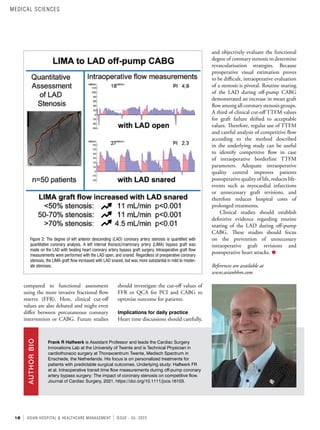
Figure 2: The degree of left anterior descending (LAD) coronary artery stenosis is quantified with
quantitative coronary analysis. A left internal thoracic/mammary artery (LIMA) bypass graft was
made on the LAD with beating heart coronary artery bypass graft surgery. Intraoperative graft flow
measurements were performed with the LAD open, and snared. Regardless of preoperative coronary
stenosis, the LIMA graft flow increased with LAD snared, but was more substantial in mild to moder-
ate stenoses.
MEDICAL SCIENCES
19
w w w . a s i a n h h m . c o m
Addressing the
Osteoporosis Care Gap
in The Asia-Pacific
In the Asia-Pacific there are significant inconsistencies
in clinical practice guidelines for the management and
prevention of osteoporosis and fragility fractures. These
guidelines vary in scope and recommendations. To address
this, in early 2021, APCO launched The APCO Framework
– the first pan-Asia-Pacific clinical practice standards for the
screening, diagnosis, and management of osteoporosis.
M Chandran, Senior Consultant and Director, Osteoporosis and Bone Metabolism Unit,
Singapore General Hospital
M Chadha, Consultant Endocrinologist, P
.D. Hinduja National Hospital and
Medical Research Centre
Q Cheng, Chief Physician and Doctoral Supervisor, Department of
Osteoporosis and Bone Disease, Huadong Hospital
A significant challenge to overcome
The survival of those who sustain
an osteoporotic fragility fracture is
significantly compromised for up to
six years, with patients facing twice
the risk of death within the first year.
Furthermore, a prior fracture at any site
doubles a person’s risk of refracture.
In the Asia-Pacific alone, an
overwhelming 319 million people aged
50 years and over are projected to be at
risk of osteoporotic fracture over the next
three decades. More than 50 per cent of
the world’s hip fractures are expected to
occur in the region by the year 2050.
TheAsia-Pacificishometo4.5billion
people, a rapidly ageing population,
and vastly different healthcare systems.
Given the anticipated, exponential
growth in fragility fractures due to
MEDICAL SCIENCES
20
w w w . a s i a n h h m . c o m
the region’s ageing population, mass
urbanisation and increasingly sedentary
lifestyles, recognition of the monumental
human and socio-economic burden of
osteoporosis, and the severe impact of
fractures on a patient’s independence and
quality of life, is critical. Osteoporosis
must become an urgent priority on
regional and global health agendas.
Despite alarming osteoporosis and
fragility fracture statistics worldwide
and the extensive availability of safe
and effective osteoporosis therapies,
more than 80 per cent of fragility
fracture patients are neither assessed, nor
treated, thereby placing a substantial,
but importantly, preventable burden on
already strained healthcare systems.
Osteoporosis is vastly under-
diagnosed and under-treated.
Disturbingly, millions of people
worldwide at high risk of fracture remain
unaware of this underlying, silent
disease. Sadly, people often only discover
they have osteoporosis after sustaining a
first fracture. A fragility fracture, which
occurs every three seconds worldwide,
compromises quality of life and loss of
independence. Worryingly, one-in-four
patients who sustain a hip fracture die
within a year, and less than half of those
who survive, regain their previous level
of function.
Osteoporosis can compromise a
person’s quality of life through loss of
independence and productivity, chronic
pain, disability, emotional distress,
reduced social interaction, and self-
limitation caused by a fear of falling.
Less than a third of hip fracture patients
regain their pre-fracture level of mobility,
while more than 80 per cent are restricted
with their daily activities, such as driving
or grocery shopping. Importantly,
osteoporosis not only affects those living
with the disease, but also their family,
and the community at large.
Among all osteoporotic fractures,
hip fractures incur the greatest
morbidity, mortality, and social and
financial costs. An analysis of nine Asian
countries and regions from the Asian
Federation of Osteoporosis Societies
(AFOS) revealed the number of hip
fractures will more than double from
1.13 million in 2018, to 2.54 million
in 2050.5 In 2018, the estimated cost
of hip fractures obtained from nine
Asian countries or regions was USD 7.5
billion. By 2050, projections suggest
this will rise to approximately USD 13
billion.5 Overwhelmingly, the costs for
treating a single hip fracture represents
approximately 19 per cent of APAC’s
regional per-head annual gross domestic
product (GDP).
China and India contribute to the
highest absolute number increase in
hip fractures in the region. In fact, the
two countries constitute approximately
37 per cent of the world’s population,
and therefore, largely account for the
anticipated hip fracture epidemic
expected in the Asia-Pacific.
Between 2025 and 2050, the
population of India is projected to
grow from 1.4 billion, to 1.88 billion,
with those aged over 50 who are more
susceptible to osteoporosis, expected to
constitute 33 per cent of the population
by the middle of the century.
In India alone, the direct medical
costs of hip fractures was an estimated
USD 256 million in 2018, the costs for
which are projected to increase to USD
612 million by 2050.
In 2013, 50 million people in India
were either osteoporotic, or considered
to be living with low bone mass. The
2018 AFOS study predicted the number
of hip fractures in India would more than
double, from approximately 332,000 in
2018, to 792, 000 in 2050.
Importantly, compared to Western
populations, hip fractures occur a decade
earlier in the Indian population.
Similarly in China, the projected
direct cost of hip fractures is expected to
rise from USD 1,690 million in 2018, to
USD 4063 million by 2050, while the
number of hip fractures is projected to
increase from almost 485,000, to more
than 1.17 million between the same
period.
Projections suggest the total number
of osteoporosis-related fractures in China
will increase from 2.33 million in 2010,
to 5.99 million in 2050.
In recent years, several paramount
themes that profoundly impact strategies
employed for osteoporosis management
have emerged.
These emerging concepts in
osteoporosis care should be astutely
considered and incorporated into new
and revised guidelines, following careful
deliberation of their applicability to local
health care practices.
MEDICAL SCIENCES
21
w w w . a s i a n h h m . c o m
Let the true “Digital Transformation”
be the base of all your marketing campaigns
Email: advertise@asianhhm.com Tel: +91 40 4961 4567 Fax +91 40 4961 4555
w w w . a s i a n h h m . c o m
COVID-19 PANDEMIC
UPGRADE YOUR
MARKETING STRATEGY
Use the webinar as a platform to launch new
products and services
Grow your audience with increased reach, impact
and user-friendliness
Rise above geographical boundaries
Generate new business
Gain the strong web presence differentiating
yourself from competitors
Connect and engage with your target audience
Give more exposure to industry specific people
Increase your brand profile and share your
capabilities with leading industry professionals
EXCLUSIVE WEBINAR SERVICES
Hosting Promotions Lead Generation
Engage people to your business Gain Market Confidence Be an Authority
22 ASIAN HOSPITAL & HEALTHCARE MANAGEMENT ISSUE - 55, 2022
vertebral fractures – and organisational
characteristics.
Another important emerging theme
is the urgent need to employ health
economics to inform intervention
thresholds and indications for specific
classes of osteoporosis therapies.
For example, a significant body
of evidence obtained through analysis
of nine active interventions across
14 countries, has demonstrated anti-
osteoporosis therapies are cost-effective
in women at high risk of fracture.When
compared with no treatment, active
osteoporotic drugs were generally cost
effective in postmenopausal women
aged over 60-65 years with low
bone mass, especially those who had
sustained prior vertebral fractures.
While vast heterogeneity
exists in epidemiologic and
economic characteristics of
One of the emerging osteoporosis
themes is the importance of Asia-
Pacific-wide systemic integration of case
identification and management at all
levels of health systems, including acute
care services, when patients present with
fractures through Post Fracture Care
Coordination Programs, such as Fracture
Liaison Services (FLS).
These coordinated systems of care
aim to identify, treat and monitor
patients presenting with a fragility
fracture. Intervention can halve the
incidence of fragility fractures, deliver
significant financial savings, and most
importantly, save lives.
Furthermore, FLSs compared with
usual care, have been shown to increase
bone mineral density (BMD) testing,
improve initiation of osteoporosis care,
and adherence to treatment, and reduce
mortality rates.
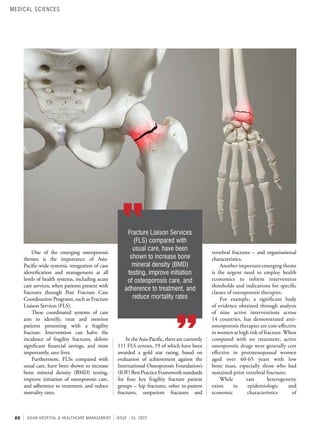
Fracture Liaison Services
(FLS) compared with
usual care, have been
shown to increase bone
mineral density (BMD)
testing, improve initiation
of osteoporosis care, and
adherence to treatment, and
reduce mortality rates
In the Asia-Pacific, there are currently
111 FLS centres, 19 of which have been
awarded a gold star rating, based on
evaluation of achievement against the
International Osteoporosis Foundation’s
(IOF)BestPracticeFrameworkstandards
for four key fragility fracture patient
groups – hip fractures, other in-patient
fractures, outpatient fractures and
MEDICAL SCIENCES
23
w w w . a s i a n h h m . c o m
countries undoubtedly influencing
recommendations included in
national and regional clinical practice
guidelines, health economic analysis
is playing an increasingly important
role in informing the relative value of
osteoporosis therapies, and helping
determine how to best allocate finite
health care resources and determine
the cost effectiveness of interventions.
A much-needed solution
The Asia-Pacific Consortium on
Osteoporosis (APCO)1
was launched
in May 2019. The overarching goal
of APCO is to stem the tsunami of
osteoporotic fractures in the Asia-
Pacific, and to promote quality care in
osteoporosis.
There are significant inconsistencies
in clinical practice guidelines in the
Asia-Pacific for the management
and prevention of osteoporosis and
fragility fractures. These guidelines
vary extensively in scope and
recommendations. There is also a lack
of information available on adherence
to national guidelines in daily clinical
practice.
Minimum clinical standards for
the assessment and management of
osteoporosis are therefore urgently
required in the Asia-Pacific, to inform
clinical practice guidelines, and
improve osteoporosis care.
After employing a comprehensive
5IQ analysis and the well-established
Delphi Consensus process to analyse
the 18 clinical practice guidelines
existing in the Asia-Pacific region,
in early 2021, APCO launched
The APCO Framework2
– the first
pan-Asia-Pacific clinical practice
standards for the screening, diagnosis,
and management of osteoporosis,
targeting a broad range of high-risk
groups.
Implementation a set of minimum
1 https://apcobonehealth.org/
2 https://apcobonehealth.org/apco-framework/
clinical standards care for the screening,
diagnosis, and management of
osteoporosis is expected to significantly
reduce the burden of osteoporosis not
only in the Asia-Pacific region, but also
worldwide.
To further support the HCP
community in the Asia-Pacific in the
implementation of minimum clinical
standards, APCO recently developed
the APCO HCP Peer to Peer
Educational Modules 3
– a 17-module
educational series designed to arm
osteoporosis champions in the Asia-
Pacific, with information, supporting
data, topical literature summaries, and
best practice examples that support
and emphasise each of The APCO
Framework’s 16 minimum clinical
standards and address emerging
themes in osteoporosis care.
3 https://apcobonehealth.org/apco-education-modules/
The development and launch of
peer to peer educational resources
for the HCP community designed to
encourage wide scale implementation
of minimum clinical standards,
demonstrates APCO’s ongoing
commitment to achieving greater
consistency in national and regional
clinical practice guidelines for the
screening, diagnosis, and management
of osteoporosis in the Asia-Pacific,
wide scale implementation of FLS and
calling for due consideration of health
economics by guideline developers and
policy makers in the Asia-Pacific.
Manju Chandran, who is the International
Osteoporosis Foundation 2021 IOF Olof
Johnell Science Awardee, is an interna-
tionally renowned Endocrinologist. She
is a Senior Consultant and Director of the
Osteoporosis and Bone Metabolism Unit
at Singapore General Hospital, and the
inaugural Chairperson of the Asia-Pacific
Consortium on Osteoporosis (APCO).
Manoj Chadha is Consultant
Endocrinologist at P
.D. Hinduja National
Hospital and Medical Research Centre,
Mumbai, India. He is Immediate Past
President of the Indian Society of Bone
Mineral Research (ISBMR), Past President
of the Endocrine Society of India, Regional
Representative at the International
Osteoporosis Foundation (IOF), and
APCO member.
Qun Cheng is Chief Physician and
Doctoral Supervisor, Department of
Osteoporosis and Bone Disease, at
Huadong Hospital affiliated with Fudan
University, Shanghai, China. She is
Director of the Shanghai Medical
Association of Osteoporosis, Deputy
Leader of the Chinese Medical Association
- Geriatric Society of Bone Metabolism,
and APCO member.
AUTHOR
BIO
MEDICAL SCIENCES
For more information visit
www.apcobonehealth.org.
References are available at
www.asianhhm.com
24 ASIAN HOSPITAL & HEALTHCARE MANAGEMENT ISSUE - 55, 2022
Understanding and
Predicting Progression to
Hepatorenal Syndrome
in Cirrhotic Patients
Hepatorenal syndrome is a severe complication in cirrhotic patients
associated with high mortality. Diagnosis of difficult and often delayed
due to diagnostic criteria. Understanding the pathophysiology,
predictors, and precipitators of hepatorenal syndrome can aid
clinicians in making the diagnosis and early initiation of therapy..
Roula Sasso, Ahmad Abou Yassine
Department of Gastroenterology, Staten Island University Hospital
P
atients with liver cirrhosis often
present with acute kidney
injury (AKI) which is a cause
of high morbidity and mortality.
Cirrhotic patients are at an increased
risk of intravascular volume depletion
secondary to certain medications (such
as diuretics or lactulose, which are
commonly used in this population),
gastrointestinal bleeding and decreased
effective arterial blood volume secondary
to splanchnic vasodilation, all of which
result in decreased renal perfusion and
renal injury.
Hepatorenal syndrome (HRS)
is a form of AKI in decompensated
cirrhotic patients and is mainly caused
by a hyperdynamic circulatory system
resulting in renal vasoconstriction and
systemic inflammation. HRS is the
only form of AKI in cirrhotic patients
MEDICAL SCIENCES
25
w w w . a s i a n h h m . c o m
that results from liver dysfunction, yet
it is often difficult to differentiate from
other causes of AKI in cirrhotic patients.
As such, this often leads to a delay in
diagnosis, management, and worse
patient outcomes.
Based on the current International
Club of Ascites (ICA), the previously
known HRS- type 1 has been renamed
HRS-AKI and diagnosis requires AKI
based on the current KDIGO guidelines
in the presence of cirrhosis and ascites,
48 hours or appropriate resuscitation,
diuretic withdrawal, and exclusion of
other causes of AKI.
Establishing predictors for
development of HRS in cirrhotic
patients with AKI could aid clinicians
in establishing a diagnosis of HRS
sooner rather than later and allow them
to initiate goal-directed management.
Some studies have attempted to describe
predictors of HRS in this population of
patients, however many of these studies
have been limited by small sample sizes
and poor generalizability. Additionally,
the definition and diagnostic criteria
of HRS has evolved over the years,
necessitating the reevaluation of older
studies in the field.
The evidence
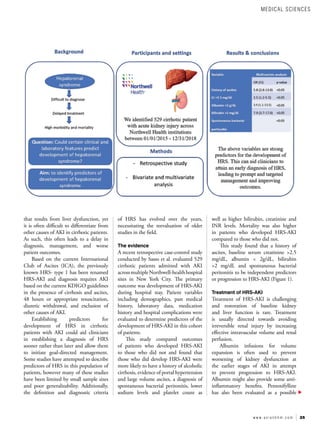
A recent retrospective case-control study
conducted by Sasso et al. evaluated 529
cirrhotic patients admitted with AKI
acrossmultipleNorthwell-healthhospital
sites in New York City. The primary
outcome was development of HRS-AKI
during hospital stay. Patient variables
including demographics, past medical
history, laboratory data, medication
history and hospital complications were
evaluated to determine predictors of the
development of HRS-AKI in this cohort
of patients.
This study compared outcomes
of patients who developed HRS-AKI
to those who did not and found that
those who did develop HRS-AKI were
more likely to have a history of alcoholic
cirrhosis, evidence of portal hypertension
and large volume ascites, a diagnosis of
spontaneous bacterial peritonitis, lower
sodium levels and platelet count as
well as higher bilirubin, creatinine and
INR levels. Mortality was also higher
in patients who developed HRS-AKI
compared to those who did not.
This study found that a history of
ascites, baseline serum creatinine >2.5
mg/dL, albumin < 2g/dL, bilirubin
>2 mg/dL and spontaneous bacterial
peritonitis to be independent predictors
or progression to HRS-AKI (Figure 1).
Treatment of HRS-AKI
Treatment of HRS-AKI is challenging
and restoration of baseline kidney
and liver function is rare. Treatment
is usually directed towards avoiding
irreversible renal injury by increasing
effective intravascular volume and renal
perfusion.
Albumin infusions for volume
expansion is often used to prevent
worsening of kidney dysfunction at
the earlier stages of AKI in attempt
to prevent progression to HRS-AKI.
Albumin might also provide some anti-
inflammatory benefits. Pentoxifylline
has also been evaluated as a possible
MEDICAL SCIENCES
26 ASIAN HOSPITAL & HEALTHCARE MANAGEMENT ISSUE - 55, 2022
of AKI. In the study by Sasso et al.,
mortality was 40 per cent among those
with HRS-AKI.
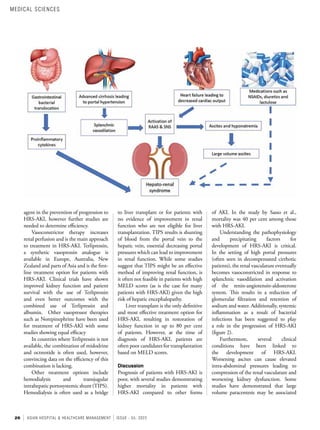
Understanding the pathophysiology
and precipitating factors for
development of HRS-AKI is critical.
In the setting of high portal pressures
(often seen in decompensated cirrhotic
patients), the renal vasculature eventually
becomes vasoconstricted in response to
splanchnic vasodilation and activation
of the renin-angiotensin-aldosterone
system. This results in a reduction of
glomerular filtration and retention of
sodium and water. Additionally, systemic
inflammation as a result of bacterial
infections has been suggested to play
a role in the progression of HRS-AKI
(figure 2).
Furthermore, several clinical
conditions have been linked to
the development of HRS-AKI.
Worsening ascites can cause elevated
intra-abdominal pressures leading to
compression of the renal vasculature and
worsening kidney dysfunction. Some
studies have demonstrated that large
volume paracentesis may be associated
to liver transplant or for patients with
no evidence of improvement in renal
function who are not eligible for liver
transplantation. TIPS results is shunting
of blood from the portal vein to the
hepatic vein, essential decreasing portal
pressures which can lead to improvement
in renal function. While some studies
suggest that TIPS might be an effective
method of improving renal function, is
it often not feasible in patients with high
MELD scores (as is the case for many
patients with HRS-AKI) given the high
risk of hepatic encephalopathy.
Liver transplant is the only definitive
and most effective treatment option for
HRS-AKI, resulting in restoration of
kidney function in up to 80 per cent
of patients. However, at the time of
diagnosis of HRS-AKI, patients are
often poor candidates for transplantation
based on MELD scores.
Discussion
Prognosis of patients with HRS-AKI is
poor, with several studies demonstrating
higher mortality in patients with
HRS-AKI compared to other forms
agent in the prevention of progression to
HRS-AKI, however further studies are
needed to determine efficiency.
Vasoconstrictor therapy increases
renal perfusion and is the main approach
to treatment in HRS-AKI. Terlipressin,
a synthetic vasopressin analogue is
available in Europe, Australia, New
Zealand and parts of Asia and is the first-
line treatment option for patients with
HRS-AKI. Clinical trials have shown
improved kidney function and patient
survival with the use of Terlipressin
and even better outcomes with the
combined use of Terlipressin and
albumin. Other vasopressor therapies
such as Norepinephrine have been used
for treatment of HRS-AKI with some
studies showing equal efficacy
In countries where Terlipressin is not
available, the combination of midodrine
and octreotide is often used, however,
convincing data on the efficiency of this
combination is lacking.
Other treatment options include
hemodialysis and transjugular
intrahepatic portosystemic shunt (TIPS).
Hemodialysis is often used as a bridge
MEDICAL SCIENCES
27
w w w . a s i a n h h m . c o m
with HRS-AKI secondary to intravascular
fluid shifts and potentiation of the
renin-angiotensin-aldosterone system.
Spontaneous bacterial peritonitis results
in a hyperinflammatory state that has
been suggested to precipitate HRS-AKI
and cardiogenic shock results in decreased
effective intravascular volume, contributing
to renal dysfunction. Additionally, certain
medications such as diuretics, non-steroidal
anti-inflammatory drugs and lactulose may
contribute to HRS-AKI (figure 2).
By understanding the pathophysiology
of HRS-AKI and integrating the clinical
conditions associated with HRS-AKI and
the established evidence-based predictors
of progression to HRS-AKI, clinicians can
stratify cirrhotic patients into high risk or
low risk for HRS-AKI allowing for earlier
diagnosis and management of this high
mortality condition.
References are available at
www.asianhhm.com
Sasso is a medical resident at
Northwell health. After completing
medical school, she pursued two
years of post-doctoral fellowship at
the department of Hepatology at the
Medical University of South Carolina.
Her research interest focus on compli-
cations of portal hypertension. Sasso is
going to start her gastroenterology and
hepatology fellowship at the University
of New Mexico
Abou Yassine is a medical resident at
Northwell health. His research interest
focus on critical illness in cirrhotic
patients including severe infections
and sepsis. Abou Yassine will complete
chief-resident training at Northwell
health before pursing a fellowship in
critical care.
AUTHOR
BIO
MEDICAL SCIENCES
28 ASIAN HOSPITAL & HEALTHCARE MANAGEMENT ISSUE - 55, 2022
Management of
Cerebrovascular
Steno-Occlusive Disease
Patients with steno-occlusive cerebrovascular disease
are at risk of ischemic symptoms from haemodynamic
insufficiency in the presence of reversible hypoperfusion,
exhausted autoregulation and impaired vasodilatory
reserve. Multidisciplinary management approach
includes blood pressure management, antithrombotic
therapy, treatment of underlying brain-body interactions
targeted at optimising cerebral blood flow and oxygen
delivery, and revascularisation procedures.
Benjamin Wai Yue Lo, Neurosurgeon & ICU Specialist
P
atients with symptomatic steno-
occlusive disease have a risk of
recurrent stroke of at least 10-15
per cent within 5 years. Progressive
atherosclerosis of internal carotid artery
(ICA) or middle cerebral artery (MCA)
is the most common cause of impaired
distal cerebral perfusion with cerebral
misery hypoperfusion (Figure 1, Table
1).
Cerebral Hypoperfusion & Collateral
Circulation
In the setting of cerebral hypoperfusion,
recurrent ischaemic events occur
depending on the following factors: (1)
amount of collateral cerebral circulation;
(2)extentofhaemodynamicimpairment;
(3) age; (4) cardiac status; (5) presence
of metabolic syndrome of hypertension,
hyperlipidemia and insulin resistance;
(6) factors affecting coagulation, blood
Contemporary multidisciplinary approach
oxygen carrying capacity and delivery
(such as anaemia and other haematology
disorders, systemic infections and sepsis,
renal and hepatic disorders).
In addition to the traditional cerebral
ischaemic symptomatology pertaining to
the affected vascular territory (Table 2),
orthostatic symptoms, syncope, transient
global amnesia, episodic limb shaking
and watershed infarction are possible.
In states of misery perfusion,
compensatory cerebral vasodilation
is not possible as the cerebral
autoregulatory capacity is exhausted and,
as a result, cerebral blood flow decreases
proportionally with cerebral perfusion
pressure (Figure 1). Possible cerebral
collateral circulation routes include:
(1) contralateral internal carotid artery
(ICA) through anterior communicating
artery; (2) posterior circulation via
posterior communicating artery; (3)
MEDICAL SCIENCES
29
w w w . a s i a n h h m . c o m
leptomeningeal or pial collaterals; (4)
collateral circulation from external
carotid artery (ECA) with retrograde
flow and connections with ophthalmic
artery, extracranial connections between
ECA or vertebral artery (VA) branches
and distal ICA; (5) collaterals through
dural meningeal arteries to cortical
arteries; (6) anterior cerebral artery
(ACA)-posterior cerebral artery (PCA)
connections via the limbic loop; and (7)
anterior spinal artery collaterals with the
vertebrobasilar circulation.
Medical management principles
Medical management strategies are
essential to treatment of cerebral
ischaemic events and prevention of
recurrent strokes in face of cerebral
hypoperfusion. These include: (1)
cautious individualised blood pressure
management (usually systolic blood
pressure targets of 130-160 mmHg
for those with severe bilateral carotid
stenoses); (2) maintenance of fluid status
to maintain appropriate plasma oncotic
pressures for adequate cerebral perfusion;
(3) anti-platelet and anticoagulant
therapies (single anti-platelet agent
and anticoagulant for those with
embolic strokes or in the setting of
cardiac arrthymias; dual anti-platelet
therapy, with laboratory evidence of
responsiveness to these agents, for those
with atherosclerotic disease or perforator
events), (4) statin, and (5) glycaemic
control.
Treatment of underlying brain-
body interactions are also essential,
including attention to haemodynamic
stability, cardiac status, optimising
cerebral oxygen delivery with avoidance
of anaemia, goal-directed therapy for
sepsis, optimisation of renal perfusion
and avoidance of coagulopathy and
encephalopathy due to underlying
multi-systemic involvement, particularly
renal or hepatic impairment.
Identification of surgical candidate
For patients with symptomatic severe
(> 70 per cent) carotid stenosis,
carotid endarterectomy or angioplasty/
stenting is considered. Thrombectomy
is considered for patients with embolic
strokes to large size cerebral vessels.
For patients who have been medically
optimised but are still at risk of
ischaemic symptoms of haemodynamic
insufficiency due to ICA/MCA stenosis/
occlusion in the setting of hypotension or
orthostasis, one can identify candidates
with reversible hypoperfusion, exhausted
autoregulationandimpairedvasodilatory
reserve. Consideration of extracranial-
intracranial bypass procedure can be
reliably made to identify patients who
have reasonable chances of augmentable
flow-induced long-term cerebral blood
flow re-organisation (collateral shift)
while preventing future hypoperfusion
events. Identification of these
candidates is made after blood pressure
management, antithrombotic therapy
and treatment of underlying brain-
body interactions targeted at optimising
cerebral blood flow and oxygen delivery.
Investigational adjuncts
In addition to clinical findings on
presentation and with monitoring
(Table 2), other adjunctive investigations
are useful in identifying such surgical
candidates. CT perfusion scans
demonstrate ischaemic penumbra
of increased time-to-peak (TTP,
time between first arrival of CT
contrast intracranially and its peak
concentration), increased mean transit
time (MTT, average time for blood
to travel through a volume of brain),
with relatively preserved cerebral blood
volume (CBV) due to vasodilation
and recruitment of collateral flow, and
decreased cerebral blood flow (CBF).
As reference, an infarcted core shows
increasedTTP,increasedMTT,decreased
CBV and decreased CBF. SPECT
(single photon emission computerised
tomography) scan with acetazolamide
(DiamoxTM) is used to identify patients
with haemodynamic insufficiency who
exhibit reversible hypoperfusion and
decreased cerebrovascular reactivity
when challenged with acetazolamide
(Figure 3a-c). In those who are in the
misery perfusion stage of haemodynamic
insufficiency, they are already maximally
MEDICAL SCIENCES
30 ASIAN HOSPITAL & HEALTHCARE MANAGEMENT ISSUE - 55, 2022
vasodilated and dysautoregulated. In this
regard, they cannot further vasodilate
in response to increased carbon dioxide
tension from diuretic acetazolamide, a
carbonic anhydrase inhibitor.
Quantitative MR angiography
(q-MRA)’s non-invasive optimal vessel
analysis (NOVA) is also essential to
quantify and measure blood flow
through large vessels of the Circle of
Willis (Figure 3b). Together with formal
cerebral angiography, it can be used to
estimate pial and collateral flow. It gives
reasonable estimates of augmentable
flow to ensure appropriate blood
velocity ranges after bypass, and also in
anticipation of longer term collateral
shift, cerebral blood flow re-organisation.
Surgical procedure
Direct superficial temporal artery
(STA) [donor] and middle cerebral
artery (MCA) M4 cortical branch
[recipient] bypass is generally
preferred. Meticulous attention to
blood pressure control, maintenance
of intravascular volume and depth
of anaesthesia are essential to avoid
cerebral hypoperfusion during these
cases with underlying steno-occlusive
disease. Intraoperative end-to-side
anastomoses are performed using 10-0
nylon sutures with indocyanine green
(ICG) and intra-operative angiographic
confirmation of anastomotic patency.
Individualised blood pressure goals
with gradual liberalisation of these
parameters are done post-operatively
with continuation of antithrombotic
agents to maintain anastomotic patency
and to avoid reperfusion-related injury.
Conclusion
For patients who have been medically
optimised but still at risk of ischemic
symptoms of haemodynamic
insufficiency due to steno-occlusive
cerebrovascular disease, one can identify
candidateswithreversiblehypoperfusion,
exhausted autoregulation and impaired
vasodilatory reserve. Consideration
of extracranial-intracranial bypass
Artery Normal Mean Flow Velocity [MFV]
(cm/s)
ICA Siphon < 70
MCA M1-M2 < 80
ACA A1 < 80
BA < 50
VA < 60
PCA < 50
Arterial Stenosis (50 per cent) Mean Flow Velocity [MFV] (cm/s)
ICA Siphon, ACA (A1) < 90
MCA M1-M2 < 100
BA-VA-PCA < 70
Figure 1. Stages of Cerebral Hypoperfusion.
Table 1. Cerebrovascular mean flow velocities.
ICA = internal carotid artery, MCA = middle cerebral artery, ACA = anterior
cerebral artery, BA = basilar artery, VA = vertebral artery, PCA = posterior
cerebral artery.
procedure can be reliably made to
identify patients who have reasonable
chances of augmentable flow-induced
long-term cerebral flow re-organisation
while preventing future hypoperfusion
events. Identification of these candidates
are made after medical optimisation,
including blood pressure management,
antithrombotic therapy and treatment
of underlying brain-body interactions
targeted at optimising cerebral blood
flow and oxygen delivery.
MEDICAL SCIENCES
31
w w w . a s i a n h h m . c o m
Table 2. Stroke Syndromes
Carotid
asymptomatic bruit
TIAs (transient ischemic attacks): transient monocular blindness,
weakness, numbness, speech/language disturbance
sudden deficit in MCA and/or ACA territory
progressive or stepwise hemispheric deficits (watershed
infarction)
MIDDLE CEREBRAL ARTERY (MCA) STROKE SYNDROMES
MCA - entire territory
contralateral gaze palsy, hemiplegia, hemisensory loss, spatial
neglect, hemianopsia
(left) global aphasia
MCA – deep
contralateral hemiplegia, hemisensory loss
(left) transcortical motor (non-fluent aphasia, intact repetition)
and/or sensory (receptive) aphasia
lacunar syndromes - pure motor hemiparesis, sensorimotor
stroke
MCA – parasylvian
contralateral weakness and sensory loss of face and hand
(left) conduction aphasia, apraxia, Gerstmann's syndrome (dys-/
a-graphia, dys-/a-calculia, finger agnosia, left-right disorientation)
(right) constructional dyspraxia
MCA - superior division
contralateral hemiplegia, hemisensory loss, gaze palsy, spatial
neglect
(left) Broca's aphasia
MCA - inferior division
contralateral hemianopsia or upper quadrantanopsia
(left) Wernicke's aphasia
(right) constructional dyspraxia
ANTERIOR CEREBRAL ARTERY (ACA) STROKE
SYNDROMES
ACA - entire territory
contralateral hemiplegia
abulia
incontinence
transcortical motor aphasia or motor and sensory aphasia
limb dyspraxia
ACA – distal
contralateral weakness of leg, hip, foot, shoulder
sensory loss in foot
transcortical motor aphasia or motor and sensory aphasia
limb dyspraxia
ACA – deep
lacunar syndromes - pure motor hemiparesis, sensorimotor
stroke
ACA - anterior choroidal
hemiparesis, hemisensory abnormalities, hemianopia
MIDBRAIN STROKE SYNDROMES
Midbrain basis (Weber's syndrome)
PCA (posterior cerebral artery) branches, top of basilar
CN (cranial nerve) 3 fascicles - ipsilateral 3rd palsy (ptosis, no
eye adduction, no up/downgaze +/- dilated pupil)
Midbrain tegmentum (Claude's syndrome)
PCA (posterior cerebral artery) branches, top of basilar
CN 3 fascicles - ipsilateral 3rd palsy
red nucleus, superior cerebellar peduncle fibers - contralateral
ataxia
Midbrain basis and tegmentum (Benedikt's syndrome)
PCA (posterior cerebral artery) branches, top of basilar
CN 3 fascicles - ipsilateral 3rd palsy
cerebral peduncle - contralateral hemiparesis
red nucleus, substantia nigra, superior cerebellar peduncle fibers
- contralateral ataxia, tremor, involuntary movements
PONS STROKE SYNDROMES
Medial pontine basis (dysarthria hemiparesis - pure
motor hemiparesis)
basilar artery (paramedian branches), ventral territory
corticospinal/bulbar tracts - contralateral face/arm/leg
weakness, dysarthria
Medial pontine basis (ataxic hemiparesis)
basilar artery (paramedian branches), ventral territory
corticospinal/bulbar tracts - contralateral face/arm/leg
weakness, dysarthria
pontine nuclei/pontocerebellar fibers - contralateral ataxia
(occasional ipsilateral ataxia)
Medial pontine basis and tegmentum (Foville's
syndrome)
basilar artery (paramedian branches), ventral and dorsal
territories
corticospinal and corticobulbar tracts - contralateral face/arm/
leg weakness, dysarthria
facial colliculus - ipsilateral face weakness, ipsilateral horizontal
gaze palsy
Medial pontine basis and tegmentum (Pontine wrong-
way eyes syndrome)
basilar artery (paramedian branches), ventral and dorsal
territories
corticospinal and corticobular tracts - contralateral face/arm/leg
weakness, dysarthria
abducens nucleus/paramedian pontine reticular formation -
ipsilateral horizontal gaze palsy
MEDICAL SCIENCES
32 ASIAN HOSPITAL & HEALTHCARE MANAGEMENT ISSUE - 55, 2022
Medial pontine basis and tegmentum (Millard-Gubler
syndrome)
basilar artery (paramedian branches), ventral and dorsal
territories
corticospinal and corticobulbar tracts - contralateral face/arm/leg
weakness, dysarthria
CN7 fascicles - ipsilateral face weakness
Medial pontine basis and tegmentum (Other regions)
basilar artery (paramedian branches), ventral and dorsal
territories
medial lemniscus - contralateral decreased position and vibration
sense
medial longitudinal fasciculus - internuclear ophthalmoplegia
(affected eye impaired adduction)
Lateral caudal pons (anterior inferior cerebellar artery -
AICA)
middle cerebellar peduncle - ipsilateral ataxia
vestibular nuclei - vertigo, nystagmus
trigeminal nucleus and tract - ipsilateral facial decreased pain and
temperature sense
spinothalamic tract - contralateral body decreased pain and
temperature sense
descending sympathetic fibers - ipsilateral Horner's syndrome
Lateral caudal pons (Other regions)
labyrinthine artery - inner ear - ipsilateral hearing loss
Dorsolateral rostral pons (superior cerebellar artery -
SCA)
superior cerebellar peduncle and cerebellum - ipsilateral ataxia
other lateral tegmental structures (variable) - variable features of
AICA syndrome (lateral tegmental involvement)
MEDULLA STROKE SYNDROMES
Medial Medulla
paramedian vertebral artery (VA), anterior spinal artery (ASA)
pyramidal tract - contralateral arm/leg weakness
medial lemniscus - contralateral decreased position/vibration
CN12 nucleus/fascicles - ipsilateral tongue weakness
Lateral Medulla (Wallenberg's syndrome)
posterior inferior cerebellar artery (PICA), vertebral artery (VA)
inferior cerebellar peduncle, vestibular nuclei - ipsilateral ataxia,
vertigo, nystagmus, nausea
trigeminal nucleus, tract - ipsilateral facial decreased pain and
temperature sense
spinothalamic tract - contralateral body decreased pain and
temperature sense
descending sympathetic fibers - ipsilateral Horner's syndrome
nucleus ambiguus - hoarseness, dysphagia
nucleus solitarius - ipsilateral decreased taste
VERTEBRAL ARTERY (VA) STROKE SYNDROMES
Subclavian Steal
asymptomatic
sometimes vertebrobasilar (VB) TIAs (dizziness, slurred speech,
faintness, imbalance)
Extracranial Vertebral Artery (VA)
asymptomatic
sometimes VB TIAs
Intracranial Vertebral Artery (VA)
lateral medullary syndrome (Wallenberg's syndrome)
medial medullary syndrome (tongue paralysis, contralateral
hemiplegia)
hemi-medullary infarction
PICA infarction (dorsolateral medulla and lower half of
cerebellum)
BASILAR ARTERY STROKE SYNDROMES
Basilar occlusion
often preceding TIAs
at onset headaches, dizziness, paresthesia, confusion followed
by CN palsies
neuro-ophthalmologic abnormalities (such as vertical skew,
oscillopsia, downbeat nystagmus), ataxia, quadriparesis/plegia,
locked-in syndrome, coma
Lacunes
pure motor hemiparesis, dysarthria-clumsy hand, pure sensory
stroke, sensorimotor stroke
Paramedian and short circumferential arteries
crossed syndromes with ipsilateral CN palsy
contralateral motor, sensory or sensorimotor deficits
neuro-ophthalmologic abnormalities, dysarthria, ataxia
Superior Cerebellar Artery (SCA)
limb ataxia, dysarthria, CN4 palsy (diplopia worse in downgaze),
Horner’s syndrome, contralateral thermoanalgesia
Anterior Inferior Cerebellar Artery (AICA)
limb and trunk ataxia, CN7 & 8 palsies, Horner’s syndrome,
contralateral hemiplegia and hemisensory loss
Posterior Inferior Cerebellar Artery (PICA)
pseudovestibular syndrome, nystagmus, trunk and limb ataxia,
lateral medullary syndrome
Top of Basilar Occlusion
abnormal pupils, convergence, vertical eye movements,
CN3 palsy, hemiplegia/quadriplegia, sensory loss, ataxia,
hypersomnolence, inattention, abnormal behaviour, confusion,
hallucinations, memory loss, visual defects, abnormal
movements
Thalamic Infarcts
abulia, memory loss, dysphasia, dyspraxia (anterolateral
infarction)
MEDICAL SCIENCES
33
w w w . a s i a n h h m . c o m
hypersomnolence, coma, abnormal vertical eye movements and
convergence, disorientation, amnesia, dysphasia (anteromedial
infarction)
pure sensory stroke, sensorimotor stroke, Dejerine-Roussy
syndrome (lateral infarction)
visual field defects (dorsal and lateral geniculate body infarction)
POSTERIOR CEREBRAL ARTERY (PCA) STROKE
SYNDROMES
PCA - deep and superficial territory
part of syndrome of top of basilar
PCA - deep territory
thalamopeduncular infarcts
PCA – superficial
cortical blindness
visual field defects (homonymous hemianopia, altitudinal
hemianopia, quadrantanopia)
abnormal color vision, pallinopsia, micropsia
visual agnosia, pure alexia, hemidyslexia, prosopagnosia,
memory deficits, topographic disorientation, amnesic aphasia
Figure 3a. MR Angiogram showing left ICA
functional occlusion.
Figure 3b. Quantitative MRA showing
decreased left MCA flow.
Figure 3c. SPECT showing slight reversible
hypoperfusion after acetazolamide challenge (right).
Acknowledgement: Acknowledgement is made to Dr. David J. Langer for his expertise in this clinical area.
Benjamin W Y Lo is a neurosurgeon and ICU specialist. His clinical
focus is cerebrovascular disorders. His research focus characterises
brain-body interactions in neurocritical care patients with cerebro-
vascular disorders. Dr. Lo’s qualifications include FRCSC certification
in neurosurgery (2009), FRCSC certification in critical care medicine
(2011), MSc and PhD degrees in clinical epidemiology and biosta-
tistics from McMaster University. His clinical experience includes
working as neurosurgeon and ICU specialist at St. Michael’s Hospital,
University of Toronto; Montreal Neurological Institute & Hospital, McGill
University; and Northwell Health Lenox Hill Hospital, New York.
AUTHOR
BIO
MEDICAL SCIENCES
34 ASIAN HOSPITAL & HEALTHCARE MANAGEMENT ISSUE - 55, 2022
In this article Dr Prasad shares his views on
chronic disease management based on four
key principles organ focus, standardised global
care guidelines, multidisciplinary approach and
tumour board and patient centric cancer care.
Prasad Narayanan, Senior Consultant & Director – Medical Oncology
Cytecare Cancer Hospitals
CHRONIC
DISEASE
MANAGEMENT
Challenges and opportunities
W
hen a disease persists for a long time, it presents different challenges.
Whether it is diabetes, asthma or hypertension, chronic disease
management is the key. This essentially entails helping the patient
live a ‘normal’ life, despite there being no cure for the ailment.
As an oncologist, I see cancer patients today live longer than ever before.
We have newer and smarter treatment modalities for cancer getting approved
on a regular basis. According to National Cancer Institute, USA, 67 per cent of
people diagnosed with cancer have survival rates of at least five years. That’s a
remarkable increase of over 20 per cent in the last four decades.
The Indian Council of Medical Research (ICMR) registry also reports a
similar trend in cancer survival, despite almost 60 per cent of cancer cases in
India being diagnosed at an advanced stage. In other words, even when there’s
no cure per se available, medical science can help patients lead a good quality
of life.
MEDICAL SCIENCES
35
w w w . a s i a n h h m . c o m
Treating cancer
Cancer is counted among the top 10 chronic diseases
globally. However, the term ‘cancer’ refers not just to one
disease, but a collection of more than 100 diseases – from
breast cancer and colon cancer to blood cancer and skin
cancer – with wide-ranging characteristics that usually
call for varied treatments.
Cancer management depends on multiple factors,
such as type of cancer, disease response, remission or
relapse, tolerance to treatment, age and overall health
of the patient, to name some. Studies show that lifestyle
changes, early detection and timely treatment can help
prevent and cure many cancers, including breast cancer,
cervical cancer, oral cancer, prostate cancer and skin
cancer. Also, treating an early stage cancer is nearly 80
per cent more cost-effective and the survival rates are five
times higher than at later stages.
Current cancer treatments include chemotherapy,
immunotherapy, radiation therapy, and surgery.
However, modalities are changing rapidly. For instance,
most cancers needed chemotherapy or other IV drug
treatments in the past. But today an increasing number
of patients – almost 30 per cent in case of lung cancer
patients – are treated with targeted therapy, mostly by
way of oral medications!
With targeted therapies, researchers are looking at
targeting the cancer-causing genetic changes in tumours
– no matter where the cancer develops in the body – to
combat the disease. Similarly, precision medicine can help
predict targetable mutations and figure out how the body
would process certain drugs even before one takes them.
Precision medicine holds immense promise in
cancer care.
We can no longer look at cancer treatment as a one-size-
fits-all; it has to be tailored to each individual, such that
the therapies work with the body’s makeup to help fight
cancer in the most effective manner.
Immunotherapy, also called biotherapy, is another
cancer treatment, powered by one’s own immune system.
There are two common types of immunotherapy. First,
monoclonal antibodies, which are designed to recognise
and attack cancer cells, and have an overall good response
with limited side effects. Second, checkpoint inhibitors
that work by blocking checkpoint proteins from binding
with their partner proteins. This prevents the “off” signal
from being sent, allowing the T cells to kill cancer cells.
Vaccines are also a type of immunotherapy that work
to boost the body’s immune system to fight cancer. There
are vaccines, such as the Human Papilloma Virus (HPV)
vaccine that help prevent cancers caused by a virus, and
vaccines that are used to treat certain cancers, such as
prostate cancer and cervical cancer, by
activating the immune cells. Researchers
are in the process of testing vaccines for
several types of cancer.
Organ site approach
Traditionally, we have approached
cancer unlike most other diseases with
potential for turning chronic; not
associating it with the organ that it
impacts. Of course, this is no longer
true for the medical fraternity. Today,
we have colleagues who have spent years
understanding how the disease not only
impacts a specific organ but certain
different parts of an organ.
For instance, head and neck cancers
comprise over 17 sites, including oral
cavity, nasal cavity, and ear, to name
some. We need to look at cancer from
an organ site approach, whereby there
are dedicated teams for each type of
cancer.
However, the awareness among
patients with regards to organ site focus
and how it impacts the course of their
treatment, chances of recurrence, and
post-treatment life is still quite low. For
many of them, especially semi-rural and
rural patients, all types, and stages of
cancer are associated with life-limiting
illness.
Hence, a major area of growth as
we look to effective chronic disease
management would also be to educate
patients and people at large about how
every cancer isn’t the same in terms of
its symptoms, risk, survival, and life
post treatment. Disseminating a lot
more knowledge about organ site-focus
can go a long way in reducing anxieties
around the disease.
Cytecare is one of the first private
hospitals in India to offer organ site-
focus-based oncology care. Our practice
is based on four prominent pillars
— organ site focussed and specialist
oncologists, standardised global
guidelines and tumour board, patient-
centric culture and clinical research.
The multidisciplinary team of clinicians
is strongly guided by national as well as
MEDICAL SCIENCES
36 ASIAN HOSPITAL & HEALTHCARE MANAGEMENT ISSUE - 55, 2022
of community to help patients cope
better. Our Patient Navigator support
system, a one-of-its-kind support
system, encourages cancer survivors to
share their personal experiences with
others in similar situations. Patients
find it comforting to hear survivors
talk about their experience of managing
pain, undergoing chemotherapy and
other treatments, communicating with
doctors, drawing strength from family
and friends.
Families of people living with
cancer also need support. We have
seen that when caregivers are cared
for, it can make a big impact in terms
of optimal outcomes for the patient.
It’s prudent for cancer care centres
to invest in patient support groups,
wellness groups, social workers,
psychologists, and counsellors as part
of their work with families. Extra
hands and empathetic hearts can make
the journey with cancer less stressful.
pain management and rehabilitation
services, to onco-nutritional support,
mind-body medicine and home care
support services, Cytecare was founded
on the principle of ‘Fighting Cancer the
Right Way’.
With healthcare taking centre stage
during the pandemic, this could be a
truly transformative phase that changes
the way we address health and chronic
disease management.
Lifecycle management
Once the cancer is stable during
treatment or in remission and life
feels normal again, it’s important to
remember that the battle isn’t over yet.
With chronic disease management, the
road ahead is long. And there are bound
to be ups and downs along the way.
In order to ensure that the journey
doesn’t get too uphill or lonely, it’s vital
to nurture a strong support system. At
Cytecare, for instance, we foster a sense
global protocols, such as the National
Comprehensive Cancer Network
(NCCN), European Society for
Medical Oncology (ESMO), National
Health Service (NHS), Indian Council
of Medical Research (ICMR) and Tata
Memorial Hospital.
Way forward
Going forth, we must look at building
organ site-focus capabilities that
understand the varied emotional
impacts associated with the difference
organ-related cancers. For instance,
the mental make-up of a patient with
breast cancer is likely to very different
than that of a patient with lung cancer.
Accordingly, not just counselling,
but the very nature of treatments
and therapies in the future should be
directed towards effectively managing
the same.
Right from diagnosis to post-
treatment prescriptions, we need
to create an environment that isn’t
overwhelming and alienating but one
that instils hope, confidence, and
positivity. Each one of us – surgeons,
doctors, therapists, radiologists,
nutritionists, nurses, counsellors –
need to see it as our collective and core
responsibility rather than an addition
to our busy schedules. Be it offering
them sufficient information support
and procedure-related advantages and
disadvantages in a language of their
choice or mind and body wellness
programs,weneedtogofromaddressing
the cancer at the site to managing the
disease that engulfs the mind, lives, and
communities.
As Suresh Ramu, Co-founder and
CEO, Cytecare Cancer Hospitals,
rightly puts it, "India needs to invest
in more patient-centric cancer care
systems, with an organ-site approach.
We must adopt a holistic way of dealing
with chronic diseases – that are often
misunderstood and not diagnosed
and treated on time. Patient-centricity
has to be at the heart of chronic
disease management. Right from
MEDICAL SCIENCES
37
w w w . a s i a n h h m . c o m
Mind-Body Wellness
It is crucial that cancer patients take
care of their mental and physical
health. Mental health is closely linked
to physical health. A disturbed state of
mind can further affect emotional and
psychological wellbeing. Chronic stress
is known to trigger inflammation in the
body and can cause fatigue, depression,
irritability, and severe headaches.
Being diagnosed with a life-
threatening disease and undergoing
treatment can cause much distress. And
thepandemichasonlyfurtheraggravated
the emotional and mental impact that
one experiences while navigating a
chronic illness. Right from concerns
about being immunocompromised
to greater anxiety about an uncertain
financial future, the trigger points are
plenty.
At Cytecare, our team of psycho-
oncologists help patients to navigate
mental health issues and find a healthy
outlet for their emotions. It is essential
to help patients manage the psychosocial
challenges of diagnosis and treatment of
cancer.
Multi-disciplinary team-based
approval
The quality of care over time is critical
to chronic disease management. For
cancer, it is important to adopt a
multi-disciplinary approach. It’s not
just about cancer care, but patient
care. For instance, co-existing medical
conditions, if any, also need to be
addressed effectively to ensure overall
health and well-being of patients.
As healthcare providers, our focus
tends to be on new, multidimensional
models of service delivery for improved
patient outcomes. That’s essential – but
so is patient satisfaction. We need to
look at continuity of care from both
perspectives – that of the patient and
that of the provider.
From medical, radiation and surgical
oncologists to pain and palliative care
experts, all cancer care centres need
to be armed with a comprehensive
team of professionals, who have a deep
understanding of the complex disease.
Cytecare’s integrated oncology works
with a world-class team of 25 plus
cancer specialists - One of the largest
such team in India.
We also have a multi-disciplinary
tumour board to ensure that each
patient not only gets expert care – from
the medical oncologist, the radiation
oncologist, the surgical oncologist and
the pathologist, among others – but
also that there is strict governance of
care.
Remote patient monitoring
Technology can be a potent tool in
bridging the healthcare gap, by moving
medical care out of the traditional
setting into places where people
live and work. This is particularly
empowering in a country like India
where an overwhelming majority of
patients have advanced stage of cancer
at the time of diagnosis.
During the pandemic, the ability
to offer remote/virtual consultations
has helped healthcare providers to
offer suitable consultations and reduce
the risks of infection, while dealing
with limited hospital resources.
Several cancer patients, who are at
high-risk of infection, managed to get
regular advice from their doctors via
teleconsultations, without having to
travel to the hospital.
The pandemic also saw patient-
centred home care being integrated
with more traditional hospital-centred
care. In time, the primary setting for
the delivery of care to certain patients
with cancer is likely to shift from the
hospital to the home – courtesy better
cancer treatments, advent of oral
therapies, shortened hospital visits,
longer survival, and most patients’
desire to be cared for at home for as
long as possible.
Smart technologies have further
facilitated timely, evidence-based care for
seamless healthcare delivery. Smart ICUs,
for instance, offer valuable benefits of
continuous remote surveillance, such as
prevention of infections, early detection
of organ failures and timely resuscitation
of patients as well as helping devise
disease-specific protocols and effective
strategies.
Prasad Narayan is a Senior
Consultant and Director at Cytecare
Cancer Hospitals. With over two
decades of rich experience in medi-
cal science and clinical research,
Prasad has been conferred with
several prestigious awards including,
‘Dronacharya Award’ for Oncology.
AUTHOR BIO
MEDICAL SCIENCES
38 ASIAN HOSPITAL & HEALTHCARE MANAGEMENT ISSUE - 55, 2022
THE HEALTH
IMPACT OF
NUDGES,
INFLUENCE
AND
COMMUNITY
There is enough evidence available now
suggesting that beyond meal plans and exercise
regimes, there are more factors that impact
healthy lifestyle and overall wellbeing of the
society – both macro and micro. And there is
merit in exploring and evaluating what different
influences can help in creating aware and
healthier societies. When it comes to behaviour
moulding at a community level, there lies an
opportunity to leverage nudges and incentives
to lead the community to achieve the desired
health and wellbeing status. A few of these
tactics that have proven to be beneficial and
further research is needed in these areas
to derive ideal outcomes and impact.
Kent Bradley, Chief Health and Nutrition Officer, Herbalife Nutrition
I
n our busy world full of easy conveniences, many consumers choose
high-sugar, high-fat foods that are low in nutrients. Leading a healthy
life is easy to wish for but much harder to attain in an environment
with so many unhealthy choices so readily available.
MEDICAL SCIENCES
39
w w w . a s i a n h h m . c o m
These days, the matter of leading a
healthy life is not a concern limited to
just individual consumers. The ongoing
pandemic, and its adverse impacts on the
economic and healthcare status on the
countries in Asia Pacific1
, has become a
significant national agenda. Many low-
and middle-income Asian economies
needed to spend more on health issues
like obesity and non-communicable
diseases (NCDs) even prior to the crisis.
It is critical to ensure that economic
pressures — either during or after
the pandemic has ended — do not
divert already limited resources away
from essential health services. As these
1 https://www.oecd-ilibrary.org/sites/aaa5448f-en/index.
html?itemId=/content/component/aaa5448f-en
countries have limited capacity and
depend heavily on household out-of-
pocket spending, the significant cost
of responding to and containing the
pandemic may not be fully within their
financial capacity. With more and more
countries and governments2
in the region
expressing their concern over the public
health issues and their preparedness to
manage them; it is clear that a more
holistic and widespread approach is
needed.
There is enough evidence available
now suggesting that there are multiple
factors, beyond medication or nutrition
awareness, that impact healthy lifestyle
2 https://www.oecd-ilibrary.org/sites/aaa5448f-en/index.
html?itemId=/content/component/aaa5448f-en
and overall wellbeing of the society –
both macro and micro environmental
level3
.
There is also merit in exploring and
evaluating the factors that can help in
creating aware and healthier societies.
The ANGELO Framework defines
four categories of environment to
consider while evaluating an impact
– physical (what is available); political
(what are the rules); economic (what are
the costs); and sociocultural (what are
the attitudes and beliefs). When it comes
to behaviour moulding at a community
level, all these categories together play a
significant role. There lies an opportunity
3 https://www.ncbi.nlm.nih.gov/pmc/articles/
PMC5129776/
MEDICAL SCIENCES
40 ASIAN HOSPITAL & HEALTHCARE MANAGEMENT ISSUE - 55, 2022
to leverage nudges, incentives, and
power of community to achieve the
desired health and wellbeing status – an
aspect which nutrition companies, and
healthcare professionals (HCPs) can
help facilitate and drive. While further
research is needed in these areas to derive
ideal outcomes and impact, a few of
these tactics have proven to be beneficial:
Nudges and influence
Nutrition labeling4
is a proven potential
method to encourage consumers to
improve dietary behaviour. Many
industries have been adopting images
and labels on packaging of food items
as an indicator of its calorific value as
well as its impact on health. Different
formats of such labelling have been
experimented in the past such as
coloured coding, warning imagery,
4 https://journals.plos.org/plosmedicine/article?id=10.1371/
journal.pmed.1003765
healthier food and lifestyle choices.
Government endorsements spanning
sustainable agriculture, sourcing, food
quality standards and supply chain
best practices have been instrumental
in building the accurate and authentic
perception for brands across. In
another instance, Taiwan’s Symbol of
National Quality (SNQ6
) is a well-
known certification for wellness and
health supplements. The SNQ is given
by the Institute for Biotechnology and
Medicine Industry, and its purpose is
to let consumers know which products
meet top safety and quality standards.
While in Vietnam, the Golden Product
for Public Health Award7
by the
Vietnam Association of Functional Food
is endorsed by the Ministry of Sciences
6 https://iamherbalifenutrition.com/our-products/taiwan-
quality-certification/
7 https://iamherbalifenutrition.com/our-products/vietnam-
public-health-award/
keywords indicating healthy choice,
fibre rich and symbols. However, a study
conducted by Duke-NUS Medical
School and NUS Saw Swee Hock
School of Public Health5
revealed that
it is important to keep the messaging
simple on food products. Multiple
symbols and too much information
on the pack can confuse shoppers and
dilute the effect of all information
shared.
For example, the Government
of Thailand made substantial efforts
towards making this labelling simplistic,
in association with Thai National
Strategic Steering Committee, National
Food Committee and the Public Health
Ministry.
Endorsements and certifications by
credible authorities have a great deal of
influence in helping consumers make
5 https://www.asiaresearchnews.com/content/healthy-food-
labels-work-and-don%25E2%2580%2599t-work
MEDICAL SCIENCES
41
w w w . a s i a n h h m . c o m
A
U
T
H
O
R
B
I
O
Kent L Bradley has worked in leadership roles in healthcare sector,
strategising health related policies and business decisions, he has
acted as strategic advisor for multiple health-tech companies. A retired
army Colonel, he has Masters Degree in Public Health from University
of Minnesota & his medical degree from Uniformed Services University
of Health Sciences, Maryland.
and Technology to achieve the similar
objectives.
Friendships and communities
As humans we are wired for social
connection and these very social
connections play an important role in
people being able to live healthier lives
- science provides evidence that social
connections have a positive impact8
on
people’s lives. According to researchers
from the Harvard Center for Population
and Development Studies9
, people with
meaningful social relationships tend to
have better health behaviours, like eating
healthy foods10
and being physically
active. Group activities11
and exercises
for instance, are known to enhance
social bonding; and social bonding in
turn leads to a proven enhanced exercise
performance.
Another research study published in
the British Journal of Sports Medicine12
found that people who regularly walk in
groups have lower blood pressure, resting
heart rate, and total cholesterol. The
recent Herbalife Nutrition Virtual Run
successfully motivated more than 25,000
consumers to form a common-purpose
community that clocked a total of 1.57
million kilometres, enough to circle the
earth almost 40 times!
Actions are hugely impacted by
beliefs, circle of friends, and family that
8 https://iamherbalifenutrition.com/health-and-wellness/5-
reasons-being-social-makes-you-happier/
9 https://www.hsph.harvard.edu/news/hsph-in-the-news/
active-social-life-longevity/
10 https://www.hsph.harvard.edu/multitaxo/topic/healthy-
eating/
11 https://journals.plos.org/plosone/article?id=10.1371/
journal.pone.0136705#sec017
12 https://bjsm.bmj.com/content/49/11/710
utm_source=TrendMD&utm_medium=cpc&utm_
campaign=BJSM_TrendMD-0
influence choices. Most people spend
a considerable portion of their time at
work and form social circles at work as
well. Thus, workplace environments
thrive when there is a focus on education
and empowerment towards better health.
Civil society, government and public
policy have a significant role to play on
how incentives are applied to create a
healthier environment. The potential
solutions call for a more holistic
approach that effectively integrates
the various groups mentioned. The
impact of unhealthy populations is not
limited to just the consumers, they run
much deeper with social, political, and
economic implications.
The HCPs impact
Perhaps those with the greatest power
to impact consumer lifestyle behaviour
are the likes of coaches, experts, and
HCPs. HCPs command a fair share of
respect and credibility among the public
as far as the nutritional information
and awareness is concerned. As
influential members of their respective
communities, HCPs have a deeper
understanding of the beliefs, practices,
attitudes, awareness as well as behaviour
of their audiences. This knowledge can
help them spread information among
their stakeholders and to nudge more
people towards a healthier lifestyle.
Herbalife Nutrition is on the right
side of these efforts. Our commitment
to improving lives and our communities
has remained at the core of everything
we do. Given the scale and scope of our
global network, we have the capacity
to make a lasting difference for people
seeking a healthier lifestyle. One of
our key initiatives last year was the
Herbalife Nutrition Dialogue Series
13
, a compilation of nutrition-related
educational videos aimed at closing the
nutrition knowledge gaps among Asia
Pacific consumers and equipping them
with credible nutrition information. The
series featured leading experts discussing
topics like diabesity, heart health, healthy
ageing and the need for multi-sector
collaboration to drive public nutrition
education.
Leading a better lifestyle is a matter
of choice, commitment, and support,
and at Herbalife Nutrition, we are
fulfilling our mission by providing not
one but multiple nudges, influences
and communities such as fitness camps,
mentorship programs and educational
efforts to help people make smart
decisions, stay active and achieve their
personal goals.
13 https://www.herbalife.com.sg/apacnews/home
MEDICAL SCIENCES
42 ASIAN HOSPITAL & HEALTHCARE MANAGEMENT ISSUE - 55, 2022
IMPLICATIONS
OF COVID-19 ON
HEART HEALTH
Profoundly straining national healthcare systems and
the global economic stability, since December 2019, the
Wuhan Virus exhibited diverse patterns of after-effects,
especially on the cardiovascular health of an individual,
thus leaving a blind spot in understanding the impacts of
the disease and a huge field for research unexplored.
Audditiya Bandopadhyay and Gyaneshwer Chaubey
Cytogenetics Laboratory, Department of Zoology, Banaras Hindu University
T
he past two decades witnessed
two recorded epidemics,
caused by the family of seven
known coronaviruses - Severe Acute
Respiratory Syndrome Coronavirus
(SARS-CoV), in 2002 - 2003, and the
Middle East Respiratory Coronavirus
(MERS-CoV) in 2012, before the
third and also the most recent one
started to emerge lately. It eventually
turned gigantic, spreading rapidly to
several countries globally, inflicting a
massive jerk to health, economy, and
lifestyle. The previously known virus
family, comprising of HCoV- 229E,
HCoV-NL63, HCoV-OC43, and
HCoV-HKU1, has long been associated
with respiratory distress syndromes
and flu-like outbreaks, with minimum
Cardiac involvement. However, with
the ascent in the number of COVID-
19 confirmed cases, the recent literature
survey documented accumulating
data for cardiovascular complications,
occurring in about 10-20 per cent of
the hospitalised COVID-19 patients.
Apart from the high occurrence of cases
of bronchitis and severe pneumonia, a
heart attack or congestive heart failure
was prevalent during the pandemic,
particularly among the patients
suffering from pre-existing heart
ailments. Reports also widely stated
COVID-19 triggered myocarditis,
along with systemic inflammation,
necrosis of its cells, mimicking heart
attacks, arrhythmias, and acute or
protracted heart failure (muscle
dysfunction), as a characteristic of the
MEDICAL SCIENCES
43
w w w . a s i a n h h m . c o m
infection. In fact, these complications
at times were the sole features of
COVID-19 clinical presentation, and
have occurred even with the cases with
milder COVID-19 symptoms as well as
in the asymptomatic. This deciphered a
distinct set of characteristics of SARS-
CoV-2 in its comprehensive cardiac
involvement, which also could probably
be a consequence of the exposure
of the virus to millions due to the
pandemic. Nevertheless, the plausible
cause of the COVID-19 infection
in the development of myocardial
injury in the patients suffering from
underlying cardiovascular disease is
still unknown and requires an extensive
study to confirm whether or not an
after-effect of the hyperactive immune
response against the virus or the virus
itself, that is leading to myocardial
inflammation, associated with cardiac
function impairment and ventricular
tachyarrhythmias.
Structural aspects of the COVID-19
virus
The virus targets the angiotensin-
converting enzyme 2 (ACE2) receptor
throughout the body while facilitating
the entry of viral genetic material by
the means of its spike protein, along
with the assistance of the cellular serine
protease transmembrane protease
serine 2 (TMPRSS2), heparan sulfate,
and other proteases, which cleaves the
viral spikes protein and make the entry
pathway for the viral genetic contents
and thus it may perturb the angiotensin-
renin pathway severely. ACE2 is
involved in the regulation of blood
volume, systemic vascular resistance,
and thus cardiovascular homeostasis.
Previous studies documented its
association with hypertension, stroke,
dyslipidemia, and cardiovascular
diseases, and kidney diseases. The
heart also has a significantly high level
of ACE2 expression which makes it
more susceptible to the SARS-COV-2
infection.ThedifferencebetweenSARS-
CoV-2 and SARS is apparently a furin
polybasic site that alters their structure
and broadens the tropism of cells that
the virus can infect when cleaved.
Studies involving autopsy specimens
quoted tropism to other organs beyond
the lungs i.e. heart, kidney, and liver,
with the presence of SARS-CoV-2
genomic RNA. In-vitro studies revealed
the ability of SARS-CoV-2 to infect the
induced pluripotent stem cells (iPSCs)
derived cardiomyocytes, causing the
distinctive pattern of cell fragmentation
along with the complete dissolution of
the contractile machinery, leading to
apoptosis, and ultimate cessation of the
heartbeat within 72 hours of the viral
exposure.
COVID-19 on systemic and
cardiovascular health
Besides the direct involvement of the
virus in the heart muscles, its entry into
theendothelialliningofthebloodvessels
of the heart and multiple vesicular beds
is well documented. Another potential
threat is the effects of secondary immune
response on the infected heart and
endothelial cells (endothelitis) which
may include the dysregulation of the
renin-angiotensin-aldosterone system
modulating blood pressure; activation
of proinflammatory responses including
platelets, neutrophils, macrophages,
and lymphocytes, the cytokine storm
and a prothrombotic state. The degree
of cardiovascular manifestations ranges
from limited necrosis of cardiac cells
leading to myocarditis to an often-
fatal inefficiency of the heart to pump
sufficient blood, thus leading to
cardiogenic shock. Myocarditis, being
a diffuse pattern of inflammation
of the heart, typically represents a
variable admixture of injury and an
inflammatory response to the injury,
and often extending through all the
three layers of the human heart to the
pericardium, encompassing the heart,
proves to be even more worrisome
than the restricted pattern injury.
Every one-fifth of the hospitalised
COVID-19 patients, suffering from
MEDICAL SCIENCES
44 ASIAN HOSPITAL & HEALTHCARE MANAGEMENT ISSUE - 55, 2022
the reports of COVID-19 associated
severe inflammatory symptoms
among the pediatric patients were not
null. An unexpected cluster of eight
children (aged 4–14 years) presenting
with a hyperinflammatory syndrome
with symptoms of Kawasaki Disease
was reported in a case series from
the United Kingdom. Other causes
included the multisystem inflammatory
syndrome of children (MIS-C), this
time not only exclusive to children but
also in the adult subjects, such as in a
45-year-old, with the same clinical.
It wouldn’t be of much surprise if the
patients present with cardiomyopathy
of unknown etiology and test positive
for SARS-CoV-2 antibodies in the
future. However, attributing all such
cardiomyopathy solely to the virus may
be difficult, given the high prevalence
of infections. A biopsy might be a
necessity to identify any virus particle
to support causality.
Conversely, an immunologic
basis is likely as there is a possibility
of myocarditis ensuing from the
hyperimmune response so as to
tackle coronavirus by releasing excess
cytokines. Cytokines might end in
inflammation that damages the lungs
and the heart alike. This condition,
known as a cytokine storm, is often
more pronounced in the elderly and
the co-morbid population. However,
it was also seen to affect the middle-
aged population largely during the
subsequent waves of the pandemic in
India being the primary reason for the
severe respiratory complications that
lead to death in patients suffering from
coronavirus. Cytokines promote blood
coagulation, thus interfering with the
body’s clot-busting system. Blood clots
in coronary arteries in turn can block
cardiac injury reflects an accumulation
of troponin - a cardiac muscle-specific
marker in blood, and the same happens
with those having pre-existing heart
ailments. For the kind of myocardial
injury in-hospital mortality, troponin
accumulation was found to be a marker
for morbidity risk. Moreover, it was
observed that the patients with higher
troponin amounts also had increased
levels of many inflammatory markers,
including interleukin-6, C-reactive
protein, ferritin, lactate dehydrogenase,
and an increased neutrophil count, and
heart dysfunction (amino-terminal
pro-B–type natriuretic peptide).
Involvement of myocytes, which
synchronise electrical conduction can
cause conduction block and malignant
ventricular arrhythmias, leading to the
consequential heart attacks. Besides
in-hospital arrhythmias, numerous
regions with high COVID-19
dissemination have observed a steep
increase in out-of-hospital cardiac
arrest and sudden death. There has
been a reported rise of 77 per cent
in the cases in Lombardy, Italy, as
compared to the previous year. Due to
a cluster of chest pain-like sensations,
an irregular EKG, and high levels of
cardiac-specific enzymes in the blood,
myocarditis imitating a heart attack has
been reported even in individuals as
young as 16 years. Heart failure, acute
cor pulmonale, and cardiogenic shock
can occur in response to significant
and diffuse heart muscle injury. Other
possible pathways, responsible for
COVID-19-related heart dysfunction,
such as Takotsubo syndrome or the
Broken heart syndrome, which is a
transient stress-related illness that causes
apical ballooning; ischemia caused by
endocarditis; and related atherosclerotic
plaque rupture with thrombosis were
also reported. Although the children
were thought to be less susceptible
to COVID-19, in comparison to
the adults, and the majority of them
with the disease were asymptomatic
or presented only milder symptoms,
Beyond the
prevention of infection,
the goal of averting
cardiovascular
involvement is
paramount.
MEDICAL SCIENCES
45
w w w . a s i a n h h m . c o m
of dilated arteries due to the disease-
related inflammation. They are the most
common to lack the symptoms after
SARS-CoV-2 infections and thus, raises
the question of how many athletes may
have an occult cardiac disease.
Beyond the prevention of infection,
the goal of averting cardiovascular
involvement is paramount. Long-term
Cardiac Surveillance and prospective
study design on the viability of
treatments, explicit for myocardial
injury are of utmost significance.
Genome-wide and Whole-genome
study designs would reveal and map
a particular population at risk, would
categorise the vulnerable groups to
prioritise them at first, and thus manage
the casualties due to the disease.
References: Rewritten from -
Bandopadhyay, A., Singh, A. K., &
Chaubey, G. (2021). COVID-19: The
cause of the manifested Cardiovascular
complications during the Pandemic.
Frontiers in Cardiovascular Medicine,
1481.
Gyaneshwer Chaubey – He spent
most of his research career in Estonian
Biocentre and University of Tartu, and
also as a visiting scientist to the Sanger
Centre, UK, before joining as a Professor
in Banaras Hindu University, India. He
is known for his in-depth expertise on
the demographic history of South and
Southeast Asia and their role in old world
peopling, and its further application as
a foundation to understand the complex
disease genetics of South Asians.
Audditiya Bandopadhyay - M.Sc in
Zoology from Banaras Hindu University,
India. Pursuing PhD under the supervision
of Prof. Gyaneshwer Chaubey, with exper-
tise in the field of Population Genetics and
Disease Genomics. Area of research and
interest - Cardiovascular Genetics and
Genomics within the South and Southeast
Asian Populations.
AUTHOR
BIO
blood flow, causing the risk for heart
attacks. A tendency for clotting, both in
the microvasculature and large vessels,
has been reported in multiple autopsy
reports and in the young COVID-
19 patients with a history of stroke.
Another relevant possibility for the
development of cardiac complications
in coronavirus patients could be a
consequence of the infected lungs.
Insufficient oxygen increases the risk of
arrhythmias. Parallelly, fever caused by
the virus alters the body’s metabolism,
thus increasing the cardiac output. As
a result, an elevated demand for oxygen
along with a reduced supply, inflicts an
imbalance, thereby causing the patient’s
heart to struggle, finally leading to
myocardial injury. The causes of death
also might often involve multiple organ
dysfunctions, and therefore difficult
to mark myocardial injury as the sole
reason. Schematic representation of
the pathways leading to post-COVID
conditions is depicted in the Figure.
Present and future directions
Previous studies have delineated the
overall clinical attributes of patients
with COVID- 19, and a portion of it
has shown that the condition of some
patients with COVID-19 deteriorates
apace. In contrast to the asymptomatic,
a substantial proportion of the
population also suffer a long-standing,
and often an incapacitating illness,
called long-COVID. The marked
heterogeneity of the malady, ranging
from lack of symptoms to fatality, is
poorly understood. The most intriguing
question that followed is that why do
certain individuals have a propensity
for heart involvement after the SARS-
CoV-2 infection. We hypothesised this
to be the result of genetic variability
among the individuals at two tiers,
modifying their risk towards the
ailment. First is the entry point for the
virus, that is the ACE2 receptors and
their variations among the individuals
of certain ethnicities, which makes them
either susceptible or resistant towards
the virus. The other one includes the
immunity of the individual and its
effects after the entry of the virus.
The reaction of the immunity towards
the non-self determines its activity,
and thus results in an overactive state
of immune responses, that leads to
systemic inflammation, which prevails
for a much longer time, as compared to
the symptoms themselves. And in many
cases, the asymptomatic individuals
are merely the result of the symptoms
getting masked due to unawareness or
the socio-economic background of the
infected. They may have underlying
inflammation-related pneumonia due
to the disease and still not experience
hypoxia and thus, be considered
asymptomatic. On the other hand, the
body of the athletes, the demographic
cluster of the young and the most
healthy, may demand more oxygen
when in practice and experience the
symptoms of hypoxia and thus, can
lead to cardiac arrest due to pulmonary
thromboembolism, as a consequence
MEDICAL SCIENCES
46 ASIAN HOSPITAL & HEALTHCARE MANAGEMENT ISSUE - 55, 2022
NEW
NORMAL,
NEW
FUTURE
ThepandemicstirredlearningsintechnologyandhealthcareforAPAC,butconsumptionandageingpopulations
continue to grow and present newer challenges, opening up more questions on how we can hedge against
future contingencies – to which Ashley McEvoy, Executive VP and Worldwide Chairman, Medical Devices,
Johnson & Johnson, is here to answer.
Ashley McEvoy, Executive Vice President and Worldwide Chairman, Medical Devices, Johnson & Johnson
1. How has the COVID-19 pandemic impacted the
MedTech industry in Asia-Pacific? Were there any
silver linings brought about by the pandemic?
The COVID-19 pandemic without a doubt is the
single most notable event in our recent history. It has
put healthcare front and centre on the agenda for
governments, healthcare companies and patients.
The silver lining is that we’ve also witnessed the
strength and the impetus for change when all these
players come together to drive better outcomes for
patients, at a scale never seen before.
Above all for MedTech, COVID-19 has been
a catalyst, and likewise for Johnson & Johnson
Medical Devices, in hastening innovations that
combine technology and medical capabilities
to address the pressing needs of patients and
healthcare partners. The exigency of the crisis also
supercharged newer ways of thinking and working
that is much needed for the sector particularly in
technology investment.
Reshaping the Future of Health through MedTech Innovation
TECHNOLOGY, EQUIPMENT & DEVICES
47
w w w . a s i a n h h m . c o m
2. What are the challenges faced
when it comes to innovation in this
space?
Asia-Pacific has always been ahead
of the curve in creating a thriving
environment for new technologies and
digital solutions. A number of countries
across the region are pioneering in
areas such as digital and robotic
surgery. I’m particularly impressed with
how China is leaning into patient and
clinical insights and translating that into
value creation in MedTech. However,
more work is needed to deepen the
understanding on the benefits of these
technologies to the patient, surgeon,
hospital as well as to the efficacy of
the healthcare system. The regulatory
and reimbursement systems are also
maturing.
More broadly, software as a medical
device is an ongoing area that is in its
infancy in many markets, despite the
acceleration of digital solutions during
COVID-19 and will be one barrier of
challenge to address in Asia-Pacific.
Data standardisation and security
is also another area that need more
attention.
3. Is MedTech innovation more critical
than ever in addressing the health-
care needs of today? Why?
We’re seeing significant changes across
the region in term of quality of care, as
well as patient needs and expectations.
Paired with burgeoning consump-
tion and the ageing population in the
region. By 2050, we are expecting
one in four people in Asia-Pacific
to be aged 60 or older 1
, signalling
a huge unmet need in healthcare.
MedTech will look to fill this pressing
need to reshape the way healthcare
is delivered to enable patients to lead
healthy and fulfilling lives. Think about
lung cancer, the number one cause of
mortality around the world. Innovation
that enables earlier, less invasive diag-
1 https://www.weforum.org/agenda/2021/10/is-asia-pacif-
ic-ready-to-be-the-world-s-most-rapidly-ageing-region/
noses and more localised interventions
as opposed to lung re-sectioning can
completely transform the standard in
lung cancer management.
The sector has always been evolv-
ing and bringing in new innovative solu-
tions. But what is clear is that we need
to accelerate the innovation journey
even more and it’s now more crucial
than ever with rapidly evolving health-
care needs. Asia-Pacific, for instance,
is estimated to be the largest patient
population with chronic diseases, yet
access to care remains limited in many
parts of the region.
4. How can MedTech innovation
future-proof the delivery of health-
care?
To future-proof the delivery of
healthcare, we need MedTech solutions
that allow for adaptability in our
healthcare systems – be it 3D printing,
digital surgery, virtual consultations,
virtual professional education or tele-
mentoring as well as tele-health. These
are all important in helping improve
access to healthcare. The future is
uncertain so it’s important to bring to
market solutions that can be adapted
easily.
We believe strengthening the indus-
try is the way forward to step up the
progress of MedTech innovation, and
this means fostering a collaborative
culture that in turn creates a thriving
and sustainable ecosystem of start-
ups that can hasten the sector’s stride
towards stronger innovation.
We’ve had a long-standing commit-
ment to supporting start-ups and foster-
ing a robust MedTech ecosystem in
the region. We are one of the found-
ing sponsor and supporter of MedTech
Innovator, the largest accelerator of
medical devices companies in the
world. Opharmic, grand prize winner
of its Asia-Pacific Accelerator program
for 2021, is one of many start-ups that
have benefited from such collabora-
tions, having accelerated its develop-
ment to bring a non-invasive alternative
for eye drug delivery to the world.
In addition, we are also rapidly acti-
vating our own digital products such as
VELYS that is elevating the orthopaedic
experience2
with robotics surgery as
well as regional partnerships such as
working with TINAVI to expand digital
surgery footprint in China3
and Navbit
to introduce a digital navigation system
for hip implant in Australia4
.
5. What does the future of MedTech
look like?
Beyond 2021, the innovation agenda
is going to continue to be important.
The pandemic has emphasised the
importance of healthcare and as the
population continues to age, there
continues to be new challenges but
also opportunities.
Looking ahead, we are aiming to
leverage collaborations and partner-
ships that will be integral in driving
MedTech innovation and create an
enhanced healthcare journey tailored
for patients and healthcare profession-
als in the region. I am confident that
Asia can lead the world in uncovering
how to digitise the MedTech experience
for patients and customers.
2 https://www.jnjmedicaldevices.com/en-US/velys
3 https://www.jnjmedicaldevices.com/en-US/news-events/
johnson-johnson-medical-shanghai-and-tinavi-sign-strate-
gic-collaboration-expand-digital
4 https://www.jnj.com/johnson-johnson-medical-announc-
es-strategic-partnership-with-aussie-startup-navbit-to-
bring-smartphone-inspired-tech-to-hip-replacement-surgery
Ashley McEvoy is Executive Vice President and Worldwide Chairman,
Medical Devices, Johnson & Johnson. Under Ashley’s leadership,
Johnson & Johnson Medical Devices has accelerated its ability to tackle
the most pressing global healthcare challenges across four franchises in
general surgery, orthopedics, eye health, and interventional solutions.
AUTHORBIO
TECHNOLOGY, EQUIPMENT & DEVICES
48 ASIAN HOSPITAL & HEALTHCARE MANAGEMENT ISSUE - 55, 2022
A special issue designed to focus
on a theme or a sector trend.
This issue is aimed at facilitating
the industry leaders share
perspectives and insights with our
readers on key issues impacting
and influencing the industry.
The issue would also cover a few
articles on trending topics in the
healthcare industry.
EXECUTIVES
SPECIAL
ISSUE 56
APRIL 2022
If interested in contributing, please reach out to
prasanthi@ochre-media.com or gracejones@ochre-media.com
49
w w w . a s i a n h h m . c o m
50 ASIAN HOSPITAL & HEALTHCARE MANAGEMENT ISSUE - 55, 2022
intelligent direction, and skilful
execution. Henry Ford opined that
quality means doing it right when no
one is looking, but in the real world
this is difficult to implement. ISO
certification ensures that “Big Brother”
is watching all the time. The necessity
for re-certification is like the Sword
of Damocles hanging above us. It
drives home the message that quality
is everyone’s responsibility at all times
and not during the audit alone. One
has to keep running to stay where
one is. To maintain the initial global
recognition, maintaining quality
needs to become a habit, a unique
opportunity to transform one’s DNA
if necessary. Success is the sum of small
efforts, repeated day-in and day-out.
The global ISO 13131 Certification
exclusively for telehealth Services fulfils
these objectives.
For decades, Telemedicine/
telehealth services were not centre
stage in the healthcare delivery
system. Covid -19 changed this. The
world has now accepted that the
original forced lockdown- enforced
acceptance of Remote Health Care
will become the new normal even after
the pandemic is de notified. Universal
acceptance increases the responsibility
of all healthcare providers deploying
technology to ensure constant high
quality while bridging the urban-rural
health divide.
Quality is never an accident. It
is always the result of sincere effort,
W
ith telehealth now becoming
an integral component
of the healthcare delivery
system, maintaining high quality, with
systems and processes, in a future
ready, technology-enabled remote
healthcare milieu becomes mandatory.
With geography becoming history,
distance has become meaningless.
Various stakeholders with diversified
backgrounds constitute the telehealth
eco system. Cultural and socio-
economic differences notwithstanding,
it is essential that the whole world talks
in the same language, as far as actual
deployment of telehealth is concerned.
Formulating dynamic standards
implies seeing the Big Picture and
understanding the nitty gritty as well.
INFORMATION TECHNOLOGY
51
w w w . a s i a n h h m . c o m
GLOBAL
CERTIFICATION
FOR TELEHEALTH
SERVICES
With Telehealth now becoming an integral component of the healthcare delivery
system, maintaining high quality, with systems and processes, in a future ready
technology enabled Remote Healthcare milieu becomes mandatory. This
article will highlight the challenges faced and overcome to obtain a global ISO
13131 Certification exclusively for Telehealth Services and its implications.
K Ganapathy, Member Board of Directors, Apollo Telemedicine Networking Foundation &, Apollo Tele Health Services
Standardising systems, processes,
documentation and re-documentation
alone will ensure providing quality
remote healthcare for anyone, anytime
anywhere. .
ISO 13131 - An Overview
The International Standards
Organization (ISO), TC 215 Health
Informatics Committee, developed a
Technical Specification, ISO/TS 13131
Telehealth Services, based on a risk
and quality management approach.
This standard supports healthcare
planning, service and workforce
planning, organisation responsibilities
and financial and IT management.
ISO was established in 1947 in
Geneva, Switzerland. An Independent,
non-governmental international
organisation, ISO develops standards
that are recognised and respected
globally. It brings experts together to
improve quality and provide world-
class healthcare services. Experts are
from 166 national standard bodies.
ISO standards are developed by
various advisory groups. Presently ISO
has 255 technical committees, 515
subcommittees, and 2498 working
bodies. Since 1947, ISO's technical
experts have created more than 18,800
standards for all possible business. ISO
standards ensure that administration
and product/work flow systems are
carried out legally, safely and effectively.
ISO technical experts have developed
several assessment protocols to ensure
that certified organisations apply these
guidelines in their workplace. The
approved protocols aid organisations
to ensure that their frameworks,
devices and workforce comply with
ISO standards. ISO 13131 provides
recommendations on guidelines
for telehealth services deploying
Information and Communication
Technology (ICT) to deliver quality
healthcare services.
Implementing ISO/TS 13131
means facilitating cooperation and
interoperability of its different health
systems to ensure quality telehealth
services. It also ensures a reliably high
standard of service, irrespective of
where a person lives, across the globe.
This standard provides guidelines for
INFORMATION TECHNOLOGY
52 ASIAN HOSPITAL & HEALTHCARE MANAGEMENT ISSUE - 55, 2022
developing quality plans and managing
company resources, while putting the
right policies in place to safeguard
clients’ private data. Securing ISO 9001
for quality management and ISO 27001
for information security management
reduces the complexity involved in
getting the IOSO 13131 branding.
Why get certified?
The decision to get a time consuming,
labor-intensive and expensive
certification is the determination
to set a benchmark in the telehealth
sector. If a leading market player
faces competition, the company
needs reassurance that its high-quality
standards would provide a stamp of
recognition distinguishing it, from its
competitors. Pioneers in the field, set
conditions of competition, to prevent
some potentially harmful practices
of others, from compromising the
reputation of all. Considering risks
involved in securing patients’ data
privacy, IT systems and processes need
to be stringent conforming to security
legislation. A preliminary gap analysis
is initially conducted and deficits
if any addressed, to fulfil specific
criteria required for ISO/TS 13131.
Beneficiaries draw confidence from
a stringent certification process. ISO
standards help organisations comply
with new regulatory requirements,
enhancing efficiency of internal
processes and quality of remote health
services provided. Documenting the
Fig 1 Apollo telehealth Servicesr eceiving ISO 13131 certifcation on Dec 102021
Presently
ISO has 255
technical
committees, 515
subcommittees,
and 2498
working bodies.
INFORMATION TECHNOLOGY
53
w w w . a s i a n h h m . c o m
guidelines required by a particular
service. The class of standards provide
flexible, general guidelines supporting
innovation in healthcare. These include
financial management and service,
workforce and healthcare planning in
addition to healthcare organisation
responsibilities, facilities, technology,
and information management. All
existing national and international
standards including standards for
safety, quality and risk in health are
evaluated. Standards overcome barriers
in knowledge sharing. Community
interest is promoted ahead of sectional
interests. Often local needs, conflicting
business models, intellectual property
and policies have to be balanced
against national and global interests.
With the pandemic disrupting
in-person care, virtual healthcare needs
to be prioritised. The time to define,
implement and enforce quality in all
aspects of telehealth is not tomorrow
but today. Formal certification by an
international organisation requires
hundred percent fulfilment of
stringent criteria . This pre supposes
commitment of a very high order and
the realisation that excellence is always
a moving target. One can never ever
rest on one’s laurels. We need to keep
running to stay where we are.
What is the Certification about?
ISO / TS 13131 is based on a risk and
quality management approach allowing
a broader approach to generate detailed
much needed framework necessary
for supply of services, improves value
of the product. The more diverse and
competitive the market, the more
guidance consumers need, to ensure
they are purchasing an excellent
cost effective service. International
Standards helps maintain a healthy
competition in the marketplace.
Right quality metrics are identified.
This information is made available
to patients, health systems and
providers. Consumers are helped to
gauge telehealth providers. Healthcare
workers and systems need feedback
for continuous improvement. Best
practices for virtual care need to be
standardised, notified and applauded
so that it will be increasingly sought.
Fig 2. 24/7 Certified Medical Call Centre of ATHS @ Hyderabad, India
INFORMATION TECHNOLOGY
54 ASIAN HOSPITAL & HEALTHCARE MANAGEMENT ISSUE - 55, 2022
Specific guidelines including technical
standards are available for clinical
specialties using telehealth. However,
these are at the most national. Global
Standards add credibility, standardise
approaches and decrease liabilities.
Guidelines in the ISO/TS 13131
specification are designed to support
telehealth services offered by a
healthcare organisation and healthcare
professionals. The specification is used
as a tool customised for each healthcare
setting. The healthcare professional
or healthcare third party is required
to possess competencies necessary
for providing healthcare remotely.
Appropriate minimum professional
standards are applied in assessment of
required competencies.
Standards in ISO 13131
These specifically deal with financial,
facilities, operations, technology, and
information management, service and
technical support, service delivery and
infrastructure deployment. The ISO/
TS 13131 specification provides useful
guidelines to assist the development of
telehealth services, but it remains the
job of each organisation to develop
appropriate guidelines for each health
service. Transitioning from face to-face
delivery of health services to telehealth
requires managing safety and quality
in a virtual environment.
Role of Quality and Quality
Management Systems (QMS) in
Telemedicine
Proof of quality is a precondition
requested by principals, prior to
placing an order. Quality of services/
products is important in all services
provided by organisations. Quality
should conform with requirements
defined by customers.Better the
service quality more the utilisation. In
telehealth the focal point is always the
patient. Comprehensive information
about content of services provided,
formal authorisation before transfer
of confidential patient data to a third
party and regular customer satisfaction
surveys are key requirements of
a QMS.Third party auditing and
certification of the system, give a
measurable value. Safeguarding legal
compliance with priority on data
safety, cost effectiveness, involvement
of employees and customer satisfaction
are key ingredients to fulfil needs of
all stakeholders in tele-monitoring
applications.
Standards and Guidelines in
Telemedicine and Telehealth
Guidelines and standards for telehealth
is an important and valuable process to
help ensure effective and safe delivery of
quality healthcare. Evidence is needed
to validate existing guidelines and
guide revision of future versions. There
is evidence supporting telehealth’s
utility and benefits. However there are
differences in approaches and norms
for conducting telehealth. Stakeholders
include clinicians, medical support
and technical staff. CEOs, business
development and other managers
also form part of the team. In any
field, improving performance and
accountability depends on having a
shared goal that unites the interests and
activities of all stakeholders.
Key Requirements for ISO 13131 Certification for telehealth Services
• Management of all telehealth processes by the healthcare organisation
• Management of financial resources to support telehealth services
• Processes relating to staff responsibilities
• Provision of infrastructure facility for telehealth service organisations
• Management of Information and Technology resources used in telehealth services
Guidelines in ISO/TS 13131
• Service planning ensures that appropriate, accessible and quality healthcare services
are provided to patients.
• Workforce planning ensures that managers, clinical and technical staff are qualified
and skilled to provide safe and high quality services.
• Healthcare planning includes planning, designing and implementation of processes,
clinical and technical guidelines, risk management and medical record management.
• Responsibilities of Stakeholders: Key stakeholders in the telehealth system
(Healthcare providers and beneficiaries) should be competent to use technologies
associated with telehealth services. Organization is responsible to provide safe and
quality services.
Safety and quality risks in the use of telehealth
• Financial management is required to provide sufficient funding for telehealth services.
• Facilities management must ensure that adequate facilities are provided in telehealth
services, including infrastructure and technical devices.
• Technology management ensures that telehealth services are equipped with ICT
to deliver quality healthcare. Transmitting healthcare information and procedures
relating to data security and data privacy are also equally important
INFORMATION TECHNOLOGY
55
w w w . a s i a n h h m . c o m
K Ganapathy
Past President, Telemedicine Society of India & Neurological Society of India
Hon Distinguished Professor The Tamilnadu Dr MGR Medical University
Emeritus Professor, National Academy of Medical Sciences
Formerly Adjunct Professor IIT Madras & Anna University
Director Apollo Telemedicine Networking Foundation &, Apollo Tele Health Services
Website: www.kganapathy.in
CHALLENGES
KNOWLEDGE: Improper knowledge about ISO standards and compliance
is a common problem. It is essential that the company knows their
current state, what is to be achieved and processes to bridge the gap.
MANAGEMENT COMMITMENT: Management's commitment to achieve
ISO compliance is critical including clear understanding of benefits
of ISO certification - from delivering quality service to improving
business efficiency. A committed management will result in effective
implementation of ISO resulting in a culture of continuous improvement.
EMPLOYEE MOTIVATION: ISO implementation drive is never easy on
employees. It is difficult to initiate if there is resistance. The latter is
due to lack of knowledge about ISO. This is eliminated/reduced through
training sessions.
AUDITING PROCESS: Internal audit report is mandatory for ISO
certification. Audit identifies areas where there is scope for improvement.
Inexperience in performing internal audits is a major challenge in ISO
standards implementations.
FINANCIAL SUPPORT: Lack of funds makes implementing ISO standards
difficult . Funds are required to train the staff, purchase high quality
equipments if required, payments to auditors, external consultants and to
procure certification. The organisation needs to ensure that all required
costs are pre calculated and have been accounted for, before the
compliance process
standard of service no matter where a
person lives, across the globe. Guidelines
ensure managing company resources,
using right policies to safeguard clients’
private data.
Future prospects
So what does the future hold for ISO/
TS 13131 ICT is being used in everyday
healthcare through texts, e-mails
and smartphone-enabled videos. It is
expected that there will be an extension
and intensification of their use in general
practice and hospitals to manage patient
health. ICT is developing at a breakneck
pace. Wireless broadband Internet
access, and 5G will be the gold standard
sooner than later. Regulations in their
applicationtotelehealthwillbetightened.
ISO standards will help all players in the
eco system to talk and understand the
same language. Enhancing efficiency
of internal processes will lead to
improvement in quality of health
services provided remotely . Preparation
for a global certification helps improve
quality of services offered and reassures
patients that they are getting better than
the best. Realising that excellence is
always a moving target it is logical next
step in a company’s journey to go (to
paraphrase Captain Kirk of Star Trek)
“where no Man had ever gone before”.
On December 10th 2021 the ISO
13131 -2021, certification for telehealth
services was obtained for the first time,
anywhere, by Apollo Telehealth Services.
It is the author’s belief that raising the
bar and setting high standards is more
important than following standards.
One day the world will strive to achieve
India class!
ISO/TS 13131 is an example of
how ICTs can improve society by
facilitating the distribution of services.
Human services are not replaced. It
is complemented and enhanced by
codifying and formalizing best practices
in quality healthcare and patient safety.
ISO 13131ensures interoperability of
different health systems ensuring a high
AUTHOR BIO
INFORMATION TECHNOLOGY
56 ASIAN HOSPITAL & HEALTHCARE MANAGEMENT ISSUE - 55, 2022
A DIGITAL
REVOLUTION
IN PATHOLOGY
Laboratory medicine is continuously evolving to
provide the much needed support for disease
monitoring, treatment decisions and patient safety.
With a rise in the adoption of machine learning and
artificial intelligence to improve turnover and optimise
efficiency, pathology laboratories are transforming
into predictive rather than reactive environments.
Suresh Vazirani, Founder Chairman, Transasia-Erba International Group of Companies
D
iagnostics is the critical first
step in the healthcare delivery
chain, as 70 per cent of the
treatment decisions are based on lab
results. The market for diagnostics
devices is growing steadily to meet
the increasing demand from hospitals
and laboratories. The onus is thus on
the manufacturer to provide a holistic
solution that integrates automation
INFORMATION TECHNOLOGY
57
w w w . a s i a n h h m . c o m
with analytics, training, updates, and
troubleshooting. Further, the use of
QR codes and RFID chips enables
automated tracking of samples and
laboratory materials such as reagents,
chemicals and equipment.
The role of AI and ML
Today, digitalisation, automation,
and laboratory information software
(LIS) have found a place in clinical
laboratories. However, many lab
processes continue to be performed
manually or are partially digitised.
Efforts are also being taken to improve
the pre-analytic, analytic, and post-
analytic processes of the clinical
laboratories with the AI-support.
The COVID-19 outbreak
accelerated the adoption of digital
technologies in laboratories. According
to a recently published report, several
examples of applications of Artificial
Intelligence (AI) to COVID-19 are
already reported such as AI-enabled
outbreak tracking apps, chatbots for
diagnostics, AI-powered analysis of
scientific publications and triage using
natural language processing (NLP)
for screening potential patients and
prognosis prediction tools, and using
radiology CT scans to manage system
capacities, among others.
Also available on record are multiple
examples of the role played by AI in the
management of non-communicable
chronic diseases such as cancer and
cardiovascular disorders. AI tools aid
in augmenting the accuracy of clinical
decision and improving patient care.
Studies reveal that AI-supported
systems can predict patient waiting time
in the phlebotomy unit and organise
the entire blood collection process or
the autoverification of test results using
a Machine Learning (ML) approach.
ML can also be used to predict out-of-
control events in internal quality
control studies, detecting instrument
failures before even they occur, or
determining compatibility between
analysers in central laboratories where
several instruments running the same
parameters are tested.
Automation of analysers
It is very interesting that the basic manual
laboratory techniques and procedures
have generally been adopted in principle
to automated, or mechanised, fashion
in automated analysers, while a wide
variety of configurations can be observed
in modern instrumentation in clinical
laboratory. Step-by-step innovations
created these ultimate configurations.
There are several approaches to
automated instrumentation historically.
For instance, multiple samples are tested
in a series in batch analysers. In contrast,
in sequential analysers, the samples are
tested sequentially, and the results are
reported at that order. Continuous-
flow analysis means a form of sequential
analysis with a continuous stream. In
random-access discrete analysers, the
most common configuration, analyses
are performed sequentially on a set of
specimens, and each sample can be
analysed for a different test selection. In
this type of analysis, an interruption can
occur in routine working for spanning
a stat sample in-between, permitting
measurement of a number of and a
variety of analytes in each specimen.
Discrete term in this type of analysers
means that each test of a patient (or a
sample) is analysed in a distinct chamber
(in a well, cuvette, reaction vessel)
The use of automated analysers has
many advantages including reduction
of workload, less time consumption
per sample analysis, more number of
tests done in less time, use of minute
amount of sample, decreased chances
of human errors, and high accuracy and
reproducibility.
Further, Total Laboratory
Automation (TLA) systems use
conveyor belts to connect pre-analytical
specimen processing and other functions
directly to an analyser. Such systems also
include functions such as post-analytical
storage or sorting of specimens or
aliquots to be transported to low-volume
testing areas—or to be sent to reference
laboratories.
At Transasia-Erba Group, we are
looking forward to launching exciting
new products by 2023. Our R&D labs
in France, UK, USA, Austria and India
will launch over 10 state-of-the-art
analysers in CLIA, molecular, high-end
haematology, AI and LIS. Also in the
offing is a TLA solution aimed at mid-
and large size laboratories. All these will
make Transasia-Erba among the top-five
companies globally to have ‘Total
solutions in Laboratory Diagnostics.
Digital data management
Modern-day cutting edge smart
technologies are giving a much-needed
renovation to laboratories and making
them ‘smart’. A smart laboratory is
nothing but an amalgam of different
hardware tools and software that helps
in data management, which is one of
its integral parts. And when it comes to
data management, one cannot ignore the
concept of digital data management.
The concept of digital data
management generally revolves around
utilising tools to store, document,
and share, analyse and manage the
experimental data. Among all the
other software available, Laboratory
Information Management System
(LIMS) is extremely helpful. LIMS is a
Test Management and
reporting are the other
two benefits of using the
Laboratory Information
Management System.
INFORMATION TECHNOLOGY
58 ASIAN HOSPITAL & HEALTHCARE MANAGEMENT ISSUE - 55, 2022
offers a host of solutions, it is left to the
companies to leverage the potential of
IoT to the fullest.
Predictive maintenance
For laboratories, one of the biggest
concerns is downtime. Planning
for upgrading via cloud-based lab
management systems and sophisticated
software is a good way to future
proof products and reduce the cost of
maintaining the instrument. The days
of preventive maintenance are long
forgotten, now is the time for predictive
maintenance. Devices with IoT
capability can sense when components
are exhibiting faults or when they
near their expected end of life and
communicate this back to technical
support and initiate actions to resolve
them – from ordering replacement parts
to requesting a completely new device.
Inventory management
Remote monitoring is also used to
evaluate the usage and consumption of
reagents for each test and their expiry
to allow efficient management of lab
Secondly, the inventory management
functionality of LIMS makes it possible
to manage reagents and stock supplies.
In addition, it also helps in generating
automatic recorder alerts in time of
depletion of the stock.
Test Management and reporting
are the other two benefits of using the
Laboratory Information Management
System. It is possible to achieve
standardised testing structures with the
help of LIMS that too with the bonus of
providing accurate and complete testing
process control.
The Internet of Things
With an increasing focus on offering
value-added services, manufacturers are
adopting rapidly evolving technologies,
such as the Internet of Things (IoT),
to meet the huge demand for fully
automated products and services.
IoT applications are being used
across all industries and healthcare is no
exception. In fact, IoT has brought in
a lot of ‘convenience’ to the healthcare
ecosystem, becoming especially useful
for medical device providers. While it
software solution that helps in addressing
data management, regulatory challenges,
and automation. This software is
extremely useful in handling laboratory
samples and the data. As a result, it helps
maintain tests, workflows and reporting
techniques that assist in standardising
operations.
The most significant part of the
LIMS is to enhance the operational
efficiency of a lab by streamlining
and automating workflows. Also, it
eliminates the purpose of manually
maintaining information and complying
with regulations. An efficient LIMS
will easily be able to keep records and
report them. As a result, it eliminates the
possibility of any human errors.
Benefits of using LIMS
The key advantage of using LIMS is
that it provides sample management. It
means that with the help of LIMS, it is
possible to manage accurate and detailed
records of every sample and securely
store them. As a result, the data is not
lost while it moves from one laboratory
to another.
According to a recently published report, several
examples of applications of Artificial Intelligence (AI)
to COVID-19 are already reported such as AI-enabled
outbreak tracking apps, chatbots for diagnostics,
AI-powered analysis of scientific publications and
triage using natural language processing (NLP) for
screening potential patients.
INFORMATION TECHNOLOGY
59
w w w . a s i a n h h m . c o m
inventory and utilisation. Further,
by analysing actual usage data, a
company can provide better customer
service by pre-scheduling the delivery
of consumables. This is particularly
relevant for a diagnostic laboratory
that is faced with a major challenge
of optimising capacities of capital
equipment.
24x7 remote access
While nothing can replace personalised
customer service, IoT is playing the role
of an adjunct to ‘smarter’ personalised
customer service. In the traditional
approach, a device manufacturer
provides after-sales service to solve a
problem with the instrument in case
of a breakdown. This could result in
repeated visits by the sales team to
first diagnose the problem and then
fix it. However with IoT, the service
team can receive real-time reports.
Technicians can thus remotely access
the instrument and get information
on the performance and repair history
and other details that can help them
save time. This will further help the
organisation to improve their TAT and
customer satisfaction.
Optimising patient outcomes
Manufacturers can utilise IoT data for
compliance monitoring and to evaluate
the performance of an instrument and
optimise test results real time, with
QC rules and calibration trends. This
can be integral to making the device
more useful to the end-user.
Transasia gives its customers the
convenience of connected devices
Transasia’s cloud-based system,
Transconnect, has helped equip labs
with cutting-edge technology to
improve patient treatment outcomes
and enable better analytic insights.
Its sophisticated software provides
the team with real-time updates,
prompting timely intervention to
avoid a breakdown. In addition, a
round the clock application support
guarantees a seamless lab workflow. IoT
sensors integrated in the instruments,
provides extensive information on the
consumption of reagents and the thus
enhances the efficiency of the lab.
Cloud computing used in
laboratory
Cloud Computing is the method of
using remote servers and networks that
are hosted on the internet for saving,
managing, processing the enormous
data of the company or a firm. For a
large number of laboratories, the data
collected from various sources like
experiments, research, and development
activities are much more valuable. In
order to keep them safe and secured, it
is mandatory to keep in enormous and
massive storage, and that’s where cloud
computing comes into the picture.
Data and files collected is a genuine
record that has been performed or
experimented. It is an asset to the
company or a laboratory. Thus, it is
necessary to safeguard and store in a
safer place.
Moreover, cloud computing helps a
lab to prevent the loss of files and vital
data.
Benefits of cloud computing
Increase revenue and profits:
Laboratories and healthcare
management companies can make use
of the robust metrics, MIS dashboards,
with fingerprints metrics to have an eye
on the recent trends and projections to
maximise profits and revenues.
Increase brand reputation:
Extensive usage of cloud computing
can help a laboratory or a healthcare
company to give a delightful patient
experience. Moreover, cloud computing
provides accuracy in reports and
diagnoses, which satisfies the patients
and ultimately makes them happy.
Productivity: With the use of cloud
computing, laboratories and healthcare
companies can increase the workflow
and work productivity, respectively.
They can maximise productivity
by leveraging EM flow as well as
automation across several departments
of the laboratories. Cloud computing
is the one-size solution that fits all the
companies that boosts productivity and
streamlines business workflow.
With the help of cloud computing,
labs can streamline business operations.
Moreover, they can centralise data,
strategies the company data, and
safeguard the same adequately.
The road ahead
Disruptive technologies will
fundamentally change the way
laboratory tests are going to be ordered,
carried out and interpreted in the
future. Data will be stored in cloud
services, and a 24/7 online availability
of health services will strengthen
predictive medicine. This may also
enable improved preventive healthcare
that is supported by deep-learning
algorithms for clinical decision-making
not only on behalf of the physician, but
also the empowered patient.
Suresh Vazirani is the Founder
Chairman of Transasia-Erba
International Group of Companies.
He set up Transasia Bio-Medicals in
1979 to meet India’s need for reliable
and affordable diagnostic systems.
He has led the organisation for over
four decades to becoming the largest
Indian In-vitro Diagnostic Company.
AUTHOR
BIO
INFORMATION TECHNOLOGY
60 ASIAN HOSPITAL & HEALTHCARE MANAGEMENT ISSUE - 55, 2022
PRODUCTS & SERVICES
HEALTHCARE MANAGEMENT
Blackmagic Design...............................................................................05
Fotona d. d...........................................................................................IFC
International Assistance Group.............................................................13
Maltron International............................................................................03
MEDICAL SCIENCES
Erba Mannheim................................................................................... IBC
International Assistance Group.............................................................13
DIAGNOSTICS
Erba Mannheim................................................................................... IBC
Europlasma NV......................................................................................60
Fotona d. d...........................................................................................IFC
Greiner Bio-One................................................................................. OBC
TECHNOLOGY, EQUIPMENT & DEVICES
Fotona d. d...........................................................................................IFC
Greiner Bio-One................................................................................. OBC
Maltron International............................................................................03
Magnum Health and Safety Pvt Ltd.......................................................27
FACILITIES & OPERATIONS MANAGEMENT
Europlasma NV.....................................................................................60
Greiner Bio-One................................................................................. OBC
INFORMATION TECHNOLOGY
Blackmagic Design...............................................................................05
COMPANY............................................... PAGE NO.
SUPPLIERS GUIDE
Blackmagic Design...............................................................................05
www.blackmagicdesign.com
Erba Mannheim................................................................................... IBC
www.erbamannheim.com
Europlasma NV.....................................................................................60
www.europlasma.be
Fotona d. d...........................................................................................IFC
www.fotona.com
Greiner Bio-One................................................................................. OBC
www.gbo.com
International Assistance Group.............................................................13
www.international-assistance-group.com
Maltron International............................................................................03
www.maltronint.com
Magnum Health and Safety Pvt Ltd.......................................................27
www.magnumohs.com
COMPANY............................................... PAGE NO.
To receive more information on products & services advertised in this issue, please fill up the "Info Request Form" provided with the magazine and fax it.
1.IFC: Inside Front Cover 2.IBC: Inside Back Cover 3.OBC: Outside Back Cover
Hydrophobic coating: water-
repelling, antifouling, anticorrosion
Activation prior to gluing, printing
Activation to improve wettability,
Hydrophilic coatings: excellent
lubricity, low friction and stiction
Over 25 year of experience in medical Low Pressure Plasma activation and nano coating
REACH, RoHS and WEEE compliant
See how our technology can help you by visiting www.Europlasma.be
or contact us on +32 55 30 32 05 and info@Europlasma.be
61 ASIAN HOSPITAL & HEALTHCARE MANAGEMENT ISSUE - 55, 2022
Sensitive LOD
of 200 copies/mL
Room temperature
transportation and storage
Highly specific
2nd generation assay
Includes Negative 
and Positive Controls 
Validated on NP, OP and
Saliva specimens
Easy to use - 1 step
lyophilized master mix
Developed by Erba
in Cambridge, UK
ErbaMDx SARS-CoV-2 RT-PCR Kit
2nd Generation, lyophilized, diagnostic assay
for detection of Covid-19 infection
Making Automation Affordable
for Labs Everywhere www.erbamannheim.com
NEW
ORF1a
ORF1b
S
E
M
N
RdRp
N
62 ASIAN HOSPITAL & HEALTHCARE MANAGEMENT ISSUE - 55, 2022
THE GENTLE TOUCH
NEXT EVOLUTION
OF SAFETY
VACUETTE®
EVOPROTECT
SAFETY Blood Collection Set
Developed with patient comfort in mind, ergonomically
designed and intuitive to use. The semi-automatic click
mechanism protects from the risk of needlestick injuries.
Greiner Bio-One GmbH / Kremsmünster, Austria / E-MAIL office@gbo.com
We are a global player / Find the contact details of your local partner on our website.

New Normal, New Future - Free Download E book

  • 1.
    1 w w w. a s i a n h h m . c o m Associate Partner ISSUE 55 2022 www.asianhhm.com IMPLICATIONS OF COVID-19 ON HEART HEALTH A DIGITAL REVOLUTION IN PATHOLOGY NEW NORMAL, NEW FUTURE Reshaping the Future of Health through MedTech Innovation Ashley McEvoy Executive Vice President and Worldwide Chairman Medical Devices Johnson & Johnson
  • 2.
    2 w w w. a s i a n h h m . c o m M u l t i - A p p l i c a t i o n L a s e r S y s t e m Dynamis Pro www.fotona.com 87048/14 The Highest Performance, Best Made Laser Systems in the World Committed to designing, manufacturing and delivering: • TightSculpting® • Fotona 4D® Laser Face Lifting • SmoothEyeTM • HAIRestartTM • Acne and Acne Scar Revision • Permanent Hair Reduction • Pigmented Lesions Removal • Scar Revision • Skin Resurfacing • NightLase® • Onychomycosis Treatment • Vascular and Endovascular Treatments • Hyperhidrosis Treatment • Laser Lipolysis • Laser Podiatry Combining the power of the industry’s highest performance Er:YAG and Nd:YAG lasers for applications in aesthetics and dermatology, as well as an additional surgical QCW Nd:YAG laser.
  • 3.
    1 w w w. a s i a n h h m . c o m Foreword MedTech Innovations Shaping the future of healthcare extend and expand this adoption to improve the health outcomes across regions and populations. However, this increased demand calls for a careful evaluation of the shift to digital infrastructure and proper regulations in place to ensure the industry is better prepared for managing health emergencies. MedTech companies would do well to innovate and develop advanced diagnostics & monitoring tools with a focus on agility, affordability and effective outcomes. Asia-Pacific will become the second-largest regional market for MedTech, contributing 35 percent of the growth over the next two years, according to McKinsey & Company. Driving MedTech innovation calls for collaborations and partnerships between MedTech and healthcare organisations and the region has the potential to guide the world towards digitisation of MedTech for enhanced care delivery. This issue features an interview with Ashley McEvoy, Executive Vice President and, Worldwide Chairman, Medical Devices, Johnson & Johnson. Ashley shared her views on how the pandemic has changed the shape of healthcare and MedTech in the Asia-Pacific region. She also talks about how collaborations and partnerships will drive MedTech innovation in the future. Hope you find this issue insightful. Please also use this as an opportunity to share your perspectives for the upcoming special issue ‘Executives Special’. Write to me - prasanthi@ochre-media.com. Prasanthi Sadhu Editor Healthcare is shifting from the traditional provider-centric, in-patient setting to patient-centric, virtual consultations with increased remote care monitoring. This transition has prompted the need for MedTech industry to relook at the products they develop and enhance value in care delivery. The COVID-19 pandemic has increased the use of digital health technologies, and the need to develop innovative devices or systems that support virtual health. The last couple of years have seen increased use of wearables, mobile and app-based technologies along with data and analytics have been transforming healthcare delivery. Advancements in healthcare technologies like Artificial Intelligence (AI), Virtual Reality and Augmented Reality 3D-printing, robotics and nanotechnology are shaping the future of healthcare. This technology boom is helping address disease and medical conditions through provision of cheaper, faster and more effective solutions for diseases. The pandemic has forced organisations to rethink their strategic planning understanding the need to go the digital route and patients have understood the importance of teleconsultations and the advantages mobile health applications bring forth. From increasing productivity to driving operational efficiency with automation of mundane tasks and gaining a 360-degree perspective through 3D rendering, the likes of Robotic Process Automation AI, 3D systems and the cloud are in focus for the medical devices industry. The pandemic has created a need for loosening regulations in offering clearances to address the medical device demand-supply needs of the sector. MedTech companies and healthcare organisations have to collaborate and work in sync for implementation of digital technologies. There lies a huge opportunity to
  • 4.
    CONTENTS HEALTHCARE MANAGEMENT 06 Behavioural Health GurritK Sethi, Founder, Miindmymiind 08 Healthcare Technology Entrepreneurship in China Caiwei Chen, Yongqi Zheng and Pradeep Ray Centre For Entrepreneurship, University of Michigan-Shanghai Jiao Tong University Joint Institute MEDICAL SCIENCES 14 Keep Calm and Reconsider Graft Revision The impact of coronary stenosis for beating heart coronary artery bypass grafting Frank R Halfwerk, Assistant Professor, Cardiac Surgery Innovations Lab, University of Twente 19 Addressing the Osteoporosis Care Gap in The Asia-Pacific M Chandran, Senior Consultant and Director, Osteoporosis and Bone Metabolism Unit, Singapore General Hospital M Chadha, Consultant Endocrinologist, P .D. Hinduja National Hospital and Medical Research Centre Q Cheng, Chief Physician and Doctoral Supervisor, Department of Osteoporosis and Bone Disease, Huadong Hospital 24 Understanding and Predicting Progression to Hepatorenal Syndrome in Cirrhotic Patients Roula Sasso, Ahmad Abou Yassine, Department of Gastroenterology Staten Island University Hospital 38 The Health Impact of Nudges, Influence and Community Kent Bradley, Chief Health and Nutrition Officer, Herbalife Nutrition 42 Implications of COVID-19 on Heart Health Audditiya Bandopadhyay and Gyaneshwer Chaubey Cytogenetics Laboratory, Department of Zoology, Banaras Hindu University INFORMATION TECHNOLOGY 50 Global Certification for Telehealth Services K Ganapathy, Member Board of Directors, Apollo Telemedicine Networking Foundation & Apollo Tele Health Services 56 A Digital Revolution in Pathology Suresh Vazirani, Founder Chairman, Transasia-Erba International Group of Companies COVER STORY 46 NEW NORMAL, NEW FUTURE Reshaping the Future of Health through MedTech Innovation Ashley McEvoy Executive Vice President and Worldwide Chairman Medical Devices Johnson & Johnson 28 Management of Cerebrovascular Steno-Occlusive Disease Contemporary multidisciplinary approach Benjamin Wai Yue Lo, Neurosurgeon & ICU Specialist 34 Chronic Disease Management Challenges and opportunities Prasad Narayanan, Senior Consultant & Director – Medical Oncology Cytecare Cancer Hospitals
  • 6.
    Advisory Board Beverly AJensen President/CEO Women's Medicine Bowl, LLC K Ganapathy Director Apollo Telemedicine Networking Foundation & Apollo Tele health Services Pradeep Kumar Ray Honorary Professor and Founder WHO Collaborating Centre on eHealth UNSW Nicola Pastorello Data Analytics Manager Daisee Gurrit K Sethi Founder, Miindmymiind Pradeep Chowbey Chairman Minimal Access, Metabolic and Bariatric Surgery Centre Sir Ganga Ram Hospital David A Shore Adjunct Professor, Organisational Development Business School, University of Monterrey Gabe Rijpma Sr. Director Health & Social Services for Asia Microsoft Peter Gross Chair, Board of Managers HackensackAlliance ACO Malcom J Underwood Chief, Division of Cardiothoracic Surgery, Department of Surgery, The Chinese University of Hong Kong, Prince of Wales Hospital EDITOR Prasanthi Sadhu EDITORIAL TEAM Grace Jones Rohith Nuguri Swetha M ART DIRECTOR M Abdul Hannan PRODUCT MANAGER Jeff Kenney SENIOR PRODUCT ASSOCIATES Ben Johnson David Nelson Peter Thomas Susanne Vincent PRODUCT ASSOCIATE John Milton Veronica Wilson CIRCULATION TEAM Sam Smith SUBSCRIPTIONS IN-CHARGE Vijay Kumar Gaddam HEAD-OPERATIONS S V Nageswara Rao © Ochre Media Private Limited. All rights reserved. No part of this publication may be reproduced, stored in a retrieval system or transmitted in any form or by any means, electronic, photocopying or otherwise, without prior permission of the publisher and copyright owner. Whilst every effort has been made to ensure the accuracy of the information in this publication, the publisher accepts no responsibility for errors or omissions. The products and services advertised are not endorsed by or connected with the publisher or its associates. The editorial opinions expressed in this publication are those of individual authors and not necessarily those of the publisher or of its associates. Copies of Asian Hospital & Healthcare Management can be purchased at the indicated cover prices. For bulk order reprints minimum order required is 500 copies, POA. Ochre Media Private Limited Media Resource Centre, #9-1-129/1,201, 2nd Floor, Oxford Plaza, S.D Road, Secunderabad - 500003, Telangana, INDIA, Phone: +91 40 4961 4567, Fax: +91 40 4961 4555 Email: info@ochre-media.com www.asianhhm.com | www.ochre-media.com A member of Confederation of Indian Industry In Association with Associate Partner Magazine Subscribe LinkedIn
  • 7.
    Blackmagic Design isa leader in video for the medical industry, and now you can create your own streaming videos with ATEM Mini. Simply connect up to 4 HDMI cameras, computers or even technical equipment. Then push the buttons on the panel to switch video sources just like a professional broadcaster! You can even add titles, picture in picture overlays and mix audio! Then live stream to Zoom, Skype or YouTube! Create Training and Educational Videos ATEM Mini’s includes everything you need. All the buttons are positioned on the front panel so it’s very easy to learn. There are 4 HDMI video inputs for connecting cameras and computers, plus a USB output that looks like a webcam so you can connect to Zoom or Skype. ATEM Software Control for Mac and PC is also included, which allows access to more advanced “broadcast” features! Use Professional Video Effects ATEM Mini is really a professional broadcast switcher used by television stations. This means it has professional effects such as a DVE for picture in picture effects commonly used for commentating over a computer slide show. There are titles for presenter names, wipe effects for transitioning between sources and a green screen keyer for replacing backgrounds with graphics! Live Stream Training and Conferences The ATEM Mini Pro model has a built in hardware streaming engine for live streamingviaitsethernetconnection.ThismeansyoucanlivestreamtoYouTube, Facebook and Twitch in much better quality and with perfectly smooth motion. You can even connect a hard disk or flash storage to the USB connection and record your stream for upload later! Monitor all Video Inputs! With so many cameras, computers and effects, things can get busy fast! The ATEM Mini Pro model features a “multiview” that lets you see all cameras, titles and program, plus streaming and recording status all on a single TV or monitor. There are even tally indicators to show when a camera is on air! Only ATEM Mini is a true professional television studio in a small compact design! SRP is Exclusive of Taxes. ATEM Mini for use in training, conferencing and teaching purposes only. Learn more at www.blackmagicdesign.com Introducing ATEM Mini Pro The compact television studio that lets you create presentation videos and live streams! ATEM Mini.......US$295 ATEM Mini Pro.......US$495 ATEM Mini Pro ISO.......US$795
  • 8.
    6 ASIAN HOSPITAL& HEALTHCARE MANAGEMENT ISSUE - 55, 2022 BEHAVIOURAL HEALTH Our behaviours define what we consume and how. The pandemic has had deep rooted effects on our psyches and this is bound to impact consumer behaviours. We all need to closely watch the changes wrought about during this time and re-strategise what we do and how, as we reach out to strengthen and expand our businesses. Gurrit K Sethi, Founder, Miindmymiind W e are all defined by our behaviours, quite literally so. Our behaviour affects how we engage with not only the external world, but also reflects on how we engage with ourselves. It is this engagement that drives the world around us… Yet we hardly ever consider this fact. Ain’t this true? I am neither a behavioural health expert, nor a mental health expert. However, there are many who practice without many credentials. In fact, the rulings and regulations around the required credentials for counselling in India is still nascent. But since I have been a business professional, and worked through people behaviours and also suffered business behaviours, and because I now work in the mental health and well-being space, I am taking the liberty of expressing the opinions of a minion from this field. As per Wikipedia, the word ‘behaviours’ extends itself to not just individuals and human beings but also to all other living beings, systems or artificial entities in conjunction with themselves or their environment. How we react or our mannerisms, as they play out have been ensconced under the apparel of behavioural sciences. This ‘science’ of behavioural sciences is studied not only with respect to human beings, but also cultures, systems etc. So much so that a lot of research today happens on the behavioural side of economics as well. Ironically our behaviour’s are being studied for their effects on the growth of economy, and for many business professionals, for how to use these behaviours for economic gains for the business. To understand what created these behaviours, I researched various elements of our environment that surrounds us. And hence I came upon the need to understand culture and if it shaped our behaviours. The discovery that both cultures and behaviours do get driven and impacted by each other came upon with some apprehension. It is so said that human behaviour is affected by both genetic inheritance as well as experience. This is quite a deep-seated aspect. And a very critical part of our mental frameworks. This leads to the belief that to support our behavioural health, it is important to understand the culture to which one belongs and, maybe, similar aspects need to be applied to the behaviours of other abstracts of our environment – our work culture especially. The culture and employee behaviours impact productivity of the organization. Many studies ascertain that work life imbalances and work stress impact mental health of the employees and this leads to loss of productivity. The WHO statistics to this effect are overwhelming. And these ‘effects and loss of productivity can definitely be minimized by the right interventions. If we look at the world as one large community and one large economy, it is invariably driven by basic human instincts and colored by the effects of the various cultures. These in turn are determined by the geography, the resource availability, the climate and many other natural factors and how overcoming challenges arising of these for survival have evolved over centuries. As the world got knitted together, not just by the expanse of the earth, but more through transportation and communication channels. As a result, new patterns of expected behaviours have evolved. Many of us in the corporate world undergo trainings on managing cultural diversity for better work output. As the global communities have come together to expand the economic gains, it is imperative to understand the different cultures of different geographies, and HEALTHCARE MANAGEMENT
  • 9.
    7 w w w. a s i a n h h m . c o m to keep the sensitivities in mind as we connect across different countries. Each place has its own unique way of living and environment driven by resources and other elements of this environment. One thing is for sure, communication is key, and, if one looks deeper, the key aspects and strains of human behaviour do remain the same, albeit with some differences But one thing remains sacrosanct through all of this: behaviours are the defining factors for humans, systems andcultures–foroutput,endresult,and the final product. It is well understood that the environment affects, rather shapes these behaviours and vice versa. And, thus it becomes important to understand the environment to be able toshapethebehaviours.Especiallywhen we all exist in such a volatile, uncertain, complex, ambiguous (VUCA) world! This is true not just for our day to day living, as behaviours add to the quality of it, but also true for our business environments, our political environments as well as the social fabric which is an essential core of our survival. The ongoing pandemic has made our already VUCA world more so. The effects of these on people’s health, homes, and other behaviours are telling. There is an increased focus on behavioural and mental health today. This heightened focus has been driven by the widened need supply gap hugely as a key after effect of the pandemic. There are an enormous number of mental health start-ups that have sprung up across varied geographies – some serious players, some fly by night operators. The need of the hour today is not just better regulations and governance by the respective authorities but by our own selves as well to recognize our issues well in advance and nip the evil in the bud. Awareness about mental health and mental well-being needs to be given due importance by educators, employers, and by each one of us. While we all look out for developmental anomalies and mental disease evidences, the focus needs to also shift to creating strong mental frameworks in the first place. With strong mental frameworks driven right through our developmental years, we will all be better equipped to handle our emotional ups and downs largely motivated by our VUCA world. Perhaps a focus on creating a mentally strong human force actually leads to a less toxic and a less VUCA world. While we work around the above challenges through research-based methodologies, let us all focus on looking after our behavioural health today and give it the requisite attention – recognize and understand our own pain points, address those pain points by seeking professional help, in time. Ironically enough, the same can be said for systems, businesses etc. Let me conclude by saying that if health is wealth, our behaviours are the cornerstones or the tombstones of everything around us, be these of our lives, our health, our work or the overall economy. Gurrit K Sethi, Founder, MIINDMYMIIND, contributes to healthcare by bringing to life new concepts which enhance accessibility, helps providers re-engineer businesses, works with Global Challenges Forum (a Swiss Foundation) on sustainable health initiatives. An avid traveller and voracious reader, these attributes provide her with incisive insights about people and systems and what drives them. AUTHOR BIO HEALTHCARE MANAGEMENT
  • 10.
    8 ASIAN HOSPITAL& HEALTHCARE MANAGEMENT ISSUE - 55, 2022 Healthcare Technology Entrepreneurship in China Entrepreneurship in healthcare is growing rapidly all over the world. Thanks to the explosion in the Internet and mobile technologies and the cooperation among technologists and medical professionals, China is seeing some great progress in this field. This article discusses some cutting edge technology entrepreneurship in China, using the technique called Business Model Canvas. Caiwei Chen, Yongqi Zheng and Pradeep Ray Centre For Entrepreneurship, University of Michigan-Shanghai Jiao Tong University Joint Institute E ntrepreneurship in healthcare technology is one of the fastest growing investments in the startups in the world today as seen from the reports from the venture capital industry. China is a country of entrepreneurs with nearly 25 per cent of the Chinese technology professionals becoming entrepreneurs. Therefore, it is not surprising that entrepreneurship HEALTHCARE MANAGEMENT
  • 11.
    9 w w w. a s i a n h h m . c o m in healthcare technology is growing rapidly in China. The Centre For Entrepreneurship (CFE) at the University of Michigan-Shanghai Jiao Tong University Joint Institute (UM-SJTU JI) is a premier institution in Asia training engineering students for entrepreneurship through courses and practicum projects in collaboration with local startups and the corporate businesses. Since the Business Model Canvas (BMC) is the de-facto standard method of presenting and validating entrepreneurship ideas, this article uses BMC to analyse healthcare entrepreneurship in China through case studies in projects that CFE has been involved in. Thearticlestartswithanintroduction of BMC followed by two case studies; one involving the Haiyang Group, the largest private sector aged care provider in China (that started with the entrepreneurial vision of the founder and CEO Mr. Max Xu) and a new startup called MiDIVI (led by Chen Liang) that is involved in the deployment of cutting- edge Mixed Reality (MR) application in surgery in China. The case studies discuss the business model of each of these sectors using BMC, followed by brief comments from the leader of each company. Business Model Canvas1 Business model canvas (BMC) is a systematic way to present the developing plan of a company’s product with nine building blocks. BMC helps the company in keeping the major decisions consistent with the product positioning. At the initiation stage of an idea, it is done with guesses, which enables the company to clarify the whole developing strategy. Then later during validation 1 A. Ostenwalder and Y. Pigneur, Business Model Genera- tion. USA: Wiley, 2010. ISBN: 9780470876411. phase, the company can evaluate and improve its plan based on BMC. Value propositions are the core values of a product, namely how it provides a solution to the problems from each specific Customer Segment. • The Customer Segments describe the target customer groups, to whom the Value Propositions are designed for. Channels indicate through which media the product will reach the Customer Segments, and how each of them is integrated. • Customer Relationships refer to the strategies to get, keep and grow customersbased ondesignated Customer Segments. • Revenue Streams are strategies the company adopts to gain profit from each Customer Segment. These include the major revenue sources and pricing model. • Key Resources include the most important things to keep the BMC HEALTHCARE MANAGEMENT
  • 12.
    10 ASIAN HOSPITAL& HEALTHCARE MANAGEMENT ISSUE - 55, 2022 suppliers and Haiyang is the only single company in China which covers three pension models which is institutional pension, community pension and home pension. The main customer segment is the elderly who need to be taken care of but lack all-day-long face-to-face care. These “new Chinese seniors” are more open to digital technologies and are also concerned about their own health. Channels for Haiyang can be divided into two parts: healthcare applications or programmes which can be downloaded directly online, and specialised wearable electronic devices which can be bought from both online and physical stores. In order to strengthen customer relationship, Haiyang provides multiple high-quality products and makes good connection between customers and caregivers. The revenue streams can be formed in two parts: direct earning from multiple telehealth products and funds from investment cooperation. models in pension industry. Their main product is Continuing Care Home- based Community (CCHC), which is a smart pension model supported by multiple digital technologies. Haiyang group is now the largest private sector aged care provider in China and it has been a partner of UM-SJTU JI CFE led by Pradeep Ray in the recently concluded project (2019-2021)“Digital Health for the Elderly” that led to the publication of the book “Digital Methods and Tools for Healthy Ageing”, (2021) eds Pradeep Ray, Siaw Teng Liaw and Artur Serrano, published by IET (UK). 1 Analysis based on BMC The value proposition for Haiyang is to provide a comprehensive pension chain service integrated with digital technologies, which enables the elderly to have a better life and relaxes their children. Most of the competitors in the industry are system or software service work, mainly from financial, physical, intellectual and human perspectives. • Key Partners can be strategic alliances to jointly provide a complete product or service, suppliers of Key Resources, and so on. • Key Activities usually consist of development, maintenance and promotion of the product. Cost Structure is the plan for expenditure on each Key Resources and Key Activities. Case Study of Haiyang Group2 Shanghai Haiyang Internet Elderly Services Co., LTD. (hereinafter referred to as ‘Haiyang’) is a leading company which provides comprehensive pension service in China. Haiyang focuses on developing an integration of digital technology, new business forms and new 2 Z. Hao, M. Xu, L. Li and P. Ray, “Role of Technology in Aged Care in China,” in Digital Methods and Tools for Healthy Ageing. U.K.: IET, 2021, ch. 11. ISBN: 978-1- 83953-462-1. HEALTHCARE MANAGEMENT
  • 13.
    11 w w w. a s i a n h h m . c o m Raw material of the products and software providers are the key resources for Haiyang. Chinese government and medical centers are Haiyang’s key partners. The former offers supporting funds and policies and the later provide the best user experience, share the data and do rapid assessment. Key activities of Haiyang include effective production, training for the elderly to use the products and high-quality maintenance. The cost mainly goes to three areas: raw materials, software support, and community workers’ salary. 2 Interview excerpts UM-SJTU JI CFE team interviewed the CEO of Haiyang Group, Max Xu (Chao Xu) in 2021 as he has been an award- winning entrepreneur and the founder of the Haiyang group. In his view the nine building blocks of BMC is ranked in the following order (from important to less important): value proposition, revenue streams, customer relationship, key partners, customer segments, channels, key activities, cost and key resources. Apart from the elements in BMC, he believes that people in the core entrepreneurial team are also important for a start-up. The whole team should have a clear division of work, avoid homogeneity, and be brave to face failure. Case Study of MiDIVI MiDIVI is a digital health technology startup in Shanghai, China and MiDIVI has been a partner of the UM-SJTU JI Centre For Entrepreneurship (CFE) in offering practicum courses like VX423 for which Caiwei Chen was an intern in this company in 2021. One main product of MiDIVI, Jinshu, is a surgery navigation system integrating medical image processing and Mixed Reality (MR) technique based on MR goggle — Microsoft HoloLens. It is supposed to assist Healthcare Practitioners (HCPs) before, during and after operations, currently supporting percutaneous puncture biopsy (PPB) for cardiothoracic surgery and neurosurgery department, to name a few. Jinshu consists of three parts, the MiDIVI smart holographic cloud platform (MSHCP) on personal computer, the J-MRview on HoloLens, and J-control on an iPad. 1 Analysis Based on BMC The value propositions of Jinshu vary with customer segments. For HCPs, Jinshu provides assistance throughout the whole surgery process. Before surgery, MSHCP builds a 3D hologram model of operative field from 2D images (such as CT images), then generate the preoperative plan (such as to determine the precise position of puncture) with deep learning algorithm. During surgery, J-MRview superimposes the hologram model on real-time view according to predefined feature points on the patient’s body. Following the model HCPs can precisely position the surgical tools without further measurement. HCPs can also ask remote experts for help using the meeting module. After surgery, HCPs can review the recorded operation video filmed by HoloLens. For patients, Jinshu clearly illustrates their conditions and the expected operation procedure with the 3D holograms. Besides, more accurate surgery lead to better therapeutic effect. For hospitals, Jinshu helps to lower surgical error rate and thus prevent potential medical disputes. Besides, the remote guiding module promotes fair treatment through the society, equalising accessibility to high level medical resources for people from all segments of society. For traditional medical device enterprises, Jinshu as a representative of information technology advancement facilitates the growth of their competitiveness in the market. Thefirststeptobuildstrongcustomer relationships is to get customers, which closely relies on the chosen channels. In general, customers are obtained through direct contact with targeted customers. Since the products apply promising technology advancement, collaboration cases with medical departments are reported by local satellite television channel, while collaborative projects are propagated on partners’ websites. Besides MiDIVI actively attends conferences and exhibitions to present its ideas. To keep and grow customers, products are continuously upgraded in response to clients’ feedback. Since MiDIVI is a relatively small enterprise, it is possible to tailor project for specific needs, providing better customer experience. Beyond the cutting-edge products, free trials of supplementary services (such as a remote meeting module) are also offered to current customers. Key activities include software development, marketing and after-sales service, each corresponds to several Key resources. MiDIVI focuses on developing medical image processing algorithm and operational navigation application. Jinshu also incorporates surgery aid devices based on HoloLens and the optical measurement and electromagnetic (OME) tracking device from NDI. For research and development (R&D), MR and deep learning technicians are major human resources. To protect intellectual property and to distinguish from competitors, patents are also of key importance. The particularity of medical devices segment leads to a special financial resource structure. Sale and application of medical devices is strictly controlled by government because they are closely related to human life and health. For the same reason, the productisation commonly takes more than one year, and licensing takes even longer. Therefore, financing, instead of profiting from common trade, is the vital R&D funds. MiDIVI being one of the small and medium-sized enterprises (SMEs), marketing is a crucial part to obtain customers and expand market share. Consistent with Channels, MiDIVI HEALTHCARE MANAGEMENT
  • 14.
    12 ASIAN HOSPITAL& HEALTHCARE MANAGEMENT ISSUE - 55, 2022 provides demonstrations to investors and employ online media to promote products like Jinshu. Key partners are mainly of three types. First, companies such as Microsoft and NDI are key suppliers that provide MiDIVI with necessary hardware. Second, strategic alliance is set up with Jingteng Tech, to name a few, with whom projects are co-launched to make the most of each company’s strength. Third, several medical experts provide both professional surgical aids and practical suggestions as users. The revenue streams include direct sale and investment. There are two possible ways for Jinshu’s sale. Hospitals usually purchase the whole set of device and service, while some medical device companies may pay for cloud service on use basis. Yet as described, there are strict restraints on the transactions. Currently the expenditure is mainly covered by investor funding. AsanITproduct,thecoststructureof Jinshu consists of software development and maintenance. To take the remote meeting module as an example, R&D expenses include purchase of resources such as software development kit. Hardware production also takes a considerable portion. Apart from HoloLens and OME tracking device, surgical tools and human anatomical models are needed for simulation and tests. In addition, there are expenses of administration, including rent, business trip and consumables. 2 Interview excerpts UM-SJTU JI CFE team interviewed the CTO of MiDIVI, Chen Liang in 2021 as he has been an entrepreneur and the founder of the MiDIVI. Chen Liang believes that the value proposition is the most important element among the nine building blocks. He regards it as the origin which makes an entrepreneur clear about his goal and decides the eight rest elements. From the perspective of MiDIVI, the value proposition should include both the innovation of product and business. The former needs to solve the pain of doctors and patients and the latter means to put ideas into practice. Besides, Chen Liang thinks that it is hard to conclude any element in BMC as a less important one. He would rather describe it as a dynamic process and judgement should be made on how to allocate people and one’s energy during different periods. Conclusion and future Entrepreneurship in healthcare technology is now booming all over the world. This article has provided a brief overview of healthcare technology entrepreneurship in China through two case studies; one large group (Haiyang) and one new startup (MiDIVI), using a Caiwei Chen is a member of the University of Michigan (UM)-Shanghai Jiao Tong University (SJTU) Joint Institute (JI) Center For Entrepreneurship (CFE) and chairs the IEEE Technology and Engineering Management Society (TEMS) student branch in JI. She is interested in interdisciplinary development in business field, with major interest in entrepreneur- ship and business analytics. Yongqi Zheng is the current treasurer of the IEEE-Technology and Engineering Management Society (TEMS) Student Branch at the University of Michigan- Shanghai JiaoTong University Joint Institute. He is a member of the UM-SJTU JI CFE and particularly particularly inter- ested in industrial engineering, product innovation and entrepreneurship. Pradeep Kumar Ray is the Founder Director of the Centre For Entrepreneurship (CFE) at the University of Michigan-Shanghai Jiao Tong University Joint Institute and is currently lead- ing an international research initiative called Technology Entrepreneurship for Sustainable Development (TESD) involv- ing more than twenty partners from all over the world. He is the founder of the WHO Collaborating Centre on eHealth in the University of New South Wales (UNSW)-Australia (2013). AUTHOR BIO conceptual model called Business Model Canvas (BMC), now extensively used for modelling and validating startups. BMC is also used to teach entrepreneurship to students all over the world and these case studies would help summarise startup ideas. However, students of entrepreneurship also learn (while doing projects) that much more details need to be added to the BMC for a real startup business and that is the subject of courses like VX420 (Entrepreneurship Basics) taught in the UM-SJTU JI. More research is needed to fill the gaps in BMC as discussed in the forthcoming book “Technology Entrepreneurship for Sustainable Development” by Springer in 2022 with Pradeep Ray and Rajib Shaw as co-editors. HEALTHCARE MANAGEMENT
  • 15.
    13 w w w. a s i a n h h m . c o m Local partners. Global solutions. www.international-assistance-group.com netiag@netiag.com + 33 1 55 30 09 10 MEDICAL & TRAVEL ASSISTANCE • ROADSIDE ASSISTANCE • COST CONTAINMENT • TPA • SECURITY SERVICES A world of possibilities. Step up. Creating a world-class solution to effective medical assistance and controlling costs needs more than a ‘one-size-fits-all’ approach. Clients vary and so do the challenges. The essence is having a broad mix with experienced people behind them. That is why we exist and excel. In a changing world, International Assistance Group has been federating assistance companies since 1992. We have grown from a small non-profit association into the world’s largest alliance of independent assistance companies and accredited providers. We make global world-class solutions a reality. That’s because we vet and select companies with local expertise, skills and knowledge delivering quality services 24/7. Creating a world-class solution to effective medical assistance and controlling costs needs more than a ‘one-size-fits-all’ approach. Clients vary and so do the challenges. The essence is having a broad mix with experienced people behind them. That is why we exist and excel. In a changing world, International Assistance Group has been federating assistance companies since 1992. We have grown from a small non-profit association into the world’s largest alliance of independent assistance companies and accredited providers. We make global world-class solutions a reality. That’s because we vet and select companies with local expertise, skills and knowledge delivering quality services 24/7. Creating a world-class solution to effective medical assistance and controlling costs needs more than a ‘one-size-fits-all’ approach. Clients vary and so do the challenges. The essence is having a broad mix with experienced people behind them. That is why we exist and excel. In a changing world, International Assistance Group has been federating assistance companies since 1992. We have grown from a small non-profit association into the world’s largest alliance of independent assistance companies and accredited providers. We make global world-class solutions a reality. That’s because we vet and select companies with local expertise, skills and knowledge delivering quality services 24/7. Creating a world-class solution to effective medical assistance and controlling costs Creating a world-class solution to effective medical assistance and controlling costs Creating a world-class solution to effective medical assistance and controlling costs Creating a world-class solution to effective medical assistance and controlling costs Creating a world-class solution to effective medical assistance and controlling costs Creating a world-class solution to effective medical assistance and controlling costs Creating a world-class solution to effective medical assistance and controlling costs needs more than a ‘one-size-fits-all’ approach. Clients vary and so do the challenges. needs more than a ‘one-size-fits-all’ approach. Clients vary and so do the challenges. needs more than a ‘one-size-fits-all’ approach. Clients vary and so do the challenges. needs more than a ‘one-size-fits-all’ approach. Clients vary and so do the challenges. needs more than a ‘one-size-fits-all’ approach. Clients vary and so do the challenges. needs more than a ‘one-size-fits-all’ approach. Clients vary and so do the challenges. needs more than a ‘one-size-fits-all’ approach. Clients vary and so do the challenges. The essence is having a broad mix with experienced people behind them. The essence is having a broad mix with experienced people behind them. The essence is having a broad mix with experienced people behind them. The essence is having a broad mix with experienced people behind them. The essence is having a broad mix with experienced people behind them. The essence is having a broad mix with experienced people behind them. The essence is having a broad mix with experienced people behind them. That is why we exist and excel. That is why we exist and excel. That is why we exist and excel. That is why we exist and excel. That is why we exist and excel. That is why we exist and excel. That is why we exist and excel. In a changing world, International Assistance Group has been federating assistance companies since 1992. We have In a changing world, International Assistance Group has been federating assistance companies since 1992. We have In a changing world, International Assistance Group has been federating assistance companies since 1992. We have In a changing world, International Assistance Group has been federating assistance companies since 1992. We have In a changing world, International Assistance Group has been federating assistance companies since 1992. We have In a changing world, International Assistance Group has been federating assistance companies since 1992. We have In a changing world, International Assistance Group has been federating assistance companies since 1992. We have grown from a small non-profit association into the world’s largest alliance of independent assistance companies and grown from a small non-profit association into the world’s largest alliance of independent assistance companies and grown from a small non-profit association into the world’s largest alliance of independent assistance companies and grown from a small non-profit association into the world’s largest alliance of independent assistance companies and grown from a small non-profit association into the world’s largest alliance of independent assistance companies and grown from a small non-profit association into the world’s largest alliance of independent assistance companies and grown from a small non-profit association into the world’s largest alliance of independent assistance companies and accredited providers. We make global world-class solutions a reality. That’s because we vet and select companies with accredited providers. We make global world-class solutions a reality. That’s because we vet and select companies with accredited providers. We make global world-class solutions a reality. That’s because we vet and select companies with accredited providers. We make global world-class solutions a reality. That’s because we vet and select companies with accredited providers. We make global world-class solutions a reality. That’s because we vet and select companies with accredited providers. We make global world-class solutions a reality. That’s because we vet and select companies with accredited providers. We make global world-class solutions a reality. That’s because we vet and select companies with local expertise, skills and knowledge delivering quality services 24/7. local expertise, skills and knowledge delivering quality services 24/7. local expertise, skills and knowledge delivering quality services 24/7. local expertise, skills and knowledge delivering quality services 24/7. local expertise, skills and knowledge delivering quality services 24/7. local expertise, skills and knowledge delivering quality services 24/7. local expertise, skills and knowledge delivering quality services 24/7. Creating a world-class solution to effective medical assistance and controlling costs needs more than a ‘one-size-fits-all’ approach. Clients vary and so do the challenges. The essence is having a broad mix with experienced people behind them. That is why we exist and excel. In a changing world, International Assistance Group has been federating assistance companies since 1992. We have grown from a small non-profit association into the world’s largest alliance of independent assistance companies and accredited providers. We make global world-class solutions a reality. That’s because we vet and select companies with local expertise, skills and knowledge delivering quality services 24/7.
  • 16.
    14 ASIAN HOSPITAL& HEALTHCARE MANAGEMENT ISSUE - 55, 2022 KEEP CALM AND RECONSIDER GRAFT REVISION Preoperative angiography in combination with intraoperative graft flow measurements may improve durability of coronary artery bypass grafts. However, native coronary flow might impair bypass graft flow based on stenoses’ severity, leading to inferior long-term outcomes. Intraoperative routine snaring of a coronary artery detects significant competitive flow, possibly intercepting unnecessary perioperative graft revisions. Frank R Halfwerk, Assistant Professor, Cardiac Surgery Innovations Lab University of Twente The impact of coronary stenosis for beating heart coronary artery bypass grafting be overestimated and impacts short and long-term outcomes of CABG. A heart lung machine takes over the heart’s pumping function and gas transfer of the lungs during heart surgery. Major drawbacks, however, are a systemic inflammatory response, acute kidney injury or brain infarctions. For coronary artery bypass graft (CABG) improves symptoms, quality of life and survival in these patients. A stenosis with a diameter reduction < 50 per cent is considered a mild stenosis, 50 – 70 per cent as moderate, and > 70 per cent as severe. Unfortunately, the degree of coronary stenosis can easily The heart, inadequate blood supply, and revascularisation The coronary arteries supply the heart itself with oxygen and nutrients. Severe narrowing of these coronaries (stenosis) might lead to chest pain or a heart attack. Myocardial revascularisation by either percutaneous coronary intervention or MEDICAL SCIENCES
  • 17.
    15 w w w. a s i a n h h m . c o m CABG, the heart lung machine can be abandoned by performing off-pump coronary artery bypass grafting where the heart keeps beating during surgery. Intraoperative choices and challenges lead to postoperative complications Patients’ own arteries from the chest or lower arm can be used to create these coronary bypasses. These arterial grafts have excellent long-term functionality, and low redo revascularisation rates. Arterial grafts require proper handling to avoid early technical failure. Competitive flow from native coronaries that are not narrowed enough impacts long term success of the coronary bypass. Detection of competitive flow for arterial grafts as early as possible after making the anastomosis might predict the long- term patency. Intraoperative assessment of graft flow can be measured with transit time flow measurements (TTFM). European guidelines on myocardial revascularisation suggest routine use of intraoperative bypass graft flow assessment. Unfortunately, this quality control technique is not always used, nor handled upon adequately during surgery. The first signs of a failed graft are heart rhythm changes, postoperative new onset of chest pain and a potential myocardial infarction might occur. Often, the patient already left the operating theatre, and bypass graft revision is not possible, or should be considered for another surgical procedure. Cut-off values for TTFM to indicate graft failure are still debated, and are not uniform between clinical studies. In a recent study conducted at Thoraxcentrum Twente of Medisch Spectrum Twente (Netherlands), preoperative angiography findings were combined with intraoperative TTFM in 50 CABG patients without the use of a heart lung machine (off-pump CABG). All patients had significant coronary artery disease as established by heart team discussion between a cardiologist and heart surgeon. Temporary closing of a severely narrowed coronary artery During off-pump CABG, a bypass graft was made with the left internal thoracic artery (LIMA) on the largest coronary artery on the front side of the heart (left anterior descending artery, LAD). This coronary artery was then temporarily closed and the bypass graft flow was measured with TTFM. Hereafter, a new measurement was performed with the coronary artery reopened. After the MEDICAL SCIENCES
  • 18.
    16 ASIAN HOSPITAL& HEALTHCARE MANAGEMENT ISSUE - 55, 2022 This increase might indicate an open, and functional anastomosis affected by competitive flow from the native coronary artery. Here, surgical graft revision will not likely improve baseline TTFM values such as mean graft flow or graft patency, resulting in a useless or even harmful procedure. Is snaring safe? Snaring the LAD is a widespread method to obtain a bloodless operative field, and is well tolerated by patients. Indeed, this technique is comparable to intracoronary shunting regarding postoperative heart enzyme rise. Atherosclerotic plaques or calcified coronary arteries make shunting technically more tough. Prolonged snaring might induce blood vessel injury, and arrhythmias, but are reversible up to 20-30 minutes of snaring. Patient-specific decision making before and during surgery Patient-specific decision making is performed daily in heart team discussion between cardiac surgeons and cardiologists according to international guidelines. Here patient characteristics determine decision making for a surgical, percutaneous or conservative treatment. Combining patient characteristics with procedural characteristics could further tailor treatment and thus improve outcomes for patients. Professional information for decision making is scattered. Direct comparison between competing treatments or diagnosis modalities is often lacking. For assessing coronary artery stenosis, visual eyeballing by a cardiologist is most common, although high intra-and inter-observer variability exists for many years with low concordance around clinical relevant cut-off points. Some centres use quantitative coronary analysis (QCA) with 2D or 3D reconstruction using cardiac angiography to analyse degree of stenosis for research purposes, but are rarely used for heart team discussions. To predict graft patency, it is no match initial bypass graft, arterial grafts were placed to other parts of the heart. As expected, higher values of bypass graft flow were observed with the coronary artery snared, effectively preventing any competitive flow. More interestingly, the mean graft flow increased from 20 mL/min with open LAD to 30 mL/min with snared LAD and differed between severity of coronary stenosis groups (Figure 1). In more than half of the patients (52 per cent) the mean graft flow was lower than clinical relevant TTFM cut-off values with the LAD open. Graft flow increased in 16 patients after snaring the LAD, and shifted to acceptable TTFM values. Adequate intraoperative quality control improves patients postoperative quality of life, reduces life-events such as myocardial infarctions or unnecessary graft revisions, and therefore reduces hospital costs of prolonged treatments. Figure 1: Mean LIMA graft flow (mL/min) increased with LAD snared compared to open LAD strati- fied to degree of stenosis. A third of all patients shifted from a low mean graft flow ≤ 20 mL/min with LAD open, to higher flows with LAD snared. Whiskers show the 25th and 75th percentile ± 1.5 times interquartile range in the Tukey box‐and‐Whiskers plot. LAD, left anterior descending coronary artery; LIMA, left internal mammary artery. MEDICAL SCIENCES
  • 19.
    Four powerFul doses per year Every issueof AHHM magazine is a powerful dose of information and knowledge – filled with original and undiluted content. Written by the best brains in hospital and healthcare industry, the magazine offers timely business insights and articles on cutting-edge technologies. Subscribe now to get your doses regularly. Email: subscriptions@asianhhm.com Tel: +91 40 4961 4567 Fax +91 40 4961 4555 www.asianhhm.com
  • 20.
    18 ASIAN HOSPITAL& HEALTHCARE MANAGEMENT ISSUE - 55, 2022 compared to functional assessment using the more invasive fractional flow reserve (FFR). Here, clinical cut-off values are also debated and might even differ between percutaneous coronary intervention or CABG. Future studies Frank R Halfwerk is Assistant Professor and leads the Cardiac Surgery Innovations Lab at the University of Twente and is Technical Physician in cardiothoracic surgery at Thoraxcentrum Twente, Medisch Spectrum in Enschede, the Netherlands. His focus is on personalized treatments for patients with predictable surgical outcomes. Underlying study: Halfwerk FR et al. Intraoperative transit time flow measurements during off-pump coronary artery bypass surgery: The impact of coronary stenosis on competitive flow. Journal of Cardiac Surgery, 2021. https://doi.org/10.1111/jocs.16103. AUTHOR BIO should investigate the cut-off values of FFR or QCA for PCI and CABG to optimise outcome for patients. Implications for daily practice Heart time discussions should carefully, and objectively evaluate the functional degree of coronary stenosis to determine revascularisation strategies. Because preoperative visual estimation proves to be difficult, intraoperative evaluation of a stenosis is pivotal. Routine snaring of the LAD during off-pump CABG demonstrated an increase in mean graft flow among all coronary stenosis groups. A third of clinical cut-off TTFM values for graft failure shifted to acceptable values. Therefore, regular use of TTFM and careful analysis of competitive flow according to the method described in the underlying study can be useful to identify competitive flow in case of intraoperative borderline TTFM parameters. Adequate intraoperative quality control improves patients postoperative quality of life, reduces life- events such as myocardial infarctions or unnecessary graft revisions, and therefore reduces hospital costs of prolonged treatments. Clinical studies should establish definitive evidence regarding routine snaring of the LAD during off-pump CABG. These studies should focus on the prevention of unnecessary intraoperative graft revisions and postoperative heart attacks. References are available at www.asianhhm.com Figure 2: The degree of left anterior descending (LAD) coronary artery stenosis is quantified with quantitative coronary analysis. A left internal thoracic/mammary artery (LIMA) bypass graft was made on the LAD with beating heart coronary artery bypass graft surgery. Intraoperative graft flow measurements were performed with the LAD open, and snared. Regardless of preoperative coronary stenosis, the LIMA graft flow increased with LAD snared, but was more substantial in mild to moder- ate stenoses. MEDICAL SCIENCES
  • 21.
    19 w w w. a s i a n h h m . c o m Addressing the Osteoporosis Care Gap in The Asia-Pacific In the Asia-Pacific there are significant inconsistencies in clinical practice guidelines for the management and prevention of osteoporosis and fragility fractures. These guidelines vary in scope and recommendations. To address this, in early 2021, APCO launched The APCO Framework – the first pan-Asia-Pacific clinical practice standards for the screening, diagnosis, and management of osteoporosis. M Chandran, Senior Consultant and Director, Osteoporosis and Bone Metabolism Unit, Singapore General Hospital M Chadha, Consultant Endocrinologist, P .D. Hinduja National Hospital and Medical Research Centre Q Cheng, Chief Physician and Doctoral Supervisor, Department of Osteoporosis and Bone Disease, Huadong Hospital A significant challenge to overcome The survival of those who sustain an osteoporotic fragility fracture is significantly compromised for up to six years, with patients facing twice the risk of death within the first year. Furthermore, a prior fracture at any site doubles a person’s risk of refracture. In the Asia-Pacific alone, an overwhelming 319 million people aged 50 years and over are projected to be at risk of osteoporotic fracture over the next three decades. More than 50 per cent of the world’s hip fractures are expected to occur in the region by the year 2050. TheAsia-Pacificishometo4.5billion people, a rapidly ageing population, and vastly different healthcare systems. Given the anticipated, exponential growth in fragility fractures due to MEDICAL SCIENCES
  • 22.
    20 w w w. a s i a n h h m . c o m the region’s ageing population, mass urbanisation and increasingly sedentary lifestyles, recognition of the monumental human and socio-economic burden of osteoporosis, and the severe impact of fractures on a patient’s independence and quality of life, is critical. Osteoporosis must become an urgent priority on regional and global health agendas. Despite alarming osteoporosis and fragility fracture statistics worldwide and the extensive availability of safe and effective osteoporosis therapies, more than 80 per cent of fragility fracture patients are neither assessed, nor treated, thereby placing a substantial, but importantly, preventable burden on already strained healthcare systems. Osteoporosis is vastly under- diagnosed and under-treated. Disturbingly, millions of people worldwide at high risk of fracture remain unaware of this underlying, silent disease. Sadly, people often only discover they have osteoporosis after sustaining a first fracture. A fragility fracture, which occurs every three seconds worldwide, compromises quality of life and loss of independence. Worryingly, one-in-four patients who sustain a hip fracture die within a year, and less than half of those who survive, regain their previous level of function. Osteoporosis can compromise a person’s quality of life through loss of independence and productivity, chronic pain, disability, emotional distress, reduced social interaction, and self- limitation caused by a fear of falling. Less than a third of hip fracture patients regain their pre-fracture level of mobility, while more than 80 per cent are restricted with their daily activities, such as driving or grocery shopping. Importantly, osteoporosis not only affects those living with the disease, but also their family, and the community at large. Among all osteoporotic fractures, hip fractures incur the greatest morbidity, mortality, and social and financial costs. An analysis of nine Asian countries and regions from the Asian Federation of Osteoporosis Societies (AFOS) revealed the number of hip fractures will more than double from 1.13 million in 2018, to 2.54 million in 2050.5 In 2018, the estimated cost of hip fractures obtained from nine Asian countries or regions was USD 7.5 billion. By 2050, projections suggest this will rise to approximately USD 13 billion.5 Overwhelmingly, the costs for treating a single hip fracture represents approximately 19 per cent of APAC’s regional per-head annual gross domestic product (GDP). China and India contribute to the highest absolute number increase in hip fractures in the region. In fact, the two countries constitute approximately 37 per cent of the world’s population, and therefore, largely account for the anticipated hip fracture epidemic expected in the Asia-Pacific. Between 2025 and 2050, the population of India is projected to grow from 1.4 billion, to 1.88 billion, with those aged over 50 who are more susceptible to osteoporosis, expected to constitute 33 per cent of the population by the middle of the century. In India alone, the direct medical costs of hip fractures was an estimated USD 256 million in 2018, the costs for which are projected to increase to USD 612 million by 2050. In 2013, 50 million people in India were either osteoporotic, or considered to be living with low bone mass. The 2018 AFOS study predicted the number of hip fractures in India would more than double, from approximately 332,000 in 2018, to 792, 000 in 2050. Importantly, compared to Western populations, hip fractures occur a decade earlier in the Indian population. Similarly in China, the projected direct cost of hip fractures is expected to rise from USD 1,690 million in 2018, to USD 4063 million by 2050, while the number of hip fractures is projected to increase from almost 485,000, to more than 1.17 million between the same period. Projections suggest the total number of osteoporosis-related fractures in China will increase from 2.33 million in 2010, to 5.99 million in 2050. In recent years, several paramount themes that profoundly impact strategies employed for osteoporosis management have emerged. These emerging concepts in osteoporosis care should be astutely considered and incorporated into new and revised guidelines, following careful deliberation of their applicability to local health care practices. MEDICAL SCIENCES
  • 23.
    21 w w w. a s i a n h h m . c o m Let the true “Digital Transformation” be the base of all your marketing campaigns Email: advertise@asianhhm.com Tel: +91 40 4961 4567 Fax +91 40 4961 4555 w w w . a s i a n h h m . c o m COVID-19 PANDEMIC UPGRADE YOUR MARKETING STRATEGY Use the webinar as a platform to launch new products and services Grow your audience with increased reach, impact and user-friendliness Rise above geographical boundaries Generate new business Gain the strong web presence differentiating yourself from competitors Connect and engage with your target audience Give more exposure to industry specific people Increase your brand profile and share your capabilities with leading industry professionals EXCLUSIVE WEBINAR SERVICES Hosting Promotions Lead Generation Engage people to your business Gain Market Confidence Be an Authority
  • 24.
    22 ASIAN HOSPITAL& HEALTHCARE MANAGEMENT ISSUE - 55, 2022 vertebral fractures – and organisational characteristics. Another important emerging theme is the urgent need to employ health economics to inform intervention thresholds and indications for specific classes of osteoporosis therapies. For example, a significant body of evidence obtained through analysis of nine active interventions across 14 countries, has demonstrated anti- osteoporosis therapies are cost-effective in women at high risk of fracture.When compared with no treatment, active osteoporotic drugs were generally cost effective in postmenopausal women aged over 60-65 years with low bone mass, especially those who had sustained prior vertebral fractures. While vast heterogeneity exists in epidemiologic and economic characteristics of One of the emerging osteoporosis themes is the importance of Asia- Pacific-wide systemic integration of case identification and management at all levels of health systems, including acute care services, when patients present with fractures through Post Fracture Care Coordination Programs, such as Fracture Liaison Services (FLS). These coordinated systems of care aim to identify, treat and monitor patients presenting with a fragility fracture. Intervention can halve the incidence of fragility fractures, deliver significant financial savings, and most importantly, save lives. Furthermore, FLSs compared with usual care, have been shown to increase bone mineral density (BMD) testing, improve initiation of osteoporosis care, and adherence to treatment, and reduce mortality rates. Fracture Liaison Services (FLS) compared with usual care, have been shown to increase bone mineral density (BMD) testing, improve initiation of osteoporosis care, and adherence to treatment, and reduce mortality rates In the Asia-Pacific, there are currently 111 FLS centres, 19 of which have been awarded a gold star rating, based on evaluation of achievement against the International Osteoporosis Foundation’s (IOF)BestPracticeFrameworkstandards for four key fragility fracture patient groups – hip fractures, other in-patient fractures, outpatient fractures and MEDICAL SCIENCES
  • 25.
    23 w w w. a s i a n h h m . c o m countries undoubtedly influencing recommendations included in national and regional clinical practice guidelines, health economic analysis is playing an increasingly important role in informing the relative value of osteoporosis therapies, and helping determine how to best allocate finite health care resources and determine the cost effectiveness of interventions. A much-needed solution The Asia-Pacific Consortium on Osteoporosis (APCO)1 was launched in May 2019. The overarching goal of APCO is to stem the tsunami of osteoporotic fractures in the Asia- Pacific, and to promote quality care in osteoporosis. There are significant inconsistencies in clinical practice guidelines in the Asia-Pacific for the management and prevention of osteoporosis and fragility fractures. These guidelines vary extensively in scope and recommendations. There is also a lack of information available on adherence to national guidelines in daily clinical practice. Minimum clinical standards for the assessment and management of osteoporosis are therefore urgently required in the Asia-Pacific, to inform clinical practice guidelines, and improve osteoporosis care. After employing a comprehensive 5IQ analysis and the well-established Delphi Consensus process to analyse the 18 clinical practice guidelines existing in the Asia-Pacific region, in early 2021, APCO launched The APCO Framework2 – the first pan-Asia-Pacific clinical practice standards for the screening, diagnosis, and management of osteoporosis, targeting a broad range of high-risk groups. Implementation a set of minimum 1 https://apcobonehealth.org/ 2 https://apcobonehealth.org/apco-framework/ clinical standards care for the screening, diagnosis, and management of osteoporosis is expected to significantly reduce the burden of osteoporosis not only in the Asia-Pacific region, but also worldwide. To further support the HCP community in the Asia-Pacific in the implementation of minimum clinical standards, APCO recently developed the APCO HCP Peer to Peer Educational Modules 3 – a 17-module educational series designed to arm osteoporosis champions in the Asia- Pacific, with information, supporting data, topical literature summaries, and best practice examples that support and emphasise each of The APCO Framework’s 16 minimum clinical standards and address emerging themes in osteoporosis care. 3 https://apcobonehealth.org/apco-education-modules/ The development and launch of peer to peer educational resources for the HCP community designed to encourage wide scale implementation of minimum clinical standards, demonstrates APCO’s ongoing commitment to achieving greater consistency in national and regional clinical practice guidelines for the screening, diagnosis, and management of osteoporosis in the Asia-Pacific, wide scale implementation of FLS and calling for due consideration of health economics by guideline developers and policy makers in the Asia-Pacific. Manju Chandran, who is the International Osteoporosis Foundation 2021 IOF Olof Johnell Science Awardee, is an interna- tionally renowned Endocrinologist. She is a Senior Consultant and Director of the Osteoporosis and Bone Metabolism Unit at Singapore General Hospital, and the inaugural Chairperson of the Asia-Pacific Consortium on Osteoporosis (APCO). Manoj Chadha is Consultant Endocrinologist at P .D. Hinduja National Hospital and Medical Research Centre, Mumbai, India. He is Immediate Past President of the Indian Society of Bone Mineral Research (ISBMR), Past President of the Endocrine Society of India, Regional Representative at the International Osteoporosis Foundation (IOF), and APCO member. Qun Cheng is Chief Physician and Doctoral Supervisor, Department of Osteoporosis and Bone Disease, at Huadong Hospital affiliated with Fudan University, Shanghai, China. She is Director of the Shanghai Medical Association of Osteoporosis, Deputy Leader of the Chinese Medical Association - Geriatric Society of Bone Metabolism, and APCO member. AUTHOR BIO MEDICAL SCIENCES For more information visit www.apcobonehealth.org. References are available at www.asianhhm.com
  • 26.
    24 ASIAN HOSPITAL& HEALTHCARE MANAGEMENT ISSUE - 55, 2022 Understanding and Predicting Progression to Hepatorenal Syndrome in Cirrhotic Patients Hepatorenal syndrome is a severe complication in cirrhotic patients associated with high mortality. Diagnosis of difficult and often delayed due to diagnostic criteria. Understanding the pathophysiology, predictors, and precipitators of hepatorenal syndrome can aid clinicians in making the diagnosis and early initiation of therapy.. Roula Sasso, Ahmad Abou Yassine Department of Gastroenterology, Staten Island University Hospital P atients with liver cirrhosis often present with acute kidney injury (AKI) which is a cause of high morbidity and mortality. Cirrhotic patients are at an increased risk of intravascular volume depletion secondary to certain medications (such as diuretics or lactulose, which are commonly used in this population), gastrointestinal bleeding and decreased effective arterial blood volume secondary to splanchnic vasodilation, all of which result in decreased renal perfusion and renal injury. Hepatorenal syndrome (HRS) is a form of AKI in decompensated cirrhotic patients and is mainly caused by a hyperdynamic circulatory system resulting in renal vasoconstriction and systemic inflammation. HRS is the only form of AKI in cirrhotic patients MEDICAL SCIENCES
  • 27.
    25 w w w. a s i a n h h m . c o m that results from liver dysfunction, yet it is often difficult to differentiate from other causes of AKI in cirrhotic patients. As such, this often leads to a delay in diagnosis, management, and worse patient outcomes. Based on the current International Club of Ascites (ICA), the previously known HRS- type 1 has been renamed HRS-AKI and diagnosis requires AKI based on the current KDIGO guidelines in the presence of cirrhosis and ascites, 48 hours or appropriate resuscitation, diuretic withdrawal, and exclusion of other causes of AKI. Establishing predictors for development of HRS in cirrhotic patients with AKI could aid clinicians in establishing a diagnosis of HRS sooner rather than later and allow them to initiate goal-directed management. Some studies have attempted to describe predictors of HRS in this population of patients, however many of these studies have been limited by small sample sizes and poor generalizability. Additionally, the definition and diagnostic criteria of HRS has evolved over the years, necessitating the reevaluation of older studies in the field. The evidence A recent retrospective case-control study conducted by Sasso et al. evaluated 529 cirrhotic patients admitted with AKI acrossmultipleNorthwell-healthhospital sites in New York City. The primary outcome was development of HRS-AKI during hospital stay. Patient variables including demographics, past medical history, laboratory data, medication history and hospital complications were evaluated to determine predictors of the development of HRS-AKI in this cohort of patients. This study compared outcomes of patients who developed HRS-AKI to those who did not and found that those who did develop HRS-AKI were more likely to have a history of alcoholic cirrhosis, evidence of portal hypertension and large volume ascites, a diagnosis of spontaneous bacterial peritonitis, lower sodium levels and platelet count as well as higher bilirubin, creatinine and INR levels. Mortality was also higher in patients who developed HRS-AKI compared to those who did not. This study found that a history of ascites, baseline serum creatinine >2.5 mg/dL, albumin < 2g/dL, bilirubin >2 mg/dL and spontaneous bacterial peritonitis to be independent predictors or progression to HRS-AKI (Figure 1). Treatment of HRS-AKI Treatment of HRS-AKI is challenging and restoration of baseline kidney and liver function is rare. Treatment is usually directed towards avoiding irreversible renal injury by increasing effective intravascular volume and renal perfusion. Albumin infusions for volume expansion is often used to prevent worsening of kidney dysfunction at the earlier stages of AKI in attempt to prevent progression to HRS-AKI. Albumin might also provide some anti- inflammatory benefits. Pentoxifylline has also been evaluated as a possible MEDICAL SCIENCES
  • 28.
    26 ASIAN HOSPITAL& HEALTHCARE MANAGEMENT ISSUE - 55, 2022 of AKI. In the study by Sasso et al., mortality was 40 per cent among those with HRS-AKI. Understanding the pathophysiology and precipitating factors for development of HRS-AKI is critical. In the setting of high portal pressures (often seen in decompensated cirrhotic patients), the renal vasculature eventually becomes vasoconstricted in response to splanchnic vasodilation and activation of the renin-angiotensin-aldosterone system. This results in a reduction of glomerular filtration and retention of sodium and water. Additionally, systemic inflammation as a result of bacterial infections has been suggested to play a role in the progression of HRS-AKI (figure 2). Furthermore, several clinical conditions have been linked to the development of HRS-AKI. Worsening ascites can cause elevated intra-abdominal pressures leading to compression of the renal vasculature and worsening kidney dysfunction. Some studies have demonstrated that large volume paracentesis may be associated to liver transplant or for patients with no evidence of improvement in renal function who are not eligible for liver transplantation. TIPS results is shunting of blood from the portal vein to the hepatic vein, essential decreasing portal pressures which can lead to improvement in renal function. While some studies suggest that TIPS might be an effective method of improving renal function, is it often not feasible in patients with high MELD scores (as is the case for many patients with HRS-AKI) given the high risk of hepatic encephalopathy. Liver transplant is the only definitive and most effective treatment option for HRS-AKI, resulting in restoration of kidney function in up to 80 per cent of patients. However, at the time of diagnosis of HRS-AKI, patients are often poor candidates for transplantation based on MELD scores. Discussion Prognosis of patients with HRS-AKI is poor, with several studies demonstrating higher mortality in patients with HRS-AKI compared to other forms agent in the prevention of progression to HRS-AKI, however further studies are needed to determine efficiency. Vasoconstrictor therapy increases renal perfusion and is the main approach to treatment in HRS-AKI. Terlipressin, a synthetic vasopressin analogue is available in Europe, Australia, New Zealand and parts of Asia and is the first- line treatment option for patients with HRS-AKI. Clinical trials have shown improved kidney function and patient survival with the use of Terlipressin and even better outcomes with the combined use of Terlipressin and albumin. Other vasopressor therapies such as Norepinephrine have been used for treatment of HRS-AKI with some studies showing equal efficacy In countries where Terlipressin is not available, the combination of midodrine and octreotide is often used, however, convincing data on the efficiency of this combination is lacking. Other treatment options include hemodialysis and transjugular intrahepatic portosystemic shunt (TIPS). Hemodialysis is often used as a bridge MEDICAL SCIENCES
  • 29.
    27 w w w. a s i a n h h m . c o m with HRS-AKI secondary to intravascular fluid shifts and potentiation of the renin-angiotensin-aldosterone system. Spontaneous bacterial peritonitis results in a hyperinflammatory state that has been suggested to precipitate HRS-AKI and cardiogenic shock results in decreased effective intravascular volume, contributing to renal dysfunction. Additionally, certain medications such as diuretics, non-steroidal anti-inflammatory drugs and lactulose may contribute to HRS-AKI (figure 2). By understanding the pathophysiology of HRS-AKI and integrating the clinical conditions associated with HRS-AKI and the established evidence-based predictors of progression to HRS-AKI, clinicians can stratify cirrhotic patients into high risk or low risk for HRS-AKI allowing for earlier diagnosis and management of this high mortality condition. References are available at www.asianhhm.com Sasso is a medical resident at Northwell health. After completing medical school, she pursued two years of post-doctoral fellowship at the department of Hepatology at the Medical University of South Carolina. Her research interest focus on compli- cations of portal hypertension. Sasso is going to start her gastroenterology and hepatology fellowship at the University of New Mexico Abou Yassine is a medical resident at Northwell health. His research interest focus on critical illness in cirrhotic patients including severe infections and sepsis. Abou Yassine will complete chief-resident training at Northwell health before pursing a fellowship in critical care. AUTHOR BIO MEDICAL SCIENCES
  • 30.
    28 ASIAN HOSPITAL& HEALTHCARE MANAGEMENT ISSUE - 55, 2022 Management of Cerebrovascular Steno-Occlusive Disease Patients with steno-occlusive cerebrovascular disease are at risk of ischemic symptoms from haemodynamic insufficiency in the presence of reversible hypoperfusion, exhausted autoregulation and impaired vasodilatory reserve. Multidisciplinary management approach includes blood pressure management, antithrombotic therapy, treatment of underlying brain-body interactions targeted at optimising cerebral blood flow and oxygen delivery, and revascularisation procedures. Benjamin Wai Yue Lo, Neurosurgeon & ICU Specialist P atients with symptomatic steno- occlusive disease have a risk of recurrent stroke of at least 10-15 per cent within 5 years. Progressive atherosclerosis of internal carotid artery (ICA) or middle cerebral artery (MCA) is the most common cause of impaired distal cerebral perfusion with cerebral misery hypoperfusion (Figure 1, Table 1). Cerebral Hypoperfusion & Collateral Circulation In the setting of cerebral hypoperfusion, recurrent ischaemic events occur depending on the following factors: (1) amount of collateral cerebral circulation; (2)extentofhaemodynamicimpairment; (3) age; (4) cardiac status; (5) presence of metabolic syndrome of hypertension, hyperlipidemia and insulin resistance; (6) factors affecting coagulation, blood Contemporary multidisciplinary approach oxygen carrying capacity and delivery (such as anaemia and other haematology disorders, systemic infections and sepsis, renal and hepatic disorders). In addition to the traditional cerebral ischaemic symptomatology pertaining to the affected vascular territory (Table 2), orthostatic symptoms, syncope, transient global amnesia, episodic limb shaking and watershed infarction are possible. In states of misery perfusion, compensatory cerebral vasodilation is not possible as the cerebral autoregulatory capacity is exhausted and, as a result, cerebral blood flow decreases proportionally with cerebral perfusion pressure (Figure 1). Possible cerebral collateral circulation routes include: (1) contralateral internal carotid artery (ICA) through anterior communicating artery; (2) posterior circulation via posterior communicating artery; (3) MEDICAL SCIENCES
  • 31.
    29 w w w. a s i a n h h m . c o m leptomeningeal or pial collaterals; (4) collateral circulation from external carotid artery (ECA) with retrograde flow and connections with ophthalmic artery, extracranial connections between ECA or vertebral artery (VA) branches and distal ICA; (5) collaterals through dural meningeal arteries to cortical arteries; (6) anterior cerebral artery (ACA)-posterior cerebral artery (PCA) connections via the limbic loop; and (7) anterior spinal artery collaterals with the vertebrobasilar circulation. Medical management principles Medical management strategies are essential to treatment of cerebral ischaemic events and prevention of recurrent strokes in face of cerebral hypoperfusion. These include: (1) cautious individualised blood pressure management (usually systolic blood pressure targets of 130-160 mmHg for those with severe bilateral carotid stenoses); (2) maintenance of fluid status to maintain appropriate plasma oncotic pressures for adequate cerebral perfusion; (3) anti-platelet and anticoagulant therapies (single anti-platelet agent and anticoagulant for those with embolic strokes or in the setting of cardiac arrthymias; dual anti-platelet therapy, with laboratory evidence of responsiveness to these agents, for those with atherosclerotic disease or perforator events), (4) statin, and (5) glycaemic control. Treatment of underlying brain- body interactions are also essential, including attention to haemodynamic stability, cardiac status, optimising cerebral oxygen delivery with avoidance of anaemia, goal-directed therapy for sepsis, optimisation of renal perfusion and avoidance of coagulopathy and encephalopathy due to underlying multi-systemic involvement, particularly renal or hepatic impairment. Identification of surgical candidate For patients with symptomatic severe (> 70 per cent) carotid stenosis, carotid endarterectomy or angioplasty/ stenting is considered. Thrombectomy is considered for patients with embolic strokes to large size cerebral vessels. For patients who have been medically optimised but are still at risk of ischaemic symptoms of haemodynamic insufficiency due to ICA/MCA stenosis/ occlusion in the setting of hypotension or orthostasis, one can identify candidates with reversible hypoperfusion, exhausted autoregulationandimpairedvasodilatory reserve. Consideration of extracranial- intracranial bypass procedure can be reliably made to identify patients who have reasonable chances of augmentable flow-induced long-term cerebral blood flow re-organisation (collateral shift) while preventing future hypoperfusion events. Identification of these candidates is made after blood pressure management, antithrombotic therapy and treatment of underlying brain- body interactions targeted at optimising cerebral blood flow and oxygen delivery. Investigational adjuncts In addition to clinical findings on presentation and with monitoring (Table 2), other adjunctive investigations are useful in identifying such surgical candidates. CT perfusion scans demonstrate ischaemic penumbra of increased time-to-peak (TTP, time between first arrival of CT contrast intracranially and its peak concentration), increased mean transit time (MTT, average time for blood to travel through a volume of brain), with relatively preserved cerebral blood volume (CBV) due to vasodilation and recruitment of collateral flow, and decreased cerebral blood flow (CBF). As reference, an infarcted core shows increasedTTP,increasedMTT,decreased CBV and decreased CBF. SPECT (single photon emission computerised tomography) scan with acetazolamide (DiamoxTM) is used to identify patients with haemodynamic insufficiency who exhibit reversible hypoperfusion and decreased cerebrovascular reactivity when challenged with acetazolamide (Figure 3a-c). In those who are in the misery perfusion stage of haemodynamic insufficiency, they are already maximally MEDICAL SCIENCES
  • 32.
    30 ASIAN HOSPITAL& HEALTHCARE MANAGEMENT ISSUE - 55, 2022 vasodilated and dysautoregulated. In this regard, they cannot further vasodilate in response to increased carbon dioxide tension from diuretic acetazolamide, a carbonic anhydrase inhibitor. Quantitative MR angiography (q-MRA)’s non-invasive optimal vessel analysis (NOVA) is also essential to quantify and measure blood flow through large vessels of the Circle of Willis (Figure 3b). Together with formal cerebral angiography, it can be used to estimate pial and collateral flow. It gives reasonable estimates of augmentable flow to ensure appropriate blood velocity ranges after bypass, and also in anticipation of longer term collateral shift, cerebral blood flow re-organisation. Surgical procedure Direct superficial temporal artery (STA) [donor] and middle cerebral artery (MCA) M4 cortical branch [recipient] bypass is generally preferred. Meticulous attention to blood pressure control, maintenance of intravascular volume and depth of anaesthesia are essential to avoid cerebral hypoperfusion during these cases with underlying steno-occlusive disease. Intraoperative end-to-side anastomoses are performed using 10-0 nylon sutures with indocyanine green (ICG) and intra-operative angiographic confirmation of anastomotic patency. Individualised blood pressure goals with gradual liberalisation of these parameters are done post-operatively with continuation of antithrombotic agents to maintain anastomotic patency and to avoid reperfusion-related injury. Conclusion For patients who have been medically optimised but still at risk of ischemic symptoms of haemodynamic insufficiency due to steno-occlusive cerebrovascular disease, one can identify candidateswithreversiblehypoperfusion, exhausted autoregulation and impaired vasodilatory reserve. Consideration of extracranial-intracranial bypass Artery Normal Mean Flow Velocity [MFV] (cm/s) ICA Siphon < 70 MCA M1-M2 < 80 ACA A1 < 80 BA < 50 VA < 60 PCA < 50 Arterial Stenosis (50 per cent) Mean Flow Velocity [MFV] (cm/s) ICA Siphon, ACA (A1) < 90 MCA M1-M2 < 100 BA-VA-PCA < 70 Figure 1. Stages of Cerebral Hypoperfusion. Table 1. Cerebrovascular mean flow velocities. ICA = internal carotid artery, MCA = middle cerebral artery, ACA = anterior cerebral artery, BA = basilar artery, VA = vertebral artery, PCA = posterior cerebral artery. procedure can be reliably made to identify patients who have reasonable chances of augmentable flow-induced long-term cerebral flow re-organisation while preventing future hypoperfusion events. Identification of these candidates are made after medical optimisation, including blood pressure management, antithrombotic therapy and treatment of underlying brain-body interactions targeted at optimising cerebral blood flow and oxygen delivery. MEDICAL SCIENCES
  • 33.
    31 w w w. a s i a n h h m . c o m Table 2. Stroke Syndromes Carotid asymptomatic bruit TIAs (transient ischemic attacks): transient monocular blindness, weakness, numbness, speech/language disturbance sudden deficit in MCA and/or ACA territory progressive or stepwise hemispheric deficits (watershed infarction) MIDDLE CEREBRAL ARTERY (MCA) STROKE SYNDROMES MCA - entire territory contralateral gaze palsy, hemiplegia, hemisensory loss, spatial neglect, hemianopsia (left) global aphasia MCA – deep contralateral hemiplegia, hemisensory loss (left) transcortical motor (non-fluent aphasia, intact repetition) and/or sensory (receptive) aphasia lacunar syndromes - pure motor hemiparesis, sensorimotor stroke MCA – parasylvian contralateral weakness and sensory loss of face and hand (left) conduction aphasia, apraxia, Gerstmann's syndrome (dys-/ a-graphia, dys-/a-calculia, finger agnosia, left-right disorientation) (right) constructional dyspraxia MCA - superior division contralateral hemiplegia, hemisensory loss, gaze palsy, spatial neglect (left) Broca's aphasia MCA - inferior division contralateral hemianopsia or upper quadrantanopsia (left) Wernicke's aphasia (right) constructional dyspraxia ANTERIOR CEREBRAL ARTERY (ACA) STROKE SYNDROMES ACA - entire territory contralateral hemiplegia abulia incontinence transcortical motor aphasia or motor and sensory aphasia limb dyspraxia ACA – distal contralateral weakness of leg, hip, foot, shoulder sensory loss in foot transcortical motor aphasia or motor and sensory aphasia limb dyspraxia ACA – deep lacunar syndromes - pure motor hemiparesis, sensorimotor stroke ACA - anterior choroidal hemiparesis, hemisensory abnormalities, hemianopia MIDBRAIN STROKE SYNDROMES Midbrain basis (Weber's syndrome) PCA (posterior cerebral artery) branches, top of basilar CN (cranial nerve) 3 fascicles - ipsilateral 3rd palsy (ptosis, no eye adduction, no up/downgaze +/- dilated pupil) Midbrain tegmentum (Claude's syndrome) PCA (posterior cerebral artery) branches, top of basilar CN 3 fascicles - ipsilateral 3rd palsy red nucleus, superior cerebellar peduncle fibers - contralateral ataxia Midbrain basis and tegmentum (Benedikt's syndrome) PCA (posterior cerebral artery) branches, top of basilar CN 3 fascicles - ipsilateral 3rd palsy cerebral peduncle - contralateral hemiparesis red nucleus, substantia nigra, superior cerebellar peduncle fibers - contralateral ataxia, tremor, involuntary movements PONS STROKE SYNDROMES Medial pontine basis (dysarthria hemiparesis - pure motor hemiparesis) basilar artery (paramedian branches), ventral territory corticospinal/bulbar tracts - contralateral face/arm/leg weakness, dysarthria Medial pontine basis (ataxic hemiparesis) basilar artery (paramedian branches), ventral territory corticospinal/bulbar tracts - contralateral face/arm/leg weakness, dysarthria pontine nuclei/pontocerebellar fibers - contralateral ataxia (occasional ipsilateral ataxia) Medial pontine basis and tegmentum (Foville's syndrome) basilar artery (paramedian branches), ventral and dorsal territories corticospinal and corticobulbar tracts - contralateral face/arm/ leg weakness, dysarthria facial colliculus - ipsilateral face weakness, ipsilateral horizontal gaze palsy Medial pontine basis and tegmentum (Pontine wrong- way eyes syndrome) basilar artery (paramedian branches), ventral and dorsal territories corticospinal and corticobular tracts - contralateral face/arm/leg weakness, dysarthria abducens nucleus/paramedian pontine reticular formation - ipsilateral horizontal gaze palsy MEDICAL SCIENCES
  • 34.
    32 ASIAN HOSPITAL& HEALTHCARE MANAGEMENT ISSUE - 55, 2022 Medial pontine basis and tegmentum (Millard-Gubler syndrome) basilar artery (paramedian branches), ventral and dorsal territories corticospinal and corticobulbar tracts - contralateral face/arm/leg weakness, dysarthria CN7 fascicles - ipsilateral face weakness Medial pontine basis and tegmentum (Other regions) basilar artery (paramedian branches), ventral and dorsal territories medial lemniscus - contralateral decreased position and vibration sense medial longitudinal fasciculus - internuclear ophthalmoplegia (affected eye impaired adduction) Lateral caudal pons (anterior inferior cerebellar artery - AICA) middle cerebellar peduncle - ipsilateral ataxia vestibular nuclei - vertigo, nystagmus trigeminal nucleus and tract - ipsilateral facial decreased pain and temperature sense spinothalamic tract - contralateral body decreased pain and temperature sense descending sympathetic fibers - ipsilateral Horner's syndrome Lateral caudal pons (Other regions) labyrinthine artery - inner ear - ipsilateral hearing loss Dorsolateral rostral pons (superior cerebellar artery - SCA) superior cerebellar peduncle and cerebellum - ipsilateral ataxia other lateral tegmental structures (variable) - variable features of AICA syndrome (lateral tegmental involvement) MEDULLA STROKE SYNDROMES Medial Medulla paramedian vertebral artery (VA), anterior spinal artery (ASA) pyramidal tract - contralateral arm/leg weakness medial lemniscus - contralateral decreased position/vibration CN12 nucleus/fascicles - ipsilateral tongue weakness Lateral Medulla (Wallenberg's syndrome) posterior inferior cerebellar artery (PICA), vertebral artery (VA) inferior cerebellar peduncle, vestibular nuclei - ipsilateral ataxia, vertigo, nystagmus, nausea trigeminal nucleus, tract - ipsilateral facial decreased pain and temperature sense spinothalamic tract - contralateral body decreased pain and temperature sense descending sympathetic fibers - ipsilateral Horner's syndrome nucleus ambiguus - hoarseness, dysphagia nucleus solitarius - ipsilateral decreased taste VERTEBRAL ARTERY (VA) STROKE SYNDROMES Subclavian Steal asymptomatic sometimes vertebrobasilar (VB) TIAs (dizziness, slurred speech, faintness, imbalance) Extracranial Vertebral Artery (VA) asymptomatic sometimes VB TIAs Intracranial Vertebral Artery (VA) lateral medullary syndrome (Wallenberg's syndrome) medial medullary syndrome (tongue paralysis, contralateral hemiplegia) hemi-medullary infarction PICA infarction (dorsolateral medulla and lower half of cerebellum) BASILAR ARTERY STROKE SYNDROMES Basilar occlusion often preceding TIAs at onset headaches, dizziness, paresthesia, confusion followed by CN palsies neuro-ophthalmologic abnormalities (such as vertical skew, oscillopsia, downbeat nystagmus), ataxia, quadriparesis/plegia, locked-in syndrome, coma Lacunes pure motor hemiparesis, dysarthria-clumsy hand, pure sensory stroke, sensorimotor stroke Paramedian and short circumferential arteries crossed syndromes with ipsilateral CN palsy contralateral motor, sensory or sensorimotor deficits neuro-ophthalmologic abnormalities, dysarthria, ataxia Superior Cerebellar Artery (SCA) limb ataxia, dysarthria, CN4 palsy (diplopia worse in downgaze), Horner’s syndrome, contralateral thermoanalgesia Anterior Inferior Cerebellar Artery (AICA) limb and trunk ataxia, CN7 & 8 palsies, Horner’s syndrome, contralateral hemiplegia and hemisensory loss Posterior Inferior Cerebellar Artery (PICA) pseudovestibular syndrome, nystagmus, trunk and limb ataxia, lateral medullary syndrome Top of Basilar Occlusion abnormal pupils, convergence, vertical eye movements, CN3 palsy, hemiplegia/quadriplegia, sensory loss, ataxia, hypersomnolence, inattention, abnormal behaviour, confusion, hallucinations, memory loss, visual defects, abnormal movements Thalamic Infarcts abulia, memory loss, dysphasia, dyspraxia (anterolateral infarction) MEDICAL SCIENCES
  • 35.
    33 w w w. a s i a n h h m . c o m hypersomnolence, coma, abnormal vertical eye movements and convergence, disorientation, amnesia, dysphasia (anteromedial infarction) pure sensory stroke, sensorimotor stroke, Dejerine-Roussy syndrome (lateral infarction) visual field defects (dorsal and lateral geniculate body infarction) POSTERIOR CEREBRAL ARTERY (PCA) STROKE SYNDROMES PCA - deep and superficial territory part of syndrome of top of basilar PCA - deep territory thalamopeduncular infarcts PCA – superficial cortical blindness visual field defects (homonymous hemianopia, altitudinal hemianopia, quadrantanopia) abnormal color vision, pallinopsia, micropsia visual agnosia, pure alexia, hemidyslexia, prosopagnosia, memory deficits, topographic disorientation, amnesic aphasia Figure 3a. MR Angiogram showing left ICA functional occlusion. Figure 3b. Quantitative MRA showing decreased left MCA flow. Figure 3c. SPECT showing slight reversible hypoperfusion after acetazolamide challenge (right). Acknowledgement: Acknowledgement is made to Dr. David J. Langer for his expertise in this clinical area. Benjamin W Y Lo is a neurosurgeon and ICU specialist. His clinical focus is cerebrovascular disorders. His research focus characterises brain-body interactions in neurocritical care patients with cerebro- vascular disorders. Dr. Lo’s qualifications include FRCSC certification in neurosurgery (2009), FRCSC certification in critical care medicine (2011), MSc and PhD degrees in clinical epidemiology and biosta- tistics from McMaster University. His clinical experience includes working as neurosurgeon and ICU specialist at St. Michael’s Hospital, University of Toronto; Montreal Neurological Institute & Hospital, McGill University; and Northwell Health Lenox Hill Hospital, New York. AUTHOR BIO MEDICAL SCIENCES
  • 36.
    34 ASIAN HOSPITAL& HEALTHCARE MANAGEMENT ISSUE - 55, 2022 In this article Dr Prasad shares his views on chronic disease management based on four key principles organ focus, standardised global care guidelines, multidisciplinary approach and tumour board and patient centric cancer care. Prasad Narayanan, Senior Consultant & Director – Medical Oncology Cytecare Cancer Hospitals CHRONIC DISEASE MANAGEMENT Challenges and opportunities W hen a disease persists for a long time, it presents different challenges. Whether it is diabetes, asthma or hypertension, chronic disease management is the key. This essentially entails helping the patient live a ‘normal’ life, despite there being no cure for the ailment. As an oncologist, I see cancer patients today live longer than ever before. We have newer and smarter treatment modalities for cancer getting approved on a regular basis. According to National Cancer Institute, USA, 67 per cent of people diagnosed with cancer have survival rates of at least five years. That’s a remarkable increase of over 20 per cent in the last four decades. The Indian Council of Medical Research (ICMR) registry also reports a similar trend in cancer survival, despite almost 60 per cent of cancer cases in India being diagnosed at an advanced stage. In other words, even when there’s no cure per se available, medical science can help patients lead a good quality of life. MEDICAL SCIENCES
  • 37.
    35 w w w. a s i a n h h m . c o m Treating cancer Cancer is counted among the top 10 chronic diseases globally. However, the term ‘cancer’ refers not just to one disease, but a collection of more than 100 diseases – from breast cancer and colon cancer to blood cancer and skin cancer – with wide-ranging characteristics that usually call for varied treatments. Cancer management depends on multiple factors, such as type of cancer, disease response, remission or relapse, tolerance to treatment, age and overall health of the patient, to name some. Studies show that lifestyle changes, early detection and timely treatment can help prevent and cure many cancers, including breast cancer, cervical cancer, oral cancer, prostate cancer and skin cancer. Also, treating an early stage cancer is nearly 80 per cent more cost-effective and the survival rates are five times higher than at later stages. Current cancer treatments include chemotherapy, immunotherapy, radiation therapy, and surgery. However, modalities are changing rapidly. For instance, most cancers needed chemotherapy or other IV drug treatments in the past. But today an increasing number of patients – almost 30 per cent in case of lung cancer patients – are treated with targeted therapy, mostly by way of oral medications! With targeted therapies, researchers are looking at targeting the cancer-causing genetic changes in tumours – no matter where the cancer develops in the body – to combat the disease. Similarly, precision medicine can help predict targetable mutations and figure out how the body would process certain drugs even before one takes them. Precision medicine holds immense promise in cancer care. We can no longer look at cancer treatment as a one-size- fits-all; it has to be tailored to each individual, such that the therapies work with the body’s makeup to help fight cancer in the most effective manner. Immunotherapy, also called biotherapy, is another cancer treatment, powered by one’s own immune system. There are two common types of immunotherapy. First, monoclonal antibodies, which are designed to recognise and attack cancer cells, and have an overall good response with limited side effects. Second, checkpoint inhibitors that work by blocking checkpoint proteins from binding with their partner proteins. This prevents the “off” signal from being sent, allowing the T cells to kill cancer cells. Vaccines are also a type of immunotherapy that work to boost the body’s immune system to fight cancer. There are vaccines, such as the Human Papilloma Virus (HPV) vaccine that help prevent cancers caused by a virus, and vaccines that are used to treat certain cancers, such as prostate cancer and cervical cancer, by activating the immune cells. Researchers are in the process of testing vaccines for several types of cancer. Organ site approach Traditionally, we have approached cancer unlike most other diseases with potential for turning chronic; not associating it with the organ that it impacts. Of course, this is no longer true for the medical fraternity. Today, we have colleagues who have spent years understanding how the disease not only impacts a specific organ but certain different parts of an organ. For instance, head and neck cancers comprise over 17 sites, including oral cavity, nasal cavity, and ear, to name some. We need to look at cancer from an organ site approach, whereby there are dedicated teams for each type of cancer. However, the awareness among patients with regards to organ site focus and how it impacts the course of their treatment, chances of recurrence, and post-treatment life is still quite low. For many of them, especially semi-rural and rural patients, all types, and stages of cancer are associated with life-limiting illness. Hence, a major area of growth as we look to effective chronic disease management would also be to educate patients and people at large about how every cancer isn’t the same in terms of its symptoms, risk, survival, and life post treatment. Disseminating a lot more knowledge about organ site-focus can go a long way in reducing anxieties around the disease. Cytecare is one of the first private hospitals in India to offer organ site- focus-based oncology care. Our practice is based on four prominent pillars — organ site focussed and specialist oncologists, standardised global guidelines and tumour board, patient- centric culture and clinical research. The multidisciplinary team of clinicians is strongly guided by national as well as MEDICAL SCIENCES
  • 38.
    36 ASIAN HOSPITAL& HEALTHCARE MANAGEMENT ISSUE - 55, 2022 of community to help patients cope better. Our Patient Navigator support system, a one-of-its-kind support system, encourages cancer survivors to share their personal experiences with others in similar situations. Patients find it comforting to hear survivors talk about their experience of managing pain, undergoing chemotherapy and other treatments, communicating with doctors, drawing strength from family and friends. Families of people living with cancer also need support. We have seen that when caregivers are cared for, it can make a big impact in terms of optimal outcomes for the patient. It’s prudent for cancer care centres to invest in patient support groups, wellness groups, social workers, psychologists, and counsellors as part of their work with families. Extra hands and empathetic hearts can make the journey with cancer less stressful. pain management and rehabilitation services, to onco-nutritional support, mind-body medicine and home care support services, Cytecare was founded on the principle of ‘Fighting Cancer the Right Way’. With healthcare taking centre stage during the pandemic, this could be a truly transformative phase that changes the way we address health and chronic disease management. Lifecycle management Once the cancer is stable during treatment or in remission and life feels normal again, it’s important to remember that the battle isn’t over yet. With chronic disease management, the road ahead is long. And there are bound to be ups and downs along the way. In order to ensure that the journey doesn’t get too uphill or lonely, it’s vital to nurture a strong support system. At Cytecare, for instance, we foster a sense global protocols, such as the National Comprehensive Cancer Network (NCCN), European Society for Medical Oncology (ESMO), National Health Service (NHS), Indian Council of Medical Research (ICMR) and Tata Memorial Hospital. Way forward Going forth, we must look at building organ site-focus capabilities that understand the varied emotional impacts associated with the difference organ-related cancers. For instance, the mental make-up of a patient with breast cancer is likely to very different than that of a patient with lung cancer. Accordingly, not just counselling, but the very nature of treatments and therapies in the future should be directed towards effectively managing the same. Right from diagnosis to post- treatment prescriptions, we need to create an environment that isn’t overwhelming and alienating but one that instils hope, confidence, and positivity. Each one of us – surgeons, doctors, therapists, radiologists, nutritionists, nurses, counsellors – need to see it as our collective and core responsibility rather than an addition to our busy schedules. Be it offering them sufficient information support and procedure-related advantages and disadvantages in a language of their choice or mind and body wellness programs,weneedtogofromaddressing the cancer at the site to managing the disease that engulfs the mind, lives, and communities. As Suresh Ramu, Co-founder and CEO, Cytecare Cancer Hospitals, rightly puts it, "India needs to invest in more patient-centric cancer care systems, with an organ-site approach. We must adopt a holistic way of dealing with chronic diseases – that are often misunderstood and not diagnosed and treated on time. Patient-centricity has to be at the heart of chronic disease management. Right from MEDICAL SCIENCES
  • 39.
    37 w w w. a s i a n h h m . c o m Mind-Body Wellness It is crucial that cancer patients take care of their mental and physical health. Mental health is closely linked to physical health. A disturbed state of mind can further affect emotional and psychological wellbeing. Chronic stress is known to trigger inflammation in the body and can cause fatigue, depression, irritability, and severe headaches. Being diagnosed with a life- threatening disease and undergoing treatment can cause much distress. And thepandemichasonlyfurtheraggravated the emotional and mental impact that one experiences while navigating a chronic illness. Right from concerns about being immunocompromised to greater anxiety about an uncertain financial future, the trigger points are plenty. At Cytecare, our team of psycho- oncologists help patients to navigate mental health issues and find a healthy outlet for their emotions. It is essential to help patients manage the psychosocial challenges of diagnosis and treatment of cancer. Multi-disciplinary team-based approval The quality of care over time is critical to chronic disease management. For cancer, it is important to adopt a multi-disciplinary approach. It’s not just about cancer care, but patient care. For instance, co-existing medical conditions, if any, also need to be addressed effectively to ensure overall health and well-being of patients. As healthcare providers, our focus tends to be on new, multidimensional models of service delivery for improved patient outcomes. That’s essential – but so is patient satisfaction. We need to look at continuity of care from both perspectives – that of the patient and that of the provider. From medical, radiation and surgical oncologists to pain and palliative care experts, all cancer care centres need to be armed with a comprehensive team of professionals, who have a deep understanding of the complex disease. Cytecare’s integrated oncology works with a world-class team of 25 plus cancer specialists - One of the largest such team in India. We also have a multi-disciplinary tumour board to ensure that each patient not only gets expert care – from the medical oncologist, the radiation oncologist, the surgical oncologist and the pathologist, among others – but also that there is strict governance of care. Remote patient monitoring Technology can be a potent tool in bridging the healthcare gap, by moving medical care out of the traditional setting into places where people live and work. This is particularly empowering in a country like India where an overwhelming majority of patients have advanced stage of cancer at the time of diagnosis. During the pandemic, the ability to offer remote/virtual consultations has helped healthcare providers to offer suitable consultations and reduce the risks of infection, while dealing with limited hospital resources. Several cancer patients, who are at high-risk of infection, managed to get regular advice from their doctors via teleconsultations, without having to travel to the hospital. The pandemic also saw patient- centred home care being integrated with more traditional hospital-centred care. In time, the primary setting for the delivery of care to certain patients with cancer is likely to shift from the hospital to the home – courtesy better cancer treatments, advent of oral therapies, shortened hospital visits, longer survival, and most patients’ desire to be cared for at home for as long as possible. Smart technologies have further facilitated timely, evidence-based care for seamless healthcare delivery. Smart ICUs, for instance, offer valuable benefits of continuous remote surveillance, such as prevention of infections, early detection of organ failures and timely resuscitation of patients as well as helping devise disease-specific protocols and effective strategies. Prasad Narayan is a Senior Consultant and Director at Cytecare Cancer Hospitals. With over two decades of rich experience in medi- cal science and clinical research, Prasad has been conferred with several prestigious awards including, ‘Dronacharya Award’ for Oncology. AUTHOR BIO MEDICAL SCIENCES
  • 40.
    38 ASIAN HOSPITAL& HEALTHCARE MANAGEMENT ISSUE - 55, 2022 THE HEALTH IMPACT OF NUDGES, INFLUENCE AND COMMUNITY There is enough evidence available now suggesting that beyond meal plans and exercise regimes, there are more factors that impact healthy lifestyle and overall wellbeing of the society – both macro and micro. And there is merit in exploring and evaluating what different influences can help in creating aware and healthier societies. When it comes to behaviour moulding at a community level, there lies an opportunity to leverage nudges and incentives to lead the community to achieve the desired health and wellbeing status. A few of these tactics that have proven to be beneficial and further research is needed in these areas to derive ideal outcomes and impact. Kent Bradley, Chief Health and Nutrition Officer, Herbalife Nutrition I n our busy world full of easy conveniences, many consumers choose high-sugar, high-fat foods that are low in nutrients. Leading a healthy life is easy to wish for but much harder to attain in an environment with so many unhealthy choices so readily available. MEDICAL SCIENCES
  • 41.
    39 w w w. a s i a n h h m . c o m These days, the matter of leading a healthy life is not a concern limited to just individual consumers. The ongoing pandemic, and its adverse impacts on the economic and healthcare status on the countries in Asia Pacific1 , has become a significant national agenda. Many low- and middle-income Asian economies needed to spend more on health issues like obesity and non-communicable diseases (NCDs) even prior to the crisis. It is critical to ensure that economic pressures — either during or after the pandemic has ended — do not divert already limited resources away from essential health services. As these 1 https://www.oecd-ilibrary.org/sites/aaa5448f-en/index. html?itemId=/content/component/aaa5448f-en countries have limited capacity and depend heavily on household out-of- pocket spending, the significant cost of responding to and containing the pandemic may not be fully within their financial capacity. With more and more countries and governments2 in the region expressing their concern over the public health issues and their preparedness to manage them; it is clear that a more holistic and widespread approach is needed. There is enough evidence available now suggesting that there are multiple factors, beyond medication or nutrition awareness, that impact healthy lifestyle 2 https://www.oecd-ilibrary.org/sites/aaa5448f-en/index. html?itemId=/content/component/aaa5448f-en and overall wellbeing of the society – both macro and micro environmental level3 . There is also merit in exploring and evaluating the factors that can help in creating aware and healthier societies. The ANGELO Framework defines four categories of environment to consider while evaluating an impact – physical (what is available); political (what are the rules); economic (what are the costs); and sociocultural (what are the attitudes and beliefs). When it comes to behaviour moulding at a community level, all these categories together play a significant role. There lies an opportunity 3 https://www.ncbi.nlm.nih.gov/pmc/articles/ PMC5129776/ MEDICAL SCIENCES
  • 42.
    40 ASIAN HOSPITAL& HEALTHCARE MANAGEMENT ISSUE - 55, 2022 to leverage nudges, incentives, and power of community to achieve the desired health and wellbeing status – an aspect which nutrition companies, and healthcare professionals (HCPs) can help facilitate and drive. While further research is needed in these areas to derive ideal outcomes and impact, a few of these tactics have proven to be beneficial: Nudges and influence Nutrition labeling4 is a proven potential method to encourage consumers to improve dietary behaviour. Many industries have been adopting images and labels on packaging of food items as an indicator of its calorific value as well as its impact on health. Different formats of such labelling have been experimented in the past such as coloured coding, warning imagery, 4 https://journals.plos.org/plosmedicine/article?id=10.1371/ journal.pmed.1003765 healthier food and lifestyle choices. Government endorsements spanning sustainable agriculture, sourcing, food quality standards and supply chain best practices have been instrumental in building the accurate and authentic perception for brands across. In another instance, Taiwan’s Symbol of National Quality (SNQ6 ) is a well- known certification for wellness and health supplements. The SNQ is given by the Institute for Biotechnology and Medicine Industry, and its purpose is to let consumers know which products meet top safety and quality standards. While in Vietnam, the Golden Product for Public Health Award7 by the Vietnam Association of Functional Food is endorsed by the Ministry of Sciences 6 https://iamherbalifenutrition.com/our-products/taiwan- quality-certification/ 7 https://iamherbalifenutrition.com/our-products/vietnam- public-health-award/ keywords indicating healthy choice, fibre rich and symbols. However, a study conducted by Duke-NUS Medical School and NUS Saw Swee Hock School of Public Health5 revealed that it is important to keep the messaging simple on food products. Multiple symbols and too much information on the pack can confuse shoppers and dilute the effect of all information shared. For example, the Government of Thailand made substantial efforts towards making this labelling simplistic, in association with Thai National Strategic Steering Committee, National Food Committee and the Public Health Ministry. Endorsements and certifications by credible authorities have a great deal of influence in helping consumers make 5 https://www.asiaresearchnews.com/content/healthy-food- labels-work-and-don%25E2%2580%2599t-work MEDICAL SCIENCES
  • 43.
    41 w w w. a s i a n h h m . c o m A U T H O R B I O Kent L Bradley has worked in leadership roles in healthcare sector, strategising health related policies and business decisions, he has acted as strategic advisor for multiple health-tech companies. A retired army Colonel, he has Masters Degree in Public Health from University of Minnesota & his medical degree from Uniformed Services University of Health Sciences, Maryland. and Technology to achieve the similar objectives. Friendships and communities As humans we are wired for social connection and these very social connections play an important role in people being able to live healthier lives - science provides evidence that social connections have a positive impact8 on people’s lives. According to researchers from the Harvard Center for Population and Development Studies9 , people with meaningful social relationships tend to have better health behaviours, like eating healthy foods10 and being physically active. Group activities11 and exercises for instance, are known to enhance social bonding; and social bonding in turn leads to a proven enhanced exercise performance. Another research study published in the British Journal of Sports Medicine12 found that people who regularly walk in groups have lower blood pressure, resting heart rate, and total cholesterol. The recent Herbalife Nutrition Virtual Run successfully motivated more than 25,000 consumers to form a common-purpose community that clocked a total of 1.57 million kilometres, enough to circle the earth almost 40 times! Actions are hugely impacted by beliefs, circle of friends, and family that 8 https://iamherbalifenutrition.com/health-and-wellness/5- reasons-being-social-makes-you-happier/ 9 https://www.hsph.harvard.edu/news/hsph-in-the-news/ active-social-life-longevity/ 10 https://www.hsph.harvard.edu/multitaxo/topic/healthy- eating/ 11 https://journals.plos.org/plosone/article?id=10.1371/ journal.pone.0136705#sec017 12 https://bjsm.bmj.com/content/49/11/710 utm_source=TrendMD&utm_medium=cpc&utm_ campaign=BJSM_TrendMD-0 influence choices. Most people spend a considerable portion of their time at work and form social circles at work as well. Thus, workplace environments thrive when there is a focus on education and empowerment towards better health. Civil society, government and public policy have a significant role to play on how incentives are applied to create a healthier environment. The potential solutions call for a more holistic approach that effectively integrates the various groups mentioned. The impact of unhealthy populations is not limited to just the consumers, they run much deeper with social, political, and economic implications. The HCPs impact Perhaps those with the greatest power to impact consumer lifestyle behaviour are the likes of coaches, experts, and HCPs. HCPs command a fair share of respect and credibility among the public as far as the nutritional information and awareness is concerned. As influential members of their respective communities, HCPs have a deeper understanding of the beliefs, practices, attitudes, awareness as well as behaviour of their audiences. This knowledge can help them spread information among their stakeholders and to nudge more people towards a healthier lifestyle. Herbalife Nutrition is on the right side of these efforts. Our commitment to improving lives and our communities has remained at the core of everything we do. Given the scale and scope of our global network, we have the capacity to make a lasting difference for people seeking a healthier lifestyle. One of our key initiatives last year was the Herbalife Nutrition Dialogue Series 13 , a compilation of nutrition-related educational videos aimed at closing the nutrition knowledge gaps among Asia Pacific consumers and equipping them with credible nutrition information. The series featured leading experts discussing topics like diabesity, heart health, healthy ageing and the need for multi-sector collaboration to drive public nutrition education. Leading a better lifestyle is a matter of choice, commitment, and support, and at Herbalife Nutrition, we are fulfilling our mission by providing not one but multiple nudges, influences and communities such as fitness camps, mentorship programs and educational efforts to help people make smart decisions, stay active and achieve their personal goals. 13 https://www.herbalife.com.sg/apacnews/home MEDICAL SCIENCES
  • 44.
    42 ASIAN HOSPITAL& HEALTHCARE MANAGEMENT ISSUE - 55, 2022 IMPLICATIONS OF COVID-19 ON HEART HEALTH Profoundly straining national healthcare systems and the global economic stability, since December 2019, the Wuhan Virus exhibited diverse patterns of after-effects, especially on the cardiovascular health of an individual, thus leaving a blind spot in understanding the impacts of the disease and a huge field for research unexplored. Audditiya Bandopadhyay and Gyaneshwer Chaubey Cytogenetics Laboratory, Department of Zoology, Banaras Hindu University T he past two decades witnessed two recorded epidemics, caused by the family of seven known coronaviruses - Severe Acute Respiratory Syndrome Coronavirus (SARS-CoV), in 2002 - 2003, and the Middle East Respiratory Coronavirus (MERS-CoV) in 2012, before the third and also the most recent one started to emerge lately. It eventually turned gigantic, spreading rapidly to several countries globally, inflicting a massive jerk to health, economy, and lifestyle. The previously known virus family, comprising of HCoV- 229E, HCoV-NL63, HCoV-OC43, and HCoV-HKU1, has long been associated with respiratory distress syndromes and flu-like outbreaks, with minimum Cardiac involvement. However, with the ascent in the number of COVID- 19 confirmed cases, the recent literature survey documented accumulating data for cardiovascular complications, occurring in about 10-20 per cent of the hospitalised COVID-19 patients. Apart from the high occurrence of cases of bronchitis and severe pneumonia, a heart attack or congestive heart failure was prevalent during the pandemic, particularly among the patients suffering from pre-existing heart ailments. Reports also widely stated COVID-19 triggered myocarditis, along with systemic inflammation, necrosis of its cells, mimicking heart attacks, arrhythmias, and acute or protracted heart failure (muscle dysfunction), as a characteristic of the MEDICAL SCIENCES
  • 45.
    43 w w w. a s i a n h h m . c o m infection. In fact, these complications at times were the sole features of COVID-19 clinical presentation, and have occurred even with the cases with milder COVID-19 symptoms as well as in the asymptomatic. This deciphered a distinct set of characteristics of SARS- CoV-2 in its comprehensive cardiac involvement, which also could probably be a consequence of the exposure of the virus to millions due to the pandemic. Nevertheless, the plausible cause of the COVID-19 infection in the development of myocardial injury in the patients suffering from underlying cardiovascular disease is still unknown and requires an extensive study to confirm whether or not an after-effect of the hyperactive immune response against the virus or the virus itself, that is leading to myocardial inflammation, associated with cardiac function impairment and ventricular tachyarrhythmias. Structural aspects of the COVID-19 virus The virus targets the angiotensin- converting enzyme 2 (ACE2) receptor throughout the body while facilitating the entry of viral genetic material by the means of its spike protein, along with the assistance of the cellular serine protease transmembrane protease serine 2 (TMPRSS2), heparan sulfate, and other proteases, which cleaves the viral spikes protein and make the entry pathway for the viral genetic contents and thus it may perturb the angiotensin- renin pathway severely. ACE2 is involved in the regulation of blood volume, systemic vascular resistance, and thus cardiovascular homeostasis. Previous studies documented its association with hypertension, stroke, dyslipidemia, and cardiovascular diseases, and kidney diseases. The heart also has a significantly high level of ACE2 expression which makes it more susceptible to the SARS-COV-2 infection.ThedifferencebetweenSARS- CoV-2 and SARS is apparently a furin polybasic site that alters their structure and broadens the tropism of cells that the virus can infect when cleaved. Studies involving autopsy specimens quoted tropism to other organs beyond the lungs i.e. heart, kidney, and liver, with the presence of SARS-CoV-2 genomic RNA. In-vitro studies revealed the ability of SARS-CoV-2 to infect the induced pluripotent stem cells (iPSCs) derived cardiomyocytes, causing the distinctive pattern of cell fragmentation along with the complete dissolution of the contractile machinery, leading to apoptosis, and ultimate cessation of the heartbeat within 72 hours of the viral exposure. COVID-19 on systemic and cardiovascular health Besides the direct involvement of the virus in the heart muscles, its entry into theendothelialliningofthebloodvessels of the heart and multiple vesicular beds is well documented. Another potential threat is the effects of secondary immune response on the infected heart and endothelial cells (endothelitis) which may include the dysregulation of the renin-angiotensin-aldosterone system modulating blood pressure; activation of proinflammatory responses including platelets, neutrophils, macrophages, and lymphocytes, the cytokine storm and a prothrombotic state. The degree of cardiovascular manifestations ranges from limited necrosis of cardiac cells leading to myocarditis to an often- fatal inefficiency of the heart to pump sufficient blood, thus leading to cardiogenic shock. Myocarditis, being a diffuse pattern of inflammation of the heart, typically represents a variable admixture of injury and an inflammatory response to the injury, and often extending through all the three layers of the human heart to the pericardium, encompassing the heart, proves to be even more worrisome than the restricted pattern injury. Every one-fifth of the hospitalised COVID-19 patients, suffering from MEDICAL SCIENCES
  • 46.
    44 ASIAN HOSPITAL& HEALTHCARE MANAGEMENT ISSUE - 55, 2022 the reports of COVID-19 associated severe inflammatory symptoms among the pediatric patients were not null. An unexpected cluster of eight children (aged 4–14 years) presenting with a hyperinflammatory syndrome with symptoms of Kawasaki Disease was reported in a case series from the United Kingdom. Other causes included the multisystem inflammatory syndrome of children (MIS-C), this time not only exclusive to children but also in the adult subjects, such as in a 45-year-old, with the same clinical. It wouldn’t be of much surprise if the patients present with cardiomyopathy of unknown etiology and test positive for SARS-CoV-2 antibodies in the future. However, attributing all such cardiomyopathy solely to the virus may be difficult, given the high prevalence of infections. A biopsy might be a necessity to identify any virus particle to support causality. Conversely, an immunologic basis is likely as there is a possibility of myocarditis ensuing from the hyperimmune response so as to tackle coronavirus by releasing excess cytokines. Cytokines might end in inflammation that damages the lungs and the heart alike. This condition, known as a cytokine storm, is often more pronounced in the elderly and the co-morbid population. However, it was also seen to affect the middle- aged population largely during the subsequent waves of the pandemic in India being the primary reason for the severe respiratory complications that lead to death in patients suffering from coronavirus. Cytokines promote blood coagulation, thus interfering with the body’s clot-busting system. Blood clots in coronary arteries in turn can block cardiac injury reflects an accumulation of troponin - a cardiac muscle-specific marker in blood, and the same happens with those having pre-existing heart ailments. For the kind of myocardial injury in-hospital mortality, troponin accumulation was found to be a marker for morbidity risk. Moreover, it was observed that the patients with higher troponin amounts also had increased levels of many inflammatory markers, including interleukin-6, C-reactive protein, ferritin, lactate dehydrogenase, and an increased neutrophil count, and heart dysfunction (amino-terminal pro-B–type natriuretic peptide). Involvement of myocytes, which synchronise electrical conduction can cause conduction block and malignant ventricular arrhythmias, leading to the consequential heart attacks. Besides in-hospital arrhythmias, numerous regions with high COVID-19 dissemination have observed a steep increase in out-of-hospital cardiac arrest and sudden death. There has been a reported rise of 77 per cent in the cases in Lombardy, Italy, as compared to the previous year. Due to a cluster of chest pain-like sensations, an irregular EKG, and high levels of cardiac-specific enzymes in the blood, myocarditis imitating a heart attack has been reported even in individuals as young as 16 years. Heart failure, acute cor pulmonale, and cardiogenic shock can occur in response to significant and diffuse heart muscle injury. Other possible pathways, responsible for COVID-19-related heart dysfunction, such as Takotsubo syndrome or the Broken heart syndrome, which is a transient stress-related illness that causes apical ballooning; ischemia caused by endocarditis; and related atherosclerotic plaque rupture with thrombosis were also reported. Although the children were thought to be less susceptible to COVID-19, in comparison to the adults, and the majority of them with the disease were asymptomatic or presented only milder symptoms, Beyond the prevention of infection, the goal of averting cardiovascular involvement is paramount. MEDICAL SCIENCES
  • 47.
    45 w w w. a s i a n h h m . c o m of dilated arteries due to the disease- related inflammation. They are the most common to lack the symptoms after SARS-CoV-2 infections and thus, raises the question of how many athletes may have an occult cardiac disease. Beyond the prevention of infection, the goal of averting cardiovascular involvement is paramount. Long-term Cardiac Surveillance and prospective study design on the viability of treatments, explicit for myocardial injury are of utmost significance. Genome-wide and Whole-genome study designs would reveal and map a particular population at risk, would categorise the vulnerable groups to prioritise them at first, and thus manage the casualties due to the disease. References: Rewritten from - Bandopadhyay, A., Singh, A. K., & Chaubey, G. (2021). COVID-19: The cause of the manifested Cardiovascular complications during the Pandemic. Frontiers in Cardiovascular Medicine, 1481. Gyaneshwer Chaubey – He spent most of his research career in Estonian Biocentre and University of Tartu, and also as a visiting scientist to the Sanger Centre, UK, before joining as a Professor in Banaras Hindu University, India. He is known for his in-depth expertise on the demographic history of South and Southeast Asia and their role in old world peopling, and its further application as a foundation to understand the complex disease genetics of South Asians. Audditiya Bandopadhyay - M.Sc in Zoology from Banaras Hindu University, India. Pursuing PhD under the supervision of Prof. Gyaneshwer Chaubey, with exper- tise in the field of Population Genetics and Disease Genomics. Area of research and interest - Cardiovascular Genetics and Genomics within the South and Southeast Asian Populations. AUTHOR BIO blood flow, causing the risk for heart attacks. A tendency for clotting, both in the microvasculature and large vessels, has been reported in multiple autopsy reports and in the young COVID- 19 patients with a history of stroke. Another relevant possibility for the development of cardiac complications in coronavirus patients could be a consequence of the infected lungs. Insufficient oxygen increases the risk of arrhythmias. Parallelly, fever caused by the virus alters the body’s metabolism, thus increasing the cardiac output. As a result, an elevated demand for oxygen along with a reduced supply, inflicts an imbalance, thereby causing the patient’s heart to struggle, finally leading to myocardial injury. The causes of death also might often involve multiple organ dysfunctions, and therefore difficult to mark myocardial injury as the sole reason. Schematic representation of the pathways leading to post-COVID conditions is depicted in the Figure. Present and future directions Previous studies have delineated the overall clinical attributes of patients with COVID- 19, and a portion of it has shown that the condition of some patients with COVID-19 deteriorates apace. In contrast to the asymptomatic, a substantial proportion of the population also suffer a long-standing, and often an incapacitating illness, called long-COVID. The marked heterogeneity of the malady, ranging from lack of symptoms to fatality, is poorly understood. The most intriguing question that followed is that why do certain individuals have a propensity for heart involvement after the SARS- CoV-2 infection. We hypothesised this to be the result of genetic variability among the individuals at two tiers, modifying their risk towards the ailment. First is the entry point for the virus, that is the ACE2 receptors and their variations among the individuals of certain ethnicities, which makes them either susceptible or resistant towards the virus. The other one includes the immunity of the individual and its effects after the entry of the virus. The reaction of the immunity towards the non-self determines its activity, and thus results in an overactive state of immune responses, that leads to systemic inflammation, which prevails for a much longer time, as compared to the symptoms themselves. And in many cases, the asymptomatic individuals are merely the result of the symptoms getting masked due to unawareness or the socio-economic background of the infected. They may have underlying inflammation-related pneumonia due to the disease and still not experience hypoxia and thus, be considered asymptomatic. On the other hand, the body of the athletes, the demographic cluster of the young and the most healthy, may demand more oxygen when in practice and experience the symptoms of hypoxia and thus, can lead to cardiac arrest due to pulmonary thromboembolism, as a consequence MEDICAL SCIENCES
  • 48.
    46 ASIAN HOSPITAL& HEALTHCARE MANAGEMENT ISSUE - 55, 2022 NEW NORMAL, NEW FUTURE ThepandemicstirredlearningsintechnologyandhealthcareforAPAC,butconsumptionandageingpopulations continue to grow and present newer challenges, opening up more questions on how we can hedge against future contingencies – to which Ashley McEvoy, Executive VP and Worldwide Chairman, Medical Devices, Johnson & Johnson, is here to answer. Ashley McEvoy, Executive Vice President and Worldwide Chairman, Medical Devices, Johnson & Johnson 1. How has the COVID-19 pandemic impacted the MedTech industry in Asia-Pacific? Were there any silver linings brought about by the pandemic? The COVID-19 pandemic without a doubt is the single most notable event in our recent history. It has put healthcare front and centre on the agenda for governments, healthcare companies and patients. The silver lining is that we’ve also witnessed the strength and the impetus for change when all these players come together to drive better outcomes for patients, at a scale never seen before. Above all for MedTech, COVID-19 has been a catalyst, and likewise for Johnson & Johnson Medical Devices, in hastening innovations that combine technology and medical capabilities to address the pressing needs of patients and healthcare partners. The exigency of the crisis also supercharged newer ways of thinking and working that is much needed for the sector particularly in technology investment. Reshaping the Future of Health through MedTech Innovation TECHNOLOGY, EQUIPMENT & DEVICES
  • 49.
    47 w w w. a s i a n h h m . c o m 2. What are the challenges faced when it comes to innovation in this space? Asia-Pacific has always been ahead of the curve in creating a thriving environment for new technologies and digital solutions. A number of countries across the region are pioneering in areas such as digital and robotic surgery. I’m particularly impressed with how China is leaning into patient and clinical insights and translating that into value creation in MedTech. However, more work is needed to deepen the understanding on the benefits of these technologies to the patient, surgeon, hospital as well as to the efficacy of the healthcare system. The regulatory and reimbursement systems are also maturing. More broadly, software as a medical device is an ongoing area that is in its infancy in many markets, despite the acceleration of digital solutions during COVID-19 and will be one barrier of challenge to address in Asia-Pacific. Data standardisation and security is also another area that need more attention. 3. Is MedTech innovation more critical than ever in addressing the health- care needs of today? Why? We’re seeing significant changes across the region in term of quality of care, as well as patient needs and expectations. Paired with burgeoning consump- tion and the ageing population in the region. By 2050, we are expecting one in four people in Asia-Pacific to be aged 60 or older 1 , signalling a huge unmet need in healthcare. MedTech will look to fill this pressing need to reshape the way healthcare is delivered to enable patients to lead healthy and fulfilling lives. Think about lung cancer, the number one cause of mortality around the world. Innovation that enables earlier, less invasive diag- 1 https://www.weforum.org/agenda/2021/10/is-asia-pacif- ic-ready-to-be-the-world-s-most-rapidly-ageing-region/ noses and more localised interventions as opposed to lung re-sectioning can completely transform the standard in lung cancer management. The sector has always been evolv- ing and bringing in new innovative solu- tions. But what is clear is that we need to accelerate the innovation journey even more and it’s now more crucial than ever with rapidly evolving health- care needs. Asia-Pacific, for instance, is estimated to be the largest patient population with chronic diseases, yet access to care remains limited in many parts of the region. 4. How can MedTech innovation future-proof the delivery of health- care? To future-proof the delivery of healthcare, we need MedTech solutions that allow for adaptability in our healthcare systems – be it 3D printing, digital surgery, virtual consultations, virtual professional education or tele- mentoring as well as tele-health. These are all important in helping improve access to healthcare. The future is uncertain so it’s important to bring to market solutions that can be adapted easily. We believe strengthening the indus- try is the way forward to step up the progress of MedTech innovation, and this means fostering a collaborative culture that in turn creates a thriving and sustainable ecosystem of start- ups that can hasten the sector’s stride towards stronger innovation. We’ve had a long-standing commit- ment to supporting start-ups and foster- ing a robust MedTech ecosystem in the region. We are one of the found- ing sponsor and supporter of MedTech Innovator, the largest accelerator of medical devices companies in the world. Opharmic, grand prize winner of its Asia-Pacific Accelerator program for 2021, is one of many start-ups that have benefited from such collabora- tions, having accelerated its develop- ment to bring a non-invasive alternative for eye drug delivery to the world. In addition, we are also rapidly acti- vating our own digital products such as VELYS that is elevating the orthopaedic experience2 with robotics surgery as well as regional partnerships such as working with TINAVI to expand digital surgery footprint in China3 and Navbit to introduce a digital navigation system for hip implant in Australia4 . 5. What does the future of MedTech look like? Beyond 2021, the innovation agenda is going to continue to be important. The pandemic has emphasised the importance of healthcare and as the population continues to age, there continues to be new challenges but also opportunities. Looking ahead, we are aiming to leverage collaborations and partner- ships that will be integral in driving MedTech innovation and create an enhanced healthcare journey tailored for patients and healthcare profession- als in the region. I am confident that Asia can lead the world in uncovering how to digitise the MedTech experience for patients and customers. 2 https://www.jnjmedicaldevices.com/en-US/velys 3 https://www.jnjmedicaldevices.com/en-US/news-events/ johnson-johnson-medical-shanghai-and-tinavi-sign-strate- gic-collaboration-expand-digital 4 https://www.jnj.com/johnson-johnson-medical-announc- es-strategic-partnership-with-aussie-startup-navbit-to- bring-smartphone-inspired-tech-to-hip-replacement-surgery Ashley McEvoy is Executive Vice President and Worldwide Chairman, Medical Devices, Johnson & Johnson. Under Ashley’s leadership, Johnson & Johnson Medical Devices has accelerated its ability to tackle the most pressing global healthcare challenges across four franchises in general surgery, orthopedics, eye health, and interventional solutions. AUTHORBIO TECHNOLOGY, EQUIPMENT & DEVICES
  • 50.
    48 ASIAN HOSPITAL& HEALTHCARE MANAGEMENT ISSUE - 55, 2022 A special issue designed to focus on a theme or a sector trend. This issue is aimed at facilitating the industry leaders share perspectives and insights with our readers on key issues impacting and influencing the industry. The issue would also cover a few articles on trending topics in the healthcare industry. EXECUTIVES SPECIAL ISSUE 56 APRIL 2022 If interested in contributing, please reach out to prasanthi@ochre-media.com or gracejones@ochre-media.com
  • 51.
    49 w w w. a s i a n h h m . c o m
  • 52.
    50 ASIAN HOSPITAL& HEALTHCARE MANAGEMENT ISSUE - 55, 2022 intelligent direction, and skilful execution. Henry Ford opined that quality means doing it right when no one is looking, but in the real world this is difficult to implement. ISO certification ensures that “Big Brother” is watching all the time. The necessity for re-certification is like the Sword of Damocles hanging above us. It drives home the message that quality is everyone’s responsibility at all times and not during the audit alone. One has to keep running to stay where one is. To maintain the initial global recognition, maintaining quality needs to become a habit, a unique opportunity to transform one’s DNA if necessary. Success is the sum of small efforts, repeated day-in and day-out. The global ISO 13131 Certification exclusively for telehealth Services fulfils these objectives. For decades, Telemedicine/ telehealth services were not centre stage in the healthcare delivery system. Covid -19 changed this. The world has now accepted that the original forced lockdown- enforced acceptance of Remote Health Care will become the new normal even after the pandemic is de notified. Universal acceptance increases the responsibility of all healthcare providers deploying technology to ensure constant high quality while bridging the urban-rural health divide. Quality is never an accident. It is always the result of sincere effort, W ith telehealth now becoming an integral component of the healthcare delivery system, maintaining high quality, with systems and processes, in a future ready, technology-enabled remote healthcare milieu becomes mandatory. With geography becoming history, distance has become meaningless. Various stakeholders with diversified backgrounds constitute the telehealth eco system. Cultural and socio- economic differences notwithstanding, it is essential that the whole world talks in the same language, as far as actual deployment of telehealth is concerned. Formulating dynamic standards implies seeing the Big Picture and understanding the nitty gritty as well. INFORMATION TECHNOLOGY
  • 53.
    51 w w w. a s i a n h h m . c o m GLOBAL CERTIFICATION FOR TELEHEALTH SERVICES With Telehealth now becoming an integral component of the healthcare delivery system, maintaining high quality, with systems and processes, in a future ready technology enabled Remote Healthcare milieu becomes mandatory. This article will highlight the challenges faced and overcome to obtain a global ISO 13131 Certification exclusively for Telehealth Services and its implications. K Ganapathy, Member Board of Directors, Apollo Telemedicine Networking Foundation &, Apollo Tele Health Services Standardising systems, processes, documentation and re-documentation alone will ensure providing quality remote healthcare for anyone, anytime anywhere. . ISO 13131 - An Overview The International Standards Organization (ISO), TC 215 Health Informatics Committee, developed a Technical Specification, ISO/TS 13131 Telehealth Services, based on a risk and quality management approach. This standard supports healthcare planning, service and workforce planning, organisation responsibilities and financial and IT management. ISO was established in 1947 in Geneva, Switzerland. An Independent, non-governmental international organisation, ISO develops standards that are recognised and respected globally. It brings experts together to improve quality and provide world- class healthcare services. Experts are from 166 national standard bodies. ISO standards are developed by various advisory groups. Presently ISO has 255 technical committees, 515 subcommittees, and 2498 working bodies. Since 1947, ISO's technical experts have created more than 18,800 standards for all possible business. ISO standards ensure that administration and product/work flow systems are carried out legally, safely and effectively. ISO technical experts have developed several assessment protocols to ensure that certified organisations apply these guidelines in their workplace. The approved protocols aid organisations to ensure that their frameworks, devices and workforce comply with ISO standards. ISO 13131 provides recommendations on guidelines for telehealth services deploying Information and Communication Technology (ICT) to deliver quality healthcare services. Implementing ISO/TS 13131 means facilitating cooperation and interoperability of its different health systems to ensure quality telehealth services. It also ensures a reliably high standard of service, irrespective of where a person lives, across the globe. This standard provides guidelines for INFORMATION TECHNOLOGY
  • 54.
    52 ASIAN HOSPITAL& HEALTHCARE MANAGEMENT ISSUE - 55, 2022 developing quality plans and managing company resources, while putting the right policies in place to safeguard clients’ private data. Securing ISO 9001 for quality management and ISO 27001 for information security management reduces the complexity involved in getting the IOSO 13131 branding. Why get certified? The decision to get a time consuming, labor-intensive and expensive certification is the determination to set a benchmark in the telehealth sector. If a leading market player faces competition, the company needs reassurance that its high-quality standards would provide a stamp of recognition distinguishing it, from its competitors. Pioneers in the field, set conditions of competition, to prevent some potentially harmful practices of others, from compromising the reputation of all. Considering risks involved in securing patients’ data privacy, IT systems and processes need to be stringent conforming to security legislation. A preliminary gap analysis is initially conducted and deficits if any addressed, to fulfil specific criteria required for ISO/TS 13131. Beneficiaries draw confidence from a stringent certification process. ISO standards help organisations comply with new regulatory requirements, enhancing efficiency of internal processes and quality of remote health services provided. Documenting the Fig 1 Apollo telehealth Servicesr eceiving ISO 13131 certifcation on Dec 102021 Presently ISO has 255 technical committees, 515 subcommittees, and 2498 working bodies. INFORMATION TECHNOLOGY
  • 55.
    53 w w w. a s i a n h h m . c o m guidelines required by a particular service. The class of standards provide flexible, general guidelines supporting innovation in healthcare. These include financial management and service, workforce and healthcare planning in addition to healthcare organisation responsibilities, facilities, technology, and information management. All existing national and international standards including standards for safety, quality and risk in health are evaluated. Standards overcome barriers in knowledge sharing. Community interest is promoted ahead of sectional interests. Often local needs, conflicting business models, intellectual property and policies have to be balanced against national and global interests. With the pandemic disrupting in-person care, virtual healthcare needs to be prioritised. The time to define, implement and enforce quality in all aspects of telehealth is not tomorrow but today. Formal certification by an international organisation requires hundred percent fulfilment of stringent criteria . This pre supposes commitment of a very high order and the realisation that excellence is always a moving target. One can never ever rest on one’s laurels. We need to keep running to stay where we are. What is the Certification about? ISO / TS 13131 is based on a risk and quality management approach allowing a broader approach to generate detailed much needed framework necessary for supply of services, improves value of the product. The more diverse and competitive the market, the more guidance consumers need, to ensure they are purchasing an excellent cost effective service. International Standards helps maintain a healthy competition in the marketplace. Right quality metrics are identified. This information is made available to patients, health systems and providers. Consumers are helped to gauge telehealth providers. Healthcare workers and systems need feedback for continuous improvement. Best practices for virtual care need to be standardised, notified and applauded so that it will be increasingly sought. Fig 2. 24/7 Certified Medical Call Centre of ATHS @ Hyderabad, India INFORMATION TECHNOLOGY
  • 56.
    54 ASIAN HOSPITAL& HEALTHCARE MANAGEMENT ISSUE - 55, 2022 Specific guidelines including technical standards are available for clinical specialties using telehealth. However, these are at the most national. Global Standards add credibility, standardise approaches and decrease liabilities. Guidelines in the ISO/TS 13131 specification are designed to support telehealth services offered by a healthcare organisation and healthcare professionals. The specification is used as a tool customised for each healthcare setting. The healthcare professional or healthcare third party is required to possess competencies necessary for providing healthcare remotely. Appropriate minimum professional standards are applied in assessment of required competencies. Standards in ISO 13131 These specifically deal with financial, facilities, operations, technology, and information management, service and technical support, service delivery and infrastructure deployment. The ISO/ TS 13131 specification provides useful guidelines to assist the development of telehealth services, but it remains the job of each organisation to develop appropriate guidelines for each health service. Transitioning from face to-face delivery of health services to telehealth requires managing safety and quality in a virtual environment. Role of Quality and Quality Management Systems (QMS) in Telemedicine Proof of quality is a precondition requested by principals, prior to placing an order. Quality of services/ products is important in all services provided by organisations. Quality should conform with requirements defined by customers.Better the service quality more the utilisation. In telehealth the focal point is always the patient. Comprehensive information about content of services provided, formal authorisation before transfer of confidential patient data to a third party and regular customer satisfaction surveys are key requirements of a QMS.Third party auditing and certification of the system, give a measurable value. Safeguarding legal compliance with priority on data safety, cost effectiveness, involvement of employees and customer satisfaction are key ingredients to fulfil needs of all stakeholders in tele-monitoring applications. Standards and Guidelines in Telemedicine and Telehealth Guidelines and standards for telehealth is an important and valuable process to help ensure effective and safe delivery of quality healthcare. Evidence is needed to validate existing guidelines and guide revision of future versions. There is evidence supporting telehealth’s utility and benefits. However there are differences in approaches and norms for conducting telehealth. Stakeholders include clinicians, medical support and technical staff. CEOs, business development and other managers also form part of the team. In any field, improving performance and accountability depends on having a shared goal that unites the interests and activities of all stakeholders. Key Requirements for ISO 13131 Certification for telehealth Services • Management of all telehealth processes by the healthcare organisation • Management of financial resources to support telehealth services • Processes relating to staff responsibilities • Provision of infrastructure facility for telehealth service organisations • Management of Information and Technology resources used in telehealth services Guidelines in ISO/TS 13131 • Service planning ensures that appropriate, accessible and quality healthcare services are provided to patients. • Workforce planning ensures that managers, clinical and technical staff are qualified and skilled to provide safe and high quality services. • Healthcare planning includes planning, designing and implementation of processes, clinical and technical guidelines, risk management and medical record management. • Responsibilities of Stakeholders: Key stakeholders in the telehealth system (Healthcare providers and beneficiaries) should be competent to use technologies associated with telehealth services. Organization is responsible to provide safe and quality services. Safety and quality risks in the use of telehealth • Financial management is required to provide sufficient funding for telehealth services. • Facilities management must ensure that adequate facilities are provided in telehealth services, including infrastructure and technical devices. • Technology management ensures that telehealth services are equipped with ICT to deliver quality healthcare. Transmitting healthcare information and procedures relating to data security and data privacy are also equally important INFORMATION TECHNOLOGY
  • 57.
    55 w w w. a s i a n h h m . c o m K Ganapathy Past President, Telemedicine Society of India & Neurological Society of India Hon Distinguished Professor The Tamilnadu Dr MGR Medical University Emeritus Professor, National Academy of Medical Sciences Formerly Adjunct Professor IIT Madras & Anna University Director Apollo Telemedicine Networking Foundation &, Apollo Tele Health Services Website: www.kganapathy.in CHALLENGES KNOWLEDGE: Improper knowledge about ISO standards and compliance is a common problem. It is essential that the company knows their current state, what is to be achieved and processes to bridge the gap. MANAGEMENT COMMITMENT: Management's commitment to achieve ISO compliance is critical including clear understanding of benefits of ISO certification - from delivering quality service to improving business efficiency. A committed management will result in effective implementation of ISO resulting in a culture of continuous improvement. EMPLOYEE MOTIVATION: ISO implementation drive is never easy on employees. It is difficult to initiate if there is resistance. The latter is due to lack of knowledge about ISO. This is eliminated/reduced through training sessions. AUDITING PROCESS: Internal audit report is mandatory for ISO certification. Audit identifies areas where there is scope for improvement. Inexperience in performing internal audits is a major challenge in ISO standards implementations. FINANCIAL SUPPORT: Lack of funds makes implementing ISO standards difficult . Funds are required to train the staff, purchase high quality equipments if required, payments to auditors, external consultants and to procure certification. The organisation needs to ensure that all required costs are pre calculated and have been accounted for, before the compliance process standard of service no matter where a person lives, across the globe. Guidelines ensure managing company resources, using right policies to safeguard clients’ private data. Future prospects So what does the future hold for ISO/ TS 13131 ICT is being used in everyday healthcare through texts, e-mails and smartphone-enabled videos. It is expected that there will be an extension and intensification of their use in general practice and hospitals to manage patient health. ICT is developing at a breakneck pace. Wireless broadband Internet access, and 5G will be the gold standard sooner than later. Regulations in their applicationtotelehealthwillbetightened. ISO standards will help all players in the eco system to talk and understand the same language. Enhancing efficiency of internal processes will lead to improvement in quality of health services provided remotely . Preparation for a global certification helps improve quality of services offered and reassures patients that they are getting better than the best. Realising that excellence is always a moving target it is logical next step in a company’s journey to go (to paraphrase Captain Kirk of Star Trek) “where no Man had ever gone before”. On December 10th 2021 the ISO 13131 -2021, certification for telehealth services was obtained for the first time, anywhere, by Apollo Telehealth Services. It is the author’s belief that raising the bar and setting high standards is more important than following standards. One day the world will strive to achieve India class! ISO/TS 13131 is an example of how ICTs can improve society by facilitating the distribution of services. Human services are not replaced. It is complemented and enhanced by codifying and formalizing best practices in quality healthcare and patient safety. ISO 13131ensures interoperability of different health systems ensuring a high AUTHOR BIO INFORMATION TECHNOLOGY
  • 58.
    56 ASIAN HOSPITAL& HEALTHCARE MANAGEMENT ISSUE - 55, 2022 A DIGITAL REVOLUTION IN PATHOLOGY Laboratory medicine is continuously evolving to provide the much needed support for disease monitoring, treatment decisions and patient safety. With a rise in the adoption of machine learning and artificial intelligence to improve turnover and optimise efficiency, pathology laboratories are transforming into predictive rather than reactive environments. Suresh Vazirani, Founder Chairman, Transasia-Erba International Group of Companies D iagnostics is the critical first step in the healthcare delivery chain, as 70 per cent of the treatment decisions are based on lab results. The market for diagnostics devices is growing steadily to meet the increasing demand from hospitals and laboratories. The onus is thus on the manufacturer to provide a holistic solution that integrates automation INFORMATION TECHNOLOGY
  • 59.
    57 w w w. a s i a n h h m . c o m with analytics, training, updates, and troubleshooting. Further, the use of QR codes and RFID chips enables automated tracking of samples and laboratory materials such as reagents, chemicals and equipment. The role of AI and ML Today, digitalisation, automation, and laboratory information software (LIS) have found a place in clinical laboratories. However, many lab processes continue to be performed manually or are partially digitised. Efforts are also being taken to improve the pre-analytic, analytic, and post- analytic processes of the clinical laboratories with the AI-support. The COVID-19 outbreak accelerated the adoption of digital technologies in laboratories. According to a recently published report, several examples of applications of Artificial Intelligence (AI) to COVID-19 are already reported such as AI-enabled outbreak tracking apps, chatbots for diagnostics, AI-powered analysis of scientific publications and triage using natural language processing (NLP) for screening potential patients and prognosis prediction tools, and using radiology CT scans to manage system capacities, among others. Also available on record are multiple examples of the role played by AI in the management of non-communicable chronic diseases such as cancer and cardiovascular disorders. AI tools aid in augmenting the accuracy of clinical decision and improving patient care. Studies reveal that AI-supported systems can predict patient waiting time in the phlebotomy unit and organise the entire blood collection process or the autoverification of test results using a Machine Learning (ML) approach. ML can also be used to predict out-of- control events in internal quality control studies, detecting instrument failures before even they occur, or determining compatibility between analysers in central laboratories where several instruments running the same parameters are tested. Automation of analysers It is very interesting that the basic manual laboratory techniques and procedures have generally been adopted in principle to automated, or mechanised, fashion in automated analysers, while a wide variety of configurations can be observed in modern instrumentation in clinical laboratory. Step-by-step innovations created these ultimate configurations. There are several approaches to automated instrumentation historically. For instance, multiple samples are tested in a series in batch analysers. In contrast, in sequential analysers, the samples are tested sequentially, and the results are reported at that order. Continuous- flow analysis means a form of sequential analysis with a continuous stream. In random-access discrete analysers, the most common configuration, analyses are performed sequentially on a set of specimens, and each sample can be analysed for a different test selection. In this type of analysis, an interruption can occur in routine working for spanning a stat sample in-between, permitting measurement of a number of and a variety of analytes in each specimen. Discrete term in this type of analysers means that each test of a patient (or a sample) is analysed in a distinct chamber (in a well, cuvette, reaction vessel) The use of automated analysers has many advantages including reduction of workload, less time consumption per sample analysis, more number of tests done in less time, use of minute amount of sample, decreased chances of human errors, and high accuracy and reproducibility. Further, Total Laboratory Automation (TLA) systems use conveyor belts to connect pre-analytical specimen processing and other functions directly to an analyser. Such systems also include functions such as post-analytical storage or sorting of specimens or aliquots to be transported to low-volume testing areas—or to be sent to reference laboratories. At Transasia-Erba Group, we are looking forward to launching exciting new products by 2023. Our R&D labs in France, UK, USA, Austria and India will launch over 10 state-of-the-art analysers in CLIA, molecular, high-end haematology, AI and LIS. Also in the offing is a TLA solution aimed at mid- and large size laboratories. All these will make Transasia-Erba among the top-five companies globally to have ‘Total solutions in Laboratory Diagnostics. Digital data management Modern-day cutting edge smart technologies are giving a much-needed renovation to laboratories and making them ‘smart’. A smart laboratory is nothing but an amalgam of different hardware tools and software that helps in data management, which is one of its integral parts. And when it comes to data management, one cannot ignore the concept of digital data management. The concept of digital data management generally revolves around utilising tools to store, document, and share, analyse and manage the experimental data. Among all the other software available, Laboratory Information Management System (LIMS) is extremely helpful. LIMS is a Test Management and reporting are the other two benefits of using the Laboratory Information Management System. INFORMATION TECHNOLOGY
  • 60.
    58 ASIAN HOSPITAL& HEALTHCARE MANAGEMENT ISSUE - 55, 2022 offers a host of solutions, it is left to the companies to leverage the potential of IoT to the fullest. Predictive maintenance For laboratories, one of the biggest concerns is downtime. Planning for upgrading via cloud-based lab management systems and sophisticated software is a good way to future proof products and reduce the cost of maintaining the instrument. The days of preventive maintenance are long forgotten, now is the time for predictive maintenance. Devices with IoT capability can sense when components are exhibiting faults or when they near their expected end of life and communicate this back to technical support and initiate actions to resolve them – from ordering replacement parts to requesting a completely new device. Inventory management Remote monitoring is also used to evaluate the usage and consumption of reagents for each test and their expiry to allow efficient management of lab Secondly, the inventory management functionality of LIMS makes it possible to manage reagents and stock supplies. In addition, it also helps in generating automatic recorder alerts in time of depletion of the stock. Test Management and reporting are the other two benefits of using the Laboratory Information Management System. It is possible to achieve standardised testing structures with the help of LIMS that too with the bonus of providing accurate and complete testing process control. The Internet of Things With an increasing focus on offering value-added services, manufacturers are adopting rapidly evolving technologies, such as the Internet of Things (IoT), to meet the huge demand for fully automated products and services. IoT applications are being used across all industries and healthcare is no exception. In fact, IoT has brought in a lot of ‘convenience’ to the healthcare ecosystem, becoming especially useful for medical device providers. While it software solution that helps in addressing data management, regulatory challenges, and automation. This software is extremely useful in handling laboratory samples and the data. As a result, it helps maintain tests, workflows and reporting techniques that assist in standardising operations. The most significant part of the LIMS is to enhance the operational efficiency of a lab by streamlining and automating workflows. Also, it eliminates the purpose of manually maintaining information and complying with regulations. An efficient LIMS will easily be able to keep records and report them. As a result, it eliminates the possibility of any human errors. Benefits of using LIMS The key advantage of using LIMS is that it provides sample management. It means that with the help of LIMS, it is possible to manage accurate and detailed records of every sample and securely store them. As a result, the data is not lost while it moves from one laboratory to another. According to a recently published report, several examples of applications of Artificial Intelligence (AI) to COVID-19 are already reported such as AI-enabled outbreak tracking apps, chatbots for diagnostics, AI-powered analysis of scientific publications and triage using natural language processing (NLP) for screening potential patients. INFORMATION TECHNOLOGY
  • 61.
    59 w w w. a s i a n h h m . c o m inventory and utilisation. Further, by analysing actual usage data, a company can provide better customer service by pre-scheduling the delivery of consumables. This is particularly relevant for a diagnostic laboratory that is faced with a major challenge of optimising capacities of capital equipment. 24x7 remote access While nothing can replace personalised customer service, IoT is playing the role of an adjunct to ‘smarter’ personalised customer service. In the traditional approach, a device manufacturer provides after-sales service to solve a problem with the instrument in case of a breakdown. This could result in repeated visits by the sales team to first diagnose the problem and then fix it. However with IoT, the service team can receive real-time reports. Technicians can thus remotely access the instrument and get information on the performance and repair history and other details that can help them save time. This will further help the organisation to improve their TAT and customer satisfaction. Optimising patient outcomes Manufacturers can utilise IoT data for compliance monitoring and to evaluate the performance of an instrument and optimise test results real time, with QC rules and calibration trends. This can be integral to making the device more useful to the end-user. Transasia gives its customers the convenience of connected devices Transasia’s cloud-based system, Transconnect, has helped equip labs with cutting-edge technology to improve patient treatment outcomes and enable better analytic insights. Its sophisticated software provides the team with real-time updates, prompting timely intervention to avoid a breakdown. In addition, a round the clock application support guarantees a seamless lab workflow. IoT sensors integrated in the instruments, provides extensive information on the consumption of reagents and the thus enhances the efficiency of the lab. Cloud computing used in laboratory Cloud Computing is the method of using remote servers and networks that are hosted on the internet for saving, managing, processing the enormous data of the company or a firm. For a large number of laboratories, the data collected from various sources like experiments, research, and development activities are much more valuable. In order to keep them safe and secured, it is mandatory to keep in enormous and massive storage, and that’s where cloud computing comes into the picture. Data and files collected is a genuine record that has been performed or experimented. It is an asset to the company or a laboratory. Thus, it is necessary to safeguard and store in a safer place. Moreover, cloud computing helps a lab to prevent the loss of files and vital data. Benefits of cloud computing Increase revenue and profits: Laboratories and healthcare management companies can make use of the robust metrics, MIS dashboards, with fingerprints metrics to have an eye on the recent trends and projections to maximise profits and revenues. Increase brand reputation: Extensive usage of cloud computing can help a laboratory or a healthcare company to give a delightful patient experience. Moreover, cloud computing provides accuracy in reports and diagnoses, which satisfies the patients and ultimately makes them happy. Productivity: With the use of cloud computing, laboratories and healthcare companies can increase the workflow and work productivity, respectively. They can maximise productivity by leveraging EM flow as well as automation across several departments of the laboratories. Cloud computing is the one-size solution that fits all the companies that boosts productivity and streamlines business workflow. With the help of cloud computing, labs can streamline business operations. Moreover, they can centralise data, strategies the company data, and safeguard the same adequately. The road ahead Disruptive technologies will fundamentally change the way laboratory tests are going to be ordered, carried out and interpreted in the future. Data will be stored in cloud services, and a 24/7 online availability of health services will strengthen predictive medicine. This may also enable improved preventive healthcare that is supported by deep-learning algorithms for clinical decision-making not only on behalf of the physician, but also the empowered patient. Suresh Vazirani is the Founder Chairman of Transasia-Erba International Group of Companies. He set up Transasia Bio-Medicals in 1979 to meet India’s need for reliable and affordable diagnostic systems. He has led the organisation for over four decades to becoming the largest Indian In-vitro Diagnostic Company. AUTHOR BIO INFORMATION TECHNOLOGY
  • 62.
    60 ASIAN HOSPITAL& HEALTHCARE MANAGEMENT ISSUE - 55, 2022 PRODUCTS & SERVICES HEALTHCARE MANAGEMENT Blackmagic Design...............................................................................05 Fotona d. d...........................................................................................IFC International Assistance Group.............................................................13 Maltron International............................................................................03 MEDICAL SCIENCES Erba Mannheim................................................................................... IBC International Assistance Group.............................................................13 DIAGNOSTICS Erba Mannheim................................................................................... IBC Europlasma NV......................................................................................60 Fotona d. d...........................................................................................IFC Greiner Bio-One................................................................................. OBC TECHNOLOGY, EQUIPMENT & DEVICES Fotona d. d...........................................................................................IFC Greiner Bio-One................................................................................. OBC Maltron International............................................................................03 Magnum Health and Safety Pvt Ltd.......................................................27 FACILITIES & OPERATIONS MANAGEMENT Europlasma NV.....................................................................................60 Greiner Bio-One................................................................................. OBC INFORMATION TECHNOLOGY Blackmagic Design...............................................................................05 COMPANY............................................... PAGE NO. SUPPLIERS GUIDE Blackmagic Design...............................................................................05 www.blackmagicdesign.com Erba Mannheim................................................................................... IBC www.erbamannheim.com Europlasma NV.....................................................................................60 www.europlasma.be Fotona d. d...........................................................................................IFC www.fotona.com Greiner Bio-One................................................................................. OBC www.gbo.com International Assistance Group.............................................................13 www.international-assistance-group.com Maltron International............................................................................03 www.maltronint.com Magnum Health and Safety Pvt Ltd.......................................................27 www.magnumohs.com COMPANY............................................... PAGE NO. To receive more information on products & services advertised in this issue, please fill up the "Info Request Form" provided with the magazine and fax it. 1.IFC: Inside Front Cover 2.IBC: Inside Back Cover 3.OBC: Outside Back Cover Hydrophobic coating: water- repelling, antifouling, anticorrosion Activation prior to gluing, printing Activation to improve wettability, Hydrophilic coatings: excellent lubricity, low friction and stiction Over 25 year of experience in medical Low Pressure Plasma activation and nano coating REACH, RoHS and WEEE compliant See how our technology can help you by visiting www.Europlasma.be or contact us on +32 55 30 32 05 and info@Europlasma.be
  • 63.
    61 ASIAN HOSPITAL& HEALTHCARE MANAGEMENT ISSUE - 55, 2022 Sensitive LOD of 200 copies/mL Room temperature transportation and storage Highly specific 2nd generation assay Includes Negative  and Positive Controls  Validated on NP, OP and Saliva specimens Easy to use - 1 step lyophilized master mix Developed by Erba in Cambridge, UK ErbaMDx SARS-CoV-2 RT-PCR Kit 2nd Generation, lyophilized, diagnostic assay for detection of Covid-19 infection Making Automation Affordable for Labs Everywhere www.erbamannheim.com NEW ORF1a ORF1b S E M N RdRp N
  • 64.
    62 ASIAN HOSPITAL& HEALTHCARE MANAGEMENT ISSUE - 55, 2022 THE GENTLE TOUCH NEXT EVOLUTION OF SAFETY VACUETTE® EVOPROTECT SAFETY Blood Collection Set Developed with patient comfort in mind, ergonomically designed and intuitive to use. The semi-automatic click mechanism protects from the risk of needlestick injuries. Greiner Bio-One GmbH / Kremsmünster, Austria / E-MAIL office@gbo.com We are a global player / Find the contact details of your local partner on our website.