New Directions In Project Management 1st Edition Paul C Tinnirello
New Directions In Project Management 1st Edition Paul C Tinnirello
New Directions In Project Management 1st Edition Paul C Tinnirello
New Directions In Project Management 1st Edition Paul C Tinnirello
New Directions In Project Management 1st Edition Paul C Tinnirello
1.
New Directions InProject Management 1st Edition
Paul C Tinnirello download
https://ebookbell.com/product/new-directions-in-project-
management-1st-edition-paul-c-tinnirello-931678
Explore and download more ebooks at ebookbell.com
2.
Here are somerecommended products that we believe you will be
interested in. You can click the link to download.
New Directions In Metal Clay 25 Creative Jewelry Projects
Isbn9781579904890 Cece Wire
https://ebookbell.com/product/new-directions-in-metal-
clay-25-creative-jewelry-projects-isbn9781579904890-cece-wire-35975880
New Directions In Punched Metal Jewelry 20 Clever And Easy Stamped
Projects Formanski
https://ebookbell.com/product/new-directions-in-punched-metal-
jewelry-20-clever-and-easy-stamped-projects-formanski-11702586
New Directions In European Private Law 1st Edition Takis Tridimas
https://ebookbell.com/product/new-directions-in-european-private-
law-1st-edition-takis-tridimas-46506658
New Directions In Linguistic Geography Exploring Articulations Of
Space Greg Niedt
https://ebookbell.com/product/new-directions-in-linguistic-geography-
exploring-articulations-of-space-greg-niedt-46615344
3.
New Directions InThe History Of The Jews In The Polish Lands Antony
Polonsky Hanna Wgrzynek Andrzej Zbikowski
https://ebookbell.com/product/new-directions-in-the-history-of-the-
jews-in-the-polish-lands-antony-polonsky-hanna-wgrzynek-andrzej-
zbikowski-47238146
New Directions In Educational Ethnography Shifts Problems And
Reconstruction William Rodick
https://ebookbell.com/product/new-directions-in-educational-
ethnography-shifts-problems-and-reconstruction-william-rodick-47242254
New Directions In Technology For Writing Instruction Practices For
English Language Teaching Classrooms 1st Edition Gonca Yangneki
https://ebookbell.com/product/new-directions-in-technology-for-
writing-instruction-practices-for-english-language-teaching-
classrooms-1st-edition-gonca-yangneki-48901196
New Directions In The Ethics And Politics Of Speech J P Messina
https://ebookbell.com/product/new-directions-in-the-ethics-and-
politics-of-speech-j-p-messina-49133534
New Directions In Mineral Processing Extractive Metallurgy Recycling
And Waste Minimization An Epd Symposium In Honor Of Patrick R Taylor
Ramana G Reddy
https://ebookbell.com/product/new-directions-in-mineral-processing-
extractive-metallurgy-recycling-and-waste-minimization-an-epd-
symposium-in-honor-of-patrick-r-taylor-ramana-g-reddy-49150478
5.
New Directions inProject Management
by Paul C. Tinnirello (Editor)
• Hardcover: 560 pages ; Dimensions (in inches):
1.35 x 9.48 x 6.46
•
• Publisher: Auerbach Publications; ISBN:
084931190X; (September 26, 2001)
•
• Average Customer Review:
Organizations that rely on computing technology for survival
understand the critical importance of managing projects that meet
strategic goals and objectives. The diversity of business globalization
and electronic commerce combined with the unceasing pace of
technical change continues to challenge efforts for more proficient
project management techniques. Presenting the tools you need to
meet the challenges of the new business environment, New Directions
in Project Management covers best practices in all areas of managing
software development projects - practices that have been determined
by measurable results not vague ideologies. In addition to a
comprehensive treatment of software development project
management, this book covers managing outsourced projects, team-
and consensus-building, requirements definition, systems integration,
measurement and metrics, and quality assurance testing. Rather than
force-feeding a particular vision of project management and one
methodology, the integrated approach combined with detailed
concepts and techniques presented here offer you valuable advice and
guidance for your project’
s success. Successful planning for the
challenges of the new business environment will remain complex, but
not unachievable. In this environment, project management cannot be
viewed only as a solitary management activity but as a set of dynamic
principles that can be cultivated and improved through practical
experience. This demands the best of your skills. Covering software
development project management from all sides, New Directions in
Project Management gives you the advantage.
6.
Table of Contents
NewDirections in Project Management
Introduction
Section I Essential Concepts of Project Management
Chapter 1 - Ten Ways to Improve Project Performance
Chapter 2 - Nine Factors for Project Success
Chapter 3 - Managing Project Management
Chapter 4 - Strategies for Heading Off IS Project Failure
Chapter 5
-
Six Myths about Managing Software Development in the New
Millennium
Chapter 6 - Back to Basics: Getting Systems Development Right
Chapter 7
-
Process Management: Integrating Project Management and
Development
Chapter 8 - Project Meetings: A Communication and Coordination Tool
Chapter 9
-
Managing Systems Requirements
Section II Critical Factors for Project Quality
Chapter 10 - Using Project Management to Become ISO 9000 Certified
Chapter 11 - SEI CMM or ISO 9000: Which Is Right for Your Organization?
Chapter 12 - An Almost Perfect Software Project: Using SEI Core Measurements
Chapter 13 - Does Your Project Risk Management System Do the Job?
Chapter 14
-
Evolution of a High-Quality Development Process in an Existing
Software Project
Chapter 15 - Incorporating Six Sigma Concepts into Systems Analysis
Chapter 16 - Solving the Software Quality Management Problem
Section III Managing Business Relationships
Chapter 17 - Prescriptions for Managing IT Priority Pressure
Chapter 18 - Business and IT: Developing Strategic Alliances
Chapter 19 - Managing the Change to Self-Directed Teams: Myths and Miseries
Chapter 20 - Improving IS Performance: The Role of the Value Chain
Chapter 21 - The Myths and Realities of IT Steering Committees
Chapter 22
-
Achieving Enterprise Culture Change Through a Project Management
Program
Chapter 23 - Developing Applications with the User in Mind
Section IV Effectively Managing Outsourced Projects
7.
Chapter 24 -A Practical Guide to Staff Augmentation and Outsourcing
Chapter 25 - The Essentials for Successful IT Outsourcing
Chapter 26 - The Management Service Provider Option
Chapter 27 - Managing the Risk of Outsourcing Agreements
Chapter 28 - Hiring and Managing Consultants
Chapter 29 - How to Manage Outsourcing for Best Results
Chapter 30
-
Outsourcing as a Means of Improving Process Maturity: An Approach
for More Rapidly Moving up the Capability Maturity Model
Section V Managing Special Projects
Chapter 31 - The Role of Project Management in Knowledge Management
Chapter 32 - Managing Development in the Era of Large Complex Systems
Chapter 33 - Developing IT Projects on a Pay-for-Performance Basis
Chapter 34 - The Pitfalls of Client/Server Development Projects
Chapter 35 - Using Project Management to Build an IT Help Desk
Chapter 36 - Leveraging Developed Software: Organizational Implications
Chapter 37
-
Managing Legacy Assets
Section VI Measuring and Improving Project Management Success
Chapter 38 - Facilitating Your Way to Project Success
Chapter 39 - Reducing IT Project Complexity
Chapter 40 - Designing an Effective Project Management Office
Chapter 41 - Assessing the Real Costs of a Major System Change
Chapter 42 - Information Technology for Project Management Automation
Chapter 43
-
The Project Management Office: A Strategy for Improvement and
Success
Chapter 44 - Creating and Implementing a Balanced Measurement Program
Chapter 45
-
Software Process Assessment: Building the Foundation for a Mature IS
Process
Index
List of Exhibits
James L. Mater,Executive Vice President and General Manager, Services Division, QualityLogic,
Inc., Beaverton, Oregon
Ulla Merz, PhD, Principal Consultant, P2E, Boulder, Colorado
Nancy Blumenstalk Mingus, President, Mingus Associates, Inc., Buffalo, New York
John P. Murray, Consultant, Madison, Wisconsin
Jeanette R. Newman, President, Newman Consulting, Inc., Minneapolis, Minnesota
Roger S. Pressman, Ph.D., President, R.S. Pressman & Associates, Inc., Orange, Connecticut
Andy Roquet, Systems Development Integration Manager, CUNA Mutual Group, Madison,
Wisconsin
Tom Rose, Director, Consultant, SMS, Inc., Hanover, Massachusetts
Hugh W. Ryan, Partner, Accenture, Chicago, Illinois
Roy Schmidt, Bradley University, Peoria, Illinois
Nancy Settle-Murphy, Founder, Chrysalis International, Boxborough, Massachussetts
Christopher Slee, Senior Partner, Consulting and Systems Integration Unit, Computer Sciences
Corp. (CSC), Waltham, Massachusetts
Malcolm Slovin, Principal, Consulting and Systems Integration Unit, Computer Sciences Corp.
(CSC), Waltham, Massachusetts
Donna B. Stoddard, Assistant Professor, Information Systems, Babson College, Babson Park,
Massachusetts
Christine B. Tayntor, Director, Application Maintenance Co-Sourcing, Honeywell International,
Morristown, New Jersey
Caroline Thornton, President and Founder, NADUM, Inc., Toronto, Ontario, Canada
Ray Walker, Senior Consultant, Process Control Initiative, DuPont Engineering, Wilmington,
Delaware
About the Editor
Paul C. Tinnirello is executive vice president and chief information officer for
a leading insurance information publishing organization in the financial
services industry as well as a consulting editor for Auerbach Publications. He
is responsible for all enterprise computing technology, including financial
software products and E-commerce development. He holds an undergraduate
degree in mathematics from Kean University in Union, New Jersey, and has a
Master’
s degree in computer and informational sciences from the New Jersey
Institute of Technology. Tinnirello has been a graduate and undergraduate
adjunct instructor at state and local colleges in New Jersey and is a member
of the academic advisory board for the College of Computing Sciences at New
Jersey Institute of Technology. He has written and published numerous
articles on software development and support and continues to present his
material at financial services conferences. Tinnirello was a founding member
of the Software Management Association and regularly contributes to various
computing industry related publications including management trends in the
E-commerce business sector. He can be reached by e-mail at
paulct@tinnirello.com
11.
Introduction
Project management remainsone of the most crucial endeavors to the successful
delivery of enterprise computing activities. The diversity of business globalization
and electronic commerce combined with the unceasing pace of technical change
continues to challenge the efforts for more proficient project management techniques.
Organizations that rely on the benefits of computing technology for business survival
realize more than ever the critical importance of managing projects in meeting
strategic goals and objectives. This ongoing recognition of project management’
s
important role was integral to the success of the original edition of Project
Management and has prompted this second book to help those who are responsible
for meeting the delivery of multifaceted technical projects.
To be effective in project management requires formidable effort, and in comparison
to other IT related tasks, it is frequently shrouded with perceptions rather than
viewed as a set of adjacent management principles. It is still surprising to find that
many IT professionals often ignore basic concepts in an attempt to formalize a single
approach that can handle the various facets associated with technical projects. In
recognition of such perceptions, this book has been organized into six sections that
cover a large spectrum of issues that traditionally exist within the project
management framework.
Successful delivery of mo st IT applications requires a solid understanding of
principles that are germane to the project management process. Section 1,
Essentials of Project Management, provides the important background
information to establish the necessary link between concepts and practice.
Experienced IT professionals have learned how to apply the basic concepts
regardless of the project. At the same time, it is equally important to acknowledge
differences in project scope without blind adherence to the rules. The cost of ignoring
sound management principles is typically disastrous and, in many cases, occurs well
into the schedule of a given project. Many professionals who fail at project
management are either victims of rigid discipline or reckless experimentation. Still,
there are many professionals who acknowledge the fundamental concepts but have
difficulty in implementing the principles into daily practice. In this regard,
incremental application of the basic guidelines can yield better results than
attempting a massive change to an organization’
s development culture. I
recommend that this section of the book be read initially, and then read again after
completing the other sections.
Recognition of quality initiatives has not been limited to engineering and
manufacturing practices. Recently, there has been better acknowledgement of the
value of quality as applied to management of software technology projects. In
particular, the success of ISO 9000 and Six Sigma have been extremely useful when
applied to the software development process. Section 2, Critical Factors for
Project Quality, has been added to the book in order to offer additional information
to ensure successful project management. Many IT professionals assume that quality
is a guaranteed byproduct of proficient project management techniques. While
quality is more likely the result of good project management methods, it cannot be
guaranteed without special focus and attention. As such, this section of the book
12.
should also bereread since the principles described herein can be applied across the
entire scope of all project management endeavors.
One of the crucial components of project management is the ability to utilize human
resources in meeting application goals. Section 3, Managing Business
Relationships, offers numerous insights that can leverage the knowledge held by
business experts and technical professionals. Historically, acquiring the skills needed
to manage people had been less emphasized than having the skills to handle
technical details. Although this may explain why IT professionals struggled with
human relationships, it is no longer acceptable to remain as merely the technical
agent. Clearly, the most successful project managers have mastered the art of
working with diverse organizational types, including vendors, contractors, and
consultants. These important skills are not easily acquired and often need years of
experience to cultivate. However, the information in this section of the book can
provide good insight and lessen the traditional time required to become proficient.
Continuous shortages of skilled professionals, as well as the need to focus on core
competencies, has prompted many, if not all, organizations to seek expertise beyond
traditional boundaries. Section 4, Effectively Managing Outsourced Projects,
describes the unique challenges when using external resources to fulfill project
objectives. While the promises of outsourcing have been well identified, there are
many issues that still require the experience of project management. Merely
outsourcing technical tasks does not guarantee successful completion, nor does it
automatically ensure that the best interests of the project will be accomplished.
Unfortunately, some IT professionals abdicate their responsibilities when using
external resources. This has caused numerous organizations to re- evaluate
procedures when engaging in outsourcing activities. However, outsourcing will likely
remain as a strong complement to internal resources needed in applications
development. Understanding the appropriate risks and rewards for using outsourcing
is now a mandatory part of any project management strategy.
Some projects are the function of unusual circumstances or occur less frequently
than most other computing activities. These types of applications are described in
Section 5, Managing Special Projects, and include various discussions on topics
such as knowledge management, and return on investment strategies. Managing
these unique types of projects can challenge even the most experienced and
seasoned professional. Sometimes, there is a tendency to administer similar
procedures as with more conventional projects and the results can be less favorable
than expected. The most important aspect to remember in these situations is that
project management should not be exercised with such regulation that it ignores the
peculiar attributes of such one-time projects. Examining the different projects
described in this section can improve those project management skills required for
future projects that may have less definable characteristics.
project management should not be viewed as a solitary management activity but
rather as a set of dynamic principles that can be cultivated and improved through
practical experience. Ignoring the need for continuous improvement would be as
detrimental as ignoring the basic principles for applying project management itself.
Section 6, Measuring and Improving project management Success, is offered
as the last segment in the book. In some respects it could be considered the most
significant portion. On the other hand, it is yet another facet of the intricate process
that defines the overall manner of project management. Despite the obvious need
for managing projects and the necessity to improve the process, many organizations
continue to fail in the consistent and repeatable application of project management
13.
principles. This maybe due, in part, to the overwhelming difficulties of technical
projects, partial success, or misunderstanding the evolution of the project
management life cycle. Nevertheless, without a commitment to measurement,
further improvements to project management efforts will stagnate and organizations
will rely on ineffective techniques to manage computing activities. This section does
not constitute the only recommendations for management growth, but it does focus
on the specifics that apply to the development of hardware and software systems.
As in the past, to use this book effectively I recommend that the reader complete
Section 1 before proceeding to other areas. Several sections may examine the same
topic but from a different perspective. Some concepts can also be applied differently
depending on the circumstances, so the reader is advised to evaluate the situation
from various viewpoints, including those provided in the book. It is also suggested to
reread several of the chapters in Section 1 in order to fully absorb the content of the
underlying basic principles.
The successful planning of project management activities for the challenges of
today’
s business environment will remain difficult, but not unachievable. Ongoing
opinions and predictions about future computing technology or shifts in economic
direction should be viewed cautiously, especially since many predictions tend to
confuse rather than aid in project management endeavors. For those of us who have
earnestly pursued the rigors of managing projects, it has demanded the best of our
skills, including the dedication to succeed. From my own experiences as a senior IT
executive, I appreciate the challenges that project management poses in a time of
rapid, yet exciting technical change. I am confident that this new version of the book
will provide you with many important concepts that add knowledge to your existing
expertise, as well as provide you with the tenacity to improve your management
skills. Much success to your project ma nagement endeavors.
Paul C. Tinnirello
14.
Section I: EssentialConcepts of Project
Management
Chapter List
Chapter 1: Ten Ways to Improve Project Performance
Chapter 2: Nine Factors for Project Success
Chapter 3: Managing Project Management
Chapter 4: Strategies for Heading Off IS Project Failure
Chapter 5: Six Myths about Managing Software Development in the New
Millennium
Chapter 6: Back to Basics: Getting Systems Development Right
Chapter 7: Process Management: Integrating Project Management and
Development
Chapter 8: Project Meetings: A Communication and Coordination Tool
Chapter 9: Managing Systems Requirements
15.
Chapter 1: TenWays to Improve Project
Performance
Ralph L. Kliem
OVERVIEW
It is a sad fact that despite all the formal methodologies, wider adoption of project
management disciplines, and more powerful tools, such as World Wide Web
technologies and project management software, most projects fail to complete
according to the three elements of project management’
s iron triangle: cost,
schedule, and quality. The record gets even more dismal as a project moves into the
high-technology arena.
At first, the tendency is to throw one’
s hands into the air and ask, “
What is the use?”
Such resignation, however, only maintains the status quo.
Fortunately, there are ten ways to improve project performance if enterprises in
general and project teams in particular implement them:
1. Bypass an obstacle
2. Cause people to stretch, not break
3. Focus on the goal
4. Follow a standardized process
5. Learn from the past
6. Maintain ongoing communications
7. Record the work being done
8. Reuse previous work
9. Seek buy-in from all involved
10. Seek simplicity, not complexity, in goal and path
1. BYPASS AN OBSTACLE
Many projects come to a standstill because an obstacle appears in the path toward
achieving their goals. It is akin to a military unit being ambushed by sniper fire, so
everyone hugs the ground. People are unwilling to raise their heads to determine the
direction of the fire, and yet, as long as they stay down, no progress can happen.
Often, any progress that was gained is lost. The worst thing that the unit can do is to
sit idle. It must move forward, retreat, or lose everything.
Many projects, unfortunately, sit idle. The results can become devastating. People
become frustrated, the team loses momentum, and indecisiveness eats away morale
and esprit de corps. People may focus on issues unrelated to the project, or
16.
insignificant issues relatedto the project become significant, as people look for
meaning in their work.
This circumstance often arises because team leaders and members subscribe to an
either/or or black/white perspective. When that happens, everything becomes
significant and, when an obstacle arises, all work halts.
Instead, team leaders and members must distinguish between what is and is not
important. This determination is best achieved by focusing on the ultimate objective,
and asking how a particular situation will impact achievement of this final goal. If
there is an effect, the team must determine the most appropriate action.
The team must remember that the best action is rarely, if ever, simply standing still.
The objective is to move forward by handling an obstacle. If it cannot be dealt with
head-on, the team should go around it on the left or right, or go over or underneath
it. Progress can continue if coupled with some resilience, perseverance, creativity,
and leadership.
2. CAUSE PEOPLE TO STRETCH, NOT BREAK
So many projects are given unrealistic deadlines that it is amazing any of them get
done at all. These deadlines are not based on work to do, but by the whim of
individuals having little knowledge about the effort required to meet the deadline. A
good analogy is trying to place ten pounds of groceries in a five-pound bag; with
enough weight and pressure, the bag will burst.
Naturally, there are many consequences. The psychological effects often manifest
themselves as burnout, turnover, and conflict. Additionally, the team is set up to fail
because constraints are not considered when setting the deadline. Performance and
productivity begin to wane as reality confronts unrealistic expectations. Team
members compete for scarce resources and start trade-off analyses of what is and is
not important.
When making unrealistic demands, management and leadership must realize the
impact of their decisions on individual and group performance. Promulgating an
unrealistic date or goal may provide a nice exhibition of dominance and decisiveness;
however, it can also cause dysfunctional behavior. It is imperative to take time to
recognize the talents, knowledge, and skills of people performing the tasks; to
identify the cost, schedule, and qualitative constraints; and to apply sound
estimating techniques to complete the project. Only then can a realistic plan be put
in place to encourage people to stretch, rather than break.
3. FOCUS ON THE GOAL
It is easy to overlook the purpose of a project when administering its details. It is
similar to the saying that, when fighting alligators, it is easy to forget that the main
purpose is to drain the swamp. Team leaders and team members become so
wrapped up in details that they lose sight of the entire purpose of their project.
People get so engrossed in the details, due to their immediacy or finiteness, that
they lose sight of the big picture and forget to ask if what they are doing is
contributing toward accomplishing the final goal.
17.
Keeping focus onthe goal offers several advantages. First, it enables people to be
proactive rather than reactive. People can choose what to respond to, rather than
jumping at each situation like one of Pavlov’
s dogs. Second, it helps in distinguishing
between what is and is not significant. Obviously, not everything is equally important,
although some team members might think so. Naturally, these people become
overburdened with work. Third, focusing on the goal provides an objective standard
of evaluation. The significance of a particular effort is determined by the degree to
which it helps to achieve a final goal.
Unfortunately, teams rely too heavily on numbers to determine significance, which
can lead to dysfunctional behavior. While numbers tell only part of the story, in some
projects they become more important than accomplishing a mission. Hence, the
team performs considerable work, and the metrics reflect that increase in effort.
However, the fundamental question may remain unanswered: Is what is happening
furthering the achievement of the final goal?
It is important, therefore, to perform three actions. The first is to constantly query
about progress, asking if what people are doing is furthering goal achievement. The
second is to establish a consistent, standard “
yardstick”for measuring progress,
keeping in mind, of course, that the importance of the yardstick is to measure the
right factors in order to determine the value of the current work. The bottom line is
to remove any blinders leading to myopic decision- making and performance. While
such decisions and performance might appear significant, in reality they do nothing,
and perhaps even impede actual accomplishment.
4. FOLLOW A STANDARDIZED PROCESS
A common set of tools, procedures, and jargon can help a project progress efficiently
and effectively toward its goal. Unfortunately, people often strongly resist following a
standardized process. They fear that it stifles creativity and the empowerment of
people. As a result, many projects become a cacophony of tools, procedures, and
techniques, requiring extensive effort to make them compatible. Naturally, this
wastes time and effort, and actually hinders progress toward a goal.
Contrary to popular belief, a standardized process actually encourages creativity and
furthers empowerment, rather than impeding both. It encourages creativity by
allowing people to work with a given set of tools and techniques; for example, to
complete a task. Through standardization, people can anticipate and understand job
requirements. Less conversion and relearning are required to complete tasks. People
can operate autonomously, knowing the standards to follow during decision- making.
When standards do not exist, people are often stymied because everything is unclear.
Standardization, therefore, offers several benefits from a project management and
technical perspective. First, it enables the efficient and effective execution of project
activities through consistency. Second, it enables better integration of activities
because team members can see the interrelationships of their work with that of
others. Third, it reduces rework because it enables the use of output developed on
earlier projects. Finally, it improves communications because team members are
playing from the “
same sheet of music.”
18.
For projects, standardizationinvolves two distinct areas; one is project management.
Standardization involves using tools and executing activities to build plans and
manage according to those plans. The other area is technical. Standardization
involves identifying requirements and specifications, and constructing a product that
satisfies both.
There are many options for moving toward standardization when managing projects.
People can join professional organizations, thereby exposing them to what has and
has not worked in similar environments. The organization can also purchase or
develop a standardized process for managing projects. Regardless of how the
organization obtains a standardized process, the key is to develop or adopt one that
people can agree to and that is compatible with the company’
s culture.
5. LEARN FROM THE PAST
The great philosopher Santayana once said that he who fails to study history is
destined to repeat it. Unfortunately, because few people learn from the past, history
often repeats itself on projects. In fact, many projects are dismal reminders that
nothing changes.
Contrary to Henry Ford, who once commented that all history is bunk, learning from
the past offers several benefits. It helps organizations avoid costly mistakes that
occurred on similar projects in the past. In addition, it helps companies capitalize on
previous successes. It also builds confidence and reduces risks for people who have
worked on earlier projects.
Learning from the past involves learning both from oneself and from others. Of the
two learning levels, learning from oneself is more difficult because it requires
introspection. While learning from others can also be difficult, it is less so because
there may be documentation or people may be available to provide an oral history or
insights.
From personal experiences, team members can visualize the current pro ject in the
context of one from the past, identifying similarities and dissimilarities, and
determining what worked and what did not work. This requires considerable
introspection and objectivity. From the experiences of others, team members can
also identify similar projects from the past, and then interview the participants, or
read audit reports and “
lessons learned,”if they exist. Of course, the challenge is to
obtain knowledge about the projects and gain access to their information.
6. MAINTAIN ONGOING COMMUNICATIONS
More projects have probably failed due to poor communications than from any other
factor. Ironically, while everyone recognizes the contribution of good communications
to success, it still remains in a dismal state.
One reason is that people confuse the medium with communication. A medium is the
vehicle for communicating, acting as an enabler of communication, rather than a
substitute for it. With the growing presence of email, videoconferencing, and World
Wide Web technologies, many people assume that they will be good communicators.
19.
All too often,the medium simply gives a poor communicator a louder voice. At least
from a project management perspective, the medium is not the message.
The other reason for poor communications is the lack of team members’
distinction
between data and information. While data is unprocessed, information is data that is
converted into something meaningful. When team members confuse the two, they
send data rather than information, whereupon the recipient must go through the
data to derive the information. Because this confusion manifests in electronic as well
as paper format, many project team members generate countless data files and e-
mails, and build innumerable Web pages replete with data but not information.
By contrast, good communication is providing the right information at the right time
in the right amount to the right person. When that occurs, people operate on the
“
same wavelength.”They take part in better dialog, reducing the number and
magnitude of misunderstandings. As a result of good communication, team members
are also better able to adapt to change.
To realize the benefits of maintaining good communications, team members can
perform three actions. The first is to concentrate on generating information rather
than data. This requires focusing on the needs of the audience, in terms of format
and level of content. The second way team members can improve communications is
to ensure that data and subsequent information are current and relevant. In fact, all
too many projects produce data and information that are outdated and irrelevant.
The third method of improving communications is to use the chosen medium as the
principal means of communication to obtain the necessary data and information. For
example, while a project might establish a Web site for this purpose, some people
might be intimidated by the technology. In such cases, good communications cannot
occur, despite the best technology.
7. RECORD THE WORK BEING DONE
On most projects, team members perform considerable work in management and
development. Unfortunately, the work often goes unrecorded, and the knowledge
and expertise is lost due to turnover and time constraints. This is a tremendous loss
to companies that could have saved this knowledge and expertise, applying it on
future, similar projects.
If companies made an effort to record the knowledge and expertise of what went
well on a project, they would gain several benefits for future projects. Such a history
improves performance among team members, because people can focus on issues
not dealt with previously, which may not be “
showstoppers.”It also forces people to
think about their actions, and determine where and when to spend their effort and
time. In addition, a recorded history tells people what has worked in the past,
enabling them to predict with reasonable accuracy the impact of their actions on the
current project.
On an existing project, team members see the value in creating a trail of activity and
auditing previous performance; they thereby gain an understanding of what was
done and how, and why things were done a certain way. Finally, sharing the
recorded information with everyone fosters good communications among team
members.
20.
If recording offersmany benefits, why is it not done more thoroughly and more often?
For one, it easier to react and see some tangible, immediate results than to take a
proactive approach, which produces long-term rather than immediate results. In
addition, such a process requires administrative overhead. Finally, even if it is done,
it often gets buried, so it is overlooked and eventually lost.
Obviously, these are monumental challenges. However, organizations can take steps
to ease the burden. First, they can see the time and effort to record activities as a
necessary activity, establishing it as a requirement rather than an option. Second,
they can establish an agreed-upon format and approach before the project begins.
Waiting until after the project starts only slows momentum, frustrates people, and
often becomes a futile attempt at reconstruction.
8. REUSE PREVIOUS WORK
While it is good for team members to feel creative on a project, unfortunately, their
desire for creativity often leads to reinventing the wheel. There are major
consequences when that occurs, including wasted effort due to repeating work,
slowing of the project’
s momentum, a failure to capitalize on the success of the past,
and extension of the project’
s life cycle. In other words, it is nonproductive.
Reuse enables organizations to use what was done before again, in a similar
situation. The benefits include expediting the project life cycle, allowing team
members to focus on more important issues, increasing the product’
s reliability, and
enabling team members to make modifications quickly. Because plans and products
are built modularly, reuse also reduces complexity. Finally, it allows more accurate
planning.
Reuse occurs on both the project management and technical development levels. For
project management, teams may reuse sections of schedules from similar projects,
segments of files loaded into automated scheduling packages, report formats and
contents, and forms. Examples of reuse related to technical development include
code, models, files generated from software tools, and specifications.
Teams can take several actions to maximize the benefits of reuse. They can acquire
knowledge of what occurred previously on other projects, enabling them to
“
cannibalize”what was done well. To obtain information about previous work, team
members can review the documentation of earlier projects, interview participants on
those projects, and read case histories in professional journals of similar projects.
Team members can also rely on personal experience to maximize the benefits of
reuse. Wide exposure to many projects in different environments results in a greater
breadth of experience from which the team can learn. That knowledge, in turn,
makes it easier to determine what to reuse. In addition, teams can use professional
and business organizations as a source of contacts with individuals who can provide,
for free, insight on what worked well on similar projects. These organizations can
also provide materials for reuse, such as forms and checklists.
9. SEEK BUY-IN BY THOSE INVOLVED
Perhaps the most powerful way to get a project to progress rapidly is through
commitment by the people doing the work. Because buy-in provides people with
21.
ownership and asense of empowerment, it generates a greater sense of
responsibility and accountability. In turn, less effort is required to follow up on tasks.
Buy-in also encourages initiative.
Unfortunately, because many projects become one- man shows, there is little
commitment. As a result, estimates are often unrealistic, representing scientific
wildly assumed guesses (swags), rather than being based on reliable, statistical
calculations. There can also be a lack of commitment to the schedule, with team
members filling in to be determined (TBD), rather than actually estimating task
schedules. As time moves on and such consequences become aggravated, the lack of
commitment can affect the project’
s potential success. Then, while it becomes costly
in terms of time, money, and effort to resolve these problems, there is still little
commitment.
To help generate commitm
ent, team managers can take an inventory of team
members, learning not only about their knowledge, expertise, and experience, but
also about their maturity and follow-up. This allows the manager to seek their
counsel appropriately. Managers can also use public disclosure to attain and sustain
commitment. When team members’
input is visible, regardless of perspective, there
is less likelihood of their denying input or reducing commitment. Finally, and this is
tied to the last point, team managers should not only gauge a person’
s ability to do a
task, but also his or her enthusiasm. While team members might have the requisite
background, they may lack the corresponding level of excitement for doing a good
job. Commitment comes from the heart — not the head.
10. SEEK SIMPLICITY, NOT COMPLEXITY, IN GOAL AND
PATH
Simplicity easily yields to complexity. That is, it is always tempting to make a
situation or a solution as complex as possible. People make a refinement here and a
slight alteration there, and before anyone realizes it, the result is totally different
from what was originally envisioned.
Simplicity, of course, is not the same as being simple. While simplicity means
identifying the shortest path, with a style that says “
that’
s it,”simple is merely paint-
by-the-numbers and lacking in sophistication. Ironically, simplicity can appear the
same as being simple because they both share the common characteristic of clarity.
Complexity, however, is quite different. It is sophistication gone amuck, whereby
confusion rather than clarity is the guiding rule. And a lot of confusion can drown
clarity.
In distinguishing between simplicity and complexity, simplicity is recognizable when
seen, but not definable. While projects always tend toward complexity, good projects
result in simplicity when completed. These are usually the projects that satisfy the
criteria for success in regard to cost, schedule, and quality.
In determining whether a plan is simple or complex, the symptoms are quite obvious.
In the latter, many people request additions, changes, removals, or repositioning, so
that the plan becomes full of exceptions and contingencies. Because this complexity
makes it difficult to follow the plan, few ultimately do so. In another symptom of
complexity, product developers must repeatedly explain their intent or meaning. In
yet another indicator, the plan must be continually revised to accommodate different
situations. The end result is similar to a rat following a path in a maze.
22.
By contrast, simplicityforces clarity of thought, demonstrating clarity in destination
and the path to take. It also requires less time and people resources to execute a
plan, and gives people confidence because they know their mission and what must
be done.
To encourage simplicity in project management, team members can first try to attain
as much experience as possible in different environments; this provides insight on
what works well. Also, they can capitalize on the experience of others to gain further
insight.
Second, if team members determine that something can be done in two steps rather
than four, they should choose the former, ignoring the tendency to believe that
because something looks simplistic it must be wrong. More often than not, the
correct solution is simplistic.
Third, project teams should ensure that all elements of a plan contribute toward
accomplishing the final goal; otherwise, they should remove it. After all, it merely
embellishes the plan, and might well increase complexity and confusion, either now
or later. Finally, teams should remove biases from a plan. Thus, they should avoid
treating an assumption as fact, and blatantly affecting approaches that have no basis
in reality. Biases in fact and data only add to complexity.
NO COMPLICITY WITH SIMPLICITY
Typical high-technology firms seldom apply more than a few of the principles cited
this chapter. Instead, their staff moves about “
helter skelter,”trying to solve a
problem with a complex solution that is likely a reinvention of what was been done
earlier on another pro ject. However, while few team members agree with the
solution, they concede at least temporarily, either because it eases the problem or
someone important felt it was the right answer. If the problem remains unsolved,
they might wait for someone to do some thing, all the while looking busy doing
insignificant work. As this occurs, the schedule slides, the budget is exceeded, and
quality deteriorates. Team members both fear and hope that the unsolved problem is
caught during testing.
Even if half the ideas in this chapter are implemented on a project, performance will
improve. The dismal track record of project success and failure, however, attests to
the fact that few use such suggestions. The challenge is to get project managers and
team members to embrace the recommendations.
23.
Chapter 2: NineFactors for Project Success
John P. Murray
OVERVIEW
The successful design, development, and implementation of information technology
(IT) projects is a very difficult, complex, and, at times, daunting process. However,
although developing IT projects can be difficult, the reality is that a relatively small
number of factors control the success or failure of every IT project, regardless of its
size or complexity. There is nothing esoteric about those factors. The problem is not
that the factors are unknown; it is that they seldom form an integral part of the IT
development process.
Of course, the recognition and management of these factors does not ensure IT
project success. Understanding the factors and the part they play in successful
project management is one thing; appropriately managing them is something else.
In addition, there is a high potential for project failure in not recognizing the part
these factors play, or failing to appropriately manage them.
If these factors are so clearly important and well-known, why do they not form an
integral part of every IT project? The short answer is that they should. The issue
here is that because they are not used, too high a number of IT projects suffer some
degree of failure.
The phrase “
IT project failure”often raises a specter of some colossal failure. For
example, the project never goes operational, or it is abandoned in midstream after
considerable expense. In addition, there are other, qualified IT failures, such as
projects that exceed their development time and expense estimates, but ultimately
become operational. There are also many projects that move to production status,
but do not meet the expectations of internal customers as defined in the project
specifications. And projects may be considered failures if the applications take too
long to process the data, or if they regularly fail in the operational environment.
In short, many organizations do not have a particularly good track record in IT
project success. However, many IT project failures can be eliminated or mitigated by
understanding and managing the nine project failure factors described in this chapter.
These factors should be recognized for the strength they can bring to every project,
and accorded the attention they deserve.
THE NINE FACTORS
The following nine factors can and do make or break IT projects:
1. Appropriate senior management levels of commitment to the project
2. Adequate project funding
3. A well-done set of project requirements and specifications
24.
4. Careful developmentof a comprehensive project plan that incorporates
sufficient time and flexibility to anticipate and deal with unforeseen difficulties
as they arise
5. An appropriate commitment of time and attention on the part of those outside
the IT department who have requested the project, combined with a
willingness to see it through to the end
6. Candid, accurate reporting of the status of the project and of potential
difficulties as they arise
7. A critical assessment of the risks inherent in the project, any potential harm
associated with those risks, and the ability of the project team to manage
those risks
8. The development of appropriate contingency plans that can be employed
should the project run into problems
9. An objective assessment of the ability and willingness of the organization to
stay the project course
The reader will realize that none of the factors has anything to do with technology. In
addition, all the factors are straightforward, and can be easily understood by anyone
with a business backgro und.
Organizations that recognize and work to appropriately include the nine factors in IT
project development are taking an important step in moving to more consistent IT
project success. However, they will have to do more than recognize the factors’
importance. They must also understand the interlocked nature of the factors, which
together form a mosaic of strong project management. If IT project success is to
improve, the role and importance of each factor must be understood. A discussion of
each of the factors will provide information about how they affect IT projects.
1. SENIOR MANAGEMENT COMMITMENT
When it is clear that a particular IT project has the interest, the support, and the
commitment of the organization’
s senior management, everyone involved in the
project will have a sharper focus. Almost all IT projects are expensive. In addition,
these projects present opportunities — some of them significant — that foster
organizational success. Poorly done projects can hamper the organization’
s success;
some can even put the organization in jeopardy. Therefore, it is imperative that the
senior managers responsible for the areas affected by a particular project become
and remain involved. If, as often happens, the process is completely left to the IT
department, the project is in trouble.
There are numerous examples of IT projects that have considerably benefited an
organization. There are also many examples of IT project failures that have seriously
disrupted an organization’
s business. Beyond the issue of total IT project failures,
there are IT projects that are not true failures, but are less than successful. Those
projects never deliver what was originally promised and are sometimes simply
abandoned.
IT projects are sometimes conceived, funded, and built without appropriate senior-
level review and involvement. This should not be seen as a failure on the part of
25.
senior management toapprove a given IT project. In virtually all organizations,
senior management approval is mandatory when a project reaches a certain funding
level. In the majority of failed IT projects, such approval was undoubtedly granted at
a high organizational level. Therefore, the issue is not that IT projects go forward
without appropriate approval, but rather that the approval is too often automatic.
All too often, senior management approves IT projects that carry potentially serious
consequences for the enterprise, without clearly understanding the organization’
s
exposure or risk. Of course, one can argue that IT management is obliged to
properly inform senior management of the project’
s potential downside. However, in
the euphoria of getting the project approved, the project’
s risks may be ignored or
glossed over. In fact, some organizations have a repeated pattern of project proposal
and subsequent failure, yet senior management remains aloof.
There is an important distinction between approval of and commitment to an IT
project. In IT projects that encounter difficulty, there is usually some point at which
members of senior management become involved, and their attention and
commitment are in place. However, this often happens at the wrong end of the
project.
IT projects beyond a set funding level, which varies by organization, should never be
seriously considered without senior management’
s clear understanding of the
project’
s perceived difficulties, risks, and benefits. Too many IT projects gain
approval based upon hype and an unrealistic calculation of the potential benefits.
Thus, senior management, with or without an IT background, should probe for the
facts. The project should be abandoned, or at least halted, until their questions can
be satisfactorily answered.
2. ADEQUATE PROJECT FUNDING
IT projects often require heavy financial investments if they are to be successful.
However, ample project funding is not in and of itself a panacea; access to large
sums of money does not ensure IT project success. Conversely, inadequate project
funding will lead to delivery of less than promised, if not outright failure.
Organizations must recognize that the time, hardware, software, and people
components that make up an IT project are expensive. They should therefore devote
ample time and attention at the project’
s beginning to analyze and apply realistic
costs to the components. Although good project expense analysis may not produce
complete figures, the process should provide a reasonable understanding of the
expense associated with the project. Once a set of realistic figures is produced, the
organization should also build a reasonable amount of contingency funding into the
estimated project cost.
IT project funding should be seen as a continuing and flexible process. While a
reasonable estimate of project expense must be made to obtain initial approval, this
figure should not be considered the final project cost. After all, changes will be
incorporated into the project plan as it goes forward. These will undoubtedly involve
added functionality, which will in turn translate into increased project cost.
As the project moves forward, its implications will be better understood. As the true
scope of the project is revealed, the project manager can more accurately identify
26.
project expenses. Therefore,costs must be recalculated at several checkpoints in the
project life cycle, and the new figures communicated to senior management.
Senior management should view the changing project costs in a positive light,
although they are more likely to rise than to fall. This is because a discussion of the
changing expense offers senior management an opportunity to probe why the
estimates changed. For example, the project sponsors might have requested
additional functionality, which increased the cost. At this point, senior management
has an opportunity to decide whether or not they want to fund these additional
project expenses or forego the added functionality. Otherwise, there is often de facto
approval of increased functionality (and project expense), without senior
management involvement.
Without interim project expense reviews, additional functions are often added,
raising project expense, but such additions are not revealed until the project is
completed, if ever. In addition, interim estimates provide an opportunity to reduce
the project scope, if necessary, to bring the cost to a more desirable level. This
might entail extending the project’
s installation date, abandoning parts of the project,
or curtailing some of the features. Whatever the result of the project review, it
presents an opportunity to make project-expense-related adjustments in a
businesslike manner.
3. WELL-DONE REQUIREMENTS AND SPECIFICATIONS
It is absolutely critical to the success of any IT project that the organization develop
a clear understanding of what will be delivered and what will not be delivered within
the project’
s scope. In fact, it is not unusual for the people who requested the
project to raise issues part way through it about functions that are not to be
delivered.
This sparks arguments between the project sponsors and the members of the IT
department, who both seek to assign blame for the apparent oversight. It represents
poor development work to make assumptions about inclusion or exclusion of items in
an IT project, and is bound to create confusion and disappointment, if not serious
project disruption.
Even if there are well-thought-out and documented project requirements and
specifications, unforeseen events will arise as the project moves forward. Sometimes,
minor additions can be made to the applications, requiring little time and expense.
However, the lack of inclusion of major items can render the project inoperable.
When this happens, there are two unattractive options. The project can be reworked
to include what was overlooked, which is likely expensive and time consuming, and
shows the IT department in an unfavorable light, even if it was not responsible for
the oversight. The other option is to abandon the project.
Not only must the project-related requirements and specifications be complete, they
must be reviewed by people familiar with the business issues the project is to
support. This review must be careful and thorough, to avoid subsequent IT
development difficulties.
All too often, when it is found that additions must be made to the requirements and
specifications in the later stages of the project, a workaround is attempted. In
addition to the time and expense of such a solution, it often does not work, or does
27.
not work well.And, while strong project management requirements and
specifications do not ensure project success, they add considerably to the probability
that the project will succeed.
4. A COMPREHENSIVE PROJECT PLAN
IT project planning is not a waste of time, although many believe it is. In fact, there
is a very strong correlation between the length of time allocated to project planning
and the project’
s ultimate success. Granted, IT planning can be overdone, but IT
installations seldom exhibit excessive attention to planning.
There are three benefits to be gained from strong project planning. First, planning
allows the planners to present a clear, well-documented, properly focused
understanding of the project. Second, the planning process raises questions that
would not otherwise be considered. There is often a rush to begin the project without
an adequate understanding of what will be done or the ramifications of the work.
The third planning benefit is that it builds confidence in the project and its processes.
As a result, when planning is finished, it is easier to confidently begin the project. In
a well-done versus a poorly planned project, then, the transition from project
concept to delivery will be easier and faster. Appropriate project planning is a
function of an organization’
s strong IT project discipline. To succeed, IT management
must make it clear that planning is an important component of project management,
and that the required planning must be completed and approved before the project
moves forward.
5. COMMITMENT OF STAKEHOLDERS
The track record is poor in organizations where responsibility for IT projects rests
with the IT department. In fact, IT projects are, with limited exceptions, developed
and operated to meet the organization’
s business needs and interests, rather than
those of IT. The organization is poorly served when people outside the IT department
can dissociate themselves fro m projects in which they have a vested interest.
Sometimes, IT projects of significant size are completed with virtually no internal
customer involvement. Their attitude might well be, “
Show me the results when the
project is done.”If and when projects of this type are finally installed, they rarely
meet internal customers’
needs.
IT department managers should realize that IT has a vested interest in developing a
process that ensures strong internal customer involvement in its projects. A lack of
customer involvement virtually ensures eventual customer dissatisfaction with some
project aspect. If IT managers cannot get customers to share project ownership,
they set themselves up for eventual customer criticism.
Therefore, IT should not initiate or install any projects without the complete support,
involvement, and attention of the appropriate internal customers. It represents a
failure on the part of senior management if internal customers take no project
responsibility, yet complain about the project’
s content and performance once it
moves into production.
28.
Because business projectswarrant the investment of large sums of IT time, effort,
and money, they should warrant a comparable investment on the part of the internal
customers who requested the project. It is senior management’
s responsibility to
make certain that everyone affected by a particular IT project has a share in the
project’
s ownership.
It will require fortitude on the part of the IT management team to halt development
of an IT project due to a lack of internal customer involvement. However, this is the
correct approach; otherwise, IT is exposed to excessive risk.
6. PROJECT STATUS REPORTING
It is not enough to simply provide regular project status updates; these updates
must be accurate. In fac t, IT project status reports are often overly optimistic. While
it might be more comfortable for departments to believe that steady project progress
is being made, it is more important that the reported status is realistic. IT projects
routinely fall into difficulty. One cause is in the failure to accurately report the real
project status in a timely fashion.
IT might provide inaccurate project reporting in the usually mistaken belief that lost
ground will be regained as the project moves forward. After all, no one will be the
wiser when the lost ground is made up and the project is back on schedule. However,
it is almost universally true that once a project falls behind, the situation will only get
worse without high-level involvement. And senior management will not provide the
needed help as long as it thinks things are going well.
As early in the project as possible, project status reporting should identify adverse
issues, as well as recommend how the difficulties can be overcome. Of course,
candid project reporting can create tension for both the project team and the
customer areas. Some degree of tension is desirable, because it will cause people to
consider issues early on which otherwise might not arise until later in the project.
And, while dealing with IT project problems and tensions can be difficult, ignoring
them will only make them more difficult.
Members of IT projects typically postpone the delivery of bad news, such as a delay.
When this happens, senior management might be alerted to the problem by some
other area, or the project manager might have to reluctantly admit to the project’
s
delayed status. Both scenarios have a negative effect on senior management, on
everyone involved in the project, and on the project itself.
7. CRITICAL RISK ASSESSMENT
An organization’
s senior management should complete and publish a careful analysis
of the project’
s risks before it seriously considers approval. It is not enough to
recognize that the project has some risk, or to have a vague idea of some of the
possible project-related risks. Risk, as it applies to a particular IT project, must be
well-understood. More importantly, those who will suffer from the project-related
risks must be made as aware of them as promptly as possible.
Identification of project risk falls into two categories: the more usual and obvious
risks, and the risks that will be generated based upon the functions and
requirements of the particular project.
29.
Usual and obviousproject risks include:
§ The use of software that is new, or at least new to the organization.
§ The organization’
s level of IT skill and knowledge. Obviously, a seasoned,
well-trained group of IT professionals will be more likely to master the project
development than less experienced people.
§ The track record of the IT department in successfully managing IT projects. IT
departments that have a strong development track record bring less risk to a
project, regardless of its size and complexity, than an organization with a
poor development record.
§ The size and complexity of the proposed project.
§ The willingness of the organization to properly fund the project.
§ The level of trust and respect between the IT members of the project team
and the internal customers on the team.
Risks associated with the particular project’
s functions include:
§ The perceived importance of the project to the business of the organization.
Obviously, an IT project that carries heavy business implications will present
a considerably higher risk level than upgrading an existing system.
§ The ability and willingness of those outside the IT department who have
requested the project to become and remain involved throughout the life of
the project. In projects where the assistance of outside vendors is required to
bring the project to a successful completion, the level of dependency on that
vendor must be calculated and managed. The willingness and ability of the
vendor to perform as expected must be seriously considered. In addition,
circumstances within vendor organizations change. For example, part way
through the project, the vendor might decide to abandon the line of hardware
the project is using. Alternatively, a competitor might buy out the vendor,
lowering the vendor’
s level of project support. Finally, the vendor might just
go out of business.
§ The quality of the project requirements and specifications. The higher the
quality of that work, the more probable the project will be a success.
§ The possibility of the loss of a key person on the project, either from IT or
from the internal customer side. If that person alone has knowledge critical to
the project’
s success, his or her loss could deal the project a fatal blow.
Every IT project presents its own set of risks. A businesslike approach to project
management requires carefully considering and addressing these risks with internal
customers and senior management as part of the project’
s approval process. If the
risk analysis leads to a decision not to move forward, it is much better for everyone
involved that the decision is made sooner, rather than later.
8. PROJECT CONTINGENCY PLANS
As a project moves forward, difficulties might well arise. Although the organization
might be highly confident that the project will succeed, it is prudent to consider the
30.
possibility of sometype of failure. Because such a possibility exists, the organization
should put a plan in place to overcome difficult situations if they should arise.
Some examples of IT project contingency planning include:
§ Recognition that the planned level of hardware resources to support the
project may prove inadequate when it is moved into production. One of the
common failings of IT projects, particularly in client/server environments, is
disappointing processing performance when the applications move to the
production environment. Although the hardware plan might seem adequate,
that might not be the case. Therefore, the project plan should have a
provision to increase hardware resources should the need arise. In addition,
senior management should be advised of this possibility.
§ Anticipation of “
surprise”additions to the project’
s functionality as it moves
forward. Too often, part way through a project, the project must incorporate
items that were overlooked, or changes in the business needs associated with
the project. This means schedule delays (with talk of “
phase two”
), and
additional project expense. In addition, other projects may be delayed, and
business initiatives dependent upon the successful completion of this project
may be delayed.
Project surprises are always a possibility, despite a strong set of project
requirements and specifications. It should therefore be a mandatory part of the
development process to recognize this possibility and raise the issue with the
appropriate people.
When an IT project is of paramount importance to an organizatio n, it makes good
business sense to consider the possibility of delay. In addition, an attempt should be
made to construct a plan to work around this eventuality.
Developing a project contingency plan should be linked to the issues of project
planning and project funding, as addressed earlier in this chapter. However, while
appropriate planning will identify many of the issues that may arise and that should
be built into the project, no amount of planning will anticipate everything that might
happen. If funding is flexible, senior management will already realize the possibility
of additional expense.
Obviously, the ideal is to generate a plan, the first time around, that is absolutely
precise with regard to expense and functions. However, that is virtually impossible in
a project of any magnitude. Believing that such a process is viable represents one of
the fundamental causes of IT project difficulty.
9. A WILLINGNESS TO STAY THE COURSE
All IT projects face some level of difficulty, and much of it can be mitigated through
sound management approaches. However, problems must be anticipated. As they
arise, people will try to find ways to reduce the pain associated with the project. At
this point, pressure will likely build to modify the project.
Some of the suggestions for doing so include:
31.
§ A reductionin the features to be delivered. A phased approach to the project
can be introduced, designed to shift parts of the project from the current
schedule to some (often poorly defined) future date.
§ An approach that proposes that flaws or problems in the system be fixed by
some workaround process. This process offers a solution to the current
problem, but will often do less than what was specified in the original project
plan. The idea is that the problem should be fully and correctly repaired, but
there is no time to do that work now. The workaround is usually accompanied
by a promise to return to the problem at some later date and make things
right. When this occurs, the chance of correcting the problem at some later
date will be close to zero.
§ A willingness to reduce testing standards and controls to meet project
deadlines. Again, the stance is to wait to fix testing-related problems so that
the schedule is met.
§ Abandonment of the project.
§ Obviously, if a project is in difficulty, some steps must be taken to correct the
situation. These steps, and their ramifications on the entire project, should be
carefully thought out and considered. It is important that everyone involved
in the project realize that if there are project difficulties, there may be
pressure to adjust the original plan. The plan should be flexible enough to
allow adjustment, if needed. Organizations must avoid overreacting to
problems and adapting the wrong approach to solving them.
Those responsible for the project’
s ultimate success within the IT department should
ensure the continuing support of the organization’
s senior management for the
project. If the project is of sufficient importance to be initiated, it should be
adequately supported if things should go wrong. In obtaining senior management
support, project managers must be willing to present an accurate picture of the
potential difficulties inherent in the project. Insofar as is practical, senior
management must be given a realistic assessment of the potential for difficulty and
be willing to stay the course if things go wrong.
CONCLUSION
It is impossible to identify and manage all the potential difficulties and ramifications
associated with IT development projects. The larger the project, the greater the
probability of unforeseen difficulty. In large IT development projects, it can become a
massive task to coordinate the various teams working on the project.
If organizations attempted to find and resolve all project difficulties and potential
difficulties, it would keep projects from moving forward; this is sometimes referred
to as “
analysis paralysis.”This chapter does not strive for perfection. Rather, it tries
to raise the awareness in IT installations and with the internal customer community,
that the better prepared everyone is going into a given project, the greater the
likelihood of a successful project.
While no one wants to be involved in an IT project that is less than successful,
virtually every organization has project failures. If available, methods should be
implemented to alleviate some of the difficulties and, as a result, improve the levels
of IT service and customer satisfaction.
32.
Of course, thenine factors outlined here create more work. However, this additional
workload need not be a burden if the factors are understood and realized. When an
organization incorporates the nine factors into the normal IT project development
processes, the work required becomes less of a burden. If a relatively small amount
of extra time and effort can improve IT projects and increase internal customer
satisfaction, it is a small price to pay.
33.
Chapter 3: ManagingProject Management
Nancy Blumenstalk Mingus
OVERVIEW
As more organizations move to formal project work, it becomes critical to capably
manage those projects. The best way to do so most effectively is to establish
standards for project management that are corporatewide, or at least span the
information systems (IS) department. These standards include project management
methodologies and life cycles, as well as software packages for project management,
process management, and time accounting.
This chapter discusses project management methodologies and life cycles, reviews
some of the more common features of each, and explains the three types of software
commonly used to support corporate project management systems.
PROJECT MANAGEMENT METHODOLOGIES AND LIFE
CYCLES
Although managers can manage projects without a formal methodology, having one
can be a big help. This section explains what project management methodologies are
and why they are important, and gives a brief history of project management
methodologies. It also defines life cycles, describes some common IS life cycles, and
explains how life cycles relate to methodologies.
Project management methodologies have been around for decades, but first started
to become popular in IS in the early 1970s. These methodologies usually have two
components. The first is an overall process for doing things, while the second
consists of templates or forms required at specific portions of that process. While the
process itself is the true methodology, most project managers consider the
templates and forms to be part and parcel of the methodology. However, most
project managers also agree that templates alone do not a methodology make.
Project management methodologies are important for two reasons. First, they
standardize the way in which an organization manages its projects. This allows
people from anywhere in the organization to talk with one another using the same
terms and the same definitions for those terms. Presenting a consistent approach to
project management via standards also allows project managers to cover for one
another when the need arises. The second reason that methodologies are important
is that they provide novice project managers with the tools to manage projects,
without requiring a long learning curve.
Project life cycles generally go hand in hand with project methodologies. Such life
cycles break a project’
s life into a series of phases or stages. The end of each phase
provides a convenient project review point for senior management to institute go or
no-go decisions, and also allows project managers to plan the next phases in more
detail. While project life cycles can have many phases, the majority have three to
five. They include some type of project start-up or initiation, a project construction
or implementation stage, and, finally, a project evaluation or post-implementation
review.
34.
SELECTING PROJECT MANAGEMENTMETHODOLOGIES
For organizations that do not have a methodology or are looking for a new one, this
section explains what to look for in project management methodologies. It discusses
the benefits and drawbacks of in house versus vendor-supplied methodologies, as
well as canned versus customized methodologies. It then describes the most popular
vendor methodologies.
First, an exploration of the benefits and drawbacks of vendor methodologies is in
order. The greatest benefit of a vendor methodology is that the work is already done,
which can save an organization literally years of developing an internal methodology.
The vendor methodology has also been tested and proven to work, saving both the
time and headaches involved in smoothing out process wrinkles.
On the downside, however, purchased methodologies require an organization to
change its existing practices to match those of the methodology. If it does not, then
the organization must customize at least some of the methodology. These
customizations can vary from minor tweaks of the process, to customizations so
severe that the original purchased methodology is virtually obliterated.
Another drawback of purchased methodologies is their price. Many vendor-supplied
methodologies cost $50,000 or more for a perpetual license. In addition, some
vendors charge thousands of dollars annually.
Some of the more popular methodologies for IS projects include Dynamic Systems
Development Method (DSDM) from Computer Associates and PRIDE from
Computacenter.
IMPLEMENTING PROJECT MANAGEMENT
METHODOLOGIES
This section explains how to implement a project management methodology. It
covers how to establish project work breakdown structures (WBSs), as well as
estimating, tracking, change control, quality control, and communication standards.
It then explains how to conduct IS departmental and client training regarding both
the methodology and the standards.
Once an organization has either selected a vendor methodology or developed one in-
house, it is ready to start the long, often tedious process of creating project
standards. While some of the purchased methodologies come with standards for
various project components, organizations will need to develop standards for those
that do not have them.
Creating WBS, Estimating, and Tracking Standards
The first standard to be established is how project WBSs will be created. Many
organizations develop project templates for the most common types of projects
developed in the organization, and then specify that project managers work from
these templates. The advantage of this is that project managers are not “
reinventing
the wheel”on each project. In turn, this speeds up planning, and allows better
project tracking.
35.
After WBS standardsare established, the organization must decide how estimates
will be created. Estima tes can be determined from expert opinions, weighted
averages, statistics from previous projects, or from techniques such as function point
analysis. If organizations track their projects accurately and religiously, they can use
statistics from previous projects to provide the most accurate estimates. This
highlights the need for standards in tracking projects.
Most organizations use some type of automated time -keeping package to track time
against projects. Time tracking has three project-related purposes. The most critical
is to accurately judge where a current project stands. However, other reasons that
are almost as important are the uses of time tracking for project cost accounting,
and for data collection — in order to better estimate the next project.
To provide the best database for estimating future projects, these packages should
allow tracking against each task in the WBS, reinforcing the desirability of standard
WBSs.
Change Control, Quality Control, and Communications
Standards
Standards for change control, quality control, and communications are equally
important to project success. Change control in this context does not refer to
changes in functioning production systems, but rather to changes in the project itself.
The most common modifications to be managed are scope changes, generally
expressed as a need for increased or different functionality. Because estimates are
based on functionality as originally conceived, changes to initial functionality will
obviously impact the project’
s cost and schedule. To minimize this effect, change
control policies outline the project manager’
s range of discretion for approving
changes, and spell out escalation levels and procedures. While these two standards
can be negotiated at the beginning of each project, general guidelines can prove
helpful.
Quality standards in an IS department tend to address how the department handles
testing and production turnover. Some examples include how unit testing, system
testing, and user acceptance testing will be performed.
Communications standards are also important to successful projects. The main
reason that projects change as often as they do is that someone misunderstood a
communication, be it the systems person or the client. The organization can
significantly reduce the number of changes to a project in its later stages by setting
clear communication guidelines during planning, and then constantly updating
everyone involved in the project as it progresses, and doing so in a standard manner.
Methodology Training
While it is attractive to start training employees on the new methodology as soon as
it is selected, this ‘
jumping the gun’
can be hazardous to the ultimate success of
methodology implementation. Certainly, the methodology will evolve as employees
start using it, but there should be a base of standards in place prior to training, lest
employees, at a minimum, require retraining. In some organizations, employees
have actually revolted and chosen not to use the methodology at all — until
standards have been established.
36.
With at leasttentative project tracking, estimating, change control, quality control,
and project communication standards in place, the organization is ready to conduct
IS departmental and client training. This training can be performed in three ways:
using outside consultants, who often develop the training as well; via internal
employees; or using a combination of consultants and employees. If the organization
chooses the combination approach, external consultants often develop the training,
whereupon they train the internal employees regarding how to deliver the training.
Since both project managers and project participants must understand the new
methodology, it often makes sense to have two separate classes. The more in-depth
class, for project ma nagers and project leaders, ideally provides case studies, so
they can actually practice the critical portions of the methodology. Although this type
of training initially takes longer, the learning curve is less steep when project
managers and leaders start following the methodology on “
real”projects.
The training for project participants can be less detailed, focusing on their roles in
the new methodology. It need not specifically train them to use all the pieces of the
methodology.
IMPLEMENTING PROJECT MANAGEMENT SOFTWARE
PACKAGES
While selecting appropriate software packages is important, it is more critical to
successfully implement these packages. This section discusses the differences
between project management software, process management software, and time
accounting software, and then examines various methods for implementing these
packages. It also discusses the benefits and drawbacks of each approach, and
outlines a process for successful implementation.
Although there are various software tools on the market today to help project
managers manage their projects, having these tools does not a project manager
make. Project managers must still perform the nine basic competencies of project
management set forth by the Project Management Institute, an international project
management professional association. Still, having these packages certainly can
make performing these functions less arduous.
Package Types
Project management-related software tools are generally divided into the three
categories of project management software, process management software, and
time accounting software. Project management software packages perform
scheduling, as well as limited project tracking. They do this by allowing project
managers to enter project WBSs, assign inter-task dependencies, allocate resources,
and assign effort/work estimates for each task. Once these basics are entered, the
tool calculates and displays the project schedule, often graphically, via either Gantt
charts or PERT/CPM (program evaluation and review technique/critical path method)
network charts.
After initial project schedules have been created, the tools allow project managers to
baseline the original schedule, and track the project’
s progress against that schedule.
Since some of the project management tools are better at such tracking than others,
37.
organizations must weighhow important the tracking feature is to them when
analyzing and selecting a particular software package. Evaluation of this feature is
particularly important because tracking is critical to future project planning.
Low-end project management packages include MS-Project from Microsoft and
SureTrak from Primavera. Low-end packages cost approximately $500 and have
adequate scheduling features, but tend to have less robust tracking features.
Mid-range project management packages include Project Scheduler from Scitor and
CA-SuperProject from Computer Associates. Mid-range packages generally have
better schedule- modeling features, better tracking, and better output capabilities,
but the purchaser pays for it. They range in price from $1000 to $2000.
High-end project management packages include Primavera Project Planner, usually
called P3. The high-end packages include the features of the mid-range products, but
also feature better multi-project handling capabilities.
Rather than focusing on project scheduling and tracking, process management
packages allow project managers to more easily plan their projects. Typical process
management packages come with standard, yet customizable, templates for a wide
variety of information systems projects. However, unlike the templates that come
with some project management packages, these templates suggest dependency
relationships between tasks, suggest the type of skills needed to perform each task,
and generally also provide a variety of estimating techniques and metrics. Process
management packages include Process Continuum from Computer Associates, which
includes Process Engineer.
The third type of project management-related software is time accounting software.
These packages allow individuals and project managers to charge actual hours back
to project tasks. They do so by creating online and hardcopy time sheets, listing
each team member’
s tasks. The team member then keeps track of the hours spent
on each task, and, usually, the date that each task was started, as well as the date
that each task was completed. This information is then transferred to whatever
project management package in use at the organization. While time accounting
software c an be used without integration with project management packages, when
integrated, it can greatly simplify the sometimes difficult tracking functions in project
management packages.
An example of time accounting packages is TimeSheet Professional from Timeslips.
Implementing Packages
Certainly, it helps project managers manage their projects more effectively if they
break projects down into phases, activities, and tasks. Similarly, software package
implementation tends to be more effective when phased in. Unfortunately, however,
in their zeal to “
get current,”organizations often try to implement too many changes
at once. Thus organizations that formerly had no tools at all might acquire three or
more. The acceptance of those tools, and sometimes even the me thodology,
plummets.
For organizations starting from scratch with project management-related software
tools, the following order can help tremendously in implementation:
38.
§ Time accountingpackages. These packages should be introduced first
because they affect the largest number of people. When using these packages,
everyone on a project team has to track his or her time, and it is often quite a
shock to people who have never had to track time before. When a time
accounting system is implemented, it is critic al that people understand that
the purpose is not to police their work. Rather, the goal is to collect accurate
data on how a current project is going, and to build an accurate database for
estimating future projects.
§ Project management packages. The organization will be ready to standardize
on a project management software package three to six months after it
introduces a time accounting package. Project managers should be involved
in the selection of this standard. Otherwise, implementing the tool will be
more difficult because managers feel they were not included, or do not
understand the rationale behind the selection of a specific tool. Having a core
group of project managers supporting the selected tool enables the company
to include them in pilot test ing of the system, and in system training. This
also forms a core advocacy group for the new tool.
§ Process management packages. In another three to six months after the
project management package is introduced, project managers will be ready to
further hone their project management skills. With a few projects under their
belts using the time accounting and project management tools, they will be
able to more fully integrate the new process management tools into their
project planning process. If, however, process management tools are
introduced too soon, project managers might not have enough real project
experience to appreciate the benefits of the somewhat complicated process
management tools.
CONCLUSION
Successful projects are critical to the success of not only project managers, but to
the whole IS department — and even to the company. Selecting appropriate project
management methodologies and life cycles, and supporting them with the proper
software tools, can help immeasurably with project success.
39.
Chapter 4: Strategiesfor Heading Off IS
Project Failure
Paul Cule
Roy Schmidt
Kalle Lyytinen
Mark Keil
OVERVIEW
Information systems software projects must be considered as risky undertakings.
The very nature of software contributes to this riskiness in that it consists of
intellectual concepts without physical substance. For example, Brooks[1]
describes
software, the output of the project, as “
pure thoughtstuff, infinitely malleable”and
“
invisible and unvisualizable.”The effects of these risky characteristics are manifest
in the frequent reports of IS projects that are late and over budget. Furthermore,
many systems do not meet the needs of the business when they are delivered and
have a low user satisfaction rating. This set of truisms seems to surround
information systems projects. A Standish Group study found that over 50 percent of
IS projects were late or over budget.[2]
This was estimated to amount to $59 billion
in cost overruns and another $81 billion in canceled software projects. The ultimate
extension of the late and over-budget condition occurs when projects become victims
of escalation — the condition of continuing, even increasing, expenditure on a project
that to the onlooker is clearly a failure.[3]
Why does this happen and what, if
anything, can managers do about it?
This chapter develops a behavioral model and concomitant strategies that include
strategies for executives and user managers that are as fundamental to IS project
success as are the strategies for IS project managers. In addition, a particular case[4]
is discussed that has already been published and discussed elsewhere to illustrate
how these strategies can be used to identify where, and why, an IS project is going
off track and how these strategies might be used to avoid IS project failure.
[1]
Fred P. Brooks, Jr., 1987, “
No Silver Bullet: Essence and Accidents of Software
Engineering,”IEEE Computer vol. 20 (4) pp. 10–
19.
[2]
J. Johnson, 1995, “
Chaos: The Dollar Drain of IT Project Failures,”Application
Development Trends vol. 2 (1), p. 47.
[3]
For example, Mark Keil, 1995, “
Pulling the Plug: Software Project Management and
the Problem of Project Escalation,”MIS Quarterly vol. 19 (4), pp. 421–
447. From
another perspective: M. Lynn Markus & Mark Keil, 1994, “
If We Build It, They Will
Come: Designing Information Systems That People Will Use,”Sloan Management
Review, vol. 35(4): pp. 11–
25. Also, State of California, Bureau of State Audits.
California State Auditor, 1994, The Department of Motor Vehicles and the Office of
Information Technology Did Not Minimize the State’
s Financial Risk In the Database
Redevelopment Project.
40.
[4]
Byron Reimus, 1997,“
The IT System That Couldn’
t Deliver,”Harvard Business
Review, vol. 75(3) pp. 22–
26. This case is discussed by various luminaries in the
ensuing pages of the same issue of the HBR.
RISKS AND RESPONSIBILITIES
IS project failure is not a new problem. It has existed since information systems
moved beyond simple automation. Historically, the responsibility for IS project
failure has been laid squarely on the shoulders of the IS project manager. The
project is defined and the IS project manager is charged with the responsibility of
delivering a system that meets the requirements, is on time, and is on budget. This
chapter shows how reality may be somewhat more complex. Developing strategies
for IS project managers alone is insufficient and requires moving beyond the typical
IS-centric view of the traditional literature.
Traditionally, in books and articles, IS project managers have been advised to follow
a structured approach to managing risk: identify individual risks, assess their impact,
and develop coping strategies for each risk. However, as is shown later in this
chapter, this approach rapidly becomes completely unwieldy as the number of risks
to be managed increases. Therefore, the authors break with this tradition by showing
that risks can be classified into four major types according to their sources, and then
managed by dealing with the sources rather than with the individual risks. This
approach yields strategies that are manageable as opposed to the unwieldiness of
trying to contain each risk individually.
What Is Meant by Risk
Before proceeding any further in this exploration it is necessary to discuss what is
meant by risk in the context of this chapter. In the management domain, risk is
defined as negative outcome and the size of the risk is the loss incurred if the
outcome should occur. Positive outcomes are not seen as risk. Thus, in management
terms, there are upside potential and downside risk. Furthermore, managers
differentiate between risk-taking and gambling. Gambling is seen as accepting the
odds — passive management — whereas risk-taking is seen as managing the odds to
achieve a favorable outcome.[5]
This chapter uses this management definition of risk,
and all of the following discussions are framed by this definition.
That a risk may have a low probability of occurrence does not negate the need to
manage it at some level. If an event occurs that causes the derailment of a project,
that event is a risk prior to its occurrence. Such an event is frequently unforeseen —
an unrecognized risk. Had it been foreseen, it would have been treated as a risk to
be managed. An unforeseen risk is like an invisible “
sword of Damocles”waiting to
fall upon the unwary, hence the literature’
s emphasis on the identification of risk.
Identifying the risk and then managing it does not make this sword go away, it
merely postpones its falling, preferably forever. From this perspective, the purpose
of managing a given risk is to defer indefinitely the occurrence of the undesired
outcome. Thus, m
anagement of a risk is continuous.
For example, obtaining top management commitment to a project, a condition
regarded as essential by many, even beyond IS project literature, may not be
sufficient. The risk always exists that the project manager will lose that top
management support for one reason or another. To manage this risk requires that
41.
the project managerwork actively to maintain the support. The risk outcome is
defined as occurring if the project manager loses that support. Once the project
manager has reestablished top management support, the potential of losing it
becomes a risk once again. This is but one risk of many to be managed.
In getting to the roots of IS project risk, new dimensions of risks are disclosed
beyond those usually considered to be the responsibility of the project manager.
These new dimensions also impinge upon the responsibilities of the investing
executive. Although some project risks are under the control of the IS project
manager, others are only partially, or not at all, under his or her control. If the
investment is to be adequately protected and the expected outcomes achieved,
management of these shared risks must be a joint responsibility of the investing
manager, user management, and the IS management. Thus, even though the
proposals in this chapter are derived from a study of IS project managers, the
implications are as important to non-IS managers as they are to the IS community.
Prior Approaches: Individual Risk
In the literature on IS project failure and the management of risks, there are two
approaches to achieving IS project success. Both these approaches seek to establish
discrete risk elements to be separately managed. One of the approaches
recommends managing IS project risks through the identification and control of
individual risk items, the risk management approach. A second approach is based on
contingency theory: project success is contingent upon the presence of some set of
factors. The second approach is predominant in the IS implementation literature.[6]
Several distinctions can be drawn between these two approaches. First, it can be
argued that the contingency factors are framed as positive elements that affect the
success of a project, whereas risk factors are framed as negative elements that
cause failure. These two streams can be further differentiated in that the stream
dealing with contingency factors represents a static view of projects, with the implicit
assumption that once a factor is present (e.g., top management support) it remains
present. In contrast, the risk management perspective represents a more dynamic
view, suggesting that risk factors (e.g., the possibility of a lack of top management
support) represent a constant threat and must be managed actively for the entire
duration of the project and thus lends itself to the discussion of management
processes and strategies more than do event-based contingency factors. The
remaining discussion is built upon the ideas of managing risk.
A number of authors[7]
have sought to propose ways of managing IS project risk.
Anecdotal prescriptions have been offered but, like many such prescriptions, they
smack somewhat of the “
silver bullet.”
[8]
However, one thing these authors have in
common is their suggestion that if risk is to be managed, it must first be identified.
In prior literature,[9]
the management strategy proposed has been to develop
checklists of risks and then to manage each risk as a distinct entity. However,
complex projects may have many risks, and managing such a multiplicity of risks,
some undefined or unrecognized, as unique items on a checklist is impractical.
Managers need a means of reducing long checklists to some manageable form
without discarding any of the risk items. A possible solution to this problem is now
discussed.
42.
Proposed Approach: CategorizingRisk
In contrast to prior approaches, the authors propose an integrative approach that
enables risks to be consolidated into categories. Each category requires a different
managerial behavior together with concomitant risk mitigation strategies. Using this
integrative approach, risk becomes more manageable and managers need not
concern themselves with failing to identify every risk item or contingency factor.
This new model of an IS project is grounded in the data from a study of IS project
risk undertaken by the authors. In this study, 41 experienced, practicing IS project
managers defined, and reached consensus on, a list of 53 risk items. A detailed
description of the study that developed this risk list is found elsewhere.[10]
The approach taken to developing the model in Exhibit 1 was to look for patterns in
the risk items in the above-mentioned study that show some risks as being similar to
each other but different from other risks. In developing mitigation strategies for
managers, the patterns sought were those that indicated differing behavioral
perspectives. The process of pattern recognition was through repeated inspection of
the data from the above study.
Exhibit 1. A Risk Categorization and Behavior Model
The first pattern to emerge from this inspection process was that some of the risk
items were totally under the control of the project manager and others were not. The
resulting division is characterized as Inside and Outside risks (i.e., risks totally within
the project manager’
s purview, or risks outside that purview). However, there was
still considerable variation amongst the risks within each group. Further inspection
resulted in the recognition of two subgroups of Inside risks which are called Task and
Self, and two subgroups of Outside risks that are called Client and Environment.
The Task classification refers to those risks that were the subject to the active
direction of the IS project manager (e.g., Poor team relationships). These are the
risk management elements typically found in the classic project management
literature. The risks in the Self category reflect the characteristics of the project
43.
manager himself orherself, and are related to the understanding and capability of
the project manager (e.g., Lack of effective project management skills).
The risks classified as Client are risks that cannot be controlled by the project
manager but are risks over which the project manager may exert some influence
(e.g., Failure to manage end user expectations). The Environment risks are external
to the project and can be neither controlled nor influenced by the project manager
(e.g., Unstable corporate environment).
Because the risks thus identified are from the project manager’
s perspective, the
different classes can be linked to the project manager views, as shown in Exhibit 1.
Each of the 53 risk items from the study was segmented into one of these four
categories. It should be noted that the categories into which the risks have been put
are a result of the authors’
perspectives based on their own project management
experiences. The results of this categorization are shown in Exhibit 2.
Exhibit 2. Categorized Risk Items
As may be seen from Exhibit 2, there is homogeneity within each category and
difference between categories. However, there may be some borderline cases in
which the reader feels that a particular risk may belong in another category. We
believe this to be appropriate in that some risks may have a contextual elem
ent. For
example, it may be that in one project, a risk such as Bad estimation may be
classified as Self and in another, Task. Bad estimation as a result of no estimating
methodology could be seen as falling in the Self category. On the other hand, where
44.
an estimating methodologyexists but is poorly executed, this risk could belong in the
Task category. The purpose of the model is to develop mitigation strategies relevant
to the category rather than to each individual risk in isolation. Thus the risk will be
managed in accordance with the category in which it falls within a given context.
However, such contextual capabilities within the model may add to its applicability in
both the general and the specific case, because any so-called borderline risk will be
subsumed into a category and managed according to the strategy relevant to that
category.
[5]
J.G. March and Z. Shapira, 1987, “
Managerial Perspectives on Risk and Risk
Taking,”Management Science, vol. 33 (11). See also Z. Shapira, 1995, Risk Taking:
A Managerial Perspective, New York: Russell Sage Foundation.
[6]
For example, T.H. Kwon and R.W. Zmud, “
Unifying the Fragmented Models of
Information Systems Implementation,”in R.J. Boland and R.A. Hirschheim (eds.),
1987, Critical Issues in Information Systems Research, New York: John Wiley & Sons.
[7]
Barry Boehm, 1989, Software Risk Management Tutorial, Washington, D.C: IEEE
Computer Society Press; Barry Boehm, 1991, “
Software Risk Management: Principles
and Practices,”IEEE Software, vol. 8 (1) pp. 32–
41.
[8]
Brooks, Note 1.
[9]
For example, Boehm, 1989, 1990, note 7.
[10]
Mark Keil, Paul Cule, Kalle Lyytinen, and Roy Schmidt, 1998, “
A Framework for
Identifying Software Project Risks,”Communications of the ACM, vol. 41 (11) pp.
76–
83.
BEHAVIORS AND STRATEGIES
Given the links between the four risk classes and the project manager, it is
appropriate to now explore the possibility of differing behaviors being required of the
project manager in dealing with each of the four categories. The following section
proposes a set of behaviors appropriate to each link. Each of these links has been
named in Exhibit 1 to capture the associated behaviors.
Self Assessment
The link between project manager and the class of risks called Self suggests a
behavior that can be called Assess. Because the risks in the Self category concern
the project manager’
s abilities, capabilities, and knowledge regarding the
management of IS projects (e.g., Lack of project management skills), the project
manager needs to continually assess her capabilities against the project needs. The
project manager can then handle any recognized shortfall in capability herself.
Assessment also may need to be done by others — for example, the project
manager’
s manager or outside auditors — to identify any shortfalls not recognized by
the project manager herself. The Assess behavior requires of the project manager
45.
that she periodicallyask questions of herself that are aimed at surfacing the risks in
the Self category. Unfortunately, it is difficult to get an accurate answer when people
ask themselves such questions as “
Am I managing change properly?”“
Do I lack
effective project management skills?”“
Do I lack an effective project management
methodology?”Yet these are the first three risk items in the Self category shown in
Exhibit 2.
The same problem exists for each of the risk items when phrased by individuals as a
question of themselves. Nonetheless, a project manager must ask these questions of
herself and answer to the best of her ability. However, there are strategies that can
make a project manager more effective in answering these questions. One way is to
use independent auditors. This is a viable proposition where there are knowledgeable
experienced project managers in-house who can execute an unbiased audit. A
second form of audit is to use assessment mechanisms such as those offered by the
Software Engineering Institute and its Process Maturity Model.[11]
A third way of
handling these questions is for the project manager to benchmark other projects and
other organizations to compare and learn. These three different, but complementary,
strategies may greatly enhance the project manager’
s ability to exercise the Assess
behavior.
Task Control
The risk factors classified as Task (e.g., Insufficient/inappropriate staffing) imply a
Control behavior by the project manager in dealing with the risks. It is the task of
the project manager to take care of these, thus calling for a task management
approach. It is generally this behavioral link that is the subject of project
management texts and education and should be ingrained in any experienced project
manager. Thus, Assess and Control describe the behaviors required of project
managers in handling inside risks. Now, the outside risks need to be addressed.
Environmental Monitoring
The risks that fall under the environment class are those about which the project
manager can do little. Some risk items might even be granted the sobriquet “
Act of
God.”However, should an event represented by such a risk occur, the project
manager needs to maximize her lead-time to react. The other type of environmental
risk is rooted in the industry environment, competition, and government action.
These types of risk require that the project manager be cognizant of them even if
she can do nothing to prevent their occurrence. Thus we suggest the behavior
Monitor to represent keeping abreast of the environmental risks in order to maximize
the possibilities for response. The monitor behavior is relatively straightforward.
Unfortunately, it can also be time consuming. Under the Environment risks (see
Exhibit 2) we see those things that relate to the industry, the company, and the
company’
s position in the industry. This monitoring responsibility requires the project
manager to be knowledgeable about what is going on “
out there”and how it might
affect the company and hence the project. For example, the IS project manager
should be aware of the potential of a corporate takeover, assess possible impacts,
and establish strategies to deal with those impacts. One way of gaining this
knowledge is to read the industry trade press rather than the computer trade press.
Industry conferences are another excellent source of monitoring information. Many
companies have internal industry and marketing seminars. If a project manager can
46.
understand the productand market from the perspective of the company’
s own
marketing force, it will enhance the project managers understanding of the
environment at large.
Client Relationships
Relate is the behavior required to handle that category of risks denoted Client. The
Client project risks are those associated with the people internal to the company with
whom the project manager deals. These are the people who are essential to the
successful outcome of the project. They are also the people who define what
constitutes a successful outcome. It is essential that the project manager establish
relationships with these individuals and groups, preferably before the project is
initiated.
The term Client is used here advisedly. It encompasses that group of people who
fund, as well as that group who will use, the system and, therefore, such groups may
be defined as the project manager’
s market. A key marketing philosophy propounded
by both practitioners and academics is that of Relationship Marketing, or Relationship
Management. This philosophy espouses building and maintaining long-term
relationships with clients (customers) regardless of any current sales activity. In
other words, the sale is made within the relationship, as opposed to the traditional
approach of building the relationship around the sale. For a particular project, top
management commitment and user involvement are easier to obtain if there has
been a strong relationship between the parties built up over time.
It is not the purpose of this chapter to describe relationship marketing and
relationship management; there is a wealth of material available elsewhere. The
important lesson for project managers is to realize that marketing themselves and
their departments in the context of long-term relationships is a fundamental
responsibility of IS management. It is equally important that the client community
also subscribes to building strong relationships with IS management.
The activities discussed under Monitor now acquire an additional role. To establish
this relationship with a group (e.g., top management), the project manager must
demonstrate an interest in, and knowledge of, those things that interest the group.
Monitoring will provide the project manager with the initial knowledge to gain access
to each group that constitutes a target market. The relationship can be enhanced by
information sharing and establishing bonds of common interests. However, this act
of sharing is not solely the responsibility of the project manager. It requires the
active participation of the investing executives, as well as the user management, to
ensure that the IS project manager is fully cognizant of the effects that the changing
environment is having on the organization as a whole, and the resulting potential
impacts on the needs the system is supposed to fulfill.
Clients may also be considered to have different levels of sponsorship of the project.
In many studies, including that by Keil et al., failure to gain top management
commitment is seen as a key determinant of project failure. Top management
commitment represents the active sponsorship of the project. This notion of
sponsorship however, extends beyond top management. It is needed throughout the
ranks of management and users affected by the project. It is here that the IS project
manager can look to the sponsorship strategies and processes of sponsor-dependent
sports such as motor racing, events such as the Olympic Games, or sponsor-
dependent organizations in the arts. These organizations must actively seek sponsors
47.
and continuously workat maintaining that sponsorship. The IS project manager
must do the same.
To many, the strategies outlined may seem obvious but, obvious or not, they do not
seem to get executed effectively. As a case in point, consider now Sullivan’
s dilemma,
using the proposed model as a vehicle for discussion.
[11]
Watts S. Humphrey, 1995, A Discipline for Software Engineering, Reading, MA:
Addison-Wesley.
SULLIVAN’
S DILEMMA: A CASE IN POINT[12]
A brief synopsis of the case follows. In this case, a CIO, Sullivan, has “
fulfilled to the
letter the role of CIO that Bennet [CEO and president] had described.”In particular,
for our analysis, Sullivan was charged with developing an information system called
Lifexpress that was supposed to provide the company’
s insurance agents with a
competitive advantage. The system took three years to develop and is being rolled
out at the time of the case. Unfortunately, the company’
s competitors have launched
similar systems. Moreover, these competitor systems seem to be better than
Lifexpress. Thus, the multi- million dollar system will not have the hoped-for impact,
which is a great concern to the company’
s executives. “
To Sullivan’
s distress, her
boss was clearly trying to hold her accountable for more than the creation and
implementation of the system — he was putting her on the hook for the results of
the system, too.”The case further notes: “
She had delivered the system on time and
on budget, and had met all the specifications that Bennett and the other senior
managers had agreed to.”Sullivan had been trying to explain to her boss what she
could control and what she could not. This merely resulted in her boss’
s becoming
impatient. Bennett tells Sullivan: “
We have to figure out how to get this thing fixed
and back on track fast. We’
re losing a lot of momentum. I don’
t think you have kept
us properly informed.”Here we have a case of a project manager delivering on what
she thought were her commitments and yet the project is clearly falling into the
“
failing”category. Sullivan has done an excellent job of risk management within the
traditional confines of IS project management. She has delivered a project according
to her “
contract.”It met the agreed specifications for the agreed price and the
agreed schedule and yet it is, for all intents and purposes, a waste of money. After
all the time and expense, the system does not meet the needs of the business.
Perhaps the first thing to note is that Sullivan was trying to establish that there were
things over which she had control and things over which she did not. In the proposed
model, the things over which she had control are have described as Task (e.g.,
schedule, budget, process, and technology). She exercised the appropriate behavior:
control. Now, consider Sullivan’
s behavior regarding Self, the other Inside risk
category.
Sullivan is described as “
wondering how she could begin to separate what she was
responsible for from she wasn’
t (sic).”On the one hand, Sullivan wishes to be
evaluated only on that which she can control, and on the other, her management
wants her to take responsibility for the project’
s outcome. Furthermore, she failed to
understand the true requirements of the project. She understood the technical
requirements as described to her three years ago, but failed to realize that the real
requirement was for a “
first-to-market”system that would give the company’
s
agents a competitive advantage over all other agents of all other companies. These
48.
characteristics, responsibility andmisunderstanding the requirements, fall into the
category Self. The act of “
wondering”to which the case refers is an example of
Assess behavior. It is only now that she is becoming aware of the Self that is needed.
It is only at this point that she is becoming aware of the true requirements. Lack of
the proper assessment behavior has put both the project and her career in jeopardy.
The model uses two other risk categories: Client and Environment. Had Sullivan been
properly monitoring the Environment, she would have been cognizant of the
activities of the competition. She would have known how the competition was forcing
changes to the scope and objectives of the project. Again, failure to monitor the
environment and act accordingly placed the project at risk.
Finally, there is the client category of risk. Here is a case that had top management
commitment, but the project still failed in the eyes of senior management. The case
tells us that Sullivan started with a good relationship with Bennett, the CEO. He had
high hopes for her. The case also tells us she obtained an initial management
commitment to Lifexpress. It appears she then reverted to focussing on task risks,
the ones she could control. In so doing, she ignored maintaining, and further
strengthening, her relationships with her clients, the company executives. As a result,
executive concerns, even displeasure, come as a complete surprise to her. Had she
exhibited relationship management behavior, she would not have been surprised and
the executives would not have been surprised. In fact, she probably could have
delivered a successful project in the first place, because she would have had
executive guidance as to evolving needs, and furthermore, she could have managed
client expectations of what could be delivered and when. Failure to actively seek and
maintain sponsorship from her client community was a major contributor to her
failure.
Sullivan managed this project correctly, given the traditional approach of limiting
project management to the elements she could control. These are the task-centered
items that project managers learn to manage in project management classes and
literature. However, once it becomes clear that the expectation of Sullivan is that she
must be responsible for the outcome of the project, the scope of what it means to be
an IS project manager becomes larger and much more complex. Sullivan’
s
management lexicon had limited her to identifying only one category of risk and thus
exhibiting a single behavior. As discussed, exhibiting the other three behaviors might
have enabled her to achieve the desired outcome.
The fault is not entirely Sullivan’
s, however. Some of the blame must go to Bennett.
Bennett abdicated his responsibility in that he never checked that the system being
developed by Sullivan would meet his company’
s changing needs. He never took it
upon himself to keep Sullivan abreast of the changing environment and changing
needs. Similarly, Sullivan’
s boss “
was clearly trying to hold her accountable for more
than the creation and implementation of the system — he was putting her on the
hook for the results of the system, too.”In so doing, he was raising Sullivan’
s
awareness of the risks in the Self category. This raising of awareness should have
been done at the beginning of the project and should have been regularly assessed
throughout the duration of the project. It is too late now to tell Sullivan that she
failed to assess, and manage, these risks. Thus, the behavior of her executives
contributed to Sullivan’
s project failure.
[12]
Reimus, note 4.
49.
CATEGORIZED RISK ANDPREEMPTIVE STRATEGIES
Brooks[13]
tells us that projects fail one day at a time. This would suggest that failure
is dynamic and its opportunities for occurrence are both ever- present and
cumulative. Sullivan’
s project did not fail on the day management first expressed
dissatisfaction, it had been steadily failing for some time. Other well-known software
failures, such as the California State DMV project,[14]
support this. The DMV project
failure did not happen on the day before the state auditors arrived on the scene. As
the audit report showed, this project had been on a failure track for some time. If we
look at most IS project failures we find the seeds of failure sown earlier in the project
and they mature in the soil of ignorance. This ignorance comes from inability to
identify, and then manage, all IS project risks.
The IS Project Management Perspective
The IS project manager’
s strategic behavior starts even before the project is initiated.
Instead of having to execute individual risk strategies every day, the project
manager now has four behaviors he or she must continually exhibit. The control
behavior should already be ingrained in any practicing project manager. However,
the other three, assess, relate, monitor, may not be so familiar to many IS project
managers. For the IS project manager, this model provides a new way of viewing the
responsibilities he or she has. For example, in the case under discussion, had
Sullivan had this behavioral model and acted accordingly she probably would not
have been surprised by the expected scope of her responsibilities. She would have
developed self-awareness. Furthermore, having established the requisite
relationships, it is unlikely that Sullivan would have been unaware that the system
she was delivering no longer met the needs of the business. This model gives IS
project managers new insights into risk and mitigation behaviors that may help them
avoid the apparent fate of Sullivan and her project.
The Senior Management Perspective
Use of this model by project managers in isolation will not be enough, as is clear
from the discussion of Sullivan. The responsibility for the successful outcome of an IS
project cannot lie with the IS project manager alone. The model also lays open the
need for active participation and proactive responsiveness from the group of
stakeholders called Clients. The need for the IS project manager to undertake
relationship building and management has been asserted. However, the whole
concept of relationships and their management requires the active participation of
multiple parties. Success cannot be achieved unless those with whom the project
manager must establish the relationship are willing to actively participate in that
relationship. There may be a temptation for the executive to turn over responsibility
to the IS project manager with an attitude of “
leave it to the nerds.”Succumbing to
this temptation results in the executive’
s abdicating, not delegating, responsibility.
The executive who stimulates the relationship with the IS community will probably
be less prone to being victim of the Client set of risks than a counterpart who cuts off
the Relate behavior.
The model, strategies, and behaviors can also be used in audit mode, as in the
Sullivan case. They can be used, at any point in a given project, to evaluate which
risk classes have the highest potential for project exposure, thus enabling
management to focus on the behaviors necessary to minimize occurrence. Just as
50.
the project managermust continually assess and manage the risks in the Self
category, there must also be those charged with the responsibility for external
assessment, counseling, and training to ensure that these Self risks are being
appropriately managed.
[13]
Fred P. Brooks, Jr. 1995, The Mythical Man-Month: Essays on Software
Engineering, Reading, MA: Addison-Wesley.
[14]
California, note 3.
STRATEGIES OR TACTICS
Some strategies for preempting IS project risks have been presented; they are
strategies, however, and, as such, they must be tailored to the project context, the
circumstances surrounding the individuals, and the environment of the project.
Because an IS project is dynamic, this context can change rapidly. One such case
could be where the incumbent project manager, who has a real grasp of the
strategies and behaviors, is replaced by a new project manager exhibiting some of
the shortfalls discussed under Self. This would require an immediate focus on the
Assess behavior by both the IS project manager and the responsible company
management.
The temptation to convert these generalized strategic behaviors into some set of
tactics to be executed by all project managers should be resisted. For example, there
may be a temptation to identify approaches such as Object-Oriented (OO)
Development as a strategy. The use of OO is more of a tactic than a strategy. In the
risk items in Exhibit 2, use of OO is a tactic within Lack of effective development
methodology. On the negative side, it could be viewed as a tactic that results in
increasing risk due to Trying new development method.
Each IS project is unique and dynamic. Each has its own changing context of
environment, people, and relationships. The tactics developed for each project,
therefore, are unique to that project context and relevant to some specific point in
time. Even though we have developed the model from the project manager’
s
perspective, the development of these project specific tactics must be a shared
responsibility. What is consistent between projects is the need for IS managers to
acquire and exhibit each of the strategic behaviors along with the active participation
and guidance of senior management.
The model developed herein is based on categorizing IS project risks as seen from
the IS project manager’
s perspective. As a result, different behaviors and mitigation
strategies by the IS project manager are suggested, one set for each of the four
resulting categories. The model also shows the need for executives, investing
managers, and managers who will use the system to share in the management of
the IS project risks. Although this chapter is useful to different stakeholders,
executives, user management, and IS project managers, it may be many times more
useful when shared among these stakeholders. The implications of IS project failure
are far too great to abdicate responsibility to the technologists.
51.
NOTES
1. Fred P.Brooks, Jr., 1987, “
No Silver Bullet: Essence and Accidents of
Software Engineering,”IEEE Computer vol. 20 (4) pp. 10–
19
2. J. Johnson, 1995, “
Chaos: The Dollar Drain of IT Project Failures,”Application
Development Trends vol. 2 (1), p. 47
3. For example, Mark Keil, 1995, “
Pulling the Plug: Software Project
Management and the Problem of Project Escalation,”MIS Quarterly vol. 19 (4),
pp. 421–
447. From another perspective: M. Lynn Markus & Mark Keil, 1994,
“
If We Build It, They Will Come: Designing Information Systems That People
Will Use,”Sloan Management Review, vol. 35(4): pp. 11–
25. Also, State of
California, Bureau of State Audits. California State Auditor, 1994, The
Department of Motor Vehicles and the Office of Information Technology Did
Not Minimize the State’
s Financial Risk In the Database Redevelopment
Project.
4. Byron Reimus, 1997, “
The IT System That Couldn’
t Deliver,”Harvard
Business Review, vol. 75(3) pp. 22–
26. This case is discussed by various
luminaries in the ensuing pages of the same issue of the HBR.
5. J.G. March and Z. Shapira, 1987, “
Managerial Perspectives on Risk and Risk
Taking,”Management Science, vol. 33 (11). See also Z. Shapira, 1995, Risk
Taking: A Managerial Perspective, New York: Russell Sage Foundation.
6. For example, T.H. Kwon and R.W. Zmud, “
Unifying the Fragmented Models of
Information Systems Implementation,”in R.J. Boland and R.A. Hirschheim
(eds.), 1987, Critical Issues in Information Systems Research, New York:
John Wiley & Sons.
7. Barry Boehm, 1989, Software Risk Management Tutorial, Washington, D.C:
IEEE Computer Society Press; Barry Boehm, 1991, “
Software Risk
Management: Principles and Practices,”IEEE Software, vol. 8 (1) pp. 32–
41.
8. Brooks, Note 1.
9. For example, Boehm, 1989, 1990, note 7.
10. Mark Keil, Paul Cule, Kalle Lyytinen, and Roy Schmidt, 1998, “
A Framework
for Identifying Software Project Risks,”Communications of the ACM, vol. 41
(11) pp. 76–
83.
11. Watts S. Humphrey, 1995, A Discipline for Software Engineering, Reading, MA:
Addison-Wesley.
12. Reimus, note 4.
13. Fred P. Brooks, Jr. 1995, The Mythical Man-Month: Essays on Software
Engineering, Reading, MA: Addison-Wesley.
14. California, note 3.
52.
Chapter 5: SixMyths about Managing Software
Development in the New Millennium
Linda G. Hayes
OVERVIEW
With widespread frustration over slipping schedules or outright runaway
development projects, the dawning of a new millennium is an auspicious time to call
into question the most basic assumptions regarding management of software
development and adopt a strategy that reflects reality. This chapter reviews and
debunks these assumptions, outlines an alternate view that takes into account the
quantum changes that have occurred in software development within the last decade,
and positions managers to succeed into the future.
MYTH 1: REQUIREMENTS EXIST
That requirements exist is the fundamental assumption of all software development
projects. At first they exist in the minds of the users, in documented form from
which the design proceeds, and then form the basis for acceptance of the finished
project.
As logical and hopeful as this may sound, it is generally not proven true. Although
users know what they want, it is not unlike the Supreme Court’
s understanding of
pornography: they know it when they see it. Until then, requirements are inchoate:
inarticulate needs that do not, of themselves, describe the features and functions
that would satisfy them.
What is widely attributed to scope creep, or the continuous expansion of the project
requirements, is really just the natural process of distilling user needs into objective
expression. For example, a requirement for a banking application might be to
maximize the profitability of each customer. Once understood, this requirement
spawns new requirements: the need to maximize the number of services sold to a
single customer, which leads to the need for a unified database of all customers and
services, and relational access among them.
Once the implementation begins, these requirements metamorphose into yet more:
users realize that what appear to be many separate customers and accounts are
often managed by a single individual, such as a parent creating trust accounts for
children, and the requirement arises to define and associate subaccounts, followed
by the need to present consolidated statements and reports … and so forth, and so
on.
Therefore, if the project manager assumes the requirements can be expressed
coherently and completely before development commences, and the entire project
plan and schedule is based on that assumption, subsequent changes wreak havoc.
Scope creep, then, is really the inevitable realization that requirements are living,
growing things that are discovered instead of defined.
53.
Reality: Seek Problems,Not Solutions
Instead of asking users to describe requirements and solutions, ask them to describe
their problems. If this is a new system, find out why it is being created — what is
being done today and how will it change with the system? If this is a rewrite of an
existing system, ask what is wrong with the old one. What problems will be solved?
This is a radically different approach than asking for requirements. A commonly told
illustration of this involves the building manager whose tenants complained about
slow elevators. After rejecting a series of costly elevator upgrade or replacement
scenarios, the manager hired a problem
-solving expert.
This expert interrogated the manager. What was wrong with the elevators? The
tenants, he said, were complaining about waiting for them. Why did that matter, the
expert asked? Because if they are unhappy they may move out, the manager
responded, and I may lose my job. The expert promised a solution.
The next day, mirrors were installed outside the elevators on all floors. The tenant
complaints subsided. The expert explained: the tenants were complaining about
waiting, not about the elevators. The solution was to make the wait more pleasant,
and mirrors offer the most popular pastime of all: admiring ourselves. This solution,
of course, cost a tiny fraction of the time and money to speed up the elevators.
The point is, if one focuses on the real problem, one will arrive at the best solution. If
starting with a solution, the wrong problem may be solved.
MYTH 2: DESIGNS ARE DOCUMENTS
The next assumption proceeds from the first. If requirements can be captured and
subdued into a static state, then the design can be based upon them and reduced to
a written document from which development flows. This assumption fails not only
because the first is flawed, but also for an independent reason. It is difficult, if not
impossible, to adequately express functionality in words and pictures. Software is
interactive; documents are not.
There are at least two levels of interactivity of a design. The first is external, at the
user interface level: what the user sees and does. A perfectly plausible screen design
on paper may prove to be impractical when created. What appear to be trivial
matters, such as using the mouse to position focus on a field or object, may render
the application awkward and unworkable to a high-speed data entry clerk, trained in
touch-typing, whose fingers never leave the keyboard.
The second level of interactivity is internal: the hardware platform, operating system,
development language, database, network topology, and other decisions that affect
how processing occurs and data is managed. An otherwise elegant database design
may fail due to response time of the underlying network access protocol, or sheer
volume demands.
54.
Reality: Go withthe Flow
Instead of expressing the design as a series of static artifacts — data elements,
screens, files, reports — describe it in terms of business processes. What will the
user do with it?
Users do not think about customer information databases or order entry screens.
They think about adding a new customer as the result of an order, answering
customer questions about their orders, shipping the orders and sending out invoices,
and making sure invoices are paid. They think in terms of processes, information,
and workflow: they know their job.
Understanding the system as a set of processes as a user experiences it, beginning
to end, will lead to a much different design than approaching the subject as a set of
disparate entities. It forces the consideration of the flow and purpose of information
— not how it is stored, but when and why it is used.
Another important aspect of what is done is, how many and how often? Will there be
100 customers or one million? What happens most frequently — entering new
customers or checking on orders? Are dozens of orders received daily, or thousands?
These numbers will greatly influence the internal design of the system, including not
just the amount of storage but the throughput rates. The external design is also
affected: screens are designed to support the way they will be needed. Frequently
needed information will be readily accessible, and high volume transactions
streamlined for heads-down entry instead of heads-up aesthetics.
Do not ask the users what they want to see. Ask them what they need to do.
MYTH 3: DEVELOPMENT IS LINEAR
If the foundation of requirements was coherent and complete, and the structure of
the design solid and stable, development would indeed be a simple, predictable
matter. In the traditional, linear development life cycle, coding is a segment that
begins after design and ends with test.
Yet everyone knows this is not how it is. Our budgets tell us so. Sixty to 80 percent
of corporate IT budgets are consumed by maintenance, which is a euphemism for
development on existing systems — systems that have already been “
released,”
sometimes decades ago. There is not an application alive — that is, being used —
that does not experience constant development. Whether called modifications or
enhancements, the fact is that 25 percent of even a so-called stable application
undergoes revision each year.
This indicates that software systems reflect the business, and successful businesses
are in a state of continuous change and improvement. Change can be a good thing,
but only if it is planned.
Reality: The Schedule Rules
Once ready to start creating the system, set a schedule that provides for the earliest
possible release of the least possible amount of functionality. In other words, deliver
the system before it is ready. Do not come up with the design and then the schedule:
The Project GutenbergeBook of On the Mexican
Highlands, with a Passing Glimpse of Cuba
60.
This ebook isfor the use of anyone anywhere in the United States and
most other parts of the world at no cost and with almost no
restrictions whatsoever. You may copy it, give it away or re-use it
under the terms of the Project Gutenberg License included with this
ebook or online at www.gutenberg.org. If you are not located in the
United States, you will have to check the laws of the country where
you are located before using this eBook.
Title: On the Mexican Highlands, with a Passing Glimpse of Cuba
Author: William Seymour Edwards
Release date: February 8, 2013 [eBook #42000]
Most recently updated: October 23, 2024
Language: English
Credits: Produced by Greg Bergquist, Matthew Wheaton and the Online
Distributed Proofreading Team at http://www.pgdp.net (This
file was produced from images generously made available
by The Internet Archive/American Libraries.)
*** START OF THE PROJECT GUTENBERG EBOOK ON THE MEXICAN
HIGHLANDS, WITH A PASSING GLIMPSE OF CUBA ***
BY
WILLIAM SEYMOUR EDWARDS
Authorof “In To The Yukon,” “Through Scandinavia to Moscow,” etc.
CINCINNATI
PRESS OF JENNINGS AND GRAHAM
Copyright, 1906, by
William Seymour Edwards
63.
THE SIX COMRADESOF CAMP FLAP-JACK—1881
To
Julius H. Seymour, Otto Ulrich von Schrader, Edmund
Seymour, and Rudolph Matz, Companions, Comrades,
and Fellow-Travellers of
“CAMP FLAP-JACK”
These pages are affectionately dedicated.
64.
FOREWORD
These pages containthe impressions of a casual traveller—a few
letters written to my friends.
Upon the temperate Highlands of Mexico, a mile and more above the
sea, I was astonished and delighted at the salubrity of climate, the
fertility of soil, the luxuriance of tree and plant, the splendor and
beauty of the cities, the intelligence and progressiveness of the people,
the orderliness and beneficence of the governmental rule.
In Cuba I caught the newborn sentiment for liberty and order, and at
the same time came curiously into touch with restive leaders, who
even then boldly announced the intention to plot and wreck that liberty
and order by sinister revolution, if their wild spirits should find no other
way to seize and hold command.
If there shall be aught among these letters to interest the reader, I
shall welcome another to the little circle for whose perusal they were
originally penned.
William Seymour Edwards.
Charleston-Kanawha, West Virginia,
November 1, 1906.
65.
CONTENTS
Chapter Page
I.
Flying Impressionsbetween Charleston-Kanawha and
New Orleans,
15
II. The Life and Color of New Orleans, 25
III. Southwestward to the Border, 36
IV. On to Mexico City, 44
V. First Impressions of Mexico City, 56
VI. Vivid Characteristics of Mexican Life, 65
VII. A Mexican Bullfight, 75
VIII. From Pullman Car to Mule-back, 86
IX. A Journey Over Lofty Tablelands, 99
X. A Provincial Despot and His Residence, 107
XI.
Inguran Mines—Five Thousand Six Hundred Feet
Below Ario,
117
XII. Antique Methods of Mining, 128
XIII. Some Tropical Financial Morality, 142
XIV. Wayside Incidents in the Land of Heat, 157
XV.
Morelia—The Capital of the State of Michoacan—
Her Streets—Her Parks—Her Churches—Her Music,
168
XVI.
Morelia and Toluca—The Markets—The Colleges—
The Schools—The Ancient and the Modern Spirit,
181
XVII.
Cuernavaca—The Country Seat of Montezuma, of
Cortez and Spanish Viceroys, of Maximilian—A
Pleasant Watering Place of Modern Mexico,
188
XVIII.
The Journey by Night from Mexico City—Over the
Mountains to the Sea Coast—The Ancient City of
Vera Cruz,
198
XIX.
Voyaging Across the Gulf of Mexico and Straits of
Yucatan from Vera Cruz to Progresso and Havana,
210
66.
XX.
The City of“Habana”—Incidents of a Day’s Sojourn
in the Cuban Capital,
220
XXI. Cuba—The Fortress of La Cabaña, 236
XXII.
Cuba—Her Fertile Sugar Lands—Matanzas by the
Sea,
247
XXIII.
Cuba—The Tobacco Lands of Guanajay—The Town
and the Bay of Mariel,
259
XXIV. Steamer Mascot—Conclusion, 270
67.
TABLE OF ILLUSTRATIONS
Facing
Page
TheSix Comrades of Camp Flap-Jack, 1881, 3
A Vista of Mexico, 15
Log Cabin of Kentucky Mountaineer, 19
Picking Cotton, Mississippi, 21
Jackson Statue, 28
The Cabildo, 30
Hauling Cotton, New Orleans, 32
Along the Levee, New Orleans, 34
Ancient French Pavements, 39
The Alamo, 41
Old Spanish Convent, 42
The Desolate Plains, 46
Awaiting our Train, 49
Mules Carrying Corn, 51
A Cargadore Bearing Vegetables, 53
Patio, Hotel Iturbide, 55
A Snap-shot for a Centavo, 56
Cargadores Toting Casks, 57
My Protectors of the Market, 58
Errand Boys of the Market, 58
A Rancherro Dude, 60
The Cathedral—Mexico City, 62
La Casa de Azulejos—Now Jockey Club, 64
Pleased with My Camera, 67
Volcano de Popocatepetl, 69
A Pulque Peddler, 71
A Friend of My Kodak, 72
68.
Dulce Vender, 73
Volcanode Iztaccihuatl, 74
Setting a Banderilla, 76
Teasing El Toro, 78
The Gardens of Chapultepec, 81
Manzanillo’s Fatal Thrust, 83
Juarez’ Tomb and Wreaths of Silver, 85
The Tree Where Cortez Wept, El Noche Triste, 87
Lake Patzcuaro, 90
Our Departure—Fonda Diligencia, 92
The Dismantled Convent, Patzcuaro, 94
Izus and El Padre, 96
The Highway to the Pacific, 101
Nearing Ario, 103
A Milk Ranch near Ario, 106
The Author—Plaza Grande, Ario, 108
The Distant Cordillera, 113
Begging a Centavo, 115
The Jefe Politico and Soldiers, 117
Transferring the Prisoner, 119
Cooling the Horses—Rancho Nuevo, 121
A Wild Fig-tree—La Playa, 122
Volcano de Jorullo, 124
Rancho San Pedro, 126
In Flight from My Kodak, 128
The Ancient Stamp Mill, 131
Copper Ore Dumps—La China Mines, 133
Moving a Mansion, 135
Bringing Out the Ore—La China Mines, 137
Washing Copper Ore, 138
An Ancient Dump of Copper Ore, 140
The Llanos—Hawk Poised upon an Organ Cactus, 142
Arranging a Battle, 146
The Victor, 146
69.
Vaqueros Crossing theRio de las Balsas, 150
The Landing, Rio de las Balsas, 154
The Mighty Cordillera, 158
A Flock of Sheep near Ario, 165
A Street Scene—Patzcuaro, 167
A Vista in Morelia, 170
The Cathedral of Morelia, 172
A Wild Otome in Flight from My Kodak, 181
A Diligencia—Toluca, 183
A Snap-shot through a Doorway—Toluca, 186
Suspicious of My Camera, 188
My Cocha—Cuernavaca, 193
Shrine of the Virgin of Guadaloupe—Cuernavaca, 195
The Borda Gardens—Cuernavaca, 197
Aztec Indians—Mexico City, 199
Volcano de Orizaba, 202
The Municipal Palace—Vera Cruz, 204
The Tame Vultures of Vera Cruz, 206
A Noble Palm, 208
A Street of Vera Cruz, 211
The Little Boys Leaving Our Ship, 213
Off for Progresso, 215
The Harbor of Havana, 218
A Spanish Hotel—Havana, 220
Calle Obispo—Havana, 222
The Cathedral—Havana, 227
The First Greensward—Havana, 229
Selling Vegetables—Havana, 231
A Corner of the Market—Havana, 234
The Fortress of La Cabaña, 236
The Entrance to La Cabaña, 238
Where Patriots were Shot—La Cabaña, 243
A Spanish Park—Matanzas, 247
The Wreck of the Maine, 250
70.
A Glimpse ofMatanzas, 254
Dressed for the Day, 259
Along the Military Road—A Ceiba Tree, 263
The Bay of Mariel, 266
Wreck of the Alfonso XII, 270
Key West Light—The Southern Extremity of the United
States,
277
Map of My Journey, 283
ON THE MEXICAN HIGHLANDS
I
Flying Impressions BetweenCharleston-
Kanawha and New Orleans
New Orleans, Louisiana,
November 15th.
When the New York and Cincinnati Flyer (the “F. F. V. Limited”) came
into Charleston yesterday, it was an hour late and quite a crowd was
waiting to get aboard. Going with me as far as Kenova were D, H, and
eight or ten of “the boys.” They all carried Winchesters and were
bound on a trip to the mountains of Mingo and McDowell, on the
Kentucky line, to capture a moonshine still which was reported to be
doing a fine business selling to the mines. D wanted me to go along,
and offered me a rifle or a shotgun, as I chose. They are big men, all
of them, and love a scrap, which means the give and take of death,
and have no fear except of ambush. I still carry in my pocket the flat-
nosed bullet D took from the rifle of Johnse Hatfield two years ago,
when he caught him lying-in-wait behind a rock watching for Doc. Ellis
to come forth from his front door. Johnse was afterward hanged in
Pikeville for other crimes. Then, a few months later, his brother “Lias,”
just to get even, picked off Doc. Ellis as he was getting out of a
Pullman car. Now “Lias” is said to be looking for D, also, but D says
he’s as handy with his gun as “Lias” is, if only he can get a fair show. D
is captain of this raid and promises to bring me tokens of a successful
haul, but I am apprehensive that, one of these days, he or some other
of “the boys” will not come back to Charleston.
At Ashland my Louisville car was attached to the Lexington train, and
we turned to the left up the long grade and soon plunged into the hill
country of eastern Kentucky. Here is a rough, harsh land, a poor,
yellow soil, underlying miles of forest from which the big timber has
long since been felled. Here and there small clearings contain log
73.
cabins, shack barns,and soil which must always produce crops as
mean as the men who till it. We were traversing the land of the
vendettas. At the little stations, long, lank, angular men were
gathered, quite frequently with a rifle or a Winchester shotgun in their
bony hands. It was only two or three years ago that one of these
passenger trains was “held up,” by a rifle-armed gang, who found the
man they were looking for crouching in the end of the smoker, and
shot him to death right then and there—but not before he had killed
two or three of the assassins.
I had gone forward into the smoking car, for it is in the day coaches
where one meets the people of the countryside when traveling. I had
seated myself beside a tall, white-haired old man who was silently
smoking a stogie, such as is made by the local tobacco growers of this
hill country. He had about him the air of a man of importance. He was
dressed in homespun jeans and wore the usual slouch felt hat. He had
a strong, commanding face, with broad, square chin and a blue eye
which bespoke friendliness, and yet hinted of inexorable sternness. I
gave him my name and told him where I lived, and whither I was
going, introducing myself as one always must when talking to these
mountain people. He was a republican, like myself, he said, and had
several times been sheriff of his county; but that was many years ago
and he declared himself to be now “a man of peace.” We talked of the
vendettas and he told me of a number of these tragedies. When I
made bold to ask him whether he had ever had any “trouble” himself,
he replied, “No, not for right smart o’ yearn;” and then he slowly drew
from his trousers pocket, a little buckskin bag, and unwound the
leathern thong with which it was fast tied. Having opened it he took
out three misshapen pieces of lead and handed them to me,
remarking, “‘T was many yearn ago I cut them thar pieces of lead, and
four more of the same kind, from this h’yar leg of mine,” slapping his
hand upon his right thigh. “But where are the other four?” I queried.
For an instant the blue eyes dilated and glittered as he replied, “I
melted ’em up into bullets agen, and sent ’em back whar they cum
from.” “Did you kill him?” I asked. The square jaws broadened grimly,
and he said, “Wall, I don’t say I killed him, but he ain’t been seen
aboot thar sence.” I offered him one of my best cigars, and turned to
74.
the subject ofthe horses of Kentucky. He was going to Lexington, he
said, to attend the horse sales the coming week and he begged me to
“light off with him,” for he was sure I would there “find a beast” I
would delight to own. I promised to visit him some day when I should
return, and he has vouched to receive me with all the hospitality for
which Kentucky mountaineers, as well as blue grass gentlemen, are
famed.
When we had come quite through the hill region, we rolled out into a
country with better soil, and land more generally cleared, and much in
grass. It was the renowned blue grass section of Kentucky, and at dark
we were in Lexington. Twinkling lights were all that I could see of the
noted town. The people who were about the station platform were well
dressed and looked well fed, and a number of big men climbed aboard.
75.
LOG CABIN OFKENTUCKY MOUNTAINEER
We arrived at Louisville half an hour late. This was fortunate, for we
had to wait only an hour for the train to Memphis, via Paducah. Two
ladies, who sat behind me when I entered the car at Charleston, stood
beside me when I secured my ticket in the Memphis sleeper and took
the section next to mine. It had been my intention to change trains at
Memphis, take the Yazoo Valley Railway and go via Vicksburg, thinking
that I might see something of the Mississippi River; but in the morning
I met a young engineer of the Illinois Central Railroad, who told me
that this route had a very bad track, the cars were poor, the trains
slow, while the line itself lay ten or twelve miles back from the river so
that I should never see it; therefore, I decided to stick to the through
fast train on which I had started, and go on to New Orleans by the
direct route down through central Mississippi.
When I awoke we were speeding southward through the wide, flat
country of western Tennessee. We passed through acres of cornstalks
from which the roughness (the leaves of the corn) and ears had been
plucked, through broad reaches of tobacco stumps, and here and there
rolled by a field white with cotton.
In the toilet room of the sleeper I found myself alone with a huge,
black-bearded, curly-headed planter, who was alternately taking nips
from a gigantic silver flask and ferociously denouncing the Governor of
Indiana for refusing to surrender Ex-governor Taylor to the myrmidons
of Kentucky law, to be there tried by a packed jury for the
assassination of Governor Goebel. I finally felt unable to keep silent
longer, and told him that I did not see the justice of his position, and
reminded him that the Governors of the neighboring States of West
Virginia, Ohio and Illinois had publicly expressed their approval of the
Governor of Indiana, and their disapproval of the political methods
then prevailing in Kentucky. He looked steadily at me with an air of
some surprise, then stretching out his flask begged me to take a drink
with him. He thereafter said no more on politics, but talked for half an
hour of the tobacco and cotton crops of western Tennessee.
76.
We arrived inMemphis at about ten o’clock of the morning and
stopped there some time. In the big and dirty railway station I felt
myself already in a country other than West Virginia.
Memphis, the little I saw of it, appeared to be a straggling, shabby
town, with wide, dusty streets, and many rambling dilapidated
buildings. The people had lost the rosy, hearty look of the blue grass
country, and were pale and sallow, while increasingly numerous
everywhere were the ebony-hued negroes. We were passing from the
latitude of the mulattoes to that of the jet-blacks, the pure blooded
Africans.
PICKING COTTON—MISSISSIPPI
Leaving Memphis, we turned southeastward and then due south,
through the central portions of the state of Mississippi. Here spreads a
77.
flat country, withthin, yellow soil in corn and cotton. Everywhere were
multitudes of negroes, all black as night. Negro women and children
were picking cotton in the fields. There were wide stretches of
apparently abandoned land, once under cultivation, much of it now
growing up in underbrush and much of it white with ripened seedling
cotton. In many places the blacks were gathering this cotton,
apparently for themselves. There were a few small towns, at long
intervals. Everywhere bales of cotton were piled on the railway station
platforms; generally the big, old-fashioned bales, occasionally the small
bale made by the modern compress. This is the shipping season, and
we frequently passed teams of four and six mules, hauling large
wagons piled high with cotton bales coming toward the railway
stations. We passed through great forests of the long-leaved yellow
pine, interspersed with much cottonwood and magnolia, while the
leaves of the sumach marked with vivid red the divisions of the
clearings and the fields. The day was dull and cloudy and a chill
lingered in the air. The two lady travelers sat all day long with their
curtains down and never left their books. The scenery and life of
Mississippi held no interest for them.
In the late afternoon we passed through Mississippi’s capital, Jackson,
and could see in the distance the rising walls of the new statehouse, to
be a white stone building of some pretentions. Here a number of
Italians and Jews, well dressed and evidently well-to-do, entered our
sleeper en route to New Orleans. The country trade of Mississippi is
said to be now almost altogether in the hands of Jews and of Italians.
The latter coming up from New Orleans, are acquiring many of the
plantations in both Mississippi and Louisiana, as well as, in many
cases, pushing out the blacks from the work on the plantations by
reason of their superior intelligence, industry and thrift. A lull in Italian
immigration followed the New Orleans massacre of the Mafia plotters
some years ago, but that tragedy is now quite forgotten, and a steady
influx of Italians of a better type has set in.
In the dining car, I sat at midday lunch with a round-faced, pleasant
mannered man some forty years of age, with whom I fell into table
chat. He was a writer on the staff of a western monthly magazine and
78.
was well acquaintedwith the country we were traversing. He pointed
out places of local interest as we hurried southward, while many
incidents of history were awakened in my own mind. All of this land of
swamp and bayou and cotton field had been marched and fought over
by the contending armies during the Civil War. Here Grant skirmished
with Johnston and won his first great triumphs of strategy in the
capture of Vicksburg. Here the cotton planters in “ye olden time” lived
like lords and applauded their senators in Congress for declaring in
public speech that “Mississippi and Louisiana wanted no public roads.”
Here Spain and France contended for supremacy and finally yielded to
the irresistible advance of the English-speaking American pioneer,
pressing southwestward from Georgia, Carolina and Tennessee.
It was still the same flat country when, near dusk, we entered
Louisiana. At the first station where we stopped an old man was
offering for sale jugs of “new molasses” and sticks of sugar cane—the
first hint that we were surely below the latitude of the frosts.
It was a murky night, no stars were out, only a flash of distant electric
lights told us that we were approaching New Orleans. We were in the
city before I was aware. Quickly passing many unlighted streets, we
were suddenly among dimly lighted houses, and then drew into an old-
time depot, a wooden building yet more dilapidated than that of
Memphis. We were instantly surrounded by a swarm of negroes. There
were acres of them with scarcely a white face to be seen. I made out
one of the swarthy blacks to be the porter of the new St. Charles
Hotel. Giving him my bags, I was piloted to an old-fashioned ’bus and
was soon driving over well asphalted streets amidst electric lights, and
found myself in the thoroughfares of a really great city. From broad
Canal Street we turned down a narrow alley and drew up in front of a
fine modern hotel. This is an edifice of iron, stone and tile, with
seemingly no wood in its structure, large, spacious and filled with
guests, the chief hostelry of New Orleans, and worthy of the modern
conditions now prevailing in this Spanish-French-American metropolis
of the Gulf States.
80.
II
The Life andColor of New Orleans
New Orleans, Louisiana,
November 16th.
After a well-served dinner in the spacious dining-room of the hotel,
where palms and orange trees yellow with ripened fruit and exhaling
the fragrance of living growth were set about in great pots, I lighted
my cigar and strolled out upon narrow St. Charles street. Following the
tide of travel I soon found myself upon that chief artery of the city’s
life,—boulevard, avenue and business thoroughfare all in one—stately
Canal street. It was crowded with a slowly moving multitude, which
flowed and ebbed and eddied, enjoying the soft warm air beneath the
electric lights and stars. I quickly became a part of it, taking pleasure
in its leisurely sauntering company.
The typical countenance about me was of the dark, swarthy Latin
south, and tall men were rarely met. Among the gossiping, good
natured promenaders of Canal street there is none of the haste which
marks New York’s lively “Rialto;” none of the scurry and jam which
jostles you in brusque Chicago. In New Orleans there is an air of
contented ease in the movement of the most poorly clad. Even the
beggars lack the energy to be importunate.
At a later hour, crossing the wide thoroughfare, I was at once among
narrow streets, the rues of the Vieux Carré, the Quartier Francais,—the
Quartier now, but once all that there was of New Orleans. The
transition was sharp. The buildings hinted of Quebec and Montreal,
and of Old France. Balconies clung to second stories, high adoby and
stucco walls were entered by narrow, close-barred doorways, latticed
windows looked down upon the passer-by, and now and then, I
fancied behind their jalousies the flash of dark eyes. My ear, too,
caught softly sonorous accents which are foreign to the harsher
81.
palatals and sibilantsof English. Beneath a glaring electric arc two
swarthy pickaninnies were pitching coppers and eagerly ejaculating in
curious, soft French. A man and a woman were chaffering at a corner
meat shop, seller and buyer both vociferating in an unfamiliar tongue.
I was hearing, for the first time, the Creole patois of old New Orleans.
Along one narrow rue—all streets are rues and all rues are narrow here
—were many brilliant lights. It was the rue —— where cafés and wine
shops and quiet restaurants abound. When last in New York M B, had
posted me and said, “If ever you shall be in New Orleans, go to the
Café ——. Go there and if you care to taste a pompano before you die,
a pompano cooked as only one mortal on this earth can do the job, go
there and whisper to the chef that ‘I’m your friend.’” So I went and
found the chef and ever since have dreamed about that fish. The room
was large; its floor was sanded and scrupulously clean. Many little
tables were set along the walls. Pangs of hunger griped me the instant
I peered within that door. I grew hungrier as I sat and watched the
zest and relish with which those about me stowed away each dainty
fragment. I was ready for that pompano when at last it came. I have
eaten this fish in New York, in Baltimore, in Washington and in
Richmond, and ever as I came further south did the delicacy of its
flesh and flavor grow. Now, the long leap to New Orleans has given me
this gourmet’s joy fresh taken from the waters of the Gulf. I ate with
slow and leisurely delight, letting my enamored palate revel in the
symphony of flavor, sipping my claret, and watching the strange
company which filled the room. The men were mostly in evening dress
—lawyers, bankers and business men. They had come in from the
theatre or, perhaps, had spent the evening over cards. At some of the
tables were only men, at others ladies were present, young, comely
and, many of them, elegantly gowned. Black eyes were dominant
among these belles, and here and there I fancied that I caught the
echo, in some of their complexions, of that warmer splendor of the
tropics which just a dash of African blood when mixed with white, so
often gives, and which has made the octoroon demoiselles of New
Orleans famous for brilliant beauty the world around. It was a gay
company, full of chat and laughter and gracious manner—the
graciousness of well-bred Latin blood.
82.
When, at last,my pompano was vanished, and the claret gone, and I
regretfully quitted the shelter of La —— it was long past the stroke of
twelve, yet the café was still crowded and the Vieux Carré was alight
and astir as though it were early in the night. Again crossing Canal
street, I found the American city dark and silent. I hurriedly went my
way to the hotel, my footsteps echoing with that strange,
reverberating hollowness which marks the tread upon the deserted,
midnight city street.
In the morning I was up betimes, taking a cup of coffee and a roll, and
then making my way down St. Charles street and crossing Canal to the
rue Royale, passing the open gates of the old convent garden of the
Ursulines, now the Archbishop’s palace, and turning into the rue St.
Petre, then into Jackson Square. The air was cool. The world had not
quite waked up. The gardeners with their water carts were giving the
morning bath to the lawns and flowers of the park. A friendly
mannered policeman had just disturbed two tramps from their nightly
slumber, bidding them move on. I sat down upon a stone bench near
where they had slept and looked across at the old Spanish-French
Cathedral of St. Louis and the municipal buildings of the courts, the
Cabildo and Hotel de Ville—architectural monuments of an already
shadowy past. The chimes were ringing to matins and the devout were
entering to the early mass.
83.
JACKSON STATUE—NEW ORLEANS
Iwatched the hurrying groups, musing the while upon the picture
before me. Here, the Canadian de Bienville, and Cadillac and Aubry
and their French compeers, as well as the Spanish Captains General,
from Don Juan de Ulloa to Don Manuel Salcedo had offered up their
thanks for safe arrival from dangerous voyages across uncharted seas.
Here, Don Antonio O’Rielly, Havana’s murderous Irish Governor, had
ordered his Spanish musketeers to shoot to death the Creole patriots,
Lafreniere, Milhet, Noyant, Marquis, Caresse, that devoted band who
84.
Welcome to ourwebsite – the perfect destination for book lovers and
knowledge seekers. We believe that every book holds a new world,
offering opportunities for learning, discovery, and personal growth.
That’s why we are dedicated to bringing you a diverse collection of
books, ranging from classic literature and specialized publications to
self-development guides and children's books.
More than just a book-buying platform, we strive to be a bridge
connecting you with timeless cultural and intellectual values. With an
elegant, user-friendly interface and a smart search system, you can
quickly find the books that best suit your interests. Additionally,
our special promotions and home delivery services help you save time
and fully enjoy the joy of reading.
Join us on a journey of knowledge exploration, passion nurturing, and
personal growth every day!
ebookbell.com



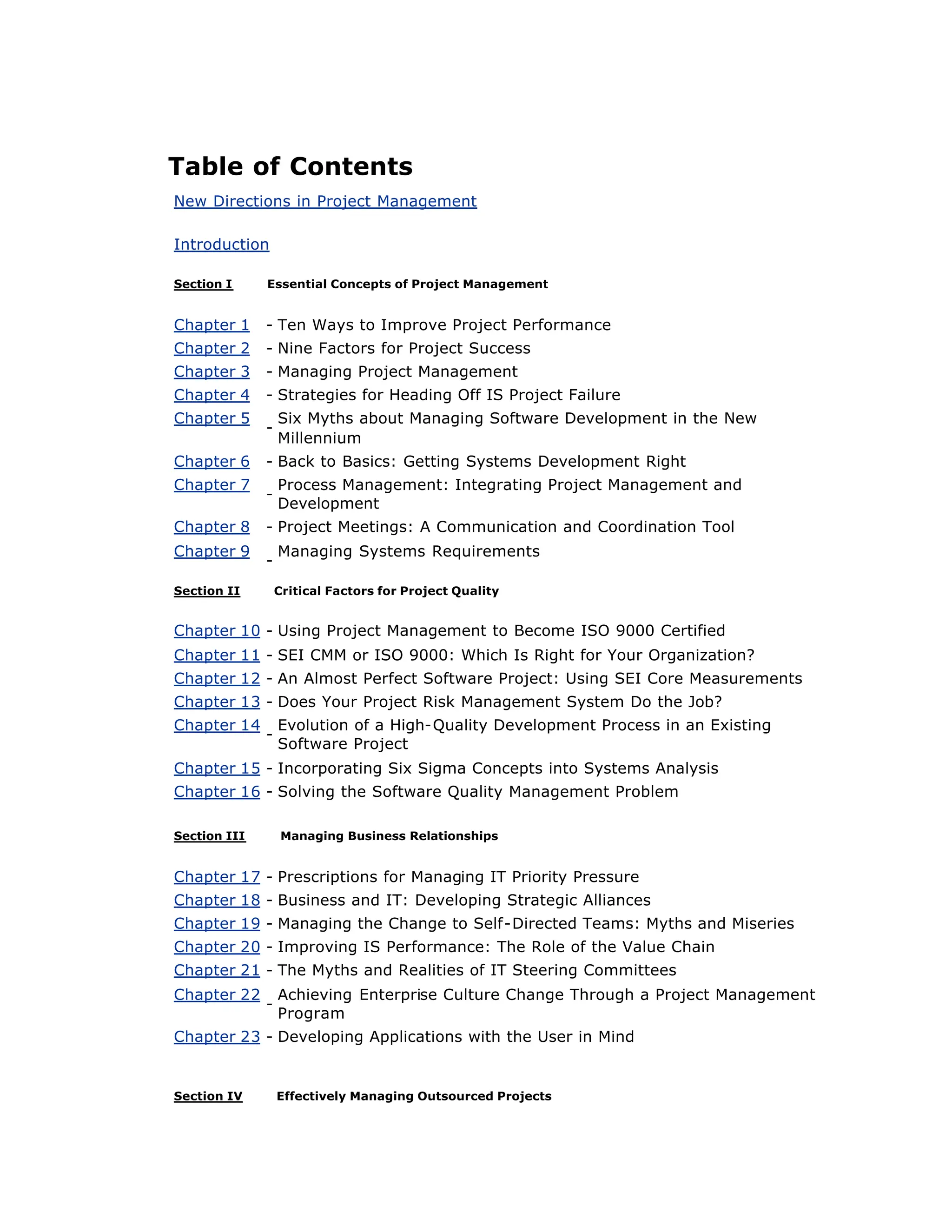
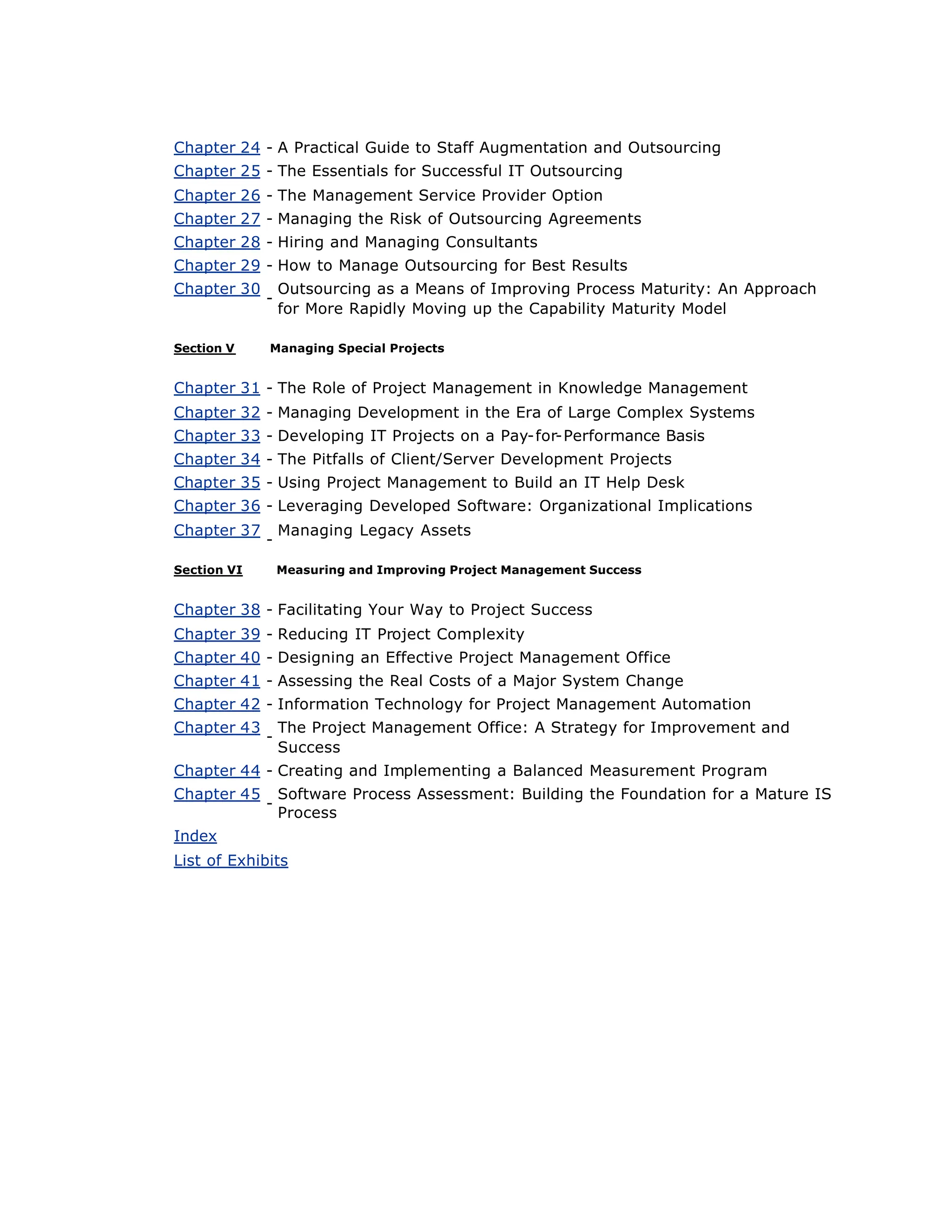



![Chapter 4: Strategies for Heading Off IS
Project Failure
Paul Cule
Roy Schmidt
Kalle Lyytinen
Mark Keil
OVERVIEW
Information systems software projects must be considered as risky undertakings.
The very nature of software contributes to this riskiness in that it consists of
intellectual concepts without physical substance. For example, Brooks[1]
describes
software, the output of the project, as “
pure thoughtstuff, infinitely malleable”and
“
invisible and unvisualizable.”The effects of these risky characteristics are manifest
in the frequent reports of IS projects that are late and over budget. Furthermore,
many systems do not meet the needs of the business when they are delivered and
have a low user satisfaction rating. This set of truisms seems to surround
information systems projects. A Standish Group study found that over 50 percent of
IS projects were late or over budget.[2]
This was estimated to amount to $59 billion
in cost overruns and another $81 billion in canceled software projects. The ultimate
extension of the late and over-budget condition occurs when projects become victims
of escalation — the condition of continuing, even increasing, expenditure on a project
that to the onlooker is clearly a failure.[3]
Why does this happen and what, if
anything, can managers do about it?
This chapter develops a behavioral model and concomitant strategies that include
strategies for executives and user managers that are as fundamental to IS project
success as are the strategies for IS project managers. In addition, a particular case[4]
is discussed that has already been published and discussed elsewhere to illustrate
how these strategies can be used to identify where, and why, an IS project is going
off track and how these strategies might be used to avoid IS project failure.
[1]
Fred P. Brooks, Jr., 1987, “
No Silver Bullet: Essence and Accidents of Software
Engineering,”IEEE Computer vol. 20 (4) pp. 10–
19.
[2]
J. Johnson, 1995, “
Chaos: The Dollar Drain of IT Project Failures,”Application
Development Trends vol. 2 (1), p. 47.
[3]
For example, Mark Keil, 1995, “
Pulling the Plug: Software Project Management and
the Problem of Project Escalation,”MIS Quarterly vol. 19 (4), pp. 421–
447. From
another perspective: M. Lynn Markus & Mark Keil, 1994, “
If We Build It, They Will
Come: Designing Information Systems That People Will Use,”Sloan Management
Review, vol. 35(4): pp. 11–
25. Also, State of California, Bureau of State Audits.
California State Auditor, 1994, The Department of Motor Vehicles and the Office of
Information Technology Did Not Minimize the State’
s Financial Risk In the Database
Redevelopment Project.](https://image.slidesharecdn.com/465839-250520151129-64816f2a/75/New-Directions-In-Project-Management-1st-Edition-Paul-C-Tinnirello-39-2048.jpg)
![[4]
Byron Reimus, 1997, “
The IT System That Couldn’
t Deliver,”Harvard Business
Review, vol. 75(3) pp. 22–
26. This case is discussed by various luminaries in the
ensuing pages of the same issue of the HBR.
RISKS AND RESPONSIBILITIES
IS project failure is not a new problem. It has existed since information systems
moved beyond simple automation. Historically, the responsibility for IS project
failure has been laid squarely on the shoulders of the IS project manager. The
project is defined and the IS project manager is charged with the responsibility of
delivering a system that meets the requirements, is on time, and is on budget. This
chapter shows how reality may be somewhat more complex. Developing strategies
for IS project managers alone is insufficient and requires moving beyond the typical
IS-centric view of the traditional literature.
Traditionally, in books and articles, IS project managers have been advised to follow
a structured approach to managing risk: identify individual risks, assess their impact,
and develop coping strategies for each risk. However, as is shown later in this
chapter, this approach rapidly becomes completely unwieldy as the number of risks
to be managed increases. Therefore, the authors break with this tradition by showing
that risks can be classified into four major types according to their sources, and then
managed by dealing with the sources rather than with the individual risks. This
approach yields strategies that are manageable as opposed to the unwieldiness of
trying to contain each risk individually.
What Is Meant by Risk
Before proceeding any further in this exploration it is necessary to discuss what is
meant by risk in the context of this chapter. In the management domain, risk is
defined as negative outcome and the size of the risk is the loss incurred if the
outcome should occur. Positive outcomes are not seen as risk. Thus, in management
terms, there are upside potential and downside risk. Furthermore, managers
differentiate between risk-taking and gambling. Gambling is seen as accepting the
odds — passive management — whereas risk-taking is seen as managing the odds to
achieve a favorable outcome.[5]
This chapter uses this management definition of risk,
and all of the following discussions are framed by this definition.
That a risk may have a low probability of occurrence does not negate the need to
manage it at some level. If an event occurs that causes the derailment of a project,
that event is a risk prior to its occurrence. Such an event is frequently unforeseen —
an unrecognized risk. Had it been foreseen, it would have been treated as a risk to
be managed. An unforeseen risk is like an invisible “
sword of Damocles”waiting to
fall upon the unwary, hence the literature’
s emphasis on the identification of risk.
Identifying the risk and then managing it does not make this sword go away, it
merely postpones its falling, preferably forever. From this perspective, the purpose
of managing a given risk is to defer indefinitely the occurrence of the undesired
outcome. Thus, m
anagement of a risk is continuous.
For example, obtaining top management commitment to a project, a condition
regarded as essential by many, even beyond IS project literature, may not be
sufficient. The risk always exists that the project manager will lose that top
management support for one reason or another. To manage this risk requires that](https://image.slidesharecdn.com/465839-250520151129-64816f2a/75/New-Directions-In-Project-Management-1st-Edition-Paul-C-Tinnirello-40-2048.jpg)
![the project manager work actively to maintain the support. The risk outcome is
defined as occurring if the project manager loses that support. Once the project
manager has reestablished top management support, the potential of losing it
becomes a risk once again. This is but one risk of many to be managed.
In getting to the roots of IS project risk, new dimensions of risks are disclosed
beyond those usually considered to be the responsibility of the project manager.
These new dimensions also impinge upon the responsibilities of the investing
executive. Although some project risks are under the control of the IS project
manager, others are only partially, or not at all, under his or her control. If the
investment is to be adequately protected and the expected outcomes achieved,
management of these shared risks must be a joint responsibility of the investing
manager, user management, and the IS management. Thus, even though the
proposals in this chapter are derived from a study of IS project managers, the
implications are as important to non-IS managers as they are to the IS community.
Prior Approaches: Individual Risk
In the literature on IS project failure and the management of risks, there are two
approaches to achieving IS project success. Both these approaches seek to establish
discrete risk elements to be separately managed. One of the approaches
recommends managing IS project risks through the identification and control of
individual risk items, the risk management approach. A second approach is based on
contingency theory: project success is contingent upon the presence of some set of
factors. The second approach is predominant in the IS implementation literature.[6]
Several distinctions can be drawn between these two approaches. First, it can be
argued that the contingency factors are framed as positive elements that affect the
success of a project, whereas risk factors are framed as negative elements that
cause failure. These two streams can be further differentiated in that the stream
dealing with contingency factors represents a static view of projects, with the implicit
assumption that once a factor is present (e.g., top management support) it remains
present. In contrast, the risk management perspective represents a more dynamic
view, suggesting that risk factors (e.g., the possibility of a lack of top management
support) represent a constant threat and must be managed actively for the entire
duration of the project and thus lends itself to the discussion of management
processes and strategies more than do event-based contingency factors. The
remaining discussion is built upon the ideas of managing risk.
A number of authors[7]
have sought to propose ways of managing IS project risk.
Anecdotal prescriptions have been offered but, like many such prescriptions, they
smack somewhat of the “
silver bullet.”
[8]
However, one thing these authors have in
common is their suggestion that if risk is to be managed, it must first be identified.
In prior literature,[9]
the management strategy proposed has been to develop
checklists of risks and then to manage each risk as a distinct entity. However,
complex projects may have many risks, and managing such a multiplicity of risks,
some undefined or unrecognized, as unique items on a checklist is impractical.
Managers need a means of reducing long checklists to some manageable form
without discarding any of the risk items. A possible solution to this problem is now
discussed.](https://image.slidesharecdn.com/465839-250520151129-64816f2a/75/New-Directions-In-Project-Management-1st-Edition-Paul-C-Tinnirello-41-2048.jpg)
![Proposed Approach: Categorizing Risk
In contrast to prior approaches, the authors propose an integrative approach that
enables risks to be consolidated into categories. Each category requires a different
managerial behavior together with concomitant risk mitigation strategies. Using this
integrative approach, risk becomes more manageable and managers need not
concern themselves with failing to identify every risk item or contingency factor.
This new model of an IS project is grounded in the data from a study of IS project
risk undertaken by the authors. In this study, 41 experienced, practicing IS project
managers defined, and reached consensus on, a list of 53 risk items. A detailed
description of the study that developed this risk list is found elsewhere.[10]
The approach taken to developing the model in Exhibit 1 was to look for patterns in
the risk items in the above-mentioned study that show some risks as being similar to
each other but different from other risks. In developing mitigation strategies for
managers, the patterns sought were those that indicated differing behavioral
perspectives. The process of pattern recognition was through repeated inspection of
the data from the above study.
Exhibit 1. A Risk Categorization and Behavior Model
The first pattern to emerge from this inspection process was that some of the risk
items were totally under the control of the project manager and others were not. The
resulting division is characterized as Inside and Outside risks (i.e., risks totally within
the project manager’
s purview, or risks outside that purview). However, there was
still considerable variation amongst the risks within each group. Further inspection
resulted in the recognition of two subgroups of Inside risks which are called Task and
Self, and two subgroups of Outside risks that are called Client and Environment.
The Task classification refers to those risks that were the subject to the active
direction of the IS project manager (e.g., Poor team relationships). These are the
risk management elements typically found in the classic project management
literature. The risks in the Self category reflect the characteristics of the project](https://image.slidesharecdn.com/465839-250520151129-64816f2a/75/New-Directions-In-Project-Management-1st-Edition-Paul-C-Tinnirello-42-2048.jpg)
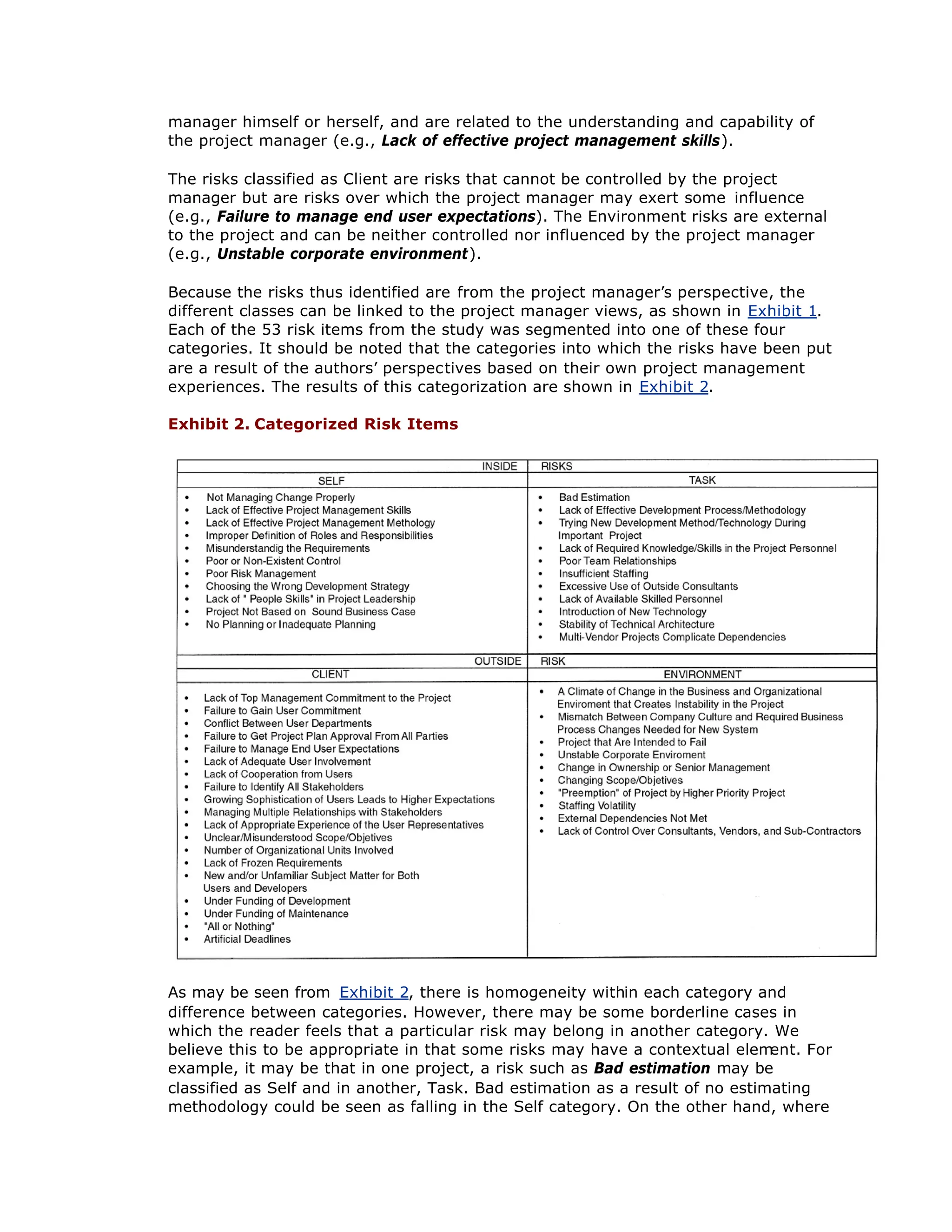
![an estimating methodology exists but is poorly executed, this risk could belong in the
Task category. The purpose of the model is to develop mitigation strategies relevant
to the category rather than to each individual risk in isolation. Thus the risk will be
managed in accordance with the category in which it falls within a given context.
However, such contextual capabilities within the model may add to its applicability in
both the general and the specific case, because any so-called borderline risk will be
subsumed into a category and managed according to the strategy relevant to that
category.
[5]
J.G. March and Z. Shapira, 1987, “
Managerial Perspectives on Risk and Risk
Taking,”Management Science, vol. 33 (11). See also Z. Shapira, 1995, Risk Taking:
A Managerial Perspective, New York: Russell Sage Foundation.
[6]
For example, T.H. Kwon and R.W. Zmud, “
Unifying the Fragmented Models of
Information Systems Implementation,”in R.J. Boland and R.A. Hirschheim (eds.),
1987, Critical Issues in Information Systems Research, New York: John Wiley & Sons.
[7]
Barry Boehm, 1989, Software Risk Management Tutorial, Washington, D.C: IEEE
Computer Society Press; Barry Boehm, 1991, “
Software Risk Management: Principles
and Practices,”IEEE Software, vol. 8 (1) pp. 32–
41.
[8]
Brooks, Note 1.
[9]
For example, Boehm, 1989, 1990, note 7.
[10]
Mark Keil, Paul Cule, Kalle Lyytinen, and Roy Schmidt, 1998, “
A Framework for
Identifying Software Project Risks,”Communications of the ACM, vol. 41 (11) pp.
76–
83.
BEHAVIORS AND STRATEGIES
Given the links between the four risk classes and the project manager, it is
appropriate to now explore the possibility of differing behaviors being required of the
project manager in dealing with each of the four categories. The following section
proposes a set of behaviors appropriate to each link. Each of these links has been
named in Exhibit 1 to capture the associated behaviors.
Self Assessment
The link between project manager and the class of risks called Self suggests a
behavior that can be called Assess. Because the risks in the Self category concern
the project manager’
s abilities, capabilities, and knowledge regarding the
management of IS projects (e.g., Lack of project management skills), the project
manager needs to continually assess her capabilities against the project needs. The
project manager can then handle any recognized shortfall in capability herself.
Assessment also may need to be done by others — for example, the project
manager’
s manager or outside auditors — to identify any shortfalls not recognized by
the project manager herself. The Assess behavior requires of the project manager](https://image.slidesharecdn.com/465839-250520151129-64816f2a/75/New-Directions-In-Project-Management-1st-Edition-Paul-C-Tinnirello-44-2048.jpg)
![that she periodically ask questions of herself that are aimed at surfacing the risks in
the Self category. Unfortunately, it is difficult to get an accurate answer when people
ask themselves such questions as “
Am I managing change properly?”“
Do I lack
effective project management skills?”“
Do I lack an effective project management
methodology?”Yet these are the first three risk items in the Self category shown in
Exhibit 2.
The same problem exists for each of the risk items when phrased by individuals as a
question of themselves. Nonetheless, a project manager must ask these questions of
herself and answer to the best of her ability. However, there are strategies that can
make a project manager more effective in answering these questions. One way is to
use independent auditors. This is a viable proposition where there are knowledgeable
experienced project managers in-house who can execute an unbiased audit. A
second form of audit is to use assessment mechanisms such as those offered by the
Software Engineering Institute and its Process Maturity Model.[11]
A third way of
handling these questions is for the project manager to benchmark other projects and
other organizations to compare and learn. These three different, but complementary,
strategies may greatly enhance the project manager’
s ability to exercise the Assess
behavior.
Task Control
The risk factors classified as Task (e.g., Insufficient/inappropriate staffing) imply a
Control behavior by the project manager in dealing with the risks. It is the task of
the project manager to take care of these, thus calling for a task management
approach. It is generally this behavioral link that is the subject of project
management texts and education and should be ingrained in any experienced project
manager. Thus, Assess and Control describe the behaviors required of project
managers in handling inside risks. Now, the outside risks need to be addressed.
Environmental Monitoring
The risks that fall under the environment class are those about which the project
manager can do little. Some risk items might even be granted the sobriquet “
Act of
God.”However, should an event represented by such a risk occur, the project
manager needs to maximize her lead-time to react. The other type of environmental
risk is rooted in the industry environment, competition, and government action.
These types of risk require that the project manager be cognizant of them even if
she can do nothing to prevent their occurrence. Thus we suggest the behavior
Monitor to represent keeping abreast of the environmental risks in order to maximize
the possibilities for response. The monitor behavior is relatively straightforward.
Unfortunately, it can also be time consuming. Under the Environment risks (see
Exhibit 2) we see those things that relate to the industry, the company, and the
company’
s position in the industry. This monitoring responsibility requires the project
manager to be knowledgeable about what is going on “
out there”and how it might
affect the company and hence the project. For example, the IS project manager
should be aware of the potential of a corporate takeover, assess possible impacts,
and establish strategies to deal with those impacts. One way of gaining this
knowledge is to read the industry trade press rather than the computer trade press.
Industry conferences are another excellent source of monitoring information. Many
companies have internal industry and marketing seminars. If a project manager can](https://image.slidesharecdn.com/465839-250520151129-64816f2a/75/New-Directions-In-Project-Management-1st-Edition-Paul-C-Tinnirello-45-2048.jpg)
![and continuously work at maintaining that sponsorship. The IS project manager
must do the same.
To many, the strategies outlined may seem obvious but, obvious or not, they do not
seem to get executed effectively. As a case in point, consider now Sullivan’
s dilemma,
using the proposed model as a vehicle for discussion.
[11]
Watts S. Humphrey, 1995, A Discipline for Software Engineering, Reading, MA:
Addison-Wesley.
SULLIVAN’
S DILEMMA: A CASE IN POINT[12]
A brief synopsis of the case follows. In this case, a CIO, Sullivan, has “
fulfilled to the
letter the role of CIO that Bennet [CEO and president] had described.”In particular,
for our analysis, Sullivan was charged with developing an information system called
Lifexpress that was supposed to provide the company’
s insurance agents with a
competitive advantage. The system took three years to develop and is being rolled
out at the time of the case. Unfortunately, the company’
s competitors have launched
similar systems. Moreover, these competitor systems seem to be better than
Lifexpress. Thus, the multi- million dollar system will not have the hoped-for impact,
which is a great concern to the company’
s executives. “
To Sullivan’
s distress, her
boss was clearly trying to hold her accountable for more than the creation and
implementation of the system — he was putting her on the hook for the results of
the system, too.”The case further notes: “
She had delivered the system on time and
on budget, and had met all the specifications that Bennett and the other senior
managers had agreed to.”Sullivan had been trying to explain to her boss what she
could control and what she could not. This merely resulted in her boss’
s becoming
impatient. Bennett tells Sullivan: “
We have to figure out how to get this thing fixed
and back on track fast. We’
re losing a lot of momentum. I don’
t think you have kept
us properly informed.”Here we have a case of a project manager delivering on what
she thought were her commitments and yet the project is clearly falling into the
“
failing”category. Sullivan has done an excellent job of risk management within the
traditional confines of IS project management. She has delivered a project according
to her “
contract.”It met the agreed specifications for the agreed price and the
agreed schedule and yet it is, for all intents and purposes, a waste of money. After
all the time and expense, the system does not meet the needs of the business.
Perhaps the first thing to note is that Sullivan was trying to establish that there were
things over which she had control and things over which she did not. In the proposed
model, the things over which she had control are have described as Task (e.g.,
schedule, budget, process, and technology). She exercised the appropriate behavior:
control. Now, consider Sullivan’
s behavior regarding Self, the other Inside risk
category.
Sullivan is described as “
wondering how she could begin to separate what she was
responsible for from she wasn’
t (sic).”On the one hand, Sullivan wishes to be
evaluated only on that which she can control, and on the other, her management
wants her to take responsibility for the project’
s outcome. Furthermore, she failed to
understand the true requirements of the project. She understood the technical
requirements as described to her three years ago, but failed to realize that the real
requirement was for a “
first-to-market”system that would give the company’
s
agents a competitive advantage over all other agents of all other companies. These](https://image.slidesharecdn.com/465839-250520151129-64816f2a/75/New-Directions-In-Project-Management-1st-Edition-Paul-C-Tinnirello-47-2048.jpg)
![characteristics, responsibility and misunderstanding the requirements, fall into the
category Self. The act of “
wondering”to which the case refers is an example of
Assess behavior. It is only now that she is becoming aware of the Self that is needed.
It is only at this point that she is becoming aware of the true requirements. Lack of
the proper assessment behavior has put both the project and her career in jeopardy.
The model uses two other risk categories: Client and Environment. Had Sullivan been
properly monitoring the Environment, she would have been cognizant of the
activities of the competition. She would have known how the competition was forcing
changes to the scope and objectives of the project. Again, failure to monitor the
environment and act accordingly placed the project at risk.
Finally, there is the client category of risk. Here is a case that had top management
commitment, but the project still failed in the eyes of senior management. The case
tells us that Sullivan started with a good relationship with Bennett, the CEO. He had
high hopes for her. The case also tells us she obtained an initial management
commitment to Lifexpress. It appears she then reverted to focussing on task risks,
the ones she could control. In so doing, she ignored maintaining, and further
strengthening, her relationships with her clients, the company executives. As a result,
executive concerns, even displeasure, come as a complete surprise to her. Had she
exhibited relationship management behavior, she would not have been surprised and
the executives would not have been surprised. In fact, she probably could have
delivered a successful project in the first place, because she would have had
executive guidance as to evolving needs, and furthermore, she could have managed
client expectations of what could be delivered and when. Failure to actively seek and
maintain sponsorship from her client community was a major contributor to her
failure.
Sullivan managed this project correctly, given the traditional approach of limiting
project management to the elements she could control. These are the task-centered
items that project managers learn to manage in project management classes and
literature. However, once it becomes clear that the expectation of Sullivan is that she
must be responsible for the outcome of the project, the scope of what it means to be
an IS project manager becomes larger and much more complex. Sullivan’
s
management lexicon had limited her to identifying only one category of risk and thus
exhibiting a single behavior. As discussed, exhibiting the other three behaviors might
have enabled her to achieve the desired outcome.
The fault is not entirely Sullivan’
s, however. Some of the blame must go to Bennett.
Bennett abdicated his responsibility in that he never checked that the system being
developed by Sullivan would meet his company’
s changing needs. He never took it
upon himself to keep Sullivan abreast of the changing environment and changing
needs. Similarly, Sullivan’
s boss “
was clearly trying to hold her accountable for more
than the creation and implementation of the system — he was putting her on the
hook for the results of the system, too.”In so doing, he was raising Sullivan’
s
awareness of the risks in the Self category. This raising of awareness should have
been done at the beginning of the project and should have been regularly assessed
throughout the duration of the project. It is too late now to tell Sullivan that she
failed to assess, and manage, these risks. Thus, the behavior of her executives
contributed to Sullivan’
s project failure.
[12]
Reimus, note 4.](https://image.slidesharecdn.com/465839-250520151129-64816f2a/75/New-Directions-In-Project-Management-1st-Edition-Paul-C-Tinnirello-48-2048.jpg)
![CATEGORIZED RISK AND PREEMPTIVE STRATEGIES
Brooks[13]
tells us that projects fail one day at a time. This would suggest that failure
is dynamic and its opportunities for occurrence are both ever- present and
cumulative. Sullivan’
s project did not fail on the day management first expressed
dissatisfaction, it had been steadily failing for some time. Other well-known software
failures, such as the California State DMV project,[14]
support this. The DMV project
failure did not happen on the day before the state auditors arrived on the scene. As
the audit report showed, this project had been on a failure track for some time. If we
look at most IS project failures we find the seeds of failure sown earlier in the project
and they mature in the soil of ignorance. This ignorance comes from inability to
identify, and then manage, all IS project risks.
The IS Project Management Perspective
The IS project manager’
s strategic behavior starts even before the project is initiated.
Instead of having to execute individual risk strategies every day, the project
manager now has four behaviors he or she must continually exhibit. The control
behavior should already be ingrained in any practicing project manager. However,
the other three, assess, relate, monitor, may not be so familiar to many IS project
managers. For the IS project manager, this model provides a new way of viewing the
responsibilities he or she has. For example, in the case under discussion, had
Sullivan had this behavioral model and acted accordingly she probably would not
have been surprised by the expected scope of her responsibilities. She would have
developed self-awareness. Furthermore, having established the requisite
relationships, it is unlikely that Sullivan would have been unaware that the system
she was delivering no longer met the needs of the business. This model gives IS
project managers new insights into risk and mitigation behaviors that may help them
avoid the apparent fate of Sullivan and her project.
The Senior Management Perspective
Use of this model by project managers in isolation will not be enough, as is clear
from the discussion of Sullivan. The responsibility for the successful outcome of an IS
project cannot lie with the IS project manager alone. The model also lays open the
need for active participation and proactive responsiveness from the group of
stakeholders called Clients. The need for the IS project manager to undertake
relationship building and management has been asserted. However, the whole
concept of relationships and their management requires the active participation of
multiple parties. Success cannot be achieved unless those with whom the project
manager must establish the relationship are willing to actively participate in that
relationship. There may be a temptation for the executive to turn over responsibility
to the IS project manager with an attitude of “
leave it to the nerds.”Succumbing to
this temptation results in the executive’
s abdicating, not delegating, responsibility.
The executive who stimulates the relationship with the IS community will probably
be less prone to being victim of the Client set of risks than a counterpart who cuts off
the Relate behavior.
The model, strategies, and behaviors can also be used in audit mode, as in the
Sullivan case. They can be used, at any point in a given project, to evaluate which
risk classes have the highest potential for project exposure, thus enabling
management to focus on the behaviors necessary to minimize occurrence. Just as](https://image.slidesharecdn.com/465839-250520151129-64816f2a/75/New-Directions-In-Project-Management-1st-Edition-Paul-C-Tinnirello-49-2048.jpg)
![the project manager must continually assess and manage the risks in the Self
category, there must also be those charged with the responsibility for external
assessment, counseling, and training to ensure that these Self risks are being
appropriately managed.
[13]
Fred P. Brooks, Jr. 1995, The Mythical Man-Month: Essays on Software
Engineering, Reading, MA: Addison-Wesley.
[14]
California, note 3.
STRATEGIES OR TACTICS
Some strategies for preempting IS project risks have been presented; they are
strategies, however, and, as such, they must be tailored to the project context, the
circumstances surrounding the individuals, and the environment of the project.
Because an IS project is dynamic, this context can change rapidly. One such case
could be where the incumbent project manager, who has a real grasp of the
strategies and behaviors, is replaced by a new project manager exhibiting some of
the shortfalls discussed under Self. This would require an immediate focus on the
Assess behavior by both the IS project manager and the responsible company
management.
The temptation to convert these generalized strategic behaviors into some set of
tactics to be executed by all project managers should be resisted. For example, there
may be a temptation to identify approaches such as Object-Oriented (OO)
Development as a strategy. The use of OO is more of a tactic than a strategy. In the
risk items in Exhibit 2, use of OO is a tactic within Lack of effective development
methodology. On the negative side, it could be viewed as a tactic that results in
increasing risk due to Trying new development method.
Each IS project is unique and dynamic. Each has its own changing context of
environment, people, and relationships. The tactics developed for each project,
therefore, are unique to that project context and relevant to some specific point in
time. Even though we have developed the model from the project manager’
s
perspective, the development of these project specific tactics must be a shared
responsibility. What is consistent between projects is the need for IS managers to
acquire and exhibit each of the strategic behaviors along with the active participation
and guidance of senior management.
The model developed herein is based on categorizing IS project risks as seen from
the IS project manager’
s perspective. As a result, different behaviors and mitigation
strategies by the IS project manager are suggested, one set for each of the four
resulting categories. The model also shows the need for executives, investing
managers, and managers who will use the system to share in the management of
the IS project risks. Although this chapter is useful to different stakeholders,
executives, user management, and IS project managers, it may be many times more
useful when shared among these stakeholders. The implications of IS project failure
are far too great to abdicate responsibility to the technologists.](https://image.slidesharecdn.com/465839-250520151129-64816f2a/75/New-Directions-In-Project-Management-1st-Edition-Paul-C-Tinnirello-50-2048.jpg)





![This ebook is for the use of anyone anywhere in the United States and
most other parts of the world at no cost and with almost no
restrictions whatsoever. You may copy it, give it away or re-use it
under the terms of the Project Gutenberg License included with this
ebook or online at www.gutenberg.org. If you are not located in the
United States, you will have to check the laws of the country where
you are located before using this eBook.
Title: On the Mexican Highlands, with a Passing Glimpse of Cuba
Author: William Seymour Edwards
Release date: February 8, 2013 [eBook #42000]
Most recently updated: October 23, 2024
Language: English
Credits: Produced by Greg Bergquist, Matthew Wheaton and the Online
Distributed Proofreading Team at http://www.pgdp.net (This
file was produced from images generously made available
by The Internet Archive/American Libraries.)
*** START OF THE PROJECT GUTENBERG EBOOK ON THE MEXICAN
HIGHLANDS, WITH A PASSING GLIMPSE OF CUBA ***](https://image.slidesharecdn.com/465839-250520151129-64816f2a/75/New-Directions-In-Project-Management-1st-Edition-Paul-C-Tinnirello-60-2048.jpg)