Banking Landscape in India
LICENSING NEW BANKS
The Union Finance Minister in his Budget Speech, 2010-11, made a significant announcement
that RBI is to consider “ giving some additional banking licenses to private sector players”.
Taking it forward, RBI, in August 2010 released a “Discussion Paper on the Entry of New
Banks in the Private Sector”. The discussion paper mentions that “vast segments of the
population, especially the underprivileged sections of the society, have still no access to the
formal banking services”. According to it, more number of banks would infuse competition,
improve quality of service, enhance banking outreach and ultimately foster inclusive growth.
Banking coverage
The position of banking coverage for the last three years is asunder:
March 2011 March 2012 March 2013
Number of Commercial banks
(Of which RRBs)
167
(82)
173
( 82)
157
(64)
Number of bank branches 74,130 81,240 88,562
Number of ATMs 74,505 95,686 1,14,014
Total banking outlets in
villages
116,208 181,753 2,68,454
[Source: Report on Trend and Progress of banking in India, 2011-12, 2012-13, Reserve Bank of
India]
The Report on Trend and Progress of banking in India, 2011-12, mentions that: “the growth in
the financial and banking sector has to keep pace with growth in the real sector .”
Licensing of banks: Past Experience
After the nationalisation of 14 banks in 1969, no new banks were set up in the private sector
space. The Committee on the Financial System (Narasimham Committee I, 1991) recommended
for setting up new banks in the private sector to start a new generation of banks to infuse
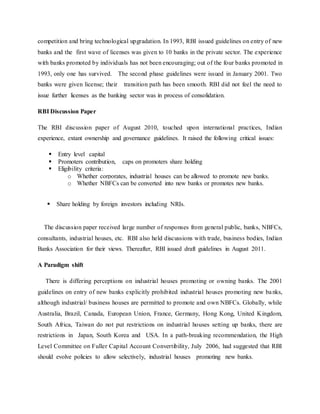
competition and bring technological upgradation. In 1993, RBI issued guidelines on entry of new
banks and the first wave of licenses was given to 10 banks in the private sector. The experience
with banks promoted by individuals has not been encouraging; out of the four banks promoted in
1993, only one has survived. The second phase guidelines were issued in January 2001. Two
banks were given license; their transition path has been smooth. RBI did not feel the need to
issue further licenses as the banking sector was in process of consolidation.
RBI Discussion Paper
The RBI discussion paper of August 2010, touched upon international practices, Indian
experience, extant ownership and governance guidelines. It raised the following critical issues:
 Entry level capital
 Promoters contribution, caps on promoters share holding
 Eligibility criteria:
o Whether corporates, industrial houses can be allowed to promote new banks.
o Whether NBFCs can be converted into new banks or promotes new banks.
 Share holding by foreign investors including NRIs.
The discussion paper received large number of responses from general public, banks, NBFCs,
consultants, industrial houses, etc. RBI also held discussions with trade, business bodies, Indian
Banks Association for their views. Thereafter, RBI issued draft guidelines in August 2011.
A Paradigm shift
There is differing perceptions on industrial houses promoting or owning banks. The 2001
guidelines on entry of new banks explicitly prohibited industrial houses promoting new banks,
although industrial/ business houses are permitted to promote and own NBFCs. Globally, while
Australia, Brazil, Canada, European Union, France, Germany, Hong Kong, United Kingdom,
South Africa, Taiwan do not put restrictions on industrial houses setting up banks, there are
restrictions in Japan, South Korea and USA. In a path-breaking recommendation, the High
Level Committee on Fuller Capital Account Convertibility, July 2006, had suggested that RBI
should evolve policies to allow selectively, industrial houses promoting new banks.
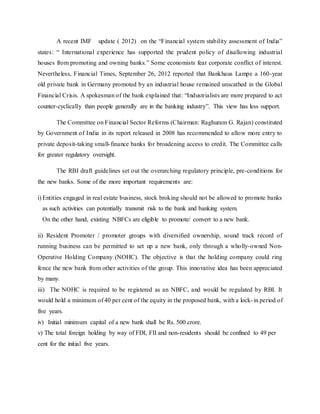
A recent IMF update ( 2012) on the “Financial system stability assessment of India”
states: “ International experience has supported the prudent policy of disallowing industrial
houses from promoting and owning banks.” Some economists fear corporate conflict of interest.
Nevertheless, Financial Times, September 26, 2012 reported that Bankhaus Lampe a 160-year
old private bank in Germany promoted by an industrial house remained unscathed in the Global
Financial Crisis. A spokesman of the bank explained that: “Industrialists are more prepared to act
counter-cyclically than people generally are in the banking industry”. This view has less support.
The Committee on Financial Sector Reforms (Chairman: Raghuram G. Rajan) constituted
by Government of India in its report released in 2008 has recommended to allow more entry to
private deposit-taking small-finance banks for broadening access to credit. The Committee calls
for greater regulatory oversight.
The RBI draft guidelines set out the overarching regulatory principle, pre-conditions for
the new banks. Some of the more important requirements are:
i) Entities engaged in real estate business, stock broking should not be allowed to promote banks
as such activities can potentially transmit risk to the bank and banking system.
On the other hand, existing NBFCs are eligible to promote/ convert to a new bank.
ii) Resident Promoter / promoter groups with diversified ownership, sound track record of
running business can be permitted to set up a new bank, only through a wholly-owned Non-
Operative Holding Company (NOHC). The objective is that the holding company could ring
fence the new bank from other activities of the group. This innovative idea has been appreciated
by many.
iii) The NOHC is required to be registered as an NBFC, and would be regulated by RBI. It
would hold a minimum of 40 per cent of the equity in the proposed bank, with a lock-in period of
five years.
iv) Initial minimum capital of a new bank shall be Rs. 500 crore.
v) The total foreign holding by way of FDI, FII and non-residents should be confined to 49 per
cent for the initial five years.
Developments
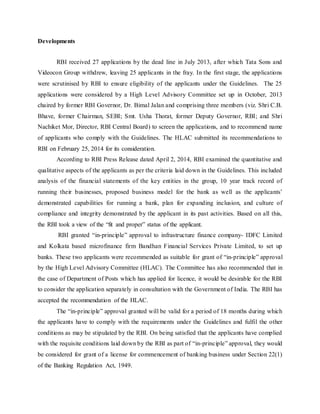
RBI received 27 applications by the dead line in July 2013, after which Tata Sons and
Videocon Group withdrew, leaving 25 applicants in the fray. In the first stage, the applications
were scrutinised by RBI to ensure eligibility of the applicants under the Guidelines. The 25
applications were considered by a High Level Advisory Committee set up in October, 2013
chaired by former RBI Governor, Dr. Bimal Jalan and comprising three members (viz. Shri C.B.
Bhave, former Chairman, SEBI; Smt. Usha Thorat, former Deputy Governor, RBI; and Shri
Nachiket Mor, Director, RBI Central Board) to screen the applications, and to recommend name
of applicants who comply with the Guidelines. The HLAC submitted its recommendations to
RBI on February 25, 2014 for its consideration.
According to RBI Press Release dated April 2, 2014, RBI examined the quantitative and
qualitative aspects of the applicants as per the criteria laid down in the Guidelines. This included
analysis of the financial statements of the key entities in the group, 10 year track record of
running their businesses, proposed business model for the bank as well as the applicants’
demonstrated capabilities for running a bank, plan for expanding inclusion, and culture of
compliance and integrity demonstrated by the applicant in its past activities. Based on all this,
the RBI took a view of the “fit and proper” status of the applicant.
RBI granted “in-principle” approval to infrastructure finance company- IDFC Limited
and Kolkata based microfinance firm Bandhan Financial Services Private Limited, to set up
banks. These two applicants were recommended as suitable for grant of “in-principle” approval
by the High Level Advisory Committee (HLAC). The Committee has also recommended that in
the case of Department of Posts which has applied for licence, it would be desirable for the RBI
to consider the application separately in consultation with the Government of India. The RBI has
accepted the recommendation of the HLAC.
The “in-principle” approval granted will be valid for a period of 18 months during which
the applicants have to comply with the requirements under the Guidelines and fulfil the other
conditions as may be stipulated by the RBI. On being satisfied that the applicants have complied
with the requisite conditions laid down by the RBI as part of “in-principle” approval, they would
be considered for grant of a license for commencement of banking business under Section 22(1)
of the Banking Regulation Act, 1949.
Way Forward
Licensing “Small Banks” and Payment Banks
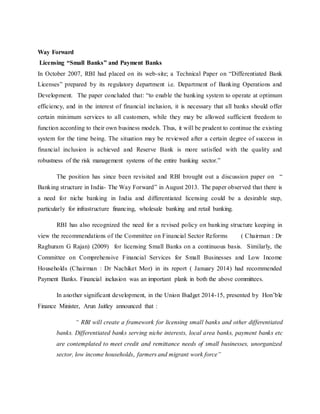
In October 2007, RBI had placed on its web-site; a Technical Paper on “Differentiated Bank
Licenses” prepared by its regulatory department i.e. Department of Banking Operations and
Development. The paper concluded that: “to enable the banking system to operate at optimum
efficiency, and in the interest of financial inclusion, it is necessary that all banks should offer
certain minimum services to all customers, while they may be allowed sufficient freedom to
function according to their own business models. Thus, it will be prudent to continue the existing
system for the time being. The situation may be reviewed after a certain degree of success in
financial inclusion is achieved and Reserve Bank is more satisfied with the quality and
robustness of the risk management systems of the entire banking sector.”
The position has since been revisited and RBI brought out a discussion paper on “
Banking structure in India- The Way Forward” in August 2013. The paper observed that there is
a need for niche banking in India and differentiated licensing could be a desirable step,
particularly for infrastructure financing, wholesale banking and retail banking.
RBI has also recognized the need for a revised policy on banking structure keeping in
view the recommendations of the Committee on Financial Sector Reforms ( Chairman : Dr
Raghuram G Rajan) (2009) for licensing Small Banks on a continuous basis. Similarly, the
Committee on Comprehensive Financial Services for Small Businesses and Low Income
Households (Chairman : Dr Nachiket Mor) in its report ( January 2014) had recommended
Payment Banks. Financial inclusion was an important plank in both the above committees.
In another significant development, in the Union Budget 2014-15, presented by Hon’ble
Finance Minister, Arun Jaitley announced that :
“ RBI will create a framework for licensing small banks and other differentiated
banks. Differentiated banks serving niche interests, local area banks, payment banks etc
are contemplated to meet credit and remittance needs of small businesses, unorganized
sector, low income households, farmers and migrant work force”
RBI, on July 17, 2014 has released the Draft Guidelines for “Licensing of Payment
Banks” and for “Licensing of Small Banks” seeking views from general public and all interested
parties. In its Press Release, RBI has also indicated that on the basis of the comments, feedback,
final guidelines will be issued and process of inviting applications for setting up of Payment
Banks and Small banks will be initiated. RBI also is working on the guidelines for continuous
authorization of universal banks.
Surely, these are interesting developments in the banking landscape in India.
--------------------------------------------------------------------------------------------------
References:
1. The Economics Times, Infra Fund IDFC, Microfin Co Bandhan Get License to Bank, April,
2014, Kolkata Edition.
2. Reserve Bank of India, Report on Trend and Progress in Banking, 2012-13, RBI, Mumbai.
3. The Committee on Comprehensive Financial Services for Small Businesses and Low Income
Households (Chairman: Dr Nachiket Mor) in its report (January 2014), Reserve Bank of India.
Updated: Saturday, July 19, 2014
7 | P a g e

Banking Landscape- Indian Experiment Dasarathi Mishra

  • 1.
    Banking Landscape inIndia LICENSING NEW BANKS
  • 2.
    The Union FinanceMinister in his Budget Speech, 2010-11, made a significant announcement that RBI is to consider “ giving some additional banking licenses to private sector players”. Taking it forward, RBI, in August 2010 released a “Discussion Paper on the Entry of New Banks in the Private Sector”. The discussion paper mentions that “vast segments of the population, especially the underprivileged sections of the society, have still no access to the formal banking services”. According to it, more number of banks would infuse competition, improve quality of service, enhance banking outreach and ultimately foster inclusive growth. Banking coverage The position of banking coverage for the last three years is asunder: March 2011 March 2012 March 2013 Number of Commercial banks (Of which RRBs) 167 (82) 173 ( 82) 157 (64) Number of bank branches 74,130 81,240 88,562 Number of ATMs 74,505 95,686 1,14,014 Total banking outlets in villages 116,208 181,753 2,68,454 [Source: Report on Trend and Progress of banking in India, 2011-12, 2012-13, Reserve Bank of India] The Report on Trend and Progress of banking in India, 2011-12, mentions that: “the growth in the financial and banking sector has to keep pace with growth in the real sector .” Licensing of banks: Past Experience After the nationalisation of 14 banks in 1969, no new banks were set up in the private sector space. The Committee on the Financial System (Narasimham Committee I, 1991) recommended for setting up new banks in the private sector to start a new generation of banks to infuse
  • 3.
    competition and bringtechnological upgradation. In 1993, RBI issued guidelines on entry of new banks and the first wave of licenses was given to 10 banks in the private sector. The experience with banks promoted by individuals has not been encouraging; out of the four banks promoted in 1993, only one has survived. The second phase guidelines were issued in January 2001. Two banks were given license; their transition path has been smooth. RBI did not feel the need to issue further licenses as the banking sector was in process of consolidation. RBI Discussion Paper The RBI discussion paper of August 2010, touched upon international practices, Indian experience, extant ownership and governance guidelines. It raised the following critical issues:  Entry level capital  Promoters contribution, caps on promoters share holding  Eligibility criteria: o Whether corporates, industrial houses can be allowed to promote new banks. o Whether NBFCs can be converted into new banks or promotes new banks.  Share holding by foreign investors including NRIs. The discussion paper received large number of responses from general public, banks, NBFCs, consultants, industrial houses, etc. RBI also held discussions with trade, business bodies, Indian Banks Association for their views. Thereafter, RBI issued draft guidelines in August 2011. A Paradigm shift There is differing perceptions on industrial houses promoting or owning banks. The 2001 guidelines on entry of new banks explicitly prohibited industrial houses promoting new banks, although industrial/ business houses are permitted to promote and own NBFCs. Globally, while Australia, Brazil, Canada, European Union, France, Germany, Hong Kong, United Kingdom, South Africa, Taiwan do not put restrictions on industrial houses setting up banks, there are restrictions in Japan, South Korea and USA. In a path-breaking recommendation, the High Level Committee on Fuller Capital Account Convertibility, July 2006, had suggested that RBI should evolve policies to allow selectively, industrial houses promoting new banks.
  • 4.
    A recent IMFupdate ( 2012) on the “Financial system stability assessment of India” states: “ International experience has supported the prudent policy of disallowing industrial houses from promoting and owning banks.” Some economists fear corporate conflict of interest. Nevertheless, Financial Times, September 26, 2012 reported that Bankhaus Lampe a 160-year old private bank in Germany promoted by an industrial house remained unscathed in the Global Financial Crisis. A spokesman of the bank explained that: “Industrialists are more prepared to act counter-cyclically than people generally are in the banking industry”. This view has less support. The Committee on Financial Sector Reforms (Chairman: Raghuram G. Rajan) constituted by Government of India in its report released in 2008 has recommended to allow more entry to private deposit-taking small-finance banks for broadening access to credit. The Committee calls for greater regulatory oversight. The RBI draft guidelines set out the overarching regulatory principle, pre-conditions for the new banks. Some of the more important requirements are: i) Entities engaged in real estate business, stock broking should not be allowed to promote banks as such activities can potentially transmit risk to the bank and banking system. On the other hand, existing NBFCs are eligible to promote/ convert to a new bank. ii) Resident Promoter / promoter groups with diversified ownership, sound track record of running business can be permitted to set up a new bank, only through a wholly-owned Non- Operative Holding Company (NOHC). The objective is that the holding company could ring fence the new bank from other activities of the group. This innovative idea has been appreciated by many. iii) The NOHC is required to be registered as an NBFC, and would be regulated by RBI. It would hold a minimum of 40 per cent of the equity in the proposed bank, with a lock-in period of five years. iv) Initial minimum capital of a new bank shall be Rs. 500 crore. v) The total foreign holding by way of FDI, FII and non-residents should be confined to 49 per cent for the initial five years.
  • 5.
    Developments RBI received 27applications by the dead line in July 2013, after which Tata Sons and Videocon Group withdrew, leaving 25 applicants in the fray. In the first stage, the applications were scrutinised by RBI to ensure eligibility of the applicants under the Guidelines. The 25 applications were considered by a High Level Advisory Committee set up in October, 2013 chaired by former RBI Governor, Dr. Bimal Jalan and comprising three members (viz. Shri C.B. Bhave, former Chairman, SEBI; Smt. Usha Thorat, former Deputy Governor, RBI; and Shri Nachiket Mor, Director, RBI Central Board) to screen the applications, and to recommend name of applicants who comply with the Guidelines. The HLAC submitted its recommendations to RBI on February 25, 2014 for its consideration. According to RBI Press Release dated April 2, 2014, RBI examined the quantitative and qualitative aspects of the applicants as per the criteria laid down in the Guidelines. This included analysis of the financial statements of the key entities in the group, 10 year track record of running their businesses, proposed business model for the bank as well as the applicants’ demonstrated capabilities for running a bank, plan for expanding inclusion, and culture of compliance and integrity demonstrated by the applicant in its past activities. Based on all this, the RBI took a view of the “fit and proper” status of the applicant. RBI granted “in-principle” approval to infrastructure finance company- IDFC Limited and Kolkata based microfinance firm Bandhan Financial Services Private Limited, to set up banks. These two applicants were recommended as suitable for grant of “in-principle” approval by the High Level Advisory Committee (HLAC). The Committee has also recommended that in the case of Department of Posts which has applied for licence, it would be desirable for the RBI to consider the application separately in consultation with the Government of India. The RBI has accepted the recommendation of the HLAC. The “in-principle” approval granted will be valid for a period of 18 months during which the applicants have to comply with the requirements under the Guidelines and fulfil the other conditions as may be stipulated by the RBI. On being satisfied that the applicants have complied with the requisite conditions laid down by the RBI as part of “in-principle” approval, they would be considered for grant of a license for commencement of banking business under Section 22(1) of the Banking Regulation Act, 1949.
  • 6.
    Way Forward Licensing “SmallBanks” and Payment Banks In October 2007, RBI had placed on its web-site; a Technical Paper on “Differentiated Bank Licenses” prepared by its regulatory department i.e. Department of Banking Operations and Development. The paper concluded that: “to enable the banking system to operate at optimum efficiency, and in the interest of financial inclusion, it is necessary that all banks should offer certain minimum services to all customers, while they may be allowed sufficient freedom to function according to their own business models. Thus, it will be prudent to continue the existing system for the time being. The situation may be reviewed after a certain degree of success in financial inclusion is achieved and Reserve Bank is more satisfied with the quality and robustness of the risk management systems of the entire banking sector.” The position has since been revisited and RBI brought out a discussion paper on “ Banking structure in India- The Way Forward” in August 2013. The paper observed that there is a need for niche banking in India and differentiated licensing could be a desirable step, particularly for infrastructure financing, wholesale banking and retail banking. RBI has also recognized the need for a revised policy on banking structure keeping in view the recommendations of the Committee on Financial Sector Reforms ( Chairman : Dr Raghuram G Rajan) (2009) for licensing Small Banks on a continuous basis. Similarly, the Committee on Comprehensive Financial Services for Small Businesses and Low Income Households (Chairman : Dr Nachiket Mor) in its report ( January 2014) had recommended Payment Banks. Financial inclusion was an important plank in both the above committees. In another significant development, in the Union Budget 2014-15, presented by Hon’ble Finance Minister, Arun Jaitley announced that : “ RBI will create a framework for licensing small banks and other differentiated banks. Differentiated banks serving niche interests, local area banks, payment banks etc are contemplated to meet credit and remittance needs of small businesses, unorganized sector, low income households, farmers and migrant work force”
  • 7.
    RBI, on July17, 2014 has released the Draft Guidelines for “Licensing of Payment Banks” and for “Licensing of Small Banks” seeking views from general public and all interested parties. In its Press Release, RBI has also indicated that on the basis of the comments, feedback, final guidelines will be issued and process of inviting applications for setting up of Payment Banks and Small banks will be initiated. RBI also is working on the guidelines for continuous authorization of universal banks. Surely, these are interesting developments in the banking landscape in India. -------------------------------------------------------------------------------------------------- References: 1. The Economics Times, Infra Fund IDFC, Microfin Co Bandhan Get License to Bank, April, 2014, Kolkata Edition. 2. Reserve Bank of India, Report on Trend and Progress in Banking, 2012-13, RBI, Mumbai. 3. The Committee on Comprehensive Financial Services for Small Businesses and Low Income Households (Chairman: Dr Nachiket Mor) in its report (January 2014), Reserve Bank of India. Updated: Saturday, July 19, 2014 7 | P a g e