Lesson: Neutralization
Acids + Bases → Salt + Water
Introduction to Neutralization
• - Neutralization = reaction of acid + base
• - General result → salt + water
• - Everyday importance: medicine, agriculture,
cleaning
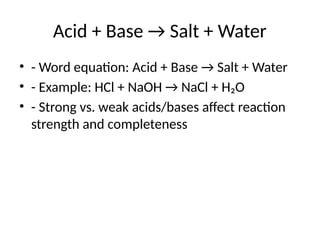
Acid + Base → Salt + Water
• - Word equation: Acid + Base → Salt + Water
• - Example: HCl + NaOH → NaCl + H₂O
• - Strong vs. weak acids/bases affect reaction
strength and completeness
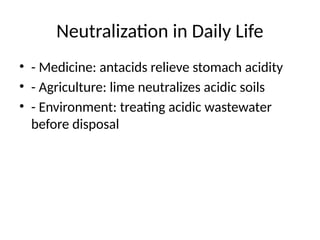
Neutralization in Daily Life
• - Medicine: antacids relieve stomach acidity
• - Agriculture: lime neutralizes acidic soils
• - Environment: treating acidic wastewater
before disposal
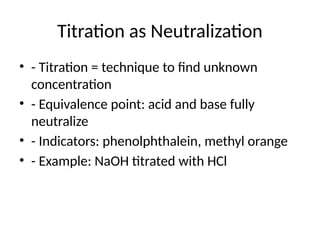
Titration as Neutralization
• - Titration = technique to find unknown
concentration
• - Equivalence point: acid and base fully
neutralize
• - Indicators: phenolphthalein, methyl orange
• - Example: NaOH titrated with HCl
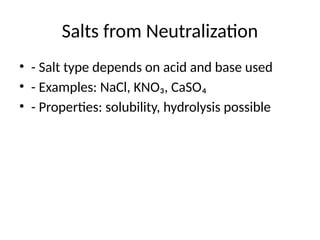
Salts from Neutralization
• - Salt type depends on acid and base used
• - Examples: NaCl, KNO₃, CaSO₄
• - Properties: solubility, hydrolysis possible
Buffer Solutions
• - Formed by partial neutralization of weak
acids/bases
• - Buffers resist sudden pH changes
• - Applications: blood pH regulation, industrial
processes
Summary & Takeaways
• - Neutralization: Acid + Base → Salt + Water
• - Essential in health, agriculture, industry
• - Titration and buffers are practical
applications
• - Central concept: balance and control of pH
Neutralization_Lesson_Refined_PPT.pptx grade 12

  • 1.
    Lesson: Neutralization Acids +Bases → Salt + Water
  • 2.
    Introduction to Neutralization •- Neutralization = reaction of acid + base • - General result → salt + water • - Everyday importance: medicine, agriculture, cleaning
  • 3.
    Acid + Base→ Salt + Water • - Word equation: Acid + Base → Salt + Water • - Example: HCl + NaOH → NaCl + H₂O • - Strong vs. weak acids/bases affect reaction strength and completeness
  • 4.
    Neutralization in DailyLife • - Medicine: antacids relieve stomach acidity • - Agriculture: lime neutralizes acidic soils • - Environment: treating acidic wastewater before disposal
  • 5.
    Titration as Neutralization •- Titration = technique to find unknown concentration • - Equivalence point: acid and base fully neutralize • - Indicators: phenolphthalein, methyl orange • - Example: NaOH titrated with HCl
  • 6.
    Salts from Neutralization •- Salt type depends on acid and base used • - Examples: NaCl, KNO₃, CaSO₄ • - Properties: solubility, hydrolysis possible
  • 7.
    Buffer Solutions • -Formed by partial neutralization of weak acids/bases • - Buffers resist sudden pH changes • - Applications: blood pH regulation, industrial processes
  • 8.
    Summary & Takeaways •- Neutralization: Acid + Base → Salt + Water • - Essential in health, agriculture, industry • - Titration and buffers are practical applications • - Central concept: balance and control of pH