Neurotransmitters
L. LUMBUKA
NEUROTRANSMITTERS.
Thursday, February 1, 2018
■ Def – Chemical substances
responsible for
transmission of impulse
through synapse.
Objectives
 Explain how a single neurotransmitter may be excitatory at one
synapse and inhibitory at another.
 Describe the structural and functional properties of the major
classes of neurotransmitters.
 Describe the most common excitatory and inhibitory
neurotransmitters in the CNS.
Neurotransmitters
 They all exhibit the following effects:
 They are made in either the cell body or the
axon terminal and packaged into synaptic
vesicles,
 they are released from the presynaptic neuron,
they bind to their receptors on the postsynaptic
membrane, and
 finally their effects are often rapidly terminated
through removal and/or degradation
Nearly all neurotransmitters induce postsynaptic
potentials by binding to their receptors in the
postsynaptic membrane. The type of receptor to
which a neurotransmitter binds determines the
postsynaptic response. Two types of
neurotransmitter receptors have been identified:
ionotropic and metabotropic.
Ionotropic receptors
Metabotropic Receptors
Ionotropic
Receptors
 These are receptors that are
part of ligand-gated ion
channels.
 They are called ionotropic
because they directly control
the movement of ions into or
out of the neuron when bound
by a neurotransmitter.
 Neurotransmitters that bind
ionotropic receptors have very
rapid but short-lived effects on
the membrane potential of the
postsynaptic neuron.
Metabotropic
Receptors
 are receptors within the plasma membrane
that are connected to a separate ion
channel in some fashion.
 They are called metabotropic because they
are directly connected to metabolic
processes that begin when they are bound
by neurotransmitters.
 Most are connected through a group of
intracellular enzymes called G-proteins.
When the neurotransmitter molecule binds
to the receptor, it activates one or more G-
proteins and begins a cascade of enzyme-
catalyzed reactions that ends in the
formation of a molecule inside the
postsynaptic neuron, called a second
messenger
Metabotro
pic
receptors
 The second messenger then opens or closes an
ion channel in the plasma membrane of the
postsynaptic neuron.
 The changes that metabotropic receptors elicit
in the membrane potential of the postsynaptic
neuron occur much more slowly,but are
typically longer-lasting and more varied than
those of ionotropic receptors.
 An example of a common second messenger
is the molecule cyclic adenosine
monophosphate (or cAMP), which is derived
from ATP. In the neuron, cAMP has multiple
functions, including binding a group of
enzymes that add phosphate groups to ion
channels, triggering them to open or close.
CRITERIA FOR
NEUROTRANSMITTE
R.
• Should be synthesized by pre synaptic neuron & stored
in vesicle.
• Should be released by stimulation of nerve.
• Travels a short distance of synaptic cleft.
• Associated with enzyme or enzyme system for
• inactivation.
• When applied extrinsically should mimic effect of nerve
stimulation.
• Regardless of the type of receptor that a
neurotransmitter binds, that binding leads to either EPSPs
or IPSPs.
• Neurotransmitters that induce EPSPs in the postsynaptic
neuron are said to have excitatory effects; those that
induce IPSPs have inhibitory effects.
• A single neurotransmitter can have both inhibitory and
excitatory effects depending on which neurotransmitter
it binds on the post synaptic neuron.
CLASSIFICATION.
■ Neurotransmitters operating within the nervous system
are usually classified into four groups by their chemical
structures.
■ Biochemical
■ Small molecule
■
■ Acetylcholine
Biogenic amines. (E,NE, DA,5HT, Histamine)
Amino acids (GABA, Glycine, Glutamate,
Aspartate)
■ Neuro peptide.
■ Physiological
■ Excitatory
■ Inbitory
ACETYLCHOLINE
Thursday, February 1, 2018
■ Principal NT released by cholinergic neurons.
■ At N-M junction.
■ Preganglionic & post-ganglionic Para-
sympathetic
■ Preganglionic Sympathetic.
■ Postganglionic sympathetic which innervates –
sweat glands & skeletal muscle blood vessels.
■ Ending of Amacrine cells of retina.
ACETYLCHOLINE
■ Receptors – Nicotinic &
Muscarinic.
■ Synthesis & storage – in
Mitochandria by AchCoa &
stored in vesicles.
■ Actions – most places its
excitatory but few (vagus
supplying heart) – inhibitory.
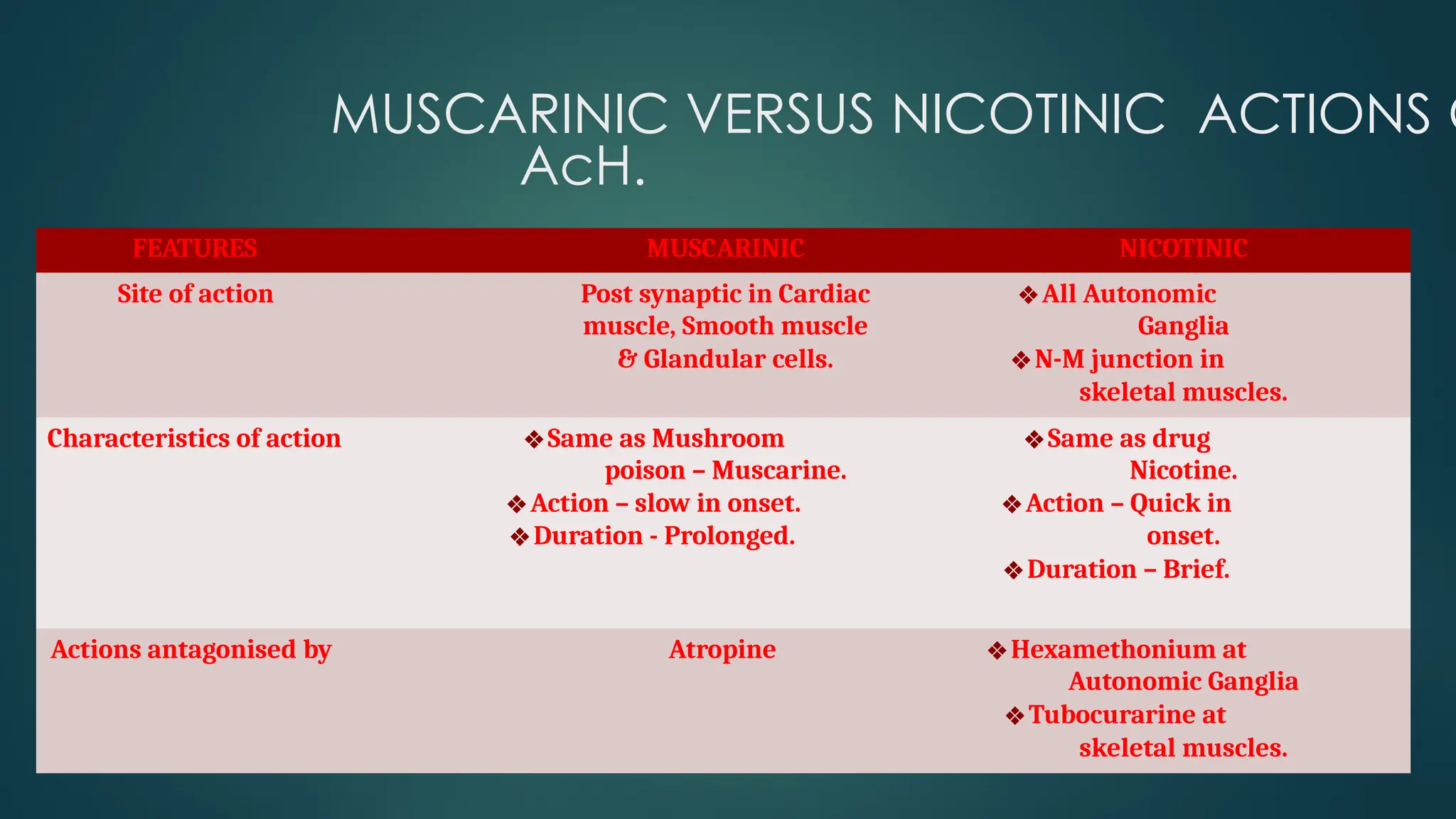
MUSCARINIC VERSUS NICOTINIC ACTIONS O
AcH.
FEATURES MUSCARINIC NICOTINIC
Site of action Post synaptic in Cardiac ❖All Autonomic
muscle, Smooth muscle Ganglia
& Glandular cells. ❖N-M junction in
skeletal muscles.
Characteristics of action ❖Same as Mushroom ❖Same as drug
poison – Muscarine. Nicotine.
❖Action – slow in onset. ❖Action – Quick in
❖Duration - Prolonged. onset.
❖Duration – Brief.
Actions antagonised by Atropine ❖Hexamethonium at
Autonomic Ganglia
❖Tubocurarine at
skeletal muscles.
BIOGENIC AMINES.
■ Catecholamines.
■ Epinephrine – mainly from
adrenal medulla.
■ Nor-epinephrine –
■ Post Ganglionic Symp
■ Cerebral cortex & Hypothalamus.
■ Pons & Medulla.
Thursday, February 1, 2018
■ Synthesis of
catecholamine.
Dopamine.
 Dopamine, used extensively in the CNS, has a variety of functions.
 It helps to coordinate movement, and is also involved in emotion
and motivation.
 The receptor for dopamine in the brain is a target for certain illegal
drugs, such as cocaine and amphetamine, and is likely responsible
for the behavioral changes seen with addiction to these drugs.
DOPAMINE
■ Naturally acting
precursors of NE.
■ Receptors
■
■
■ D1 – Activates adenyl cyclase
via Gs protein
D2 – Inhibit adenyl cyclase
via Gi protein.
D3 – Localised to Nucleus
Accumbens.
■ Neurons – in Mid brain
to
■ Striatum
■ Olfactory tubercle
■ Nucleus accumbens
■ limbic system area.
■ Highest conc present in
Basal Ganglia, limbic
system & CTZ in medulla.
FUNCTIONAL ROLES OF DOPAMINE
■ Control of Movements
■ Induction of Vomiting.
■ Inhibition of Prolactin secretion & stimulation of
GnRH.
■ Retina – Inhibitory Neurons.
■ Schizophrenia type of Psychosis due to Increased
levels of D2 receptors.
SEROTONIN.
Thursday, February 1, 2018
■ Synthesis – from
Tryptophan.
■ Metabolism –
Inactivated by MAO to
5-hydroxy indole acetic
acid(5-HIAA)
■ Sites of secretion
■ In Brain
■ Non-neural cells.
SEROTONIN.
Thursday, February 1, 2018
■ Serotonin receptors –
■ 7 group of receptors (5HT1-
5HT7) with further groups
A-F.
■ Functional role in CNS
■ Regulation of carbohydrate
intake & Hypothalamic
releasing hormones.
■ Pain inhibition.
■ Hallucination
HISTAMINE
■ Sites of secretion
■ In Brain & Non-neural cells.
■ Histamine receptors
■ H1 – activates Phospholipase C
■ H2 – increases intracellular cAMP
■ H3 – inhibition of histamine via G protein.
■ Functional role
■ Excitatory
■ Arousal & sexual behaviour, Regulation of ant pituitary, Drinking, Pain threshold & Itch sensation
AMINO ACID
NEUROTRANSMITTERS
 Glutamate; glycine; and g-
aminobutyric acid, or GABA.
 Glutamate is the most important
excitatory neurotransmitter in the CNS
—it is estimated that over half of all
synapses in the CNS release glutamate.
 When it binds to its ionotropic
postsynaptic receptors, glutamate
triggers the opening of a type of
channel that can pass both sodium
and calcium ions.
 This elicits an EPSP in the postsynaptic
neuron.
■ Excitatory
■ Glutamate – Brain &
dorsal sensory nerve
■ Aspartate - Cortical
pyramidal cells.
■ Inhibitory
■ GABA – whole CNS
■ Glycine. – Grey matter of spinal
cord & brain stem.
GLUTAMIC
ACID
■ Synthesis – Mainly
from Glucose via Kreb
cycle or Glutamine,
synthesized by Glial
cells & taken by
neurons.
■ Receptors – High
conc in Hippocampus
& Cerebellum.
GABA &
Glycine
• Receptors –
• A – Inhibition by increasing Cl conductance
• B – By K conductance
• C – in Retina.
• Glycine and GABA are the two major inhibitory
neurotransmitters of the nervous system. Both induce
IPSPs in the postsynaptic neurons primarily by opening
chloride ion channels and hyperpolarizing the
axolemma. GABA use is widespread in the CNS; as
many as one-third of neurons in the brain use it as
their major inhibitory neurotransmitter. Glycine is
found in about half of the inhibitory synapses in the
spinal cord; the remainder of the synapses use GABA.
NEUROPEPTID
E
TRANSMITTERS.
Thursday, February 1, 2018
• Mechanism of action –
• Alter ion channel function, modify cell metabolism &
gene expression.
• Types.
• Neuroactive peptides – TRH, LH releasing
hormone, somatostatin.
• Pituitary peptides – Vasopressin & Oxytocin.
• Peptides acting on the Gut and Brain – Leucine,
Enkephalin, Methionine, Sub P,
Cholecystokinin, VIP, Neurotensin, Insulin,
Glucose, Opioid polypeptides.
Neurotransmitters.pptxxxxxxxxxxxxxxxxxxxxah

Neurotransmitters.pptxxxxxxxxxxxxxxxxxxxxah

  • 1.
  • 2.
    NEUROTRANSMITTERS. Thursday, February 1,2018 ■ Def – Chemical substances responsible for transmission of impulse through synapse.
  • 3.
    Objectives  Explain howa single neurotransmitter may be excitatory at one synapse and inhibitory at another.  Describe the structural and functional properties of the major classes of neurotransmitters.  Describe the most common excitatory and inhibitory neurotransmitters in the CNS.
  • 4.
    Neurotransmitters  They allexhibit the following effects:  They are made in either the cell body or the axon terminal and packaged into synaptic vesicles,  they are released from the presynaptic neuron, they bind to their receptors on the postsynaptic membrane, and  finally their effects are often rapidly terminated through removal and/or degradation
  • 5.
    Nearly all neurotransmittersinduce postsynaptic potentials by binding to their receptors in the postsynaptic membrane. The type of receptor to which a neurotransmitter binds determines the postsynaptic response. Two types of neurotransmitter receptors have been identified: ionotropic and metabotropic. Ionotropic receptors Metabotropic Receptors
  • 6.
    Ionotropic Receptors  These arereceptors that are part of ligand-gated ion channels.  They are called ionotropic because they directly control the movement of ions into or out of the neuron when bound by a neurotransmitter.  Neurotransmitters that bind ionotropic receptors have very rapid but short-lived effects on the membrane potential of the postsynaptic neuron.
  • 7.
    Metabotropic Receptors  are receptorswithin the plasma membrane that are connected to a separate ion channel in some fashion.  They are called metabotropic because they are directly connected to metabolic processes that begin when they are bound by neurotransmitters.  Most are connected through a group of intracellular enzymes called G-proteins. When the neurotransmitter molecule binds to the receptor, it activates one or more G- proteins and begins a cascade of enzyme- catalyzed reactions that ends in the formation of a molecule inside the postsynaptic neuron, called a second messenger
  • 8.
    Metabotro pic receptors  The secondmessenger then opens or closes an ion channel in the plasma membrane of the postsynaptic neuron.  The changes that metabotropic receptors elicit in the membrane potential of the postsynaptic neuron occur much more slowly,but are typically longer-lasting and more varied than those of ionotropic receptors.  An example of a common second messenger is the molecule cyclic adenosine monophosphate (or cAMP), which is derived from ATP. In the neuron, cAMP has multiple functions, including binding a group of enzymes that add phosphate groups to ion channels, triggering them to open or close.
  • 9.
    CRITERIA FOR NEUROTRANSMITTE R. • Shouldbe synthesized by pre synaptic neuron & stored in vesicle. • Should be released by stimulation of nerve. • Travels a short distance of synaptic cleft. • Associated with enzyme or enzyme system for • inactivation. • When applied extrinsically should mimic effect of nerve stimulation. • Regardless of the type of receptor that a neurotransmitter binds, that binding leads to either EPSPs or IPSPs. • Neurotransmitters that induce EPSPs in the postsynaptic neuron are said to have excitatory effects; those that induce IPSPs have inhibitory effects. • A single neurotransmitter can have both inhibitory and excitatory effects depending on which neurotransmitter it binds on the post synaptic neuron.
  • 10.
    CLASSIFICATION. ■ Neurotransmitters operatingwithin the nervous system are usually classified into four groups by their chemical structures. ■ Biochemical ■ Small molecule ■ ■ Acetylcholine Biogenic amines. (E,NE, DA,5HT, Histamine) Amino acids (GABA, Glycine, Glutamate, Aspartate) ■ Neuro peptide. ■ Physiological ■ Excitatory ■ Inbitory
  • 11.
    ACETYLCHOLINE Thursday, February 1,2018 ■ Principal NT released by cholinergic neurons. ■ At N-M junction. ■ Preganglionic & post-ganglionic Para- sympathetic ■ Preganglionic Sympathetic. ■ Postganglionic sympathetic which innervates – sweat glands & skeletal muscle blood vessels. ■ Ending of Amacrine cells of retina.
  • 12.
    ACETYLCHOLINE ■ Receptors –Nicotinic & Muscarinic. ■ Synthesis & storage – in Mitochandria by AchCoa & stored in vesicles. ■ Actions – most places its excitatory but few (vagus supplying heart) – inhibitory.
  • 13.
    MUSCARINIC VERSUS NICOTINICACTIONS O AcH. FEATURES MUSCARINIC NICOTINIC Site of action Post synaptic in Cardiac ❖All Autonomic muscle, Smooth muscle Ganglia & Glandular cells. ❖N-M junction in skeletal muscles. Characteristics of action ❖Same as Mushroom ❖Same as drug poison – Muscarine. Nicotine. ❖Action – slow in onset. ❖Action – Quick in ❖Duration - Prolonged. onset. ❖Duration – Brief. Actions antagonised by Atropine ❖Hexamethonium at Autonomic Ganglia ❖Tubocurarine at skeletal muscles.
  • 14.
    BIOGENIC AMINES. ■ Catecholamines. ■Epinephrine – mainly from adrenal medulla. ■ Nor-epinephrine – ■ Post Ganglionic Symp ■ Cerebral cortex & Hypothalamus. ■ Pons & Medulla. Thursday, February 1, 2018 ■ Synthesis of catecholamine.
  • 15.
    Dopamine.  Dopamine, usedextensively in the CNS, has a variety of functions.  It helps to coordinate movement, and is also involved in emotion and motivation.  The receptor for dopamine in the brain is a target for certain illegal drugs, such as cocaine and amphetamine, and is likely responsible for the behavioral changes seen with addiction to these drugs.
  • 16.
    DOPAMINE ■ Naturally acting precursorsof NE. ■ Receptors ■ ■ ■ D1 – Activates adenyl cyclase via Gs protein D2 – Inhibit adenyl cyclase via Gi protein. D3 – Localised to Nucleus Accumbens. ■ Neurons – in Mid brain to ■ Striatum ■ Olfactory tubercle ■ Nucleus accumbens ■ limbic system area. ■ Highest conc present in Basal Ganglia, limbic system & CTZ in medulla.
  • 17.
    FUNCTIONAL ROLES OFDOPAMINE ■ Control of Movements ■ Induction of Vomiting. ■ Inhibition of Prolactin secretion & stimulation of GnRH. ■ Retina – Inhibitory Neurons. ■ Schizophrenia type of Psychosis due to Increased levels of D2 receptors.
  • 18.
    SEROTONIN. Thursday, February 1,2018 ■ Synthesis – from Tryptophan. ■ Metabolism – Inactivated by MAO to 5-hydroxy indole acetic acid(5-HIAA) ■ Sites of secretion ■ In Brain ■ Non-neural cells.
  • 19.
    SEROTONIN. Thursday, February 1,2018 ■ Serotonin receptors – ■ 7 group of receptors (5HT1- 5HT7) with further groups A-F. ■ Functional role in CNS ■ Regulation of carbohydrate intake & Hypothalamic releasing hormones. ■ Pain inhibition. ■ Hallucination
  • 20.
    HISTAMINE ■ Sites ofsecretion ■ In Brain & Non-neural cells. ■ Histamine receptors ■ H1 – activates Phospholipase C ■ H2 – increases intracellular cAMP ■ H3 – inhibition of histamine via G protein. ■ Functional role ■ Excitatory ■ Arousal & sexual behaviour, Regulation of ant pituitary, Drinking, Pain threshold & Itch sensation
  • 21.
    AMINO ACID NEUROTRANSMITTERS  Glutamate;glycine; and g- aminobutyric acid, or GABA.  Glutamate is the most important excitatory neurotransmitter in the CNS —it is estimated that over half of all synapses in the CNS release glutamate.  When it binds to its ionotropic postsynaptic receptors, glutamate triggers the opening of a type of channel that can pass both sodium and calcium ions.  This elicits an EPSP in the postsynaptic neuron. ■ Excitatory ■ Glutamate – Brain & dorsal sensory nerve ■ Aspartate - Cortical pyramidal cells. ■ Inhibitory ■ GABA – whole CNS ■ Glycine. – Grey matter of spinal cord & brain stem.
  • 22.
    GLUTAMIC ACID ■ Synthesis –Mainly from Glucose via Kreb cycle or Glutamine, synthesized by Glial cells & taken by neurons. ■ Receptors – High conc in Hippocampus & Cerebellum.
  • 23.
    GABA & Glycine • Receptors– • A – Inhibition by increasing Cl conductance • B – By K conductance • C – in Retina. • Glycine and GABA are the two major inhibitory neurotransmitters of the nervous system. Both induce IPSPs in the postsynaptic neurons primarily by opening chloride ion channels and hyperpolarizing the axolemma. GABA use is widespread in the CNS; as many as one-third of neurons in the brain use it as their major inhibitory neurotransmitter. Glycine is found in about half of the inhibitory synapses in the spinal cord; the remainder of the synapses use GABA.
  • 24.
    NEUROPEPTID E TRANSMITTERS. Thursday, February 1,2018 • Mechanism of action – • Alter ion channel function, modify cell metabolism & gene expression. • Types. • Neuroactive peptides – TRH, LH releasing hormone, somatostatin. • Pituitary peptides – Vasopressin & Oxytocin. • Peptides acting on the Gut and Brain – Leucine, Enkephalin, Methionine, Sub P, Cholecystokinin, VIP, Neurotensin, Insulin, Glucose, Opioid polypeptides.