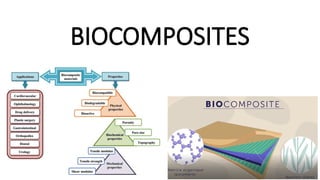
BIOCOMPOSITES
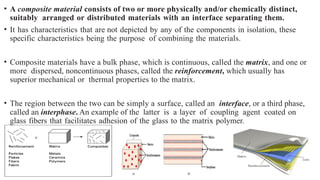
• A composite material consists of two or more physically and/or chemically distinct,
suitably arranged or distributed materials with an interface separating them.
• It has characteristics that are not depicted by any of the components in isolation, these
specific characteristics being the purpose of combining the materials.
• Composite materials have a bulk phase, which is continuous, called the matrix, and one or
more dispersed, noncontinuous phases, called the reinforcement, which usually has
superior mechanical or thermal properties to the matrix.
• The region between the two can be simply a surface, called an interface, or a third phase,
called an interphase. An example of the latter is a layer of coupling agent coated on
glass fibers that facilitates adhesion of the glass to the matrix polymer.
•The essence of the concept of composites is this:
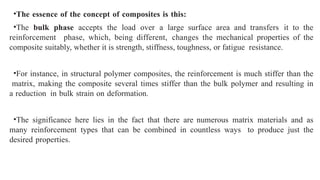
•The bulk phase accepts the load over a large surface area and transfers it to the
reinforcement phase, which, being different, changes the mechanical properties of the
composite suitably, whether it is strength, stiffness, toughness, or fatigue resistance.
•For instance, in structural polymer composites, the reinforcement is much stiffer than the
matrix, making the composite several times stiffer than the bulk polymer and resulting in
a reduction in bulk strain on deformation.
•The significance here lies in the fact that there are numerous matrix materials and as
many reinforcement types that can be combined in countless ways to produce just the
desired properties.
• Other concerns, such as biocompatibility, precise property matching, mimicking
natural structures, etc., can become more important, yet these too are areas where
composites offer much promise in device design.
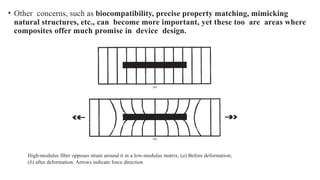
High-modulus fiber opposes strain around it in a low-modulus matrix, (a) Before deformation;
(b) after deformation. Arrows indicate force direction
CLASSIFICATION
The factors that most contribute to the engineering performance of the composite
include
1.Materials that make up the individual components
2.Quantity, form, and arrangement of the components
3.Interaction between the components
• The reinforcement system in a composite material strongly determines the
properties achievable in a composite.
• These can include the shape, size, orientation, composition, distribution, and
manner of incorporation of the reinforcement.
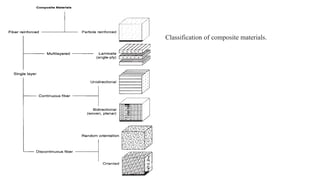
Biomedical composites, this results in two broad groups, namely,
1.Fiber-reinforced and
2.Particle reinforced composites.
•Composite materials can also be broadly classified based simply on
the matrix material used. This is often done more for processing than
for performance purposes.
•Thus there are
•polymer-matrix composites (PMCs),
•ceramic-matrix composites (CMCs), or
•metal-matrix composites (MMCs).
The last type is an advanced composite uncommon in biomedical
applications and is mostly used for high-temperature applications.
CONSTITUENTS
Matrices
• The matrix in a composite is the continuous bulk phase that envelopes the reinforcement
phase either completely or partially. It serves several important functions. It holds the fibers
or particles in place, and in oriented composites, it maintains the preferred direction of
fibers.
• The matrix transfers the applied load to the reinforcement and redistributes the stress. When
used with brittle fibers, the matrix helps increase fracture toughness because it is typically of
a lower stiffness material and can tolerate greater elongation and shear forces than the
reinforcement.
• The matrix also determines the environmental durability of the composite by resisting
chemical, hygroscopic, and thermal stresses and protecting the reinforcement from these
stresses. The matrix also greatly influences the processing characteristics of a composite.
Classification of composite materials.
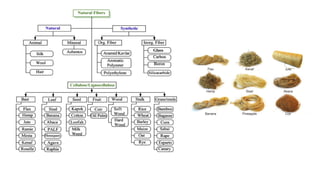
Fibers Reinforced
• A great majority of materials is stronger and stiffer in the fibrous form than in
any other form. This explains the emphasis on using fibers in composite
materials design, particularly in structural applications, where they are the principal
load-carrying component.
• Fibers have a very high aspect ratio of length to diameter compared with particles
and whiskers, and the smaller the diameter, the greater is the strength of the fiber due
to a reduction in surface flaws. Many properties of a composite are determined by
the length, orientation, and volume fraction of fibers of a given type.
• Fibers are often manufactured as continuous filaments, with diameters in the range
of 5 to 50 µm, and then they are arranged to produce tows, yarns, strands, rovings,
mats, etc. These are used to fabricate continuous fiber composites, often for large
structural applications.
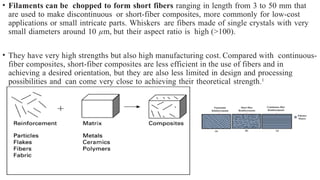
• Filaments can be chopped to form short fibers ranging in length from 3 to 50 mm that
are used to make discontinuous or short-fiber composites, more commonly for low-cost
applications or small intricate parts. Whiskers are fibers made of single crystals with very
small diameters around 10 µm, but their aspect ratio is high (>100).
• They have very high strengths but also high manufacturing cost. Compared with continuous-
fiber composites, short-fiber composites are less efficient in the use of fibers and in
achieving a desired orientation, but they are also less limited in design and processing
possibilities and can come very close to achieving their theoretical strength.1
Constituents of Biomedical Composites
Particles Reinforced
• Particles can be added to a matrix to improve mechanical properties such as
toughness and hardness. Other properties, such as dimensional stability, electrical
insulation, and thermal conductivity, can also be controlled effectively by particles,
especially when added to polymer matrices.
• Particulate reinforcement is randomly distributed in a matrix, resulting in isotropic
composites. Particles can either strengthen or weaken a matrix depending on its shape,
stiffness, and bonding strength with the matrix. Spherical particles are less effective
than platelet or flakelike particles in adding stiffness.
• Hard particles in a low-modulus polymer increase stiffness, whereas compliant
particles such as silicone rubber, when added to a stiff polymer matrix, result in a
softer composite. Fillers are non-reinforcing particles such as carbon black and glass
microspheres that are added more for economic and not performance purposes.
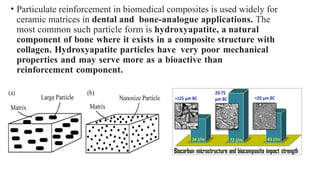
• Particulate reinforcement in biomedical composites is used widely for
ceramic matrices in dental and bone-analogue applications. The
most common such particle form is hydroxyapatite, a natural
component of bone where it exists in a composite structure with
collagen. Hydroxyapatite particles have very poor mechanical
properties and may serve more as a bioactive than
reinforcement component.
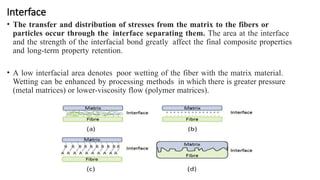
Interface
• The transfer and distribution of stresses from the matrix to the fibers or
particles occur through the interface separating them. The area at the interface
and the strength of the interfacial bond greatly affect the final composite properties
and long-term property retention.
• A low interfacial area denotes poor wetting of the fiber with the matrix material.
Wetting can be enhanced by processing methods in which there is greater pressure
(metal matrices) or lower-viscosity flow (polymer matrices).
Processing
1.Polymer-Matrix Composites
• Continuous-fiber composites can be made in a variety of ways, such as manual layup of
laminates, filament winding, pultrusion, and resin transfer molding. Manual lay up involves
stacking preimpregnated (or prepreg) tapes and sheets of parallel-fiber filaments held
together by thermoplas- tic resin or partially cured thermoset resin, followed by
autoclaving.
• This is not very expensive and not suitable for small medical implants. Like layup, filament
winding allows for high-fiber-volume fraction and control of properties but is limited to
tubular shapes, and the fibers cannot be oriented along the axis of the component.
• Pultrusion is ideal for very stiff composite rods and beams and can be used for making
orthodontic arch wires. Resin transfer molding allows very complex shapes and short cycle
times but requires expert design of preforms and molds. Compression molding is another
method suitable for both thermosets and thermoplastics.
2.Ceramic-Matrix Composites
• Ceramic-matrix composites are manufactured commonly by either pressing methods or
infiltration methods. In the former, the reinforcement is mixed with a powder of the
matrix, which is densified by hot pressing or hot isotactic pressing (HIP).
• Near-zero porosity can be achieved, but the simultaneous high pressure and
temperature can degrade fibers or result in a strong interfacial bond that may reduce
fracture toughness. In infiltration methods, a sintered fibrous or paniculate preform
is filled by the matrix by such methods as chemical vapor deposition, glass melt
infiltration, and preceramic polymer or sol infiltration.
• Alumina-glass dental composites are made by this method. This method has the
advantage of complex shape capability, low pressure, and flexible fiber architecture.
Disad- vantages are high matrix porosity (>10 percent) and long fabrication cycles.
Particulate reinforcement can also be used through tape-casting and slip-casting the
initial preform.
PHYSICAL PROPERTIES
• Composite materials can be designed to have a wide range of physical and biochemical
properties, making it important to develop predictive models to aid in designing with
the many complex variables that face the composites engineer.
• Although these models tend be complicated due to the microstructure of composites, it
is important to resist the temptation to treat a composite as a black box with gross
properties because this macroscopic approach does not have the predictive power
crucial for failure analysis.
• There have been three general approaches to predicting the basic mechanical properties
of a composite:
1.Mechanics of materials models
2.Theory of elasticity models
3.Semiempirical models
BIOLOGIC RESPONSE
• Materials can elicit a different host response in the bulk form than in the
fibrous or particulate form. For instance, UHMWPE, as in an acetabular cup of a
hip prosthesis, is generally biocompatible, whereas its fibrous form, as in a finely
woven fabric, has been shown to produce a different, more adverse reaction.
• Furthermore, when the discontinuous phase is particles, whiskers, platelets, or
microspheres with dimensions on a cellular scale, the inflammatory response can
include their ingestion by immune cells and transport to other parts of the body.
BIOMEDICAL APPLICATIONS
• Orthopedic
• Dental
• External Prosthetics and Orthotics
• Soft-Tissue Engineering.
•THE END

BIOCOMPOSITmmmmmmmmmmmmmmmmmmmmmmmmES.pptx

  • 1.
  • 2.
    • A compositematerial consists of two or more physically and/or chemically distinct, suitably arranged or distributed materials with an interface separating them. • It has characteristics that are not depicted by any of the components in isolation, these specific characteristics being the purpose of combining the materials. • Composite materials have a bulk phase, which is continuous, called the matrix, and one or more dispersed, noncontinuous phases, called the reinforcement, which usually has superior mechanical or thermal properties to the matrix. • The region between the two can be simply a surface, called an interface, or a third phase, called an interphase. An example of the latter is a layer of coupling agent coated on glass fibers that facilitates adhesion of the glass to the matrix polymer.
  • 3.
    •The essence ofthe concept of composites is this: •The bulk phase accepts the load over a large surface area and transfers it to the reinforcement phase, which, being different, changes the mechanical properties of the composite suitably, whether it is strength, stiffness, toughness, or fatigue resistance. •For instance, in structural polymer composites, the reinforcement is much stiffer than the matrix, making the composite several times stiffer than the bulk polymer and resulting in a reduction in bulk strain on deformation. •The significance here lies in the fact that there are numerous matrix materials and as many reinforcement types that can be combined in countless ways to produce just the desired properties.
  • 4.
    • Other concerns,such as biocompatibility, precise property matching, mimicking natural structures, etc., can become more important, yet these too are areas where composites offer much promise in device design. High-modulus fiber opposes strain around it in a low-modulus matrix, (a) Before deformation; (b) after deformation. Arrows indicate force direction
  • 5.
    CLASSIFICATION The factors thatmost contribute to the engineering performance of the composite include 1.Materials that make up the individual components 2.Quantity, form, and arrangement of the components 3.Interaction between the components • The reinforcement system in a composite material strongly determines the properties achievable in a composite. • These can include the shape, size, orientation, composition, distribution, and manner of incorporation of the reinforcement. Biomedical composites, this results in two broad groups, namely, 1.Fiber-reinforced and 2.Particle reinforced composites.
  • 6.
    •Composite materials canalso be broadly classified based simply on the matrix material used. This is often done more for processing than for performance purposes. •Thus there are •polymer-matrix composites (PMCs), •ceramic-matrix composites (CMCs), or •metal-matrix composites (MMCs). The last type is an advanced composite uncommon in biomedical applications and is mostly used for high-temperature applications.
  • 7.
    CONSTITUENTS Matrices • The matrixin a composite is the continuous bulk phase that envelopes the reinforcement phase either completely or partially. It serves several important functions. It holds the fibers or particles in place, and in oriented composites, it maintains the preferred direction of fibers. • The matrix transfers the applied load to the reinforcement and redistributes the stress. When used with brittle fibers, the matrix helps increase fracture toughness because it is typically of a lower stiffness material and can tolerate greater elongation and shear forces than the reinforcement. • The matrix also determines the environmental durability of the composite by resisting chemical, hygroscopic, and thermal stresses and protecting the reinforcement from these stresses. The matrix also greatly influences the processing characteristics of a composite.
  • 8.
  • 9.
    Fibers Reinforced • Agreat majority of materials is stronger and stiffer in the fibrous form than in any other form. This explains the emphasis on using fibers in composite materials design, particularly in structural applications, where they are the principal load-carrying component. • Fibers have a very high aspect ratio of length to diameter compared with particles and whiskers, and the smaller the diameter, the greater is the strength of the fiber due to a reduction in surface flaws. Many properties of a composite are determined by the length, orientation, and volume fraction of fibers of a given type. • Fibers are often manufactured as continuous filaments, with diameters in the range of 5 to 50 µm, and then they are arranged to produce tows, yarns, strands, rovings, mats, etc. These are used to fabricate continuous fiber composites, often for large structural applications.
  • 11.
    • Filaments canbe chopped to form short fibers ranging in length from 3 to 50 mm that are used to make discontinuous or short-fiber composites, more commonly for low-cost applications or small intricate parts. Whiskers are fibers made of single crystals with very small diameters around 10 µm, but their aspect ratio is high (>100). • They have very high strengths but also high manufacturing cost. Compared with continuous- fiber composites, short-fiber composites are less efficient in the use of fibers and in achieving a desired orientation, but they are also less limited in design and processing possibilities and can come very close to achieving their theoretical strength.1
  • 12.
  • 13.
    Particles Reinforced • Particlescan be added to a matrix to improve mechanical properties such as toughness and hardness. Other properties, such as dimensional stability, electrical insulation, and thermal conductivity, can also be controlled effectively by particles, especially when added to polymer matrices. • Particulate reinforcement is randomly distributed in a matrix, resulting in isotropic composites. Particles can either strengthen or weaken a matrix depending on its shape, stiffness, and bonding strength with the matrix. Spherical particles are less effective than platelet or flakelike particles in adding stiffness. • Hard particles in a low-modulus polymer increase stiffness, whereas compliant particles such as silicone rubber, when added to a stiff polymer matrix, result in a softer composite. Fillers are non-reinforcing particles such as carbon black and glass microspheres that are added more for economic and not performance purposes.
  • 14.
    • Particulate reinforcementin biomedical composites is used widely for ceramic matrices in dental and bone-analogue applications. The most common such particle form is hydroxyapatite, a natural component of bone where it exists in a composite structure with collagen. Hydroxyapatite particles have very poor mechanical properties and may serve more as a bioactive than reinforcement component.
  • 15.
    Interface • The transferand distribution of stresses from the matrix to the fibers or particles occur through the interface separating them. The area at the interface and the strength of the interfacial bond greatly affect the final composite properties and long-term property retention. • A low interfacial area denotes poor wetting of the fiber with the matrix material. Wetting can be enhanced by processing methods in which there is greater pressure (metal matrices) or lower-viscosity flow (polymer matrices).
  • 16.
    Processing 1.Polymer-Matrix Composites • Continuous-fibercomposites can be made in a variety of ways, such as manual layup of laminates, filament winding, pultrusion, and resin transfer molding. Manual lay up involves stacking preimpregnated (or prepreg) tapes and sheets of parallel-fiber filaments held together by thermoplas- tic resin or partially cured thermoset resin, followed by autoclaving. • This is not very expensive and not suitable for small medical implants. Like layup, filament winding allows for high-fiber-volume fraction and control of properties but is limited to tubular shapes, and the fibers cannot be oriented along the axis of the component. • Pultrusion is ideal for very stiff composite rods and beams and can be used for making orthodontic arch wires. Resin transfer molding allows very complex shapes and short cycle times but requires expert design of preforms and molds. Compression molding is another method suitable for both thermosets and thermoplastics.
  • 17.
    2.Ceramic-Matrix Composites • Ceramic-matrixcomposites are manufactured commonly by either pressing methods or infiltration methods. In the former, the reinforcement is mixed with a powder of the matrix, which is densified by hot pressing or hot isotactic pressing (HIP). • Near-zero porosity can be achieved, but the simultaneous high pressure and temperature can degrade fibers or result in a strong interfacial bond that may reduce fracture toughness. In infiltration methods, a sintered fibrous or paniculate preform is filled by the matrix by such methods as chemical vapor deposition, glass melt infiltration, and preceramic polymer or sol infiltration. • Alumina-glass dental composites are made by this method. This method has the advantage of complex shape capability, low pressure, and flexible fiber architecture. Disad- vantages are high matrix porosity (>10 percent) and long fabrication cycles. Particulate reinforcement can also be used through tape-casting and slip-casting the initial preform.
  • 18.
    PHYSICAL PROPERTIES • Compositematerials can be designed to have a wide range of physical and biochemical properties, making it important to develop predictive models to aid in designing with the many complex variables that face the composites engineer. • Although these models tend be complicated due to the microstructure of composites, it is important to resist the temptation to treat a composite as a black box with gross properties because this macroscopic approach does not have the predictive power crucial for failure analysis. • There have been three general approaches to predicting the basic mechanical properties of a composite: 1.Mechanics of materials models 2.Theory of elasticity models 3.Semiempirical models
  • 19.
    BIOLOGIC RESPONSE • Materialscan elicit a different host response in the bulk form than in the fibrous or particulate form. For instance, UHMWPE, as in an acetabular cup of a hip prosthesis, is generally biocompatible, whereas its fibrous form, as in a finely woven fabric, has been shown to produce a different, more adverse reaction. • Furthermore, when the discontinuous phase is particles, whiskers, platelets, or microspheres with dimensions on a cellular scale, the inflammatory response can include their ingestion by immune cells and transport to other parts of the body.
  • 20.
    BIOMEDICAL APPLICATIONS • Orthopedic •Dental • External Prosthetics and Orthotics • Soft-Tissue Engineering.
  • 21.