Neural Turing Machine
(NTM)
Google DeepMind (2014)
장영록
발표 내용
• Turing Machine 이란?
• Overview
• Concept
• Architecture
• Copy Task
• Details
• Addressing Mechanism
• Reading & Writing
• Controller
• Experiment
• Copy
• Priority Sort
• Conclusion
Turing Machine 이란?
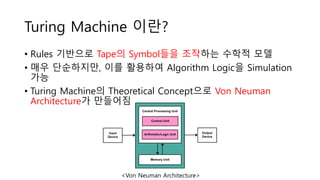
• Rules 기반으로 Tape의 Symbol들을 조작하는 수학적 모델
• 매우 단순하지만, 이를 활용하여 Algorithm Logic을 Simulation
가능
• Turing Machine의 Theoretical Concept으로 Von Neuman
Architecture가 만들어짐
<Von Neuman Architecture>
Turing Machine의 구성 요소 (1)
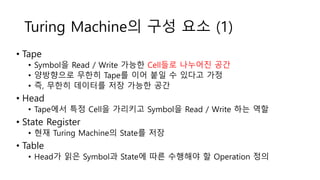
• Tape
• Symbol을 Read / Write 가능한 Cell들로 나누어진 공간
• 양방향으로 무한히 Tape를 이어 붙일 수 있다고 가정
• 즉, 무한히 데이터를 저장 가능한 공간
• Head
• Tape에서 특정 Cell을 가리키고 Symbol을 Read / Write 하는 역할
• State Register
• 현재 Turing Machine의 State를 저장
• Table
• Head가 읽은 Symbol과 State에 따른 수행해야 할 Operation 정의
Turing Machine의 구성 요소 (2)
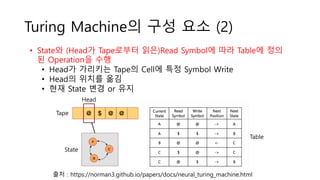
출처 : https://norman3.github.io/papers/docs/neural_turing_machine.html
State
Tape
Table
• State와 (Head가 Tape로부터 읽은)Read Symbol에 따라 Table에 정의
된 Operation을 수행
• Head가 가리키는 Tape의 Cell에 특정 Symbol Write
• Head의 위치를 옮김
• 현재 State 변경 or 유지
Head
NTM Overview – Concept (1)
• (Turing Machine의 Tape 같은) External Memory 공간을 활용하는
Neural Network
• Differentiable 하므로 Memory addressing, Read, Write 등의
Operation을 Training Dataset을 통해 학습
• RNN의 Hidden state가 Internal memory 같은 역할을 했다면 NTM
은 External memory를 활용
NTM Overview – Copy Task
출처 : https://medium.com/@benjamin_47408/neural-turing-
machines-an-artificial-working-memory-cd913420508b
NTM
• Previous Read Vector
• (LSTM의 경우 Previous
Hidden State)
• Previous weight
External
Input
External Output
• Binary Target으로
Supervised Learning
• Binary Vector + Delimeter
로 Input 구성
• Ex) 12
• [0,0,0,0,1,1,0,0,0,0]
Number
Delimeter
(start, end)
출처 : https://www.youtube.com/watch?v=2wbDiZCWQtY
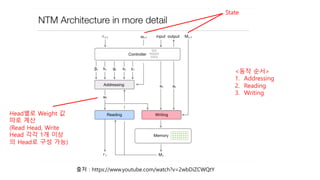
Head별로 Weight 값
따로 계산
(Read Head, Write
Head 각각 1개 이상
의 Head로 구성 가능)
<동작 순서>
1. Addressing
2. Reading
3. Writing
State
Addressing Mechanism
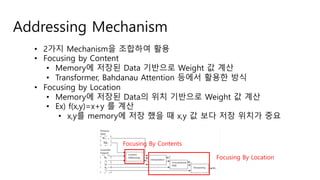
• 2가지 Mechanism을 조합하여 활용
• Focusing by Content
• Memory에 저장된 Data 기반으로 Weight 값 계산
• Transformer, Bahdanau Attention 등에서 활용한 방식
• Focusing by Location
• Memory에 저장된 Data의 위치 기반으로 Weight 값 계산
• Ex) f(x,y)=x+y 를 계산
• x,y를 memory에 저장 했을 때 x,y 값 보다 저장 위치가 중요
Focusing By Contents
Focusing By Location
NTM – Memory
출처 : https://norman3.github.io/papers/docs/neural_turing_machine.html
Memory에
저장된
Vector
Memory
Location
Content Addressing
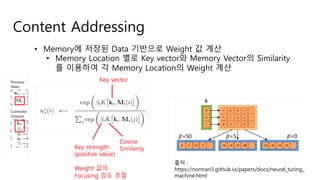
• Memory에 저장된 Data 기반으로 Weight 값 계산
• Memory Location 별로 Key vector와 Memory Vector의 Similarity
를 이용하여 각 Memory Location의 Weight 계산
Key strength
(positive value)
Weight 값의
Focusing 강도 조절
Key vector
Cosine
Similarity
출처 :
https://norman3.github.io/papers/docs/neural_turing_
machine.html
Location Addressing - Interpolation
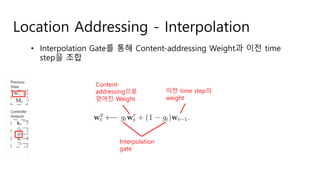
• Interpolation Gate를 통해 Content-addressing Weight과 이전 time
step을 조합
Interpolation
gate
Content-
addressing으로
얻어진 Weight
이전 time step의
weight
Location Addressing – Convolutional Shift (1)
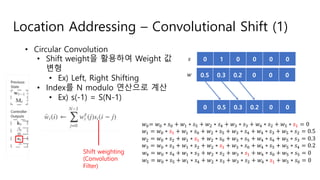
• Circular Convolution
• Shift weight을 활용하여 Weight 값
변형
• Ex) Left, Right Shifting
• Index를 N modulo 연산으로 계산
• Ex) s(-1) = S(N-1)
Shift weighting
(Convolution
Filter)
0.5 0.3 0.2 0 0 0
0 1 0 0 0 0
!"= !" ∗ %" + !' ∗ %( + !) ∗ %* + !+ ∗ %+ + !* ∗ %) + !( ∗ %' = 0
!' = !" ∗ %' + !' ∗ %" + !) ∗ %( + !+ ∗ %* + !* ∗ %+ + !( ∗ %) = 0.5
!) = !" ∗ %) + !' ∗ %' + !) ∗ %" + !+ ∗ %( + !* ∗ %* + !( ∗ %+ = 0.3
!+ = !" ∗ %+ + !' ∗ %) + !) ∗ %' + !+ ∗ %" + !* ∗ %( + !( ∗ %* = 0.2
!* = !" ∗ %* + !' ∗ %+ + !) ∗ %) + !+ ∗ %' + !* ∗ %" + !( ∗ %( = 0
!( = !" ∗ %( + !' ∗ %* + !) ∗ %+ + !+ ∗ %) + !* ∗ %' + !( ∗ %" = 0
!
%
0 0.5 0.3 0.2 0 0
Location Addressing – Convolutional Shift (2)
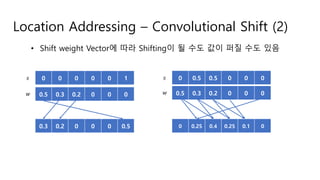
• Shift weight Vector에 따라 Shifting이 될 수도 값이 퍼질 수도 있음
0.5 0.3 0.2 0 0 0
0 0 0 0 0 1
!
"
0.3 0.2 0 0 0 0.5
0.5 0.3 0.2 0 0 0
0 0.5 0.5 0 0 0
!
"
0 0.25 0.4 0.25 0.1 0
Location Addressing – Sharpening
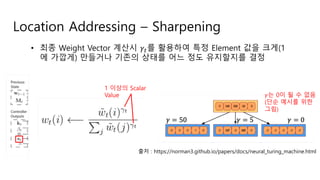
• 최종 Weight Vector 계산시 !"를 활용하여 특정 Element 값을 크게(1
에 가깝게) 만들거나 기존의 상태를 어느 정도 유지할지를 결정
1 이상의 Scalar
Value !는 0이 될 수 없음
(단순 예시를 위한
그림)
출처 : https://norman3.github.io/papers/docs/neural_turing_machine.html
NTM - Reading
WeightRead Vector
Memory Vector
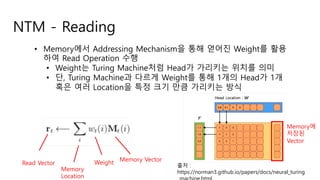
• Memory에서 Addressing Mechanism을 통해 얻어진 Weight를 활용
하여 Read Operation 수행
• Weight는 Turing Machine처럼 Head가 가리키는 위치를 의미
• 단, Turing Machine과 다르게 Weight를 통해 1개의 Head가 1개
혹은 여러 Location을 특정 크기 만큼 가리키는 방식
출처 :
https://norman3.github.io/papers/docs/neural_turingMemory
Location
Memory에
저장된
Vector
NTM – Writing (1)
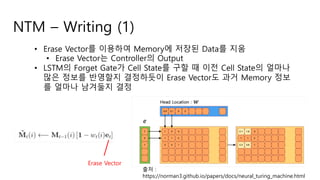
• Erase Vector를 이용하여 Memory에 저장된 Data를 지움
• Erase Vector는 Controller의 Output
• LSTM의 Forget Gate가 Cell State를 구할 때 이전 Cell State의 얼마나
많은 정보를 반영할지 결정하듯이 Erase Vector도 과거 Memory 정보
를 얼마나 남겨둘지 결정
Erase Vector
출처 :
https://norman3.github.io/papers/docs/neural_turing_machine.html
NTM – Writing (2)
• Add Vector를 이용하여 Memory에 Data를 적음
• Add Vector는 Controller의 Output
Add Vector 출처 :
https://norman3.github.io/papers/docs/neural_turing
_machine.html
Controller Network (1)
• Network 구성 Parameter
• Memory 크기
• Read Head 수, Write Head 수
• Read Head 수 만큼 Read Weight이 생성되고 순차적으로
Read Vector을 생성하여 concat하여 사용
• Write Head 수 만큼 Write Weight, Add Vector, Erase Vector가
생성되고 순차적으로 Memory Write
• Location Shift Range
• Shift range가 1인 경우 !", !$, !%&$값만 학습을 통해 결정됨
• 나머지는 0으로 padding됨
Controller Network (2)
• LSTM 혹은 Feed Forward Network로 구성
• LSTM의 Hidden State는 컴퓨터의 Register와 유사한 역할
• CPU -> Controller
• RAM -> Memory
• Feed Forward Network로 Controller를 구성하더라도 Memory Read /
Write 작업을 통해 Sequence Data 학습 가능
Experiment – Copy (1)
출처 : https://medium.com/@benjamin_47408/neural-turing-
machines-an-artificial-working-memory-cd913420508b
NTM
• Previous Read Vector
• (LSTM의 경우 Previous
Hidden State)
• Previous weight
External
Input
External Output
• Binary Target으로
Supervised Learning
• Binary Vector + Delimeter
로 Input 구성
• Ex) 12
• [0,0,0,0,1,1,0,0,0,0]
Number
Delimeter
(start, end)
Experiment – Copy (2)
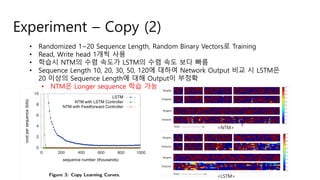
<NTM>
<LSTM>
• Randomized 1~20 Sequence Length, Random Binary Vectors로 Training
• Read, Write head 1개씩 사용
• 학습시 NTM의 수렴 속도가 LSTM의 수렴 속도 보다 빠름
• Sequence Length 10, 20, 30, 50, 120에 대하여 Network Output 비교 시 LSTM은
20 이상의 Sequence Length에 대해 Output이 부정확
• NTM은 Longer sequence 학습 가능
Experiment – Copy (3)
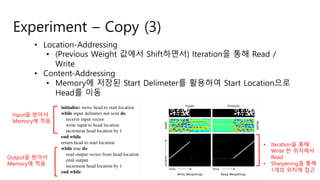
• Location-Addressing
• (Previous Weight 값에서 Shift하면서) Iteration을 통해 Read /
Write
• Content-Addressing
• Memory에 저장된 Start Delimeter를 활용하여 Start Location으로
Head를 이동
Input을 받아서
Memory에 적음
Output을 받아서
Memory에 적음
• Iteration을 통해
Write 한 위치에서
Read
• Sharpening을 통해
1개의 위치에 접근
Experiment – Priority Sort
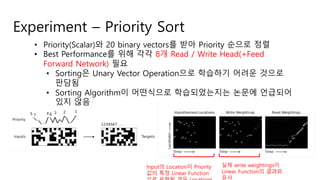
• Priority(Scalar)와 20 binary vectors를 받아 Priority 순으로 정렬
• Best Performance를 위해 각각 8개 Read / Write Head(+Feed
Forward Network) 필요
• Sorting은 Unary Vector Operation으로 학습하기 어려운 것으로
판담됨
• Sorting Algorithm이 어떤식으로 학습되었는지는 논문에 언급되어
있지 않음
Input의 Location이 Priority
값의 특정 Linear Function
실제 write weightings이
Linear Function의 결과와
유사
Conclusion
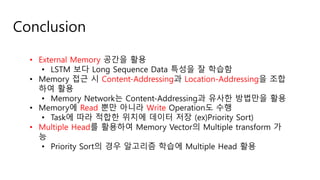
• External Memory 공간을 활용
• LSTM 보다 Long Sequence Data 특성을 잘 학습함
• Memory 접근 시 Content-Addressing과 Location-Addressing을 조합
하여 활용
• Memory Network는 Content-Addressing과 유사한 방법만을 활용
• Memory에 Read 뿐만 아니라 Write Operation도 수행
• Task에 따라 적합한 위치에 데이터 저장 (ex)Priority Sort)
• Multiple Head를 활용하여 Memory Vector의 Multiple transform 가
능
• Priority Sort의 경우 알고리즘 학습에 Multiple Head 활용
Future seminar
• Few-Shot Generalization Across Dialogue Tasks
• 대화시스템 플랫폼 RASA의 NeurIPS Paper 2018
• 대화 처리(Dialogue Management)에 관한 논문
• NTM 관한 논문
Neural turing machine

  • 1.
    Neural Turing Machine (NTM) GoogleDeepMind (2014) 장영록
  • 2.
    발표 내용 • TuringMachine 이란? • Overview • Concept • Architecture • Copy Task • Details • Addressing Mechanism • Reading & Writing • Controller • Experiment • Copy • Priority Sort • Conclusion
  • 3.
    Turing Machine 이란? •Rules 기반으로 Tape의 Symbol들을 조작하는 수학적 모델 • 매우 단순하지만, 이를 활용하여 Algorithm Logic을 Simulation 가능 • Turing Machine의 Theoretical Concept으로 Von Neuman Architecture가 만들어짐 <Von Neuman Architecture>
  • 4.
    Turing Machine의 구성요소 (1) • Tape • Symbol을 Read / Write 가능한 Cell들로 나누어진 공간 • 양방향으로 무한히 Tape를 이어 붙일 수 있다고 가정 • 즉, 무한히 데이터를 저장 가능한 공간 • Head • Tape에서 특정 Cell을 가리키고 Symbol을 Read / Write 하는 역할 • State Register • 현재 Turing Machine의 State를 저장 • Table • Head가 읽은 Symbol과 State에 따른 수행해야 할 Operation 정의
  • 5.
    Turing Machine의 구성요소 (2) 출처 : https://norman3.github.io/papers/docs/neural_turing_machine.html State Tape Table • State와 (Head가 Tape로부터 읽은)Read Symbol에 따라 Table에 정의 된 Operation을 수행 • Head가 가리키는 Tape의 Cell에 특정 Symbol Write • Head의 위치를 옮김 • 현재 State 변경 or 유지 Head
  • 6.
    NTM Overview –Concept (1) • (Turing Machine의 Tape 같은) External Memory 공간을 활용하는 Neural Network • Differentiable 하므로 Memory addressing, Read, Write 등의 Operation을 Training Dataset을 통해 학습 • RNN의 Hidden state가 Internal memory 같은 역할을 했다면 NTM 은 External memory를 활용
  • 7.
    NTM Overview –Copy Task 출처 : https://medium.com/@benjamin_47408/neural-turing- machines-an-artificial-working-memory-cd913420508b NTM • Previous Read Vector • (LSTM의 경우 Previous Hidden State) • Previous weight External Input External Output • Binary Target으로 Supervised Learning • Binary Vector + Delimeter 로 Input 구성 • Ex) 12 • [0,0,0,0,1,1,0,0,0,0] Number Delimeter (start, end)
  • 8.
    출처 : https://www.youtube.com/watch?v=2wbDiZCWQtY Head별로Weight 값 따로 계산 (Read Head, Write Head 각각 1개 이상 의 Head로 구성 가능) <동작 순서> 1. Addressing 2. Reading 3. Writing State
  • 9.
    Addressing Mechanism • 2가지Mechanism을 조합하여 활용 • Focusing by Content • Memory에 저장된 Data 기반으로 Weight 값 계산 • Transformer, Bahdanau Attention 등에서 활용한 방식 • Focusing by Location • Memory에 저장된 Data의 위치 기반으로 Weight 값 계산 • Ex) f(x,y)=x+y 를 계산 • x,y를 memory에 저장 했을 때 x,y 값 보다 저장 위치가 중요 Focusing By Contents Focusing By Location
  • 10.
    NTM – Memory 출처: https://norman3.github.io/papers/docs/neural_turing_machine.html Memory에 저장된 Vector Memory Location
  • 11.
    Content Addressing • Memory에저장된 Data 기반으로 Weight 값 계산 • Memory Location 별로 Key vector와 Memory Vector의 Similarity 를 이용하여 각 Memory Location의 Weight 계산 Key strength (positive value) Weight 값의 Focusing 강도 조절 Key vector Cosine Similarity 출처 : https://norman3.github.io/papers/docs/neural_turing_ machine.html
  • 12.
    Location Addressing -Interpolation • Interpolation Gate를 통해 Content-addressing Weight과 이전 time step을 조합 Interpolation gate Content- addressing으로 얻어진 Weight 이전 time step의 weight
  • 13.
    Location Addressing –Convolutional Shift (1) • Circular Convolution • Shift weight을 활용하여 Weight 값 변형 • Ex) Left, Right Shifting • Index를 N modulo 연산으로 계산 • Ex) s(-1) = S(N-1) Shift weighting (Convolution Filter) 0.5 0.3 0.2 0 0 0 0 1 0 0 0 0 !"= !" ∗ %" + !' ∗ %( + !) ∗ %* + !+ ∗ %+ + !* ∗ %) + !( ∗ %' = 0 !' = !" ∗ %' + !' ∗ %" + !) ∗ %( + !+ ∗ %* + !* ∗ %+ + !( ∗ %) = 0.5 !) = !" ∗ %) + !' ∗ %' + !) ∗ %" + !+ ∗ %( + !* ∗ %* + !( ∗ %+ = 0.3 !+ = !" ∗ %+ + !' ∗ %) + !) ∗ %' + !+ ∗ %" + !* ∗ %( + !( ∗ %* = 0.2 !* = !" ∗ %* + !' ∗ %+ + !) ∗ %) + !+ ∗ %' + !* ∗ %" + !( ∗ %( = 0 !( = !" ∗ %( + !' ∗ %* + !) ∗ %+ + !+ ∗ %) + !* ∗ %' + !( ∗ %" = 0 ! % 0 0.5 0.3 0.2 0 0
  • 14.
    Location Addressing –Convolutional Shift (2) • Shift weight Vector에 따라 Shifting이 될 수도 값이 퍼질 수도 있음 0.5 0.3 0.2 0 0 0 0 0 0 0 0 1 ! " 0.3 0.2 0 0 0 0.5 0.5 0.3 0.2 0 0 0 0 0.5 0.5 0 0 0 ! " 0 0.25 0.4 0.25 0.1 0
  • 15.
    Location Addressing –Sharpening • 최종 Weight Vector 계산시 !"를 활용하여 특정 Element 값을 크게(1 에 가깝게) 만들거나 기존의 상태를 어느 정도 유지할지를 결정 1 이상의 Scalar Value !는 0이 될 수 없음 (단순 예시를 위한 그림) 출처 : https://norman3.github.io/papers/docs/neural_turing_machine.html
  • 16.
    NTM - Reading WeightReadVector Memory Vector • Memory에서 Addressing Mechanism을 통해 얻어진 Weight를 활용 하여 Read Operation 수행 • Weight는 Turing Machine처럼 Head가 가리키는 위치를 의미 • 단, Turing Machine과 다르게 Weight를 통해 1개의 Head가 1개 혹은 여러 Location을 특정 크기 만큼 가리키는 방식 출처 : https://norman3.github.io/papers/docs/neural_turingMemory Location Memory에 저장된 Vector
  • 17.
    NTM – Writing(1) • Erase Vector를 이용하여 Memory에 저장된 Data를 지움 • Erase Vector는 Controller의 Output • LSTM의 Forget Gate가 Cell State를 구할 때 이전 Cell State의 얼마나 많은 정보를 반영할지 결정하듯이 Erase Vector도 과거 Memory 정보 를 얼마나 남겨둘지 결정 Erase Vector 출처 : https://norman3.github.io/papers/docs/neural_turing_machine.html
  • 18.
    NTM – Writing(2) • Add Vector를 이용하여 Memory에 Data를 적음 • Add Vector는 Controller의 Output Add Vector 출처 : https://norman3.github.io/papers/docs/neural_turing _machine.html
  • 19.
    Controller Network (1) •Network 구성 Parameter • Memory 크기 • Read Head 수, Write Head 수 • Read Head 수 만큼 Read Weight이 생성되고 순차적으로 Read Vector을 생성하여 concat하여 사용 • Write Head 수 만큼 Write Weight, Add Vector, Erase Vector가 생성되고 순차적으로 Memory Write • Location Shift Range • Shift range가 1인 경우 !", !$, !%&$값만 학습을 통해 결정됨 • 나머지는 0으로 padding됨
  • 20.
    Controller Network (2) •LSTM 혹은 Feed Forward Network로 구성 • LSTM의 Hidden State는 컴퓨터의 Register와 유사한 역할 • CPU -> Controller • RAM -> Memory • Feed Forward Network로 Controller를 구성하더라도 Memory Read / Write 작업을 통해 Sequence Data 학습 가능
  • 21.
    Experiment – Copy(1) 출처 : https://medium.com/@benjamin_47408/neural-turing- machines-an-artificial-working-memory-cd913420508b NTM • Previous Read Vector • (LSTM의 경우 Previous Hidden State) • Previous weight External Input External Output • Binary Target으로 Supervised Learning • Binary Vector + Delimeter 로 Input 구성 • Ex) 12 • [0,0,0,0,1,1,0,0,0,0] Number Delimeter (start, end)
  • 22.
    Experiment – Copy(2) <NTM> <LSTM> • Randomized 1~20 Sequence Length, Random Binary Vectors로 Training • Read, Write head 1개씩 사용 • 학습시 NTM의 수렴 속도가 LSTM의 수렴 속도 보다 빠름 • Sequence Length 10, 20, 30, 50, 120에 대하여 Network Output 비교 시 LSTM은 20 이상의 Sequence Length에 대해 Output이 부정확 • NTM은 Longer sequence 학습 가능
  • 23.
    Experiment – Copy(3) • Location-Addressing • (Previous Weight 값에서 Shift하면서) Iteration을 통해 Read / Write • Content-Addressing • Memory에 저장된 Start Delimeter를 활용하여 Start Location으로 Head를 이동 Input을 받아서 Memory에 적음 Output을 받아서 Memory에 적음 • Iteration을 통해 Write 한 위치에서 Read • Sharpening을 통해 1개의 위치에 접근
  • 24.
    Experiment – PrioritySort • Priority(Scalar)와 20 binary vectors를 받아 Priority 순으로 정렬 • Best Performance를 위해 각각 8개 Read / Write Head(+Feed Forward Network) 필요 • Sorting은 Unary Vector Operation으로 학습하기 어려운 것으로 판담됨 • Sorting Algorithm이 어떤식으로 학습되었는지는 논문에 언급되어 있지 않음 Input의 Location이 Priority 값의 특정 Linear Function 실제 write weightings이 Linear Function의 결과와 유사
  • 25.
    Conclusion • External Memory공간을 활용 • LSTM 보다 Long Sequence Data 특성을 잘 학습함 • Memory 접근 시 Content-Addressing과 Location-Addressing을 조합 하여 활용 • Memory Network는 Content-Addressing과 유사한 방법만을 활용 • Memory에 Read 뿐만 아니라 Write Operation도 수행 • Task에 따라 적합한 위치에 데이터 저장 (ex)Priority Sort) • Multiple Head를 활용하여 Memory Vector의 Multiple transform 가 능 • Priority Sort의 경우 알고리즘 학습에 Multiple Head 활용
  • 26.
    Future seminar • Few-ShotGeneralization Across Dialogue Tasks • 대화시스템 플랫폼 RASA의 NeurIPS Paper 2018 • 대화 처리(Dialogue Management)에 관한 논문 • NTM 관한 논문