ARTIFICIAL NETWORK MODEL FOR POTATOES DRYING PARAMETERS PREDICTION
OUTLINE
• Background of Study
• Statement of Research Problem
• Objectives of Study
• Significance of the Study
• Review of Related Literature
• Materials and Methods
Background Of Study
• Drying operations can help in reducing the moisture content of feed materials for
avoidance of microbial growth and deterioration, for shell life elongation, to
minimize packaging and improving storage for easy transportation.
• Drying is considered one of the methods that are used to preserve some perishable
agricultural produces like sweet potato, to ensure their availability all year round,
reduce post-harvest and achieve food security, hot air drying is one of the most
efficient and effective method of drying.
Statement of the Problem
• Agricultural products have high moisture content and sweet potato is
not excluded, this can lead to deterioration easily if not properly
processed especially after harvest and since sweet potatoes are
seasonal.
• Generally, the quality of dried products depends on the entire drying
conditions, so it is important to understand the drying process
parameters and characteristics of sweet potato, since its ultimate aim is
to increase the shelf life and preserve the product by reducing its
moisture content.
Objective Of Study
The specific objectives are of this proposal is;
i. Characterizes the sample sweet potato before and after drying
ii. Develop the mathematical model for the drying kinetics of the sample
iii.Determine the main parameter for moisture removal with the samples
iv.Fit the experimental data to the developed model which is Artificial
Neural Network (ANN)
Significance of the Study
• With the successful completion of the research, it will solve some food
preservation and storage problems by reducing waste of agricultural product
(sweet potato).
• The developed model will help in determining the moisture ratio of the product
study.
• It will help to create employment opportunity by having some industries where
potato flour and chips could be produced.
• It can also serve as a base for further research work, it can help in optimization
which will be enable the manufacturer of flour to know the optimal condition
for the preservation of the product.
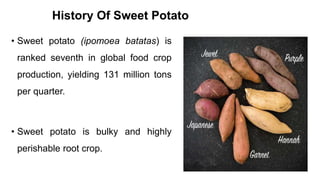
History Of Sweet Potato
• Sweet potato (ipomoea batatas) is
ranked seventh in global food crop
production, yielding 131 million tons
per quarter.
• Sweet potato is bulky and highly
perishable root crop.
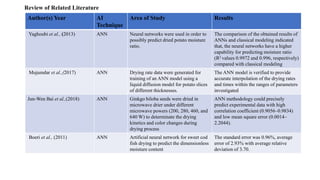
Review of Related Literature
Author(s) Year AI
Technique
Area of Study Results
Yaghoubi et al., (2013) ANN Neural networks were used in order to
possibly predict dried potato moisture
ratio.
The comparison of the obtained results of
ANNs and classical modeling indicated
that, the neural networks have a higher
capability for predicting moisture ratio
(R2 values 0.9972 and 0.996, respectively)
compared with classical modeling
Mujumdar et al.,(2017) ANN Drying rate data were generated for
training of an ANN model using a
liquid diffusion model for potato slices
of different thicknesses.
The ANN model is verified to provide
accurate interpolation of the drying rates
and times within the ranges of parameters
investigated
Jun-Wen Bai et al.,(2018) ANN Ginkgo biloba seeds were dried in
microwave drier under different
microwave powers (200, 280, 460, and
640 W) to determinate the drying
kinetics and color changes during
drying process
ANN methodology could precisely
predict experimental data with high
correlation coefficient (0.9056–0.9834)
and low mean square error (0.0014–
2.2044).
Boeri et al., (2011) ANN Artificial neural network for sweet cod
fish drying to predict the dimensionless
moisture content
The standard error was 0.96%, average
error of 2.93% with average relative
deviation of 3.70.
Review of Related Literature
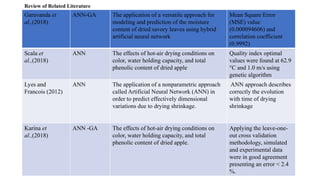
Garavanda et
al.,(2018)
ANN-GA The application of a versatile approach for
modeling and prediction of the moisture
content of dried savory leaves using hybrid
artificial neural network
Mean Square Error
(MSE) value
(0.000094606) and
correlation coefficient
(0.9992)
Scala et
al.,(2018)
ANN The effects of hot-air drying conditions on
color, water holding capacity, and total
phenolic content of dried apple
Quality index optimal
values were found at 62.9
°C and 1.0 m/s using
genetic algorithm
Lyes and
Francois (2012)
ANN The application of a nonparametric approach
called Artificial Neural Network (ANN) in
order to predict effectively dimensional
variations due to drying shrinkage.
ANN approach describes
correctly the evolution
with time of drying
shrinkage
Karina et
al.,(2018)
ANN -GA The effects of hot-air drying conditions on
color, water holding capacity, and total
phenolic content of dried apple.
Applying the leave-one-
out cross validation
methodology, simulated
and experimental data
were in good agreement
presenting an error < 2.4
%.
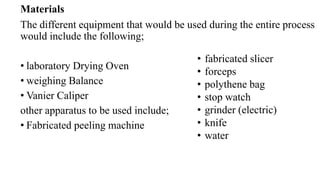
Materials
The different equipment that would be used during the entire process
would include the following;
• laboratory Drying Oven
• weighing Balance
• Vanier Caliper
other apparatus to be used include;
• Fabricated peeling machine
• fabricated slicer
• forceps
• polythene bag
• stop watch
• grinder (electric)
• knife
• water
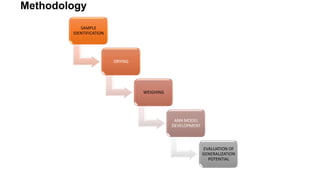
Methodology
SAMPLE
IDENTIFICATION
DRYING
WEIGHING
ANN MODEL
DEVELOPMENT
EVALUATION OF
GENERALIZATION
POTENTIAL
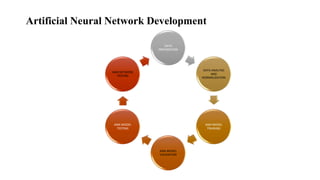
Artificial Neural Network Development
DATA
PREPARATION
DATA ANALYSIS
AND
NORMALIZATION
ANN MODEL
TRAINING
ANN MODEL
VALIDATION
ANN MODEL
TESTING
ANN NETWORK
TESTING
Neural network for plant fruit drying.pptx

Neural network for plant fruit drying.pptx

  • 1.
    ARTIFICIAL NETWORK MODELFOR POTATOES DRYING PARAMETERS PREDICTION
  • 2.
    OUTLINE • Background ofStudy • Statement of Research Problem • Objectives of Study • Significance of the Study • Review of Related Literature • Materials and Methods
  • 3.
    Background Of Study •Drying operations can help in reducing the moisture content of feed materials for avoidance of microbial growth and deterioration, for shell life elongation, to minimize packaging and improving storage for easy transportation. • Drying is considered one of the methods that are used to preserve some perishable agricultural produces like sweet potato, to ensure their availability all year round, reduce post-harvest and achieve food security, hot air drying is one of the most efficient and effective method of drying.
  • 4.
    Statement of theProblem • Agricultural products have high moisture content and sweet potato is not excluded, this can lead to deterioration easily if not properly processed especially after harvest and since sweet potatoes are seasonal. • Generally, the quality of dried products depends on the entire drying conditions, so it is important to understand the drying process parameters and characteristics of sweet potato, since its ultimate aim is to increase the shelf life and preserve the product by reducing its moisture content.
  • 5.
    Objective Of Study Thespecific objectives are of this proposal is; i. Characterizes the sample sweet potato before and after drying ii. Develop the mathematical model for the drying kinetics of the sample iii.Determine the main parameter for moisture removal with the samples iv.Fit the experimental data to the developed model which is Artificial Neural Network (ANN)
  • 6.
    Significance of theStudy • With the successful completion of the research, it will solve some food preservation and storage problems by reducing waste of agricultural product (sweet potato). • The developed model will help in determining the moisture ratio of the product study. • It will help to create employment opportunity by having some industries where potato flour and chips could be produced. • It can also serve as a base for further research work, it can help in optimization which will be enable the manufacturer of flour to know the optimal condition for the preservation of the product.
  • 7.
    History Of SweetPotato • Sweet potato (ipomoea batatas) is ranked seventh in global food crop production, yielding 131 million tons per quarter. • Sweet potato is bulky and highly perishable root crop.
  • 8.
    Review of RelatedLiterature Author(s) Year AI Technique Area of Study Results Yaghoubi et al., (2013) ANN Neural networks were used in order to possibly predict dried potato moisture ratio. The comparison of the obtained results of ANNs and classical modeling indicated that, the neural networks have a higher capability for predicting moisture ratio (R2 values 0.9972 and 0.996, respectively) compared with classical modeling Mujumdar et al.,(2017) ANN Drying rate data were generated for training of an ANN model using a liquid diffusion model for potato slices of different thicknesses. The ANN model is verified to provide accurate interpolation of the drying rates and times within the ranges of parameters investigated Jun-Wen Bai et al.,(2018) ANN Ginkgo biloba seeds were dried in microwave drier under different microwave powers (200, 280, 460, and 640 W) to determinate the drying kinetics and color changes during drying process ANN methodology could precisely predict experimental data with high correlation coefficient (0.9056–0.9834) and low mean square error (0.0014– 2.2044). Boeri et al., (2011) ANN Artificial neural network for sweet cod fish drying to predict the dimensionless moisture content The standard error was 0.96%, average error of 2.93% with average relative deviation of 3.70.
  • 9.
    Review of RelatedLiterature Garavanda et al.,(2018) ANN-GA The application of a versatile approach for modeling and prediction of the moisture content of dried savory leaves using hybrid artificial neural network Mean Square Error (MSE) value (0.000094606) and correlation coefficient (0.9992) Scala et al.,(2018) ANN The effects of hot-air drying conditions on color, water holding capacity, and total phenolic content of dried apple Quality index optimal values were found at 62.9 °C and 1.0 m/s using genetic algorithm Lyes and Francois (2012) ANN The application of a nonparametric approach called Artificial Neural Network (ANN) in order to predict effectively dimensional variations due to drying shrinkage. ANN approach describes correctly the evolution with time of drying shrinkage Karina et al.,(2018) ANN -GA The effects of hot-air drying conditions on color, water holding capacity, and total phenolic content of dried apple. Applying the leave-one- out cross validation methodology, simulated and experimental data were in good agreement presenting an error < 2.4 %.
  • 10.
    Materials The different equipmentthat would be used during the entire process would include the following; • laboratory Drying Oven • weighing Balance • Vanier Caliper other apparatus to be used include; • Fabricated peeling machine • fabricated slicer • forceps • polythene bag • stop watch • grinder (electric) • knife • water
  • 11.
  • 12.
    Artificial Neural NetworkDevelopment DATA PREPARATION DATA ANALYSIS AND NORMALIZATION ANN MODEL TRAINING ANN MODEL VALIDATION ANN MODEL TESTING ANN NETWORK TESTING