OPTIMIZATION OF THERMALLY MODIFIED STARCH ADHESIVE USING
DESIGN MIXTURE METHOD
OUTLINE
• Background of Study
• Statement of the Problem
• Aim and Objective of the Study
• Significance of the Study
• Literature Review
• Materials and Method
• Results Obtained
• Conclusion
• Recommendation
Background of Study
Biodegradable polymers obtained from renewable natural resources have
recently been receiving increasing attention due to their potential as alternative to
traditional petroleum – based plastics. Among the various sources, polysaccharides stand
out as a highly convenient feedstock because they are readily available, renewable,
inexpensive and provide great stereo chemical diversity.
Starch, a renewable polysaccharide polymer, has attracted a lot of attention as a feedstock
due to its melt processability after plasticization, renewability,
In order to use starch adhesive as a feedstock for applications, it is necessary to modify it
to migrate these limitations and bring about other desirable properties.
Statement of the Problem
As a result of the availability of metal on large volumes and the
introduction of more and varying plastics, problems arises on how these
diversity of materials could be joined. It has been observed that binding by
mechanical means such as welding, riveting, hailing etc does not evenly stress
distribution in the binded area.
Aim and Objectives of the Study
The main objective of this project is to optimize the production of
thermally modified adhesive from local starch materials. The specific
objectives of this work are:
1. Preparation of cassava, potato and corn starches.
2. Formulation of cassava, potato and corn starch adhesive.
3. Modification of cassava, potato and corn starch adhesive.
4. Enhancement of the viscosity of modified starch adhesive.
5. Characterization of modified starch adhesive.
6. Optimization of the starch modification process using Design mixture.
Significance of the Study
This study optimized the utilization of cassava, potato, and corn starch a
secondary product in their different productions which is usually drained off
especially in the rural areas as a raw material for the optimization of thermally
modified starch adhesive.
The major drawback in the use of starch as an adhesive is the stability of
the product over time which this study investigated possible ways of
optimizing this property of adhesive produced by studying the effect of borax
and temperature on the viscosity, density and pH of adhesive.
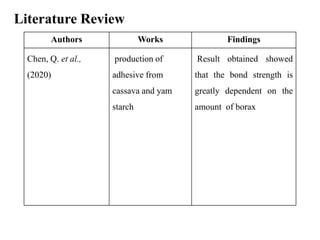
Literature Review
Authors Works Findings
Chen, Q. et al.,
(2020)
production of
adhesive from
cassava and yam
starch
Result obtained showed
that the bond strength is
greatly dependent on the
amount of borax
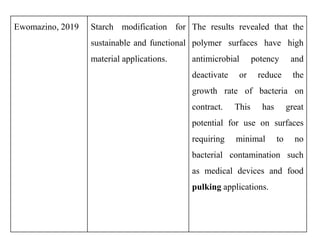
Ewomazino, 2019 Starch modification for
sustainable and functional
material applications.
The results revealed that the
polymer surfaces have high
antimicrobial potency and
deactivate or reduce the
growth rate of bacteria on
contract. This has great
potential for use on surfaces
requiring minimal to no
bacterial contamination such
as medical devices and food
pulking applications.
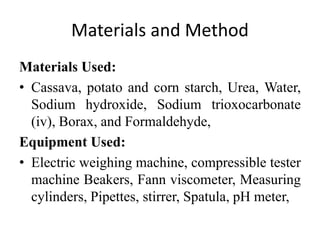
Materials and Method
Materials Used:
• Cassava, potato and corn starch, Urea, Water,
Sodium hydroxide, Sodium trioxocarbonate
(iv), Borax, and Formaldehyde,
Equipment Used:
• Electric weighing machine, compressible tester
machine Beakers, Fann viscometer, Measuring
cylinders, Pipettes, stirrer, Spatula, pH meter,
Method
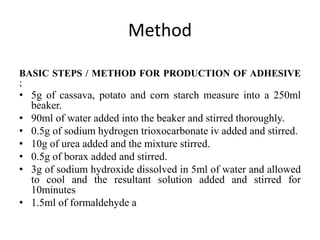
BASIC STEPS / METHOD FOR PRODUCTION OF ADHESIVE
;
• 5g of cassava, potato and corn starch measure into a 250ml
beaker.
• 90ml of water added into the beaker and stirred thoroughly.
• 0.5g of sodium hydrogen trioxocarbonate iv added and stirred.
• 10g of urea added and the mixture stirred.
• 0.5g of borax added and stirred.
• 3g of sodium hydroxide dissolved in 5ml of water and allowed
to cool and the resultant solution added and stirred for
10minutes
• 1.5ml of formaldehyde a
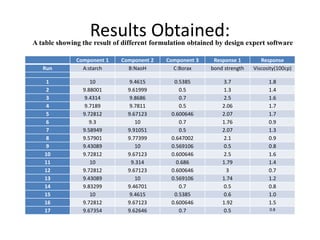
Results Obtained:
Component 1 Component 2 Component 3 Response 1 Response
Run A:starch B:NaoH C:Borax bond strength Viscosity(100cp)
1 10 9.4615 0.5385 3.7 1.8
2 9.88001 9.61999 0.5 1.3 1.4
3 9.4314 9.8686 0.7 2.5 1.6
4 9.7189 9.7811 0.5 2.06 1.7
5 9.72812 9.67123 0.600646 2.07 1.7
6 9.3 10 0.7 1.76 0.9
7 9.58949 9.91051 0.5 2.07 1.3
8 9.57901 9.77399 0.647002 2.1 0.9
9 9.43089 10 0.569106 0.5 0.8
10 9.72812 9.67123 0.600646 2.5 1.6
11 10 9.314 0.686 1.79 1.4
12 9.72812 9.67123 0.600646 3 0.7
13 9.43089 10 0.569106 1.74 1.2
14 9.83299 9.46701 0.7 0.5 0.8
15 10 9.4615 0.5385 0.6 1.0
16 9.72812 9.67123 0.600646 1.92 1.5
17 9.67354 9.62646 0.7 0.5 0.8
A table showing the result of different formulation obtained by design expert software
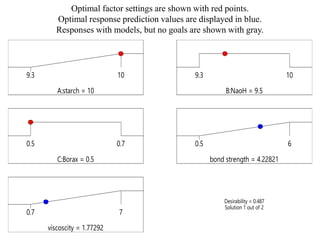
Optimal factor settings are shown with red points.
Optimal response prediction values are displayed in blue.
Responses with models, but no goals are shown with gray.
A:starch = 10
9.3 10
B:NaoH = 9.5
9.3 10
C:Borax = 0.5
0.5 0.7
bond strength = 4.22821
0.5 6
viscoscity = 1.77292
0.7 7
Desirability = 0.487
Solution 1 out of 2
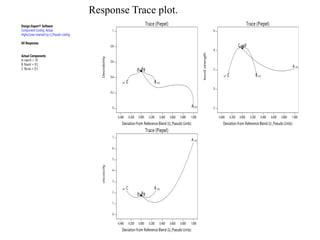
Response Trace plot.
Design-Expert® Software
Component Coding: Actual
Highs/Lows inverted by U_Pseudo coding
All Responses
Actual Components
A: starch = 10
B: NaoH = 9.5
C: Borax = 0.5
-0.400 -0.200 0.000 0.200 0.400 0.600 0.800 1.000
0
0.2
0.4
0.6
0.8
1
A
A
10
9.3
B
B
9.5
9.3
C
C
0.7
0.5
Trace (Piepel)
Deviation from Reference Blend (U_Pseudo Units)
Desirability
-0.400 -0.200 0.000 0.200 0.400 0.600 0.800 1.000
-2
0
2
4
6
A
A
10
9.3
B
B
9.5
9.3
C
C
0.7
0.5
Trace (Piepel)
Deviation from Reference Blend (U_Pseudo Units)
bond
strength
-0.400 -0.200 0.000 0.200 0.400 0.600 0.800 1.000
0
1
2
3
4
5
6
7
A
A
10
9.3
B
B
9.5
9.3
C
C
0.7
0.5
Trace (Piepel)
Deviation from Reference Blend (U_Pseudo Units)
viscoscity
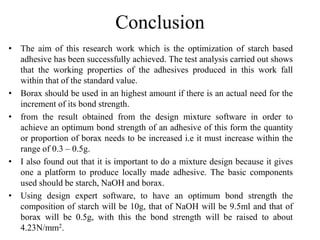
Conclusion
• The aim of this research work which is the optimization of starch based
adhesive has been successfully achieved. The test analysis carried out shows
that the working properties of the adhesives produced in this work fall
within that of the standard value.
• Borax should be used in an highest amount if there is an actual need for the
increment of its bond strength.
• from the result obtained from the design mixture software in order to
achieve an optimum bond strength of an adhesive of this form the quantity
or proportion of borax needs to be increased i.e it must increase within the
range of 0.3 – 0.5g.
• I also found out that it is important to do a mixture design because it gives
one a platform to produce locally made adhesive. The basic components
used should be starch, NaOH and borax.
• Using design expert software, to have an optimum bond strength the
composition of starch will be 10g, that of NaOH will be 9.5ml and that of
borax will be 0.5g, with this the bond strength will be raised to about
4.23N/mm2.
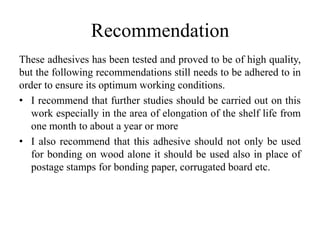
Recommendation
These adhesives has been tested and proved to be of high quality,
but the following recommendations still needs to be adhered to in
order to ensure its optimum working conditions.
• I recommend that further studies should be carried out on this
work especially in the area of elongation of the shelf life from
one month to about a year or more
• I also recommend that this adhesive should not only be used
for bonding on wood alone it should be used also in place of
postage stamps for bonding paper, corrugated board etc.
THANK YOU!

OPTIMIZATION OF THERMALLY MODIFIED STARCH ADHESIVE USING DESIGN MIXTURE METHOD.pptx

  • 1.
    OPTIMIZATION OF THERMALLYMODIFIED STARCH ADHESIVE USING DESIGN MIXTURE METHOD
  • 2.
    OUTLINE • Background ofStudy • Statement of the Problem • Aim and Objective of the Study • Significance of the Study • Literature Review • Materials and Method • Results Obtained • Conclusion • Recommendation
  • 3.
    Background of Study Biodegradablepolymers obtained from renewable natural resources have recently been receiving increasing attention due to their potential as alternative to traditional petroleum – based plastics. Among the various sources, polysaccharides stand out as a highly convenient feedstock because they are readily available, renewable, inexpensive and provide great stereo chemical diversity. Starch, a renewable polysaccharide polymer, has attracted a lot of attention as a feedstock due to its melt processability after plasticization, renewability, In order to use starch adhesive as a feedstock for applications, it is necessary to modify it to migrate these limitations and bring about other desirable properties.
  • 4.
    Statement of theProblem As a result of the availability of metal on large volumes and the introduction of more and varying plastics, problems arises on how these diversity of materials could be joined. It has been observed that binding by mechanical means such as welding, riveting, hailing etc does not evenly stress distribution in the binded area.
  • 5.
    Aim and Objectivesof the Study The main objective of this project is to optimize the production of thermally modified adhesive from local starch materials. The specific objectives of this work are: 1. Preparation of cassava, potato and corn starches. 2. Formulation of cassava, potato and corn starch adhesive. 3. Modification of cassava, potato and corn starch adhesive. 4. Enhancement of the viscosity of modified starch adhesive. 5. Characterization of modified starch adhesive. 6. Optimization of the starch modification process using Design mixture.
  • 6.
    Significance of theStudy This study optimized the utilization of cassava, potato, and corn starch a secondary product in their different productions which is usually drained off especially in the rural areas as a raw material for the optimization of thermally modified starch adhesive. The major drawback in the use of starch as an adhesive is the stability of the product over time which this study investigated possible ways of optimizing this property of adhesive produced by studying the effect of borax and temperature on the viscosity, density and pH of adhesive.
  • 7.
    Literature Review Authors WorksFindings Chen, Q. et al., (2020) production of adhesive from cassava and yam starch Result obtained showed that the bond strength is greatly dependent on the amount of borax
  • 8.
    Ewomazino, 2019 Starchmodification for sustainable and functional material applications. The results revealed that the polymer surfaces have high antimicrobial potency and deactivate or reduce the growth rate of bacteria on contract. This has great potential for use on surfaces requiring minimal to no bacterial contamination such as medical devices and food pulking applications.
  • 9.
    Materials and Method MaterialsUsed: • Cassava, potato and corn starch, Urea, Water, Sodium hydroxide, Sodium trioxocarbonate (iv), Borax, and Formaldehyde, Equipment Used: • Electric weighing machine, compressible tester machine Beakers, Fann viscometer, Measuring cylinders, Pipettes, stirrer, Spatula, pH meter,
  • 10.
    Method BASIC STEPS /METHOD FOR PRODUCTION OF ADHESIVE ; • 5g of cassava, potato and corn starch measure into a 250ml beaker. • 90ml of water added into the beaker and stirred thoroughly. • 0.5g of sodium hydrogen trioxocarbonate iv added and stirred. • 10g of urea added and the mixture stirred. • 0.5g of borax added and stirred. • 3g of sodium hydroxide dissolved in 5ml of water and allowed to cool and the resultant solution added and stirred for 10minutes • 1.5ml of formaldehyde a
  • 11.
    Results Obtained: Component 1Component 2 Component 3 Response 1 Response Run A:starch B:NaoH C:Borax bond strength Viscosity(100cp) 1 10 9.4615 0.5385 3.7 1.8 2 9.88001 9.61999 0.5 1.3 1.4 3 9.4314 9.8686 0.7 2.5 1.6 4 9.7189 9.7811 0.5 2.06 1.7 5 9.72812 9.67123 0.600646 2.07 1.7 6 9.3 10 0.7 1.76 0.9 7 9.58949 9.91051 0.5 2.07 1.3 8 9.57901 9.77399 0.647002 2.1 0.9 9 9.43089 10 0.569106 0.5 0.8 10 9.72812 9.67123 0.600646 2.5 1.6 11 10 9.314 0.686 1.79 1.4 12 9.72812 9.67123 0.600646 3 0.7 13 9.43089 10 0.569106 1.74 1.2 14 9.83299 9.46701 0.7 0.5 0.8 15 10 9.4615 0.5385 0.6 1.0 16 9.72812 9.67123 0.600646 1.92 1.5 17 9.67354 9.62646 0.7 0.5 0.8 A table showing the result of different formulation obtained by design expert software
  • 12.
    Optimal factor settingsare shown with red points. Optimal response prediction values are displayed in blue. Responses with models, but no goals are shown with gray. A:starch = 10 9.3 10 B:NaoH = 9.5 9.3 10 C:Borax = 0.5 0.5 0.7 bond strength = 4.22821 0.5 6 viscoscity = 1.77292 0.7 7 Desirability = 0.487 Solution 1 out of 2
  • 13.
    Response Trace plot. Design-Expert®Software Component Coding: Actual Highs/Lows inverted by U_Pseudo coding All Responses Actual Components A: starch = 10 B: NaoH = 9.5 C: Borax = 0.5 -0.400 -0.200 0.000 0.200 0.400 0.600 0.800 1.000 0 0.2 0.4 0.6 0.8 1 A A 10 9.3 B B 9.5 9.3 C C 0.7 0.5 Trace (Piepel) Deviation from Reference Blend (U_Pseudo Units) Desirability -0.400 -0.200 0.000 0.200 0.400 0.600 0.800 1.000 -2 0 2 4 6 A A 10 9.3 B B 9.5 9.3 C C 0.7 0.5 Trace (Piepel) Deviation from Reference Blend (U_Pseudo Units) bond strength -0.400 -0.200 0.000 0.200 0.400 0.600 0.800 1.000 0 1 2 3 4 5 6 7 A A 10 9.3 B B 9.5 9.3 C C 0.7 0.5 Trace (Piepel) Deviation from Reference Blend (U_Pseudo Units) viscoscity
  • 14.
    Conclusion • The aimof this research work which is the optimization of starch based adhesive has been successfully achieved. The test analysis carried out shows that the working properties of the adhesives produced in this work fall within that of the standard value. • Borax should be used in an highest amount if there is an actual need for the increment of its bond strength. • from the result obtained from the design mixture software in order to achieve an optimum bond strength of an adhesive of this form the quantity or proportion of borax needs to be increased i.e it must increase within the range of 0.3 – 0.5g. • I also found out that it is important to do a mixture design because it gives one a platform to produce locally made adhesive. The basic components used should be starch, NaOH and borax. • Using design expert software, to have an optimum bond strength the composition of starch will be 10g, that of NaOH will be 9.5ml and that of borax will be 0.5g, with this the bond strength will be raised to about 4.23N/mm2.
  • 15.
    Recommendation These adhesives hasbeen tested and proved to be of high quality, but the following recommendations still needs to be adhered to in order to ensure its optimum working conditions. • I recommend that further studies should be carried out on this work especially in the area of elongation of the shelf life from one month to about a year or more • I also recommend that this adhesive should not only be used for bonding on wood alone it should be used also in place of postage stamps for bonding paper, corrugated board etc.
  • 16.