Software Construction &
Development
Requirements Analysis
Lecture 2A
2
Recap of Requirements Elicitation
• Requirements elicitation deals with discovering
requirements for a software product
• It is an iterative process and consists of many
activities including establishing objectives,
understanding background, organizing
knowledge, and collecting requirements
• Introduced the concept of elicitation and
requirements elicitation process
• Basics of knowledge acquisition (reading, listening,
asking, & observing)
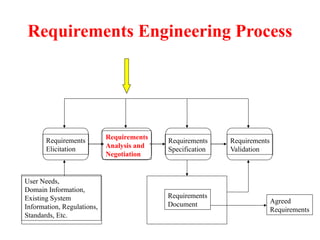
Requirements Engineering Process
Requirements
Elicitation
Requirements
Analysis and
Negotiation
Requirements
Specification
Requirements
Validation
User Needs,
Domain Information,
Existing System
Information, Regulations,
Standards, Etc.
Requirements
Document Agreed
Requirements
4
Requirements Analysis and Negotiation
• In order to understand requirements analysis and
negotiation clearly and to appreciate that,
different skills are needed to perform
• Contradiction in requirements (Less cost and
quality, security and fast)
• The aim of requirements analysis is to discover
problems with the system requirements, especially
incompleteness and inconsistencies
5
Comments on Requirements Analysis
• Analysts read the requirements, highlight problems,
and discuss them in requirements review meetings
• This is a time-consuming and expensive activity
• Analysts have to think about implications of the
draft statements of requirements
• People do not think in the same way and different
analysts tackle the process in different ways
• It is not possible to make this activity a structured
and systematic process
• It depends on the judgment and experience of
process participants
6
Requirements Analysis Stages
1. Necessity checking
2. Consistency and completeness checking
3. Feasibility checking
7
Necessity Checking
• The NEED for the requirement is analyzed.
• In some cases, requirements may be proposed
which don’t contribute to the business goals of
the organization or to the specific problem to
be addressed by the system
8
Consistency and Completeness Checking
• The requirements are cross-checked for
consistency and completeness.
• Consistency means that no requirements should
be contradictory;
• Completeness means that no services or
constraints which are needed have been missed
out.
9
Feasibility Checking
• The requirements are checked to ensure that
they are feasible in the context
• Budget
• Schedule
• Available for the system development
10
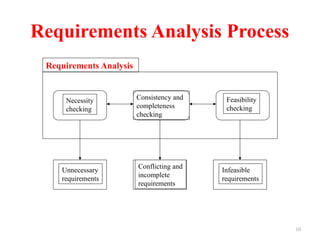
Requirements Analysis Process
Necessity
checking
Consistency and
completeness
checking
Feasibility
checking
Unnecessary
requirements
Conflicting and
incomplete
requirements
Infeasible
requirements
Requirements Analysis
11
Analysis Techniques
1. Analysis checklists
– A checklist is a list of questions which analysts
may use to assess each requirement
2. Interaction matrices
– Interaction matrices are used to discover
interactions between requirements and to highlight
conflicts and overlaps
12
Analysis Checklists
• Each requirement may be assessed against the
checklist
• When potential problems are discovered, these
should be noted carefully
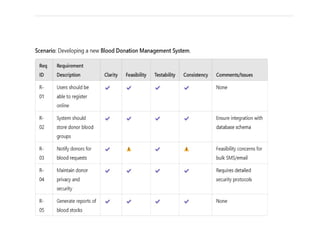
• They can be implemented as a spreadsheet,
where the rows are labeled with the
requirements identifiers and columns are the
checklist items
• They are useful as they provide a reminder of
what to look for and reduce the chances that you
will forget some requirements checks
14
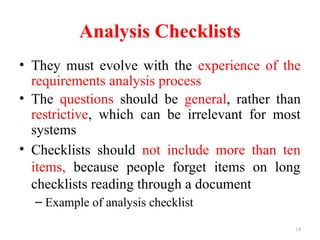
Analysis Checklists
• They must evolve with the experience of the
requirements analysis process
• The questions should be general, rather than
restrictive, which can be irrelevant for most
systems
• Checklists should not include more than ten
items, because people forget items on long
checklists reading through a document
– Example of analysis checklist
15
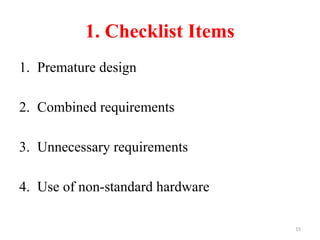
1. Checklist Items
1. Premature design
2. Combined requirements
3. Unnecessary requirements
4. Use of non-standard hardware
16
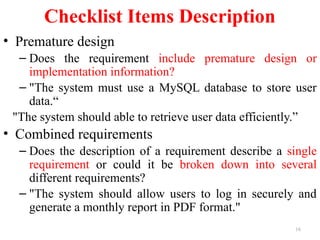
Checklist Items Description
• Premature design
– Does the requirement include premature design or
implementation information?
– "The system must use a MySQL database to store user
data.“
"The system should able to retrieve user data efficiently.”
• Combined requirements
– Does the description of a requirement describe a single
requirement or could it be broken down into several
different requirements?
– "The system should allow users to log in securely and
generate a monthly report in PDF format."
Checklist Items Description
• Unnecessary requirements
– Is the requirement ‘gold plating’? That is, is the
requirement a cosmetic addition to the system which is
not really necessary.
– "The system must support a feature for faxing reports
to users."
• Use of non-standard hardware
– Does the requirement mean that non-standard hardware
or software must be used? To make this decision, you
need to know the computer platform requirements
– Non-standard architecture (RISC)
18
2. Checklist Items
1. Conformance with business goals
2. Requirements ambiguity
3. Requirements realism
4. Requirements testability
19
Checklist Items Description
• Conformance with business goals
– Is the requirement consistent with the business
goals defined in the introduction to the
requirements document?
– Increase customer satisfaction by providing
quicker access to support
• Requirements ambiguity
– Is the requirement ambiguous i.e., could it be read
in different ways by different people? What are
the possible interpretations of the requirement?
– "The system should load quickly.“
– Better approach
– "The system should load the homepage within 2
seconds
Checklist Items Description
• Requirements realism
– Is the requirement realistic given the technology which will
be used to implement the system?
– "The system must handle one million simultaneous users
with zero downtime
• Requirements testability
– Is the requirement testable, that is, is it stated in such a way
that test engineers can derive a test which can show if the
system meets that requirement?
– "The system should provide a good user experience.“
– Better approach
– "The system must allow users to complete the registration process in
under 2 minutes and achieve a user satisfaction score of at least 80%
in post-registration surveys."
Requirements Interactions
• A very important objective of requirements
analysis is to discover the interactions between
requirements and to highlight requirements
conflicts and overlaps
• A requirements interaction matrix shows how
requirements interact with each other, which can
be constructed using a spreadsheet
• Each requirement is compared with other
requirements, and the matrix is filled as follows:
– For requirements which conflict, fill in a 1
– For requirements which overlap, fill in a 1000
– For requirements which are independent, fill in a 0
22
Comments - Interaction Matrices
• If you can’t decide whether requirements conflict,
you should assume that a conflict exists. If an
error is made it is usually fairly cheap to fix; it can
be much more expensive to resolve undetected
conflicts
• The advantage of using numeric values for
conflicts and overlaps is that you can sum each
row and column to find the number of conflicts
and the number of overlaps
• Requirements which have high values for one or
both of these figures should be carefully examined.
23
Comments - Interaction Matrices
• A large number of conflicts or overlaps means that
any changes to that requirement will probably have
a major impact of the rest of the requirements
• “Interaction matrices work only when there is
relatively small number of requirements”, as each
requirement is compared with every other
requirements.
• The upper limit should be about 200 requirements
• These overlaps and conflicts have to be discussed
and resolved during requirements negotiation.
24
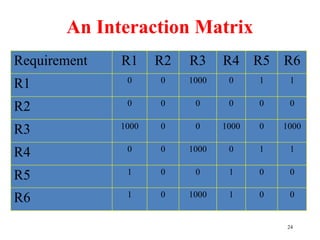
An Interaction Matrix
Requirement R1 R2 R3 R4 R5 R6
R1 0 0 1000 0 1 1
R2 0 0 0 0 0 0
R3 1000 0 0 1000 0 1000
R4 0 0 1000 0 1 1
R5 1 0 0 1 0 0
R6 1 0 1000 1 0 0

nETWORKING LEACTURE 2 HGUYI ULec 2A.pptx

  • 1.
  • 2.
    2 Recap of RequirementsElicitation • Requirements elicitation deals with discovering requirements for a software product • It is an iterative process and consists of many activities including establishing objectives, understanding background, organizing knowledge, and collecting requirements • Introduced the concept of elicitation and requirements elicitation process • Basics of knowledge acquisition (reading, listening, asking, & observing)
  • 3.
    Requirements Engineering Process Requirements Elicitation Requirements Analysisand Negotiation Requirements Specification Requirements Validation User Needs, Domain Information, Existing System Information, Regulations, Standards, Etc. Requirements Document Agreed Requirements
  • 4.
    4 Requirements Analysis andNegotiation • In order to understand requirements analysis and negotiation clearly and to appreciate that, different skills are needed to perform • Contradiction in requirements (Less cost and quality, security and fast) • The aim of requirements analysis is to discover problems with the system requirements, especially incompleteness and inconsistencies
  • 5.
    5 Comments on RequirementsAnalysis • Analysts read the requirements, highlight problems, and discuss them in requirements review meetings • This is a time-consuming and expensive activity • Analysts have to think about implications of the draft statements of requirements • People do not think in the same way and different analysts tackle the process in different ways • It is not possible to make this activity a structured and systematic process • It depends on the judgment and experience of process participants
  • 6.
    6 Requirements Analysis Stages 1.Necessity checking 2. Consistency and completeness checking 3. Feasibility checking
  • 7.
    7 Necessity Checking • TheNEED for the requirement is analyzed. • In some cases, requirements may be proposed which don’t contribute to the business goals of the organization or to the specific problem to be addressed by the system
  • 8.
    8 Consistency and CompletenessChecking • The requirements are cross-checked for consistency and completeness. • Consistency means that no requirements should be contradictory; • Completeness means that no services or constraints which are needed have been missed out.
  • 9.
    9 Feasibility Checking • Therequirements are checked to ensure that they are feasible in the context • Budget • Schedule • Available for the system development
  • 10.
    10 Requirements Analysis Process Necessity checking Consistencyand completeness checking Feasibility checking Unnecessary requirements Conflicting and incomplete requirements Infeasible requirements Requirements Analysis
  • 11.
    11 Analysis Techniques 1. Analysischecklists – A checklist is a list of questions which analysts may use to assess each requirement 2. Interaction matrices – Interaction matrices are used to discover interactions between requirements and to highlight conflicts and overlaps
  • 12.
    12 Analysis Checklists • Eachrequirement may be assessed against the checklist • When potential problems are discovered, these should be noted carefully • They can be implemented as a spreadsheet, where the rows are labeled with the requirements identifiers and columns are the checklist items • They are useful as they provide a reminder of what to look for and reduce the chances that you will forget some requirements checks
  • 14.
    14 Analysis Checklists • Theymust evolve with the experience of the requirements analysis process • The questions should be general, rather than restrictive, which can be irrelevant for most systems • Checklists should not include more than ten items, because people forget items on long checklists reading through a document – Example of analysis checklist
  • 15.
    15 1. Checklist Items 1.Premature design 2. Combined requirements 3. Unnecessary requirements 4. Use of non-standard hardware
  • 16.
    16 Checklist Items Description •Premature design – Does the requirement include premature design or implementation information? – "The system must use a MySQL database to store user data.“ "The system should able to retrieve user data efficiently.” • Combined requirements – Does the description of a requirement describe a single requirement or could it be broken down into several different requirements? – "The system should allow users to log in securely and generate a monthly report in PDF format."
  • 17.
    Checklist Items Description •Unnecessary requirements – Is the requirement ‘gold plating’? That is, is the requirement a cosmetic addition to the system which is not really necessary. – "The system must support a feature for faxing reports to users." • Use of non-standard hardware – Does the requirement mean that non-standard hardware or software must be used? To make this decision, you need to know the computer platform requirements – Non-standard architecture (RISC)
  • 18.
    18 2. Checklist Items 1.Conformance with business goals 2. Requirements ambiguity 3. Requirements realism 4. Requirements testability
  • 19.
    19 Checklist Items Description •Conformance with business goals – Is the requirement consistent with the business goals defined in the introduction to the requirements document? – Increase customer satisfaction by providing quicker access to support • Requirements ambiguity – Is the requirement ambiguous i.e., could it be read in different ways by different people? What are the possible interpretations of the requirement? – "The system should load quickly.“ – Better approach – "The system should load the homepage within 2 seconds
  • 20.
    Checklist Items Description •Requirements realism – Is the requirement realistic given the technology which will be used to implement the system? – "The system must handle one million simultaneous users with zero downtime • Requirements testability – Is the requirement testable, that is, is it stated in such a way that test engineers can derive a test which can show if the system meets that requirement? – "The system should provide a good user experience.“ – Better approach – "The system must allow users to complete the registration process in under 2 minutes and achieve a user satisfaction score of at least 80% in post-registration surveys."
  • 21.
    Requirements Interactions • Avery important objective of requirements analysis is to discover the interactions between requirements and to highlight requirements conflicts and overlaps • A requirements interaction matrix shows how requirements interact with each other, which can be constructed using a spreadsheet • Each requirement is compared with other requirements, and the matrix is filled as follows: – For requirements which conflict, fill in a 1 – For requirements which overlap, fill in a 1000 – For requirements which are independent, fill in a 0
  • 22.
    22 Comments - InteractionMatrices • If you can’t decide whether requirements conflict, you should assume that a conflict exists. If an error is made it is usually fairly cheap to fix; it can be much more expensive to resolve undetected conflicts • The advantage of using numeric values for conflicts and overlaps is that you can sum each row and column to find the number of conflicts and the number of overlaps • Requirements which have high values for one or both of these figures should be carefully examined.
  • 23.
    23 Comments - InteractionMatrices • A large number of conflicts or overlaps means that any changes to that requirement will probably have a major impact of the rest of the requirements • “Interaction matrices work only when there is relatively small number of requirements”, as each requirement is compared with every other requirements. • The upper limit should be about 200 requirements • These overlaps and conflicts have to be discussed and resolved during requirements negotiation.
  • 24.
    24 An Interaction Matrix RequirementR1 R2 R3 R4 R5 R6 R1 0 0 1000 0 1 1 R2 0 0 0 0 0 0 R3 1000 0 0 1000 0 1000 R4 0 0 1000 0 1 1 R5 1 0 0 1 0 0 R6 1 0 1000 1 0 0

Editor's Notes

  • #4 Interleaving, a technique for making forward error correction more robust with respect to burst errors