System Analysis
and Design
Chapter 3: Requirements
Determination
At the end of this chapter:
●Apply requirements analysis techniques
(business process automation, business process
improvement, or business process
reengineering).
●Use requirements gathering techniques
(interview, questionnaire, document analysis, or
observation).
●Develop requirements definition.
Requirements Determination
- transform high-level business needs into a detailed
list of system requirements
- ensure the new system provides value to the
business
- Supporting Activities:
- Creating use cases
- Building process models
- Building a data model
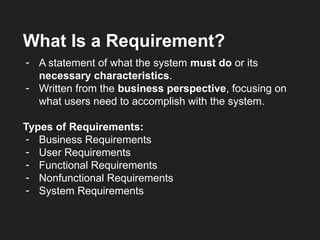
What Is a Requirement?
- A statement of what the system must do or its
necessary characteristics.
- Written from the business perspective, focusing on
what users need to accomplish with the system.
Types of Requirements:
- Business Requirements
- User Requirements
- Functional Requirements
- Nonfunctional Requirements
- System Requirements
Functional Requirement
VS
Non-functional
Requirement
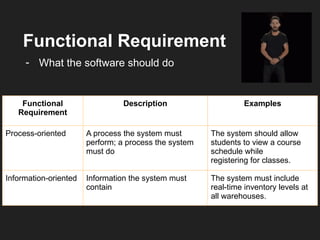
Functional Requirement
- What the software should do
Functional
Requirement
Description Examples
Process-oriented A process the system must
perform; a process the system
must do
The system should allow
students to view a course
schedule while
registering for classes.
Information-oriented Information the system must
contain
The system must include
real-time inventory levels at
all warehouses.
Nonfunctional Requirement
- characteristics the system should have
Nonfunctional
Requirement
Description Examples
Operational The physical and technical
environments in which the system
will operate
The system should be able to
work on any Web browser.
Performance The speed, capacity, and reliability of
the system
The system should be available
for use 24 hours per day, 365
days per year.
Security Who has authorized access to the
system under what circumstances
Customers can see their order
history only during business
hours.
Cultural and Political Cultural and political factors and legal
requirements that affect the system
Personal information is
protected in compliance with the
Data Protection Act.
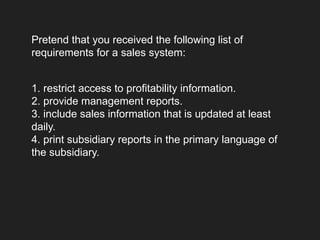
Pretend that you received the following list of
requirements for a sales system:
1. restrict access to profitability information.
2. provide management reports.
3. include sales information that is updated at least
daily.
4. print subsidiary reports in the primary language of
the subsidiary.
FUNCTIONAL NONFUNCTIONAL
Requirements Elicitation
Techniques
- Interviews
- Questionnaires,
- Document Analysis
- Observations
Requirements
Elicitation Techniques
Interviews
Requirements
Elicitation Techniques
Interviews
Requirements Elicitation
Techniques
Questionnaires
Requirements Elicitation
Techniques
Document Analysis
Requirements Definition

Chapter 2 - Requirements Determination.pptx

  • 1.
    System Analysis and Design Chapter3: Requirements Determination
  • 3.
    At the endof this chapter: ●Apply requirements analysis techniques (business process automation, business process improvement, or business process reengineering). ●Use requirements gathering techniques (interview, questionnaire, document analysis, or observation). ●Develop requirements definition.
  • 4.
    Requirements Determination - transformhigh-level business needs into a detailed list of system requirements - ensure the new system provides value to the business - Supporting Activities: - Creating use cases - Building process models - Building a data model
  • 5.
    What Is aRequirement? - A statement of what the system must do or its necessary characteristics. - Written from the business perspective, focusing on what users need to accomplish with the system. Types of Requirements: - Business Requirements - User Requirements - Functional Requirements - Nonfunctional Requirements - System Requirements
  • 6.
  • 8.
    Functional Requirement - Whatthe software should do Functional Requirement Description Examples Process-oriented A process the system must perform; a process the system must do The system should allow students to view a course schedule while registering for classes. Information-oriented Information the system must contain The system must include real-time inventory levels at all warehouses.
  • 9.
    Nonfunctional Requirement - characteristicsthe system should have Nonfunctional Requirement Description Examples Operational The physical and technical environments in which the system will operate The system should be able to work on any Web browser. Performance The speed, capacity, and reliability of the system The system should be available for use 24 hours per day, 365 days per year. Security Who has authorized access to the system under what circumstances Customers can see their order history only during business hours. Cultural and Political Cultural and political factors and legal requirements that affect the system Personal information is protected in compliance with the Data Protection Act.
  • 10.
    Pretend that youreceived the following list of requirements for a sales system: 1. restrict access to profitability information. 2. provide management reports. 3. include sales information that is updated at least daily. 4. print subsidiary reports in the primary language of the subsidiary.
  • 11.
  • 12.
    Requirements Elicitation Techniques - Interviews -Questionnaires, - Document Analysis - Observations
  • 13.
  • 14.
  • 15.
  • 16.
  • 17.

Editor's Notes

  • #4 REQUIREMENTS DETERMINATION Requirements determination is performed to transform the system request’s high-level statement of business requirements into a more detailed, precise list of what the new system must do to provide the needed value to the business. This detailed list of requirements is supported, confirmed, and clarified by the other activities of the analysis phase: creating use cases, building process models, and building a data model. We first explain what a requirement is and discuss the process of creating a requirements definition statement.
  • #5 REQUIREMENTS DETERMINATION Requirements determination is performed to transform the system request’s high-level statement of business requirements into a more detailed, precise list of what the new system must do to provide the needed value to the business. This detailed list of requirements is supported, confirmed, and clarified by the other activities of the analysis phase: creating use cases, building process models, and building a data model. We first explain what a requirement is and discuss the process of creating a requirements definition statement.
  • #8 REQUIREMENTS DETERMINATION Requirements determination is performed to transform the system request’s high-level statement of business requirements into a more detailed, precise list of what the new system must do to provide the needed value to the business. This detailed list of requirements is supported, confirmed, and clarified by the other activities of the analysis phase: creating use cases, building process models, and building a data model. We first explain what a requirement is and discuss the process of creating a requirements definition statement.
  • #9 REQUIREMENTS DETERMINATION Requirements determination is performed to transform the system request’s high-level statement of business requirements into a more detailed, precise list of what the new system must do to provide the needed value to the business. This detailed list of requirements is supported, confirmed, and clarified by the other activities of the analysis phase: creating use cases, building process models, and building a data model. We first explain what a requirement is and discuss the process of creating a requirements definition statement.
  • #12 REQUIREMENTS DETERMINATION Requirements determination is performed to transform the system request’s high-level statement of business requirements into a more detailed, precise list of what the new system must do to provide the needed value to the business. This detailed list of requirements is supported, confirmed, and clarified by the other activities of the analysis phase: creating use cases, building process models, and building a data model. We first explain what a requirement is and discuss the process of creating a requirements definition statement.
  • #13 REQUIREMENTS DETERMINATION Requirements determination is performed to transform the system request’s high-level statement of business requirements into a more detailed, precise list of what the new system must do to provide the needed value to the business. This detailed list of requirements is supported, confirmed, and clarified by the other activities of the analysis phase: creating use cases, building process models, and building a data model. We first explain what a requirement is and discuss the process of creating a requirements definition statement.
  • #14 REQUIREMENTS DETERMINATION Requirements determination is performed to transform the system request’s high-level statement of business requirements into a more detailed, precise list of what the new system must do to provide the needed value to the business. This detailed list of requirements is supported, confirmed, and clarified by the other activities of the analysis phase: creating use cases, building process models, and building a data model. We first explain what a requirement is and discuss the process of creating a requirements definition statement.
  • #15 REQUIREMENTS DETERMINATION Requirements determination is performed to transform the system request’s high-level statement of business requirements into a more detailed, precise list of what the new system must do to provide the needed value to the business. This detailed list of requirements is supported, confirmed, and clarified by the other activities of the analysis phase: creating use cases, building process models, and building a data model. We first explain what a requirement is and discuss the process of creating a requirements definition statement.
  • #16 REQUIREMENTS DETERMINATION Requirements determination is performed to transform the system request’s high-level statement of business requirements into a more detailed, precise list of what the new system must do to provide the needed value to the business. This detailed list of requirements is supported, confirmed, and clarified by the other activities of the analysis phase: creating use cases, building process models, and building a data model. We first explain what a requirement is and discuss the process of creating a requirements definition statement.
  • #17 REQUIREMENTS DETERMINATION Requirements determination is performed to transform the system request’s high-level statement of business requirements into a more detailed, precise list of what the new system must do to provide the needed value to the business. This detailed list of requirements is supported, confirmed, and clarified by the other activities of the analysis phase: creating use cases, building process models, and building a data model. We first explain what a requirement is and discuss the process of creating a requirements definition statement.