Amy Clark
EDLD 5362 SP 3 12 ET8040
      April 20, 2012


                           1
The Two Network I Chose Are:
                The Two Network I Chose Are:
Diigo (Dee' go) allows users to bookmark favorite
websites for access from any computer.'

 Ning is a social network builder. go) allows users to
bookmark favorite websites for access from any computer.
I is a social network builder.
                                                           2
Diigo stands for Digest of Internet
Information, Groups & Other Stuff
       Diigo is two services in one

     Research & collaborative research tool

 Knowledge sharing community & social content
                       site

                                               3
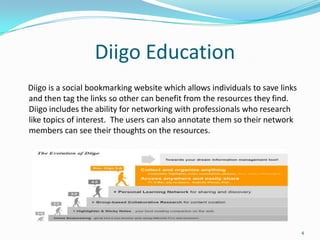
Diigo Education
Diigo is a social bookmarking website which allows individuals to save links
and then tag the links so other can benefit from the resources they find.
Diigo includes the ability for networking with professionals who research
like topics of interest. The users can also annotate them so their network
members can see their thoughts on the resources.


                                                                               4
Why Use Diigo Educator?
 Pitler (2007) encourages the use of social bookmarking sites
  along with other collaborative tools for teacher & student
  cooperative learning in his book Using Technology with
  Classroom Instruction that Works.

 As a librarian I like that this site allows tagging and
  annotations. These are both very useful in finding & sharing
  information and resources. This is a valuable tool to research
  areas of personal interest as well as initiatives of a school
  district. Saving and tagging resources allows me to share with
  my fellow educators.

                                                                   5
Diigo Educators Impact
 Using Diigo should lead educators to more informed
  educational practices and recommendations.

 Quality search results in less time than using sites such as
  Google.

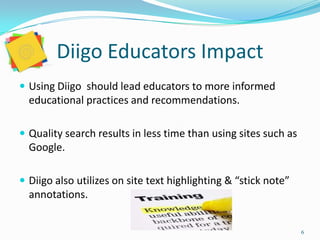
 Diigo also utilizes on site text highlighting & “stick note”
  annotations.


                                                                 6
Network # 2 : Ning
 Ning is the world’s largest    Educause (2008) states
  platform for creating          Ning is a social network
  social websites. Top           building site that allows
  organizers, markets,           users to have a public and
  influencers and activist       private social networks or
  use Ning to create an          create their own.
  online destination that
  weaves social
  conversations in content
  and inspire action (Ning
  2012).

                                                              7
•Ning empowers teachers to make
   curriculum relevant and students
 succeed by taking advantages of new
technologies & 21st century learning to
       promote student success.

  •Videos, photos, news, forums and
        events can be added.

                                          8
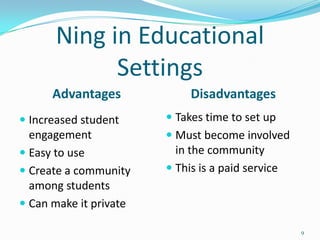
Ning in Educational
            Settings
      Advantages             Disadvantages
 Increased student      Takes time to set up
  engagement             Must become involved
 Easy to use             in the community
 Create a community     This is a paid service
  among students
 Can make it private

                                                   9
Network Potential
Robert Moore (2006) acknowledges a
quote by Jim Collins (Good to Great),
“Good-to-great organizations avoid
technology fads and bandwagons,
yet they become pioneers in the
application of carefully selected
technologies.”
                                        10
 The collaboration that comes from social networking
  options available are important to education & today’s
  21st century learner.
 Advocacy for inexpensive and open source social
  networks are available for teacher & student use is a
  valuable and vital asset for our school district.
 The correct social network has the potential for both
  personal and professional growth.
 A networked environment engages and benefits student
  learning and success.


                                                           11
References
Diigo. (2012). About diigo. Retrieved on April 18, 2012 from http://www.diigo.com/about.

Educause. (2008). 7 things you should know about…ning. Educause learning initiative. Retrieved
   on April 18, 2012 from http://net.educause/edu/ir/.

Mathews, J.B. (2004, April). Why statewide educational networks are important to state and
  educational leaders. Southern Regional Education Board. Retrieved on April 18, 2012 from
  http://www.sreb.org/programs/EdTech/pubs/PDF/04T02-
  Statewide_Ed_Tech_Net_important.pdf.

Moore, R.J. (August, 2006). The five best accelerators in schools. School Administrator, 63.7, p. 8.

Pitler, H., Hubbell, E., Kuhn, M. & Malenoski, K. (2007). Using technology with classroom
    instruction that works. Alexandria, VA: ASCD.

Ning, Inc. (2012). About ning. Retrieved on April 18, 2012 from
   http://www.ning.com/about/corporate/history.

                                                                                                       12

Networking for learning

  • 1.
    Amy Clark EDLD 5362SP 3 12 ET8040 April 20, 2012 1
  • 2.
    The Two NetworkI Chose Are: The Two Network I Chose Are: Diigo (Dee' go) allows users to bookmark favorite websites for access from any computer.'  Ning is a social network builder. go) allows users to bookmark favorite websites for access from any computer. I is a social network builder. 2
  • 3.
    Diigo stands forDigest of Internet Information, Groups & Other Stuff Diigo is two services in one  Research & collaborative research tool  Knowledge sharing community & social content site 3
  • 4.
    Diigo Education Diigo isa social bookmarking website which allows individuals to save links and then tag the links so other can benefit from the resources they find. Diigo includes the ability for networking with professionals who research like topics of interest. The users can also annotate them so their network members can see their thoughts on the resources. 4
  • 5.
    Why Use DiigoEducator?  Pitler (2007) encourages the use of social bookmarking sites along with other collaborative tools for teacher & student cooperative learning in his book Using Technology with Classroom Instruction that Works.  As a librarian I like that this site allows tagging and annotations. These are both very useful in finding & sharing information and resources. This is a valuable tool to research areas of personal interest as well as initiatives of a school district. Saving and tagging resources allows me to share with my fellow educators. 5
  • 6.
    Diigo Educators Impact Using Diigo should lead educators to more informed educational practices and recommendations.  Quality search results in less time than using sites such as Google.  Diigo also utilizes on site text highlighting & “stick note” annotations. 6
  • 7.
    Network # 2: Ning  Ning is the world’s largest  Educause (2008) states platform for creating Ning is a social network social websites. Top building site that allows organizers, markets, users to have a public and influencers and activist private social networks or use Ning to create an create their own. online destination that weaves social conversations in content and inspire action (Ning 2012). 7
  • 8.
    •Ning empowers teachersto make curriculum relevant and students succeed by taking advantages of new technologies & 21st century learning to promote student success. •Videos, photos, news, forums and events can be added. 8
  • 9.
    Ning in Educational Settings Advantages Disadvantages  Increased student  Takes time to set up engagement  Must become involved  Easy to use in the community  Create a community  This is a paid service among students  Can make it private 9
  • 10.
    Network Potential Robert Moore(2006) acknowledges a quote by Jim Collins (Good to Great), “Good-to-great organizations avoid technology fads and bandwagons, yet they become pioneers in the application of carefully selected technologies.” 10
  • 11.
     The collaborationthat comes from social networking options available are important to education & today’s 21st century learner.  Advocacy for inexpensive and open source social networks are available for teacher & student use is a valuable and vital asset for our school district.  The correct social network has the potential for both personal and professional growth.  A networked environment engages and benefits student learning and success. 11
  • 12.
    References Diigo. (2012). Aboutdiigo. Retrieved on April 18, 2012 from http://www.diigo.com/about. Educause. (2008). 7 things you should know about…ning. Educause learning initiative. Retrieved on April 18, 2012 from http://net.educause/edu/ir/. Mathews, J.B. (2004, April). Why statewide educational networks are important to state and educational leaders. Southern Regional Education Board. Retrieved on April 18, 2012 from http://www.sreb.org/programs/EdTech/pubs/PDF/04T02- Statewide_Ed_Tech_Net_important.pdf. Moore, R.J. (August, 2006). The five best accelerators in schools. School Administrator, 63.7, p. 8. Pitler, H., Hubbell, E., Kuhn, M. & Malenoski, K. (2007). Using technology with classroom instruction that works. Alexandria, VA: ASCD. Ning, Inc. (2012). About ning. Retrieved on April 18, 2012 from http://www.ning.com/about/corporate/history. 12