Freitag, 26. Februar 2016
Rechtswissenschaftliche Fakultät
Universität Salzburg
Churfürststraße 1 5010 Salzburg
Federico Costantini
Dipartimento di Scienze Giuridiche
Università degli Studi di Udine
[name].[surname]@uniud.it
NETWORK ANALYSIS AND «PREDICTIVE
POLICING»: TOWARDS A «PROFILING
SOCIETY»?
Internationales Rechtsinformatik Symposion
IRIS 2016
Sicherheit & Recht I
Vorsitz / Chaired by Viola Schmid
14:00 - 15:30
Hörsaal 211
2
<index>
</index>
<First_Part>
Preliminary remarks
</First_Part>
<Second_Part>
Predictive policing
</Second_Part>
<Third_Part>
Network Analysis and Predictive policing
</Third_Part>
<Fourth_Part>
Issues in Network Analysis and Predictive policing
</Fourth_Part>
<Conclusion>
«Control» -> «Profiling»?
</Conclusion>
3
<First_Part>
Preliminary remarks
4
<index>
</index>
<First_Part>
Preliminary remarks
(1) Why predictive policing?
(2) The meaning of «anticipating the future»
(3) The relevance of the topic
5
<First_Part>
Preliminary remarks: (1) why predictive policing?
My most recent research is focused on the concept of «control» in law.
- it is not simply a kind of «surveillance»
- it is not simply a kind of «order»
The concept of «control» entails a cybernetic vision in which
law is a kind of «technology» in itself.
My purpose is to analyze (and criticize) it.
6
<First_Part>
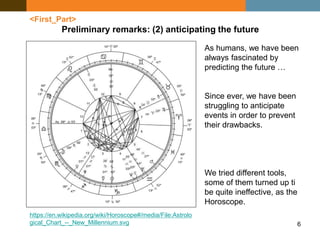
Preliminary remarks: (2) anticipating the future
https://en.wikipedia.org/wiki/Horoscope#/media/File:Astrolo
gical_Chart_--_New_Millennium.svg
As humans, we have been
always fascinated by
predicting the future …
Since ever, we have been
struggling to anticipate
events in order to prevent
their drawbacks.
We tried different tools,
some of them turned up ti
be quite ineffective, as the
Horoscope.
7
<First_Part>
Preliminary remarks: (2) anticipating the future
https://de.wikipedia.org/wiki/
Cesare_Lombroso#/media/Fi
le:Lombroso.JPG
Cesare Lombroso
(1835 - 1909)
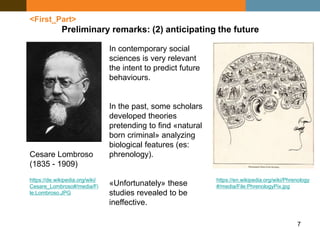
In contemporary social
sciences is very relevant
the intent to predict future
behaviours.
In the past, some scholars
developed theories
pretending to find «natural
born criminal» analyzing
biological features (es:
phrenology).
«Unfortunately» these
studies revealed to be
ineffective.
https://en.wikipedia.org/wiki/Phrenology
#/media/File:PhrenologyPix.jpg
8
<First_Part>
Preliminary remarks: (2) anticipating the future
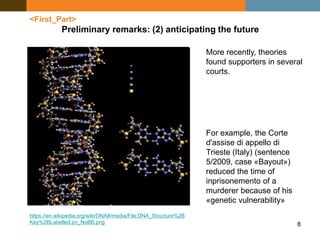
More recently, theories
found supporters in several
courts.
For example, the Corte
d'assise di appello di
Trieste (Italy) (sentence
5/2009, case «Bayout»)
reduced the time of
inprisonemento of a
murderer because of his
«genetic vulnerability»
https://en.wikipedia.org/wiki/DNA#/media/File:DNA_Structure%2B
Key%2BLabelled.pn_NoBB.png
9
<First_Part>
Preliminary remarks: (3) relevance of «prediction»
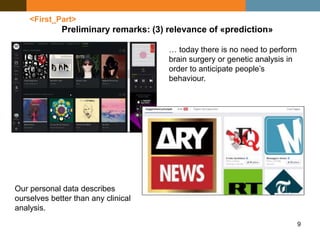
Our personal data describes
ourselves better than any clinical
analysis.
… today there is no need to perform
brain surgery or genetic analysis in
order to anticipate people’s
behaviour.
10
<First_Part>
Preliminary remarks: (3) relevance of «prediction»
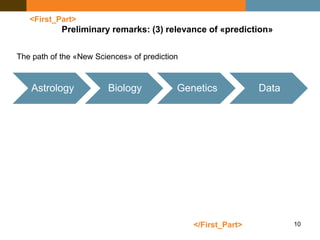
Astrology Biology Genetics Data
</First_Part>
The path of the «New Sciences» of prediction
11
<Second_Part>
Predictive Policing
<index>
</index>
(1) Definition
(2) Features
(3) Main issues
12
<Second_Part>
Predictive Policing: (1) definition
«any policing strategy or tactic that develops and
uses information and advanced analysis to
inform forward-thinking crime prevention»
Uchida, Craig D., A national discussion on predictive policing: Defining our terms and mapping successful
implementation strategies. National Institute of Justice, 2009 (p. 1).
(originally, John Morgan, Director of NIJ’s Office of Science and Technology)
13
<Second_Part>
Predictive Policing: (2) features
It is a«intelligence-led policing»
- it is not a simple «criminal pattern analysis»
the activity of “crime mapping” based on the estimation of crimes previously
committed
- it is not a mere «smart policing»
an investigation approach implemented with the most advances
techniques and strategies.
The key feature of “predictive policing” is in its purpose, which
is «to transform policing from a reactive process to a proactive
process».
White/Uchida, Smart policing: What’s in a name?, The Criminologist, volume XXXVIII,
issue 5, 2013, p. 54-56
14
<Second_Part>
Predictive Policing: (2) features
(in my view)
It is a cybernetic version of police
enforcement, grounded on the
theoretical concept of “control”.
15
<Second_Part>
Predictive Policing: (3) main (technical) issues
PRO:
(1) the benefits to public order
(2) the reduction of the social costs or risk for people,
(3) it is effective.
CONTRA
(1) the mathematical models adopted;
(2) the risk of abuse by political authorities;
(3) the prejudice for the rights of defense in criminal proceedings;
(4) the ethical implications of such a pervasive use of data.
</Second_Part>
16
<Third_Part>
Network Analysis and Predictive policing
<index>
</index>
(1) some examples
(2) the context: The «Onlife Manifesto»
(3) the case
17
<Third_Part>
Network Analysis and Predictive policing: (1) examples
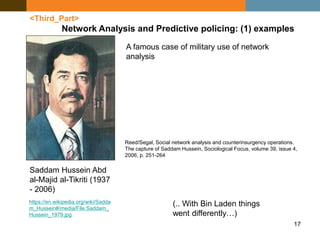
Saddam Hussein Abd
al-Majid al-Tikriti (1937
- 2006)
https://en.wikipedia.org/wiki/Sadda
m_Hussein#/media/File:Saddam_
Hussein_1979.jpg
Reed/Segal, Social network analysis and counterinsurgency operations.
The capture of Saddam Hussein, Sociological Focus, volume 39, issue 4,
2006, p. 251-264
A famous case of military use of network
analysis
(.. With Bin Laden things
went differently…)
18
<Third_Part>
Network Analysis and Predictive policing: (1) examples
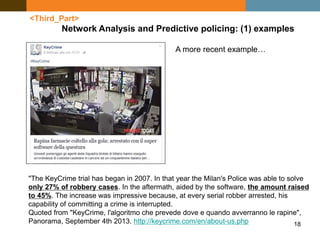
"The KeyCrime trial has began in 2007. In that year the Milan's Police was able to solve
only 27% of robbery cases. In the aftermath, aided by the software, the amount raised
to 45%. The increase was impressive because, at every serial robber arrested, his
capability of committing a crime is interrupted.
Quoted from "KeyCrime, l'algoritmo che prevede dove e quando avverranno le rapine",
Panorama, September 4th 2013. http://keycrime.com/en/about-us.php
A more recent example…
19
<Third_Part>
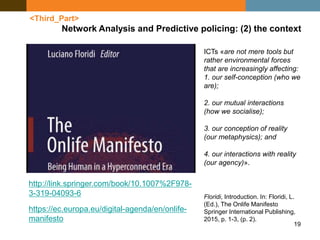
Network Analysis and Predictive policing: (2) the context
https://ec.europa.eu/digital-agenda/en/onlife-
manifesto
http://link.springer.com/book/10.1007%2F978-
3-319-04093-6
ICTs «are not mere tools but
rather environmental forces
that are increasingly affecting:
1. our self-conception (who we
are);
2. our mutual interactions
(how we socialise);
3. our conception of reality
(our metaphysics); and
4. our interactions with reality
(our agency)».
Floridi, Introduction. In: Floridi, L.
(Ed.), The Onlife Manifesto
Springer International Publishing,
2015, p. 1-3, (p. 2).
20
<Third_Part>
Network Analysis and Predictive policing: (3) the case
Let us assume that a subject A:
(1) has purchased some dangerous items W1, W2, W3, Wn;
(2) has shown preferences (for example with a “like” on Facebook) for hateful
contents (for example, a YouTube video, an image on Tumblr, a Web page, a
Facebook comment) X1, X2, X3, Xn, which are show to a sociopathic profile;
(3) has connections with users Y1, Y2, Y3, Yn, all bearing criminal records;
(4) is a regular attender of Z1, Z2, Z3, Zn, notorious “hot spots” for illicit
activities.
What if, based on these data, an algorithm stated that
– in a certain range of places and time – subject A
could commit a crime against an identified subject B?
</Third_Part>
21
<Fourth_Part>
Issues in Network Analysis and Predictive policing
<index>
</index>
(1) Epistemical issues
(2) Criminal law
(3) Ethical
22
<Fourth_Part>
Network Analysis and Predictive policing: (1) epistemical issues
(referring to the case considered before):
What is worth the information given by the prediction
that A could assault subject B in a certain range of
time and places?
23
<Fourth_Part>
Network Analysis and Predictive policing: (1) epistemical issues
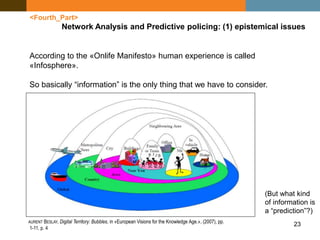
According to the «Onlife Manifesto» human experience is called
«Infosphere».
So basically “information” is the only thing that we have to consider.
AURENT BESLAY, Digital Territory: Bubbles, in «European Visions for the Knowledge Age.», (2007), pp.
1-11, p. 4
(But what kind
of information is
a “prediction”?)
24
<Fourth_Part>
Network Analysis and Predictive policing: (1) epistemical issues
A prediction is a “proof” or a
“presumption” (or neither of them)?
25
<Fourth_Part>
Network Analysis and Predictive policing: (1) epistemical issues
… It is not a real “proof” because:
(1) it refers to odds and not to facts;
(2) (with regard to the definition of knowledge as “justified true belief”) it is
different both from argumentative «truth» (classical conception of proof) and
empirical «certainty» (modern conception of proof);
(3) it is difficult to assign onuses and obligations to parties in a process
(«burden of persuasion» or «burden of production») with respect to
probabilities.
26
<Fourth_Part>
Network Analysis and Predictive policing: (1) epistemical issues
It is not a real «presumption» (namely the judicial proof of an unknown fact
by deducing known circumstances), because:
(1) the fact to be proved is placed in the future, so it is
not correct to assume simply that it is unknown, because it is actually not
happened;
(2) it is not clear how in a judicial process should be managed the
knowledge represented by a probability (for example, on which
grounds it should be considered full evidence or just an Anscheinsbeweis).
27
<Fourth_Part>
Network Analysis and Predictive policing: (1) epistemical issues
Maybe, it could be at least a judicial argument, so its influence could
depend by (for example):
(1) the acceptance of the audience (Perelman) or
(2) the «warranties» provided by the parties (Toulmin).
28
<Fourth_Part>
Network Analysis and Predictive policing: (2) Criminal law issues
(referring to the same case)
what kind of responsibility may be ascribed to
subject A with respect to subject B?
29
<Fourth_Part>
Network Analysis and Predictive policing: (2) Criminal law issues
According to the «Onlife Manifesto», we should develop a completely new
mindset and specifically
«(i) a new philosophy of nature,
(ii) a new philosophical anthropology,
(iii) a synthetic environmentalism as a bridge between us and the world, and
(iv) a new philosophy of politics among us».
Floridi, Hyperhistory and the Philosophy of Information Policies. In: Floridi, L. (Ed.), The Onlife
Manifesto, (p. 54).
«what is real is informational and what is informational is real»
Floridi, The 4th Revolution. How the infosphere is reshaping human reality, p. 41.
30
<Fourth_Part>
Network Analysis and Predictive policing: (2) Criminal law issues
On these premises it is difficult to justify “predictive policing” because:
(1) traditionally – in western legal culture – indictment needs: «actus reus»
and «mens rea», and both are missing if an action yet an action has not
been performed. There has to be a “real” – and not informational – action.
(2) in EU legal framework there is a general prohibition of «automated
individual decisions» as stated in:
- Article 15 Directive 95/46/EU,
- Article 19 Regulation (EC) No 45/2001,
- Article 20 of the «General Data Protection Regulation» (soon into force).
31
<Fourth_Part>
Network Analysis and Predictive policing: (3) ethical issues
(referring to the same case)
What penalty – and on what theoretical basis – may
be enforced to the subject A for the crime that he is
predicted to commit against the subject B?
32
<Fourth_Part>
Network Analysis and Predictive policing: (3) ethical issues
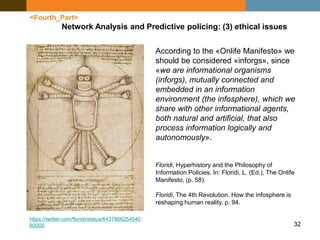
According to the «Onlife Manifesto» we
should be considered «inforgs», since
«we are informational organisms
(inforgs), mutually connected and
embedded in an information
environment (the infosphere), which we
share with other informational agents,
both natural and artificial, that also
process information logically and
autonomously».
Floridi, Hyperhistory and the Philosophy of
Information Policies. In: Floridi, L. (Ed.), The Onlife
Manifesto, (p. 58).
Floridi, The 4th Revolution. How the infosphere is
reshaping human reality, p. 94.
https://twitter.com/floridi/status/6437866254540
80000
33
<Fourth_Part>
Network Analysis and Predictive policing: (3) ethical issues
This means that:
(1) anticipating the crime is not punishing for it. Is not envisaged in any of
the theories of penalty debated in criminal science – remuneration
(Vergeltung), atonement (Sühne), general prevention or individual
deterrence.
(2) a «proactive» reaction to crime does not need to be brought to court-
since it is not a punishment – and so it may directly be enforced by police.
(3) a crime becomes just an “anomaly” in the flow of information. Anything
could be defined and prosecuted as such. No binding criteria for lawmakers.
</Fourth_Part>
34
<Fourth_Part>
Network Analysis and Predictive policing: (3) ethical issues
</Fourth_Part>
If «predictive police» has to «anticipate» crime, then its goal is not just
to punish the agent after the offense, but properly to control his
behaviour in order to reduce the risk of committing it, gauging the
inputs from which the subject shapes his representation of reality.
To do so, we have to be constantly “profiled”.
35
<Conclusion>
Society of Control -> Profiling Society
</Conclusion>
(1) A human being, conceived as an inforg, could be seen as «free»?
(2) In a society in which is allowed “predictive policing” – in its full meaning
people’s behavior would be only “monitored” or also “controlled” by
institutions?
36
Many thanks for your patience
Federico Costantini
[name].[surname]@uniud.it

NETWORK ANALYSIS AND «PREDICTIVE POLICING»: TOWARDS A «PROFILING SOCIETY»?

  • 1.
    Freitag, 26. Februar2016 Rechtswissenschaftliche Fakultät Universität Salzburg Churfürststraße 1 5010 Salzburg Federico Costantini Dipartimento di Scienze Giuridiche Università degli Studi di Udine [name].[surname]@uniud.it NETWORK ANALYSIS AND «PREDICTIVE POLICING»: TOWARDS A «PROFILING SOCIETY»? Internationales Rechtsinformatik Symposion IRIS 2016 Sicherheit & Recht I Vorsitz / Chaired by Viola Schmid 14:00 - 15:30 Hörsaal 211
  • 2.
    2 <index> </index> <First_Part> Preliminary remarks </First_Part> <Second_Part> Predictive policing </Second_Part> <Third_Part> NetworkAnalysis and Predictive policing </Third_Part> <Fourth_Part> Issues in Network Analysis and Predictive policing </Fourth_Part> <Conclusion> «Control» -> «Profiling»? </Conclusion>
  • 3.
  • 4.
    4 <index> </index> <First_Part> Preliminary remarks (1) Whypredictive policing? (2) The meaning of «anticipating the future» (3) The relevance of the topic
  • 5.
    5 <First_Part> Preliminary remarks: (1)why predictive policing? My most recent research is focused on the concept of «control» in law. - it is not simply a kind of «surveillance» - it is not simply a kind of «order» The concept of «control» entails a cybernetic vision in which law is a kind of «technology» in itself. My purpose is to analyze (and criticize) it.
  • 6.
    6 <First_Part> Preliminary remarks: (2)anticipating the future https://en.wikipedia.org/wiki/Horoscope#/media/File:Astrolo gical_Chart_--_New_Millennium.svg As humans, we have been always fascinated by predicting the future … Since ever, we have been struggling to anticipate events in order to prevent their drawbacks. We tried different tools, some of them turned up ti be quite ineffective, as the Horoscope.
  • 7.
    7 <First_Part> Preliminary remarks: (2)anticipating the future https://de.wikipedia.org/wiki/ Cesare_Lombroso#/media/Fi le:Lombroso.JPG Cesare Lombroso (1835 - 1909) In contemporary social sciences is very relevant the intent to predict future behaviours. In the past, some scholars developed theories pretending to find «natural born criminal» analyzing biological features (es: phrenology). «Unfortunately» these studies revealed to be ineffective. https://en.wikipedia.org/wiki/Phrenology #/media/File:PhrenologyPix.jpg
  • 8.
    8 <First_Part> Preliminary remarks: (2)anticipating the future More recently, theories found supporters in several courts. For example, the Corte d'assise di appello di Trieste (Italy) (sentence 5/2009, case «Bayout») reduced the time of inprisonemento of a murderer because of his «genetic vulnerability» https://en.wikipedia.org/wiki/DNA#/media/File:DNA_Structure%2B Key%2BLabelled.pn_NoBB.png
  • 9.
    9 <First_Part> Preliminary remarks: (3)relevance of «prediction» Our personal data describes ourselves better than any clinical analysis. … today there is no need to perform brain surgery or genetic analysis in order to anticipate people’s behaviour.
  • 10.
    10 <First_Part> Preliminary remarks: (3)relevance of «prediction» Astrology Biology Genetics Data </First_Part> The path of the «New Sciences» of prediction
  • 11.
  • 12.
    12 <Second_Part> Predictive Policing: (1)definition «any policing strategy or tactic that develops and uses information and advanced analysis to inform forward-thinking crime prevention» Uchida, Craig D., A national discussion on predictive policing: Defining our terms and mapping successful implementation strategies. National Institute of Justice, 2009 (p. 1). (originally, John Morgan, Director of NIJ’s Office of Science and Technology)
  • 13.
    13 <Second_Part> Predictive Policing: (2)features It is a«intelligence-led policing» - it is not a simple «criminal pattern analysis» the activity of “crime mapping” based on the estimation of crimes previously committed - it is not a mere «smart policing» an investigation approach implemented with the most advances techniques and strategies. The key feature of “predictive policing” is in its purpose, which is «to transform policing from a reactive process to a proactive process». White/Uchida, Smart policing: What’s in a name?, The Criminologist, volume XXXVIII, issue 5, 2013, p. 54-56
  • 14.
    14 <Second_Part> Predictive Policing: (2)features (in my view) It is a cybernetic version of police enforcement, grounded on the theoretical concept of “control”.
  • 15.
    15 <Second_Part> Predictive Policing: (3)main (technical) issues PRO: (1) the benefits to public order (2) the reduction of the social costs or risk for people, (3) it is effective. CONTRA (1) the mathematical models adopted; (2) the risk of abuse by political authorities; (3) the prejudice for the rights of defense in criminal proceedings; (4) the ethical implications of such a pervasive use of data. </Second_Part>
  • 16.
    16 <Third_Part> Network Analysis andPredictive policing <index> </index> (1) some examples (2) the context: The «Onlife Manifesto» (3) the case
  • 17.
    17 <Third_Part> Network Analysis andPredictive policing: (1) examples Saddam Hussein Abd al-Majid al-Tikriti (1937 - 2006) https://en.wikipedia.org/wiki/Sadda m_Hussein#/media/File:Saddam_ Hussein_1979.jpg Reed/Segal, Social network analysis and counterinsurgency operations. The capture of Saddam Hussein, Sociological Focus, volume 39, issue 4, 2006, p. 251-264 A famous case of military use of network analysis (.. With Bin Laden things went differently…)
  • 18.
    18 <Third_Part> Network Analysis andPredictive policing: (1) examples "The KeyCrime trial has began in 2007. In that year the Milan's Police was able to solve only 27% of robbery cases. In the aftermath, aided by the software, the amount raised to 45%. The increase was impressive because, at every serial robber arrested, his capability of committing a crime is interrupted. Quoted from "KeyCrime, l'algoritmo che prevede dove e quando avverranno le rapine", Panorama, September 4th 2013. http://keycrime.com/en/about-us.php A more recent example…
  • 19.
    19 <Third_Part> Network Analysis andPredictive policing: (2) the context https://ec.europa.eu/digital-agenda/en/onlife- manifesto http://link.springer.com/book/10.1007%2F978- 3-319-04093-6 ICTs «are not mere tools but rather environmental forces that are increasingly affecting: 1. our self-conception (who we are); 2. our mutual interactions (how we socialise); 3. our conception of reality (our metaphysics); and 4. our interactions with reality (our agency)». Floridi, Introduction. In: Floridi, L. (Ed.), The Onlife Manifesto Springer International Publishing, 2015, p. 1-3, (p. 2).
  • 20.
    20 <Third_Part> Network Analysis andPredictive policing: (3) the case Let us assume that a subject A: (1) has purchased some dangerous items W1, W2, W3, Wn; (2) has shown preferences (for example with a “like” on Facebook) for hateful contents (for example, a YouTube video, an image on Tumblr, a Web page, a Facebook comment) X1, X2, X3, Xn, which are show to a sociopathic profile; (3) has connections with users Y1, Y2, Y3, Yn, all bearing criminal records; (4) is a regular attender of Z1, Z2, Z3, Zn, notorious “hot spots” for illicit activities. What if, based on these data, an algorithm stated that – in a certain range of places and time – subject A could commit a crime against an identified subject B? </Third_Part>
  • 21.
    21 <Fourth_Part> Issues in NetworkAnalysis and Predictive policing <index> </index> (1) Epistemical issues (2) Criminal law (3) Ethical
  • 22.
    22 <Fourth_Part> Network Analysis andPredictive policing: (1) epistemical issues (referring to the case considered before): What is worth the information given by the prediction that A could assault subject B in a certain range of time and places?
  • 23.
    23 <Fourth_Part> Network Analysis andPredictive policing: (1) epistemical issues According to the «Onlife Manifesto» human experience is called «Infosphere». So basically “information” is the only thing that we have to consider. AURENT BESLAY, Digital Territory: Bubbles, in «European Visions for the Knowledge Age.», (2007), pp. 1-11, p. 4 (But what kind of information is a “prediction”?)
  • 24.
    24 <Fourth_Part> Network Analysis andPredictive policing: (1) epistemical issues A prediction is a “proof” or a “presumption” (or neither of them)?
  • 25.
    25 <Fourth_Part> Network Analysis andPredictive policing: (1) epistemical issues … It is not a real “proof” because: (1) it refers to odds and not to facts; (2) (with regard to the definition of knowledge as “justified true belief”) it is different both from argumentative «truth» (classical conception of proof) and empirical «certainty» (modern conception of proof); (3) it is difficult to assign onuses and obligations to parties in a process («burden of persuasion» or «burden of production») with respect to probabilities.
  • 26.
    26 <Fourth_Part> Network Analysis andPredictive policing: (1) epistemical issues It is not a real «presumption» (namely the judicial proof of an unknown fact by deducing known circumstances), because: (1) the fact to be proved is placed in the future, so it is not correct to assume simply that it is unknown, because it is actually not happened; (2) it is not clear how in a judicial process should be managed the knowledge represented by a probability (for example, on which grounds it should be considered full evidence or just an Anscheinsbeweis).
  • 27.
    27 <Fourth_Part> Network Analysis andPredictive policing: (1) epistemical issues Maybe, it could be at least a judicial argument, so its influence could depend by (for example): (1) the acceptance of the audience (Perelman) or (2) the «warranties» provided by the parties (Toulmin).
  • 28.
    28 <Fourth_Part> Network Analysis andPredictive policing: (2) Criminal law issues (referring to the same case) what kind of responsibility may be ascribed to subject A with respect to subject B?
  • 29.
    29 <Fourth_Part> Network Analysis andPredictive policing: (2) Criminal law issues According to the «Onlife Manifesto», we should develop a completely new mindset and specifically «(i) a new philosophy of nature, (ii) a new philosophical anthropology, (iii) a synthetic environmentalism as a bridge between us and the world, and (iv) a new philosophy of politics among us». Floridi, Hyperhistory and the Philosophy of Information Policies. In: Floridi, L. (Ed.), The Onlife Manifesto, (p. 54). «what is real is informational and what is informational is real» Floridi, The 4th Revolution. How the infosphere is reshaping human reality, p. 41.
  • 30.
    30 <Fourth_Part> Network Analysis andPredictive policing: (2) Criminal law issues On these premises it is difficult to justify “predictive policing” because: (1) traditionally – in western legal culture – indictment needs: «actus reus» and «mens rea», and both are missing if an action yet an action has not been performed. There has to be a “real” – and not informational – action. (2) in EU legal framework there is a general prohibition of «automated individual decisions» as stated in: - Article 15 Directive 95/46/EU, - Article 19 Regulation (EC) No 45/2001, - Article 20 of the «General Data Protection Regulation» (soon into force).
  • 31.
    31 <Fourth_Part> Network Analysis andPredictive policing: (3) ethical issues (referring to the same case) What penalty – and on what theoretical basis – may be enforced to the subject A for the crime that he is predicted to commit against the subject B?
  • 32.
    32 <Fourth_Part> Network Analysis andPredictive policing: (3) ethical issues According to the «Onlife Manifesto» we should be considered «inforgs», since «we are informational organisms (inforgs), mutually connected and embedded in an information environment (the infosphere), which we share with other informational agents, both natural and artificial, that also process information logically and autonomously». Floridi, Hyperhistory and the Philosophy of Information Policies. In: Floridi, L. (Ed.), The Onlife Manifesto, (p. 58). Floridi, The 4th Revolution. How the infosphere is reshaping human reality, p. 94. https://twitter.com/floridi/status/6437866254540 80000
  • 33.
    33 <Fourth_Part> Network Analysis andPredictive policing: (3) ethical issues This means that: (1) anticipating the crime is not punishing for it. Is not envisaged in any of the theories of penalty debated in criminal science – remuneration (Vergeltung), atonement (Sühne), general prevention or individual deterrence. (2) a «proactive» reaction to crime does not need to be brought to court- since it is not a punishment – and so it may directly be enforced by police. (3) a crime becomes just an “anomaly” in the flow of information. Anything could be defined and prosecuted as such. No binding criteria for lawmakers. </Fourth_Part>
  • 34.
    34 <Fourth_Part> Network Analysis andPredictive policing: (3) ethical issues </Fourth_Part> If «predictive police» has to «anticipate» crime, then its goal is not just to punish the agent after the offense, but properly to control his behaviour in order to reduce the risk of committing it, gauging the inputs from which the subject shapes his representation of reality. To do so, we have to be constantly “profiled”.
  • 35.
    35 <Conclusion> Society of Control-> Profiling Society </Conclusion> (1) A human being, conceived as an inforg, could be seen as «free»? (2) In a society in which is allowed “predictive policing” – in its full meaning people’s behavior would be only “monitored” or also “controlled” by institutions?
  • 36.
    36 Many thanks foryour patience Federico Costantini [name].[surname]@uniud.it