www.tetcos.com
NetSim v9Model - Predict - Validate
Network Simulation/Emulation Platform
TM
www.tetcos.com
Webinar Contents
1. Why use a Network Simulator for research ?
2. Introduction to NetSim
3. Introduction to IoT
4. IoT Technologies – 802.15.4, 6LowPAN
5. Designing IoT scenario using NetSim
6. Analyzing Metrics
7. Protocol Code editing
8. Areas of R & D in IoT
9. Q & A Session
www.tetcos.com
Why use a Network
Simulator for research ?
www.tetcos.com
Communication Networks
have become too complex for
traditional analytical methods
or “rules of thumb” to provide
an accurate understanding of
system behavior and possible
problems and solutions
www.tetcos.com
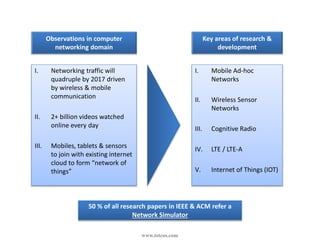
I. Networking traffic will
quadruple by 2017 driven
by wireless & mobile
communication
II. 2+ billion videos watched
online every day
III. Mobiles, tablets & sensors
to join with existing internet
cloud to form “network of
things”
I. Mobile Ad-hoc
Networks
II. Wireless Sensor
Networks
III. Cognitive Radio
IV. LTE / LTE-A
V. Internet of Things (IOT)
50 % of all research papers in IEEE & ACM refer a
Network Simulator
Observations in computer
networking domain
Key areas of research &
development
www.tetcos.com
Introduction to NetSim
www.tetcos.com
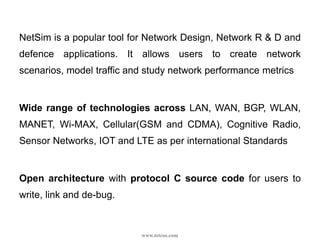
NetSim is a popular tool for Network Design, Network R & D and
defence applications. It allows users to create network
scenarios, model traffic and study network performance metrics
Wide range of technologies across LAN, WAN, BGP, WLAN,
MANET, Wi-MAX, Cellular(GSM and CDMA), Cognitive Radio,
Sensor Networks, IOT and LTE as per international Standards
Open architecture with protocol C source code for users to
write, link and de-bug.
www.tetcos.com
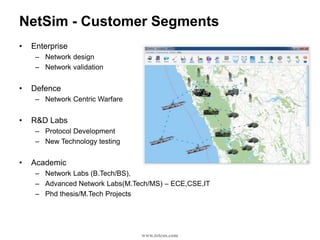
NetSim - Customer Segments
• Enterprise
– Network design
– Network validation
• Defence
– Network Centric Warfare
• R&D Labs
– Protocol Development
– New Technology testing
• Academic
– Network Labs (B.Tech/BS),
– Advanced Network Labs(M.Tech/MS) – ECE,CSE,IT
– Phd thesis/M.Tech Projects
www.tetcos.com
Architecture
Network Stack in NetSim Example of Internetwork Protocols
Kernel
www.tetcos.com
Standards Implemented
Component
No
Networks / Protocols
International
Standards
Component 1
(Base. Required for
all components)
Internetworks: Ethernet - Fast & Gigabit, Address
Resolution Protocol, WLAN - 802.11 a, b, g , n, ac and e,
Propagation - Free space, Log-normal Shadowing, Rayleigh
Fading, IPv4 with VPN, Firewalls, Routing - RIP, OSPF,
Queuing - Round Robin, FIFO, Priority, TCP, UDP.
Common Modules Applications: Traffic Generator: Voice,
Video, FTP, Database, HTTP, Email, Peer-to-peer and
Custom. Virtual Network Stack, Simulation Kernel
Command Line Interface, Metrics Engine with packet and
event trace, Packet Animator
IEEE 802.3, RFC 826
802.11 a/b/g/n/ac/e,
RFC 2453,2328, RFC's
793, 2001 and 768
Component 2
Legacy Networks: Aloha - Pure & Slotted, CSMA/CD,
Token Ring, Token Bus, ATM, X.25, Frame Relay,
Multi-Protocol Label Switching (MPLS)
IEEE 802.3, IEEE
802.4, IEEE 802.5,
ATM Forum, ITU
Forum, IETF RFC 3031
Component 3 BGP Networks: Border Gateway Protocol (BGP)
IETF, RFC’s 1771 &
3121
Component 4
Advanced Wireless Networks: MANET - DSR, AODV,
OLSR, ZRP, Wi-Max
IETF, RFC 4728, 3561,
3626, IEEE 802.16d
Component 5 Cellular Networks - GSM, CDMA
3GPP, ETSI, IMT-MC,
IS-95 A/B, IxRTT, 1x-
EV-Do, 3xRTT
www.tetcos.com
Standards Implemented
Component
No
Networks / Protocols
International
Standards
Component 6
(Component 4
required)
Wireless Sensor Networks, IOT & Personal Area Networks:
WSN with agent model & battery models ZigBee
IEEE 802.15.4 MAC,
MANET in L3
Component 7
Cognitive Radio Networks
WRAN
IEEE 802.22
Component 8 Long Term Evolution
LTE
3GPP
Component 9
(Component 4
required)
Military Radio
TDMA Link 16
--
www.tetcos.com
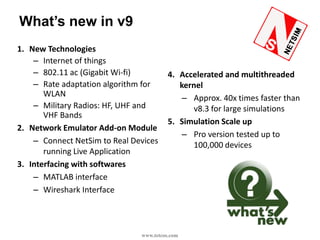
1. New Technologies
– Internet of things
– 802.11 ac (Gigabit Wi-fi)
– Rate adaptation algorithm for
WLAN
– Military Radios: HF, UHF and
VHF Bands
2. Network Emulator Add-on Module
– Connect NetSim to Real Devices
running Live Application
3. Interfacing with softwares
– MATLAB interface
– Wireshark Interface
4. Accelerated and multithreaded
kernel
– Approx. 40x times faster than
v8.3 for large simulations
5. Simulation Scale up
– Pro version tested up to
100,000 devices
What’s new in v9
www.tetcos.com
Introduction to IoT
www.tetcos.com
The phrase "Internet of Things" (IoT) was coined at the beginning of the
21st century by the MIT Auto-ID Center with special mention to Kevin
Ashton (Ashton 2009) and David L. Brock (Brock 2001).
As a complex cyber-physical system, the IoT integrates all kinds of
sensing, identification, communication, networking, and informatics
devices and systems, and seamlessly connects all the people and
things upon interests, so that anybody, at any time and any place,
through any device and media, can more efficiently access the
information of any object and any service
(ITU 2005, European Commission Information Society 2008 and 2009).
www.tetcos.com
• Figure: A vivid description of the vision of Internet-of-Things (Authorized by
Jon Berkeley in a report by The Economist in 2007)
www.tetcos.com
Application Domains
• Smart and green buildings
– Structure, energy, environment
• Networked healthcare
– Mobile patient management, geriatric care
– Wearable health monitors
• Smart Cities
– Transportation, pollution, water distribution, etc.
• Agriculture
• Forest and wildlife
Wireless Blood
Oxymeters
Endangered Wildlife
Forest Fires
www.tetcos.com
Sample IoT Application- Healthcare
• Tracking and monitoring of all objects (people, equipment,
medicine, etc.) by using wearable WSN devices on a 24/7
basis (Alemdar et al. 2010).
• Remote service like Healthcare, stroke habitation and training,
dietary and medication management, telemedicine and remote
diagnosis etc. can be delivered remotely through the internet
and field devices (Plaza et al. 2011, Klasnja and Pratt 2012,
Ludwig et al. 2012).
• Information management (logistics, diagnosis, therapy,
recovery, medication, management, finance, and even daily
activity) can be collected, managed, and utilized throughout the
entire value chain (Domingo 2012).
• Cross-organization integration i.e. The hospital information
systems (HISs) are extended to patient’ home, and can be
integrated into larger scale healthcare system that may cover a
community, city or even state (Serbanati et al. 2011, Yin et al.
2009, and Liu et al. 2008).
Reference : ZHIBO PANG, Technologies and Architectures of the
Internet-of-Things (IoT) for Health and Well-being
www.tetcos.com
IoT Technologies
- 802.15.4
- 6LowPAN
www.tetcos.com
• Wireless Sensor Network (802.15.4) is a key enabling technology of IoT. It
connects a number of sensor and/or actuator nodes into a network through
wireless communication, and integrates this network into a higher level system
through a network gateway.
The main components or layers are:
1. Sensor Networking: The sensors can be used for collecting and
transmitting information about their surrounding environment;
2. Access Networking: also called Wide Area Network (WAN),
intermediary or “sink nodes” or gateway collecting information from a group of
sensors and facilitating communication with a control center or with external entities
IEEE 802.15.4 LR-WPAN
Wireless Sensor Networks(WSN)
Introduction
• IEEE 802.15.4 LR-WPAN(Low data Rate -
Wireless Personal Area Networks) standard is
widely used for sensor networks. Sensors are
used for its position independent sensing
capabilities even in toxic and inaccessible
regions to humans.
• Sensors are low cost and can be randomly
placed as long as they are in some sensors
coverage area.
IEEE 802.15.4 operational modes
Superframe Architecture
The structure of a superframe is defined by two
parameters:
– macBeaconOrder (BO)
– macSuperframeOrder (SO)
SuperFrame Contd..
• LoWPAN is an acronym for Low power Wireless
Personal Area Networks.
• The 6LoWPAN IoT gateway functions as a border
router in a 6LoWPAN network, connecting a wireless
IPv6 network to the Internet.
6LoWPAN Gateway
The Network Protocol Stack
• IEEE 802.15.4 PHY at 2.4 GHz
• Mesh support
• UDP over IPv6 with 6LoWPAN adaptation layer
IPv6
6LoWPAN
IEEE 802.15.4 MAC
IEEE 802.15.4 PHY
Application
UDP
IPv6
6LoWPAN
IEEE 802.15.4 MAC
IEEE 802.15.4 PHY
Ethernet MAC
Ethernet PHY
Wireline Local
Area Network
and the
Internet
Sensors
Sensors
Sensors
Designing IoT scenario
using NetSim
www.tetcos.com
Analysis
www.tetcos.com
Protocol Code editing
www.tetcos.com
Writing Custom Code
• Source C codes for all protocols are provided along with
• Users can modify code and link custom code to NetSim
• Integrated debugging, animation and tracing available for custom code
Editing Protocol for “Hello World” Program
www.tetcos.com
Education - International
Defence / Space / Industry
Over 300+ Customers across 15 countries
Education - India
www.tetcos.com
Research Areas in IoT
• Seamless integration of heterogeneous devices in IoT
• Energy management and sustainable operation of IoT
• Efficient protocol design and operation
• Self configuration and fault tolerance among sensors
• Sensor device clustering (LEACH)
• Routing and Localization within sensors
• Network architecture for IoT
• 6LoWPAN based IoT design
• Modeling and simulation of large scale IoT networks
and many more…
www.tetcos.com
Q & A Session
Note: Depending on the available time, we will try to cover all your questions. In
case your query is not answered, we assure you to answer your question via email.
www.tetcos.com
For technical information contact
Visit: www.tetcos.com
E-mail: sales@tetcos.com
Tele-fax: +91 80 2663 062411
For Commercial information,
please contact our local channel partner
available at http://tetcos.com/listcp.html

NetSim Webinar on IOT

  • 1.
    www.tetcos.com NetSim v9Model -Predict - Validate Network Simulation/Emulation Platform TM
  • 2.
    www.tetcos.com Webinar Contents 1. Whyuse a Network Simulator for research ? 2. Introduction to NetSim 3. Introduction to IoT 4. IoT Technologies – 802.15.4, 6LowPAN 5. Designing IoT scenario using NetSim 6. Analyzing Metrics 7. Protocol Code editing 8. Areas of R & D in IoT 9. Q & A Session
  • 3.
    www.tetcos.com Why use aNetwork Simulator for research ?
  • 4.
    www.tetcos.com Communication Networks have becometoo complex for traditional analytical methods or “rules of thumb” to provide an accurate understanding of system behavior and possible problems and solutions
  • 5.
    www.tetcos.com I. Networking trafficwill quadruple by 2017 driven by wireless & mobile communication II. 2+ billion videos watched online every day III. Mobiles, tablets & sensors to join with existing internet cloud to form “network of things” I. Mobile Ad-hoc Networks II. Wireless Sensor Networks III. Cognitive Radio IV. LTE / LTE-A V. Internet of Things (IOT) 50 % of all research papers in IEEE & ACM refer a Network Simulator Observations in computer networking domain Key areas of research & development
  • 6.
  • 7.
    www.tetcos.com NetSim is apopular tool for Network Design, Network R & D and defence applications. It allows users to create network scenarios, model traffic and study network performance metrics Wide range of technologies across LAN, WAN, BGP, WLAN, MANET, Wi-MAX, Cellular(GSM and CDMA), Cognitive Radio, Sensor Networks, IOT and LTE as per international Standards Open architecture with protocol C source code for users to write, link and de-bug.
  • 8.
    www.tetcos.com NetSim - CustomerSegments • Enterprise – Network design – Network validation • Defence – Network Centric Warfare • R&D Labs – Protocol Development – New Technology testing • Academic – Network Labs (B.Tech/BS), – Advanced Network Labs(M.Tech/MS) – ECE,CSE,IT – Phd thesis/M.Tech Projects
  • 9.
    www.tetcos.com Architecture Network Stack inNetSim Example of Internetwork Protocols Kernel
  • 10.
    www.tetcos.com Standards Implemented Component No Networks /Protocols International Standards Component 1 (Base. Required for all components) Internetworks: Ethernet - Fast & Gigabit, Address Resolution Protocol, WLAN - 802.11 a, b, g , n, ac and e, Propagation - Free space, Log-normal Shadowing, Rayleigh Fading, IPv4 with VPN, Firewalls, Routing - RIP, OSPF, Queuing - Round Robin, FIFO, Priority, TCP, UDP. Common Modules Applications: Traffic Generator: Voice, Video, FTP, Database, HTTP, Email, Peer-to-peer and Custom. Virtual Network Stack, Simulation Kernel Command Line Interface, Metrics Engine with packet and event trace, Packet Animator IEEE 802.3, RFC 826 802.11 a/b/g/n/ac/e, RFC 2453,2328, RFC's 793, 2001 and 768 Component 2 Legacy Networks: Aloha - Pure & Slotted, CSMA/CD, Token Ring, Token Bus, ATM, X.25, Frame Relay, Multi-Protocol Label Switching (MPLS) IEEE 802.3, IEEE 802.4, IEEE 802.5, ATM Forum, ITU Forum, IETF RFC 3031 Component 3 BGP Networks: Border Gateway Protocol (BGP) IETF, RFC’s 1771 & 3121 Component 4 Advanced Wireless Networks: MANET - DSR, AODV, OLSR, ZRP, Wi-Max IETF, RFC 4728, 3561, 3626, IEEE 802.16d Component 5 Cellular Networks - GSM, CDMA 3GPP, ETSI, IMT-MC, IS-95 A/B, IxRTT, 1x- EV-Do, 3xRTT
  • 11.
    www.tetcos.com Standards Implemented Component No Networks /Protocols International Standards Component 6 (Component 4 required) Wireless Sensor Networks, IOT & Personal Area Networks: WSN with agent model & battery models ZigBee IEEE 802.15.4 MAC, MANET in L3 Component 7 Cognitive Radio Networks WRAN IEEE 802.22 Component 8 Long Term Evolution LTE 3GPP Component 9 (Component 4 required) Military Radio TDMA Link 16 --
  • 12.
    www.tetcos.com 1. New Technologies –Internet of things – 802.11 ac (Gigabit Wi-fi) – Rate adaptation algorithm for WLAN – Military Radios: HF, UHF and VHF Bands 2. Network Emulator Add-on Module – Connect NetSim to Real Devices running Live Application 3. Interfacing with softwares – MATLAB interface – Wireshark Interface 4. Accelerated and multithreaded kernel – Approx. 40x times faster than v8.3 for large simulations 5. Simulation Scale up – Pro version tested up to 100,000 devices What’s new in v9
  • 13.
  • 14.
    www.tetcos.com The phrase "Internetof Things" (IoT) was coined at the beginning of the 21st century by the MIT Auto-ID Center with special mention to Kevin Ashton (Ashton 2009) and David L. Brock (Brock 2001). As a complex cyber-physical system, the IoT integrates all kinds of sensing, identification, communication, networking, and informatics devices and systems, and seamlessly connects all the people and things upon interests, so that anybody, at any time and any place, through any device and media, can more efficiently access the information of any object and any service (ITU 2005, European Commission Information Society 2008 and 2009).
  • 15.
    www.tetcos.com • Figure: Avivid description of the vision of Internet-of-Things (Authorized by Jon Berkeley in a report by The Economist in 2007)
  • 16.
    www.tetcos.com Application Domains • Smartand green buildings – Structure, energy, environment • Networked healthcare – Mobile patient management, geriatric care – Wearable health monitors • Smart Cities – Transportation, pollution, water distribution, etc. • Agriculture • Forest and wildlife Wireless Blood Oxymeters Endangered Wildlife Forest Fires
  • 17.
    www.tetcos.com Sample IoT Application-Healthcare • Tracking and monitoring of all objects (people, equipment, medicine, etc.) by using wearable WSN devices on a 24/7 basis (Alemdar et al. 2010). • Remote service like Healthcare, stroke habitation and training, dietary and medication management, telemedicine and remote diagnosis etc. can be delivered remotely through the internet and field devices (Plaza et al. 2011, Klasnja and Pratt 2012, Ludwig et al. 2012). • Information management (logistics, diagnosis, therapy, recovery, medication, management, finance, and even daily activity) can be collected, managed, and utilized throughout the entire value chain (Domingo 2012). • Cross-organization integration i.e. The hospital information systems (HISs) are extended to patient’ home, and can be integrated into larger scale healthcare system that may cover a community, city or even state (Serbanati et al. 2011, Yin et al. 2009, and Liu et al. 2008). Reference : ZHIBO PANG, Technologies and Architectures of the Internet-of-Things (IoT) for Health and Well-being
  • 18.
  • 19.
    www.tetcos.com • Wireless SensorNetwork (802.15.4) is a key enabling technology of IoT. It connects a number of sensor and/or actuator nodes into a network through wireless communication, and integrates this network into a higher level system through a network gateway. The main components or layers are: 1. Sensor Networking: The sensors can be used for collecting and transmitting information about their surrounding environment; 2. Access Networking: also called Wide Area Network (WAN), intermediary or “sink nodes” or gateway collecting information from a group of sensors and facilitating communication with a control center or with external entities
  • 20.
    IEEE 802.15.4 LR-WPAN WirelessSensor Networks(WSN)
  • 21.
    Introduction • IEEE 802.15.4LR-WPAN(Low data Rate - Wireless Personal Area Networks) standard is widely used for sensor networks. Sensors are used for its position independent sensing capabilities even in toxic and inaccessible regions to humans. • Sensors are low cost and can be randomly placed as long as they are in some sensors coverage area.
  • 22.
  • 23.
  • 24.
    The structure ofa superframe is defined by two parameters: – macBeaconOrder (BO) – macSuperframeOrder (SO) SuperFrame Contd..
  • 25.
    • LoWPAN isan acronym for Low power Wireless Personal Area Networks. • The 6LoWPAN IoT gateway functions as a border router in a 6LoWPAN network, connecting a wireless IPv6 network to the Internet. 6LoWPAN Gateway
  • 26.
    The Network ProtocolStack • IEEE 802.15.4 PHY at 2.4 GHz • Mesh support • UDP over IPv6 with 6LoWPAN adaptation layer IPv6 6LoWPAN IEEE 802.15.4 MAC IEEE 802.15.4 PHY Application UDP IPv6 6LoWPAN IEEE 802.15.4 MAC IEEE 802.15.4 PHY Ethernet MAC Ethernet PHY Wireline Local Area Network and the Internet Sensors Sensors Sensors
  • 27.
  • 28.
  • 29.
  • 30.
    www.tetcos.com Writing Custom Code •Source C codes for all protocols are provided along with • Users can modify code and link custom code to NetSim • Integrated debugging, animation and tracing available for custom code Editing Protocol for “Hello World” Program
  • 31.
    www.tetcos.com Education - International Defence/ Space / Industry Over 300+ Customers across 15 countries Education - India
  • 32.
    www.tetcos.com Research Areas inIoT • Seamless integration of heterogeneous devices in IoT • Energy management and sustainable operation of IoT • Efficient protocol design and operation • Self configuration and fault tolerance among sensors • Sensor device clustering (LEACH) • Routing and Localization within sensors • Network architecture for IoT • 6LoWPAN based IoT design • Modeling and simulation of large scale IoT networks and many more…
  • 33.
    www.tetcos.com Q & ASession Note: Depending on the available time, we will try to cover all your questions. In case your query is not answered, we assure you to answer your question via email.
  • 34.
    www.tetcos.com For technical informationcontact Visit: www.tetcos.com E-mail: sales@tetcos.com Tele-fax: +91 80 2663 062411 For Commercial information, please contact our local channel partner available at http://tetcos.com/listcp.html