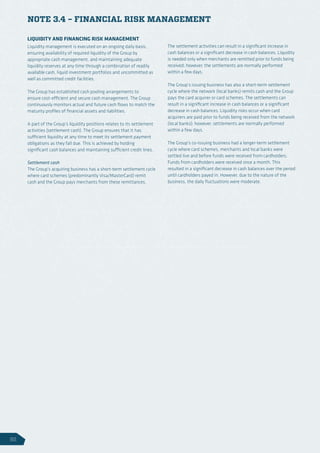
2
Table of contents
Visit us at nets.eu
3
4 Joint letter from the Chairman and CEO
8 Our business
14 Financial performance:
16 Five-year financial summary
18 Performance highlights and outlook for 2016
22 Our strategy
30 Business unit performance:
32 Merchant Services
34 Financial & Network Services
36 Corporate Services
38 Our platform: security and stability
42 Risk management
48 Corporate Governance
50 Corporate Social Responsibility
56 Board of Directors
58 Executive Committee
60 Nets financial statements 2015:
62 Statement by the Board of Directors
and Executive Management
63 Independent auditor’s report
64 Consolidated financial statements
140 Financial Statements of the Parent Company
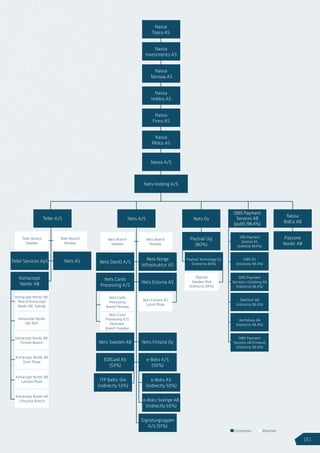
150 Nets Group chart
Joint letter from
the Chairman
and CEO
4
5
2015 was a year of transformation and investment at Nets,
where we focused on building a strong foundation for future
growth whilst also accelerating our business performance.
We started the year by reorganising our business around our
customers in order to get closer to their needs and priorities.
We closed the year by refining our strategy and aligning behind
a vision of powering digital payments in the Nordic region. We
are confident that a customer-centric business model combined
with significant investments in 2015 will reinforce our position
in the Nordic payment ecosystem.
ACCELERATING BUSINESS PERFORMANCE
2015 was a year of accelerated performance. We realised strong
financial results in 2015 through business growth and operational
efficiencies. Net revenue was up by 6% and EBITDA before
special items by 35% compared with 2014.
During the year, we further strengthened our information
security levels, both in terms of upgrading our platforms,
improving our processes and strengthening security awareness
among our employees. Security and stability are integral parts
of the way we do business at Nets and prerequisites to keeping
our customers’ trust, and will continuously be improved.
ORGANISING FOR FURTHER GROWTH
In 2015, we implemented a new operating model, dividing our
business into three customer segments – Merchant Services,
Financial  Network Services and Corporate Services. This
has created a more focused and agile business that is closer
to our customers and our markets and will help us continue to
strengthen our service proposition and increase innovation.
With a number of key hires completed in 2015, we now have our
Top100 managers in place across the new operating model. Key
highlights include bringing on board Klaus Pedersen as Group CFO,
Asger Hattel as new Head of Merchant Services, Niels Mortensen
as new Head of Operations, Manne Tiensuu as new Head of HR and
Karsten Anker Petersen as new Head of Group Communication.
TRANSFORMING MERCHANT SERVICES
A key priority has been to strengthen our offering to merchants
across the Nordic region through both organic and inorganic
Building a strong
foundation for
future growth
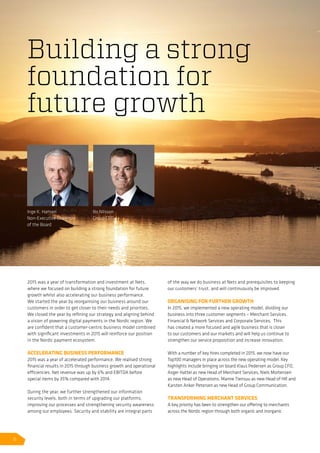
Inge K. Hansen
Non-Executive Chairman
of the Board
Bo Nilsson
Group CEO
6
investments. An example of our efforts in this area is the
acquisition of Nordea Merchant Acquiring, which significantly
expanded our business in Sweden – an area that will remain a
focus for growth. Similarly, an agreement to acquire the majority
of shares in Storebox was signed in December with closing date on
7 January 2016, enabling our merchants to offer their customers
the ability to store e-receipts, deduct discounts and collect loyalty
points on their mobile devices. Operationally, we also launched an
easier customer onboarding process as well as an enhanced online
merchant interface providing greater flexibility and enhanced data
capabilities. Early feedback from these initiatives is encouraging.
POWERING DIGITAL PAYMENTS
Having laid the groundwork in the first half of the year, it
was time to revisit our strategy in the fall. Our new vision,
‘powering digital payments’, places payments at the core of
everything we do, with value-adding digitisation and security
services as natural adjacencies. As digital payments become
more ubiquitous in the Nordic region, our role as a centre of the
payment ecosystem and with end-to-end responsibilities across
the value chain becomes ever more strategic.
We see mobile payments as an exciting innovation opportunity
and want to continue to enable a strong mobile payments
ecosystem, making the Nordics the global benchmark for
mobile payments technology. We are a natural partner for
merchants, corporates and financial institutions, and we
remain excited by the opportunities ahead for Nets and our
customers in 2016 and beyond.
On behalf of the Board and the Executive Committee, we
would like to thank everyone in the Nets organisation for their
contribution to the 2015 result and transformation as well as
our customers for the trust they have shown Nets and our
stakeholders and partners for their continued collaboration in
powering digital payments.
Joint letter from the Chairman and CEO
Inge K. Hansen
Non-Executive Chairman of the Board
Bo Nilsson
Group CEO
7
Our business
8
9
Nets is a leading provider of payment services and related
technology solutions across the Nordics. We operate a centre for
the payment ecosystem and operate a secure, reliable and deeply
entrenched network which connects merchants, corporates,
financial institutions and consumers, enabling them to make
and receive payments as well as, increasingly, utilise value added
services to help them improve their respective activities. Our
primary focus is on the Nordics.
We operate across the entire payments value chain from
payment capture and authorisation through to processing,
clearing and settlement. We do this on both the merchant
and corporate side of the chain as well as the card issuer and
consumer side, and in some instances, we own and operate the
scheme in between. We facilitate payments across all major
channels – in person, online and over a mobile device – and
all major types – local debit (i.e. Dankort and BankAxept),
international debit/credit (e.g. Visa and MasterCard) and
alternative methods (e.g. mobile and digital payment
acceptance solutions (apps, wallets, etc.), recurrent payment
solutions, credit transfers, etc.).
Nets is a leader payment provider both in terms of innovation and
scale. For more than five decades, we have been instrumental in
developing a modern payment infrastructure, with the introduction
of a number of innovative payment solutions to Nordic societies.
In 2015, we processed over DKK 409 billion of payment volume and
over 7.3 billion transactions across the Nordics.
We deliver our services through three customer-facing operating
segments.
Merchant Services provides in-store, online and

mobile payment acceptance solutions to more
than 300,000 merchants across the Nordic
region from large corporate chains to small
and medium-sized enterprises (SMEs) and micro merchants.
We serve our merchants through a broad set of distribution
channels, including indirect partnership relationships such as
bank referrals, value-added resellers and web developers as
well as through our direct sales force. Our breadth of service,
payment type and geographic coverage allows us to be a one-
stop shop for merchants in the countries in which we operate. In
2015, Merchant Services generated DKK 1,866m of net revenue
and 560m of EBITDA before special items (25% of our total).
Financial  Network Services provides
outsourced processing services to more than
200 issuers of payment cards, primarily
banks, across the Nordic region as well as
complementary services including card management systems
(CMS), fraud  dispute solutions, and mobile wallet technology.
The business area also operates and processes the national
debit card schemes in Denmark and Norway, branded Dankort
and BankAxept, respectively. In 2015, Financial  Network
Services generated DKK 2,206m of net revenue and 811m of
EBITDA before special items (36% of our total).
Our business
10
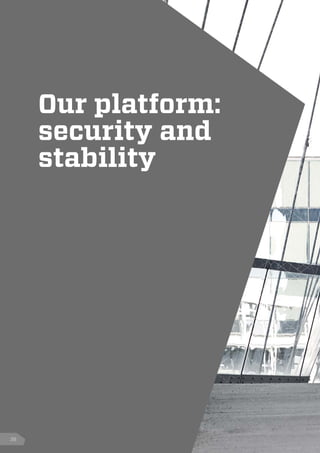
Corporate Services provides the payment
platform for recurrent bill payments and credit
transfer transactions for more than 250,000
corporates primarily in Denmark and Norway. At
the centre of this business is the ability to provide a seamless
and integrated solution for recurring bill payments to corporates
and consumers (e.g. Leverandørservice and Betalingsservice). It
also includes solutions for real-time clearing providing instant
payments across bank accounts as well as the national digital
ID systems in Denmark and Norway. In 2015, Corporate Services
generated DKK 2,764m of net revenue and 880m of EBITDA
before special items (39% of our total).
Our business
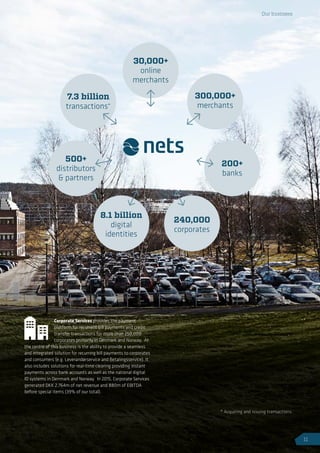
30,000+
online

merchants
300,000+
merchants
7.3 billion
transactions*
* Acquiring and issuing transactions.
500+
distributors
 partners
200+
banks
240,000
corporates
8.1 billion
digital
identities
11
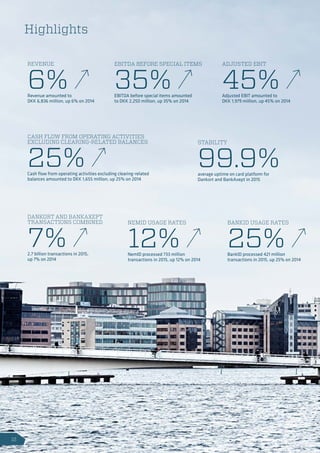
REVENUE
6%Revenue amounted to
DKK 6,836 million, up 6% on 2014
ADJUSTED EBIT
45%Adjusted EBIT amounted to
DKK 1,979 million, up 45% on 2014
EBITDA BEFORE SPECIAL ITEMS
35%EBITDA before special items amounted
to DKK 2,250 million, up 35% on 2014
DANKORT AND BANKAXEPT
TRANSACTIONS COMBINED
7%2.7 billion transactions in 2015,
up 7% on 2014
STABILITY
99.9%average uptime on card platform for
Dankort and BankAxept in 2015
NEMID USAGE RATES
12%NemID processed 733 million
transactions in 2015, up 12% on 2014
Highlights
BANKID USAGE RATES
25%BankID processed 421 million
transactions in 2015, up 25% on 2014
CASH FLOW FROM OPERATING ACTIVITIES
EXCLUDING CLEARING-RELATED BALANCES
25%Cash flow from operating activities excluding clearing-related
balances amounted to DKK 1,655 million, up 25% on 2014
12
Our business
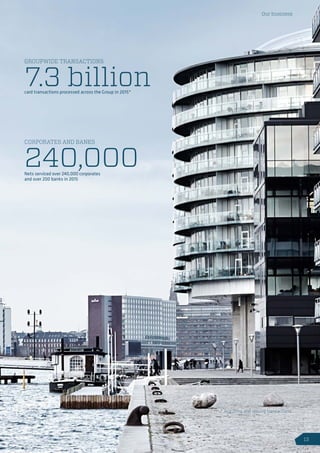
GROUPWIDE TRANSACTIONS
7.3 billioncard transactions processed across the Group in 2015*
CORPORATES AND BANKS
240,000Nets serviced over 240,000 corporates
and over 200 banks in 2015
* Acquiring and issuing transactions.
13
Financial
performance
• Five-year financial summary
• Performance highlights
and outlook for 2016
14
15
Five-year financial summary
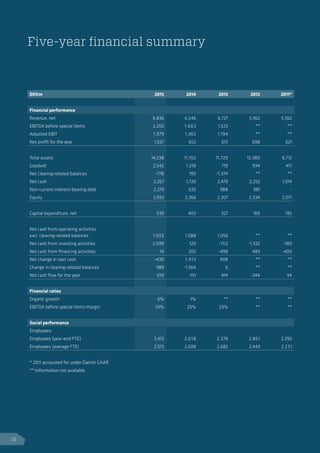
DKKm 2015 2014 2013 2012 2011*
Financial performance
Revenue, net 6,836 6,546 6,727 5,962 5,562
EBITDA before special items 2,250 1,663 1,525 ** **
Adjusted EBIT 1,979 1,365 1,194 ** **
Net profit for the year 1,037 652 613 698 621
Total assets 14,238 11,102 11,729 12,380 6,712
Goodwill 2,542 1,318 719 934 417
Net clearing-related balances -778 190 -1,374 ** **
Net cash 2,267 1,726 2,479 2,255 1,974
Non-current interest-bearing debt 2,279 635 988 981 -
Equity 3,993 2,366 2,307 2,334 2,071
Capital expenditure, net 539 403 327 169 195
Net cash from operating activities
excl. clearing-related balances 1,655 1,088 1,056 ** **
Net cash from investing activities -2,099 120 -150 -1,332 -180
Net cash from financing activities 14 205 -498 483 -400
Net change in own cash -430 1,413 408 ** **
Change in clearing-related balances 989 -1,564 6 ** **
Net cash flow for the year 559 -151 414 -244 94
Financial ratios
Organic growth 6% 1% ** ** **
EBITDA before special items margin 33% 25% 23% ** **
Social performance
Employees:
Employees (year-end FTE) 2,413 2,618 2,578 2,861 2,290
Employees (average FTE) 2,513 2,608 2,682 2,443 2,231
* 2011 accounted for under Danish GAAP.
** Information not available.
16
Financial performance
17
In 2015, Nets realised strong financial results through solid
revenue growth and a significantly improved cost structure and
continued to invest in secure and stable operations, flexible and
scalable IT services and innovative solutions. Financial results
exceeded expectations for the year. Nets acquired Nordea
Merchant Acquiring (in December) and Signaturgruppen A/S
(in July) and increased its ownership in the Nordic e-commerce
payment provider, DIBS, to 98.4%.
NET REVENUE
In 2015, net revenue increased by 4% to DKK 6,836 million,
corresponding to organic growth of 6% adjusted for impact
from changes in exchange rates and adjusted for acquisitions
and disposal of business activities. In 2015, changes in
exchange rates, especially the depreciation in NOK, impacted
revenue negatively by approximately 3% while impact from
acquisitions and disposal of business activities increased
revenue by approximately 1%.
The growth has been realised through strengthened
commercialisation of the business, increased sales force
effectiveness and new solutions and product launches.
EXPENSES
In 2015, the efficiency in Nets was significantly improved leading
to a reduction in total operating expenses of 6% to DKK 4,586
million compared to DKK 4,883 million in 2014.
Cost of sales decreased by 9% to DKK 983 million, external expenses
decreased by 6% to DKK 1,731 million, and staff costs decreased
by 4% to DKK 1,872 million. The decreases reflected improved
operational procurement, a mixed shift in our POS business towards
a higher proportion of rental-based terminals, a lower use of
external consultants and impact from changes in exchange rates.
Management will maintain focus on the ongoing streamlining
of operations including standardisation, simplification and
consolidation of vendors, and improvement of commercial processes.
EBITDA BEFORE SPECIAL ITEMS
EBITDA before special items improved to DKK 2,250 million,
up by DKK 587 million or 35% compared to 2014. The EBITDA
margin before special items increased to 33%. Improved
EBITDA before special items was a combination of growth in
revenue and significantly improved operational efficiency.
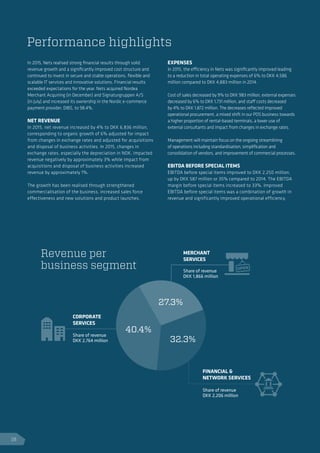
Revenue per
business segment
MERCHANT
SERVICES
FINANCIAL 
NETWORK SERVICES
CORPORATE
SERVICES
40.4%
27.3%
32.3%
Share of revenue
DKK 1,866 million
Share of revenue
DKK 2,206 million
Share of revenue
DKK 2,764 million
Performance highlights
18
SPECIAL ITEMS
Special items totalled DKK 536 million, compared to
DKK 411 million in 2014. Costs of transformation
programmes, mainly related to external consultants,
amounted to DKK 353 million compared to DKK 124 million
in 2014. Costs of reorganisation and restructuring, including
employee termination costs, amounted to DKK 159 million
compared to DKK 109 million in 2014. Costs associated with
business set-ups, acquisitions and disposals amounted to
DKK 42 million compared to DKK 181 million in 2014, with
the latter impacted by the sale of the Nets Group. Once the
transformation programme completes, the special items will
be significantly reduced.
ADJUSTED EBIT
Adjusted EBIT improved to DKK 1,979 million, up by DKK 614 million
or 45% compared to 2014. Underlying depreciation  amortisation
amounted to 271 million, a decrease of DKK 27 million compared to
2014, mainly related to development projects being fully amortised
during the year.
AMORTISATIONS OF BUSINESS COMBINATION
INTANGIBLES AND IMPAIRMENT LOSSES
In 2015, amortisations of business combination intangibles and
impairment losses amounted to DKK 188 million, an increase
of DKK 78 million compared to 2014 driven by impairment of
one development project amounting to DKK 43 million and
amortisations on new acquisitions.
FAIR VALUE ADJUSTMENTS FROM ASSETS
AVAILABLE FOR SALE AND LIABILITIES
Gain from fair value adjustment of other financial assets amounted
to DKK 968 million and relates to the Group’s share in Visa Europe
within its subsidiary Nets Oy. Fair value adjustment on contingent
consideration liability related to Visa Europe shares amounted to
DKK 774 million. The Group is obligated to pass on proceeds from the
shares in Nets Oy to the previous owners of the Nets Group when
those are received (net of any costs and taxes). Consequently, the
transaction has no impact on the net profit for the year.
TAX
The effective tax rate for 2015 was 30.0% compared to 30.1% in
2014. The effective tax rate for 2015 was negatively impacted by
the obligation to pass on received proceeds to the parent company
of 10.0%, but also positively impacted by a final ruling from
the Finnish tax authorities for deductibility of depreciation on
intangibles related to the acquisition of Nets Oy in 2012 of 4.0%.
STRATEGIC INVESTMENTS AND DIVESTMENTS
In 2015, Nets acquired the Nordea Merchant Acquiring business and
the majority of shares in Signaturgruppen A/S. The ownership of DIBS
Payment Services AB was increased to 98.4% (from previously 85,8%).
In total, acquisitions amounted to DKK 1,570 million. On 7 January 2016,
Nets completed the acquisition of Storebox A/S. Storebox A/S is a
leading provider of e-receipts and loyalty solutions to merchants.
There were no divestments in 2015.
Financial performance
19
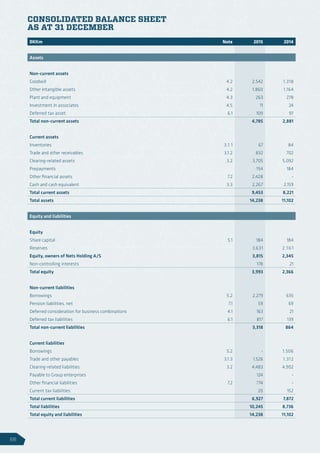
ASSETS
On 31 December 2015, total assets amounted to DKK 14,238
million compared to DKK 11,102 million on 31 December 2014.
Total non-current assets amounted to DKK 4,785 million
compared to DKK 2,881 million on 31 December 2014. Goodwill
and other intangible assets increased by DKK 1,224 million and
DKK 696 million, respectively, primarily driven by the purchase
price allocations related to the new acquisitions.
Total current assets amounted to DKK 9,453 million compared to
DKK 8,221 million on 31 December 2014. The increase in current
assets was driven by other financial assets of DKK 2,428 million,
consisting of the fair value of the Group’s share in Visa Europe
as of 31 December 2015. Additional proceeds could be received
through the Group’s branches in Sweden and Norway, although
not recognised as of 31 December 2015 due to uncertainties.
Clearing-related assets decreased by DKK 1,387 million mainly
due to the exit of the co-issuing business in Finland amounting
to DKK 1,221 million on 31 December 2014.
CAPITAL STRUCTURE
EQUITY
On 31 December 2015, total equity amounted to DKK 3,993 million
equivalent to an equity ratio of 28% compared to 21% for 2014.
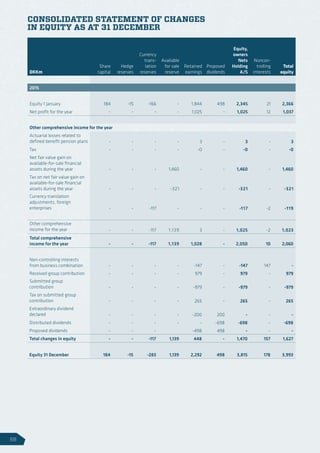
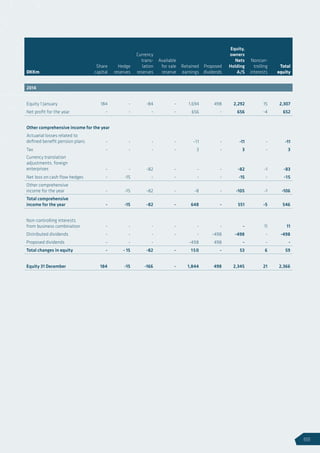
In 2015, equity was mainly impacted by DKK 1,139 million due
to a fair value adjustment of the Group’s shares in Visa Europe
within its subsidiary Teller A/S. The Group is obligated to pass on
these proceeds when received net of any costs and taxes to the
previous owners of the Group. Equity was also impacted by group
contribution between the Group’s branches in Norway and the
Group’s parent companies Nassa Midco AS and Nassa Finco AS
for the fiscal year 2014 executed in June 2015 and for 2015. Net
positive impact from group contribution amounted to DKK 265
million corresponding to the net tax effect.
Impact from exchange rates was negative by DKK 119 million
related to the depreciation of NOK versus DKK. In 2015 dividend
payments amounted to DKK 698 million.
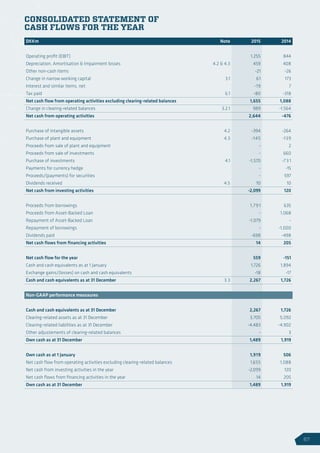
CASH FLOWS
CASH FLOW FROM OPERATING ACTIVITIES
EXCLUDING CLEARING WORKING CAPITAL
Cash flow from operating activities excluding clearing working
capital amounted to DKK 1,655 million in 2015, up by DKK 567
million compared to 2014, mainly driven by improved cash flow
from operating activities.
In 2015, tax payments amounted to DKK 80 million compared
to DKK 318 million in 2014. The decrease in tax payments was
20
Financial performance
due to the group contribution arrangement in Norway and
positive outcome of the advance tax ruling in Finland related to
the acquisition of Nets Oy (former Luottokunta Oy).
CASH FLOW FROM CLEARING BALANCES
Cash flow from clearing balances amounted to DKK 989 million
in 2015 compared to negative DKK 1,564 million the year before.
Year-end clearing balances are impacted by which day of the
week the accounts are closed and the transaction volume in the
days prior to closing.
CASH FLOW FROM INVESTING ACTIVITIES
Cash flow from investing activities amounted to DKK 2,099
million, including total acquisitions of DKK 1,570 million and
investments in intangibles, mainly development projects, of
DKK 394 million and purchase of plant  equipment of
DKK 145 million.
In 2014, the cash flow from investing activities was positive
by DKK 120 million due to divestments and sale of securities
contributing by DKK 1,255 million. In 2014, acquisitions
totalled DKK 731 million.
CASH FLOW FROM FINANCING ACTIVITIES
The cash flow used for financing activities was DKK 14
million including repayments of borrowings of DKK 1,079
million partly offset by proceeds from new borrowings of
DKK 1,791 million in connection with acquisitions. Dividend
payments in 2015 amounted to DKK 698 million. In 2014,
the cash flow from financing activities was a net cash-
in flow of DKK 205 million mainly due to proceeds from
new borrowings of DKK 1,703 million in connection with
acquisitions offset by repayment of loans of DKK 1,000
million related to the acquisition of Nets Oy in 2012 and
dividend payments of DKK 498 million.
OWN CASH
On 31 December 2015 own cash amounted to DKK 1,489 million,
down by DKK 430 million compared to 31 December 2014,
primarily driven by high investing activities of total DKK 2,099
million, including acquisitions of DKK 1,570 million, offset by
strong cash flow from operating activities excluding clearing
balances of DKK 1,655 million.
OUTLOOK 2016
In 2016, Nets expects a year with solid organic growth in
revenue and increasing EBITDA before special items margins.
Nets will continue to streamline operations and processes and
invest in innovative solutions with an ambition to create value
to our customers, partners and shareholders and deliver on
stability, security and integrity to build the future of Nets.
Financial performance
21
Our strategy
22
23
Our strategy
POWERING DIGITAL PAYMENTS
At Nets, payments have been at the core of our business ever
since inception in 1968. Whilst our offerings to merchants,
corporates, financial institutions, consumers and wider
society may have evolved over time, payments of all types
remain at the heart of everything we do.
The Nordics have led the way in the development of digital
payments and related services globally. Positioned as a
centre of the Nordic payments ecosystem, we have been an
important contributor to this evolution for nearly 50 years.
Our industry moves at a rapid pace and throughout we have
been at the forefront of new technologies and product
innovation. This pace of change is set to continue, and
combined with the ongoing early adoption of technology in
the Nordics, will remain a key driver of market growth and
opportunity for Nets.
Our vision, “Powering Digital Payments”, outlines our
ambition to deliver successful and innovative solutions
for our customers for years to come. Our strategy is built
around our customers encompassing four key elements:
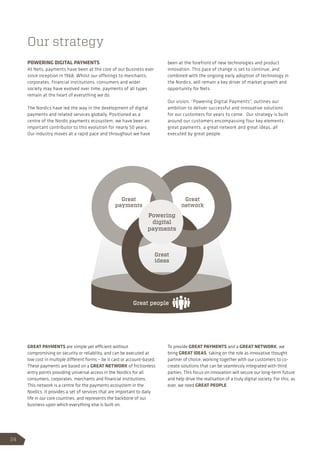
great payments, a great network and great ideas, all
executed by great people.
GREAT PAYMENTS are simple yet efficient without
compromising on security or reliability, and can be executed at
low cost in multiple different forms – be it card or account-based.
These payments are based on a GREAT NETWORK of frictionless
entry points providing universal access in the Nordics for all
consumers, corporates, merchants and financial institutions.
This network is a centre for the payments ecosystem in the
Nordics, it provides a set of services that are important to daily
life in our core countries, and represents the backbone of our
business upon which everything else is built on.
To provide GREAT PAYMENTS and a GREAT NETWORK, we
bring GREAT IDEAS, taking on the role as innovative thought
partner of choice, working together with our customers to co-
create solutions that can be seamlessly integrated with third
parties. This focus on innovation will secure our long-term future
and help drive the realisation of a truly digital society. For this, as
ever, we need GREAT PEOPLE.
Powering
digital
payments
Great
payments
Great
network
Great
ideas
Great people
24
AN INTEGRATED CUSTOMER-CENTRIC APPROACH
Our solutions span across the entire payment value chain, and across
all forms of payments. As such, we serve customers of all shapes
and sizes, ranging from consumers through merchants, to large
corporates, to the financial sector, and to governments. Our strategy
and operating model allow us to leverage the power of the integrated
network to offer specific value propositions to all customer segments
based on their individual needs. We retain a strong Nordic focus, yet
given the power of our platform, we are able to offer our customers
the support needed wherever they are present.
Given our ambition to continually increase our customer focus,
meet target market needs and remain agile, we have designed a
new, efficient operating model. During the year, we re-organised
our business into three customer-facing segments, namely
Merchant Services, Financial  Network Services and Corporate
Services. Our Group-level Technology and Operations units work to
ensure digital enablement and rapid delivery across the business.
At Group level, we have deployed dedicated key account
management structures to allow us to bring together
subject-matter experts from across our business to serve our
customers and the wider ecosystem. To monitor how well
we execute against our targets and our customer-focused
approach, we carry out an annual customer satisfaction survey.
Evidencing the success of our approach, many of the
underlying parameters, including customer service, security,
innovation and customer involvement, show an improvement
in comparison with previous years. To complement our
annual customer satisfaction survey, we carry out several
delivery surveys throughout the year upon delivery and
implementation of customer projects. Satisfaction with our
ability to deliver customer projects has also been improving,
moving up from 75 (2014) to 81 (2015). We continue to strive
to learn from our customers’ feedback to help us further
improve our services.
Our strategy
CONSUMERS
“Making life easier, guaranteeing
a secure experience across
channels and technologies”
MERCHANTS
“Provide one-stop-shop payment
solutions that optimise sales
and customer retention”
FINANCIAL INSTITUTIONS
“Embedded payment partner
to jointly drive each of our
customers’ competitiveness”
PARTNERS
“Being the preferred partner
for the Nordic digital
payments ecosystem”
CORPORATES
“Offering value-adding and
efficient collection and
payment-related solutions”
SECTOR
“Provide access to interoperability,
scale, compliance, expertise,
and innovation”
25
THE POWER OF OUR NETWORK
Combined, our three segments cover the entire payment
value chain across all types of payments serving hundreds
of thousands of merchants  corporates, hundreds of banks
and millions of consumers. We are able to leverage this great
network to provide benefits to the wider ecosystem and, in
an industry where product innovation is critical, it allows us to
empower adoption of new solutions rapidly across society.
Our integrated Mobile Strategy is an example of our ability to
adapt to the market developments. While mobile payments
in the retail sector are now gravitating towards contactless
payments, the supply of mobile payments in general is still
quite fragmented. A number of mobile payment initiatives
often deploy proprietary solutions – whilst Nets is focusing on
international standards to ensure scalability and therefore rapid
adoption by all market participants.
For our customers, we enable a strong mobile payments
ecosystem, making the Nordics the benchmark for mobile
payments. We are a strategic partner enabling leading mobile
payment solutions across the Nordics and are developing the
existing portfolio of Nets products and platforms accordingly.
By introducing a new rapid delivery model for our mobile
development, we reduce time to market, increase flexibility and
agility and are able to work more closely with our customers.
Our main deliverables to the market in 2016 will be the launch
of Nets’ Token Services that allows for tokenisation of both
international and domestic card schemes. Tokenisation is the
secure enablement of payment cards used for mobile payment
solutions – both bank branded as well as those brought to
market by the global tech giants – by which the Primary
Account Numbers (PANs) or other sensitive data are replaced by
encrypted “proxy numbers” called tokens. With this launch, Nets
will be perfectly positioned to benefit from the rapid expected
growth in mobile payments across all segments.
Data Analytics is another area in which we are building new
capabilities, as Nets is well positioned to help our customers
optimise their businesses based on data analytics. In order to
explore commercial opportunities, and answer a growing demand
FOR OUR CUSTOMERS, WE
ENABLE A STRONG MOBILE
PAYMENTS ECOSYSTEM,
MAKING THE NORDICS
THE BENCHMARK FOR
MOBILE PAYMENTS
26
for clarity and overview, we will leverage a deep understanding of
merchants and the financial sector across the Nordics, and turn
data into insights and business value for both customers and
consumers. We are building on significant investments made in
business intelligence and analytics platforms and will bring new
products to market across our business segments.
Complementing our group-wide strategic priorities, our business
units are each focused on delivering enhanced performance and
developing new solutions for customers in line with their own
specific customer-focused strategies.
Merchant Services’ ambition is to be a one-
stop shop value-adding payment services
provider for all Nordic merchants as their
front-end payment point, offering full front-
end solutions for all types of enterprise.
2015 saw the strengthening of our integrated proposition for
merchants and our e-commerce offering – these, along with
continued growth in Sweden, are areas of continued strategic
focus for the future.
Financial  Network Services’ ambition is to
deliver simpler, smarter and faster card-based
payments and to continue to drive innovation
for our customers and the network of Dankort
and BankAxept users. In this vein, 2015 saw the delivery and
rapid adoption of contactless payment functionality for Dankort
and strengthened fraud prevention services for a number of our
financial services customers. We will launch mobile contactless
functionality in 2016 and continue to improve our card
management and other value-added services offerings.
Corporate Services’ ambition is to be the
premium provider of account-to-account
services, including recurring payment services
 national clearing and settlement services,
as well as to enable secure and convenient digital identity
systems in Denmark and Norway and make business processes
paperless through digitisation. Our focus for the future will
continue to be on the development of enhanced recurring
payment solutions and the wider deployment and adoption of
real-time clearing solutions.
Our strategy
27
BUILDING A BEST-IN-CLASS OPERATIONAL PLATFORM
Our primary focus is delivering stable and secure payments for
the Nordics. In order to deliver these important services to our
society we continuously invest in our technology and operational
systems to deliver successful outcomes. We have made
significant progress throughout 2015 in delivering simple scalable
architectures that will remain a core focus for the future.
Being able to rapidly develop and deliver new technology
solutions to our customers across all our businesses, and use
our great network to drive adoption, is a critical competitive
advantage and hence we remain focused on improving our IT
delivery model so as to accelerate our time to market.
GREAT PEOPLE
In support of our new, customer-centric operating model, a
number of key hires have been made in 2015 to ensure we have
the right leadership for our three segments and our corporate
areas, including Technology and Operations.
The implementation and execution of our strategy throughout
the business remains a top priority. We want to develop
a leadership culture that will empower people, hold them
accountable and engage them in our transition from good to
great. Ensuring that every person sees a direct link between his
or her personal objectives and those of the business is key. These
targets are ultimately linked to the individual’s reward system.
Our incentive programme covers all permanent employees as
we wish to reward achievements at all levels where people
go above and beyond and create a significant impact on the
business. In 2015, 66% of our employees were rewarded in
our incentive programme Performance Pay, based on their
2014 performance.
28
Our strategy
WE WANT TO DEVELOP A LEADERSHIP
CULTURE THAT WILL EMPOWER
PEOPLE, HOLD THEM ACCOUNTABLE
AND ENGAGE THEM IN OUR
TRANSITION FROM GOOD TO GREAT
29
Business unit
performance
• Merchant Services
• Financial  Network Services
• Corporate Services
30
31
Merchant Services provide our merchant customers with
payment acceptance solutions across channels (in store, online
and mobile) and with the broadest range of payment methods
in the Nordic region, including Visa, MasterCard, JCB, American
Express, Union Pay and local payment methods. Merchant
Services are present across all Nordic and Baltic countries and
work with a broad set of value-adding partners across the region.
Merchant Services manage and simplify our merchants’
payments flows. We enable merchants to accept payments,
easily and without friction regardless of channels, receive the
settlement in their bank account and get detailed reconciliation
information and statistics, all in different currencies depending
on merchant needs and consumer preferences.
Revenue is primarily driven by a fee per transaction with monthly
subscription fees for additional services.
PERFORMANCE
The underlying transaction volume is continuing to grow steadily
during the year across our geographies with e-commerce volumes
continuing to experience double digit per cent growth in the Nordic
region. Merchant Services has experienced increased growth
during 2015 compared to the previous year driven by increased
commercialisation across the organisation as well as significant
increase in e-commerce growth from the acquisitions made in 2014.
As mobile payment solutions continue to grow, Merchant
Services are actively involved in enabling merchants to accept
various mobile-based payments. Examples include enabling
contactless terminals across the Nordic region to accept bank-
issued wallets, Samsung Pay and Apple Pay payments as well
as supporting acceptance of bank and merchant-driven mobile
payment solutions based on cards, invoices and direct bank
payments. In addition, together with selected Nordic anchor
merchants, Merchant Services are building mobile-based
commerce, loyalty and instant marketing solutions.
With the acquisition of Nordea Merchant Acquiring, we have
significantly expanded our business in Sweden – an area that
will remain a focus for growth. The acquisition is part of the
broader partnership with Nordea and will see Nets and Nordea
offer combined payment acceptance. It will also further increase
our distribution reach to SMEs by leveraging the Nordea branch
network in the Nordics. At the end of the year, we signed an
agreement to acquire Storebox, a provider of e-receipts, to
enhance our offering within loyalty and information value-added
solutions to our existing merchant customer base.
Merchant
Services
MERCHANT SERVICES
ARE ACTIVELY
INVOLVED IN ENABLING
MERCHANTS TO ACCEPT
VARIOUS MOBILE-
BASED PAYMENTS
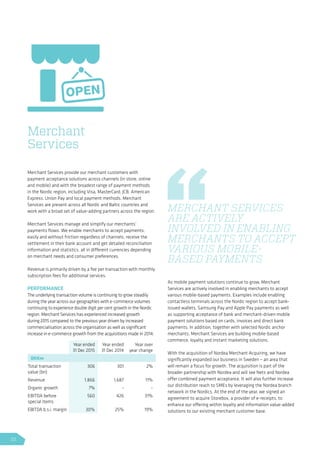
Year ended
31 Dec 2015
Year ended
31 Dec 2014
Year over
year change
DKKm
Total transaction
value (bn)
306 301 2%
Revenue 1,866 1,687 11%
Organic growth 7% - -
EBITDA before
special items
560 426 31%
EBITDA b.s.i. margin 30% 25% 19%
32
Business unit performance
Key highlights
•	 Launch of new merchant portal for SMEs providing merchants with significantly improved
insights into their business performance
•	 Launch of Nets EasyBiz to simplify payment acceptance for new merchants by packaging
terminal and relevant payment methods into one agreement
•	 Enablement of terminals to accept NFC wallets, Apple Pay, Samsung Pay and other original
equipment manufacturer (OEM) pays
•	 Significantly increased momentum in SME customer segment and increased cross-sell agreements
across multiple partner channels. High growth in e-receipt and related value-added services
33
Financial  Network Services provides processing services
for issuers of payment cards, primarily banks, in the Nordic
region as well as complementary services including Card
Management Systems, Fraud  Dispute solutions, and
Mobile Services.
The business area also operates and processes the national
debit card systems in Denmark and Norway, branded Dankort
and BankAxept, respectively. These schemes have been
instrumental in the establishment of a modern Nordic
electronic card payment infrastructure, currently processing
over 2.7 billion transactions a year.
The revenue model for Financial  Network Services is primarily
transaction-based combined with additional volume-related fees
for additional services.
PERFORMANCE
In 2015 the underlying number of transactions processed by
Financial  Network Services grew 7%.
During the year Financial  Network Services has managed to
increase its customer portfolio with new clients in Sweden and
the Baltics while also supporting existing customers in their
efforts to offer new card products and services. This ranges from
the roll-out of contactless cards to the launch of mobile wallets.
Financial  Network Services have also managed to penetrate
the customer portfolio with existing value-added services.
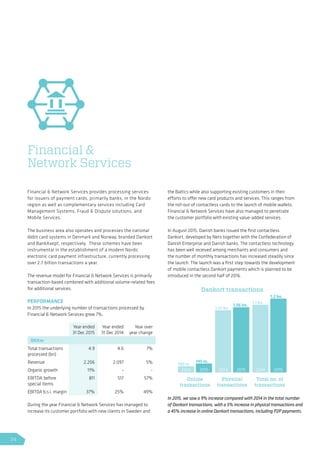
In August 2015, Danish banks issued the first contactless
Dankort, developed by Nets together with the Confederation of
Danish Enterprise and Danish banks. The contactless technology
has been well received among merchants and consumers and
the number of monthly transactions has increased steadily since
the launch. The launch was a first step towards the development
of mobile contactless Dankort payments which is planned to be
introduced in the second half of 2016.
Financial 
Network Services
2014 2014 20142015 2015 2015
Online
transactions
Physical
transactions
Total no. of
transactions
100 m.
1.01 bn.
1.1 bn.
145 m.
1.06 bn.
1.2 bn.
Dankort transactions
In 2015, we saw a 9% increase compared with 2014 in the total number
of Dankort transactions, with a 5% increase in physical transactions and
a 45% increase in online Dankort transactions, including P2P payments.
Year ended
31 Dec 2015
Year ended
31 Dec 2014
Year over
year change
DKKm
Total transactions
processed (bn)
4.9 4.6 7%
Revenue 2,206 2,097 5%
Organic growth 11% - -
EBITDA before
special items
811 517 57%
EBITDA b.s.i. margin 37% 25% 49%
34
Key highlights
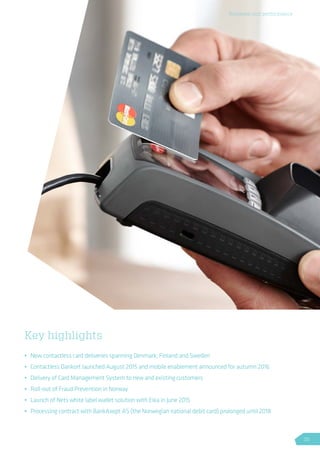
•	 New contactless card deliveries spanning Denmark, Finland and Sweden
•	 Contactless Dankort launched August 2015 and mobile enablement announced for autumn 2016
•	 Delivery of Card Management System to new and existing customers
•	 Roll-out of Fraud Prevention in Norway
•	 Launch of Nets white label wallet solution with Eika in June 2015
•	 Processing contract with BankAxept AS (the Norwegian national debit card) prolonged until 2018
Business unit performance
35
Corporate Services provides a payment platform for recurrent bill
payments and credit transfer transactions for corporates historically
primarily in Denmark and Norway. At the centre of this business is
the ability to provide a seamless and integrated solution for recurring
bill payments to corporates and consumers (e.g. Leverandørservice
and Betalingsservice). It also includes solutions for real-time clearing
providing instant payments across bank accounts as well as the
national digital ID systems in Denmark and Norway
For the majority of its revenue, Corporate Services’ revenue
model is transaction-based and built upon a strong network
of payees and payers featuring recurring payments as the
core value proposition. The model was historically reached in
collaboration with banks. In Norway, the services are sold to the
banks, which sell them to their business customers, while in
Denmark the services are sold directly to corporates.
PERFORMANCE
In 2015, key transaction volumes grew 6%. As in previous years,
the growth in Norway was higher compared to Denmark as the
household penetration of the direct debit and invoicing solutions
is higher in Denmark than in Norway.
Within clearing, demand rose due to dynamics in both end-
customer preferences and new digital potentials. On top of the
existing services relating to the Norwegian Interbank Clearing
System (NICS) in Norway and Sum-  Intraday clearing in
Denmark, RealTime24/7, Nets’ express clearing solution, took
off as an infrastructure basis for the mobile platforms known as
peer-to-peer (P2P) payments.
Within the first year, 70 million transactions were handled with
monthly growth rates of more than 15%.
Within solutions for digital identity, Nets’ Danish solution
(NemID) processed 733 million transactions, up 12% on
2014, which means a NemID was used 13.3 times a month.
In November 2015, NemID celebrated more than 3 billion
transactions processed since its launch in 2010. Nets’ Norwegian
solution (BankID) processed 421 million transactions, up 25%
on 2014, which means a BankID is used 7.5 times a month. The
upgraded and faster solutions of NemID and BankID launched at
the end of 2014 are the main drivers of the increase.
Corporate
Services
Year ended
31 Dec 2015
Year ended
31 Dec 2014
Year over
year change
DKKm
Total transactions
volume (bn)
0.83 0.78 6%
Revenue 2,764 2,762 0%
Organic growth 2% - -
EBITDA before
special items
880 719 22%
EBITDA b.s.i. margin 32% 26% 22%
36
Business unit performance
Key highlights
•	 Launched improved payment portal solution in Norway for faster and more convenient sign-up
to direct debit and e-invoicing solutions in Norway for debtors and creditors
•	 Completed transition to upgraded and faster digital ID solution in Denmark and Norway
•	 Successful introduction of real-time clearing solution providing instant account-to-account payments
37
Our platform:
security and
stability
38
39
SECURITY AND STABILITY
In the past two years we have made significant investments
in further strengthening our information security levels while
also expanding our security organisation, thereby placing Nets
among the companies with the most extensive IT security
departments in the Nordics.
We thoroughly screen and educate new employees and on a
regular basis conduct mandatory security awareness e-learning
programmes for all employees across the Group. It is essential
that everyone at Nets, regardless of job function, understands
the fundamental security principles and acts accordingly in order
not to expose the company to external threats.
We have accelerated the technical upgrades of our platforms and
further improved our operational processes. The new agreement
signed with IBM on 27 November will provide improved terms
and conditions as added bonuses in our quest to obtain the
highest standards possible within security and stability.
Nets operates important payment platforms in the Nordic and
Baltic regions. High levels of security and stability are our licence to
operate and are on the agenda at every board
and executive committee meeting at Nets.
Information security is not only a matter for the IT
department, but an important topic throughout the
organisation, and our customers need to be able to
trust that we set the bar very high within this area,
with procedures reflecting the level of professionalism
rightly expected from a supplier handling sensitive
data. On a positive note, our customer satisfaction
survey shows an upward trend, allowing us to conclude
that Nets in general is perceived by our major customers
as a company with a high level of security in our operations.
Information security threats and demands in our
industry have risen and diversified considerably in recent
years, and it is imperative that our internal procedures and
security budget reflect this development. Safeguarding
a company 100% against internal or external information
security threats is an illusion if we are to maintain
satisfactory usability levels, but our ability to quickly identify
and readily handle potential threats to mitigate the negative
impact of an incident is crucial.
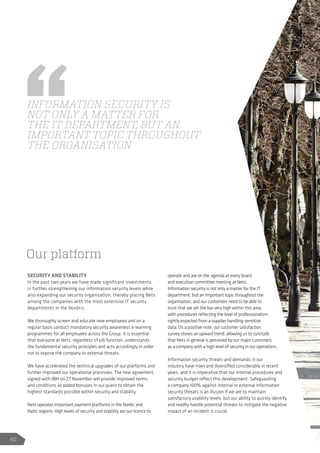
INFORMATION SECURITY IS
NOT ONLY A MATTER FOR
THE IT DEPARTMENT, BUT AN
IMPORTANT TOPIC THROUGHOUT
THE ORGANISATION
Our platform
40
Our platform
41
Risk
management
42
43
We operate in a competitive market for payments and digital
services which is characterised by changes to technology,
business and operations, making risk management an integral
part of doing business at Nets. Our company’s position at the
forefront of the financial technology innovation, operating
within an environment of shifting EU-regulation and
increasing cybercrime, drives an ever-shifting risk landscape.
In order to navigate in this environment and create continued
value for our stakeholders, we have set a clear course of
action for managing the risks facing Nets.
GOVERNANCE OF RISK AT NETS
At Nets, we operate a tiered approach to risk governance.
The Board of Directors is responsible for the overall
governance of Nets and oversees our risk landscape, sets the
company’s risk appetite, tolerances and limits and approves
strategies and policies within the area of risk, security and
business continuity.
The Board appoints an Audit Committee which monitors,
amongst other tasks, risk management strategies, policies,
process and methods.
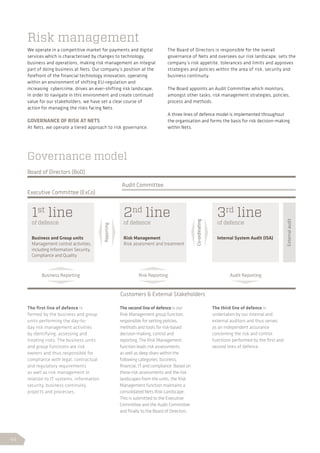
A three lines of defence model is implemented throughout
the organisation and forms the basis for risk decision-making
within Nets.
Risk management
Governance model
The first line of defence is
formed by the business and group
units performing the day-to-
day risk management activities
by identifying, assessing and
treating risks. The business units
and group functions are risk
owners and thus responsible for
compliance with legal, contractual
and regulatory requirements
as well as risk management in
relation to IT systems, information
security, business continuity,
projects and processes.
The second line of defence is our
Risk Management group function,
responsible for setting policies,
methods and tools for risk-based
decision-making, control and
reporting. The Risk Management
function leads risk assessments
as well as deep dives within the
following categories: business,
financial, IT and compliance. Based on
these risk assessments and the risk
landscapes from the units, the Risk
Management function maintains a
consolidated Nets Risk Landscape.
This is submitted to the Executive
Committee and the Audit Committee
and finally to the Board of Directors.
The third line of defence is
undertaken by our internal and
external auditors and thus serves
as an independent assurance
concerning the risk and control
functions performed by the first and
second lines of defence.
Business Reporting Risk Reporting
Reporting
Co-ordinating
Externalaudit
Audit Reporting
Customers  External Stakeholders
Executive Committee (ExCo)
Board of Directors (BoD)
Audit Committee
1st
line
of defence
Business and Group units
Management control activities,
including Information Security,
Compliance and Quality
2nd
line
of defence
Risk Management
Risk assesment and treatment
3rd
line
of defence
Internal System Audit (ISA)
44
Risk management
45
RISK METHODOLOGY  REPORTING
At Nets, our risk management methodology adopts the risk management approach of
the ISO 31000 standard with a continuous risk management process as follows:
The risk reporting reflects the three lines of defence and has our risk landscape as
its point of reference in the risk management process. Each business unit and
operational unit develops its own risk landscape. The landscape reflects inherent
risks related to our business but also risks stemming from the use of IT systems
and operational processes, financial activity and compliance/legal matters.
During 2015, new parameters of reporting have been introduced to
further strengthen the treatment of risks in the chain from business
unit to the Executive Committee and the Board of Directors.
46
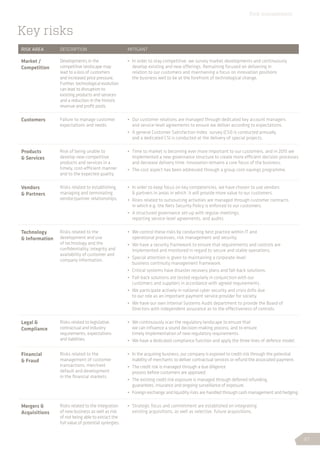
RISK AREA DESCRIPTION MITIGANT
Market /
Competition
Developments in the
competitive landscape may
lead to a loss of customers
and increased price pressure.
Further, technological evolution
can lead to disruption to
existing products and services
and a reduction in the historic
revenue and profit pools.
•	 In order to stay competitive, we survey market developments and continuously
develop existing and new offerings. Remaining focused on delivering in
relation to our customers and maintaining a focus on innovation positions
the business well to be at the forefront of technological change.
Customers Failure to manage customer
expectations and needs.
•	 Our customer relations are managed through dedicated key account managers
and service-level agreements to ensure we deliver according to expectations.
•	 A general Customer Satisfaction Index survey (CSI) is conducted annually,
and a dedicated CSI is conducted at the delivery of special projects.
Products
 Services
Risk of being unable to
develop new competitive
products and services in a
timely, cost-efficient manner
and to the expected quality.
•	 Time to market is becoming ever more important to our customers, and in 2015 we
implemented a new governance structure to create more efficient decision processes
and decrease delivery time. Innovation remains a core focus of the business.
•	 The cost aspect has been addressed through a group cost-savings programme.
Vendors
 Partners
Risks related to establishing,
managing and terminating
vendor/partner relationships.
•	 In order to keep focus on key competencies, we have chosen to use vendors
 partners in areas in which it will provide more value to our customers.
•	 Risks related to outsourcing activities are managed through customer contracts
in which e.g. the Nets Security Policy is enforced to our customers.
•	 A structured governance set-up with regular meetings,
reporting service-level agreements, and audits.
Technology
 Information
Risks related to the
development and use
of technology and the
confidentiality, integrity and
availability of customer and
company information.
•	 We control these risks by conducting best practice within IT and
operational processes, risk management and security.
•	 We have a security framework to ensure that requirements and controls are
implemented and monitored in regard to secure and stable operations.
•	 Special attention is given to maintaining a corporate-level
business continuity management framework.
•	 Critical systems have disaster recovery plans and fall-back solutions.
•	 Fall-back solutions are tested regularly in conjunction with our
customers and suppliers in accordance with agreed requirements.
•	 We participate actively in national cyber security and crisis drills due
to our role as an important payment service provider for society.
•	 We have our own Internal Systems Audit department to provide the Board of
Directors with independent assurance as to the effectiveness of controls.
Legal 
Compliance
Risks related to legislative,
contractual and industry
requirements, expectations
and liabilities.
•	 We continuously scan the regulatory landscape to ensure that
we can influence a sound decision-making process, and to ensure
timely implementation of new regulatory requirements.
•	 We have a dedicated compliance function and apply the three lines of defence model.
Financial
 Fraud
Risks related to the
management of customer
transactions, merchant
default and development
in the financial markets.
•	 In the acquiring business, our company is exposed to credit risk through the potential
inability of merchants to deliver contractual services or refund the associated payment.
•	 The credit risk is managed through a due diligence
process before customers are approved.
•	 The existing credit risk exposure is managed through deferred refunding,
guarantees, insurance and ongoing surveillance of exposure.
•	 Foreign exchange and liquidity risks are handled through cash management and hedging.
Mergers 
Acquisitions
Risks related to the integration
of new business as well as risk
of not being able to extract the
full value of potential synergies.
•	 Strategic focus and commitment are established on integrating
existing acquisitions, as well as selective, future acquisitions.
Key risks
Risk management
47
Corporate
Governance
The Board of Directors has established board committees
with the purpose of supporting the board and advising it on
fulfilling its responsibilities to shareholders, employees and
other stakeholders of the Company. In order to strengthen the
competences in the board, Monica Caneman and Per-Kristian
Halvorsen have been elected as independent board members.
The Board of Directors has established two committees:
	
•	 Audit Committee
•	 Remuneration Committee
Reporting to the Board of Directors, the committees have
individual charters defining their main tasks and responsibilities.
AUDIT COMMITTEE
The Board of Directors has established an Audit Committee,
which currently consists of four members. The committee’s
role is to assist the Board of Directors with the oversight of
external auditors, Internal Systems Audit, financial reporting,
risk management, corporate social responsibility and the
whistleblowing scheme.
The Board of Directors appoints committee members and the
committee chair. The committee meets at least four times a year.
REMUNERATION COMMITTEE
The Board of Directors has established a Remuneration
Committee consisting of three members of the Board of
Directors. The committee’s role is to review and make
recommendations to the Board of Directors regarding
remuneration strategy and policy, remuneration of the CEO,
the Executive Committee and the board members. The Board
of Directors appoints committee members and the committee
chair. The committee meets at least four times a year.
48
49
Corporate
Social
Responsibility
50
51
Nets plays a central role in the digitisation of the Nordic
countries through our focus on powering digital payments and
through our services within digital identities and digitisation
of paper-based processes.
Our primary social responsibility is to help ensure that our
modern societies function in a safe and efficient manner
within the areas of digital payments, security and identities
for the benefit of citizens and businesses alike. As a company
we fully recognise and respect the social impact we have on
the communities in which we operate and work continuously
to earn the trust of our many stakeholders.
Our CSR strategy outlines our work towards strengthening our
profile and reputation in the eyes of our customers, shareholders
and general stakeholders as a responsible corporate citizen.
Nets’ CSR strategy is based on the ten principles set out in the
UN Global Compact with a focus on the four main areas of: a)
Human rights, including diversity, b) Supply chain management,
c) Climate and environmental impact, and d) Community
involvement. Nets is not a member of the UN Global Compact
but we respect and adhere to the ten principles.
Our CSR strategy is based on a foundation of ethical guidelines
that are mandatory to comply with for all employees across
the Nets Group. Our ethical guidelines are publicly available on
our website www.nets.eu as well as on the company intranet
The e-learning programme on ethical conduct will be rolled
out in 2016.
HUMAN RIGHTS
Nets’ approach to human rights is firmly based on our core
values and ethical guidelines. Our Human  Labour Rights
policy is guided by the United Nations’ Declaration of Human
Rights and the ILO Declaration on Fundamental Principles and
Rights at Work. The policy covers key issues of importance
to the Nets Group and our employees. Nets’ Group policy
on Human and Labour Rights applies to all wholly-owned
subsidiaries, including all employees in those companies.
PROGRESS IN 2015
DIVERSITY
Nets regards diversity as a prerequisite for a healthy, forward-
looking company. We aspire to be an attractive workplace for
current and future employees, and we aim to ensure that men
and women have equal opportunities for furthering their careers
and securing management roles in the company.
Nets seeks to approach a gender balance (40/60) of capable
female and male executives at the top six levels in the company.
As of 31 December 2015, the number of women in management
positions accounted to 34% which is a decline from 2014 (37%)
and below our target of 40%.
In 2016 we will continue our focus on gender balance through
activities such as:
•	 A focus on offering a sensible work/life balance to reconcile
the demands of working life and family life
•	 Discussing managerial desires and ambitions in annual
employee development interviews
BOARD OF DIRECTORS
By the end of 2015, the Board of Directors consisted of 11 male
executives including four employee representatives. Nets’ Board of
Directors aimed to include at least one female board member by the
end of 2017, bringing the company up to the Danish industry average.
Our objective with regard to gender diversity on the Board of
Directors was met in March 2016 with the inclusion of Monica
Caneman on the Board.
WHISTLEBLOWING
In 2014 Nets implemented a whistleblower scheme, under which
employees, management and externals may report serious
violations or misconduct, or suspicions thereof that may influence
the Nets Group as a whole or the life or health of an individual.
Reports are received and investigated by an external law firm,
and reports may be submitted anonymously.
Corporate Social Responsibility
52
Corporate Social Responsibility
53
SUPPLY CHAIN MANAGEMENT
Operating in an international context, Nets is fully committed to
complying with existing legislation, and we recognise international
business standards applying to our field of work. Moreover, we
advocate for sound business practices throughout our value chain.
Our supply chain policy is included in all agreements between
suppliers and Nets. In cases where specific issues arise that require
documentation, we work closely with our suppliers to handle these.
PROGRESS IN 2015
During the year we have worked with customers requesting
information on our CSR policy and actions. In no cases have
these requests raised concern from customers.
In 2016 we will continue our ongoing open dialogue with customers
on inquiries and concerns from customers regarding our CSR work.
CLIMATE AND ENVIRONMENTAL IMPACT
We support a preventative approach to environmental challenges
and a responsible way of conducting our own business operations.
We are committed to being an environmentally conscious
service provider and business partner and work strategically
and systematically based on the requirements of our ISO140001
certification towards minimising our environmental impact at
every level of our organisation.
PROGRESS IN 2015
2015 was the first year that our ISO14001 system was in daily
operation. Consistent with Nets’ environmental policy, planned
actions and activities within our four focus areas have been
carried out resulting in positive results within all four areas.
Reduction in CO2 emissions from travel between locations
2,584 tonnes CO2 saved – a 57% decrease compared to 2014
Reduce energy consumption for building operations
Energy consumption reduced by 7% compared to 2014
Reduce usage of paper for internal print output
Internal print output reduced by 1,475,000 sheets of paper or by
20% compared to the baseline established in 2014
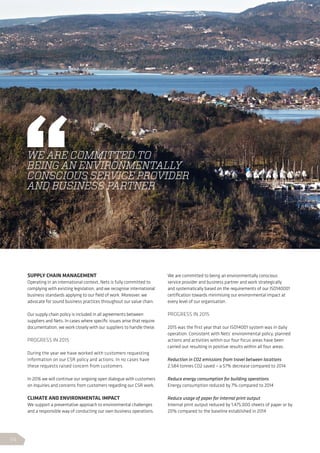
WE ARE COMMITTED TO
BEING AN ENVIRONMENTALLY
CONSCIOUS SERVICE PROVIDER
AND BUSINESS PARTNER
54
Reduce quantity of waste and ensure improved recycling
Total quantity of mixed waste reduced by approx. 16 tonnes or
approx. 9% compared to the baseline established in 2014.
In 2016, we will continue to raise awareness of our environmental
policy throughout the organisation.
COMMUNITY INVOLVEMENT
As an international corporate citizen, Nets supports causes
that are close to our business and will have a positive impact
on people and communities in general. Nets has chosen to
primarily promote children’s education, both in general and
within IT and IT security-related areas, but also supports more
general activities that have an impact on the communities in
which we operate.
PROGRESS IN 2015
In 2015, we engaged in a programme to support the education
of children in state schools within the area of digital security. In
2015, a pilot was run in selected schools and will continue in an
updated version in 2016 addressing a wider audience.
During the year, we have supported a number of organisations
and causes. Save The Children Denmark have received donations
from our customer satisfaction survey, where we donate
DKK 50 per respondent, along with the proceeds we get from
the sale of second-hand hardware through our broker. At the
national collections ’Danmarks Indsamling’ and ‘The Danish
Cancer Society’, we donated DKK 50,000 to each cause.
We have also continued our partnership with ISOBRO – the
Danish collection agencies’ trade association – to support more
effective collection methods as well as by contributing to the
training of organisational staff.
In 2016 we expect to continue our support related to our overall
purpose of supporting children’s education and IT security.
Corporate Social Responsibility
55
Board of Directors
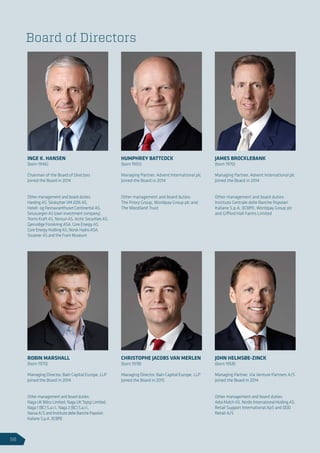
INGE K. HANSEN
(born 1946)
Chairman of the Board of Directors
Joined the Board in 2014
Other management and board duties:
Harding AS, Skiskytter VM 2016 AS,
Hotell- og Restauranthuset Continental AS,
Siriusungen AS (own investment company),
Troms Kraft AS, Norsun AS, Arctic Securities AS,
Gjensidige Forsikring ASA, Core Energy AS,
Core Energy Holding AS, Norsk Hydro ASA,
Sissener AS and the Fram Museum
HUMPHREY BATTCOCK
(born 1955)
Managing Partner, Advent International plc
Joined the Board in 2014
Other management and board duties:
The Priory Group, Worldpay Group plc and
The Woodland Trust
JAMES BROCKLEBANK
(born 1970)
Managing Partner, Advent International plc
Joined the Board in 2014
Other management and board duties:
Instituto Centrale delle Banche Popolari
Italiane S.p.A. (ICBPI), Worldpay Group plc
and Gifford Hall Farms Limited
ROBIN MARSHALL
(born 1970)
Managing Director, Bain Capital Europe, LLP
Joined the Board in 2014
Other management and board duties:
Naga UK Bidco Limited, Naga UK Topcp Limited,
Naga 1 (BC) S.a.r.l., Naga 2 (BC) S.a.r.l.,
Nassa A/S and Instituto delle Banche Popolari
Italiane S.p.A. (ICBPI)
CHRISTOPHE JACOBS VAN MERLEN
(born 1978)
Managing Director, Bain Capital Europe, LLP
Joined the Board in 2015
JOHN HELMSØE-ZINCK
(born 1958)
Managing Partner, Via Venture Partners A/S
Joined the Board in 2014
Other management and board duties:
Adra Match AS, Nordic International Holding AS,
Retail Support International ApS and DDD
Retail A/S
Board of Directors
56
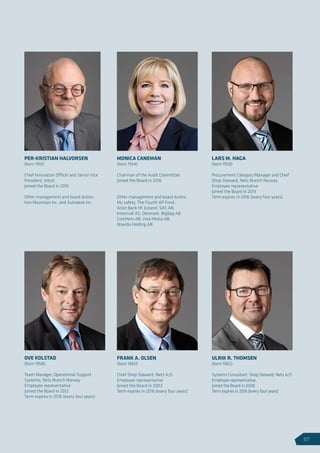
LARS M. HAGA
(born 1958)
Procurement Category Manager and Chief
Shop Steward, Nets Branch Norway
Employee representative
Joined the Board in 2013
Term expires in 2016 (every four years)
OVE KOLSTAD
(born 1958)
Team Manager, Operational Support
Systems, Nets Branch Norway
Employee representative
Joined the Board in 2012
Term expires in 2016 (every four years)
FRANK A. OLSEN
(born 1960)
Chief Shop Steward, Nets A/S
Employee representative
Joined the Board in 2003
Term expires in 2016 (every four years)
ULRIK R. THOMSEN
(born 1965)
Systems Consultant, Shop Steward, Nets A/S
Employee representative
Joined the Board in 2008
Term expires in 2016 (every four years)
PER-KRISTIAN HALVORSEN
(born 1951)
Chief Innovation Officer and Senior Vice
President, Intuit
Joined the Board in 2015
Other management and board duties:
Iron Mountain Inc. and Autodesk Inc.
MONICA CANEMAN
(born 1954)
Chairman of the Audit Committee
Joined the Board in 2016
Other management and board duties:
My safety, The Fourth AP Fond,
Arion Bank hf, Iceland, SAS AB,
Intermail AS, Denmark, BigBag AB,
ComHem AB, Viva Media AB,
Bravida Holding AB.
57
Board of Directors
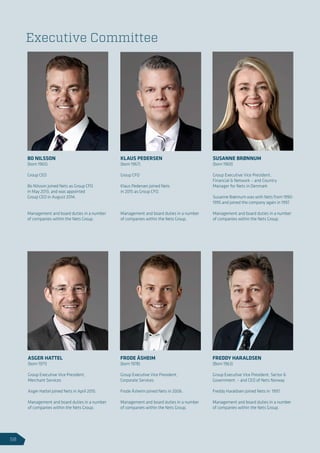
BO NILSSON
(born 1965)
Group CEO
Bo Nilsson joined Nets as Group CFO
in May 2013, and was appointed
Group CEO in August 2014.
Management and board duties in a number
of companies within the Nets Group.
KLAUS PEDERSEN
(born 1967)
Group CFO
Klaus Pedersen joined Nets
in 2015 as Group CFO.
Management and board duties in a number
of companies within the Nets Group.
SUSANNE BRØNNUM
(born 1969)
Group Executive Vice President,
Financial  Network – and Country
Manager for Nets in Denmark
Susanne Brønnum was with Nets from 1990-
1995 and joined the company again in 1997.
Management and board duties in a number
of companies within the Nets Group.
ASGER HATTEL
(born 1971)
Group Executive Vice President,
Merchant Services
Asger Hattel joined Nets in April 2015.
Management and board duties in a number
of companies within the Nets Group.
FRODE ÅSHEIM
(born 1978)
Group Executive Vice President,
Corporate Services
Frode Åsheim joined Nets in 2006.
Management and board duties in a number
of companies within the Nets Group.
FREDDY HARALDSEN
(Born 1963)
Group Executive Vice President, Sector 
Government – and CEO of Nets Norway
Freddy Haraldsen joined Nets in 1997.
Management and board duties in a number
of companies within the Nets Group.
Executive Committee
58
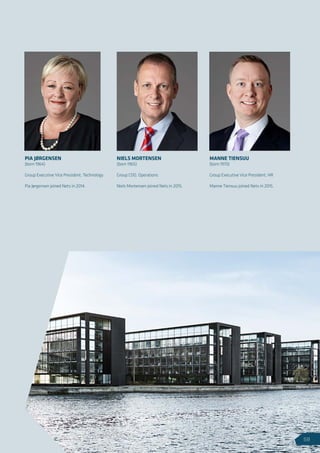
MANNE TIENSUU
(born 1970)
Group Executive Vice President, HR
Manne Tiensuu joined Nets in 2015.
PIA JØRGENSEN
(born 1964)
Group Executive Vice President, Technology
Pia Jørgensen joined Nets in 2014.
NIELS MORTENSEN
(born 1965)
Group COO, Operations
Niels Mortensen joined Nets in 2015.
59
Nets
financial
statements
2015
60
61
Statement by the Board of Directors
and Executive Management
The Board of Directors and the Executive Management have
today discussed and approved the annual report of Nets Holding
A/S for the financial year 2015.
The consolidated financial statements have been prepared in
accordance with International Financial Reporting Standards
as adopted by the European Union and further disclosure
requirements required according to the Danish Financial
Statements Act. The financial statements of the parent
company have been prepared in accordance with the Danish
Financial Statements Act.
It is our opinion that the consolidated financial statements and
the parent company financial statements give a true and fair
view of the Group's and the Parent Company's financial position
at 31 December 2015, the results of the Group and Parent
Company’s operations and consolidated cash flows for the
financial year 1 January – 31 December 2015.
In our opinion, the Management review includes a true and
fair account of the development in the Group's and the Parent
Company's operations and financial conditions, the results for
the year, cash flows and financial position as well as a description
of the most significant risks and uncertainty factors that the
Group and the Parent Company face.
We recommend that the annual report be approved at the annual
general meeting.
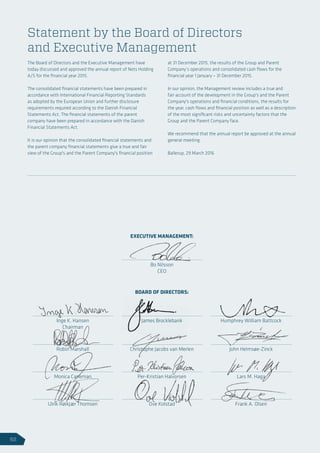
Ballerup, 29 March 2016
EXECUTIVE MANAGEMENT:
Bo Nilsson
CEO
BOARD OF DIRECTORS:
Inge K. Hansen
Chairman
James Brocklebank Humphrey William Battcock
Robin Marshall Christophe Jacobs van Merlen John Helmsøe-Zinck
Monica Caneman Per-Kristian Halvorsen Lars M. Haga
Ulrik Røikjær Thomsen Ove Kolstad Frank A. Olsen
62
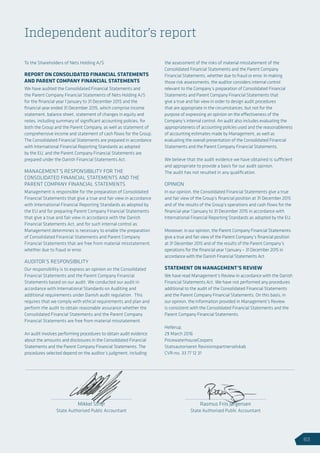
Independent auditor’s report
To the Shareholders of Nets Holding A/S
REPORT ON CONSOLIDATED FINANCIAL STATEMENTS
AND PARENT COMPANY FINANCIAL STATEMENTS
We have audited the Consolidated Financial Statements and
the Parent Company Financial Statements of Nets Holding A/S
for the financial year 1 January to 31 December 2015 and the
financial year ended 31 December 2015, which comprise income
statement, balance sheet, statement of changes in equity and
notes, including summary of significant accounting policies, for
both the Group and the Parent Company, as well as statement of
comprehensive income and statement of cash flows for the Group.
The Consolidated Financial Statements are prepared in accordance
with International Financial Reporting Standards as adopted
by the EU, and the Parent Company Financial Statements are
prepared under the Danish Financial Statements Act.
MANAGEMENT’S RESPONSIBILITY FOR THE
CONSOLIDATED FINANCIAL STATEMENTS AND THE
PARENT COMPANY FINANCIAL STATEMENTS
Management is responsible for the preparation of Consolidated
Financial Statements that give a true and fair view in accordance
with International Financial Reporting Standards as adopted by
the EU and for preparing Parent Company Financial Statements
that give a true and fair view in accordance with the Danish
Financial Statements Act, and for such internal control as
Management determines is necessary to enable the preparation
of Consolidated Financial Statements and Parent Company
Financial Statements that are free from material misstatement,
whether due to fraud or error.
AUDITOR’S RESPONSIBILITY
Our responsibility is to express an opinion on the Consolidated
Financial Statements and the Parent Company Financial
Statements based on our audit. We conducted our audit in
accordance with International Standards on Auditing and
additional requirements under Danish audit regulation. This
requires that we comply with ethical requirements and plan and
perform the audit to obtain reasonable assurance whether the
Consolidated Financial Statements and the Parent Company
Financial Statements are free from material misstatement.
An audit involves performing procedures to obtain audit evidence
about the amounts and disclosures in the Consolidated Financial
Statements and the Parent Company Financial Statements. The
procedures selected depend on the auditor’s judgment, including
the assessment of the risks of material misstatement of the
Consolidated Financial Statements and the Parent Company
Financial Statements, whether due to fraud or error. In making
those risk assessments, the auditor considers internal control
relevant to the Company’s preparation of Consolidated Financial
Statements and Parent Company Financial Statements that
give a true and fair view in order to design audit procedures
that are appropriate in the circumstances, but not for the
purpose of expressing an opinion on the effectiveness of the
Company’s internal control. An audit also includes evaluating the
appropriateness of accounting policies used and the reasonableness
of accounting estimates made by Management, as well as
evaluating the overall presentation of the Consolidated Financial
Statements and the Parent Company Financial Statements.
We believe that the audit evidence we have obtained is sufficient
and appropriate to provide a basis for our audit opinion.
The audit has not resulted in any qualification.
OPINION
In our opinion, the Consolidated Financial Statements give a true
and fair view of the Group’s financial position at 31 December 2015
and of the results of the Group’s operations and cash flows for the
financial year 1 January to 31 December 2015 in accordance with
International Financial Reporting Standards as adopted by the EU.
Moreover, in our opinion, the Parent Company Financial Statements
give a true and fair view of the Parent Company’s financial position
at 31 December 2015 and of the results of the Parent Company’s
operations for the financial year 1 January – 31 December 2015 in
accordance with the Danish Financial Statements Act.
STATEMENT ON MANAGEMENT’S REVIEW
We have read Management’s Review in accordance with the Danish
Financial Statements Act. We have not performed any procedures
additional to the audit of the Consolidated Financial Statements
and the Parent Company Financial Statements. On this basis, in
our opinion, the information provided in Management’s Review
is consistent with the Consolidated Financial Statements and the
Parent Company Financial Statements.
Hellerup,
29 March 2016
PricewaterhouseCoopers
Statsautoriseret Revisionspartnerselskab
CVR-no. 33 77 12 31
Mikkel Sthyr
State Authorised Public Accountant
Rasmus Friis Jørgensen
State Authorised Public Accountant
63
CONSOLIDATED INCOME STATEMENT
DKKm Note 2015 2014
Revenue, gross 9,040 8,607
Interchange fees and processing fees -2,204 -2,061
Revenue, net of interchange fees and processing fees 2.1 6,836 6,546
Cost of sales -983 -1,081
External expenses -1,731 -1,846
Staff costs 2.3 -1,872 -1,956
Operating profit before depreciation and amortisation (EBITDA) before special items 2,250 1,663
Special items 2.2 -536 -411
Operating profit before depreciation and amortisation (EBITDA) 1,714 1,252
Amortisation of business combination intangibles  impairment losses 4.2  4.3 -188 -110
Underlying depreciations and amortisations 4.2  4.3 -271 -298
Operating profit (EBIT) 1,255 844
Profit from associates after tax 4.5 -3 13
Profit from divestment of business - 45
Fair value adjustment of Visa Europe share 7.2 968 -
Fair value adjustment on contingent consideration liability related to Visa Europe share 7.2 -774 -
Financial income 5.3 93 82
Financial expenses 5.3 -57 -51
Net financials 227 89
Profit before tax 1,482 933
Income taxes 6.1 -445 -281
Net profit for the year 1,037 652
Profit is attributable to:
  Owners of Nets Holding A/S 1,025 656
  Non-controlling interests 12 -4
1,037 652
Non-GAAP performance measaures
Operating profit before depreciation and amortisation (EBITDA) before special items 2,250 1,663
Underlying depreciations and amortisations -271 -298
Adjusted EBIT 1,979 1,365
64
CONSOLIDATED STATEMENT OF
OTHER COMPREHENSIVE INCOME
DKKm Note 2015 2014
Net profit for the year 1,037 652
Other comprehensive income:
Items that will not be reclassified subsequently to the consolidated income statement:
Actuarial gains/(losses) on defined benefit pension plans 7.1 3 -11
Tax -0 3
Total items never reclassified to the consolidated income statement 3 -8
Items that will be reclassified subsequently to the consolidated income statement,
when specific conditions are met:
Currency translation adjustments, foreign enterprises -119 -83
Fair value adjustment of Visa Europe share 7.2 1,460 -
Tax -321 -
Net loss on cash flow hedges - -15
Total items that may be reclassified to the consolidated income statement
subsequently
1,020 -98
Other comprehensive income for the year, net of tax 1,023 -106
Total comprehensive income for the year, net of tax 2,060 546
Total comprehensive income for the year is attributable to:
  Owners of Nets Holding A/S 2,050 550
  Non-controlling interests 10 -4
2,060 546
65
CONSOLIDATED BALANCE SHEET
AS AT 31 DECEMBER
DKKm Note 2015 2014
Assets
Non-current assets
Goodwill 4.2 2,542 1,318
Other intangible assets 4.2 1,860 1,164
Plant and equipment 4.3 263 278
Investment in associates 4.5 11 24
Deferred tax asset 6.1 109 97
Total non-current assets 4,785 2,881
Current assets
Inventories 3.1.1 67 84
Trade and other receivables 3.1.2 832 702
Clearing-related assets 3.2 3,705 5,092
Prepayments 154 184
Other financial assets 7.2 2,428 -
Cash and cash equivalent 3.3 2,267 2,159
Total current assets 9,453 8,221
Total assets 14,238 11,102
Equity and liabilities
Equity
Share capital 5.1 184 184
Reserves 3,631 2,161
Equity, owners of Nets Holding A/S 3,815 2,345
Non-controlling interests 178 21
Total equity 3,993 2,366
Non-current liabilities
Borrowings 5.2 2,279 635
Pension liabilities, net 7.1 59 69
Deferred consideration for business combinations 4.1 163 21
Deferred tax liabilities 6.1 817 139
Total non-current liabilities 3,318 864
Current liabilities
Borrowings 5.2 - 1,506
Trade and other payables 3.1.3 1,526 1,312
Clearing-related liabilities 3.2 4,483 4,902
Payable to Group enterprises 124 -
Other financial liabilities 7.2 774 -
Current tax liabilities 20 152
Total current liabilities 6,927 7,872
Total liabilities 10,245 8,736
Total equity and liabilities 14,238 11,102
66
CONSOLIDATED STATEMENT OF
CASH FLOWS FOR THE YEAR
DKKm Note 2015 2014
Operating profit (EBIT) 1,255 844
Depreciation, Amortisation  Impairment losses 4.2  4.3 459 408
Other non-cash items -21 -26
Change in narrow working capital 3.1 61 173
Interest and similar items, net -19 7
Tax paid 6.1 -80 -318
Net cash flow from operating activities excluding clearing-related balances 1,655 1,088
Change in clearing-related balances 3.2.1 989 -1,564
Net cash from operating activities 2,644 -476
Purchase of intangible assets 4.2 -394 -264
Purchase of plant and equipment 4.3 -145 -139
Proceeds from sale of plant and equipment - 2
Proceeds from sale of investments - 660
Purchase of investments 4.1 -1,570 -73 1
Payments for currency hedge - -15
Proceeds/(payments) for securities - 597
Dividends received 4.5 10 10
Net cash from investing activities -2,099 120
Proceeds from borrowings 1,791 635
Proceeds from Asset-Backed Loan - 1,068
Repayment of Asset-Backed Loan -1,079 -
Repayment of borrowings - -1,000
Dividends paid -698 -498
Net cash flows from financing activities 14 205
Net cash flow for the year 559 -151
Cash and cash equivalents as at 1 January 1,726 1,894
Exchange gains/(losses) on cash and cash equivalents -18 -17
Cash and cash equivalents as at 31 December 3.3 2,267 1,726
Non-GAAP performance measaures
Cash and cash equivalents as at 31 December 2,267 1,726
Clearing-related assets as at 31 December 3,705 5,092
Clearing-related liabilities as at 31 December -4,483 -4,902
Other adjustements of clearing-related balances - 3
Own cash as at 31 December 1,489 1,919
Own cash as at 1 January 1,919 506
Net cash flow from operating activities excluding clearing-related balances 1,655 1,088
Net cash from investing activities in the year -2,099 120
Net cash flows from financing activities in the year 14 205
Own cash as at 31 December 1,489 1,919
67
CONSOLIDATED STATEMENT OF CHANGES
IN EQUITY AS AT 31 DECEMBER
DKKm
Share
capital
Hedge
reserves
Currency
trans-
lation
reserves
Available
for sale
reserve
Retained
earnings
Proposed
dividends
Equity,
owners
Nets
Holding
A/S
Noncon-
trolling
interests
Total
equity
2015
Equity 1 January 184 -15 -166 - 1,844 498 2,345 21 2,366
Net profit for the year - - - - 1,025 - 1,025 12 1,037
Other comprehensive income for the year
Actuarial losses related to
defined benefit pension plans - - - - 3 - 3 - 3
Tax - - - - -0 - -0 - -0
Net fair value gain on
available-for-sale financial
assets during the year - - - 1,460 - - 1,460 - 1,460
Tax on net fair value gain on
available-for-sale financial
assets during the year - - - -321 - - -321 - -321
Currency translation
adjustments, foreign
enterprises - - -117 - - - -117 -2 -119
Other comprehensive
income for the year - - -117 1,139 3 - 1,025 -2 1,023
Total comprehensive
income for the year - - -117 1,139 1,028 - 2,050 10 2,060
Non-controlling interests
from business combination - - - - -147 - -147 147 -
Received group contribution - - - - 979 - 979 - 979
Submitted group
contribution - - - - -979 - -979 - -979
Tax on submitted group
contribution - - - - 265 - 265 - 265
Extraordinary dividend
declared - - - - -200 200 - - -
Distributed dividends - - - - - -698 -698 - -698
Proposed dividends - - - -498 498 - - -
Total changes in equity - - -117 1,139 448 - 1,470 157 1,627
Equity 31 December 184 -15 -283 1,139 2,292 498 3,815 178 3,993
68
DKKm
Share
capital
Hedge
reserves
Currency
trans-
lation
reserves
Available
for sale
reserve
Retained
earnings
Proposed
dividends
Equity,
owners
Nets
Holding
A/S
Noncon-
trolling
interests
Total
equity
2014
Equity 1 January 184 - -84 - 1,694 498 2,292 15 2,307
Net profit for the year - - - - 656 - 656 -4 652
Other comprehensive income for the year
Actuarial losses related to
defined benefit pension plans - - - - -11 - -11 - -11
Tax - - - - 3 - 3 - 3
Currency translation
adjustments, foreign
enterprises - - -82 - - - -82 -1 -83
Net loss on cash flow hedges - -15 - - - - -15 - -15
Other comprehensive
income for the year - -15 -82 - -8 - -105 -1 -106
Total comprehensive
income for the year - -15 -82 - 648 - 551 -5 546
Non-controlling interests
from business combination - - - - - - - 11 11
Distributed dividends - - - - - -498 -498 - -498
Proposed dividends - - - -498 498 - - -
Total changes in equity - - 15 -82 - 150 - 53 6 59
Equity 31 December 184 -15 -166 - 1,844 498 2,345 21 2,366
69
CONTENTS
With the aim of providing enhanced information and a better understanding of the Group’s financial results, position and cash flows, the
notes to the consolidated financial statements for the period ended 31 December 2015 have been structured into key themes. Further,
to provide additional context to the IFRS financial statements and disclosures, narrative comments have been placed adjacent to the
disclosures in the relevant theme section. The notes are presented in the following themes:
•	 Basis of preparation
•	 Earnings
•	 Working capital
•	 Strategic investment and divestment
•	 Funding and capital structure
•	 Tax and Governance
•	 Other disclosures
Contained within the narrative comments information is financial analysis which is used by Executive Management in the monitoring of
the business.
For ease of reference, an overview of how the financial statement disclosure notes have been allocated to each of the respective themes
is set out below.
1 BASIS OF PREPARATION
1.1 	 Application of materiality
1.2 	 Basis of preparation
1.3 	 Summary of key accounting estimates and judgements
1.4 	 Changes in accounting policies and disclosures
1.5 	 Basis for consolidation
2 EARNINGS
2.1 	Revenue
2.2 	 Costs and Special items
2.3 	 Staff costs
2.4 	 Foreign currency exposure
3 WORKING CAPITAL
3.1 	 Change in narrow working capital
3.1.1 	Inventories
3.1.2 	 Trade and other receivables
3.1.3 	 Trade and other payables
3.2 	 Clearing-related balances
3.2.1 	 Change in clearing-related balances
3.3 	 Cash and cash equivalents
3.4 	 Financial risk management
4 STRATEGIC INVESTMENT AND DIVESTMENT
4.1 	 Business combinations
4.2 	 Intangible assets
4.3 	 Plant and equipment
4.4 	 Impairment tests
4.5 	 Investment in associates
5 FUNDING AND CAPITAL STRUCTURE
5.1 	 Share capital
5.2 	 Borrowings and related risks
5.3 	 Net financials
5.4 	 Interest risk management
5.5	 Commitments, contingencies and collaterals
6 TAX AND GOVERNANCE
6.1 	 Income and deferred income taxes
6.2	 Related party transactions
6.3 	 Fee to statutory auditors
7 OTHER DISCLOSURES
7.1 	 Pension assets and pension obligations, net
7.2 	 Other financial assets and liabilities
7.3 	 Classification of financial assets and financial liabilities
7.4 	 Standards issued but not yet effective
7.5 	 Events after the balance sheet date
7.6 	 Companies in the Group
7.7 	 Financial definitions
70
71
Section 1:
Basis of
preparation
72
73
1.1 APPLICATION OF MATERIALITY
In the preparation of these consolidated financial statements, an
evaluation of what information is considered relevant and useful
has been performed by Executive Management. With the aim of
providing consolidated financial statements which enable users
to more clearly focus on issues which are considered important
for decision-making purposes, certain measures have been
undertaken to remove immaterial clutter, including:
Aggregating immaterial line items on the primary statements
(income statement, balance sheet and statement of cash flows);
Moving disaggregated items from the primary statements to the
Notes;
Including disclosure requirements of accounting standards only
to the extent they are material to the Group.
1.2 BASIS OF PREPARATION
The basis of preparation relates to the accounting framework
which Executive Management has applied in the preparation of
the consolidated financial statements of Nets Holding A/S.
International Financial Reporting Standards (IFRS), as adopted
by the European Union, and additional Danish disclosure
requirements have been applied in the preparation of these
consolidated financial statements. Included within these financial
statements are the following disclosures which are non-IFRS:
•	 Adjusted EBIT
•	 Own cash
The Company is incorporated and registered in Denmark, and the
functional currency at the parent company and the presentational
currency of the Group is Danish kroner (DKK). All values are
rounded to the nearest million, except when otherwise indicated.
The accounting policies described in the financial statements
have been applied consistently in each of the periods presented.
The consolidated financial statements have been prepared on
a historical cost basis, except for certain financial assets and
liabilities measured at fair value.
1.3 SUMMARY OF KEY ACCOUNTING ESTIMATES AND
JUDGEMENTS
The preparation of the Group’s consolidated financial statements
requires Executive Management to make assumptions that
affect the reported amount of assets and liabilities at the
balance sheet date and the reported amounts of revenue and
expenses during the financial period.
Estimates and judgements used in the determination of reported
results are continuously evaluated, and are based on historical
experience and on various other factors that are believed to be
reasonable in the circumstances. Actual results may differ from
these estimates under different assumptions or conditions.
Executive Management considers the following estimates
and related judgements material to the assets and liabilities
recognised in the consolidated financial statements; these are
described in further detail adjacent to the relevant disclosure note.
•	 Business combinations (Note 4.1)
•	 Useful life of customer agreements (Note 4.2)
•	 Recoverable amount of goodwill and capitalised
development projects (Note 4.4)
•	 Tax (Note 6.1)
•	 Defined benefit plans (Note 7.1)
•	 Value of Visa Europe shares and related contingent
consideration liability (Note 7.2)
1.4 CHANGES IN ACCOUNTING POLICIES AND
DISCLOSURES – NEW AND AMENDED STANDARDS
AND INTERPRETATIONS
The Group applied for the first time certain standards and
amendments which are effective for annual periods beginning
on or after 1 January 2015. None of these amendments have
had material impact on the Group.
A summary of standards issued but not yet effective is
included in Note 7.4.
ACCOUNTING POLICIES PERVASIVE TO THE
CONSOLIDATED FINANCIAL STATEMENTS:
1.5 BASIS FOR CONSOLIDATION
The consolidated financial information incorporates the
financial information of the Group and entities controlled by
the Company (its subsidiaries). Control is achieved where the
Group is exposed, or has rights, to variable returns from its
involvement with an entity and has the ability to affect those
returns through its power over the entity. Potential voting
rights are included in the assessment of whether the Group
has power over an entity.
Income and expenses of subsidiaries acquired or disposed of
during the year are included in the consolidated statement
of comprehensive income from the date on which the Group
obtains control or up to the date on which the Group ceases
to have control, as appropriate. Total comprehensive income
of subsidiaries is attributed to the owners of the Group and to
the non-controlling interests, even if this results in the non-
controlling interests having a deficit balance.
When necessary, adjustments are made to the financial
information of subsidiaries to bring their accounting policies
into line with those used by other members of the Group.
BASIS OF PREPARATION
74
All intra-group transactions, balances, income and expenses
are eliminated in full on consolidation.
1.6 FOREIGN CURRENCY TRANSLATION
Functional and presentational currency
Items included in the financial information of each of the Group’s
entities are measured using the currency of the primary economic
environment in which the entity operates (functional currency).
The consolidated financial information is presented in Danish
kroner (DKK), which is also the functional and presentational
currency of the parent company.
On recognition of foreign branches which are integrated entities,
monetary items are translated at the exchange rates at the
balance sheet date. Non-monetary items are translated at the
exchange rates at the acquisition date or at the date of any
subsequent revaluation or impairment of the asset. Items in the
consolidated income statements are translated at the exchange
rates at the transaction date, although items derived from non-
monetary items are translated at the historical exchange rates
applying to the non-monetary items.
Translation of transactions and balances
Foreign currency transactions are translated into the functional
currency using the exchange rates prevailing at the dates of the
transactions. Foreign exchange gains and losses resulting from
the settlement of such transactions and from the translation
at year-end exchange rates of monetary assets and liabilities
denominated in foreign currencies are recognised in the
consolidated income statement.
Translation of Group companies
Financial information of foreign subsidiaries is translated into Danish
kroner at the exchange rates prevailing at the end of the reporting period
for assets and liabilities, and at average exchange rates for consolidated
income statement and other comprehensive income items.
All effects of exchange rate adjustment are recognised in the
consolidated income statement, with the exception of exchange
rate adjustments of investments in subsidiaries arising from:
•	 the translation of foreign subsidiaries’ net assets including
goodwill recognised at acquisition date, at the beginning of the
year at the exchange rates at the end of the reporting period;
•	 the translation of foreign subsidiaries’ income statements
using average exchange rates, whereas balance sheet items
are translated using the exchange rates prevailing at the end
of the reporting period;
•	 the translation of non-current intra-Group receivables that are
considered to be an addition to net investments in subsidiaries.
The above exchange rate adjustments are recognised in other
comprehensive income.
75
Section 2:
Earnings
This section contains disclosure information related to the
revenue, staff costs and earnings development of the Group.
This section also discloses information regarding foreign
currency exposure.
76
77
NOTE 2.1 – REVENUE
REVENUE RECOGNITION
Revenue represents (1) amounts from transaction
processing in relation to issuing, co-issuing and acquiring
card activities; (2) amounts from the sale of secure
transactions of data between the customer and an
acquiring bank or processor; (3) products, which include the
sale or lease of terminals and electronic payment systems
with incidental software or accessories; and (4) services,
which include fees for installation and deployment,
customer support, repair services, and custom software
development.
Revenue from transaction service charges, transaction
processing and similar services is recognised as revenue
when services are performed.
Revenue from the sale of products is recognised when the
significant risks and rewards of ownership of the goods
have passed to the buyer, usually on delivery of the goods.
Revenue from the sale of products is measured at the fair
value of the consideration received or receivable, net of
returns and allowances.
Rental income arising from leases of terminals is
accounted for on a straight-line basis over the lease terms
and is included in revenue due to its operating nature.
Net revenues from services obligations to be provided over
a period of time are initially deferred and then recognised
on a straight-line basis over the period during which the
services are provided.
Revenue is recognised as the gross amount excluding VAT,
taxes and duties and discounts in relation to the sale.
Revenue is measured at the fair value of the consideration
received or receivable.
INTERCHANGE FEES AND PROCESSING FEES
Interchange fees and processing fees are the accumulated
total of all fees directly related to creating a transaction
service charge and sales of other services. This represents
interchange fees, processing fees, sales commission,
network fees and handling fees.
SIGNIFICANT ACCOUNTING POLICIES
78
DKKm 2015 2014
Gross revenue per transaction type
Transaction services 7,797 7,388
Non transaction services 1,243 1,219
Total 9,040 8,607
Gross revenue per business area
Merchant Services 3,539 3,303
Financial  Network Services 2,730 2,536
Corporate Services 2,771 2,768
Total 9,040 8,607
Net revenue per business area
Merchant Services 1,866 1,687
Financial  Network Services 2,206 2,097
Corporate Services 2,764 2,762
Total 6,836 6,546
Gross revenue per geographical area
Denmark 4,367 3,777
Norway 2,580 2,638
Finland 1,234 1,255
Other countries 859 937
Total 9,040 8,607
Net revenue per geographical area
Denmark 3,207 3,101
Norway 2,233 2,275
Finland 806 810
Other countries 590 360
Total 6,836 6,546
SPECIFICATION OF REVENUE
The geographical breakdown of revenue is based on the location of the legal entities and branches in the Group except for
Nets Card Processing A/S which is included in “Other countries”, as most revenue is outside Denmark. “Other countries” also includes
activities in legal entities in Sweden and Estonia.
79
DKKm 2015 2014
Special items
External
expenses
Staff
costs
External
expenses
Staff
costs
Reorganisation and restructuring costs 8 151 159 3 106 109
Costs associated with business set-ups, acquisitions and disposals 42 - 42 168 13 181
Transformation programme 315 38 353 124 - 124
Other costs and income, net -18 - -18 -3 - -3
Total special items 347 189 536 292 119 411
NOTE 2.2 – COSTS AND SPECIAL ITEMS
COST OF SALES
Cost of sales is the accumulated total of all costs
related to products and services which have been sold.
This represents mainly the cost of terminals sold and
decentralised production costs.
EXTERNAL EXPENSES
External expenses incurred in generating the revenue
for the year comprise IT operation, operating leases for
software, maintenance and development costs that do
not qualify for capitalisation, lease expenses and other
marketing, sales and distribution costs, loss and fraud.
Immaterial other gains and losses of a nature secondary
to the main activities of the Group are recognised within
external expenses.
SPECIAL ITEMS
Special items are costs or income that are recognised in
the income statement which cannot be attributed directly
to the Group’s ordinary activities. Such costs and income
include the cost of extensive restructuring or processes and
fundamental structural adjustment. They are therefore
separately disclosed to allow a more comparable view of
underlying trading performance.
REORGANISATION AND RESTRUCTURING COSTS
Costs of reorganisation and restructuring amounted to DKK 159
million (2014: DKK 109 million) and mainly include costs related
to termination of employees as part of making Nets more
cost-efficient and competitive in meeting the strategy of being
operationally excellent.
COSTS ASSOCIATED WITH BUSINESS SET-UPS,
ACQUISITIONS AND DISPOSALS
Costs associated with business set-ups, acquisitions and
disposals amounted to DKK 42 million (2014: DKK 181 million)
and mainly include costs related to external advisors.
TRANSFORMATION PROGRAMME
Costs related to the transformation programme, mainly external
management consultants, amounted to DKK 353 million (2014:
DKK 124 million) and include costs related to placing Nets in the
best position to continue to achieve the growth plans in our
strategy “from Good to Great”.
The use of special items entails management judgement in the separation from other items in the income statement.
Management carefully considers such changes in order to ensure the correct distinction between the operating activities and
restructuring of the Group carried out to enhance the future earnings potential.
Special items in the year amounted to DKK 536 million (2014: DKK 411 million) and included the following costs:
SIGNIFICANT ACCOUNTING POLICIES
KEY ACCOUNTING ESTIMATES AND JUDGEMENTS
80
NOTE 2.3 – STAFF COSTS
Information about remuneration to the Board of Directors and Management is disclosed in Note 6.2.
DKKm 2015 2014
Staff costs
Wages and salaries 1,715 1,676
Pensions - defined contribution plans 180 188
Pensions - defined benefit obligations - reference Note 7.1 5 7
Other social security contributions 115 118
Other employee costs 200 167
Total employee costs for the year 2,215 2,156
Employee costs included in development projects 154 81
Total employee costs expensed in the income statement 2,061 2,075
Employee costs included in special items 189 119
Total employee costs included in EBITDA before special items 1,872 1,956
Actuarial losses recognised in other comprehensive income -3 11
Average number of full-time employees 2,513 2,608
Year-end number of full-time employees 2,413 2,618
STAFF COSTS
Wages, salaries, pension contributions, social security contributions, annual leave and sick leave and bonuses are recognised
in the year in which the associated services are rendered by employees of the Group.
SIGNIFICANT ACCOUNTING POLICIES
81
NOTE 2.4 – FOREIGN CURRENCY EXPOSURE
(DKKm) 2015 2014 2015 2014
Probable change in
currency
Net
revenue EBITDA
NOK 10% 223 228 79 67
SEK 10% 54 20 24 3
EUR 1% 9 9 2 1
TRANSACTION RISK
The Group operates predominantly in northern Europe. Hence, it
is primarily exposed to exchange-rate risks from NOK and SEK,
and to a minor degree USD, GBP and ISK. EUR-based exposure
is considered low, given the de facto fixed-rate policy the Danish
Central Bank has maintained since the beginning of the euro
currency. The Group has only minor exposure to currencies other
than those mentioned above.
Foreign currency risk is managed at Group level, focusing on two
distinct areas: business activities and Group assets and liabilities.
BUSINESS ACTIVITIES
There is exchange-rate exposure associated with settlement
assets and settlement obligations; however, the exposure is
limited, as card transactions are generally executed and settled in
the same currency and in the same timeframe. Discrepancies in
outflow and inflow of clearing funds result in the Group trading
currencies on an ongoing basis to settle these.
GROUP ASSETS AND LIABILITIES
The Group holds assets and liabilities in foreign currency, mainly in
four different classes, which are as follows:
•	 Cash at bank – the Group has cash at bank which is in
different currencies relevant to underlying card-clearing
structure. This and the Group’s own cash are not being
hedged;
•	 Borrowings – the Group has term loans denominated in euro
and Swedish kroner (see Note 5.2 for further information).
FOREIGN EXCHANGE SENSITIVITY ANALYSIS
The Group’s exposure to foreign currency fluctuations is summarised in the following tables.
A probable change in the following currencies will impact the Group’s revenue and operating profit
before depreciation and amortisation for the year as outlined in the table below:
82
A probable change in the following currencies against the currencies as at the balance sheet date
would have the following hypothetical impact on profit before tax and the Group’s equity, based on
the exposure of balances in foreign currency.
A large part of the balances in foreign currency is naturally hedged by the underlying business activities.
1
Receivables include settlement assets and cardholder-related balances.
2
Liabilities include settlement obligations and merchant creditor.
Exchange rate DKK per 100 2015 2014
Key currencies NOK SEK EUR NOK SEK EUR
Average 	 83.43 79.74 745.86 89.29 81.99 745.49
End of year 	77.61 81.22 746.25 82.32 78.56 744.36
Year-end change -5.7% 3.4% 0.3% -7.0% -6.0% -0.2%
DKK
Exposure of balances
in foreign currency
Cash and cash
equivalents Securities Receivables1
Borrowings Liabilities2
Net assets
Probable
change in
currency
Hypothe-
tical impact
profit
before tax
Hypothe-
tical impact
on equity
2015
NOK 1,003 - 783 - -1,436 350 10% 56 35
SEK 454 - 603 -203 -295 559 10% 28 56
EUR 698 - 836 -2,091 -1,131 -1,688 1% -19 -17
Total 2,155 - 2,222 -2,294 -2,862 -779
2014
NOK 1,236 - 818 -9 -1,653 392 10% 0 39
SEK 50 - 911 -290 -359 312 10% -33 31
EUR 843 - 1,956 -1,642 -1,439 -282 1% 8 -3
Total 2,129 - 3,685 -1,941 -3,451 422
83
Section 3:
Working
capital
84
85
WORKING CAPITAL
The working capital of the Group comprises narrow working
capital and clearing-related balances.
Narrow working capital comprises inventory (primarily terminals,
spare parts, etc.), trade receivables, prepayments and other
receivable and trade and other payables. Management actively
focuses on optimising the narrow working capital requirements
of the Group’s operations.
Clearing-related balances comprises the aggregate of
receivables from cardholders and settlement assets less the
aggregate of merchant creditors, settlement obligations and
prepayments from cardholders, as these balances have a
tendency to off-set each other, except for receivables from
cardholders.
However, Management has limited ability to influence the
working capital of clearing-related balances on a day-to-
day basis, as these are principally driven by the volume of
transactions and the time elapsed since the last clearing of
financial issuers/card schemes which is why these balances
fluctuate from reporting date to reporting date. A description
of the components in the clearing-related balances and the key
drivers behind their respective amounts is given in Note 3.2.
FINANCIAL ASSETS
Financial assets are classified, at initial recognition, as
financial assets at fair value through profit or loss, loans
and receivables, held-to-maturity investments, available-
for-sale financial assets, or as derivatives designated as
hedging instruments in an effective hedge, as appropriate.
All financial assets are recognised initially at fair value
plus, in the case of financial assets not recorded at fair
value through profit or loss, transaction costs that are
attributable to the acquisition of the financial asset.
SUBSEQUENT MEASUREMENT
Loans and receivables
This category is the most relevant to the Group and applies
to trade and other receivables and clearing-related assets.
Loans and receivables are subsequently measured at
amortised cost using the effective interest rate (EIR)
method, less impairment.
Interest income arising under the EIR method is recognised
in financial income in the income statement. Losses arising
from impairment are recognised in the income statement
in external expenses.
Financial assets at fair value through profit or loss
Listed securities are classified as held for trading and are
measured at fair value through profit or loss.
IMPAIRMENT OF FINANCIAL ASSETS
Disclosures relating to impairment of financial assets are
provided in the following notes:
•	 Trade receivables – Note 3.1.2
•	 Clearing-related assets – Note 3.2
INVENTORIES
Inventories are measured at cost in accordance with the FIFO
method. Where the expected net realisable value is lower
than cost, inventories are written down to this lower value.
TRADE AND OTHER PAYABLES
Amounts are initially recognised at fair value. Subsequently,
these items are measured at amortised cost.
SIGNIFICANT ACCOUNTING POLICIES
86
NOTE 3.1 – CHANGE IN NARROW WORKING CAPITAL
NOTE 3.1.1 – INVENTORIES
DKKm 2015 2014
Change in narrow working capital
Inventories 17 15
Trade receivables -162 -67
Prepayments and other receivables 30 57
Trade and other payables 176 168
Total change in narrow working capital 61 173
DKKm 2015 2014
Inventories
Raw materials and supplies - -
Work in progress - 0
Finished goods and merchandise 68 91
Total inventories (gross) 68 91
Inventory write-downs at year-end -1 -7
Total inventories (net) 67 84
Movements in the inventory write-downs
Inventory write-downs as at 1 January -7 -53
Inventory write-downs during the year - -4
Provisions used 6 43
Decrease in provisions regarding divested business - 7
Exchange differences - -
Inventory write-downs as at 31 December -1 -7
Write-downs of inventories to net realisable value amounted to DKK 0 million net (2014: DKK 4 million) and are included in cost of sales.
87
NOTE 3.1.2 – TRADE AND OTHER RECEIVABLES
Increase in Receivables past due less than 6 months mainly relates to the Finnish entities, which were
settled in January 2016 without losses.
RELATED CREDIT RISK
The Group is exposed to credit risks related to the trade
receivables. Exposure is considered minimal, as the base consists
of a large number of customers and merchants spread across
diverse industries and geographical areas, which minimises the
credit risks.
DKKm 2015 2014
Trade receivables
Trade receivables 647 545
Allowances for doubtful debts -17 -8
Trade receivables, net 630 537
Other receivables 202 165
Total 832 702
Allowances for doubtful debts at 1 January -8 -9
Impairment losses 8 -1
Adjustment of provision for bad debt -16 -
Reversal of impairment losses - -
Decrease in provisions regarding divested business - 1
Exchange rate adjustment -1 1
Allowances for doubtful debts at 31 December -17 -8
Receivables past due but not impaired 91 63
Receivables past due but not impaired can be specified as follows:
Receivables past due less than 6 months 80 45
Receivables past due between 6 and 12 months 6 15
Receivables past due more than 12 months 5 3
Total 91 63
88
NOTE 3.1.3 – TRADE AND OTHER PAYABLES
DKKm 2015 2014
Trade and other payables
Trade payables 465 369
Prepayments from customers 162 74
Payables from associates 3 2
Other liabilities 896 867
Total 1,526 1,312
Other liabilities
Employee costs payable 436 455
Other payables 392 351
VAT and duties payable 68 61
Total 896 867
Recognised as follows in the balance sheet:
Current liabilities 1,526 1,312
Total 1,526 1,312
89
The carrying amount of clearing-related balances is, in general, driven by a combination of card turnover, average settlement days and
timing of settlement.
RECEIVABLE FROM CARDHOLDERS
In Finland, Nets Oy issued cards in its own name to cardholders
in collaboration with local banks. This business was closed down
during 2015. The balance was driven by card spend (volume)
(this month and previous) and average credit days. In respect
of receivables from cardholders related to the Group’s financial
issuing services in Finland, write-downs for anticipated doubtful
debts were based on an assessment of potential risk, individual
assessments of receivables and historically experienced
write-down for anticipated losses on uniform groups of these
receivables. In general, receivables overdue by 180 days were
written down to zero, and receivables overdue by 90 days were
written down by 20%.
Settlement assets consist primarily of the Group’s receivables
from the card schemes/networks/banks for transactions
processed on behalf of merchants or card issuing banks.
Merchant creditors consist primarily of the Group’s liability to
merchants for transactions that have been processed but not
yet settled. Certain settlement terms towards merchants exceed
settlement terms towards the remittance from card scheme/
banks, thus creating negative working capital.
Settlement obligations consist primarily of the Group’s
obligations to the card schemes/networks for transactions made
by cardholders who are customers in issuing banks for whom
the Group processes transaction. The settlement assets and
settlement obligations are primarily clearing transactions and
fees that are cleared at the beginning of the following month
with card issuers and card acquirers respectively.
Prepayment from cardholders is applicable only in Finland and
the liability consisted primarily of prepayments of vouchers
and gift cards. In connection with the sale of the card business
beginning 2014 it was decided not to continue the remaining
voucher business.
NOTE 3.2 – CLEARING-RELATED BALANCES
DKKm 2015 2014
Clearing-related assets
Receivable from cardholders - 1,221
Settlement assets 3,705 3,871
Total 3,705 5,092
Clearing-related liabilities
Merchant creditors 2,066 2,450
Settlement obligations 2,417 2,417
Prepayments from cardholders - 35
Total 4,483 4,902
90
CREDIT RISK MANAGEMENT
Credit risk refers to the risk that a counterparty will default on its
contractual obligations, resulting in financial loss to the Group.
The Group has adopted a policy of dealing with creditworthy
counterparties and obtaining sufficient collateral, where
appropriate, as a means of mitigating the risk of financial loss
from defaults.
The Group is exposed to the risk of unpaid merchant service
charges where a customer ceases to trade. To manage this risk,
the Group maintains credit risk exposure in line with approved
appetite for risk whilst achieving appropriate risk versus reward
performance and ensuring that customers will be able to meet
their obligations to the Group. In addition, the Group is
exposed to chargebacks that arise where customers may not
have received the goods or services for which they have paid
and seek recompense from the card issuer. Whilst the financial
responsibility for a chargeback lies with the merchant, in the
event that the merchant is no longer in business, the Group has a
liability to re-compensate the card scheme or the issuing bank.
The Group was also previously exposed to credit risk through
the co-issuing model that the subsidiary Nets Oy was running
in Finland with four banks. In this business model, Nets Oy was
exposed to the banks’ private clients’ nonpayment of credit card
debt and a subsequent prolonged debt-collection process. This
business was closed down during 2015.
NOTE 3.2.1 – CHANGE IN CLEARING-RELATED BALANCES
DKKm 2015 2014
Change in clearing-related balances
Change in settlement assets 166 -39
Change in settlement obligations - -86
Change in cardholder receivables 1,221 -16
Change in cardholder prepayments -14 -491
Change in merchant creditors -384 -932
Total 989 -1,564
The credit rating of the banks to which the Group has the largest exposure is monitored on a continuous basis. The Group has entered
into cash pool arrangements for activities in Denmark and Sweden.
NOTE 3.3 – CASH AND CASH EQUIVALENTS
DKKm 2015 2014
Cash at bank and on hand 2,267 2,159
Cash and cash equivalents as at 31 December 2,267 2,159
Bank overdrafts - -433
Net cash and cash equivalents as at 31 December 2,267 1,726
Restricted cash included in cash at bank and on hand 31 29
CASH AND CASH EQUIVALENTS
Cash and cash equivalents comprises cash, and short-term highly liquid investments that are readily convertible to known
amounts of cash and subject to insignificant risk of change in value.
SIGNIFICANT ACCOUNTING POLICIES
91
LIQUIDITY AND FINANCING RISK MANAGEMENT
Liquidity management is executed on an ongoing daily basis,
ensuring availability of required liquidity of the Group by
appropriate cash management, and maintaining adequate
liquidity reserves at any time through a combination of readily
available cash, liquid investment portfolios and uncommitted as
well as committed credit facilities.
The Group has established cash pooling arrangements to
ensure cost-efficient and secure cash management. The Group
continuously monitors actual and future cash flows to match the
maturity profiles of financial assets and liabilities.
A part of the Group’s liquidity positions relates to its settlement
activities (settlement cash). The Group ensures that it has
sufficient liquidity at any time to meet its settlement payment
obligations as they fall due. This is achieved by holding
significant cash balances and maintaining sufficient credit lines.
Settlement cash
The Group’s acquiring business has a short-term settlement cycle
where card schemes (predominantly Visa/MasterCard) remit
cash and the Group pays merchants from these remittances.
The settlement activities can result in a significant increase in
cash balances or a significant decrease in cash balances. Liquidity
is needed only when merchants are remitted prior to funds being
received; however, the settlements are normally performed
within a few days.
The Group’s issuing business has also a short-term settlement
cycle where the network (local banks) remits cash and the Group
pays the card acquirer or card schemes. The settlements can
result in a significant increase in cash balances or a significant
decrease in cash balances. Liquidity risks occur when card
acquirers are paid prior to funds being received from the network
(local banks); however, settlements are normally performed
within a few days.
The Group’s co-issuing business had a longer-term settlement
cycle where card schemes, merchants and local banks were
settled live and before funds were received from cardholders.
Funds from cardholders were received once a month. This
resulted in a significant decrease in cash balances over the period
until cardholders payed in. However, due to the nature of the
business, the daily fluctuations were moderate.
NOTE 3.4 – FINANCIAL RISK MANAGEMENT
92
MATURITY ANALYSIS
The following table details the Group’s remaining contractual maturity for its non-derivative
financial assets and liabilities, with agreed payment periods:
The maturity analysis is based on undiscounted cash flows, including estimated interest. Interest is included based on current rates.
Operating lease obligations are disclosed in Note 5.5. A more detailed maturity analysis of the Group loans is disclosed in Note 5.2.
DKKm  1 month 1-3 months 3-12 months  1 year Total
2015
Trade and other receivables 753 79 - - 832
Settlement assets 3,705 3,705
Total financial assets at the end of the year by maturity 4,458 79 - - 4,537
Borrowings -2 -15 -7 1 -2,692 -2,780
Trade and other payables -533 -504 -489 - -1,526
Merchant creditors -2,066 - - - -2,066
Settlement obligations -2,417 - - - -2,417
Deferred consideration for business combinations - - - -163 -163
Payable to Group enterprises -124 - - - -124
Total financial liabilities at the end
of the year by maturity -5,142 -519 -560 -2,855 -9,076
2014
Trade and other receivables 623 75 4 - 702
Receivable from cardholders 389 155 677 - 1,221
Settlement assets 3,871 - - - 3,871
Securities - - - - -
Financial assets held for sale - - - - -
Total financial assets at the end
of the year by maturity 4,883 230 681 - 5,794
Borrowings -1,512 - -28 -804 -2,344
Trade and other payables -453 -427 -432 - -1,312
Merchant creditors -2,450 - - - -2,450
Settlement obligations -2,417 - - - -2,417
Deferred consideration for business combinations - - - -21 -21
Total financial liabilities at the end
of the year by maturity -6,832 -427 -460 -825 -8,544
93
Section 4:
Strategic
investment and
divestment
94
95
This section includes disclosure information related to how the
Group executed its growth strategy related to:
•	 Expansion of geographic and service offering footprint
through acquisitions
•	 Development of innovative product and service offerings
Strategic acquisitions
The Group is actively committed to renewing and supplementing
the portfolio of services offered and to strengthening our
geographic footprint. During 2015, the Group strengthened its
market coverage with the acquisition of Kortaccept Nordic AB,
Signaturgruppen A/S and the additional shares of
DIBS Payment Services AB.
This section provides information on the consideration paid by
the Group for acquiring these entities and shows how these
businesses have impacted the Group’s balance sheet at their
respective acquisition dates, including details on goodwill and
other intangible assets acquired.
Investments in development projects
Nets’ vision is “Powering digital payments”. The Group
continuously innovates to bring to market products and services
relevant to our focus areas in new payment instruments,
analytics and authentication.
This section includes financial information related to expenditure
on development projects.
STRATEGIC INVESTMENT AND DIVESTMENT
96
NOTE 4.1 – BUSINESS COMBINATIONS
BUSINESS COMBINATIONS
Acquisitions of businesses are accounted for using the
acquisition method. The cost of an acquisition is measured
as the aggregate of the consideration transferred
measured at acquisition date fair value and the amount of
any non-controlling interests in the acquiree. The Group
recognises any non-controlling interest in the acquiree on
an acquisition-by-acquisition basis, either at fair value (full
goodwill) or at the non-controlling interest’s proportionate
share of the recognised amounts of the acquiree’s
identifiable assets.
Any contingent consideration to be transferred is
measured at fair value at the acquisition date. Acquisition-
related costs are expensed as and when incurred within
external expenses and staff costs.
At the acquisition date, the identifiable assets acquired
and the liabilities, including contingent liabilities assumed,
are recognised at their fair value at the acquisition date.
Goodwill is initially measured at cost, being the excess of
the aggregate of the consideration transferred and the
amount of any non-controlling interest in the acquiree over
the fair value of the identifiable net assets acquired.
If the initial accounting for a business combination is
incomplete by the end of the reporting year in which the
combination occurs, the Group reports provisional amounts
for the items for which the accounting is incomplete.
Those provisional amounts are adjusted during the
following 12 months from the acquisition date, if
additional assets or liabilities are recognised, to reflect
new information obtained about facts and circumstances
that existed at the acquisition date that, if known, would
have affected the amounts recognised at that date. The
effect of the adjustment is recognised in the opening
balance of equity and the comparative figures are
restated accordingly.
When the Group ceases to have control of any retained
interest in the entity it is re-measured to its fair value at
the date when control is lost, with the change in carrying
amount recognised in the consolidated income statement.
The fair value is the initial carrying amount for the purposes
of subsequently accounting for the retained interest as an
associate, joint venture or financial asset. In addition, any
amounts previously recognised in other comprehensive
income in respect of that entity are accounted for as if
the Group had directly disposed of the related assets
or liabilities. This may mean that amounts previously
recognised in other comprehensive income are reclassified
to the consolidated income statement.
SIGNIFICANT ACCOUNTING POLICIES
The most significant assets acquired generally comprise
goodwill, customer agreements and development projects.
As no active market exists for the majority of acquired
assets, liabilities and contingent liabilities, in particular in
respect of acquired intangible assets, management makes
estimates of the fair value. The methods applied are based
on the present value of future cash flows based on after-
tax royalty payments, churn rates or other expected cash
flows related to the specific asset.
The fair value of development projects and customer
contracts acquired in business combinations is based on an
evaluation of the conditions relating to the acquired portfolio
and related customer relationships. Measurement is based
on a discounted cash flow model on key assumptions about
the estimated split of the acquired and expected revenue,
the related churn rates and profitability of the revenue at the
time of the acquisition.
ACQUISITION OF SHARES IN
DIBS PAYMENT SERVICES AB
The Group acquired 85.8% of the shares in DIBS
Payment Services AB as at 30 December 2014. As DIBS
Payment Services AB was listed on NASDAQ OMX
First North in Stockholm until 13 March 2015, the flow
of financial information was subject to regulatory
requirements until that date, and not accessible to
individual shareholders. The gap between recognised
net assets and consideration paid was preliminarily
recognised as goodwill and adjusted in 2015.
KEY ACCOUNTING ESTIMATES AND JUDGEMENTS
97
ACQUISITION OF BUSINESSES
The group made two acquisitions in 2015 (2014: three). The acquisitions had the following effect on
the Group’s consolidated financial statements as at the reporting date:
NOTE 4.1 – BUSINESS COMBINATIONS – CONTINUED
DKKm 2015
Kortaccept Nordic AB Signaturgruppen A/S
Book
value on
acquisition
date
Opening
Balance
Book
value on
acquisition
date
Opening
Balance
Total
acquisitions
(Opening
balance)
Goodwill - 1,073 - 204 1,277
Development projects - - - - -
Customer agreements - 440 - - 440
Plant and equipment - - 0 0 0
Inventory - - - -
Trade and other receivables - - 9 9 9
Clearing-related assets - - - - -
Prepayment - - 1 1 1
Cash and cash equivalent 299 299 16 16 315
Deferred tax - -97 -0 -0 -97
Trade and other payables - - -13 -13 -13
Clearing-related liabilities - - - - -
Non-controlling interests - - - -125 -125
Consideration transferred 1,715 92 1,807
Cash and cash equivalent in aquisition of business 299 16 315
Cash consideration transferred 1,416 76 1,492
Contingent and deferred consideration - 125 125
Total payment regarding acquisitions of business 1,416 201 1,617
98
The final purchase price allocations for businesses acquired in 2014 are as follows:
DKKm 2014
DIBS Payment Services AB Other acquisitions
Book
value on
acquisition
date
Opening
Balance
Book
value on
acquisition
date
Opening
Balance
Total
acquisitions
(Opening
balance)
Goodwill 12 362 - 162 524
Development projects 27 38 17 38 76
Customer agreements - 136 - 115 251
Plant and equipment 2 2 12 12 13
Inventory - - 2 2 2
Trade and other receivables 7 7 9 9 17
Clearing-related assets - - 34 34 34
Prepayment 14 14 - - 14
Cash and cash equivalent 40 40 26 26 66
Deferred tax -3 -35 - -30 -66
Trade and other payables -26 -26 -46 -46 -71
Clearing-related liabilities - - -34 -34 -34
Non-controlling interests - -11 - -38 -49
Consideration transferred 527 249 776
Cash and cash equivalent in business aquisitions 40 26 66
Cash consideration transferred 487 223 710
Contingent and deferred consideration - 38 38
Total payment in respect of business acquisitions 487 261 748
99
KORTACCEPT NORDIC AB
On 10 December 2015, the Group acquired 100% of the share
capital of Kortaccept Nordic AB (Nordea Merchant Acquiring) for
the total consideration of DKK 1,715 million.
The acquisition of Nordea Merchant Acquiring has strengthened
the Group’s total product and service offering towards Nordic and
Baltic merchants and there is a strong strategic match between
the core business and competences of Nordea Merchant
Acquiring and the Merchant Services business in the Group.
Goodwill represents the value of the current workforce and
know-how and also the operational synergies expected from
integration within the Group.
In the period from the acquisition date to 31 December 2014,
Kortaccept Nordic AB contributed revenue of DKK 19 million and
operating profit of DKK 17 million to the Group. Acquisition costs
relating to the purchase of Kortaccept Nordic AB amount to
DKK 30 million.
SIGNATURGRUPPEN A/S
On 2 July 2015, the Group acquired 51% of the share capital in
Signaturgruppen for a total consideration of DKK 92 million.
At the same date the Group entered into a put-and-call option
to acquire the remaining 49% of the share, at an exercise price
based on a number of elements including growth in EBITDA.
The acquisition of Signaturgruppen added a strong partner for
online digital identity in Denmark.
The Goodwill represents the value of the current workforce and
potential synergies expected when integrated in the Group.
Signaturgruppen A/S contributed revenue of DKK 18 million
and operating profit of DKK 8 million to the Group. Total annual
revenue of Signaturgruppen for 2015 was DKK 33 million.
Acquisition costs relating to the purchase of Signaturgruppen
A/S amounted to DKK 1 million.
STOREBOX A/S
An agreement to acquire 70% of the share capital of Storebox
A/S was signed in December 2015 with closing date in January
2016 for the total consideration of DKK 70 million.
DIBS PAYMENT SERVICES AB
On 30 December 2014, the Group acquired 85.8% of the share
capital of DIBS Payment Services AB for the total consideration
of DKK 527 million excluding acquisition costs.
The acquisition added the widest range of simple and secure
payment solutions online in the Nordic countries. Goodwill
represents the value of the current workforce and know-how and
also the operational synergies expected from integration within
the Group.
Total annual revenue for 2014 of DIBS Payment Services AB was
estimated at DKK 140 million (approximate figures extracted
from unaudited financial information) based on extractions at
the time of acquisition. In the period from the acquisition date
to 31 December 2014, DIBS Payment Services AB contributed
revenue of DKK 0 million and operating profit of DKK 0 million
to the Group. Acquisition costs relating to the purchase of DIBS
Payment Services AB amount to DKK 15 million. In 2015 the
Group acquired further 12.6% of the share capital. The Group
owns 98.4% of the share capital at year end 2015.
OTHER ACQUISITIONS
On 24 July 2014, the Group acquired 100% of the share capital of
Payzone AB. On 1 December 2014, the Group acquired 80% of the
share capital of Paytrail Oyj. Total considerations amounted to
DKK 270 million excluding acquisition costs.
At the same time, the Group entered into a call-and-put option
to acquire the remaining 20% of Paytrail Oyj, at an exercise price
based on a number of elements, including growth and EBITDA in
the following years.
Goodwill represents the value of the current workforce and
know-how and also the operational synergies expected from
integration within the Nets Group.
Payzone AB
The acquisition of Payzone AB added a cash-integrated payment
solution tailored for the retail, hotel and restaurant industries;
its clients range from large chains to small merchants and are
well positioned in the Swedish market. Total annual revenue
of Payzone AB for 2014 was estimated at DKK 56 million
(approximate figures extracted from unaudited financial
information) based on extractions at the time of acquisition.
In the period from the acquisition date to 31 December 2014,
Payzone AB contributed revenue of DKK 23 million and operating
profit of DKK 6 million to the Group. Acquisition costs relating to
the purchase of Payzone AB amounted to DKK 3 million.
Paytrail Oyj
The acquisition of Paytrail Oyj added a strong partner for online
payment in the Finnish region.
Total annual revenue of Paytrail Oyj for 2014 was estimated at
DKK 39 million (approximate figures extracted from unaudited
financial information) based on extractions at the time of
acquisition. In the period from the acquisition date to 31 December
2014, Paytrail Oyj contributed revenue of DKK 0 million and
operating profit of DKK 0 million to the Group. Acquisition costs
relating to the purchase of Paytrail Oyj amounted to DKK 1 million.
100
NOTE 4.2 – INTANGIBLE ASSETS
DEVELOPMENT PROJECTS
Development costs that are directly attributable to the
design and testing of identifiable and unique projects
including software products controlled by the Group are
recognised as intangible assets when the following criteria
are met:
•	 It is technically feasible to complete the
asset so that it will be available for use
•	 Management intends to complete the asset
and there is an ability to use or sell it
•	 The asset will generate probable
future economic benefits
•	 Expenditure attributable to the asset during
its development can be reliably measured.
Costs associated with maintaining the assets are
recognised as an expense as and when incurred.
Directly attributable costs that are capitalised as part of
the assets include employee costs and an appropriate
portion of relevant overheads.
Capitalised assets including computer software
development costs are amortised over their estimated
useful lives of 3–7 years.
Development projects in progress are tested for
impairment at least annually.
CUSTOMER AGREEMENTS AND RIGHTS
Customer agreements and rights are carried at historical
cost less accumulated amortisation and any impairment
loss. Amortisation is calculated using the straight-line
method to allocate the cost over estimated useful life,
which does not exceed:
•	 Customer agreements up to 15 years
•	 Rights 3–10 years
GOODWILL
Goodwill arising from an acquisition of a business is
carried at cost as established at the date of acquisition
of the business less accumulated impairment losses, if
any. Goodwill is not amortised. The carrying amount of
goodwill is tested annually and if events or changes in
circumstances indicate impairment.
SIGNIFICANT ACCOUNTING POLICIES
CUSTOMER AGREEMENTS
The useful life of customer agreements is determined
based on periodic assessments of customer churn or
actual useful life and the intended use for those assets.
Such studies are completed or updated when new events
occur that have the potential to impact the determination
of the useful life of the asset, i.e. when events or
circumstances occur that indicate the carrying amount of
the asset may not be recoverable and should therefore be
tested for impairment.
DEVELOPMENT PROJECTS
For development projects in progress, Executive
Management estimates on an ongoing basis whether
each project is likely to generate future economic benefits
for the Group in order to qualify for recognition. The
development projects are evaluated on technical as well
as commercial criteria.
The useful life of development projects is determined
based on periodic assessments of or actual useful life
and the intended use for those assets. Such studies
are completed or updated when new events occur
that have the potential to impact the determination
of the useful life of the asset, i.e. when events or
circumstances occur that indicate the carrying amount
of the asset may not be recoverable and should
therefore be tested for impairment.
KEY ACCOUNTING ESTIMATES AND JUDGEMENTS
101
DKKm 2015
Other intangible assets
Goodwill
Customer
agreements
Develop-
ment
projects
Develop-
ment
projects
in progress
Total other
intangible
assets
Total
Intangible
Assets
Accumulated cost as at 1 January 1,812 1,465 871 185 2,521 4,333
Additions through business combinations 1,233 605 19 - 624 1,857
Additions - - 57 337 394 394
Disposals through sale of business - - - - - -
Assets disposed of or fully amortised - - - - - -
Currency translation adjustment -26 -10 3 -9 -16 -42
Accumulated cost as at 31 December 3,019 2,060 950 513 3,523 6,542
Accumulated amortisation and write-
downs for impairment as at 1 January -494 -875 -482 - -1,357 -1,851
Transfers assets held for sale - - - - - -
Amortisation - -130 -142 -272 -272
Write-downs for impairment* - - -43 - -43 -43
Disposals though sale of business - - - - - -
Assets disposed of or fully amortised - - - - - -
Currency translation adjustment 17 7 2 - 9 26
Accumulated amortisation and write-
downs for impairment as at 31 December -477 -998 -665 - -1,663 -2,140
Carrying amount as at 31 December 2,542 1,062 285 513 1,860 4,402
102
* Consists of write-downs for impairment for a development project due to a negative development in forecasted revenue and earnings.
DKKm 2014
Other intangible assets
Goodwill
Customer
agreements
Develop-
ment
projects
Develop-
ment
projects
in progress
Total other
intangible
assets
Total
Intangible
Assets
Accumulated cost as at 1 January 1,248 1,422 800 9 2,231 3,479
Additions through business
combinations
622 115 65 2 182 804
Additions - - 73 191 264 264
Disposals through sale of business -9 - - -10 -10 -19
Assets disposed of or fully amortised - -50 -57 - -107 -107
Currency translation adjustment -49 -22 -10 -7 -39 -88
Accumulated cost as at 31 December 1,812 1,465 871 185 2,521 4,333
-
Accumulated amortisation and write-
downs for impairment as at 1 January
-529 -830 -377 -7 -1,214 -1,743
Transfers assets held for sale - -
Amortisation - -108 -149 - -257 -257
Write-downs for impairment* 9 - - 7 7 16
Assets disposed of or fully amortised - 50 41 - 91 91
Currency translation adjustment 26 13 3 - 16 42
Accumulated amortisation and write-
downs for impairment as at 31 December -494 -875 -482 - -1,357 -1,851
Carrying amount as at 31 December 1,318 590 389 185 1,164 2,482
DKKm 2015 2014
Development costs recognised in the consolidated income statement 337 347
103
NOTE 4.3 – PLANT AND EQUIPMENT
PLANT AND EQUIPMENT
Plant and equipment are stated at their purchase price, including incremental expenses on acquisition less accumulated
depreciation and any recognised impairment loss.
Depreciation is provided on a straight-line basis over the expected useful economic life of the assets concerned.
The estimated useful life for this purpose is:
Leasehold improvements 	 10 years
Terminals 	 3 years
Plant and machinery 	 2–4 years
SIGNIFICANT ACCOUNTING POLICIES
104
Terminals are leased by the Group to third-party merchants under operating leases. These operating leases are under various
agreements which terminate between 2016 and 2018. The agreements include an extension option.
DKKm 2014
Leasehold
improvements Terminals
Plant and
machinery Total
Accumulated cost as at 1 January 164 291 549 1,004
Additions through business combinations - 9 4 13
Additions 22 85 32 139
Disposals through sale of business -7 - -34 -41
Assets disposed of - -29 -22 -51
Currency translation adjustment -9 -15 -31 -54
Accumulated cost as at 31 December 170 341 498 1,009
-
Accumulated depreciation and write-downs for impairment as at 1 January -94 -172 -428 -694
Depreciation -17 -77 -56 -149
Write-downs for impairment - -2 - -2
Disposals through sale of business 5 - 27 32
Assets disposed of - 25 21 45
Currency translation adjustment 4 6 26 36
Accumulated depreciation and write-downs for impairment as at
31 December -102 -220 -410 -731
Carrying amount as at 31 December 69 121 121 278
DKKm 2015
Leasehold
improvements Terminals
Plant and
machinery Total
Accumulated cost as at 1 January 170 341 498 1,009
Additions 6 95 44 145
Assets disposed of -1 -7 -11 -19
Currency translation adjustment -6 1 -19 -24
Accumulated cost as at 31 December 169 430 512 1,111
Accumulated depreciation and write-downs for impairment at 1 January -102 -220 -410 -732
Depreciation -17 -80 -46 -143
Write-downs for impairment -1 -1
Assets disposed of 1 1 10 12
Currency translation adjustment 5 - 11 16
Accumulated depreciation and write-downs for impairment as at
31 December -113 -300 -435 -848
Carrying amount as at 31 December 56 130 77 263
105
NOTE 4.4 – IMPAIRMENT TESTS
IMPAIRMENT OF GOODWILL
For the purposes of impairment testing, goodwill is allocated
to each of the Group’s cash-generating units that are
expected to benefit from the synergies of the combination.
A cash-generating unit to which goodwill has been allocated
is tested for impairment annually, or more frequently when
there is any indication that the unit may be impaired.
If the recoverable amount of the cash-generating unit is less
than its carrying amount, the impairment loss is allocated
first to reduce the carrying amount of any goodwill allocated
to the unit and then to the other assets of the unit pro rata
based on the carrying amount of each asset in the unit.
Any impairment loss for goodwill is recognised directly in the
income statements and cannot be reversed in subsequent
periods.
On disposal of the relevant cash-generating unit, the
attributable amount of goodwill is included in the
determination of the profit or loss on disposal.
IMPAIRMENT OF OTHER INTANGIBLE ASSETS
AND PLANT AND EQUIPMENT
At each reporting date, the Group assesses whether there
is any indication that its other intangible assets or plant
and equipment are impaired. If any such indication exists,
the Group estimates the recoverable amount of the asset
and the impairment loss (if any). If an asset does not
generate cash flows that are independent from those of
other assets or groups of assets, the recoverable amount
is determined for the cash-generating unit to which the
asset belongs.
The recoverable amount of an asset is the higher of
its fair value less cost to sell and its value in use. If the
recoverable amount of an intangible asset or plant and
equipment is less than its carrying value, an impairment
loss is recognised immediately in the consolidated income
statement.
A reversal of an impairment loss on other intangible assets
or plant and equipment is recognised as and when it arises
only to the extent that the carrying amount does not
exceed the carrying amount (adjusted for depreciation and
amortisation), had no impairment loss been recognised.
SIGNIFICANT ACCOUNTING POLICIES
RECOVERABLE AMOUNT OF GOODWILL AND
CAPITALISED DEVELOPMENT PROJECTS
The assessment of whether goodwill and/or capitalised
development projects are subject to impairment requires
significant Management judgement in determining various
assumptions, such as cash-flow projections, discount rate
and terminal growth rates.
The sensitivity of the estimated measurement to
these assumptions, combined or individually, can be
significant. Furthermore, the use of different estimates
or assumptions when determining the fair value of such
assets may result in different values and could result in
impairment charges in future periods.
KEY ACCOUNTING ESTIMATES AND JUDGEMENTS
106
IMPAIRMENT TESTS OF GOODWILL
The carrying amount of goodwill is tested for impairment annually and if events or changes in
circumstances indicate impairment. The tests were carried out towards the end of 2015.
The tests performed did not identify any impairment.
The carrying amount of goodwill allocated to cash-generating units is as follows:
The recoverable amount of goodwill recognised is determined
based on value in use calculations which use cash flow
projections covering a four-year period incorporating the
assumptions used in financial budgets, including expected
impact from changes in business models, approved by
Management. Cash flows beyond that four-year period have
been extrapolated using a steady 2% per annum growth rate.
Management believes that the growth rates are reasonable
based on the products being developed, and any reasonably
possible change in the key assumptions on which the
recoverable amount is based would not cause the carrying
amount to exceed its recoverable amount.
Discount rates used for impairment calculations are pre-tax and
range from 7% to 11% for the individual cash-generating unit to
reflect differences in the business and risk. Discount rates are
unchanged compared to 2014.
Key factors that could trigger an impairment test include the
following:
•	 New technology changing the way we do payments
compared to today
•	 Macro economy down-scaling
•	 Regulatory matters
MERCHANT SERVICES
Merchant Services consist mainly of goodwill related to the
acquisition of activities in Sweden (Payzone AB, DIBS Payment
Services AB and Kortaccept Nordic AB (see Note 4.1), Denmark
(Nets Merchant Solution A/S) and Finland (Nets Finland OY
and Paytrail Oyj). The individual entities cannot be evaluated
separately because value-added processes are generated across
the Group, including synergies from combining operations,
economies of scale and future growth potential.
FINANCIAL  NETWORK SERVICES
Financial  Network Services consist of goodwill arising from
the acquisition of Nets Oy (former Louttokunta Oy) in 2012,
and goodwill related to the establishment of Nordito AS, which
subsequently was merged into Nets Holding A/S in 2010. Goodwill
has been tested at aggregated level as Financial  Network
Services are considered as one CGU. The individual entities cannot
be evaluated separately because value-added processes are
generated across the Group, including synergies from combining
operations, economies of scale and future growth potential.
CORPORATE SERVICES
Corporate Services consist of goodwill related to the acquisition
of NemID activities and Signaturgruppen A/S (see Note 4.1).
The individual entities cannot be evaluated separately because
value-added processes are generated across the Group, including
synergies from combining operations, economies of scale and
future growth potential.
DKKm 2015 2014
Cash-generating unit
Merchant Services 1,821 778
Financial  Network Services 515 531
Corporate Services 206 9
Total 2,542 1,318
107
NOTE 4.5 – INVESTMENT IN ASSOCIATES
ASSOCIATES
An associate is an entity over which the Group has
significant influence. Investments in associates are
recognised under the equity method.
Investments in associates are recognised in the balance
sheet at the proportional share of the entity’s equity value
calculated in accordance with Group accounting policies
with the addition of rights.
Associates with negative equity value are measured at
zero, and any receivables from these enterprises are written
down, if required, based on an individual assessment.
If a legal or constructive obligation exists to cover the
associate’s negative balance, a liability is recognised.
The income statement reflects the Group’s share of the
results of operations of the associate.
Any change in other comprehensive income of the
associate is presented as part of the Group’s other
comprehensive income. In addition, when a change has
been recognised directly in the equity of the associate,
the Group recognises its share of any changes, when
applicable, in the statement of changes in equity.
The proportionate share of the net profit/loss in associates
after tax and elimination of the proportionate share of
intra-group gains/losses is recognised in the Group’s
consolidated income statement.
SIGNIFICANT ACCOUNTING POLICIES
108
DKKm 2015 2014
Investment in associates
Accumulated cost at 1 January 60 60
Accumulated cost at 31 December 60 60
Revaluation at 1 January -36 -38
Adjustment previous year -6 -
Share of profit after tax 2 13
Depreciation on rights acquired - -1
Exchange differences 1 -0
Dividends distributed -10 -10
Revaluation at 31 December -49 -36
Carrying amount at 31 December 11 24
DKKm
2015 Nets’ share
Company name Share Currency Revenue
Profit for
the year Net assets Equity
Profit for
the year
e-Boks A/S 50% DKK 170 4 22 11 2
Total 170 4 22 11 2
2014 Nets’ share
Company name Share Currency Revenue
Profit for
the year Net assets Equity
Profit for
the year
e-Boks A/S 50% DKK 148 26 48 24 13
Total 148 26 48 24 13
109
Section 5:
Funding
and capital
structure
110
111
FUNDING AND CAPITAL STRUCTURE
In 2015 the Group obtained new senior debt totalling DKK 1,791
million to finance acquisitions. Information on these acquisitions
can be found in Section 4.
Overdraft facilities in the amount of EUR 115 million were available
to the Group from facilities held at Nassa Midco AS, a parent
company, to be used for daily cash management.
In 2015, an Asset-Backed Loan facility in the amount of DKK 1,079
million was repaid.
This section includes disclosure information related to the equity
and borrowings of the Group. In addition, the section includes
financial risk management information related to the borrowings
in the form of interest rate and funding risk.
112
5.1 – SHARE CAPITAL
CAPITAL MANAGEMENT
The Group manages its capital base to ensure entities in the Group
are able to continue as a going concern, and seeks to maximise the
return to shareholders through adequate share of debt and equity
on its balance sheet.
Within the Group, certain subsidiaries are registered as payment
institutions in Denmark (Nets Denmark A/S and Teller A/S), in Finland
(Nets Oy and Paytrail Oyj) and in Sweden (Kortaccept Nordic AB
and DIBS Payment Services AB), and therefore such subsidiaries are
subject to minimum capital requirements by local authorities.
The share capital was established as at 1 January 2009 through the merger between PBS Holding A/S and Nordito AS. There have been
no changes to the share capital since the merger.
2015 2014
Share capital Shares
(numbers
in millions)
Nominal
value
(DKKm)
Shares
(numbers
in millions)
Nominal
value
(DKKm)
Holding at 1 January 184 184 184 184
Holding at 31 December 184 184 184 184
EQUITY
Dividends
Dividends expected to be distributed for the year are
recognised under a separate item in equity. Dividends and
interim dividends are recognised as a liability at the time of
adoption by the Annual General Meeting and the meeting
of the Board of Directors, respectively.
Foreign currency translation reserve
Foreign currency translation reserve comprises exchange
rate differences arising from translation of the functional
currency of foreign enterprises’ financial information into
Danish kroner.
Translation adjustments are recognised in the consolidated
income statements when the net investment is realised.
Hedge reserve
The hedge reserve comprises fair value of hedging
instruments qualifying for hedge accounting. Hedge
accounting ceases when the hedging instrument matures
or is no longer effective. When the hedged item is the
cost of a non-financial asset or non-financial liability, the
amounts recognised as other comprehensive income are
transferred to the income statement in the same period
as the non-financial asset or liability affect the income
statement.
SIGNIFICANT ACCOUNTING POLICIES
DIVIDEND
At the end of 2015, proposed dividend (not yet declared) of DKK 498 million (DKK 2.71 per share) is
included in Retained earnings.
The declared dividend included in Retained earnings was DKK 498 million (DKK 2.71 per share) in 2014.
113
5.2 – BORROWINGS AND RELATED RISKS
1
For the term loans, Revolving Credit facility and the loan from group enterprises, there is a floor of 0.75% on the Euribor and Stibor.
TERMS AND MATURITY OF THE GROUP’S INTEREST-BEARING LOANS AND BORROWINGS
Nominal
interest
rate
Average
effective
interest rate
Cur-
rency
Year of
matu-
rity
Nominal
Amount
Value hedged
Carrying amount
DKKm 2015 2014
Bank loans floating rates
Term loan EUR Euribor1)
+ 3.00 - 3.50% 4.1% EUR 2021 545 - 535 530
Term loan SEK Stibor1)
+ 3.25 - 3.75% 4.3% SEK 2021 203 - 199 105
Revolving Credit facility Euribor1)
+ 3.00 - 3.75% 4.0% EUR 2021 448 - 448 -
Loan from Nassa A/S Euribor1)
+ 3.00 % 3.8% EUR 2021 1,097 - 1,097 -
Asset-Backed Loan Euribor + 1.75% 1.9% EUR 2016 - - - 1,073
Overdraft facility (Multicurrency) Variable 3.0% 2015 - - - 433
Total bank loans 2,279 2,141
Total
Non-current liabilities 2,279 635
Current liabilities - 1,506
FINANCIAL LIABILITIES
All financial liabilities are recognised initially at fair value
and, in the case of loans and borrowings and payables, net
of directly attributable transaction costs.
The Group’s financial liabilities include trade and other
payables, clearing-related liabilities, loans and borrowings
including bank overdrafts, financial guarantee contracts
and derivative financial instruments.
Loans and borrowings
This is the category most relevant to the Group.
After initial recognition, interest-bearing loans and
borrowings are subsequently measured at amortised cost
using the effective interest rate method. Gains and losses
are recognised in profit or loss when the liabilities are
derecognised as well as through the EIR amortisation process.
This category generally applies to interest-bearing loans
and borrowings.
Derecognition
A financial liability is derecognised when the
obligation under the liability is discharged or cancelled
or expires. When an existing financial liability is replaced
by another from the same lender on substantially
different terms, or the terms of an existing liability are
substantially modified, such an exchange or modification
is treated as the derecognition of the original liability and
the recognition of a new liability. The difference in the
respective carrying amounts is recognised in the income
statement.
DERIVATIVE FINANCIAL INSTRUMENTS AND
HEDGE ACCOUNTING
Derivative financial instruments are initially recognised
at fair value on the date on which a derivative contract
is entered into and are subsequently remeasured at fair
value. Derivatives are carried as financial assets when
the fair value is positive and as financial liabilities when
the fair value is negative.
Any gains or losses arising from changes in the fair
value of derivatives are taken directly to profit or loss,
except for the effective portion of cash flow hedges,
which is recognised in OCI in the cash flow hedge
reserve, while any ineffective portion is recognised
immediately in the statement of profit or loss as
financial items.
Amounts recognised as OCI are transferred to the
income statement when the hedged interest expense is
recognised in the income statement.
SIGNIFICANT ACCOUNTING POLICIES
114
TERM LOANS (NOMINATED IN EUR AND SEK)
Loans were established in connection with the acquisition of shares
in Paytrail Oyj and DIBS Payments Services AB. The Group decided
to take out loans in both SEK and EUR to hedge the underlying
value generation in the acquired companies.
OVERDRAFT FACILITIES
Overdraft facilities in the amount of EUR 115 million were
carved out of the revolving facility in Nassa Midco AS, a parent
company to the Group, to replace existing overdraft facilities
previously used to operate day-to-day business. The Group has
also established additional intraday facilities to improve the
headroom for the daily operation.
REVOLVING CREDIT FACILITY (RCF)
RCF had an original size of EUR 200 million of which EUR 115 million
have been carved out into overdraft facility. The remaining EUR 85
million is used for general corporate purpose. The current drawing
of EUR 60 million has been used to partly finance the acquisition of
Kortaccept Nordic AB.
LOAN FROM NASSA A/S (NOMINATED IN EUR)
The loan was established in connection with the acquisition of
shares in Kortaccept Nordic AB.
The maturity analysis is based on undiscounted cash flows, including estimated interest. Interest is included based on current rates.
MATURITY ANALYSIS 2015
2015
DKKm
Carrrying
amounts
Contractual
cash flow 1 year 1-2 years 3-4 years  5 years
Term loan 734 910 29 58 58 765
Revolving Credit facility 448 542 1 7 34 34 457
Loan from Nassa A/S 1,097 1,328 42 83 84 1,119
Total 2,279 2,780 88 175 176 2,341
2014
DKKm
Carrrying
amounts
Contractual
cash flow 1 year 1-2 years 3-4 years  5 years
Term loan 635 832 28 55 55 694
Asset-Backed Loan 1,073 1,079 1,079 - - -
Overdraft facility 433 433 433 - - -
Total 2,141 2,344 1,540 55 55 694
115
5.3 – NET FINANCIALS
DKKm 2015 2014
Financial income
Net foreign exchange gains 63 -
Financial income from securities - 28
Interest income on short-term bank deposits 3 17
Interest income from Co-issuing activities 27 37
Total financial income 93 82
Financial expenses
Net foreign exchange loss - 10
Interest expense on bank loans 35 19
Fair value adjustment of financial liabilities - -
Amortisation of transaction costs 9 18
Other fees etc. 13 4
Total financial expenses 57 51
Net financials 36 31
FINANCIAL ITEMS
Financial income and expenses comprise interest income and expenses, realised and unrealised gains, and dividends, losses
on transactions denominated in foreign currencies and securities and subsequent changes to contingent acquisitions costs.
SIGNIFICANT ACCOUNTING POLICIES
116
5.4 – INTEREST RISK MANAGEMENT
The Group is exposed to interest rate risk on loans, credits and cash balances as well as mismatches
on maturities between loans and cash, resulting in variable interest cash flows.
The Group’s loan arrangements are based on variable basis interest rates. Cash held at variable rates
partly offsets risk arising from changing interest rates on the Group’s loans and credits.
A probable change in interest rates compared to the interest as at the balance sheet date would have the following hypothetical impact
on profit before tax and the Group’s equity, based on the exposure of balances as at 31 December.
Exposure to changes in interest rates
DKKm
Variable,
non-
contractual
Contractual
variable
rates
 1 month Total
Cash on hand 2,267 - 2,267
Bank loans - -1,182 -1,182
Group loan - -1,097 -1,097
Net 2,267 -2,279 -12
DKKm
Probable
change in
interest
Hypothetical impact
on profit for the year
Hypothetical impact
on equity
2015 2014 2015 2014
Borrowings and loan from parent company 1 p.p. 7 18 7 18
117
5.5 – COMMITMENTS, CONTINGENCIES AND COLLATERALS
Operating lease commitments are related to noncancellable
operating leases primarily pertaining to premises, cars and office
equipment. The lease costs for 2015 and 2014 were DKK 101 million
and DKK 106 million, respectively.
COMMITMENTS
The Group has entered into a number of long-term agreements for
the purchase of services.
CONTINGENCIES
The Group is engaged in certain litigation proceedings. In the
opinion of Management, settlement or continuation of these
proceedings is not expected to have a material effect on the
Group’s financial position, operating profit or cash flow.
COLLATERALS
Nets Holding A/S, Nets A/S, Teller A/S and Nets Oy are guarantors
under the senior facility agreement at Nassa Midco AS and have
certain of their assets, including selected bank accounts, pledged
to the lenders.
All such arrangements strictly observe applicable laws and
regulations. This has no effect on daily business and excludes all
settlement assets.
In 2014 EUR 149 million of the Receivables from cardholders were
pledged as security for the Asset-Backed Loan in Finland.
GROUP AS A LESSEE:
The total contractual obligations as at 31 December can be specified as follows:
DKKm
Less than
1 year
1-3 years 3-5 years More than
5 years
Total
2015
Operating leases 103 142 72 - 317
Total contractual obligations 103 142 72 0 317
2014
Operating leases 101 186 132 52 471
Total contractual obligations 101 186 132 52 471
LEASES
Contracts to lease assets are classified as financial leasing if they transfer substantially all the risks and rewards of
ownership of the asset to the Group. Other contracts to lease assets are classified as operating leases.
The Group as lessee
Operating lease payments are recognised as an expense on a straight-line basis over the lease term, except where another
systematic basis is more representative of the time pattern in which economic benefits from the leased asset are consumed.
Contingent rentals arising under operating leases are recognised as an expense in the period in which they are incurred.
SIGNIFICANT ACCOUNTING POLICIES
118
119
Section 6:
Tax and
Governance
This section includes disclosures that relate to the Group’s
Tax and Governance policies.
120
121
6.1 – INCOME AND DEFERRED INCOME TAXES
INCOME TAXES
Tax for the year comprises current income tax, change
in deferred tax and adjustments from prior years. Tax is
recognised in the income statement except to the extent
that it relates to items recognised in other comprehensive
income or equity.
The tax rates and tax laws used to compute the amount are
those that are enacted, or substantively enacted, as at the
reporting date in the countries where the Group operates
and generates taxable income. Deferred tax arises due to
temporary differences between the carrying amount in
the consolidated financial statements and the tax base of
assets and liabilities as at the balance sheet date. Deferred
tax is not recognised for temporary differences arising on
the initial recognition of goodwill and other items where
amortisation for tax purposes is disallowed.
Deferred tax assets are recognised if they can be offset
against deferred tax in other consolidated enterprises or if it
is probable that they can be utilised in future earnings.
Deferred tax is measured on the basis of the tax rules and
tax rates in the respective countries that will be effective
under the legislation as at the balance sheet date when the
deferred tax is expected to be realised or the liability settled.
Changes in deferred tax as a result of changes in tax rates
are recognised in the consolidated income statements
except for the effect of items recognised directly in Other
comprehensive income.
Deferred tax assets and liabilities are offset in the
Consolidated statement of financial position if the Group
has a legally enforceable right to offset and the deferred
tax assets and liabilities relate to the same legal tax entity.
Nets Holding A/S and Danish subsidiaries are jointly
taxed. The current Danish corporation tax allocated
between the jointly taxed companies in proportion to their
taxable income is recognised in the consolidated income
statements. The tax saving as a result of losses is also
refunded proportionately.
The companies in the Group are taxed under the on-
account tax scheme. Interest/refunds relating to the tax
payment are included in interest income and expense and
similar items.
Deferred tax assets and liabilities are offset in the
Consolidated statement of financial position if the Group
has a legally enforceable right to offset and the deferred
tax assets and liabilities relate to the same legal tax entity.
SIGNIFICANT ACCOUNTING POLICIES
DEFERRED TAX ASSETS
The Group recognises deferred tax assets, including
the expected tax value of tax loss carryforwards if
management assesses that these tax assets can be
offset against positive taxable income in the foreseeable
future. This judgement is made annually and based on
budgets and business plans for the coming years, including
planned commercial initiatives. As at 31 December 2015,
the carrying amount of the deferred tax assets is DKK 109
million (2014: DKK 97 million) and unrecognised tax losses
is DKK 244 million (2014: DKK 245 million).
KEY ACCOUNTING ESTIMATES AND JUDGEMENTS
122
The tax on the Group’s profit before tax differs from the theoretical amount that would arise using the weighted average tax rate
applicable to profits of the consolidated entities as follows:
DKKm 2015 2014
Income taxes expensed
Current tax on profit for the year 307 313
Deferred tax on profit for the year 197 -27
Adjustments related to previous years - current tax -59 -5
Income taxes in the Income statement 445 281
DKKm 2015 2014
Profit before tax 1,482 933
Income tax expense calculated at domestic tax rate 348 229
Deviation in foreign subsidiaries’ tax rates compared with Danish tax rate (net) 20 12
Non-taxable income less non-taxdeductible expenses (net) 6 36
Adjustments related to previous years - current tax -59 -5
Not recognised tax losses and tax offsets not recognised as deferred tax assets - 3
Change in income tax rates on deferred tax 3 1
Tax effect of fair value adjustment of shares and contingent consideration liability 148 -
Other taxes -21 5
Income tax expense recognised in the income statement 445 281
2015 2014
Computation of effective tax rate percentage
Statutory corporate income tax rate in Denmark 23.5 24.5
Deviation in foreign subsidiaries’ tax rates compared with Danish tax rate (net) 1.3 1.3
Non-taxable income less non-taxdeductible expenses (net) 0.4 4.1
Adjustments related to previous years - current tax -4.0 -0.5
Not recognised tax losses and tax offsets not recognised as deferred tax assets - 0.1
Change in income tax rates on deferred tax 0.2 0.1
Tax effect of fair value adjustment of shares and contingent consideration liability 10.0 -
Other taxes -1.4 0.5
Effective tax rate 30.0 30.1
DKKm 2015 2014
Income taxes paid
Income taxes paid in Denmark 127 133
Income taxes paid outside Denmark -47 185
Total income taxes paid 80 318
123
DKKm
Intangible
assets
Plant 
equip-
ment
Invento-
ries
Other
receiv-
ables
Employee
benefits
obligation
Other
financial
assets Total
Development in deferred income tax assets and liabilities
2015
Net deferred tax asset/(liability) at 1 January -82 35 - -17 22 - -42
Additions through business combinations -139 - - - - - -139
Deferred tax on profit for the year 29 -3 - -21 -8 -194 -197
Adjustment relating to previous years -8 - - - - - -8
Deferred tax on items recognised in Other
comprehensive income - - - - -1 -321 -322
Exchange rate adjustment - - - - - - -
Net deferred tax asset/(liability) at
31 December -200 32 - -38 13 -515 -708
Classified as follows:
Deferred tax asset, 31 December 109
Deferred tax liability, 31 December 817
DKKm
Intangible
assets
Plant 
equip-
ment
Inven-
tories
Other
receiva-
bles
Employee
benefits
obligation
Other
financial
assets Total
Development in deferred income tax assets and liabilities
2014
Net deferred tax asset/(liability) at 1 January -94 54 7 -24 18 - -39
Additions through business combinations -34 - - - - - -34
Deferred tax on profit for the year 43 -16 - 5 - - 32
Adjustment relating to previous years - -3 -7 2 3 - -5
Deferred tax on items recognised in Other
comprehensive income - - - - 3 - 3
Exchange rate adjustment 3 - - - -2 - 1
Net deferred tax asset/(liability)
at 31 December -82 35 - -17 22 - -42
Classified as follows:
Deferred tax asset, 31 December 97
Deferred tax liability, 31 December 139
UNUSED TAX LOSSES NOT RECOGNISED
The aggregate unused tax losses of DKK 244 million (2014:
DKK 245 million) are not recognised as it is considered unlikely
that the tax losses will be realised in the near future.
OTHER TAX INFORMATION
In 2015, Nets Group won the appeal thereby enabling deduction of
depreciation on the intangible assets related to the acquisition of
Nets Oy (former Luottokunta Oy). This is for an amount of
DKK 674m applied as tax base, however, with DKK 100m deducted
for the intangible asset part that related to Prepaid Business
which was sold in January 2014. The total tax value is DKK 115m
(20% of DKK 574m) where DKK 67m is taken up as a deferred tax
asset in 2015 to be applied evenly over the next 3 years and
DKK 48m has been received in cash by the Finish tax authorities
plus interest compensation equivalent to DKK 11m.
124
RELATED PARTY TRANSACTIONS
In 2015 owners of the ultimate parent company invoiced the Group
for service fees totalling DKK 30 million (2014: DKK 11 million).
As at 31 December 2015 the Group’s borrowings were DKK 1,259
million in respect of Nassa A/S and receivables were DKK 38 million
in respect of Nassa Midco AS. As at 31 December 2014 the Group’s
receivables were DKK 32 million in respect of Nassa Midco AS.
Transactions with e-Boks A/S comprise mainly administrative
services in the amount of DKK 24 million (2014: DKK 30 million).
There were no transactions with any members of Group
Management or members of the Board of Directors of the Group,
other than remuneration, and furthermore no loans were granted
to the Board of Directors
REMUNERATION TO THE BOARD OF DIRECTORS AND GROUP MANAGEMENT
In 2015 short-term benefits included fixed-base salary and accrued cash bonuses designed to incentivise individual performance and the
achievement of a number of predefined short-term functional and individual business targets linked to goals in the Group’s balanced
scorecard.
In 2014 short-term benefits included fixed-base salary, paid-out exit bonus in connection with the sale of the Group and accrued cash
bonuses designed to incentivise individual performance and the achievement of a number of predefined short-term functional and
individual business targets linked to goals in the Group’s balanced scorecard. Short-term benefits also include severance pay to the
former CEO and members of Group Management.
At year-end 2015 Group management consisted of eight members (six in 2014)
Executive Management, Group Management and certain other
employees have been offered investment in Nets through share
holding in a parent company. Share holdings are subject to
customary leaver provisions in private equity held entities.
The economic interest held is as follows:
Executive Management 	 2.4% (2014: 0%)
Group Management 	 3.8% (2014: 0%)
NOTE 6.2 – RELATED PARTY TRANSACTIONS
DKKm 2015 2014
Board of
Directors
Executive
Manage-
ment
Group
Manage-
ment Total
Board of
Directors
Executive
Manage-
ment
Group
Manage-
ment Total
Short term benefits 2 18 33 53 3 42 42 87
Pensions - 0 2 2 - 0 2 2
Benefits - 0 1 1 - 0 1 1
Total 2 18 36 56 3 42 45 90
125
NOTE 6.3 – FEE TO STATUTORY AUDITORS
*In 2015 and 2014 other services mainly comprise services related to merger  acquisition activities and business optimisation.
DKKm 2015 2014
Remuneration to Auditors (PwC elected for 2015, 2014: EY)
Statutory audit 4 3
Non-statutory audit services:
Other assurance engagements 2 2
Tax advisory services 1 1
Other services* 10 13
Total non-statutory audit services 13 16
Total 17 19
Other Auditors in subsidiaries
Statutory audit - 2
Non-statutory audit services:
Other assurance engagements - 2
Total non-statutory audit services - 2
Total - 4
126
127
Section 7:
Other
disclosures
Included in this section are disclosures which are material
to the financial statements from either a quantitative or a
qualitative perspective, but which do not directly relate to
a specific theme section.
128
129
NOTE 7.1 – PENSION ASSETS AND PENSION OBLIGATIONS, NET
PENSIONS
The Group has entered into defined benefit plans and
defined contribution plans with its employees.
In a defined benefit plan, the Group is obliged to pay
a specific benefit to certain employees from the time
of retirement. A pension asset or pension obligation
corresponding to the present value of the obligations less
the defined pension plan’s assets at fair value is recognised
for these benefit plans.
The costs of providing benefits under the defined benefit
plan are determined annually by independent actuaries
using the projected unit credit method.
The defined pension plans’ assets are estimated at fair
value at the balance sheet date.
Remeasurements, comprising actuarial gains and losses,
the effect of the asset ceiling, excluding amounts included
in net interest on the net defined benefit liability and the
return on plan assets (excluding amounts included in net
interest on the net defined benefit liability), are recognised
immediately in the statement of financial position with a
corresponding debit or credit to retained earnings through
OCI in the period in which they occur.
Remeasurements are not reclassified to profit or loss in
subsequent periods.
Pension assets recognised are limited to the present value
of future repayments from the pension plan or reduced
future funding commitments. To calculate the present
value of economic benefits, consideration is given to any
applicable minimum funding requirements.
In case of changes in benefits relating to employees’
previous service period, a change in the estimated present
value of the pension obligations will occur, which will be
recognised immediately if the employees have acquired
a final right to the changed benefits. If not, the change is
recognised over the period in which the employees become
entitled to the changed benefit.
Net periodic pension income/(cost) from defined benefit
plans consists of the items: service costs, interest
expenses and interest income on assets. Service costs
are recognised in wages, salaries and pension costs.
Interest expenses and interest income on assets, net, are
recognised in pension costs.
For the defined contribution plans, the Group will pay in a
fixed periodic contribution to separate legal entities and
will have no further obligations after the payment has
been made.
Costs regarding defined contribution plans are recognised
as incurred within staff costs.
SIGNIFICANT ACCOUNTING POLICIES
DEFINED BENEFIT PENSION PLANS
The pension obligation costs for defined benefit plans are
estimated based on certain actuarial assumptions, the
most significant of which relate to returns on plan assets,
discount rate, wage inflation and demography (mortality,
disability, etc.). The assumed discount rate may fluctuate
significantly. We believe the actuarial assumptions
illustrate current market conditions and expectations for
market returns in the long term. Even modest changes
to the actuarial assumptions may result in significant
changes to the pension liability. The defined benefit
pension plans have been terminated and no new members
enter into the agreement.
KEY ACCOUNTING ESTIMATES AND JUDGEMENTS
130
The actuarial assumptions used for the valuation of the pension
obligation are based on regularly used assumptions within
insurance for demographic factors. Nets has used the assumptions
according to the guidance from the Norwegian Accounting
Standards Board (NASB), as these reflect Nets’ expectations
regarding annual wage and price inflation.
The table above shows the estimated impact of some of the
risks that the Group is exposed to. The Group is also exposed to
fluctuations in the market value of assets. For some of these
risks, if the defined benefit obligation rises or falls, the market
value of assets may move in the opposite direction, thereby
eliminating part of the risk.
The Group has used a mortality rate in accordance with the
Norwegian K2013 table. Overall, an expected lifetime after
retirement at age 65 is 18.1 years for men and 21.1 years for women.
DEFINED BENEFIT PLANS
Assumptions Sensitivity 2015
2015 2014 +1 %-point -1 %-point
Discount rate 2.7% 2.3% -21 23
General wage inflation 2.5% 2.8% 6 -5
Expected regulation of minimum payment 0.0% 0.0% 18 -15
DKKm 2015 2014
Specification of pensions
Fair value of plan assets 74 69
Projected benefit obligations 133 138
Pension asset/(liability) recognised in the balance sheet -59 -69
DKKm 2015 2014
Change in pension assets/(obligations) recognised in the balance sheet
Pension liability recognised in the balance sheets at 1 January -69 -71
Pension (costs)/income recognised in the income statements -5 -6
Actuarial gains/(loss) on projected benefit obligations and plan assets recognised in other comprehen-
sive income
3 -11
Gain on plan assets 2 2
Nets’ contribution 5 5
Benefit paid to employees 6 -1
Exchange rate adjustments -1 13
Pension assets/(obligations) recognised in the balance sheet at 31 December -59 -69
DKKm 2015 2014
Within 1 year 7 8
1 - 5 years 25 20
Beyond 5 years 101 109
Total 133 137
EXPECTED MATURITY OF PROJECTED BENEFIT OBLIGATION
131
NOTE 7.2 – OTHER FINANCIAL ASSETS AND
FINANCIAL LIABILITIES
On 2 November 2015 Visa Inc. announced that they had entered
into an agreement to acquire 100% of the share capital in Visa
Europe Ltd. The transaction is subject to regulatory approvals
and is expected to be closed in the second quarter of 2016. The
purchase price consideration consists of an upfront consideration
and an earn-out element. At 31 December 2015 the Group's
subsidiaries Nets Oy and Teller A/S hold principal member shares
in Visa Europe Ltd.
The share purchase agreement for the acquisition of Nets Oy
in 2012 includes an obligation for the Group to pass on any net
proceeds received by Nets Oy from the Visa Europe shares net of
tax and related costs. Also, the share purchase agreement between
the previous owners of the Group and Bain, Advent and ATP
includes an obligation for the Parent of the Group to pass on net
proceeds received by Teller A/S from the Visa Europe shares net of
tax and related costs. The fair value adjustments of the Visa Europe
shares (assets) and the obligation to pass on any proceeds (liability)
have been measured based on available information and Executive
Management’s best estimate as at 31 December 2015.
FINANCIAL ASSETS
Other financial assets are classified, at initial recognition, as
financial assets at fair value through the income statement,
held-to-maturity investments, available-for-sale financial
assets, or as derivatives designated as hedging instruments
in an effective hedge, as appropriate. All financial assets are
recognised initially at fair value plus, in the case of financial
assets not recorded at fair value through profit or loss,
transaction costs that are attributable to the acquisition of
the financial asset.
SIGNIFICANT ACCOUNTING POLICIES
OTHER FINANCIAL ASSETS
The Visa Europe share held by Nets Oy are designated
as fair value through the income statement in order to
present both the fair value gain of the shares and the value
adjustment on the liability to pass on the proceeds in the
income statement (accounting mismatch).
The Visa Europe share held by Teller A/S are classified as
assets available for sale with value adjustments being
recognised in other comprehensive income as the related
liability to pass on the proceed is held by Nassa A/S. On
completion of the transaction, the gain recognised in other
comprehensive income is recycled to the income statement.
OTHER FINANCIAL LIABILITIES
Other financial liabilities consist of the liability to pass on
the net proceed after tax to the former owners and are
measured at fair value.
The fair value adjustments of the Visa Europe shares
(assets) and the obligation to pass on any proceeds
(liability) have been measured based on available
information and Executive Management’s best estimate
as at 31 December 2015.
KEY ACCOUNTING ESTIMATES AND JUDGEMENTS
132
In addition, the Group could potentially receive a share of proceeds payable by Visa Inc. to Visa Norway and Visa Sweden, respectively,
through the Group's branches in these countries. These proceeds are subject to a number of uncertainties and therefore not recognised
in the balance sheet as at 31 December 2015.
DKKm 2015 2014
Consolidated income statement
Value adjustment on shares (financial income) 968 -
Vale adjustment on debt (financial expense) -774 -
Tax on pass through proceeds -194 -
Net profit for the year - -
Net fair value gain on available-for-sale financial assets during the year 1,460 -
Tax -321 -
Other comprehensive income for the year, net of tax 1,139 -
Total comprehensive income for the year, net of tax 1,139 -
DKKm 2015 2014
Defered tax liability
Deferred tax on net fair value gain on available-for-sale financial assets -515 -
Deferred tax liability as at 31 December -515 -
DKKm 2015 2014
Other financial liabilities
Visa proceeds to be paid to former owners of Nets Oy -774 -
Other financial liabilities as at 31 December -774 -
DKKm 2015 2014
Other financial assets
Visa Europe Shares held by Teller A/S 1,460 -
Visa Europe Shares held by Nets Oy 968 -
Other financial assets as at 31 December 2,428 -
133
NOTE 7.3 – CLASSIFICATION OF FINANCIAL ASSETS
AND FINANCIAL LIABILITIES
DKKm
Financial assets and liabilities
Fair value
through
income
statement
Loans and
receivables
Cash and
cash equiva-
lents
Financial
liabilities
measured at
amortised
cost
Available for
sale Total
2015
Trade and other receivables - 832 - - - 832
Receivable from cardholders - - - - - -
Settlement assets - 3,705 - - - 3,705
Securities - - - - -
Cash at bank and on hand - 2,267 - - 2,267
Other financial assets 968 - - - 1,460 2,428
Total financial assets 968 4,537 2,267 - 1,460 9,232
Borrowings - - - -2,279 - -2,279
Trade and other payables - - - -1,526 - -1,526
Merchant creditors - -2,066 - - - -2,066
Settlement obligations - -2,417 - - - -2,417
Deferred consideration for
business combinations -163 - - - - -163
Other financial liabilities -774 - - - - -774
Total financial liabilities -937 -4,483 - -3,805 - -9,225
Total net financial assets 31 54 2,267 -3,805 1,460 7
2014
Trade and other receivables - 702 - - - 702
Receivable from cardholders - 1,221 - - - 1,221
Settlement assets - 3,871 - - - 3,871
Securities - - - - - -
Cash at bank and on hand - - 2,159 - - 2,159
Other financial asssets - - - - - -
Total financial assets - 5,794 2,159 - - 7,953
Borrowings - - - -2,141 - -2,141
Trade and other payables - - - -1,312 - -1,312
Merchant creditors - -2,450 - - - -2,450
Settlement obligations - -2,417 - - - -2,417
Deferred consideration for
business combinations -21 - - - - -21
Total financial liabilities -21 -4,867 - -3,453 - -8,341
Total net financial assets -21 927 2,159 -3,453 - -388
134
FAIR VALUE MEASUREMENT HIERARCHY
The carrying values and fair values are identical, except for the
bank loans measured at amortised cost. Refer to Note 5.2 for
carrying amounts and nominal value of bank loans. Fair value of
bank loans is assumed to be similar to the nominal value.
The methods and assumptions used in measuring the Group’s
financial assets and liabilities at fair value are unchanged from 2013.
The methods and assumptions are as follows:
•	 the fair value of financial assets traded in active markets is
based on quoted market prices as at the balance sheet date
(level 1);
•	 financial liabilities with variable interest rates, e.g. bank
loans, are measured at par;
•	 financial assets and liabilities which are highly liquid and have
a short duration are estimated to have a fair value that is
identical with the book value.
135
NOTE 7.4 – STANDARDS ISSUED BUT NOT YET EFFECTIVE
The standards and interpretations which have been issued, but
are not yet effective, up to the date of issuance of the Group’s
financial statements, and which are considered to have an effect
on the Group, are disclosed below.
New standards and amendments which are not yet effective
and which are not considered to have an impact on the Group
are not disclosed. The Group intends to adopt these standards, if
applicable, when they become effective.
IFRS 9 FINANCIAL INSTRUMENTS
In July 2014, the IASB issued the final version of IFRS 9 Financial
Instruments, which reflects all phases of the financial instruments
project and replaces IAS 39 Financial Instruments: Recognition
and Measurement and all previous versions of IFRS 9.
IFRS 9 is currently awaiting EU endorsement. The standard
introduces new requirements for classification and measurement,
impairment, and hedge accounting. IFRS 9 is effective for annual
periods beginning on or after 1 January 2018, with early application
permitted.
The Group is currently assessing the impact of IFRS 9, and plans to
adopt the new standard on the required effective date.
IFRS 15 REVENUE FROM CONTRACTS WITH CUSTOMERS
IFRS 15 was issued in May 2014 and establishes a new five-
step model that will apply to revenue arising from contracts
with customers. IFRS 15 is currently awaiting EU endorsement.
Under IFRS 15, revenue is recognised at an amount that reflects
the consideration to which an entity expects to be entitled in
exchange for transferring goods or services to a customer.
The principles in IFRS 15 provide a more structured approach to
measuring and recognising revenue.
The new revenue standard is applicable to all entities and will
supersede all current revenue recognition requirements under IFRS.
Either full or modified retrospective application is required for
annual periods beginning on or after 1 January 2017, with early
adoption permitted.
The Group is currently assessing the impact of IFRS 15 and plans
to adopt the new standard on the required effective date.
IFRS 16 LEASES
IASB has issued IFRS 16 Leases, with effective date 1 January
2019. It currently awaits EU endorsement. IFRS 16 is part of the
convergence project with FASB to replace IAS 17. The standard
requires the recognition of assets and liabilities for most leases.
Nets Group has made a preliminary assessment of the impact
of the standard and evaluated that the implementation of the
standard is likely to result in capitalisation of the majority of
the Group’s operational lease contracts. The Group is currently
assessing the impact of IFRS 16, and plans to adopt the new
standard on the required effective date.
136
NOTE 7.5 – EVENTS AFTER THE BALANCE SHEET DATE
No significant events with an effect to the annual report of 2015 have occurred subsequent to 31 December 2015.
137
NOTE 7.6 – COMPANIES IN THE GROUP
Company Structure Currency Ownership
Nassa Topco Group
Ultimate parent company
Nassa Topco AS1
Ultimate Parent DKK 90%
Nassa Investments AS Parent DKK 90%
Nassa Norway AS Parent DKK 100%
Nassa Holdco AS Parent DKK 100%
Nassa Finco AS1
Parent DKK 100%
Nassa Midco AS Parent DKK 100%
Nassa A/S Parent DKK 100%
Nets Holding Group
Parent company
Nets Holding A/S Parent DKK 100%
Denmark
Nets A/S2
Subsidiary DKK 100%
Nets DanID A/S Subsidiary DKK 100%
Nets Cards Processing A/S Subsidiary DKK 100%
Teller A/S2
Subsidiary DKK 100%
Teller Services ApS Subsidiary DKK 100%
Signaturgruppen A/S Subsidiary DKK 51%
DIBS Payment Services A/S Subsidiary DKK 98.4%
e-Boks A/S Associate DKK 50%
Norway
Nets Norge Infrastruktur AS Subsidiary NOK 100%
Nets AS3
Subsidiary NOK 100%
EDIGard AS Subsidiary NOK 57.8%
DIBS AS Subsidiary NOK 98.4%
e-Boks AS Associate NOK 50%
Sweden
Nets Sweden AB Subsidiary SEK 100%
Nassa BidCo AB Subsidiary SEK 100%
Payzone Nordic AB Subsidiary SEK 57.8%
Kortaccept Nordic AB Subsidiary SEK 98.4%
DIBS Payment Services AB Subsidiary SEK 50%
DIBS Payment Services i Göteborg AB Subsidiary SEK 98.4%
DebiTech AB Subsidiary SEK 98.4%
VerifyEasy AB Subsidiary SEK 98.4%
e-Boks Sverige AB Associate SEK 50%
1
Consolidated financial statements are prepared for this company.
2
As at 1 January 2015, Nets A/S has merged with Nets Norway AS.
3
Previously, Visa Norge AS.
138
NOTE 7.7 – FINANCIAL DEFINITIONS
Company Structure Currency Ownership
Nets Holding Group (continued)
Finland
Nets Oy Subsidiary EUR 100%
Nets Finland Oy Subsidiary EUR 100%
Paytrail Oyj Subsidiary EUR 80%
Paytrail Technology Oy Subsidiary EUR 80%
DIBS Payment Services AB Subsidiary EUR 98.4%
Other countries
Nets Estonia AS Subsidiary EUR 100%
ITP Baltic SIA (Estonia) Subsidiary EUR 53%
Key figures and financial ratios stated in the consolidated financial statements have been calculated as follows:
EBITDA before special items EBITDA before special items
Special items As defined in Note 2.2.
EBITDA Earnings before interest, tax, depreciations,
amortisations and impairment losses
Underlying depreciations
and amortisations
Depreciations  amortisations adjusted for amortisation of
business combination intangibles  impairment losses
Adjusted EBIT EBITDA before special items and adjusted for
underlying depreciations and amortisations
EBIT Earnings before interest and tax (operating profit)
Capital expenditure (CAPEX) Purchase of intangible assets and plant  equipment and capitalised
development projects for the year, excluding acquisition of subsidiaries
Cash flow from operating activities
excl. clearing-related balances
Operating cash flow excluding clearing-related cash flow
Own cash Cash and cash equivalents end-year excluding clearing-related balances
EBITDA before special items margin, % EBITDA before special items / net revenue
139
Financial
Statements
of the Parent
Company
140
141
DKKm Note 2015 2014
Revenue 2 5 5
External expenses 3 -50 -165
Staff costs 4 -28 -25
Operating profit (EBIT) -73 -185
Profit from subsidiaries after tax 5 2,934 699
Net fair value adjustment on liability related to avaible-for-sale financial assets 5 -774 0
Financial income 6 25 6
Financial expenses 6 -64 -45
Net financials -813 -39
Profit before tax 2,048 475
Income taxes 7 16 16
Net profit for the year 2,064 491
Proposed profit appropriation:
Proposed dividends 498 498
Net revaluation according to the equity method 1,51 1 -431
Retained earnings 55 424
Total appropriation 2,064 491
INCOME STATEMENT FOR THE PARENT COMPANY
142
DKKm Note 2015 2014
Assets
Non-current assets
Other intangible assets 8 1 1
Investment in subsidiaries 5 6,344 4,401
Total non-current assets 6,345 4,402
Current assets
Receivables from Group enterprises 383 562
Receivables from Parent Company 16 33
Other receivables 1 0
Prepayments 9 1 1
Cash and cash equivalents 324 4
Total current assets 725 600
Total assets 7,070 5,002
Equity and liabilities
Equity
Share capital 184 184
Net revaluation according to the equity method 1,51 1 0
Hedges reserves -15 -15
Retained earnings 1,388 1,385
Proposed dividends 498 498
Total equity 3,566 2,052
Non-current liabilities
Borrowings 734 635
Other financial liabilities 5 774 0
Total non-current liabilities 1,508 635
Current liabilities
Borrowings 0 169
Trade payables etc. 55 70
Payables to Group enterprises 1,914 2,066
Corporation tax 7 7 3
Other payables 10 20 7
Total current liabilities 1,996 2,315
Total liabilities other than provisions 3,504 2,950
Total equity and liabilities 7,070 5,002
BALANCE SHEET FOR THE PARENT COMPANY
AS AT 31 DECEMBER
Contingent liabilities
Related party transactions
Collaterals
11
12
13
143
STATEMENT OF CHANGES IN EQUITY
FOR THE PARENT COMPANY
DKKm
Share
capital
Net
revaluation
according to
the equity
method
Hedges
reserves
Retained
earnings Dividends Total equity
2015
Equity 1 January 184 0 -15 1,385 498 2,052
Currency translation adjustment etc. - - - -117 - -117
Net loss on cash flow hedges - - - - - 0
Received group contribution - - - 979 - 979
Submitted group contribution, net - - - -714 - -714
Extraordinary dividend declared - - - -200 200 0
Distributed dividends - - - - -698 -698
Retained earnings, cf. profit appropriation - 1,511 - 55 498 2,064
Equity 31 December 184 1,511 -15 1,388 498 3,566
2014
Equity 1 January 184 510 0 961 498 2,153
Currency translation adjustment etc. - -79 - - - -79
Net loss on cash flow hedges - - -15 - - -15
Distributed dividends - - - - -498 -498
Retained earnings, cf. profit appropriation - -431 - 424 498 491
Equity 31 December 184 0 -15 1,385 498 2,052
The share capital was established on 1 January 2009 through a merger of PBS Holding A/S and Nordito AS.
There have been no changes in the share capital since the merger.
The share capital comprises shares of DKK 1 each.
Nets Holding A/S is included in the consolidated Financial Statements for the ultimate parent company Nassa Topco AS, Haavard
Martinsens Vei 54, NO-0978, 0251 Oslo, Norway.
144
NOTE 1 ACCOUNTING POLICIES
NOTE 2 REVENUE
NOTE 3 FEES TO STATUTORY AUDITOR AS ELECTED BY
THE ANNUAL GENERAL MEETING
DKKm 2015 2014
Group services (wages and salaries etc.) 5 5
Total 5 5
The financial statements of the parent company have been
prepared in accordance with the Danish Financial 	Statements Act
(Large Class C).
The accounting policies for the financial statements of the Parent
are the same as for the consolidated financial statements with
the following additions. For a description of the accounting
policies of the Group, please refer to Section 1 in the Consolidated
financial statements.
SUPPLEMENTARY ACCOUNTING POLICIES
FOR THE PARENT COMPANY
Financial assets
In the financial statements of the parent company, investment
in subsidiaries and associated companies are recorded under the
equity method, which is at the respective share of the net asset
values in subsidiaries and associated companies. Any cost in
excess of net assets in the acquired company is capitalised in the
parent company under Financial assets as part of investments in
subsidiaries (Goodwill  other intangible assets). Amortisation of
goodwill is provided under the straight-line method over a period of
5-10 years.
Net profit of subsidiaries less unrealised intra-Group profits is
recorded in the income statement of the parent company.
Profits in subsidiaries are disclosed as profit after tax.
Tax
For Danish tax purposes, the Parent is assessed jointly with its
Danish subsidiaries. The Danish jointly taxed companies are
included in a Danish on-account tax payment scheme for Danish
corporate income tax. All current taxes under the scheme are
recorded in the individual companies.
Statement of cash flows
No separate statement of cash flows has been prepared for the
Parent; please refer to the Consolidated statement of cash flows.
DKKm 2015 2014 2014
Statutory audit 1 1
Other services 1 0
Total 2 1
Other services mainly comprises services related to merger and acquisition activities.
145
NOTE 5 INVESTMENT IN SUBSIDIARIES
DKKm 2015 2014 2014
Accumulated cost as at 1 January 3,679 3,153
Additions 79 526
Cost as at 31 December 3,758 3,679
Value adjustment as at 1 January 722 1,056
Dividends received -1,218 -952
Received Group contribution 979 0
Submitted Group contribution, net -714 0
Net profit for the year 2,934 699
Currency translation adjustment -117 -81
Value adjustment as at 31 December 2,586 722
Carrying amount as at 31 December 6,344 4,401
On 2 November 2015 Visa Inc. announced that they had entered into an agreement to acquire 100% of the share capital in Visa Europe
Ltd. The transaction is subject to regulatory approvals and is expected to be closed in second quarter of 2016. The purchase price
consideration consists of an upfront consideration and an earn-out element. At 31 December 2015 the Group’s subsidiaries Nets Oy and
Teller A/S hold principal member shares in Visa Europe Ltd.
The share purchase agreement for the acquisition of Nets Oy in 2012 includes an obligation for the Group to pass on any net proceeds
received by Nets Oy from the Visa Europe shares net of tax and related costs. Also, the share purchase agreement between the previous
owners of the Group and Bain, Advent and ATP includes an obligation for the Parent of the Group to pass on net proceeds received by
Teller A/S from the Visa Europe shares net of tax and related costs. The fair value adjustments of the Visa Europe shares (assets) is
included in net profit for the year at DKK 1,913 million and the obligation to pass on any proceeds (liability) of DKK 774 million has been
measured based on available information and Executive Management’s best estimate as at 31 December 2015. For further information
please refer to Note 7.2 in the consolidated financial statements.
DKKm 2015 2014 2014
Total staff costs are specified as follows:
Wages and salaries 23 20
Pension contributions plans 2 1
Other social security contributions 0 1
Other employee costs 3 3
Total 28 25
For information regarding remuneration to the Board of Directors and the Executive
Management please refer to note 6.2 in the consolidated financial statements.
Average number of full-time employees 9 8
Number of full-time employees year-end 9 8
NOTE 4 STAFF COSTS
146
NOTE 6 NET FINANCIALS
NOTE 7 INCOME TAX
DKKm 2015 2014 2014
Financial income
Group enterprises 4 5
Currency translation adjustment, net 21 0
Other interest income 0 1
Total financial income 25 6
Financial expenses
Group enterprises 22 13
Interest expenses on bank loans 30 19
Amortisation of transaction cost 12 12
Other fees etc. 0 1
Total financial expenses 64 45
Net financials -39 -39
DKKm 2015 2014 2014
Financial income
Current tax -16 -16
Total -16 -16
Tax payable as at 1 January 3 28
Tax paid for previous year, net -3 -28
Tax paid on account -124 -112
Joint taxation 147 131
Tax for the year -16 -16
Tax payable as at 31 December 7 3
Tax is included in the following items:
Tax payables 7 3
147
NOTE 8 OTHER INTANGIBLE ASSETS
NOTE 9 PREPAYMENTS
NOTE 10 OTHER PAYABLES
DKKm 2015 2014 2014
Rights Rights
Accumulated cost as at 1 January 1 1
Cost as at 31 December 1 1
Amortisation as at 1 January 0 0
Amortisation for the year 0 0
Amortisation as at 31 December 0 0
Carrying amount as at 31 December 1 1
DKKm 2015 2014 2014
Wages, salaries, etc. 1 1
Total 1 1
DKKm 2015 2014 2014
Employee costs payable 15 6
Other payables 5 1
Total 20 7
148
NOTE 11 CONTINGENT LIABILITIES
NOTE 12 RELATED PARTY TRANSACTIONS
NOTE 13 COLLATERALS
Nets Holding A/S and its Danish subsidiaries are jointly taxed with the Danish companies in the Nets Holding A/S Group. The joint
taxation also covers withholding taxes in the form of dividend tax, royalty tax and interest tax. The Danish companies are jointly and
individually liable for the joint taxation. Any subsequent adjustments to income taxes and withholding taxes may lead to a larger
liability. The tax for the individual companies is allocated in full on the basis of the expected taxable income.
Nets Holding A/S is included under joint registration with the Danish companies and is in that respect liable for any VAT in the Nets
Holding A/S Group, apart from Nets DanID A/S.
The Company has entered into leases remaining in force until the end of February 2016. Total liabilities amount to DKK 0.7 million (2014:
DKK 2.8 million).
For information on pending litigation and other contingencies, please refer to Note 5.5 in the consolidated financial statements.
For information on transactions with related parties, please refer to Note 6.2 in the consolidated financial statements.
Nets Holding A/S is guarantor under the senior facility agreement at Nassa Midco AS and has certain assets, including selected bank
accounts, pledged to the lenders. All such arrangements strictly observe applicable laws and regulations. This has no effect on daily
business and excludes all settlement assets.
149
Nets
Group chart
150
Nassa
Topco AS
Nassa
Investments AS
Nassa
Norway AS
Nassa
Finco AS
Nassa
Midco AS
Nassa A/S
Nets Holding A/S
Nassa
BidCo AB
Payzone
Nordic AB
Nets Oy
Paytrail Technology Oy
(indirectly 80%)
Paytrail Oyj
(80%)
Paytrail
Sweden filial
(indirectly 80%)
Teller A/S
Teller Branch
Norway
Nets AS
Teller Branch
Sweden
Companies Branches
Teller Services ApS
Kortaccept
Nordic AB
Kortaccept Nordic AB,
filial af Kortaccept
Nordic AB, Sverige
Kortaccept Nordic
AB, NUF
Kortaccept Nordic AB,
Finnish Branch
Kortaccept Nordic AB
Eesti filiaal
Kortaccept Nordic AB
Latvijas filiale
Kortaccept Nordic AB
Lithuania Branch
Nets A/S
Nets Branch
Sweden
Nets Sweden AB
Nets DanID A/S
EDIGard AS
(53%)
ITP Baltic SIA
(indirectly 53%)
Nets Cards
Processing A/S
Nets Cards
Processing
Branch Norway
Nets Cards
Processing A/S
Denmark,
Branch Sweden
e-Boks AS
(indirectly 50%)
e-Boks Sverige AB
(indirectly 50%)
Nets Estonia AS
Nets Estonia AS
Latvia filiale
Nets Branch
Norway
Nets Finland Oy
Nets Norge
Infrastruktur AS
e-Boks A/S
(50%)
Signaturgruppen
A/S (51%)
DIBS Payment
Services AB
(publ) (98.4%)
DIBS Payment
Services AS
(indirectly 98.4%)
DIBS AS
(indirectly 98.4%)
DIBS Payment
Services i Göteborg AB
(indirectly 98.4%)
DebiTech AB
(indirectly 98.4%)
VerifyEasy AB
(indirectly 98.4%)
DIBS Payment
Services AB (Finland)
(indirectly 98.4%)
Nassa
Holdco AS
151
Nets Holding A/S
Lautrupbjerg 10 | DK-2750 Ballerup
www.nets.eu
CVR-nr. 27225993

Nets_annual report_2015_FINAL

  • 2.
  • 3.
    3 4 Joint letterfrom the Chairman and CEO 8 Our business 14 Financial performance: 16 Five-year financial summary 18 Performance highlights and outlook for 2016 22 Our strategy 30 Business unit performance: 32 Merchant Services 34 Financial & Network Services 36 Corporate Services 38 Our platform: security and stability 42 Risk management 48 Corporate Governance 50 Corporate Social Responsibility 56 Board of Directors 58 Executive Committee 60 Nets financial statements 2015: 62 Statement by the Board of Directors and Executive Management 63 Independent auditor’s report 64 Consolidated financial statements 140 Financial Statements of the Parent Company 150 Nets Group chart
  • 4.
    Joint letter from theChairman and CEO 4
  • 5.
  • 6.
    2015 was ayear of transformation and investment at Nets, where we focused on building a strong foundation for future growth whilst also accelerating our business performance. We started the year by reorganising our business around our customers in order to get closer to their needs and priorities. We closed the year by refining our strategy and aligning behind a vision of powering digital payments in the Nordic region. We are confident that a customer-centric business model combined with significant investments in 2015 will reinforce our position in the Nordic payment ecosystem. ACCELERATING BUSINESS PERFORMANCE 2015 was a year of accelerated performance. We realised strong financial results in 2015 through business growth and operational efficiencies. Net revenue was up by 6% and EBITDA before special items by 35% compared with 2014. During the year, we further strengthened our information security levels, both in terms of upgrading our platforms, improving our processes and strengthening security awareness among our employees. Security and stability are integral parts of the way we do business at Nets and prerequisites to keeping our customers’ trust, and will continuously be improved. ORGANISING FOR FURTHER GROWTH In 2015, we implemented a new operating model, dividing our business into three customer segments – Merchant Services, Financial Network Services and Corporate Services. This has created a more focused and agile business that is closer to our customers and our markets and will help us continue to strengthen our service proposition and increase innovation. With a number of key hires completed in 2015, we now have our Top100 managers in place across the new operating model. Key highlights include bringing on board Klaus Pedersen as Group CFO, Asger Hattel as new Head of Merchant Services, Niels Mortensen as new Head of Operations, Manne Tiensuu as new Head of HR and Karsten Anker Petersen as new Head of Group Communication. TRANSFORMING MERCHANT SERVICES A key priority has been to strengthen our offering to merchants across the Nordic region through both organic and inorganic Building a strong foundation for future growth Inge K. Hansen Non-Executive Chairman of the Board Bo Nilsson Group CEO 6
  • 7.
    investments. An exampleof our efforts in this area is the acquisition of Nordea Merchant Acquiring, which significantly expanded our business in Sweden – an area that will remain a focus for growth. Similarly, an agreement to acquire the majority of shares in Storebox was signed in December with closing date on 7 January 2016, enabling our merchants to offer their customers the ability to store e-receipts, deduct discounts and collect loyalty points on their mobile devices. Operationally, we also launched an easier customer onboarding process as well as an enhanced online merchant interface providing greater flexibility and enhanced data capabilities. Early feedback from these initiatives is encouraging. POWERING DIGITAL PAYMENTS Having laid the groundwork in the first half of the year, it was time to revisit our strategy in the fall. Our new vision, ‘powering digital payments’, places payments at the core of everything we do, with value-adding digitisation and security services as natural adjacencies. As digital payments become more ubiquitous in the Nordic region, our role as a centre of the payment ecosystem and with end-to-end responsibilities across the value chain becomes ever more strategic. We see mobile payments as an exciting innovation opportunity and want to continue to enable a strong mobile payments ecosystem, making the Nordics the global benchmark for mobile payments technology. We are a natural partner for merchants, corporates and financial institutions, and we remain excited by the opportunities ahead for Nets and our customers in 2016 and beyond. On behalf of the Board and the Executive Committee, we would like to thank everyone in the Nets organisation for their contribution to the 2015 result and transformation as well as our customers for the trust they have shown Nets and our stakeholders and partners for their continued collaboration in powering digital payments. Joint letter from the Chairman and CEO Inge K. Hansen Non-Executive Chairman of the Board Bo Nilsson Group CEO 7
  • 8.
  • 9.
  • 10.
    Nets is aleading provider of payment services and related technology solutions across the Nordics. We operate a centre for the payment ecosystem and operate a secure, reliable and deeply entrenched network which connects merchants, corporates, financial institutions and consumers, enabling them to make and receive payments as well as, increasingly, utilise value added services to help them improve their respective activities. Our primary focus is on the Nordics. We operate across the entire payments value chain from payment capture and authorisation through to processing, clearing and settlement. We do this on both the merchant and corporate side of the chain as well as the card issuer and consumer side, and in some instances, we own and operate the scheme in between. We facilitate payments across all major channels – in person, online and over a mobile device – and all major types – local debit (i.e. Dankort and BankAxept), international debit/credit (e.g. Visa and MasterCard) and alternative methods (e.g. mobile and digital payment acceptance solutions (apps, wallets, etc.), recurrent payment solutions, credit transfers, etc.). Nets is a leader payment provider both in terms of innovation and scale. For more than five decades, we have been instrumental in developing a modern payment infrastructure, with the introduction of a number of innovative payment solutions to Nordic societies. In 2015, we processed over DKK 409 billion of payment volume and over 7.3 billion transactions across the Nordics. We deliver our services through three customer-facing operating segments. Merchant Services provides in-store, online and mobile payment acceptance solutions to more than 300,000 merchants across the Nordic region from large corporate chains to small and medium-sized enterprises (SMEs) and micro merchants. We serve our merchants through a broad set of distribution channels, including indirect partnership relationships such as bank referrals, value-added resellers and web developers as well as through our direct sales force. Our breadth of service, payment type and geographic coverage allows us to be a one- stop shop for merchants in the countries in which we operate. In 2015, Merchant Services generated DKK 1,866m of net revenue and 560m of EBITDA before special items (25% of our total). Financial Network Services provides outsourced processing services to more than 200 issuers of payment cards, primarily banks, across the Nordic region as well as complementary services including card management systems (CMS), fraud dispute solutions, and mobile wallet technology. The business area also operates and processes the national debit card schemes in Denmark and Norway, branded Dankort and BankAxept, respectively. In 2015, Financial Network Services generated DKK 2,206m of net revenue and 811m of EBITDA before special items (36% of our total). Our business 10
  • 11.
    Corporate Services providesthe payment platform for recurrent bill payments and credit transfer transactions for more than 250,000 corporates primarily in Denmark and Norway. At the centre of this business is the ability to provide a seamless and integrated solution for recurring bill payments to corporates and consumers (e.g. Leverandørservice and Betalingsservice). It also includes solutions for real-time clearing providing instant payments across bank accounts as well as the national digital ID systems in Denmark and Norway. In 2015, Corporate Services generated DKK 2,764m of net revenue and 880m of EBITDA before special items (39% of our total). Our business 30,000+ online merchants 300,000+ merchants 7.3 billion transactions* * Acquiring and issuing transactions. 500+ distributors partners 200+ banks 240,000 corporates 8.1 billion digital identities 11
  • 12.
    REVENUE 6%Revenue amounted to DKK6,836 million, up 6% on 2014 ADJUSTED EBIT 45%Adjusted EBIT amounted to DKK 1,979 million, up 45% on 2014 EBITDA BEFORE SPECIAL ITEMS 35%EBITDA before special items amounted to DKK 2,250 million, up 35% on 2014 DANKORT AND BANKAXEPT TRANSACTIONS COMBINED 7%2.7 billion transactions in 2015, up 7% on 2014 STABILITY 99.9%average uptime on card platform for Dankort and BankAxept in 2015 NEMID USAGE RATES 12%NemID processed 733 million transactions in 2015, up 12% on 2014 Highlights BANKID USAGE RATES 25%BankID processed 421 million transactions in 2015, up 25% on 2014 CASH FLOW FROM OPERATING ACTIVITIES EXCLUDING CLEARING-RELATED BALANCES 25%Cash flow from operating activities excluding clearing-related balances amounted to DKK 1,655 million, up 25% on 2014 12
  • 13.
    Our business GROUPWIDE TRANSACTIONS 7.3billioncard transactions processed across the Group in 2015* CORPORATES AND BANKS 240,000Nets serviced over 240,000 corporates and over 200 banks in 2015 * Acquiring and issuing transactions. 13
  • 14.
    Financial performance • Five-year financialsummary • Performance highlights and outlook for 2016 14
  • 15.
  • 16.
    Five-year financial summary DKKm2015 2014 2013 2012 2011* Financial performance Revenue, net 6,836 6,546 6,727 5,962 5,562 EBITDA before special items 2,250 1,663 1,525 ** ** Adjusted EBIT 1,979 1,365 1,194 ** ** Net profit for the year 1,037 652 613 698 621 Total assets 14,238 11,102 11,729 12,380 6,712 Goodwill 2,542 1,318 719 934 417 Net clearing-related balances -778 190 -1,374 ** ** Net cash 2,267 1,726 2,479 2,255 1,974 Non-current interest-bearing debt 2,279 635 988 981 - Equity 3,993 2,366 2,307 2,334 2,071 Capital expenditure, net 539 403 327 169 195 Net cash from operating activities excl. clearing-related balances 1,655 1,088 1,056 ** ** Net cash from investing activities -2,099 120 -150 -1,332 -180 Net cash from financing activities 14 205 -498 483 -400 Net change in own cash -430 1,413 408 ** ** Change in clearing-related balances 989 -1,564 6 ** ** Net cash flow for the year 559 -151 414 -244 94 Financial ratios Organic growth 6% 1% ** ** ** EBITDA before special items margin 33% 25% 23% ** ** Social performance Employees: Employees (year-end FTE) 2,413 2,618 2,578 2,861 2,290 Employees (average FTE) 2,513 2,608 2,682 2,443 2,231 * 2011 accounted for under Danish GAAP. ** Information not available. 16
  • 17.
  • 18.
    In 2015, Netsrealised strong financial results through solid revenue growth and a significantly improved cost structure and continued to invest in secure and stable operations, flexible and scalable IT services and innovative solutions. Financial results exceeded expectations for the year. Nets acquired Nordea Merchant Acquiring (in December) and Signaturgruppen A/S (in July) and increased its ownership in the Nordic e-commerce payment provider, DIBS, to 98.4%. NET REVENUE In 2015, net revenue increased by 4% to DKK 6,836 million, corresponding to organic growth of 6% adjusted for impact from changes in exchange rates and adjusted for acquisitions and disposal of business activities. In 2015, changes in exchange rates, especially the depreciation in NOK, impacted revenue negatively by approximately 3% while impact from acquisitions and disposal of business activities increased revenue by approximately 1%. The growth has been realised through strengthened commercialisation of the business, increased sales force effectiveness and new solutions and product launches. EXPENSES In 2015, the efficiency in Nets was significantly improved leading to a reduction in total operating expenses of 6% to DKK 4,586 million compared to DKK 4,883 million in 2014. Cost of sales decreased by 9% to DKK 983 million, external expenses decreased by 6% to DKK 1,731 million, and staff costs decreased by 4% to DKK 1,872 million. The decreases reflected improved operational procurement, a mixed shift in our POS business towards a higher proportion of rental-based terminals, a lower use of external consultants and impact from changes in exchange rates. Management will maintain focus on the ongoing streamlining of operations including standardisation, simplification and consolidation of vendors, and improvement of commercial processes. EBITDA BEFORE SPECIAL ITEMS EBITDA before special items improved to DKK 2,250 million, up by DKK 587 million or 35% compared to 2014. The EBITDA margin before special items increased to 33%. Improved EBITDA before special items was a combination of growth in revenue and significantly improved operational efficiency. Revenue per business segment MERCHANT SERVICES FINANCIAL NETWORK SERVICES CORPORATE SERVICES 40.4% 27.3% 32.3% Share of revenue DKK 1,866 million Share of revenue DKK 2,206 million Share of revenue DKK 2,764 million Performance highlights 18
  • 19.
    SPECIAL ITEMS Special itemstotalled DKK 536 million, compared to DKK 411 million in 2014. Costs of transformation programmes, mainly related to external consultants, amounted to DKK 353 million compared to DKK 124 million in 2014. Costs of reorganisation and restructuring, including employee termination costs, amounted to DKK 159 million compared to DKK 109 million in 2014. Costs associated with business set-ups, acquisitions and disposals amounted to DKK 42 million compared to DKK 181 million in 2014, with the latter impacted by the sale of the Nets Group. Once the transformation programme completes, the special items will be significantly reduced. ADJUSTED EBIT Adjusted EBIT improved to DKK 1,979 million, up by DKK 614 million or 45% compared to 2014. Underlying depreciation amortisation amounted to 271 million, a decrease of DKK 27 million compared to 2014, mainly related to development projects being fully amortised during the year. AMORTISATIONS OF BUSINESS COMBINATION INTANGIBLES AND IMPAIRMENT LOSSES In 2015, amortisations of business combination intangibles and impairment losses amounted to DKK 188 million, an increase of DKK 78 million compared to 2014 driven by impairment of one development project amounting to DKK 43 million and amortisations on new acquisitions. FAIR VALUE ADJUSTMENTS FROM ASSETS AVAILABLE FOR SALE AND LIABILITIES Gain from fair value adjustment of other financial assets amounted to DKK 968 million and relates to the Group’s share in Visa Europe within its subsidiary Nets Oy. Fair value adjustment on contingent consideration liability related to Visa Europe shares amounted to DKK 774 million. The Group is obligated to pass on proceeds from the shares in Nets Oy to the previous owners of the Nets Group when those are received (net of any costs and taxes). Consequently, the transaction has no impact on the net profit for the year. TAX The effective tax rate for 2015 was 30.0% compared to 30.1% in 2014. The effective tax rate for 2015 was negatively impacted by the obligation to pass on received proceeds to the parent company of 10.0%, but also positively impacted by a final ruling from the Finnish tax authorities for deductibility of depreciation on intangibles related to the acquisition of Nets Oy in 2012 of 4.0%. STRATEGIC INVESTMENTS AND DIVESTMENTS In 2015, Nets acquired the Nordea Merchant Acquiring business and the majority of shares in Signaturgruppen A/S. The ownership of DIBS Payment Services AB was increased to 98.4% (from previously 85,8%). In total, acquisitions amounted to DKK 1,570 million. On 7 January 2016, Nets completed the acquisition of Storebox A/S. Storebox A/S is a leading provider of e-receipts and loyalty solutions to merchants. There were no divestments in 2015. Financial performance 19
  • 20.
    ASSETS On 31 December2015, total assets amounted to DKK 14,238 million compared to DKK 11,102 million on 31 December 2014. Total non-current assets amounted to DKK 4,785 million compared to DKK 2,881 million on 31 December 2014. Goodwill and other intangible assets increased by DKK 1,224 million and DKK 696 million, respectively, primarily driven by the purchase price allocations related to the new acquisitions. Total current assets amounted to DKK 9,453 million compared to DKK 8,221 million on 31 December 2014. The increase in current assets was driven by other financial assets of DKK 2,428 million, consisting of the fair value of the Group’s share in Visa Europe as of 31 December 2015. Additional proceeds could be received through the Group’s branches in Sweden and Norway, although not recognised as of 31 December 2015 due to uncertainties. Clearing-related assets decreased by DKK 1,387 million mainly due to the exit of the co-issuing business in Finland amounting to DKK 1,221 million on 31 December 2014. CAPITAL STRUCTURE EQUITY On 31 December 2015, total equity amounted to DKK 3,993 million equivalent to an equity ratio of 28% compared to 21% for 2014. In 2015, equity was mainly impacted by DKK 1,139 million due to a fair value adjustment of the Group’s shares in Visa Europe within its subsidiary Teller A/S. The Group is obligated to pass on these proceeds when received net of any costs and taxes to the previous owners of the Group. Equity was also impacted by group contribution between the Group’s branches in Norway and the Group’s parent companies Nassa Midco AS and Nassa Finco AS for the fiscal year 2014 executed in June 2015 and for 2015. Net positive impact from group contribution amounted to DKK 265 million corresponding to the net tax effect. Impact from exchange rates was negative by DKK 119 million related to the depreciation of NOK versus DKK. In 2015 dividend payments amounted to DKK 698 million. CASH FLOWS CASH FLOW FROM OPERATING ACTIVITIES EXCLUDING CLEARING WORKING CAPITAL Cash flow from operating activities excluding clearing working capital amounted to DKK 1,655 million in 2015, up by DKK 567 million compared to 2014, mainly driven by improved cash flow from operating activities. In 2015, tax payments amounted to DKK 80 million compared to DKK 318 million in 2014. The decrease in tax payments was 20
  • 21.
    Financial performance due tothe group contribution arrangement in Norway and positive outcome of the advance tax ruling in Finland related to the acquisition of Nets Oy (former Luottokunta Oy). CASH FLOW FROM CLEARING BALANCES Cash flow from clearing balances amounted to DKK 989 million in 2015 compared to negative DKK 1,564 million the year before. Year-end clearing balances are impacted by which day of the week the accounts are closed and the transaction volume in the days prior to closing. CASH FLOW FROM INVESTING ACTIVITIES Cash flow from investing activities amounted to DKK 2,099 million, including total acquisitions of DKK 1,570 million and investments in intangibles, mainly development projects, of DKK 394 million and purchase of plant equipment of DKK 145 million. In 2014, the cash flow from investing activities was positive by DKK 120 million due to divestments and sale of securities contributing by DKK 1,255 million. In 2014, acquisitions totalled DKK 731 million. CASH FLOW FROM FINANCING ACTIVITIES The cash flow used for financing activities was DKK 14 million including repayments of borrowings of DKK 1,079 million partly offset by proceeds from new borrowings of DKK 1,791 million in connection with acquisitions. Dividend payments in 2015 amounted to DKK 698 million. In 2014, the cash flow from financing activities was a net cash- in flow of DKK 205 million mainly due to proceeds from new borrowings of DKK 1,703 million in connection with acquisitions offset by repayment of loans of DKK 1,000 million related to the acquisition of Nets Oy in 2012 and dividend payments of DKK 498 million. OWN CASH On 31 December 2015 own cash amounted to DKK 1,489 million, down by DKK 430 million compared to 31 December 2014, primarily driven by high investing activities of total DKK 2,099 million, including acquisitions of DKK 1,570 million, offset by strong cash flow from operating activities excluding clearing balances of DKK 1,655 million. OUTLOOK 2016 In 2016, Nets expects a year with solid organic growth in revenue and increasing EBITDA before special items margins. Nets will continue to streamline operations and processes and invest in innovative solutions with an ambition to create value to our customers, partners and shareholders and deliver on stability, security and integrity to build the future of Nets. Financial performance 21
  • 22.
  • 23.
  • 24.
    Our strategy POWERING DIGITALPAYMENTS At Nets, payments have been at the core of our business ever since inception in 1968. Whilst our offerings to merchants, corporates, financial institutions, consumers and wider society may have evolved over time, payments of all types remain at the heart of everything we do. The Nordics have led the way in the development of digital payments and related services globally. Positioned as a centre of the Nordic payments ecosystem, we have been an important contributor to this evolution for nearly 50 years. Our industry moves at a rapid pace and throughout we have been at the forefront of new technologies and product innovation. This pace of change is set to continue, and combined with the ongoing early adoption of technology in the Nordics, will remain a key driver of market growth and opportunity for Nets. Our vision, “Powering Digital Payments”, outlines our ambition to deliver successful and innovative solutions for our customers for years to come. Our strategy is built around our customers encompassing four key elements: great payments, a great network and great ideas, all executed by great people. GREAT PAYMENTS are simple yet efficient without compromising on security or reliability, and can be executed at low cost in multiple different forms – be it card or account-based. These payments are based on a GREAT NETWORK of frictionless entry points providing universal access in the Nordics for all consumers, corporates, merchants and financial institutions. This network is a centre for the payments ecosystem in the Nordics, it provides a set of services that are important to daily life in our core countries, and represents the backbone of our business upon which everything else is built on. To provide GREAT PAYMENTS and a GREAT NETWORK, we bring GREAT IDEAS, taking on the role as innovative thought partner of choice, working together with our customers to co- create solutions that can be seamlessly integrated with third parties. This focus on innovation will secure our long-term future and help drive the realisation of a truly digital society. For this, as ever, we need GREAT PEOPLE. Powering digital payments Great payments Great network Great ideas Great people 24
  • 25.
    AN INTEGRATED CUSTOMER-CENTRICAPPROACH Our solutions span across the entire payment value chain, and across all forms of payments. As such, we serve customers of all shapes and sizes, ranging from consumers through merchants, to large corporates, to the financial sector, and to governments. Our strategy and operating model allow us to leverage the power of the integrated network to offer specific value propositions to all customer segments based on their individual needs. We retain a strong Nordic focus, yet given the power of our platform, we are able to offer our customers the support needed wherever they are present. Given our ambition to continually increase our customer focus, meet target market needs and remain agile, we have designed a new, efficient operating model. During the year, we re-organised our business into three customer-facing segments, namely Merchant Services, Financial Network Services and Corporate Services. Our Group-level Technology and Operations units work to ensure digital enablement and rapid delivery across the business. At Group level, we have deployed dedicated key account management structures to allow us to bring together subject-matter experts from across our business to serve our customers and the wider ecosystem. To monitor how well we execute against our targets and our customer-focused approach, we carry out an annual customer satisfaction survey. Evidencing the success of our approach, many of the underlying parameters, including customer service, security, innovation and customer involvement, show an improvement in comparison with previous years. To complement our annual customer satisfaction survey, we carry out several delivery surveys throughout the year upon delivery and implementation of customer projects. Satisfaction with our ability to deliver customer projects has also been improving, moving up from 75 (2014) to 81 (2015). We continue to strive to learn from our customers’ feedback to help us further improve our services. Our strategy CONSUMERS “Making life easier, guaranteeing a secure experience across channels and technologies” MERCHANTS “Provide one-stop-shop payment solutions that optimise sales and customer retention” FINANCIAL INSTITUTIONS “Embedded payment partner to jointly drive each of our customers’ competitiveness” PARTNERS “Being the preferred partner for the Nordic digital payments ecosystem” CORPORATES “Offering value-adding and efficient collection and payment-related solutions” SECTOR “Provide access to interoperability, scale, compliance, expertise, and innovation” 25
  • 26.
    THE POWER OFOUR NETWORK Combined, our three segments cover the entire payment value chain across all types of payments serving hundreds of thousands of merchants corporates, hundreds of banks and millions of consumers. We are able to leverage this great network to provide benefits to the wider ecosystem and, in an industry where product innovation is critical, it allows us to empower adoption of new solutions rapidly across society. Our integrated Mobile Strategy is an example of our ability to adapt to the market developments. While mobile payments in the retail sector are now gravitating towards contactless payments, the supply of mobile payments in general is still quite fragmented. A number of mobile payment initiatives often deploy proprietary solutions – whilst Nets is focusing on international standards to ensure scalability and therefore rapid adoption by all market participants. For our customers, we enable a strong mobile payments ecosystem, making the Nordics the benchmark for mobile payments. We are a strategic partner enabling leading mobile payment solutions across the Nordics and are developing the existing portfolio of Nets products and platforms accordingly. By introducing a new rapid delivery model for our mobile development, we reduce time to market, increase flexibility and agility and are able to work more closely with our customers. Our main deliverables to the market in 2016 will be the launch of Nets’ Token Services that allows for tokenisation of both international and domestic card schemes. Tokenisation is the secure enablement of payment cards used for mobile payment solutions – both bank branded as well as those brought to market by the global tech giants – by which the Primary Account Numbers (PANs) or other sensitive data are replaced by encrypted “proxy numbers” called tokens. With this launch, Nets will be perfectly positioned to benefit from the rapid expected growth in mobile payments across all segments. Data Analytics is another area in which we are building new capabilities, as Nets is well positioned to help our customers optimise their businesses based on data analytics. In order to explore commercial opportunities, and answer a growing demand FOR OUR CUSTOMERS, WE ENABLE A STRONG MOBILE PAYMENTS ECOSYSTEM, MAKING THE NORDICS THE BENCHMARK FOR MOBILE PAYMENTS 26
  • 27.
    for clarity andoverview, we will leverage a deep understanding of merchants and the financial sector across the Nordics, and turn data into insights and business value for both customers and consumers. We are building on significant investments made in business intelligence and analytics platforms and will bring new products to market across our business segments. Complementing our group-wide strategic priorities, our business units are each focused on delivering enhanced performance and developing new solutions for customers in line with their own specific customer-focused strategies. Merchant Services’ ambition is to be a one- stop shop value-adding payment services provider for all Nordic merchants as their front-end payment point, offering full front- end solutions for all types of enterprise. 2015 saw the strengthening of our integrated proposition for merchants and our e-commerce offering – these, along with continued growth in Sweden, are areas of continued strategic focus for the future. Financial Network Services’ ambition is to deliver simpler, smarter and faster card-based payments and to continue to drive innovation for our customers and the network of Dankort and BankAxept users. In this vein, 2015 saw the delivery and rapid adoption of contactless payment functionality for Dankort and strengthened fraud prevention services for a number of our financial services customers. We will launch mobile contactless functionality in 2016 and continue to improve our card management and other value-added services offerings. Corporate Services’ ambition is to be the premium provider of account-to-account services, including recurring payment services national clearing and settlement services, as well as to enable secure and convenient digital identity systems in Denmark and Norway and make business processes paperless through digitisation. Our focus for the future will continue to be on the development of enhanced recurring payment solutions and the wider deployment and adoption of real-time clearing solutions. Our strategy 27
  • 28.
    BUILDING A BEST-IN-CLASSOPERATIONAL PLATFORM Our primary focus is delivering stable and secure payments for the Nordics. In order to deliver these important services to our society we continuously invest in our technology and operational systems to deliver successful outcomes. We have made significant progress throughout 2015 in delivering simple scalable architectures that will remain a core focus for the future. Being able to rapidly develop and deliver new technology solutions to our customers across all our businesses, and use our great network to drive adoption, is a critical competitive advantage and hence we remain focused on improving our IT delivery model so as to accelerate our time to market. GREAT PEOPLE In support of our new, customer-centric operating model, a number of key hires have been made in 2015 to ensure we have the right leadership for our three segments and our corporate areas, including Technology and Operations. The implementation and execution of our strategy throughout the business remains a top priority. We want to develop a leadership culture that will empower people, hold them accountable and engage them in our transition from good to great. Ensuring that every person sees a direct link between his or her personal objectives and those of the business is key. These targets are ultimately linked to the individual’s reward system. Our incentive programme covers all permanent employees as we wish to reward achievements at all levels where people go above and beyond and create a significant impact on the business. In 2015, 66% of our employees were rewarded in our incentive programme Performance Pay, based on their 2014 performance. 28
  • 29.
    Our strategy WE WANTTO DEVELOP A LEADERSHIP CULTURE THAT WILL EMPOWER PEOPLE, HOLD THEM ACCOUNTABLE AND ENGAGE THEM IN OUR TRANSITION FROM GOOD TO GREAT 29
  • 30.
    Business unit performance • MerchantServices • Financial Network Services • Corporate Services 30
  • 31.
  • 32.
    Merchant Services provideour merchant customers with payment acceptance solutions across channels (in store, online and mobile) and with the broadest range of payment methods in the Nordic region, including Visa, MasterCard, JCB, American Express, Union Pay and local payment methods. Merchant Services are present across all Nordic and Baltic countries and work with a broad set of value-adding partners across the region. Merchant Services manage and simplify our merchants’ payments flows. We enable merchants to accept payments, easily and without friction regardless of channels, receive the settlement in their bank account and get detailed reconciliation information and statistics, all in different currencies depending on merchant needs and consumer preferences. Revenue is primarily driven by a fee per transaction with monthly subscription fees for additional services. PERFORMANCE The underlying transaction volume is continuing to grow steadily during the year across our geographies with e-commerce volumes continuing to experience double digit per cent growth in the Nordic region. Merchant Services has experienced increased growth during 2015 compared to the previous year driven by increased commercialisation across the organisation as well as significant increase in e-commerce growth from the acquisitions made in 2014. As mobile payment solutions continue to grow, Merchant Services are actively involved in enabling merchants to accept various mobile-based payments. Examples include enabling contactless terminals across the Nordic region to accept bank- issued wallets, Samsung Pay and Apple Pay payments as well as supporting acceptance of bank and merchant-driven mobile payment solutions based on cards, invoices and direct bank payments. In addition, together with selected Nordic anchor merchants, Merchant Services are building mobile-based commerce, loyalty and instant marketing solutions. With the acquisition of Nordea Merchant Acquiring, we have significantly expanded our business in Sweden – an area that will remain a focus for growth. The acquisition is part of the broader partnership with Nordea and will see Nets and Nordea offer combined payment acceptance. It will also further increase our distribution reach to SMEs by leveraging the Nordea branch network in the Nordics. At the end of the year, we signed an agreement to acquire Storebox, a provider of e-receipts, to enhance our offering within loyalty and information value-added solutions to our existing merchant customer base. Merchant Services MERCHANT SERVICES ARE ACTIVELY INVOLVED IN ENABLING MERCHANTS TO ACCEPT VARIOUS MOBILE- BASED PAYMENTS Year ended 31 Dec 2015 Year ended 31 Dec 2014 Year over year change DKKm Total transaction value (bn) 306 301 2% Revenue 1,866 1,687 11% Organic growth 7% - - EBITDA before special items 560 426 31% EBITDA b.s.i. margin 30% 25% 19% 32
  • 33.
    Business unit performance Keyhighlights • Launch of new merchant portal for SMEs providing merchants with significantly improved insights into their business performance • Launch of Nets EasyBiz to simplify payment acceptance for new merchants by packaging terminal and relevant payment methods into one agreement • Enablement of terminals to accept NFC wallets, Apple Pay, Samsung Pay and other original equipment manufacturer (OEM) pays • Significantly increased momentum in SME customer segment and increased cross-sell agreements across multiple partner channels. High growth in e-receipt and related value-added services 33
  • 34.
    Financial NetworkServices provides processing services for issuers of payment cards, primarily banks, in the Nordic region as well as complementary services including Card Management Systems, Fraud Dispute solutions, and Mobile Services. The business area also operates and processes the national debit card systems in Denmark and Norway, branded Dankort and BankAxept, respectively. These schemes have been instrumental in the establishment of a modern Nordic electronic card payment infrastructure, currently processing over 2.7 billion transactions a year. The revenue model for Financial Network Services is primarily transaction-based combined with additional volume-related fees for additional services. PERFORMANCE In 2015 the underlying number of transactions processed by Financial Network Services grew 7%. During the year Financial Network Services has managed to increase its customer portfolio with new clients in Sweden and the Baltics while also supporting existing customers in their efforts to offer new card products and services. This ranges from the roll-out of contactless cards to the launch of mobile wallets. Financial Network Services have also managed to penetrate the customer portfolio with existing value-added services. In August 2015, Danish banks issued the first contactless Dankort, developed by Nets together with the Confederation of Danish Enterprise and Danish banks. The contactless technology has been well received among merchants and consumers and the number of monthly transactions has increased steadily since the launch. The launch was a first step towards the development of mobile contactless Dankort payments which is planned to be introduced in the second half of 2016. Financial Network Services 2014 2014 20142015 2015 2015 Online transactions Physical transactions Total no. of transactions 100 m. 1.01 bn. 1.1 bn. 145 m. 1.06 bn. 1.2 bn. Dankort transactions In 2015, we saw a 9% increase compared with 2014 in the total number of Dankort transactions, with a 5% increase in physical transactions and a 45% increase in online Dankort transactions, including P2P payments. Year ended 31 Dec 2015 Year ended 31 Dec 2014 Year over year change DKKm Total transactions processed (bn) 4.9 4.6 7% Revenue 2,206 2,097 5% Organic growth 11% - - EBITDA before special items 811 517 57% EBITDA b.s.i. margin 37% 25% 49% 34
  • 35.
    Key highlights • Newcontactless card deliveries spanning Denmark, Finland and Sweden • Contactless Dankort launched August 2015 and mobile enablement announced for autumn 2016 • Delivery of Card Management System to new and existing customers • Roll-out of Fraud Prevention in Norway • Launch of Nets white label wallet solution with Eika in June 2015 • Processing contract with BankAxept AS (the Norwegian national debit card) prolonged until 2018 Business unit performance 35
  • 36.
    Corporate Services providesa payment platform for recurrent bill payments and credit transfer transactions for corporates historically primarily in Denmark and Norway. At the centre of this business is the ability to provide a seamless and integrated solution for recurring bill payments to corporates and consumers (e.g. Leverandørservice and Betalingsservice). It also includes solutions for real-time clearing providing instant payments across bank accounts as well as the national digital ID systems in Denmark and Norway For the majority of its revenue, Corporate Services’ revenue model is transaction-based and built upon a strong network of payees and payers featuring recurring payments as the core value proposition. The model was historically reached in collaboration with banks. In Norway, the services are sold to the banks, which sell them to their business customers, while in Denmark the services are sold directly to corporates. PERFORMANCE In 2015, key transaction volumes grew 6%. As in previous years, the growth in Norway was higher compared to Denmark as the household penetration of the direct debit and invoicing solutions is higher in Denmark than in Norway. Within clearing, demand rose due to dynamics in both end- customer preferences and new digital potentials. On top of the existing services relating to the Norwegian Interbank Clearing System (NICS) in Norway and Sum- Intraday clearing in Denmark, RealTime24/7, Nets’ express clearing solution, took off as an infrastructure basis for the mobile platforms known as peer-to-peer (P2P) payments. Within the first year, 70 million transactions were handled with monthly growth rates of more than 15%. Within solutions for digital identity, Nets’ Danish solution (NemID) processed 733 million transactions, up 12% on 2014, which means a NemID was used 13.3 times a month. In November 2015, NemID celebrated more than 3 billion transactions processed since its launch in 2010. Nets’ Norwegian solution (BankID) processed 421 million transactions, up 25% on 2014, which means a BankID is used 7.5 times a month. The upgraded and faster solutions of NemID and BankID launched at the end of 2014 are the main drivers of the increase. Corporate Services Year ended 31 Dec 2015 Year ended 31 Dec 2014 Year over year change DKKm Total transactions volume (bn) 0.83 0.78 6% Revenue 2,764 2,762 0% Organic growth 2% - - EBITDA before special items 880 719 22% EBITDA b.s.i. margin 32% 26% 22% 36
  • 37.
    Business unit performance Keyhighlights • Launched improved payment portal solution in Norway for faster and more convenient sign-up to direct debit and e-invoicing solutions in Norway for debtors and creditors • Completed transition to upgraded and faster digital ID solution in Denmark and Norway • Successful introduction of real-time clearing solution providing instant account-to-account payments 37
  • 38.
  • 39.
  • 40.
    SECURITY AND STABILITY Inthe past two years we have made significant investments in further strengthening our information security levels while also expanding our security organisation, thereby placing Nets among the companies with the most extensive IT security departments in the Nordics. We thoroughly screen and educate new employees and on a regular basis conduct mandatory security awareness e-learning programmes for all employees across the Group. It is essential that everyone at Nets, regardless of job function, understands the fundamental security principles and acts accordingly in order not to expose the company to external threats. We have accelerated the technical upgrades of our platforms and further improved our operational processes. The new agreement signed with IBM on 27 November will provide improved terms and conditions as added bonuses in our quest to obtain the highest standards possible within security and stability. Nets operates important payment platforms in the Nordic and Baltic regions. High levels of security and stability are our licence to operate and are on the agenda at every board and executive committee meeting at Nets. Information security is not only a matter for the IT department, but an important topic throughout the organisation, and our customers need to be able to trust that we set the bar very high within this area, with procedures reflecting the level of professionalism rightly expected from a supplier handling sensitive data. On a positive note, our customer satisfaction survey shows an upward trend, allowing us to conclude that Nets in general is perceived by our major customers as a company with a high level of security in our operations. Information security threats and demands in our industry have risen and diversified considerably in recent years, and it is imperative that our internal procedures and security budget reflect this development. Safeguarding a company 100% against internal or external information security threats is an illusion if we are to maintain satisfactory usability levels, but our ability to quickly identify and readily handle potential threats to mitigate the negative impact of an incident is crucial. INFORMATION SECURITY IS NOT ONLY A MATTER FOR THE IT DEPARTMENT, BUT AN IMPORTANT TOPIC THROUGHOUT THE ORGANISATION Our platform 40
  • 41.
  • 42.
  • 43.
  • 44.
    We operate ina competitive market for payments and digital services which is characterised by changes to technology, business and operations, making risk management an integral part of doing business at Nets. Our company’s position at the forefront of the financial technology innovation, operating within an environment of shifting EU-regulation and increasing cybercrime, drives an ever-shifting risk landscape. In order to navigate in this environment and create continued value for our stakeholders, we have set a clear course of action for managing the risks facing Nets. GOVERNANCE OF RISK AT NETS At Nets, we operate a tiered approach to risk governance. The Board of Directors is responsible for the overall governance of Nets and oversees our risk landscape, sets the company’s risk appetite, tolerances and limits and approves strategies and policies within the area of risk, security and business continuity. The Board appoints an Audit Committee which monitors, amongst other tasks, risk management strategies, policies, process and methods. A three lines of defence model is implemented throughout the organisation and forms the basis for risk decision-making within Nets. Risk management Governance model The first line of defence is formed by the business and group units performing the day-to- day risk management activities by identifying, assessing and treating risks. The business units and group functions are risk owners and thus responsible for compliance with legal, contractual and regulatory requirements as well as risk management in relation to IT systems, information security, business continuity, projects and processes. The second line of defence is our Risk Management group function, responsible for setting policies, methods and tools for risk-based decision-making, control and reporting. The Risk Management function leads risk assessments as well as deep dives within the following categories: business, financial, IT and compliance. Based on these risk assessments and the risk landscapes from the units, the Risk Management function maintains a consolidated Nets Risk Landscape. This is submitted to the Executive Committee and the Audit Committee and finally to the Board of Directors. The third line of defence is undertaken by our internal and external auditors and thus serves as an independent assurance concerning the risk and control functions performed by the first and second lines of defence. Business Reporting Risk Reporting Reporting Co-ordinating Externalaudit Audit Reporting Customers External Stakeholders Executive Committee (ExCo) Board of Directors (BoD) Audit Committee 1st line of defence Business and Group units Management control activities, including Information Security, Compliance and Quality 2nd line of defence Risk Management Risk assesment and treatment 3rd line of defence Internal System Audit (ISA) 44
  • 45.
  • 46.
    RISK METHODOLOGY REPORTING At Nets, our risk management methodology adopts the risk management approach of the ISO 31000 standard with a continuous risk management process as follows: The risk reporting reflects the three lines of defence and has our risk landscape as its point of reference in the risk management process. Each business unit and operational unit develops its own risk landscape. The landscape reflects inherent risks related to our business but also risks stemming from the use of IT systems and operational processes, financial activity and compliance/legal matters. During 2015, new parameters of reporting have been introduced to further strengthen the treatment of risks in the chain from business unit to the Executive Committee and the Board of Directors. 46
  • 47.
    RISK AREA DESCRIPTIONMITIGANT Market / Competition Developments in the competitive landscape may lead to a loss of customers and increased price pressure. Further, technological evolution can lead to disruption to existing products and services and a reduction in the historic revenue and profit pools. • In order to stay competitive, we survey market developments and continuously develop existing and new offerings. Remaining focused on delivering in relation to our customers and maintaining a focus on innovation positions the business well to be at the forefront of technological change. Customers Failure to manage customer expectations and needs. • Our customer relations are managed through dedicated key account managers and service-level agreements to ensure we deliver according to expectations. • A general Customer Satisfaction Index survey (CSI) is conducted annually, and a dedicated CSI is conducted at the delivery of special projects. Products Services Risk of being unable to develop new competitive products and services in a timely, cost-efficient manner and to the expected quality. • Time to market is becoming ever more important to our customers, and in 2015 we implemented a new governance structure to create more efficient decision processes and decrease delivery time. Innovation remains a core focus of the business. • The cost aspect has been addressed through a group cost-savings programme. Vendors Partners Risks related to establishing, managing and terminating vendor/partner relationships. • In order to keep focus on key competencies, we have chosen to use vendors partners in areas in which it will provide more value to our customers. • Risks related to outsourcing activities are managed through customer contracts in which e.g. the Nets Security Policy is enforced to our customers. • A structured governance set-up with regular meetings, reporting service-level agreements, and audits. Technology Information Risks related to the development and use of technology and the confidentiality, integrity and availability of customer and company information. • We control these risks by conducting best practice within IT and operational processes, risk management and security. • We have a security framework to ensure that requirements and controls are implemented and monitored in regard to secure and stable operations. • Special attention is given to maintaining a corporate-level business continuity management framework. • Critical systems have disaster recovery plans and fall-back solutions. • Fall-back solutions are tested regularly in conjunction with our customers and suppliers in accordance with agreed requirements. • We participate actively in national cyber security and crisis drills due to our role as an important payment service provider for society. • We have our own Internal Systems Audit department to provide the Board of Directors with independent assurance as to the effectiveness of controls. Legal Compliance Risks related to legislative, contractual and industry requirements, expectations and liabilities. • We continuously scan the regulatory landscape to ensure that we can influence a sound decision-making process, and to ensure timely implementation of new regulatory requirements. • We have a dedicated compliance function and apply the three lines of defence model. Financial Fraud Risks related to the management of customer transactions, merchant default and development in the financial markets. • In the acquiring business, our company is exposed to credit risk through the potential inability of merchants to deliver contractual services or refund the associated payment. • The credit risk is managed through a due diligence process before customers are approved. • The existing credit risk exposure is managed through deferred refunding, guarantees, insurance and ongoing surveillance of exposure. • Foreign exchange and liquidity risks are handled through cash management and hedging. Mergers Acquisitions Risks related to the integration of new business as well as risk of not being able to extract the full value of potential synergies. • Strategic focus and commitment are established on integrating existing acquisitions, as well as selective, future acquisitions. Key risks Risk management 47
  • 48.
    Corporate Governance The Board ofDirectors has established board committees with the purpose of supporting the board and advising it on fulfilling its responsibilities to shareholders, employees and other stakeholders of the Company. In order to strengthen the competences in the board, Monica Caneman and Per-Kristian Halvorsen have been elected as independent board members. The Board of Directors has established two committees: • Audit Committee • Remuneration Committee Reporting to the Board of Directors, the committees have individual charters defining their main tasks and responsibilities. AUDIT COMMITTEE The Board of Directors has established an Audit Committee, which currently consists of four members. The committee’s role is to assist the Board of Directors with the oversight of external auditors, Internal Systems Audit, financial reporting, risk management, corporate social responsibility and the whistleblowing scheme. The Board of Directors appoints committee members and the committee chair. The committee meets at least four times a year. REMUNERATION COMMITTEE The Board of Directors has established a Remuneration Committee consisting of three members of the Board of Directors. The committee’s role is to review and make recommendations to the Board of Directors regarding remuneration strategy and policy, remuneration of the CEO, the Executive Committee and the board members. The Board of Directors appoints committee members and the committee chair. The committee meets at least four times a year. 48
  • 49.
  • 50.
  • 51.
  • 52.
    Nets plays acentral role in the digitisation of the Nordic countries through our focus on powering digital payments and through our services within digital identities and digitisation of paper-based processes. Our primary social responsibility is to help ensure that our modern societies function in a safe and efficient manner within the areas of digital payments, security and identities for the benefit of citizens and businesses alike. As a company we fully recognise and respect the social impact we have on the communities in which we operate and work continuously to earn the trust of our many stakeholders. Our CSR strategy outlines our work towards strengthening our profile and reputation in the eyes of our customers, shareholders and general stakeholders as a responsible corporate citizen. Nets’ CSR strategy is based on the ten principles set out in the UN Global Compact with a focus on the four main areas of: a) Human rights, including diversity, b) Supply chain management, c) Climate and environmental impact, and d) Community involvement. Nets is not a member of the UN Global Compact but we respect and adhere to the ten principles. Our CSR strategy is based on a foundation of ethical guidelines that are mandatory to comply with for all employees across the Nets Group. Our ethical guidelines are publicly available on our website www.nets.eu as well as on the company intranet The e-learning programme on ethical conduct will be rolled out in 2016. HUMAN RIGHTS Nets’ approach to human rights is firmly based on our core values and ethical guidelines. Our Human Labour Rights policy is guided by the United Nations’ Declaration of Human Rights and the ILO Declaration on Fundamental Principles and Rights at Work. The policy covers key issues of importance to the Nets Group and our employees. Nets’ Group policy on Human and Labour Rights applies to all wholly-owned subsidiaries, including all employees in those companies. PROGRESS IN 2015 DIVERSITY Nets regards diversity as a prerequisite for a healthy, forward- looking company. We aspire to be an attractive workplace for current and future employees, and we aim to ensure that men and women have equal opportunities for furthering their careers and securing management roles in the company. Nets seeks to approach a gender balance (40/60) of capable female and male executives at the top six levels in the company. As of 31 December 2015, the number of women in management positions accounted to 34% which is a decline from 2014 (37%) and below our target of 40%. In 2016 we will continue our focus on gender balance through activities such as: • A focus on offering a sensible work/life balance to reconcile the demands of working life and family life • Discussing managerial desires and ambitions in annual employee development interviews BOARD OF DIRECTORS By the end of 2015, the Board of Directors consisted of 11 male executives including four employee representatives. Nets’ Board of Directors aimed to include at least one female board member by the end of 2017, bringing the company up to the Danish industry average. Our objective with regard to gender diversity on the Board of Directors was met in March 2016 with the inclusion of Monica Caneman on the Board. WHISTLEBLOWING In 2014 Nets implemented a whistleblower scheme, under which employees, management and externals may report serious violations or misconduct, or suspicions thereof that may influence the Nets Group as a whole or the life or health of an individual. Reports are received and investigated by an external law firm, and reports may be submitted anonymously. Corporate Social Responsibility 52
  • 53.
  • 54.
    SUPPLY CHAIN MANAGEMENT Operatingin an international context, Nets is fully committed to complying with existing legislation, and we recognise international business standards applying to our field of work. Moreover, we advocate for sound business practices throughout our value chain. Our supply chain policy is included in all agreements between suppliers and Nets. In cases where specific issues arise that require documentation, we work closely with our suppliers to handle these. PROGRESS IN 2015 During the year we have worked with customers requesting information on our CSR policy and actions. In no cases have these requests raised concern from customers. In 2016 we will continue our ongoing open dialogue with customers on inquiries and concerns from customers regarding our CSR work. CLIMATE AND ENVIRONMENTAL IMPACT We support a preventative approach to environmental challenges and a responsible way of conducting our own business operations. We are committed to being an environmentally conscious service provider and business partner and work strategically and systematically based on the requirements of our ISO140001 certification towards minimising our environmental impact at every level of our organisation. PROGRESS IN 2015 2015 was the first year that our ISO14001 system was in daily operation. Consistent with Nets’ environmental policy, planned actions and activities within our four focus areas have been carried out resulting in positive results within all four areas. Reduction in CO2 emissions from travel between locations 2,584 tonnes CO2 saved – a 57% decrease compared to 2014 Reduce energy consumption for building operations Energy consumption reduced by 7% compared to 2014 Reduce usage of paper for internal print output Internal print output reduced by 1,475,000 sheets of paper or by 20% compared to the baseline established in 2014 WE ARE COMMITTED TO BEING AN ENVIRONMENTALLY CONSCIOUS SERVICE PROVIDER AND BUSINESS PARTNER 54
  • 55.
    Reduce quantity ofwaste and ensure improved recycling Total quantity of mixed waste reduced by approx. 16 tonnes or approx. 9% compared to the baseline established in 2014. In 2016, we will continue to raise awareness of our environmental policy throughout the organisation. COMMUNITY INVOLVEMENT As an international corporate citizen, Nets supports causes that are close to our business and will have a positive impact on people and communities in general. Nets has chosen to primarily promote children’s education, both in general and within IT and IT security-related areas, but also supports more general activities that have an impact on the communities in which we operate. PROGRESS IN 2015 In 2015, we engaged in a programme to support the education of children in state schools within the area of digital security. In 2015, a pilot was run in selected schools and will continue in an updated version in 2016 addressing a wider audience. During the year, we have supported a number of organisations and causes. Save The Children Denmark have received donations from our customer satisfaction survey, where we donate DKK 50 per respondent, along with the proceeds we get from the sale of second-hand hardware through our broker. At the national collections ’Danmarks Indsamling’ and ‘The Danish Cancer Society’, we donated DKK 50,000 to each cause. We have also continued our partnership with ISOBRO – the Danish collection agencies’ trade association – to support more effective collection methods as well as by contributing to the training of organisational staff. In 2016 we expect to continue our support related to our overall purpose of supporting children’s education and IT security. Corporate Social Responsibility 55
  • 56.
    Board of Directors INGEK. HANSEN (born 1946) Chairman of the Board of Directors Joined the Board in 2014 Other management and board duties: Harding AS, Skiskytter VM 2016 AS, Hotell- og Restauranthuset Continental AS, Siriusungen AS (own investment company), Troms Kraft AS, Norsun AS, Arctic Securities AS, Gjensidige Forsikring ASA, Core Energy AS, Core Energy Holding AS, Norsk Hydro ASA, Sissener AS and the Fram Museum HUMPHREY BATTCOCK (born 1955) Managing Partner, Advent International plc Joined the Board in 2014 Other management and board duties: The Priory Group, Worldpay Group plc and The Woodland Trust JAMES BROCKLEBANK (born 1970) Managing Partner, Advent International plc Joined the Board in 2014 Other management and board duties: Instituto Centrale delle Banche Popolari Italiane S.p.A. (ICBPI), Worldpay Group plc and Gifford Hall Farms Limited ROBIN MARSHALL (born 1970) Managing Director, Bain Capital Europe, LLP Joined the Board in 2014 Other management and board duties: Naga UK Bidco Limited, Naga UK Topcp Limited, Naga 1 (BC) S.a.r.l., Naga 2 (BC) S.a.r.l., Nassa A/S and Instituto delle Banche Popolari Italiane S.p.A. (ICBPI) CHRISTOPHE JACOBS VAN MERLEN (born 1978) Managing Director, Bain Capital Europe, LLP Joined the Board in 2015 JOHN HELMSØE-ZINCK (born 1958) Managing Partner, Via Venture Partners A/S Joined the Board in 2014 Other management and board duties: Adra Match AS, Nordic International Holding AS, Retail Support International ApS and DDD Retail A/S Board of Directors 56
  • 57.
    LARS M. HAGA (born1958) Procurement Category Manager and Chief Shop Steward, Nets Branch Norway Employee representative Joined the Board in 2013 Term expires in 2016 (every four years) OVE KOLSTAD (born 1958) Team Manager, Operational Support Systems, Nets Branch Norway Employee representative Joined the Board in 2012 Term expires in 2016 (every four years) FRANK A. OLSEN (born 1960) Chief Shop Steward, Nets A/S Employee representative Joined the Board in 2003 Term expires in 2016 (every four years) ULRIK R. THOMSEN (born 1965) Systems Consultant, Shop Steward, Nets A/S Employee representative Joined the Board in 2008 Term expires in 2016 (every four years) PER-KRISTIAN HALVORSEN (born 1951) Chief Innovation Officer and Senior Vice President, Intuit Joined the Board in 2015 Other management and board duties: Iron Mountain Inc. and Autodesk Inc. MONICA CANEMAN (born 1954) Chairman of the Audit Committee Joined the Board in 2016 Other management and board duties: My safety, The Fourth AP Fond, Arion Bank hf, Iceland, SAS AB, Intermail AS, Denmark, BigBag AB, ComHem AB, Viva Media AB, Bravida Holding AB. 57
  • 58.
    Board of Directors BONILSSON (born 1965) Group CEO Bo Nilsson joined Nets as Group CFO in May 2013, and was appointed Group CEO in August 2014. Management and board duties in a number of companies within the Nets Group. KLAUS PEDERSEN (born 1967) Group CFO Klaus Pedersen joined Nets in 2015 as Group CFO. Management and board duties in a number of companies within the Nets Group. SUSANNE BRØNNUM (born 1969) Group Executive Vice President, Financial Network – and Country Manager for Nets in Denmark Susanne Brønnum was with Nets from 1990- 1995 and joined the company again in 1997. Management and board duties in a number of companies within the Nets Group. ASGER HATTEL (born 1971) Group Executive Vice President, Merchant Services Asger Hattel joined Nets in April 2015. Management and board duties in a number of companies within the Nets Group. FRODE ÅSHEIM (born 1978) Group Executive Vice President, Corporate Services Frode Åsheim joined Nets in 2006. Management and board duties in a number of companies within the Nets Group. FREDDY HARALDSEN (Born 1963) Group Executive Vice President, Sector Government – and CEO of Nets Norway Freddy Haraldsen joined Nets in 1997. Management and board duties in a number of companies within the Nets Group. Executive Committee 58
  • 59.
    MANNE TIENSUU (born 1970) GroupExecutive Vice President, HR Manne Tiensuu joined Nets in 2015. PIA JØRGENSEN (born 1964) Group Executive Vice President, Technology Pia Jørgensen joined Nets in 2014. NIELS MORTENSEN (born 1965) Group COO, Operations Niels Mortensen joined Nets in 2015. 59
  • 60.
  • 61.
  • 62.
    Statement by theBoard of Directors and Executive Management The Board of Directors and the Executive Management have today discussed and approved the annual report of Nets Holding A/S for the financial year 2015. The consolidated financial statements have been prepared in accordance with International Financial Reporting Standards as adopted by the European Union and further disclosure requirements required according to the Danish Financial Statements Act. The financial statements of the parent company have been prepared in accordance with the Danish Financial Statements Act. It is our opinion that the consolidated financial statements and the parent company financial statements give a true and fair view of the Group's and the Parent Company's financial position at 31 December 2015, the results of the Group and Parent Company’s operations and consolidated cash flows for the financial year 1 January – 31 December 2015. In our opinion, the Management review includes a true and fair account of the development in the Group's and the Parent Company's operations and financial conditions, the results for the year, cash flows and financial position as well as a description of the most significant risks and uncertainty factors that the Group and the Parent Company face. We recommend that the annual report be approved at the annual general meeting. Ballerup, 29 March 2016 EXECUTIVE MANAGEMENT: Bo Nilsson CEO BOARD OF DIRECTORS: Inge K. Hansen Chairman James Brocklebank Humphrey William Battcock Robin Marshall Christophe Jacobs van Merlen John Helmsøe-Zinck Monica Caneman Per-Kristian Halvorsen Lars M. Haga Ulrik Røikjær Thomsen Ove Kolstad Frank A. Olsen 62
  • 63.
    Independent auditor’s report Tothe Shareholders of Nets Holding A/S REPORT ON CONSOLIDATED FINANCIAL STATEMENTS AND PARENT COMPANY FINANCIAL STATEMENTS We have audited the Consolidated Financial Statements and the Parent Company Financial Statements of Nets Holding A/S for the financial year 1 January to 31 December 2015 and the financial year ended 31 December 2015, which comprise income statement, balance sheet, statement of changes in equity and notes, including summary of significant accounting policies, for both the Group and the Parent Company, as well as statement of comprehensive income and statement of cash flows for the Group. The Consolidated Financial Statements are prepared in accordance with International Financial Reporting Standards as adopted by the EU, and the Parent Company Financial Statements are prepared under the Danish Financial Statements Act. MANAGEMENT’S RESPONSIBILITY FOR THE CONSOLIDATED FINANCIAL STATEMENTS AND THE PARENT COMPANY FINANCIAL STATEMENTS Management is responsible for the preparation of Consolidated Financial Statements that give a true and fair view in accordance with International Financial Reporting Standards as adopted by the EU and for preparing Parent Company Financial Statements that give a true and fair view in accordance with the Danish Financial Statements Act, and for such internal control as Management determines is necessary to enable the preparation of Consolidated Financial Statements and Parent Company Financial Statements that are free from material misstatement, whether due to fraud or error. AUDITOR’S RESPONSIBILITY Our responsibility is to express an opinion on the Consolidated Financial Statements and the Parent Company Financial Statements based on our audit. We conducted our audit in accordance with International Standards on Auditing and additional requirements under Danish audit regulation. This requires that we comply with ethical requirements and plan and perform the audit to obtain reasonable assurance whether the Consolidated Financial Statements and the Parent Company Financial Statements are free from material misstatement. An audit involves performing procedures to obtain audit evidence about the amounts and disclosures in the Consolidated Financial Statements and the Parent Company Financial Statements. The procedures selected depend on the auditor’s judgment, including the assessment of the risks of material misstatement of the Consolidated Financial Statements and the Parent Company Financial Statements, whether due to fraud or error. In making those risk assessments, the auditor considers internal control relevant to the Company’s preparation of Consolidated Financial Statements and Parent Company Financial Statements that give a true and fair view in order to design audit procedures that are appropriate in the circumstances, but not for the purpose of expressing an opinion on the effectiveness of the Company’s internal control. An audit also includes evaluating the appropriateness of accounting policies used and the reasonableness of accounting estimates made by Management, as well as evaluating the overall presentation of the Consolidated Financial Statements and the Parent Company Financial Statements. We believe that the audit evidence we have obtained is sufficient and appropriate to provide a basis for our audit opinion. The audit has not resulted in any qualification. OPINION In our opinion, the Consolidated Financial Statements give a true and fair view of the Group’s financial position at 31 December 2015 and of the results of the Group’s operations and cash flows for the financial year 1 January to 31 December 2015 in accordance with International Financial Reporting Standards as adopted by the EU. Moreover, in our opinion, the Parent Company Financial Statements give a true and fair view of the Parent Company’s financial position at 31 December 2015 and of the results of the Parent Company’s operations for the financial year 1 January – 31 December 2015 in accordance with the Danish Financial Statements Act. STATEMENT ON MANAGEMENT’S REVIEW We have read Management’s Review in accordance with the Danish Financial Statements Act. We have not performed any procedures additional to the audit of the Consolidated Financial Statements and the Parent Company Financial Statements. On this basis, in our opinion, the information provided in Management’s Review is consistent with the Consolidated Financial Statements and the Parent Company Financial Statements. Hellerup, 29 March 2016 PricewaterhouseCoopers Statsautoriseret Revisionspartnerselskab CVR-no. 33 77 12 31 Mikkel Sthyr State Authorised Public Accountant Rasmus Friis Jørgensen State Authorised Public Accountant 63
  • 64.
    CONSOLIDATED INCOME STATEMENT DKKmNote 2015 2014 Revenue, gross 9,040 8,607 Interchange fees and processing fees -2,204 -2,061 Revenue, net of interchange fees and processing fees 2.1 6,836 6,546 Cost of sales -983 -1,081 External expenses -1,731 -1,846 Staff costs 2.3 -1,872 -1,956 Operating profit before depreciation and amortisation (EBITDA) before special items 2,250 1,663 Special items 2.2 -536 -411 Operating profit before depreciation and amortisation (EBITDA) 1,714 1,252 Amortisation of business combination intangibles impairment losses 4.2 4.3 -188 -110 Underlying depreciations and amortisations 4.2 4.3 -271 -298 Operating profit (EBIT) 1,255 844 Profit from associates after tax 4.5 -3 13 Profit from divestment of business - 45 Fair value adjustment of Visa Europe share 7.2 968 - Fair value adjustment on contingent consideration liability related to Visa Europe share 7.2 -774 - Financial income 5.3 93 82 Financial expenses 5.3 -57 -51 Net financials 227 89 Profit before tax 1,482 933 Income taxes 6.1 -445 -281 Net profit for the year 1,037 652 Profit is attributable to:   Owners of Nets Holding A/S 1,025 656   Non-controlling interests 12 -4 1,037 652 Non-GAAP performance measaures Operating profit before depreciation and amortisation (EBITDA) before special items 2,250 1,663 Underlying depreciations and amortisations -271 -298 Adjusted EBIT 1,979 1,365 64
  • 65.
    CONSOLIDATED STATEMENT OF OTHERCOMPREHENSIVE INCOME DKKm Note 2015 2014 Net profit for the year 1,037 652 Other comprehensive income: Items that will not be reclassified subsequently to the consolidated income statement: Actuarial gains/(losses) on defined benefit pension plans 7.1 3 -11 Tax -0 3 Total items never reclassified to the consolidated income statement 3 -8 Items that will be reclassified subsequently to the consolidated income statement, when specific conditions are met: Currency translation adjustments, foreign enterprises -119 -83 Fair value adjustment of Visa Europe share 7.2 1,460 - Tax -321 - Net loss on cash flow hedges - -15 Total items that may be reclassified to the consolidated income statement subsequently 1,020 -98 Other comprehensive income for the year, net of tax 1,023 -106 Total comprehensive income for the year, net of tax 2,060 546 Total comprehensive income for the year is attributable to:   Owners of Nets Holding A/S 2,050 550   Non-controlling interests 10 -4 2,060 546 65
  • 66.
    CONSOLIDATED BALANCE SHEET ASAT 31 DECEMBER DKKm Note 2015 2014 Assets Non-current assets Goodwill 4.2 2,542 1,318 Other intangible assets 4.2 1,860 1,164 Plant and equipment 4.3 263 278 Investment in associates 4.5 11 24 Deferred tax asset 6.1 109 97 Total non-current assets 4,785 2,881 Current assets Inventories 3.1.1 67 84 Trade and other receivables 3.1.2 832 702 Clearing-related assets 3.2 3,705 5,092 Prepayments 154 184 Other financial assets 7.2 2,428 - Cash and cash equivalent 3.3 2,267 2,159 Total current assets 9,453 8,221 Total assets 14,238 11,102 Equity and liabilities Equity Share capital 5.1 184 184 Reserves 3,631 2,161 Equity, owners of Nets Holding A/S 3,815 2,345 Non-controlling interests 178 21 Total equity 3,993 2,366 Non-current liabilities Borrowings 5.2 2,279 635 Pension liabilities, net 7.1 59 69 Deferred consideration for business combinations 4.1 163 21 Deferred tax liabilities 6.1 817 139 Total non-current liabilities 3,318 864 Current liabilities Borrowings 5.2 - 1,506 Trade and other payables 3.1.3 1,526 1,312 Clearing-related liabilities 3.2 4,483 4,902 Payable to Group enterprises 124 - Other financial liabilities 7.2 774 - Current tax liabilities 20 152 Total current liabilities 6,927 7,872 Total liabilities 10,245 8,736 Total equity and liabilities 14,238 11,102 66
  • 67.
    CONSOLIDATED STATEMENT OF CASHFLOWS FOR THE YEAR DKKm Note 2015 2014 Operating profit (EBIT) 1,255 844 Depreciation, Amortisation Impairment losses 4.2 4.3 459 408 Other non-cash items -21 -26 Change in narrow working capital 3.1 61 173 Interest and similar items, net -19 7 Tax paid 6.1 -80 -318 Net cash flow from operating activities excluding clearing-related balances 1,655 1,088 Change in clearing-related balances 3.2.1 989 -1,564 Net cash from operating activities 2,644 -476 Purchase of intangible assets 4.2 -394 -264 Purchase of plant and equipment 4.3 -145 -139 Proceeds from sale of plant and equipment - 2 Proceeds from sale of investments - 660 Purchase of investments 4.1 -1,570 -73 1 Payments for currency hedge - -15 Proceeds/(payments) for securities - 597 Dividends received 4.5 10 10 Net cash from investing activities -2,099 120 Proceeds from borrowings 1,791 635 Proceeds from Asset-Backed Loan - 1,068 Repayment of Asset-Backed Loan -1,079 - Repayment of borrowings - -1,000 Dividends paid -698 -498 Net cash flows from financing activities 14 205 Net cash flow for the year 559 -151 Cash and cash equivalents as at 1 January 1,726 1,894 Exchange gains/(losses) on cash and cash equivalents -18 -17 Cash and cash equivalents as at 31 December 3.3 2,267 1,726 Non-GAAP performance measaures Cash and cash equivalents as at 31 December 2,267 1,726 Clearing-related assets as at 31 December 3,705 5,092 Clearing-related liabilities as at 31 December -4,483 -4,902 Other adjustements of clearing-related balances - 3 Own cash as at 31 December 1,489 1,919 Own cash as at 1 January 1,919 506 Net cash flow from operating activities excluding clearing-related balances 1,655 1,088 Net cash from investing activities in the year -2,099 120 Net cash flows from financing activities in the year 14 205 Own cash as at 31 December 1,489 1,919 67
  • 68.
    CONSOLIDATED STATEMENT OFCHANGES IN EQUITY AS AT 31 DECEMBER DKKm Share capital Hedge reserves Currency trans- lation reserves Available for sale reserve Retained earnings Proposed dividends Equity, owners Nets Holding A/S Noncon- trolling interests Total equity 2015 Equity 1 January 184 -15 -166 - 1,844 498 2,345 21 2,366 Net profit for the year - - - - 1,025 - 1,025 12 1,037 Other comprehensive income for the year Actuarial losses related to defined benefit pension plans - - - - 3 - 3 - 3 Tax - - - - -0 - -0 - -0 Net fair value gain on available-for-sale financial assets during the year - - - 1,460 - - 1,460 - 1,460 Tax on net fair value gain on available-for-sale financial assets during the year - - - -321 - - -321 - -321 Currency translation adjustments, foreign enterprises - - -117 - - - -117 -2 -119 Other comprehensive income for the year - - -117 1,139 3 - 1,025 -2 1,023 Total comprehensive income for the year - - -117 1,139 1,028 - 2,050 10 2,060 Non-controlling interests from business combination - - - - -147 - -147 147 - Received group contribution - - - - 979 - 979 - 979 Submitted group contribution - - - - -979 - -979 - -979 Tax on submitted group contribution - - - - 265 - 265 - 265 Extraordinary dividend declared - - - - -200 200 - - - Distributed dividends - - - - - -698 -698 - -698 Proposed dividends - - - -498 498 - - - Total changes in equity - - -117 1,139 448 - 1,470 157 1,627 Equity 31 December 184 -15 -283 1,139 2,292 498 3,815 178 3,993 68
  • 69.
    DKKm Share capital Hedge reserves Currency trans- lation reserves Available for sale reserve Retained earnings Proposed dividends Equity, owners Nets Holding A/S Noncon- trolling interests Total equity 2014 Equity 1January 184 - -84 - 1,694 498 2,292 15 2,307 Net profit for the year - - - - 656 - 656 -4 652 Other comprehensive income for the year Actuarial losses related to defined benefit pension plans - - - - -11 - -11 - -11 Tax - - - - 3 - 3 - 3 Currency translation adjustments, foreign enterprises - - -82 - - - -82 -1 -83 Net loss on cash flow hedges - -15 - - - - -15 - -15 Other comprehensive income for the year - -15 -82 - -8 - -105 -1 -106 Total comprehensive income for the year - -15 -82 - 648 - 551 -5 546 Non-controlling interests from business combination - - - - - - - 11 11 Distributed dividends - - - - - -498 -498 - -498 Proposed dividends - - - -498 498 - - - Total changes in equity - - 15 -82 - 150 - 53 6 59 Equity 31 December 184 -15 -166 - 1,844 498 2,345 21 2,366 69
  • 70.
    CONTENTS With the aimof providing enhanced information and a better understanding of the Group’s financial results, position and cash flows, the notes to the consolidated financial statements for the period ended 31 December 2015 have been structured into key themes. Further, to provide additional context to the IFRS financial statements and disclosures, narrative comments have been placed adjacent to the disclosures in the relevant theme section. The notes are presented in the following themes: • Basis of preparation • Earnings • Working capital • Strategic investment and divestment • Funding and capital structure • Tax and Governance • Other disclosures Contained within the narrative comments information is financial analysis which is used by Executive Management in the monitoring of the business. For ease of reference, an overview of how the financial statement disclosure notes have been allocated to each of the respective themes is set out below. 1 BASIS OF PREPARATION 1.1 Application of materiality 1.2 Basis of preparation 1.3 Summary of key accounting estimates and judgements 1.4 Changes in accounting policies and disclosures 1.5 Basis for consolidation 2 EARNINGS 2.1 Revenue 2.2 Costs and Special items 2.3 Staff costs 2.4 Foreign currency exposure 3 WORKING CAPITAL 3.1 Change in narrow working capital 3.1.1 Inventories 3.1.2 Trade and other receivables 3.1.3 Trade and other payables 3.2 Clearing-related balances 3.2.1 Change in clearing-related balances 3.3 Cash and cash equivalents 3.4 Financial risk management 4 STRATEGIC INVESTMENT AND DIVESTMENT 4.1 Business combinations 4.2 Intangible assets 4.3 Plant and equipment 4.4 Impairment tests 4.5 Investment in associates 5 FUNDING AND CAPITAL STRUCTURE 5.1 Share capital 5.2 Borrowings and related risks 5.3 Net financials 5.4 Interest risk management 5.5 Commitments, contingencies and collaterals 6 TAX AND GOVERNANCE 6.1 Income and deferred income taxes 6.2 Related party transactions 6.3 Fee to statutory auditors 7 OTHER DISCLOSURES 7.1 Pension assets and pension obligations, net 7.2 Other financial assets and liabilities 7.3 Classification of financial assets and financial liabilities 7.4 Standards issued but not yet effective 7.5 Events after the balance sheet date 7.6 Companies in the Group 7.7 Financial definitions 70
  • 71.
  • 72.
  • 73.
  • 74.
    1.1 APPLICATION OFMATERIALITY In the preparation of these consolidated financial statements, an evaluation of what information is considered relevant and useful has been performed by Executive Management. With the aim of providing consolidated financial statements which enable users to more clearly focus on issues which are considered important for decision-making purposes, certain measures have been undertaken to remove immaterial clutter, including: Aggregating immaterial line items on the primary statements (income statement, balance sheet and statement of cash flows); Moving disaggregated items from the primary statements to the Notes; Including disclosure requirements of accounting standards only to the extent they are material to the Group. 1.2 BASIS OF PREPARATION The basis of preparation relates to the accounting framework which Executive Management has applied in the preparation of the consolidated financial statements of Nets Holding A/S. International Financial Reporting Standards (IFRS), as adopted by the European Union, and additional Danish disclosure requirements have been applied in the preparation of these consolidated financial statements. Included within these financial statements are the following disclosures which are non-IFRS: • Adjusted EBIT • Own cash The Company is incorporated and registered in Denmark, and the functional currency at the parent company and the presentational currency of the Group is Danish kroner (DKK). All values are rounded to the nearest million, except when otherwise indicated. The accounting policies described in the financial statements have been applied consistently in each of the periods presented. The consolidated financial statements have been prepared on a historical cost basis, except for certain financial assets and liabilities measured at fair value. 1.3 SUMMARY OF KEY ACCOUNTING ESTIMATES AND JUDGEMENTS The preparation of the Group’s consolidated financial statements requires Executive Management to make assumptions that affect the reported amount of assets and liabilities at the balance sheet date and the reported amounts of revenue and expenses during the financial period. Estimates and judgements used in the determination of reported results are continuously evaluated, and are based on historical experience and on various other factors that are believed to be reasonable in the circumstances. Actual results may differ from these estimates under different assumptions or conditions. Executive Management considers the following estimates and related judgements material to the assets and liabilities recognised in the consolidated financial statements; these are described in further detail adjacent to the relevant disclosure note. • Business combinations (Note 4.1) • Useful life of customer agreements (Note 4.2) • Recoverable amount of goodwill and capitalised development projects (Note 4.4) • Tax (Note 6.1) • Defined benefit plans (Note 7.1) • Value of Visa Europe shares and related contingent consideration liability (Note 7.2) 1.4 CHANGES IN ACCOUNTING POLICIES AND DISCLOSURES – NEW AND AMENDED STANDARDS AND INTERPRETATIONS The Group applied for the first time certain standards and amendments which are effective for annual periods beginning on or after 1 January 2015. None of these amendments have had material impact on the Group. A summary of standards issued but not yet effective is included in Note 7.4. ACCOUNTING POLICIES PERVASIVE TO THE CONSOLIDATED FINANCIAL STATEMENTS: 1.5 BASIS FOR CONSOLIDATION The consolidated financial information incorporates the financial information of the Group and entities controlled by the Company (its subsidiaries). Control is achieved where the Group is exposed, or has rights, to variable returns from its involvement with an entity and has the ability to affect those returns through its power over the entity. Potential voting rights are included in the assessment of whether the Group has power over an entity. Income and expenses of subsidiaries acquired or disposed of during the year are included in the consolidated statement of comprehensive income from the date on which the Group obtains control or up to the date on which the Group ceases to have control, as appropriate. Total comprehensive income of subsidiaries is attributed to the owners of the Group and to the non-controlling interests, even if this results in the non- controlling interests having a deficit balance. When necessary, adjustments are made to the financial information of subsidiaries to bring their accounting policies into line with those used by other members of the Group. BASIS OF PREPARATION 74
  • 75.
    All intra-group transactions,balances, income and expenses are eliminated in full on consolidation. 1.6 FOREIGN CURRENCY TRANSLATION Functional and presentational currency Items included in the financial information of each of the Group’s entities are measured using the currency of the primary economic environment in which the entity operates (functional currency). The consolidated financial information is presented in Danish kroner (DKK), which is also the functional and presentational currency of the parent company. On recognition of foreign branches which are integrated entities, monetary items are translated at the exchange rates at the balance sheet date. Non-monetary items are translated at the exchange rates at the acquisition date or at the date of any subsequent revaluation or impairment of the asset. Items in the consolidated income statements are translated at the exchange rates at the transaction date, although items derived from non- monetary items are translated at the historical exchange rates applying to the non-monetary items. Translation of transactions and balances Foreign currency transactions are translated into the functional currency using the exchange rates prevailing at the dates of the transactions. Foreign exchange gains and losses resulting from the settlement of such transactions and from the translation at year-end exchange rates of monetary assets and liabilities denominated in foreign currencies are recognised in the consolidated income statement. Translation of Group companies Financial information of foreign subsidiaries is translated into Danish kroner at the exchange rates prevailing at the end of the reporting period for assets and liabilities, and at average exchange rates for consolidated income statement and other comprehensive income items. All effects of exchange rate adjustment are recognised in the consolidated income statement, with the exception of exchange rate adjustments of investments in subsidiaries arising from: • the translation of foreign subsidiaries’ net assets including goodwill recognised at acquisition date, at the beginning of the year at the exchange rates at the end of the reporting period; • the translation of foreign subsidiaries’ income statements using average exchange rates, whereas balance sheet items are translated using the exchange rates prevailing at the end of the reporting period; • the translation of non-current intra-Group receivables that are considered to be an addition to net investments in subsidiaries. The above exchange rate adjustments are recognised in other comprehensive income. 75
  • 76.
    Section 2: Earnings This sectioncontains disclosure information related to the revenue, staff costs and earnings development of the Group. This section also discloses information regarding foreign currency exposure. 76
  • 77.
  • 78.
    NOTE 2.1 –REVENUE REVENUE RECOGNITION Revenue represents (1) amounts from transaction processing in relation to issuing, co-issuing and acquiring card activities; (2) amounts from the sale of secure transactions of data between the customer and an acquiring bank or processor; (3) products, which include the sale or lease of terminals and electronic payment systems with incidental software or accessories; and (4) services, which include fees for installation and deployment, customer support, repair services, and custom software development. Revenue from transaction service charges, transaction processing and similar services is recognised as revenue when services are performed. Revenue from the sale of products is recognised when the significant risks and rewards of ownership of the goods have passed to the buyer, usually on delivery of the goods. Revenue from the sale of products is measured at the fair value of the consideration received or receivable, net of returns and allowances. Rental income arising from leases of terminals is accounted for on a straight-line basis over the lease terms and is included in revenue due to its operating nature. Net revenues from services obligations to be provided over a period of time are initially deferred and then recognised on a straight-line basis over the period during which the services are provided. Revenue is recognised as the gross amount excluding VAT, taxes and duties and discounts in relation to the sale. Revenue is measured at the fair value of the consideration received or receivable. INTERCHANGE FEES AND PROCESSING FEES Interchange fees and processing fees are the accumulated total of all fees directly related to creating a transaction service charge and sales of other services. This represents interchange fees, processing fees, sales commission, network fees and handling fees. SIGNIFICANT ACCOUNTING POLICIES 78
  • 79.
    DKKm 2015 2014 Grossrevenue per transaction type Transaction services 7,797 7,388 Non transaction services 1,243 1,219 Total 9,040 8,607 Gross revenue per business area Merchant Services 3,539 3,303 Financial Network Services 2,730 2,536 Corporate Services 2,771 2,768 Total 9,040 8,607 Net revenue per business area Merchant Services 1,866 1,687 Financial Network Services 2,206 2,097 Corporate Services 2,764 2,762 Total 6,836 6,546 Gross revenue per geographical area Denmark 4,367 3,777 Norway 2,580 2,638 Finland 1,234 1,255 Other countries 859 937 Total 9,040 8,607 Net revenue per geographical area Denmark 3,207 3,101 Norway 2,233 2,275 Finland 806 810 Other countries 590 360 Total 6,836 6,546 SPECIFICATION OF REVENUE The geographical breakdown of revenue is based on the location of the legal entities and branches in the Group except for Nets Card Processing A/S which is included in “Other countries”, as most revenue is outside Denmark. “Other countries” also includes activities in legal entities in Sweden and Estonia. 79
  • 80.
    DKKm 2015 2014 Specialitems External expenses Staff costs External expenses Staff costs Reorganisation and restructuring costs 8 151 159 3 106 109 Costs associated with business set-ups, acquisitions and disposals 42 - 42 168 13 181 Transformation programme 315 38 353 124 - 124 Other costs and income, net -18 - -18 -3 - -3 Total special items 347 189 536 292 119 411 NOTE 2.2 – COSTS AND SPECIAL ITEMS COST OF SALES Cost of sales is the accumulated total of all costs related to products and services which have been sold. This represents mainly the cost of terminals sold and decentralised production costs. EXTERNAL EXPENSES External expenses incurred in generating the revenue for the year comprise IT operation, operating leases for software, maintenance and development costs that do not qualify for capitalisation, lease expenses and other marketing, sales and distribution costs, loss and fraud. Immaterial other gains and losses of a nature secondary to the main activities of the Group are recognised within external expenses. SPECIAL ITEMS Special items are costs or income that are recognised in the income statement which cannot be attributed directly to the Group’s ordinary activities. Such costs and income include the cost of extensive restructuring or processes and fundamental structural adjustment. They are therefore separately disclosed to allow a more comparable view of underlying trading performance. REORGANISATION AND RESTRUCTURING COSTS Costs of reorganisation and restructuring amounted to DKK 159 million (2014: DKK 109 million) and mainly include costs related to termination of employees as part of making Nets more cost-efficient and competitive in meeting the strategy of being operationally excellent. COSTS ASSOCIATED WITH BUSINESS SET-UPS, ACQUISITIONS AND DISPOSALS Costs associated with business set-ups, acquisitions and disposals amounted to DKK 42 million (2014: DKK 181 million) and mainly include costs related to external advisors. TRANSFORMATION PROGRAMME Costs related to the transformation programme, mainly external management consultants, amounted to DKK 353 million (2014: DKK 124 million) and include costs related to placing Nets in the best position to continue to achieve the growth plans in our strategy “from Good to Great”. The use of special items entails management judgement in the separation from other items in the income statement. Management carefully considers such changes in order to ensure the correct distinction between the operating activities and restructuring of the Group carried out to enhance the future earnings potential. Special items in the year amounted to DKK 536 million (2014: DKK 411 million) and included the following costs: SIGNIFICANT ACCOUNTING POLICIES KEY ACCOUNTING ESTIMATES AND JUDGEMENTS 80
  • 81.
    NOTE 2.3 –STAFF COSTS Information about remuneration to the Board of Directors and Management is disclosed in Note 6.2. DKKm 2015 2014 Staff costs Wages and salaries 1,715 1,676 Pensions - defined contribution plans 180 188 Pensions - defined benefit obligations - reference Note 7.1 5 7 Other social security contributions 115 118 Other employee costs 200 167 Total employee costs for the year 2,215 2,156 Employee costs included in development projects 154 81 Total employee costs expensed in the income statement 2,061 2,075 Employee costs included in special items 189 119 Total employee costs included in EBITDA before special items 1,872 1,956 Actuarial losses recognised in other comprehensive income -3 11 Average number of full-time employees 2,513 2,608 Year-end number of full-time employees 2,413 2,618 STAFF COSTS Wages, salaries, pension contributions, social security contributions, annual leave and sick leave and bonuses are recognised in the year in which the associated services are rendered by employees of the Group. SIGNIFICANT ACCOUNTING POLICIES 81
  • 82.
    NOTE 2.4 –FOREIGN CURRENCY EXPOSURE (DKKm) 2015 2014 2015 2014 Probable change in currency Net revenue EBITDA NOK 10% 223 228 79 67 SEK 10% 54 20 24 3 EUR 1% 9 9 2 1 TRANSACTION RISK The Group operates predominantly in northern Europe. Hence, it is primarily exposed to exchange-rate risks from NOK and SEK, and to a minor degree USD, GBP and ISK. EUR-based exposure is considered low, given the de facto fixed-rate policy the Danish Central Bank has maintained since the beginning of the euro currency. The Group has only minor exposure to currencies other than those mentioned above. Foreign currency risk is managed at Group level, focusing on two distinct areas: business activities and Group assets and liabilities. BUSINESS ACTIVITIES There is exchange-rate exposure associated with settlement assets and settlement obligations; however, the exposure is limited, as card transactions are generally executed and settled in the same currency and in the same timeframe. Discrepancies in outflow and inflow of clearing funds result in the Group trading currencies on an ongoing basis to settle these. GROUP ASSETS AND LIABILITIES The Group holds assets and liabilities in foreign currency, mainly in four different classes, which are as follows: • Cash at bank – the Group has cash at bank which is in different currencies relevant to underlying card-clearing structure. This and the Group’s own cash are not being hedged; • Borrowings – the Group has term loans denominated in euro and Swedish kroner (see Note 5.2 for further information). FOREIGN EXCHANGE SENSITIVITY ANALYSIS The Group’s exposure to foreign currency fluctuations is summarised in the following tables. A probable change in the following currencies will impact the Group’s revenue and operating profit before depreciation and amortisation for the year as outlined in the table below: 82
  • 83.
    A probable changein the following currencies against the currencies as at the balance sheet date would have the following hypothetical impact on profit before tax and the Group’s equity, based on the exposure of balances in foreign currency. A large part of the balances in foreign currency is naturally hedged by the underlying business activities. 1 Receivables include settlement assets and cardholder-related balances. 2 Liabilities include settlement obligations and merchant creditor. Exchange rate DKK per 100 2015 2014 Key currencies NOK SEK EUR NOK SEK EUR Average 83.43 79.74 745.86 89.29 81.99 745.49 End of year 77.61 81.22 746.25 82.32 78.56 744.36 Year-end change -5.7% 3.4% 0.3% -7.0% -6.0% -0.2% DKK Exposure of balances in foreign currency Cash and cash equivalents Securities Receivables1 Borrowings Liabilities2 Net assets Probable change in currency Hypothe- tical impact profit before tax Hypothe- tical impact on equity 2015 NOK 1,003 - 783 - -1,436 350 10% 56 35 SEK 454 - 603 -203 -295 559 10% 28 56 EUR 698 - 836 -2,091 -1,131 -1,688 1% -19 -17 Total 2,155 - 2,222 -2,294 -2,862 -779 2014 NOK 1,236 - 818 -9 -1,653 392 10% 0 39 SEK 50 - 911 -290 -359 312 10% -33 31 EUR 843 - 1,956 -1,642 -1,439 -282 1% 8 -3 Total 2,129 - 3,685 -1,941 -3,451 422 83
  • 84.
  • 85.
  • 86.
    WORKING CAPITAL The workingcapital of the Group comprises narrow working capital and clearing-related balances. Narrow working capital comprises inventory (primarily terminals, spare parts, etc.), trade receivables, prepayments and other receivable and trade and other payables. Management actively focuses on optimising the narrow working capital requirements of the Group’s operations. Clearing-related balances comprises the aggregate of receivables from cardholders and settlement assets less the aggregate of merchant creditors, settlement obligations and prepayments from cardholders, as these balances have a tendency to off-set each other, except for receivables from cardholders. However, Management has limited ability to influence the working capital of clearing-related balances on a day-to- day basis, as these are principally driven by the volume of transactions and the time elapsed since the last clearing of financial issuers/card schemes which is why these balances fluctuate from reporting date to reporting date. A description of the components in the clearing-related balances and the key drivers behind their respective amounts is given in Note 3.2. FINANCIAL ASSETS Financial assets are classified, at initial recognition, as financial assets at fair value through profit or loss, loans and receivables, held-to-maturity investments, available- for-sale financial assets, or as derivatives designated as hedging instruments in an effective hedge, as appropriate. All financial assets are recognised initially at fair value plus, in the case of financial assets not recorded at fair value through profit or loss, transaction costs that are attributable to the acquisition of the financial asset. SUBSEQUENT MEASUREMENT Loans and receivables This category is the most relevant to the Group and applies to trade and other receivables and clearing-related assets. Loans and receivables are subsequently measured at amortised cost using the effective interest rate (EIR) method, less impairment. Interest income arising under the EIR method is recognised in financial income in the income statement. Losses arising from impairment are recognised in the income statement in external expenses. Financial assets at fair value through profit or loss Listed securities are classified as held for trading and are measured at fair value through profit or loss. IMPAIRMENT OF FINANCIAL ASSETS Disclosures relating to impairment of financial assets are provided in the following notes: • Trade receivables – Note 3.1.2 • Clearing-related assets – Note 3.2 INVENTORIES Inventories are measured at cost in accordance with the FIFO method. Where the expected net realisable value is lower than cost, inventories are written down to this lower value. TRADE AND OTHER PAYABLES Amounts are initially recognised at fair value. Subsequently, these items are measured at amortised cost. SIGNIFICANT ACCOUNTING POLICIES 86
  • 87.
    NOTE 3.1 –CHANGE IN NARROW WORKING CAPITAL NOTE 3.1.1 – INVENTORIES DKKm 2015 2014 Change in narrow working capital Inventories 17 15 Trade receivables -162 -67 Prepayments and other receivables 30 57 Trade and other payables 176 168 Total change in narrow working capital 61 173 DKKm 2015 2014 Inventories Raw materials and supplies - - Work in progress - 0 Finished goods and merchandise 68 91 Total inventories (gross) 68 91 Inventory write-downs at year-end -1 -7 Total inventories (net) 67 84 Movements in the inventory write-downs Inventory write-downs as at 1 January -7 -53 Inventory write-downs during the year - -4 Provisions used 6 43 Decrease in provisions regarding divested business - 7 Exchange differences - - Inventory write-downs as at 31 December -1 -7 Write-downs of inventories to net realisable value amounted to DKK 0 million net (2014: DKK 4 million) and are included in cost of sales. 87
  • 88.
    NOTE 3.1.2 –TRADE AND OTHER RECEIVABLES Increase in Receivables past due less than 6 months mainly relates to the Finnish entities, which were settled in January 2016 without losses. RELATED CREDIT RISK The Group is exposed to credit risks related to the trade receivables. Exposure is considered minimal, as the base consists of a large number of customers and merchants spread across diverse industries and geographical areas, which minimises the credit risks. DKKm 2015 2014 Trade receivables Trade receivables 647 545 Allowances for doubtful debts -17 -8 Trade receivables, net 630 537 Other receivables 202 165 Total 832 702 Allowances for doubtful debts at 1 January -8 -9 Impairment losses 8 -1 Adjustment of provision for bad debt -16 - Reversal of impairment losses - - Decrease in provisions regarding divested business - 1 Exchange rate adjustment -1 1 Allowances for doubtful debts at 31 December -17 -8 Receivables past due but not impaired 91 63 Receivables past due but not impaired can be specified as follows: Receivables past due less than 6 months 80 45 Receivables past due between 6 and 12 months 6 15 Receivables past due more than 12 months 5 3 Total 91 63 88
  • 89.
    NOTE 3.1.3 –TRADE AND OTHER PAYABLES DKKm 2015 2014 Trade and other payables Trade payables 465 369 Prepayments from customers 162 74 Payables from associates 3 2 Other liabilities 896 867 Total 1,526 1,312 Other liabilities Employee costs payable 436 455 Other payables 392 351 VAT and duties payable 68 61 Total 896 867 Recognised as follows in the balance sheet: Current liabilities 1,526 1,312 Total 1,526 1,312 89
  • 90.
    The carrying amountof clearing-related balances is, in general, driven by a combination of card turnover, average settlement days and timing of settlement. RECEIVABLE FROM CARDHOLDERS In Finland, Nets Oy issued cards in its own name to cardholders in collaboration with local banks. This business was closed down during 2015. The balance was driven by card spend (volume) (this month and previous) and average credit days. In respect of receivables from cardholders related to the Group’s financial issuing services in Finland, write-downs for anticipated doubtful debts were based on an assessment of potential risk, individual assessments of receivables and historically experienced write-down for anticipated losses on uniform groups of these receivables. In general, receivables overdue by 180 days were written down to zero, and receivables overdue by 90 days were written down by 20%. Settlement assets consist primarily of the Group’s receivables from the card schemes/networks/banks for transactions processed on behalf of merchants or card issuing banks. Merchant creditors consist primarily of the Group’s liability to merchants for transactions that have been processed but not yet settled. Certain settlement terms towards merchants exceed settlement terms towards the remittance from card scheme/ banks, thus creating negative working capital. Settlement obligations consist primarily of the Group’s obligations to the card schemes/networks for transactions made by cardholders who are customers in issuing banks for whom the Group processes transaction. The settlement assets and settlement obligations are primarily clearing transactions and fees that are cleared at the beginning of the following month with card issuers and card acquirers respectively. Prepayment from cardholders is applicable only in Finland and the liability consisted primarily of prepayments of vouchers and gift cards. In connection with the sale of the card business beginning 2014 it was decided not to continue the remaining voucher business. NOTE 3.2 – CLEARING-RELATED BALANCES DKKm 2015 2014 Clearing-related assets Receivable from cardholders - 1,221 Settlement assets 3,705 3,871 Total 3,705 5,092 Clearing-related liabilities Merchant creditors 2,066 2,450 Settlement obligations 2,417 2,417 Prepayments from cardholders - 35 Total 4,483 4,902 90
  • 91.
    CREDIT RISK MANAGEMENT Creditrisk refers to the risk that a counterparty will default on its contractual obligations, resulting in financial loss to the Group. The Group has adopted a policy of dealing with creditworthy counterparties and obtaining sufficient collateral, where appropriate, as a means of mitigating the risk of financial loss from defaults. The Group is exposed to the risk of unpaid merchant service charges where a customer ceases to trade. To manage this risk, the Group maintains credit risk exposure in line with approved appetite for risk whilst achieving appropriate risk versus reward performance and ensuring that customers will be able to meet their obligations to the Group. In addition, the Group is exposed to chargebacks that arise where customers may not have received the goods or services for which they have paid and seek recompense from the card issuer. Whilst the financial responsibility for a chargeback lies with the merchant, in the event that the merchant is no longer in business, the Group has a liability to re-compensate the card scheme or the issuing bank. The Group was also previously exposed to credit risk through the co-issuing model that the subsidiary Nets Oy was running in Finland with four banks. In this business model, Nets Oy was exposed to the banks’ private clients’ nonpayment of credit card debt and a subsequent prolonged debt-collection process. This business was closed down during 2015. NOTE 3.2.1 – CHANGE IN CLEARING-RELATED BALANCES DKKm 2015 2014 Change in clearing-related balances Change in settlement assets 166 -39 Change in settlement obligations - -86 Change in cardholder receivables 1,221 -16 Change in cardholder prepayments -14 -491 Change in merchant creditors -384 -932 Total 989 -1,564 The credit rating of the banks to which the Group has the largest exposure is monitored on a continuous basis. The Group has entered into cash pool arrangements for activities in Denmark and Sweden. NOTE 3.3 – CASH AND CASH EQUIVALENTS DKKm 2015 2014 Cash at bank and on hand 2,267 2,159 Cash and cash equivalents as at 31 December 2,267 2,159 Bank overdrafts - -433 Net cash and cash equivalents as at 31 December 2,267 1,726 Restricted cash included in cash at bank and on hand 31 29 CASH AND CASH EQUIVALENTS Cash and cash equivalents comprises cash, and short-term highly liquid investments that are readily convertible to known amounts of cash and subject to insignificant risk of change in value. SIGNIFICANT ACCOUNTING POLICIES 91
  • 92.
    LIQUIDITY AND FINANCINGRISK MANAGEMENT Liquidity management is executed on an ongoing daily basis, ensuring availability of required liquidity of the Group by appropriate cash management, and maintaining adequate liquidity reserves at any time through a combination of readily available cash, liquid investment portfolios and uncommitted as well as committed credit facilities. The Group has established cash pooling arrangements to ensure cost-efficient and secure cash management. The Group continuously monitors actual and future cash flows to match the maturity profiles of financial assets and liabilities. A part of the Group’s liquidity positions relates to its settlement activities (settlement cash). The Group ensures that it has sufficient liquidity at any time to meet its settlement payment obligations as they fall due. This is achieved by holding significant cash balances and maintaining sufficient credit lines. Settlement cash The Group’s acquiring business has a short-term settlement cycle where card schemes (predominantly Visa/MasterCard) remit cash and the Group pays merchants from these remittances. The settlement activities can result in a significant increase in cash balances or a significant decrease in cash balances. Liquidity is needed only when merchants are remitted prior to funds being received; however, the settlements are normally performed within a few days. The Group’s issuing business has also a short-term settlement cycle where the network (local banks) remits cash and the Group pays the card acquirer or card schemes. The settlements can result in a significant increase in cash balances or a significant decrease in cash balances. Liquidity risks occur when card acquirers are paid prior to funds being received from the network (local banks); however, settlements are normally performed within a few days. The Group’s co-issuing business had a longer-term settlement cycle where card schemes, merchants and local banks were settled live and before funds were received from cardholders. Funds from cardholders were received once a month. This resulted in a significant decrease in cash balances over the period until cardholders payed in. However, due to the nature of the business, the daily fluctuations were moderate. NOTE 3.4 – FINANCIAL RISK MANAGEMENT 92
  • 93.
    MATURITY ANALYSIS The followingtable details the Group’s remaining contractual maturity for its non-derivative financial assets and liabilities, with agreed payment periods: The maturity analysis is based on undiscounted cash flows, including estimated interest. Interest is included based on current rates. Operating lease obligations are disclosed in Note 5.5. A more detailed maturity analysis of the Group loans is disclosed in Note 5.2. DKKm 1 month 1-3 months 3-12 months 1 year Total 2015 Trade and other receivables 753 79 - - 832 Settlement assets 3,705 3,705 Total financial assets at the end of the year by maturity 4,458 79 - - 4,537 Borrowings -2 -15 -7 1 -2,692 -2,780 Trade and other payables -533 -504 -489 - -1,526 Merchant creditors -2,066 - - - -2,066 Settlement obligations -2,417 - - - -2,417 Deferred consideration for business combinations - - - -163 -163 Payable to Group enterprises -124 - - - -124 Total financial liabilities at the end of the year by maturity -5,142 -519 -560 -2,855 -9,076 2014 Trade and other receivables 623 75 4 - 702 Receivable from cardholders 389 155 677 - 1,221 Settlement assets 3,871 - - - 3,871 Securities - - - - - Financial assets held for sale - - - - - Total financial assets at the end of the year by maturity 4,883 230 681 - 5,794 Borrowings -1,512 - -28 -804 -2,344 Trade and other payables -453 -427 -432 - -1,312 Merchant creditors -2,450 - - - -2,450 Settlement obligations -2,417 - - - -2,417 Deferred consideration for business combinations - - - -21 -21 Total financial liabilities at the end of the year by maturity -6,832 -427 -460 -825 -8,544 93
  • 94.
  • 95.
  • 96.
    This section includesdisclosure information related to how the Group executed its growth strategy related to: • Expansion of geographic and service offering footprint through acquisitions • Development of innovative product and service offerings Strategic acquisitions The Group is actively committed to renewing and supplementing the portfolio of services offered and to strengthening our geographic footprint. During 2015, the Group strengthened its market coverage with the acquisition of Kortaccept Nordic AB, Signaturgruppen A/S and the additional shares of DIBS Payment Services AB. This section provides information on the consideration paid by the Group for acquiring these entities and shows how these businesses have impacted the Group’s balance sheet at their respective acquisition dates, including details on goodwill and other intangible assets acquired. Investments in development projects Nets’ vision is “Powering digital payments”. The Group continuously innovates to bring to market products and services relevant to our focus areas in new payment instruments, analytics and authentication. This section includes financial information related to expenditure on development projects. STRATEGIC INVESTMENT AND DIVESTMENT 96
  • 97.
    NOTE 4.1 –BUSINESS COMBINATIONS BUSINESS COMBINATIONS Acquisitions of businesses are accounted for using the acquisition method. The cost of an acquisition is measured as the aggregate of the consideration transferred measured at acquisition date fair value and the amount of any non-controlling interests in the acquiree. The Group recognises any non-controlling interest in the acquiree on an acquisition-by-acquisition basis, either at fair value (full goodwill) or at the non-controlling interest’s proportionate share of the recognised amounts of the acquiree’s identifiable assets. Any contingent consideration to be transferred is measured at fair value at the acquisition date. Acquisition- related costs are expensed as and when incurred within external expenses and staff costs. At the acquisition date, the identifiable assets acquired and the liabilities, including contingent liabilities assumed, are recognised at their fair value at the acquisition date. Goodwill is initially measured at cost, being the excess of the aggregate of the consideration transferred and the amount of any non-controlling interest in the acquiree over the fair value of the identifiable net assets acquired. If the initial accounting for a business combination is incomplete by the end of the reporting year in which the combination occurs, the Group reports provisional amounts for the items for which the accounting is incomplete. Those provisional amounts are adjusted during the following 12 months from the acquisition date, if additional assets or liabilities are recognised, to reflect new information obtained about facts and circumstances that existed at the acquisition date that, if known, would have affected the amounts recognised at that date. The effect of the adjustment is recognised in the opening balance of equity and the comparative figures are restated accordingly. When the Group ceases to have control of any retained interest in the entity it is re-measured to its fair value at the date when control is lost, with the change in carrying amount recognised in the consolidated income statement. The fair value is the initial carrying amount for the purposes of subsequently accounting for the retained interest as an associate, joint venture or financial asset. In addition, any amounts previously recognised in other comprehensive income in respect of that entity are accounted for as if the Group had directly disposed of the related assets or liabilities. This may mean that amounts previously recognised in other comprehensive income are reclassified to the consolidated income statement. SIGNIFICANT ACCOUNTING POLICIES The most significant assets acquired generally comprise goodwill, customer agreements and development projects. As no active market exists for the majority of acquired assets, liabilities and contingent liabilities, in particular in respect of acquired intangible assets, management makes estimates of the fair value. The methods applied are based on the present value of future cash flows based on after- tax royalty payments, churn rates or other expected cash flows related to the specific asset. The fair value of development projects and customer contracts acquired in business combinations is based on an evaluation of the conditions relating to the acquired portfolio and related customer relationships. Measurement is based on a discounted cash flow model on key assumptions about the estimated split of the acquired and expected revenue, the related churn rates and profitability of the revenue at the time of the acquisition. ACQUISITION OF SHARES IN DIBS PAYMENT SERVICES AB The Group acquired 85.8% of the shares in DIBS Payment Services AB as at 30 December 2014. As DIBS Payment Services AB was listed on NASDAQ OMX First North in Stockholm until 13 March 2015, the flow of financial information was subject to regulatory requirements until that date, and not accessible to individual shareholders. The gap between recognised net assets and consideration paid was preliminarily recognised as goodwill and adjusted in 2015. KEY ACCOUNTING ESTIMATES AND JUDGEMENTS 97
  • 98.
    ACQUISITION OF BUSINESSES Thegroup made two acquisitions in 2015 (2014: three). The acquisitions had the following effect on the Group’s consolidated financial statements as at the reporting date: NOTE 4.1 – BUSINESS COMBINATIONS – CONTINUED DKKm 2015 Kortaccept Nordic AB Signaturgruppen A/S Book value on acquisition date Opening Balance Book value on acquisition date Opening Balance Total acquisitions (Opening balance) Goodwill - 1,073 - 204 1,277 Development projects - - - - - Customer agreements - 440 - - 440 Plant and equipment - - 0 0 0 Inventory - - - - Trade and other receivables - - 9 9 9 Clearing-related assets - - - - - Prepayment - - 1 1 1 Cash and cash equivalent 299 299 16 16 315 Deferred tax - -97 -0 -0 -97 Trade and other payables - - -13 -13 -13 Clearing-related liabilities - - - - - Non-controlling interests - - - -125 -125 Consideration transferred 1,715 92 1,807 Cash and cash equivalent in aquisition of business 299 16 315 Cash consideration transferred 1,416 76 1,492 Contingent and deferred consideration - 125 125 Total payment regarding acquisitions of business 1,416 201 1,617 98
  • 99.
    The final purchaseprice allocations for businesses acquired in 2014 are as follows: DKKm 2014 DIBS Payment Services AB Other acquisitions Book value on acquisition date Opening Balance Book value on acquisition date Opening Balance Total acquisitions (Opening balance) Goodwill 12 362 - 162 524 Development projects 27 38 17 38 76 Customer agreements - 136 - 115 251 Plant and equipment 2 2 12 12 13 Inventory - - 2 2 2 Trade and other receivables 7 7 9 9 17 Clearing-related assets - - 34 34 34 Prepayment 14 14 - - 14 Cash and cash equivalent 40 40 26 26 66 Deferred tax -3 -35 - -30 -66 Trade and other payables -26 -26 -46 -46 -71 Clearing-related liabilities - - -34 -34 -34 Non-controlling interests - -11 - -38 -49 Consideration transferred 527 249 776 Cash and cash equivalent in business aquisitions 40 26 66 Cash consideration transferred 487 223 710 Contingent and deferred consideration - 38 38 Total payment in respect of business acquisitions 487 261 748 99
  • 100.
    KORTACCEPT NORDIC AB On10 December 2015, the Group acquired 100% of the share capital of Kortaccept Nordic AB (Nordea Merchant Acquiring) for the total consideration of DKK 1,715 million. The acquisition of Nordea Merchant Acquiring has strengthened the Group’s total product and service offering towards Nordic and Baltic merchants and there is a strong strategic match between the core business and competences of Nordea Merchant Acquiring and the Merchant Services business in the Group. Goodwill represents the value of the current workforce and know-how and also the operational synergies expected from integration within the Group. In the period from the acquisition date to 31 December 2014, Kortaccept Nordic AB contributed revenue of DKK 19 million and operating profit of DKK 17 million to the Group. Acquisition costs relating to the purchase of Kortaccept Nordic AB amount to DKK 30 million. SIGNATURGRUPPEN A/S On 2 July 2015, the Group acquired 51% of the share capital in Signaturgruppen for a total consideration of DKK 92 million. At the same date the Group entered into a put-and-call option to acquire the remaining 49% of the share, at an exercise price based on a number of elements including growth in EBITDA. The acquisition of Signaturgruppen added a strong partner for online digital identity in Denmark. The Goodwill represents the value of the current workforce and potential synergies expected when integrated in the Group. Signaturgruppen A/S contributed revenue of DKK 18 million and operating profit of DKK 8 million to the Group. Total annual revenue of Signaturgruppen for 2015 was DKK 33 million. Acquisition costs relating to the purchase of Signaturgruppen A/S amounted to DKK 1 million. STOREBOX A/S An agreement to acquire 70% of the share capital of Storebox A/S was signed in December 2015 with closing date in January 2016 for the total consideration of DKK 70 million. DIBS PAYMENT SERVICES AB On 30 December 2014, the Group acquired 85.8% of the share capital of DIBS Payment Services AB for the total consideration of DKK 527 million excluding acquisition costs. The acquisition added the widest range of simple and secure payment solutions online in the Nordic countries. Goodwill represents the value of the current workforce and know-how and also the operational synergies expected from integration within the Group. Total annual revenue for 2014 of DIBS Payment Services AB was estimated at DKK 140 million (approximate figures extracted from unaudited financial information) based on extractions at the time of acquisition. In the period from the acquisition date to 31 December 2014, DIBS Payment Services AB contributed revenue of DKK 0 million and operating profit of DKK 0 million to the Group. Acquisition costs relating to the purchase of DIBS Payment Services AB amount to DKK 15 million. In 2015 the Group acquired further 12.6% of the share capital. The Group owns 98.4% of the share capital at year end 2015. OTHER ACQUISITIONS On 24 July 2014, the Group acquired 100% of the share capital of Payzone AB. On 1 December 2014, the Group acquired 80% of the share capital of Paytrail Oyj. Total considerations amounted to DKK 270 million excluding acquisition costs. At the same time, the Group entered into a call-and-put option to acquire the remaining 20% of Paytrail Oyj, at an exercise price based on a number of elements, including growth and EBITDA in the following years. Goodwill represents the value of the current workforce and know-how and also the operational synergies expected from integration within the Nets Group. Payzone AB The acquisition of Payzone AB added a cash-integrated payment solution tailored for the retail, hotel and restaurant industries; its clients range from large chains to small merchants and are well positioned in the Swedish market. Total annual revenue of Payzone AB for 2014 was estimated at DKK 56 million (approximate figures extracted from unaudited financial information) based on extractions at the time of acquisition. In the period from the acquisition date to 31 December 2014, Payzone AB contributed revenue of DKK 23 million and operating profit of DKK 6 million to the Group. Acquisition costs relating to the purchase of Payzone AB amounted to DKK 3 million. Paytrail Oyj The acquisition of Paytrail Oyj added a strong partner for online payment in the Finnish region. Total annual revenue of Paytrail Oyj for 2014 was estimated at DKK 39 million (approximate figures extracted from unaudited financial information) based on extractions at the time of acquisition. In the period from the acquisition date to 31 December 2014, Paytrail Oyj contributed revenue of DKK 0 million and operating profit of DKK 0 million to the Group. Acquisition costs relating to the purchase of Paytrail Oyj amounted to DKK 1 million. 100
  • 101.
    NOTE 4.2 –INTANGIBLE ASSETS DEVELOPMENT PROJECTS Development costs that are directly attributable to the design and testing of identifiable and unique projects including software products controlled by the Group are recognised as intangible assets when the following criteria are met: • It is technically feasible to complete the asset so that it will be available for use • Management intends to complete the asset and there is an ability to use or sell it • The asset will generate probable future economic benefits • Expenditure attributable to the asset during its development can be reliably measured. Costs associated with maintaining the assets are recognised as an expense as and when incurred. Directly attributable costs that are capitalised as part of the assets include employee costs and an appropriate portion of relevant overheads. Capitalised assets including computer software development costs are amortised over their estimated useful lives of 3–7 years. Development projects in progress are tested for impairment at least annually. CUSTOMER AGREEMENTS AND RIGHTS Customer agreements and rights are carried at historical cost less accumulated amortisation and any impairment loss. Amortisation is calculated using the straight-line method to allocate the cost over estimated useful life, which does not exceed: • Customer agreements up to 15 years • Rights 3–10 years GOODWILL Goodwill arising from an acquisition of a business is carried at cost as established at the date of acquisition of the business less accumulated impairment losses, if any. Goodwill is not amortised. The carrying amount of goodwill is tested annually and if events or changes in circumstances indicate impairment. SIGNIFICANT ACCOUNTING POLICIES CUSTOMER AGREEMENTS The useful life of customer agreements is determined based on periodic assessments of customer churn or actual useful life and the intended use for those assets. Such studies are completed or updated when new events occur that have the potential to impact the determination of the useful life of the asset, i.e. when events or circumstances occur that indicate the carrying amount of the asset may not be recoverable and should therefore be tested for impairment. DEVELOPMENT PROJECTS For development projects in progress, Executive Management estimates on an ongoing basis whether each project is likely to generate future economic benefits for the Group in order to qualify for recognition. The development projects are evaluated on technical as well as commercial criteria. The useful life of development projects is determined based on periodic assessments of or actual useful life and the intended use for those assets. Such studies are completed or updated when new events occur that have the potential to impact the determination of the useful life of the asset, i.e. when events or circumstances occur that indicate the carrying amount of the asset may not be recoverable and should therefore be tested for impairment. KEY ACCOUNTING ESTIMATES AND JUDGEMENTS 101
  • 102.
    DKKm 2015 Other intangibleassets Goodwill Customer agreements Develop- ment projects Develop- ment projects in progress Total other intangible assets Total Intangible Assets Accumulated cost as at 1 January 1,812 1,465 871 185 2,521 4,333 Additions through business combinations 1,233 605 19 - 624 1,857 Additions - - 57 337 394 394 Disposals through sale of business - - - - - - Assets disposed of or fully amortised - - - - - - Currency translation adjustment -26 -10 3 -9 -16 -42 Accumulated cost as at 31 December 3,019 2,060 950 513 3,523 6,542 Accumulated amortisation and write- downs for impairment as at 1 January -494 -875 -482 - -1,357 -1,851 Transfers assets held for sale - - - - - - Amortisation - -130 -142 -272 -272 Write-downs for impairment* - - -43 - -43 -43 Disposals though sale of business - - - - - - Assets disposed of or fully amortised - - - - - - Currency translation adjustment 17 7 2 - 9 26 Accumulated amortisation and write- downs for impairment as at 31 December -477 -998 -665 - -1,663 -2,140 Carrying amount as at 31 December 2,542 1,062 285 513 1,860 4,402 102
  • 103.
    * Consists ofwrite-downs for impairment for a development project due to a negative development in forecasted revenue and earnings. DKKm 2014 Other intangible assets Goodwill Customer agreements Develop- ment projects Develop- ment projects in progress Total other intangible assets Total Intangible Assets Accumulated cost as at 1 January 1,248 1,422 800 9 2,231 3,479 Additions through business combinations 622 115 65 2 182 804 Additions - - 73 191 264 264 Disposals through sale of business -9 - - -10 -10 -19 Assets disposed of or fully amortised - -50 -57 - -107 -107 Currency translation adjustment -49 -22 -10 -7 -39 -88 Accumulated cost as at 31 December 1,812 1,465 871 185 2,521 4,333 - Accumulated amortisation and write- downs for impairment as at 1 January -529 -830 -377 -7 -1,214 -1,743 Transfers assets held for sale - - Amortisation - -108 -149 - -257 -257 Write-downs for impairment* 9 - - 7 7 16 Assets disposed of or fully amortised - 50 41 - 91 91 Currency translation adjustment 26 13 3 - 16 42 Accumulated amortisation and write- downs for impairment as at 31 December -494 -875 -482 - -1,357 -1,851 Carrying amount as at 31 December 1,318 590 389 185 1,164 2,482 DKKm 2015 2014 Development costs recognised in the consolidated income statement 337 347 103
  • 104.
    NOTE 4.3 –PLANT AND EQUIPMENT PLANT AND EQUIPMENT Plant and equipment are stated at their purchase price, including incremental expenses on acquisition less accumulated depreciation and any recognised impairment loss. Depreciation is provided on a straight-line basis over the expected useful economic life of the assets concerned. The estimated useful life for this purpose is: Leasehold improvements 10 years Terminals 3 years Plant and machinery 2–4 years SIGNIFICANT ACCOUNTING POLICIES 104
  • 105.
    Terminals are leasedby the Group to third-party merchants under operating leases. These operating leases are under various agreements which terminate between 2016 and 2018. The agreements include an extension option. DKKm 2014 Leasehold improvements Terminals Plant and machinery Total Accumulated cost as at 1 January 164 291 549 1,004 Additions through business combinations - 9 4 13 Additions 22 85 32 139 Disposals through sale of business -7 - -34 -41 Assets disposed of - -29 -22 -51 Currency translation adjustment -9 -15 -31 -54 Accumulated cost as at 31 December 170 341 498 1,009 - Accumulated depreciation and write-downs for impairment as at 1 January -94 -172 -428 -694 Depreciation -17 -77 -56 -149 Write-downs for impairment - -2 - -2 Disposals through sale of business 5 - 27 32 Assets disposed of - 25 21 45 Currency translation adjustment 4 6 26 36 Accumulated depreciation and write-downs for impairment as at 31 December -102 -220 -410 -731 Carrying amount as at 31 December 69 121 121 278 DKKm 2015 Leasehold improvements Terminals Plant and machinery Total Accumulated cost as at 1 January 170 341 498 1,009 Additions 6 95 44 145 Assets disposed of -1 -7 -11 -19 Currency translation adjustment -6 1 -19 -24 Accumulated cost as at 31 December 169 430 512 1,111 Accumulated depreciation and write-downs for impairment at 1 January -102 -220 -410 -732 Depreciation -17 -80 -46 -143 Write-downs for impairment -1 -1 Assets disposed of 1 1 10 12 Currency translation adjustment 5 - 11 16 Accumulated depreciation and write-downs for impairment as at 31 December -113 -300 -435 -848 Carrying amount as at 31 December 56 130 77 263 105
  • 106.
    NOTE 4.4 –IMPAIRMENT TESTS IMPAIRMENT OF GOODWILL For the purposes of impairment testing, goodwill is allocated to each of the Group’s cash-generating units that are expected to benefit from the synergies of the combination. A cash-generating unit to which goodwill has been allocated is tested for impairment annually, or more frequently when there is any indication that the unit may be impaired. If the recoverable amount of the cash-generating unit is less than its carrying amount, the impairment loss is allocated first to reduce the carrying amount of any goodwill allocated to the unit and then to the other assets of the unit pro rata based on the carrying amount of each asset in the unit. Any impairment loss for goodwill is recognised directly in the income statements and cannot be reversed in subsequent periods. On disposal of the relevant cash-generating unit, the attributable amount of goodwill is included in the determination of the profit or loss on disposal. IMPAIRMENT OF OTHER INTANGIBLE ASSETS AND PLANT AND EQUIPMENT At each reporting date, the Group assesses whether there is any indication that its other intangible assets or plant and equipment are impaired. If any such indication exists, the Group estimates the recoverable amount of the asset and the impairment loss (if any). If an asset does not generate cash flows that are independent from those of other assets or groups of assets, the recoverable amount is determined for the cash-generating unit to which the asset belongs. The recoverable amount of an asset is the higher of its fair value less cost to sell and its value in use. If the recoverable amount of an intangible asset or plant and equipment is less than its carrying value, an impairment loss is recognised immediately in the consolidated income statement. A reversal of an impairment loss on other intangible assets or plant and equipment is recognised as and when it arises only to the extent that the carrying amount does not exceed the carrying amount (adjusted for depreciation and amortisation), had no impairment loss been recognised. SIGNIFICANT ACCOUNTING POLICIES RECOVERABLE AMOUNT OF GOODWILL AND CAPITALISED DEVELOPMENT PROJECTS The assessment of whether goodwill and/or capitalised development projects are subject to impairment requires significant Management judgement in determining various assumptions, such as cash-flow projections, discount rate and terminal growth rates. The sensitivity of the estimated measurement to these assumptions, combined or individually, can be significant. Furthermore, the use of different estimates or assumptions when determining the fair value of such assets may result in different values and could result in impairment charges in future periods. KEY ACCOUNTING ESTIMATES AND JUDGEMENTS 106
  • 107.
    IMPAIRMENT TESTS OFGOODWILL The carrying amount of goodwill is tested for impairment annually and if events or changes in circumstances indicate impairment. The tests were carried out towards the end of 2015. The tests performed did not identify any impairment. The carrying amount of goodwill allocated to cash-generating units is as follows: The recoverable amount of goodwill recognised is determined based on value in use calculations which use cash flow projections covering a four-year period incorporating the assumptions used in financial budgets, including expected impact from changes in business models, approved by Management. Cash flows beyond that four-year period have been extrapolated using a steady 2% per annum growth rate. Management believes that the growth rates are reasonable based on the products being developed, and any reasonably possible change in the key assumptions on which the recoverable amount is based would not cause the carrying amount to exceed its recoverable amount. Discount rates used for impairment calculations are pre-tax and range from 7% to 11% for the individual cash-generating unit to reflect differences in the business and risk. Discount rates are unchanged compared to 2014. Key factors that could trigger an impairment test include the following: • New technology changing the way we do payments compared to today • Macro economy down-scaling • Regulatory matters MERCHANT SERVICES Merchant Services consist mainly of goodwill related to the acquisition of activities in Sweden (Payzone AB, DIBS Payment Services AB and Kortaccept Nordic AB (see Note 4.1), Denmark (Nets Merchant Solution A/S) and Finland (Nets Finland OY and Paytrail Oyj). The individual entities cannot be evaluated separately because value-added processes are generated across the Group, including synergies from combining operations, economies of scale and future growth potential. FINANCIAL NETWORK SERVICES Financial Network Services consist of goodwill arising from the acquisition of Nets Oy (former Louttokunta Oy) in 2012, and goodwill related to the establishment of Nordito AS, which subsequently was merged into Nets Holding A/S in 2010. Goodwill has been tested at aggregated level as Financial Network Services are considered as one CGU. The individual entities cannot be evaluated separately because value-added processes are generated across the Group, including synergies from combining operations, economies of scale and future growth potential. CORPORATE SERVICES Corporate Services consist of goodwill related to the acquisition of NemID activities and Signaturgruppen A/S (see Note 4.1). The individual entities cannot be evaluated separately because value-added processes are generated across the Group, including synergies from combining operations, economies of scale and future growth potential. DKKm 2015 2014 Cash-generating unit Merchant Services 1,821 778 Financial Network Services 515 531 Corporate Services 206 9 Total 2,542 1,318 107
  • 108.
    NOTE 4.5 –INVESTMENT IN ASSOCIATES ASSOCIATES An associate is an entity over which the Group has significant influence. Investments in associates are recognised under the equity method. Investments in associates are recognised in the balance sheet at the proportional share of the entity’s equity value calculated in accordance with Group accounting policies with the addition of rights. Associates with negative equity value are measured at zero, and any receivables from these enterprises are written down, if required, based on an individual assessment. If a legal or constructive obligation exists to cover the associate’s negative balance, a liability is recognised. The income statement reflects the Group’s share of the results of operations of the associate. Any change in other comprehensive income of the associate is presented as part of the Group’s other comprehensive income. In addition, when a change has been recognised directly in the equity of the associate, the Group recognises its share of any changes, when applicable, in the statement of changes in equity. The proportionate share of the net profit/loss in associates after tax and elimination of the proportionate share of intra-group gains/losses is recognised in the Group’s consolidated income statement. SIGNIFICANT ACCOUNTING POLICIES 108
  • 109.
    DKKm 2015 2014 Investmentin associates Accumulated cost at 1 January 60 60 Accumulated cost at 31 December 60 60 Revaluation at 1 January -36 -38 Adjustment previous year -6 - Share of profit after tax 2 13 Depreciation on rights acquired - -1 Exchange differences 1 -0 Dividends distributed -10 -10 Revaluation at 31 December -49 -36 Carrying amount at 31 December 11 24 DKKm 2015 Nets’ share Company name Share Currency Revenue Profit for the year Net assets Equity Profit for the year e-Boks A/S 50% DKK 170 4 22 11 2 Total 170 4 22 11 2 2014 Nets’ share Company name Share Currency Revenue Profit for the year Net assets Equity Profit for the year e-Boks A/S 50% DKK 148 26 48 24 13 Total 148 26 48 24 13 109
  • 110.
  • 111.
  • 112.
    FUNDING AND CAPITALSTRUCTURE In 2015 the Group obtained new senior debt totalling DKK 1,791 million to finance acquisitions. Information on these acquisitions can be found in Section 4. Overdraft facilities in the amount of EUR 115 million were available to the Group from facilities held at Nassa Midco AS, a parent company, to be used for daily cash management. In 2015, an Asset-Backed Loan facility in the amount of DKK 1,079 million was repaid. This section includes disclosure information related to the equity and borrowings of the Group. In addition, the section includes financial risk management information related to the borrowings in the form of interest rate and funding risk. 112
  • 113.
    5.1 – SHARECAPITAL CAPITAL MANAGEMENT The Group manages its capital base to ensure entities in the Group are able to continue as a going concern, and seeks to maximise the return to shareholders through adequate share of debt and equity on its balance sheet. Within the Group, certain subsidiaries are registered as payment institutions in Denmark (Nets Denmark A/S and Teller A/S), in Finland (Nets Oy and Paytrail Oyj) and in Sweden (Kortaccept Nordic AB and DIBS Payment Services AB), and therefore such subsidiaries are subject to minimum capital requirements by local authorities. The share capital was established as at 1 January 2009 through the merger between PBS Holding A/S and Nordito AS. There have been no changes to the share capital since the merger. 2015 2014 Share capital Shares (numbers in millions) Nominal value (DKKm) Shares (numbers in millions) Nominal value (DKKm) Holding at 1 January 184 184 184 184 Holding at 31 December 184 184 184 184 EQUITY Dividends Dividends expected to be distributed for the year are recognised under a separate item in equity. Dividends and interim dividends are recognised as a liability at the time of adoption by the Annual General Meeting and the meeting of the Board of Directors, respectively. Foreign currency translation reserve Foreign currency translation reserve comprises exchange rate differences arising from translation of the functional currency of foreign enterprises’ financial information into Danish kroner. Translation adjustments are recognised in the consolidated income statements when the net investment is realised. Hedge reserve The hedge reserve comprises fair value of hedging instruments qualifying for hedge accounting. Hedge accounting ceases when the hedging instrument matures or is no longer effective. When the hedged item is the cost of a non-financial asset or non-financial liability, the amounts recognised as other comprehensive income are transferred to the income statement in the same period as the non-financial asset or liability affect the income statement. SIGNIFICANT ACCOUNTING POLICIES DIVIDEND At the end of 2015, proposed dividend (not yet declared) of DKK 498 million (DKK 2.71 per share) is included in Retained earnings. The declared dividend included in Retained earnings was DKK 498 million (DKK 2.71 per share) in 2014. 113
  • 114.
    5.2 – BORROWINGSAND RELATED RISKS 1 For the term loans, Revolving Credit facility and the loan from group enterprises, there is a floor of 0.75% on the Euribor and Stibor. TERMS AND MATURITY OF THE GROUP’S INTEREST-BEARING LOANS AND BORROWINGS Nominal interest rate Average effective interest rate Cur- rency Year of matu- rity Nominal Amount Value hedged Carrying amount DKKm 2015 2014 Bank loans floating rates Term loan EUR Euribor1) + 3.00 - 3.50% 4.1% EUR 2021 545 - 535 530 Term loan SEK Stibor1) + 3.25 - 3.75% 4.3% SEK 2021 203 - 199 105 Revolving Credit facility Euribor1) + 3.00 - 3.75% 4.0% EUR 2021 448 - 448 - Loan from Nassa A/S Euribor1) + 3.00 % 3.8% EUR 2021 1,097 - 1,097 - Asset-Backed Loan Euribor + 1.75% 1.9% EUR 2016 - - - 1,073 Overdraft facility (Multicurrency) Variable 3.0% 2015 - - - 433 Total bank loans 2,279 2,141 Total Non-current liabilities 2,279 635 Current liabilities - 1,506 FINANCIAL LIABILITIES All financial liabilities are recognised initially at fair value and, in the case of loans and borrowings and payables, net of directly attributable transaction costs. The Group’s financial liabilities include trade and other payables, clearing-related liabilities, loans and borrowings including bank overdrafts, financial guarantee contracts and derivative financial instruments. Loans and borrowings This is the category most relevant to the Group. After initial recognition, interest-bearing loans and borrowings are subsequently measured at amortised cost using the effective interest rate method. Gains and losses are recognised in profit or loss when the liabilities are derecognised as well as through the EIR amortisation process. This category generally applies to interest-bearing loans and borrowings. Derecognition A financial liability is derecognised when the obligation under the liability is discharged or cancelled or expires. When an existing financial liability is replaced by another from the same lender on substantially different terms, or the terms of an existing liability are substantially modified, such an exchange or modification is treated as the derecognition of the original liability and the recognition of a new liability. The difference in the respective carrying amounts is recognised in the income statement. DERIVATIVE FINANCIAL INSTRUMENTS AND HEDGE ACCOUNTING Derivative financial instruments are initially recognised at fair value on the date on which a derivative contract is entered into and are subsequently remeasured at fair value. Derivatives are carried as financial assets when the fair value is positive and as financial liabilities when the fair value is negative. Any gains or losses arising from changes in the fair value of derivatives are taken directly to profit or loss, except for the effective portion of cash flow hedges, which is recognised in OCI in the cash flow hedge reserve, while any ineffective portion is recognised immediately in the statement of profit or loss as financial items. Amounts recognised as OCI are transferred to the income statement when the hedged interest expense is recognised in the income statement. SIGNIFICANT ACCOUNTING POLICIES 114
  • 115.
    TERM LOANS (NOMINATEDIN EUR AND SEK) Loans were established in connection with the acquisition of shares in Paytrail Oyj and DIBS Payments Services AB. The Group decided to take out loans in both SEK and EUR to hedge the underlying value generation in the acquired companies. OVERDRAFT FACILITIES Overdraft facilities in the amount of EUR 115 million were carved out of the revolving facility in Nassa Midco AS, a parent company to the Group, to replace existing overdraft facilities previously used to operate day-to-day business. The Group has also established additional intraday facilities to improve the headroom for the daily operation. REVOLVING CREDIT FACILITY (RCF) RCF had an original size of EUR 200 million of which EUR 115 million have been carved out into overdraft facility. The remaining EUR 85 million is used for general corporate purpose. The current drawing of EUR 60 million has been used to partly finance the acquisition of Kortaccept Nordic AB. LOAN FROM NASSA A/S (NOMINATED IN EUR) The loan was established in connection with the acquisition of shares in Kortaccept Nordic AB. The maturity analysis is based on undiscounted cash flows, including estimated interest. Interest is included based on current rates. MATURITY ANALYSIS 2015 2015 DKKm Carrrying amounts Contractual cash flow 1 year 1-2 years 3-4 years 5 years Term loan 734 910 29 58 58 765 Revolving Credit facility 448 542 1 7 34 34 457 Loan from Nassa A/S 1,097 1,328 42 83 84 1,119 Total 2,279 2,780 88 175 176 2,341 2014 DKKm Carrrying amounts Contractual cash flow 1 year 1-2 years 3-4 years 5 years Term loan 635 832 28 55 55 694 Asset-Backed Loan 1,073 1,079 1,079 - - - Overdraft facility 433 433 433 - - - Total 2,141 2,344 1,540 55 55 694 115
  • 116.
    5.3 – NETFINANCIALS DKKm 2015 2014 Financial income Net foreign exchange gains 63 - Financial income from securities - 28 Interest income on short-term bank deposits 3 17 Interest income from Co-issuing activities 27 37 Total financial income 93 82 Financial expenses Net foreign exchange loss - 10 Interest expense on bank loans 35 19 Fair value adjustment of financial liabilities - - Amortisation of transaction costs 9 18 Other fees etc. 13 4 Total financial expenses 57 51 Net financials 36 31 FINANCIAL ITEMS Financial income and expenses comprise interest income and expenses, realised and unrealised gains, and dividends, losses on transactions denominated in foreign currencies and securities and subsequent changes to contingent acquisitions costs. SIGNIFICANT ACCOUNTING POLICIES 116
  • 117.
    5.4 – INTERESTRISK MANAGEMENT The Group is exposed to interest rate risk on loans, credits and cash balances as well as mismatches on maturities between loans and cash, resulting in variable interest cash flows. The Group’s loan arrangements are based on variable basis interest rates. Cash held at variable rates partly offsets risk arising from changing interest rates on the Group’s loans and credits. A probable change in interest rates compared to the interest as at the balance sheet date would have the following hypothetical impact on profit before tax and the Group’s equity, based on the exposure of balances as at 31 December. Exposure to changes in interest rates DKKm Variable, non- contractual Contractual variable rates 1 month Total Cash on hand 2,267 - 2,267 Bank loans - -1,182 -1,182 Group loan - -1,097 -1,097 Net 2,267 -2,279 -12 DKKm Probable change in interest Hypothetical impact on profit for the year Hypothetical impact on equity 2015 2014 2015 2014 Borrowings and loan from parent company 1 p.p. 7 18 7 18 117
  • 118.
    5.5 – COMMITMENTS,CONTINGENCIES AND COLLATERALS Operating lease commitments are related to noncancellable operating leases primarily pertaining to premises, cars and office equipment. The lease costs for 2015 and 2014 were DKK 101 million and DKK 106 million, respectively. COMMITMENTS The Group has entered into a number of long-term agreements for the purchase of services. CONTINGENCIES The Group is engaged in certain litigation proceedings. In the opinion of Management, settlement or continuation of these proceedings is not expected to have a material effect on the Group’s financial position, operating profit or cash flow. COLLATERALS Nets Holding A/S, Nets A/S, Teller A/S and Nets Oy are guarantors under the senior facility agreement at Nassa Midco AS and have certain of their assets, including selected bank accounts, pledged to the lenders. All such arrangements strictly observe applicable laws and regulations. This has no effect on daily business and excludes all settlement assets. In 2014 EUR 149 million of the Receivables from cardholders were pledged as security for the Asset-Backed Loan in Finland. GROUP AS A LESSEE: The total contractual obligations as at 31 December can be specified as follows: DKKm Less than 1 year 1-3 years 3-5 years More than 5 years Total 2015 Operating leases 103 142 72 - 317 Total contractual obligations 103 142 72 0 317 2014 Operating leases 101 186 132 52 471 Total contractual obligations 101 186 132 52 471 LEASES Contracts to lease assets are classified as financial leasing if they transfer substantially all the risks and rewards of ownership of the asset to the Group. Other contracts to lease assets are classified as operating leases. The Group as lessee Operating lease payments are recognised as an expense on a straight-line basis over the lease term, except where another systematic basis is more representative of the time pattern in which economic benefits from the leased asset are consumed. Contingent rentals arising under operating leases are recognised as an expense in the period in which they are incurred. SIGNIFICANT ACCOUNTING POLICIES 118
  • 119.
  • 120.
    Section 6: Tax and Governance Thissection includes disclosures that relate to the Group’s Tax and Governance policies. 120
  • 121.
  • 122.
    6.1 – INCOMEAND DEFERRED INCOME TAXES INCOME TAXES Tax for the year comprises current income tax, change in deferred tax and adjustments from prior years. Tax is recognised in the income statement except to the extent that it relates to items recognised in other comprehensive income or equity. The tax rates and tax laws used to compute the amount are those that are enacted, or substantively enacted, as at the reporting date in the countries where the Group operates and generates taxable income. Deferred tax arises due to temporary differences between the carrying amount in the consolidated financial statements and the tax base of assets and liabilities as at the balance sheet date. Deferred tax is not recognised for temporary differences arising on the initial recognition of goodwill and other items where amortisation for tax purposes is disallowed. Deferred tax assets are recognised if they can be offset against deferred tax in other consolidated enterprises or if it is probable that they can be utilised in future earnings. Deferred tax is measured on the basis of the tax rules and tax rates in the respective countries that will be effective under the legislation as at the balance sheet date when the deferred tax is expected to be realised or the liability settled. Changes in deferred tax as a result of changes in tax rates are recognised in the consolidated income statements except for the effect of items recognised directly in Other comprehensive income. Deferred tax assets and liabilities are offset in the Consolidated statement of financial position if the Group has a legally enforceable right to offset and the deferred tax assets and liabilities relate to the same legal tax entity. Nets Holding A/S and Danish subsidiaries are jointly taxed. The current Danish corporation tax allocated between the jointly taxed companies in proportion to their taxable income is recognised in the consolidated income statements. The tax saving as a result of losses is also refunded proportionately. The companies in the Group are taxed under the on- account tax scheme. Interest/refunds relating to the tax payment are included in interest income and expense and similar items. Deferred tax assets and liabilities are offset in the Consolidated statement of financial position if the Group has a legally enforceable right to offset and the deferred tax assets and liabilities relate to the same legal tax entity. SIGNIFICANT ACCOUNTING POLICIES DEFERRED TAX ASSETS The Group recognises deferred tax assets, including the expected tax value of tax loss carryforwards if management assesses that these tax assets can be offset against positive taxable income in the foreseeable future. This judgement is made annually and based on budgets and business plans for the coming years, including planned commercial initiatives. As at 31 December 2015, the carrying amount of the deferred tax assets is DKK 109 million (2014: DKK 97 million) and unrecognised tax losses is DKK 244 million (2014: DKK 245 million). KEY ACCOUNTING ESTIMATES AND JUDGEMENTS 122
  • 123.
    The tax onthe Group’s profit before tax differs from the theoretical amount that would arise using the weighted average tax rate applicable to profits of the consolidated entities as follows: DKKm 2015 2014 Income taxes expensed Current tax on profit for the year 307 313 Deferred tax on profit for the year 197 -27 Adjustments related to previous years - current tax -59 -5 Income taxes in the Income statement 445 281 DKKm 2015 2014 Profit before tax 1,482 933 Income tax expense calculated at domestic tax rate 348 229 Deviation in foreign subsidiaries’ tax rates compared with Danish tax rate (net) 20 12 Non-taxable income less non-taxdeductible expenses (net) 6 36 Adjustments related to previous years - current tax -59 -5 Not recognised tax losses and tax offsets not recognised as deferred tax assets - 3 Change in income tax rates on deferred tax 3 1 Tax effect of fair value adjustment of shares and contingent consideration liability 148 - Other taxes -21 5 Income tax expense recognised in the income statement 445 281 2015 2014 Computation of effective tax rate percentage Statutory corporate income tax rate in Denmark 23.5 24.5 Deviation in foreign subsidiaries’ tax rates compared with Danish tax rate (net) 1.3 1.3 Non-taxable income less non-taxdeductible expenses (net) 0.4 4.1 Adjustments related to previous years - current tax -4.0 -0.5 Not recognised tax losses and tax offsets not recognised as deferred tax assets - 0.1 Change in income tax rates on deferred tax 0.2 0.1 Tax effect of fair value adjustment of shares and contingent consideration liability 10.0 - Other taxes -1.4 0.5 Effective tax rate 30.0 30.1 DKKm 2015 2014 Income taxes paid Income taxes paid in Denmark 127 133 Income taxes paid outside Denmark -47 185 Total income taxes paid 80 318 123
  • 124.
    DKKm Intangible assets Plant equip- ment Invento- ries Other receiv- ables Employee benefits obligation Other financial assets Total Developmentin deferred income tax assets and liabilities 2015 Net deferred tax asset/(liability) at 1 January -82 35 - -17 22 - -42 Additions through business combinations -139 - - - - - -139 Deferred tax on profit for the year 29 -3 - -21 -8 -194 -197 Adjustment relating to previous years -8 - - - - - -8 Deferred tax on items recognised in Other comprehensive income - - - - -1 -321 -322 Exchange rate adjustment - - - - - - - Net deferred tax asset/(liability) at 31 December -200 32 - -38 13 -515 -708 Classified as follows: Deferred tax asset, 31 December 109 Deferred tax liability, 31 December 817 DKKm Intangible assets Plant equip- ment Inven- tories Other receiva- bles Employee benefits obligation Other financial assets Total Development in deferred income tax assets and liabilities 2014 Net deferred tax asset/(liability) at 1 January -94 54 7 -24 18 - -39 Additions through business combinations -34 - - - - - -34 Deferred tax on profit for the year 43 -16 - 5 - - 32 Adjustment relating to previous years - -3 -7 2 3 - -5 Deferred tax on items recognised in Other comprehensive income - - - - 3 - 3 Exchange rate adjustment 3 - - - -2 - 1 Net deferred tax asset/(liability) at 31 December -82 35 - -17 22 - -42 Classified as follows: Deferred tax asset, 31 December 97 Deferred tax liability, 31 December 139 UNUSED TAX LOSSES NOT RECOGNISED The aggregate unused tax losses of DKK 244 million (2014: DKK 245 million) are not recognised as it is considered unlikely that the tax losses will be realised in the near future. OTHER TAX INFORMATION In 2015, Nets Group won the appeal thereby enabling deduction of depreciation on the intangible assets related to the acquisition of Nets Oy (former Luottokunta Oy). This is for an amount of DKK 674m applied as tax base, however, with DKK 100m deducted for the intangible asset part that related to Prepaid Business which was sold in January 2014. The total tax value is DKK 115m (20% of DKK 574m) where DKK 67m is taken up as a deferred tax asset in 2015 to be applied evenly over the next 3 years and DKK 48m has been received in cash by the Finish tax authorities plus interest compensation equivalent to DKK 11m. 124
  • 125.
    RELATED PARTY TRANSACTIONS In2015 owners of the ultimate parent company invoiced the Group for service fees totalling DKK 30 million (2014: DKK 11 million). As at 31 December 2015 the Group’s borrowings were DKK 1,259 million in respect of Nassa A/S and receivables were DKK 38 million in respect of Nassa Midco AS. As at 31 December 2014 the Group’s receivables were DKK 32 million in respect of Nassa Midco AS. Transactions with e-Boks A/S comprise mainly administrative services in the amount of DKK 24 million (2014: DKK 30 million). There were no transactions with any members of Group Management or members of the Board of Directors of the Group, other than remuneration, and furthermore no loans were granted to the Board of Directors REMUNERATION TO THE BOARD OF DIRECTORS AND GROUP MANAGEMENT In 2015 short-term benefits included fixed-base salary and accrued cash bonuses designed to incentivise individual performance and the achievement of a number of predefined short-term functional and individual business targets linked to goals in the Group’s balanced scorecard. In 2014 short-term benefits included fixed-base salary, paid-out exit bonus in connection with the sale of the Group and accrued cash bonuses designed to incentivise individual performance and the achievement of a number of predefined short-term functional and individual business targets linked to goals in the Group’s balanced scorecard. Short-term benefits also include severance pay to the former CEO and members of Group Management. At year-end 2015 Group management consisted of eight members (six in 2014) Executive Management, Group Management and certain other employees have been offered investment in Nets through share holding in a parent company. Share holdings are subject to customary leaver provisions in private equity held entities. The economic interest held is as follows: Executive Management 2.4% (2014: 0%) Group Management 3.8% (2014: 0%) NOTE 6.2 – RELATED PARTY TRANSACTIONS DKKm 2015 2014 Board of Directors Executive Manage- ment Group Manage- ment Total Board of Directors Executive Manage- ment Group Manage- ment Total Short term benefits 2 18 33 53 3 42 42 87 Pensions - 0 2 2 - 0 2 2 Benefits - 0 1 1 - 0 1 1 Total 2 18 36 56 3 42 45 90 125
  • 126.
    NOTE 6.3 –FEE TO STATUTORY AUDITORS *In 2015 and 2014 other services mainly comprise services related to merger acquisition activities and business optimisation. DKKm 2015 2014 Remuneration to Auditors (PwC elected for 2015, 2014: EY) Statutory audit 4 3 Non-statutory audit services: Other assurance engagements 2 2 Tax advisory services 1 1 Other services* 10 13 Total non-statutory audit services 13 16 Total 17 19 Other Auditors in subsidiaries Statutory audit - 2 Non-statutory audit services: Other assurance engagements - 2 Total non-statutory audit services - 2 Total - 4 126
  • 127.
  • 128.
    Section 7: Other disclosures Included inthis section are disclosures which are material to the financial statements from either a quantitative or a qualitative perspective, but which do not directly relate to a specific theme section. 128
  • 129.
  • 130.
    NOTE 7.1 –PENSION ASSETS AND PENSION OBLIGATIONS, NET PENSIONS The Group has entered into defined benefit plans and defined contribution plans with its employees. In a defined benefit plan, the Group is obliged to pay a specific benefit to certain employees from the time of retirement. A pension asset or pension obligation corresponding to the present value of the obligations less the defined pension plan’s assets at fair value is recognised for these benefit plans. The costs of providing benefits under the defined benefit plan are determined annually by independent actuaries using the projected unit credit method. The defined pension plans’ assets are estimated at fair value at the balance sheet date. Remeasurements, comprising actuarial gains and losses, the effect of the asset ceiling, excluding amounts included in net interest on the net defined benefit liability and the return on plan assets (excluding amounts included in net interest on the net defined benefit liability), are recognised immediately in the statement of financial position with a corresponding debit or credit to retained earnings through OCI in the period in which they occur. Remeasurements are not reclassified to profit or loss in subsequent periods. Pension assets recognised are limited to the present value of future repayments from the pension plan or reduced future funding commitments. To calculate the present value of economic benefits, consideration is given to any applicable minimum funding requirements. In case of changes in benefits relating to employees’ previous service period, a change in the estimated present value of the pension obligations will occur, which will be recognised immediately if the employees have acquired a final right to the changed benefits. If not, the change is recognised over the period in which the employees become entitled to the changed benefit. Net periodic pension income/(cost) from defined benefit plans consists of the items: service costs, interest expenses and interest income on assets. Service costs are recognised in wages, salaries and pension costs. Interest expenses and interest income on assets, net, are recognised in pension costs. For the defined contribution plans, the Group will pay in a fixed periodic contribution to separate legal entities and will have no further obligations after the payment has been made. Costs regarding defined contribution plans are recognised as incurred within staff costs. SIGNIFICANT ACCOUNTING POLICIES DEFINED BENEFIT PENSION PLANS The pension obligation costs for defined benefit plans are estimated based on certain actuarial assumptions, the most significant of which relate to returns on plan assets, discount rate, wage inflation and demography (mortality, disability, etc.). The assumed discount rate may fluctuate significantly. We believe the actuarial assumptions illustrate current market conditions and expectations for market returns in the long term. Even modest changes to the actuarial assumptions may result in significant changes to the pension liability. The defined benefit pension plans have been terminated and no new members enter into the agreement. KEY ACCOUNTING ESTIMATES AND JUDGEMENTS 130
  • 131.
    The actuarial assumptionsused for the valuation of the pension obligation are based on regularly used assumptions within insurance for demographic factors. Nets has used the assumptions according to the guidance from the Norwegian Accounting Standards Board (NASB), as these reflect Nets’ expectations regarding annual wage and price inflation. The table above shows the estimated impact of some of the risks that the Group is exposed to. The Group is also exposed to fluctuations in the market value of assets. For some of these risks, if the defined benefit obligation rises or falls, the market value of assets may move in the opposite direction, thereby eliminating part of the risk. The Group has used a mortality rate in accordance with the Norwegian K2013 table. Overall, an expected lifetime after retirement at age 65 is 18.1 years for men and 21.1 years for women. DEFINED BENEFIT PLANS Assumptions Sensitivity 2015 2015 2014 +1 %-point -1 %-point Discount rate 2.7% 2.3% -21 23 General wage inflation 2.5% 2.8% 6 -5 Expected regulation of minimum payment 0.0% 0.0% 18 -15 DKKm 2015 2014 Specification of pensions Fair value of plan assets 74 69 Projected benefit obligations 133 138 Pension asset/(liability) recognised in the balance sheet -59 -69 DKKm 2015 2014 Change in pension assets/(obligations) recognised in the balance sheet Pension liability recognised in the balance sheets at 1 January -69 -71 Pension (costs)/income recognised in the income statements -5 -6 Actuarial gains/(loss) on projected benefit obligations and plan assets recognised in other comprehen- sive income 3 -11 Gain on plan assets 2 2 Nets’ contribution 5 5 Benefit paid to employees 6 -1 Exchange rate adjustments -1 13 Pension assets/(obligations) recognised in the balance sheet at 31 December -59 -69 DKKm 2015 2014 Within 1 year 7 8 1 - 5 years 25 20 Beyond 5 years 101 109 Total 133 137 EXPECTED MATURITY OF PROJECTED BENEFIT OBLIGATION 131
  • 132.
    NOTE 7.2 –OTHER FINANCIAL ASSETS AND FINANCIAL LIABILITIES On 2 November 2015 Visa Inc. announced that they had entered into an agreement to acquire 100% of the share capital in Visa Europe Ltd. The transaction is subject to regulatory approvals and is expected to be closed in the second quarter of 2016. The purchase price consideration consists of an upfront consideration and an earn-out element. At 31 December 2015 the Group's subsidiaries Nets Oy and Teller A/S hold principal member shares in Visa Europe Ltd. The share purchase agreement for the acquisition of Nets Oy in 2012 includes an obligation for the Group to pass on any net proceeds received by Nets Oy from the Visa Europe shares net of tax and related costs. Also, the share purchase agreement between the previous owners of the Group and Bain, Advent and ATP includes an obligation for the Parent of the Group to pass on net proceeds received by Teller A/S from the Visa Europe shares net of tax and related costs. The fair value adjustments of the Visa Europe shares (assets) and the obligation to pass on any proceeds (liability) have been measured based on available information and Executive Management’s best estimate as at 31 December 2015. FINANCIAL ASSETS Other financial assets are classified, at initial recognition, as financial assets at fair value through the income statement, held-to-maturity investments, available-for-sale financial assets, or as derivatives designated as hedging instruments in an effective hedge, as appropriate. All financial assets are recognised initially at fair value plus, in the case of financial assets not recorded at fair value through profit or loss, transaction costs that are attributable to the acquisition of the financial asset. SIGNIFICANT ACCOUNTING POLICIES OTHER FINANCIAL ASSETS The Visa Europe share held by Nets Oy are designated as fair value through the income statement in order to present both the fair value gain of the shares and the value adjustment on the liability to pass on the proceeds in the income statement (accounting mismatch). The Visa Europe share held by Teller A/S are classified as assets available for sale with value adjustments being recognised in other comprehensive income as the related liability to pass on the proceed is held by Nassa A/S. On completion of the transaction, the gain recognised in other comprehensive income is recycled to the income statement. OTHER FINANCIAL LIABILITIES Other financial liabilities consist of the liability to pass on the net proceed after tax to the former owners and are measured at fair value. The fair value adjustments of the Visa Europe shares (assets) and the obligation to pass on any proceeds (liability) have been measured based on available information and Executive Management’s best estimate as at 31 December 2015. KEY ACCOUNTING ESTIMATES AND JUDGEMENTS 132
  • 133.
    In addition, theGroup could potentially receive a share of proceeds payable by Visa Inc. to Visa Norway and Visa Sweden, respectively, through the Group's branches in these countries. These proceeds are subject to a number of uncertainties and therefore not recognised in the balance sheet as at 31 December 2015. DKKm 2015 2014 Consolidated income statement Value adjustment on shares (financial income) 968 - Vale adjustment on debt (financial expense) -774 - Tax on pass through proceeds -194 - Net profit for the year - - Net fair value gain on available-for-sale financial assets during the year 1,460 - Tax -321 - Other comprehensive income for the year, net of tax 1,139 - Total comprehensive income for the year, net of tax 1,139 - DKKm 2015 2014 Defered tax liability Deferred tax on net fair value gain on available-for-sale financial assets -515 - Deferred tax liability as at 31 December -515 - DKKm 2015 2014 Other financial liabilities Visa proceeds to be paid to former owners of Nets Oy -774 - Other financial liabilities as at 31 December -774 - DKKm 2015 2014 Other financial assets Visa Europe Shares held by Teller A/S 1,460 - Visa Europe Shares held by Nets Oy 968 - Other financial assets as at 31 December 2,428 - 133
  • 134.
    NOTE 7.3 –CLASSIFICATION OF FINANCIAL ASSETS AND FINANCIAL LIABILITIES DKKm Financial assets and liabilities Fair value through income statement Loans and receivables Cash and cash equiva- lents Financial liabilities measured at amortised cost Available for sale Total 2015 Trade and other receivables - 832 - - - 832 Receivable from cardholders - - - - - - Settlement assets - 3,705 - - - 3,705 Securities - - - - - Cash at bank and on hand - 2,267 - - 2,267 Other financial assets 968 - - - 1,460 2,428 Total financial assets 968 4,537 2,267 - 1,460 9,232 Borrowings - - - -2,279 - -2,279 Trade and other payables - - - -1,526 - -1,526 Merchant creditors - -2,066 - - - -2,066 Settlement obligations - -2,417 - - - -2,417 Deferred consideration for business combinations -163 - - - - -163 Other financial liabilities -774 - - - - -774 Total financial liabilities -937 -4,483 - -3,805 - -9,225 Total net financial assets 31 54 2,267 -3,805 1,460 7 2014 Trade and other receivables - 702 - - - 702 Receivable from cardholders - 1,221 - - - 1,221 Settlement assets - 3,871 - - - 3,871 Securities - - - - - - Cash at bank and on hand - - 2,159 - - 2,159 Other financial asssets - - - - - - Total financial assets - 5,794 2,159 - - 7,953 Borrowings - - - -2,141 - -2,141 Trade and other payables - - - -1,312 - -1,312 Merchant creditors - -2,450 - - - -2,450 Settlement obligations - -2,417 - - - -2,417 Deferred consideration for business combinations -21 - - - - -21 Total financial liabilities -21 -4,867 - -3,453 - -8,341 Total net financial assets -21 927 2,159 -3,453 - -388 134
  • 135.
    FAIR VALUE MEASUREMENTHIERARCHY The carrying values and fair values are identical, except for the bank loans measured at amortised cost. Refer to Note 5.2 for carrying amounts and nominal value of bank loans. Fair value of bank loans is assumed to be similar to the nominal value. The methods and assumptions used in measuring the Group’s financial assets and liabilities at fair value are unchanged from 2013. The methods and assumptions are as follows: • the fair value of financial assets traded in active markets is based on quoted market prices as at the balance sheet date (level 1); • financial liabilities with variable interest rates, e.g. bank loans, are measured at par; • financial assets and liabilities which are highly liquid and have a short duration are estimated to have a fair value that is identical with the book value. 135
  • 136.
    NOTE 7.4 –STANDARDS ISSUED BUT NOT YET EFFECTIVE The standards and interpretations which have been issued, but are not yet effective, up to the date of issuance of the Group’s financial statements, and which are considered to have an effect on the Group, are disclosed below. New standards and amendments which are not yet effective and which are not considered to have an impact on the Group are not disclosed. The Group intends to adopt these standards, if applicable, when they become effective. IFRS 9 FINANCIAL INSTRUMENTS In July 2014, the IASB issued the final version of IFRS 9 Financial Instruments, which reflects all phases of the financial instruments project and replaces IAS 39 Financial Instruments: Recognition and Measurement and all previous versions of IFRS 9. IFRS 9 is currently awaiting EU endorsement. The standard introduces new requirements for classification and measurement, impairment, and hedge accounting. IFRS 9 is effective for annual periods beginning on or after 1 January 2018, with early application permitted. The Group is currently assessing the impact of IFRS 9, and plans to adopt the new standard on the required effective date. IFRS 15 REVENUE FROM CONTRACTS WITH CUSTOMERS IFRS 15 was issued in May 2014 and establishes a new five- step model that will apply to revenue arising from contracts with customers. IFRS 15 is currently awaiting EU endorsement. Under IFRS 15, revenue is recognised at an amount that reflects the consideration to which an entity expects to be entitled in exchange for transferring goods or services to a customer. The principles in IFRS 15 provide a more structured approach to measuring and recognising revenue. The new revenue standard is applicable to all entities and will supersede all current revenue recognition requirements under IFRS. Either full or modified retrospective application is required for annual periods beginning on or after 1 January 2017, with early adoption permitted. The Group is currently assessing the impact of IFRS 15 and plans to adopt the new standard on the required effective date. IFRS 16 LEASES IASB has issued IFRS 16 Leases, with effective date 1 January 2019. It currently awaits EU endorsement. IFRS 16 is part of the convergence project with FASB to replace IAS 17. The standard requires the recognition of assets and liabilities for most leases. Nets Group has made a preliminary assessment of the impact of the standard and evaluated that the implementation of the standard is likely to result in capitalisation of the majority of the Group’s operational lease contracts. The Group is currently assessing the impact of IFRS 16, and plans to adopt the new standard on the required effective date. 136
  • 137.
    NOTE 7.5 –EVENTS AFTER THE BALANCE SHEET DATE No significant events with an effect to the annual report of 2015 have occurred subsequent to 31 December 2015. 137
  • 138.
    NOTE 7.6 –COMPANIES IN THE GROUP Company Structure Currency Ownership Nassa Topco Group Ultimate parent company Nassa Topco AS1 Ultimate Parent DKK 90% Nassa Investments AS Parent DKK 90% Nassa Norway AS Parent DKK 100% Nassa Holdco AS Parent DKK 100% Nassa Finco AS1 Parent DKK 100% Nassa Midco AS Parent DKK 100% Nassa A/S Parent DKK 100% Nets Holding Group Parent company Nets Holding A/S Parent DKK 100% Denmark Nets A/S2 Subsidiary DKK 100% Nets DanID A/S Subsidiary DKK 100% Nets Cards Processing A/S Subsidiary DKK 100% Teller A/S2 Subsidiary DKK 100% Teller Services ApS Subsidiary DKK 100% Signaturgruppen A/S Subsidiary DKK 51% DIBS Payment Services A/S Subsidiary DKK 98.4% e-Boks A/S Associate DKK 50% Norway Nets Norge Infrastruktur AS Subsidiary NOK 100% Nets AS3 Subsidiary NOK 100% EDIGard AS Subsidiary NOK 57.8% DIBS AS Subsidiary NOK 98.4% e-Boks AS Associate NOK 50% Sweden Nets Sweden AB Subsidiary SEK 100% Nassa BidCo AB Subsidiary SEK 100% Payzone Nordic AB Subsidiary SEK 57.8% Kortaccept Nordic AB Subsidiary SEK 98.4% DIBS Payment Services AB Subsidiary SEK 50% DIBS Payment Services i Göteborg AB Subsidiary SEK 98.4% DebiTech AB Subsidiary SEK 98.4% VerifyEasy AB Subsidiary SEK 98.4% e-Boks Sverige AB Associate SEK 50% 1 Consolidated financial statements are prepared for this company. 2 As at 1 January 2015, Nets A/S has merged with Nets Norway AS. 3 Previously, Visa Norge AS. 138
  • 139.
    NOTE 7.7 –FINANCIAL DEFINITIONS Company Structure Currency Ownership Nets Holding Group (continued) Finland Nets Oy Subsidiary EUR 100% Nets Finland Oy Subsidiary EUR 100% Paytrail Oyj Subsidiary EUR 80% Paytrail Technology Oy Subsidiary EUR 80% DIBS Payment Services AB Subsidiary EUR 98.4% Other countries Nets Estonia AS Subsidiary EUR 100% ITP Baltic SIA (Estonia) Subsidiary EUR 53% Key figures and financial ratios stated in the consolidated financial statements have been calculated as follows: EBITDA before special items EBITDA before special items Special items As defined in Note 2.2. EBITDA Earnings before interest, tax, depreciations, amortisations and impairment losses Underlying depreciations and amortisations Depreciations amortisations adjusted for amortisation of business combination intangibles impairment losses Adjusted EBIT EBITDA before special items and adjusted for underlying depreciations and amortisations EBIT Earnings before interest and tax (operating profit) Capital expenditure (CAPEX) Purchase of intangible assets and plant equipment and capitalised development projects for the year, excluding acquisition of subsidiaries Cash flow from operating activities excl. clearing-related balances Operating cash flow excluding clearing-related cash flow Own cash Cash and cash equivalents end-year excluding clearing-related balances EBITDA before special items margin, % EBITDA before special items / net revenue 139
  • 140.
  • 141.
  • 142.
    DKKm Note 20152014 Revenue 2 5 5 External expenses 3 -50 -165 Staff costs 4 -28 -25 Operating profit (EBIT) -73 -185 Profit from subsidiaries after tax 5 2,934 699 Net fair value adjustment on liability related to avaible-for-sale financial assets 5 -774 0 Financial income 6 25 6 Financial expenses 6 -64 -45 Net financials -813 -39 Profit before tax 2,048 475 Income taxes 7 16 16 Net profit for the year 2,064 491 Proposed profit appropriation: Proposed dividends 498 498 Net revaluation according to the equity method 1,51 1 -431 Retained earnings 55 424 Total appropriation 2,064 491 INCOME STATEMENT FOR THE PARENT COMPANY 142
  • 143.
    DKKm Note 20152014 Assets Non-current assets Other intangible assets 8 1 1 Investment in subsidiaries 5 6,344 4,401 Total non-current assets 6,345 4,402 Current assets Receivables from Group enterprises 383 562 Receivables from Parent Company 16 33 Other receivables 1 0 Prepayments 9 1 1 Cash and cash equivalents 324 4 Total current assets 725 600 Total assets 7,070 5,002 Equity and liabilities Equity Share capital 184 184 Net revaluation according to the equity method 1,51 1 0 Hedges reserves -15 -15 Retained earnings 1,388 1,385 Proposed dividends 498 498 Total equity 3,566 2,052 Non-current liabilities Borrowings 734 635 Other financial liabilities 5 774 0 Total non-current liabilities 1,508 635 Current liabilities Borrowings 0 169 Trade payables etc. 55 70 Payables to Group enterprises 1,914 2,066 Corporation tax 7 7 3 Other payables 10 20 7 Total current liabilities 1,996 2,315 Total liabilities other than provisions 3,504 2,950 Total equity and liabilities 7,070 5,002 BALANCE SHEET FOR THE PARENT COMPANY AS AT 31 DECEMBER Contingent liabilities Related party transactions Collaterals 11 12 13 143
  • 144.
    STATEMENT OF CHANGESIN EQUITY FOR THE PARENT COMPANY DKKm Share capital Net revaluation according to the equity method Hedges reserves Retained earnings Dividends Total equity 2015 Equity 1 January 184 0 -15 1,385 498 2,052 Currency translation adjustment etc. - - - -117 - -117 Net loss on cash flow hedges - - - - - 0 Received group contribution - - - 979 - 979 Submitted group contribution, net - - - -714 - -714 Extraordinary dividend declared - - - -200 200 0 Distributed dividends - - - - -698 -698 Retained earnings, cf. profit appropriation - 1,511 - 55 498 2,064 Equity 31 December 184 1,511 -15 1,388 498 3,566 2014 Equity 1 January 184 510 0 961 498 2,153 Currency translation adjustment etc. - -79 - - - -79 Net loss on cash flow hedges - - -15 - - -15 Distributed dividends - - - - -498 -498 Retained earnings, cf. profit appropriation - -431 - 424 498 491 Equity 31 December 184 0 -15 1,385 498 2,052 The share capital was established on 1 January 2009 through a merger of PBS Holding A/S and Nordito AS. There have been no changes in the share capital since the merger. The share capital comprises shares of DKK 1 each. Nets Holding A/S is included in the consolidated Financial Statements for the ultimate parent company Nassa Topco AS, Haavard Martinsens Vei 54, NO-0978, 0251 Oslo, Norway. 144
  • 145.
    NOTE 1 ACCOUNTINGPOLICIES NOTE 2 REVENUE NOTE 3 FEES TO STATUTORY AUDITOR AS ELECTED BY THE ANNUAL GENERAL MEETING DKKm 2015 2014 Group services (wages and salaries etc.) 5 5 Total 5 5 The financial statements of the parent company have been prepared in accordance with the Danish Financial Statements Act (Large Class C). The accounting policies for the financial statements of the Parent are the same as for the consolidated financial statements with the following additions. For a description of the accounting policies of the Group, please refer to Section 1 in the Consolidated financial statements. SUPPLEMENTARY ACCOUNTING POLICIES FOR THE PARENT COMPANY Financial assets In the financial statements of the parent company, investment in subsidiaries and associated companies are recorded under the equity method, which is at the respective share of the net asset values in subsidiaries and associated companies. Any cost in excess of net assets in the acquired company is capitalised in the parent company under Financial assets as part of investments in subsidiaries (Goodwill other intangible assets). Amortisation of goodwill is provided under the straight-line method over a period of 5-10 years. Net profit of subsidiaries less unrealised intra-Group profits is recorded in the income statement of the parent company. Profits in subsidiaries are disclosed as profit after tax. Tax For Danish tax purposes, the Parent is assessed jointly with its Danish subsidiaries. The Danish jointly taxed companies are included in a Danish on-account tax payment scheme for Danish corporate income tax. All current taxes under the scheme are recorded in the individual companies. Statement of cash flows No separate statement of cash flows has been prepared for the Parent; please refer to the Consolidated statement of cash flows. DKKm 2015 2014 2014 Statutory audit 1 1 Other services 1 0 Total 2 1 Other services mainly comprises services related to merger and acquisition activities. 145
  • 146.
    NOTE 5 INVESTMENTIN SUBSIDIARIES DKKm 2015 2014 2014 Accumulated cost as at 1 January 3,679 3,153 Additions 79 526 Cost as at 31 December 3,758 3,679 Value adjustment as at 1 January 722 1,056 Dividends received -1,218 -952 Received Group contribution 979 0 Submitted Group contribution, net -714 0 Net profit for the year 2,934 699 Currency translation adjustment -117 -81 Value adjustment as at 31 December 2,586 722 Carrying amount as at 31 December 6,344 4,401 On 2 November 2015 Visa Inc. announced that they had entered into an agreement to acquire 100% of the share capital in Visa Europe Ltd. The transaction is subject to regulatory approvals and is expected to be closed in second quarter of 2016. The purchase price consideration consists of an upfront consideration and an earn-out element. At 31 December 2015 the Group’s subsidiaries Nets Oy and Teller A/S hold principal member shares in Visa Europe Ltd. The share purchase agreement for the acquisition of Nets Oy in 2012 includes an obligation for the Group to pass on any net proceeds received by Nets Oy from the Visa Europe shares net of tax and related costs. Also, the share purchase agreement between the previous owners of the Group and Bain, Advent and ATP includes an obligation for the Parent of the Group to pass on net proceeds received by Teller A/S from the Visa Europe shares net of tax and related costs. The fair value adjustments of the Visa Europe shares (assets) is included in net profit for the year at DKK 1,913 million and the obligation to pass on any proceeds (liability) of DKK 774 million has been measured based on available information and Executive Management’s best estimate as at 31 December 2015. For further information please refer to Note 7.2 in the consolidated financial statements. DKKm 2015 2014 2014 Total staff costs are specified as follows: Wages and salaries 23 20 Pension contributions plans 2 1 Other social security contributions 0 1 Other employee costs 3 3 Total 28 25 For information regarding remuneration to the Board of Directors and the Executive Management please refer to note 6.2 in the consolidated financial statements. Average number of full-time employees 9 8 Number of full-time employees year-end 9 8 NOTE 4 STAFF COSTS 146
  • 147.
    NOTE 6 NETFINANCIALS NOTE 7 INCOME TAX DKKm 2015 2014 2014 Financial income Group enterprises 4 5 Currency translation adjustment, net 21 0 Other interest income 0 1 Total financial income 25 6 Financial expenses Group enterprises 22 13 Interest expenses on bank loans 30 19 Amortisation of transaction cost 12 12 Other fees etc. 0 1 Total financial expenses 64 45 Net financials -39 -39 DKKm 2015 2014 2014 Financial income Current tax -16 -16 Total -16 -16 Tax payable as at 1 January 3 28 Tax paid for previous year, net -3 -28 Tax paid on account -124 -112 Joint taxation 147 131 Tax for the year -16 -16 Tax payable as at 31 December 7 3 Tax is included in the following items: Tax payables 7 3 147
  • 148.
    NOTE 8 OTHERINTANGIBLE ASSETS NOTE 9 PREPAYMENTS NOTE 10 OTHER PAYABLES DKKm 2015 2014 2014 Rights Rights Accumulated cost as at 1 January 1 1 Cost as at 31 December 1 1 Amortisation as at 1 January 0 0 Amortisation for the year 0 0 Amortisation as at 31 December 0 0 Carrying amount as at 31 December 1 1 DKKm 2015 2014 2014 Wages, salaries, etc. 1 1 Total 1 1 DKKm 2015 2014 2014 Employee costs payable 15 6 Other payables 5 1 Total 20 7 148
  • 149.
    NOTE 11 CONTINGENTLIABILITIES NOTE 12 RELATED PARTY TRANSACTIONS NOTE 13 COLLATERALS Nets Holding A/S and its Danish subsidiaries are jointly taxed with the Danish companies in the Nets Holding A/S Group. The joint taxation also covers withholding taxes in the form of dividend tax, royalty tax and interest tax. The Danish companies are jointly and individually liable for the joint taxation. Any subsequent adjustments to income taxes and withholding taxes may lead to a larger liability. The tax for the individual companies is allocated in full on the basis of the expected taxable income. Nets Holding A/S is included under joint registration with the Danish companies and is in that respect liable for any VAT in the Nets Holding A/S Group, apart from Nets DanID A/S. The Company has entered into leases remaining in force until the end of February 2016. Total liabilities amount to DKK 0.7 million (2014: DKK 2.8 million). For information on pending litigation and other contingencies, please refer to Note 5.5 in the consolidated financial statements. For information on transactions with related parties, please refer to Note 6.2 in the consolidated financial statements. Nets Holding A/S is guarantor under the senior facility agreement at Nassa Midco AS and has certain assets, including selected bank accounts, pledged to the lenders. All such arrangements strictly observe applicable laws and regulations. This has no effect on daily business and excludes all settlement assets. 149
  • 150.
  • 151.
    Nassa Topco AS Nassa Investments AS Nassa NorwayAS Nassa Finco AS Nassa Midco AS Nassa A/S Nets Holding A/S Nassa BidCo AB Payzone Nordic AB Nets Oy Paytrail Technology Oy (indirectly 80%) Paytrail Oyj (80%) Paytrail Sweden filial (indirectly 80%) Teller A/S Teller Branch Norway Nets AS Teller Branch Sweden Companies Branches Teller Services ApS Kortaccept Nordic AB Kortaccept Nordic AB, filial af Kortaccept Nordic AB, Sverige Kortaccept Nordic AB, NUF Kortaccept Nordic AB, Finnish Branch Kortaccept Nordic AB Eesti filiaal Kortaccept Nordic AB Latvijas filiale Kortaccept Nordic AB Lithuania Branch Nets A/S Nets Branch Sweden Nets Sweden AB Nets DanID A/S EDIGard AS (53%) ITP Baltic SIA (indirectly 53%) Nets Cards Processing A/S Nets Cards Processing Branch Norway Nets Cards Processing A/S Denmark, Branch Sweden e-Boks AS (indirectly 50%) e-Boks Sverige AB (indirectly 50%) Nets Estonia AS Nets Estonia AS Latvia filiale Nets Branch Norway Nets Finland Oy Nets Norge Infrastruktur AS e-Boks A/S (50%) Signaturgruppen A/S (51%) DIBS Payment Services AB (publ) (98.4%) DIBS Payment Services AS (indirectly 98.4%) DIBS AS (indirectly 98.4%) DIBS Payment Services i Göteborg AB (indirectly 98.4%) DebiTech AB (indirectly 98.4%) VerifyEasy AB (indirectly 98.4%) DIBS Payment Services AB (Finland) (indirectly 98.4%) Nassa Holdco AS 151
  • 152.
    Nets Holding A/S Lautrupbjerg10 | DK-2750 Ballerup www.nets.eu CVR-nr. 27225993