Silvia Fragola –
Trainer and coach on Agile Project Management
silvia.fragola@cefriel.com
@silviafragola
May 25, 2015
Agile	
  methodologies	
  for	
  innova2ve	
  	
  
so3ware	
  development	
  projects
22
Key points of the speech
1.  Illustrating the true essence of an agile approach
2.  Describing what kind of projects an agile approach best fits
3.  Giving the key elements to be successfully agile
33
First of all
an important premise
44
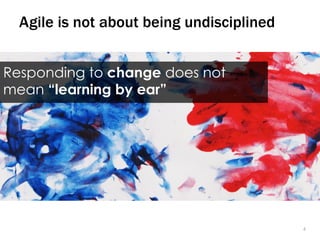
Agile is not about being undisciplined
Responding to change does not
mean “learning by ear”
55
Agile is a practice
Mature Agile frameworks
require a disciplined,
repeatable, process-
driven approach to
actively manage a
“scope in fieri”
66
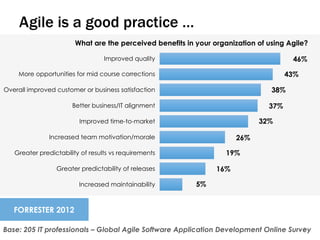
Agile is a good practice …
FORRESTER 2012
What are the perceived benefits in your organization of using Agile?
46%
43%
38%
37%
32%
26%
19%
16%
5%
Improved quality
More opportunities for mid course corrections
Overall improved customer or business satisfaction
Better business/IT alignment
Improved time-to-market
Increased team motivation/morale
Greater predictability of results vs requirements
Greater predictability of releases
Increased maintainability
Base: 205 IT professionals – Global Agile Software Application Development Online Survey
77
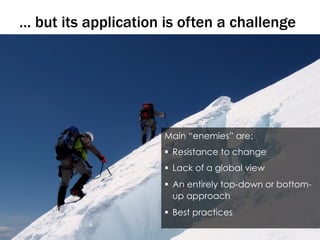
… but its application is often a challenge
Main “enemies” are:
§  Resistance to change
§  Lack of a global view
§  An entirely top-down or bottom-
up approach
§  Best practices
88
When does it worth
the effort to apply
an agile
approach?
The choice shall be
based both on
intrinsic and
extrinsic
characteristics of
the project
99
Intrinsic characteristics of the
project
1
Extrinsic characteristics of the
project2	
  
1010
Agility: at the heart of the matter 1/2
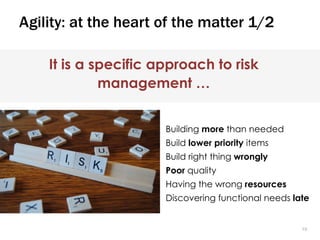
It is a specific approach to risk
management …
Building more than needed
Build lower priority items
Build right thing wrongly
Poor quality
Having the wrong resources
Discovering functional needs late
1111
Agility: at the heart of the matter 2/2
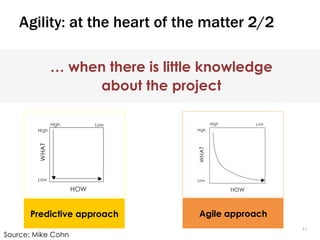
Predictive approach Agile approach
Source: Mike Cohn
… when there is little knowledge
about the project
1212
Agile approach
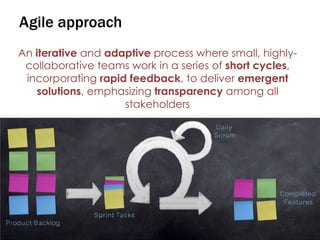
An iterative and adaptive process where small, highly-
collaborative teams work in a series of short cycles,
incorporating rapid feedback, to deliver emergent
solutions, emphasizing transparency among all
stakeholders
1313
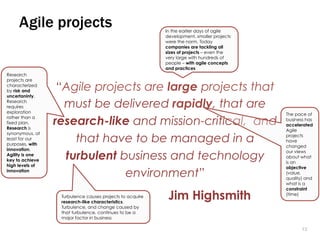
Agile projects
“Agile projects are large projects that
must be delivered rapidly, that are
research-like and mission-critical, and
that have to be managed in a
turbulent business and technology
environment”
Jim Highsmith
In the earlier days of agile
development, smaller projects
were the norm. Today
companies are tackling all
sizes of projects – even the
very large with hundreds of
people – with agile concepts
and practices
Research
projects are
characterized
by risk and
uncertaninty.
Research
requires
exploration
rather than a
fixed plan.
Research is
synonymous, at
least for our
purposes, with
innovation.
Agility is one
key to achieve
high levels of
innovation
The pace of
business has
accelerated
Agile
projects
have
changed
our views
about what
is an
objective
(value,
quality) and
what is a
constraint
(time)
Turbulence causes projects to acquire
research-like characteristics.
Turbulence, and change caused by
that turbulence, continues to be a
major factor in business
1414
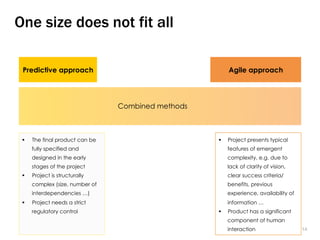
One size does not fit all
Predictive approach Agile approach
§  The final product can be
fully specified and
designed in the early
stages of the project
§  Project is structurally
complex (size, number of
interdependencies …)
§  Project needs a strict
regulatory control
§  Project presents typical
features of emergent
complexity, e.g. due to
lack of clarity of vision,
clear success criteria/
benefits, previous
experience, availability of
information …
§  Product has a significant
component of human
interaction
Combined methods
1515
Intrinsic characteristics of the
project
1
Extrinsic characteristics of the
project
2
1616
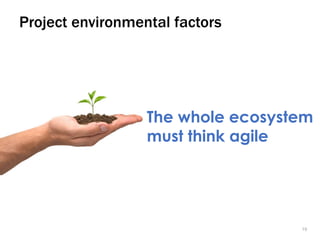
Project environmental factors
The whole ecosystem
must think agile
1717
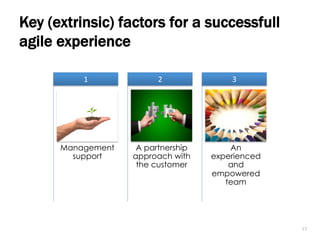
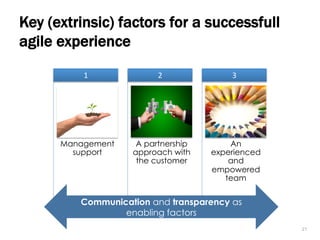
Management
support
1	
  
A partnership
approach with
the customer
2	
  
An
experienced
and
empowered
team
3	
  
Key (extrinsic) factors for a successfull
agile experience
1818
Management support
Management has to
clearly know risks and
benefits of an agile
approach
1919
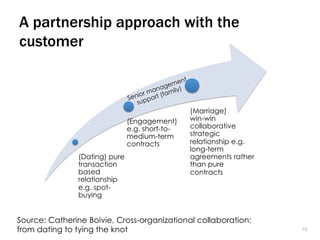
A partnership approach with the
customer
Source: Catherine Boivie, Cross-organizational collaboration:
from dating to tying the knot
(Dating) pure
transaction
based
relationship
e.g. spot-
buying
(Engagement)
e.g. short-to-
medium-term
contracts
(Marriage)
win-win
collaborative
strategic
relationship e.g.
long-term
agreements rather
than pure
contracts
Senior management
support (family)
2020
An experienced and empowered team
Everyone is
responsible,
everyone has the
authority
2121
Management
support
1	
  
A partnership
approach with
the customer
2	
  
An
experienced
and
empowered
team
3	
  
Key (extrinsic) factors for a successfull
agile experience
Communication and transparency as
enabling factors
2222
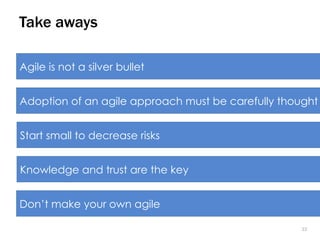
Take aways
Agile is not a silver bullet
Adoption of an agile approach must be carefully thought
Start small to decrease risks
Knowledge and trust are the key
Don’t make your own agile
2323
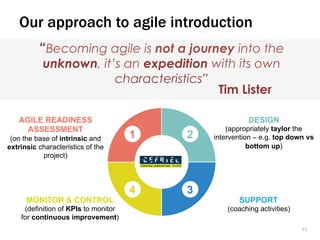
Our approach to agile introduction
AGILE READINESS
ASSESSMENT
(on the base of intrinsic and
extrinsic characteristics of the
project)
DESIGN
(appropriately taylor the
intervention – e.g. top down vs
bottom up)
MONITOR & CONTROL
(definition of KPIs to monitor
for continuous improvement)
SUPPORT
(coaching activities)
“Becoming agile is not a journey into the
unknown, it’s an expedition with its own
characteristics”
Tim Lister
2424
“We can never direct a living system, only
disturb it and wait to see the response … we
can’t know all the forces shaping an
organization we wish to change, so all we
can do is provoke the system in some way by
experimenting with a force we think ight have
some impact, then watch to see what
happens”
Conclusions 1/2
Christopher Avery
2525
A transparent and
shared view of the
future is the key
Conclusions 2/2
2626
Any
questions?

Agile methodologies for innovative software development projects

  • 1.
    Silvia Fragola – Trainerand coach on Agile Project Management silvia.fragola@cefriel.com @silviafragola May 25, 2015 Agile  methodologies  for  innova2ve     so3ware  development  projects
  • 2.
    22 Key points ofthe speech 1.  Illustrating the true essence of an agile approach 2.  Describing what kind of projects an agile approach best fits 3.  Giving the key elements to be successfully agile
  • 3.
    33 First of all animportant premise
  • 4.
    44 Agile is notabout being undisciplined Responding to change does not mean “learning by ear”
  • 5.
    55 Agile is apractice Mature Agile frameworks require a disciplined, repeatable, process- driven approach to actively manage a “scope in fieri”
  • 6.
    66 Agile is agood practice … FORRESTER 2012 What are the perceived benefits in your organization of using Agile? 46% 43% 38% 37% 32% 26% 19% 16% 5% Improved quality More opportunities for mid course corrections Overall improved customer or business satisfaction Better business/IT alignment Improved time-to-market Increased team motivation/morale Greater predictability of results vs requirements Greater predictability of releases Increased maintainability Base: 205 IT professionals – Global Agile Software Application Development Online Survey
  • 7.
    77 … but itsapplication is often a challenge Main “enemies” are: §  Resistance to change §  Lack of a global view §  An entirely top-down or bottom- up approach §  Best practices
  • 8.
    88 When does itworth the effort to apply an agile approach? The choice shall be based both on intrinsic and extrinsic characteristics of the project
  • 9.
    99 Intrinsic characteristics ofthe project 1 Extrinsic characteristics of the project2  
  • 10.
    1010 Agility: at theheart of the matter 1/2 It is a specific approach to risk management … Building more than needed Build lower priority items Build right thing wrongly Poor quality Having the wrong resources Discovering functional needs late
  • 11.
    1111 Agility: at theheart of the matter 2/2 Predictive approach Agile approach Source: Mike Cohn … when there is little knowledge about the project
  • 12.
    1212 Agile approach An iterativeand adaptive process where small, highly- collaborative teams work in a series of short cycles, incorporating rapid feedback, to deliver emergent solutions, emphasizing transparency among all stakeholders
  • 13.
    1313 Agile projects “Agile projectsare large projects that must be delivered rapidly, that are research-like and mission-critical, and that have to be managed in a turbulent business and technology environment” Jim Highsmith In the earlier days of agile development, smaller projects were the norm. Today companies are tackling all sizes of projects – even the very large with hundreds of people – with agile concepts and practices Research projects are characterized by risk and uncertaninty. Research requires exploration rather than a fixed plan. Research is synonymous, at least for our purposes, with innovation. Agility is one key to achieve high levels of innovation The pace of business has accelerated Agile projects have changed our views about what is an objective (value, quality) and what is a constraint (time) Turbulence causes projects to acquire research-like characteristics. Turbulence, and change caused by that turbulence, continues to be a major factor in business
  • 14.
    1414 One size doesnot fit all Predictive approach Agile approach §  The final product can be fully specified and designed in the early stages of the project §  Project is structurally complex (size, number of interdependencies …) §  Project needs a strict regulatory control §  Project presents typical features of emergent complexity, e.g. due to lack of clarity of vision, clear success criteria/ benefits, previous experience, availability of information … §  Product has a significant component of human interaction Combined methods
  • 15.
    1515 Intrinsic characteristics ofthe project 1 Extrinsic characteristics of the project 2
  • 16.
    1616 Project environmental factors Thewhole ecosystem must think agile
  • 17.
    1717 Management support 1   A partnership approachwith the customer 2   An experienced and empowered team 3   Key (extrinsic) factors for a successfull agile experience
  • 18.
    1818 Management support Management hasto clearly know risks and benefits of an agile approach
  • 19.
    1919 A partnership approachwith the customer Source: Catherine Boivie, Cross-organizational collaboration: from dating to tying the knot (Dating) pure transaction based relationship e.g. spot- buying (Engagement) e.g. short-to- medium-term contracts (Marriage) win-win collaborative strategic relationship e.g. long-term agreements rather than pure contracts Senior management support (family)
  • 20.
    2020 An experienced andempowered team Everyone is responsible, everyone has the authority
  • 21.
    2121 Management support 1   A partnership approachwith the customer 2   An experienced and empowered team 3   Key (extrinsic) factors for a successfull agile experience Communication and transparency as enabling factors
  • 22.
    2222 Take aways Agile isnot a silver bullet Adoption of an agile approach must be carefully thought Start small to decrease risks Knowledge and trust are the key Don’t make your own agile
  • 23.
    2323 Our approach toagile introduction AGILE READINESS ASSESSMENT (on the base of intrinsic and extrinsic characteristics of the project) DESIGN (appropriately taylor the intervention – e.g. top down vs bottom up) MONITOR & CONTROL (definition of KPIs to monitor for continuous improvement) SUPPORT (coaching activities) “Becoming agile is not a journey into the unknown, it’s an expedition with its own characteristics” Tim Lister
  • 24.
    2424 “We can neverdirect a living system, only disturb it and wait to see the response … we can’t know all the forces shaping an organization we wish to change, so all we can do is provoke the system in some way by experimenting with a force we think ight have some impact, then watch to see what happens” Conclusions 1/2 Christopher Avery
  • 25.
    2525 A transparent and sharedview of the future is the key Conclusions 2/2
  • 26.