Wisconsin .NET Users GroupSept 2009
Who Are We?Joseph ParadiInnovation Lead, Accenturejoseph.a.paradi@accenture.comWade WegnerArchitect Evangelist, Microsoftwade.wegner@microsoft.comhttp://blog.wadewegner.com/
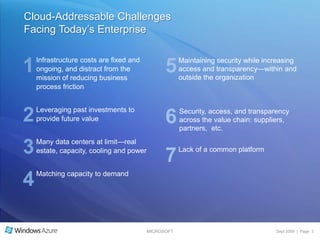
Cloud-Addressable ChallengesFacing Today’s Enterprise115Infrastructure costs are fixed and ongoing, and distract from the mission of reducing business process frictionLeveraging past investments to provide future valueMany data centers at limit—real estate, capacity, cooling and powerMatching capacity to demandMaintaining security while increasing access and transparency—within and outside the organization26Security, access, and transparency across the value chain: suppliers, partners,  etc.37Lack of a common platform4
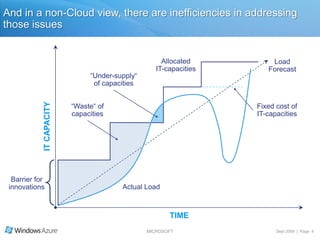
And in a non-Cloud view, there are inefficiencies in addressing those issuesAllocated IT-capacitiesLoad Forecast“Under-supply“ of capacities“Waste“ of capacitiesFixed cost of IT-capacitiesIT CAPACITYBarrier forinnovationsActualLoadTIME
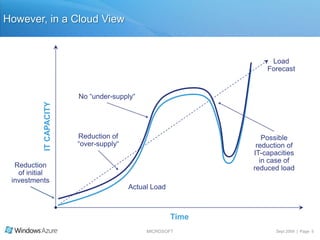
However, in a Cloud ViewLoad ForecastAllocated IT capacitiesNo “under-supply“IT CAPACITYReduction of “over-supply“Possible reduction of IT-capacities in case of reduced loadReduction of initial investmentsActualLoadTime
It has happened before
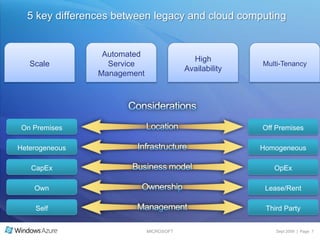
5 key differences between legacy and cloud computingScaleAutomated Service ManagementHigh AvailabilityMulti-TenancyConsiderationsOff PremisesOn PremisesLocationHomogeneousHeterogeneousInfrastructureCapExOpExBusiness modelOwnLease/RentOwnershipSelfThird PartyManagement
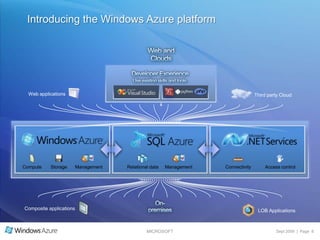
Introducing the Windows Azure platformWeb and CloudsDeveloper ExperienceThird party CloudWeb applicationsUse existing skills and tools.ComputeStorageManagementManagementRelational dataConnectivityAccess controlOn-premisesLOB ApplicationsComposite applications
Introducing Windows AzureDelivering the Reality of Cloud ComputingWindows Azure delivers Cloud computing for the enterprise“It’s the transformation of our software, it’s the transformation of our strategy and our offerings across the board to fundamentally embrace services.”–Ray Ozzie  Chief Software Architect  Microsoft
Comprehensive SLAsDependable performanceYears of Microsoft ExperienceFaster time to marketSpeedier developmentSimpler deploymentEfficiencyManage resources withless cost and effortFocusConcentrate on delivering solutions, not infrastructureTrustRely on a solid development platformAgilityRespond rapidly to changing needsRapid monetization Scalability without complexity Fewer operational hurdlesOn-demand computingElimination of idle IT capacityLower TCO Why Windows Azure
NEXT UP:Windows Azure Architecture
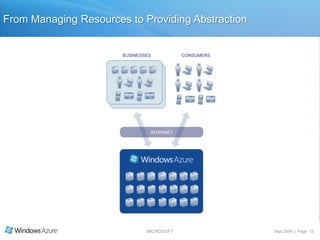
From Managing Resources to Providing AbstractionBUSINESSESCONSUMERSINTERNET
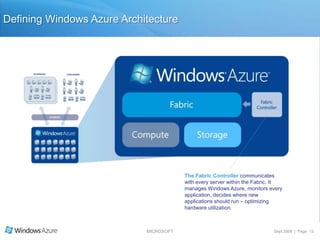
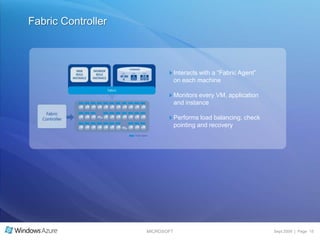
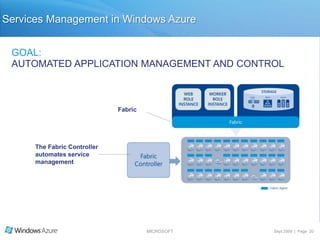
Defining Windows Azure ArchitectureFabricFabric controllerComputeStorageThe Fabric Controller communicates with every server within the Fabric. It manages Windows Azure, monitors every application, decides where new applications should run – optimizing hardware utilization.
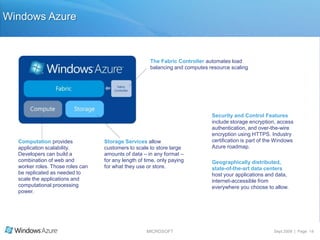
Windows AzureThe Fabric Controller automates load balancing and computes resource scalingSecurity and Control Features  include storage encryption, access authentication, and over-the-wire encryption using HTTPS. Industry certification is part of the Windows Azure roadmap.Computation provides application scalability.  Developers can build a combination of web and worker roles. Those roles can be replicated as needed to scale the applications and computational processing power.Storage Services allow customers to scale to store large amounts of data – in any format – for any length of time, only paying for what they use or store.Geographically distributed, state-of-the-art data centers host your applications and data, internet-accessible from everywhere you choose to allow.
Fabric ControllerInteracts with a “Fabric Agent” on each machineMonitors every VM, application and instancePerforms load balancing, check pointing and recovery
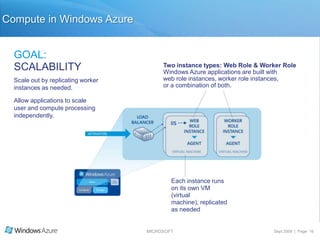
Compute in Windows AzureGOAL:SCALABILITYTwo instance types: Web Role & Worker RoleWindows Azure applications are built with web role instances, worker role instances, or a combination of both.Scale out by replicating worker instances as needed.Allow applications to scale user and compute processing independently.Each instance runs on its own VM (virtual machine), replicated as needed
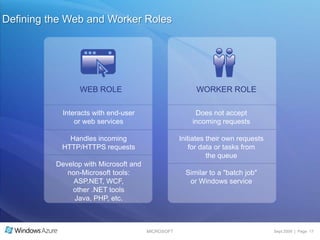
Defining the Web and Worker RolesWEB ROLEWORKER ROLEInteracts with end-useror web servicesHandles incomingHTTP/HTTPS requestsDevelop with Microsoft andnon-Microsoft tools:ASP.NET, WCF, other .NET toolsJava, PHP, etc.Does not acceptincoming requestsInitiates their own requestsfor data or tasks from the queueSimilar to a "batch job"or Windows service
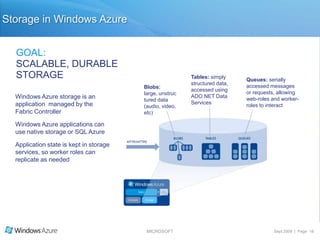
Storage in Windows AzureGOAL:SCALABLE, DURABLE STORAGETables: simply structured data, accessed using ADO.NET Data ServicesQueues: serially accessed messages or requests, allowing web-roles and worker-roles to interactBlobs: large, unstructured data (audio, video, etc)Windows Azure storage is an application  managed by the Fabric ControllerWindows Azure applications can use native storage or SQL AzureApplication state is kept in storage services, so worker roles can replicate as needed
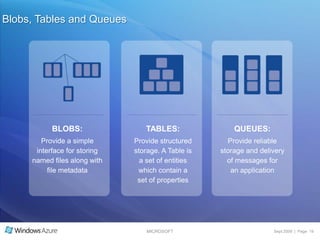
Blobs, Tables and QueuesBLOBS: Provide a simple interface for storing named files along with file metadataQUEUES: Provide reliable storage and delivery of messages for an applicationTABLES: Provide structured storage. A Table is a set of entities which contain a set of properties
Services Management in Windows AzureGOAL:AUTOMATED APPLICATION MANAGEMENT AND CONTROLFabricThe Fabric Controller automates service management
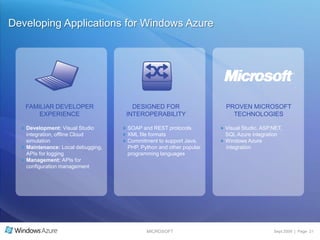
Developing Applications for Windows AzureFAMILIAR DEVELOPER EXPERIENCEDESIGNED FOR INTEROPERABILITYPROVEN MICROSOFT TECHNOLOGIESDevelopment: Visual Studio integration, offline Cloud simulationMaintenance: Local debugging, APIs for loggingManagement: APIs for configuration managementSOAP and REST protocols   XML file formatsCommitment to support Java, PHP, Python and other popular programming languagesVisual Studio, ASP.NET, SQL Azure integrationWindows Azure   integration
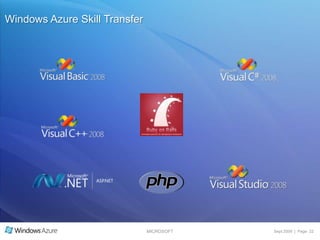
Windows Azure Skill Transfer
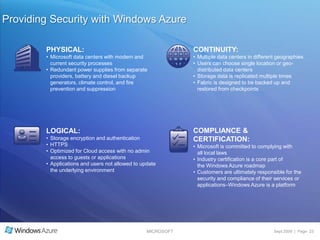
Providing Security with Windows AzurePHYSICAL:Microsoft data centers with modern and current security processes
Redundant power supplies from separate providers, battery and diesel backup generators, climate control, and fire prevention and suppressionCONTINUITY: Multiple data centers in different geographies
Users can choose single location or geo-distributed data centers
Storage data is replicated multiple times
Fabric is designed to be backed up and restored from checkpointsCOMPLIANCE & CERTIFICATION:Microsoft is committed to complying with all local laws
Industry certification is a core part of          the Windows Azure roadmap
Customers are ultimately responsible for the security and compliance of their services or applications–Windows Azure is a platformLOGICAL:Storage encryption and authentication
HTTPS
Optimized for Cloud access with no admin access to guests or applications
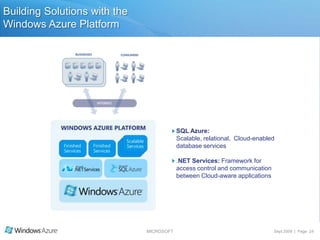
Applications and users not allowed to update the underlying environmentBuilding Solutions with the Windows Azure PlatformSQL Azure: Scalable, relational,  Cloud-enabled database services.NET Services: Framework for access control and communication between Cloud-aware applications
NEXT UP:SQL Azure Architecture
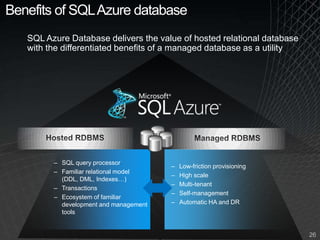
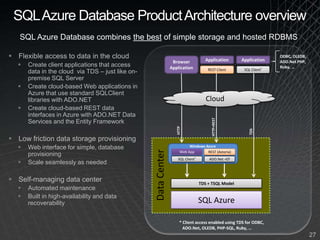
Benefits of SQL Azure databaseSQL Azure Database delivers the value of hosted relational database with the differentiated benefits of a managed database as a utilityHosted RDBMSManaged RDBMSSQL query processor
Familiar relational model (DDL, DML, Indexes…)
Transactions
Ecosystem of familiar development and management tools
Low-friction provisioning

Wisconsin .NET UG - Windows Azure

  • 1.
    Wisconsin .NET UsersGroupSept 2009
  • 2.
    Who Are We?JosephParadiInnovation Lead, Accenturejoseph.a.paradi@accenture.comWade WegnerArchitect Evangelist, Microsoftwade.wegner@microsoft.comhttp://blog.wadewegner.com/
  • 3.
    Cloud-Addressable ChallengesFacing Today’sEnterprise115Infrastructure costs are fixed and ongoing, and distract from the mission of reducing business process frictionLeveraging past investments to provide future valueMany data centers at limit—real estate, capacity, cooling and powerMatching capacity to demandMaintaining security while increasing access and transparency—within and outside the organization26Security, access, and transparency across the value chain: suppliers, partners, etc.37Lack of a common platform4
  • 4.
    And in anon-Cloud view, there are inefficiencies in addressing those issuesAllocated IT-capacitiesLoad Forecast“Under-supply“ of capacities“Waste“ of capacitiesFixed cost of IT-capacitiesIT CAPACITYBarrier forinnovationsActualLoadTIME
  • 5.
    However, in aCloud ViewLoad ForecastAllocated IT capacitiesNo “under-supply“IT CAPACITYReduction of “over-supply“Possible reduction of IT-capacities in case of reduced loadReduction of initial investmentsActualLoadTime
  • 6.
  • 7.
    5 key differencesbetween legacy and cloud computingScaleAutomated Service ManagementHigh AvailabilityMulti-TenancyConsiderationsOff PremisesOn PremisesLocationHomogeneousHeterogeneousInfrastructureCapExOpExBusiness modelOwnLease/RentOwnershipSelfThird PartyManagement
  • 8.
    Introducing the WindowsAzure platformWeb and CloudsDeveloper ExperienceThird party CloudWeb applicationsUse existing skills and tools.ComputeStorageManagementManagementRelational dataConnectivityAccess controlOn-premisesLOB ApplicationsComposite applications
  • 9.
    Introducing Windows AzureDeliveringthe Reality of Cloud ComputingWindows Azure delivers Cloud computing for the enterprise“It’s the transformation of our software, it’s the transformation of our strategy and our offerings across the board to fundamentally embrace services.”–Ray Ozzie Chief Software Architect Microsoft
  • 10.
    Comprehensive SLAsDependable performanceYearsof Microsoft ExperienceFaster time to marketSpeedier developmentSimpler deploymentEfficiencyManage resources withless cost and effortFocusConcentrate on delivering solutions, not infrastructureTrustRely on a solid development platformAgilityRespond rapidly to changing needsRapid monetization Scalability without complexity Fewer operational hurdlesOn-demand computingElimination of idle IT capacityLower TCO Why Windows Azure
  • 11.
  • 12.
    From Managing Resourcesto Providing AbstractionBUSINESSESCONSUMERSINTERNET
  • 13.
    Defining Windows AzureArchitectureFabricFabric controllerComputeStorageThe Fabric Controller communicates with every server within the Fabric. It manages Windows Azure, monitors every application, decides where new applications should run – optimizing hardware utilization.
  • 14.
    Windows AzureThe FabricController automates load balancing and computes resource scalingSecurity and Control Features include storage encryption, access authentication, and over-the-wire encryption using HTTPS. Industry certification is part of the Windows Azure roadmap.Computation provides application scalability. Developers can build a combination of web and worker roles. Those roles can be replicated as needed to scale the applications and computational processing power.Storage Services allow customers to scale to store large amounts of data – in any format – for any length of time, only paying for what they use or store.Geographically distributed, state-of-the-art data centers host your applications and data, internet-accessible from everywhere you choose to allow.
  • 15.
    Fabric ControllerInteracts witha “Fabric Agent” on each machineMonitors every VM, application and instancePerforms load balancing, check pointing and recovery
  • 16.
    Compute in WindowsAzureGOAL:SCALABILITYTwo instance types: Web Role & Worker RoleWindows Azure applications are built with web role instances, worker role instances, or a combination of both.Scale out by replicating worker instances as needed.Allow applications to scale user and compute processing independently.Each instance runs on its own VM (virtual machine), replicated as needed
  • 17.
    Defining the Weband Worker RolesWEB ROLEWORKER ROLEInteracts with end-useror web servicesHandles incomingHTTP/HTTPS requestsDevelop with Microsoft andnon-Microsoft tools:ASP.NET, WCF, other .NET toolsJava, PHP, etc.Does not acceptincoming requestsInitiates their own requestsfor data or tasks from the queueSimilar to a "batch job"or Windows service
  • 18.
    Storage in WindowsAzureGOAL:SCALABLE, DURABLE STORAGETables: simply structured data, accessed using ADO.NET Data ServicesQueues: serially accessed messages or requests, allowing web-roles and worker-roles to interactBlobs: large, unstructured data (audio, video, etc)Windows Azure storage is an application managed by the Fabric ControllerWindows Azure applications can use native storage or SQL AzureApplication state is kept in storage services, so worker roles can replicate as needed
  • 19.
    Blobs, Tables andQueuesBLOBS: Provide a simple interface for storing named files along with file metadataQUEUES: Provide reliable storage and delivery of messages for an applicationTABLES: Provide structured storage. A Table is a set of entities which contain a set of properties
  • 20.
    Services Management inWindows AzureGOAL:AUTOMATED APPLICATION MANAGEMENT AND CONTROLFabricThe Fabric Controller automates service management
  • 21.
    Developing Applications forWindows AzureFAMILIAR DEVELOPER EXPERIENCEDESIGNED FOR INTEROPERABILITYPROVEN MICROSOFT TECHNOLOGIESDevelopment: Visual Studio integration, offline Cloud simulationMaintenance: Local debugging, APIs for loggingManagement: APIs for configuration managementSOAP and REST protocols XML file formatsCommitment to support Java, PHP, Python and other popular programming languagesVisual Studio, ASP.NET, SQL Azure integrationWindows Azure integration
  • 22.
  • 23.
    Providing Security withWindows AzurePHYSICAL:Microsoft data centers with modern and current security processes
  • 24.
    Redundant power suppliesfrom separate providers, battery and diesel backup generators, climate control, and fire prevention and suppressionCONTINUITY: Multiple data centers in different geographies
  • 25.
    Users can choosesingle location or geo-distributed data centers
  • 26.
    Storage data isreplicated multiple times
  • 27.
    Fabric is designedto be backed up and restored from checkpointsCOMPLIANCE & CERTIFICATION:Microsoft is committed to complying with all local laws
  • 28.
    Industry certification isa core part of the Windows Azure roadmap
  • 29.
    Customers are ultimatelyresponsible for the security and compliance of their services or applications–Windows Azure is a platformLOGICAL:Storage encryption and authentication
  • 30.
  • 31.
    Optimized for Cloudaccess with no admin access to guests or applications
  • 32.
    Applications and usersnot allowed to update the underlying environmentBuilding Solutions with the Windows Azure PlatformSQL Azure: Scalable, relational, Cloud-enabled database services.NET Services: Framework for access control and communication between Cloud-aware applications
  • 33.
    NEXT UP:SQL AzureArchitecture
  • 34.
    Benefits of SQLAzure databaseSQL Azure Database delivers the value of hosted relational database with the differentiated benefits of a managed database as a utilityHosted RDBMSManaged RDBMSSQL query processor
  • 35.
    Familiar relational model(DDL, DML, Indexes…)
  • 36.
  • 37.
    Ecosystem of familiardevelopment and management tools
  • 38.