Submitted by: Saheed Shittu &
Satbir Singh
MADS 6610, Organizational
Decision Making
Prof. Dr. Amit Kohli
July 05, 2022
Table of Contents
1. Brief history of the company
2. Problems due to bad decisions by the company
3. Application of decision-making tool
4. Implementation of the solution
5. Impact on the company after utilization of decision-
making tool
6. Conclusion
7. References
2
History of Nestlé
3
Nestle is a Swiss multinational food and beverage company.
History begins in 1866 when the Anglo-Swiss Condensed Milk Company opens
the first European condensed milk factory in Switzerland.
In 1867, Nestlé’s founder, German-born pharmacist Henri Nestlé, launches his
‘farine lactée’ (infant food) in Vevey, Switzerland.
In 1905, Anglo-Swiss and Nestlé merge to form the Nestlé & Anglo-Swiss Milk
Company.
History of Nestlé (cont’d.)
• It operates in 186 countries with about 354 factories
• The company had two head offices, in Vevey and Cham, and opened a third office in
London to drive dairy export sales.
• It is the world’s largest foodstuff company.
4
History of Nestlé (cont’d.)
• Its staff strength is around 270,000 people.
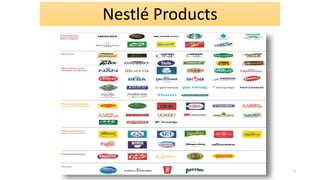
• The company has over 2,000 brands
• Products made by Nestle include baby food, bottled water, breakfast cereals, coffee and
tea, confectionery, dairy products, ice cream, frozen food, pet foods, and snacks.
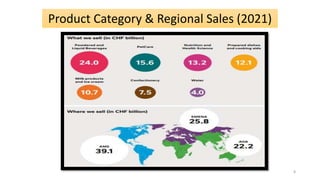
• The Beverage category, which includes mainly coffee and cocoa malt beverages, accounts
for 27.5% of its sales.
5
History of Nestlé (cont’d.)
• Its largest market is in the US with $28 billion of sales
• In 2021, the sales amounted to CHF(Swiss Franc) 87.1 billion. (USD 95 billion)
• It spends CHF 1.7 billion on research & development with a staff of about 4100
employees
(Nestle website, www.nestle.com)
6
Nestlé Products
7
8
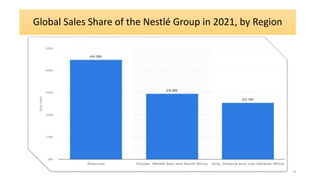
Product Category & Regional Sales (2021)
Global Sales Share of the Nestlé Group in 2021, by Region
9
Bad Decisions Made by Nestlé
10
Baby infant formula Pelargon introduced by nestle,
In the 1970s, Nestle was accused of causing third-world women to become dependent on infant milk formula,
It had fewer nutrients and was more expensive,
Babies died because their mothers bottle-fed them with Western-style newborn milk in impoverished cities in Asia,
Africa, and Latin America (Krasny, 2012).
The formula increased infant mortality by 9.4 per 1000 births, (Jesse, 2018: National Bureau Of Economic Research)
It is estimated that nearly 66,000 babies died in 1981 at the peak of the infant formula controversy (Jesse, 2018)
Problems faced due to bad decision made by
Nestlé
11
Product boycott: Rights groups (IBFAN, BMA; INBC)
Reputational damage (Andrei, 2021)
Loss of customer trust
High cost of public relations to redeem the company’s image
Decrease in brand loyalty
Application
of Decision-
Making Tool
12
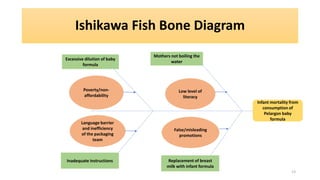
Ishikawa Fish Bone Diagram
13
Infant mortality from
consumption of
Pelargon baby
formula
Mothers not boiling the
water
Excessive dilution of baby
formula
Replacement of breast
milk with infant formula
Inadequate instructions
Poverty/non-
affordability
Low level of
literacy
Language barrier
and inefficiency
of the packaging
team
False/misleading
promotions
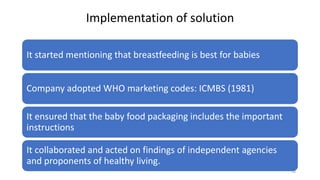
Implementation of solution
It started mentioning that breastfeeding is best for babies
Company adopted WHO marketing codes: ICMBS (1981)
It ensured that the baby food packaging includes the important
instructions
It collaborated and acted on findings of independent agencies
and proponents of healthy living.
14
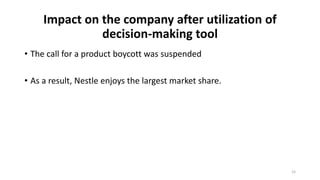
Impact on the company after utilization of
decision-making tool
• The call for a product boycott was suspended
• As a result, Nestle enjoys the largest market share.
15
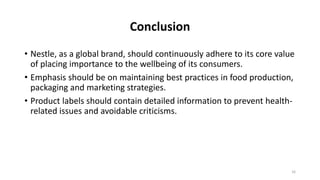
Conclusion
• Nestle, as a global brand, should continuously adhere to its core value
of placing importance to the wellbeing of its consumers.
• Emphasis should be on maintaining best practices in food production,
packaging and marketing strategies.
• Product labels should contain detailed information to prevent health-
related issues and avoidable criticisms.
16
References
• Andrei, M. (2021). Why Nestle is one of the most hated companies in the world.
https://www.zmescience.com/science/nestle-company-pollution-children/
• Anttila-Hughes, J., Fernald, L., Gertler, P., Krause, P., & Wydick, B. (2018). Mortality from Nestlé’s Marketing
of Infant Formula in Low and Middle-Income Countries. National Bureau of Economic Research. DOI
10.3386/w24452. https://www.nber.org/papers/w24452
• Boyd, C. (2012). The Nestlé Infant Formula Controversy and a Strange Web of Subsequent Business Scandals.
Journal of Business Ethics, Vol. 106, No. 3 pp. 283-293. https://www-jstor-
org.libaccess.fdu.edu/stable/pdf/41426691.pdf?refreqid=excelsior%3Ad8c2cf0cdcfa7504c07eb93829c4c1c0
&ab_segments=&origin=&acceptTC=1
• Nelsen, A. (2018). Nestlé under fire for marketing claims on baby milk formulas. The Guardian News.
https://www.theguardian.com/business/2018/feb/01/nestle-under-fire-for-marketing-claims-on-baby-milk-
formulas
• Nestle website. https://www.nestle.com/sites/default/files/asset-
library/documents/reports/csv%20reports/environmental%20sustainability/sustainability_review_english.pd
f
• Tanrikulu, H., Neri, D., Robertson, A., & Mialon, M. (2020). Corporate political activity of the baby food
industry: the example of Nestlé in the United States of America. International Breastfeeding Journal, Vol.
15(22), https://doi.org/10.1186/s13006-020-00268-x
17

Nestle.pptx

  • 1.
    Submitted by: SaheedShittu & Satbir Singh MADS 6610, Organizational Decision Making Prof. Dr. Amit Kohli July 05, 2022
  • 2.
    Table of Contents 1.Brief history of the company 2. Problems due to bad decisions by the company 3. Application of decision-making tool 4. Implementation of the solution 5. Impact on the company after utilization of decision- making tool 6. Conclusion 7. References 2
  • 3.
    History of Nestlé 3 Nestleis a Swiss multinational food and beverage company. History begins in 1866 when the Anglo-Swiss Condensed Milk Company opens the first European condensed milk factory in Switzerland. In 1867, Nestlé’s founder, German-born pharmacist Henri Nestlé, launches his ‘farine lactée’ (infant food) in Vevey, Switzerland. In 1905, Anglo-Swiss and Nestlé merge to form the Nestlé & Anglo-Swiss Milk Company.
  • 4.
    History of Nestlé(cont’d.) • It operates in 186 countries with about 354 factories • The company had two head offices, in Vevey and Cham, and opened a third office in London to drive dairy export sales. • It is the world’s largest foodstuff company. 4
  • 5.
    History of Nestlé(cont’d.) • Its staff strength is around 270,000 people. • The company has over 2,000 brands • Products made by Nestle include baby food, bottled water, breakfast cereals, coffee and tea, confectionery, dairy products, ice cream, frozen food, pet foods, and snacks. • The Beverage category, which includes mainly coffee and cocoa malt beverages, accounts for 27.5% of its sales. 5
  • 6.
    History of Nestlé(cont’d.) • Its largest market is in the US with $28 billion of sales • In 2021, the sales amounted to CHF(Swiss Franc) 87.1 billion. (USD 95 billion) • It spends CHF 1.7 billion on research & development with a staff of about 4100 employees (Nestle website, www.nestle.com) 6
  • 7.
  • 8.
    8 Product Category &Regional Sales (2021)
  • 9.
    Global Sales Shareof the Nestlé Group in 2021, by Region 9
  • 10.
    Bad Decisions Madeby Nestlé 10 Baby infant formula Pelargon introduced by nestle, In the 1970s, Nestle was accused of causing third-world women to become dependent on infant milk formula, It had fewer nutrients and was more expensive, Babies died because their mothers bottle-fed them with Western-style newborn milk in impoverished cities in Asia, Africa, and Latin America (Krasny, 2012). The formula increased infant mortality by 9.4 per 1000 births, (Jesse, 2018: National Bureau Of Economic Research) It is estimated that nearly 66,000 babies died in 1981 at the peak of the infant formula controversy (Jesse, 2018)
  • 11.
    Problems faced dueto bad decision made by Nestlé 11 Product boycott: Rights groups (IBFAN, BMA; INBC) Reputational damage (Andrei, 2021) Loss of customer trust High cost of public relations to redeem the company’s image Decrease in brand loyalty
  • 12.
  • 13.
    Ishikawa Fish BoneDiagram 13 Infant mortality from consumption of Pelargon baby formula Mothers not boiling the water Excessive dilution of baby formula Replacement of breast milk with infant formula Inadequate instructions Poverty/non- affordability Low level of literacy Language barrier and inefficiency of the packaging team False/misleading promotions
  • 14.
    Implementation of solution Itstarted mentioning that breastfeeding is best for babies Company adopted WHO marketing codes: ICMBS (1981) It ensured that the baby food packaging includes the important instructions It collaborated and acted on findings of independent agencies and proponents of healthy living. 14
  • 15.
    Impact on thecompany after utilization of decision-making tool • The call for a product boycott was suspended • As a result, Nestle enjoys the largest market share. 15
  • 16.
    Conclusion • Nestle, asa global brand, should continuously adhere to its core value of placing importance to the wellbeing of its consumers. • Emphasis should be on maintaining best practices in food production, packaging and marketing strategies. • Product labels should contain detailed information to prevent health- related issues and avoidable criticisms. 16
  • 17.
    References • Andrei, M.(2021). Why Nestle is one of the most hated companies in the world. https://www.zmescience.com/science/nestle-company-pollution-children/ • Anttila-Hughes, J., Fernald, L., Gertler, P., Krause, P., & Wydick, B. (2018). Mortality from Nestlé’s Marketing of Infant Formula in Low and Middle-Income Countries. National Bureau of Economic Research. DOI 10.3386/w24452. https://www.nber.org/papers/w24452 • Boyd, C. (2012). The Nestlé Infant Formula Controversy and a Strange Web of Subsequent Business Scandals. Journal of Business Ethics, Vol. 106, No. 3 pp. 283-293. https://www-jstor- org.libaccess.fdu.edu/stable/pdf/41426691.pdf?refreqid=excelsior%3Ad8c2cf0cdcfa7504c07eb93829c4c1c0 &ab_segments=&origin=&acceptTC=1 • Nelsen, A. (2018). Nestlé under fire for marketing claims on baby milk formulas. The Guardian News. https://www.theguardian.com/business/2018/feb/01/nestle-under-fire-for-marketing-claims-on-baby-milk- formulas • Nestle website. https://www.nestle.com/sites/default/files/asset- library/documents/reports/csv%20reports/environmental%20sustainability/sustainability_review_english.pd f • Tanrikulu, H., Neri, D., Robertson, A., & Mialon, M. (2020). Corporate political activity of the baby food industry: the example of Nestlé in the United States of America. International Breastfeeding Journal, Vol. 15(22), https://doi.org/10.1186/s13006-020-00268-x 17