Regione Puglia
Area Politiche per lo Sviluppo economico,
Il lavoro e l’innovazione

Apulia Regional Government
Research & Innovation Department
InnovaPuglia spa

LIVING LAB: SPACE FOR REGIONS
Bari, February 28th 2014

http://livinglabs.regione.puglia.it
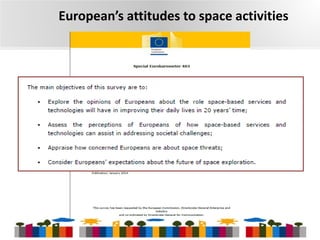
European’s attitudes to space activities

2
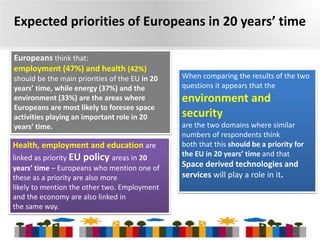
Expected priorities of Europeans in 20 years’ time
Europeans think that:
employment (47%) and health (42%)
should be the main priorities of the EU in 20
years’ time, while energy (37%) and the
environment (33%) are the areas where
Europeans are most likely to foresee space
activities playing an important role in 20
years’ time.

Health, employment and education are
linked as priority EU policy areas in 20
years’ time – Europeans who mention one of
these as a priority are also more
likely to mention the other two. Employment
and the economy are also linked in
the same way.

When comparing the results of the two
questions it appears that the

environment and
security
are the two domains where similar
numbers of respondents think
both that this should be a priority for
the EU in 20 years’ time and that

Space derived technologies and
services will play a role in it.

3
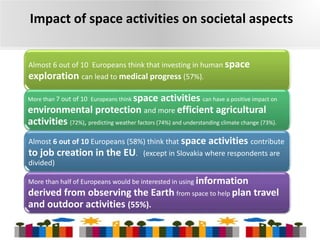
Impact of space activities on societal aspects
Almost 6 out of 10 Europeans think that investing in human space
exploration can lead to medical progress (57%).

space activities can have a positive impact on
environmental protection and more efficient agricultural
activities (72%), predicting weather factors (74%) and understanding climate change (73%).
More than 7 out of 10 Europeans think

Almost 6 out of 10 Europeans (58%) think that space activities contribute
to job creation in the EU. (except in Slovakia where respondents are
divided)
More than half of Europeans would be interested in using information

derived from observing the Earth from space to help plan travel
and outdoor activities (55%).
4
Impact of space activities on societal aspects
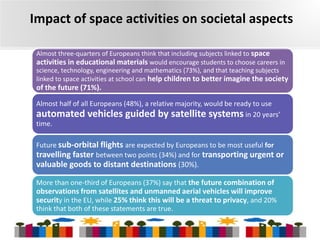
Almost three-quarters of Europeans think that including subjects linked to space
activities in educational materials would encourage students to choose careers in
science, technology, engineering and mathematics (73%), and that teaching subjects
linked to space activities at school can help children to better imagine the society

of the future (71%).
Almost half of all Europeans (48%), a relative majority, would be ready to use
automated vehicles guided by satellite systems in 20 years’
time.
Future sub-orbital flights are expected by Europeans to be most useful for
travelling faster between two points (34%) and for transporting urgent or

valuable goods to distant destinations (30%).
More than one-third of Europeans (37%) say that the future combination of

observations from satellites and unmanned aerial vehicles will improve
security in the EU, while 25% think this will be a threat to privacy, and 20%
think that both of these statements are true.
5
Europeans and space threats

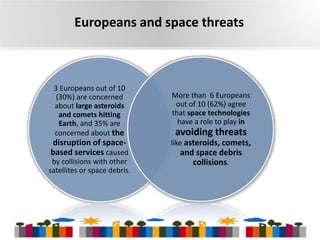
3 Europeans out of 10
(30%) are concerned
about large asteroids
and comets hitting
Earth, and 35% are
concerned about the

disruption of spacebased services caused
by collisions with other
satellites or space debris.

More than 6 Europeans
out of 10 (62%) agree
that space technologies
have a role to play in

avoiding threats
like asteroids, comets,

and space debris
collisions.

6
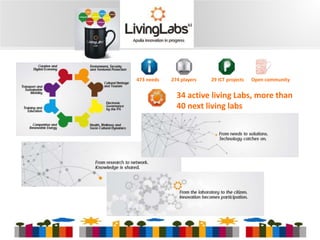
473 needs

274 players

29 ICT projects

Open community

34 active living Labs, more than
40 next living labs

7
Project Sectorial areas
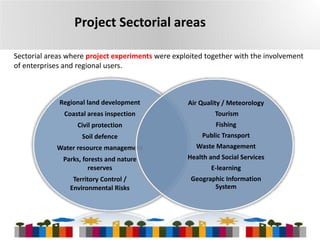
Sectorial areas where project experiments were exploited together with the involvement
of enterprises and regional users.

Regional land development

Air Quality / Meteorology

Coastal areas inspection

Tourism

Civil protection

Fishing

Soil defence

Public Transport

Water resource management

Waste Management

Parks, forests and nature
reserves

Health and Social Services

Territory Control /
Environmental Risks

Geographic Information
System

E-learning

8
Regione
Europeans and space exploration Puglia
Area Politiche per lo Sviluppo economico,
Il lavoro e l’innovazione

There is no clear consensus among Europeans about how important it is for the
Apulia Regional Government
EU to invest further in space exploration: 47% say it is important, while 46% say
Research & Innovation Department
it is not important.
InnovaPuglia spa

Europeans who think that further investment in space exploration is
important highlight the following reasons: to develop and test new
technologies (63%) and to make unexpected scientific discoveries (53%).
LIVING LAB: SPACE FOR
These represent 29% and 24 of all the respondents respectively.

REGIONS

Focus space Spazio 20 is
Europeans who do not think further investment in Groupexploration febbraio 2014
important are most likely to say this because they think there are other more
pressing issues (72%). This represents a third of all the respondents (33%). This
result might be linked to the current overall socio-economic context.

9

http://livinglabs.regione.puglia.it
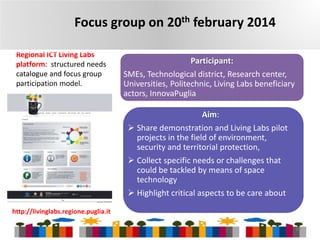
Focus group on 20th february 2014
Regional ICT Living Labs
platform: structured needs
catalogue and focus group
participation model.

Participant:
SMEs, Technological district, Research center,
Universities, Politechnic, Living Labs beneficiary
actors, InnovaPuglia
Aim:
 Share demonstration and Living Labs pilot
projects in the field of environment,
security and territorial protection,
 Collect specific needs or challenges that
could be tackled by means of space
technology
 Highlight critical aspects to be care about

http://livinglabs.regione.puglia.it
10
Regional answers from the living labs network

1. WHAT has already been developed in
Puglia?
2. HOW SPACE technologies and
services intercepted and satisfied
users requirements or needs?

3. With WHOM was
built?

the solution

11
Questions for the stakeholders
1.

2.
3.

LIVING LAB: SPACE FOR REGIONS
Bari, February 28th 2014

4.

Output:
Mobilising ‘demand’ of services built on a stack of
public and freely available data.
Stepping up any necessary regulation and
interoperability standards.
Identify and promote education and training in
secondary school and university on specific space
technology.
Encourage research and development efforts on
•



Real time satellite image for security,
emergency and monitoring;
Remote observation of the subsoil for sub-land
infrastructure register;
Satellite monitoring of Cultural heritage.

12

Nereus 28 02 14- Presentazione chieco_def

  • 1.
    Regione Puglia Area Politicheper lo Sviluppo economico, Il lavoro e l’innovazione Apulia Regional Government Research & Innovation Department InnovaPuglia spa LIVING LAB: SPACE FOR REGIONS Bari, February 28th 2014 http://livinglabs.regione.puglia.it
  • 2.
    European’s attitudes tospace activities 2
  • 3.
    Expected priorities ofEuropeans in 20 years’ time Europeans think that: employment (47%) and health (42%) should be the main priorities of the EU in 20 years’ time, while energy (37%) and the environment (33%) are the areas where Europeans are most likely to foresee space activities playing an important role in 20 years’ time. Health, employment and education are linked as priority EU policy areas in 20 years’ time – Europeans who mention one of these as a priority are also more likely to mention the other two. Employment and the economy are also linked in the same way. When comparing the results of the two questions it appears that the environment and security are the two domains where similar numbers of respondents think both that this should be a priority for the EU in 20 years’ time and that Space derived technologies and services will play a role in it. 3
  • 4.
    Impact of spaceactivities on societal aspects Almost 6 out of 10 Europeans think that investing in human space exploration can lead to medical progress (57%). space activities can have a positive impact on environmental protection and more efficient agricultural activities (72%), predicting weather factors (74%) and understanding climate change (73%). More than 7 out of 10 Europeans think Almost 6 out of 10 Europeans (58%) think that space activities contribute to job creation in the EU. (except in Slovakia where respondents are divided) More than half of Europeans would be interested in using information derived from observing the Earth from space to help plan travel and outdoor activities (55%). 4
  • 5.
    Impact of spaceactivities on societal aspects Almost three-quarters of Europeans think that including subjects linked to space activities in educational materials would encourage students to choose careers in science, technology, engineering and mathematics (73%), and that teaching subjects linked to space activities at school can help children to better imagine the society of the future (71%). Almost half of all Europeans (48%), a relative majority, would be ready to use automated vehicles guided by satellite systems in 20 years’ time. Future sub-orbital flights are expected by Europeans to be most useful for travelling faster between two points (34%) and for transporting urgent or valuable goods to distant destinations (30%). More than one-third of Europeans (37%) say that the future combination of observations from satellites and unmanned aerial vehicles will improve security in the EU, while 25% think this will be a threat to privacy, and 20% think that both of these statements are true. 5
  • 6.
    Europeans and spacethreats 3 Europeans out of 10 (30%) are concerned about large asteroids and comets hitting Earth, and 35% are concerned about the disruption of spacebased services caused by collisions with other satellites or space debris. More than 6 Europeans out of 10 (62%) agree that space technologies have a role to play in avoiding threats like asteroids, comets, and space debris collisions. 6
  • 7.
    473 needs 274 players 29ICT projects Open community 34 active living Labs, more than 40 next living labs 7
  • 8.
    Project Sectorial areas Sectorialareas where project experiments were exploited together with the involvement of enterprises and regional users. Regional land development Air Quality / Meteorology Coastal areas inspection Tourism Civil protection Fishing Soil defence Public Transport Water resource management Waste Management Parks, forests and nature reserves Health and Social Services Territory Control / Environmental Risks Geographic Information System E-learning 8
  • 9.
    Regione Europeans and spaceexploration Puglia Area Politiche per lo Sviluppo economico, Il lavoro e l’innovazione There is no clear consensus among Europeans about how important it is for the Apulia Regional Government EU to invest further in space exploration: 47% say it is important, while 46% say Research & Innovation Department it is not important. InnovaPuglia spa Europeans who think that further investment in space exploration is important highlight the following reasons: to develop and test new technologies (63%) and to make unexpected scientific discoveries (53%). LIVING LAB: SPACE FOR These represent 29% and 24 of all the respondents respectively. REGIONS Focus space Spazio 20 is Europeans who do not think further investment in Groupexploration febbraio 2014 important are most likely to say this because they think there are other more pressing issues (72%). This represents a third of all the respondents (33%). This result might be linked to the current overall socio-economic context. 9 http://livinglabs.regione.puglia.it
  • 10.
    Focus group on20th february 2014 Regional ICT Living Labs platform: structured needs catalogue and focus group participation model. Participant: SMEs, Technological district, Research center, Universities, Politechnic, Living Labs beneficiary actors, InnovaPuglia Aim:  Share demonstration and Living Labs pilot projects in the field of environment, security and territorial protection,  Collect specific needs or challenges that could be tackled by means of space technology  Highlight critical aspects to be care about http://livinglabs.regione.puglia.it 10
  • 11.
    Regional answers fromthe living labs network 1. WHAT has already been developed in Puglia? 2. HOW SPACE technologies and services intercepted and satisfied users requirements or needs? 3. With WHOM was built? the solution 11
  • 12.
    Questions for thestakeholders 1. 2. 3. LIVING LAB: SPACE FOR REGIONS Bari, February 28th 2014 4. Output: Mobilising ‘demand’ of services built on a stack of public and freely available data. Stepping up any necessary regulation and interoperability standards. Identify and promote education and training in secondary school and university on specific space technology. Encourage research and development efforts on •   Real time satellite image for security, emergency and monitoring; Remote observation of the subsoil for sub-land infrastructure register; Satellite monitoring of Cultural heritage. 12