Nephrotic
Syndrome/Primary
Glomerulopathies
Prof. Joshua K. Kayima
Glomerular Diseases
1. Various diseases affect the glomerulus
they could be inflammatory or non-
inflammatory
2. Diseases lead to alterations glomerular
permiability [Proteinuria] ; structure
[Histology] ; and function [GRF].
[Contd.] Glomerular Disease
 Glomerular disease can be primary [restricted in
clinical manifestation to the kidney, with unknown
cause]
 Or secondary (secondary to known primary
conditions or part of a multisystem disease)
E.g. systemic lupus
Vasculitis
HIV / HBV / HCV
Diabetes mellitus
Disease expression.
The hallmark of glomerular disease is the
excretion of protein in urine
 Presentations
Asymptomatic urinary abnormalities
Acute glomerulonephritis
Rapidly progressive glomerulonephritis
Chronic glomerulonephritis
Nephrotic syndrome
(Overlap syndromes)
Nephrotic Syndrome
 Key component = PROTEINURIA (severe/heavy)
Def.: > 3.5g/1.73m2
/24 hrs
Practice: > 2.5 – 3g/24 hrs
 Other components of the syndrome and metabolic
complications are all 2°
to proteinuria
(cont.) Other Components of
Syndrome
 Hypoalbuminemia
 Oedema
 Dyslipidaemia (Hyperlipidemia)
 Lipiduria
 Hypercoagulability
Pathology
 Nephrotic syndrome can complicate any disease that
 Perturbes
negative electrostatic charge or
architecture of:
a) GBM and
b) Podocytes and
c) their slit diaphragms
 Molecules mediating GBM – Podocyte – slit diaphragm
interactions
nephrin, podocin
alpha-actin-4
Interest in mechanism of disease
Causes of Nephrotic Syndrome
Idiopathic
Post infectious
Viruses [Hepatitis B, C, HIV, measles, EBV]
Bacteria [streptococcal, syphilis]
Parasites [plasmodiam malarie, schistosoma]
 Vasculitis /Collagen [SLE, Wegener’s, Henoch-
Schönlein purpura PAN, Good pasture’s]
Causes of Nephrotic Syndrome
[Contd.]
Systemic diseases [Diabetes Mellitus,
amyloidosis]
Drugs/chemicals [Penicillamine, captopril,
gold, Mg]
Allergy [Drugs, vaccines, stings]
Malignancies – [colon, prostate, lung, breast]
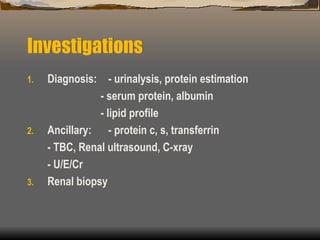
Investigations
1. Diagnosis: - urinalysis, protein estimation
- serum protein, albumin
- lipid profile
2. Ancillary: - protein c, s, transferrin
- TBC, Renal ultrasound, C-xray
- U/E/Cr
3. Renal biopsy
Investigations [Contd.]
4. Cause a) clinical examination
b) ASOT, Anti-DNAse, VDRL,
HBs Ag, HCVAb, HIV Elisa, B/S-
MPs, stool, urine micro Blood
sugar, C3 – levels, ANA ,anti -
GBM, ANCA, Anti PLA 2R Ab
Culture (throat, discharges,
skin, blood urine)
Histologic entities [Common]
 Minimal change disease (MCD)
 Mesangial proliferative GN
 Focal and segmental glomerulosclerosis (FSGS)
 Membranous glomerulopathy
 Membranoproliferative glomerulonephritis (MPGN)
 Diabetic nephropathy
 Amyloidosis
Renal Biopsy
 Valuable- Adults
 Probably even paediatrics locally
30 – 45% minimal change disease (MCD)
Definitive diagnosis
Guiding therapy
Assessing prognosis
Pathogenesis
 Some Nephrotic patients may have expanded
plasma volume
RAA – axis suppressed
Yet with oedema
 1o
renal salt/H2O retention may be responsible
for oedema ? GN
Hypoalbuminaemia
 ↑ Urinary loss
 ↓ Synthesis – Liver
 ↑ Catabolism - Renal
Dyslipidemia (Hyper-)
 2o
to:
i) ↑ hepatic lipoprotein synthesis due to
↓ oncotic pressure
ii) ↑ urinary loss of proteins (regulate
lipid homeostasis)
iii) Defective lipid catabolism
 ↑ LDL-c, ↑ Total Chol – usual
 ↑ TG, ↑ VLDL-c – late
 Effects - Accelerate artherosclerosis
- Progression of CKD
Hypercoagulability
 Fibrinolysis
 ↑ Conc. of Fibrinogen
 Factor V, VII, VIII, X
 ↑ Platelet aggregation
 Accelerated thromboplastin generation
 Loss of ATIII, protein-C, protein-S
 Hypo-volaemia
Complication of hypercoagulability
 Renal vein thrombosis → renal necrosis
 DVT → PTE
 Sagittal sinus thrombosis
 Arterial thrombosis
→ organ Ischaemia
Infections
 1 gG loss in urine
 ↑ Catabolism
Infections in Nephrotic Syndrome
 1o
peritonitis
 Bacteremia
 Septicaemia
 Cellulitis – Strep pneumoniae
β- hemolytic strptococci
E. coli
Klebsiella
 ↓ Immune function
predispose to viral infections
e.g. measles (varicella)
“Transport – Proteins” Loss
Transferrin - microcytic anaemia
Cholecalciferol - binding protein
- Vit D deficiency,
- Hypo Ca++
- 2o
hyperparathyroidism
Thyroxine - binding globulin
- depressed thyroxine levels
Protein-bound drugs
changed pharmaco-kinetics
Anaemia Risk
 Urinary Iron loss
 loss of trasfernin (transport protein)
 Impaired biosynthesis of Erythropoietin
 Concurrent ACE inhibitor therapy
Growth & Development Delay with
Active nephrotic
Hypovolaemia
 → Oliguria, ARF
 ↑ BUN
 ↑ Risk of thrombosis
Untreated Nephrotic Syndrome
Numerous complications:
 Hypovolaemia
 Hypertension
 Hyperlipidemia
 Hypercoagulability
 Growth and
developmental days
 Anaemia
 Risk of severe
infections
Ascites – (untreated)
Associated with:
 Venous Dilation – of abdominal wall
 Umbilical hernia
 Rectal prolapse
 ↑ Respiratory difficulty
 Scrotal/labial pain
 Anasarca
Glomerular
Injury
Proteinuria
Transport
Protein
Albuminuria Immunoglobulin
1gG
ATTIII, Protein-C,
Protein-S
Infections
Hypoalbuminuria
↓ oncotic pressure
Hypovolaemia
Osmotic
pressure
Oedema
Liver
RAAS
Aldosterone
AVP
• Skin sepsis
• DVT
↑ Synthesis of fibrinogen
Lipoproteins
Hypelipidaemia
Renal salt % water retention
• Failure of growth &
development
• Malnutrition
• Bone disease
• Transferrin
• Hormones
• Drugs
• Ca++
Treatment Goal
 Induce prompt remission
 Minimize complications and subsequent
mortality
Approach to Solving Problems for
the Nephrotic Patient
Search, identify, deal with:
Glomerular injury.
 Corticosteroids,(prednisone) immunosuppressive
agents,
(cyclophosphamide,cyclosporine,tacrolimus,azathio
prine) monoclonal Ab
 Associated hypertension
 Stage of CKD
Approach to Solving Problems for the
Nephrotic Patient
2. Oedema – Symptomatic
 Care for intravascular volume
 Loop diuretic? Spironolactone?, thiazides?,
bed rest?
 ?Albumin infusion
Approach to Solving Problems for the
Nephrotic Patient
3. Infections
 Care –(aseptic technique)
 Search for (septic screen)
 Antibiotics
 ? Immunisations ( influenza, pneumococcal, HBV,
varicella)
 Immunoglobulins (with exposure)
 Isolation (epidemics)
Approach to Solving Problems for the
Nephrotic Patient
4. Hyperlipidaemia
 “Statins” – lipid lowering agents
(HMGCoA reductase inhibitors)
5. Hypercoagulable State
 Anticoagulants
- Heparin
- Warfarin
Approach to Solving Problems for the
Nephrotic Patient
6. Malnutrition
 High protein diet
7. Bone Disease
 Vit D, Ca++ suppl
 Bisphosphonates (osteoporosis)
Approach to Solving Problems for the
Nephrotic Patient
8. Proteinuria
 Angiotensin Converting Enzyme (ACE)
inhibitors
 Angiotensin2 Receptor blocker (ARB)
 Sodium-Glucose Cotransporter-2 (SGLT-2)
inhibitors
 Mineralocorticoid Receptor Antagonists (MRA)
Nephrotic Syndrome powerpoint presentation

Nephrotic Syndrome powerpoint presentation

  • 1.
  • 2.
    Glomerular Diseases 1. Variousdiseases affect the glomerulus they could be inflammatory or non- inflammatory 2. Diseases lead to alterations glomerular permiability [Proteinuria] ; structure [Histology] ; and function [GRF].
  • 3.
    [Contd.] Glomerular Disease Glomerular disease can be primary [restricted in clinical manifestation to the kidney, with unknown cause]  Or secondary (secondary to known primary conditions or part of a multisystem disease) E.g. systemic lupus Vasculitis HIV / HBV / HCV Diabetes mellitus
  • 4.
    Disease expression. The hallmarkof glomerular disease is the excretion of protein in urine  Presentations Asymptomatic urinary abnormalities Acute glomerulonephritis Rapidly progressive glomerulonephritis Chronic glomerulonephritis Nephrotic syndrome (Overlap syndromes)
  • 5.
    Nephrotic Syndrome  Keycomponent = PROTEINURIA (severe/heavy) Def.: > 3.5g/1.73m2 /24 hrs Practice: > 2.5 – 3g/24 hrs  Other components of the syndrome and metabolic complications are all 2° to proteinuria
  • 6.
    (cont.) Other Componentsof Syndrome  Hypoalbuminemia  Oedema  Dyslipidaemia (Hyperlipidemia)  Lipiduria  Hypercoagulability
  • 7.
    Pathology  Nephrotic syndromecan complicate any disease that  Perturbes negative electrostatic charge or architecture of: a) GBM and b) Podocytes and c) their slit diaphragms  Molecules mediating GBM – Podocyte – slit diaphragm interactions nephrin, podocin alpha-actin-4 Interest in mechanism of disease
  • 8.
    Causes of NephroticSyndrome Idiopathic Post infectious Viruses [Hepatitis B, C, HIV, measles, EBV] Bacteria [streptococcal, syphilis] Parasites [plasmodiam malarie, schistosoma]  Vasculitis /Collagen [SLE, Wegener’s, Henoch- Schönlein purpura PAN, Good pasture’s]
  • 9.
    Causes of NephroticSyndrome [Contd.] Systemic diseases [Diabetes Mellitus, amyloidosis] Drugs/chemicals [Penicillamine, captopril, gold, Mg] Allergy [Drugs, vaccines, stings] Malignancies – [colon, prostate, lung, breast]
  • 10.
    Investigations 1. Diagnosis: -urinalysis, protein estimation - serum protein, albumin - lipid profile 2. Ancillary: - protein c, s, transferrin - TBC, Renal ultrasound, C-xray - U/E/Cr 3. Renal biopsy
  • 11.
    Investigations [Contd.] 4. Causea) clinical examination b) ASOT, Anti-DNAse, VDRL, HBs Ag, HCVAb, HIV Elisa, B/S- MPs, stool, urine micro Blood sugar, C3 – levels, ANA ,anti - GBM, ANCA, Anti PLA 2R Ab Culture (throat, discharges, skin, blood urine)
  • 12.
    Histologic entities [Common] Minimal change disease (MCD)  Mesangial proliferative GN  Focal and segmental glomerulosclerosis (FSGS)  Membranous glomerulopathy  Membranoproliferative glomerulonephritis (MPGN)  Diabetic nephropathy  Amyloidosis
  • 13.
    Renal Biopsy  Valuable-Adults  Probably even paediatrics locally 30 – 45% minimal change disease (MCD) Definitive diagnosis Guiding therapy Assessing prognosis
  • 14.
    Pathogenesis  Some Nephroticpatients may have expanded plasma volume RAA – axis suppressed Yet with oedema  1o renal salt/H2O retention may be responsible for oedema ? GN
  • 15.
    Hypoalbuminaemia  ↑ Urinaryloss  ↓ Synthesis – Liver  ↑ Catabolism - Renal
  • 16.
    Dyslipidemia (Hyper-)  2o to: i)↑ hepatic lipoprotein synthesis due to ↓ oncotic pressure ii) ↑ urinary loss of proteins (regulate lipid homeostasis) iii) Defective lipid catabolism  ↑ LDL-c, ↑ Total Chol – usual  ↑ TG, ↑ VLDL-c – late  Effects - Accelerate artherosclerosis - Progression of CKD
  • 17.
    Hypercoagulability  Fibrinolysis  ↑Conc. of Fibrinogen  Factor V, VII, VIII, X  ↑ Platelet aggregation  Accelerated thromboplastin generation  Loss of ATIII, protein-C, protein-S  Hypo-volaemia
  • 18.
    Complication of hypercoagulability Renal vein thrombosis → renal necrosis  DVT → PTE  Sagittal sinus thrombosis  Arterial thrombosis → organ Ischaemia
  • 19.
    Infections  1 gGloss in urine  ↑ Catabolism
  • 20.
    Infections in NephroticSyndrome  1o peritonitis  Bacteremia  Septicaemia  Cellulitis – Strep pneumoniae β- hemolytic strptococci E. coli Klebsiella  ↓ Immune function predispose to viral infections e.g. measles (varicella)
  • 21.
    “Transport – Proteins”Loss Transferrin - microcytic anaemia Cholecalciferol - binding protein - Vit D deficiency, - Hypo Ca++ - 2o hyperparathyroidism Thyroxine - binding globulin - depressed thyroxine levels Protein-bound drugs changed pharmaco-kinetics
  • 22.
    Anaemia Risk  UrinaryIron loss  loss of trasfernin (transport protein)  Impaired biosynthesis of Erythropoietin  Concurrent ACE inhibitor therapy
  • 23.
    Growth & DevelopmentDelay with Active nephrotic
  • 24.
    Hypovolaemia  → Oliguria,ARF  ↑ BUN  ↑ Risk of thrombosis
  • 25.
    Untreated Nephrotic Syndrome Numerouscomplications:  Hypovolaemia  Hypertension  Hyperlipidemia  Hypercoagulability  Growth and developmental days  Anaemia  Risk of severe infections
  • 26.
    Ascites – (untreated) Associatedwith:  Venous Dilation – of abdominal wall  Umbilical hernia  Rectal prolapse  ↑ Respiratory difficulty  Scrotal/labial pain  Anasarca
  • 27.
    Glomerular Injury Proteinuria Transport Protein Albuminuria Immunoglobulin 1gG ATTIII, Protein-C, Protein-S Infections Hypoalbuminuria ↓oncotic pressure Hypovolaemia Osmotic pressure Oedema Liver RAAS Aldosterone AVP • Skin sepsis • DVT ↑ Synthesis of fibrinogen Lipoproteins Hypelipidaemia Renal salt % water retention • Failure of growth & development • Malnutrition • Bone disease • Transferrin • Hormones • Drugs • Ca++
  • 28.
    Treatment Goal  Induceprompt remission  Minimize complications and subsequent mortality
  • 29.
    Approach to SolvingProblems for the Nephrotic Patient Search, identify, deal with: Glomerular injury.  Corticosteroids,(prednisone) immunosuppressive agents, (cyclophosphamide,cyclosporine,tacrolimus,azathio prine) monoclonal Ab  Associated hypertension  Stage of CKD
  • 30.
    Approach to SolvingProblems for the Nephrotic Patient 2. Oedema – Symptomatic  Care for intravascular volume  Loop diuretic? Spironolactone?, thiazides?, bed rest?  ?Albumin infusion
  • 31.
    Approach to SolvingProblems for the Nephrotic Patient 3. Infections  Care –(aseptic technique)  Search for (septic screen)  Antibiotics  ? Immunisations ( influenza, pneumococcal, HBV, varicella)  Immunoglobulins (with exposure)  Isolation (epidemics)
  • 32.
    Approach to SolvingProblems for the Nephrotic Patient 4. Hyperlipidaemia  “Statins” – lipid lowering agents (HMGCoA reductase inhibitors) 5. Hypercoagulable State  Anticoagulants - Heparin - Warfarin
  • 33.
    Approach to SolvingProblems for the Nephrotic Patient 6. Malnutrition  High protein diet 7. Bone Disease  Vit D, Ca++ suppl  Bisphosphonates (osteoporosis)
  • 34.
    Approach to SolvingProblems for the Nephrotic Patient 8. Proteinuria  Angiotensin Converting Enzyme (ACE) inhibitors  Angiotensin2 Receptor blocker (ARB)  Sodium-Glucose Cotransporter-2 (SGLT-2) inhibitors  Mineralocorticoid Receptor Antagonists (MRA)