CONTRIBUTION BASED
SOCIAL SECURITY FUND
PRESENTER: AJAYA BUDHATHOKI
LLM STUDENT AT NEPAL LAW CAMPUS
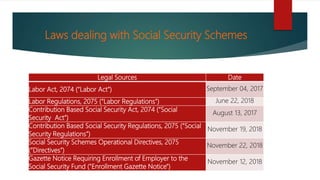
Laws dealing with Social Security Schemes
Legal Sources Date
Labor Act, 2074 (“Labor Act”) September 04, 2017
Labor Regulations, 2075 (“Labor Regulations”) June 22, 2018
Contribution Based Social Security Act, 2074 (“Social
Security Act”)
August 13, 2017
Contribution Based Social Security Regulations, 2075 (“Social
Security Regulations”)
November 19, 2018
Social Security Schemes Operational Directives, 2075
(“Directives”)
November 22, 2018
Gazette Notice Requiring Enrollment of Employer to the
Social Security Fund ("Enrollment Gazette Notice")
November 12, 2018
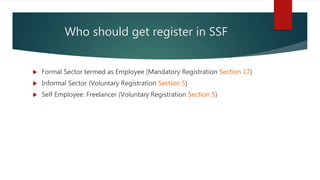
Who should get register in SSF
 Formal Sector termed as Employee (Mandatory Registration Section 17)
 Informal Sector (Voluntary Registration Section 5)
 Self Employee: Freelancer (Voluntary Registration Section 5)
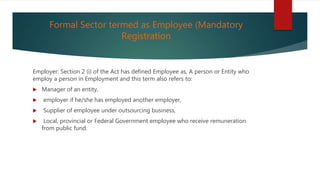
Formal Sector termed as Employee (Mandatory
Registration
Employer: Section 2 (i) of the Act has defined Employee as, A person or Entity who
employ a person in Employment and this term also refers to:
 Manager of an entity,
 employer if he/she has employed another employer,
 Supplier of employee under outsourcing business,
 Local, provincial or Federal Government employee who receive remuneration
from public fund.
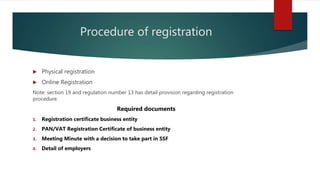
Procedure of registration
 Physical registration
 Online Registration
Note: section 19 and regulation number 13 has detail provision regarding registration
procedure.
Required documents
1. Registration certificate business entity
2. PAN/VAT Registration Certificate of business entity
3. Meeting Minute with a decision to take part in SSF
4. Detail of employers
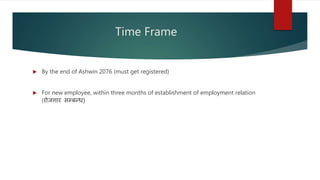
Time Frame
 By the end of Ashwin 2076 (must get registered)
 For new employee, within three months of establishment of employment relation
(रोजगार सम्बन्ध)
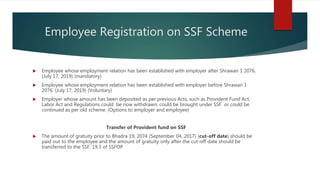
Employee Registration on SSF Scheme
 Employee whose employment relation has been established with employer after Shrawan 1 2076.
(July 17, 2019) (mandatory)
 Employee whose employment relation has been established with employer before Shrawan 1
2076. (July 17, 2019) (Voluntary)
 Employer whose amount has been deposited as per previous Acts, such as Provident Fund Act,
Labor Act and Regulations could be now withdrawn; could be brought under SSF or could be
continued as per old scheme. (Options to employer and employee)
Transfer of Provident fund on SSF
 The amount of gratuity prior to Bhadra 19, 2074 (September 04, 2017) (cut-off date) should be
paid out to the employee and the amount of gratuity only after the cut-off date should be
transferred to the SSF. 19.3 of SSFOP
Fine/Punishment
Section 9: Registered Employeer
 If Employee failed to deposit amount on SSF, 10 percent of interest would be
charged by SSF.
 However if Employer gave an application mentioning there was a situation beyond
his/her control to deposit required amount and declare to deposit it within one
month then SSF could give permission to deposit it with full or partial relief of fine.
Section 19
 Each employer shall get registered within prescribed timeline by Government.
 If didn’t, then any of its employee can file an complain in the SSF mentioning the
same
 After investigation, SSF can give order to Employer to register it into SSF.
 Employer shall mandatorily follow the order of the SSF and hence get it registered.
What is CBSSF?
SSF is a name which altogether consists of following scheme Section 10
 Medical Treatment, Health and Maternity Protection Scheme
 Accident and Disability Protection Scheme
 Dependent Family Protection Scheme and,
 Old Age Protection Scheme
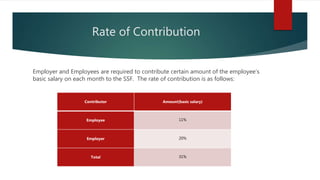
Rate of Contribution
Employer and Employees are required to contribute certain amount of the employee’s
basic salary on each month to the SSF. The rate of contribution is as follows:
Contributor Amount(basic salary)
Employee 11%
Employer 20%
Total 31%
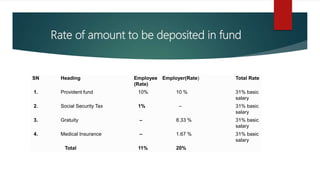
Rate of amount to be deposited in fund
SN Heading Employee
(Rate)
Employer(Rate) Total Rate
1. Provident fund 10% 10 % 31% basic
salary
2. Social Security Tax 1% – 31% basic
salary
3. Gratuity – 8.33 % 31% basic
salary
4. Medical Insurance – 1.67 % 31% basic
salary
Total 11% 20%
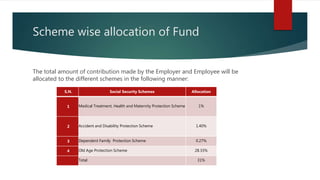
Scheme wise allocation of Fund
The total amount of contribution made by the Employer and Employee will be
allocated to the different schemes in the following manner:
S.N. Social Security Schemes Allocation
1 Medical Treatment, Health and Maternity Protection Scheme 1%
2 Accident and Disability Protection Scheme 1.40%
3 Dependent Family Protection Scheme 0.27%
4 Old Age Protection Scheme 28.33%
Total 31%
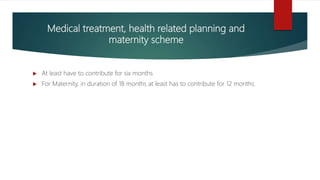
Medical treatment, health related planning and
maternity scheme
 At least have to contribute for six months
 For Maternity, in duration of 18 months at least has to contribute for 12 months.
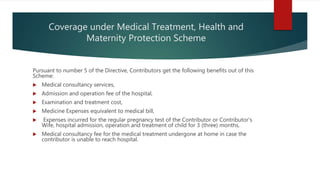
Coverage under Medical Treatment, Health and
Maternity Protection Scheme
Pursuant to number 5 of the Directive, Contributors get the following benefits out of this
Scheme:
 Medical consultancy services,
 Admission and operation fee of the hospital,
 Examination and treatment cost,
 Medicine Expenses equivalent to medical bill,
 Expenses incurred for the regular pregnancy test of the Contributor or Contributor's
Wife, hospital admission, operation and treatment of child for 3 (three) months,
 Medical consultancy fee for the medical treatment undergone at home in case the
contributor is unable to reach hospital.
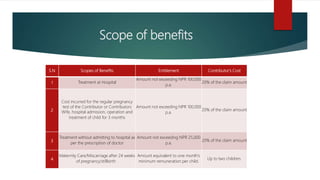
Scope of benefits
S.N Scopes of Benefits Entitlement Contributor's Cost
1 Treatment at Hospital
Amount not exceeding NPR 100,000
p.a.
20% of the claim amount
2
Cost incurred for the regular pregnancy
test of the Contributor or Contributors
Wife, hospital admission, operation and
treatment of child for 3 months
Amount not exceeding NPR 100,000
p.a.
20% of the claim amount
3
Treatment without admitting to hospital as
per the prescription of doctor
Amount not exceeding NPR 25,000
p.a.
20% of the claim amount
4
Maternity Care/Miscarriage after 24 weeks
of pregnancy/stillbirth
Amount equivalent to one month’s
minimum remuneration per child.
Up to two children.
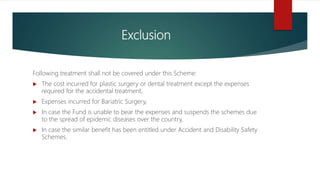
Exclusion
Following treatment shall not be covered under this Scheme:
 The cost incurred for plastic surgery or dental treatment except the expenses
required for the accidental treatment,
 Expenses incurred for Bariatric Surgery,
 In case the Fund is unable to bear the expenses and suspends the schemes due
to the spread of epidemic diseases over the country,
 In case the similar benefit has been entitled under Accident and Disability Safety
Schemes.
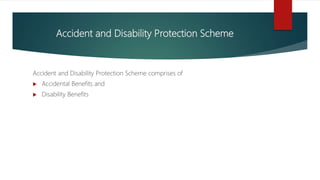
Accident and Disability Protection Scheme
Accident and Disability Protection Scheme comprises of
 Accidental Benefits and
 Disability Benefits
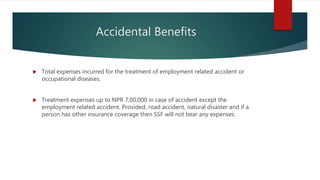
Accidental Benefits
 Total expenses incurred for the treatment of employment related accident or
occupational diseases.
 Treatment expenses up to NPR 7,00,000 in case of accident except the
employment related accident. Provided, road accident, natural disaster and if a
person has other insurance coverage then SSF will not bear any expenses.
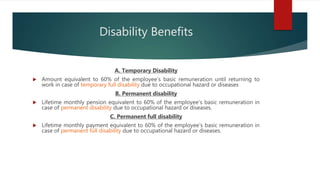
Disability Benefits
A. Temporary Disability
 Amount equivalent to 60% of the employee’s basic remuneration until returning to
work in case of temporary full disability due to occupational hazard or diseases
B. Permanent disability
 Lifetime monthly pension equivalent to 60% of the employee’s basic remuneration in
case of permanent disability due to occupational hazard or diseases.
C. Permanent full disability
 Lifetime monthly payment equivalent to 60% of the employee’s basic remuneration in
case of permanent full disability due to occupational hazard or diseases.
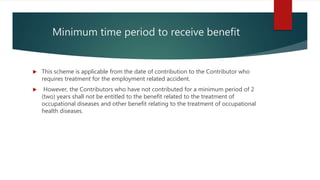
Minimum time period to receive benefit
 This scheme is applicable from the date of contribution to the Contributor who
requires treatment for the employment related accident.
 However, the Contributors who have not contributed for a minimum period of 2
(two) years shall not be entitled to the benefit related to the treatment of
occupational diseases and other benefit relating to the treatment of occupational
health diseases.
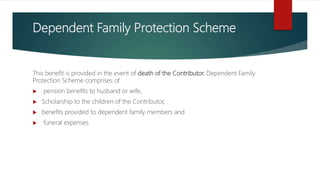
Dependent Family Protection Scheme
This benefit is provided in the event of death of the Contributor. Dependent Family
Protection Scheme comprises of
 pension benefits to husband or wife,
 Scholarship to the children of the Contributor,
 benefits provided to dependent family members and
 funeral expenses
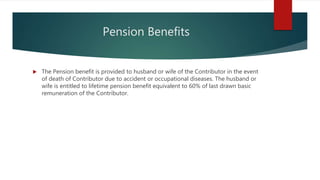
Pension Benefits
 The Pension benefit is provided to husband or wife of the Contributor in the event
of death of Contributor due to accident or occupational diseases. The husband or
wife is entitled to lifetime pension benefit equivalent to 60% of last drawn basic
remuneration of the Contributor.
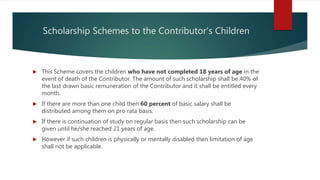
Scholarship Schemes to the Contributor’s Children
 This Scheme covers the children who have not completed 18 years of age in the
event of death of the Contributor. The amount of such scholarship shall be 40% of
the last drawn basic remuneration of the Contributor and it shall be entitled every
month.
 If there are more than one child then 60 percent of basic salary shall be
distributed among them on pro rata basis.
 If there is continuation of study on regular basis then such scholarship can be
given until he/she reached 21 years of age.
 However if such children is physically or mentally disabled then limitation of age
shall not be applicable.
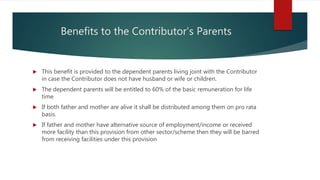
Benefits to the Contributor’s Parents
 This benefit is provided to the dependent parents living joint with the Contributor
in case the Contributor does not have husband or wife or children.
 The dependent parents will be entitled to 60% of the basic remuneration for life
time
 If both father and mother are alive it shall be distributed among them on pro rata
basis.
 If father and mother have alternative source of employment/income or received
more facility than this provision from other sector/scheme then they will be barred
from receiving facilities under this provision
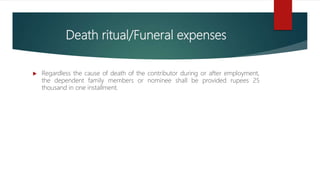
Death ritual/Funeral expenses
 Regardless the cause of death of the contributor during or after employment,
the dependent family members or nominee shall be provided rupees 25
thousand in one installment.
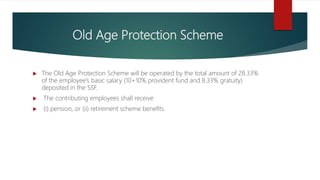
Old Age Protection Scheme
 The Old Age Protection Scheme will be operated by the total amount of 28.33%
of the employee’s basic salary (10+10% provident fund and 8.33% gratuity)
deposited in the SSF.
 The contributing employees shall receive
 (i) pension, or (ii) retirement scheme benefits.
Pension
 Upon completion of the retirement age (60), the total sum amount of
contribution made by the employer and the employee and the amount of accrued
from the investment made by the Fund will be divided by 180 months (15 years)
and such amount will be provided as pension every month during the employee’s
lifetime.
 Upon death of the Contributor prior to the retirement age, their heir shall receive
the total lump sum amount of the contribution made by the employer and the
employee and the accrued benefit received from the Fund
Retirement Benefits
 The Contributors working prior to Shrawan 01, 2076 (July 17, 2019) contributing
28.33% for provident fund and gratuity shall be entitled to receive a lump sum
amount of the contribution and income accrued on such amount upon retirement.
Thank you !

Nepal contribution based social security fund ppt

  • 1.
    CONTRIBUTION BASED SOCIAL SECURITYFUND PRESENTER: AJAYA BUDHATHOKI LLM STUDENT AT NEPAL LAW CAMPUS
  • 2.
    Laws dealing withSocial Security Schemes Legal Sources Date Labor Act, 2074 (“Labor Act”) September 04, 2017 Labor Regulations, 2075 (“Labor Regulations”) June 22, 2018 Contribution Based Social Security Act, 2074 (“Social Security Act”) August 13, 2017 Contribution Based Social Security Regulations, 2075 (“Social Security Regulations”) November 19, 2018 Social Security Schemes Operational Directives, 2075 (“Directives”) November 22, 2018 Gazette Notice Requiring Enrollment of Employer to the Social Security Fund ("Enrollment Gazette Notice") November 12, 2018
  • 3.
    Who should getregister in SSF  Formal Sector termed as Employee (Mandatory Registration Section 17)  Informal Sector (Voluntary Registration Section 5)  Self Employee: Freelancer (Voluntary Registration Section 5)
  • 4.
    Formal Sector termedas Employee (Mandatory Registration Employer: Section 2 (i) of the Act has defined Employee as, A person or Entity who employ a person in Employment and this term also refers to:  Manager of an entity,  employer if he/she has employed another employer,  Supplier of employee under outsourcing business,  Local, provincial or Federal Government employee who receive remuneration from public fund.
  • 5.
    Procedure of registration Physical registration  Online Registration Note: section 19 and regulation number 13 has detail provision regarding registration procedure. Required documents 1. Registration certificate business entity 2. PAN/VAT Registration Certificate of business entity 3. Meeting Minute with a decision to take part in SSF 4. Detail of employers
  • 6.
    Time Frame  Bythe end of Ashwin 2076 (must get registered)  For new employee, within three months of establishment of employment relation (रोजगार सम्बन्ध)
  • 7.
    Employee Registration onSSF Scheme  Employee whose employment relation has been established with employer after Shrawan 1 2076. (July 17, 2019) (mandatory)  Employee whose employment relation has been established with employer before Shrawan 1 2076. (July 17, 2019) (Voluntary)  Employer whose amount has been deposited as per previous Acts, such as Provident Fund Act, Labor Act and Regulations could be now withdrawn; could be brought under SSF or could be continued as per old scheme. (Options to employer and employee) Transfer of Provident fund on SSF  The amount of gratuity prior to Bhadra 19, 2074 (September 04, 2017) (cut-off date) should be paid out to the employee and the amount of gratuity only after the cut-off date should be transferred to the SSF. 19.3 of SSFOP
  • 8.
    Fine/Punishment Section 9: RegisteredEmployeer  If Employee failed to deposit amount on SSF, 10 percent of interest would be charged by SSF.  However if Employer gave an application mentioning there was a situation beyond his/her control to deposit required amount and declare to deposit it within one month then SSF could give permission to deposit it with full or partial relief of fine.
  • 9.
    Section 19  Eachemployer shall get registered within prescribed timeline by Government.  If didn’t, then any of its employee can file an complain in the SSF mentioning the same  After investigation, SSF can give order to Employer to register it into SSF.  Employer shall mandatorily follow the order of the SSF and hence get it registered.
  • 10.
    What is CBSSF? SSFis a name which altogether consists of following scheme Section 10  Medical Treatment, Health and Maternity Protection Scheme  Accident and Disability Protection Scheme  Dependent Family Protection Scheme and,  Old Age Protection Scheme
  • 11.
    Rate of Contribution Employerand Employees are required to contribute certain amount of the employee’s basic salary on each month to the SSF. The rate of contribution is as follows: Contributor Amount(basic salary) Employee 11% Employer 20% Total 31%
  • 12.
    Rate of amountto be deposited in fund SN Heading Employee (Rate) Employer(Rate) Total Rate 1. Provident fund 10% 10 % 31% basic salary 2. Social Security Tax 1% – 31% basic salary 3. Gratuity – 8.33 % 31% basic salary 4. Medical Insurance – 1.67 % 31% basic salary Total 11% 20%
  • 13.
    Scheme wise allocationof Fund The total amount of contribution made by the Employer and Employee will be allocated to the different schemes in the following manner: S.N. Social Security Schemes Allocation 1 Medical Treatment, Health and Maternity Protection Scheme 1% 2 Accident and Disability Protection Scheme 1.40% 3 Dependent Family Protection Scheme 0.27% 4 Old Age Protection Scheme 28.33% Total 31%
  • 14.
    Medical treatment, healthrelated planning and maternity scheme  At least have to contribute for six months  For Maternity, in duration of 18 months at least has to contribute for 12 months.
  • 15.
    Coverage under MedicalTreatment, Health and Maternity Protection Scheme Pursuant to number 5 of the Directive, Contributors get the following benefits out of this Scheme:  Medical consultancy services,  Admission and operation fee of the hospital,  Examination and treatment cost,  Medicine Expenses equivalent to medical bill,  Expenses incurred for the regular pregnancy test of the Contributor or Contributor's Wife, hospital admission, operation and treatment of child for 3 (three) months,  Medical consultancy fee for the medical treatment undergone at home in case the contributor is unable to reach hospital.
  • 16.
    Scope of benefits S.NScopes of Benefits Entitlement Contributor's Cost 1 Treatment at Hospital Amount not exceeding NPR 100,000 p.a. 20% of the claim amount 2 Cost incurred for the regular pregnancy test of the Contributor or Contributors Wife, hospital admission, operation and treatment of child for 3 months Amount not exceeding NPR 100,000 p.a. 20% of the claim amount 3 Treatment without admitting to hospital as per the prescription of doctor Amount not exceeding NPR 25,000 p.a. 20% of the claim amount 4 Maternity Care/Miscarriage after 24 weeks of pregnancy/stillbirth Amount equivalent to one month’s minimum remuneration per child. Up to two children.
  • 17.
    Exclusion Following treatment shallnot be covered under this Scheme:  The cost incurred for plastic surgery or dental treatment except the expenses required for the accidental treatment,  Expenses incurred for Bariatric Surgery,  In case the Fund is unable to bear the expenses and suspends the schemes due to the spread of epidemic diseases over the country,  In case the similar benefit has been entitled under Accident and Disability Safety Schemes.
  • 18.
    Accident and DisabilityProtection Scheme Accident and Disability Protection Scheme comprises of  Accidental Benefits and  Disability Benefits
  • 19.
    Accidental Benefits  Totalexpenses incurred for the treatment of employment related accident or occupational diseases.  Treatment expenses up to NPR 7,00,000 in case of accident except the employment related accident. Provided, road accident, natural disaster and if a person has other insurance coverage then SSF will not bear any expenses.
  • 20.
    Disability Benefits A. TemporaryDisability  Amount equivalent to 60% of the employee’s basic remuneration until returning to work in case of temporary full disability due to occupational hazard or diseases B. Permanent disability  Lifetime monthly pension equivalent to 60% of the employee’s basic remuneration in case of permanent disability due to occupational hazard or diseases. C. Permanent full disability  Lifetime monthly payment equivalent to 60% of the employee’s basic remuneration in case of permanent full disability due to occupational hazard or diseases.
  • 21.
    Minimum time periodto receive benefit  This scheme is applicable from the date of contribution to the Contributor who requires treatment for the employment related accident.  However, the Contributors who have not contributed for a minimum period of 2 (two) years shall not be entitled to the benefit related to the treatment of occupational diseases and other benefit relating to the treatment of occupational health diseases.
  • 22.
    Dependent Family ProtectionScheme This benefit is provided in the event of death of the Contributor. Dependent Family Protection Scheme comprises of  pension benefits to husband or wife,  Scholarship to the children of the Contributor,  benefits provided to dependent family members and  funeral expenses
  • 23.
    Pension Benefits  ThePension benefit is provided to husband or wife of the Contributor in the event of death of Contributor due to accident or occupational diseases. The husband or wife is entitled to lifetime pension benefit equivalent to 60% of last drawn basic remuneration of the Contributor.
  • 24.
    Scholarship Schemes tothe Contributor’s Children  This Scheme covers the children who have not completed 18 years of age in the event of death of the Contributor. The amount of such scholarship shall be 40% of the last drawn basic remuneration of the Contributor and it shall be entitled every month.  If there are more than one child then 60 percent of basic salary shall be distributed among them on pro rata basis.  If there is continuation of study on regular basis then such scholarship can be given until he/she reached 21 years of age.  However if such children is physically or mentally disabled then limitation of age shall not be applicable.
  • 25.
    Benefits to theContributor’s Parents  This benefit is provided to the dependent parents living joint with the Contributor in case the Contributor does not have husband or wife or children.  The dependent parents will be entitled to 60% of the basic remuneration for life time  If both father and mother are alive it shall be distributed among them on pro rata basis.  If father and mother have alternative source of employment/income or received more facility than this provision from other sector/scheme then they will be barred from receiving facilities under this provision
  • 26.
    Death ritual/Funeral expenses Regardless the cause of death of the contributor during or after employment, the dependent family members or nominee shall be provided rupees 25 thousand in one installment.
  • 27.
    Old Age ProtectionScheme  The Old Age Protection Scheme will be operated by the total amount of 28.33% of the employee’s basic salary (10+10% provident fund and 8.33% gratuity) deposited in the SSF.  The contributing employees shall receive  (i) pension, or (ii) retirement scheme benefits.
  • 28.
    Pension  Upon completionof the retirement age (60), the total sum amount of contribution made by the employer and the employee and the amount of accrued from the investment made by the Fund will be divided by 180 months (15 years) and such amount will be provided as pension every month during the employee’s lifetime.  Upon death of the Contributor prior to the retirement age, their heir shall receive the total lump sum amount of the contribution made by the employer and the employee and the accrued benefit received from the Fund
  • 29.
    Retirement Benefits  TheContributors working prior to Shrawan 01, 2076 (July 17, 2019) contributing 28.33% for provident fund and gratuity shall be entitled to receive a lump sum amount of the contribution and income accrued on such amount upon retirement.
  • 30.