Click to continue
Neil Alden Armstrong

• Neil Alden Armstrong (August 5, 1930 – August 25, 2012) was an
  American astronaut, test pilot, aerospace engineer, university
  professor and United States Naval Aviator. He was the first person
  to walk on the Moon. Before becoming an astronaut, Armstrong was
  a United States Navy officer and had served in the Korean War.
  After the war, he served as a test pilot at the National Advisory
  Committee for Aeronautics High-Speed Flight Station, now known
  as the Dryden Flight Research Center, where he logged over 900
  flights. He graduated from Purdue University and the University of
  Southern California.

• A participant in the U.S. Air Force's Man In Space Soonest and X-20
  Dyna-Soar human spaceflight programs, Armstrong joined the
  NASA Astronaut Corps in 1962. His first spaceflight was the NASA
  Gemini 8 mission in 1966, for which he was the command
  pilot, becoming one of the first U.S. civilians in space. On this
  mission, he performed the first manned docking of two spacecraft
  with pilot David Scott.
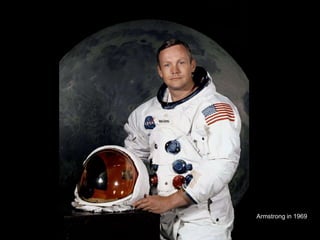
Armstrong in 1969
• Armstrong's second and last spaceflight was as mission
  commander of the Apollo 11 moon landing in July 1969.
  On this mission, Armstrong and Buzz Aldrin descended
  to the lunar surface and spent 2½ hours exploring, while
  Michael Collins remained in orbit in the Command
  Module. Armstrong was awarded the Presidential Medal
  of Freedom by President Richard Nixon along with
  Collins and Aldrin, the Congressional Space Medal of
  Honor by President Jimmy Carter in 1978, and the
  Congressional Gold Medal in 2009.

• On August 25, 2012, Armstrong died in
  Cincinnati, Ohio, at the age of 82 due to complications
  from blocked coronary arteries.
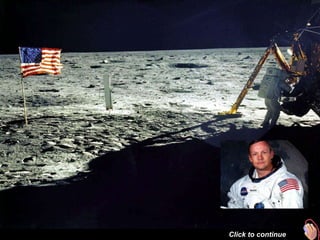
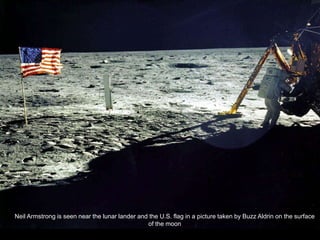
Neil Armstrong is seen near the lunar lander and the U.S. flag in a picture taken by Buzz Aldrin on the surface
                                                of the moon
Quick bites about Neil Armstrong


•      Armstrong's interest in flight began in childhood: He earned his student
    pilot's certificate on his 16th birthday, before he got an automobile driver's
    license. "He never had a girl. He didn't need a car. All he had to do was get
    out to that airport," Armstrong's father was quoted as saying in the
    astronaut's biography, "First Man."
•      Armstrong's pulse was measured at 150 beats per minute as he guided
    the lunar lander to the moon's surface, NASA said. "I believe every human
    has a finite number of heartbeats," Armstrong once said. "I don't intend to
    waste any of mine."
•      Asked about his experience on the moon, he told CBS: "It's an interesting
    place to be. I recommend it."
•      A crater on the moon is named for Armstrong. It is located about 30 miles
    (50 kilometers) from the site of the landing.
•      In 2005 Armstrong was upset to learn that his barber had sold clippings
    of his hair to a collector for $3,000. The man who bought the hair refused to
    return it, saying he was adding it to his collection of locks from Abraham
    Lincoln, Napoleon, Marilyn Monroe, Albert Einstein and others.
•      Although he was famously reticent, Armstrong once appeared in a TV
    commercial for Chrysler. He said he made the ad because of Chrysler's
    engineering history and his desire to help the company out of financial
    troubles.
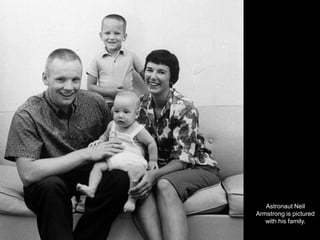
Astronaut Neil
Armstrong is pictured
   with his family.
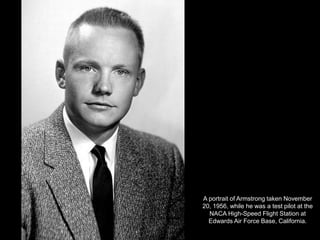
A portrait of Armstrong taken November
20, 1956, while he was a test pilot at the
  NACA High-Speed Flight Station at
  Edwards Air Force Base, California.
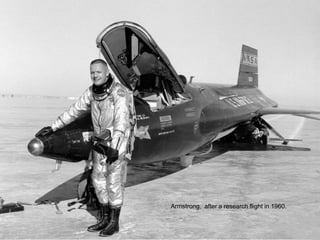
Armstrong, after a research flight in 1960.
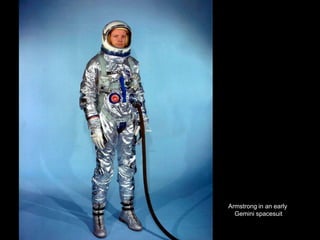
Armstrong in an early
  Gemini spacesuit
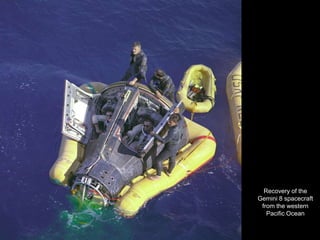
Recovery of the
Gemini 8 spacecraft
 from the western
   Pacific Ocean
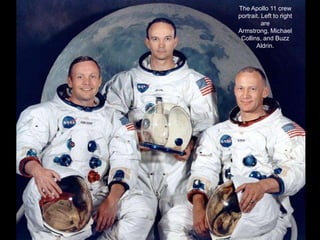
The Apollo 11 crew
portrait. Left to right
          are
Armstrong, Michael
 Collins, and Buzz
       Aldrin.
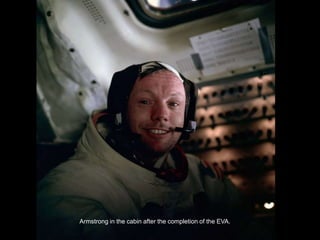
Armstrong in the cabin after the completion of the EVA.
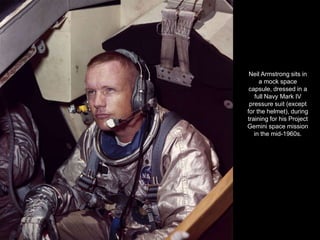
Neil Armstrong sits in
     a mock space
 capsule, dressed in a
   full Navy Mark IV
 pressure suit (except
for the helmet), during
training for his Project
Gemini space mission
   in the mid-1960s.
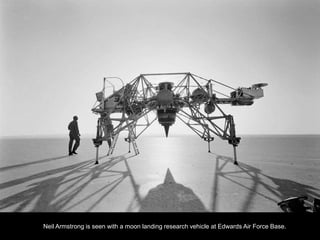
Neil Armstrong is seen with a moon landing research vehicle at Edwards Air Force Base.
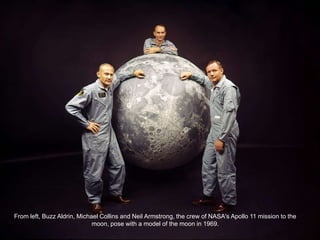
From left, Buzz Aldrin, Michael Collins and Neil Armstrong, the crew of NASA's Apollo 11 mission to the
                             moon, pose with a model of the moon in 1969.
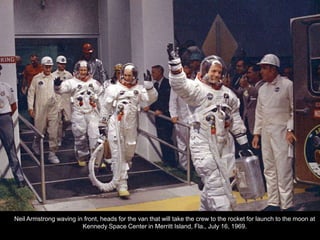
Neil Armstrong waving in front, heads for the van that will take the crew to the rocket for launch to the moon at
                        Kennedy Space Center in Merritt Island, Fla., July 16, 1969.
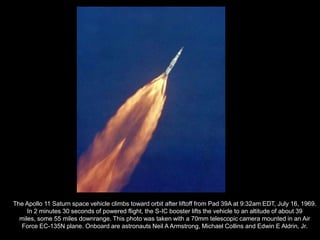
The Apollo 11 Saturn space vehicle climbs toward orbit after liftoff from Pad 39A at 9:32am EDT, July 16, 1969.
     In 2 minutes 30 seconds of powered flight, the S-IC booster lifts the vehicle to an altitude of about 39
  miles, some 55 miles downrange. This photo was taken with a 70mm telescopic camera mounted in an Air
  Force EC-135N plane. Onboard are astronauts Neil A Armstrong, Michael Collins and Edwin E Aldrin, Jr.
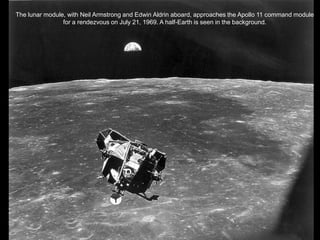
The lunar module, with Neil Armstrong and Edwin Aldrin aboard, approaches the Apollo 11 command module
                for a rendezvous on July 21, 1969. A half-Earth is seen in the background.
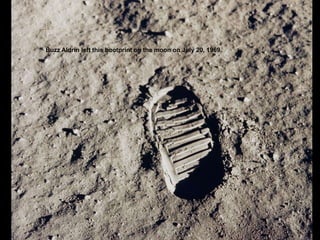
Buzz Aldrin left this bootprint on the moon on July 20, 1969.
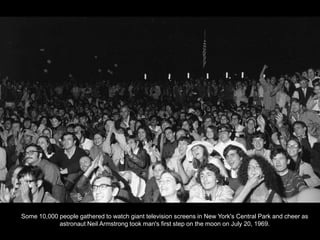
Some 10,000 people gathered to watch giant television screens in New York's Central Park and cheer as
            astronaut Neil Armstrong took man's first step on the moon on July 20, 1969.
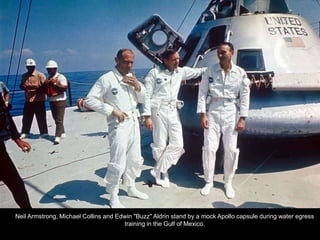
Neil Armstrong, Michael Collins and Edwin "Buzz" Aldrin stand by a mock Apollo capsule during water egress
                                      training in the Gulf of Mexico.
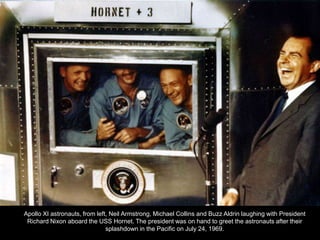
Apollo XI astronauts, from left, Neil Armstrong, Michael Collins and Buzz Aldrin laughing with President
 Richard Nixon aboard the USS Hornet. The president was on hand to greet the astronauts after their
                               splashdown in the Pacific on July 24, 1969.
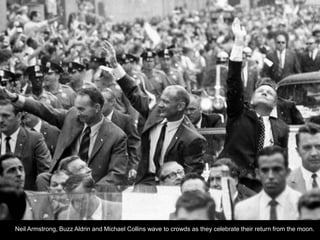
Neil Armstrong, Buzz Aldrin and Michael Collins wave to crowds as they celebrate their return from the moon.
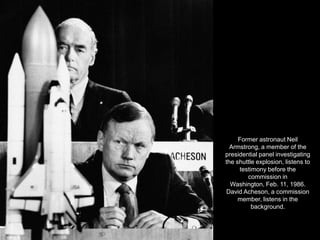
Former astronaut Neil
  Armstrong, a member of the
presidential panel investigating
the shuttle explosion, listens to
     testimony before the
        commission in
  Washington, Feb. 11, 1986.
David Acheson, a commission
     member, listens in the
          background.
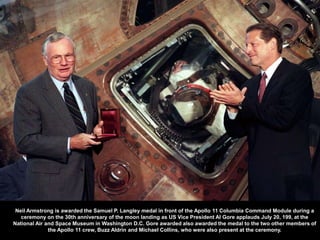
Neil Armstrong is awarded the Samuel P. Langley medal in front of the Apollo 11 Columbia Command Module during a
   ceremony on the 30th anniversary of the moon landing as US Vice President Al Gore applauds July 20, 199, at the
National Air and Space Museum in Washington D.C. Gore awarded also awarded the medal to the two other members of
              the Apollo 11 crew, Buzz Aldrin and Michael Collins, who were also present at the ceremony.
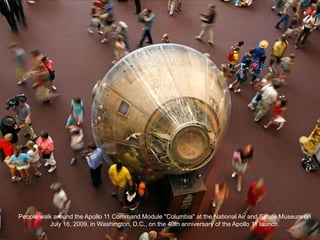
People walk around the Apollo 11 Command Module "Columbia" at the National Air and Space Museum on
          July 16, 2009, in Washington, D.C., on the 40th anniversary of the Apollo 11 launch.
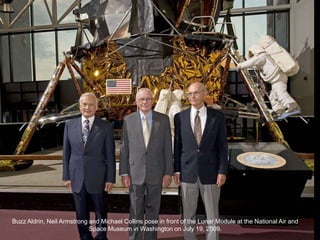
Buzz Aldrin, Neil Armstrong and Michael Collins pose in front of the Lunar Module at the National Air and
                            Space Museum in Washington on July 19, 2009.
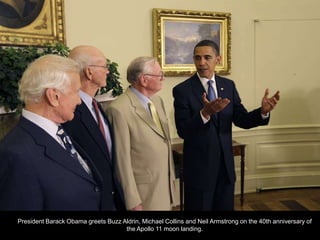
President Barack Obama greets Buzz Aldrin, Michael Collins and Neil Armstrong on the 40th anniversary of
                                    the Apollo 11 moon landing.
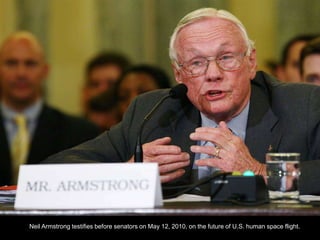
Neil Armstrong testifies before senators on May 12, 2010, on the future of U.S. human space flight.
Nikos


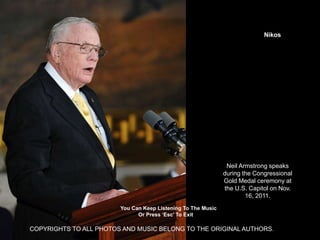
                                                               Neil Armstrong speaks
                                                              during the Congressional
                                                              Gold Medal ceremony at
                                                              the U.S. Capitol on Nov.
                                                                      16, 2011.
                        You Can Keep Listening To The Music
                              Or Press ‘Esc’ To Exit

COPYRIGHTS TO ALL PHOTOS AND MUSIC BELONG TO THE ORIGINAL AUTHORS.

Neil Armstrong 1930 - 2012. (Nikos)

  • 1.
  • 2.
    Neil Alden Armstrong •Neil Alden Armstrong (August 5, 1930 – August 25, 2012) was an American astronaut, test pilot, aerospace engineer, university professor and United States Naval Aviator. He was the first person to walk on the Moon. Before becoming an astronaut, Armstrong was a United States Navy officer and had served in the Korean War. After the war, he served as a test pilot at the National Advisory Committee for Aeronautics High-Speed Flight Station, now known as the Dryden Flight Research Center, where he logged over 900 flights. He graduated from Purdue University and the University of Southern California. • A participant in the U.S. Air Force's Man In Space Soonest and X-20 Dyna-Soar human spaceflight programs, Armstrong joined the NASA Astronaut Corps in 1962. His first spaceflight was the NASA Gemini 8 mission in 1966, for which he was the command pilot, becoming one of the first U.S. civilians in space. On this mission, he performed the first manned docking of two spacecraft with pilot David Scott.
  • 3.
  • 4.
    • Armstrong's secondand last spaceflight was as mission commander of the Apollo 11 moon landing in July 1969. On this mission, Armstrong and Buzz Aldrin descended to the lunar surface and spent 2½ hours exploring, while Michael Collins remained in orbit in the Command Module. Armstrong was awarded the Presidential Medal of Freedom by President Richard Nixon along with Collins and Aldrin, the Congressional Space Medal of Honor by President Jimmy Carter in 1978, and the Congressional Gold Medal in 2009. • On August 25, 2012, Armstrong died in Cincinnati, Ohio, at the age of 82 due to complications from blocked coronary arteries.
  • 5.
    Neil Armstrong isseen near the lunar lander and the U.S. flag in a picture taken by Buzz Aldrin on the surface of the moon
  • 6.
    Quick bites aboutNeil Armstrong • Armstrong's interest in flight began in childhood: He earned his student pilot's certificate on his 16th birthday, before he got an automobile driver's license. "He never had a girl. He didn't need a car. All he had to do was get out to that airport," Armstrong's father was quoted as saying in the astronaut's biography, "First Man." • Armstrong's pulse was measured at 150 beats per minute as he guided the lunar lander to the moon's surface, NASA said. "I believe every human has a finite number of heartbeats," Armstrong once said. "I don't intend to waste any of mine." • Asked about his experience on the moon, he told CBS: "It's an interesting place to be. I recommend it." • A crater on the moon is named for Armstrong. It is located about 30 miles (50 kilometers) from the site of the landing. • In 2005 Armstrong was upset to learn that his barber had sold clippings of his hair to a collector for $3,000. The man who bought the hair refused to return it, saying he was adding it to his collection of locks from Abraham Lincoln, Napoleon, Marilyn Monroe, Albert Einstein and others. • Although he was famously reticent, Armstrong once appeared in a TV commercial for Chrysler. He said he made the ad because of Chrysler's engineering history and his desire to help the company out of financial troubles.
  • 7.
    Astronaut Neil Armstrong ispictured with his family.
  • 8.
    A portrait ofArmstrong taken November 20, 1956, while he was a test pilot at the NACA High-Speed Flight Station at Edwards Air Force Base, California.
  • 9.
    Armstrong, after aresearch flight in 1960.
  • 10.
    Armstrong in anearly Gemini spacesuit
  • 11.
    Recovery of the Gemini8 spacecraft from the western Pacific Ocean
  • 12.
    The Apollo 11crew portrait. Left to right are Armstrong, Michael Collins, and Buzz Aldrin.
  • 13.
    Armstrong in thecabin after the completion of the EVA.
  • 14.
    Neil Armstrong sitsin a mock space capsule, dressed in a full Navy Mark IV pressure suit (except for the helmet), during training for his Project Gemini space mission in the mid-1960s.
  • 15.
    Neil Armstrong isseen with a moon landing research vehicle at Edwards Air Force Base.
  • 16.
    From left, BuzzAldrin, Michael Collins and Neil Armstrong, the crew of NASA's Apollo 11 mission to the moon, pose with a model of the moon in 1969.
  • 17.
    Neil Armstrong wavingin front, heads for the van that will take the crew to the rocket for launch to the moon at Kennedy Space Center in Merritt Island, Fla., July 16, 1969.
  • 18.
    The Apollo 11Saturn space vehicle climbs toward orbit after liftoff from Pad 39A at 9:32am EDT, July 16, 1969. In 2 minutes 30 seconds of powered flight, the S-IC booster lifts the vehicle to an altitude of about 39 miles, some 55 miles downrange. This photo was taken with a 70mm telescopic camera mounted in an Air Force EC-135N plane. Onboard are astronauts Neil A Armstrong, Michael Collins and Edwin E Aldrin, Jr.
  • 19.
    The lunar module,with Neil Armstrong and Edwin Aldrin aboard, approaches the Apollo 11 command module for a rendezvous on July 21, 1969. A half-Earth is seen in the background.
  • 20.
    Buzz Aldrin leftthis bootprint on the moon on July 20, 1969.
  • 21.
    Some 10,000 peoplegathered to watch giant television screens in New York's Central Park and cheer as astronaut Neil Armstrong took man's first step on the moon on July 20, 1969.
  • 22.
    Neil Armstrong, MichaelCollins and Edwin "Buzz" Aldrin stand by a mock Apollo capsule during water egress training in the Gulf of Mexico.
  • 23.
    Apollo XI astronauts,from left, Neil Armstrong, Michael Collins and Buzz Aldrin laughing with President Richard Nixon aboard the USS Hornet. The president was on hand to greet the astronauts after their splashdown in the Pacific on July 24, 1969.
  • 24.
    Neil Armstrong, BuzzAldrin and Michael Collins wave to crowds as they celebrate their return from the moon.
  • 25.
    Former astronaut Neil Armstrong, a member of the presidential panel investigating the shuttle explosion, listens to testimony before the commission in Washington, Feb. 11, 1986. David Acheson, a commission member, listens in the background.
  • 26.
    Neil Armstrong isawarded the Samuel P. Langley medal in front of the Apollo 11 Columbia Command Module during a ceremony on the 30th anniversary of the moon landing as US Vice President Al Gore applauds July 20, 199, at the National Air and Space Museum in Washington D.C. Gore awarded also awarded the medal to the two other members of the Apollo 11 crew, Buzz Aldrin and Michael Collins, who were also present at the ceremony.
  • 27.
    People walk aroundthe Apollo 11 Command Module "Columbia" at the National Air and Space Museum on July 16, 2009, in Washington, D.C., on the 40th anniversary of the Apollo 11 launch.
  • 28.
    Buzz Aldrin, NeilArmstrong and Michael Collins pose in front of the Lunar Module at the National Air and Space Museum in Washington on July 19, 2009.
  • 29.
    President Barack Obamagreets Buzz Aldrin, Michael Collins and Neil Armstrong on the 40th anniversary of the Apollo 11 moon landing.
  • 30.
    Neil Armstrong testifiesbefore senators on May 12, 2010, on the future of U.S. human space flight.
  • 31.
    Nikos Neil Armstrong speaks during the Congressional Gold Medal ceremony at the U.S. Capitol on Nov. 16, 2011. You Can Keep Listening To The Music Or Press ‘Esc’ To Exit COPYRIGHTS TO ALL PHOTOS AND MUSIC BELONG TO THE ORIGINAL AUTHORS.