NEGOTIATION AND
BARGAINING
UNIT -4 -> SOFTWARE AGENTS
THAMARAI KANNAN M /CSE-C
NEGOTIATION
The process of developing intelligent
agents or systems that can engage in
bargaining or decision-making with other
agents or systems.
The goal of negotiation in AI is to develop agents
that can interact with other agents or systems in
a way that maximizes their own objectives.
NEED FOR NEGOTIATION
Resource Allocation : Negotiation techniques can be used to
allocate these resources efficiently and fairly among the
different agents or systems.
Conflict Resolution : Negotiation techniques can help to resolve
these conflicts and reach a mutually acceptable solution.
Cooperative Decision : Negotiation can help to facilitate this
cooperation by allowing agents to share information, coordinate
their actions, and allocate tasks and responsibilities.
Human Interaction : Negotiation skills can help AI systems to
understand and respond to human needs and preferences.
MOST COMMONLY USED PROTOCOL
1.Bilateral negotiation protocol: In this protocol, two agents negotiate
with each other to reach an agreement. Each agent presents an initial offer, and
then they take turns making counteroffers until they reach a mutually acceptable
agreement.
2.Multilateral negotiation protocol In this protocol, more than two agents
negotiate with each other to reach a mutually beneficial agreement. The agents may form
coalitions or alliances to strengthen their bargaining power.
3.Auction-based negotiation protocol: In this protocol, agents bid for
resources or items of value, with the highest bidder being awarded the resource or item.
4.Mediated negotiation protocol In this protocol, a third party mediator
facilitates the negotiation process between two or more agents.
5.Automated negotiation protocol In this protocol, the negotiation process is
entirely automated, and AI agents negotiate with each other without human intervention.
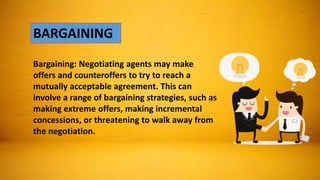
Bargaining: Negotiating agents may make
offers and counteroffers to try to reach a
mutually acceptable agreement. This can
involve a range of bargaining strategies, such as
making extreme offers, making incremental
concessions, or threatening to walk away from
the negotiation.
BARGAINING
1.Distributive bargaining: This strategy involves trying to maximize one's own
gain by claiming a larger share of a fixed resource. For example, in an auction,
agents may bid against each other to try to win a specific item.
2.Integrative bargaining: This strategy involves finding ways to create value and
expand the available resources so that both parties can benefit. For example, in
a negotiation over a business partnership, agents may seek to identify
opportunities for joint ventures or other mutually beneficial projects.
3.Concession-making: This strategy involves making concessions or
compromises in order to reach an agreement. For example, one agent may be
willing to accept a lower price for a resource in exchange for other benefits.
4.Anchoring: This strategy involves making an extreme initial offer in order to
influence the negotiation process. For example, an agent may start with a high
bid in an auction in order to set the tone for the rest of the negotiation.
VARIOUS BARGAINING STATERGIES

NEGOTIATION AND BARGAINING.pptx

  • 1.
    NEGOTIATION AND BARGAINING UNIT -4-> SOFTWARE AGENTS THAMARAI KANNAN M /CSE-C
  • 2.
    NEGOTIATION The process ofdeveloping intelligent agents or systems that can engage in bargaining or decision-making with other agents or systems. The goal of negotiation in AI is to develop agents that can interact with other agents or systems in a way that maximizes their own objectives.
  • 3.
    NEED FOR NEGOTIATION ResourceAllocation : Negotiation techniques can be used to allocate these resources efficiently and fairly among the different agents or systems. Conflict Resolution : Negotiation techniques can help to resolve these conflicts and reach a mutually acceptable solution. Cooperative Decision : Negotiation can help to facilitate this cooperation by allowing agents to share information, coordinate their actions, and allocate tasks and responsibilities. Human Interaction : Negotiation skills can help AI systems to understand and respond to human needs and preferences.
  • 4.
    MOST COMMONLY USEDPROTOCOL 1.Bilateral negotiation protocol: In this protocol, two agents negotiate with each other to reach an agreement. Each agent presents an initial offer, and then they take turns making counteroffers until they reach a mutually acceptable agreement. 2.Multilateral negotiation protocol In this protocol, more than two agents negotiate with each other to reach a mutually beneficial agreement. The agents may form coalitions or alliances to strengthen their bargaining power. 3.Auction-based negotiation protocol: In this protocol, agents bid for resources or items of value, with the highest bidder being awarded the resource or item. 4.Mediated negotiation protocol In this protocol, a third party mediator facilitates the negotiation process between two or more agents. 5.Automated negotiation protocol In this protocol, the negotiation process is entirely automated, and AI agents negotiate with each other without human intervention.
  • 5.
    Bargaining: Negotiating agentsmay make offers and counteroffers to try to reach a mutually acceptable agreement. This can involve a range of bargaining strategies, such as making extreme offers, making incremental concessions, or threatening to walk away from the negotiation. BARGAINING
  • 6.
    1.Distributive bargaining: Thisstrategy involves trying to maximize one's own gain by claiming a larger share of a fixed resource. For example, in an auction, agents may bid against each other to try to win a specific item. 2.Integrative bargaining: This strategy involves finding ways to create value and expand the available resources so that both parties can benefit. For example, in a negotiation over a business partnership, agents may seek to identify opportunities for joint ventures or other mutually beneficial projects. 3.Concession-making: This strategy involves making concessions or compromises in order to reach an agreement. For example, one agent may be willing to accept a lower price for a resource in exchange for other benefits. 4.Anchoring: This strategy involves making an extreme initial offer in order to influence the negotiation process. For example, an agent may start with a high bid in an auction in order to set the tone for the rest of the negotiation. VARIOUS BARGAINING STATERGIES