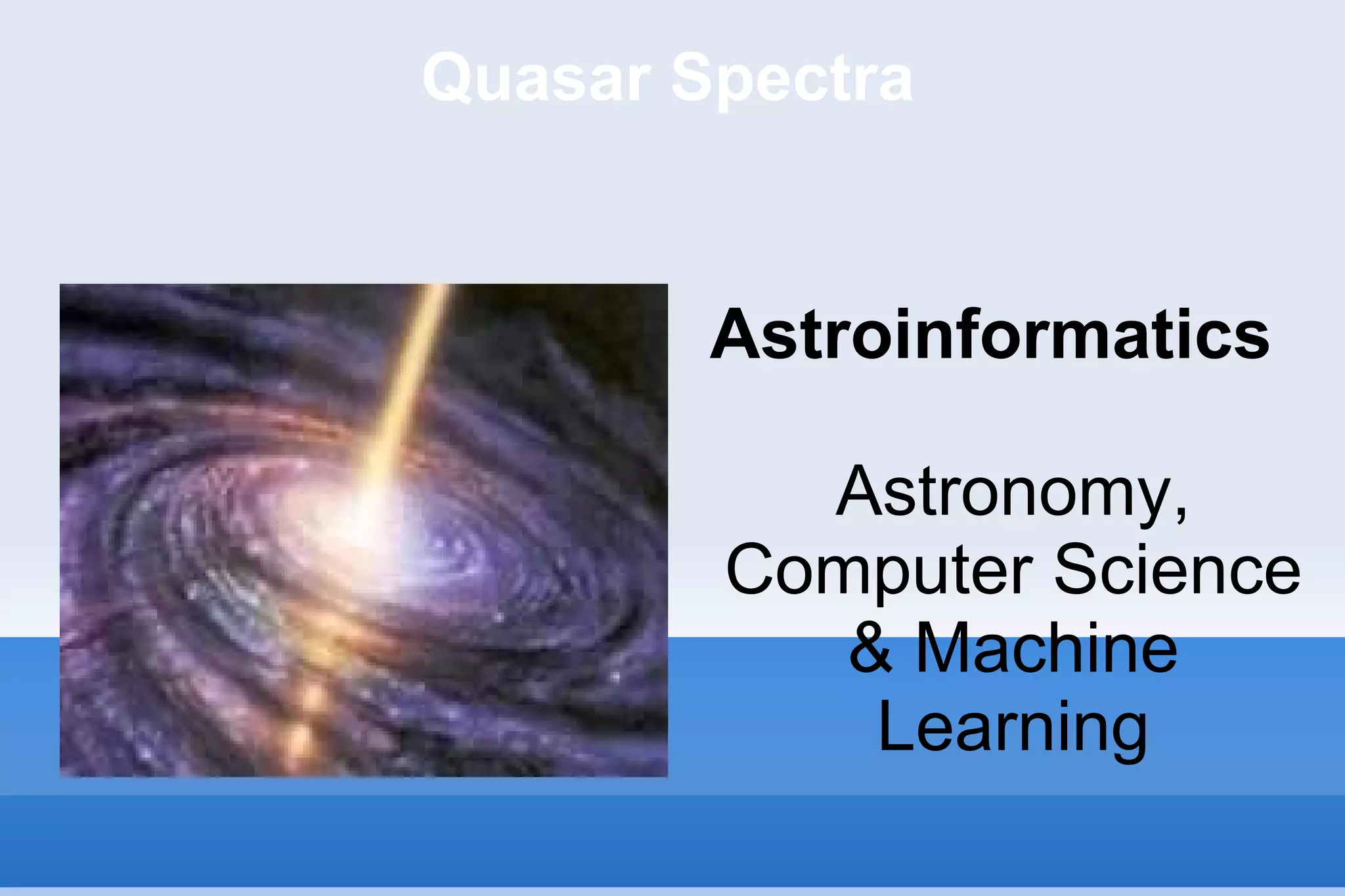
Quasar Spectra Astroinformatics Astronomy, Computer Science & Machine Learning
Quote "… the community will realise that its  lone-astronomer  days are over,  ... the subject has become too vast and  complicated  …  … science can be realised only through  code " Anne Finkbeiner (2010)
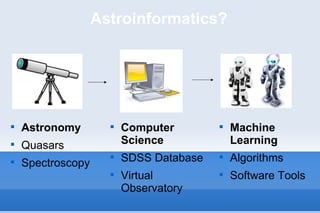
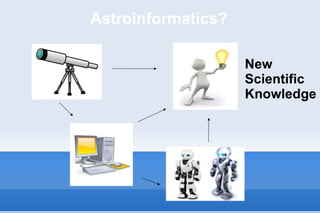
Astroinformatics? Machine Learning Algorithms Software Tools Computer Science SDSS Database Virtual Observatory Astronomy Quasars Spectroscopy
Astroinformatics? New Scientific Knowledge
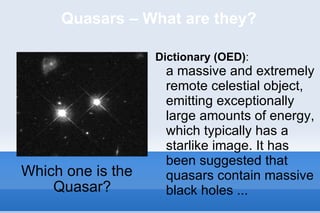
Quasars – What are they? Which one is the Quasar? Dictionary (OED) :  a massive and extremely remote celestial object, emitting exceptionally large amounts of energy, which typically has a starlike image. It has been suggested that quasars contain massive black holes ...
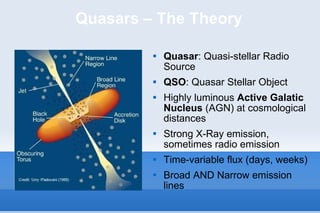
Quasars – The Theory Quasar : Quasi-stellar Radio Source QSO : Quasar Stellar Object Highly luminous  Active Galatic Nucleus  (AGN) at cosmological distances Strong X-Ray emission, sometimes radio emission Time-variable flux (days, weeks) Broad AND Narrow emission lines
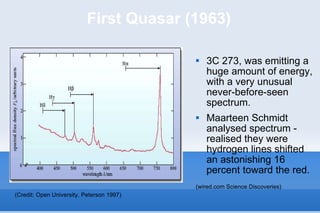
First Quasar (1963) 3C 273, was emitting a huge amount of energy, with a very unusual  never-before-seen spectrum. Maarteen Schmidt analysed spectrum -  realised they were hydrogen lines shifted an astonishing 16 percent toward the red. (wired.com Science Discoveries)   (Credit: Open University, Peterson 1997)
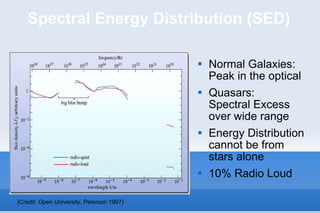
Spectral Energy Distribution (SED) Normal Galaxies: Peak in the optical Quasars: Spectral Excess over wide range Energy Distribution cannot be from stars alone 10% Radio Loud (Credit: Open University, Peterson 1997)
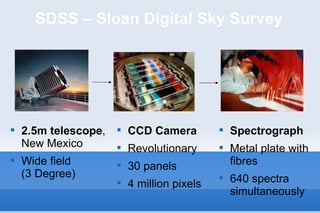
SDSS – Sloan Digital Sky Survey Spectrograph Metal plate with fibres 640 spectra simultaneously CCD Camera Revolutionary 30 panels 4 million pixels 2.5m telescope , New Mexico Wide field  (3 Degree)
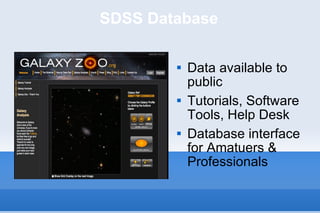
SDSS Database Data available to public Tutorials, Software Tools, Help Desk Database interface for Amatuers & Professionals
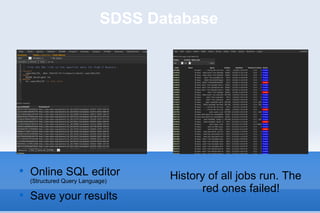
SDSS Database History of all jobs run. The red ones failed! Online SQL editor  (Structured Query Language) Save your results
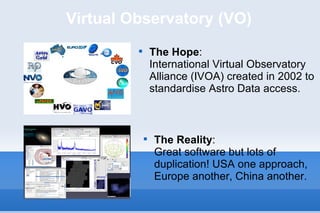
Virtual Observatory (VO) The Reality :  Great software but lots of duplication! USA one approach, Europe another, China another. The Hope : International Virtual Observatory Alliance (IVOA) created in 2002 to standardise Astro Data access.
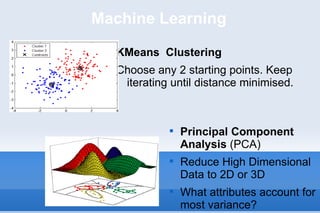
Machine Learning KMeans  Clustering  Choose any 2 starting points. Keep iterating until distance minimised. Principal Component Analysis  (PCA) Reduce High Dimensional Data to 2D or 3D What attributes account for most variance?
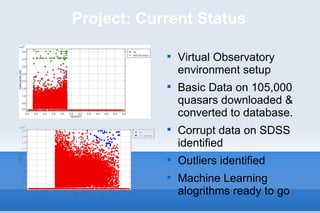
Project: Current Status Virtual Observatory environment setup Basic Data on 105,000 quasars downloaded & converted to database. Corrupt data on SDSS identified Outliers identified Machine Learning alogrithms ready to go
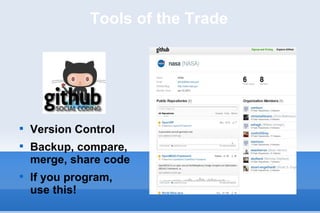
Tools of the Trade Version Control Backup, compare, merge, share code If you program,  use this!
Tools of the Trade Free, Open Source  MATLAB capabilities Links to C, C++, FORTRAN, R etc Numerical libraries and plotting Becoming de facto open-source scientific  environment
Tools of the Trade Teaches ”scientists and engineers the concepts, skills, and tools they need to use and build software more productively” software-carpentry.org
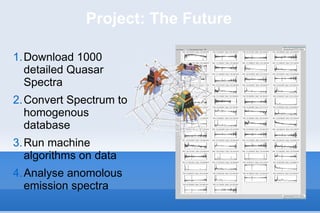
Project: The Future Download 1000 detailed Quasar Spectra Convert Spectrum to homogenous database Run machine algorithms on data Analyse anomolous emission spectra
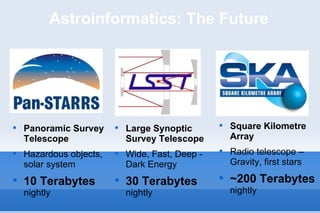
Astroinformatics: The Future Large Synoptic Survey Telescope Wide, Fast, Deep - Dark Energy 30 Terabytes  nightly Square Kilometre Array Radio telescope – Gravity, first stars ~200 Terabytes  nightly Panoramic Survey Telescope   Hazardous objects, solar system 10 Terabytes  nightly
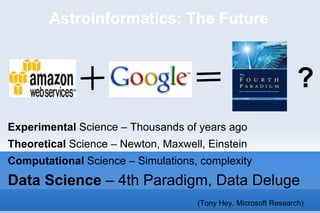
Astroinformatics: The Future ? Experimental  Science – Thousands of years ago Theoretical  Science – Newton, Maxwell, Einstein Computational  Science – Simulations, complexity Data Science  – 4th Paradigm, Data Deluge (Tony Hey, Microsoft Research)
Astroinformatics: The Future ” Now is the time for the recognition of Astroinformatics … The future of Astronomy depends on it." (Astroinformatics: A 21st Century Approach to Astronomy, KD Borne, 2009)

Presentation

  • 1.
    Quasar Spectra AstroinformaticsAstronomy, Computer Science & Machine Learning
  • 2.
    Quote "… thecommunity will realise that its lone-astronomer days are over, ... the subject has become too vast and complicated … … science can be realised only through code " Anne Finkbeiner (2010)
  • 3.
    Astroinformatics? Machine LearningAlgorithms Software Tools Computer Science SDSS Database Virtual Observatory Astronomy Quasars Spectroscopy
  • 4.
  • 5.
    Quasars – Whatare they? Which one is the Quasar? Dictionary (OED) : a massive and extremely remote celestial object, emitting exceptionally large amounts of energy, which typically has a starlike image. It has been suggested that quasars contain massive black holes ...
  • 6.
    Quasars – TheTheory Quasar : Quasi-stellar Radio Source QSO : Quasar Stellar Object Highly luminous Active Galatic Nucleus (AGN) at cosmological distances Strong X-Ray emission, sometimes radio emission Time-variable flux (days, weeks) Broad AND Narrow emission lines
  • 7.
    First Quasar (1963)3C 273, was emitting a huge amount of energy, with a very unusual never-before-seen spectrum. Maarteen Schmidt analysed spectrum - realised they were hydrogen lines shifted an astonishing 16 percent toward the red. (wired.com Science Discoveries) (Credit: Open University, Peterson 1997)
  • 8.
    Spectral Energy Distribution(SED) Normal Galaxies: Peak in the optical Quasars: Spectral Excess over wide range Energy Distribution cannot be from stars alone 10% Radio Loud (Credit: Open University, Peterson 1997)
  • 9.
    SDSS – SloanDigital Sky Survey Spectrograph Metal plate with fibres 640 spectra simultaneously CCD Camera Revolutionary 30 panels 4 million pixels 2.5m telescope , New Mexico Wide field (3 Degree)
  • 10.
    SDSS Database Dataavailable to public Tutorials, Software Tools, Help Desk Database interface for Amatuers & Professionals
  • 11.
    SDSS Database Historyof all jobs run. The red ones failed! Online SQL editor (Structured Query Language) Save your results
  • 12.
    Virtual Observatory (VO)The Reality : Great software but lots of duplication! USA one approach, Europe another, China another. The Hope : International Virtual Observatory Alliance (IVOA) created in 2002 to standardise Astro Data access.
  • 13.
    Machine Learning KMeans Clustering Choose any 2 starting points. Keep iterating until distance minimised. Principal Component Analysis (PCA) Reduce High Dimensional Data to 2D or 3D What attributes account for most variance?
  • 14.
    Project: Current StatusVirtual Observatory environment setup Basic Data on 105,000 quasars downloaded & converted to database. Corrupt data on SDSS identified Outliers identified Machine Learning alogrithms ready to go
  • 15.
    Tools of theTrade Version Control Backup, compare, merge, share code If you program, use this!
  • 16.
    Tools of theTrade Free, Open Source MATLAB capabilities Links to C, C++, FORTRAN, R etc Numerical libraries and plotting Becoming de facto open-source scientific environment
  • 17.
    Tools of theTrade Teaches ”scientists and engineers the concepts, skills, and tools they need to use and build software more productively” software-carpentry.org
  • 18.
    Project: The FutureDownload 1000 detailed Quasar Spectra Convert Spectrum to homogenous database Run machine algorithms on data Analyse anomolous emission spectra
  • 19.
    Astroinformatics: The FutureLarge Synoptic Survey Telescope Wide, Fast, Deep - Dark Energy 30 Terabytes nightly Square Kilometre Array Radio telescope – Gravity, first stars ~200 Terabytes nightly Panoramic Survey Telescope Hazardous objects, solar system 10 Terabytes nightly
  • 20.
    Astroinformatics: The Future? Experimental Science – Thousands of years ago Theoretical Science – Newton, Maxwell, Einstein Computational Science – Simulations, complexity Data Science – 4th Paradigm, Data Deluge (Tony Hey, Microsoft Research)
  • 21.
    Astroinformatics: The Future” Now is the time for the recognition of Astroinformatics … The future of Astronomy depends on it." (Astroinformatics: A 21st Century Approach to Astronomy, KD Borne, 2009)