CLASS-10
CHAPTER-1 CHEMICAL
REACTIONS AND CHEMICALS
TYPES OF CHEMICAL REACTIONS
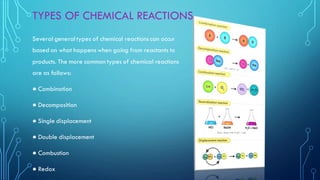
Several general types of chemical reactions can occur
based on what happens when going from reactants to
products. The more common types of chemical reactions
are as follows:
● Combination
● Decomposition
● Single displacement
● Double displacement
● Combustion
● Redox
COMBINATION REACTION
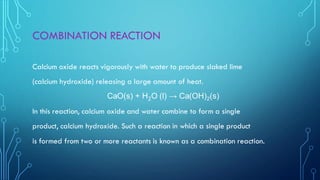
Calcium oxide reacts vigorously with water to produce slaked lime
(calcium hydroxide) releasing a large amount of heat.
CaO(s) + H2O (l) → Ca(OH)2(s)
In this reaction, calcium oxide and water combine to form a single
product, calcium hydroxide. Such a reaction in which a single product
is formed from two or more reactants is known as a combination reaction.
EXAMPLES OF COMBINATION REACTION
• BURNING OF COAL
C + O2 --> CO2
• FORMATIONOFWATER HYDROGENAND OXYGEN
2H2 + O2 -> 2H2O
EXOTHERMIC REACTION
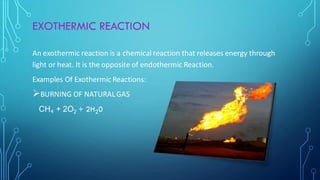
An exothermic reaction is a chemical reaction that releases energy through
light or heat. It is the opposite of endothermic Reaction.
Examples Of Exothermic Reactions:
➢BURNING OF NATURALGAS
CH₄ + 2O2 + 2H20
DECOMPOSITION REACTION
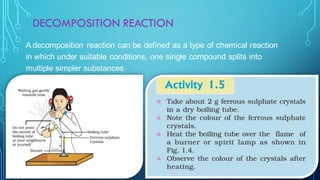
A decomposition reaction can be defined as a type of chemical reaction
in which under suitable conditions, one single compound splits into
multiple simpler substances.
SOME MORE DECOMPOSITION REACTIONS
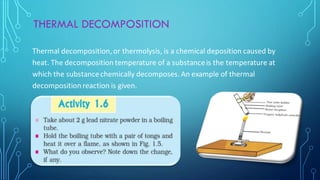
THERMAL DECOMPOSITION
Thermal decomposition, or thermolysis, is a chemical deposition caused by
heat. The decomposition temperature of a substanceis the temperature at
which the substancechemically decomposes. An example of thermal
decomposition reaction is given.
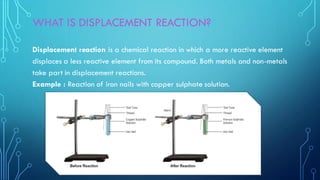
WHAT IS DISPLACEMENT REACTION?
Displacement reaction is a chemical reaction in which a more reactive element
displaces a less reactive element from its compound. Both metals and non-metals
take part in displacement reactions.
Example : Reaction of iron nails with copper sulphate solution.
AN EXAMPLE OF DISPLACEMENT REACTION
WHAT IS DOUBLE DISPLACEMENT REATION?
Double replacement reactions—occur when parts of two
ionic compounds are exchanged, making two new
compounds. The overall pattern of a double replacement
reaction looks like this:
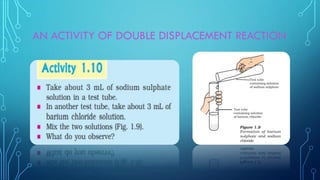
AN ACTIVITY OF DOUBLE DISPLACEMENT REACTION
OXIDATION AND REDUCTION (REDOX)
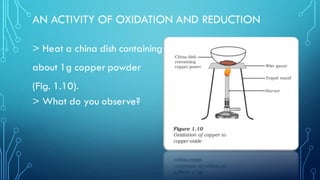
AN ACTIVITY OF OXIDATION AND REDUCTION
> Heat a china dish containing
about 1g copper powder
(Fig. 1.10).
> What do you observe?
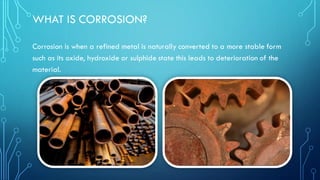
WHAT IS CORROSION?
Corrosion is when a refined metal is naturally converted to a more stable form
such as its oxide, hydroxide or sulphide state this leads to deterioration of the
material.
WHAT IS RANCIDITY?
Rancidity is a very general term and in its most general meaning, it refers to the
spoilage of a food in such a way that it becomes undesirable (and usually
unsafe) for consumption.
PRESENTED BY
ANIL KUMAR

Ncert Class 10 Chapter 1 PPT

  • 1.
  • 2.
    TYPES OF CHEMICALREACTIONS Several general types of chemical reactions can occur based on what happens when going from reactants to products. The more common types of chemical reactions are as follows: ● Combination ● Decomposition ● Single displacement ● Double displacement ● Combustion ● Redox
  • 3.
    COMBINATION REACTION Calcium oxidereacts vigorously with water to produce slaked lime (calcium hydroxide) releasing a large amount of heat. CaO(s) + H2O (l) → Ca(OH)2(s) In this reaction, calcium oxide and water combine to form a single product, calcium hydroxide. Such a reaction in which a single product is formed from two or more reactants is known as a combination reaction.
  • 4.
    EXAMPLES OF COMBINATIONREACTION • BURNING OF COAL C + O2 --> CO2 • FORMATIONOFWATER HYDROGENAND OXYGEN 2H2 + O2 -> 2H2O
  • 5.
    EXOTHERMIC REACTION An exothermicreaction is a chemical reaction that releases energy through light or heat. It is the opposite of endothermic Reaction. Examples Of Exothermic Reactions: ➢BURNING OF NATURALGAS CH₄ + 2O2 + 2H20
  • 6.
    DECOMPOSITION REACTION A decompositionreaction can be defined as a type of chemical reaction in which under suitable conditions, one single compound splits into multiple simpler substances.
  • 7.
  • 8.
    THERMAL DECOMPOSITION Thermal decomposition,or thermolysis, is a chemical deposition caused by heat. The decomposition temperature of a substanceis the temperature at which the substancechemically decomposes. An example of thermal decomposition reaction is given.
  • 9.
    WHAT IS DISPLACEMENTREACTION? Displacement reaction is a chemical reaction in which a more reactive element displaces a less reactive element from its compound. Both metals and non-metals take part in displacement reactions. Example : Reaction of iron nails with copper sulphate solution.
  • 10.
    AN EXAMPLE OFDISPLACEMENT REACTION
  • 11.
    WHAT IS DOUBLEDISPLACEMENT REATION? Double replacement reactions—occur when parts of two ionic compounds are exchanged, making two new compounds. The overall pattern of a double replacement reaction looks like this:
  • 12.
    AN ACTIVITY OFDOUBLE DISPLACEMENT REACTION
  • 13.
  • 14.
    AN ACTIVITY OFOXIDATION AND REDUCTION > Heat a china dish containing about 1g copper powder (Fig. 1.10). > What do you observe?
  • 15.
    WHAT IS CORROSION? Corrosionis when a refined metal is naturally converted to a more stable form such as its oxide, hydroxide or sulphide state this leads to deterioration of the material.
  • 16.
    WHAT IS RANCIDITY? Rancidityis a very general term and in its most general meaning, it refers to the spoilage of a food in such a way that it becomes undesirable (and usually unsafe) for consumption.
  • 17.