4thGrade Mathematics ● Unpacked Content
For the new Common Core State Standards that will be effective in all North Carolina schools in the 2012-13 school year.
This document is designed to help North Carolina educators teach the Common Core (Standard Course of Study). NCDPI staff are continually
updating and improving these tools to better serve teachers.

  What is the purpose of this document?
  To increase student achievement by ensuring educators understand specifically what the new standards mean a student must know,
  understand and be able to do. This document may also be used to facilitate discussion among teachers and curriculum staff and to encourage
  coherence in the sequence, pacing, and units of study for grade-level curricula. This document, along with on-going professional
  development, is one of many resources used to understand and teach the CCSS.

  What is in the document?
  Descriptions of what each standard means a student will know, understand and be able to do. The “unpacking” of the standards done in this
  document is an effort to answer a simple question “What does this standard mean that a student must know and be able to do?” and to
  ensure the description is helpful, specific and comprehensive for educators.

  How do I send Feedback?
  We intend the explanations and examples in this document to be helpful and specific. That said, we believe that as this document is used,
  teachers and educators will find ways in which the unpacking can be improved and made ever more useful. Please send feedback to us at
  feedback@dpi.state.nc.us and we will use your input to refine our unpacking of the standards. Thank You!

  Just want the standards alone?
  You can find the standards alone at http://corestandards.org/the-standards


      4th Grade Mathematics ● Unpacked Content	


     August, 2011
At A Glance
This page provides a give a snapshot of the mathematical concepts that are new or have been removed from this grade level as well as
instructional considerations for the first year of implementation. 	
  

New to 4th Grade:
  • Factors and multiples (4.OA.4)
  • Multiply a fraction by a whole number (4.NF.4)
  • Conversions of measurements within the same system (4.MD.1, 4.MD.2)
  • Angles and angle measurements (4.MD.5 4.MD.6, 4.MD.7)
  • Lines of symmetry (4.G.3)

Moved from 4th Grade:
  • Coordinate system (3.01)
  • Transformations (3.03)
  • Line graphs and bar graphs (4.01)
  • Data - median, range, mode, comparing sets data (4.03)
  • Probability (4.04)
  • Number relationships (5.02, 5.03)

Notes:
   • Topics may appear to be similar between the CCSS and the 2003 NCSCOS; however, the CCSS may be presented at a higher
       cognitive demand.
   • For more detailed information see Math Crosswalks: http://www.dpi.state.nc.us/acre/standards/support-tools/

Instructional considerations for CCSS implementation in 2012-2013
   • 4.MD.3 calls for students to generalize their understanding of area and perimeter by connecting the concepts to mathematical
       formulas. These concepts should be developed through conceptual experiences in the classroom not just memorization.
       Foundation of this concept will be built in third grade the following year.


4th Grade Mathematics ● Unpacked Content                                                                                    page 2	
  
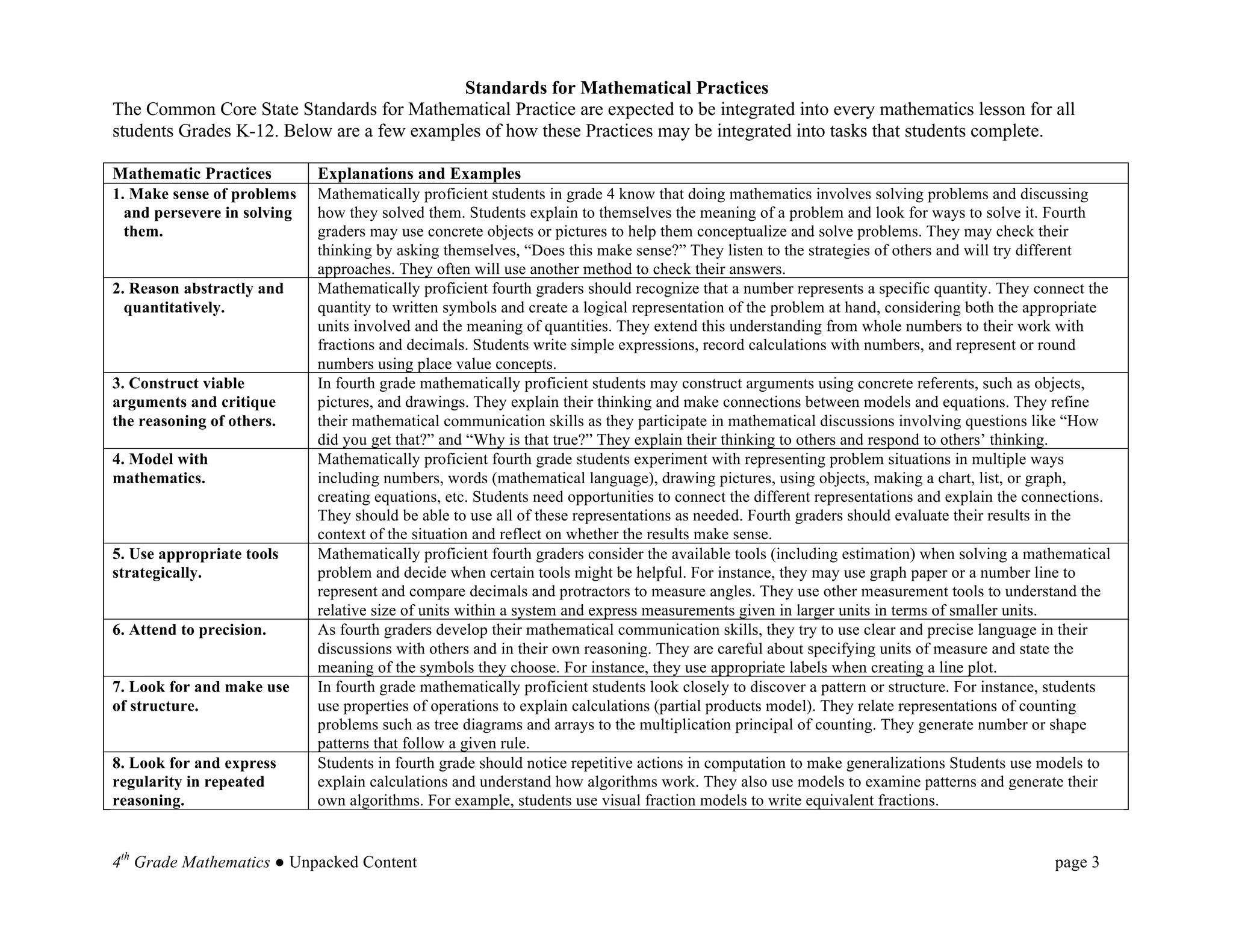
Standards for Mathematical Practices
The Common Core State Standards for Mathematical Practice are expected to be integrated into every mathematics lesson for all
students Grades K-12. Below are a few examples of how these Practices may be integrated into tasks that students complete.

Mathematic Practices         Explanations and Examples
1. Make sense of problems    Mathematically proficient students in grade 4 know that doing mathematics involves solving problems and discussing
  and persevere in solving   how they solved them. Students explain to themselves the meaning of a problem and look for ways to solve it. Fourth
  them.                      graders may use concrete objects or pictures to help them conceptualize and solve problems. They may check their
                             thinking by asking themselves, “Does this make sense?” They listen to the strategies of others and will try different
                             approaches. They often will use another method to check their answers.
2. Reason abstractly and     Mathematically proficient fourth graders should recognize that a number represents a specific quantity. They connect the
  quantitatively.            quantity to written symbols and create a logical representation of the problem at hand, considering both the appropriate
                             units involved and the meaning of quantities. They extend this understanding from whole numbers to their work with
                             fractions and decimals. Students write simple expressions, record calculations with numbers, and represent or round
                             numbers using place value concepts.
3. Construct viable          In fourth grade mathematically proficient students may construct arguments using concrete referents, such as objects,
arguments and critique       pictures, and drawings. They explain their thinking and make connections between models and equations. They refine
the reasoning of others.     their mathematical communication skills as they participate in mathematical discussions involving questions like “How
                             did you get that?” and “Why is that true?” They explain their thinking to others and respond to others’ thinking.
4. Model with                Mathematically proficient fourth grade students experiment with representing problem situations in multiple ways
mathematics.                 including numbers, words (mathematical language), drawing pictures, using objects, making a chart, list, or graph,
                             creating equations, etc. Students need opportunities to connect the different representations and explain the connections.
                             They should be able to use all of these representations as needed. Fourth graders should evaluate their results in the
                             context of the situation and reflect on whether the results make sense.
5. Use appropriate tools     Mathematically proficient fourth graders consider the available tools (including estimation) when solving a mathematical
strategically.               problem and decide when certain tools might be helpful. For instance, they may use graph paper or a number line to
                             represent and compare decimals and protractors to measure angles. They use other measurement tools to understand the
                             relative size of units within a system and express measurements given in larger units in terms of smaller units.
6. Attend to precision.      As fourth graders develop their mathematical communication skills, they try to use clear and precise language in their
                             discussions with others and in their own reasoning. They are careful about specifying units of measure and state the
                             meaning of the symbols they choose. For instance, they use appropriate labels when creating a line plot.
7. Look for and make use     In fourth grade mathematically proficient students look closely to discover a pattern or structure. For instance, students
of structure.                use properties of operations to explain calculations (partial products model). They relate representations of counting
                             problems such as tree diagrams and arrays to the multiplication principal of counting. They generate number or shape
                             patterns that follow a given rule.
8. Look for and express      Students in fourth grade should notice repetitive actions in computation to make generalizations Students use models to
regularity in repeated       explain calculations and understand how algorithms work. They also use models to examine patterns and generate their
reasoning.                   own algorithms. For example, students use visual fraction models to write equivalent fractions.


4th Grade Mathematics ● Unpacked Content                                                                                                      page 3	
  
Grade 4 Critical Areas
The Critical Areas are designed to bring focus to the standards at each grade by describing the big ideas that educators can use to build
their curriculum and to guide instruction. The Critical Areas for fourth grade can be found on page 27 in the Common Core State Standards
for Mathematics.	
  

1. Developing understanding and fluency with multi-digit multiplication, and developing understanding of dividing to find
quotients involving multi-digit dividends.
Students generalize their understanding of place value to 1,000,000, understanding the relative sizes of numbers in each place. They
apply their understanding of models for multiplication (equal-sized groups, arrays, area models), place value, and properties of
operations, in particular the distributive property, as they develop, discuss, and use efficient, accurate, and generalizable methods to
compute products of multi-digit whole numbers. Depending on the numbers and the context, they select and accurately apply
appropriate methods to estimate or mentally calculate products. They develop fluency with efficient procedures for multiplying whole
numbers; understand and explain why the procedures work based on place value and properties of operations; and use them to solve
problems. Students apply their understanding of models for division, place value, properties of operations, and the relationship of
division to multiplication as they develop, discuss, and use efficient, accurate, and generalizable procedures to find quotients involving
multi-digit dividends. They select and accurately apply appropriate methods to estimate and mentally calculate quotients, and interpret
remainders based upon the context.

2. Developing an understanding of fraction equivalence, addition and subtraction of fractions with like denominators, and
multiplication of fractions by whole numbers.
Students develop understanding of fraction equivalence and operations with fractions. They recognize that two different fractions can
be equal (e.g., 15/9 = 5/3), and they develop methods for generating and recognizing equivalent fractions. Students extend previous
understandings about how fractions are built from unit fractions, composing fractions from unit fractions, decomposing fractions into
unit fractions, and using the meaning of fractions and the meaning of multiplication to multiply a fraction by a whole number.

3. Understanding that geometric figures can be analyzed and classified based on their properties, such as having parallel sides,
perpendicular sides, particular angle measures, and symmetry.
Students describe, analyze, compare, and classify two-dimensional shapes. Through building, drawing, and analyzing two-
dimensional shapes, students deepen their understanding of properties of two-dimensional objects and the use of them to solve
problems involving symmetry.


4th Grade Mathematics ● Unpacked Content                                                                                          page 4	
  
Operations and Algebraic Thinking                                                                                                                       4.OA
Common Core Cluster
Use the four operations with whole numbers to solve problems.
Mathematically proficient students communicate precisely by engaging in discussion about their reasoning using appropriate mathematical language. The
terms students should learn to use with increasing precision with this cluster are: multiplication/multiply, division/divide, addition/add,
subtraction/subtract, equations, unknown, remainders, reasonableness, mental computation, estimation, rounding
      Common Core Standard                  Unpacking
                                            What do these standards mean a child will know and be able to do?
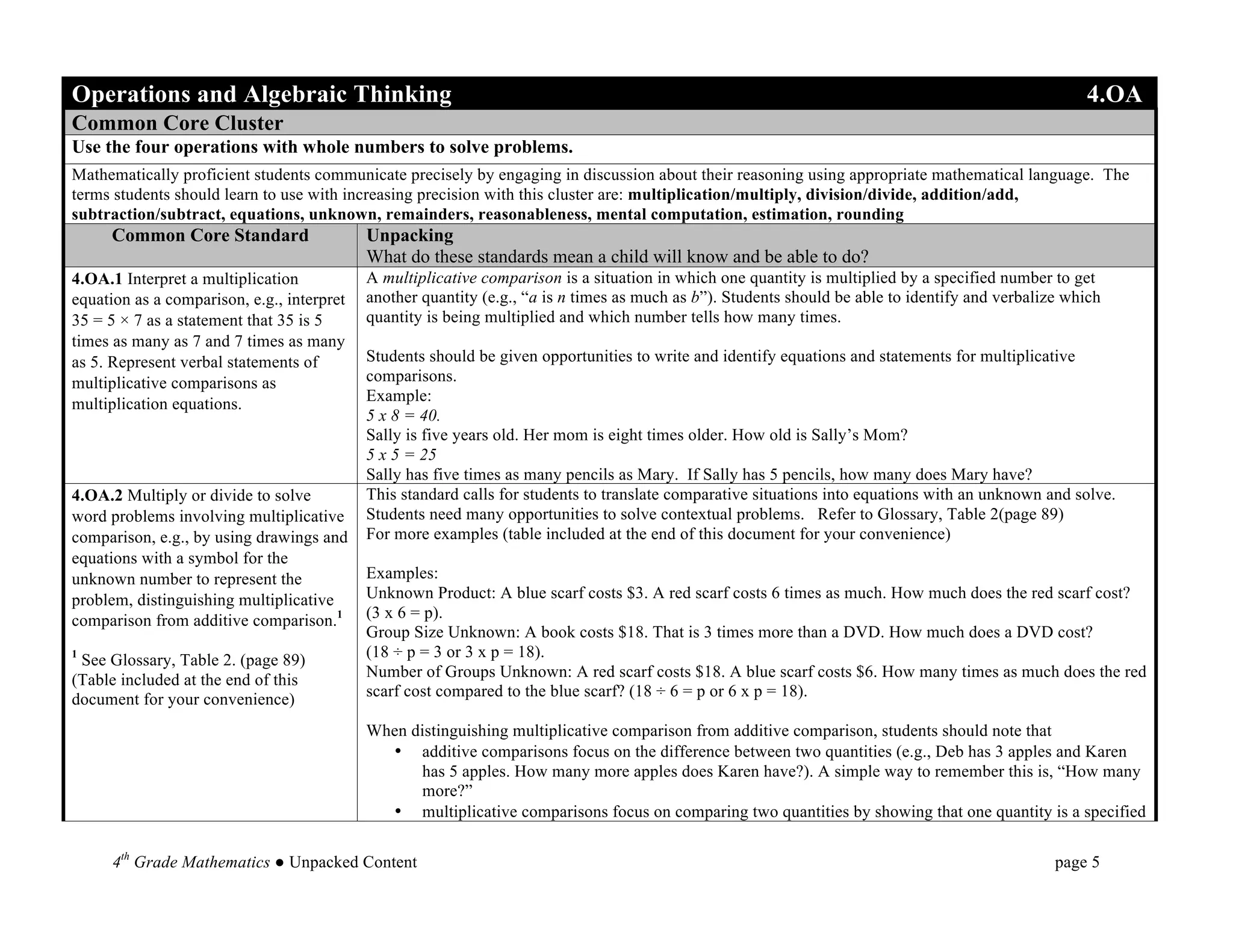
4.OA.1 Interpret a multiplication           A multiplicative comparison is a situation in which one quantity is multiplied by a specified number to get
equation as a comparison, e.g., interpret   another quantity (e.g., “a is n times as much as b”). Students should be able to identify and verbalize which
35 = 5 × 7 as a statement that 35 is 5      quantity is being multiplied and which number tells how many times.
times as many as 7 and 7 times as many
as 5. Represent verbal statements of        Students should be given opportunities to write and identify equations and statements for multiplicative
multiplicative comparisons as               comparisons.
multiplication equations.                   Example:
                                            5 x 8 = 40.
                                            Sally is five years old. Her mom is eight times older. How old is Sally’s Mom?
                                            5 x 5 = 25
                                            Sally has five times as many pencils as Mary. If Sally has 5 pencils, how many does Mary have?
4.OA.2 Multiply or divide to solve          This standard calls for students to translate comparative situations into equations with an unknown and solve.
word problems involving multiplicative      Students need many opportunities to solve contextual problems. Refer to Glossary, Table 2(page 89)
comparison, e.g., by using drawings and     For more examples (table included at the end of this document for your convenience)
equations with a symbol for the
unknown number to represent the             Examples:
problem, distinguishing multiplicative      Unknown Product: A blue scarf costs $3. A red scarf costs 6 times as much. How much does the red scarf cost?
comparison from additive comparison.1       (3 x 6 = p).
                                            Group Size Unknown: A book costs $18. That is 3 times more than a DVD. How much does a DVD cost?
1
 See Glossary, Table 2. (page 89)           (18 ÷ p = 3 or 3 x p = 18).
(Table included at the end of this          Number of Groups Unknown: A red scarf costs $18. A blue scarf costs $6. How many times as much does the red
document for your convenience)              scarf cost compared to the blue scarf? (18 ÷ 6 = p or 6 x p = 18).

                                            When distinguishing multiplicative comparison from additive comparison, students should note that
                                              • additive comparisons focus on the difference between two quantities (e.g., Deb has 3 apples and Karen
                                                  has 5 apples. How many more apples does Karen have?). A simple way to remember this is, “How many
                                                  more?”
                                              • multiplicative comparisons focus on comparing two quantities by showing that one quantity is a specified


      4th Grade Mathematics ● Unpacked Content                                                                                                    page 5	
  
number of times larger or smaller than the other (e.g., Deb ran 3 miles. Karen ran 5 times as many miles
                                                    as Deb. How many miles did Karen run?). A simple way to remember this is “How many times as
                                                    much?” or “How many times as many?”
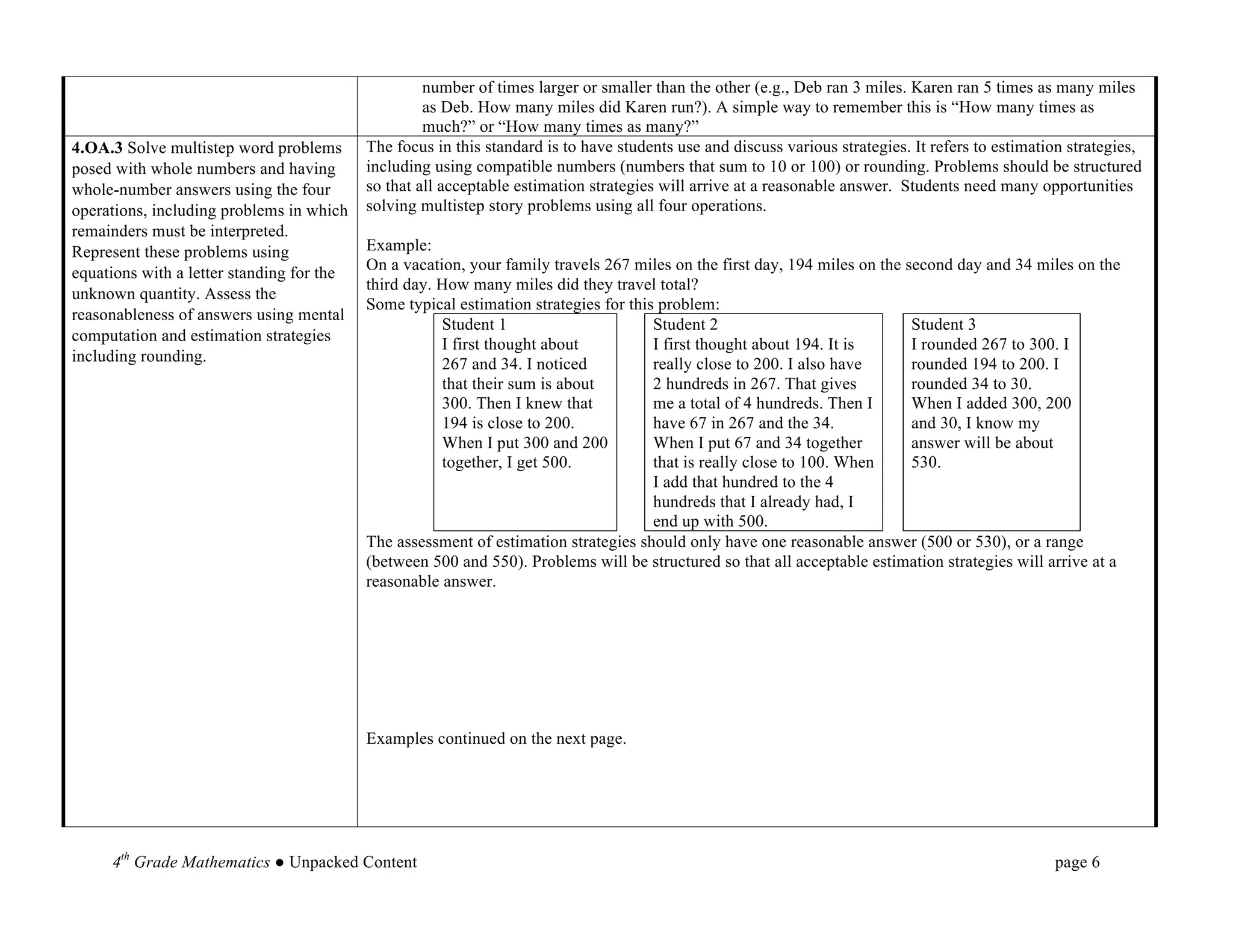
4.OA.3 Solve multistep word problems       The focus in this standard is to have students use and discuss various strategies. It refers to estimation strategies,
posed with whole numbers and having        including using compatible numbers (numbers that sum to 10 or 100) or rounding. Problems should be structured
whole-number answers using the four        so that all acceptable estimation strategies will arrive at a reasonable answer. Students need many opportunities
operations, including problems in which    solving multistep story problems using all four operations.
remainders must be interpreted.
Represent these problems using             Example:
equations with a letter standing for the   On a vacation, your family travels 267 miles on the first day, 194 miles on the second day and 34 miles on the
                                           third day. How many miles did they travel total?
unknown quantity. Assess the
                                           Some typical estimation strategies for this problem:
reasonableness of answers using mental
                                                      Student 1                       Student 2                             Student 3
computation and estimation strategies
                                                      I first thought about           I first thought about 194. It is      I rounded 267 to 300. I
including rounding.                                   267 and 34. I noticed           really close to 200. I also have      rounded 194 to 200. I
                                                      that their sum is about         2 hundreds in 267. That gives         rounded 34 to 30.
                                                      300. Then I knew that           me a total of 4 hundreds. Then I      When I added 300, 200
                                                      194 is close to 200.            have 67 in 267 and the 34.            and 30, I know my
                                                      When I put 300 and 200          When I put 67 and 34 together         answer will be about
                                                      together, I get 500.            that is really close to 100. When     530.
                                                                                      I add that hundred to the 4
                                                                                      hundreds that I already had, I
                                                                                      end up with 500.
                                           The assessment of estimation strategies should only have one reasonable answer (500 or 530), or a range
                                           (between 500 and 550). Problems will be structured so that all acceptable estimation strategies will arrive at a
                                           reasonable answer.


                                           Examples continued on the next page.


     4th Grade Mathematics ● Unpacked Content                                                                                                      page 6	
  
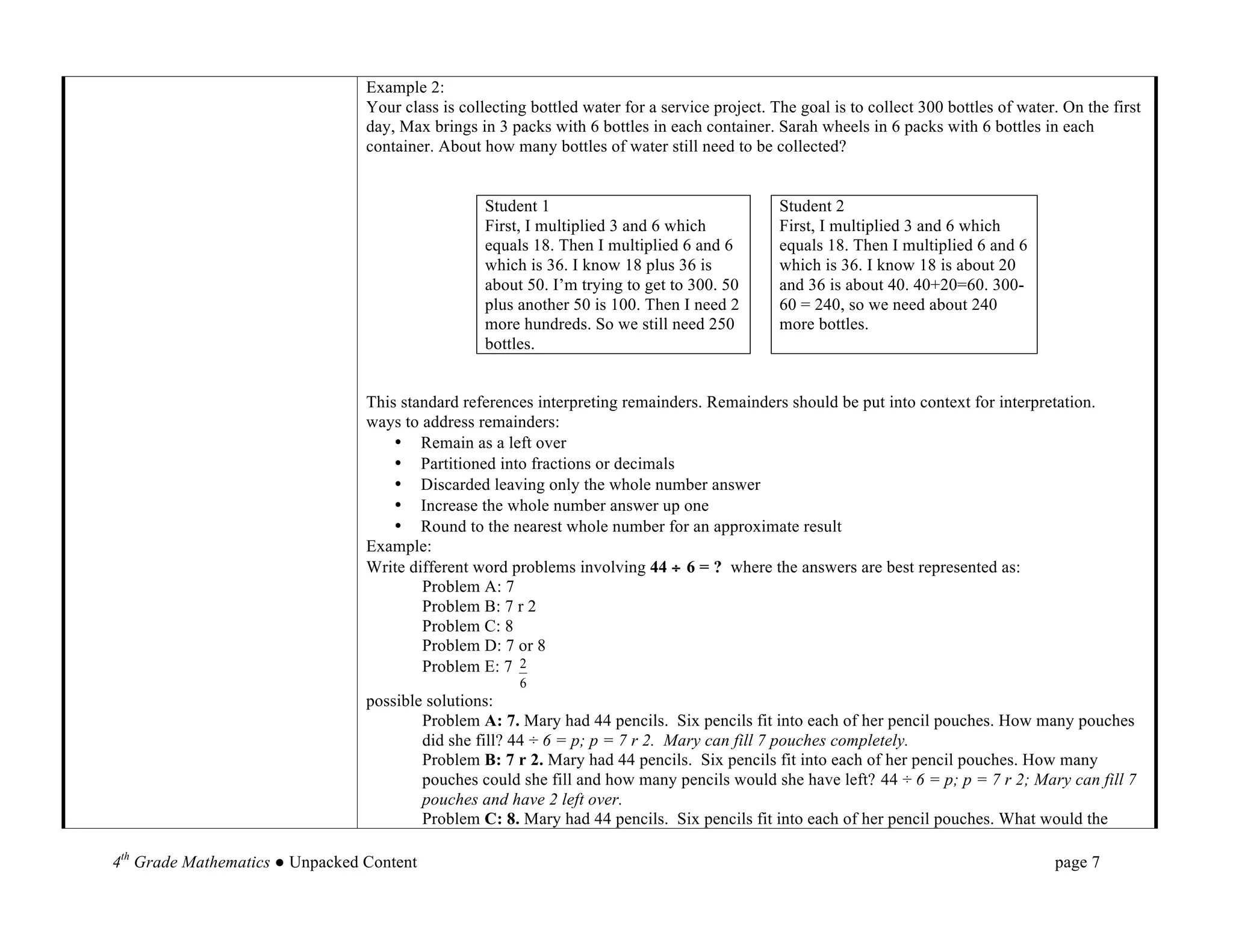
Example 2:
                                 Your class is collecting bottled water for a service project. The goal is to collect 300 bottles of water. On the first
                                 day, Max brings in 3 packs with 6 bottles in each container. Sarah wheels in 6 packs with 6 bottles in each
                                 container. About how many bottles of water still need to be collected?


                                                   Student 1                                    Student 2
                                                   First, I multiplied 3 and 6 which            First, I multiplied 3 and 6 which
                                                   equals 18. Then I multiplied 6 and 6         equals 18. Then I multiplied 6 and 6
                                                   which is 36. I know 18 plus 36 is            which is 36. I know 18 is about 20
                                                   about 50. I’m trying to get to 300. 50       and 36 is about 40. 40+20=60. 300-
                                                   plus another 50 is 100. Then I need 2        60 = 240, so we need about 240
                                                   more hundreds. So we still need 250          more bottles.
                                                   bottles.


                                 This standard references interpreting remainders. Remainders should be put into context for interpretation.
                                 ways to address remainders:
                                     • Remain as a left over
                                     • Partitioned into fractions or decimals
                                     • Discarded leaving only the whole number answer
                                     • Increase the whole number answer up one
                                     • Round to the nearest whole number for an approximate result
                                 Example:
                                 Write different word problems involving 44 ÷ 6 = ? where the answers are best represented as:
                                         Problem A: 7
                                         Problem B: 7 r 2
                                         Problem C: 8
                                         Problem D: 7 or 8
                                         Problem E: 7 2
                                                        6
                                 possible solutions:
                                         Problem A: 7. Mary had 44 pencils. Six pencils fit into each of her pencil pouches. How many pouches
                                         did she fill? 44 ÷ 6 = p; p = 7 r 2. Mary can fill 7 pouches completely.
                                         Problem B: 7 r 2. Mary had 44 pencils. Six pencils fit into each of her pencil pouches. How many
                                         pouches could she fill and how many pencils would she have left? 44 ÷ 6 = p; p = 7 r 2; Mary can fill 7
                                         pouches and have 2 left over.
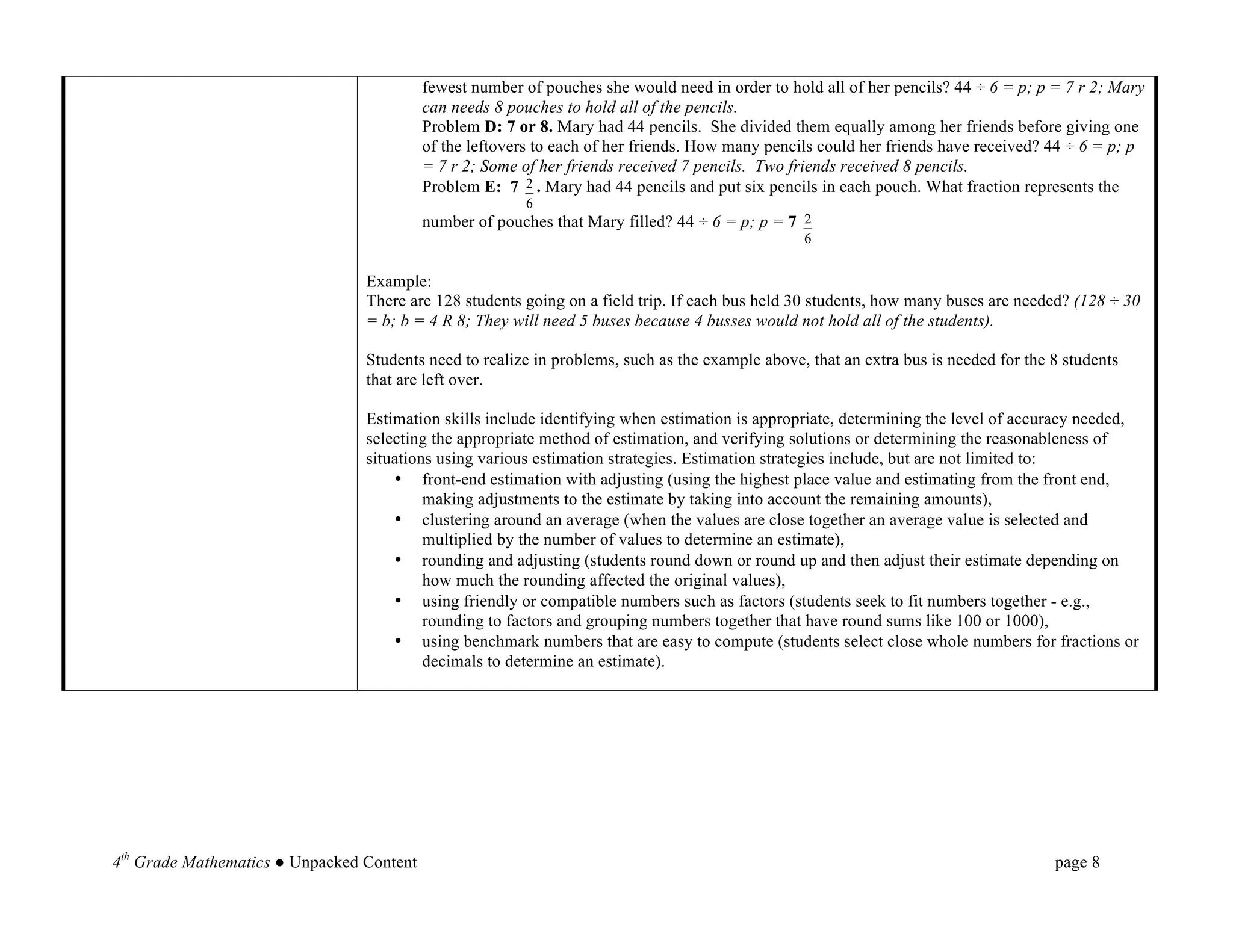
                                         Problem C: 8. Mary had 44 pencils. Six pencils fit into each of her pencil pouches. What would the

4th Grade Mathematics ● Unpacked Content                                                                                                  page 7	
  
fewest number of pouches she would need in order to hold all of her pencils? 44 ÷ 6 = p; p = 7 r 2; Mary
                                           can needs 8 pouches to hold all of the pencils.
                                           Problem D: 7 or 8. Mary had 44 pencils. She divided them equally among her friends before giving one
                                           of the leftovers to each of her friends. How many pencils could her friends have received? 44 ÷ 6 = p; p
                                           = 7 r 2; Some of her friends received 7 pencils. Two friends received 8 pencils.
                                           Problem E: 7 2 . Mary had 44 pencils and put six pencils in each pouch. What fraction represents the
                                                         6
                                           number of pouches that Mary filled? 44 ÷ 6 = p; p = 7 2
                                                                                                  6


                                 Example:
                                 There are 128 students going on a field trip. If each bus held 30 students, how many buses are needed? (128 ÷ 30
                                 = b; b = 4 R 8; They will need 5 buses because 4 busses would not hold all of the students).

                                 Students need to realize in problems, such as the example above, that an extra bus is needed for the 8 students
                                 that are left over.

                                 Estimation skills include identifying when estimation is appropriate, determining the level of accuracy needed,
                                 selecting the appropriate method of estimation, and verifying solutions or determining the reasonableness of
                                 situations using various estimation strategies. Estimation strategies include, but are not limited to:
                                     • front-end estimation with adjusting (using the highest place value and estimating from the front end,
                                          making adjustments to the estimate by taking into account the remaining amounts),
                                     • clustering around an average (when the values are close together an average value is selected and
                                          multiplied by the number of values to determine an estimate),
                                     • rounding and adjusting (students round down or round up and then adjust their estimate depending on
                                          how much the rounding affected the original values),
                                     • using friendly or compatible numbers such as factors (students seek to fit numbers together - e.g.,
                                          rounding to factors and grouping numbers together that have round sums like 100 or 1000),
                                     • using benchmark numbers that are easy to compute (students select close whole numbers for fractions or
                                          decimals to determine an estimate).


4th Grade Mathematics ● Unpacked Content                                                                                              page 8	
  
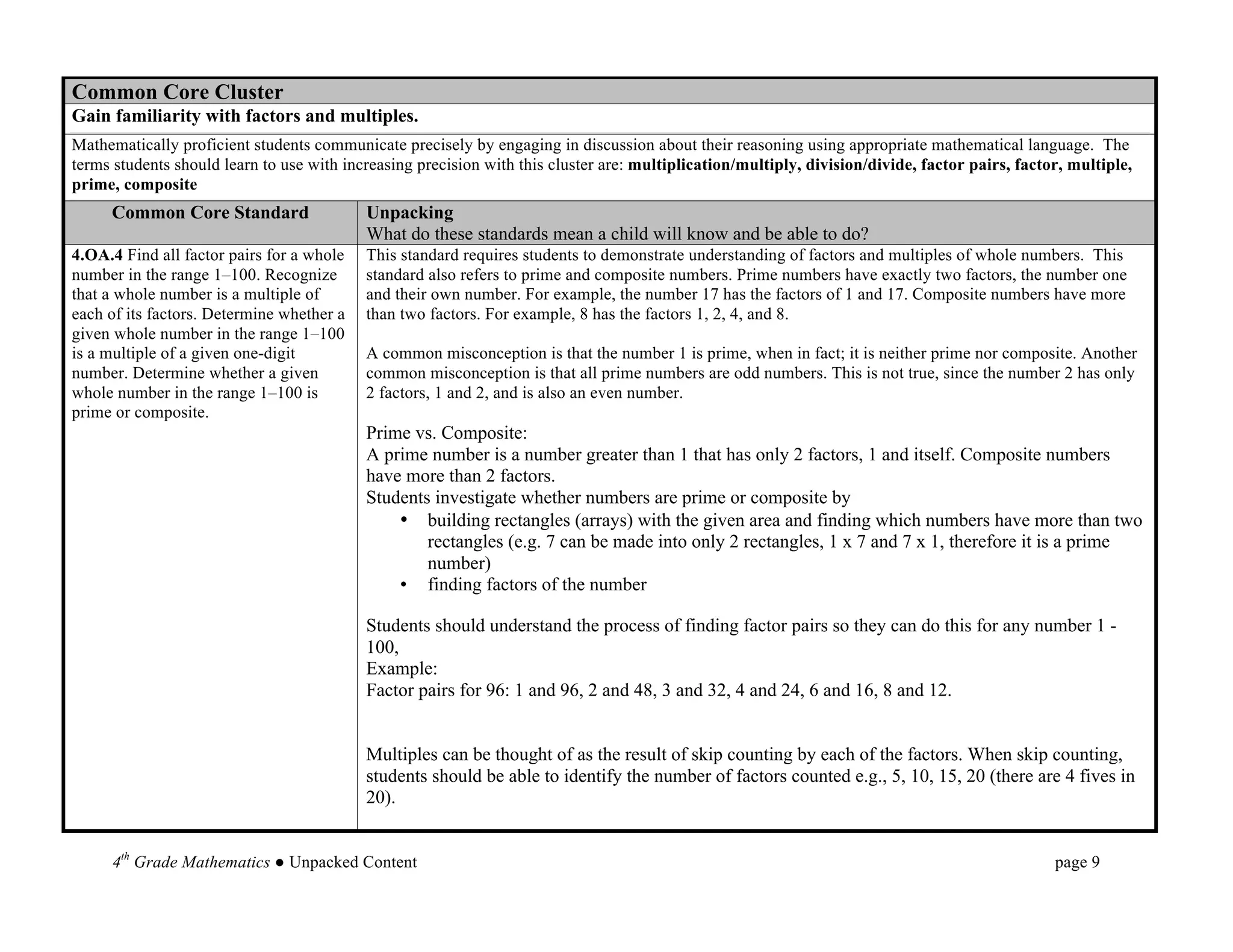
Common Core Cluster
Gain familiarity with factors and multiples.
Mathematically proficient students communicate precisely by engaging in discussion about their reasoning using appropriate mathematical language. The
terms students should learn to use with increasing precision with this cluster are: multiplication/multiply, division/divide, factor pairs, factor, multiple,
prime, composite
     Common Core Standard                  Unpacking
                                           What do these standards mean a child will know and be able to do?
4.OA.4 Find all factor pairs for a whole   This standard requires students to demonstrate understanding of factors and multiples of whole numbers. This
number in the range 1–100. Recognize       standard also refers to prime and composite numbers. Prime numbers have exactly two factors, the number one
that a whole number is a multiple of       and their own number. For example, the number 17 has the factors of 1 and 17. Composite numbers have more
each of its factors. Determine whether a   than two factors. For example, 8 has the factors 1, 2, 4, and 8.
given whole number in the range 1–100
is a multiple of a given one-digit         A common misconception is that the number 1 is prime, when in fact; it is neither prime nor composite. Another
number. Determine whether a given          common misconception is that all prime numbers are odd numbers. This is not true, since the number 2 has only
whole number in the range 1–100 is         2 factors, 1 and 2, and is also an even number.
prime or composite.
                                           Prime vs. Composite:
                                           A prime number is a number greater than 1 that has only 2 factors, 1 and itself. Composite numbers
                                           have more than 2 factors.
                                           Students investigate whether numbers are prime or composite by
                                               • building rectangles (arrays) with the given area and finding which numbers have more than two
                                                   rectangles (e.g. 7 can be made into only 2 rectangles, 1 x 7 and 7 x 1, therefore it is a prime
                                                   number)
                                               • finding factors of the number

                                           Students should understand the process of finding factor pairs so they can do this for any number 1 -
                                           100,
                                           Example:
                                           Factor pairs for 96: 1 and 96, 2 and 48, 3 and 32, 4 and 24, 6 and 16, 8 and 12.


                                           Multiples can be thought of as the result of skip counting by each of the factors. When skip counting,
                                           students should be able to identify the number of factors counted e.g., 5, 10, 15, 20 (there are 4 fives in
                                           20).


      4th Grade Mathematics ● Unpacked Content                                                                                                   page 9	
  
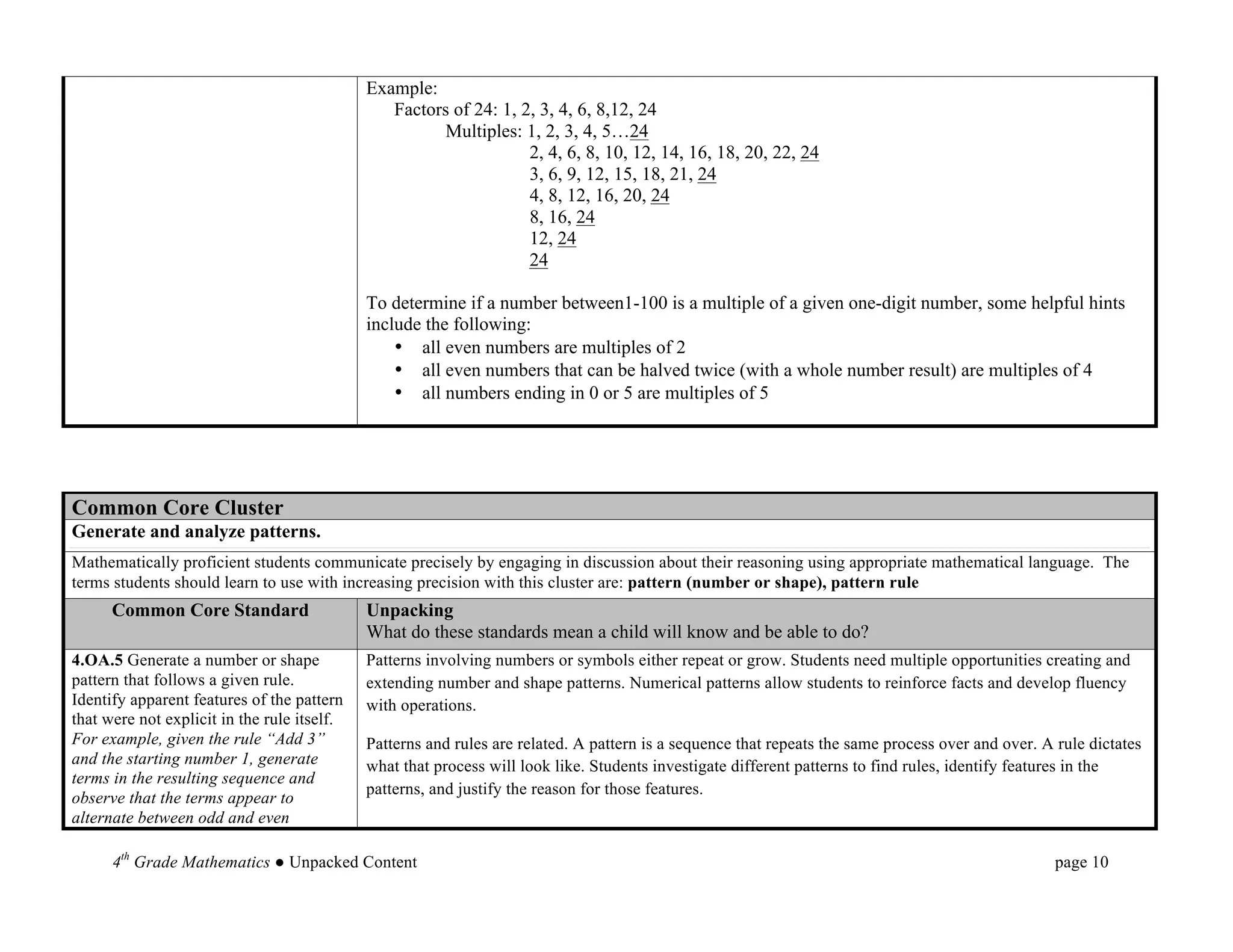
Example:
                                                Factors of 24: 1, 2, 3, 4, 6, 8,12, 24
                                                       Multiples: 1, 2, 3, 4, 5…24
                                                                   2, 4, 6, 8, 10, 12, 14, 16, 18, 20, 22, 24
                                                                   3, 6, 9, 12, 15, 18, 21, 24
                                                                   4, 8, 12, 16, 20, 24
                                                                   8, 16, 24
                                                                   12, 24
                                                                   24

                                             To determine if a number between1-100 is a multiple of a given one-digit number, some helpful hints
                                             include the following:
                                                 • all even numbers are multiples of 2
                                                 • all even numbers that can be halved twice (with a whole number result) are multiples of 4
                                                 • all numbers ending in 0 or 5 are multiples of 5


Common Core Cluster
Generate and analyze patterns.
Mathematically proficient students communicate precisely by engaging in discussion about their reasoning using appropriate mathematical language. The
terms students should learn to use with increasing precision with this cluster are: pattern (number or shape), pattern rule
      Common Core Standard                   Unpacking
                                             What do these standards mean a child will know and be able to do?
4.OA.5 Generate a number or shape            Patterns involving numbers or symbols either repeat or grow. Students need multiple opportunities creating and
pattern that follows a given rule.           extending number and shape patterns. Numerical patterns allow students to reinforce facts and develop fluency
Identify apparent features of the pattern    with operations.
that were not explicit in the rule itself.
For example, given the rule “Add 3”          Patterns and rules are related. A pattern is a sequence that repeats the same process over and over. A rule dictates
and the starting number 1, generate          what that process will look like. Students investigate different patterns to find rules, identify features in the
terms in the resulting sequence and
                                             patterns, and justify the reason for those features.
observe that the terms appear to
alternate between odd and even

      4th Grade Mathematics ● Unpacked Content                                                                                                      page 10	
  
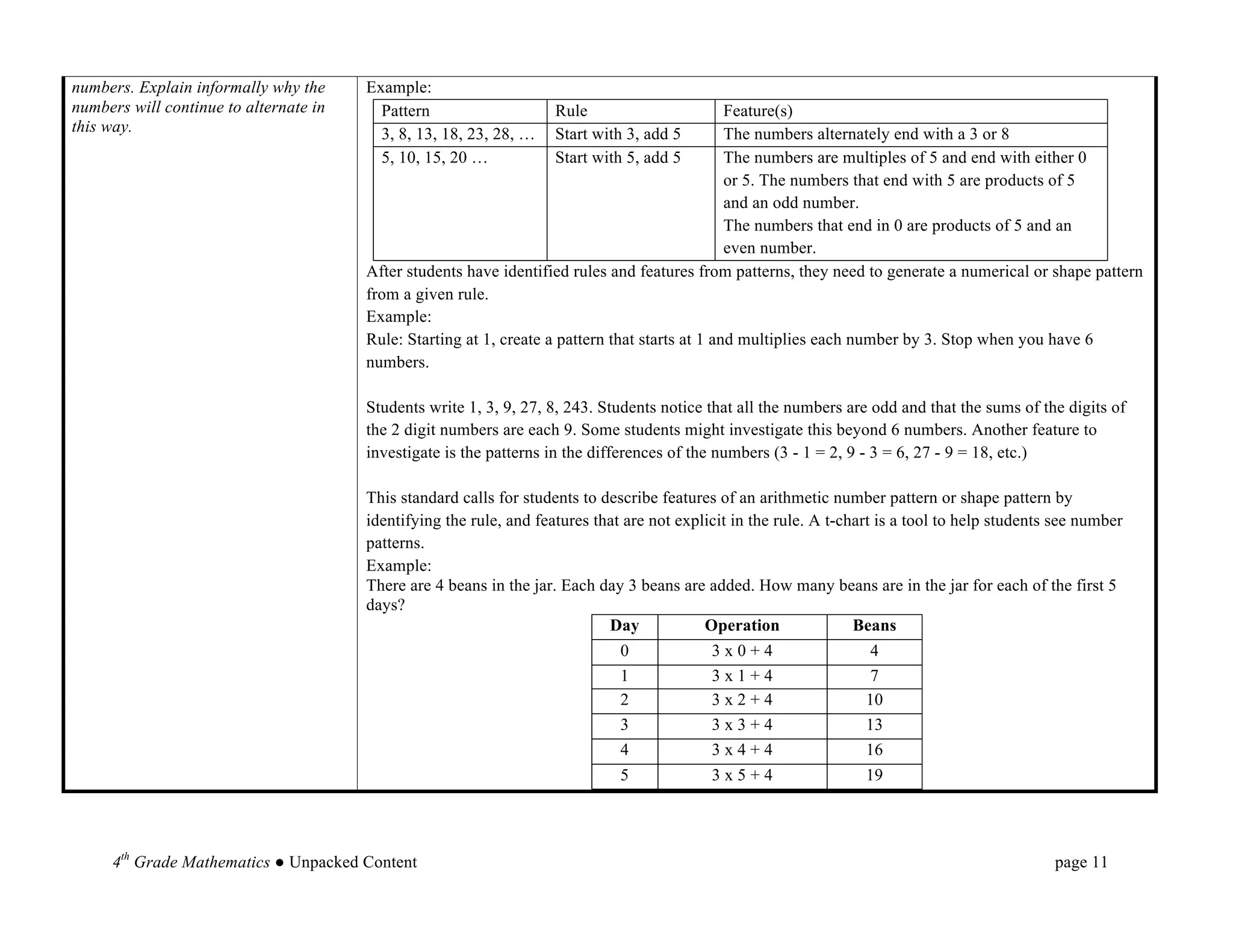
numbers. Explain informally why the     Example:
numbers will continue to alternate in     Pattern                    Rule                        Feature(s)
this way.                                 3, 8, 13, 18, 23, 28, …    Start with 3, add 5         The numbers alternately end with a 3 or 8
                                          5, 10, 15, 20 …            Start with 5, add 5         The numbers are multiples of 5 and end with either 0
                                                                                                 or 5. The numbers that end with 5 are products of 5
                                                                                                 and an odd number.
                                                                                                 The numbers that end in 0 are products of 5 and an
                                                                                                 even number.
                                        After students have identified rules and features from patterns, they need to generate a numerical or shape pattern
                                        from a given rule.
                                        Example:
                                        Rule: Starting at 1, create a pattern that starts at 1 and multiplies each number by 3. Stop when you have 6
                                        numbers.

                                        Students write 1, 3, 9, 27, 8, 243. Students notice that all the numbers are odd and that the sums of the digits of
                                        the 2 digit numbers are each 9. Some students might investigate this beyond 6 numbers. Another feature to
                                        investigate is the patterns in the differences of the numbers (3 - 1 = 2, 9 - 3 = 6, 27 - 9 = 18, etc.)

                                        This standard calls for students to describe features of an arithmetic number pattern or shape pattern by
                                        identifying the rule, and features that are not explicit in the rule. A t-chart is a tool to help students see number
                                        patterns. 	
  
                                        Example:
                                        There are 4 beans in the jar. Each day 3 beans are added. How many beans are in the jar for each of the first 5
                                        days?
                                                                             Day            Operation               Beans
                                                                               0             3x0+4                   4
                                                                               1             3x1+4                   7
                                                                               2             3x2+4                   10
                                                                               3             3x3+4                   13
                                                                               4             3x4+4                   16
                                                                               5             3x5+4                   19


     4th Grade Mathematics ● Unpacked Content                                                                                                     page 11	
  
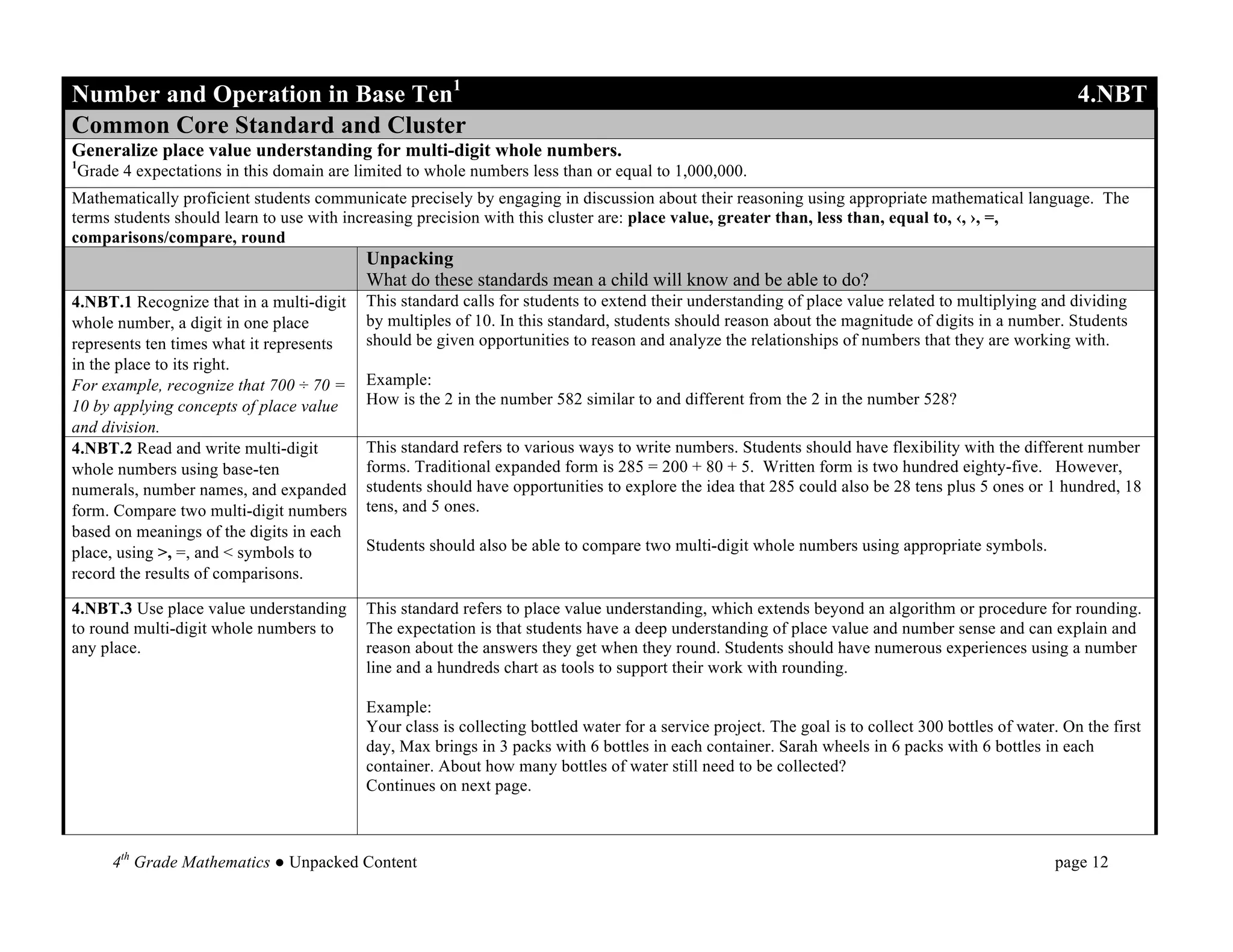
Number and Operation in Base Ten1                                                                                                                         4.NBT
Common Core Standard and Cluster
Generalize place value understanding for multi-digit whole numbers.
1
    Grade 4 expectations in this domain are limited to whole numbers less than or equal to 1,000,000.
Mathematically proficient students communicate precisely by engaging in discussion about their reasoning using appropriate mathematical language. The
terms students should learn to use with increasing precision with this cluster are: place value, greater than, less than, equal to, ‹, ›, =,
comparisons/compare, round
                                             Unpacking
                                             What do these standards mean a child will know and be able to do?
4.NBT.1 Recognize that in a multi-digit      This standard calls for students to extend their understanding of place value related to multiplying and dividing
whole number, a digit in one place           by multiples of 10. In this standard, students should reason about the magnitude of digits in a number. Students
represents ten times what it represents      should be given opportunities to reason and analyze the relationships of numbers that they are working with.
in the place to its right.
For example, recognize that 700 ÷ 70 =       Example:
10 by applying concepts of place value       How is the 2 in the number 582 similar to and different from the 2 in the number 528?
and division.
4.NBT.2 Read and write multi-digit           This standard refers to various ways to write numbers. Students should have flexibility with the different number
whole numbers using base-ten                 forms. Traditional expanded form is 285 = 200 + 80 + 5. Written form is two hundred eighty-five. However,
numerals, number names, and expanded         students should have opportunities to explore the idea that 285 could also be 28 tens plus 5 ones or 1 hundred, 18
form. Compare two multi-digit numbers        tens, and 5 ones.
based on meanings of the digits in each
place, using >, =, and < symbols to          Students should also be able to compare two multi-digit whole numbers using appropriate symbols.
record the results of comparisons.

4.NBT.3 Use place value understanding        This standard refers to place value understanding, which extends beyond an algorithm or procedure for rounding.
to round multi-digit whole numbers to        The expectation is that students have a deep understanding of place value and number sense and can explain and
any place.                                   reason about the answers they get when they round. Students should have numerous experiences using a number
                                             line and a hundreds chart as tools to support their work with rounding.

                                             Example:
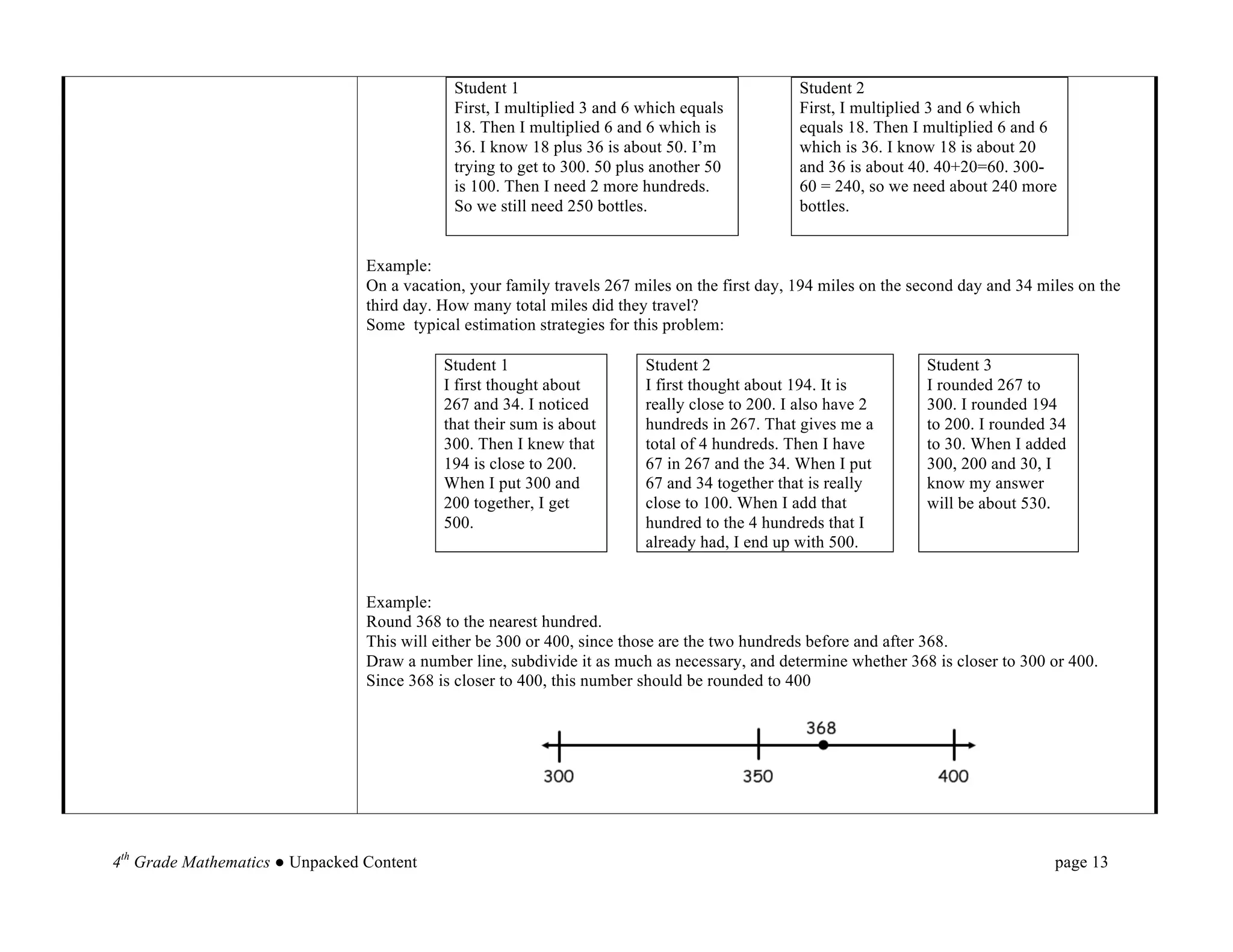
                                             Your class is collecting bottled water for a service project. The goal is to collect 300 bottles of water. On the first
                                             day, Max brings in 3 packs with 6 bottles in each container. Sarah wheels in 6 packs with 6 bottles in each
                                             container. About how many bottles of water still need to be collected?
                                             Continues on next page.


         4th Grade Mathematics ● Unpacked Content                                                                                                     page 12	
  
Student 1                                          Student 2
                                             First, I multiplied 3 and 6 which equals           First, I multiplied 3 and 6 which
                                             18. Then I multiplied 6 and 6 which is             equals 18. Then I multiplied 6 and 6
                                             36. I know 18 plus 36 is about 50. I’m             which is 36. I know 18 is about 20
                                             trying to get to 300. 50 plus another 50           and 36 is about 40. 40+20=60. 300-
                                             is 100. Then I need 2 more hundreds.               60 = 240, so we need about 240 more
                                             So we still need 250 bottles.                      bottles.	


                                 Example:
                                 On a vacation, your family travels 267 miles on the first day, 194 miles on the second day and 34 miles on the
                                 third day. How many total miles did they travel?
                                 Some typical estimation strategies for this problem:

                                            Student 1                    Student 2                                Student 3
                                            I first thought about        I first thought about 194. It is         I rounded 267 to
                                            267 and 34. I noticed        really close to 200. I also have 2       300. I rounded 194
                                            that their sum is about      hundreds in 267. That gives me a         to 200. I rounded 34
                                            300. Then I knew that        total of 4 hundreds. Then I have         to 30. When I added
                                            194 is close to 200.         67 in 267 and the 34. When I put         300, 200 and 30, I
                                            When I put 300 and           67 and 34 together that is really        know my answer
                                            200 together, I get          close to 100. When I add that            will be about 530.	


                                            500.                         hundred to the 4 hundreds that I
                                                                         already had, I end up with 500.


                                 Example:
                                 Round 368 to the nearest hundred.
                                 This will either be 300 or 400, since those are the two hundreds before and after 368.
                                 Draw a number line, subdivide it as much as necessary, and determine whether 368 is closer to 300 or 400.
                                 Since 368 is closer to 400, this number should be rounded to 400


4th Grade Mathematics ● Unpacked Content                                                                                                            page 13	
  
Common Core Cluster
Use place value understanding and properties of operations to perform multi-digit arithmetic.
1
  Grade 4 expectations in this domain are limited to whole numbers less than or equal to 1,000,000.
Students generalize their understanding of place value to 1,000,000, understanding the relative sizes of numbers in each place. They apply their
understanding of models for multiplication (equal-sized groups, arrays, area models), place value, and properties of operations, in particular the distributive
property, as they develop, discuss, and use efficient, accurate, and generalizable methods to compute products of multi-digit whole numbers. Depending on
the numbers and the context, they select and accurately apply appropriate methods to estimate or mentally calculate products.	
 They develop fluency with
efficient procedures for multiplying whole numbers; understand and explain why the procedures work based on place value and properties of operations;
and use them to solve problems. Students apply their understanding of models for division, place value, properties of operations, and the relationship of
division to multiplication as they develop, discuss, and use efficient, accurate, and generalizable procedures to find quotients involving multi-digit
dividends. They select and accurately apply appropriate methods to estimate and mentally calculate quotients, and interpret remainders based upon the
context.
Mathematically proficient students communicate precisely by engaging in discussion about their reasoning using appropriate mathematical language. The
terms students should learn to use with increasing precision with this cluster are: partition(ed), fraction, unit fraction, equivalent, multiple, reason,
denominator, numerator, comparison/compare, ‹, ›, =, benchmark fraction
     Common Core Standard                  Unpacking
                                           What do these standards mean a child will know and be able to do?
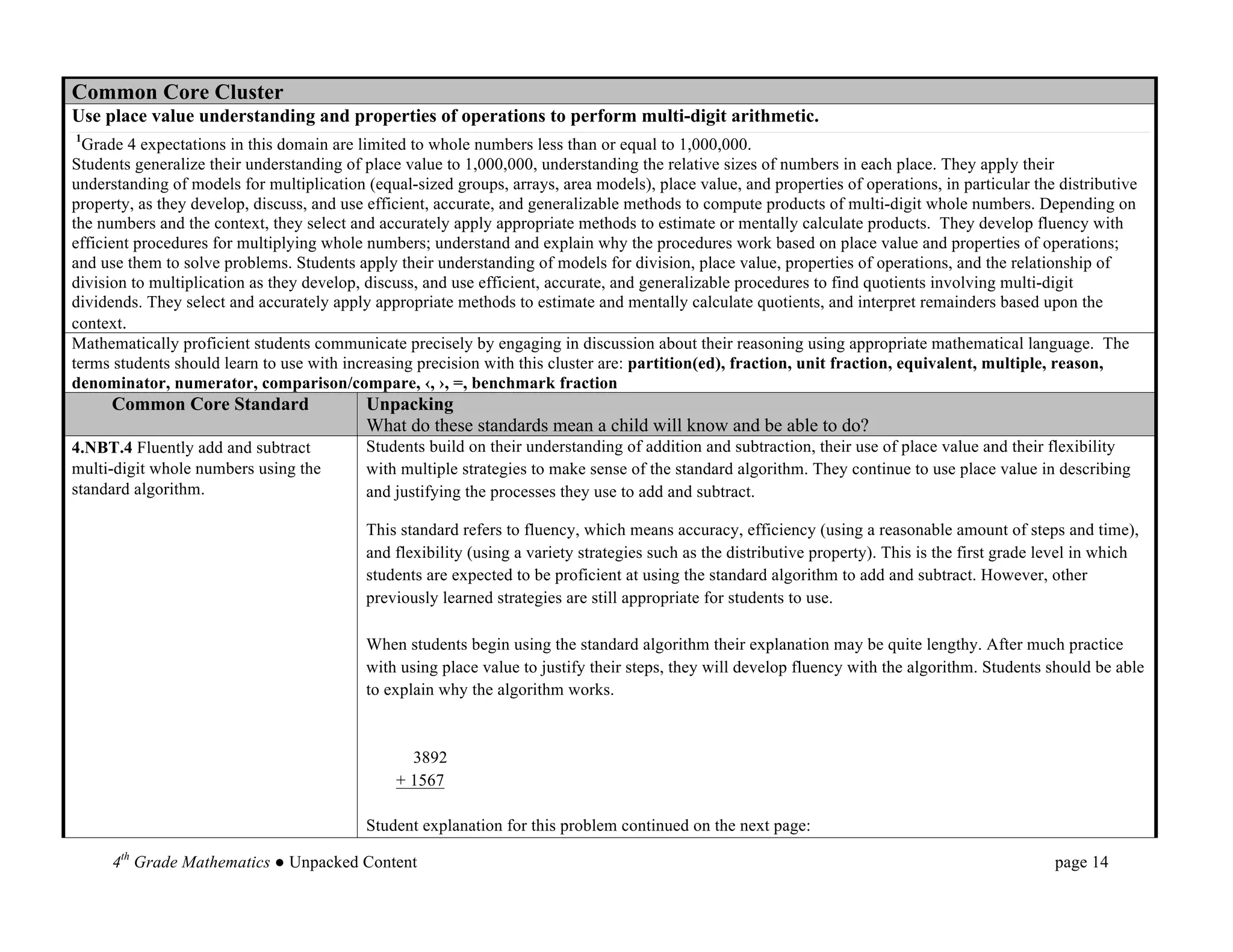
4.NBT.4 Fluently add and subtract          Students build on their understanding of addition and subtraction, their use of place value and their flexibility
multi-digit whole numbers using the        with multiple strategies to make sense of the standard algorithm. They continue to use place value in describing
standard algorithm.                        and justifying the processes they use to add and subtract.

                                           This standard refers to fluency, which means accuracy, efficiency (using a reasonable amount of steps and time),
                                           and flexibility (using a variety strategies such as the distributive property). This is the first grade level in which
                                           students are expected to be proficient at using the standard algorithm to add and subtract. However, other
                                           previously learned strategies are still appropriate for students to use.	


                                           When students begin using the standard algorithm their explanation may be quite lengthy. After much practice
                                           with using place value to justify their steps, they will develop fluency with the algorithm. Students should be able
                                           to explain why the algorithm works.


                                                  3892
                                                + 1567

                                           Student explanation for this problem continued on the next page:

      4th Grade Mathematics ● Unpacked Content                                                                                                     page 14	
  
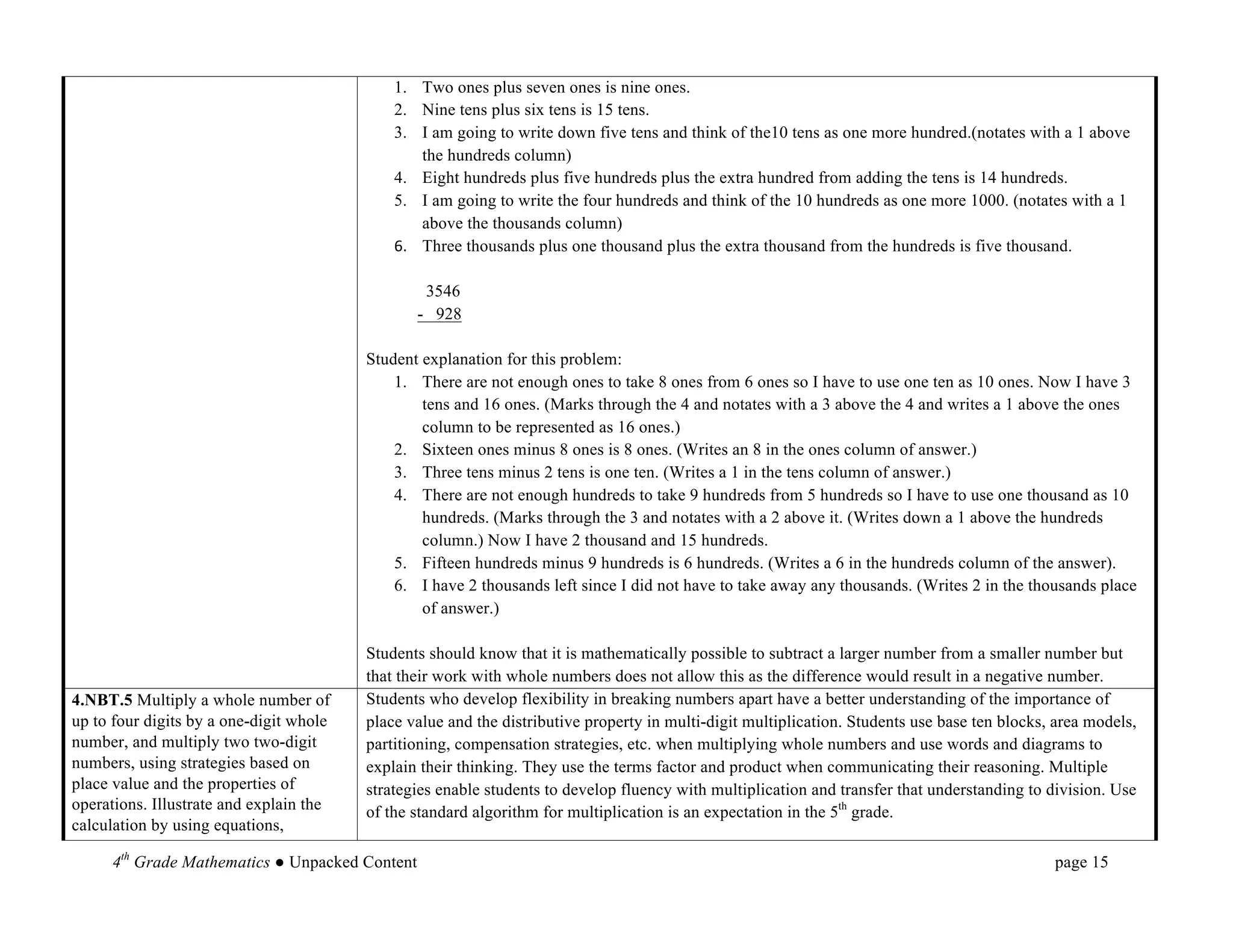
1. Two ones plus seven ones is nine ones.
                                             2. Nine tens plus six tens is 15 tens.
                                             3. I am going to write down five tens and think of the10 tens as one more hundred.(notates with a 1 above
                                                the hundreds column)
                                             4. Eight hundreds plus five hundreds plus the extra hundred from adding the tens is 14 hundreds.
                                             5. I am going to write the four hundreds and think of the 10 hundreds as one more 1000. (notates with a 1
                                                above the thousands column)
                                             6. Three thousands plus one thousand plus the extra thousand from the hundreds is five thousand.	
  

                                                 3546
                                                - 928

                                         Student explanation for this problem:
                                             1. There are not enough ones to take 8 ones from 6 ones so I have to use one ten as 10 ones. Now I have 3
                                                 tens and 16 ones. (Marks through the 4 and notates with a 3 above the 4 and writes a 1 above the ones
                                                 column to be represented as 16 ones.)
                                             2. Sixteen ones minus 8 ones is 8 ones. (Writes an 8 in the ones column of answer.)
                                             3. Three tens minus 2 tens is one ten. (Writes a 1 in the tens column of answer.)
                                             4. There are not enough hundreds to take 9 hundreds from 5 hundreds so I have to use one thousand as 10
                                                 hundreds. (Marks through the 3 and notates with a 2 above it. (Writes down a 1 above the hundreds
                                                 column.) Now I have 2 thousand and 15 hundreds.
                                             5. Fifteen hundreds minus 9 hundreds is 6 hundreds. (Writes a 6 in the hundreds column of the answer).
                                             6. I have 2 thousands left since I did not have to take away any thousands. (Writes 2 in the thousands place
                                                 of answer.)

                                         Students should know that it is mathematically possible to subtract a larger number from a smaller number but
                                         that their work with whole numbers does not allow this as the difference would result in a negative number.	
  
4.NBT.5 Multiply a whole number of       Students who develop flexibility in breaking numbers apart have a better understanding of the importance of
up to four digits by a one-digit whole   place value and the distributive property in multi-digit multiplication. Students use base ten blocks, area models,
number, and multiply two two-digit       partitioning, compensation strategies, etc. when multiplying whole numbers and use words and diagrams to
numbers, using strategies based on       explain their thinking. They use the terms factor and product when communicating their reasoning. Multiple
place value and the properties of        strategies enable students to develop fluency with multiplication and transfer that understanding to division. Use
operations. Illustrate and explain the   of the standard algorithm for multiplication is an expectation in the 5th grade.
calculation by using equations,

     4th Grade Mathematics ● Unpacked Content                                                                                                  page 15	
  
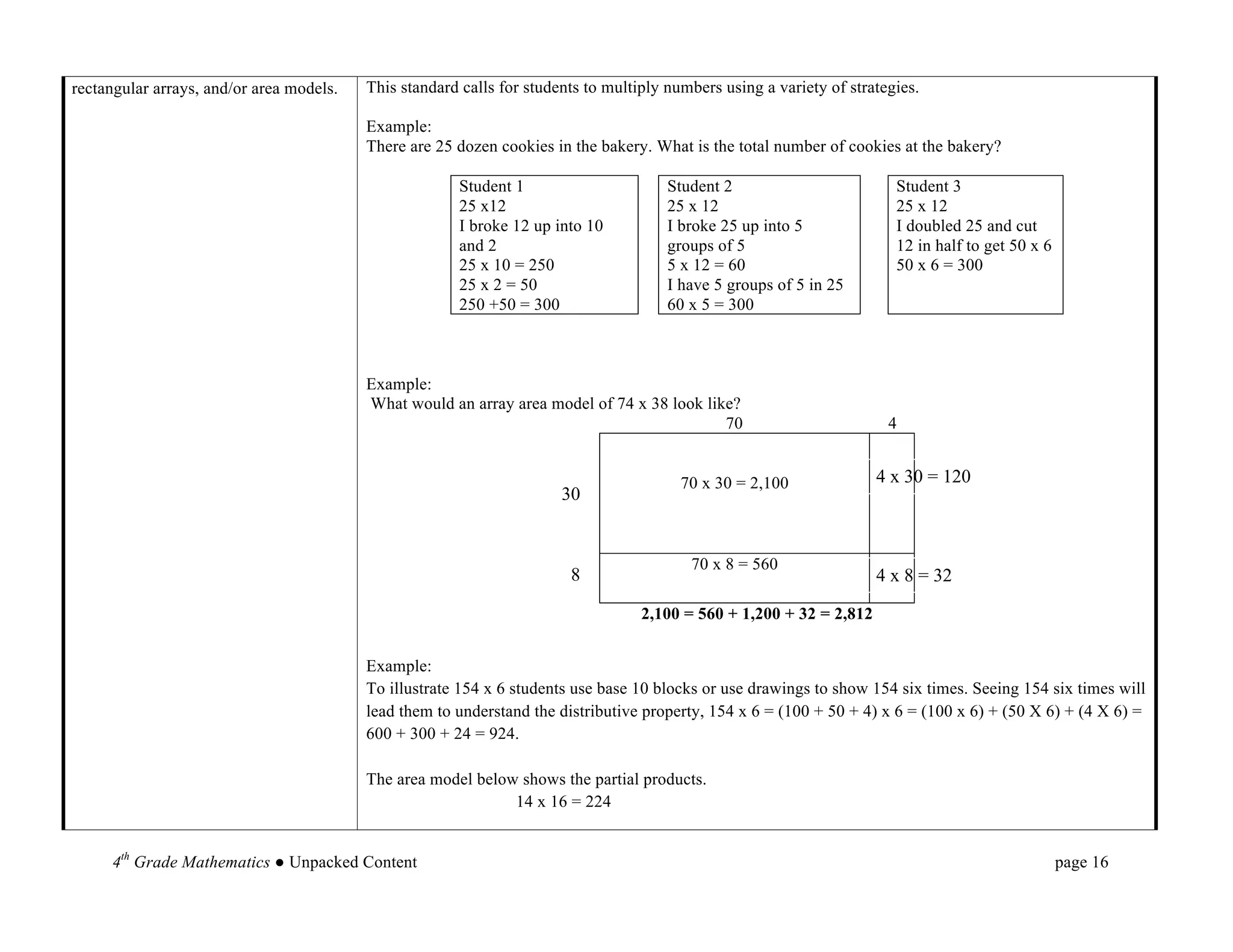
rectangular arrays, and/or area models.   This standard calls for students to multiply numbers using a variety of strategies.

                                          Example:
                                          There are 25 dozen cookies in the bakery. What is the total number of cookies at the bakery?

                                                       Student 1                                  Student 2                         Student 3
                                                       25 x12                                     25 x 12                           25 x 12
                                                       I broke 12 up into 10                      I broke 25 up into 5              I doubled 25 and cut
                                                       and 2                                      groups of 5                       12 in half to get 50 x 6
                                                       25 x 10 = 250                              5 x 12 = 60                       50 x 6 = 300
                                                       25 x 2 = 50                                I have 5 groups of 5 in 25
                                                       250 +50 = 300                              60 x 5 = 300


                                          Example:
                                          What would an array area model of 74 x 38 look like?
                                                                                            70                                     4


                                                                                                    70 x 30 = 2,100               4 x 30 = 120
                                                                                       30


                                                                                                     70 x 8 = 560
                                                                                           8                                      4 x 8 = 32

                                                                                               2,100 = 560 + 1,200 + 32 = 2,812


                                          Example:
                                          To illustrate 154 x 6 students use base 10 blocks or use drawings to show 154 six times. Seeing 154 six times will
                                          lead them to understand the distributive property, 154 x 6 = (100 + 50 + 4) x 6 = (100 x 6) + (50 X 6) + (4 X 6) =
                                          600 + 300 + 24 = 924.

                                          The area model below shows the partial products.
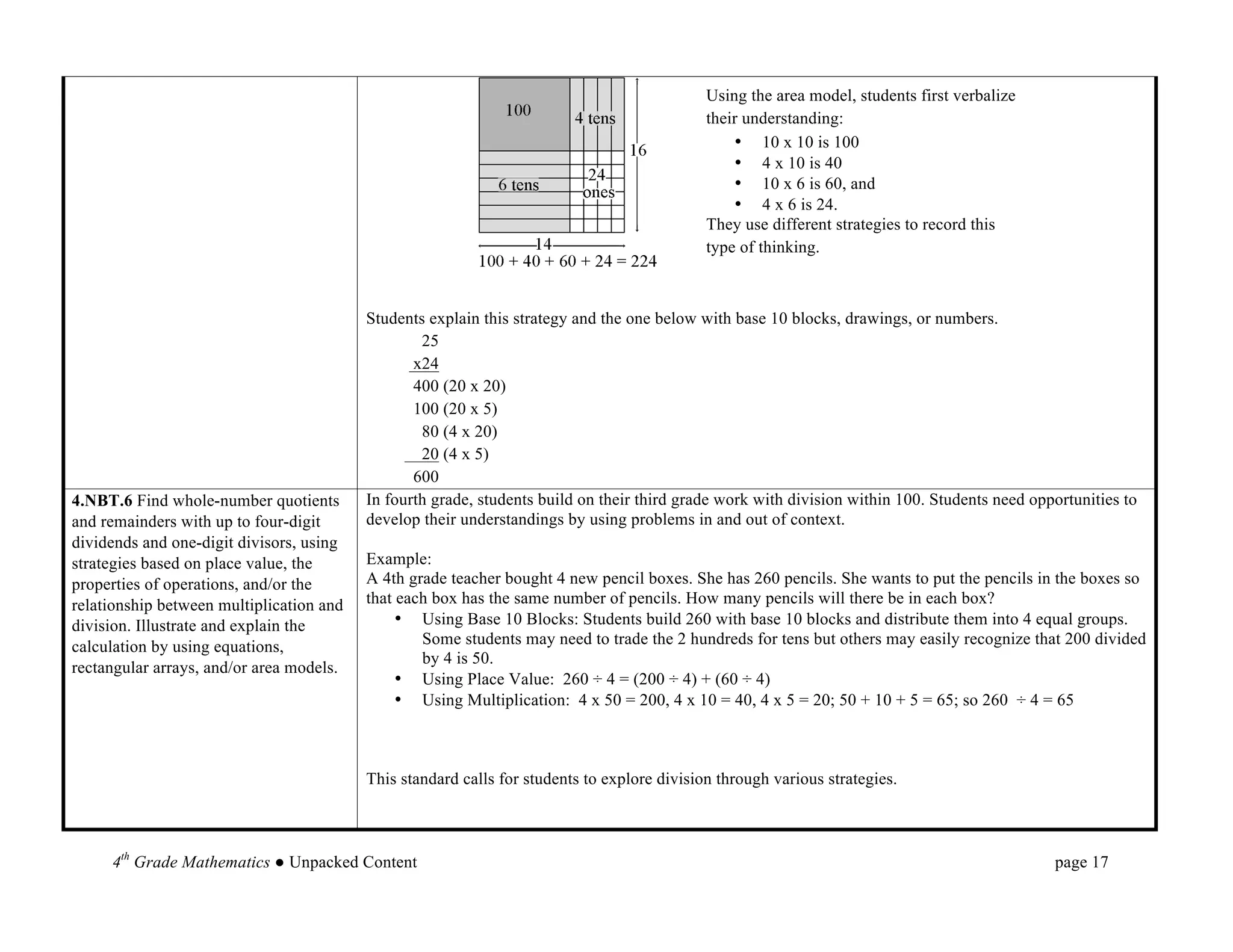
                                                              14 x 16 = 224


     4th Grade Mathematics ● Unpacked Content                                                                                                                  page 16	
  
Using the area model, students first verbalize
                                                                                             their understanding:
                                                                                                 • 10 x 10 is 100
                                                                                                 • 4 x 10 is 40
                                                                                                 • 10 x 6 is 60, and
                                                                                                 • 4 x 6 is 24.
                                                                                             They use different strategies to record this
                                                                                             type of thinking.


                                          Students explain this strategy and the one below with base 10 blocks, drawings, or numbers.
                                                  25
                                                 x24
                                                 400 (20 x 20)
                                                 100 (20 x 5)
                                                  80 (4 x 20)
                                                  20 (4 x 5)
                                                 600
4.NBT.6 Find whole-number quotients       In fourth grade, students build on their third grade work with division within 100. Students need opportunities to
and remainders with up to four-digit      develop their understandings by using problems in and out of context.
dividends and one-digit divisors, using
strategies based on place value, the      Example:
properties of operations, and/or the      A 4th grade teacher bought 4 new pencil boxes. She has 260 pencils. She wants to put the pencils in the boxes so
relationship between multiplication and   that each box has the same number of pencils. How many pencils will there be in each box?
division. Illustrate and explain the           • Using Base 10 Blocks: Students build 260 with base 10 blocks and distribute them into 4 equal groups.
calculation by using equations,                   Some students may need to trade the 2 hundreds for tens but others may easily recognize that 200 divided
                                                  by 4 is 50.
rectangular arrays, and/or area models.
                                               • Using Place Value: 260 ÷ 4 = (200 ÷ 4) + (60 ÷ 4)
                                               • Using Multiplication: 4 x 50 = 200, 4 x 10 = 40, 4 x 5 = 20; 50 + 10 + 5 = 65; so 260 ÷ 4 = 65


                                          This standard calls for students to explore division through various strategies.


     4th Grade Mathematics ● Unpacked Content                                                                                                  page 17	
  
Example:
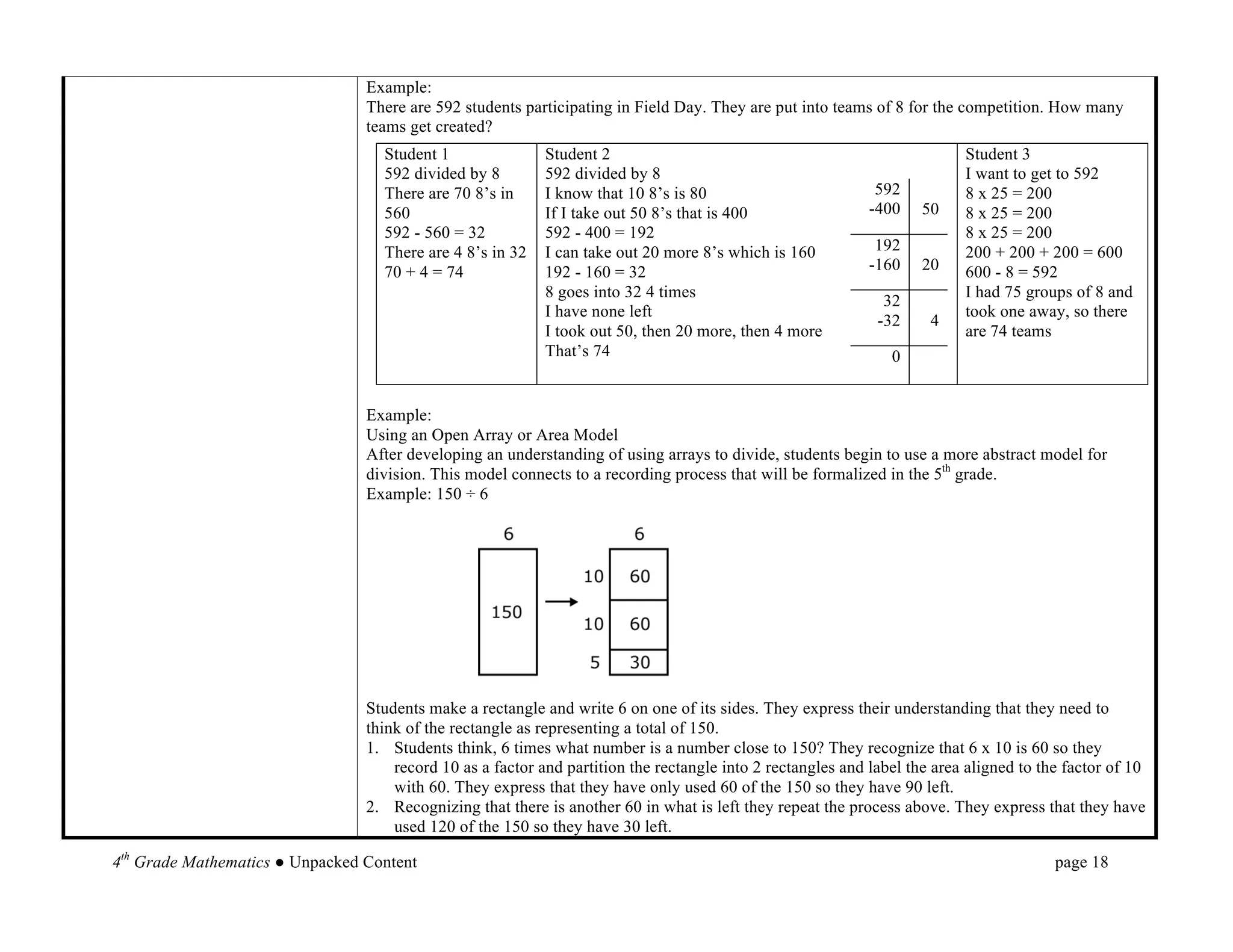
                                 There are 592 students participating in Field Day. They are put into teams of 8 for the competition. How many
                                 teams get created?
                                   Student 1                Student 2                                                      Student 3
                                   592 divided by 8         592 divided by 8                                               I want to get to 592
                                   There are 70 8’s in      I know that 10 8’s is 80                          592          8 x 25 = 200
                                   560                      If I take out 50 8’s that is 400                 -400    50    8 x 25 = 200
                                   592 - 560 = 32           592 - 400 = 192                                                8 x 25 = 200
                                   There are 4 8’s in 32    I can take out 20 more 8’s which is 160           192          200 + 200 + 200 = 600
                                   70 + 4 = 74              192 - 160 = 32                                   -160    20    600 - 8 = 592
                                                            8 goes into 32 4 times                                         I had 75 groups of 8 and
                                                                                                               32
                                                            I have none left                                               took one away, so there
                                                                                                              -32     4
                                                            I took out 50, then 20 more, then 4 more                       are	
  74 teams	
  
                                                            That’s 74                                           0


                                 Example:
                                 Using an Open Array or Area Model
                                 After developing an understanding of using arrays to divide, students begin to use a more abstract model for
                                 division. This model connects to a recording process that will be formalized in the 5th grade.
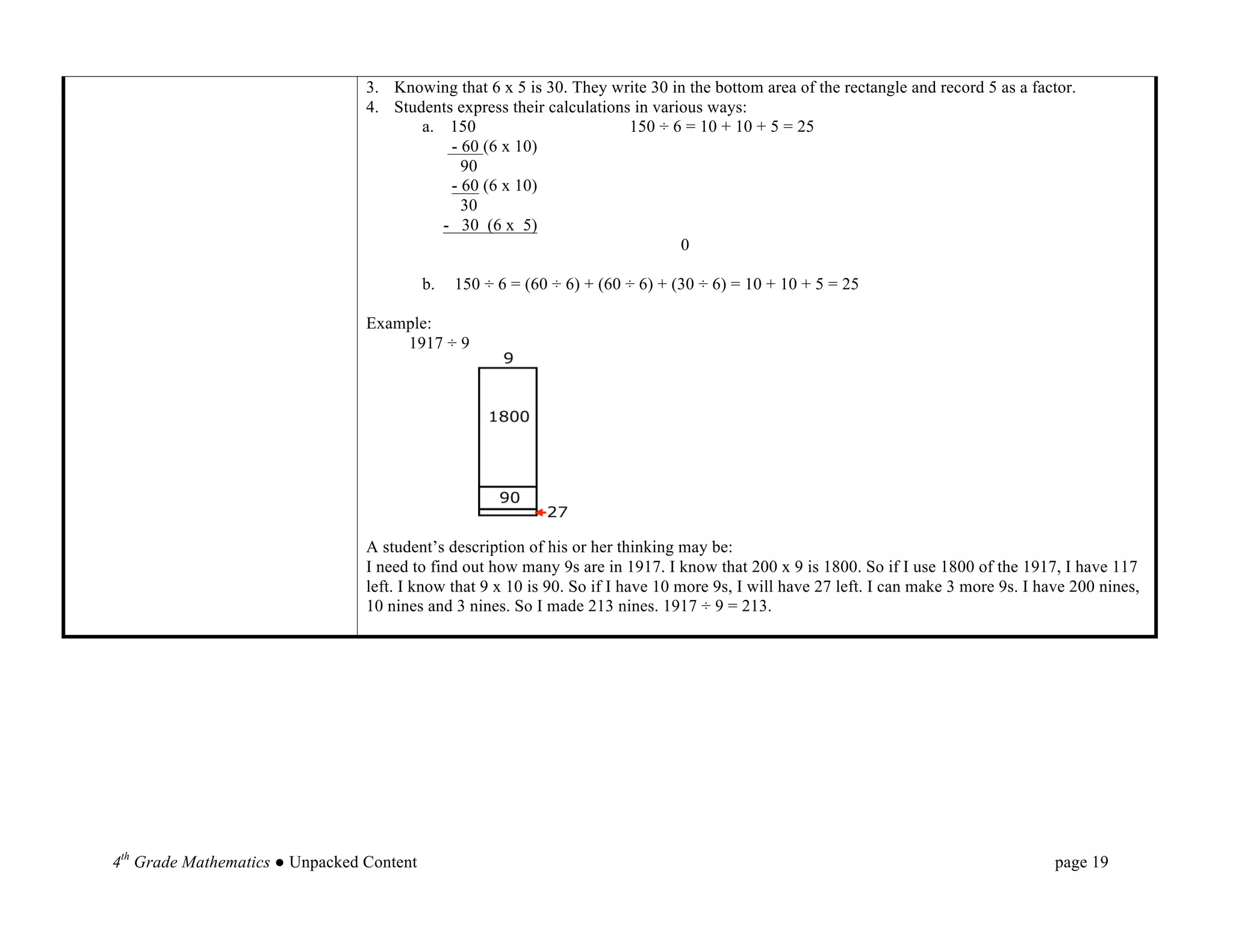
                                 Example: 150 ÷ 6


                                 Students make a rectangle and write 6 on one of its sides. They express their understanding that they need to
                                 think of the rectangle as representing a total of 150.
                                 1. Students think, 6 times what number is a number close to 150? They recognize that 6 x 10 is 60 so they
                                     record 10 as a factor and partition the rectangle into 2 rectangles and label the area aligned to the factor of 10
                                     with 60. They express that they have only used 60 of the 150 so they have 90 left.
                                 2. Recognizing that there is another 60 in what is left they repeat the process above. They express that they have
                                     used 120 of the 150 so they have 30 left.

4th Grade Mathematics ● Unpacked Content                                                                                                 page 18	
  
3. Knowing that 6 x 5 is 30. They write 30 in the bottom area of the rectangle and record 5 as a factor.
                                 4. Students express their calculations in various ways:
                                        a. 150                         150 ÷ 6 = 10 + 10 + 5 = 25
                                            - 60 (6 x 10)
                                              90
                                            - 60 (6 x 10)
                                              30
                                           - 30 (6 x 5)
                                                                               0

                                           b.   150 ÷ 6 = (60 ÷ 6) + (60 ÷ 6) + (30 ÷ 6) = 10 + 10 + 5 = 25

                                 Example:
                                     1917 ÷ 9


                                 A student’s description of his or her thinking may be:
                                 I need to find out how many 9s are in 1917. I know that 200 x 9 is 1800. So if I use 1800 of the 1917, I have 117
                                 left. I know that 9 x 10 is 90. So if I have 10 more 9s, I will have 27 left. I can make 3 more 9s. I have 200 nines,
                                 10 nines and 3 nines. So I made 213 nines. 1917 ÷ 9 = 213.


4th Grade Mathematics ● Unpacked Content                                                                                                 page 19	


Number and Operation – Fractions1                                                                                                                     4.NF
Common Core Cluster
Extend understanding of fraction equivalence and ordering.
Students develop understanding of fraction equivalence and operations with fractions. They recognize that two different fractions can be equal (e.g., 15/9 =
5/3), and they develop methods for generating and recognizing equivalent fractions.
Mathematically proficient students communicate precisely by engaging in discussion about their reasoning using appropriate mathematical language. The
terms students should learn to use with increasing precision with this cluster are: partition(ed), fraction, unit fraction, equivalent, multiple, reason,
denominator, numerator, comparison/compare, ‹, ›, =, benchmark fraction
     Common Core Standard                  Unpacking
                                           What do these standards mean a child will know and be able to do?
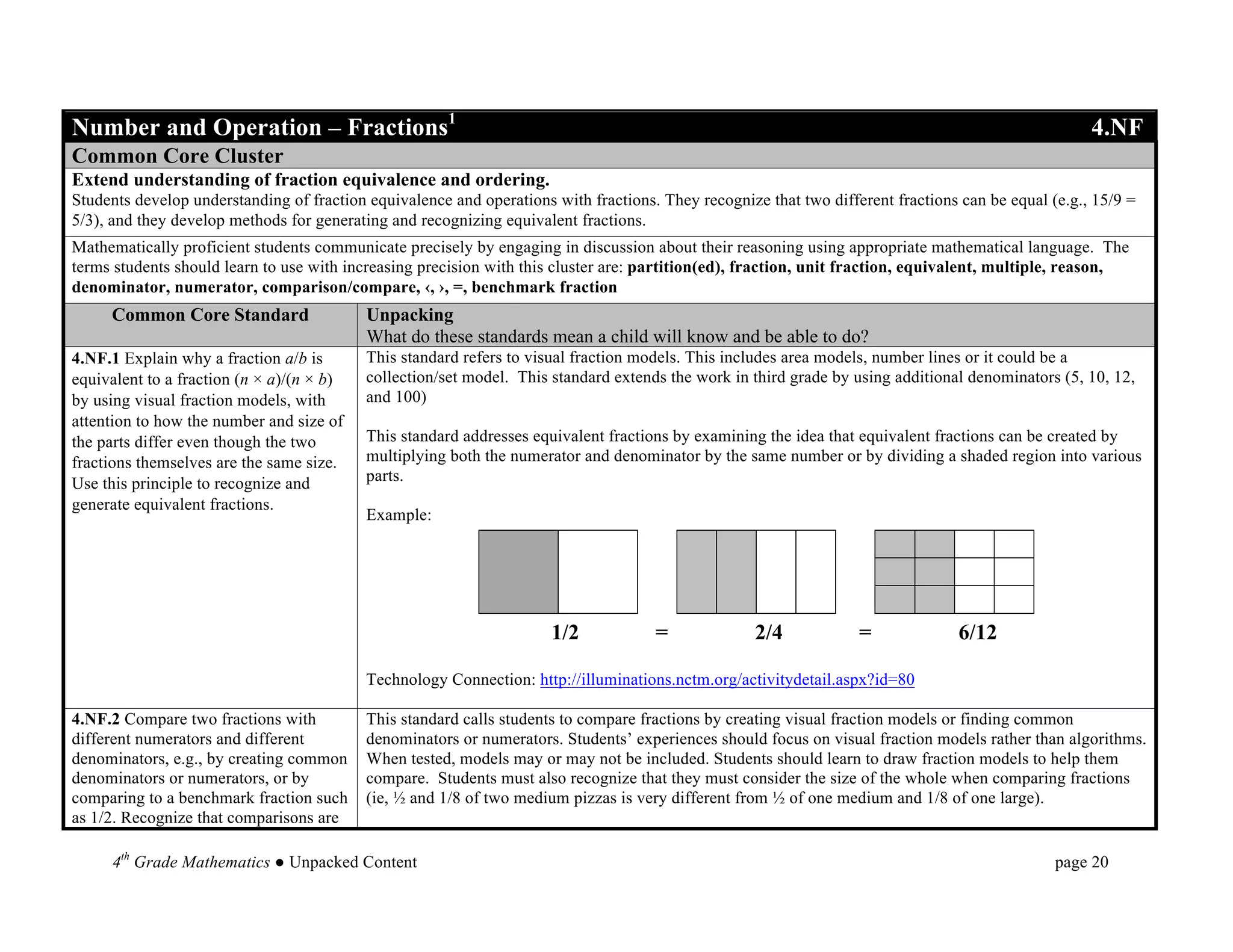
4.NF.1 Explain why a fraction a/b is       This standard refers to visual fraction models. This includes area models, number lines or it could be a
equivalent to a fraction (n × a)/(n × b)   collection/set model. This standard extends the work in third grade by using additional denominators (5, 10, 12,
by using visual fraction models, with      and 100)
attention to how the number and size of
the parts differ even though the two       This standard addresses equivalent fractions by examining the idea that equivalent fractions can be created by
fractions themselves are the same size.    multiplying both the numerator and denominator by the same number or by dividing a shaded region into various
Use this principle to recognize and        parts.
generate equivalent fractions.
                                           Example:


                                                                      1/2            =              2/4            =              6/12

                                           Technology Connection: http://illuminations.nctm.org/activitydetail.aspx?id=80

4.NF.2 Compare two fractions with          This standard calls students to compare fractions by creating visual fraction models or finding common
different numerators and different         denominators or numerators. Students’ experiences should focus on visual fraction models rather than algorithms.
denominators, e.g., by creating common     When tested, models may or may not be included. Students should learn to draw fraction models to help them
denominators or numerators, or by          compare. Students must also recognize that they must consider the size of the whole when comparing fractions
comparing to a benchmark fraction such     (ie, ½ and 1/8 of two medium pizzas is very different from ½ of one medium and 1/8 of one large).
as 1/2. Recognize that comparisons are

      4th Grade Mathematics ● Unpacked Content                                                                                                  page 20	
  
valid only when the two fractions refer    Example:
to the same whole. Record the results of   Use patterns blocks.
comparisons with symbols >, =, or <,          1. If a red trapezoid is one whole, which block shows 1 ?
and justify the conclusions, e.g., by                                                                   3
using a visual fraction model.                 2. If the blue rhombus   is 1 ,   which block shows one whole?
                                                                           3
                                               3. If the red trapezoid is one whole, which block shows 2 ?
                                                                                                            3


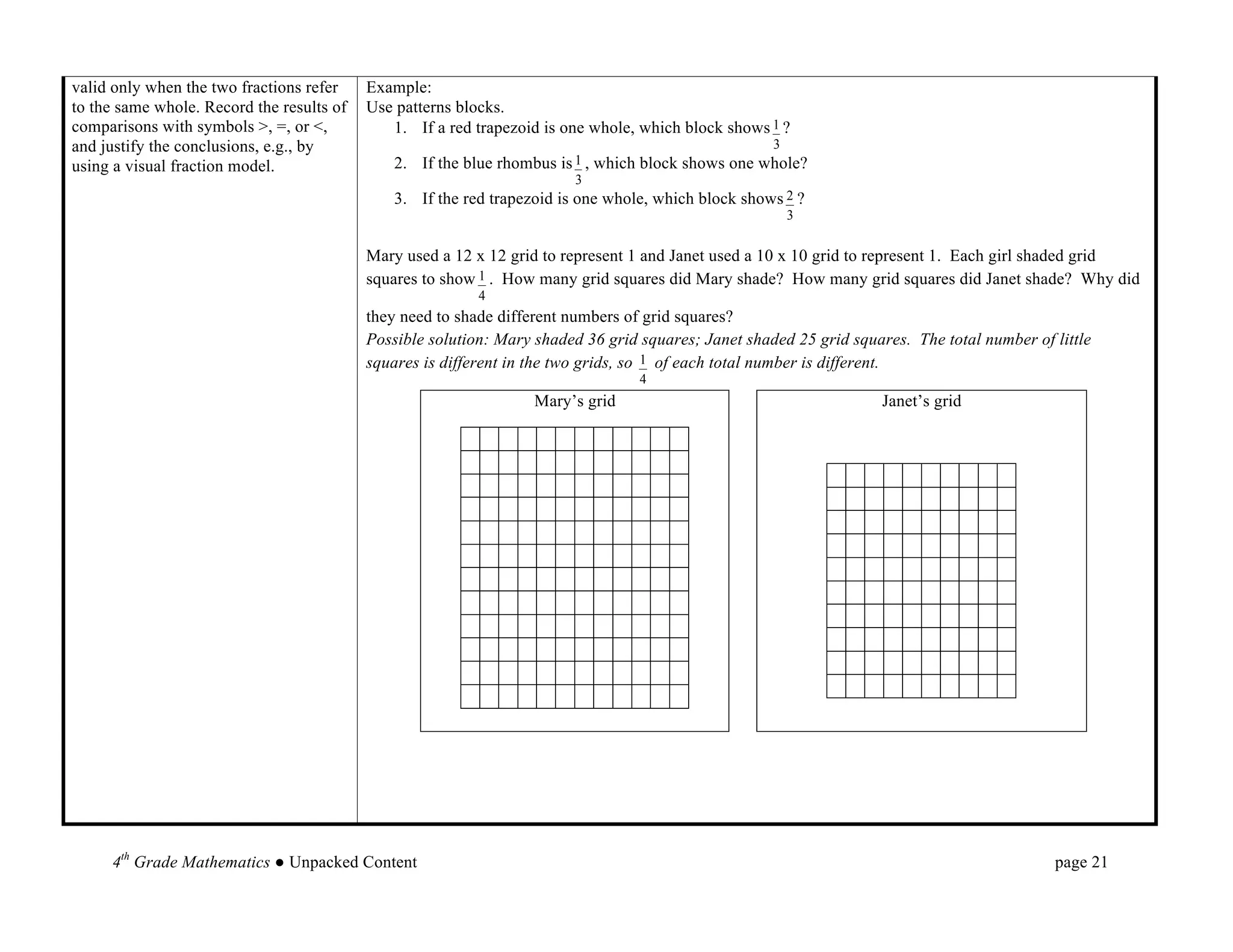
                                           Mary used a 12 x 12 grid to represent 1 and Janet used a 10 x 10 grid to represent 1. Each girl shaded grid
                                           squares to show 1 . How many grid squares did Mary shade? How many grid squares did Janet shade? Why did
                                                           4
                                           they need to shade different numbers of grid squares?
                                           Possible solution: Mary shaded 36 grid squares; Janet shaded 25 grid squares. The total number of little
                                           squares is different in the two grids, so 1 of each total number is different.
                                                                                       4
                                                                   Mary’s grid                                       Janet’s grid


     4th Grade Mathematics ● Unpacked Content                                                                                                page 21	
  
Examples continued on the next page.
                                 Example:
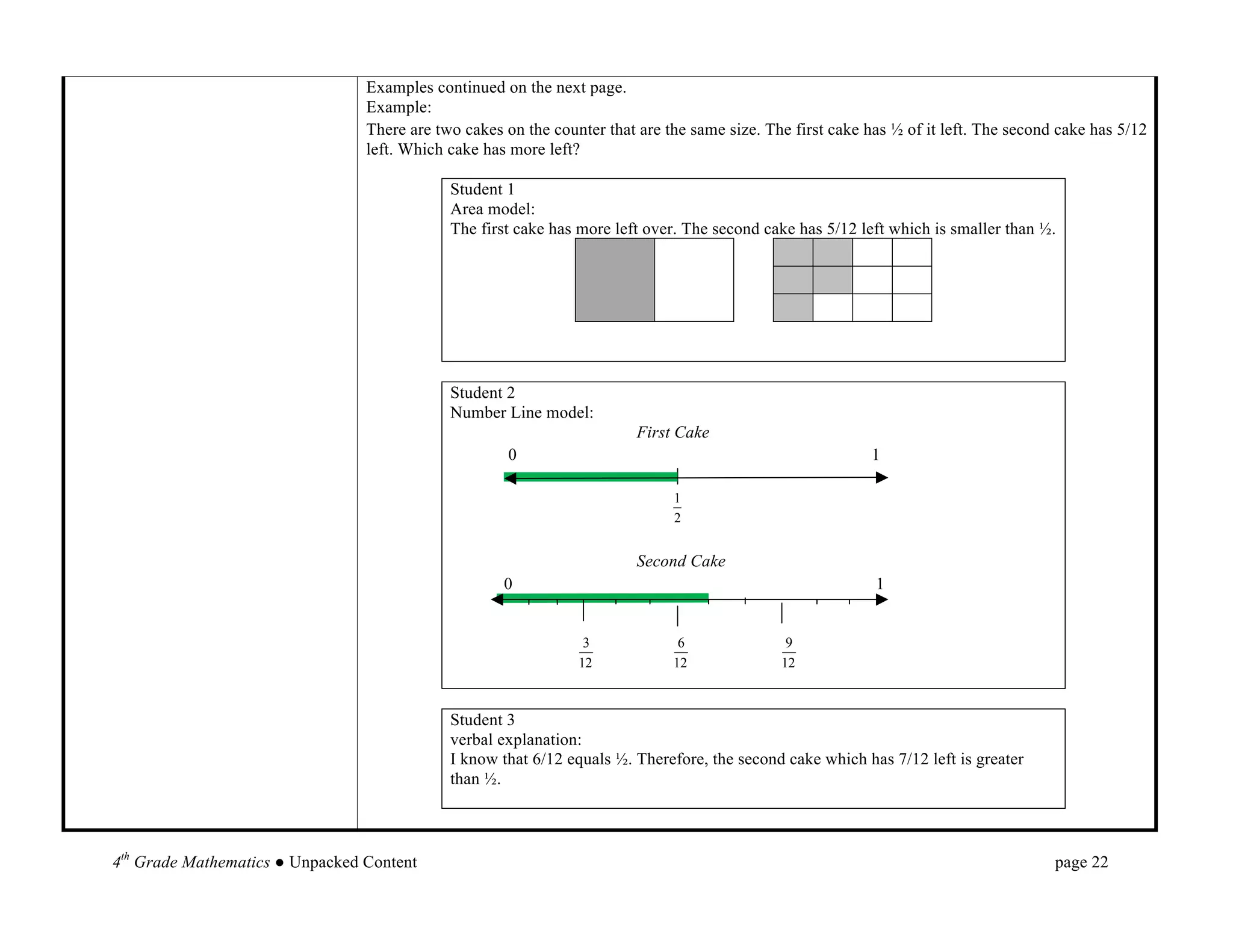
                                 There are two cakes on the counter that are the same size. The first cake has ½ of it left. The second cake has 5/12
                                 left. Which cake has more left?

                                             Student 1
                                             Area model:
                                             The first cake has more left over. The second cake has 5/12 left which is smaller than ½.


                                             Student 2
                                             Number Line model:
                                                                         First Cake
                                                      0                                                     1

                                                                              1
                                                                              2


                                                                         Second Cake
                                                     0                                                      1


                                                                 3             6               9
                                                                12            12              12


                                             Student 3
                                             verbal explanation:
                                             I know that 6/12 equals ½. Therefore, the second cake which has 7/12 left is greater
                                             than ½.


4th Grade Mathematics ● Unpacked Content                                                                                               page 22	
  
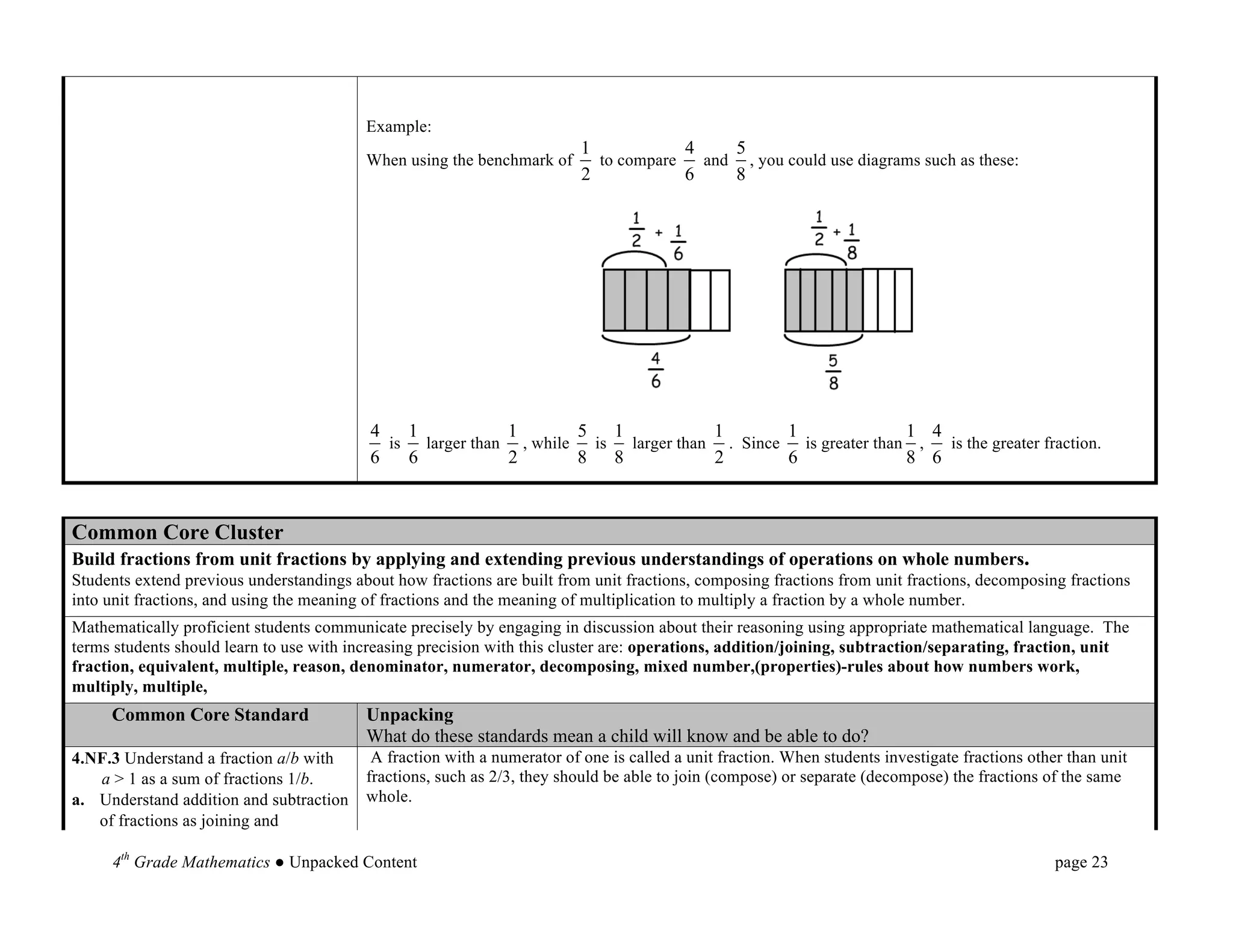
Example:
                                                                          1            4    5
                                          When using the benchmark of       to compare   and , you could use diagrams such as these:
                                                                          2            6    8


                                           4    1            1        5 1            1        1                1 4
                                             is   larger than , while  is larger than . Since   is greater than ,  is the greater fraction.
                                           6    6            2        8 8            2        6                8 6


Common Core Cluster
Build fractions from unit fractions by applying and extending previous understandings of operations on whole numbers.
Students extend previous understandings about how fractions are built from unit fractions, composing fractions from unit fractions, decomposing fractions
into unit fractions, and using the meaning of fractions and the meaning of multiplication to multiply a fraction by a whole number.
Mathematically proficient students communicate precisely by engaging in discussion about their reasoning using appropriate mathematical language. The
terms students should learn to use with increasing precision with this cluster are: operations, addition/joining, subtraction/separating, fraction, unit
fraction, equivalent, multiple, reason, denominator, numerator, decomposing, mixed number,(properties)-rules about how numbers work,
multiply, multiple,
     Common Core Standard                 Unpacking
                                          What do these standards mean a child will know and be able to do?
4.NF.3 Understand a fraction a/b with      A fraction with a numerator of one is called a unit fraction. When students investigate fractions other than unit
   a > 1 as a sum of fractions 1/b.       fractions, such as 2/3, they should be able to join (compose) or separate (decompose) the fractions of the same
a. Understand addition and subtraction    whole.
   of fractions as joining and

     4th Grade Mathematics ● Unpacked Content                                                                                                    page 23	
  
separating parts referring to the    Example: 2/3 = 1/3 + 1/3
   same whole.                          Being able to visualize this decomposition into unit fractions helps students when adding or subtracting fractions.
                                        Students need multiple opportunities to work with mixed numbers and be able to decompose them in more than
                                        one way. Students may use visual models to help develop this understanding.

                                        Example:
                                              1¼-¾=                  4/4 + ¼ = 5/4          5/4 – ¾ = 2/4 or ½

                                        Example of word problem:
                                        Mary and Lacey decide to share a pizza. Mary ate 3/6 and Lacey ate 2/6 of the pizza. How much of the pizza did
                                        the girls eat together?
                                        Possible solution: The amount of pizza Mary ate can be thought of a 3/6 or 1/6 and 1/6 and 1/6. The amount of
                                        pizza Lacey ate can be thought of a 1/6 and 1/6. The total amount of pizza they ate is 1/6 + 1/6 + 1/6 + 1/6 + 1/6
                                        or 5/6 of the whole pizza.
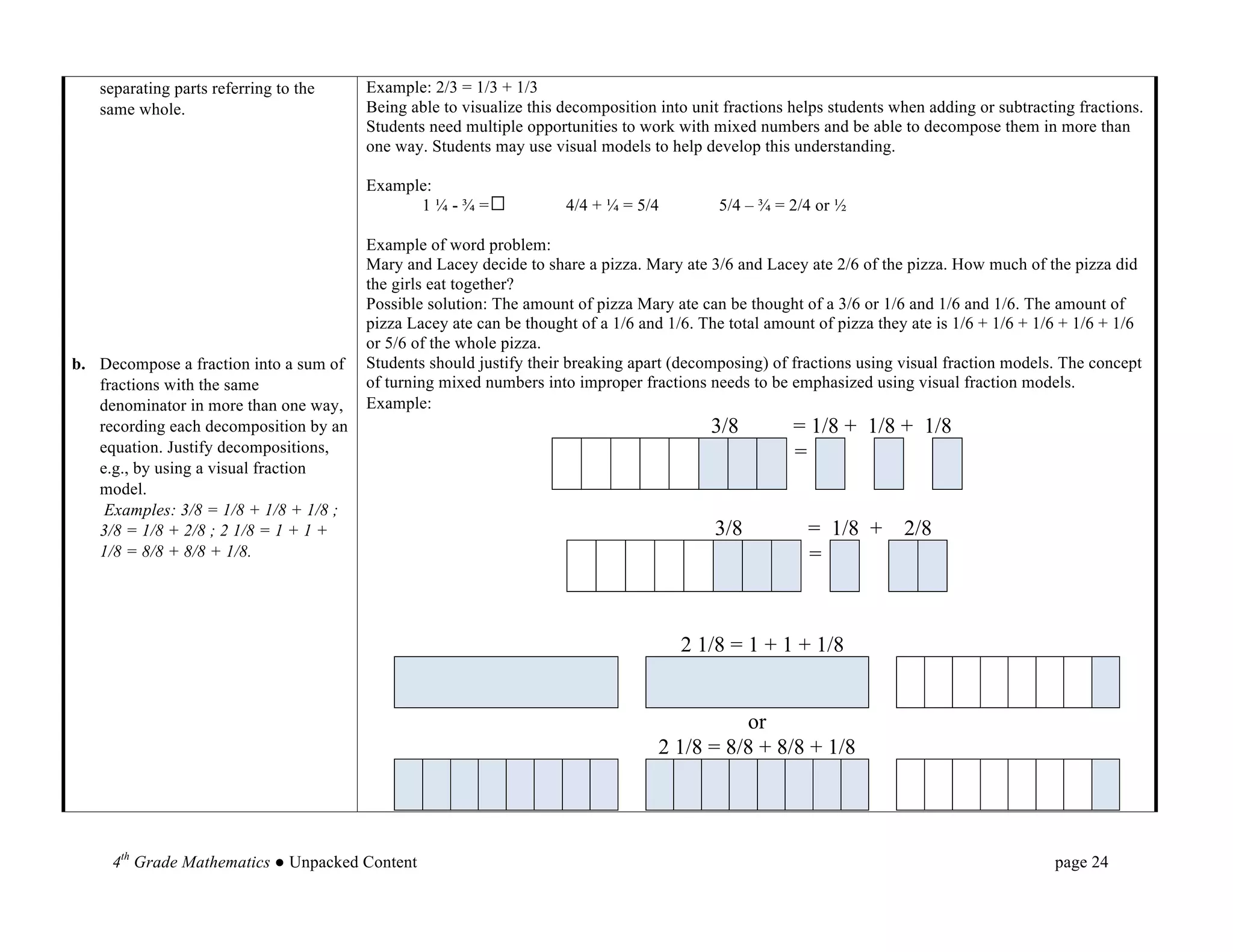
b. Decompose a fraction into a sum of   Students should justify their breaking apart (decomposing) of fractions using visual fraction models. The concept
   fractions with the same              of turning mixed numbers into improper fractions needs to be emphasized using visual fraction models.
   denominator in more than one way,    Example:
   recording each decomposition by an                                                      3/8         = 1/8 + 1/8 + 1/8
   equation. Justify decompositions,                                                                   =
   e.g., by using a visual fraction
   model.
    Examples: 3/8 = 1/8 + 1/8 + 1/8 ;
   3/8 = 1/8 + 2/8 ; 2 1/8 = 1 + 1 +                                                       3/8           = 1/8 +       2/8
   1/8 = 8/8 + 8/8 + 1/8.                                                                                =


                                                                                      2 1/8 = 1 + 1 + 1/8


                                                                                             or
                                                                                   2 1/8 = 8/8 + 8/8 + 1/8


     4th Grade Mathematics ● Unpacked Content                                                                                                page 24	
  
c. Add and subtract mixed numbers       A separate algorithm for mixed numbers in addition and subtraction is not necessary. Students will tend to add or
   with like denominators, e.g., by     subtract the whole numbers first and then work with the fractions using the same strategies they have applied to
   replacing each mixed number with     problems that contained only fractions.
   an equivalent fraction, and/or by
   using properties of operations and   Example:
   the relationship between addition    Susan and Maria need 8 3/8 feet of ribbon to package gift baskets. Susan has 3 1/8 feet of ribbon and Maria has 5
   and subtraction.                     3/8 feet of ribbon. How much ribbon do they have altogether? Will it be enough to complete the project? Explain
                                        why or why not.

                                        The student thinks: I can add the ribbon Susan has to the ribbon Maria has to find out how much ribbon they have
                                        altogether. Susan has 3 1/8 feet of ribbon and Maria has 5 3/8 feet of ribbon. I can write this as 3 1/8 + 5 3/8. I
                                        know they have 8 feet of ribbon by adding the 3 and 5. They also have 1/8 and 3/8 which makes a total of 4/8
                                        more. Altogether they have 8 4/8 feet of ribbon. 8 4/8 is larger than 8 3/8 so they will have enough ribbon to
                                        complete the project. They will even have a little extra ribbon left, 1/8 foot.

                                        Example:
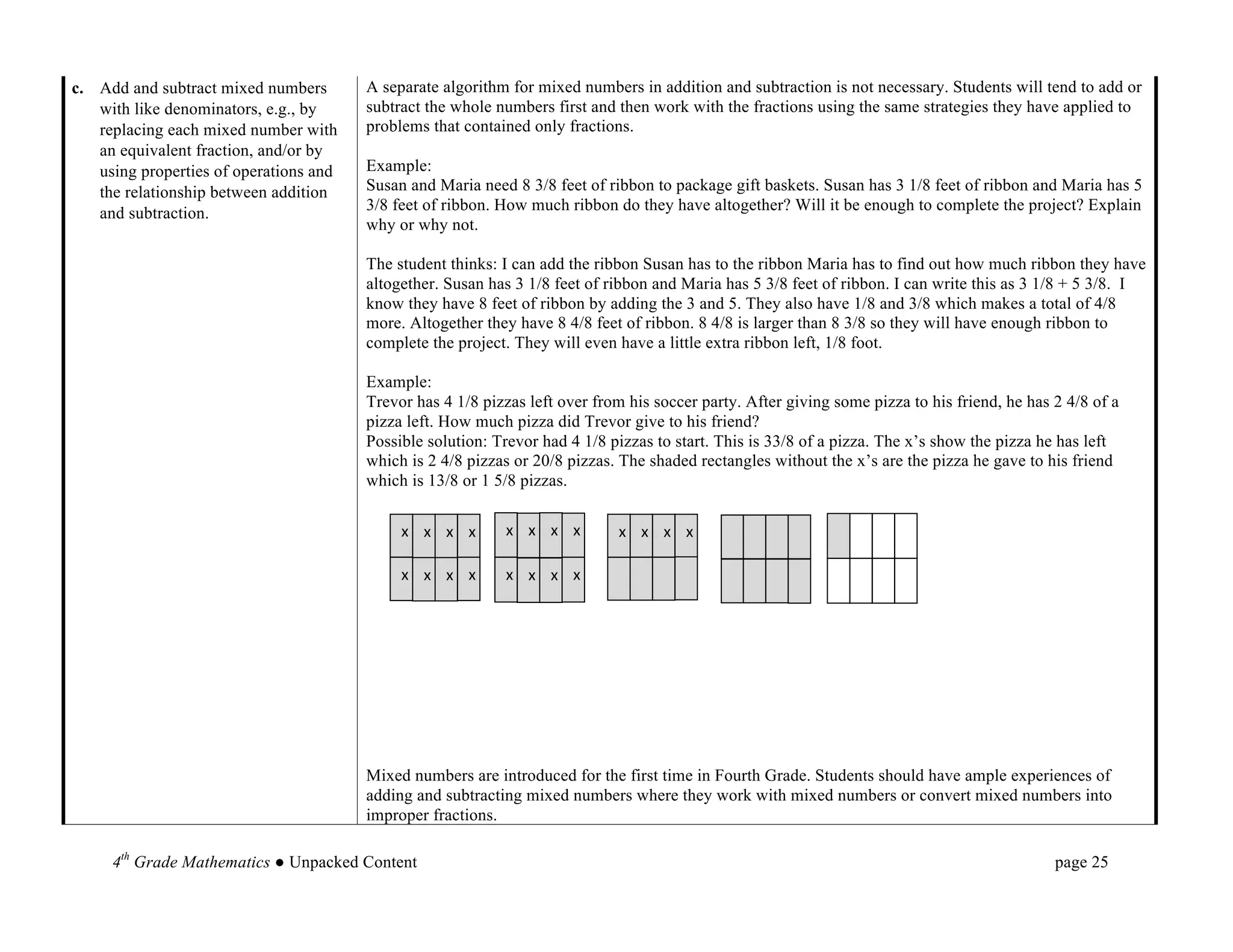
                                        Trevor has 4 1/8 pizzas left over from his soccer party. After giving some pizza to his friend, he has 2 4/8 of a
                                        pizza left. How much pizza did Trevor give to his friend?
                                        Possible solution: Trevor had 4 1/8 pizzas to start. This is 33/8 of a pizza. The x’s show the pizza he has left
                                        which is 2 4/8 pizzas or 20/8 pizzas. The shaded rectangles without the x’s are the pizza he gave to his friend
                                        which is 13/8 or 1 5/8 pizzas.


                                             x	
   x	
   x	
   x	
     x	
   x	
   x	
   x	
     x	
   x	
   x	
   x	
  

                                             x	
   x	
   x	
   x	
     x	
   x	
   x	
   x	


                                        Mixed numbers are introduced for the first time in Fourth Grade. Students should have ample experiences of
                                        adding and subtracting mixed numbers where they work with mixed numbers or convert mixed numbers into
                                        improper fractions.

     4th Grade Mathematics ● Unpacked Content                                                                                                  page 25	
  
Example:
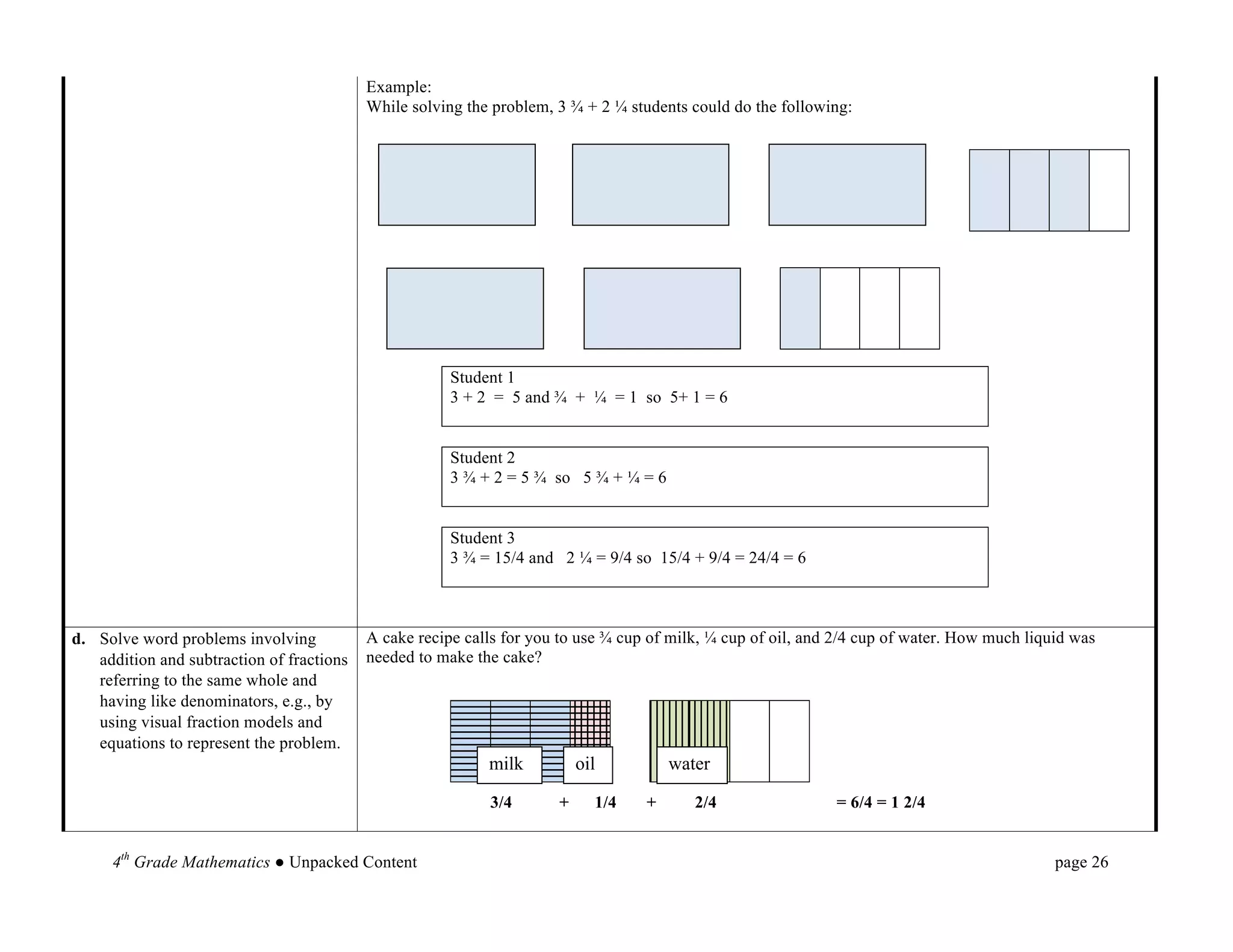
                                           While solving the problem, 3 ¾ + 2 ¼ students could do the following:


                                                            Student 1
                                                            3 + 2 = 5 and ¾ + ¼ = 1 so 5+ 1 = 6


                                                            Student 2
                                                            3 ¾ + 2 = 5 ¾ so 5 ¾ + ¼ = 6


                                                            Student 3
                                                            3 ¾ = 15/4 and 2 ¼ = 9/4 so 15/4 + 9/4 = 24/4 = 6


d. Solve word problems involving           A cake recipe calls for you to use ¾ cup of milk, ¼ cup of oil, and 2/4 cup of water. How much liquid was
   addition and subtraction of fractions   needed to make the cake?
   referring to the same whole and
   having like denominators, e.g., by
   using visual fraction models and
   equations to represent the problem.
                                                                 milk          oil                water

                                                                 3/4       +           1/4    +      2/4          = 6/4 = 1 2/4


     4th Grade Mathematics ● Unpacked Content                                                                                                 page 26	
  
4.NF.4 Apply and extend previous          This standard builds on students’ work of adding fractions and extending that work into multiplication.
understandings of multiplication to
multiply a fraction by a whole number.    Example:
a. Understand a fraction a/b as a         3/6 = 1/6 + 1/6 + 1/6 = 3 x (1/6)
   multiple of 1/b.                       Number line:
   For example, use a visual fraction
   model to represent 5/4 as the


   product 5 × (1/4), recording the                                                          1       2       3       4       5       6       7       8
   conclusion by the equation 5/4 = 5                                                    0
                                                                                             6       6       6       6       6       6       6       6
   × (1/4).


                                          Area model:
                                                                                             1   2       3       4       5       6
                                                                                             6   6       6       6       6       6


b. Understand a multiple of a/b as a      This standard extended the idea of multiplication as repeated addition. For example, 3 x (2/5) = 2/5 + 2/5 + 2/5 =
   multiple of 1/b, and use this          6/5 = 6 x (1/5). Students are expected to use and create visual fraction models to multiply a whole number by a
   understanding to multiply a fraction   fraction.
   by a whole number.                                          2             2                 2
   For example, use a visual fraction                          5             5                 5
   model to express 3 × (2/5) as 6 ×
   (1/5), recognizing this product as
   6/5. (In general, n × (a/b) = (n ×
   a)/b.)
                                                                                             1   2       3       4       5           1   2       3       4   5
                                                                                             5   5       5       5       5           5   5       5       5   5


     4th Grade Mathematics ● Unpacked Content                                                                                                                    page 27	
  
c. Solve word problems involving         This standard calls for students to use visual fraction models to solve word problems related to multiplying a
   multiplication of a fraction by a     whole number by a fraction.
   whole number, e.g., by using visual
   fraction models and equations to      Example:
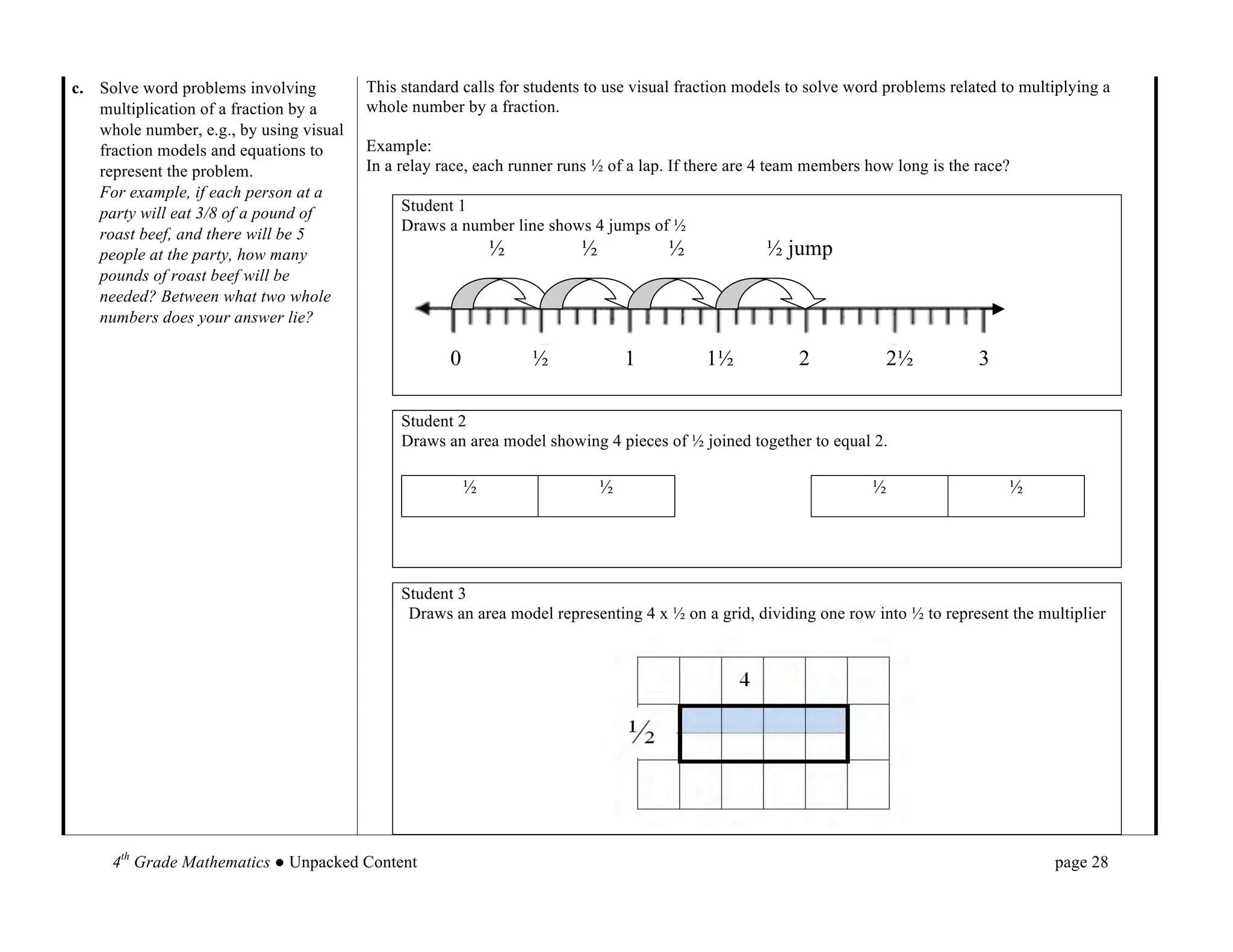
   represent the problem.                In a relay race, each runner runs ½ of a lap. If there are 4 team members how long is the race?
   For example, if each person at a
   party will eat 3/8 of a pound of           Student 1
                                              Draws a number line shows 4 jumps of ½
   roast beef, and there will be 5
   people at the party, how many                             ½          ½                ½          ½ jump
   pounds of roast beef will be
   needed? Between what two whole
   numbers does your answer lie?

                                                     0           ½                   1       1½         2            2½            3

                                              Student 2
                                              Draws an area model showing 4 pieces of ½ joined together to equal 2.

                                                         ½                  ½ 	
                                   ½                    ½ 	


                                              Student 3
                                               Draws an area model representing 4 x ½ on a grid, dividing one row into ½ to represent the multiplier


     4th Grade Mathematics ● Unpacked Content                                                                                                    page 28	
  
Example:
                                 Heather bought 12 plums and ate 1 of them. Paul bought 12 plums and ate 1 of them. Which statement is true?
                                                                                3                                            4
                                 Draw a model to explain your reasoning.
                                            a. Heather and Paul ate the same number of plums.
                                            b. Heather ate 4 plums and Paul ate 3 plums.
                                            c. Heather ate 3 plums and Paul ate 4 plums.
                                            d. Heather had 9 plums remaining.

                                 Example:
                                 Students need many opportunities to work with problems in context to understand the connections between
                                 models and corresponding equations. Contexts involving a whole number times a fraction lend themselves to
                                 modeling and examining patterns.
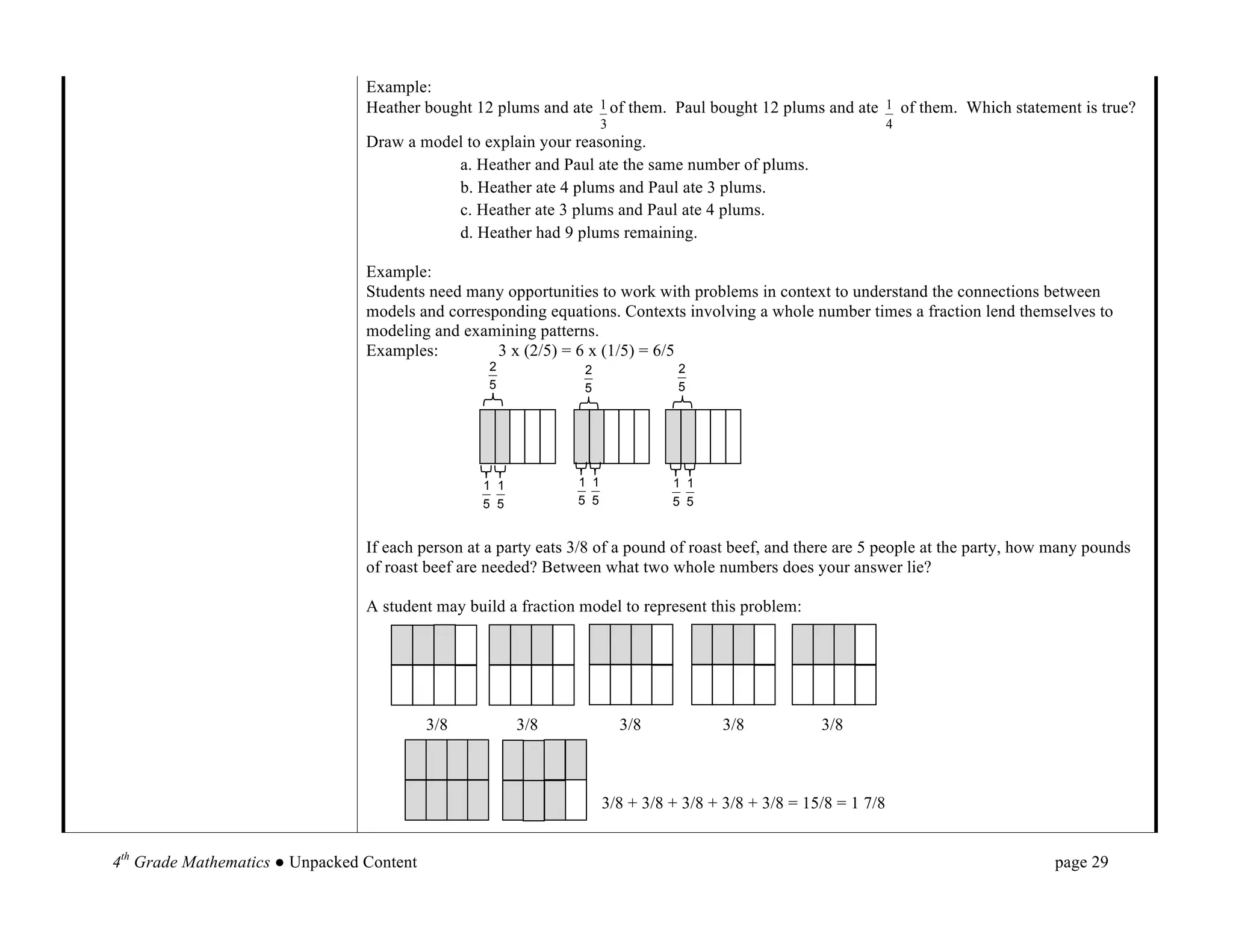
                                 Examples:          3 x (2/5) = 6 x (1/5) = 6/5
                                                  2 	
           2 	
           2 	
  
                                                    5                    5                    5


                                                  1 	
  1 	
           1 	
  1 	
           1 	
  1 	
  
                                                  5 5                  5 5                  5 5


                                 If each person at a party eats 3/8 of a pound of roast beef, and there are 5 people at the party, how many pounds
                                 of roast beef are needed? Between what two whole numbers does your answer lie?

                                 A student may build a fraction model to represent this problem:


                                           3/8                   3/8                  3/8                  3/8   3/8


                                                                                3/8 + 3/8 + 3/8 + 3/8 + 3/8 = 15/8 = 1 7/8


4th Grade Mathematics ● Unpacked Content                                                                                              page 29	
  
Common Core Cluster
Understand decimal notation for fractions, and compare decimal fractions.
Mathematically proficient students communicate precisely by engaging in discussion about their reasoning using appropriate mathematical language. The
terms students should learn to use with increasing precision with this cluster are: fraction, numerator, denominator, equivalent, reasoning, decimals,
tenths, hundreds, multiplication, comparisons/compare, ‹, ›, =
     Common Core Standard                Unpacking
                                         What do these standards mean a child will know and be able to do?
4.NF.5 Express a fraction with           This standard continues the work of equivalent fractions by having students change fractions with a 10 in the
denominator 10 as an equivalent          denominator into equivalent fractions that have a 100 in the denominator. In order to prepare for work with
fraction with denominator 100, and use   decimals (4.NF.6 and 4.NF.7), experiences that allow students to shade decimal grids (10x10 grids) can support
this technique to add two fractions      this work. Student experiences should focus on working with grids rather than algorithms.
with respective denominators 10 and      Students can also use base ten blocks and other place value models to explore the relationship between fractions
100.2                                    with denominators of 10 and denominators of 100.
For example, express 3/10 as 30/100,
                                         This work in fourth grade lays the foundation for performing operations with decimal numbers in fifth grade.
and add 3/10 + 4/100 = 34/100.

2                                        Example:
  Students who can generate equivalent
                                                                           Ones         .     Tenths          Hundredths
fractions can develop strategies for
adding fractions with unlike
denominators in general. But addition                                     Tenths Grid                         Hundredths Grid
and subtraction with unlike
denominators in general is not a
requirement at this grade.


                                                                      .3 = 3 tenths = 3/10             .30 = 30 hundredths = 30/100


     4th Grade Mathematics ● Unpacked Content                                                                                                 page 30	
  
Example:
                                         Represent 3 tenths and 30 hundredths on the models below.
                                                              10ths circle                                                                                       100ths circle


4.NF.6 Use decimal notation for          Decimals are introduced for the first time. Students should have ample opportunities to explore and reason about
fractions with denominators 10 or 100.   the idea that a number can be represented as both a fraction and a decimal.
For example, rewrite 0.62 as 62/100;
describe a length as 0.62 meters;        Students make connections between fractions with denominators of 10 and 100 and the place value chart. By
locate 0.62 on a number line diagram.    reading fraction names, students say 32/100 as thirty-two hundredths and rewrite this as 0.32 or represent it on a
                                         place value model as shown below.

                                           Hundreds                  Tens                    Ones                     •                    Tenths   Hundredths
                                                                                                                      •                    3        2

                                         Students use the representations explored in 4.NF.5 to understand 32/100 can be expanded to 3/10 and 2/100.

                                         Students represent values such as 0.32 or 32/100 on a number line. 32/100 is more than 30/100 (or 3/10) and less
                                         than 40/100 (or 4/10). It is closer to 30/100 so it would be placed on the number line near that value.

                                                                            0.32	


                                                   0	
   0.1	
   0.2	
   0.3	
   0.4	
   0.5	
   0.6	
   0.7	
   0.8	
   0.9	
   1.0	


     4th Grade Mathematics ● Unpacked Content                                                                                                                                                         page 31	
  
4.NF.7 Compare two decimals to             Students should reason that comparisons are only valid when they refer to the same whole. Visual models include
hundredths by reasoning about their        area models, decimal grids, decimal circles, number lines, and meter sticks.
size. Recognize that comparisons are
valid only when the two decimals refer     Students build area and other models to compare decimals. Through these experiences and their work with fraction
to the same whole. Record the results      models, they build the understanding that comparisons between decimals or fractions are only valid when the
of comparisons with the symbols >, =,      whole is the same for both cases. Each of the models below shows 3/10 but the whole on the right is much bigger
or <, and justify the conclusions, e.g.,   than the whole on the left. They are both 3/10 but the model on the right is a much larger quantity than the model
                                           on the left.
by using a visual model.


                                           When the wholes are the same, the decimals or fractions can be compared.

                                           Example:
                                           Draw a model to show that 0.3 < 0.5. (Students would sketch two models of approximately the same size to show
                                           the area that represents three-tenths is smaller than the area that represents five-tenths.


      4th Grade Mathematics ● Unpacked Content                                                                                                 page 32	
  
Measurement and Data                                                                                                                                   4.MD
Common Core Cluster
Solve problems involving measurement and conversion of measurements from a larger unit to a smaller unit.
Mathematically proficient students communicate precisely by engaging in discussion about their reasoning using appropriate mathematical language. The
terms students should learn to use with increasing precision with this cluster are: measure, metric, customary, convert/conversion, relative size, liquid
volume, mass, length, distance, kilometer (km), meter (m), centimeter (cm), kilogram (kg), gram (g), liter (L), milliliter (mL), inch (in), foot (ft),
yard (yd), mile (mi), ounce (oz), pound (lb), cup (c), pint (pt), quart (qt), gallon (gal), time, hour, minute, second, equivalent, operations, add,
subtract, multiply, divide, fractions, decimals, area, perimeter
      Common Core Standard                   Unpacking
                                             What do these standards mean a child will know and be able to do?
4.MD.1 Know relative sizes of                The units of measure that have not been addressed in prior years are cups, pints, quarts, gallons, pounds, ounces,
measurement units within one system of       kilometers, milliliters, and seconds. Students’ prior experiences were limited to measuring length, mass (metric
units including km, m, cm; kg, g; lb,        and customary systems), liquid volume (metric only), and elapsed time. Students did not convert measurements.
oz.; l, ml; hr, min, sec. Within a single    Students need ample opportunities to become familiar with these new units of measure and explore the patterns
system of measurement, express               and relationships in the conversion tables that they create.
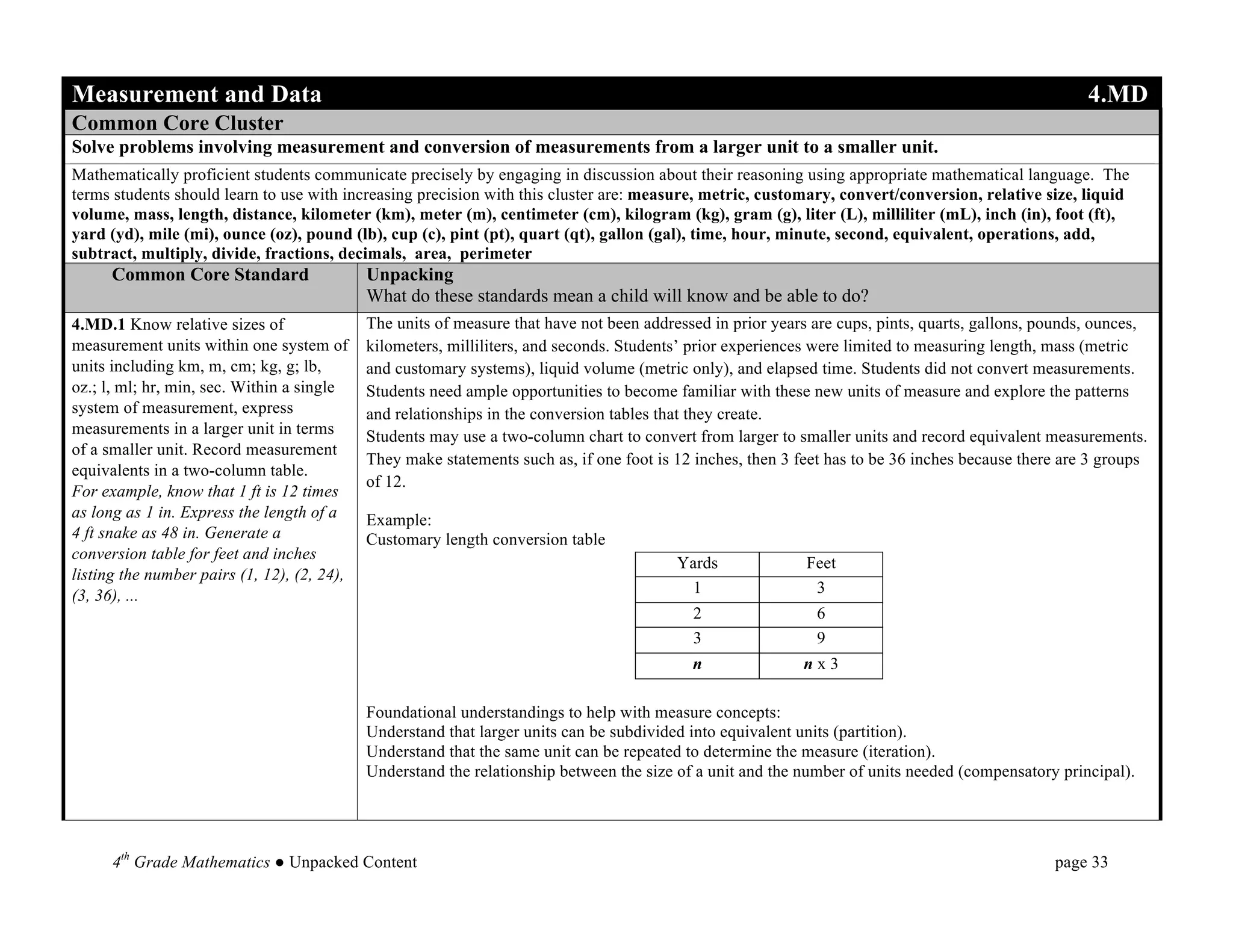
measurements in a larger unit in terms       Students may use a two-column chart to convert from larger to smaller units and record equivalent measurements.
of a smaller unit. Record measurement
                                             They make statements such as, if one foot is 12 inches, then 3 feet has to be 36 inches because there are 3 groups
equivalents in a two-column table.
                                             of 12.
For example, know that 1 ft is 12 times
as long as 1 in. Express the length of a     Example:
4 ft snake as 48 in. Generate a              Customary length conversion table
conversion table for feet and inches
                                                                                          Yards              Feet
listing the number pairs (1, 12), (2, 24),
(3, 36), ...                                                                               1                  3
                                                                                            2                 6
                                                                                            3                 9
                                                                                            n               nx3

                                             Foundational understandings to help with measure concepts:
                                             Understand that larger units can be subdivided into equivalent units (partition).
                                             Understand that the same unit can be repeated to determine the measure (iteration).
                                             Understand the relationship between the size of a unit and the number of units needed (compensatory principal).


      4th Grade Mathematics ● Unpacked Content                                                                                                   page 33	
  
4.MD.2 Use the four operations to solve   This standard includes multi-step word problems related to expressing measurements from a larger unit in terms
word problems involving distances,        of a smaller unit (e.g., feet to inches, meters to centimeter, dollars to cents). Students should have ample
intervals of time, liquid volumes,        opportunities to use number line diagrams to solve word problems.
masses of objects, and money, including   Example:
problems involving simple fractions or    Charlie and 10 friends are planning for a pizza party. They purchased 3 quarts of milk. If each glass holds 8oz
decimals, and problems that require       will everyone get at least one glass of milk?
expressing measurements given in a
                                          possible solution: Charlie plus 10 friends = 11 total people
larger unit in terms of a smaller unit.
                                                  11 people x 8 ounces (glass of milk) = 88 total ounces
Represent measurement quantities using
diagrams such as number line diagrams                                  1 quart = 2 pints = 4 cups = 32 ounces
that feature a measurement scale.
                                                                    Therefore 1 quart = 2 pints = 4 cups = 32 ounces
                                                                              2 quarts = 4 pints = 8 cups = 64 ounces
                                                                              3 quarts = 6 pints = 12 cups = 96 ounces
                                          If Charlie purchased 3 quarts (6 pints) of milk there would be enough for everyone at his party to have at least one
                                          glass of milk. If each person drank 1 glass then he would have 1- 8 oz glass or 1 cup of milk left over.

                                          Additional Examples with various operations:
                                          Division/fractions: Susan has 2 feet of ribbon. She wants to give her ribbon to her 3 best friends so each friend
                                          gets the same amount. How much ribbon will each friend get?
                                          Students may record their solutions using fractions or inches. (The answer would be 2/3 of a foot or 8 inches.
                                          Students are able to express the answer in inches because they understand that 1/3 of a foot is 4 inches and 2/3 of a
                                          foot is 2 groups of 1/3.)

                                          Addition: Mason ran for an hour and 15 minutes on Monday, 25 minutes on Tuesday, and 40 minutes on
                                          Wednesday. What was the total number of minutes Mason ran?

                                          Subtraction: A pound of apples costs $1.20. Rachel bought a pound and a half of apples. If she gave the clerk a
                                          $5.00 bill, how much change will she get back?

                                          Multiplication: Mario and his 2 brothers are selling lemonade. Mario brought one and a half liters, Javier brought
                                          2 liters, and Ernesto brought 450 milliliters. How many total milliliters of lemonade did the boys have?

                                          Number line diagrams that feature a measurement scale can represent measurement quantities. Examples include:
                                          ruler, diagram marking off distance along a road with cities at various points, a timetable showing hours
                                          throughout the day, or a volume measure on the side of a container.

     4th Grade Mathematics ● Unpacked Content                                                                                                   page 34	
  
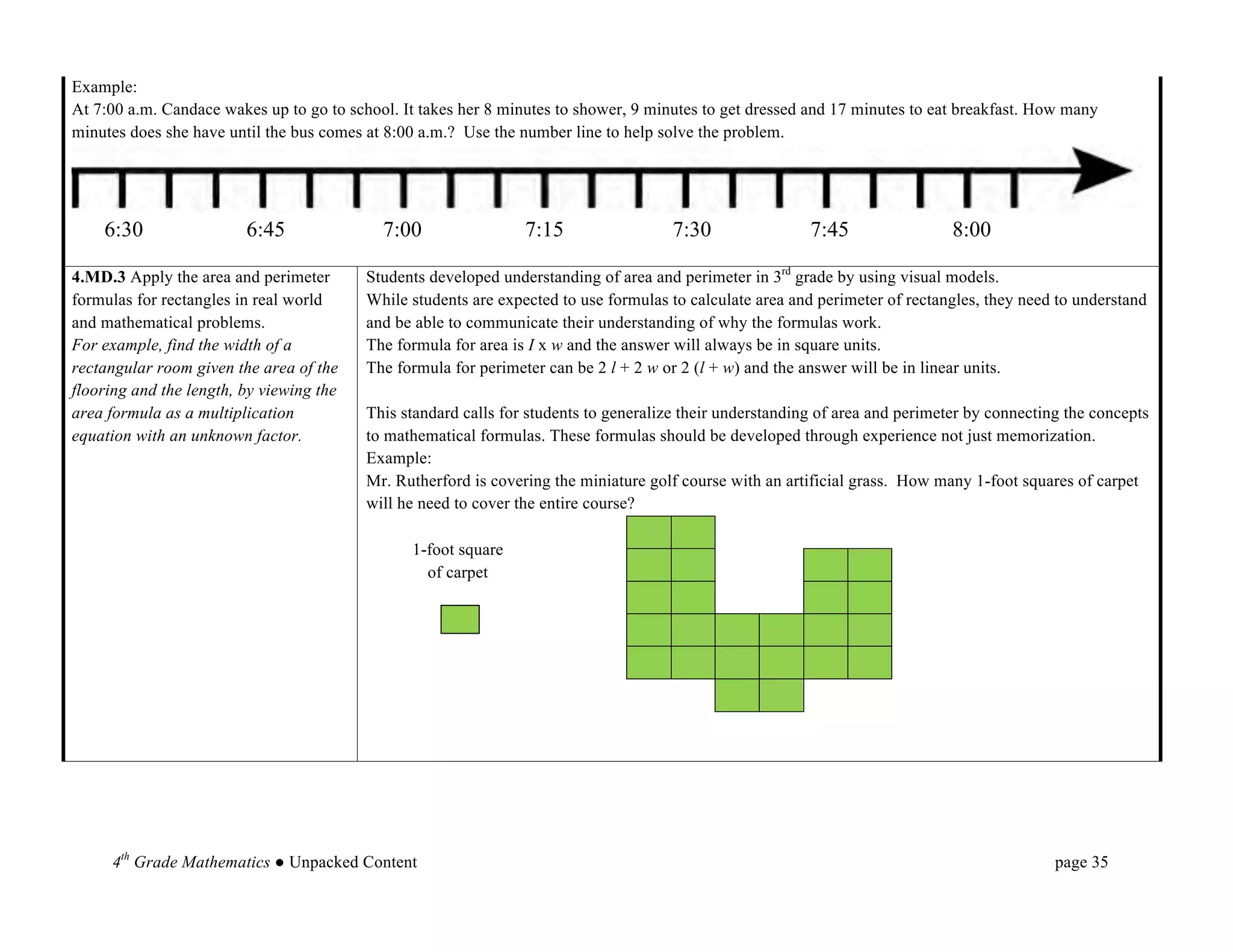
Example:
At 7:00 a.m. Candace wakes up to go to school. It takes her 8 minutes to shower, 9 minutes to get dressed and 17 minutes to eat breakfast. How many
minutes does she have until the bus comes at 8:00 a.m.? Use the number line to help solve the problem.


    6:30                 6:45               7:00                 7:15                  7:30                7:45                 8:00

4.MD.3 Apply the area and perimeter       Students developed understanding of area and perimeter in 3rd grade by using visual models.
formulas for rectangles in real world     While students are expected to use formulas to calculate area and perimeter of rectangles, they need to understand
and mathematical problems.                and be able to communicate their understanding of why the formulas work.
For example, find the width of a          The formula for area is I x w and the answer will always be in square units.
rectangular room given the area of the    The formula for perimeter can be 2 l + 2 w or 2 (l + w) and the answer will be in linear units.
flooring and the length, by viewing the
area formula as a multiplication          This standard calls for students to generalize their understanding of area and perimeter by connecting the concepts
equation with an unknown factor.          to mathematical formulas. These formulas should be developed through experience not just memorization.
                                          Example:
                                          Mr. Rutherford is covering the miniature golf course with an artificial grass. How many 1-foot squares of carpet
                                          will he need to cover the entire course?

                                                1-foot square
                                                  of carpet


     4th Grade Mathematics ● Unpacked Content                                                                                                  page 35	
  
Common Core Cluster
Represent and interpret data.
Mathematically proficient students communicate precisely by engaging in discussion about their reasoning using appropriate mathematical language. The
terms students should learn to use with increasing precision with this cluster are: data, line plot, length, fractions
     Common Core Standard                  Unpacking
                                           What do these standards mean a child will know and be able to do?
4.MD.4 Make a line plot to display a       This standard provides a context for students to work with fractions by measuring objects to an eighth of an inch.
data set of measurements in fractions of   Students are making a line plot of this data and then adding and subtracting fractions based on data in the line
a unit (1/2, 1/4, 1/8). Solve problems     plot.
involving addition and subtraction of
fractions by using information
presented in line plots.
For example, from a line plot find and     Example:
                                           Students measured objects in their desk to the nearest ½, ¼, or 1/8 inch. They displayed their data collected on a
interpret the difference in length
                                           line plot. How many object measured ¼ inch? ½ inch? If you put all the objects together end to end what
between the longest and shortest
                                           would be the total length of all the objects.
specimens in an insect collection.

                                   X
                                   X                         X                         X
                      X            X            X            X                         X                          X


     4th Grade Mathematics ● Unpacked Content                                                                                                   page 36	
  
Common Core Cluster
Geometric measurement: understand concepts of angle and measure angles.
Mathematically proficient students communicate precisely by engaging in discussion about their reasoning using appropriate mathematical language. The
terms students should learn to use with increasing precision with this cluster are: measure, point, end point, geometric shapes, ray, angle, circle, fraction,
intersect, one-degree angle, protractor, decomposed, addition, subtraction, unknown
     Common Core Standard                   Unpacking
                                            What do these standards mean a child will know and be able to do?
4.MD.5 Recognize angles as geometric        This standard brings up a connection between angles and circular measurement (360 degrees).
shapes that are formed wherever two
rays share a common endpoint, and
understand concepts of angle
measurement:
a. An angle is measured with                The diagram below will help students understand that an angle measurement is not related to an area since the
    reference to a circle with its center   area between the 2 rays is different for both circles yet the angle measure is the same
    at the common endpoint of the rays,
    by considering the fraction of the
    circular arc between the points
    where the two rays intersect the
    circle. An angle that turns through
    1/360 of a circle is called a “one-
    degree angle,” and can be used to
    measure angles.


b. An angle that turns through n one-       This standard calls for students to explore an angle as a series of “one-degree turns.”
   degree angles is said to have an         A water sprinkler rotates one-degree at each interval. If the sprinkler rotates a total of 100 degrees, how many
   angle measure of n degrees.              one-degree turns has the sprinkler made?
4.MD.6 Measure angles in whole-             Before students begin measuring angles with protractors, they need to have some experiences with benchmark
number degrees using a protractor.          angles. They transfer their understanding that a 360º rotation about a point makes a complete circle to recognize
Sketch angles of specified measure.         and sketch angles that measure approximately 90º and 180º. They extend this understanding and recognize and
                                            sketch angles that measure approximately 45º and 30º. They use appropriate terminology (acute, right, and
                                            obtuse) to describe angles and rays (perpendicular).


      4th Grade Mathematics ● Unpacked Content                                                                                                   page 37	
  
Students should measure angles and sketch angles

                                                                                                                                             135 degrees
                                                                                       120 degrees


4.MD.7 Recognize angle measure as          This standard addresses the idea of decomposing (breaking apart) an angle into smaller parts.
additive. When an angle is decomposed
into non-overlapping parts, the angle
measure of the whole is the sum of the
angle measures of the parts. Solve
addition and subtraction problems to
find unknown angles on a diagram in
real world and mathematical problems,
e.g., by using an equation with a symbol
for the unknown angle measure.

                                           Example:
                                           A lawn water sprinkler rotates 65 degress and then pauses. It then rotates an additional 25 degrees. What is the
                                           total degree of the water sprinkler rotation? To cover a full 360 degrees how many times will the water sprinkler
                                           need to be moved?
                                           If the water sprinkler rotates a total of 25 degrees then pauses. How many 25 degree cycles will it go through for
                                           the rotation to reach at least 90 degrees?
                                           Example:
                                           If the two rays are perpendicular, what is the value of m?


                                           Example:
                                           Joey knows that when a clock’s hands are exactly on 12 and 1, the angle formed by the clock’s hands measures
                                           30º. What is the measure of the angle formed when a clock’s hands are exactly on the 12 and 4?

     4th Grade Mathematics ● Unpacked Content                                                                                                   page 38	
  
Geometry                                                                                                                                                   4.G
Common Core Cluster
Draw and identify lines and angles, and classify shapes by properties of their lines and angles.
Students describe, analyze, compare, and classify two-dimensional shapes. Through building, drawing, and analyzing two-dimensional shapes, students
deepen their understanding of properties of two-dimensional objects and the use of them to solve problems involving symmetry.
Mathematically proficient students communicate precisely by engaging in discussion about their reasoning using appropriate mathematical language. The
terms students should learn to use with increasing precision with this cluster are: classify shapes/figures, (properties)-rules about how numbers work,
point, line, line segment, ray, angle, vertex/vertices, right angle, acute, obtuse, perpendicular, parallel, right triangle, isosceles triangle, equilateral
triangle, scalene triangle, line of symmetry, symmetric figures, two dimensional
From previous grades: polygon, rhombus/rhombi, rectangle, square, triangle, quadrilateral, pentagon, hexagon, cube, trapezoid, half/quarter
circle, circle, cone, cylinder, sphere
     Common Core Standard                  Unpacking
                                           What do these standards mean a child will know and be able to do?
4.G.1 Draw points, lines, line segments,    This standard asks students to draw two-dimensional geometric objects and to also identify them in two-
rays, angles (right, acute, obtuse), and   dimensional figures. This is the first time that students are exposed to rays, angles, and perpendicular and parallel
perpendicular and parallel lines.          lines.	
  Examples of points, line segments, lines, angles, parallelism, and perpendicularity can be seen daily.
Identify these in two-dimensional          Students do not easily identify lines and rays because they are more abstract.
figures.

                                                                        right angle


                                                                        acute angle


                                                                        obtuse angle

                                                                       straight angle

                                                                          segment
                                                                            line


     4th Grade Mathematics ● Unpacked Content                                                                                                     page 39	
  
ray


                                                                         parallel lines


                                                                      perpendicular lines


                                            Example:
                                            Draw two different types of quadrilaterals that have two pairs of parallel sides?
                                            Is it possible to have an acute right triangle? Justify your reasoning using pictures and words.	


                                            Example:
                                            How many acute, obtuse and right angles are in this shape?


                                            Draw and list the properties of a parallelogram. Draw and list the properties of a rectangle. How are your
                                            drawings and lists alike? How are they different? Be ready to share your thinking with the class.

4.G.2 Classify two-dimensional figures      Two-dimensional figures may be classified using different characteristics such as, parallel or perpendicular lines
based on the presence or absence of         or by angle measurement.
parallel or perpendicular lines, or the
presence or absence of angles of a          Parallel or Perpendicular Lines:
specified size. Recognize right triangles   Students should become familiar with the concept of parallel and perpendicular lines. Two lines are parallel if
as a category, and identify right           they never intersect and are always equidistant. Two lines are perpendicular if they intersect in right angles (90º).
triangles.
                                            Students may use transparencies with lines to arrange two lines in different ways to determine that the 2 lines
                                            might intersect in one point or may never intersect. Further investigations may be initiated using geometry
                                            software. These types of explorations may lead to a discussion on angles.


      4th Grade Mathematics ● Unpacked Content                                                                                                     page 40	
  
Parallel and perpendicular lines are shown below:


                                 This standard calls for students to sort objects based on parallelism, perpendicularity and angle types.
                                 Example:


                                 Do you agree with the label on each of the circles in the Venn diagram above? Describe why some shapes fall in
                                 the overlapping sections of the circles.

                                 Example:
                                 Draw and name a figure that has two parallel sides and exactly 2 right angles.

                                 Example:
                                 For each of the following, sketch an example if it is possible. If it is impossible, say so, and explain why or show
                                 a counter example.
                                             • A parallelogram with exactly one right angle.
                                             • An isosceles right triangle.
                                             • A rectangle that is not a parallelogram. (impossible)
                                             • Every square is a quadrilateral.
                                             • Every trapezoid is a parallelogram.


4th Grade Mathematics ● Unpacked Content                                                                                                page 41	
  
Example:
                                             Identify which of these shapes have perpendicular or parallel sides and justify your selection.


                                             A possible justification that students might give is:
                                             The square has perpendicular lines because the sides meet at a corner, forming right angles.


                                             Angle Measurement:
                                             This expectation is closely connected to 4.MD.5, 4.MD.6, and 4.G.1. Students’ experiences with drawing and
                                             identifying right, acute, and obtuse angles support them in classifying two-dimensional figures based on specified
                                             angle measurements. They use the benchmark angles of 90°, 180°, and 360° to approximate the measurement of
                                             angles.
                                             Right triangles can be a category for classification. A right triangle has one right angle. There are different types
                                             of right triangles. An isosceles right triangle has two or more congruent sides and a scalene right triangle has no
                                             congruent sides.	
  
4.G.3 Recognize a line of symmetry for       Students need experiences with figures which are symmetrical and non-symmetrical. Figures include both regular
a two-dimensional figure as a line           and non-regular polygons. Folding cut-out figures will help students determine whether a figure has one or more
across the figure such that the figure can   lines of symmetry.
be folded along the line into matching
parts. Identify line-symmetric figures       This standard only includes line symmetry not rotational symmetry. 	
  
and draw lines of symmetry.
                                             Example:
                                             For each figure, draw all of the lines of symmetry. What pattern do you notice? How many lines of symmetry do
                                             you think there would be for regular polygons with 9 and 11 sides. Sketch each figure and check your
                                             predictions.
                                             Polygons with an odd number of sides have lines of symmetry that go from a midpoint of a side through a vertex.


                                                                                     Some examples used in this document are from the Arizona Mathematics Education Department


      4th Grade Mathematics ● Unpacked Content                                                                                                                    page 42	
  
Glossary
Table 1 Common addition and subtraction situations1
                              Result Unknown                              Change Unknown                                 Start Unknown
                   Two bunnies sat on the grass. Three          Two bunnies were sitting on the grass.       Some bunnies were sitting on the grass.
                   more bunnies hopped there. How many          Some more bunnies hopped there. Then         Three more bunnies hopped there. Then
    Add to         bunnies are on the grass now?                there were five bunnies. How many            there were five bunnies. How many
                   2+3=?                                        bunnies hopped over to the first two?        bunnies were on the grass before?
                                                                2+?=5                                        ?+3=5
                   Five apples were on the table. I ate two     Five apples were on the table. I ate         Some apples were on the table. I ate two
                   apples. How many apples are on the           some apples. Then there were three           apples. Then there were three apples.
  Take from
                   table now?                                   apples. How many apples did I eat?           How many apples were on the table
                   5–2=?                                        5–?=3                                        before? ? – 2 = 3

                                Total Unknown                              Addend Unknown                           Both Addends Unknown2
                   Three red apples and two green apples        Five apples are on the table. Three are      Grandma has five flowers. How many
                   are on the table. How many apples are        red and the rest are green. How many         can she put in her red vase and how
Put Together/      on the table?                                apples are green?                            many in her blue vase?
 Take Apart3       3+2=?                                        3 + ? = 5, 5 – 3 = ?                         5 = 0 + 5, 5 = 5 + 0
                                                                                                             5 = 1 + 4, 5 = 4 + 1
                                                                                                             5 = 2 + 3, 5 = 3 + 2

                            Difference Unknown                              Bigger Unknown                               Smaller Unknown
                   (“How many more?” version):                  (Version with “more”):                       (Version with “more”):
                   Lucy has two apples. Julie has five          Julie has three more apples than Lucy.       Julie has three more apples than Lucy.
                   apples. How many more apples does            Lucy has two apples. How many apples         Julie has five apples. How many apples
                   Julie have than Lucy?                        does Julie have?                             does Lucy have?
  Compare4           (“How many fewer?” version):                 (Version with “fewer”):                     (Version with “fewer”):
                     Lucy has two apples. Julie has five          Lucy has 3 fewer apples than Julie.         Lucy has 3 fewer apples than Julie.
                     apples. How many fewer apples does           Lucy has two apples. How many apples Julie has five apples. How many apples
                     Lucy have than Julie?                        does Julie have?                            does Lucy have?
                     2 + ? = 5, 5 – 2 = ?                         2 + 3 = ?, 3 + 2 = ?                        5 – 3 = ?, ? + 3 = 5
2
  These take apart situations can be used to show all the decompositions of a given number. The associated equations, which have the total on the left of
the equal sign, help children understand that the = sign does not always mean makes or results in but always does mean is the same number as.
3
  Either addend can be unknown, so there are three variations of these problem situations. Both Addends Unknown is a productive extension of this basic
situation, especially for small numbers less than or equal to 10.
4
  For the Bigger Unknown or Smaller Unknown situations, one version directs the correct operation (the version using more for the bigger unknown and
using less for the smaller unknown). The other versions are more difficult.
1
  Adapted from Box 2-4 of Mathematics Learning in Early Childhood, National Research Council (2009, pp. 32, 33).
4th Grade Mathematics ● Unpacked Content                                                                                                        page 43	
  
Table 2 Common multiplication and division situations1
                          Unknown Product                           Group Size Unknown                       Number of Groups Unknown
                                                                (“How many in each group?”                 (“How many groups?” Division)
                                                                           Division)
                                3×6=?                             3 × ? = 18, and 18 ÷ 3 = ?                    ? × 6 = 18, and 18 ÷ 6 = ?
                  There are 3 bags with 6 plums in       If 18 plums are shared equally into 3 bags,     If 18 plums are to be packed 6 to a
                  each bag. How many plums are           then how many plums will be in each bag?        bag, then how many bags are needed?
                  there in all?
    Equal                                                Measurement example. You have 18 inches         Measurement example. You have 18
    Groups        Measurement example. You need 3        of string, which you will cut into 3 equal      inches of string, which you will cut
                  lengths of string, each 6 inches       pieces. How long will each piece of string      into pieces that are 6 inches long. How
                  long. How much string will you         be?                                             many pieces of string will you have?
                  need altogether?
                  There are 3 rows of apples with 6      If 18 apples are arranged into 3 equal rows,    If 18 apples are arranged into equal
                  apples in each row. How many           how many apples will be in each row?            rows of 6 apples, how many rows will
                  apples are there?                                                                      there be?
    Arrays,2
                                                         Area example. A rectangle has area 18
     Area3
                  Area example. What is the area of a    square centimeters. If one side is 3 cm long,   Area example. A rectangle has area 18
                  3 cm by 6 cm rectangle?                how long is a side next to it?                  square centimeters. If one side is 6 cm
                                                                                                         long, how long is a side next to it?
                  A blue hat costs $6. A red hat costs   A red hat costs $18 and that is 3 times as      A red hat costs $18 and a blue hat
                  3 times as much as the blue hat.       much as a blue hat costs. How much does a       costs $6. How many times as much
                  How much does the red hat cost?        blue hat cost?                                  does the red hat cost as the blue hat?

    Compare       Measurement example. A rubber          Measurement example. A rubber band is           Measurement example. A rubber band
                  band is 6 cm long. How long will       stretched to be 18 cm long and that is 3        was 6 cm long at first. Now it is
                  the rubber band be when it is          times as long as it was at first. How long      stretched to be 18 cm long. How many
                  stretched to be 3 times as long?       was the rubber band at first?                   times as long is the rubber band now as
                                                                                                         it was at first?
    General                     a×b=?                               a × ? = p, and p ÷ a = ?                     ? × b = p, and p ÷ b = ?
2
  The language in the array examples shows the easiest form of array problems. A harder form is to use the terms rows and columns: The apples in
the grocery window are in 3 rows and 6 columns. How many apples are in there? Both forms are valuable.
3
  Area involves arrays of squares that have been pushed together so that there are no gaps or overlaps, so array problems include these especially
important measurement situations.
1
  The first examples in each cell are examples of discrete things. These are easier for students and should be given before the measurement
examples.

4th Grade Mathematics ● Unpacked Content                                                                                                  page 44	
  
Table 3 The properties of operations
Here a, b and c stand for arbitrary numbers in a given number system. The properties of operations apply to the rational number system, the real
number system, and the complex number system.


                  Associative property of addition                                           (a + b) + c = a + (b + c)


                 Commutative property of addition                                                  a+b=b+a


                    Additive identity property of 0                                              a+0=0+a=a


               Associative property of multiplication                                         (a × b) × c = a × (b × c)


              Commutative property of multiplication                                                a×b=b×a


                Multiplicative identity property of 1                                             a×1=1×a=a


       Distributive property of multiplication over addition                                 a × (b + c) = a × b + a × c


4th Grade Mathematics ● Unpacked Content                                                                                                 page 45	
  

NC Instructional Support Tools

  • 1.
      4thGrade Mathematics ●Unpacked Content For the new Common Core State Standards that will be effective in all North Carolina schools in the 2012-13 school year. This document is designed to help North Carolina educators teach the Common Core (Standard Course of Study). NCDPI staff are continually updating and improving these tools to better serve teachers. What is the purpose of this document? To increase student achievement by ensuring educators understand specifically what the new standards mean a student must know, understand and be able to do. This document may also be used to facilitate discussion among teachers and curriculum staff and to encourage coherence in the sequence, pacing, and units of study for grade-level curricula. This document, along with on-going professional development, is one of many resources used to understand and teach the CCSS. What is in the document? Descriptions of what each standard means a student will know, understand and be able to do. The “unpacking” of the standards done in this document is an effort to answer a simple question “What does this standard mean that a student must know and be able to do?” and to ensure the description is helpful, specific and comprehensive for educators. How do I send Feedback? We intend the explanations and examples in this document to be helpful and specific. That said, we believe that as this document is used, teachers and educators will find ways in which the unpacking can be improved and made ever more useful. Please send feedback to us at feedback@dpi.state.nc.us and we will use your input to refine our unpacking of the standards. Thank You! Just want the standards alone? You can find the standards alone at http://corestandards.org/the-standards 4th Grade Mathematics ● Unpacked Content                     August, 2011
  • 2.
    At A Glance Thispage provides a give a snapshot of the mathematical concepts that are new or have been removed from this grade level as well as instructional considerations for the first year of implementation.   New to 4th Grade: • Factors and multiples (4.OA.4) • Multiply a fraction by a whole number (4.NF.4) • Conversions of measurements within the same system (4.MD.1, 4.MD.2) • Angles and angle measurements (4.MD.5 4.MD.6, 4.MD.7) • Lines of symmetry (4.G.3) Moved from 4th Grade: • Coordinate system (3.01) • Transformations (3.03) • Line graphs and bar graphs (4.01) • Data - median, range, mode, comparing sets data (4.03) • Probability (4.04) • Number relationships (5.02, 5.03) Notes: • Topics may appear to be similar between the CCSS and the 2003 NCSCOS; however, the CCSS may be presented at a higher cognitive demand. • For more detailed information see Math Crosswalks: http://www.dpi.state.nc.us/acre/standards/support-tools/ Instructional considerations for CCSS implementation in 2012-2013 • 4.MD.3 calls for students to generalize their understanding of area and perimeter by connecting the concepts to mathematical formulas. These concepts should be developed through conceptual experiences in the classroom not just memorization. Foundation of this concept will be built in third grade the following year. 4th Grade Mathematics ● Unpacked Content page 2  
  • 3.
    Standards for MathematicalPractices The Common Core State Standards for Mathematical Practice are expected to be integrated into every mathematics lesson for all students Grades K-12. Below are a few examples of how these Practices may be integrated into tasks that students complete. Mathematic Practices Explanations and Examples 1. Make sense of problems Mathematically proficient students in grade 4 know that doing mathematics involves solving problems and discussing and persevere in solving how they solved them. Students explain to themselves the meaning of a problem and look for ways to solve it. Fourth them. graders may use concrete objects or pictures to help them conceptualize and solve problems. They may check their thinking by asking themselves, “Does this make sense?” They listen to the strategies of others and will try different approaches. They often will use another method to check their answers. 2. Reason abstractly and Mathematically proficient fourth graders should recognize that a number represents a specific quantity. They connect the quantitatively. quantity to written symbols and create a logical representation of the problem at hand, considering both the appropriate units involved and the meaning of quantities. They extend this understanding from whole numbers to their work with fractions and decimals. Students write simple expressions, record calculations with numbers, and represent or round numbers using place value concepts. 3. Construct viable In fourth grade mathematically proficient students may construct arguments using concrete referents, such as objects, arguments and critique pictures, and drawings. They explain their thinking and make connections between models and equations. They refine the reasoning of others. their mathematical communication skills as they participate in mathematical discussions involving questions like “How did you get that?” and “Why is that true?” They explain their thinking to others and respond to others’ thinking. 4. Model with Mathematically proficient fourth grade students experiment with representing problem situations in multiple ways mathematics. including numbers, words (mathematical language), drawing pictures, using objects, making a chart, list, or graph, creating equations, etc. Students need opportunities to connect the different representations and explain the connections. They should be able to use all of these representations as needed. Fourth graders should evaluate their results in the context of the situation and reflect on whether the results make sense. 5. Use appropriate tools Mathematically proficient fourth graders consider the available tools (including estimation) when solving a mathematical strategically. problem and decide when certain tools might be helpful. For instance, they may use graph paper or a number line to represent and compare decimals and protractors to measure angles. They use other measurement tools to understand the relative size of units within a system and express measurements given in larger units in terms of smaller units. 6. Attend to precision. As fourth graders develop their mathematical communication skills, they try to use clear and precise language in their discussions with others and in their own reasoning. They are careful about specifying units of measure and state the meaning of the symbols they choose. For instance, they use appropriate labels when creating a line plot. 7. Look for and make use In fourth grade mathematically proficient students look closely to discover a pattern or structure. For instance, students of structure. use properties of operations to explain calculations (partial products model). They relate representations of counting problems such as tree diagrams and arrays to the multiplication principal of counting. They generate number or shape patterns that follow a given rule. 8. Look for and express Students in fourth grade should notice repetitive actions in computation to make generalizations Students use models to regularity in repeated explain calculations and understand how algorithms work. They also use models to examine patterns and generate their reasoning. own algorithms. For example, students use visual fraction models to write equivalent fractions.   4th Grade Mathematics ● Unpacked Content page 3  
  • 4.
    Grade 4 CriticalAreas The Critical Areas are designed to bring focus to the standards at each grade by describing the big ideas that educators can use to build their curriculum and to guide instruction. The Critical Areas for fourth grade can be found on page 27 in the Common Core State Standards for Mathematics.   1. Developing understanding and fluency with multi-digit multiplication, and developing understanding of dividing to find quotients involving multi-digit dividends. Students generalize their understanding of place value to 1,000,000, understanding the relative sizes of numbers in each place. They apply their understanding of models for multiplication (equal-sized groups, arrays, area models), place value, and properties of operations, in particular the distributive property, as they develop, discuss, and use efficient, accurate, and generalizable methods to compute products of multi-digit whole numbers. Depending on the numbers and the context, they select and accurately apply appropriate methods to estimate or mentally calculate products. They develop fluency with efficient procedures for multiplying whole numbers; understand and explain why the procedures work based on place value and properties of operations; and use them to solve problems. Students apply their understanding of models for division, place value, properties of operations, and the relationship of division to multiplication as they develop, discuss, and use efficient, accurate, and generalizable procedures to find quotients involving multi-digit dividends. They select and accurately apply appropriate methods to estimate and mentally calculate quotients, and interpret remainders based upon the context. 2. Developing an understanding of fraction equivalence, addition and subtraction of fractions with like denominators, and multiplication of fractions by whole numbers. Students develop understanding of fraction equivalence and operations with fractions. They recognize that two different fractions can be equal (e.g., 15/9 = 5/3), and they develop methods for generating and recognizing equivalent fractions. Students extend previous understandings about how fractions are built from unit fractions, composing fractions from unit fractions, decomposing fractions into unit fractions, and using the meaning of fractions and the meaning of multiplication to multiply a fraction by a whole number. 3. Understanding that geometric figures can be analyzed and classified based on their properties, such as having parallel sides, perpendicular sides, particular angle measures, and symmetry. Students describe, analyze, compare, and classify two-dimensional shapes. Through building, drawing, and analyzing two- dimensional shapes, students deepen their understanding of properties of two-dimensional objects and the use of them to solve problems involving symmetry.   4th Grade Mathematics ● Unpacked Content page 4  
  • 5.
    Operations and AlgebraicThinking 4.OA Common Core Cluster Use the four operations with whole numbers to solve problems. Mathematically proficient students communicate precisely by engaging in discussion about their reasoning using appropriate mathematical language. The terms students should learn to use with increasing precision with this cluster are: multiplication/multiply, division/divide, addition/add, subtraction/subtract, equations, unknown, remainders, reasonableness, mental computation, estimation, rounding Common Core Standard Unpacking What do these standards mean a child will know and be able to do? 4.OA.1 Interpret a multiplication A multiplicative comparison is a situation in which one quantity is multiplied by a specified number to get equation as a comparison, e.g., interpret another quantity (e.g., “a is n times as much as b”). Students should be able to identify and verbalize which 35 = 5 × 7 as a statement that 35 is 5 quantity is being multiplied and which number tells how many times. times as many as 7 and 7 times as many as 5. Represent verbal statements of Students should be given opportunities to write and identify equations and statements for multiplicative multiplicative comparisons as comparisons. multiplication equations. Example: 5 x 8 = 40. Sally is five years old. Her mom is eight times older. How old is Sally’s Mom? 5 x 5 = 25 Sally has five times as many pencils as Mary. If Sally has 5 pencils, how many does Mary have? 4.OA.2 Multiply or divide to solve This standard calls for students to translate comparative situations into equations with an unknown and solve. word problems involving multiplicative Students need many opportunities to solve contextual problems. Refer to Glossary, Table 2(page 89) comparison, e.g., by using drawings and For more examples (table included at the end of this document for your convenience) equations with a symbol for the unknown number to represent the Examples: problem, distinguishing multiplicative Unknown Product: A blue scarf costs $3. A red scarf costs 6 times as much. How much does the red scarf cost? comparison from additive comparison.1 (3 x 6 = p). Group Size Unknown: A book costs $18. That is 3 times more than a DVD. How much does a DVD cost? 1 See Glossary, Table 2. (page 89) (18 ÷ p = 3 or 3 x p = 18). (Table included at the end of this Number of Groups Unknown: A red scarf costs $18. A blue scarf costs $6. How many times as much does the red document for your convenience) scarf cost compared to the blue scarf? (18 ÷ 6 = p or 6 x p = 18). When distinguishing multiplicative comparison from additive comparison, students should note that • additive comparisons focus on the difference between two quantities (e.g., Deb has 3 apples and Karen has 5 apples. How many more apples does Karen have?). A simple way to remember this is, “How many more?” • multiplicative comparisons focus on comparing two quantities by showing that one quantity is a specified 4th Grade Mathematics ● Unpacked Content page 5  
  • 6.
    number of timeslarger or smaller than the other (e.g., Deb ran 3 miles. Karen ran 5 times as many miles as Deb. How many miles did Karen run?). A simple way to remember this is “How many times as much?” or “How many times as many?” 4.OA.3 Solve multistep word problems The focus in this standard is to have students use and discuss various strategies. It refers to estimation strategies, posed with whole numbers and having including using compatible numbers (numbers that sum to 10 or 100) or rounding. Problems should be structured whole-number answers using the four so that all acceptable estimation strategies will arrive at a reasonable answer. Students need many opportunities operations, including problems in which solving multistep story problems using all four operations. remainders must be interpreted. Represent these problems using Example: equations with a letter standing for the On a vacation, your family travels 267 miles on the first day, 194 miles on the second day and 34 miles on the third day. How many miles did they travel total? unknown quantity. Assess the Some typical estimation strategies for this problem: reasonableness of answers using mental Student 1 Student 2 Student 3 computation and estimation strategies I first thought about I first thought about 194. It is I rounded 267 to 300. I including rounding. 267 and 34. I noticed really close to 200. I also have rounded 194 to 200. I that their sum is about 2 hundreds in 267. That gives rounded 34 to 30. 300. Then I knew that me a total of 4 hundreds. Then I When I added 300, 200 194 is close to 200. have 67 in 267 and the 34. and 30, I know my When I put 300 and 200 When I put 67 and 34 together answer will be about together, I get 500. that is really close to 100. When 530. I add that hundred to the 4 hundreds that I already had, I end up with 500. The assessment of estimation strategies should only have one reasonable answer (500 or 530), or a range (between 500 and 550). Problems will be structured so that all acceptable estimation strategies will arrive at a reasonable answer. Examples continued on the next page. 4th Grade Mathematics ● Unpacked Content page 6  
  • 7.
    Example 2: Your class is collecting bottled water for a service project. The goal is to collect 300 bottles of water. On the first day, Max brings in 3 packs with 6 bottles in each container. Sarah wheels in 6 packs with 6 bottles in each container. About how many bottles of water still need to be collected? Student 1 Student 2 First, I multiplied 3 and 6 which First, I multiplied 3 and 6 which equals 18. Then I multiplied 6 and 6 equals 18. Then I multiplied 6 and 6 which is 36. I know 18 plus 36 is which is 36. I know 18 is about 20 about 50. I’m trying to get to 300. 50 and 36 is about 40. 40+20=60. 300- plus another 50 is 100. Then I need 2 60 = 240, so we need about 240 more hundreds. So we still need 250 more bottles. bottles. This standard references interpreting remainders. Remainders should be put into context for interpretation. ways to address remainders: • Remain as a left over • Partitioned into fractions or decimals • Discarded leaving only the whole number answer • Increase the whole number answer up one • Round to the nearest whole number for an approximate result Example: Write different word problems involving 44 ÷ 6 = ? where the answers are best represented as: Problem A: 7 Problem B: 7 r 2 Problem C: 8 Problem D: 7 or 8 Problem E: 7 2 6 possible solutions: Problem A: 7. Mary had 44 pencils. Six pencils fit into each of her pencil pouches. How many pouches did she fill? 44 ÷ 6 = p; p = 7 r 2. Mary can fill 7 pouches completely. Problem B: 7 r 2. Mary had 44 pencils. Six pencils fit into each of her pencil pouches. How many pouches could she fill and how many pencils would she have left? 44 ÷ 6 = p; p = 7 r 2; Mary can fill 7 pouches and have 2 left over. Problem C: 8. Mary had 44 pencils. Six pencils fit into each of her pencil pouches. What would the 4th Grade Mathematics ● Unpacked Content page 7  
  • 8.
    fewest number ofpouches she would need in order to hold all of her pencils? 44 ÷ 6 = p; p = 7 r 2; Mary can needs 8 pouches to hold all of the pencils. Problem D: 7 or 8. Mary had 44 pencils. She divided them equally among her friends before giving one of the leftovers to each of her friends. How many pencils could her friends have received? 44 ÷ 6 = p; p = 7 r 2; Some of her friends received 7 pencils. Two friends received 8 pencils. Problem E: 7 2 . Mary had 44 pencils and put six pencils in each pouch. What fraction represents the 6 number of pouches that Mary filled? 44 ÷ 6 = p; p = 7 2 6 Example: There are 128 students going on a field trip. If each bus held 30 students, how many buses are needed? (128 ÷ 30 = b; b = 4 R 8; They will need 5 buses because 4 busses would not hold all of the students). Students need to realize in problems, such as the example above, that an extra bus is needed for the 8 students that are left over. Estimation skills include identifying when estimation is appropriate, determining the level of accuracy needed, selecting the appropriate method of estimation, and verifying solutions or determining the reasonableness of situations using various estimation strategies. Estimation strategies include, but are not limited to: • front-end estimation with adjusting (using the highest place value and estimating from the front end, making adjustments to the estimate by taking into account the remaining amounts), • clustering around an average (when the values are close together an average value is selected and multiplied by the number of values to determine an estimate), • rounding and adjusting (students round down or round up and then adjust their estimate depending on how much the rounding affected the original values), • using friendly or compatible numbers such as factors (students seek to fit numbers together - e.g., rounding to factors and grouping numbers together that have round sums like 100 or 1000), • using benchmark numbers that are easy to compute (students select close whole numbers for fractions or decimals to determine an estimate).         4th Grade Mathematics ● Unpacked Content page 8  
  • 9.
    Common Core Cluster Gainfamiliarity with factors and multiples. Mathematically proficient students communicate precisely by engaging in discussion about their reasoning using appropriate mathematical language. The terms students should learn to use with increasing precision with this cluster are: multiplication/multiply, division/divide, factor pairs, factor, multiple, prime, composite Common Core Standard Unpacking What do these standards mean a child will know and be able to do? 4.OA.4 Find all factor pairs for a whole This standard requires students to demonstrate understanding of factors and multiples of whole numbers. This number in the range 1–100. Recognize standard also refers to prime and composite numbers. Prime numbers have exactly two factors, the number one that a whole number is a multiple of and their own number. For example, the number 17 has the factors of 1 and 17. Composite numbers have more each of its factors. Determine whether a than two factors. For example, 8 has the factors 1, 2, 4, and 8. given whole number in the range 1–100 is a multiple of a given one-digit A common misconception is that the number 1 is prime, when in fact; it is neither prime nor composite. Another number. Determine whether a given common misconception is that all prime numbers are odd numbers. This is not true, since the number 2 has only whole number in the range 1–100 is 2 factors, 1 and 2, and is also an even number. prime or composite. Prime vs. Composite: A prime number is a number greater than 1 that has only 2 factors, 1 and itself. Composite numbers have more than 2 factors. Students investigate whether numbers are prime or composite by • building rectangles (arrays) with the given area and finding which numbers have more than two rectangles (e.g. 7 can be made into only 2 rectangles, 1 x 7 and 7 x 1, therefore it is a prime number) • finding factors of the number Students should understand the process of finding factor pairs so they can do this for any number 1 - 100, Example: Factor pairs for 96: 1 and 96, 2 and 48, 3 and 32, 4 and 24, 6 and 16, 8 and 12. Multiples can be thought of as the result of skip counting by each of the factors. When skip counting, students should be able to identify the number of factors counted e.g., 5, 10, 15, 20 (there are 4 fives in 20). 4th Grade Mathematics ● Unpacked Content page 9  
  • 10.
    Example: Factors of 24: 1, 2, 3, 4, 6, 8,12, 24 Multiples: 1, 2, 3, 4, 5…24 2, 4, 6, 8, 10, 12, 14, 16, 18, 20, 22, 24 3, 6, 9, 12, 15, 18, 21, 24 4, 8, 12, 16, 20, 24 8, 16, 24 12, 24 24 To determine if a number between1-100 is a multiple of a given one-digit number, some helpful hints include the following: • all even numbers are multiples of 2 • all even numbers that can be halved twice (with a whole number result) are multiples of 4 • all numbers ending in 0 or 5 are multiples of 5 Common Core Cluster Generate and analyze patterns. Mathematically proficient students communicate precisely by engaging in discussion about their reasoning using appropriate mathematical language. The terms students should learn to use with increasing precision with this cluster are: pattern (number or shape), pattern rule Common Core Standard Unpacking What do these standards mean a child will know and be able to do? 4.OA.5 Generate a number or shape Patterns involving numbers or symbols either repeat or grow. Students need multiple opportunities creating and pattern that follows a given rule. extending number and shape patterns. Numerical patterns allow students to reinforce facts and develop fluency Identify apparent features of the pattern with operations. that were not explicit in the rule itself. For example, given the rule “Add 3” Patterns and rules are related. A pattern is a sequence that repeats the same process over and over. A rule dictates and the starting number 1, generate what that process will look like. Students investigate different patterns to find rules, identify features in the terms in the resulting sequence and patterns, and justify the reason for those features. observe that the terms appear to alternate between odd and even 4th Grade Mathematics ● Unpacked Content page 10  
  • 11.
    numbers. Explain informallywhy the Example: numbers will continue to alternate in Pattern Rule Feature(s) this way. 3, 8, 13, 18, 23, 28, … Start with 3, add 5 The numbers alternately end with a 3 or 8 5, 10, 15, 20 … Start with 5, add 5 The numbers are multiples of 5 and end with either 0 or 5. The numbers that end with 5 are products of 5 and an odd number. The numbers that end in 0 are products of 5 and an even number. After students have identified rules and features from patterns, they need to generate a numerical or shape pattern from a given rule. Example: Rule: Starting at 1, create a pattern that starts at 1 and multiplies each number by 3. Stop when you have 6 numbers. Students write 1, 3, 9, 27, 8, 243. Students notice that all the numbers are odd and that the sums of the digits of the 2 digit numbers are each 9. Some students might investigate this beyond 6 numbers. Another feature to investigate is the patterns in the differences of the numbers (3 - 1 = 2, 9 - 3 = 6, 27 - 9 = 18, etc.) This standard calls for students to describe features of an arithmetic number pattern or shape pattern by identifying the rule, and features that are not explicit in the rule. A t-chart is a tool to help students see number patterns.   Example: There are 4 beans in the jar. Each day 3 beans are added. How many beans are in the jar for each of the first 5 days? Day Operation Beans 0 3x0+4 4 1 3x1+4 7 2 3x2+4 10 3 3x3+4 13 4 3x4+4 16 5 3x5+4 19   4th Grade Mathematics ● Unpacked Content page 11  
  • 12.
    Number and Operationin Base Ten1 4.NBT Common Core Standard and Cluster Generalize place value understanding for multi-digit whole numbers. 1 Grade 4 expectations in this domain are limited to whole numbers less than or equal to 1,000,000. Mathematically proficient students communicate precisely by engaging in discussion about their reasoning using appropriate mathematical language. The terms students should learn to use with increasing precision with this cluster are: place value, greater than, less than, equal to, ‹, ›, =, comparisons/compare, round Unpacking What do these standards mean a child will know and be able to do? 4.NBT.1 Recognize that in a multi-digit This standard calls for students to extend their understanding of place value related to multiplying and dividing whole number, a digit in one place by multiples of 10. In this standard, students should reason about the magnitude of digits in a number. Students represents ten times what it represents should be given opportunities to reason and analyze the relationships of numbers that they are working with. in the place to its right. For example, recognize that 700 ÷ 70 = Example: 10 by applying concepts of place value How is the 2 in the number 582 similar to and different from the 2 in the number 528? and division. 4.NBT.2 Read and write multi-digit This standard refers to various ways to write numbers. Students should have flexibility with the different number whole numbers using base-ten forms. Traditional expanded form is 285 = 200 + 80 + 5. Written form is two hundred eighty-five. However, numerals, number names, and expanded students should have opportunities to explore the idea that 285 could also be 28 tens plus 5 ones or 1 hundred, 18 form. Compare two multi-digit numbers tens, and 5 ones. based on meanings of the digits in each place, using >, =, and < symbols to Students should also be able to compare two multi-digit whole numbers using appropriate symbols. record the results of comparisons. 4.NBT.3 Use place value understanding This standard refers to place value understanding, which extends beyond an algorithm or procedure for rounding. to round multi-digit whole numbers to The expectation is that students have a deep understanding of place value and number sense and can explain and any place. reason about the answers they get when they round. Students should have numerous experiences using a number line and a hundreds chart as tools to support their work with rounding. Example: Your class is collecting bottled water for a service project. The goal is to collect 300 bottles of water. On the first day, Max brings in 3 packs with 6 bottles in each container. Sarah wheels in 6 packs with 6 bottles in each container. About how many bottles of water still need to be collected? Continues on next page. 4th Grade Mathematics ● Unpacked Content page 12  
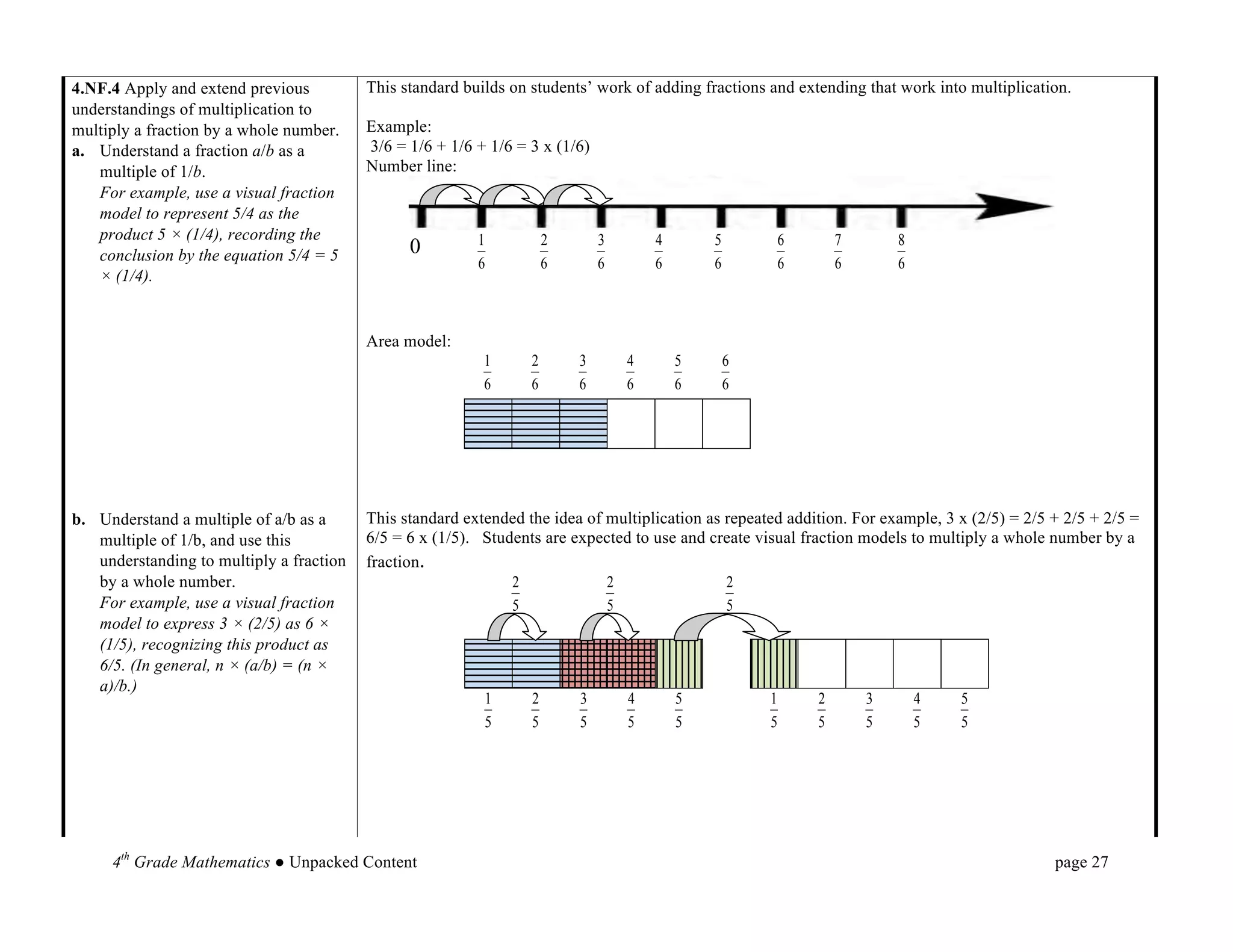
  • 13.
    Student 1 Student 2 First, I multiplied 3 and 6 which equals First, I multiplied 3 and 6 which 18. Then I multiplied 6 and 6 which is equals 18. Then I multiplied 6 and 6 36. I know 18 plus 36 is about 50. I’m which is 36. I know 18 is about 20 trying to get to 300. 50 plus another 50 and 36 is about 40. 40+20=60. 300- is 100. Then I need 2 more hundreds. 60 = 240, so we need about 240 more So we still need 250 bottles. bottles.   Example: On a vacation, your family travels 267 miles on the first day, 194 miles on the second day and 34 miles on the third day. How many total miles did they travel? Some typical estimation strategies for this problem: Student 1 Student 2 Student 3 I first thought about I first thought about 194. It is I rounded 267 to 267 and 34. I noticed really close to 200. I also have 2 300. I rounded 194 that their sum is about hundreds in 267. That gives me a to 200. I rounded 34 300. Then I knew that total of 4 hundreds. Then I have to 30. When I added 194 is close to 200. 67 in 267 and the 34. When I put 300, 200 and 30, I When I put 300 and 67 and 34 together that is really know my answer 200 together, I get close to 100. When I add that will be about 530.           500. hundred to the 4 hundreds that I already had, I end up with 500. Example: Round 368 to the nearest hundred. This will either be 300 or 400, since those are the two hundreds before and after 368. Draw a number line, subdivide it as much as necessary, and determine whether 368 is closer to 300 or 400. Since 368 is closer to 400, this number should be rounded to 400 4th Grade Mathematics ● Unpacked Content page 13  
  • 14.
    Common Core Cluster Useplace value understanding and properties of operations to perform multi-digit arithmetic. 1 Grade 4 expectations in this domain are limited to whole numbers less than or equal to 1,000,000. Students generalize their understanding of place value to 1,000,000, understanding the relative sizes of numbers in each place. They apply their understanding of models for multiplication (equal-sized groups, arrays, area models), place value, and properties of operations, in particular the distributive property, as they develop, discuss, and use efficient, accurate, and generalizable methods to compute products of multi-digit whole numbers. Depending on the numbers and the context, they select and accurately apply appropriate methods to estimate or mentally calculate products. They develop fluency with efficient procedures for multiplying whole numbers; understand and explain why the procedures work based on place value and properties of operations; and use them to solve problems. Students apply their understanding of models for division, place value, properties of operations, and the relationship of division to multiplication as they develop, discuss, and use efficient, accurate, and generalizable procedures to find quotients involving multi-digit dividends. They select and accurately apply appropriate methods to estimate and mentally calculate quotients, and interpret remainders based upon the context. Mathematically proficient students communicate precisely by engaging in discussion about their reasoning using appropriate mathematical language. The terms students should learn to use with increasing precision with this cluster are: partition(ed), fraction, unit fraction, equivalent, multiple, reason, denominator, numerator, comparison/compare, ‹, ›, =, benchmark fraction Common Core Standard Unpacking What do these standards mean a child will know and be able to do? 4.NBT.4 Fluently add and subtract Students build on their understanding of addition and subtraction, their use of place value and their flexibility multi-digit whole numbers using the with multiple strategies to make sense of the standard algorithm. They continue to use place value in describing standard algorithm. and justifying the processes they use to add and subtract. This standard refers to fluency, which means accuracy, efficiency (using a reasonable amount of steps and time), and flexibility (using a variety strategies such as the distributive property). This is the first grade level in which students are expected to be proficient at using the standard algorithm to add and subtract. However, other previously learned strategies are still appropriate for students to use.       When students begin using the standard algorithm their explanation may be quite lengthy. After much practice with using place value to justify their steps, they will develop fluency with the algorithm. Students should be able to explain why the algorithm works. 3892 + 1567 Student explanation for this problem continued on the next page: 4th Grade Mathematics ● Unpacked Content page 14  
  • 15.
    1. Two onesplus seven ones is nine ones. 2. Nine tens plus six tens is 15 tens. 3. I am going to write down five tens and think of the10 tens as one more hundred.(notates with a 1 above the hundreds column) 4. Eight hundreds plus five hundreds plus the extra hundred from adding the tens is 14 hundreds. 5. I am going to write the four hundreds and think of the 10 hundreds as one more 1000. (notates with a 1 above the thousands column) 6. Three thousands plus one thousand plus the extra thousand from the hundreds is five thousand.   3546 - 928 Student explanation for this problem: 1. There are not enough ones to take 8 ones from 6 ones so I have to use one ten as 10 ones. Now I have 3 tens and 16 ones. (Marks through the 4 and notates with a 3 above the 4 and writes a 1 above the ones column to be represented as 16 ones.) 2. Sixteen ones minus 8 ones is 8 ones. (Writes an 8 in the ones column of answer.) 3. Three tens minus 2 tens is one ten. (Writes a 1 in the tens column of answer.) 4. There are not enough hundreds to take 9 hundreds from 5 hundreds so I have to use one thousand as 10 hundreds. (Marks through the 3 and notates with a 2 above it. (Writes down a 1 above the hundreds column.) Now I have 2 thousand and 15 hundreds. 5. Fifteen hundreds minus 9 hundreds is 6 hundreds. (Writes a 6 in the hundreds column of the answer). 6. I have 2 thousands left since I did not have to take away any thousands. (Writes 2 in the thousands place of answer.) Students should know that it is mathematically possible to subtract a larger number from a smaller number but that their work with whole numbers does not allow this as the difference would result in a negative number.   4.NBT.5 Multiply a whole number of Students who develop flexibility in breaking numbers apart have a better understanding of the importance of up to four digits by a one-digit whole place value and the distributive property in multi-digit multiplication. Students use base ten blocks, area models, number, and multiply two two-digit partitioning, compensation strategies, etc. when multiplying whole numbers and use words and diagrams to numbers, using strategies based on explain their thinking. They use the terms factor and product when communicating their reasoning. Multiple place value and the properties of strategies enable students to develop fluency with multiplication and transfer that understanding to division. Use operations. Illustrate and explain the of the standard algorithm for multiplication is an expectation in the 5th grade. calculation by using equations, 4th Grade Mathematics ● Unpacked Content page 15  
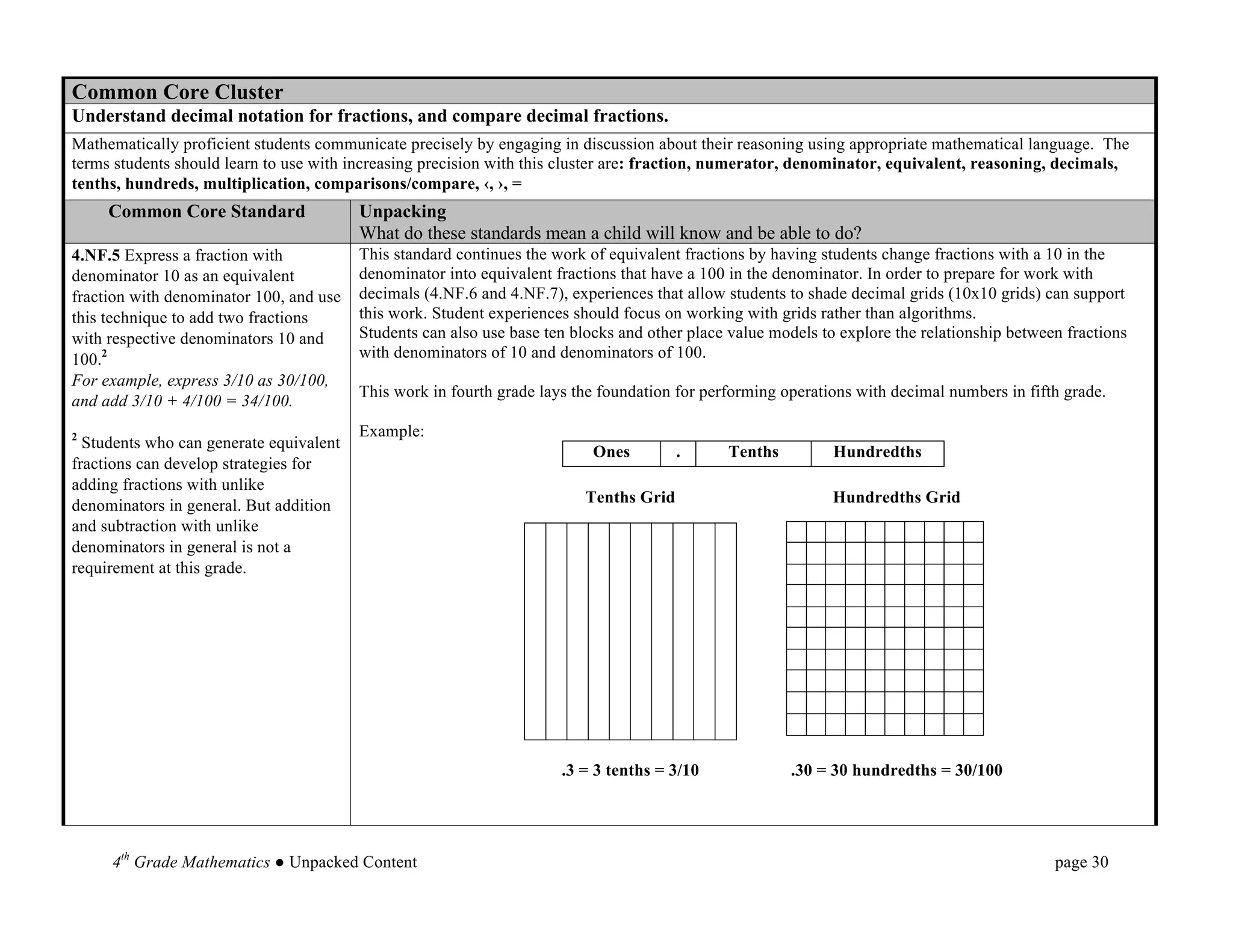
  • 16.
    rectangular arrays, and/orarea models. This standard calls for students to multiply numbers using a variety of strategies. Example: There are 25 dozen cookies in the bakery. What is the total number of cookies at the bakery? Student 1 Student 2 Student 3 25 x12 25 x 12 25 x 12 I broke 12 up into 10 I broke 25 up into 5 I doubled 25 and cut and 2 groups of 5 12 in half to get 50 x 6 25 x 10 = 250 5 x 12 = 60 50 x 6 = 300 25 x 2 = 50 I have 5 groups of 5 in 25 250 +50 = 300 60 x 5 = 300 Example: What would an array area model of 74 x 38 look like? 70 4           70 x 30 = 2,100 4 x 30 = 120 30 70 x 8 = 560 8 4 x 8 = 32 2,100 = 560 + 1,200 + 32 = 2,812 Example: To illustrate 154 x 6 students use base 10 blocks or use drawings to show 154 six times. Seeing 154 six times will lead them to understand the distributive property, 154 x 6 = (100 + 50 + 4) x 6 = (100 x 6) + (50 X 6) + (4 X 6) = 600 + 300 + 24 = 924. The area model below shows the partial products. 14 x 16 = 224 4th Grade Mathematics ● Unpacked Content page 16  
  • 17.
    Using the areamodel, students first verbalize their understanding: • 10 x 10 is 100 • 4 x 10 is 40 • 10 x 6 is 60, and • 4 x 6 is 24. They use different strategies to record this type of thinking. Students explain this strategy and the one below with base 10 blocks, drawings, or numbers. 25 x24 400 (20 x 20) 100 (20 x 5) 80 (4 x 20) 20 (4 x 5) 600 4.NBT.6 Find whole-number quotients In fourth grade, students build on their third grade work with division within 100. Students need opportunities to and remainders with up to four-digit develop their understandings by using problems in and out of context. dividends and one-digit divisors, using strategies based on place value, the Example: properties of operations, and/or the A 4th grade teacher bought 4 new pencil boxes. She has 260 pencils. She wants to put the pencils in the boxes so relationship between multiplication and that each box has the same number of pencils. How many pencils will there be in each box? division. Illustrate and explain the • Using Base 10 Blocks: Students build 260 with base 10 blocks and distribute them into 4 equal groups. calculation by using equations, Some students may need to trade the 2 hundreds for tens but others may easily recognize that 200 divided by 4 is 50. rectangular arrays, and/or area models. • Using Place Value: 260 ÷ 4 = (200 ÷ 4) + (60 ÷ 4) • Using Multiplication: 4 x 50 = 200, 4 x 10 = 40, 4 x 5 = 20; 50 + 10 + 5 = 65; so 260 ÷ 4 = 65 This standard calls for students to explore division through various strategies. 4th Grade Mathematics ● Unpacked Content page 17  
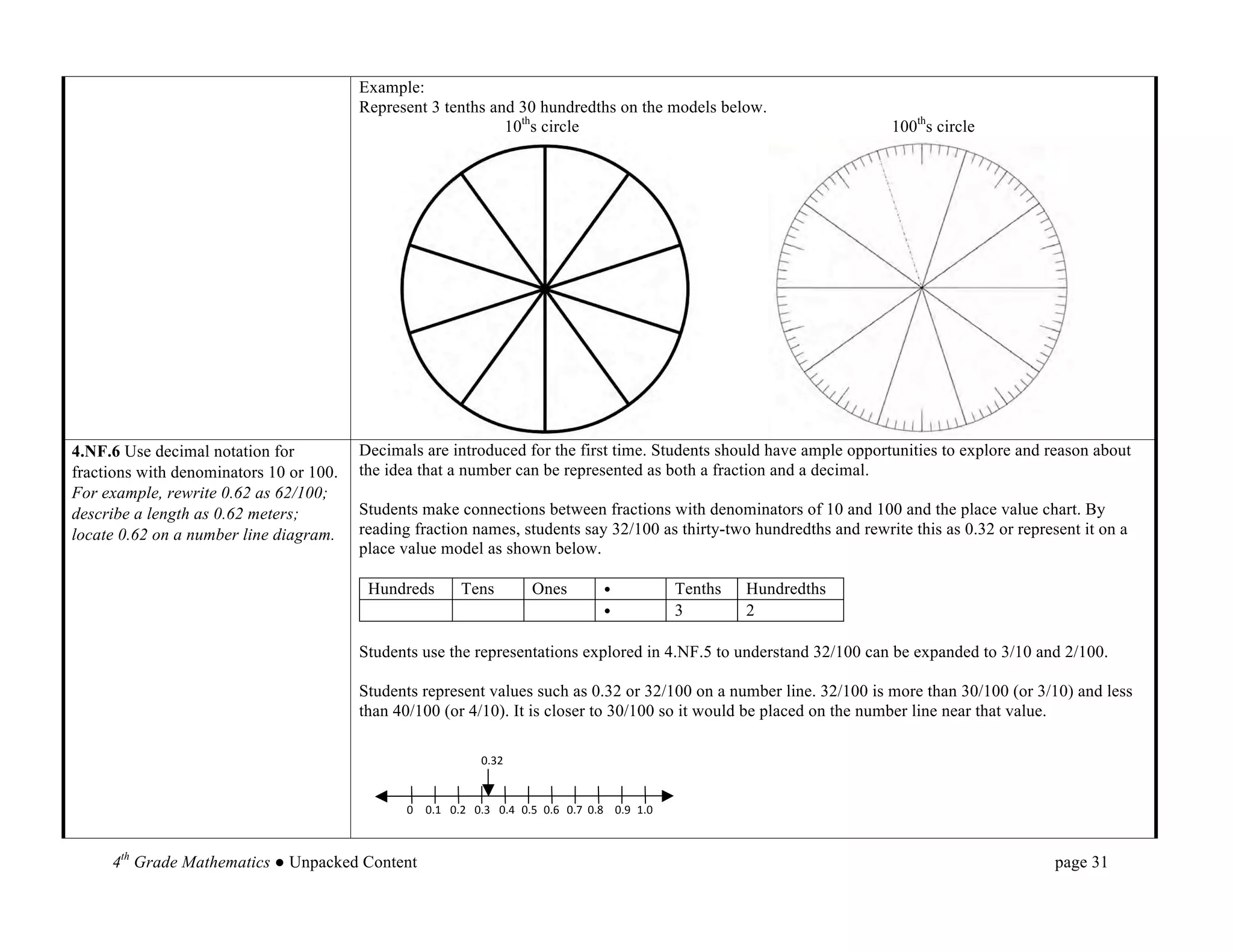
  • 18.
    Example: There are 592 students participating in Field Day. They are put into teams of 8 for the competition. How many teams get created? Student 1 Student 2 Student 3 592 divided by 8 592 divided by 8 I want to get to 592 There are 70 8’s in I know that 10 8’s is 80 592 8 x 25 = 200 560 If I take out 50 8’s that is 400 -400 50 8 x 25 = 200 592 - 560 = 32 592 - 400 = 192 8 x 25 = 200 There are 4 8’s in 32 I can take out 20 more 8’s which is 160 192 200 + 200 + 200 = 600 70 + 4 = 74 192 - 160 = 32 -160 20 600 - 8 = 592 8 goes into 32 4 times I had 75 groups of 8 and 32 I have none left took one away, so there -32 4 I took out 50, then 20 more, then 4 more are  74 teams   That’s 74 0 Example: Using an Open Array or Area Model After developing an understanding of using arrays to divide, students begin to use a more abstract model for division. This model connects to a recording process that will be formalized in the 5th grade. Example: 150 ÷ 6 Students make a rectangle and write 6 on one of its sides. They express their understanding that they need to think of the rectangle as representing a total of 150. 1. Students think, 6 times what number is a number close to 150? They recognize that 6 x 10 is 60 so they record 10 as a factor and partition the rectangle into 2 rectangles and label the area aligned to the factor of 10 with 60. They express that they have only used 60 of the 150 so they have 90 left. 2. Recognizing that there is another 60 in what is left they repeat the process above. They express that they have used 120 of the 150 so they have 30 left. 4th Grade Mathematics ● Unpacked Content page 18  
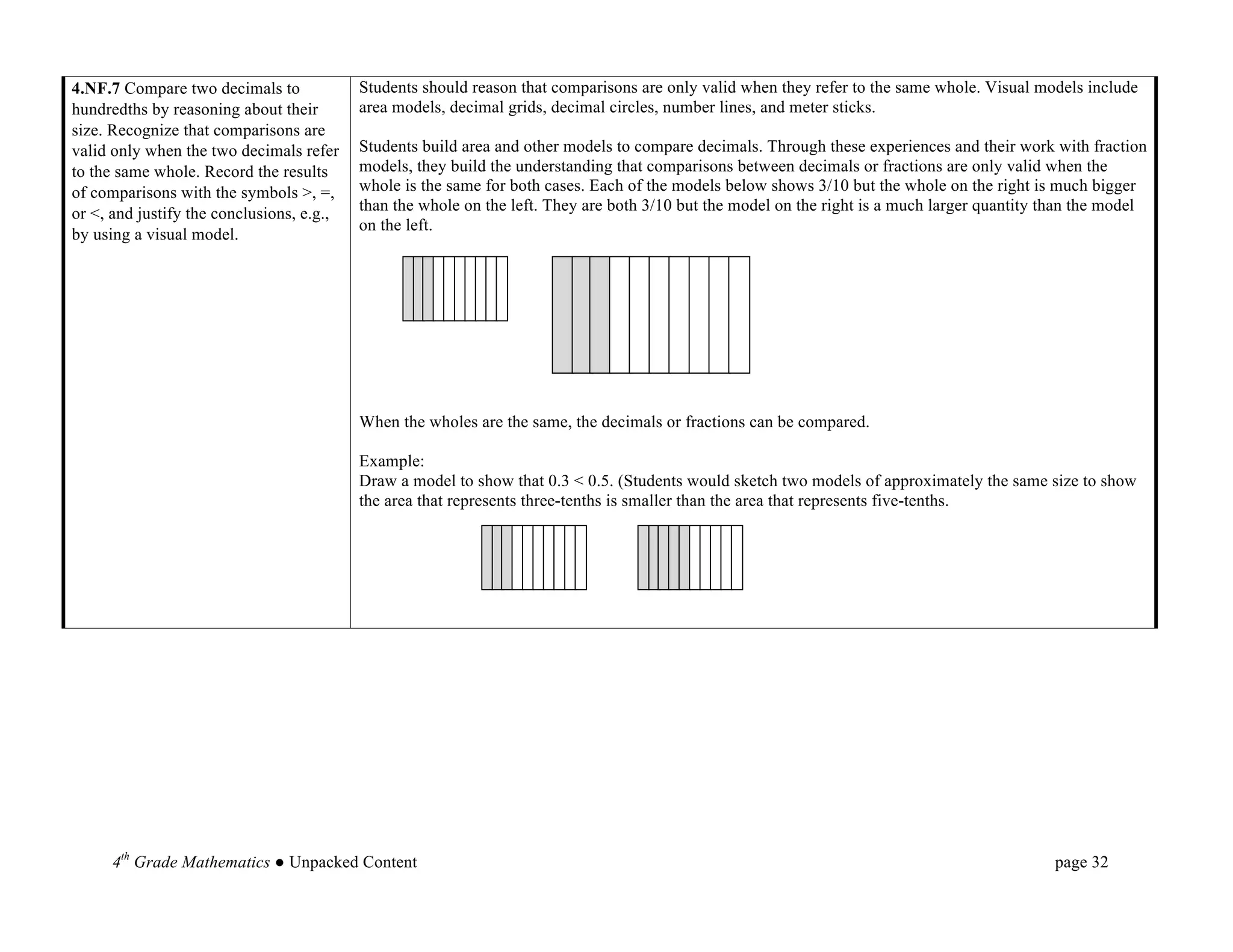
  • 19.
    3. Knowing that6 x 5 is 30. They write 30 in the bottom area of the rectangle and record 5 as a factor. 4. Students express their calculations in various ways: a. 150 150 ÷ 6 = 10 + 10 + 5 = 25 - 60 (6 x 10) 90 - 60 (6 x 10) 30 - 30 (6 x 5) 0 b. 150 ÷ 6 = (60 ÷ 6) + (60 ÷ 6) + (30 ÷ 6) = 10 + 10 + 5 = 25 Example: 1917 ÷ 9 A student’s description of his or her thinking may be: I need to find out how many 9s are in 1917. I know that 200 x 9 is 1800. So if I use 1800 of the 1917, I have 117 left. I know that 9 x 10 is 90. So if I have 10 more 9s, I will have 27 left. I can make 3 more 9s. I have 200 nines, 10 nines and 3 nines. So I made 213 nines. 1917 ÷ 9 = 213.             4th Grade Mathematics ● Unpacked Content page 19  
  • 20.
      Number and Operation– Fractions1 4.NF Common Core Cluster Extend understanding of fraction equivalence and ordering. Students develop understanding of fraction equivalence and operations with fractions. They recognize that two different fractions can be equal (e.g., 15/9 = 5/3), and they develop methods for generating and recognizing equivalent fractions. Mathematically proficient students communicate precisely by engaging in discussion about their reasoning using appropriate mathematical language. The terms students should learn to use with increasing precision with this cluster are: partition(ed), fraction, unit fraction, equivalent, multiple, reason, denominator, numerator, comparison/compare, ‹, ›, =, benchmark fraction Common Core Standard Unpacking What do these standards mean a child will know and be able to do? 4.NF.1 Explain why a fraction a/b is This standard refers to visual fraction models. This includes area models, number lines or it could be a equivalent to a fraction (n × a)/(n × b) collection/set model. This standard extends the work in third grade by using additional denominators (5, 10, 12, by using visual fraction models, with and 100) attention to how the number and size of the parts differ even though the two This standard addresses equivalent fractions by examining the idea that equivalent fractions can be created by fractions themselves are the same size. multiplying both the numerator and denominator by the same number or by dividing a shaded region into various Use this principle to recognize and parts. generate equivalent fractions. Example: 1/2 = 2/4 = 6/12 Technology Connection: http://illuminations.nctm.org/activitydetail.aspx?id=80 4.NF.2 Compare two fractions with This standard calls students to compare fractions by creating visual fraction models or finding common different numerators and different denominators or numerators. Students’ experiences should focus on visual fraction models rather than algorithms. denominators, e.g., by creating common When tested, models may or may not be included. Students should learn to draw fraction models to help them denominators or numerators, or by compare. Students must also recognize that they must consider the size of the whole when comparing fractions comparing to a benchmark fraction such (ie, ½ and 1/8 of two medium pizzas is very different from ½ of one medium and 1/8 of one large). as 1/2. Recognize that comparisons are 4th Grade Mathematics ● Unpacked Content page 20  
  • 21.
    valid only whenthe two fractions refer Example: to the same whole. Record the results of Use patterns blocks. comparisons with symbols >, =, or <, 1. If a red trapezoid is one whole, which block shows 1 ? and justify the conclusions, e.g., by 3 using a visual fraction model. 2. If the blue rhombus is 1 , which block shows one whole? 3 3. If the red trapezoid is one whole, which block shows 2 ? 3 Mary used a 12 x 12 grid to represent 1 and Janet used a 10 x 10 grid to represent 1. Each girl shaded grid squares to show 1 . How many grid squares did Mary shade? How many grid squares did Janet shade? Why did 4 they need to shade different numbers of grid squares? Possible solution: Mary shaded 36 grid squares; Janet shaded 25 grid squares. The total number of little squares is different in the two grids, so 1 of each total number is different. 4 Mary’s grid Janet’s grid 4th Grade Mathematics ● Unpacked Content page 21  
  • 22.
    Examples continued onthe next page. Example: There are two cakes on the counter that are the same size. The first cake has ½ of it left. The second cake has 5/12 left. Which cake has more left? Student 1 Area model: The first cake has more left over. The second cake has 5/12 left which is smaller than ½. Student 2 Number Line model: First Cake 0 1 1 2 Second Cake 0 1 3 6 9 12 12 12 Student 3 verbal explanation: I know that 6/12 equals ½. Therefore, the second cake which has 7/12 left is greater than ½. 4th Grade Mathematics ● Unpacked Content page 22  
  • 23.
    Example: 1 4 5 When using the benchmark of to compare and , you could use diagrams such as these: 2 6 8 4 1 1 5 1 1 1 1 4 is larger than , while is larger than . Since is greater than , is the greater fraction. 6 6 2 8 8 2 6 8 6 Common Core Cluster Build fractions from unit fractions by applying and extending previous understandings of operations on whole numbers. Students extend previous understandings about how fractions are built from unit fractions, composing fractions from unit fractions, decomposing fractions into unit fractions, and using the meaning of fractions and the meaning of multiplication to multiply a fraction by a whole number. Mathematically proficient students communicate precisely by engaging in discussion about their reasoning using appropriate mathematical language. The terms students should learn to use with increasing precision with this cluster are: operations, addition/joining, subtraction/separating, fraction, unit fraction, equivalent, multiple, reason, denominator, numerator, decomposing, mixed number,(properties)-rules about how numbers work, multiply, multiple, Common Core Standard Unpacking What do these standards mean a child will know and be able to do? 4.NF.3 Understand a fraction a/b with A fraction with a numerator of one is called a unit fraction. When students investigate fractions other than unit a > 1 as a sum of fractions 1/b. fractions, such as 2/3, they should be able to join (compose) or separate (decompose) the fractions of the same a. Understand addition and subtraction whole. of fractions as joining and 4th Grade Mathematics ● Unpacked Content page 23  
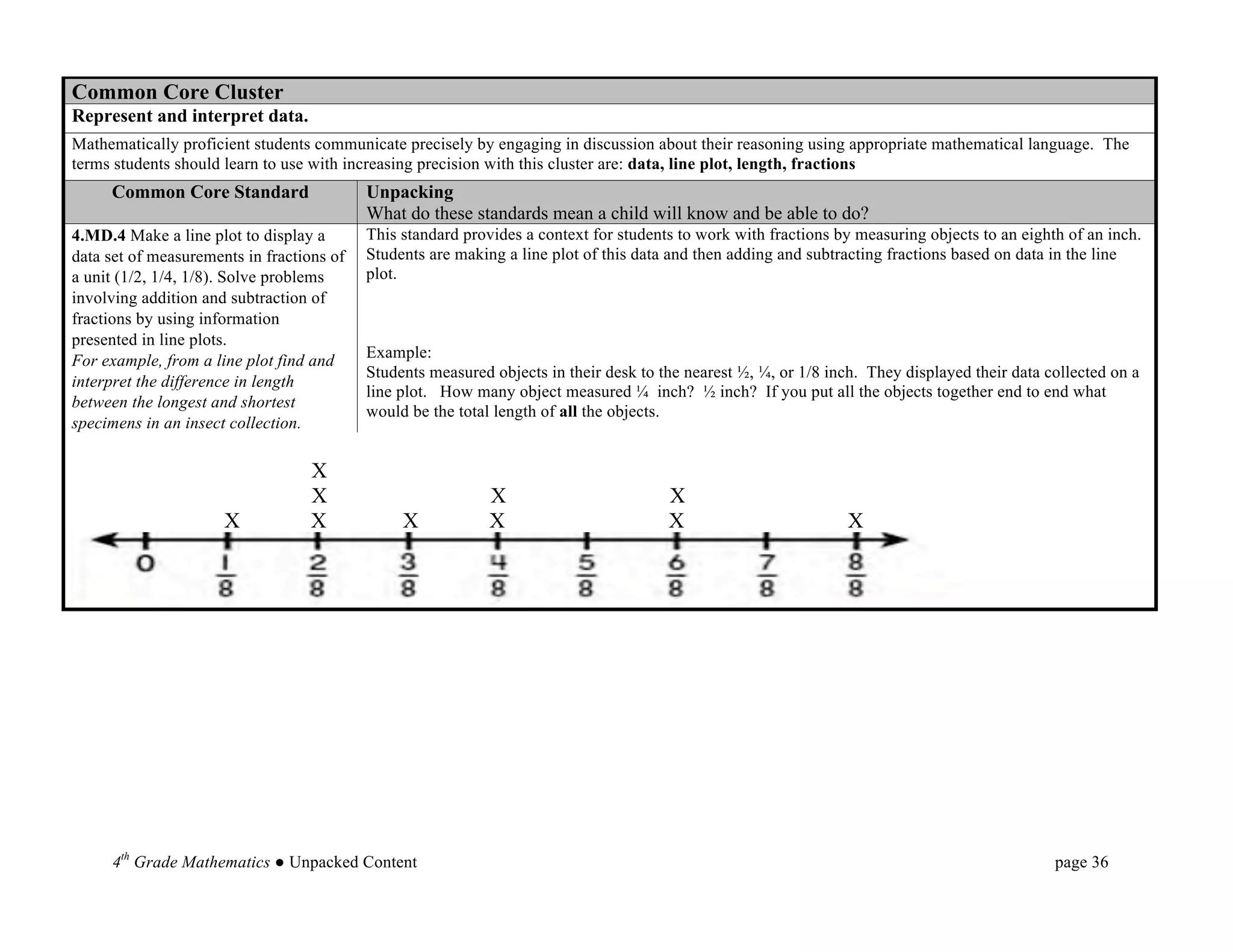
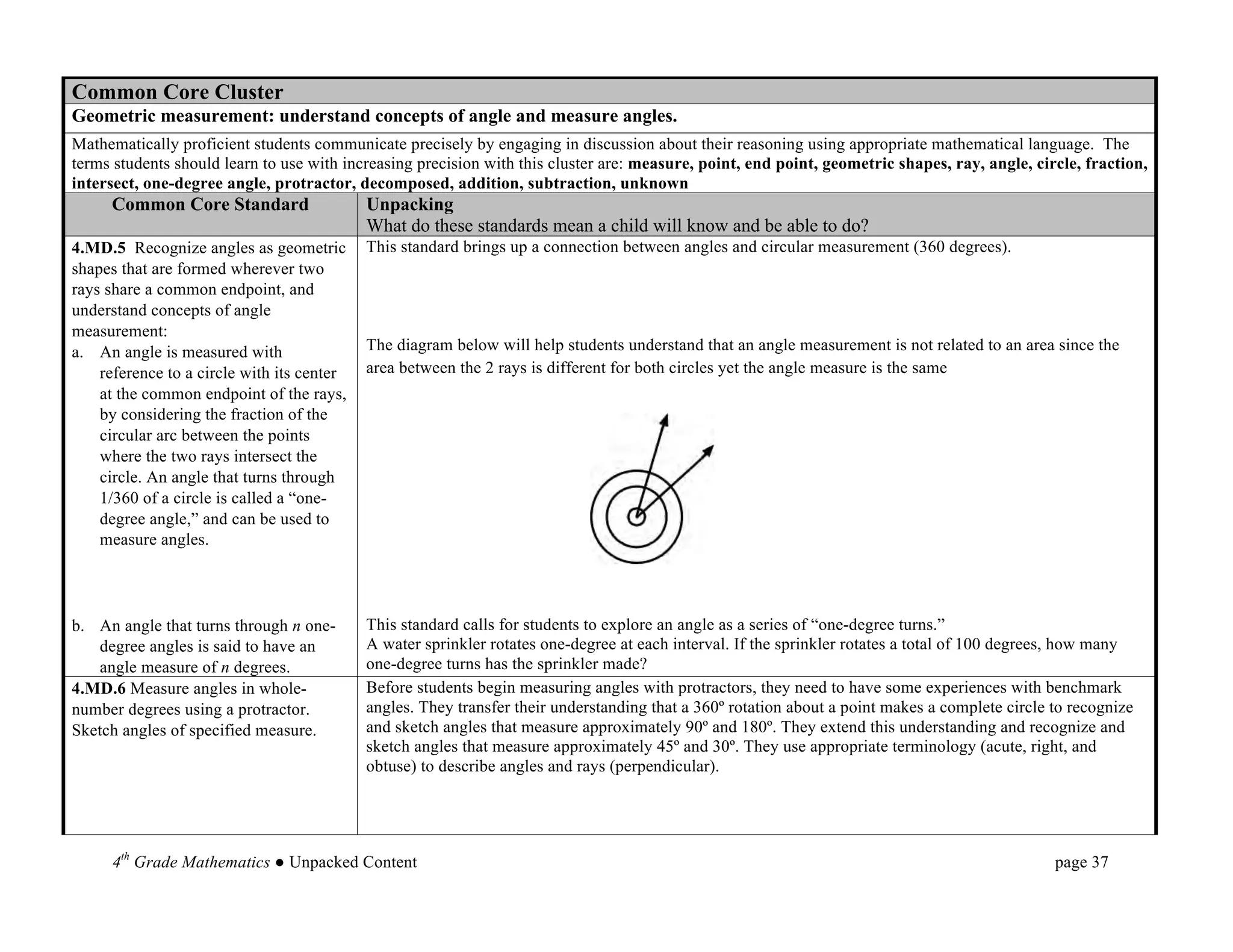
  • 24.
    separating parts referringto the Example: 2/3 = 1/3 + 1/3 same whole. Being able to visualize this decomposition into unit fractions helps students when adding or subtracting fractions. Students need multiple opportunities to work with mixed numbers and be able to decompose them in more than one way. Students may use visual models to help develop this understanding. Example: 1¼-¾= 4/4 + ¼ = 5/4 5/4 – ¾ = 2/4 or ½ Example of word problem: Mary and Lacey decide to share a pizza. Mary ate 3/6 and Lacey ate 2/6 of the pizza. How much of the pizza did the girls eat together? Possible solution: The amount of pizza Mary ate can be thought of a 3/6 or 1/6 and 1/6 and 1/6. The amount of pizza Lacey ate can be thought of a 1/6 and 1/6. The total amount of pizza they ate is 1/6 + 1/6 + 1/6 + 1/6 + 1/6 or 5/6 of the whole pizza. b. Decompose a fraction into a sum of Students should justify their breaking apart (decomposing) of fractions using visual fraction models. The concept fractions with the same of turning mixed numbers into improper fractions needs to be emphasized using visual fraction models. denominator in more than one way, Example: recording each decomposition by an 3/8 = 1/8 + 1/8 + 1/8 equation. Justify decompositions, = e.g., by using a visual fraction model. Examples: 3/8 = 1/8 + 1/8 + 1/8 ; 3/8 = 1/8 + 2/8 ; 2 1/8 = 1 + 1 + 3/8 = 1/8 + 2/8 1/8 = 8/8 + 8/8 + 1/8. = 2 1/8 = 1 + 1 + 1/8 or 2 1/8 = 8/8 + 8/8 + 1/8 4th Grade Mathematics ● Unpacked Content page 24  
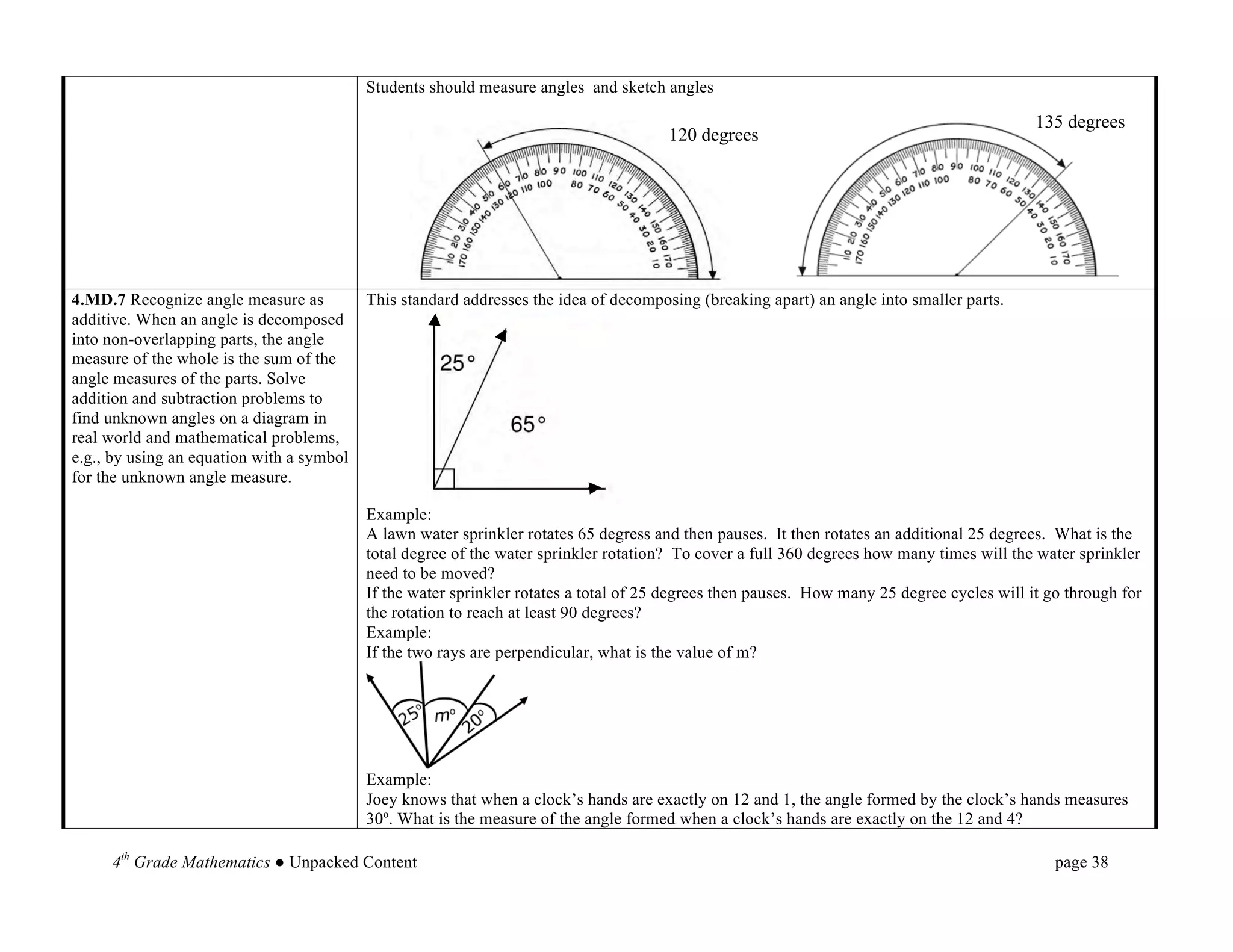
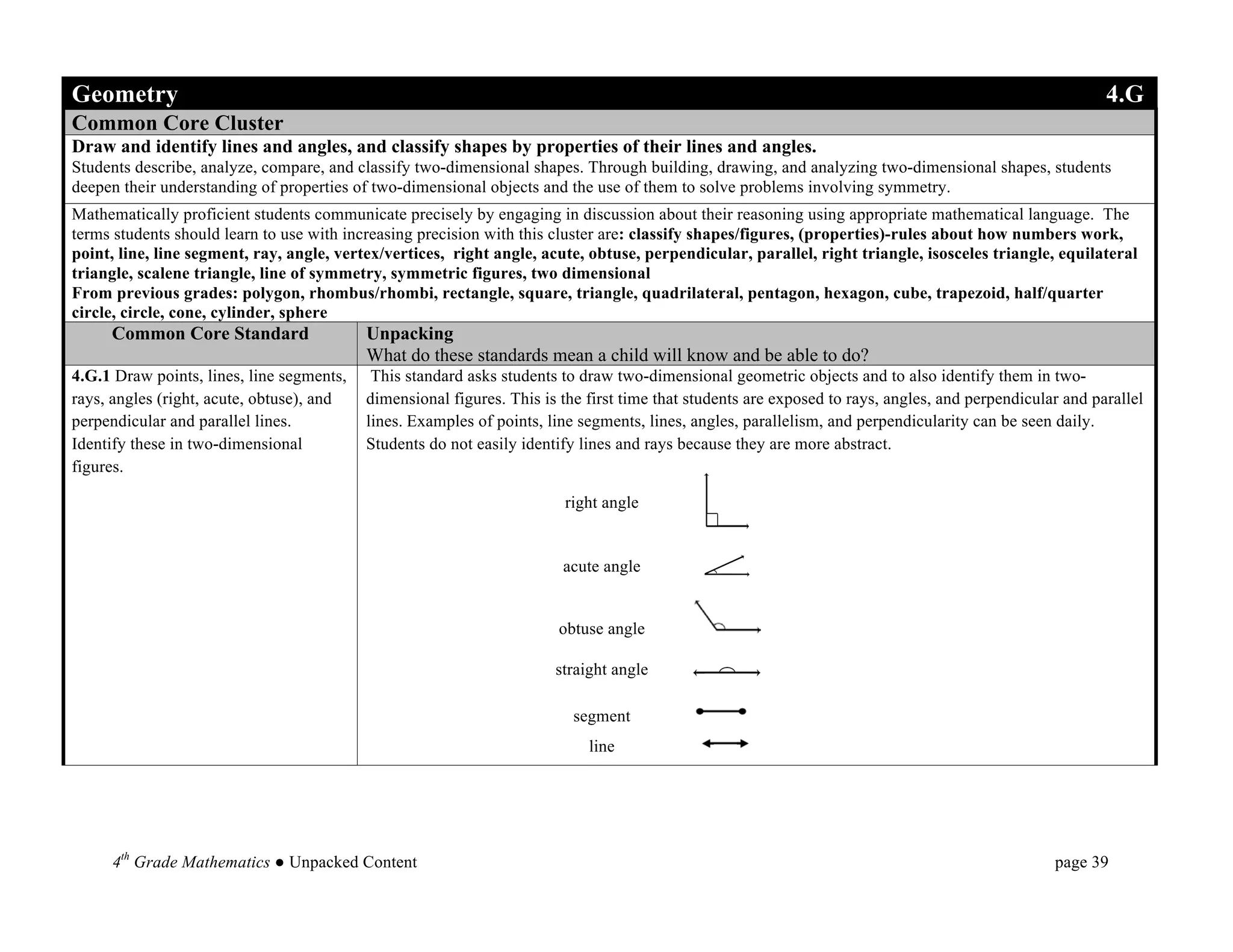
  • 25.
    c. Add andsubtract mixed numbers A separate algorithm for mixed numbers in addition and subtraction is not necessary. Students will tend to add or with like denominators, e.g., by subtract the whole numbers first and then work with the fractions using the same strategies they have applied to replacing each mixed number with problems that contained only fractions. an equivalent fraction, and/or by using properties of operations and Example: the relationship between addition Susan and Maria need 8 3/8 feet of ribbon to package gift baskets. Susan has 3 1/8 feet of ribbon and Maria has 5 and subtraction. 3/8 feet of ribbon. How much ribbon do they have altogether? Will it be enough to complete the project? Explain why or why not. The student thinks: I can add the ribbon Susan has to the ribbon Maria has to find out how much ribbon they have altogether. Susan has 3 1/8 feet of ribbon and Maria has 5 3/8 feet of ribbon. I can write this as 3 1/8 + 5 3/8. I know they have 8 feet of ribbon by adding the 3 and 5. They also have 1/8 and 3/8 which makes a total of 4/8 more. Altogether they have 8 4/8 feet of ribbon. 8 4/8 is larger than 8 3/8 so they will have enough ribbon to complete the project. They will even have a little extra ribbon left, 1/8 foot. Example: Trevor has 4 1/8 pizzas left over from his soccer party. After giving some pizza to his friend, he has 2 4/8 of a pizza left. How much pizza did Trevor give to his friend? Possible solution: Trevor had 4 1/8 pizzas to start. This is 33/8 of a pizza. The x’s show the pizza he has left which is 2 4/8 pizzas or 20/8 pizzas. The shaded rectangles without the x’s are the pizza he gave to his friend which is 13/8 or 1 5/8 pizzas. x   x   x   x   x   x   x   x   x   x   x   x   x   x   x   x   x   x   x   x   Mixed numbers are introduced for the first time in Fourth Grade. Students should have ample experiences of adding and subtracting mixed numbers where they work with mixed numbers or convert mixed numbers into improper fractions. 4th Grade Mathematics ● Unpacked Content page 25  
  • 26.
    Example: While solving the problem, 3 ¾ + 2 ¼ students could do the following:             Student 1 3 + 2 = 5 and ¾ + ¼ = 1 so 5+ 1 = 6 Student 2 3 ¾ + 2 = 5 ¾ so 5 ¾ + ¼ = 6 Student 3 3 ¾ = 15/4 and 2 ¼ = 9/4 so 15/4 + 9/4 = 24/4 = 6 d. Solve word problems involving A cake recipe calls for you to use ¾ cup of milk, ¼ cup of oil, and 2/4 cup of water. How much liquid was addition and subtraction of fractions needed to make the cake? referring to the same whole and having like denominators, e.g., by using visual fraction models and equations to represent the problem. milk oil water 3/4 + 1/4 + 2/4 = 6/4 = 1 2/4 4th Grade Mathematics ● Unpacked Content page 26  
  • 27.
    4.NF.4 Apply andextend previous This standard builds on students’ work of adding fractions and extending that work into multiplication. understandings of multiplication to multiply a fraction by a whole number. Example: a. Understand a fraction a/b as a 3/6 = 1/6 + 1/6 + 1/6 = 3 x (1/6) multiple of 1/b. Number line: For example, use a visual fraction model to represent 5/4 as the                       product 5 × (1/4), recording the 1 2 3 4 5 6 7 8 conclusion by the equation 5/4 = 5 0 6 6 6 6 6 6 6 6 × (1/4). Area model: 1 2 3 4 5 6 6 6 6 6 6 6 b. Understand a multiple of a/b as a This standard extended the idea of multiplication as repeated addition. For example, 3 x (2/5) = 2/5 + 2/5 + 2/5 = multiple of 1/b, and use this 6/5 = 6 x (1/5). Students are expected to use and create visual fraction models to multiply a whole number by a understanding to multiply a fraction fraction. by a whole number. 2 2 2 For example, use a visual fraction 5 5 5 model to express 3 × (2/5) as 6 × (1/5), recognizing this product as 6/5. (In general, n × (a/b) = (n × a)/b.) 1 2 3 4 5 1 2 3 4 5 5 5 5 5 5 5 5 5 5 5 4th Grade Mathematics ● Unpacked Content page 27  
  • 28.
    c. Solve wordproblems involving This standard calls for students to use visual fraction models to solve word problems related to multiplying a multiplication of a fraction by a whole number by a fraction. whole number, e.g., by using visual fraction models and equations to Example: represent the problem. In a relay race, each runner runs ½ of a lap. If there are 4 team members how long is the race? For example, if each person at a party will eat 3/8 of a pound of Student 1 Draws a number line shows 4 jumps of ½ roast beef, and there will be 5 people at the party, how many ½ ½ ½ ½ jump pounds of roast beef will be needed? Between what two whole numbers does your answer lie? 0 ½ 1 1½ 2 2½ 3 Student 2 Draws an area model showing 4 pieces of ½ joined together to equal 2. ½ ½   ½ ½   Student 3 Draws an area model representing 4 x ½ on a grid, dividing one row into ½ to represent the multiplier 4th Grade Mathematics ● Unpacked Content page 28  
  • 29.
    Example: Heather bought 12 plums and ate 1 of them. Paul bought 12 plums and ate 1 of them. Which statement is true? 3 4 Draw a model to explain your reasoning. a. Heather and Paul ate the same number of plums. b. Heather ate 4 plums and Paul ate 3 plums. c. Heather ate 3 plums and Paul ate 4 plums. d. Heather had 9 plums remaining. Example: Students need many opportunities to work with problems in context to understand the connections between models and corresponding equations. Contexts involving a whole number times a fraction lend themselves to modeling and examining patterns. Examples: 3 x (2/5) = 6 x (1/5) = 6/5 2   2   2   5 5 5 1  1   1  1   1  1   5 5 5 5 5 5 If each person at a party eats 3/8 of a pound of roast beef, and there are 5 people at the party, how many pounds of roast beef are needed? Between what two whole numbers does your answer lie? A student may build a fraction model to represent this problem: 3/8 3/8 3/8 3/8 3/8 3/8 + 3/8 + 3/8 + 3/8 + 3/8 = 15/8 = 1 7/8 4th Grade Mathematics ● Unpacked Content page 29  
  • 30.
    Common Core Cluster Understanddecimal notation for fractions, and compare decimal fractions. Mathematically proficient students communicate precisely by engaging in discussion about their reasoning using appropriate mathematical language. The terms students should learn to use with increasing precision with this cluster are: fraction, numerator, denominator, equivalent, reasoning, decimals, tenths, hundreds, multiplication, comparisons/compare, ‹, ›, = Common Core Standard Unpacking What do these standards mean a child will know and be able to do? 4.NF.5 Express a fraction with This standard continues the work of equivalent fractions by having students change fractions with a 10 in the denominator 10 as an equivalent denominator into equivalent fractions that have a 100 in the denominator. In order to prepare for work with fraction with denominator 100, and use decimals (4.NF.6 and 4.NF.7), experiences that allow students to shade decimal grids (10x10 grids) can support this technique to add two fractions this work. Student experiences should focus on working with grids rather than algorithms. with respective denominators 10 and Students can also use base ten blocks and other place value models to explore the relationship between fractions 100.2 with denominators of 10 and denominators of 100. For example, express 3/10 as 30/100, This work in fourth grade lays the foundation for performing operations with decimal numbers in fifth grade. and add 3/10 + 4/100 = 34/100. 2 Example: Students who can generate equivalent Ones . Tenths Hundredths fractions can develop strategies for adding fractions with unlike denominators in general. But addition Tenths Grid Hundredths Grid and subtraction with unlike denominators in general is not a requirement at this grade. .3 = 3 tenths = 3/10 .30 = 30 hundredths = 30/100 4th Grade Mathematics ● Unpacked Content page 30  
  • 31.
    Example: Represent 3 tenths and 30 hundredths on the models below. 10ths circle 100ths circle                                                                               4.NF.6 Use decimal notation for Decimals are introduced for the first time. Students should have ample opportunities to explore and reason about fractions with denominators 10 or 100. the idea that a number can be represented as both a fraction and a decimal. For example, rewrite 0.62 as 62/100; describe a length as 0.62 meters; Students make connections between fractions with denominators of 10 and 100 and the place value chart. By locate 0.62 on a number line diagram. reading fraction names, students say 32/100 as thirty-two hundredths and rewrite this as 0.32 or represent it on a place value model as shown below. Hundreds Tens Ones • Tenths Hundredths • 3 2 Students use the representations explored in 4.NF.5 to understand 32/100 can be expanded to 3/10 and 2/100. Students represent values such as 0.32 or 32/100 on a number line. 32/100 is more than 30/100 (or 3/10) and less than 40/100 (or 4/10). It is closer to 30/100 so it would be placed on the number line near that value. 0.32   0   0.1   0.2   0.3   0.4   0.5   0.6   0.7   0.8   0.9   1.0   4th Grade Mathematics ● Unpacked Content page 31  
  • 32.
    4.NF.7 Compare twodecimals to Students should reason that comparisons are only valid when they refer to the same whole. Visual models include hundredths by reasoning about their area models, decimal grids, decimal circles, number lines, and meter sticks. size. Recognize that comparisons are valid only when the two decimals refer Students build area and other models to compare decimals. Through these experiences and their work with fraction to the same whole. Record the results models, they build the understanding that comparisons between decimals or fractions are only valid when the of comparisons with the symbols >, =, whole is the same for both cases. Each of the models below shows 3/10 but the whole on the right is much bigger or <, and justify the conclusions, e.g., than the whole on the left. They are both 3/10 but the model on the right is a much larger quantity than the model on the left. by using a visual model. When the wholes are the same, the decimals or fractions can be compared. Example: Draw a model to show that 0.3 < 0.5. (Students would sketch two models of approximately the same size to show the area that represents three-tenths is smaller than the area that represents five-tenths.           4th Grade Mathematics ● Unpacked Content page 32  
  • 33.
    Measurement and Data 4.MD Common Core Cluster Solve problems involving measurement and conversion of measurements from a larger unit to a smaller unit. Mathematically proficient students communicate precisely by engaging in discussion about their reasoning using appropriate mathematical language. The terms students should learn to use with increasing precision with this cluster are: measure, metric, customary, convert/conversion, relative size, liquid volume, mass, length, distance, kilometer (km), meter (m), centimeter (cm), kilogram (kg), gram (g), liter (L), milliliter (mL), inch (in), foot (ft), yard (yd), mile (mi), ounce (oz), pound (lb), cup (c), pint (pt), quart (qt), gallon (gal), time, hour, minute, second, equivalent, operations, add, subtract, multiply, divide, fractions, decimals, area, perimeter Common Core Standard Unpacking What do these standards mean a child will know and be able to do? 4.MD.1 Know relative sizes of The units of measure that have not been addressed in prior years are cups, pints, quarts, gallons, pounds, ounces, measurement units within one system of kilometers, milliliters, and seconds. Students’ prior experiences were limited to measuring length, mass (metric units including km, m, cm; kg, g; lb, and customary systems), liquid volume (metric only), and elapsed time. Students did not convert measurements. oz.; l, ml; hr, min, sec. Within a single Students need ample opportunities to become familiar with these new units of measure and explore the patterns system of measurement, express and relationships in the conversion tables that they create. measurements in a larger unit in terms Students may use a two-column chart to convert from larger to smaller units and record equivalent measurements. of a smaller unit. Record measurement They make statements such as, if one foot is 12 inches, then 3 feet has to be 36 inches because there are 3 groups equivalents in a two-column table. of 12. For example, know that 1 ft is 12 times as long as 1 in. Express the length of a Example: 4 ft snake as 48 in. Generate a Customary length conversion table conversion table for feet and inches Yards Feet listing the number pairs (1, 12), (2, 24), (3, 36), ... 1 3 2 6 3 9 n nx3 Foundational understandings to help with measure concepts: Understand that larger units can be subdivided into equivalent units (partition). Understand that the same unit can be repeated to determine the measure (iteration). Understand the relationship between the size of a unit and the number of units needed (compensatory principal). 4th Grade Mathematics ● Unpacked Content page 33  
  • 34.
    4.MD.2 Use thefour operations to solve This standard includes multi-step word problems related to expressing measurements from a larger unit in terms word problems involving distances, of a smaller unit (e.g., feet to inches, meters to centimeter, dollars to cents). Students should have ample intervals of time, liquid volumes, opportunities to use number line diagrams to solve word problems. masses of objects, and money, including Example: problems involving simple fractions or Charlie and 10 friends are planning for a pizza party. They purchased 3 quarts of milk. If each glass holds 8oz decimals, and problems that require will everyone get at least one glass of milk? expressing measurements given in a possible solution: Charlie plus 10 friends = 11 total people larger unit in terms of a smaller unit. 11 people x 8 ounces (glass of milk) = 88 total ounces Represent measurement quantities using diagrams such as number line diagrams 1 quart = 2 pints = 4 cups = 32 ounces that feature a measurement scale. Therefore 1 quart = 2 pints = 4 cups = 32 ounces 2 quarts = 4 pints = 8 cups = 64 ounces 3 quarts = 6 pints = 12 cups = 96 ounces If Charlie purchased 3 quarts (6 pints) of milk there would be enough for everyone at his party to have at least one glass of milk. If each person drank 1 glass then he would have 1- 8 oz glass or 1 cup of milk left over. Additional Examples with various operations: Division/fractions: Susan has 2 feet of ribbon. She wants to give her ribbon to her 3 best friends so each friend gets the same amount. How much ribbon will each friend get? Students may record their solutions using fractions or inches. (The answer would be 2/3 of a foot or 8 inches. Students are able to express the answer in inches because they understand that 1/3 of a foot is 4 inches and 2/3 of a foot is 2 groups of 1/3.) Addition: Mason ran for an hour and 15 minutes on Monday, 25 minutes on Tuesday, and 40 minutes on Wednesday. What was the total number of minutes Mason ran? Subtraction: A pound of apples costs $1.20. Rachel bought a pound and a half of apples. If she gave the clerk a $5.00 bill, how much change will she get back? Multiplication: Mario and his 2 brothers are selling lemonade. Mario brought one and a half liters, Javier brought 2 liters, and Ernesto brought 450 milliliters. How many total milliliters of lemonade did the boys have? Number line diagrams that feature a measurement scale can represent measurement quantities. Examples include: ruler, diagram marking off distance along a road with cities at various points, a timetable showing hours throughout the day, or a volume measure on the side of a container. 4th Grade Mathematics ● Unpacked Content page 34  
  • 35.
    Example: At 7:00 a.m.Candace wakes up to go to school. It takes her 8 minutes to shower, 9 minutes to get dressed and 17 minutes to eat breakfast. How many minutes does she have until the bus comes at 8:00 a.m.? Use the number line to help solve the problem. 6:30 6:45 7:00 7:15 7:30 7:45 8:00 4.MD.3 Apply the area and perimeter Students developed understanding of area and perimeter in 3rd grade by using visual models. formulas for rectangles in real world While students are expected to use formulas to calculate area and perimeter of rectangles, they need to understand and mathematical problems. and be able to communicate their understanding of why the formulas work. For example, find the width of a The formula for area is I x w and the answer will always be in square units. rectangular room given the area of the The formula for perimeter can be 2 l + 2 w or 2 (l + w) and the answer will be in linear units. flooring and the length, by viewing the area formula as a multiplication This standard calls for students to generalize their understanding of area and perimeter by connecting the concepts equation with an unknown factor. to mathematical formulas. These formulas should be developed through experience not just memorization. Example: Mr. Rutherford is covering the miniature golf course with an artificial grass. How many 1-foot squares of carpet will he need to cover the entire course? 1-foot square of carpet     4th Grade Mathematics ● Unpacked Content page 35  
  • 36.
    Common Core Cluster Representand interpret data. Mathematically proficient students communicate precisely by engaging in discussion about their reasoning using appropriate mathematical language. The terms students should learn to use with increasing precision with this cluster are: data, line plot, length, fractions Common Core Standard Unpacking What do these standards mean a child will know and be able to do? 4.MD.4 Make a line plot to display a This standard provides a context for students to work with fractions by measuring objects to an eighth of an inch. data set of measurements in fractions of Students are making a line plot of this data and then adding and subtracting fractions based on data in the line a unit (1/2, 1/4, 1/8). Solve problems plot. involving addition and subtraction of fractions by using information presented in line plots. For example, from a line plot find and Example: Students measured objects in their desk to the nearest ½, ¼, or 1/8 inch. They displayed their data collected on a interpret the difference in length line plot. How many object measured ¼ inch? ½ inch? If you put all the objects together end to end what between the longest and shortest would be the total length of all the objects. specimens in an insect collection. X X X X X X X X X X             4th Grade Mathematics ● Unpacked Content page 36  
  • 37.
    Common Core Cluster Geometricmeasurement: understand concepts of angle and measure angles. Mathematically proficient students communicate precisely by engaging in discussion about their reasoning using appropriate mathematical language. The terms students should learn to use with increasing precision with this cluster are: measure, point, end point, geometric shapes, ray, angle, circle, fraction, intersect, one-degree angle, protractor, decomposed, addition, subtraction, unknown Common Core Standard Unpacking What do these standards mean a child will know and be able to do? 4.MD.5 Recognize angles as geometric This standard brings up a connection between angles and circular measurement (360 degrees). shapes that are formed wherever two rays share a common endpoint, and understand concepts of angle measurement: a. An angle is measured with The diagram below will help students understand that an angle measurement is not related to an area since the reference to a circle with its center area between the 2 rays is different for both circles yet the angle measure is the same at the common endpoint of the rays, by considering the fraction of the circular arc between the points where the two rays intersect the circle. An angle that turns through 1/360 of a circle is called a “one- degree angle,” and can be used to measure angles. b. An angle that turns through n one- This standard calls for students to explore an angle as a series of “one-degree turns.” degree angles is said to have an A water sprinkler rotates one-degree at each interval. If the sprinkler rotates a total of 100 degrees, how many angle measure of n degrees. one-degree turns has the sprinkler made? 4.MD.6 Measure angles in whole- Before students begin measuring angles with protractors, they need to have some experiences with benchmark number degrees using a protractor. angles. They transfer their understanding that a 360º rotation about a point makes a complete circle to recognize Sketch angles of specified measure. and sketch angles that measure approximately 90º and 180º. They extend this understanding and recognize and sketch angles that measure approximately 45º and 30º. They use appropriate terminology (acute, right, and obtuse) to describe angles and rays (perpendicular). 4th Grade Mathematics ● Unpacked Content page 37  
  • 38.
    Students should measureangles and sketch angles 135 degrees 120 degrees                         4.MD.7 Recognize angle measure as This standard addresses the idea of decomposing (breaking apart) an angle into smaller parts. additive. When an angle is decomposed into non-overlapping parts, the angle measure of the whole is the sum of the angle measures of the parts. Solve addition and subtraction problems to find unknown angles on a diagram in real world and mathematical problems, e.g., by using an equation with a symbol for the unknown angle measure. Example: A lawn water sprinkler rotates 65 degress and then pauses. It then rotates an additional 25 degrees. What is the total degree of the water sprinkler rotation? To cover a full 360 degrees how many times will the water sprinkler need to be moved? If the water sprinkler rotates a total of 25 degrees then pauses. How many 25 degree cycles will it go through for the rotation to reach at least 90 degrees? Example: If the two rays are perpendicular, what is the value of m? Example: Joey knows that when a clock’s hands are exactly on 12 and 1, the angle formed by the clock’s hands measures 30º. What is the measure of the angle formed when a clock’s hands are exactly on the 12 and 4? 4th Grade Mathematics ● Unpacked Content page 38  
  • 39.
    Geometry 4.G Common Core Cluster Draw and identify lines and angles, and classify shapes by properties of their lines and angles. Students describe, analyze, compare, and classify two-dimensional shapes. Through building, drawing, and analyzing two-dimensional shapes, students deepen their understanding of properties of two-dimensional objects and the use of them to solve problems involving symmetry. Mathematically proficient students communicate precisely by engaging in discussion about their reasoning using appropriate mathematical language. The terms students should learn to use with increasing precision with this cluster are: classify shapes/figures, (properties)-rules about how numbers work, point, line, line segment, ray, angle, vertex/vertices, right angle, acute, obtuse, perpendicular, parallel, right triangle, isosceles triangle, equilateral triangle, scalene triangle, line of symmetry, symmetric figures, two dimensional From previous grades: polygon, rhombus/rhombi, rectangle, square, triangle, quadrilateral, pentagon, hexagon, cube, trapezoid, half/quarter circle, circle, cone, cylinder, sphere Common Core Standard Unpacking What do these standards mean a child will know and be able to do? 4.G.1 Draw points, lines, line segments, This standard asks students to draw two-dimensional geometric objects and to also identify them in two- rays, angles (right, acute, obtuse), and dimensional figures. This is the first time that students are exposed to rays, angles, and perpendicular and parallel perpendicular and parallel lines. lines.  Examples of points, line segments, lines, angles, parallelism, and perpendicularity can be seen daily. Identify these in two-dimensional Students do not easily identify lines and rays because they are more abstract. figures. right angle acute angle obtuse angle straight angle segment line 4th Grade Mathematics ● Unpacked Content page 39  
  • 40.
    ray parallel lines perpendicular lines Example: Draw two different types of quadrilaterals that have two pairs of parallel sides? Is it possible to have an acute right triangle? Justify your reasoning using pictures and words.   Example: How many acute, obtuse and right angles are in this shape? Draw and list the properties of a parallelogram. Draw and list the properties of a rectangle. How are your drawings and lists alike? How are they different? Be ready to share your thinking with the class. 4.G.2 Classify two-dimensional figures Two-dimensional figures may be classified using different characteristics such as, parallel or perpendicular lines based on the presence or absence of or by angle measurement. parallel or perpendicular lines, or the presence or absence of angles of a Parallel or Perpendicular Lines: specified size. Recognize right triangles Students should become familiar with the concept of parallel and perpendicular lines. Two lines are parallel if as a category, and identify right they never intersect and are always equidistant. Two lines are perpendicular if they intersect in right angles (90º). triangles. Students may use transparencies with lines to arrange two lines in different ways to determine that the 2 lines might intersect in one point or may never intersect. Further investigations may be initiated using geometry software. These types of explorations may lead to a discussion on angles. 4th Grade Mathematics ● Unpacked Content page 40  
  • 41.
    Parallel and perpendicularlines are shown below: This standard calls for students to sort objects based on parallelism, perpendicularity and angle types. Example: Do you agree with the label on each of the circles in the Venn diagram above? Describe why some shapes fall in the overlapping sections of the circles. Example: Draw and name a figure that has two parallel sides and exactly 2 right angles. Example: For each of the following, sketch an example if it is possible. If it is impossible, say so, and explain why or show a counter example. • A parallelogram with exactly one right angle. • An isosceles right triangle. • A rectangle that is not a parallelogram. (impossible) • Every square is a quadrilateral. • Every trapezoid is a parallelogram. 4th Grade Mathematics ● Unpacked Content page 41  
  • 42.
    Example: Identify which of these shapes have perpendicular or parallel sides and justify your selection. A possible justification that students might give is: The square has perpendicular lines because the sides meet at a corner, forming right angles. Angle Measurement: This expectation is closely connected to 4.MD.5, 4.MD.6, and 4.G.1. Students’ experiences with drawing and identifying right, acute, and obtuse angles support them in classifying two-dimensional figures based on specified angle measurements. They use the benchmark angles of 90°, 180°, and 360° to approximate the measurement of angles. Right triangles can be a category for classification. A right triangle has one right angle. There are different types of right triangles. An isosceles right triangle has two or more congruent sides and a scalene right triangle has no congruent sides.   4.G.3 Recognize a line of symmetry for Students need experiences with figures which are symmetrical and non-symmetrical. Figures include both regular a two-dimensional figure as a line and non-regular polygons. Folding cut-out figures will help students determine whether a figure has one or more across the figure such that the figure can lines of symmetry. be folded along the line into matching parts. Identify line-symmetric figures This standard only includes line symmetry not rotational symmetry.   and draw lines of symmetry. Example: For each figure, draw all of the lines of symmetry. What pattern do you notice? How many lines of symmetry do you think there would be for regular polygons with 9 and 11 sides. Sketch each figure and check your predictions. Polygons with an odd number of sides have lines of symmetry that go from a midpoint of a side through a vertex. Some examples used in this document are from the Arizona Mathematics Education Department 4th Grade Mathematics ● Unpacked Content page 42  
  • 43.
    Glossary Table 1 Commonaddition and subtraction situations1 Result Unknown Change Unknown Start Unknown Two bunnies sat on the grass. Three Two bunnies were sitting on the grass. Some bunnies were sitting on the grass. more bunnies hopped there. How many Some more bunnies hopped there. Then Three more bunnies hopped there. Then Add to bunnies are on the grass now? there were five bunnies. How many there were five bunnies. How many 2+3=? bunnies hopped over to the first two? bunnies were on the grass before? 2+?=5 ?+3=5 Five apples were on the table. I ate two Five apples were on the table. I ate Some apples were on the table. I ate two apples. How many apples are on the some apples. Then there were three apples. Then there were three apples. Take from table now? apples. How many apples did I eat? How many apples were on the table 5–2=? 5–?=3 before? ? – 2 = 3 Total Unknown Addend Unknown Both Addends Unknown2 Three red apples and two green apples Five apples are on the table. Three are Grandma has five flowers. How many are on the table. How many apples are red and the rest are green. How many can she put in her red vase and how Put Together/ on the table? apples are green? many in her blue vase? Take Apart3 3+2=? 3 + ? = 5, 5 – 3 = ? 5 = 0 + 5, 5 = 5 + 0 5 = 1 + 4, 5 = 4 + 1 5 = 2 + 3, 5 = 3 + 2 Difference Unknown Bigger Unknown Smaller Unknown (“How many more?” version): (Version with “more”): (Version with “more”): Lucy has two apples. Julie has five Julie has three more apples than Lucy. Julie has three more apples than Lucy. apples. How many more apples does Lucy has two apples. How many apples Julie has five apples. How many apples Julie have than Lucy? does Julie have? does Lucy have? Compare4 (“How many fewer?” version): (Version with “fewer”): (Version with “fewer”): Lucy has two apples. Julie has five Lucy has 3 fewer apples than Julie. Lucy has 3 fewer apples than Julie. apples. How many fewer apples does Lucy has two apples. How many apples Julie has five apples. How many apples Lucy have than Julie? does Julie have? does Lucy have? 2 + ? = 5, 5 – 2 = ? 2 + 3 = ?, 3 + 2 = ? 5 – 3 = ?, ? + 3 = 5 2 These take apart situations can be used to show all the decompositions of a given number. The associated equations, which have the total on the left of the equal sign, help children understand that the = sign does not always mean makes or results in but always does mean is the same number as. 3 Either addend can be unknown, so there are three variations of these problem situations. Both Addends Unknown is a productive extension of this basic situation, especially for small numbers less than or equal to 10. 4 For the Bigger Unknown or Smaller Unknown situations, one version directs the correct operation (the version using more for the bigger unknown and using less for the smaller unknown). The other versions are more difficult. 1 Adapted from Box 2-4 of Mathematics Learning in Early Childhood, National Research Council (2009, pp. 32, 33). 4th Grade Mathematics ● Unpacked Content page 43  
  • 44.
    Table 2 Commonmultiplication and division situations1 Unknown Product Group Size Unknown Number of Groups Unknown (“How many in each group?” (“How many groups?” Division) Division) 3×6=? 3 × ? = 18, and 18 ÷ 3 = ? ? × 6 = 18, and 18 ÷ 6 = ? There are 3 bags with 6 plums in If 18 plums are shared equally into 3 bags, If 18 plums are to be packed 6 to a each bag. How many plums are then how many plums will be in each bag? bag, then how many bags are needed? there in all? Equal Measurement example. You have 18 inches Measurement example. You have 18 Groups Measurement example. You need 3 of string, which you will cut into 3 equal inches of string, which you will cut lengths of string, each 6 inches pieces. How long will each piece of string into pieces that are 6 inches long. How long. How much string will you be? many pieces of string will you have? need altogether? There are 3 rows of apples with 6 If 18 apples are arranged into 3 equal rows, If 18 apples are arranged into equal apples in each row. How many how many apples will be in each row? rows of 6 apples, how many rows will apples are there? there be? Arrays,2 Area example. A rectangle has area 18 Area3 Area example. What is the area of a square centimeters. If one side is 3 cm long, Area example. A rectangle has area 18 3 cm by 6 cm rectangle? how long is a side next to it? square centimeters. If one side is 6 cm long, how long is a side next to it? A blue hat costs $6. A red hat costs A red hat costs $18 and that is 3 times as A red hat costs $18 and a blue hat 3 times as much as the blue hat. much as a blue hat costs. How much does a costs $6. How many times as much How much does the red hat cost? blue hat cost? does the red hat cost as the blue hat? Compare Measurement example. A rubber Measurement example. A rubber band is Measurement example. A rubber band band is 6 cm long. How long will stretched to be 18 cm long and that is 3 was 6 cm long at first. Now it is the rubber band be when it is times as long as it was at first. How long stretched to be 18 cm long. How many stretched to be 3 times as long? was the rubber band at first? times as long is the rubber band now as it was at first? General a×b=? a × ? = p, and p ÷ a = ? ? × b = p, and p ÷ b = ? 2 The language in the array examples shows the easiest form of array problems. A harder form is to use the terms rows and columns: The apples in the grocery window are in 3 rows and 6 columns. How many apples are in there? Both forms are valuable. 3 Area involves arrays of squares that have been pushed together so that there are no gaps or overlaps, so array problems include these especially important measurement situations. 1 The first examples in each cell are examples of discrete things. These are easier for students and should be given before the measurement examples. 4th Grade Mathematics ● Unpacked Content page 44  
  • 45.
    Table 3 Theproperties of operations Here a, b and c stand for arbitrary numbers in a given number system. The properties of operations apply to the rational number system, the real number system, and the complex number system. Associative property of addition (a + b) + c = a + (b + c) Commutative property of addition a+b=b+a Additive identity property of 0 a+0=0+a=a Associative property of multiplication (a × b) × c = a × (b × c) Commutative property of multiplication a×b=b×a Multiplicative identity property of 1 a×1=1×a=a Distributive property of multiplication over addition a × (b + c) = a × b + a × c 4th Grade Mathematics ● Unpacked Content page 45