Internship Report on NBP, Gulberg branch
i
ACKNOWLEDGEMENT
For the completion of my report I am indebted to plenty of people for their very sincere
cooperation that they extended to me at various stages. First and foremost problem that
every student faces is the completion of a report is gathering of data while it is very
difficult to learn & rotate in different department of the bank especially in National Bank
of Pakistan where work burden is quite higher compare with other banks. On the other
hand there is too much short time of our internship (eight weeks), furthermore staffs of
the bank are too busy in their work so that we cannot be able to learn and do according to
our report requirement. I am very thankful to staff members of National Bank of Pakistan,
Main Branch Islamabad, for guidance and providing me valuable information regarding
my report completion. Finally I am thankful to the most merciful and Almighty Allah
who gives me the strength that I fulfill my task efficiently.
NIDA MAJEED
Internship Report on NBP, Gulberg branch
ii
EXECUTIVE SUMMARY
This report highlights the operations and functions of National Bank of Pakistan. NBP act
as financial agent to its customers in return it gets reward for its services in the shape of
profit. Being a Government owned institution it plays an important role in development of
society as well as in development and growth of the economy.
National Bank of Pakistan is one of the leading banks in Pakistan. According to
international standards of banking system it is one of the best bank in South Asian region.
This report explains how different functions of NBP work and what are their services.
The main purpose of the internship is to gather relevant information to compile internship
report on National Bank of Pakistan Gulberg branch.
Another purpose of this Internship program is to enable teachers to get to know what I
learn from baking system of NBP during my internship period and the students to use the
management techniques acquired during their courses, and find out the possible solution
of management problems faced by the organization
The report is based on my eight week internship program in National Bank of Pakistan.
The methodology reported for collection of data is primary as well as secondary data. The
biggest source of information is my personal experience, observation while working with
staff and having discussion with them. The annual reports of many years also helped me
in this regard.
Internship Report on NBP, Gulberg branch
iii
Table of Contents
CORPORATE CULTURE.................................................................... 8
SYSTEM AND PROCEDURES............................................................... 8
NBP FOUNDATION ........................................................................ 9
WORK ENVIRONMENT..................................................................... 9
PROVISION OF CURRENT INFORMATION ................................................ 9
SECURITY SYSTEM ........................................................................ 9
SENIOR MANAGEMENT................................................................... 11
OVERSEAS OPERATIONS MANAGEMENT.......................................... 13
BRANCH MANAGER:...................................................................... 15
OPERATION MANAGER:.................................................................. 15
HALL AND DEPOSIT INCHARGE: ........................................................ 16
CREDIT INCHARGE: ...................................................................... 16
DEPOSIT OFFICER:....................................................................... 16
PENSION PAYMENT INCHARGE:......................................................... 17
REMITTANCES AND DISPATCH INCHARGE: ............................................ 17
CASHIER................................................................................... 17
ASSISTANT (scrolling of passport fee):................................................ 18
ACCOUNT OPENING INCHARGE:........................................................ 18
ORGANIZATIONAL STRUCTURE ......................................................... 19
REGIONAL STRUCTURE .................................................................. 20
BRANCH STRUCTURE .................................................................... 21
DEMOCRATIC MANAGEMENT STYLE .................................................... 22
AUTOCRATIC MANAGEMENT STYLE .................................................... 22
CONSULTATIVE MANAGEMENT STYLE ................................................. 23
LAISSEZ FAIRE MANAGEMENT STYLE................................................... 23
NATIONAL BANK OF PAKISTAN STYLE ................................................. 23
Internship Report on NBP, Gulberg branch
iv
EMPLOYEE MORALE & EFFICIENCY OF WORK......................................... 24
FACILITIES TO STAFF .................................................................... 25
PRODUCT ................................................................................. 26
PRODUCT LINE ........................................................................... 26
1- Deposits......................................................................... 27
a) Current Deposits............................................................. 27
a) PLS Saving Deposits ......................................................... 28
C) Fixed Deposit Account ......................................................... 29
D) Foreign Currency Account ..................................................... 29
E) NBP Premium Aamdani ......................................................... 30
F) NBP Premium Saver............................................................. 30
G)National Income Daily Account ................................................ 31
2 - Advances........................................................................... 31
a) NBP Saibaan.................................................................. 31
C) NBP Advance Salary ............................................................ 32
PROCESS ............................................................................... 33
Personal Accident Insurance ........................................................ 33
Financing Facility for Stock Investors .............................................. 33
PRICE...................................................................................... 34
LETTER OF CREDIT.................................................................... 34
EXPORTS ............................................................................... 38
REMITTANCES.......................................................................... 39
BILLS.................................................................................... 40
Project Finances/Advances.......................................................... 42
ATM FACILITY CHARGES .............................................................. 44
PLACE .................................................................................. 45
DISTRIBUTION NETWORK ........................................................... 45
Internship Report on NBP, Gulberg branch
v
NBP BRANCH NETWORK ........................................................... 45
BRANCHES in PAKISTAN .............................................................. 46
BRANCHES IN LAHORE ................................................................ 47
PROMOTION .............................................................................. 52
PROMOTION TOOLS .................................................................... 52
PEOPLE.................................................................................... 54
Number of Employees of National Bank of Pakistan........................... 54
PROCESS .................................................................................. 56
Provincial & Regional processes.................................................. 56
Branch processes ................................................................... 57
FINANCIAL HIGHLIGHTS - 2016......................................................... 58
INCOME STATEMENT.................................................................. 60
HORIZONTAL ANALYSIS.............................................................. 61
RATIO ANALYSIS.......................................................................... 66
LIQUIDITY RATIOS ..................................................................... 68
Interpretation: ........................................................................ 68
ADVANCES TO TOTAL DEPOSIT RATIO ......................................... 69
INTEREST COVERAGE RATIO ......................................................... 70
PORTFOLIO MANAGEMENT RATIO ................................................... 71
Interpretation: ........................................................................ 71
FINANCIAL LEVERAGE RATIO......................................................... 72
DEBT EQUITY RATIO................................................................ 72
Interpretation: ........................................................................ 72
DEBT TO TOTAL ASSETS RATIO ................................................... 73
Interpretation: ........................................................................ 73
PROFITABILITY RATIO ................................................................ 74
NET PROFIT MARGIN ............................................................... 74
Internship Report on NBP, Gulberg branch
vi
Interpretation: ........................................................................ 74
RETURN ON ASSETS .............................................................. 75
Interpretation: ........................................................................ 75
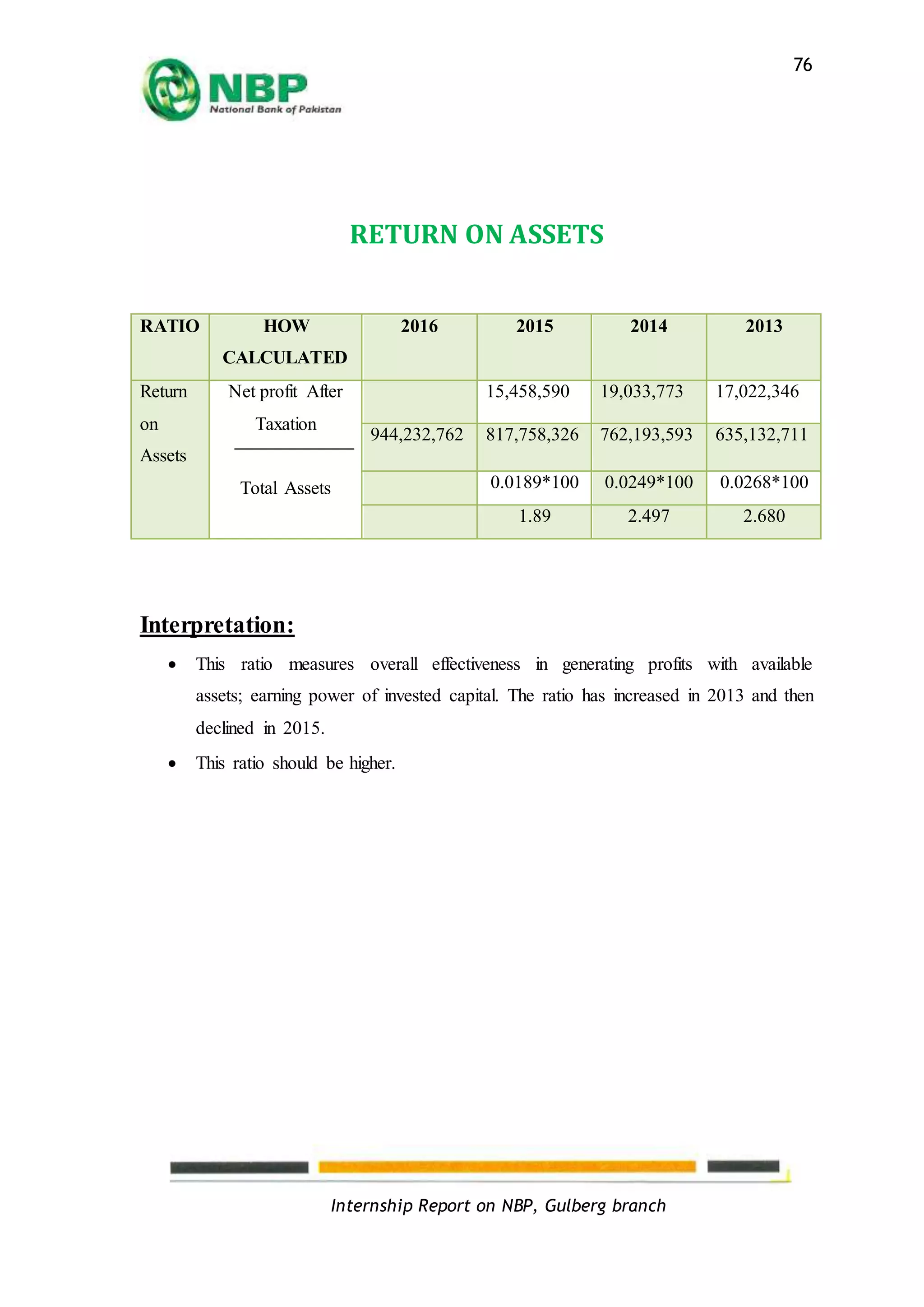
RETURN ON ASSETS ................................................................... 76
Interpretation: ........................................................................ 76
RETURN ON EQUITY................................................................... 77
Interpretation: ........................................................................ 77
ACCOUNTS DEPARTMENT ............................................................... 78
1.1 Current/Demand Account .................................................... 78
1.2 Profit & Loss scheme Accounts............................................... 79
1.3 PLS Term Deposits ............................................................ 79
1.4 MIS (Monthly Income Scheme).............................................. 80
1.5 Call Deposit (CD) .............................................................. 80
Procedure ............................................................................... 80
Encashment of Call Deposits ........................................................... 81
PROCEDURE FROM OPENING OF ACCOUNT TO CLOSING OF ACCOUNT............ 81
a) Individual Account ................................................................ 81
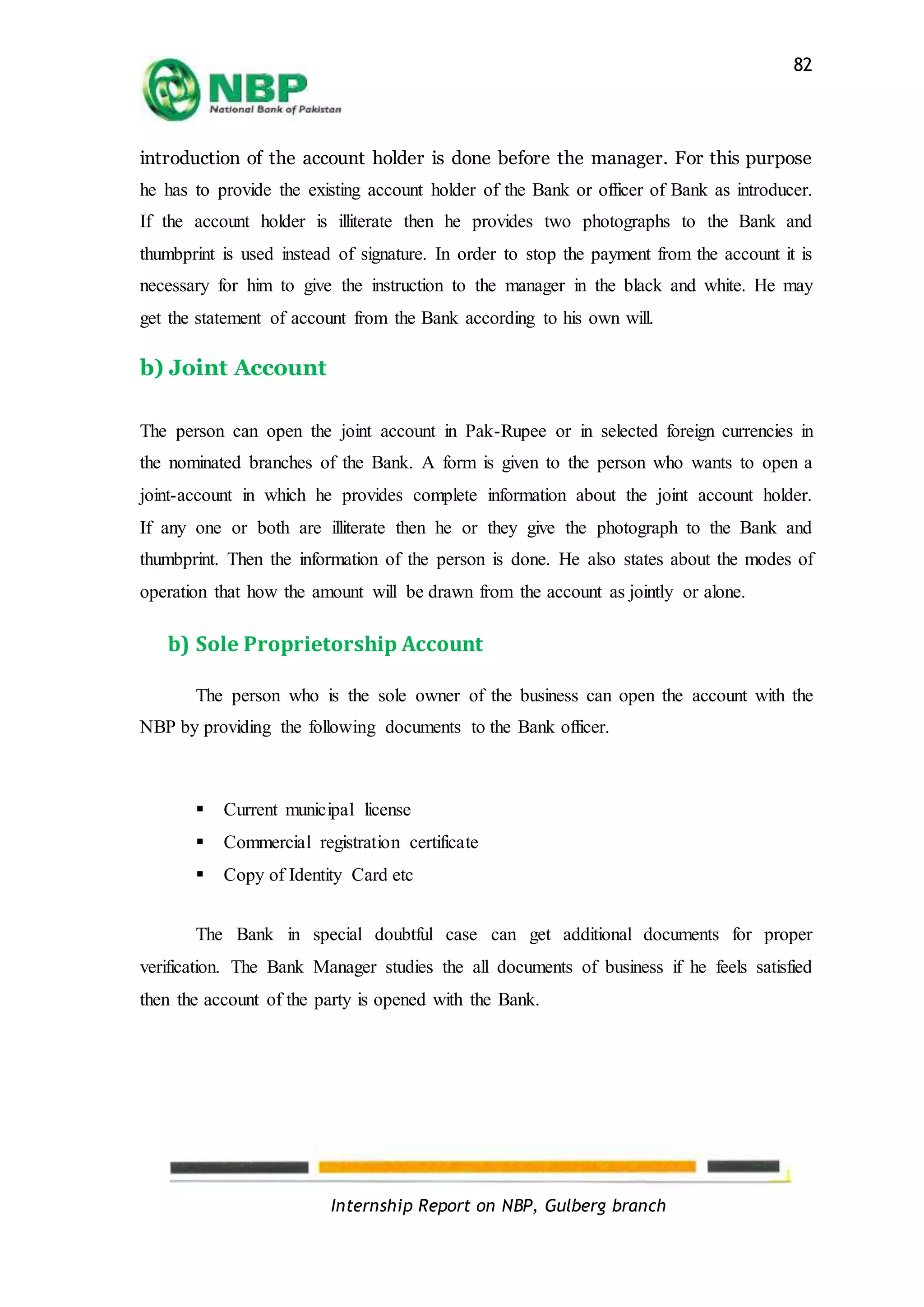
b) Joint Account ...................................................................... 82
b) Sole Proprietorship Account.................................................. 82
d) Partnership Firm Account ........................................................ 83
f) Limited Companies Account ...................................................... 83
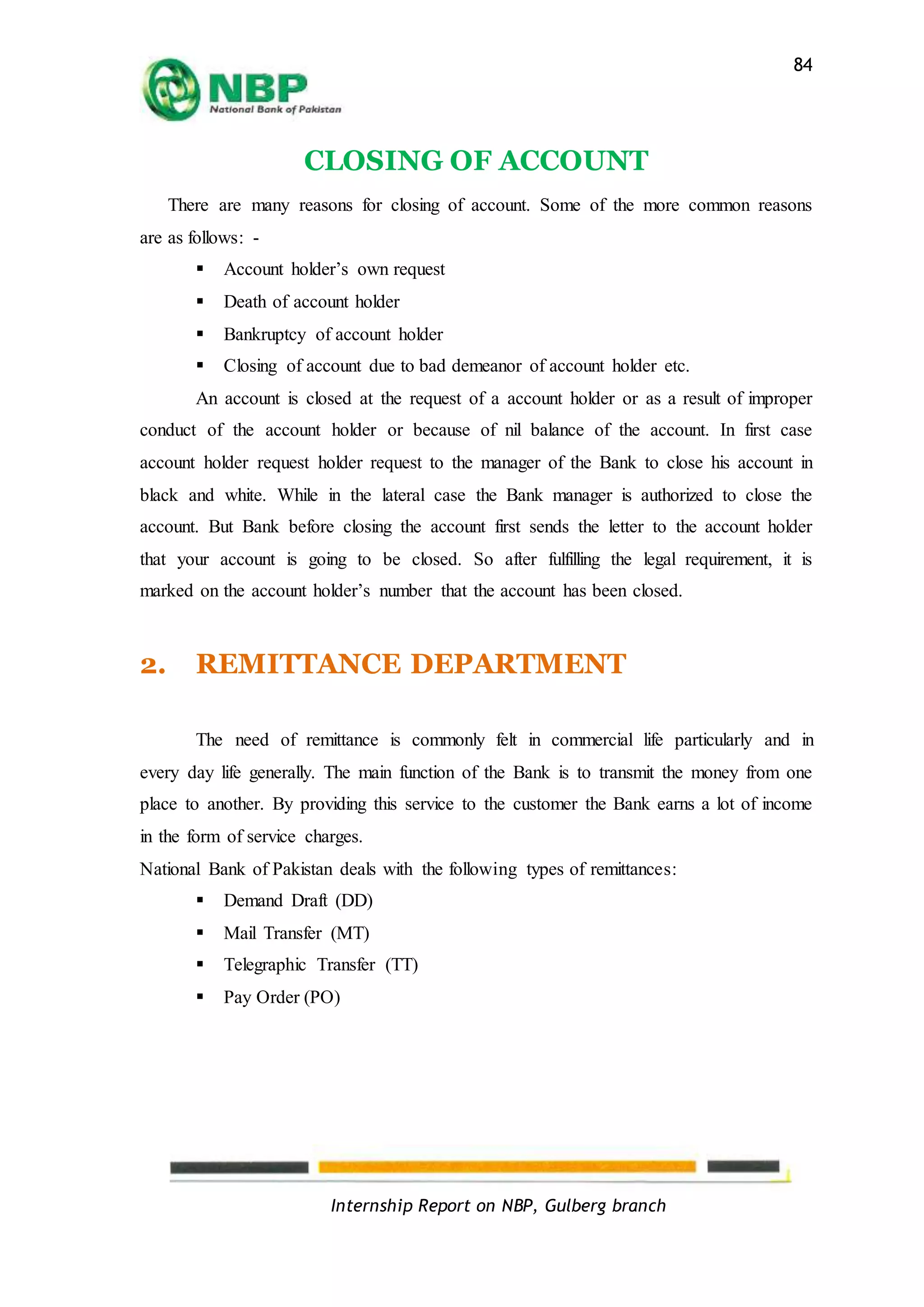
CLOSING OF ACCOUNT ............................................................... 84
2. REMITTANCE DEPARTMENT .................................................. 84
2.1 Demand Draft (DD) ............................................................ 85
2.2 Mail Transfer (MT)............................................................ 85
2.3 Telegraphic Transfer (TT) .................................................... 85
2.4 Pay Order (PO)................................................................. 85
Internship Report on NBP, Gulberg branch
vii
3. COLLECTION DEPARTMENT........................................................ 86
3.1 Short Credit (SC)............................................................... 86
3.2 Local Short Credit (LSC) ...................................................... 86
4-HUMAN RESOURCE DEPARTMENT ...................................................... 86
Change Management Program:......................................................... 87
Training of new staff:................................................................... 87
Benefits: ................................................................................ 87
MTO Program: ......................................................................... 87
OPERATION OFFICER BATCH: ........................................................ 88
TRAINING PROGRAMMES ............................................................. 88
(WEAK 1&2) Accounts Department ............................................... 90
CURRENT / DEMAND ACCOUNT ................................................... 90
SAVING ACCOUNT (PLS) ........................................................... 90
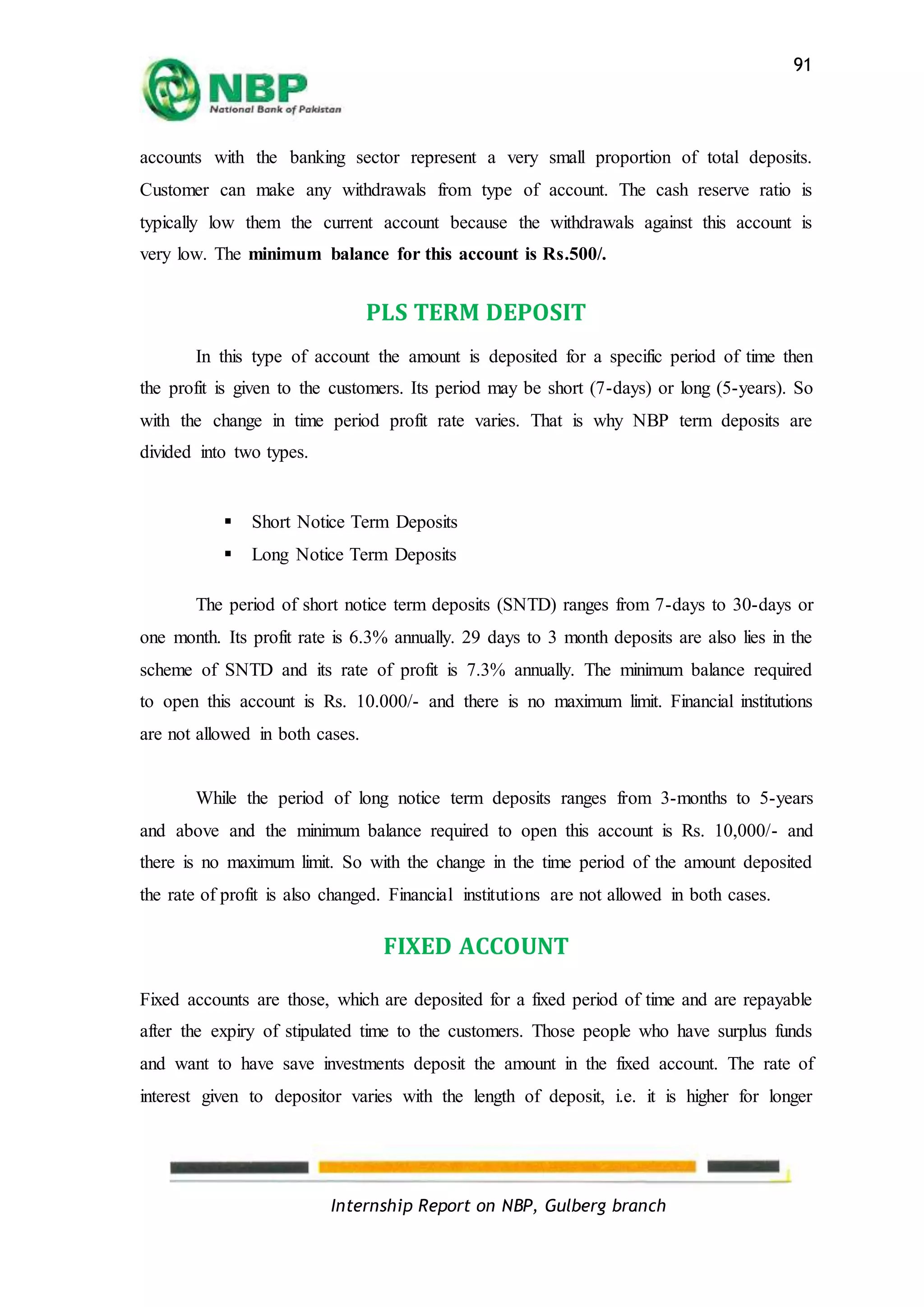
PLS TERM DEPOSIT ................................................................. 91
FIXED ACCOUNT .................................................................... 91
PROCEDURE OF OPENING AN ACCOUNT .............................................. 92
2. Joint Account ...................................................................... 95
3. Sole proprietorship Account ....................................................... 95
4. Partnership Firm............................................................... 95
5. Limited Company.............................................................. 96
Minimum Balance ..................................................................... 96
Preparation of Daily,Weekly,Monthly and Annual Statements ........................ 99
Daily Statements ..................................................................... 99
Monthly Statements.................................................................100
Statements for Tax Purpose.........................................................100
Issuance of Cheque Book..............................................................100
1.1 Encashment of Cheques...........................................................101
Internship Report on NBP, Gulberg branch
viii
1.2 Collection of Cheques ..........................................................102
1.3 Issue of Cheque Books..........................................................103
DEMAND DRAFT (DD) ...................................................................105
MAIL TRANSFER (MT) ...................................................................107
TELEGRAPHIC TRANSFER (TT) .....................................................108
PAY ORDER (PO) ........................................................................109
TYPES OF CLEARING....................................................................112
INWARD CLEARANCE.................................................................112
OUTWARD CLEARANCE ..............................................................112
SAME DAY CLEARANCE...............................................................112
INTER CITY CLEARANCE .........................................................113
In-Word Clearing Books................................................................114
Out-Word Clearing Book...............................................................114
Report ...............................................................................116
SANCTION OF LOAN ...............................................................117
The Investigation process ...........................................................117
1. Financial Condition ..............................................................118
2. Structural Liquidity ..........................................................118
3. Industry/Business of Operation ..................................................118
4. Debt Equity Management ........................................................118
5. Asset Management ...............................................................119
6. Borrower’s Credit Worthiness ......................................................119
TYPES OF ADVANCES ................................................................124
Demand Finance ....................................................................124
Cash Finance.........................................................................125
Running Finance ....................................................................125
1. NBP "Karobar" .....................................................................125
Internship Report on NBP, Gulberg branch
ix
INPUT STAGE ............................................................................129
Matching Stage..........................................................................130
Decision Stage ..........................................................................131
NBP EFE Matrix.......................................................................134
SPACE matrix............................................................................136
(BCG) MATRIX ...........................................................................138
Quantitative Strategic Planning Matrix (QSPM).....................................141
Internship Report on NBP, Gulberg branch
1
HISTORY OF BANKING IN PAKISTAN
At the time of partition, the total number of commercial banks in Pakistan was 38. Out
of these, the Pakistani banks were 2, Indian Banks 29 and exchange banks 7. The total
deposits of Pakistani banks were or Rs. 880 million whereas the advances were Rs. 198.0
million. According to banking Companies Ordinance, Commercial banks are companies
“which transact the business of banking in Pakistan”. Commercial banks have constituted
the most important source of institutional credit in the economy of Pakistan. Being the
large deposit institution and the main source of short term credit, commercial banks are
the center of the financial activities in Pakistan. Section 37 (2a) of the State Bank of
Pakistan Act, 1965 lays down that the banks having a paid-up capital and reserve of not
less than Rs. 5 laks and fulfilling certain other requirements may be declared as
“Scheduled Banks”.
At the time of independence in 1947 the banks services were very badly affected and
by June 30, 1948, the number of offices of scheduled banks came down to only 81 in the
territories now comprising Pakistan: but by December 31, 1973, there were following 14
scheduled Pakistani commercial banks with 3,323 offices all over the Pakistan and 74
offices in foreign countries. Banking sector was again effected in 1970s.
The Govt. of Pakistan nationalized the banks in early 1974. The act was taken with a
view to minimize the control of some specific families over the money market. But this
step proved to be fatal with the passage of time and the Govt. had to revise its decision of
1974 in 1990s. Since then privatized banks like MCB, ABL are working very well and
have improved their deposit line and have changed the concept of customer service hence
improving positive competition among the Govt. Banks in Pakistan as well.
Internship Report on NBP, Gulberg branch
2
INTRODUCTION OF NBP
1949 National Bank of Pakistan (NBP) was established under the National Bank of
Pakistan Ordinance 1949 and was 100% govt.-owned. NBP acted as an agent of the
Central Bank wherever the State Bank did not have its own Branch. It also undertook
Government Treasury operations.
Its principal activities are to provide commercial banking and related services in Pakistan
and overseas. The Group handles treasury transactions for the Government of Pakistan
asagent to the State Bank of Pakistan. It has its head office in Karachi. The Bank has
1254 domestic branches. In addition, NBP has 22 overseas branches and one
representative office including theExport Processing Zone Branch. The Bank also
provides services as trustee to National Investment Trust including safe custody of
securities on behalf of NIT.
National Bank of Pakistan maintains its position as Pakistan premium Bank determined to
set high standards of Achievements. It is the major business partner of Government of
Pakistan with special emphasis on fostering Pakistan’s economic growth through
aggressive and balanced lending policies, technologically oriented products and services
offered through its large network of branches locally, internationally and representative
offices.
Internship Report on NBP, Gulberg branch
3
HISTORY OF NBP
In 1949 (September) U.K devalued its currency, India followed suit but Pakistan did not.
India said we had contravened the agreement of keeping both currencies at par. We said
we had not done that, India had done it arbitrarily without consulting us. On October 3,
1949 the two central banks were to announce the new par value of both the currencies but
India denied a day earlier. India also froze our trade-balance surplus that is still an
unsettled dispute. India also withdraws the Marwari Merchants who were employed
annually for movement of Jute crop by financing it. There being no jute industry, prices
fell sharply, foreign banks and foreign merchants stood aside and an agrarian unrest was
threatening.
Two ordinances were, therefore, issued
1. Jute Board Establishment Ordinance
2. NBP Ordinance dated 08-11-1949
National Bank of Pakistan was established on November 9, 1949 under the National Bank
of Pakistan Ordinance 1949 in order to cope with the crisis conditions which were
developed after trade deadlock with India and devaluation of Indian Rupee in
1949.Initially the bank was established with the objective to extend credit to the
agriculture sector. The normal procedure of establishing a banking company under the
companies Law was set aside and a bank was established through the promulgation of an
ordinance due to the crisis situation that had developed with regard to financing of Jute
trade. The bank commenced its operations from November 20, 1949 at six important jute
centres in the East Pakistan and directed its resources in financing of jute crop. The Banks
Karachi and Lahore offices were subsequently opened in December 1949.The nature of
responsibilities of the Bank is different and unique from other Banks/Financial
institutions. The Bank Act as the agent to the State Bank of Pakistan for handling
Provincial/Federal Government receipts and payments on their behalf.
Internship Report on NBP, Gulberg branch
4
Mr. Ghulam Farooq was Chairman Jute Board and Mr.Mumtaz Hassan was Chairman
NBP.Until June, 1950, NBP remained exclusively in jute operations, there after other
commodities were also taken up. After that Mr. Zahid Husain. Governor SBP assumed
additional charge also as Chairman NBP’s Board of Directors and Mr. M.A Mohair
became its first M.D.
In 1952 NBP replaced Imperial Bank of India. This arrangement was negotiated by Mr.
Mumtaz Hassan as acting Governor of SBP.
In 1962, when Mumtaz Hassan became the M.D (He had already served NBP for 10 years
as its Chairman of Government Director), the number of Branches had increased from 6
to 239 and deposits from Rs. 50 million (5 Crore) to 1 billion and 60 million (106 crore),
profit from 3 million (3 lac) to 21 million (2.1 crore) and the staff increased from 380 to
7091, as compared to 1949-50. In December 1966 its 600TH branch was opened raising
the deposits to 2.31 bn. And staff to 14,963.Upto 1965, the shareholders had received
225% of their original investment. Now it has more than 21549 employees 1537 branches
and Rs.208283 million deposits.
The Bank has also played an important role in financing the country growing trade, which
has expanded through the years as diversification took place. Today the Bank finances
imports/exports business to the tune of Rs. 62.17 billion, where as in 1960, financing
under this head was only Rs. 1.54 billion.
The field is being de-layered to improve customer services and enable faster decision
making. As a result of this de-layering zones have been eliminated and the numbers of
regions have been increased. Organizational Hierarchy at the regional level has been
restructured and operational and business activities have been completely separated.
Internship Report on NBP, Gulberg branch
5
OVERSEAS BRANCHES
 Offices in Karachi and Lahore followed.
 1950 NBP established a branch in Jeddah, Saudi Arabia.
 1955 By this time NBP had branches in London and Calcutta.
 1957 NBP established a branch in Baghdad, Iraq.
 1962 NBP established a branch in Dar-es-Salaam, Tanganyika.
 1964 The Iraqi government nationalized NBP's Baghdad branch.
 1965 The Indian government seized the Calcutta branch on the outbreak of
hostilities between India and Pakistan.
 1967 The Tanzanian government nationalized the Dar-Es-Salaam branch.
 1971 NBP acquired Bank of China's two branches, one in Karachi and one at
Chittagong. At separation of East Pakistan NBP lost its branches there.
NBP merged with Eastern Mercantile Bank and with Eastern Bank
Corporation.
 1974 The government of Pakistan nationalized NBP. As part of the concomitant
consolidation of the banking sector, NBP acquired Bank of Bahawalpur
(est. 1947).
 1977 NBP opened an offshore brain Cairo.
 1994 NBP amalgamated Mehran Bank (est. 1991).
 1997 NBP's branch in Ashgabat, Turkmenistan commenced operations.
 2000 NBP opened a representative office in Almaty, Kazakhstan.
 2001 State Bank of Pakistan and Bank of England agree to allow only 2
Pakistani banks to operate in the UK. NBP and United Bank agreed to
merge their operations to form Pakistan International Bank, of which NBP
would own 45% and United Bank 55%.
 2002 Pakistan International Bank renamed itself United National Bank
Limited (UNB). The ownership structure of the UNB remained as
before.
Internship Report on NBP, Gulberg branch
6
VISION
To be recognized as a leader and a brand
synonymouswith trust, highest standards of service
quality, international best practices and social
responsibility
MISSION
NBP will aspire to the values that make NBP truly the
Nation’s Bank, by:
 Institutionalizing a merit and performance culture.
 Creating a distinctive brand identity by providing the
highest standards of services.
 Adopting the best international management practices.
 Maximizing stakeholders value.
 Discharging our responsibility as a good corporate citizen of
Pakistan and in countries where we operate
Internship Report on NBP, Gulberg branch
7
CORE VALUES
 Highest standards of Integrity
 Institutionalizing team work and performance culture
 Excellence in service
 Advancement of skills for tomorrow’s challenges
 Awareness of social and community responsibility
 Value creation for all stakeholder
GOAL
"To enhance profitability and maximization of NBP share through
increasing leverage of existing customer base and diversified range
of products".
Internship Report on NBP, Gulberg branch
8
OVERVIEW
CORPORATE CULTURE
In August 1995, the National Bank of Pakistan initiated an ambitious and far
sighted Corporate Culture Change Program in collaboration with Price Waterhouse
(U.K.) and A.F. Ferguson & Co. It commenced with an Executive Envisioning Workshop
(Bhurban). This two day workshop developed a comprehensive mission statement – a
vision of the bank’s future, it sets out in clear and realistic terms the key objectives and
goals of NBP based on the perceived strengths, weaknesses, opportunities and threats
being faced by the institution. In this perspective, NBP has defined for itself a course
where it will endeavor to maximize its impact commensurate with the size and scale of
operations. In order to change the bank’s posture from reactive to proactive, four major
areas have been highlighted for concerted plans of actions.
I) Personal - Human Resource Management Plan
II) Operations - Strategic Management Plan
III) Marketing - Strategic Management Plan
IV) Technology- Information Technologies Acquisition Plan
SYSTEM AND PROCEDURES
Since the foundation of the bank in 1949 no effort has been made to improve the
operational systems and procedures. The Basic Book of Instructions, (BBI) the
operational manual of the bank has its origins in the pre-independence practices,
prevailing at institutions such as the Imperial Bank of India. In 1995, the critical need of
updating of management of the bank and its operations was realized. Work is continuing
under supervision of senior executives, to bring the BBI in line with current banking
conditions and systems.
Internship Report on NBP, Gulberg branch
9
NBP FOUNDATION
The National Bank of Pakistan foundation has been established on the pattern of
Fauji/Shaheen foundations to undertake a variety of activities for the welfare of the
employees. It is the first institutions of its kind in the banking industry of Pakistan and
poignant symbol of management labor relations. The foundation has already registered
with the registrar of cooperative societies, Government of Pakistan. With compulsory
membership, it has its own Board of Trustees and a full time ousted Managing Director
selected through public advertisement. NBP has committed contribution of Rs. 500,000
per month while the employees would share contribution in prescribed amount by
adjustment from their salaries.
WORK ENVIRONMENT
In order to improve the work environment, the bank embarked on an ambitious
restoration renovation of its Head Office premises. NBP Building has not seen any major
refurbishment of improvement effort since 1970. The entire 14 story building is being
renovated with special emphasis on interiors and seating arrangements. This work is
being over seen by independent architects (Nespak). A pleasant workplace would
positively impact productivity.
PROVISION OF CURRENT INFORMATION
The bank conducts training programs for the employees on regular basis and prints
various book-lets giving current information about bank, banking & economic scenario in
Pakistan and beyond Pakistan.
SECURITY SYSTEM
New security systems have also been put in place to improve safety and
effectively monitor main traffic areas inside the building. By use of sophisticated
surveillance equipment and crowd management the flow of employees, clients and other
visitors has been streamlined.
Internship Report on NBP, Gulberg branch
10
MANAGEMENT AND ORGANIZATION
OF BANK
Management is a distinct process consisting of activities of planning, organizing,
actuating and controlling performed to determine and accomplish stated
objectives with the use of human being and other resources.
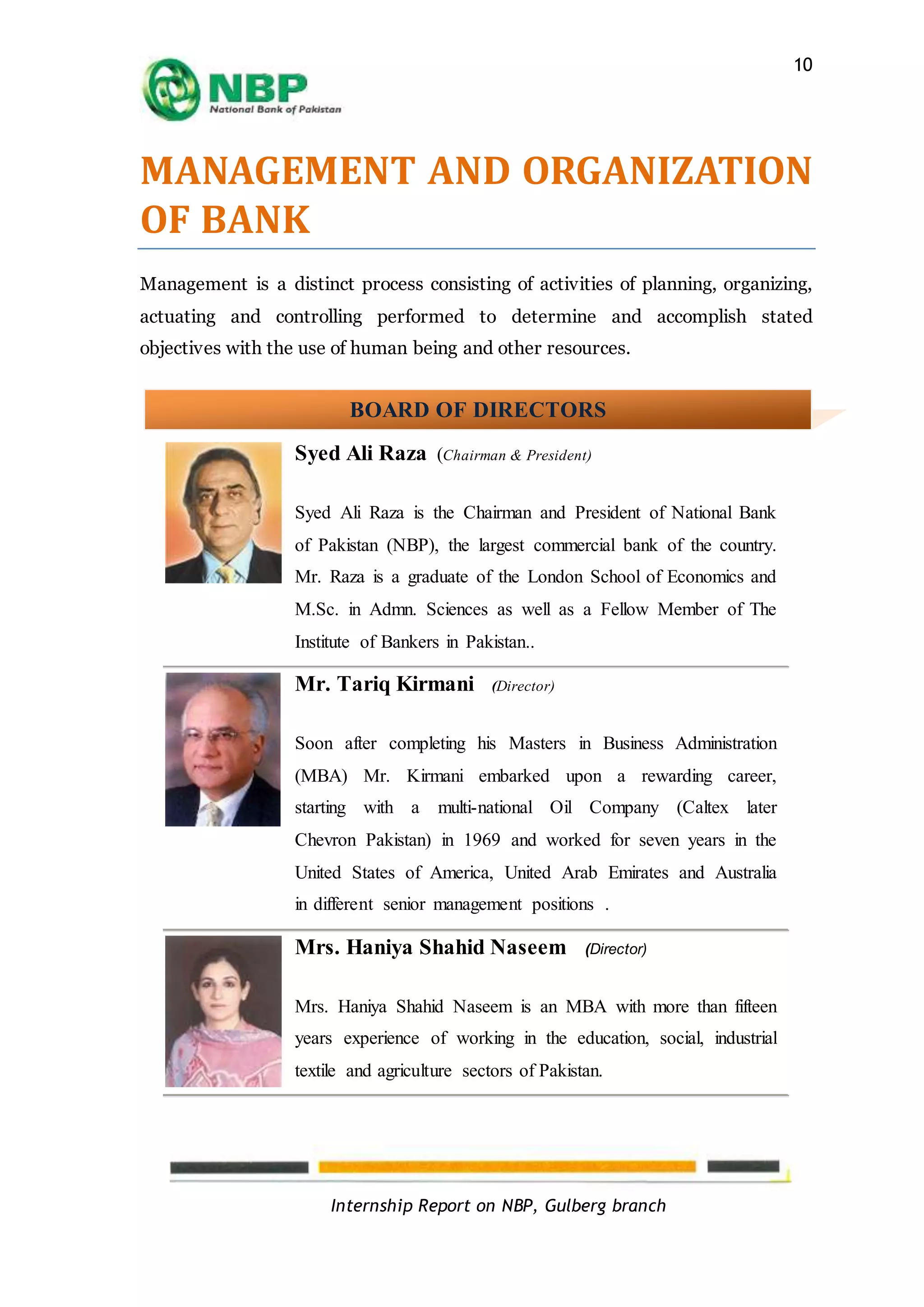
Syed Ali Raza (Chairman & President)
Syed Ali Raza is the Chairman and President of National Bank
of Pakistan (NBP), the largest commercial bank of the country.
Mr. Raza is a graduate of the London School of Economics and
M.Sc. in Admn. Sciences as well as a Fellow Member of The
Institute of Bankers in Pakistan..
Mr. Tariq Kirmani (Director)
Soon after completing his Masters in Business Administration
(MBA) Mr. Kirmani embarked upon a rewarding career,
starting with a multi-national Oil Company (Caltex later
Chevron Pakistan) in 1969 and worked for seven years in the
United States of America, United Arab Emirates and Australia
in different senior management positions .
Mrs. Haniya Shahid Naseem (Director)
Mrs. Haniya Shahid Naseem is an MBA with more than fifteen
years experience of working in the education, social, industrial
textile and agriculture sectors of Pakistan.
BOARD OF DIRECTORS
Internship Report on NBP, Gulberg branch
11
Ms. Nazrat Bashir(Director)
Ms. Nazrat Bashir belongs to District Management Group of
Civil Services of Pakistan. She is Masters in Economics from
New York University, New York, USA and Master in
Psychology from Peshawar University, Peshawar
Mr. Ekhlaq Ahmed(Director)
Mr. Ekhlaq Ahmed, EVP is the Company Secretary of the Bank and
also the Secretary of Credit & Operations Committees. He is M.A.
(Economics) from Rajshahi University, Bangladesh (former East
Pakistan). Mr. Ekhlaq Ahmed is the first senior executive of the Bank
who has achieved the status of “Certified Director”.
SENIOR MANAGEMENT
QamarHussain
Chief Operating Officer , Credit Management Group
Dr.AsifA.Brohi
SEVP & Group Chief, Operations Group
Internship Report on NBP, Gulberg branch
12
ImamBakhshBaloch
SEVP & Group Chief, Audit & Inspection Group
N.B.Soomro
SEVP Islamic Banking Group
MasoodKarimShaikh
SEVP & Group Chief, Corporate & Investment Banking Group
AghaFidaullah
EVP/Group Chief, Special Assets Management Group
ZiaullahKhan
Senior Executive Vice President
EkhlaqAhmed
EVP & Secretary Board of Directors
Dr.MirzaAbrarBaig
SEVP & Group Chief, Human Resources Management & Administration Group
NadeemA.Ilyas
EVP & PSO to President , Group Chief (A), Compliance Group
AmerSiddiqui
SEVP & Group Chief, Commercial & Retail Banking Group
Internship Report on NBP, Gulberg branch
13
OVERSEAS OPERATIONS MANAGEMENT
NaeemSyed
EVP, Divisional Head, Project Management Office
ShahidAnwarKhan
SEVP & Group Chief, Overseas Banking Group
AamirSattar
SVP, Divisional Head, Financial Control Division
MuhammadNusratVohra
SEVP & Group Chief, Treasury Management Group
AtifHassanKhan
Group Chief (A), Information Technology Group
AliHassan
SVP-Head PMO-CBA / Chief Information Security Officer
R.A.Kaleemi
SEVP & Chief Representative, Canada Office
M. Rafiq Bengali
SEVP & Regional Chief Executive, Americas Region
Internship Report on NBP, Gulberg branch
14
Asif Hassan
SEVP & Regional Chief Executive, Far East Region
Nausherwan Adil
SEVP & Regional Chief Executive, Europe Region
Khawar Saeed
SVP & Regional Chief Executive, Central Asian Republics Region
Zubair Ahmed
EVP & Regional Chief Executive, Middle East, Africa & South Asia Region
Muhammad Hanif Khan
SVP & Coordinator, Afghan Operations
NBP'S INITIATIVE IN 2014
Internship Report on NBP, Gulberg branch
15
JOB DESCRIPTION
A Banker is responsible for establishing and maintaining positive customer relationships,
planning and delivering effective sales strategies and monitoring the progress of new and
existing financial products. Bankers may work as managers in high street branches
providing operational support on a day-to-day basis, or in more specialized posts in
corporate and commercial departments at area, regional or head offices.
Banks operate in a fiercely competitive market place where change is common. Products
and services offered have to develop to satisfy the expectations and demands of
customers and working with staff and customers to achieve targets has become a very
major part of the role.
TYPICAL WORK ACTIVITIES OF EMPLOYEES IN VARIOUS
DEPARTMENTS
BRANCH MANAGER:
The Duties of Branch Manager includes:
 Marketing of Credit
 Advances & Recovering Loans and Mark-ups.
OPERATION MANAGER:
 All the circulars/office orders are followed up by operation Manager.
 Loan Sanction--- supervise the credit In-charge along with Branch Manager.
 Overall assigning of Branch employees duties on different departments is supervised
by operation manager.
 Overall checking of bank books whether they are complete and accurate.
 Work as a compliance officer (To rectify flaws and Mistakes in different banking
operations).
Internship Report on NBP, Gulberg branch
16
HALL AND DEPOSIT INCHARGE:
 Supervising all the activities of operations.
 Act as a joint custodian with Head Cashier.
 Maintaining Bank Cash Scroll.
 Balancing the cash with Head Cashier on day end.
 Locking the Strong Room (Room that contain remaining cash balance at day end)
 Act as a Joint Signatory.
CREDIT INCHARGE:
His work activities include:
 Administration of Credits.
 Preparing Loan Proposals.
 Sanction the loans.
 Keep proper investigation of Securities from customers (i.e. mortgages, pledge, stock
etc.)
 Preparing Loan Case.
 Recovering Principal amount of Loans (i.e. instalments, lump sum)
 Recovering Mark-up as bank income from customers periodically (i.e. half yearly,
quarterly, annually)
 Preparing Branch Profit and Loss Statements. (i.e. monthly, half yearly, quarterly,
annually)
 Dealing with WESTERN UNION PAYMENT through SWIFT Code.
DEPOSIT OFFICER:
Accepting Account Holders Cheques and after verification of balance in account,
customer signature from Specimen Signature Card, debit the Customer’s account in the
system i.e. posting of cheque.
 All the receipts received by Branch Account Holders are also credited by the officer
in their accounts.
 Also give details to customers about Balance Enquiry.
Internship Report on NBP, Gulberg branch
17
 Collection and transfer of Passport Fees. (Being the Hub Branch for collection of
Passport Fee from nearest 7 to 8 branches and keeping it weekly nil by transferring
the Govt. passport collection to Govt. offices along with “Govt. Debit Scroll”
PENSION PAYMENT INCHARGE:
 Giving pension payment to Govt. employees after verifying Pension Payment number
(P.P.NO.), File Number (maintained by bank and relevant Govt. office) and claim
NO. (EOBI)
 Also performs Clearing services.
 Receiving Inward Clearing and return in any case of objection through NIFT.
 Making outward clearing for our customers to be clear from other banks through
NIFT.
 Maintaining intercity Cheques through TCS services or DAK.
REMITTANCES AND DISPATCH INCHARGE:
 All the Dak which is send to Main Branch or other branches is made with TCS slip
enter in DISPATCH REGISTER.
 All the Dak which is received from other banks branches with their particulars enter
in MAIL INWARD REGISTER.
CASHIER
 Collecting Govt. utility bills ( SUI-GAS, WASA, WAPDA )
 Receiving bill payment from customer and entering the particulars in “CASH
RECIEPT BOOK”
 Collecting Govt. tax i.e. income tax, sales tax, property tax and keeping the record of
TAX VOUCHER COPY.
 Receiving Tax payment from customers and enters into CASH RECIEPT
BOOK.
Internship Report on NBP, Gulberg branch
18
 On day end, totalling the govt. bills and Govt. tax collection and hand over the
physical cash plus vouchers after proper balancing to Head Cashier for final cash
balancing.
ASSISTANT (scrolling of passport fee):
Preparing Passport collection scrolls also called Govt. Debit Scrolls and maintaining 3
copies of it for
 Main Branch
 Bank’s Branch Copy
 Passport Office
ACCOUNT OPENING INCHARGE:
 Opening of Bank Accounts.
 Basic Banking Account (BBA)
 PLS Saving Account
 Current Account
 Fixed Account
 Visually impaired/Blind Person’s Account
 Maintenance of Cheque Book records.
 Entering of newly printed cheque books with their particulars in Cheque Book
Register.
 Taking signature of authorized Account Holder on relevant entry of Cheque book
register at the time of issuance.
 Keeping all the cheque books under Lock and Key.
 Sending Letter of Thanks to newly account opening customers.
 After Letter of Thanks ACKNOWLEDGEMENT received from customers on
verification of his Home Address only then Bank Officer can issue Cheque Book.
 Attach the Letter of Thank Acknowledgement part with Account Opening Form of
those customers.
Internship Report on NBP, Gulberg branch
19
CORPORATE STRUCTURE
ORGANIZATIONAL STRUCTURE
Board of Directors
President
Group Chief
Group Credit Group HR Group Compliance Group Credit
Management Chief Chief Administration
Chief Chief
At Regional Level
Regional Credit Regional HR Regional Compliance Incharge Credit
Management Chief Chief Administration
Chief
Branch Manager Branch Operation Manager
Internship Report on NBP, Gulberg branch
20
REGIONAL STRUCTURE
REGIONAL CHIEF EXECUTIVE
GENERAL MANAGER
Administration Wing
GENERAL MANAGER
Advances, Legal & Recovery
Wing
GENERAL MANGER
Planning, Business Development Customers
Services & Implementation of Audit and
Inspection Reports Wing
Internship Report on NBP, Gulberg branch
21
BRANCH STRUCTURE
Manager OG-I Advance
OG-II Admin
OG-II ForexOG-II Head
Cashier
OG-II Agency
Services
OG-III Accounts
Godown
Keeper
Godown
Keeper
Godown
Keeper
Godown
Keeper
AssistantAssistantAssistantAssistant
Head
Messenger
Messenger
Internship Report on NBP, Gulberg branch
22
ADMINISTRATIVE STYLE
In many management text books the three most talked about management styles are
democratic, autocratic and consultative. Selecting the correct management style may lead
to greater motivation and productivity from your staff. However, it is not as easy as just
'picking' a style. Managers’ personalities and characteristics will influence the type of
style adopted. For example a timid manager will find an autocratic management style
difficult to adopt.
DEMOCRATIC MANAGEMENT STYLE
A democratic manager delegates authority to his/her staff, giving them responsibility to
complete the task given to them (also known as empowerment). Staff will complete the
tasks using their own work methods. However, the task must be completed on time.
Employees are involved in decision making giving them a sense of belonging and
motivating individuals. Because staff feels a sense of belonging and are motivated the
quality of decision making and work also improves. Although popular in business today,
a democratic management style can slow decision making down because staff needs to be
consulted. Also some employees may take advantage of the fact that their manager is
democratic by not working to their full potential and allowing other group members to
'carry' them.
AUTOCRATIC MANAGEMENT STYLE
In contrast to the above an autocratic manager dictates orders to their staff and makes
decisions without any consultation. The leader likes to control the situation they are in.
Decisions are quick because staff is not consulted and work is usually completed on time.
However this type of management style can decrease motivation and increase staff
turnover because staff are not consulted and do not feel valued.
Internship Report on NBP, Gulberg branch
23
CONSULTATIVE MANAGEMENT STYLE
A consultative management style can be viewed as a combination of the above two. The
manager will ask views and opinions from their staff, allowing them to feel involved but
will ultimately make the final decision.
LAISSEZ FAIRE MANAGEMENT STYLE
A laisses faire manager sets the tasks and gives staff complete freedom to complete the
task as they see fit. There is minimal involvement from the manager. The manager
however does not sit idle and watch them work! He or she is there to coach or answer
questions, supply information if required. There are benefits, staff again are developed to
take responsibility which may lead to improved motivation. However with little direct
guidance from the manager staff may begin to feel lost and not reach the goals originally
set within the time frame.
NATIONAL BANK OF PAKISTAN STYLE
The bank management style is autocratic. Management makes decisions which
subordinates and relevant departments have to follow. For instance, the management said
to its any branch to increase sales by 10 percent and that branch has to follow this
command. In any case, if the branch fails to achieve the desire output, they become
answerable before management. In some situation, the management style becomes
democratic or consultative but again it is on management discretion that when to involve
subordinates in decision making process.
The style of the NBP management usually decides the success or failure of the bank. So it
can be said that whatever style the manager or operation manager chooses, best describe
its objectives. Bank knows that how to get work out of people? When to involve them in
decision making? What motivates employees? These are the question whose answers can
be best given by the management because they know the bank and its operations very
deeply.
Internship Report on NBP, Gulberg branch
24
EMPLOYEE MORALE & EFFICIENCY OF WORK
Employee morale can be defined as “The mental and emotional condition (as of
enthusiasm, confidence, or loyalty) of an individual or group with regard to the function
or tasks at hand.”
In the context of the workplace, “The degree to which an employee feels good about his
or her work and work environment.”
Efficiency in work may not result in quick promotion, but will definitely result in success.
In order to improve and be efficient one has to have the right attitude, a desire to better
things, be alert, desire to learn & grow, be hard working, patient, optimistic and be
willing to co-operate.
Employees feel good when management involves them in decision making process. They
feel themselves valuable to the bank and deem their selves the part of the bank. They
work with happiness and passion.
As contrary to democratic or consultative style, in autocratic style, the bank morale is not
so high because employees feel the work as burden but at the same time that burden gets
the work well from employees. Employees try to give their best in order to become eye
star of the management. Favoritism is always there in any work place. So by giving the
best output, one can win the trust of the organization.
By concluding the above discussion, it can be said that no single management style can be
applied in the organization. There is a mixture of the styles in the organization that vary
from situation to situation. And the resultant employee morale and his efficiency of the
work also depend upon situation, organization culture and the most important, the
employee nature and his loyalty towards his work.
Internship Report on NBP, Gulberg branch
25
FACILITIES TO STAFF
The scale of pay and allowances for officers and staff are revised from time to time as
need grows. In addition employment with bank personable and bonuses are regularly
paid.The bank provides free medical treatment for all its employers, their families and
dependent parents. A senior member of the medical profession acts as Medical Advisor
and medical consultant.The bank pays school fees for the children of all the supervisory,
electrical and subordinate staff and this facility is extended to college fees also.To meet
the problem of finding suitable residential accommodation in the huge cities.
NBP has had recourse to several measures in Karachi and Lahore for instance the bank
has constructed residential quarters. NBP has granted loans on easy terms to members of
staff to enable them to construct houses of their own.To solve the problems of
conveyance for its employees the bank makes advances to staff for the purchase of cars
motorcycles and cycles.
The bank has provided finance for the establishment of sports clubs and staff recreation
centers, to enable staff sport clubs and other suitable recreational activities to flourish.
Co-operative stores and subsidized canteens help the lower paid categories to get the best
value form their earnings.
In 1949, the first year of operations the NBP has one hundred employees one its
payroll but with in two years this number had grown to 1505 by 1960 the figure
has risen to 5023 and afterwards it expanded upto 14,091 M.
During the first ten years the NBP trained its own staff through a series of
training program both for junior officers and clerical staff. By 1958 how ever it
was obvious that one thing more comprehensive was needed and the bank
established a staff college Karachi. Three colleges at Islamabad, Lahore and
Peshawar, setup later.
Internship Report on NBP, Gulberg branch
26
MARKETING MIX
PRODUCT
The National Bank of Pakistan offering for sale several related products individually,
which is commonly known as product lining.
PRODUCT LINE
A group of products that are closely related because they function in a similar manner, are
sold to the same customer groups, are marketed through same types of outlets, or fall
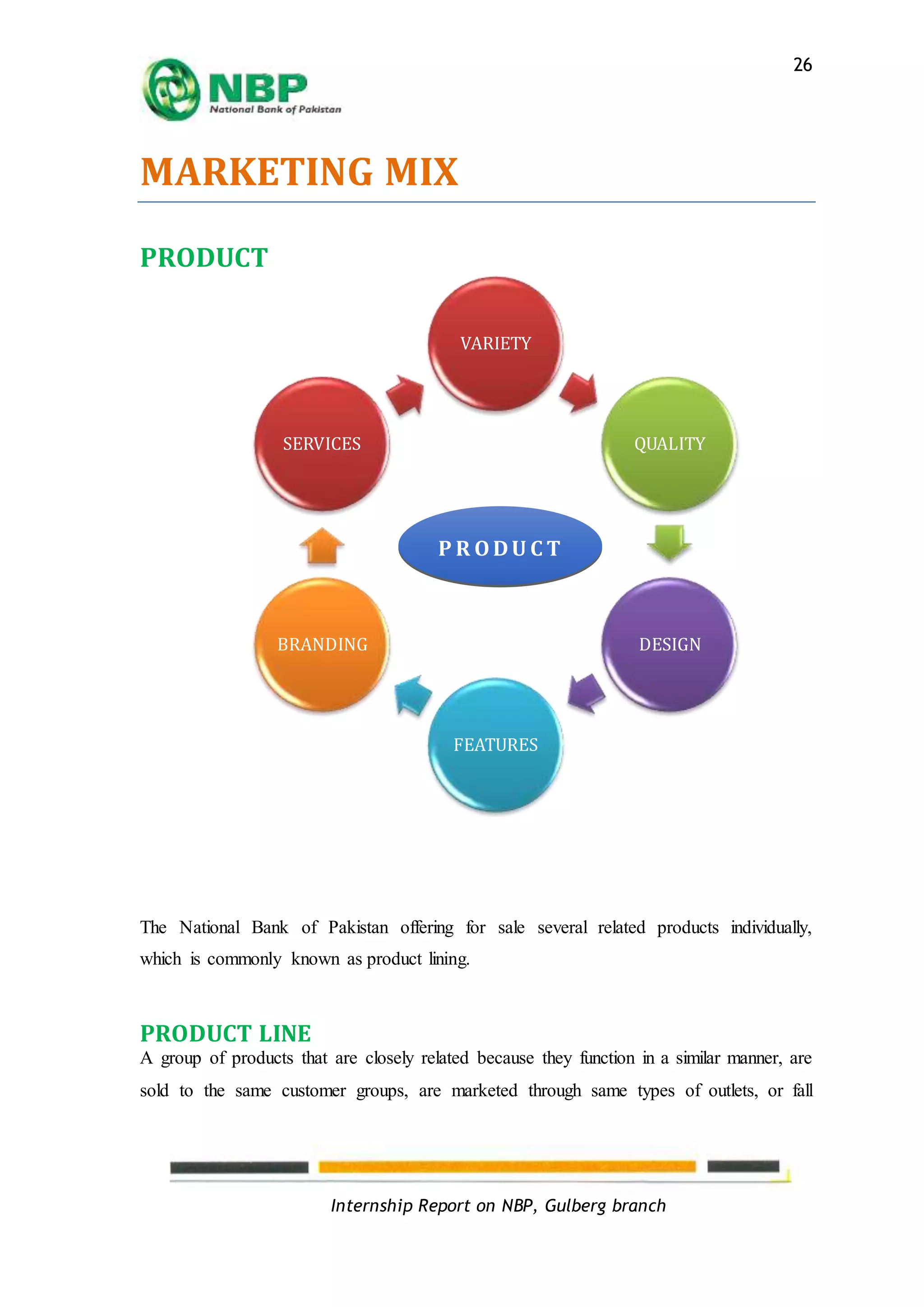
VARIETY
QUALITY
DESIGN
FEATURES
BRANDING
SERVICES
P R ODU C T
Internship Report on NBP, Gulberg branch
27
within the given price ranges”. The followings are the main consumer banking products
of NBP.
1- Deposits
The National Bank of Pakistan offers to their clients a variety of Deposit Schemes with
personalized services at competitive rates of interest. Any Pakistani citizen can open
his/her account for any deposit scheme at any of its Branches strategically located
throughout Pakistan. The Bank with its huge network of 1243 branches garners savings
from both the rich and the poor in urban as well as rural areas. Even a poor farmer in a
remote village, with his meager annual income, feels secure to safe keep his minuscule
savings in National Bank of Pakistan, Because National Bank of Pakistan has a long
heritage of trust and professional commitment.
a) Current Deposits
These are payable to the customer when ever they are demanded. When a banker accepts
a demand deposit, he incurs the obligation of paying all cheques etc, drawn against him to
the extent of the balance in the account. Because of their nature, these deposits are treated
as current liabilities by the banks. Bankers in Pakistan do not allow nay profit on these
deposits, and customers are required to maintain a minimum balance, failing which
incidental charges are deducted from such accounts. This is because Current Deposits
may be withdrawn by the depositors at any time, and as such the bank is not entirely free
to employ such deposits. Current Accounts/ Basic Banking accounts are opened, on
proper introduction and submission of required documents along with initial deposit
prescribed from time to time. Basic banking accounts are opened for an individuals
(single or joint) only whereas current accounts are opened for individuals (single or joint)
Charitable institution, provident and other funds of benevolent nature of local bodies,
autonomous corporations, banks, associations, educational institutions, firms etc. and in
all other cases where the accounts are to opened under the order of a competent court of
law. No profit is paid on the balances of current/basic banking accounts. The bank is
authorized to deduct service charges (incidental charges) on current accounts levied
through its half yearly schedule of charges, in case the average balance falls below the
minimum balance as prescribed by the bank. No balance maintenance condition is applied
Internship Report on NBP, Gulberg branch
28
on basic banking account.
a) PLS Saving Deposits
In Pakistan a Savings Deposits Account can be opened with a very small amount of
money, and the depositor is issued a cheque book for withdrawals. Profit is paid at a
flexible rate calculated on six monthly basis under the Interest Free Banking System.
There is no restriction on the withdrawals from the deposit accounts but the amount of
money withdraw is deleted from the amount to be taken for calculation of products for
assessment of profit to be paid to the account holder. It discourages unnecessary
withdrawals from the deposits. In order to popularize the scheme the SBP has allowed the
Savings Scheme for school and college students and industrial labour also. The purpose
of these accounts is to inculcate the habit of savings in the constituents. As such, the
initial deposits required for opening these accounts are very nominal.1NBP charge Rs.500
for opening of PLS Savings deposits.
The silent features of profit and loss sharing and saving accounts of NBP are as fallows
1. These accounts can be opened by individuals in their own single or joint name.
The PLS savings account can also be opened for provident fund or other
benevolent funds of banks, firms, organizations, NGO’s and educational
institutions.
2. PLS saving account can be opened with a minimum amount of Rs.500/- only
3. To share in the profit a minimum balance of Rs.500/- must be maintained in the
account. The minimum balance on sixth and last of month will qualify for the
profits. The profits will be calculated on the basis of monthly minimum balance
for the periods of six months i.e. from January to June and July to December
4. The head office of NBP determines the profit or loss on PLS saving deposits and
advice its branches the rate and time of distribution of these profits.
5. There shall be no restrictions on maintaining the maximum balance in PLS saving
account.
6. On the first day of Ramzan each year the Zakat at the rate of 2.5% will be
deducted from these deposits on the balance of that day. But if depositors affix an
Internship Report on NBP, Gulberg branch
29
affidavit of Zakat deduction along with account opening form or he is a non-
Muslim, no Zakat will be deducted from his account.
C) Fixed Deposit Account
The deposits that can be withdrawn after a specified period of time are referred to as
Fixed or Term Deposits. The period for which these deposits are kept by the bank
ordinarily varies from three months to five years in accordance with the agreement made
between the customer and the banker. Profit/Return is paid to the depositors on all fixed
or Time deposits, and the rate of profit/Return varies with the duration for which the
amount is kept with the banker. By lending out or investing these funds, the bank earns
more than the Profit/Return that it has to pay on them to the depositors.1 By giving an
advance notice to the bank the deposit can be withdraw from the bank before the expiry
of the period. Fixed deposit accounts have higher rate of interest as compare to other
accounts. The rate of interest rises with the length of period and the amount of deposit.
The bank grants to the depositor a fix deposit (FDR) which is not transferable to any other
person. The silent features of fixed deposit account of NBP are as fallows
1. The PLS term deposit are opened for individuals in their own single or joint
names, banks firms and other organizations.
2. The PLS term deposit receipt are issued for any amount. There is minimum or
maximum limit or deposits in a single term deposit account.
3. PLS term depositors may be allowed some facilities against the security of these
receipt credits, after making “Lien” on the relevant receipt and subject to recovery
of service charges.
4. Under term deposit scheme the depositors not cease to earn the profit
immediately, after the respective maturity date.
D) Foreign Currency Account
Government of Pakistan has introduced many important reforms in Foreign Exchange
Control in the country since February, 1990, for the purpose of strengthening the Foreign
Exchange Reserves. One of these reforms relates to foreign currency accounts, which can
be opened in United States Dollars, Pound Sterling, Euro and Japanese Yen in any of the
Internship Report on NBP, Gulberg branch
30
authorized branches of commercial banks throughout the country.1 Foreign currency
accounts are opened, on proper introduction and submission of required documents along
with an initial deposit prescribed from time to time. Rates of return on foreign currency
deposits are subject to fluctuation as determined in accordance with State Bank of
Pakistan directives and will be paid on six monthly basis whereas the return on term
deposit/SNTD will be paid on maturity or as prescribed by SBP. The bank shall have no
responsibility for or liability to the account holders for any diminution due to taxes
imposed or depreciation in the value of funds credited to the account whether due to
devaluation or fluctuation in the exchange rate or other wise.
E) NBP Premium Aamdani
NBP Premium aamdani is a retail product of the bank. The amount of investment required
for this account is Rs. 20,000/-to Rs. 5,000,000.The investment period is 5 years. Zakat
and withholding tax will be deducted as per rules. In NBP premium aamdani, the account
holders have benefit of free demand draft, pay order; free cheque book and NBP cash
card (ATM+Debit). The Financing facility is available up to 90% of the deposit value.1
Profit paid every period as follows:
Period Profit
Rates
1st year 7.50%
2nd years 8.50%
3rd years 9.50%
4th years 10.50%
5th years 11%
F) NBP Premium Saver
NBP Premium saver is a retail product of the bank. The minimum saving balance of Rs.
20,001 and a maximum balance of Rs. 300,000 are required for opening a premium saver
account. Two debit withdrawals allowed in a month and no limit on number of deposit
Internship Report on NBP, Gulberg branch
31
transactions. The profit is calculated monthly and Paid on half yearly basis. Free NBP
Cash Card (ATM + Debit) facility is available to account holder.
G)National Income Daily Account
The scheme of National income daily account was launched in December 1995 to attract
corporate customers. It is a current account scheme and is part of the profit and loss
system of accounts in operation throughout the country. Deposits in the NIDA accepted
on the condition that the depositor shall always maintain a minimum balance as
prescribed by the bank in his account. In the event however, that any depositor wishes to
withdraw the amount and the balance in his account is less than the required amount, the
account will be converted to the ordinary PLS SB account for the purpose of calculating
profit. An example of how the NIDA accounts are maintained is shown on the next page.
2 - Advances
National Bank of Pakistan plays a pivotal role in translating the government's
development plans in terms of growth in industrial, commercial and agricultural sectors in
Pakistan. Accordingly the Bank has formulated its Credit Policy under the guidelines of
SBP-the Central Bank of Pakistan.
a) NBP Saibaan
The NBP Saibaan is retail product of the bank. It has different product items which are
home purchase, home construction, home renovation and purchase of land plus
construction. If anyone has a Home Finance Facility outstanding with another bank he
can have it transferred to NBP through a hassle-free process.1 A brief description of these
products is as fallows
Internship Report on NBP, Gulberg branch
32
TYPE OF
ADVANCE
Financing
Amount
Financing
Period
Debt to equity
Ratio
Home Purchase (House or
Apartment)
Rs. 35 Million 3 to 20 years 85:15
(maximum)
Home
Construction
Rs. 35 Million 3 to 20 years 85:15
(maximum)
Home
Renovation
Rs. 15 Million 3 to 15 years 80:20
(maximum)
Purchase of land Plus
Construction
Rs.35 Million 3 to 20 years 80:20
(maximum)
C) NBP Advance Salary
The NBP Advance salary has been the flag-ship product for NBP. NBP Advance Salary,
the leading personal loan product of the country, is maintaining its inimitability ever since
it was launched. This was only possible due to its swift growth and remarkable loan
disbursement of over 118 billion.1 You can avail up to 20 net take home salaries with
easy repayment installments. Its hassle free acquisition with no prior formalities and easy
availability in a short turn around time is attributed as the most distinguishing features of
the product. The product is offered countrywide. The terms and conditions of NBP
Advance salary is shown on next page:
Internship Report on NBP, Gulberg branch
33
PROCESS
Remitters log on to www.pakremit.com and after completing the registration process, are
able to remit funds. The whole process takes a few minutes. Funds in Pak Rupees can be
sent to beneficiaries, having an account with any bank in Pakistan, including NBP. While
funds are credited directly to beneficiaries maintaining accounts with NBP, a pay order or
demand draft is couriered to other banks for their customers. Pay order or demand draft
can also be couriered directly to the beneficiary’s office or home, if requested by the
remitter. Funds in US Dollars can be sent only to a Beneficiary maintaining a US Dollar
account with one of NBP’s Foreign Exchange Branches. Click here for details of NBP
Foreign Exchange Branches
Personal Accident Insurance
 No documentation
 No medical required
 Premium Auto Debit facility & choice of deactivation
 Coverage includes death due to:
 Natural Calamities e.g. Earthquake, Flood, Cyclone etc
• Accident
 Civil Commotion*
 Acts of Terrorism
Financing Facility for Stock Investors
 Comfortable environment for trading
 No security requirement, except for the customer’s equity
 Customer’s equity freely available for investment
 Equity acceptable in cash or approved shares
Internship Report on NBP, Gulberg branch
34
PRICE
“Price is what is charged for something”
WHAT IS PRICING?
The second major and important marketing mix tool is “PRICE”.
Prices are the easiest marketing mix element to adjust; product features, channels and
even promotion take
More time, price also communicates to meet the company’s intended value positioning at
its product or brand. Although non-price factors have become more important in recent
decades.
Price still remains one of the most important elements in delivery marketing share and
profitability.
BANK CHARGES
LETTER OF CREDIT.
1.1.1. Opening of cash Letters of Credit
ANNUAL VOLUME
DURING A CALENDAR
YEAR(2016) Ist Qtr Each Sub.Qtr Minimum
Or part Or part Amount
Thereof Thereof Per L/C
a.Upto Rs.20 (M) 0.40% 0.20% RS.1000
b. Upto Rs.50 (M) 0.35% 0.20%
c. Upto Rs.100 (M) 0.30% 0.20%
d. Upto Rs.250 (M) 0.25% 0.20%
e. Upto Rs.500 (M) 0.20% 0.15%
f. Upto Rs.1,000 (M) 0.15% 0.10%
g. Above Rs.1,000 (M) 0.10% 0.05%
Internship Report on NBP, Gulberg branch
35
Revalidation Commission
On expiry of L/C when the same is revalidated,
revalidation commission should be recovered as
is applicable for opening of Fresh Letter of
Credit. L/C commission will be calculated on
the amount of liability as per exchange rate
prevailing on the date of revalidation
Transfer Commission
When a Letter of Credit is transferred to a new
beneficiary, transfer commission should be
charged as applicable in case of Fresh Letter of
Credit.
Approval from SBP from re-
import of consignment back
to Pakistan
Rs.2,000/- (Flat) per case.
L/C Cancellation Charges Rs.1, 500/- (Flat) Plus actual telex / SWIFT
charges
Non-reimbursable Letter of
Creditunder Barter/Aid/Loan
and authorization to pay
1% on 1st quarter and 0.30% for each
Subsequent quarter or part thereof Minimum of
Rs.2000/-
Amendments Rs.750/- per transaction (Flat)
Internship Report on NBP, Gulberg branch
36
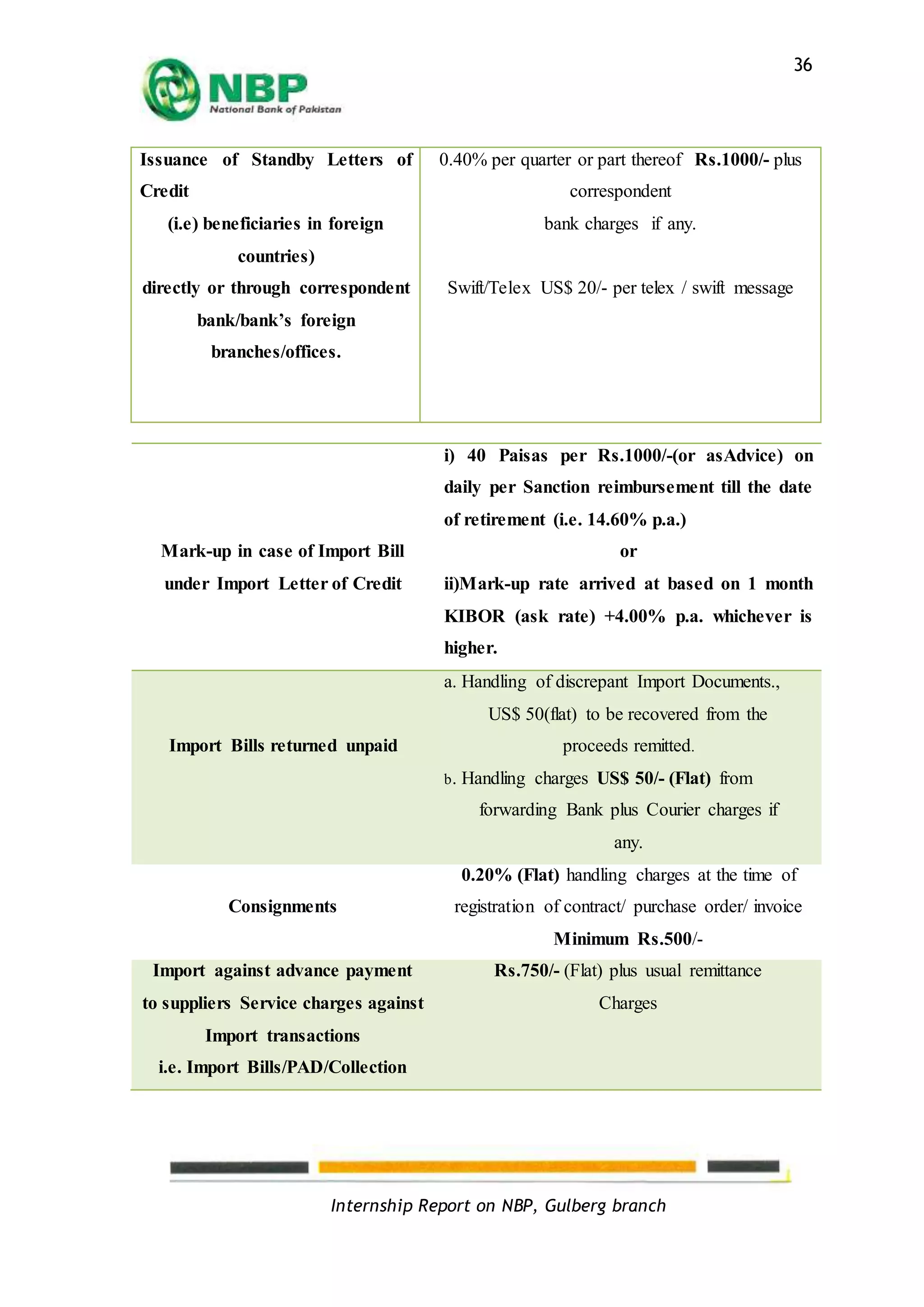
Issuance of Standby Letters of
Credit
(i.e) beneficiaries in foreign
countries)
directly or through correspondent
bank/bank’s foreign
branches/offices.
0.40% per quarter or part thereof Rs.1000/- plus
correspondent
bank charges if any.
Swift/Telex US$ 20/- per telex / swift message
Mark-up in case of Import Bill
under Import Letter of Credit
i) 40 Paisas per Rs.1000/-(or asAdvice) on
daily per Sanction reimbursement till the date
of retirement (i.e. 14.60% p.a.)
or
ii)Mark-up rate arrived at based on 1 month
KIBOR (ask rate) +4.00% p.a. whichever is
higher.
Import Bills returned unpaid
a. Handling of discrepant Import Documents.,
US$ 50(flat) to be recovered from the
proceeds remitted.
b. Handling charges US$ 50/- (Flat) from
forwarding Bank plus Courier charges if
any.
Consignments
0.20% (Flat) handling charges at the time of
registration of contract/ purchase order/ invoice
Minimum Rs.500/-
Import against advance payment
to suppliers Service charges against
Import transactions
i.e. Import Bills/PAD/Collection
Rs.750/- (Flat) plus usual remittance
Charges
Internship Report on NBP, Gulberg branch
37
Processing Charges for Export
Registration
Rs. 200/-(Flat)
Returning charges for export bills Rs. 200/-(Flat)
Letter of Credit
Advising Rs.400/-(Flat)
Amendment Advising Rs.300/-(Flat)
Negotiation of Bills against Letters of
Credit issued under
Barter/Remittance
from SBP
0.25% mininmum Rs.200/-
Confirmation
0.25% per quarter Minimum
Rs.250/-
Transfer of Export L/Cs. Rs. 450/-(Flat)
Reimbursement payment to other local
Bank from Non-Resident Rupee
Account
Rs. 400/-(Flat)
Internship Report on NBP, Gulberg branch
38
EXPORTS
EXPORT BILLS CHARGES
Documents are sent to other banks
for negotiation under restricted Letter of
Credit.
Rs.350/-( Flat)
DUTY DRAW BACK CLAIMS
CHARGES
0.25% of the amount of claim Minimum Rs.250/-
per claim.
Handling of export documents against which
advance payment is received
Rs.200/- (Flat) plus postal charges.
COLLECTIONS CHARGES
Clean Cheques/Drafts/FTCs Rs.100/- per Collection (Flat)
Documentary (on which bank do not earn
any exchange difference)
Rs.200/- per Collection (Flat)
Internship Report on NBP, Gulberg branch
39
REMITTANCES
OUTWARD CHARGES
Foreign Traveller Cheques 1% of the amount of Traveller Cheques sold Min. Rs.200/-
Remittance abroad through Foreign
Currency Account
Commission @ US$ 1.00 per US$ 1,000/- or part
thereof Min. US$ 5.00 Maximum US$ 25.00 plus
Telex / SWIFT charges: Rs.250/- per Telex /SWIFT in
case of telegraphic transfer.
Remittance against surrender of F.C Notes
or cash deposited in F.C Account within 10
days from the date of such deposits
In addition to charges mentioned under 3.1.2. service
charges @ 1.0% to be recovered in case the remittance
amount exceeds US$ 5,000/- or its equivalent in other
foreign currencies.
Inward Collection received (relating to F.C
Account) from abroad or local
banks/branches and where the payment is
demanded in Foreign Currency
US$ 3.00 per US$ 1,000/- or part thereof Minimum
US$ 3.00 Maximum US$ 6.00
Inward cheques expressed in foreign
Currency drawn on foreign currency A/cs
received from local/upcountry bank’s
branches for payment in Pak Rupees after
conversion at authorized dealers
buying T.T clean rates
Commission @ Paisas 15 per Rs. 100/- Minimum
Rs.200/-
Internship Report on NBP, Gulberg branch
40
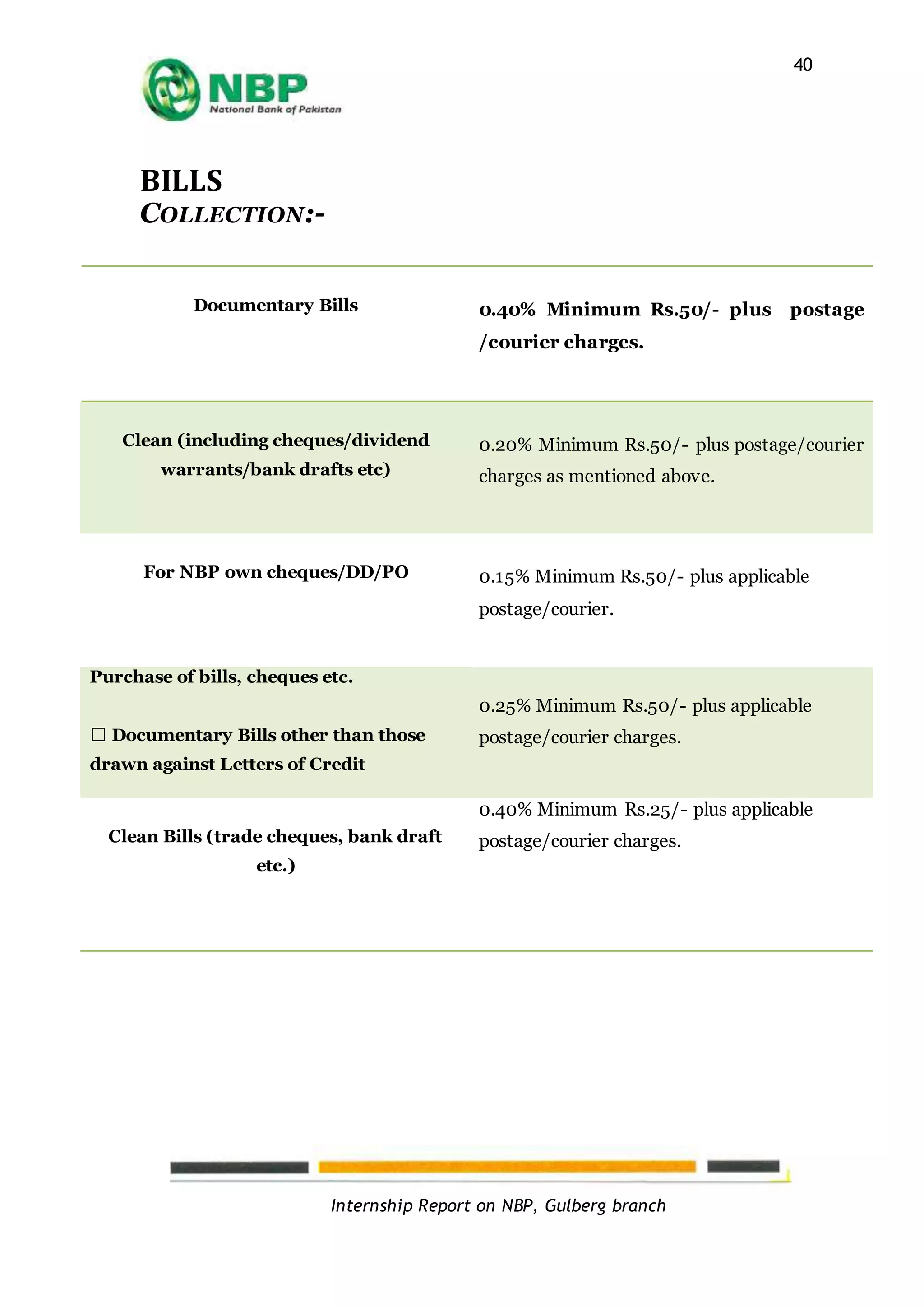
BILLS
COLLECTION:-
Documentary Bills 0.40% Minimum Rs.50/- plus postage
/courier charges.
Clean (including cheques/dividend
warrants/bank drafts etc)
0.20% Minimum Rs.50/- plus postage/courier
charges as mentioned above.
For NBP own cheques/DD/PO 0.15% Minimum Rs.50/- plus applicable
postage/courier.
Purchase of bills, cheques etc.
� Documentary Bills other than those
drawn against Letters of Credit
0.25% Minimum Rs.50/- plus applicable
postage/courier charges.
Clean Bills (trade cheques, bank draft
etc.)
0.40% Minimum Rs.25/- plus applicable
postage/courier charges.
Internship Report on NBP, Gulberg branch
41
At opening end
a. Handling Charges.
b. If bills matures after expiry
of L/C
 Rs.0.40% per bill Minimum
Rs.500/- at the time of
retirement of bill.
 Usual Charges as in (a) above
plus delivery of documents
against acceptance commission
@ 0.10% per month on bill
amount on realisation from the
date of expiry of L/C but
Minimum Rs.500/-.
At Collecting end.
a.Collection Charges
b. In case of purchase
 Commission @ 0.30% Minimum
Rs.200/-
 Usual Commission as in (a) above and
keep mark down @ 0.75% for every 15
days from the date of
purchase till the date of maturity.
Discounting of Inland Usance
Bills
Mark-up @ 25 paisa per Rs.1000/- on daily
product (or per Sanction Advice) plus flat
Commission @0.1%.
Internship Report on NBP, Gulberg branch
42
Project Finances/Advances
Project Application Fee
(Non-refundable)
Following charges will be recovered in
addition to mark-up/Return on
Investment.
Miscellaneous (i.e. charges for
documentation, evaluation of security
and maintenance thereof etc.)
At actual, in addition:
1. Project examination fee @ 0.50%
(flat) after acceptance of sanctioned by the
company but before disbursement of the
total amount of sanctioned (Funded and
Non Funded Both) Minimum Rs.15,000/-
2. Legal documentation fee. @ 0.25%
Flat after acceptance of sanctioned by the
Company but before disbursement of
the total amount of sanctioned (Funded and
Non Funded Both)
3. Project monitoring fee @ 0.50% p.a.
payable quarterly on outstanding amount
(Funded and Non Funded Both)
4. Commitment fee @ 1.50% p.a. payable
quarterly on the un-disbursement amount of
sanction (Funded only)
5. Front End/Arrangement Fee. @
1.50% (Flat) wherever applicable as per
Bank’s discretion.
Internship Report on NBP, Gulberg branch
43
 Godown Rent.
 Salaries of Godown
Keepers/Chowkidars
Actual
Actual
Godown Inspection Charges.
a. Without any municipal limit.
Actual Treatment
� Debit to party account if Godown
Inspection charges are upto Rs.500/- for
payment to staff.
� Debit to party and credit to bank Income
Account if Inspection charges are more than
Rs.500/- and reimbursement of TA/DA
charges through debit
to “Expenditure Account” with the approval
of Competent Authority.
Delivery Charges:-
If a godown keeper is not posted
Conveyance Charges will be
recovered.
Actual
Internship Report on NBP, Gulberg branch
44
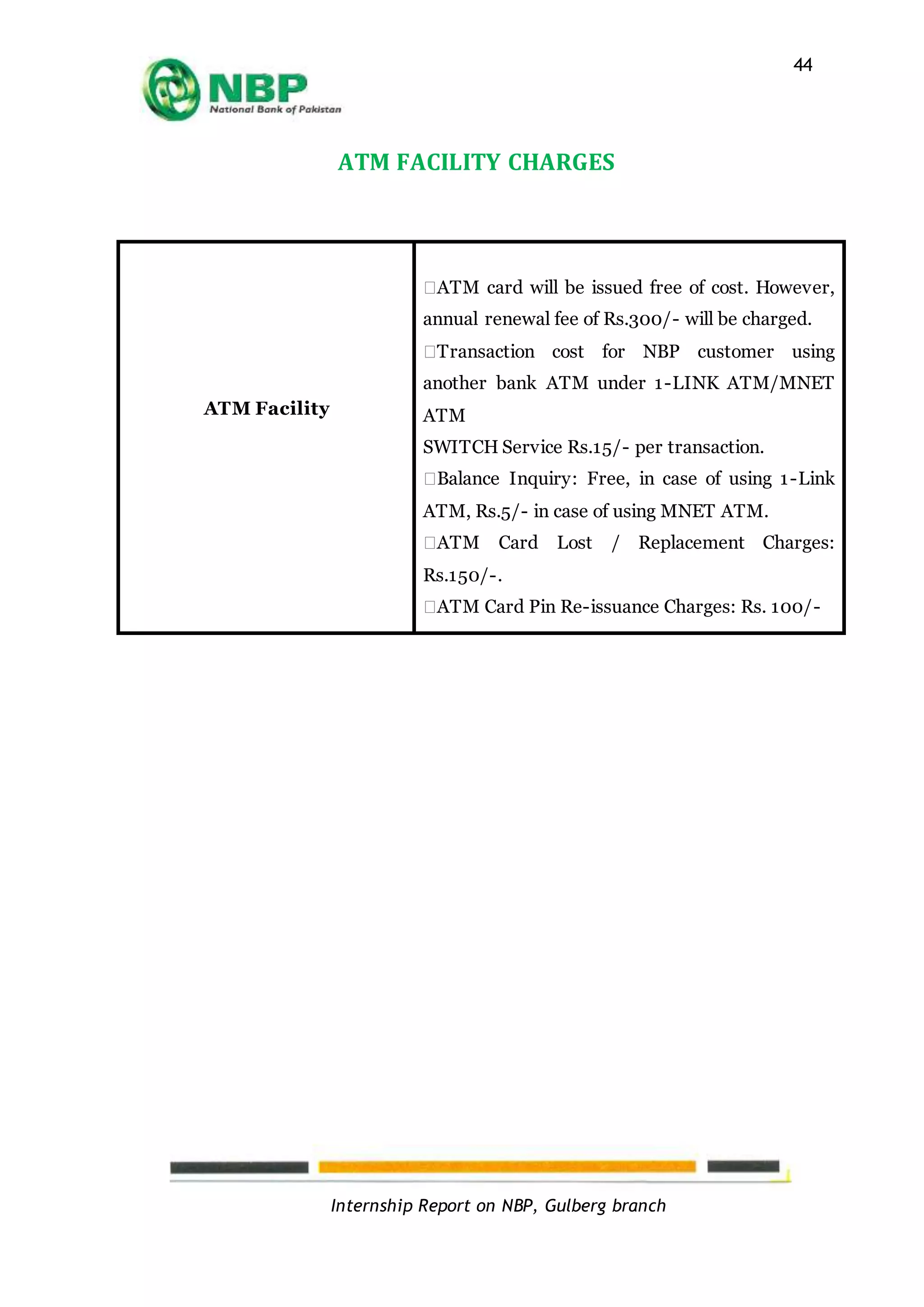
ATM FACILITY CHARGES
ATM Facility
�ATM card will be issued free of cost. However,
annual renewal fee of Rs.300/- will be charged.
�Transaction cost for NBP customer using
another bank ATM under 1-LINK ATM/MNET
ATM
SWITCH Service Rs.15/- per transaction.
�Balance Inquiry: Free, in case of using 1-Link
ATM, Rs.5/- in case of using MNET ATM.
�ATM Card Lost / Replacement Charges:
Rs.150/-.
�ATM Card Pin Re-issuance Charges: Rs. 100/-
Internship Report on NBP, Gulberg branch
45
PLACE
DISTRIBUTION NETWORK
A set of interdependent organizations that help make a product or service available for
use or consumption by the consumer or business use.
It is also known as marketing channel. Company’s channel decision affects every other
marketing mix decision. Marketing channels or distribution channels that look forward
toward the customer. Downstream marketing channel partners such as wholesalers and
retailers, from a vital connection between the firm and its customers.
Pricing Depends on whether the company works with national discount chains, uses high
quality specialty stores or sells directly to consumers over the web.
Promotion and communication Decision depends on how much persuasion, training,
motivation and support its channel partners need.
Acquiring or Developing New product depends upon how well these products fit the
capabilities of its channel members.
NBP BRANCH NETWORK
NBP branch networks include:
 ATM Network
 Domestic Network
 Islamic Network
 Online Network
 Overseas Network
 Swift Network
 Customer Facilitation Centres
 Agriculture Branches
Internship Report on NBP, Gulberg branch
46
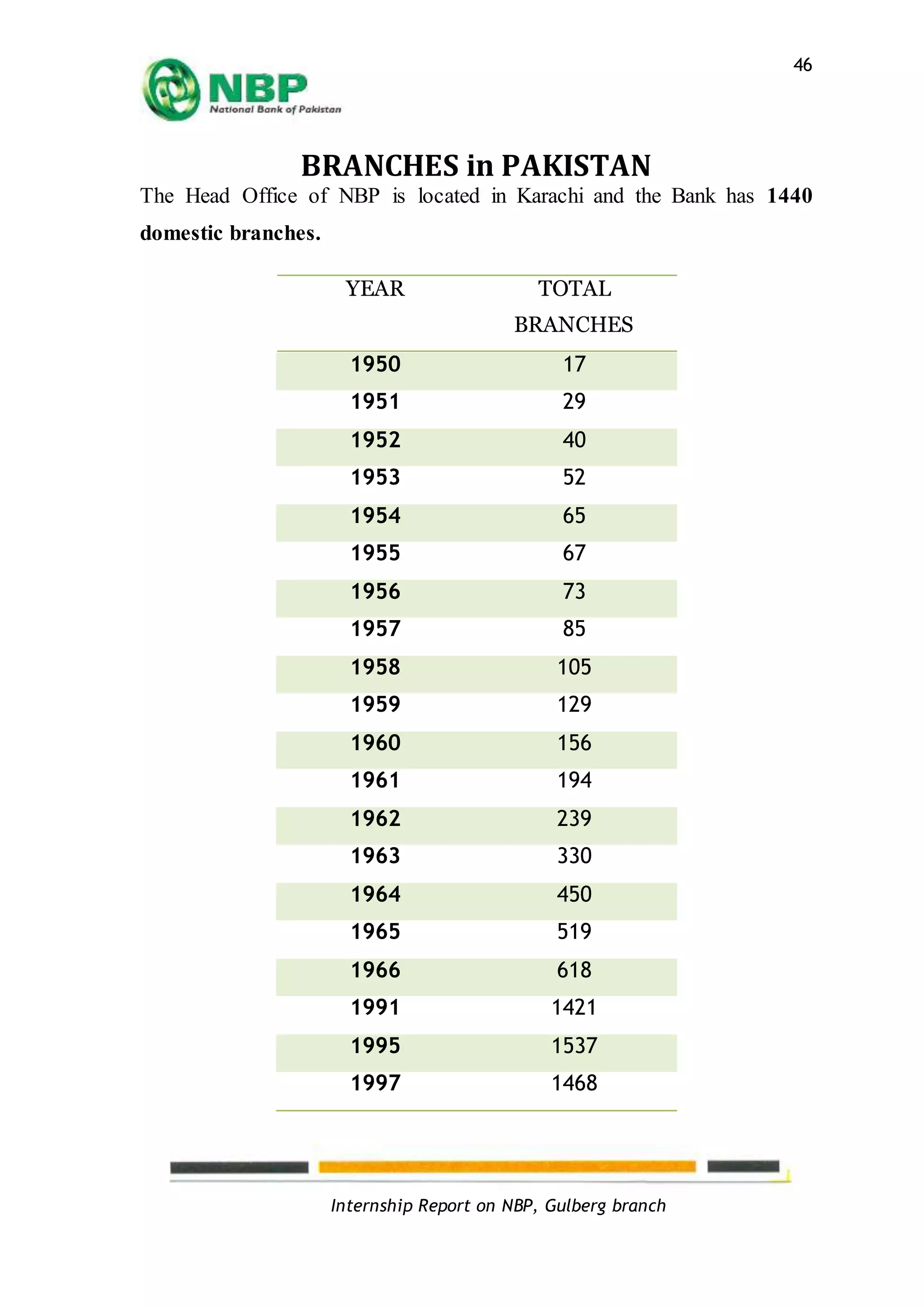
BRANCHES in PAKISTAN
The Head Office of NBP is located in Karachi and the Bank has 1440
domestic branches.
YEAR TOTAL
BRANCHES
1950 17
1951 29
1952 40
1953 52
1954 65
1955 67
1956 73
1957 85
1958 105
1959 129
1960 156
1961 194
1962 239
1963 330
1964 450
1965 519
1966 618
1991 1421
1995 1537
1997 1468
Internship Report on NBP, Gulberg branch
47
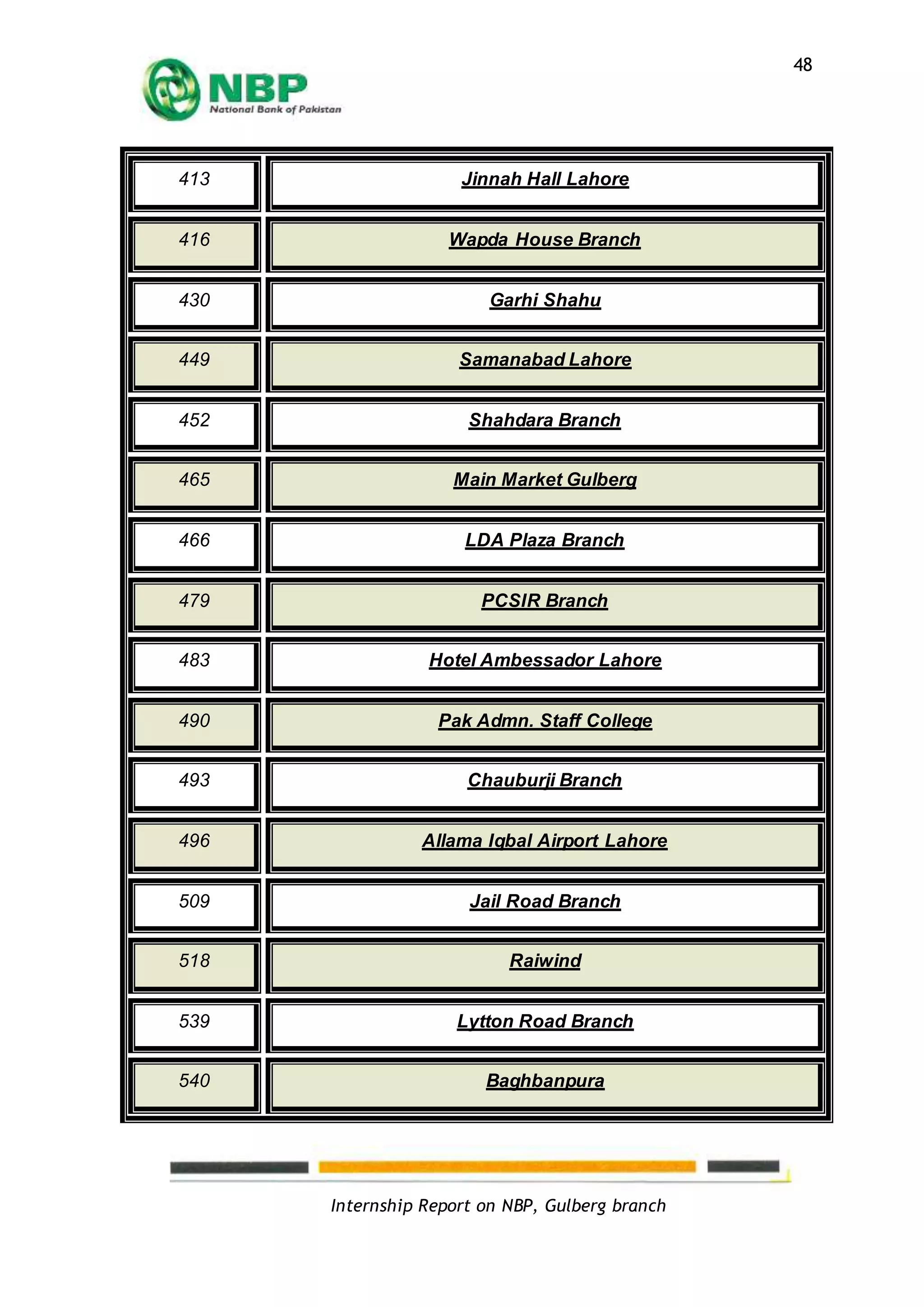
BRANCHES IN LAHORE
Branch
Code
Branch Details
300 Main Branch Lahore (Hub Branch)
303 Anarkali Branch
313 Gardee Trust Building Branch
323 D.H. Society (Circular Road)
324 Civil Secretariate Branch Lahore
356 Lahore Cantt. Corporate Branch
372 Model Town Lahore
390 Pakistan Railway Headquarters
409 Regal Chowk Branch
1998 1434
1999 1434
2000 1375
2001 1245
2016-2010 More than 1287
Internship Report on NBP, Gulberg branch
48
413 Jinnah Hall Lahore
416 Wapda House Branch
430 Garhi Shahu
449 Samanabad Lahore
452 Shahdara Branch
465 Main Market Gulberg
466 LDA Plaza Branch
479 PCSIR Branch
483 Hotel Ambessador Lahore
490 Pak Admn. Staff College
493 Chauburji Branch
496 Allama Iqbal Airport Lahore
509 Jail Road Branch
518 Raiwind
539 Lytton Road Branch
540 Baghbanpura
Internship Report on NBP, Gulberg branch
49
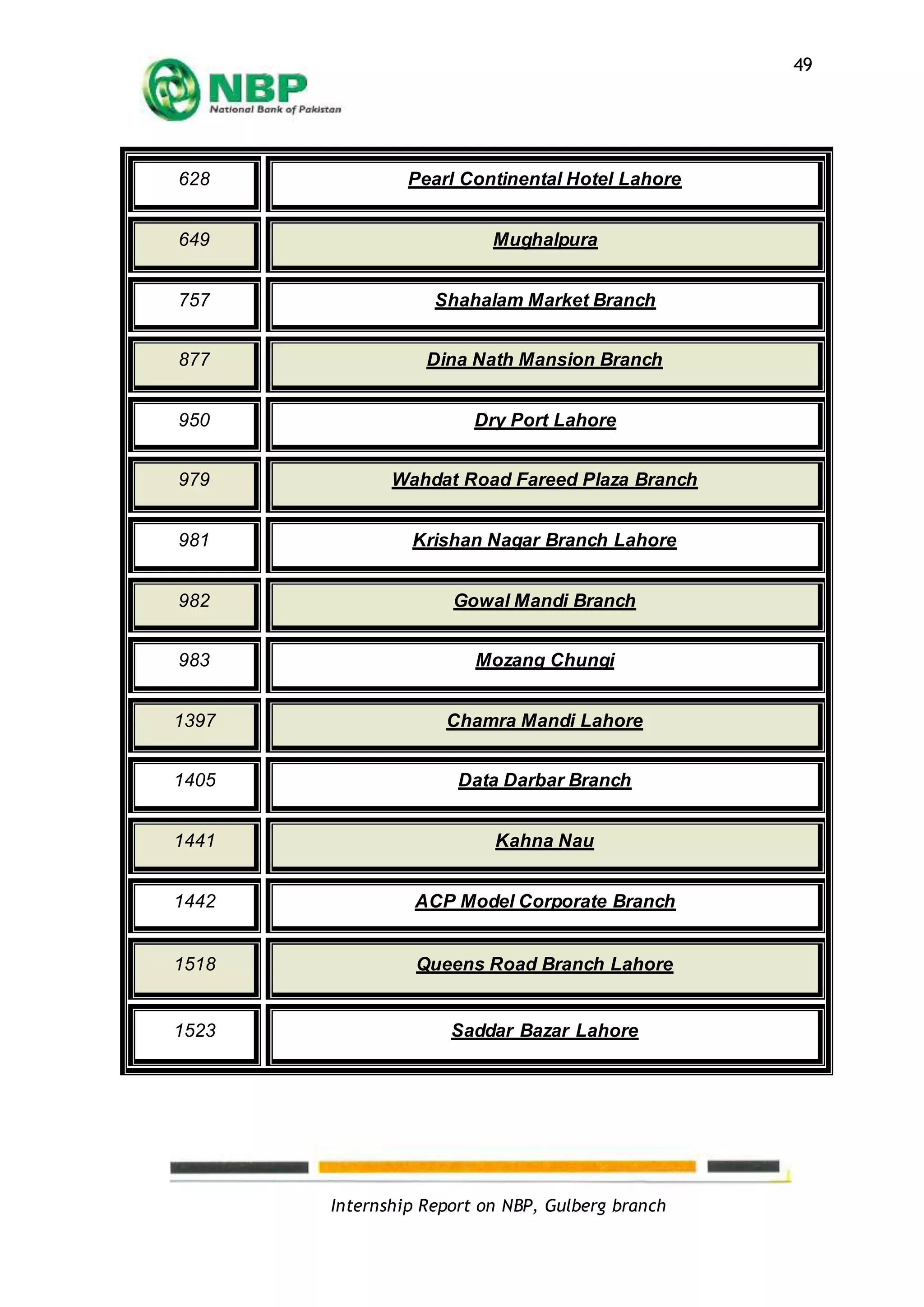
628 Pearl Continental Hotel Lahore
649 Mughalpura
757 Shahalam Market Branch
877 Dina Nath Mansion Branch
950 Dry Port Lahore
979 Wahdat Road Fareed Plaza Branch
981 Krishan Nagar Branch Lahore
982 Gowal Mandi Branch
983 Mozang Chungi
1397 Chamra Mandi Lahore
1405 Data Darbar Branch
1441 Kahna Nau
1442 ACP Model Corporate Branch
1518 Queens Road Branch Lahore
1523 Saddar Bazar Lahore
Internship Report on NBP, Gulberg branch
50
1524 Davis Road
1537 New Garden Town
1569 Model Branch Gulberg (Hub Branch)
1587 Ismail Nagar
1606 Multan Road Branch
1607 New Muslim Town
1618 Walton Road
1619 Lady Willington Hospital
1655 Shahpur Kanjran
1669 Township Branch
1707 Shaikh Zaid Hospital
1741 Faisal Town Lahore
1857 Rehman Plaza Corporate Branch
1887 Allama Iqbal Town Lahore
Internship Report on NBP, Gulberg branch
51
1917 Tech. Society Branch
1948 Mall Road Punjab Provincial Assembly
1966 Block 'Y' Commercial Area Phase-III DHA,
1996 Bund Road Gulshan-e-Ravi Lahore
1997 Badami Bagh Lahore
2045 University of Punjab Quaid-e-Azam Campus Lahore
Internship Report on NBP, Gulberg branch
52
PROMOTION
“Promotion means activities that communicate the merits of the product and
persuade target customers to buy it”
Building good customer relationships calls for more that just developing a good
product, pricing it attractively and making it available to target customers.
Companies must also communicate their value proposition to customers and
what they communicate should not be left to chance. All of their communications
must be planned and blended into carefully integrated marketing
communications programs. Just as good communication is important in building
and maintaining any kind of relationship, it is a crucial element in a company’s
efforts to build profitable relationships.
PROMOTION TOOLS
PROMOTIONAL ACTIVITIES AT NBP
Promotion is one of the most important contributors to the success of any organization
whether it is a banking company or a non-banking company. NBP realizes the importance
of this variable of marketing mix. In today’s competitive environment “promotion” has
emerged as an important factor along with the quality of services and products.
Although NBP has not much involved in promotional activities but they are trying to
develop such activities to attract customers. A bank with marketing philosophy and
orientation, the client is always placed at the centre of the business and all of the products
and services are designed to serve the customers in best possible way.
Through organizing sports events NBP is trying to increase its Public relations.
Explanation of sport events are given below:
Internship Report on NBP, Gulberg branch
53
SPORTS
Physical activity is essential for everyone. It Builds self Confidence and can be an
excellent group activity for your family and friends. Exercise is an activity that transcends
age. The NBP sports Complex is open for all its customers and for others also.
SPORT COMPLEX
Recently, Mohammed Mian Soomro, the caretaker prime Minister of Pakistan, performed
the formal inauguration of the National bank of Pakistan (NBP) Sport Complex in
Clifton. Sindh Governor, Dr. Ishrat-ul-Edab khan, provincial minister and Governor of
State Bank of Pakistan, Dr. Shamshad Akhtar have also graced the occasion.
The Caretaker Prime Minister in his inaugural speech had stated that the whole NBP sport
Complex was very well planned and deserved compliments for the architecture that made
optimum use of the space. He also says that Health and sports compliment each other
because healthy minds and bodies are less susceptible to ailments.
So the Bank organizes and develops the sport complex for the sake of society and those
people who are not avail the healthy life.
The NBP chief was of the view that the sports wing of his Bank was the most organized
one in the country. He said the NBP sponsors sports in all parts of the country and
provides jobs to sportsmen.
Syed Ali Raza said that to tap the talent, the NBP has been organizing coaching camps
for crickets, hockey and football in various parts of the country at the grassroots level.
Advertisements in the Press:
NBP mostly gives advertisements for its products and services in some of the leading
newspapers. Advertisements for job opportunities are also placed in the daily newspaper
magazines.
Internship Report on NBP, Gulberg branch
54
PEOPLE
Number of Employees of National Bank of Pakistan
Permanent 13237
Temporary/ On Contractual basis 842
Bank's own staff strength at the end of the year 14079
Outsourced 2350
Total Staff Strength 16429
An employee may be defined as: "A person in the service of another under any contract
of hire, express or implied, oral or written, where the employer has the power or right to
control and direct the employee in the material details of how the work is to be
performed." iAn employee contributes labor and expertise to an endeavor. Employees
perform the discrete activity of economic production. Of the three factors of production,
employees usually provide the labour. Specifically, an employee is any person hired by
an employer to do a specific "job". In most modern economies, the term employee refers
to a specific defined relationship between an individual and a corporation, which differs
from those of customer, or client. The relationship between National Bank of Pakistan
and its employees is usually handled through the Human Resource Management &
Administration Group & Employees benefit disbursement & trustee division. These
groups handle the incorporation of new hires, and the disbursement of any benefits which
the employee may be entitled, or any grievances that employee may have.
ii
Internship Report on NBP, Gulberg branch
55
There are differing classifications of workers within National Bank of Pakistan, these
are:
Permanent
Temporary / On Contractual
Outsourced
The Employees of National Bank of Pakistan are organizing into trade unions, which
represent most of the available work force in National Bank of Pakistan. These trade
Unions utilize their representative power to collectively bargain with the management of
bank in order to advance concerns and demands of their membership.
Internship Report on NBP, Gulberg branch
56
PROCESS
Provincial & Regional processes
There are four executives of National Bank of Pakistan to supervise the Bank’s maters of
every province, as they are called Provincial Chiefs. These provincial chiefs are
responsible for the entire banking operations in their respective provinces. The provincial
management includes:
The Provincial Chief Punjab
The Provincial Chief Sind
The Provincial Chief Baluchistan
The Provincial Chief N.W.FP & Kashmir
These provinces are sub-divided into regions, the regions are controlled and manage by
Regional heads, which are responsible for the supervision in their circles and deal with
the problems of their respective Regions. The regional management of National Bank of
Pakistan is divided into two areas which are:
Overseas
Countrywide
The overseas regions include Middle East, Far East, Europe & USA, and Central Asia.
The country has been divided into 29 regions by National Bank of Pakistan to facilitate its
functions. The detail about National Bank of Pakistan’s regions is shown as Annexed-II at
the end of the report. These regions are sub divided into Zones, the in charge of a Zone is
called Zonal Chief.
Internship Report on NBP, Gulberg branch
57
Branch processes
The National Bank of Pakistan, in order to facilitate its functions on branch level appoints
Branch Managers & other staff according to branch’s activities and volume of business.
The branch managers are responsible for all functions and staff within the branch office.
The job of branch managers is to take charge of the entire operation of his branch, making
sure that everything runs smoothly. The other functions involves scheduling of employee
work hours, overseeing training, hiring and firing, assuring that proper procedures are
followed, and reporting to upper management any problems or providing reports and
updates as required by bank’s protocol.
Internship Report on NBP, Gulberg branch
58
FINANCIAL ANALYSIS
FINANCIAL HIGHLIGHTS - 2016
Rs. In Million
Authorized Capital 7,500
Paid-up Capital 7,091
Shareholders’ Equity & Reserves 81,954
Deposits 501,872
Advances-Net 316,110
Investments-Net 139,947
Total Asset 635,133
Pre-Tax Profit 26,311
After-Tax Profit 17,022
No. of Branches 1,250
No. of Employees 14,091
Internship Report on NBP, Gulberg branch
59
ASSETS (Rupees in ‘000)
2016 2015
2014
Cash and balances with treasury
banks
115,827,868 106,503,756 94,873,249
Balances with other banks 28,405,564 38,344,608 37,472,832
Lending to Financial Institutions 19,587,176 17,128,032 21,464,600
Investments 217,642,822 170,822,491 211,146,038
Advances 475,243,431 412,986,865 340,318,930
Operating Fixed Assets 25,147,192 24,217,655 25,922,979
Deferred Tax Assets 3,062,271 3,204,572 -
ther Assets 59,316,438 44,550,347 30,994,965
944,232,762 817,758,326 762,193,593
LIABILITIES
Bills payable 10,621,169 10,219,061 7,061,902
Borrowings 45,278,130 40,458,926 10,815,176
Deposits and other Accounts 726,464,825 624,939,016 591,907,435
Sub-ordinated loans - -
Liabilities against assets subject to
finance lease
42,629 25,274 33,554
Deferred Tax Liabilities - - 5,097,831
Other Liabilities 42,269,623 39,656,831 30,940,041
824,676,384 715,299,108 645,855,939
NET ASSETS 119,556,378 102,459,218 116,337,654
REPRESENTED BY
Share Capital 10.763,702 8,969,751 8,154,319
Reserves 22,681,707 19,941,047 15,772,124
Unappropriated profit 61,346,510 52,456,204 45,344,188
94,791,919 81,367,002 69,270,631
Internship Report on NBP, Gulberg branch
60
INCOME STATEMENT
Surplus on revaluation of Assets 24,764,459 21,092,216 47,067,023
119,556,378 102,459,218 116,337,654
Income Statement
2016 2015
Mark-up/Return/Interest earned 77,947,697 60,942,798
Mark-up/Return/Interest expensed 39,489,649 23,884,768
Net-Mark-up/interest Income 38,458,048 37,058,030
provision against non-performing advances 11,043,469 10,593,565
Provision for/(reversal of) diminution in the value of
investment
605,629 373,249
Provision against off balance sheet obligations 20,237 4000
Bad debt written off directly - -
Mark-up/interest Income after provisions 26,788,713 26,087,216
Non-Mark-up/interest Income
Fee, commission and brokerage income 8,930,391 7,925,370
dividend income 1,920,336 2,878,932
Income from dealing in foreign currencies 3,028,165 3,969,057
Gain on sale and redemption of securities-net 4,591,894 395,427
Unrealized/(loss) on revaluation of investments
classified as held-for-trading
2,355 1,707
Other income 552,216 1,245,369
Total Non-Mark-up/interest Income 19,025,357 42,503,078
45814,070
Non-Mark-up/interest expenses
Administrative expenses 22,571,470 18,171,198
Internship Report on NBP, Gulberg branch
61
HORIZONTAL ANALYSIS
(Balance Sheet)
Other provisions/write offs 620,780 747,521
Other charges 321,647 583,367
Total Non-Mark-up/interest expenses 23,513,897 19,502,080
22,300,173
Profit Before Taxation 9,221,513 23,000,998
Taxation-current (4,133,282) 11,762,650
-prior years (999,904) -
-deferred 4,088,327 (4,220,242)
18,211,846 7,542,408
Profit After Taxation 15,458,590
Un-appropriated profit brought forward 52,456,204 45,344,188
Transfer from surplus on revaluation of fix assets on
account of incremental depreciation
123,934 130,456
Profit available for appropriation 70,791,984 60,933,234
Assets 2016 2015(%) Growth
Cash & Balances with treasury Banks 108.7 112 10
Balances with other banks 74.08 102 -12
Lending to financial institutions-net 114.36 80 -3
Investment-net 127.41 81 4
Advances-net 115.07 121 18
Operating fix assets 103.83 93 -2
Deferred tax Assets-net 95.56
Internship Report on NBP, Gulberg branch
62
Interpretation
Index analysis of balance sheet shows that "Cash & Balances with treasury
Banks" growth rate is 10% which caused by increase 8% in 2016 and 12% in 2015,
Advances-net grow by 18% in current year increase by 15% as compare to 21% in 2015.
Operating fixed assets growth rate 80.5% but current year Operating fixed decrease by
2% Other assets also show a greater increase from 33% to 44% in current year and its
growth rate approximately 38%,while lending to financial institution shows declining
trend since last few years over all declining 3% but in current year this trend is changing
and growthth rat is 14%.
Bill payable & deposit in other banks also increasing with growth rate 24%
respectively, Equity show positive trend with growth rate of 17% this is because of
Other assets 133.14 144 38
Liabilities 115.46 107 11
Bill payables 103.93 145 24
Borrowings 109 374 133
Deposit and other accounts 116.25 106 11
Liabilities against assets subject to finance lease 168.67 75 21
deferred tax liabilities-net - - -
other liabilities 106.6 128 17
115.30 111 26
Net Assets 116.68 88 2
Represented By
Share capital 120 110 15
Reserves 113.74 126 20
Unappropriated profit 116.95 116 16
116.50 117 17
Surplus on revaluation of Assets-net 117.41 45 -6
116.68 88 2
Internship Report on NBP, Gulberg branch
63
Reserves and Un-appropriated profit increasing with rate of 20% and 16% & Share
capital increasing with 15%. Liabilities growing by 14% Other liabilities increase from
16% to 28% with growth rate 26%, Borrowing and Liabilities against subject to finance
lease show greater increase with growth rate of 21%.
HORIZONTAL ANALYSIS
(Income Statement)
2016(%) 2015(%) Growth
Mark-up/Return/Interest earned 127.90 120.5 23.5
Mark-up/Return/Interest expensed 165.33 141 31
Net-Mark-up/interest Income 103.78 110 10.5
provision against non-performing advances 104.25 224 89
Provision for/(reversal of) diminution in the value of
investment
162.26
-927 -561
Provision against off balance sheet obligations 505.90 327.5
Bad debt written off directly - 232 116
Mark-up/interest Income after provisions 102.70 90.25 -2.85
Non-Mark-up/interest Income
Fee, commission and brokerage income 112.68 117 13.6
dividend income 66.70 88.22 0.53
Income from dealing in foreign currencies 76.30 380.6 179
Gain on sale and redemption of securities-net 116.12 17 9
Unrealized/(loss) on revaluation of investments
classified as held-for-trading
137.96
-5.34 310
Other income 44.34 845 384
Total Non-Mark-up/interest Income 44.76 121 16
Non-Mark-up/interest expenses
Administrative expenses 124.22 127 16
Other provisions/write offs 83 445 -264
Internship Report on NBP, Gulberg branch
64
Interpretation
Markup/interest earned increasing at the rate of 23.5% on other hand Interest
expenses also increasing with the rate of 31% that’s why, Net markup/interest income
after provisions decrease by 10% as compare to last year Interest Income After provision
decreasing with rate of approximately 3% this decrease is because of increase in
Provision against off balance sheet obligations and Bad debts written off directly with
rate of 218% & 116%,and Provisions against Non performing assets with greater increase
rate about 81% but on the other hand Provisions for/diminution in the rate of investment
shows greater decrease at rate of 561%,Total Non Markup/Interest Income increase in
current year increase from 11% to 21% with rate of 16% this increase is because of
greater increase in Other Income and Unrealized/on revaluation of investment classified
as held for trading with rate of 384%& 310 respectively and Income from dealing in
foreign currencies, current year shows greater increase of 380% as compare to last year
with rate of 179%.
Profit Before taxation shows declining trend 18% decrease in current year profit
with decreasing rate of 6% this decrease is caused by greater increase in Interest expense
Other charges 55.14 3403 1655
Total Non-Mark-up/interest expenses 120.6 135 20
82 -6
Profit Before Taxation 40.09 82 -6
Taxation-current 35.14 141 19
-prior years -63
-deferred 96.88 -1304 -390
241.50 84 -10
Profit After Taxation 76 -6
Un-appropriated profit brought forward 115.68 141 54
Transfer from surplus on revaluation of fix assets
on account of incremental depreciation
95
334 164
Profit available for appropriation 116.18 119 17.5
Internship Report on NBP, Gulberg branch
65
increase from 5% to 35% with 200% growth rate this increase is because of greater
increase in other charges with growth rate of 1655%, Admin expense increase from 5% to
27%, Profit after tax in current year less than the previous year because of greater
increase in Current taxation by 37% as compare to last year tax.
VERTICLE ANALYSIS
(Balance sheet)
Assets 2016 2015 2014
Cash & Balances with treasury Banks 12.26 13.02 12.4
Balances with other banks 3 4.7 4.9
Lending to financial institutions-net 2.07 2.1 2.81
Investment-net 23.05 21 27.7
Advances-net 50.33 50.5 44.7
Operating fix assets 2.66 3 3.4
Deferred tax Assets-net 0.32 0.4 0
Other assets 6.28 5.5 4.066
Liabilities
Bill payables 1.12 1.43 1.1
Borrowings 4.80 5.7 1.7
Deposit and other accounts 76.93 87 92
Sub-ordinate loans
Liabilities against assets subject to finance lease 0.004 0.0035 0.0052
deferred tax liabilities-net 0 0.8
other liabilities 4.48 5.5 5
87.34 87.5 85
Net Assets 12.66 12.5 15
Represented By
Share capital 1.14 11 11.77
Reserves 2.40 24.5 23
Internship Report on NBP, Gulberg branch
66
RATIO ANALYSIS
Ratios simply mean a number expressed in terms of another. A ratio is a statistical
yardstick by mean of which relationship between two or various figures can be compared
or measured. Thus Ratio Analysis shows the relationship between accounting data. Ratio
can be found out by dividing on number by another number. Ratio analysis is an
important and age old technique of financial analysis. Following are some of the
advantages of ratio analysis.
Some important and commonly used ratios are as follow.
1. Liquidity Ratio
This ratio show the firms ability to meet the short term obligations
 Current Ratio
 Quick Ratio/Acid test Ratio
2. Activity Ratio
This ratio shows the effective performance of the firm.
 Receivable Turnover ratio
 Inventory Turnover ratio
 Payable Turnover ratio
 Total Asset Turnover ratio
 Fixed Asset Turnover ratio
3. Financial Leverage Ratio
This ratio shows the extent to which the firm is financed by debts.
Un-appropriated profit 6.50 64.5 65.5
10.03 10 9
Surplus on revaluation of Assets-net 2.62 2.5 6
12.66 12.5 15
Internship Report on NBP, Gulberg branch
67
 Long Term debt to equity
 Total Capitalization
 Long Term debt to Assets
 Debt ratio
4. Profitability Ratio
This ratio shows how effectively firm is using its assets.
 Gross Profit Margin
 Return on Investment
 Operating Profit Margin
 Net Profit Margin
 Return on equity
5. Coverage Ratio
This ratio shows the ability of firm to meet its interest from earning before interest and
tax.
 Time interest earned ratio
6. Market Ratio
This ratio shows the worth of the firm in the market.
 Earning per share
 Price earning ratio
 Book value per share
Internship Report on NBP, Gulberg branch
68
LIQUIDITY RATIOS
CURRENT RATIO
RATIO HOW
CALCULATED
2016 2015 2014 2013
Current
Ratio
Current Assets
Current Liabilities
115,827,868 +
28,405,564 +
19,587,176 +
59,316,438
106,503,756+
38,344,608+
17,128,032+
44,550,347
94,873,249+
37,472,832+
21,464,600+
30,994,965
78,625,227+
40,641,679+
23,012,732+
27,113,698
10,621,169 +
45,278,130 +
726,464,825 +
42,269,623
10,219,061+
40,458,926+
624,939,016+
39,656,831
7,061,902+
10,815,176+
591,907,43
+ 30,940,041
10,605,663+
11,704,079+
501,872,243
+26,596,300
223,137,046 206,526,743 184,805,646 169,393,336
824,633,747 715,273,834 108,007,862 550,778,285
0.271 0.289 1.711 0.308
Interpretation:
 The above analysis of current ratio shows that the current ratio has fluctuated over
four years time . It is maximum in 2014 that is 1.711 but again decreased in 2015
and 2016. The Bank’s cash flows and other assets are not predictable; therefore the
current ratio is not acceptable.
The current ratio of 2016 indicates that for every worth Rs.1 current liability, the bank
has the current assets of worth Rs. 0.289 which is not favourable and unacceptable.
Internship Report on NBP, Gulberg branch
69
ADVANCES TO TOTAL DEPOSIT RATIO
Interpretation:
The advances to total deposit ratio indicates that the deposits are more than the advances
and that there has been a declining trend for the years 2013 to 2014 but increasing in 2014
to 2016. The bank is not spending, utilizing or using its deposits in several sectors of
economy on which the Bank is loosing returns, which could have been earned by
advancing them.
Although the advances and deposits have increased from previous years but the altogether
effect is not favorable. There should be little more advances.
RATIO HOW
CALCULATED
2016 2015 2014 2013
Advances
to total
Deposits
ratio
Advances
Total Deposits
475,243,431 412,986,865 340,318,930 316,110,406
726,464,825 624,939,016 591,907,435 501,872,243
0.654 0.661 0.575 0.630
Internship Report on NBP, Gulberg branch
70
INTEREST COVERAGE RATIO
Interpretation:
The ratio is decreasing over previous 3 years 2005 t0 2015 but in 2016 it is increasing
which is good sign and it shows the bank strength to pay off its financial charges in form
o f interest. This ratio should be higher. The bank has earned the interest from the
advances being spent in different sectors of the economy.
RATIO HOW
CALCULATED
2016 2015 2014 2013
Interest
Coverage
ratio
Profit before Tax
Interest
Expensed
28,221,513 23,000,998 28,060,501 26,310,577
23,513,897 19,502,080 14,391,079 13,634,485
1.231 1.179 1.949 1.929
Internship Report on NBP, Gulberg branch
71
PORTFOLIO MANAGEMENT RATIO
Interpretation:
 The ratio shows that the advances increased in 2016 but not to a greater extent
since assets other than advances have too increased causing the total assets to rise.
 It illustrates that the Bank is using other sources of income besides its core
operation as well.
RATIO HOW
CALCULATED
2016 2015 2014 2013
Advances
to total
assets
ratio
Advances
Total Assets
475,243,431 412,986,865 340,318,930 316,110,406
944,232,762 817,758,326 762,193,593 635,132,711
0.7892 0.5050 0.4465 0.4977
Internship Report on NBP, Gulberg branch
72
FINANCIAL LEVERAGE RATIO
DEBT EQUITY RATIO
RATIO HOW
CALCULATED
2016 2015 2014 2013
Debt to
Equity
Ratio
Long term Debt
Equity
10,621,169
+
45,278,130
+
726,464,825
10,219,061+
40,458,926+
624,939,016
7,061,902+
10,815,176+
591,907,435
10,605,663+
11,704,079+
501,872,243
94,791,919 81,367,002 69,270,631 53,044,649
8.201 8.303 8.803 9.882
Interpretation:
 The Debt to Equity ratio of 2016 tells us that the creditors are providing 8.201
paisa for financing for each Rs. 1 being provided by share holders for the year
2015 which has decreased from the previous years. Creditors would generally like
this ratio to be low. The low the ratio, the higher the level of Bank’s financing that
is being provided by shareholders and creditors.
Internship Report on NBP, Gulberg branch
73
DEBT TO TOTAL ASSETS RATIO
Interpretation:
 The greater the ratio, the lesser is the firm’s financial risk. From year 2013 to
2016, it is stable while maximum in 2015 which shows the proportion of assets
being financed by debt has decreased.
RATIO HOW
CALCULATED
2016 2015 2014 2013
Debt to
Total
Assets
ratio
Total Debt
Total Assets
824,676,384 715,299,108 645,855,939 553,178,593
944,232,762 817,758,326 762,193,593 635,132,711
0.873 0.874 0.847 0.871
Internship Report on NBP, Gulberg branch
74
PROFITABILITY RATIO
NET PROFIT MARGIN
Interpretation:
 In year 2013, the profit generated was huge. The net interest income has increased
over the three year span. During 2015, the profitability position was much better
than 2005. The markup interest expensed was less as compared to 2014 and 2005.
 The profitability has declined in 2015 but still good enough. But in 2016 it has
decreased much which is not good sign.
RATIO HOW
CALCULATED
2016 2015 2014 2013
Net
profit
margin
ratio
Net profit after
Taxation *100
Interest Earned
15,458,590 19,033,773 17,022,346
77,947,697 60,942,798 50,569,481 43,788,628
25.37 37.64 38.87
Internship Report on NBP, Gulberg branch
75
RETURN ON ASSETS
Interpretation:
 This ratio measures overall effectiveness in generating profits with available
assets; earning power of invested capital. The ratio has increased in 2013 and then
declined in 2015.
 This ratio should be higher.
RATI
O
HOW
CALCULATE
D
2016 2015 2014 2013
Return
on
Assets
Net profit After
Taxation
Total Assets
15,458,590 19,033,773 17,022,346
944,232,76
2
817,758,32
6
762,193,59
3
635,132,71
1
0.0189*100 0.0249*100 0.0268*100
1.89 2.497 2.680
Internship Report on NBP, Gulberg branch
76
RETURN ON ASSETS
Interpretation:
 This ratio measures overall effectiveness in generating profits with available
assets; earning power of invested capital. The ratio has increased in 2013 and then
declined in 2015.
 This ratio should be higher.
RATIO HOW
CALCULATED
2016 2015 2014 2013
Return
on
Assets
Net profit After
Taxation
Total Assets
15,458,590 19,033,773 17,022,346
944,232,762 817,758,326 762,193,593 635,132,711
0.0189*100 0.0249*100 0.0268*100
1.89 2.497 2.680
Internship Report on NBP, Gulberg branch
77
RETURN ON EQUITY
Interpretation:
This ratio is more meaningful for share holders who are interested to know the profit
earned by the company because the dividend paid from available profit higher ratio
means factor of production fully utilized and good position. Here ratio is stable in 2005
and 2013 but decrease in 2014 and 2015.Decreasing trend of this ratio is an alarming sign
for the Bank.
RATIO HOW
CALCULATED
2016 2015 2014 2013
Return
on
Equity
Net profit After
Tax
Capital Fund
15,458,590 19,033,773 17,022,346
94,791,919 81,367,002 69,270,631 53,044,649
0.1899 0.275 0.321
Internship Report on NBP, Gulberg branch
78
DEPARTMENTS
ACCOUNTS DEPARTMENT
National Bank of Pakistan accepts / collectors deposits from their account holders.
For this purpose account opening from is provided to the potential customers. At the same
time introduction of the customer is done before the manager by existing account holder
or officer of the bank who knows the depositor very well. Manager takes the depositor’s
signatures on signature specimen card in order to avoid from discrepancy. Accountant
compares the signature of check with signatures of the card before passing the check. All
the rules and regulation of opening of account can be changed at any time by the Bank.
Depositor can open following types of accounts with the National Bank of Pakistan: -
 Current / Demand Account
 PLS (profit and loss scheme) Account
a) Short Notice Term Deposit
b) Long Notice Term Deposit
 MIS (Monthly Income Scheme)
The system adopted by NBP to cash the cheque is bit difficult as compare to other
banks in Pakistan. Particularly what I have seen at Main Branch is totally non-
professional behavior. There is no direct coordination between cashier, signature
checking authority and cheque entry person.
1.1 Current/Demand Account
From this account depositors can draw amount at any time by presenting the
checks in the Bank. People deposit their money in this account because there is no
restriction of heavy withdrawals. The Bank neither pays interest nor deducts the Zakat
from the deposits of this account. The Bank also does not take any service charges up to
the minimum balance of account from the depositors. The minimum balance required to
Internship Report on NBP, Gulberg branch
79
opened an account is Rs. 500/-. If the balance declines from the minimum
balance, the Bank charges Rs. 25/- as incidental charges. In developed and under
developed countries a very significant part of money is kept under current or
demand account. In NBP normally this account is opened by the businessmen.
1.2 Profit & Loss scheme Accounts
In fact this type of deposits is designed to encourage the saving habits of nation.
The minimum amount requires to open the account is Rs. 100/-. The account holder gets
the profit at the rate of 7% annually expected (subjected to the bank’s profit) which is
calculated and announced on the half yearly basis. Now the Bank has introduced the
change in this scheme that account holder can draw the required amount at any time. This
deposit carries a small portion of the bank’s total deposits.
1.3 PLS Term Deposits
In this type of account the amount is deposited for a specific period of time then
the profit is given to the customers. Its period may be short (7-days) or long (5-years). So
with the change in time period profit rate varies. That is why NBP term deposits are
divided into two types.
1- Short Notice Term Deposits
2- Long Notice Term Deposits
The period of short notice term deposits (SNTD) ranges from 7-days to 30-days or
one month. Its profit rate is 6.3% annually. 29 days to 3 month deposits are also lies in the
scheme of SNTD and its rate of profit is 7.3% annually. The minimum balance required
to open this account is Rs. 10.000/- and there is no maximum limit. Financial institutions
are not allowed in both cases.
While the period of long notice term deposits ranges from 3-months to 5-years
and above and the minimum balance required to open this account is Rs. 10,000/- and
Internship Report on NBP, Gulberg branch
80
there is no maximum limit. So with the change in the time period of the amount deposited
the rate of profit is also changed. Financial institutions are not allowed in both cases.
1.4 MIS (Monthly Income Scheme)
In this scheme amount is deposited for the five years. The minimum
balance required to open MIS account is Rs. 10, 0000/-. There is no maximum
balance but the amount deposited would be in the multiple of 10,000. The
depositor gets the profit at the rate of 16% annually. As the name of the scheme
shows that the depositor gets a fixed amount monthly for five years.
1.5 Call Deposit (CD)
Call deposits are not actual deposits of Bank. It is in fact the liability of the Bank.
Call deposits are often prepared by the Bank for contractors.
Procedure
In the preparation of the call deposit the following steps are involved: -
1- Depositor fills the voucher no F-17. He writes the following information :
 Name of Company
 Amount
 Date etc.
2- He deposits the cash along with the filled voucher in the cash department. Cashier
affixes the cash received stamp after writing the amount paid in red ink. Then the
voucher is sent to the accounts department.
3- The accountant writes the amount paid in the cash scroll register from the voucher.
Then he gives the call deposit leaf to the assistant.
4- Assistant filled the call deposit leaf according to the information provided in the
voucher. After entering the call deposit number, name of company, address, amount
and date in call deposit register then he sends the prepared call deposit to the officer /
Internship Report on NBP, Gulberg branch
81
OG-III for authentication. Then depositor writes two signature on counter-foil. The
counter-foil is left with Bank and the call deposit is handed over to the depositor.
Encashment of Call Deposits
For the encashment of call deposit the following procedure is adopted.
1. Call deposit holder affixes the five rupee tickets on the back side of call deposit.
2. The call deposit holder puts the two signatures on the back side of the call deposit just
like on the counter-foil and deposits the call deposit from the deposit counter.
3. A token is issued after checking the apparent tenor.
4. The accountant compares the signatures of call deposit with the signature of the
counter-foil and sends the call-deposit to the cash department.
5. Then after depositing the token, call deposit holder gets the amount of call deposit.
PROCEDURE FROM OPENING OF ACCOUNT TO CLOSING OF
ACCOUNT
The depositor can open the account with the Bank in the following ways:
 Individually
 Jointly
 Sole proprietorship
 Partnership
 Corporation
a) Individual Account
A person can open account with the Bank in Pak-rupee or in selected
foreign currencies in nominated branches of the National Bank of Pakistan. First
of all he has to fill the account opening form provided by the Bank. Then the
Internship Report on NBP, Gulberg branch
82
introduction of the account holder is done before the manager. For this purpose
he has to provide the existing account holder of the Bank or officer of Bank as introducer.
If the account holder is illiterate then he provides two photographs to the Bank and
thumbprint is used instead of signature. In order to stop the payment from the account it is
necessary for him to give the instruction to the manager in the black and white. He may
get the statement of account from the Bank according to his own will.
b) Joint Account
The person can open the joint account in Pak-Rupee or in selected foreign currencies in
the nominated branches of the Bank. A form is given to the person who wants to open a
joint-account in which he provides complete information about the joint account holder.
If any one or both are illiterate then he or they give the photograph to the Bank and
thumbprint. Then the information of the person is done. He also states about the modes of
operation that how the amount will be drawn from the account as jointly or alone.
b) Sole Proprietorship Account
The person who is the sole owner of the business can open the account with the
NBP by providing the following documents to the Bank officer.
 Current municipal license
 Commercial registration certificate
 Copy of Identity Card etc
The Bank in special doubtful case can get additional documents for proper
verification. The Bank Manager studies the all documents of business if he feels satisfied
then the account of the party is opened with the Bank.
Internship Report on NBP, Gulberg branch
83
d) Partnership Firm Account
The partnership firms can also opened the account with the Bank. But for this they
have to provide the following types of information to the Bank. For this purpose a form is
provided to account holders in which they provide the following information to the Bank
and the person is also nominated who can draw the amount from the Bank.
 Name of firm
 Name of partners
 Identity cards of partners
 Registration of certificate of the firms with the authorities
 Photograph of partners in case of illiterate and thumbprint
f) Limited Companies Account
In order to open the account of the company the following documents are required by the
Bank so that the Bank would take action in case of any Fraud or discrepancy.
 Memorandum of Association
 Memorandum of Article
 Most recent Balance Sheet and Profit and Loss Statement
 Resolution of Board of Directors about the person who is authorized to sign
the cheques.
 Any other document
Internship Report on NBP, Gulberg branch
84
CLOSING OF ACCOUNT
There are many reasons for closing of account. Some of the more common reasons
are as follows: -
 Account holder’s own request
 Death of account holder
 Bankruptcy of account holder
 Closing of account due to bad demeanor of account holder etc.
An account is closed at the request of a account holder or as a result of improper
conduct of the account holder or because of nil balance of the account. In first case
account holder request holder request to the manager of the Bank to close his account in
black and white. While in the lateral case the Bank manager is authorized to close the
account. But Bank before closing the account first sends the letter to the account holder
that your account is going to be closed. So after fulfilling the legal requirement, it is
marked on the account holder’s number that the account has been closed.
2. REMITTANCE DEPARTMENT
The need of remittance is commonly felt in commercial life particularly and in
every day life generally. The main function of the Bank is to transmit the money from one
place to another. By providing this service to the customer the Bank earns a lot of income
in the form of service charges.
National Bank of Pakistan deals with the following types of remittances:
 Demand Draft (DD)
 Mail Transfer (MT)
 Telegraphic Transfer (TT)
 Pay Order (PO)
Internship Report on NBP, Gulberg branch
85
2.1 Demand Draft (DD)
The demand draft is a written order given by the branch of the Bank on the behalf
of customer to the other branch of the same Bank or to any other Bank to pay the certain
amount to the concerned person.
2.2 Mail Transfer (MT)
It is the method of transferring of money from on place / branch to another place /
branch of the same bank or any other bank’s branch through mail service. In MT there is
no need of advise because the amount of MT is directly credited in the receiver / payee’s
account. That is why MT can be used to transfer the amount from one account to the
account of other branch / bank.
2.3 Telegraphic Transfer (TT)
This is most urgent method of remitting the money from one place to other place.
Some times when the remittances desired by the person to send urgently then sender may
request to the manager of NBP branch to issue TT.
2.4 Pay Order (PO)
A pay order is a written order issued by the Bank or its branch, drawn upon and
payable by it self, to pay a specified sum of money to the person. The purpose of the pay
order is to transfer the fund from one place to another place. It is not usually issued in
favor of parties of other cities. In fact pay order is issued for local transfer of the money
from one person to another or from one person to any department. It is used for different
purpose. The purpose may be the repair of furniture or renovation of branch.
Internship Report on NBP, Gulberg branch
86
3.COLLECTION DEPARTMENT
Through short credit and local short credit Bank collects the money on behalf of
the customer or account holder after receiving the cheques from the party / account
holder.
3.1 Short Credit (SC)
Bank collects the money on behalf of the account holder from the branch of the
other Bank situated in other city against cheque given by the account holder.
3.2 Local Short Credit (LSC)
Through this service Bank collectors the amount of cheque from The branch of
other Bank of the same city on behalf of the depositor.
4-HUMAN RESOURCE DEPARTMENT
For NBP the dedicated, hardworking staff is one of the key strengths of the bank. NBP
has been investing in developing this valuable resource through need based training and
career growth development. Our HR objective is to become an employer of choice and to
maintain complete industrial harmony within the institution.
Batch Trainees
Management
Training
Officers (MTO)
Operation
officers
Internship Report on NBP, Gulberg branch
87
NBP offers unlimited opportunities to its employees for continuous personal and
professional growth:
Change Management Program:
NBP has started an ambitious Change Management Program to further train its employees
to meet the challenges of present day requirements.
Training of new staff:
Training and development are the core issues of HR, which will ultimately improve our
customer service and help us, attain the standard of a progressive bank.
Benefits:
Besides a competitive financial package, we offer excellent working conditions, job
satisfaction, superior leadership, and a conducive environment for growth.
The jobs at National Bank of Pakistan are open to all graduates applicants from a wide
variety of degree subjects. However, for specialist roles numerate degree disciplines may
be preferred. These include:
 Mathematics
 Finance
 Business Studies
 Economics
 Law
 Accounting
MTO Program:
Our new hiring of top class MBAs as Management Trainee Officers (MTOs) and
search for talent within the bank has helped in preparing second and third tier leadership
lines which will shape our succession planning process and at the same time will ensure
that with the passage of time our employee refinement and skill enrichment
Internship Report on NBP, Gulberg branch
88
program continues. NBP also have started new ‘Employee Communication Program'
and internal organizational magazine to improve the interaction of top and middle level
management with the lower management. Female employees are being encouraged
through female empowerment program under which they are given responsible and
challenging assignments. Currently over 60 females are employed as branch manager all
over country and some females hold senior management positions
National Bank management trainee program is a dynamic path to launch fast track
banking career. The program provides high quality training and development of the bank
across Pakistan.
Eligibility Criteria : MBA or Masters Degree with 3.0o/4.oo 0r 3.70/5.00 GPA or higher
from an HEC recognized institution or a 4-year foreign/local Bachelors Degree, excellent
communication skills and an age limit of 25 years.
OPERATION OFFICER BATCH:
Joining the National Bank operation officer Batch is a sure way to get involved in various
day to day consumer-banking activities of the bank such .as: Account opening,
remittances, collection, clearing, government securities, lockers, etc. This position
includes an intense 4-week training program designed to teach officers how to manage
the above mention areas.
Eligibility Criteria: Graduate/Post Graduate Degree with 1st or 2nd Division from an
HEC recognized institution, excellent communication skills, and age limit of 24 years.
TRAINING PROGRAMMES
NBP’s management believes in developing the potential of the bank’s employees to the
fullest extent. Training & development Centre of the Bank are housed in state of the art
facilities at Lahore, Karachi, and Islamabad. The centres are responsible for providing
multi-level high quality training programmes to all staff members in the following areas:
 Customer service skills
 Consumer Banking Operations
Internship Report on NBP, Gulberg branch
89
 Credit Marketing & Credit proposals
 Administration/Documentation
 Marketing and selling skills
 Leadership and Management skills
 Personal effectiveness and skills
It is obligatory for each staff member of the bank to attend at least two days of training in
a calendar year in order to cope up with new methods and procedures. Whenever the
Training Department is unable to provide focused training for certain group of staff,
reputable external training providers are invited to fill the gap.
Management trainees are able to progress rapidly to senior management positions, often
via a ‘ fast track’ route where they can expect a managerial appointment at the end of the
successful training. Some management trainees will choose to move to another NBP’s
branch where they may manage a particular business area, such as personal loans. Other
may prefer corporate banking or a more specialized role, such as:
 Human resources
 Marketing
 Credit and Risk analysis
 Card services
 Operational management
 Investment analysis
Internship Report on NBP, Gulberg branch
90
TRAINING PROGRAM
(WEAK 1&2) Accounts Department
Types of accounts
Following types of accounts are open in NBP
 Saving account
 Current or demand account
 Fixed account
CURRENT / DEMAND ACCOUNT
From this account depositors can draw amount at any time by presenting the
checks in the Bank. People deposit their money in this account because there is no
restriction of heavy withdrawals. The Bank neither pays interest nor deducts the Zakat
from the deposits of this account. The Bank also does not take any service charges up to
the minimum balance of account from the depositors. The minimum balance required to
opened an account is Rs. 500/-. If the balance declines from the minimum balance then
Bank charges Rs. 25/- as incidental charges. In developed and under developed countries
a very significant part of money is kept under current or demand account. In NBP
normally this account is opened by the businessmen.
SAVING ACCOUNT (PLS)
This type of account is designed to encourage the saving habit of the customer and lead to
a long-term banking or investment relationship.
Bank saving accounts are in the nature of deposits accounts and are not normally
available for drawings. Rates of interest are typically ahead, by a small margin. Saving
Internship Report on NBP, Gulberg branch
91
accounts with the banking sector represent a very small proportion of total deposits.
Customer can make any withdrawals from type of account. The cash reserve ratio is
typically low them the current account because the withdrawals against this account is
very low. The minimum balance for this account is Rs.500/.
PLS TERM DEPOSIT
In this type of account the amount is deposited for a specific period of time then
the profit is given to the customers. Its period may be short (7-days) or long (5-years). So
with the change in time period profit rate varies. That is why NBP term deposits are
divided into two types.
 Short Notice Term Deposits
 Long Notice Term Deposits
The period of short notice term deposits (SNTD) ranges from 7-days to 30-days or
one month. Its profit rate is 6.3% annually. 29 days to 3 month deposits are also lies in the
scheme of SNTD and its rate of profit is 7.3% annually. The minimum balance required
to open this account is Rs. 10.000/- and there is no maximum limit. Financial institutions
are not allowed in both cases.
While the period of long notice term deposits ranges from 3-months to 5-years
and above and the minimum balance required to open this account is Rs. 10,000/- and
there is no maximum limit. So with the change in the time period of the amount deposited
the rate of profit is also changed. Financial institutions are not allowed in both cases.
FIXED ACCOUNT
Fixed accounts are those, which are deposited for a fixed period of time and are repayable
after the expiry of stipulated time to the customers. Those people who have surplus funds
and want to have save investments deposit the amount in the fixed account. The rate of
interest given to depositor varies with the length of deposit, i.e. it is higher for longer
Internship Report on NBP, Gulberg branch
92
period and lowers for shorter period. The rates on this type of deposits are higher than the
saving bank accounts. The cash reserves against this deposit are very low because there is
no fear of withdrawal of a month before the stipulated of time. No paying books or passes
book or cheque book is issued.
The authorities of national bank of Pakistan have the right to revise all these rates
of interest with out any notice to customers generally rates of interest are revised after six
months. The amount deposited for 7 and 30 days short term notice and accumulated for
the period exceeding the limit and the customers can get the interest of the extra days of
deposit but in the case of months and years the customer did not get any additional
interest for the exceeding period of deposit.
PROCEDURE OF OPENING AN ACCOUNT
The depositor can open the account with the Bank in the following ways:
 Individually
 Jointly
 Sole proprietorship
 Partnership
 Corporation
1. Individual Account
A person can open account with the Bank in Pak-rupee or in selected foreign
currencies in nominated branches of the National Bank of Pakistan. First of all he has to
fill the account opening form provided by the Bank. Then the introduction of the account
holder is done before the manager. For this purpose he has to provide the existing account
holder of the Bank or officer of Bank as introducer. If the account holder is illiterate then
he provides two photographs to the Bank and thumbprint is used instead of signature. In
order to stop the payment from the account it is necessary for him to give the instruction
Internship Report on NBP, Gulberg branch
93
to the manager in the black and white. He may get the statement of account from the
Bank according to his own will.
APPLICATION FOR ACCOUNT OPENING:
Internship Report on NBP, Gulberg branch
94
Internship Report on NBP, Gulberg branch
95
2. Joint Account
The person can open the joint account in Pak-Rupee or in selected foreign
currencies in the nominated branches of the Bank. A form is given to the person who
wants to open a joint-account in which he provides complete information about the joint
account holder. If any one or both are illiterate then he or they give the photograph to the
Bank and thumbprint. Then the information of the person is done. He also states about the
modes of operation that how the amount will be drawn from the account as jointly or
alone.
3. Sole proprietorship Account
The person who is the sole owner of the business can open the account with the NBP
by providing the following documents to the Bank officer.
 Current municipal license
 Commercial registration certificate
 Copy of Identity Card etc
The Bank in special doubtful case can get additional documents for proper
verification. The Bank Manager studies the all documents of business if he feels satisfied
then the account of the party is opened with the Bank.
4. Partnership Firm
The partnership firms can also opened the account with the Bank. But for this
they have to provide the following types of information to the Bank. For this
purpose a form is provided to account holders in which they provide the following
information to the Bank and the person is also nominated who can draw the
amount from the Bank.
Internship Report on NBP, Gulberg branch
96
 Name of firm
 Name of partners
 Identity cards of partners
 Registration of certificate of the firms with the authorities
 Photograph of partners in case of illiterate and thumbprint
5. Limited Company
In order to open the account of the company the following documents are
required by the Bank so that the Bank would take action in case of any Fraud or
discrepancy.
 Memorandum of Association
 Memorandum of Article
 Most recent Balance Sheet and Profit and Loss Statement
 Resolution of Board of Directors about the person who is authorized
to sign the cheques .
 Any other document
Minimum Balance
1. Current Account
In order to the open a current account with the Bank the required
minimum balance is Rs. 500/-. If the balance is reduced from Rs. 500 then after
six month Bank charges Rs. 25 as incidental charges.
2. PLS Account
For opening of PLS account the minimum balance required is Rs. 100.
Internship Report on NBP, Gulberg branch
97
Profit rate of this account is 8.5% annually expected (subjected to the banks
profit).
3. PLS Term Deposit
The minimum balance required for this type of deposit is Rs. 10,000/- and
rate of profit varies according to time period.
4.Monthly Income Scheme (MIS)
For this scheme required minimum balance is Rs. 10,000. There is no
maximum limit but the deposited amount should be in multiple of 10,000.
Internship Report on NBP, Gulberg branch
98
PROCEDURE FOR CLOSING AN ACCOUNT
The customer can close the account. Customer is required to submit an application for
closing the account. Then the account is closed out and his balance is paid to him after
deducting the closing charges, i.e., Rs. 200 and the application is filed in Account Closing
File. Remaining leaves of cheques will also be collected from the customer.
The activities of Accounts Department can further be divided as:
 Routing of expenses vouchers
 Preparation of daily activity reports
 Preparation of weekly and monthly statements
 Preparation of statements for tax purpose
Routing of Expenses
Vouchers of all expenses and material purchases are routed out through this
department. As far as the expenses are concerned, they include the heads of salaries paid
to confirmed employees of bank, wages paid to employees that are on contractual basis,
rent of the building, lease installment and insurance premium paid to insurance company
for the insurance of vehicles and cash in safe and counter. Expenses also include the
utility bill, which consists of courier, electricity, water and gas bills, medical expenses,
which are reimbursed.
Internship Report on NBP, Gulberg branch
99
Preparation of Daily Activity Reports
As far as the daily activity reports of this department are concerned, these include the
following heads:
Voucher collecting of
Loan transactions
General ledger transactions
Foreign currency related transactions
Fixed deposit related transactions
The checking is on daily basis.
Preparation of Daily,Weekly,Monthly and Annual Statements
Daily Statements
These statements are sent daily to Main Office Karachi. These are:
 Daily Affair Statement, which is same as Balance Sheet
 Statement of Income and Expenditure, which includes the details of income
generated and expenses incurred by the bank.
Weekly Statements
These statements are generated on weekly basis for the purpose of sending it to Head
Office. These also include:
 Statement of affair
 Deposit and advances position of the bank
Internship Report on NBP, Gulberg branch
100
Monthly Statements
These statements are prepared on monthly basis and also sent to Head Office (Qatar).
These include:
 Provisional statement of income and expenses. This statement adjusted for accruals
and pre-payments.
 Monthly Balance Sheet and Income Statement
 Comparative Statement
Statements for Tax Purpose
The department also prepares two statements for the purpose of paying tax on
monthly and annual basis. These statements are generated for the purpose of submitting
to Central Board of Revenue. These are:
 Statement of deduction of income chargeable under the head salary under Section
53 (Tax deducted at source)
 Withholding Tax from the payments made to vendors, suppliers and other parties
providing various services. The rate of withholding tax is as follows:
For Suppliers 2.5%
For other parties 5%
Issuance of Cheque Book
After opening the account, a cheque book is given to the customer to sign upon which the
number of cheque book issued and the name of the customer is written. Bank issues a
cheque book against requisition. A cheque book may be of 20 (PLS), 25, 50 or 100 leave
(current A/C). Rs. 4.50 per leaf as excise duty is charged to the customer.
A cheque book register is maintained by the office. In this register, the cheque
book inventory, cheque books issue are recorded.
Internship Report on NBP, Gulberg branch
101
DEPOSIT SECTIONS
1.1 Encashment of Cheques
After scrutinizing the apparent tenor of cheque a token is issued to the account
holder.
 Verification of Signature
After affixing the two stamps i.e. paid stamp and branch stamp, a cheque is sent to
the accountant for the verification of signature from signature specimen card. After
authentication a cheque is sent to the cash department.
 Deduction of Zakat
From the profitable accounts Zakat is deducted at the rate o Rs. 2.5% annually on
the outstanding balance of accounts on the first day of every valuation date i.e. first day of
Ramadan. Minimum balance for the deduction of Zakat is fixed by the Central Zakat
Authority (CZA) before the valuation date.
 Exemption from Zakat
The accounts of Foreigners (including Muslims of other nations) and Pakistani
non-Muslims are exempted from the compulsory deduction of Zakat. The accounts of the
followers of Fiqah-i-Jafria sect are also exempted from the deduction of Zakat after the
submission of affidavit on a legal stamped paper.
 Withholding Tax
When ever a profit is paid on any deposits it is subjected to the withholding tax @
10% annually.
Internship Report on NBP, Gulberg branch
102
1.2 Collection of Cheques
Through short credit and local short credit Bank collects the money on behalf of
the customer or account holder after receiving the cheques from the party/ account holder.
a) Short credit (SC)
Bank collects the money on behalf of the account holder from the branch of the
other Bank situated in other city against cheque given by the account holder.
PROCEDURE
Account holder handed over the cheque to branch officer for the collection from
the branch of the other Bank situated in other city. Officer issued a counter foil of the
voucher F – 275 after authentication and crossing cheque to cheque depositor. The cheque
is sent to the Main Branch of NBP of that city along with the voucher F – 275. Then
representative of the main branch takes the cheque to the clearing house. Where the
exchange of cheques take place among the banks. Then Main Branch of NBP of the city
sends the debit voucher to the concerned branch. The Bank credits the account of he
depositor by the same amount of cheque.
b) Local Short-Credit (LSC)
Through this service Bank collectors the amount of cheque from the branch of other Bank
of the same city on behalf of the depositor.
PRODUCERS
Depositor handed over the cheque of other Bank to branch officer for collection. He fills
the credit voucher and also crosses the cheque by affixing the cross stamp. Then after
authentication foil is given to the depositor and cheque is sent to the Main Branch of
NBP. From there cheque is sent to clearing house. In the clearing house exchange of
cheques take place among the banks in the presence of agent of SBP. Then Main Branch
of NBP sends the F – 15 debit voucher. Then Bank credits the account of deposit by the
same amount.
Internship Report on NBP, Gulberg branch
103
1.3 Issue of Cheque Books
When a person opens his account with the Bank his issued a cheque book from
Deposit Department. To issue a new cheque book the account holder is provided with a
form, he fills the form by writing his name, account number and address, he also show his
authorized signatures on the form. The manager verifies the signatures and assistant
issues the cheque book.
When the leaves in the cheque book are finished, the account holder signs the
requisition slip and presents it on the counter, the manager authenticates the signatures
and assistant issues the cheque book. When ever a cheque book is issued to the account
holder the bank charges the Rs. 3/leaf from him.
Price of cheque book No. of Leaves
Rs. 30 10
Rs. 150 50
Its price can be taken in the form of net cash or directly deducted from the account.
The assistant not only writes the following information on the title page of cheque
book but also in the cheque book issuance register.
 Issuing date
 Name of account holder
 Number of account
 Type of account
 Total price of cheque book
So after authentication of authorized officer on the cheque book register, the cheque book
is handed over to the account holder
A cheque book register is maintained by the office. In this register, the cheque
Internship Report on NBP, Gulberg branch
104
book inventory, cheque books issue are recorded.
For the First time issuance of Cheque book. Following form is required:
Internship Report on NBP, Gulberg branch
105
REMITTANCE DEPARTMENT
The need of remittance is commonly felt in commercial life particularly
and in every day life generally. The main function of the Bank is to transmit the
money from one place to another. By providing this service to the customer the
Bank earns a lot of income in the form of service charges.
National Bank of Pakistan deals with the following types of remittances:
1- Demand Draft (DD)
2- Mail Transfer (MT)
3- Telegraphic Transfer (TT)
4- Pay Order (PO)
DEMAND DRAFT (DD)
The demand draft is a written order given by the branch of the Bank on the
behalf of customer to the other branch of the same Bank or to any other Bank to
pay the certain amount to the concerned person.
Procedure to Prepare (DD)
1) First of all draft voucher is filled which contains the following information
 Name of the parties involved
 Date
 Amount to be sent
 Account number if the DD is crossed
2) Credit voucher is filled in order to get excise duty, with holding tax and
exchange commission.
Internship Report on NBP, Gulberg branch
106
3) Party deposits the total amount of two vouchers i.e. the amount of DD +
Exchange Commission + Excise + With-holding Tax.
4) Then cashier sends the cash receipt voucher to accounts department.
Accountant record the amount paid in his cash scroll register.
5) Accountant gives the DD leaf along with the DD-voucher to the assistant.
Assistant will record the senders name and amount, receiver’s name. After
writing the all information in the DD-Register assistant gives it to the
officer (OG-III) along with the DD for authentication.
6) After authentication DD is handed over to the party and the Bank sends
the advise to the concerned branch. So that when a party presents a DD in
the concerned branch its payments will be made to the person, if the DD is
to same bank’s branch. If the DD is to the other banks branch then it
should be cleared through the clearing.
Parties Involved in (DD)
The following parties are involved in DD:
1. Purchaser / Sender
The purchaser is the person who is desirous of sending the money to a
particular person payable at a certain place / branch.
2. Issuing or Drawing Branch
The branch from where the DD is issued to another branch or another bank’s
branch.
3. Drawee Branch
The branch on which the draft has been drawn and called upon to pay the
amount.
Internship Report on NBP, Gulberg branch
107
4. Payee
Payee is the person who received the amount after presenting the DD in
Bank’s branch.
MAIL TRANSFER (MT)
It is the method of transferring of money from on place / branch to another place /
branch of the same bank or any other bank’s branch through mail service. In MT there is
no need of advice because the amount of MT is directly credited in the receiver / payee’s
account. That is why MT can be used to transfer the amount from one account to the
account of other branch / bank.
Procedure to Prepare (MT)
 First of all voucher F-117 is filled in which sender writes the amount to be sent,
name, account no. of the receiving party with the Bank, date etc.
 He gives the voucher to assistant who fills another credit voucher in order to
deduct exchange commission, postage charges and with-holding tax according to
the amount of MT.
 Party deposits the total amount of the both voucher in the cash department.
 Cashier gives the voucher to the accountant after affixing the paid stamp and
writing the amount paid in red-ink.
 Accountant writes the amount paid in the cash scroll register and gives the MT
leaf to the assistant.
 MT leaf is filled according to the information provided in credit voucher. He also
writes the same information in MT register. Then he gives the MT leaf and MT
register to officer for authentication.
 He takes the two signatures on the counter foil of the MT and counter foil is
handed over to the party. At the end MT along with the fan fold is send to the
concerned branch through mail. The rates are attached in the appendix.
Internship Report on NBP, Gulberg branch
108
Lockers service
National bank of Pakistan also provides lockers facility in the country. The
lockers issued only to the depositors. No lockers are issued to any unknown
person. The dual control system is used for lockers. The officer has master key to
apply on the locker but he cannot open the locker of any person. The locker holder
provides the bank has specimen signature. Whenever the locker holders come to
open the locker, his signatures are verified by the officer and then will be able to
open his locker. If the key of the locker is lost company providing these lockers
breaks the locker and new lock is fitted in its locker and lock is destroyed in the
presence of the locker holder and bank charges Rs. 1200 for that. In case the
locker holder dies, the court opens his locker in the presence of his heir as
mentioned in his will or and his belongings are given to them and the locker is
closed.
TELEGRAPHIC TRANSFER (TT)
This is most urgent method of remitting the money from one place to other place.
Some times when the remittances desired by the person to send urgently then sender may
request to the manager of NBP branch to issue TT.
Procedure to Prepare (TT)
For sending the TT the manger applied the test. In the test he uses the coding
technique. So writes his own code number which is allotted him by Bank, branch code
etc. so after confirming all the information the concerned branch will make the payment
to person. If the party wants to convey the same message through telephone then he
has to pay the charges of telephone along with the TT charges.
Internship Report on NBP, Gulberg branch
109
Issuance and Payment of Telegraphic Transfer Outgoing
Application form is filled by the client in which the name and account
number of the beneficiary, which is to be credited and name of customer is
required. For telegraphic transfer, the payment can be made in case or by cheque
or by debiting the customer’s account if he is the account holder. The amount of
Telegraphic Transfer should be written on the form. The amount is transferred to
beneficiary’s account in the other bank. An advice is given to the customer but
application is filled in the record of the bank.
If the beneficiary is not the account holder of DBL, bank credits a Telegraphic
Transfer payable account and when payment is made to the beneficiary, TT
payable account is debited.
Issuance and Payment of Telegraphic Transfer Incoming
When a TT is received then an entry is passed in TT incoming register after
verifying the test. When a person comes and wants to encash his TT, bank checks
the statements of that person. If the bank finds any account credited to the
person’s account against TT, bank prepares a voucher for this payment against
that TT. The customer then presents that certificate to the cash counter and
collects money.
PAY ORDER (PO)
A pay order is a written order issued by the Bank or its branch, drawn
upon and payable by it self, to pay a specified sum of money to the person. The
purpose of the pay order is to transfer the fund from one place to another place. It
is not usually issued in favor of parties of other cities. In fact pay order is issued
for local transfer of the money from one person to another or from one person to
any department. It is used for different purpose. The purpose may be the repair of
Internship Report on NBP, Gulberg branch
110
furniture or renovation of branch.
Procedure to Prepare (PO)
Its procedure varies with the nature of purpose. If the price of work is of
huge amount, then first of all manager writes the letter to the Zonal Chief in order
to get the sanction of the work. Then the advertisement of the work is given in the
news papers in order to invites the contractors. But for the small work branch
manager has discretionary powers that he can select the party whose rate of
works is lowest one. After finishing the work completely/partially contractor
submits the bills of work on his stamp pad. Then Bank issues pay order to party.
So against the pay order contractor gets the amount of work done from the
issuing branch.
Internship Report on NBP, Gulberg branch
111
CLEARING DEPARTMENT
A clearinghouse is an association of commercial banks set up in given locality for
the purpose of interchange and settlement of credit claims. The function of clearinghouse
is performed by the central bank of a country by tradition or by law. In Pakistan, the
clearing system is operated by the SBP. If SBP has no office at a place, then NBP, as a
representative of SBP act as a clearinghouse.
After the World War II, a rapid growth in banking institutions has taken place.
The use of cheques in making payments has also widely increased. The collection as
settlement of mutual obligations in the form of cheques is now a big task for all the
commercial bank. When Cheque is drawn on one bank and the holder (payee) deposits
the same in his account at the bank of the drawer, the mutual obligation are settled by the
internal bank administration and there arises no inter bank debits from the use of cheques.
The total assets and total liabilities of the bank remain unchanged.
In practice, the person receiving a Cheque is rarely a depositor of the cheque at the
same bank as the drawer. He deposits the cheque with his bank other than of payer for the
collection of the amount. Now the bank in which the cheque has been deposited becomes
a creditor of the drawer’s bank. The depositor bank will pay his amount of the cheque by
transferring it from cash reserves if there are no offsetting transactions. The banks on
which the cheques are drawn become in debt to the bank in which the cheques are
deposited. At the same time, the creditors’ banks receive large amounts of cheques drawn
on other banks giving claims of payment by them.
The easy, safe and most efficient way is to offset the reciprocal claims against the
other and receive only the net amount owned by them. This facility of net inter bank
payment is provided by the clearinghouse.
The representatives of the local commercial banks meet at a fixed time on all the
business days of the week. The meeting is held in the office of the bank that officially
Internship Report on NBP, Gulberg branch
112
performs the duties of clearinghouse. The representatives of the commercial banks deliver
the cheques payable at other local banks and receive the cheques drawn on their bank.
The cheques are then sorted according to the bank on which they are drawn. A summary
sheet is prepared which shows the names of the banks, the total number of cheques
delivered and received by them. Totals are also made of all the cheques presented by or to
each bank. The difference between the total represents the amount to be paid by a
particular bank and the amount to be received by it. Each bank then receives the net
amount due to it or pays the net amount owed by it.
TYPES OF CLEARING
Clearing department deals with two main types of clearing
INWARD CLEARANCE
(Credit Clearing)
If an instrument is drawn on any other bank or branch, and instrument is presented
in NIFT to give credit to NBP city branch client. This is Inward clearance of NBP. In
inward clearance inflows of funds happen.
OUTWARD CLEARANCE
(Debit Clearance)
If an instrument is drawn on NBP and presented in NIFT for clearance, and to Debit NBP
account holder debit, it is called outward clearance. In such clearance, outflow of funds
happen.
SAME DAY CLEARANCE
It happens within one day. Such clearance happens before 12Pm. Commission charges are
applied on it. Such cheques amount should be more than 5 Hundred Thousand.
Internship Report on NBP, Gulberg branch
113
INTER CITY CLEARANCE
It includes 5 cities. It is also through NIFT.
Lahore
Karachi
Islamabad
Faisalabad
Multan
CHEQUE TYPES FOR CLEARANCE
Three types of cheques are handled by clearing department.
 In house cheques
 Local cheques
 Outstation cheques
IN HOUSE CHEQUES
These are the cheques which are drawn from NBP one branch to NBP another branch.
LOCAL CHEQUES
These are the cheques which are drawn from one bank to another bank. These are
presented in NIFT for clearance purpose. This clearance is performed among NIFT
members.
OUT STATION CHEQUES
These are the cheques which are drawn from one bank to another bank within a country
and outside a city. It is among two such cities which located in two different cities. It is
performed through NIFT in five cities. Any other transaction of out of city which does not
involve NIFT is called collection.
Internship Report on NBP, Gulberg branch
114
In-Word Clearing Books
The bank uses this book for the purpose of recording all the cheques that are being
received by the bank in the first clearing. All details of the cheques are recorded in this
book.
Out-Word Clearing Book
The bank uses outward clearing register for the purpose of recording all the details
of the cheques that the bank has delivered to other banks.
Internship Report on NBP, Gulberg branch
115
ADVANCES DEPARTMENT
In advance / credit department first step is preparation of credit line proposal for
preparation of credit report. For this purpose following information are required by the
Bank from the party.
 Purpose of loan
 Details of all firms or companies associated with business
 Name of proprietor or partners or directors
 Accurate and up to date balance sheet and profit and loss
statements of last two years of business.
 Market report of the borrowers repute. Report from the Bank if the
borrower has maintained his account with the Bank.
 CIB report
 Full detail of existing limit and actual liabilities against the
business.
 Particular about the foreign exchange deposits and bills given by
the borrower to the Bank.
 Memorandum & article of association in case of limited companies
 Audited report of the balance sheet and income statement of last
two years
Preparation of Credit Proposal
At first formal application for the credit approval is submitted by the party. For this
purpose borrower can use coarse paper or the form provided by the Bank. Along with the
application borrower also submits the documents required by the Bank. The Bank
Manager evaluates all the documents provided by the borrower. He gets the party’s
credibility report confidentially from the other commercial banks. He checks the balance
Internship Report on NBP, Gulberg branch
116
sheet and income against the assets of the company. He also measures the proportion
current and fixed assets in the total assets. He also measures the percentage of owner's
equity. Then he does the ratio analysis of the company. If the company/party is involved
in the export and import business, then the data of the last three/two years of the business
is considered. The manger of the Bank also examines the projects viability. The securities
provided by the debtor to the Bank are evaluated by measuring their worth. In case of
pledging, the value to the property pledged is assessed by the manager. While in case of
new party manager checks from where the party is financing for their business.
Report
After preparing the proposal the manager prepares the report about the company/business.
Report contains the following information:
 Name of company
 Date of establishment
 Address
 Nature of business
 Branch office
 Limited of credit
 Worth of business
 Date
 Bankers opinion
 Head cashier’s opinion
 Branch manager’s opinion
In case of partnership business the following information are included in report.
 Partner- Their share in capital, profit and loss
 Deed of partnership
 Partnership letter
 Turn over
 Net profit
 Personal property of partners
Internship Report on NBP, Gulberg branch
117
 Bank Balance of Partners
 Advance payment to suppliers
 Particulars of the machinery installed in the factory through
financing
In case of the corporation/Limited company the following information are included:
 Incorporation and commencement of the company
 Sales offices
 Capital formation
 Directors and their contribution to capital
 Balance sheet with explanation and evaluation
 Net worth of the company
SANCTION OF LOAN
If the limit of the loan lies within the power’s of manager then he sanctions the loan.
Otherwise manager with the covering letter along with all necessary documents sends it
to the concerned sanctioning authority.
The Investigation process
1. Knowing the market place
2. Risks inherent in lending
 Management risk
 Market risk
 Earnings fluctuations risk
 Default risk
 Marketability risk
Criteria checked for loans
Major areas requiring focused attention of the analyst are:
Internship Report on NBP, Gulberg branch
118
1. Financial Condition
This is reflected in the trends of:
Net sales
Gross sales
Operating profits
Net profits (at least for the last 3 years)
2. Structural Liquidity
It refers to the extent of liquidity usually available in the business, or which is the routine
requirement of the borrower based on the nature of his periodically maturing liabilities.
3. Industry/Business of Operation
The banker has to check that in which industry or segment of market the loan is being
given this is important because if there were a recession in that industry for decades then
it would not be feasible to invest in such a business.
Certain traditionally stable industries are in Pakistan in which NBP feels satisfied while
investing.
For example in they feel satisfied by investing in ICI.
4. Debt Equity Management
Excessive reliance on debt, rather than plough back of profits or injection of fresh equity,
to maintain a healthy combination of debt and equity is thought with danger because
ultimately the debt servicing requirements place a heavy burden on its liquidity thereby
its survival.
Internship Report on NBP, Gulberg branch
119
5. Asset Management
Asset management involves the analysis of how productively the assets of the company
are being used. Sales and profitability can be measured with this.
6. Borrower’s Credit Worthiness
In order to get a complete picture of the borrower’s credit worthiness, inquiries will have
to be made about:
 His business.
 Trade experience.
 Assets and liabilities.
 His account with bank or with other banks.
 His financial statements and income tax returns.
 An interview with him will be necessary to elucidate or supplement the
information that may have been collected.
7. Management
Before giving loan NBP also checks whether the management have the depth, skill and
experience. If the management is aggressive and adoptive to the new changes then it is
most likely that the banker may receive the loan back on due date
8. Securities
In case the borrower is not in a position to meet his obligations, there must be something
else to call back upon. So bankers take securities to have a resource to them to guard
liquidity, that is, security is an insurance against calamities. In case of cash finance the
customer have to give the same amount of money to the NBP as a security for which it
takes loan.
Internship Report on NBP, Gulberg branch
120
Condition for security
The security must be liquid or radically convertible to cash with more then adequate
margin of safety fully under the banks control, having high value, which can with stand
volatile market condition.
Secured by acceptable immovable tangible collateral with necessary margin and fair
degree of marketability under the forced sale situation (should have buyer).
The types of securities may vary from a piece of land or building to commercial papers or
ornaments. Further, security has its own importance, not only as constituting the ultimate
source of recovery in the event of failure of the borrower or his enterprise, but as
providing a measure to the borrowers own stake in the enterprise and also placing the
limitation on his future borrowings.
However, though security serves as a cushion to fall bank upon in case of need, but its
adequacy alone should not form the sole consideration for judging the suitability of the
loan. So the choice of security is not made in isolation, but keeping into consideration the
customer and security offered together.
GUARANTEES
A grantee is defined as
“An undertaking by a person to responsible for the debt of
another person.”
National bank of Pakistan issues guarantees to government agencies like
atomic energy, high way department, and customs. Sui northern gas and others.
It also issues guarantee to multinational organization like Sandoz, PBS, etc. for
the purchase of pesticide or insecticide from any fertilizer company. Bank accepts
only long other bank guarantee but in some cases personnel guarantee is also
accepted. The guarantee issued is treated as contingent liability. According to
local rules and regulation the policy for issuance of guarantee can be changed.
Internship Report on NBP, Gulberg branch
121
The expiry of the guarantee can be set by both bank and guarantor. The minimum
period is one year and the guarantee can be reissue for extra period with paying
charges.
The two officers whose signatures appears in the specimen signature book
of bank and also counter sign by the zonal chief must sign each guarantee. Both
officers must also sign any amendment. Am amendment in the guarantee can be
made after giving written application to issuing
branch. If the value of the guarantee is reduced by the amendment the liability
amount will be reduced and if will value is increased additional liability entries
will be passed.
The bank provides following types of guarantees to the customers.
 Bid bond
 Mobilization bond
 Performance bond
Bid bond
The facility provided at the time of bid opening is called bid bond.
Mobilization bond
When the bid is accepted, the bank provides this type of facility to the customer.
Performance bond
When the project is completed, the contractor about the performance of
the project provides a performance certificate for one year. During one year, if
there is any mishap in the project the repair otherwise authorities claim the
Internship Report on NBP, Gulberg branch
122
performance charges from the bank.
Bank charges commission on issuance of guarantee as per their schedule of
charges. If the party did not pay the amount in the stipulated time period, bank
puts this case for recovery. If some amount is recovering then it is good otherwise
bank deduct the amount from its profit and starts the legal procedure against the
property pledged by the customer to bank.
Bank assesses the demand of the customer and then writes letters to other
banks to provide them confidential report of credibility about the customer this is
one provided in the shape of CIB (credit information bureau) report provided by
theSBP. In this report the credits of the customers with the bank operating in
Pakistan are given. After checking this report the bank issues the guarantee to the
customer. In case of death of his heir as given in the will be responsible for that
guarantee.
Security
It is an interest or right in the property gives to the creditor to convert it in
cash in case of debtor fails to meet the principal and interest.
The bank provides the following securities to the customers.
Mortgage
Transfer of interest in movable property for securing the payment of
money lend on existing or future liability. The bank provides the following two
types of mortgage.
 Registered mortgage
 Equitable mortgage
Internship Report on NBP, Gulberg branch
123
Registered mortgage
Registered mortgage is provided on the residential property, commercial
industrial property, raw plot, etc. A party can get registered mortgage if they
provide the following documents to the bank.
 Title deed
 Non encumbrance (NEC)
 pit form (in case a constructed hose)
 Valuation certificate
 Affidavit
 Mortgage deed
 Personnel guarantee of mortgagor
 Power of attorney
 Legal opinion
Banks examine all these reports, and if they are correct then issue the mortgage to
the party. The bank examines these reports to see that the property they want to
mortgage is registered and is not already pledged. The bank also calculates the
value of the property and the legal opinion of the customer in case of non-
payment.
Equitable mortgage
Equitable mortgage is provided on the residential property, commercial
industrial property, raw plot, etc.
Title deed
Non encumbrance certificate (nec)
Internship Report on NBP, Gulberg branch
124
Pti form (in case a constructed house)
Valuation certificate
Affidavit
Memorandum of deposit of title deed
Personal guarantee of mortgagor
Power of attorney
Legal opinion
In this mortgage a charge form bound the customer for any legal action in case of
non-payment. In this type of mortgage hypothecation of stocks involves.
Pledge
A pledge is an “a class security given to customers for stocks ware house, customs,
and etc. it is defined as actual delivery of movable property to lender as security
for a loan. When the customer makes the payment of the loan in full he can back
his mortgage property from the bank i.e. when full payment is made the stock is
released
TYPES OF ADVANCES
Demand Finance
One time disbursement of the whole amount sanctioned, as the limit for
the credit allows. Any person, individual, group, company, firm and all others can
achieve this mode of financing. The mark-up or interest is calculated on the total
amount disbursed and requires to be paid before the date of final adjustment.
Regarding the amount, limit and period, it depends on the nature of the case in
review.
Internship Report on NBP, Gulberg branch
125
Cash Finance
In this mode of financing the borrower is allowed to make withdrawals of funds
as he requires, but the total amount outstanding cannot exceed the limit
sanctioned. The mark-up/interest is calculated on the amount outstanding on his
account. The calculation of mark-up/interest is based on the number of days a
specific amount is withdrawn. This finance if normally borrowed by small traders
or individuals for their petty matters involving cash transactions up to rupees
three hundred thousand maximum.
Running Finance
To assist a large-scale business operator to carry on his day to day requirements
of liquid funds, this account is opened is made operation in his favor. Running
finance is provided where the amount goes beyond rupees three hundred
thousand. The mark-up/interest is calculated the same way as in case of cash
finance. Security against running finance is that which is easily convertible in to
cash and bank kept 25% margins with it.
Types of Finance Provided by NBP
1. NBP "Karobar"
NBP Karobar under the “President's ROZGAR Scheme” recorded excellent
growth after its full launch in April 2014. This is a unique product launched to tap into the
un-banked and actually the so far un-bankable poor people of Pakistan targeted towards
the unemployed youths aged between 18 to 45 years. This product not only serves the
bank's commercial strategy but is also an effort towards poverty alleviation in the
country. It is a unique Public – Private Partnership with GOP paying 50% of the mark-up
(the rest is paid by the customers), as well as providing free life and disability insurance
to the NBP “Karobar” customers and sharing the losses with the bank. The portfolio at
Internship Report on NBP, Gulberg branch
126
year end was over Rs.2 billion. The target is almost 1.8 million customers in the next five
years. There is exciting new income generating products in the pipeline to achieve the
targets of NBP. The income generation targeted is in excess of ten thousand rupees net
per month for each customer. The bank plans on disbursing almost Rs. 100 billion which
will touch the lives of almost thirty million citizens.
Main features of this product are:
• Age limit is 18-45 years.
• Finance limit to Rs. 200,000/-.
• Tenure of this loan 1-5 years.
• Markup rates are variable. i.e. KIBOR +2% per annum. The customers will pay
6% as long as government provides the balance markup to NBP on monthly basis.
• NBP’S loan available for: Utility Store, Mobile General Store, Transport,
PCO/Tele-centers.
Internship Report on NBP, Gulberg branch
127
2. NBP "Saibaan"
Housing is every citizen's birth right. It is a known fact that the Mortgage
Business drives approximately 100 different sectors and thus is one of the driving forces
in boosting the economy of a country. In line with this, NBP's Mortgage Financing
Product, under the brand of NBP Saibaan, has been fully launched throughout Pakistan
in 2014, catering to both the urban and rural areas of the country. In 2014, NBP Saibaan
has been the market leader in housing finance as the overall disbursements were at an
average of approximately Rs. 350 million each month, which is by far ahead of the
competition. As on December 31st 2014 the total NBP Saibaan portfolio stands at Rs.
9.35 billion. Thus NBP Saibaan has become the leader amongst the top five Banks of
Pakistan in Mortgages. Pakistan has a massive backlog of over 6 million housing units,
where in the country needs about 0.6 million additional units every year. A supply of 0.3
million units per year exists only. A back log of 0.3 million additional units is added to
the existing 6 million every year. In 2015, we intend to cater to this housing demand
significantly by targeting all segments of the population nationwide.
Main features of this product are:
 Finance available for home purchase, home construction and home
improvement.
 Period of repayment ranges between 3-20 years.
 Loans available up to a maximum of Rs.10 million.
 Mark-up choices available. Rate ranges between 7.5% – 9.75%.
 Minimum approval and disbursement timing.
 Limited to areas where there is no documentation, fee, resale and
foreclosure related issues, so to protect the bank’s interest.
Internship Report on NBP, Gulberg branch
128
3. NBP "Advance Salary"
The flagship NBP Advance Salary product continued to grow in 2014 and
maintained its position as the single largest product in the country with its accumulated
disbursement crossing Rs.115 billion. The number of organizations whose employees are
entitled to avail this scheme is gradually being increased ensuring continued growth. The
latest addition is the Pakistan Army and the target is almost half a million new customers
in the next three years in addition to the existing base of one million satisfied customers
approximately. Our retail banking is expanding its reach to its diversified customer base
by offering new services and products through new delivery channels so as to minimize
counter traffic, increase product offering and reduce administrative costs.
Main features of this product are:
 NBP facilities to employee by 20 Months salaries in advance.
 Minimum documents required for advance salaries scheme.
 Advance salaries are repayable in 60 months installments.
 NBP imposes no processing charges, no collaterals and no insurance
on advance salaries.
 NBP charged mark-up at 18 percent per annum on reducing balance
method.
4. NBP "Kisan Dost"
National Bank of Pakistan's lending in agricultural field.
National Bank of Pakistan is lending farmers for development of agriculture
sector of the country under certain terms and conditions.NBP provide loan to farmers for
production, development purposes, for purchase of tractors, for installation of tube wells,
for purchase of agricultural instruments, micro loan, for construction of godown, for
construction of fish pond, for development of livestock and farming, for mil processing,
Internship Report on NBP, Gulberg branch
129
COMPREHENSIVE
STRATEGY FORMULATION
FRAMEWORK
Strategy-formulation framework consist of three stages that are Input stage, matching
stage and decision stage.. The tools presented in this framework are applicable to all sizes
and types of organizations and can help strategists identify, evaluate and select strategies.
Strategists never consider all feasible alternatives that could benefit the firm because there
are infinite number of possible actions and an infinite number of ways to implement those
actions. Therefore, a manageable set of the most attractive alternative strategies must be
developed with the help of this three stage framework.
STAGE: 1
INPUT STAGE
The input stage consist of three types of matrics that are given below. Thesethree
matrixes providebasic input information for the matvhing and decision stage.
Matrix (EFE) Matrix (CPM) Matrix (IFE)
Internship Report on NBP, Gulberg branch
130
(BCG)Matrix
SWOT Matrix
Internal-External Matrix
(SPACE) Matrix
Grand Strategy Matrix
STAGE: 2
Matching Stage
This is the second stage of strategy formulation framework that is
called the matching stage. This matvhing stage of strategy formulation
framework con sist of five techniques tha can be used in any sequence.
These are given below.
Internship Report on NBP, Gulberg branch
131
STAGE: 3
Decision Stage
This stage involves the single technique, the Quantitative Strategic Planning Matrix
(QSPM). A QSPM uses input information from Stage 1 to objectively evaluate feasible
alternative strategies identified in Stage 2. A QSPM reveals the relative attractiveness of
alternative strategies and thus provide objective basis for selecting specific strategies.
All nine techniques included in the strategy Formulation framework require the
integration of intuition and analysis. Autonomous divisions in an organization commonly
use strategy formulation techniques to develop strategies and objectives.
INTERNAL FACTOR EVALUATION MATRIX
IFE matrix also provides a basis for identifying and evaluating relationships among those
areas. The Internal Factor Evaluation matrix or short IFE matrix is used in strategy
formulation.
Decision stage
(QSPM) MATRIX
Internship Report on NBP, Gulberg branch
132
Sr.
No.
Key Internal factors Weight Rating Weighted
Score
Strengths
1. Strong financial position .09 4 .36
2. Growth and expansion .06 3 .18
3. Specialized training for employees .09 3 .27
4. Extensive domestic and overseas branch network .07 3 .21
5. Wide range of products and services .10 2 .20
6. Customer loyalty and trust .09 4 .36
Weaknesses
1. Limited no. of employees .11 2 .22
2. Lack of standardized performance evaluation and
hiring system
.09 1 .09
3. Political pressures because of being a public sector
bank
.05 2 .10
4. Limited support for innovation and creativity .04 2 .08
5. Weak customer service .10 2 .20
6. Limited technological advancement .11 2 .22
TOTAL 1 2.49
Internship Report on NBP, Gulberg branch
133
ANALYSIS of IFE Matrix of NBP
This analysis of Internal Factors indicates that National Bank of Pakistan (NBP) is about
average in using its internal strengths to off set their weaknesses. NBP is having some
success in controlling their internal operations relative to responding to their weaknesses.
However, they should not be satisfied with being average in this highly competitive
business environment. The goal is to establish a competitive advantage over other firms,
and they have plenty of room for improvement. NBP needs to identify ways to improve
their operations to gain this competitive advantage. Again, the IFE assessment is not an
exact science and the exercising of good judgment is essential.
IFE analysis shows that NBP should try to improve their ability to respond to the internal
environment. However, NBP should strive to be effective in both the external and internal
environments. These tools are only one of much analysis to be conducted to identify an
appropriate course of action.
Internship Report on NBP, Gulberg branch
134
EXTERNAL FACTOR EVALUATION MATRIX
The following is given the EFE matrix of national bank of Pakistan which summarizes the
key external factors that are opportunities and threats.
NBP EFE Matrix
Sr.
No.
Key External factors Weight Rating Weighted
Score
Opportunities
1. Growth opportunities for banking industry. .14 2 .28
2. Technological advancements like on-line banking,
ATMs, Mobile phone banking facilities
.20 3 .60
3. Innovative products like credit cards, debit cards,
smart cards, various types of loans and advances.
.18 3 .54
Threats
1. Increased competition from numerous private
commercial banks.
.20 2 .40
2. Economic recession. .13 2 .26
3. Wide range of versatile products and services from
competitors.
.15 2 .30
TOTAL 1 2.38
Internship Report on NBP, Gulberg branch
135
ANALYSIS of EFE Matrix of NBP
This assessment of the External Factors reveals that National Bank of Pakistan is below
the industry average in responding to the external environment. They should begin to
prepare a strategy to better defend the firm against external threats present in the business
environment and try to identify ways to take advantage of opportunities because there is
large competition in banking sectors due to entrants of many Private banks. However,
EFE is basically a tool for strategists to use to help develop an appropriate course of
action.
It appears from the EFE and IFE analysis that NBP should try to improve their ability to
respond to the external environment. However, NBP should strive to be effective in both
the external and internal environments. These tools are only one of many analyses to be
conducted to identify an appropriate course of action. This analysis is a starting place
rather than end. This is to be the fact finding stage, the Input stage that will lead to the
development of alternative strategies, the Matching stage. To make this EFE and IFE a
more valuable assessment, it needs to be brought to the next stage, the TOWS analysis.
Internship Report on NBP, Gulberg branch
136
SPACE matrix
The SPACE matrix is a management tool used to analyze a company. It is used to
determine what type of a strategy a company should undertake. The Strategic
Position & Action Evaluation matrix or short a SPACE matrix is a strategic
management tool that focuses on strategy formulation especially as related to the
competitive position of an organization.
The SPACE matrix is broken down to four quadrants where each quadrant suggests a
different type or a nature of a strategy:
 Aggressive
 Conservative
 Defensive
 Competitive
The detailed space matrix of national bank of Pakistan is given below.
Internship Report on NBP, Gulberg branch
137
SPACE Matrix OF NBP
Financial strength (FS)Environmental Stability (ES)
ROA +5 Inflation -2
Leverage +4 Technology -1
Liquidity +6 Demand Elasticity -2
Cash Flow +5 Taxation -4
Average +5.00 Average -2.25
Competitive advantage (CA) Industry Strength (IS)
Product Quality -1 Barrier to entry +6
Market Share -1 Growth Potential +4
Brand & Image -3 Access to Financing +4
Product Lifecycle -2 Consolidation +5
Average -1.75 Average +4.75
Total Y-axis score: 2.
( 3 ,
2.75)
Internship Report on NBP, Gulberg branch
138
(BCG) MATRIX
The BCG matrix model is a portfolio planning model developed by Bruce Henderson of
the Boston Consulting Group in the early 1970's.The BCG model is based on
classification of products (and implicitly also company business units) into four
categories based on combinations of market growth and market share relative to the
largest competitor.
STARS (high growth, high market share)
 Stars are defined by having high market share in a growing market.
 Stars are the leaders in the business but still need a lot of support for promotion a
placement.
QUESTION MARKS (high growth, low market share)
 These products are in growing markets but have low market share.
 Question marks have high demands and low returns due to low market share.
 These products need to increase their market share quickly otherwise they will
become dogs.
BCG CASH COWS (low growth, high market share)
 Cash cows are in a position of high market share in a mature market.
 If competitive advantage has been achieved, cash cows have high profit margins
and generate a lot of cash flow.
 Because of the low growth, promotion and placement investments are low.
BCG DOGS (low growth, low market share)
 Dogs are in low growth markets and have low market share.
Internship Report on NBP, Gulberg branch
139
 Dogs should be avoided and minimized.
BCG Matrix of NBP
Segments Relative
Market
Share
Industrial
Growth
Sales
Revenue
%age
Sales
Profit %age
Profit
Corporate
Finance
45% 4.33% 324,911 0.60% 322,389 1.40%
Trading &
Sales
68% 50% 14,472,033 27% 13,074,776 57%
Retail
Banking
60% 15.3% 13,114,628 25% 3,555,802 15.5%
Commercial
Banking
87% -5.8% 20,687,687 39% 5,060,790 22%
Payment &
settlement
75% 63% 1,712,732 3.2% 900,957 3.9%
Agency
Services
50% 11.3% 3,161,901 6% 83,285 0.36%
Total 53,473,892 100% 22,997,999 100%
Internship Report on NBP, Gulberg branch
140
BCG Matrix of NBP
Relative Market Share
High Medium
Low
1.00 0.50 0
High +20
QUESTI
ON
Stars
Industrial
Growth %
Cash Cows Dogs
Low -20
BCG analysis
This above analysis of BCG matrix shows that almost all segments of NBP lies in Stars
except one which is corporate Finance segment lies in Question mark Quadrant.
Corporate Finance sector has a need of cash because there cash generation is low.
For this segment the recommended strategies are:
 Bank must decide to strengthen it by pursuing an intensive strategy (market
penetration, market development, product development).
 Bank must have to increase its markete share of this corporate finance segment
in order to avoid of becoming this dog.
Internship Report on NBP, Gulberg branch
141
Quantitative Strategic Planning Matrix (QSPM)
Quantitative Strategic Planning Matrix (QSPM) is a high-level strategic management
approach for evaluating possible strategies. Quantitative Strategic Planning Matrix or a
QSPM provides an analytical method for comparing feasible alternative actions. The
QSPM method falls within so-called stage 3 of the strategy formulation analytical
framework.When company executives think about what to do, and which way to go, they
usually have a prioritized list of strategies. If they like one strategy over another one, they
move it up on the list. This process is very much intuitive and subjective.
Internship Report on NBP, Gulberg branch
142
SWOT ANALYSIS
SWOT analysis is an acronym that stands for strengths, weakness, opportunities,
and threats SWOT analysis is careful evaluation of an organization’s internal strengths
and weakness as well as its environment opportunities and threats.
“The overall evaluation of a company strengths, weaknesses, opportunities and threats is
called SWOT analysis.”2
In SWOT analysis the best strategies accomplish an organization’s mission by:
1. Exploiting an organizations opportunities and strength.
2. Neutralizing it threats.
3. Avoiding or correcting its weakness.
SWOT analysis is one of the most important steps in formulating strategy using the
organization mission as a context, managers assess internal strengths distinctive
competencies and weakness and external opportunities and threats. The goal is to then
develop good strategies and exploit opportunities and strengths neutralize threats and
avoid weaknesses.
1. STRENGTHS
1.1 Oldest Institution
NBP in one of the oldest bank of Pakistan and first nationalized bank Hence its
customer base is strength from this plus point as customers have more confidence in the
bank. The additional value services as the privilege for the bank.
Internship Report on NBP, Gulberg branch
143
1.2 Agent to SBP
The NBP performs additional services for its customers as well as the other bank
customer in the absence of SBP.
1.3 Huge Deposits
NBP has the relative competence in having more deposits than the other bank.
This is because of the confidence the customer have in the bank. The bank being the
privileged and oldest bank in banking sector of Pakistan enjoys this edge over all others,
lacking it.
1.4 Employee Benefit
The employers at NBP are offered reasonable monetary benefit. Normally two
bonuses are given Eid-Ul-Fitar & Eid-Ul-Azha. This serves as an additional benefit and
competency for the bank and a source of motivation for the employees.
1.5 Broad Network
The bank has another competency i.e. it has broad-basses network of branches
throughout the country also more than one branch in high productive cities. The
customers are provided services at their nearest possible place to confirm customer
satisfied.
1.6 Strictly followed Rules & Regulations
The employees at NBP are strict followers of rule & regulation imposed by bank.
The disciplined environment at NBP bolsters its image and also enhances the over all out
put of the organization.
Internship Report on NBP, Gulberg branch
144
1.7 Professional Competence
The employees at NBP here have a good hold on their descriptions, as they are
highly skilled Professionals with back ground in business administration, banking,
economics etc. These professional competencies enable the employees to understand and
perform the function and operation in better way.
1.8 Healthy Environment
The working condition in the NBP branch here is very conductive and favorable
for better output. The informal environment affects the performance of the employees in a
positive way.
1.9 Good Employee Manager Relationship
The bank enjoys a good plus point when it comes to the employee manager
relationship the hearing as removing of discrepancies if any, between the employees, and
between the manager and employees.
2. WEAKNESSES
2.1 Lack of Marketing Efforts
The bank does not promote its corporate image, services, etc on a competitive
way. Hence lacks far behind in marketing effort .A need for aggressive marketing in there
in the era marketing in now becoming a part of every organization.
Internship Report on NBP, Gulberg branch
145
2.2 Political Pressure
The strong political hold of some parties and government and their dominance is
affecting the bank in a negative way. They sometime have to provide loan under the
pressure, which leads to uneven and adjusted feeling in the bank employees.
2.3 Favoritism and Nepotism
The promotions and bonuses etc in the bank are often powered by senior’s
favoritism or depends upon their wills and decision. This adds to the negative factors,
which denominate the employees thus resulting in affecting their performance negatively.
2.4 Lack of Financial Products
The bank falls far behind when the innovative and new schemes are considered. It
has not been involved in the tug of war between the competitors to the accounts and
strengthens the existing customer base. This stands out to be the major incompetence and
weakness of the banks.
2.5 Poor Services at Counter during Rush Hours
During the rush hours, the bank is founded out to be a total flop to handle the mob
of people peaking from windows and doors. The bank has deficiency to operate in the
stages of rush hours where the people find them services entangled in a situation of
nowhere because they are not well served.
2.6 Lack of Online Network
The bank lack the strength of being powered by the network of computers, which
have saved time, energy and would have lessened the mental stress, the employees have
currently. This would add to the strength if it were powered by network of computers.
Internship Report on NBP, Gulberg branch
146
2.7 Lack of Modern Equipments
The bank lacks the modern Equipment that is note counting machine computers.
Even if there is any equipment they lack to fall in the criteria of being rearmed as update
and upgraded
2.8 Uneven Work Distribution
The workload in NBP is not evenly distributed and the workload tends to be more
on some employees while others abscond away from their responsibilities, which server
as a demotivation factor for employees performing above average work.
3. OPPORTUNITIES
3.1 Electronic Banking
The world today has become a global village because of advancement in the
technologies, especially in communication sector. More emphasis is now given to avail
the modern technologies to better the performances. NBP can utilize the electronic
banking opportunity to ensure on line banking 24 hours a day. This would give a
competitive edge over others.
3.2 Micro Financing
Because of the need for micro financing in the market, there are lot of
opportunities in this regard. Other banks have already initiated, now the time has arrived
when the NBP must realize it and take on step to cater an ongoing demand.
Internship Report on NBP, Gulberg branch
147
4. THREATS
4.1 Increasing Competition
The bank is facing threats with the emergence of new competitors especially in
terms of foreign banks. These foreign banks are equipped with heavy financial power
with excellent and innovative ways of promoting and performing their services. The
bank has to take initiative in this regard or will find itself far back in competition.
4.2 Political Pressure by Elected Government
The ongoing shift in power in political arena in the country effects the
performance of the bank has to forward loans to politically powerful persons which create
a sense of insecurity and demoralization in the customer as well as employees.
4.3 Downsizing
The bank is currently acting upon the policy of downsizing which threaten the
environment of the bank Employees feel insecurity in doing their jobs and work, hence
affecting the over all performance of employees negatively.
4.4 Customer Complaints
There exists no regular and specific system of the removal of customer
complaints. Now a day a need for total customer satisfaction is emerging and in their
demanding consequences customer's complaints are ignored
Internship Report on NBP, Gulberg branch
148
SUGGESTIONS
NBP is an effectively operating and profit making organization and carrying out its
activities under a specified system of procedure. The main regulatory body is State Bank
of Pakistan, which provides policy guidelines and ensures that the money market operates
on sound professional basis. While the head office specifies the whole procedure of
function and operations. This procedure has been modernized with the passage of time
with a view to streamline the approach and underlying procedure for effective
overhauling of its own capabilities so as to bring them at par with international practices.
Here I am giving some suggestions, which in my view can add some input for efficiency
and better performance of NBP.
The recommendations are as follows:
Professional training
NBP staff lacks professionalism. They lack the necessary training to do the job efficiently
and properly. Although staff colleges in all major cities but they are not performing well.
For this purpose these staff colleges should be reorganized and their syllabus should be
made in such a way to help the employee understand the ever changing global economic
scenario.
Banking council of Pakistan should also initiate some programs to equip the staff with
much needed professional training.
Delegation of authority
Employees of the bank should be given a task and authority and they should be asked for
their responsibility.
Internship Report on NBP, Gulberg branch
149
Performance Appraisal
The manager should strictly monitor the performance of every staff member. All of them
should be awarded according to their performance and result in the shape of bonuses to
motivated and incite them to work more efficiently.
Changes in Policies
There should not be any abrupt policies change by the upper management, as this practice
hurts the customer confidences in the bank. Government should make long term policies.
Need of Qualified Staff
Required, qualified staff should be provided to branch in order to improve the functioning
of the branch. Especially a telephone operator should be appointed.
Link with the Head Quarter
100 major branches of NBP should established a direct link with the, head quarter In
Karachi, through Internet or Intranet. This will make the functions and decision making
of the management easier and convenient.
Credit Card
National bank of Pakistan should start its operation in credit card. These cards are very
helpful for the ordinary customer in general and the business people in particular. To
make it mores secure and to eliminate the misuse of it, the management is required to
keep proper security against the card.
Internship Report on NBP, Gulberg branch
150
Decreasing Administrative Expenses
Bank should their administrative expenses. This was Rs 8 billion in the year 2000. That
can be done by lying off the surplus pool of employee with golden handshakes scheme.
The branches that are not much used could also be closed. Employee can also be how to
control the bank expenses. That will give positive results in the future.
Needs to be Flexible in credit Policy
As mentioned earlier, NBP is very conservative in advances and loans policy. It reduces
the investment opportunities. Also loans should be given to the small businessmen and
the agriculture sector at the low markup rate. It should adopt flexible credit policy while
giving credit to the agriculture sector.
Technological Advancement
I would like to suggest that at least all the main branches of NBP should be fully
computerized in order to expedite the dealing process among bankers and their customers.
Every department should be provided a computer with adequate training (especially
Advances, Deposits and Foreign Exchange departments).
Daily records should be entered directly into these computers, (instead entering the
overall daily transactions after the banking hours). It will not only reduce transaction
time, will increase accuracy but will also be efficient as well.
Not only it will be economical but will also reduce the extra burden of work of the bank.
It will also help in reducing the use of excessive paper work.
Internship Report on NBP, Gulberg branch
151
CONCLUSIONS
The National Bank of Pakistan plays a key role in the strategic national development. The
bank has historically been the financial arm of the government and has enjoyed the
blessings of state support in the form of huge public sector funds and deposits.
In contract to other banks populating the FSI sector, NBP is mandated to uphold
public interest. It is critical too as all other banks and NBFIs in public sector have
been closed down or merged with NBP.
In contract to other banks populating the FSI sector, NBP is mandated to uphold
public interest. It is critical too as all other banks and NBFIs in public sector have
been closed down or merged with NBP.
The current management of National Bank of Pakistan was hired purely for their
international experience, business orientation to turn around a purely public institution
into a sustainable and commercially viable bank serving public interest along the lines
of a large modern commercial bank.
The National Bank of Pakistan has effective budgeting system in place. Annual
budget of the bank is approved by the Board and monthly comparisons of actual
results with the budget are prepared and reviewed by the senior management.
The National Bank of Pakistan has a comprehensive framework of written policies
and procedures on all major areas of operations such as Credit, Treasury Operations,
Finance, Internal audit and Compliance approved by the Board.
The National Bank of Pakistan provides sustainable financing for growth of industries
of critical national importance such as energy, education, healthcare, transport,
shipping, Research & development.
Internship Report on NBP, Gulberg branch
152
RECOMMENDATIONS
 The National bank of Pakistan should be fully prepared in its management of
financial crises and its business continuity planning, within the standing
committee framework, and should work with others to strengthen national crises
management preparations.
 The bank should improve the quality of training of its employees and the integrity,
controls and efficiency of its systems, processes and financial reporting.
 The bank should improve its recruitment, retention and development and to
reform the Bank’s pension scheme.
 The bank should renegotiate the Bank’s long term financial framework and to
overhaul the Bank’s financial system.
 The Bank should improve IT capability in the analytical areas and to develop a
medium term strategy for banking and market operations.
 The National bank of Pakistan should monitor the impact of its operations on the
environment, which is mainly through the use of power and the generation of
waste.
 NBP, being the only lending arm to the government for public sector development
should design, develop and deliver product and services for economic growth.
Internship Report on NBP, Gulberg branch
153
 The bank should provide support to the Micro, Small and Medium enterprises
thereby reducing unemployment and helping to create a more equitable
distribution of wealth.
 The NBP should adopt modern banking tools and techniques. Quality leadership,
clear vision, investment in IT infrastructure and human resource development.
 The bank should develop software for pension disbursement.
 As for as Islamic Banking environment is concerned the management and
employees of NBP should work together for basic research for discovering their
own laws, developing theories or concepts for the better direction of their own
business environment according to Quran & Sunnah.
 The branches should reduce its large expenses in order to increase the value of the
bank.
 The NBP should strengthen incentives and accelerate a results-oriented training
and communications programs for management and staff.
 The National Bank of Pakistan should implement a financial inclusion program to
meet the needs of underserved economic subsectors, including outreach programs
to meet the requirements of the agriculture, housing, SME and microfinance
sectors.
 The National Bank of Pakistan should introduce a framework for consolidated
supervision and reorganize the regulatory architecture to allow better regulation
and supervision of financial control division of bank.
ii Black's Law Dictionary page 471 (5th ed)
Internship Report on NBP, Gulberg branch
154

nbp report

  • 1.
    Internship Report onNBP, Gulberg branch i ACKNOWLEDGEMENT For the completion of my report I am indebted to plenty of people for their very sincere cooperation that they extended to me at various stages. First and foremost problem that every student faces is the completion of a report is gathering of data while it is very difficult to learn & rotate in different department of the bank especially in National Bank of Pakistan where work burden is quite higher compare with other banks. On the other hand there is too much short time of our internship (eight weeks), furthermore staffs of the bank are too busy in their work so that we cannot be able to learn and do according to our report requirement. I am very thankful to staff members of National Bank of Pakistan, Main Branch Islamabad, for guidance and providing me valuable information regarding my report completion. Finally I am thankful to the most merciful and Almighty Allah who gives me the strength that I fulfill my task efficiently. NIDA MAJEED
  • 2.
    Internship Report onNBP, Gulberg branch ii EXECUTIVE SUMMARY This report highlights the operations and functions of National Bank of Pakistan. NBP act as financial agent to its customers in return it gets reward for its services in the shape of profit. Being a Government owned institution it plays an important role in development of society as well as in development and growth of the economy. National Bank of Pakistan is one of the leading banks in Pakistan. According to international standards of banking system it is one of the best bank in South Asian region. This report explains how different functions of NBP work and what are their services. The main purpose of the internship is to gather relevant information to compile internship report on National Bank of Pakistan Gulberg branch. Another purpose of this Internship program is to enable teachers to get to know what I learn from baking system of NBP during my internship period and the students to use the management techniques acquired during their courses, and find out the possible solution of management problems faced by the organization The report is based on my eight week internship program in National Bank of Pakistan. The methodology reported for collection of data is primary as well as secondary data. The biggest source of information is my personal experience, observation while working with staff and having discussion with them. The annual reports of many years also helped me in this regard.
  • 3.
    Internship Report onNBP, Gulberg branch iii Table of Contents CORPORATE CULTURE.................................................................... 8 SYSTEM AND PROCEDURES............................................................... 8 NBP FOUNDATION ........................................................................ 9 WORK ENVIRONMENT..................................................................... 9 PROVISION OF CURRENT INFORMATION ................................................ 9 SECURITY SYSTEM ........................................................................ 9 SENIOR MANAGEMENT................................................................... 11 OVERSEAS OPERATIONS MANAGEMENT.......................................... 13 BRANCH MANAGER:...................................................................... 15 OPERATION MANAGER:.................................................................. 15 HALL AND DEPOSIT INCHARGE: ........................................................ 16 CREDIT INCHARGE: ...................................................................... 16 DEPOSIT OFFICER:....................................................................... 16 PENSION PAYMENT INCHARGE:......................................................... 17 REMITTANCES AND DISPATCH INCHARGE: ............................................ 17 CASHIER................................................................................... 17 ASSISTANT (scrolling of passport fee):................................................ 18 ACCOUNT OPENING INCHARGE:........................................................ 18 ORGANIZATIONAL STRUCTURE ......................................................... 19 REGIONAL STRUCTURE .................................................................. 20 BRANCH STRUCTURE .................................................................... 21 DEMOCRATIC MANAGEMENT STYLE .................................................... 22 AUTOCRATIC MANAGEMENT STYLE .................................................... 22 CONSULTATIVE MANAGEMENT STYLE ................................................. 23 LAISSEZ FAIRE MANAGEMENT STYLE................................................... 23 NATIONAL BANK OF PAKISTAN STYLE ................................................. 23
  • 4.
    Internship Report onNBP, Gulberg branch iv EMPLOYEE MORALE & EFFICIENCY OF WORK......................................... 24 FACILITIES TO STAFF .................................................................... 25 PRODUCT ................................................................................. 26 PRODUCT LINE ........................................................................... 26 1- Deposits......................................................................... 27 a) Current Deposits............................................................. 27 a) PLS Saving Deposits ......................................................... 28 C) Fixed Deposit Account ......................................................... 29 D) Foreign Currency Account ..................................................... 29 E) NBP Premium Aamdani ......................................................... 30 F) NBP Premium Saver............................................................. 30 G)National Income Daily Account ................................................ 31 2 - Advances........................................................................... 31 a) NBP Saibaan.................................................................. 31 C) NBP Advance Salary ............................................................ 32 PROCESS ............................................................................... 33 Personal Accident Insurance ........................................................ 33 Financing Facility for Stock Investors .............................................. 33 PRICE...................................................................................... 34 LETTER OF CREDIT.................................................................... 34 EXPORTS ............................................................................... 38 REMITTANCES.......................................................................... 39 BILLS.................................................................................... 40 Project Finances/Advances.......................................................... 42 ATM FACILITY CHARGES .............................................................. 44 PLACE .................................................................................. 45 DISTRIBUTION NETWORK ........................................................... 45
  • 5.
    Internship Report onNBP, Gulberg branch v NBP BRANCH NETWORK ........................................................... 45 BRANCHES in PAKISTAN .............................................................. 46 BRANCHES IN LAHORE ................................................................ 47 PROMOTION .............................................................................. 52 PROMOTION TOOLS .................................................................... 52 PEOPLE.................................................................................... 54 Number of Employees of National Bank of Pakistan........................... 54 PROCESS .................................................................................. 56 Provincial & Regional processes.................................................. 56 Branch processes ................................................................... 57 FINANCIAL HIGHLIGHTS - 2016......................................................... 58 INCOME STATEMENT.................................................................. 60 HORIZONTAL ANALYSIS.............................................................. 61 RATIO ANALYSIS.......................................................................... 66 LIQUIDITY RATIOS ..................................................................... 68 Interpretation: ........................................................................ 68 ADVANCES TO TOTAL DEPOSIT RATIO ......................................... 69 INTEREST COVERAGE RATIO ......................................................... 70 PORTFOLIO MANAGEMENT RATIO ................................................... 71 Interpretation: ........................................................................ 71 FINANCIAL LEVERAGE RATIO......................................................... 72 DEBT EQUITY RATIO................................................................ 72 Interpretation: ........................................................................ 72 DEBT TO TOTAL ASSETS RATIO ................................................... 73 Interpretation: ........................................................................ 73 PROFITABILITY RATIO ................................................................ 74 NET PROFIT MARGIN ............................................................... 74
  • 6.
    Internship Report onNBP, Gulberg branch vi Interpretation: ........................................................................ 74 RETURN ON ASSETS .............................................................. 75 Interpretation: ........................................................................ 75 RETURN ON ASSETS ................................................................... 76 Interpretation: ........................................................................ 76 RETURN ON EQUITY................................................................... 77 Interpretation: ........................................................................ 77 ACCOUNTS DEPARTMENT ............................................................... 78 1.1 Current/Demand Account .................................................... 78 1.2 Profit & Loss scheme Accounts............................................... 79 1.3 PLS Term Deposits ............................................................ 79 1.4 MIS (Monthly Income Scheme).............................................. 80 1.5 Call Deposit (CD) .............................................................. 80 Procedure ............................................................................... 80 Encashment of Call Deposits ........................................................... 81 PROCEDURE FROM OPENING OF ACCOUNT TO CLOSING OF ACCOUNT............ 81 a) Individual Account ................................................................ 81 b) Joint Account ...................................................................... 82 b) Sole Proprietorship Account.................................................. 82 d) Partnership Firm Account ........................................................ 83 f) Limited Companies Account ...................................................... 83 CLOSING OF ACCOUNT ............................................................... 84 2. REMITTANCE DEPARTMENT .................................................. 84 2.1 Demand Draft (DD) ............................................................ 85 2.2 Mail Transfer (MT)............................................................ 85 2.3 Telegraphic Transfer (TT) .................................................... 85 2.4 Pay Order (PO)................................................................. 85
  • 7.
    Internship Report onNBP, Gulberg branch vii 3. COLLECTION DEPARTMENT........................................................ 86 3.1 Short Credit (SC)............................................................... 86 3.2 Local Short Credit (LSC) ...................................................... 86 4-HUMAN RESOURCE DEPARTMENT ...................................................... 86 Change Management Program:......................................................... 87 Training of new staff:................................................................... 87 Benefits: ................................................................................ 87 MTO Program: ......................................................................... 87 OPERATION OFFICER BATCH: ........................................................ 88 TRAINING PROGRAMMES ............................................................. 88 (WEAK 1&2) Accounts Department ............................................... 90 CURRENT / DEMAND ACCOUNT ................................................... 90 SAVING ACCOUNT (PLS) ........................................................... 90 PLS TERM DEPOSIT ................................................................. 91 FIXED ACCOUNT .................................................................... 91 PROCEDURE OF OPENING AN ACCOUNT .............................................. 92 2. Joint Account ...................................................................... 95 3. Sole proprietorship Account ....................................................... 95 4. Partnership Firm............................................................... 95 5. Limited Company.............................................................. 96 Minimum Balance ..................................................................... 96 Preparation of Daily,Weekly,Monthly and Annual Statements ........................ 99 Daily Statements ..................................................................... 99 Monthly Statements.................................................................100 Statements for Tax Purpose.........................................................100 Issuance of Cheque Book..............................................................100 1.1 Encashment of Cheques...........................................................101
  • 8.
    Internship Report onNBP, Gulberg branch viii 1.2 Collection of Cheques ..........................................................102 1.3 Issue of Cheque Books..........................................................103 DEMAND DRAFT (DD) ...................................................................105 MAIL TRANSFER (MT) ...................................................................107 TELEGRAPHIC TRANSFER (TT) .....................................................108 PAY ORDER (PO) ........................................................................109 TYPES OF CLEARING....................................................................112 INWARD CLEARANCE.................................................................112 OUTWARD CLEARANCE ..............................................................112 SAME DAY CLEARANCE...............................................................112 INTER CITY CLEARANCE .........................................................113 In-Word Clearing Books................................................................114 Out-Word Clearing Book...............................................................114 Report ...............................................................................116 SANCTION OF LOAN ...............................................................117 The Investigation process ...........................................................117 1. Financial Condition ..............................................................118 2. Structural Liquidity ..........................................................118 3. Industry/Business of Operation ..................................................118 4. Debt Equity Management ........................................................118 5. Asset Management ...............................................................119 6. Borrower’s Credit Worthiness ......................................................119 TYPES OF ADVANCES ................................................................124 Demand Finance ....................................................................124 Cash Finance.........................................................................125 Running Finance ....................................................................125 1. NBP "Karobar" .....................................................................125
  • 9.
    Internship Report onNBP, Gulberg branch ix INPUT STAGE ............................................................................129 Matching Stage..........................................................................130 Decision Stage ..........................................................................131 NBP EFE Matrix.......................................................................134 SPACE matrix............................................................................136 (BCG) MATRIX ...........................................................................138 Quantitative Strategic Planning Matrix (QSPM).....................................141
  • 10.
    Internship Report onNBP, Gulberg branch 1 HISTORY OF BANKING IN PAKISTAN At the time of partition, the total number of commercial banks in Pakistan was 38. Out of these, the Pakistani banks were 2, Indian Banks 29 and exchange banks 7. The total deposits of Pakistani banks were or Rs. 880 million whereas the advances were Rs. 198.0 million. According to banking Companies Ordinance, Commercial banks are companies “which transact the business of banking in Pakistan”. Commercial banks have constituted the most important source of institutional credit in the economy of Pakistan. Being the large deposit institution and the main source of short term credit, commercial banks are the center of the financial activities in Pakistan. Section 37 (2a) of the State Bank of Pakistan Act, 1965 lays down that the banks having a paid-up capital and reserve of not less than Rs. 5 laks and fulfilling certain other requirements may be declared as “Scheduled Banks”. At the time of independence in 1947 the banks services were very badly affected and by June 30, 1948, the number of offices of scheduled banks came down to only 81 in the territories now comprising Pakistan: but by December 31, 1973, there were following 14 scheduled Pakistani commercial banks with 3,323 offices all over the Pakistan and 74 offices in foreign countries. Banking sector was again effected in 1970s. The Govt. of Pakistan nationalized the banks in early 1974. The act was taken with a view to minimize the control of some specific families over the money market. But this step proved to be fatal with the passage of time and the Govt. had to revise its decision of 1974 in 1990s. Since then privatized banks like MCB, ABL are working very well and have improved their deposit line and have changed the concept of customer service hence improving positive competition among the Govt. Banks in Pakistan as well.
  • 11.
    Internship Report onNBP, Gulberg branch 2 INTRODUCTION OF NBP 1949 National Bank of Pakistan (NBP) was established under the National Bank of Pakistan Ordinance 1949 and was 100% govt.-owned. NBP acted as an agent of the Central Bank wherever the State Bank did not have its own Branch. It also undertook Government Treasury operations. Its principal activities are to provide commercial banking and related services in Pakistan and overseas. The Group handles treasury transactions for the Government of Pakistan asagent to the State Bank of Pakistan. It has its head office in Karachi. The Bank has 1254 domestic branches. In addition, NBP has 22 overseas branches and one representative office including theExport Processing Zone Branch. The Bank also provides services as trustee to National Investment Trust including safe custody of securities on behalf of NIT. National Bank of Pakistan maintains its position as Pakistan premium Bank determined to set high standards of Achievements. It is the major business partner of Government of Pakistan with special emphasis on fostering Pakistan’s economic growth through aggressive and balanced lending policies, technologically oriented products and services offered through its large network of branches locally, internationally and representative offices.
  • 12.
    Internship Report onNBP, Gulberg branch 3 HISTORY OF NBP In 1949 (September) U.K devalued its currency, India followed suit but Pakistan did not. India said we had contravened the agreement of keeping both currencies at par. We said we had not done that, India had done it arbitrarily without consulting us. On October 3, 1949 the two central banks were to announce the new par value of both the currencies but India denied a day earlier. India also froze our trade-balance surplus that is still an unsettled dispute. India also withdraws the Marwari Merchants who were employed annually for movement of Jute crop by financing it. There being no jute industry, prices fell sharply, foreign banks and foreign merchants stood aside and an agrarian unrest was threatening. Two ordinances were, therefore, issued 1. Jute Board Establishment Ordinance 2. NBP Ordinance dated 08-11-1949 National Bank of Pakistan was established on November 9, 1949 under the National Bank of Pakistan Ordinance 1949 in order to cope with the crisis conditions which were developed after trade deadlock with India and devaluation of Indian Rupee in 1949.Initially the bank was established with the objective to extend credit to the agriculture sector. The normal procedure of establishing a banking company under the companies Law was set aside and a bank was established through the promulgation of an ordinance due to the crisis situation that had developed with regard to financing of Jute trade. The bank commenced its operations from November 20, 1949 at six important jute centres in the East Pakistan and directed its resources in financing of jute crop. The Banks Karachi and Lahore offices were subsequently opened in December 1949.The nature of responsibilities of the Bank is different and unique from other Banks/Financial institutions. The Bank Act as the agent to the State Bank of Pakistan for handling Provincial/Federal Government receipts and payments on their behalf.
  • 13.
    Internship Report onNBP, Gulberg branch 4 Mr. Ghulam Farooq was Chairman Jute Board and Mr.Mumtaz Hassan was Chairman NBP.Until June, 1950, NBP remained exclusively in jute operations, there after other commodities were also taken up. After that Mr. Zahid Husain. Governor SBP assumed additional charge also as Chairman NBP’s Board of Directors and Mr. M.A Mohair became its first M.D. In 1952 NBP replaced Imperial Bank of India. This arrangement was negotiated by Mr. Mumtaz Hassan as acting Governor of SBP. In 1962, when Mumtaz Hassan became the M.D (He had already served NBP for 10 years as its Chairman of Government Director), the number of Branches had increased from 6 to 239 and deposits from Rs. 50 million (5 Crore) to 1 billion and 60 million (106 crore), profit from 3 million (3 lac) to 21 million (2.1 crore) and the staff increased from 380 to 7091, as compared to 1949-50. In December 1966 its 600TH branch was opened raising the deposits to 2.31 bn. And staff to 14,963.Upto 1965, the shareholders had received 225% of their original investment. Now it has more than 21549 employees 1537 branches and Rs.208283 million deposits. The Bank has also played an important role in financing the country growing trade, which has expanded through the years as diversification took place. Today the Bank finances imports/exports business to the tune of Rs. 62.17 billion, where as in 1960, financing under this head was only Rs. 1.54 billion. The field is being de-layered to improve customer services and enable faster decision making. As a result of this de-layering zones have been eliminated and the numbers of regions have been increased. Organizational Hierarchy at the regional level has been restructured and operational and business activities have been completely separated.
  • 14.
    Internship Report onNBP, Gulberg branch 5 OVERSEAS BRANCHES  Offices in Karachi and Lahore followed.  1950 NBP established a branch in Jeddah, Saudi Arabia.  1955 By this time NBP had branches in London and Calcutta.  1957 NBP established a branch in Baghdad, Iraq.  1962 NBP established a branch in Dar-es-Salaam, Tanganyika.  1964 The Iraqi government nationalized NBP's Baghdad branch.  1965 The Indian government seized the Calcutta branch on the outbreak of hostilities between India and Pakistan.  1967 The Tanzanian government nationalized the Dar-Es-Salaam branch.  1971 NBP acquired Bank of China's two branches, one in Karachi and one at Chittagong. At separation of East Pakistan NBP lost its branches there. NBP merged with Eastern Mercantile Bank and with Eastern Bank Corporation.  1974 The government of Pakistan nationalized NBP. As part of the concomitant consolidation of the banking sector, NBP acquired Bank of Bahawalpur (est. 1947).  1977 NBP opened an offshore brain Cairo.  1994 NBP amalgamated Mehran Bank (est. 1991).  1997 NBP's branch in Ashgabat, Turkmenistan commenced operations.  2000 NBP opened a representative office in Almaty, Kazakhstan.  2001 State Bank of Pakistan and Bank of England agree to allow only 2 Pakistani banks to operate in the UK. NBP and United Bank agreed to merge their operations to form Pakistan International Bank, of which NBP would own 45% and United Bank 55%.  2002 Pakistan International Bank renamed itself United National Bank Limited (UNB). The ownership structure of the UNB remained as before.
  • 15.
    Internship Report onNBP, Gulberg branch 6 VISION To be recognized as a leader and a brand synonymouswith trust, highest standards of service quality, international best practices and social responsibility MISSION NBP will aspire to the values that make NBP truly the Nation’s Bank, by:  Institutionalizing a merit and performance culture.  Creating a distinctive brand identity by providing the highest standards of services.  Adopting the best international management practices.  Maximizing stakeholders value.  Discharging our responsibility as a good corporate citizen of Pakistan and in countries where we operate
  • 16.
    Internship Report onNBP, Gulberg branch 7 CORE VALUES  Highest standards of Integrity  Institutionalizing team work and performance culture  Excellence in service  Advancement of skills for tomorrow’s challenges  Awareness of social and community responsibility  Value creation for all stakeholder GOAL "To enhance profitability and maximization of NBP share through increasing leverage of existing customer base and diversified range of products".
  • 17.
    Internship Report onNBP, Gulberg branch 8 OVERVIEW CORPORATE CULTURE In August 1995, the National Bank of Pakistan initiated an ambitious and far sighted Corporate Culture Change Program in collaboration with Price Waterhouse (U.K.) and A.F. Ferguson & Co. It commenced with an Executive Envisioning Workshop (Bhurban). This two day workshop developed a comprehensive mission statement – a vision of the bank’s future, it sets out in clear and realistic terms the key objectives and goals of NBP based on the perceived strengths, weaknesses, opportunities and threats being faced by the institution. In this perspective, NBP has defined for itself a course where it will endeavor to maximize its impact commensurate with the size and scale of operations. In order to change the bank’s posture from reactive to proactive, four major areas have been highlighted for concerted plans of actions. I) Personal - Human Resource Management Plan II) Operations - Strategic Management Plan III) Marketing - Strategic Management Plan IV) Technology- Information Technologies Acquisition Plan SYSTEM AND PROCEDURES Since the foundation of the bank in 1949 no effort has been made to improve the operational systems and procedures. The Basic Book of Instructions, (BBI) the operational manual of the bank has its origins in the pre-independence practices, prevailing at institutions such as the Imperial Bank of India. In 1995, the critical need of updating of management of the bank and its operations was realized. Work is continuing under supervision of senior executives, to bring the BBI in line with current banking conditions and systems.
  • 18.
    Internship Report onNBP, Gulberg branch 9 NBP FOUNDATION The National Bank of Pakistan foundation has been established on the pattern of Fauji/Shaheen foundations to undertake a variety of activities for the welfare of the employees. It is the first institutions of its kind in the banking industry of Pakistan and poignant symbol of management labor relations. The foundation has already registered with the registrar of cooperative societies, Government of Pakistan. With compulsory membership, it has its own Board of Trustees and a full time ousted Managing Director selected through public advertisement. NBP has committed contribution of Rs. 500,000 per month while the employees would share contribution in prescribed amount by adjustment from their salaries. WORK ENVIRONMENT In order to improve the work environment, the bank embarked on an ambitious restoration renovation of its Head Office premises. NBP Building has not seen any major refurbishment of improvement effort since 1970. The entire 14 story building is being renovated with special emphasis on interiors and seating arrangements. This work is being over seen by independent architects (Nespak). A pleasant workplace would positively impact productivity. PROVISION OF CURRENT INFORMATION The bank conducts training programs for the employees on regular basis and prints various book-lets giving current information about bank, banking & economic scenario in Pakistan and beyond Pakistan. SECURITY SYSTEM New security systems have also been put in place to improve safety and effectively monitor main traffic areas inside the building. By use of sophisticated surveillance equipment and crowd management the flow of employees, clients and other visitors has been streamlined.
  • 19.
    Internship Report onNBP, Gulberg branch 10 MANAGEMENT AND ORGANIZATION OF BANK Management is a distinct process consisting of activities of planning, organizing, actuating and controlling performed to determine and accomplish stated objectives with the use of human being and other resources. Syed Ali Raza (Chairman & President) Syed Ali Raza is the Chairman and President of National Bank of Pakistan (NBP), the largest commercial bank of the country. Mr. Raza is a graduate of the London School of Economics and M.Sc. in Admn. Sciences as well as a Fellow Member of The Institute of Bankers in Pakistan.. Mr. Tariq Kirmani (Director) Soon after completing his Masters in Business Administration (MBA) Mr. Kirmani embarked upon a rewarding career, starting with a multi-national Oil Company (Caltex later Chevron Pakistan) in 1969 and worked for seven years in the United States of America, United Arab Emirates and Australia in different senior management positions . Mrs. Haniya Shahid Naseem (Director) Mrs. Haniya Shahid Naseem is an MBA with more than fifteen years experience of working in the education, social, industrial textile and agriculture sectors of Pakistan. BOARD OF DIRECTORS
  • 20.
    Internship Report onNBP, Gulberg branch 11 Ms. Nazrat Bashir(Director) Ms. Nazrat Bashir belongs to District Management Group of Civil Services of Pakistan. She is Masters in Economics from New York University, New York, USA and Master in Psychology from Peshawar University, Peshawar Mr. Ekhlaq Ahmed(Director) Mr. Ekhlaq Ahmed, EVP is the Company Secretary of the Bank and also the Secretary of Credit & Operations Committees. He is M.A. (Economics) from Rajshahi University, Bangladesh (former East Pakistan). Mr. Ekhlaq Ahmed is the first senior executive of the Bank who has achieved the status of “Certified Director”. SENIOR MANAGEMENT QamarHussain Chief Operating Officer , Credit Management Group Dr.AsifA.Brohi SEVP & Group Chief, Operations Group
  • 21.
    Internship Report onNBP, Gulberg branch 12 ImamBakhshBaloch SEVP & Group Chief, Audit & Inspection Group N.B.Soomro SEVP Islamic Banking Group MasoodKarimShaikh SEVP & Group Chief, Corporate & Investment Banking Group AghaFidaullah EVP/Group Chief, Special Assets Management Group ZiaullahKhan Senior Executive Vice President EkhlaqAhmed EVP & Secretary Board of Directors Dr.MirzaAbrarBaig SEVP & Group Chief, Human Resources Management & Administration Group NadeemA.Ilyas EVP & PSO to President , Group Chief (A), Compliance Group AmerSiddiqui SEVP & Group Chief, Commercial & Retail Banking Group
  • 22.
    Internship Report onNBP, Gulberg branch 13 OVERSEAS OPERATIONS MANAGEMENT NaeemSyed EVP, Divisional Head, Project Management Office ShahidAnwarKhan SEVP & Group Chief, Overseas Banking Group AamirSattar SVP, Divisional Head, Financial Control Division MuhammadNusratVohra SEVP & Group Chief, Treasury Management Group AtifHassanKhan Group Chief (A), Information Technology Group AliHassan SVP-Head PMO-CBA / Chief Information Security Officer R.A.Kaleemi SEVP & Chief Representative, Canada Office M. Rafiq Bengali SEVP & Regional Chief Executive, Americas Region
  • 23.
    Internship Report onNBP, Gulberg branch 14 Asif Hassan SEVP & Regional Chief Executive, Far East Region Nausherwan Adil SEVP & Regional Chief Executive, Europe Region Khawar Saeed SVP & Regional Chief Executive, Central Asian Republics Region Zubair Ahmed EVP & Regional Chief Executive, Middle East, Africa & South Asia Region Muhammad Hanif Khan SVP & Coordinator, Afghan Operations NBP'S INITIATIVE IN 2014
  • 24.
    Internship Report onNBP, Gulberg branch 15 JOB DESCRIPTION A Banker is responsible for establishing and maintaining positive customer relationships, planning and delivering effective sales strategies and monitoring the progress of new and existing financial products. Bankers may work as managers in high street branches providing operational support on a day-to-day basis, or in more specialized posts in corporate and commercial departments at area, regional or head offices. Banks operate in a fiercely competitive market place where change is common. Products and services offered have to develop to satisfy the expectations and demands of customers and working with staff and customers to achieve targets has become a very major part of the role. TYPICAL WORK ACTIVITIES OF EMPLOYEES IN VARIOUS DEPARTMENTS BRANCH MANAGER: The Duties of Branch Manager includes:  Marketing of Credit  Advances & Recovering Loans and Mark-ups. OPERATION MANAGER:  All the circulars/office orders are followed up by operation Manager.  Loan Sanction--- supervise the credit In-charge along with Branch Manager.  Overall assigning of Branch employees duties on different departments is supervised by operation manager.  Overall checking of bank books whether they are complete and accurate.  Work as a compliance officer (To rectify flaws and Mistakes in different banking operations).
  • 25.
    Internship Report onNBP, Gulberg branch 16 HALL AND DEPOSIT INCHARGE:  Supervising all the activities of operations.  Act as a joint custodian with Head Cashier.  Maintaining Bank Cash Scroll.  Balancing the cash with Head Cashier on day end.  Locking the Strong Room (Room that contain remaining cash balance at day end)  Act as a Joint Signatory. CREDIT INCHARGE: His work activities include:  Administration of Credits.  Preparing Loan Proposals.  Sanction the loans.  Keep proper investigation of Securities from customers (i.e. mortgages, pledge, stock etc.)  Preparing Loan Case.  Recovering Principal amount of Loans (i.e. instalments, lump sum)  Recovering Mark-up as bank income from customers periodically (i.e. half yearly, quarterly, annually)  Preparing Branch Profit and Loss Statements. (i.e. monthly, half yearly, quarterly, annually)  Dealing with WESTERN UNION PAYMENT through SWIFT Code. DEPOSIT OFFICER: Accepting Account Holders Cheques and after verification of balance in account, customer signature from Specimen Signature Card, debit the Customer’s account in the system i.e. posting of cheque.  All the receipts received by Branch Account Holders are also credited by the officer in their accounts.  Also give details to customers about Balance Enquiry.
  • 26.
    Internship Report onNBP, Gulberg branch 17  Collection and transfer of Passport Fees. (Being the Hub Branch for collection of Passport Fee from nearest 7 to 8 branches and keeping it weekly nil by transferring the Govt. passport collection to Govt. offices along with “Govt. Debit Scroll” PENSION PAYMENT INCHARGE:  Giving pension payment to Govt. employees after verifying Pension Payment number (P.P.NO.), File Number (maintained by bank and relevant Govt. office) and claim NO. (EOBI)  Also performs Clearing services.  Receiving Inward Clearing and return in any case of objection through NIFT.  Making outward clearing for our customers to be clear from other banks through NIFT.  Maintaining intercity Cheques through TCS services or DAK. REMITTANCES AND DISPATCH INCHARGE:  All the Dak which is send to Main Branch or other branches is made with TCS slip enter in DISPATCH REGISTER.  All the Dak which is received from other banks branches with their particulars enter in MAIL INWARD REGISTER. CASHIER  Collecting Govt. utility bills ( SUI-GAS, WASA, WAPDA )  Receiving bill payment from customer and entering the particulars in “CASH RECIEPT BOOK”  Collecting Govt. tax i.e. income tax, sales tax, property tax and keeping the record of TAX VOUCHER COPY.  Receiving Tax payment from customers and enters into CASH RECIEPT BOOK.
  • 27.
    Internship Report onNBP, Gulberg branch 18  On day end, totalling the govt. bills and Govt. tax collection and hand over the physical cash plus vouchers after proper balancing to Head Cashier for final cash balancing. ASSISTANT (scrolling of passport fee): Preparing Passport collection scrolls also called Govt. Debit Scrolls and maintaining 3 copies of it for  Main Branch  Bank’s Branch Copy  Passport Office ACCOUNT OPENING INCHARGE:  Opening of Bank Accounts.  Basic Banking Account (BBA)  PLS Saving Account  Current Account  Fixed Account  Visually impaired/Blind Person’s Account  Maintenance of Cheque Book records.  Entering of newly printed cheque books with their particulars in Cheque Book Register.  Taking signature of authorized Account Holder on relevant entry of Cheque book register at the time of issuance.  Keeping all the cheque books under Lock and Key.  Sending Letter of Thanks to newly account opening customers.  After Letter of Thanks ACKNOWLEDGEMENT received from customers on verification of his Home Address only then Bank Officer can issue Cheque Book.  Attach the Letter of Thank Acknowledgement part with Account Opening Form of those customers.
  • 28.
    Internship Report onNBP, Gulberg branch 19 CORPORATE STRUCTURE ORGANIZATIONAL STRUCTURE Board of Directors President Group Chief Group Credit Group HR Group Compliance Group Credit Management Chief Chief Administration Chief Chief At Regional Level Regional Credit Regional HR Regional Compliance Incharge Credit Management Chief Chief Administration Chief Branch Manager Branch Operation Manager
  • 29.
    Internship Report onNBP, Gulberg branch 20 REGIONAL STRUCTURE REGIONAL CHIEF EXECUTIVE GENERAL MANAGER Administration Wing GENERAL MANAGER Advances, Legal & Recovery Wing GENERAL MANGER Planning, Business Development Customers Services & Implementation of Audit and Inspection Reports Wing
  • 30.
    Internship Report onNBP, Gulberg branch 21 BRANCH STRUCTURE Manager OG-I Advance OG-II Admin OG-II ForexOG-II Head Cashier OG-II Agency Services OG-III Accounts Godown Keeper Godown Keeper Godown Keeper Godown Keeper AssistantAssistantAssistantAssistant Head Messenger Messenger
  • 31.
    Internship Report onNBP, Gulberg branch 22 ADMINISTRATIVE STYLE In many management text books the three most talked about management styles are democratic, autocratic and consultative. Selecting the correct management style may lead to greater motivation and productivity from your staff. However, it is not as easy as just 'picking' a style. Managers’ personalities and characteristics will influence the type of style adopted. For example a timid manager will find an autocratic management style difficult to adopt. DEMOCRATIC MANAGEMENT STYLE A democratic manager delegates authority to his/her staff, giving them responsibility to complete the task given to them (also known as empowerment). Staff will complete the tasks using their own work methods. However, the task must be completed on time. Employees are involved in decision making giving them a sense of belonging and motivating individuals. Because staff feels a sense of belonging and are motivated the quality of decision making and work also improves. Although popular in business today, a democratic management style can slow decision making down because staff needs to be consulted. Also some employees may take advantage of the fact that their manager is democratic by not working to their full potential and allowing other group members to 'carry' them. AUTOCRATIC MANAGEMENT STYLE In contrast to the above an autocratic manager dictates orders to their staff and makes decisions without any consultation. The leader likes to control the situation they are in. Decisions are quick because staff is not consulted and work is usually completed on time. However this type of management style can decrease motivation and increase staff turnover because staff are not consulted and do not feel valued.
  • 32.
    Internship Report onNBP, Gulberg branch 23 CONSULTATIVE MANAGEMENT STYLE A consultative management style can be viewed as a combination of the above two. The manager will ask views and opinions from their staff, allowing them to feel involved but will ultimately make the final decision. LAISSEZ FAIRE MANAGEMENT STYLE A laisses faire manager sets the tasks and gives staff complete freedom to complete the task as they see fit. There is minimal involvement from the manager. The manager however does not sit idle and watch them work! He or she is there to coach or answer questions, supply information if required. There are benefits, staff again are developed to take responsibility which may lead to improved motivation. However with little direct guidance from the manager staff may begin to feel lost and not reach the goals originally set within the time frame. NATIONAL BANK OF PAKISTAN STYLE The bank management style is autocratic. Management makes decisions which subordinates and relevant departments have to follow. For instance, the management said to its any branch to increase sales by 10 percent and that branch has to follow this command. In any case, if the branch fails to achieve the desire output, they become answerable before management. In some situation, the management style becomes democratic or consultative but again it is on management discretion that when to involve subordinates in decision making process. The style of the NBP management usually decides the success or failure of the bank. So it can be said that whatever style the manager or operation manager chooses, best describe its objectives. Bank knows that how to get work out of people? When to involve them in decision making? What motivates employees? These are the question whose answers can be best given by the management because they know the bank and its operations very deeply.
  • 33.
    Internship Report onNBP, Gulberg branch 24 EMPLOYEE MORALE & EFFICIENCY OF WORK Employee morale can be defined as “The mental and emotional condition (as of enthusiasm, confidence, or loyalty) of an individual or group with regard to the function or tasks at hand.” In the context of the workplace, “The degree to which an employee feels good about his or her work and work environment.” Efficiency in work may not result in quick promotion, but will definitely result in success. In order to improve and be efficient one has to have the right attitude, a desire to better things, be alert, desire to learn & grow, be hard working, patient, optimistic and be willing to co-operate. Employees feel good when management involves them in decision making process. They feel themselves valuable to the bank and deem their selves the part of the bank. They work with happiness and passion. As contrary to democratic or consultative style, in autocratic style, the bank morale is not so high because employees feel the work as burden but at the same time that burden gets the work well from employees. Employees try to give their best in order to become eye star of the management. Favoritism is always there in any work place. So by giving the best output, one can win the trust of the organization. By concluding the above discussion, it can be said that no single management style can be applied in the organization. There is a mixture of the styles in the organization that vary from situation to situation. And the resultant employee morale and his efficiency of the work also depend upon situation, organization culture and the most important, the employee nature and his loyalty towards his work.
  • 34.
    Internship Report onNBP, Gulberg branch 25 FACILITIES TO STAFF The scale of pay and allowances for officers and staff are revised from time to time as need grows. In addition employment with bank personable and bonuses are regularly paid.The bank provides free medical treatment for all its employers, their families and dependent parents. A senior member of the medical profession acts as Medical Advisor and medical consultant.The bank pays school fees for the children of all the supervisory, electrical and subordinate staff and this facility is extended to college fees also.To meet the problem of finding suitable residential accommodation in the huge cities. NBP has had recourse to several measures in Karachi and Lahore for instance the bank has constructed residential quarters. NBP has granted loans on easy terms to members of staff to enable them to construct houses of their own.To solve the problems of conveyance for its employees the bank makes advances to staff for the purchase of cars motorcycles and cycles. The bank has provided finance for the establishment of sports clubs and staff recreation centers, to enable staff sport clubs and other suitable recreational activities to flourish. Co-operative stores and subsidized canteens help the lower paid categories to get the best value form their earnings. In 1949, the first year of operations the NBP has one hundred employees one its payroll but with in two years this number had grown to 1505 by 1960 the figure has risen to 5023 and afterwards it expanded upto 14,091 M. During the first ten years the NBP trained its own staff through a series of training program both for junior officers and clerical staff. By 1958 how ever it was obvious that one thing more comprehensive was needed and the bank established a staff college Karachi. Three colleges at Islamabad, Lahore and Peshawar, setup later.
  • 35.
    Internship Report onNBP, Gulberg branch 26 MARKETING MIX PRODUCT The National Bank of Pakistan offering for sale several related products individually, which is commonly known as product lining. PRODUCT LINE A group of products that are closely related because they function in a similar manner, are sold to the same customer groups, are marketed through same types of outlets, or fall VARIETY QUALITY DESIGN FEATURES BRANDING SERVICES P R ODU C T
  • 36.
    Internship Report onNBP, Gulberg branch 27 within the given price ranges”. The followings are the main consumer banking products of NBP. 1- Deposits The National Bank of Pakistan offers to their clients a variety of Deposit Schemes with personalized services at competitive rates of interest. Any Pakistani citizen can open his/her account for any deposit scheme at any of its Branches strategically located throughout Pakistan. The Bank with its huge network of 1243 branches garners savings from both the rich and the poor in urban as well as rural areas. Even a poor farmer in a remote village, with his meager annual income, feels secure to safe keep his minuscule savings in National Bank of Pakistan, Because National Bank of Pakistan has a long heritage of trust and professional commitment. a) Current Deposits These are payable to the customer when ever they are demanded. When a banker accepts a demand deposit, he incurs the obligation of paying all cheques etc, drawn against him to the extent of the balance in the account. Because of their nature, these deposits are treated as current liabilities by the banks. Bankers in Pakistan do not allow nay profit on these deposits, and customers are required to maintain a minimum balance, failing which incidental charges are deducted from such accounts. This is because Current Deposits may be withdrawn by the depositors at any time, and as such the bank is not entirely free to employ such deposits. Current Accounts/ Basic Banking accounts are opened, on proper introduction and submission of required documents along with initial deposit prescribed from time to time. Basic banking accounts are opened for an individuals (single or joint) only whereas current accounts are opened for individuals (single or joint) Charitable institution, provident and other funds of benevolent nature of local bodies, autonomous corporations, banks, associations, educational institutions, firms etc. and in all other cases where the accounts are to opened under the order of a competent court of law. No profit is paid on the balances of current/basic banking accounts. The bank is authorized to deduct service charges (incidental charges) on current accounts levied through its half yearly schedule of charges, in case the average balance falls below the minimum balance as prescribed by the bank. No balance maintenance condition is applied
  • 37.
    Internship Report onNBP, Gulberg branch 28 on basic banking account. a) PLS Saving Deposits In Pakistan a Savings Deposits Account can be opened with a very small amount of money, and the depositor is issued a cheque book for withdrawals. Profit is paid at a flexible rate calculated on six monthly basis under the Interest Free Banking System. There is no restriction on the withdrawals from the deposit accounts but the amount of money withdraw is deleted from the amount to be taken for calculation of products for assessment of profit to be paid to the account holder. It discourages unnecessary withdrawals from the deposits. In order to popularize the scheme the SBP has allowed the Savings Scheme for school and college students and industrial labour also. The purpose of these accounts is to inculcate the habit of savings in the constituents. As such, the initial deposits required for opening these accounts are very nominal.1NBP charge Rs.500 for opening of PLS Savings deposits. The silent features of profit and loss sharing and saving accounts of NBP are as fallows 1. These accounts can be opened by individuals in their own single or joint name. The PLS savings account can also be opened for provident fund or other benevolent funds of banks, firms, organizations, NGO’s and educational institutions. 2. PLS saving account can be opened with a minimum amount of Rs.500/- only 3. To share in the profit a minimum balance of Rs.500/- must be maintained in the account. The minimum balance on sixth and last of month will qualify for the profits. The profits will be calculated on the basis of monthly minimum balance for the periods of six months i.e. from January to June and July to December 4. The head office of NBP determines the profit or loss on PLS saving deposits and advice its branches the rate and time of distribution of these profits. 5. There shall be no restrictions on maintaining the maximum balance in PLS saving account. 6. On the first day of Ramzan each year the Zakat at the rate of 2.5% will be deducted from these deposits on the balance of that day. But if depositors affix an
  • 38.
    Internship Report onNBP, Gulberg branch 29 affidavit of Zakat deduction along with account opening form or he is a non- Muslim, no Zakat will be deducted from his account. C) Fixed Deposit Account The deposits that can be withdrawn after a specified period of time are referred to as Fixed or Term Deposits. The period for which these deposits are kept by the bank ordinarily varies from three months to five years in accordance with the agreement made between the customer and the banker. Profit/Return is paid to the depositors on all fixed or Time deposits, and the rate of profit/Return varies with the duration for which the amount is kept with the banker. By lending out or investing these funds, the bank earns more than the Profit/Return that it has to pay on them to the depositors.1 By giving an advance notice to the bank the deposit can be withdraw from the bank before the expiry of the period. Fixed deposit accounts have higher rate of interest as compare to other accounts. The rate of interest rises with the length of period and the amount of deposit. The bank grants to the depositor a fix deposit (FDR) which is not transferable to any other person. The silent features of fixed deposit account of NBP are as fallows 1. The PLS term deposit are opened for individuals in their own single or joint names, banks firms and other organizations. 2. The PLS term deposit receipt are issued for any amount. There is minimum or maximum limit or deposits in a single term deposit account. 3. PLS term depositors may be allowed some facilities against the security of these receipt credits, after making “Lien” on the relevant receipt and subject to recovery of service charges. 4. Under term deposit scheme the depositors not cease to earn the profit immediately, after the respective maturity date. D) Foreign Currency Account Government of Pakistan has introduced many important reforms in Foreign Exchange Control in the country since February, 1990, for the purpose of strengthening the Foreign Exchange Reserves. One of these reforms relates to foreign currency accounts, which can be opened in United States Dollars, Pound Sterling, Euro and Japanese Yen in any of the
  • 39.
    Internship Report onNBP, Gulberg branch 30 authorized branches of commercial banks throughout the country.1 Foreign currency accounts are opened, on proper introduction and submission of required documents along with an initial deposit prescribed from time to time. Rates of return on foreign currency deposits are subject to fluctuation as determined in accordance with State Bank of Pakistan directives and will be paid on six monthly basis whereas the return on term deposit/SNTD will be paid on maturity or as prescribed by SBP. The bank shall have no responsibility for or liability to the account holders for any diminution due to taxes imposed or depreciation in the value of funds credited to the account whether due to devaluation or fluctuation in the exchange rate or other wise. E) NBP Premium Aamdani NBP Premium aamdani is a retail product of the bank. The amount of investment required for this account is Rs. 20,000/-to Rs. 5,000,000.The investment period is 5 years. Zakat and withholding tax will be deducted as per rules. In NBP premium aamdani, the account holders have benefit of free demand draft, pay order; free cheque book and NBP cash card (ATM+Debit). The Financing facility is available up to 90% of the deposit value.1 Profit paid every period as follows: Period Profit Rates 1st year 7.50% 2nd years 8.50% 3rd years 9.50% 4th years 10.50% 5th years 11% F) NBP Premium Saver NBP Premium saver is a retail product of the bank. The minimum saving balance of Rs. 20,001 and a maximum balance of Rs. 300,000 are required for opening a premium saver account. Two debit withdrawals allowed in a month and no limit on number of deposit
  • 40.
    Internship Report onNBP, Gulberg branch 31 transactions. The profit is calculated monthly and Paid on half yearly basis. Free NBP Cash Card (ATM + Debit) facility is available to account holder. G)National Income Daily Account The scheme of National income daily account was launched in December 1995 to attract corporate customers. It is a current account scheme and is part of the profit and loss system of accounts in operation throughout the country. Deposits in the NIDA accepted on the condition that the depositor shall always maintain a minimum balance as prescribed by the bank in his account. In the event however, that any depositor wishes to withdraw the amount and the balance in his account is less than the required amount, the account will be converted to the ordinary PLS SB account for the purpose of calculating profit. An example of how the NIDA accounts are maintained is shown on the next page. 2 - Advances National Bank of Pakistan plays a pivotal role in translating the government's development plans in terms of growth in industrial, commercial and agricultural sectors in Pakistan. Accordingly the Bank has formulated its Credit Policy under the guidelines of SBP-the Central Bank of Pakistan. a) NBP Saibaan The NBP Saibaan is retail product of the bank. It has different product items which are home purchase, home construction, home renovation and purchase of land plus construction. If anyone has a Home Finance Facility outstanding with another bank he can have it transferred to NBP through a hassle-free process.1 A brief description of these products is as fallows
  • 41.
    Internship Report onNBP, Gulberg branch 32 TYPE OF ADVANCE Financing Amount Financing Period Debt to equity Ratio Home Purchase (House or Apartment) Rs. 35 Million 3 to 20 years 85:15 (maximum) Home Construction Rs. 35 Million 3 to 20 years 85:15 (maximum) Home Renovation Rs. 15 Million 3 to 15 years 80:20 (maximum) Purchase of land Plus Construction Rs.35 Million 3 to 20 years 80:20 (maximum) C) NBP Advance Salary The NBP Advance salary has been the flag-ship product for NBP. NBP Advance Salary, the leading personal loan product of the country, is maintaining its inimitability ever since it was launched. This was only possible due to its swift growth and remarkable loan disbursement of over 118 billion.1 You can avail up to 20 net take home salaries with easy repayment installments. Its hassle free acquisition with no prior formalities and easy availability in a short turn around time is attributed as the most distinguishing features of the product. The product is offered countrywide. The terms and conditions of NBP Advance salary is shown on next page:
  • 42.
    Internship Report onNBP, Gulberg branch 33 PROCESS Remitters log on to www.pakremit.com and after completing the registration process, are able to remit funds. The whole process takes a few minutes. Funds in Pak Rupees can be sent to beneficiaries, having an account with any bank in Pakistan, including NBP. While funds are credited directly to beneficiaries maintaining accounts with NBP, a pay order or demand draft is couriered to other banks for their customers. Pay order or demand draft can also be couriered directly to the beneficiary’s office or home, if requested by the remitter. Funds in US Dollars can be sent only to a Beneficiary maintaining a US Dollar account with one of NBP’s Foreign Exchange Branches. Click here for details of NBP Foreign Exchange Branches Personal Accident Insurance  No documentation  No medical required  Premium Auto Debit facility & choice of deactivation  Coverage includes death due to:  Natural Calamities e.g. Earthquake, Flood, Cyclone etc • Accident  Civil Commotion*  Acts of Terrorism Financing Facility for Stock Investors  Comfortable environment for trading  No security requirement, except for the customer’s equity  Customer’s equity freely available for investment  Equity acceptable in cash or approved shares
  • 43.
    Internship Report onNBP, Gulberg branch 34 PRICE “Price is what is charged for something” WHAT IS PRICING? The second major and important marketing mix tool is “PRICE”. Prices are the easiest marketing mix element to adjust; product features, channels and even promotion take More time, price also communicates to meet the company’s intended value positioning at its product or brand. Although non-price factors have become more important in recent decades. Price still remains one of the most important elements in delivery marketing share and profitability. BANK CHARGES LETTER OF CREDIT. 1.1.1. Opening of cash Letters of Credit ANNUAL VOLUME DURING A CALENDAR YEAR(2016) Ist Qtr Each Sub.Qtr Minimum Or part Or part Amount Thereof Thereof Per L/C a.Upto Rs.20 (M) 0.40% 0.20% RS.1000 b. Upto Rs.50 (M) 0.35% 0.20% c. Upto Rs.100 (M) 0.30% 0.20% d. Upto Rs.250 (M) 0.25% 0.20% e. Upto Rs.500 (M) 0.20% 0.15% f. Upto Rs.1,000 (M) 0.15% 0.10% g. Above Rs.1,000 (M) 0.10% 0.05%
  • 44.
    Internship Report onNBP, Gulberg branch 35 Revalidation Commission On expiry of L/C when the same is revalidated, revalidation commission should be recovered as is applicable for opening of Fresh Letter of Credit. L/C commission will be calculated on the amount of liability as per exchange rate prevailing on the date of revalidation Transfer Commission When a Letter of Credit is transferred to a new beneficiary, transfer commission should be charged as applicable in case of Fresh Letter of Credit. Approval from SBP from re- import of consignment back to Pakistan Rs.2,000/- (Flat) per case. L/C Cancellation Charges Rs.1, 500/- (Flat) Plus actual telex / SWIFT charges Non-reimbursable Letter of Creditunder Barter/Aid/Loan and authorization to pay 1% on 1st quarter and 0.30% for each Subsequent quarter or part thereof Minimum of Rs.2000/- Amendments Rs.750/- per transaction (Flat)
  • 45.
    Internship Report onNBP, Gulberg branch 36 Issuance of Standby Letters of Credit (i.e) beneficiaries in foreign countries) directly or through correspondent bank/bank’s foreign branches/offices. 0.40% per quarter or part thereof Rs.1000/- plus correspondent bank charges if any. Swift/Telex US$ 20/- per telex / swift message Mark-up in case of Import Bill under Import Letter of Credit i) 40 Paisas per Rs.1000/-(or asAdvice) on daily per Sanction reimbursement till the date of retirement (i.e. 14.60% p.a.) or ii)Mark-up rate arrived at based on 1 month KIBOR (ask rate) +4.00% p.a. whichever is higher. Import Bills returned unpaid a. Handling of discrepant Import Documents., US$ 50(flat) to be recovered from the proceeds remitted. b. Handling charges US$ 50/- (Flat) from forwarding Bank plus Courier charges if any. Consignments 0.20% (Flat) handling charges at the time of registration of contract/ purchase order/ invoice Minimum Rs.500/- Import against advance payment to suppliers Service charges against Import transactions i.e. Import Bills/PAD/Collection Rs.750/- (Flat) plus usual remittance Charges
  • 46.
    Internship Report onNBP, Gulberg branch 37 Processing Charges for Export Registration Rs. 200/-(Flat) Returning charges for export bills Rs. 200/-(Flat) Letter of Credit Advising Rs.400/-(Flat) Amendment Advising Rs.300/-(Flat) Negotiation of Bills against Letters of Credit issued under Barter/Remittance from SBP 0.25% mininmum Rs.200/- Confirmation 0.25% per quarter Minimum Rs.250/- Transfer of Export L/Cs. Rs. 450/-(Flat) Reimbursement payment to other local Bank from Non-Resident Rupee Account Rs. 400/-(Flat)
  • 47.
    Internship Report onNBP, Gulberg branch 38 EXPORTS EXPORT BILLS CHARGES Documents are sent to other banks for negotiation under restricted Letter of Credit. Rs.350/-( Flat) DUTY DRAW BACK CLAIMS CHARGES 0.25% of the amount of claim Minimum Rs.250/- per claim. Handling of export documents against which advance payment is received Rs.200/- (Flat) plus postal charges. COLLECTIONS CHARGES Clean Cheques/Drafts/FTCs Rs.100/- per Collection (Flat) Documentary (on which bank do not earn any exchange difference) Rs.200/- per Collection (Flat)
  • 48.
    Internship Report onNBP, Gulberg branch 39 REMITTANCES OUTWARD CHARGES Foreign Traveller Cheques 1% of the amount of Traveller Cheques sold Min. Rs.200/- Remittance abroad through Foreign Currency Account Commission @ US$ 1.00 per US$ 1,000/- or part thereof Min. US$ 5.00 Maximum US$ 25.00 plus Telex / SWIFT charges: Rs.250/- per Telex /SWIFT in case of telegraphic transfer. Remittance against surrender of F.C Notes or cash deposited in F.C Account within 10 days from the date of such deposits In addition to charges mentioned under 3.1.2. service charges @ 1.0% to be recovered in case the remittance amount exceeds US$ 5,000/- or its equivalent in other foreign currencies. Inward Collection received (relating to F.C Account) from abroad or local banks/branches and where the payment is demanded in Foreign Currency US$ 3.00 per US$ 1,000/- or part thereof Minimum US$ 3.00 Maximum US$ 6.00 Inward cheques expressed in foreign Currency drawn on foreign currency A/cs received from local/upcountry bank’s branches for payment in Pak Rupees after conversion at authorized dealers buying T.T clean rates Commission @ Paisas 15 per Rs. 100/- Minimum Rs.200/-
  • 49.
    Internship Report onNBP, Gulberg branch 40 BILLS COLLECTION:- Documentary Bills 0.40% Minimum Rs.50/- plus postage /courier charges. Clean (including cheques/dividend warrants/bank drafts etc) 0.20% Minimum Rs.50/- plus postage/courier charges as mentioned above. For NBP own cheques/DD/PO 0.15% Minimum Rs.50/- plus applicable postage/courier. Purchase of bills, cheques etc. � Documentary Bills other than those drawn against Letters of Credit 0.25% Minimum Rs.50/- plus applicable postage/courier charges. Clean Bills (trade cheques, bank draft etc.) 0.40% Minimum Rs.25/- plus applicable postage/courier charges.
  • 50.
    Internship Report onNBP, Gulberg branch 41 At opening end a. Handling Charges. b. If bills matures after expiry of L/C  Rs.0.40% per bill Minimum Rs.500/- at the time of retirement of bill.  Usual Charges as in (a) above plus delivery of documents against acceptance commission @ 0.10% per month on bill amount on realisation from the date of expiry of L/C but Minimum Rs.500/-. At Collecting end. a.Collection Charges b. In case of purchase  Commission @ 0.30% Minimum Rs.200/-  Usual Commission as in (a) above and keep mark down @ 0.75% for every 15 days from the date of purchase till the date of maturity. Discounting of Inland Usance Bills Mark-up @ 25 paisa per Rs.1000/- on daily product (or per Sanction Advice) plus flat Commission @0.1%.
  • 51.
    Internship Report onNBP, Gulberg branch 42 Project Finances/Advances Project Application Fee (Non-refundable) Following charges will be recovered in addition to mark-up/Return on Investment. Miscellaneous (i.e. charges for documentation, evaluation of security and maintenance thereof etc.) At actual, in addition: 1. Project examination fee @ 0.50% (flat) after acceptance of sanctioned by the company but before disbursement of the total amount of sanctioned (Funded and Non Funded Both) Minimum Rs.15,000/- 2. Legal documentation fee. @ 0.25% Flat after acceptance of sanctioned by the Company but before disbursement of the total amount of sanctioned (Funded and Non Funded Both) 3. Project monitoring fee @ 0.50% p.a. payable quarterly on outstanding amount (Funded and Non Funded Both) 4. Commitment fee @ 1.50% p.a. payable quarterly on the un-disbursement amount of sanction (Funded only) 5. Front End/Arrangement Fee. @ 1.50% (Flat) wherever applicable as per Bank’s discretion.
  • 52.
    Internship Report onNBP, Gulberg branch 43  Godown Rent.  Salaries of Godown Keepers/Chowkidars Actual Actual Godown Inspection Charges. a. Without any municipal limit. Actual Treatment � Debit to party account if Godown Inspection charges are upto Rs.500/- for payment to staff. � Debit to party and credit to bank Income Account if Inspection charges are more than Rs.500/- and reimbursement of TA/DA charges through debit to “Expenditure Account” with the approval of Competent Authority. Delivery Charges:- If a godown keeper is not posted Conveyance Charges will be recovered. Actual
  • 53.
    Internship Report onNBP, Gulberg branch 44 ATM FACILITY CHARGES ATM Facility �ATM card will be issued free of cost. However, annual renewal fee of Rs.300/- will be charged. �Transaction cost for NBP customer using another bank ATM under 1-LINK ATM/MNET ATM SWITCH Service Rs.15/- per transaction. �Balance Inquiry: Free, in case of using 1-Link ATM, Rs.5/- in case of using MNET ATM. �ATM Card Lost / Replacement Charges: Rs.150/-. �ATM Card Pin Re-issuance Charges: Rs. 100/-
  • 54.
    Internship Report onNBP, Gulberg branch 45 PLACE DISTRIBUTION NETWORK A set of interdependent organizations that help make a product or service available for use or consumption by the consumer or business use. It is also known as marketing channel. Company’s channel decision affects every other marketing mix decision. Marketing channels or distribution channels that look forward toward the customer. Downstream marketing channel partners such as wholesalers and retailers, from a vital connection between the firm and its customers. Pricing Depends on whether the company works with national discount chains, uses high quality specialty stores or sells directly to consumers over the web. Promotion and communication Decision depends on how much persuasion, training, motivation and support its channel partners need. Acquiring or Developing New product depends upon how well these products fit the capabilities of its channel members. NBP BRANCH NETWORK NBP branch networks include:  ATM Network  Domestic Network  Islamic Network  Online Network  Overseas Network  Swift Network  Customer Facilitation Centres  Agriculture Branches
  • 55.
    Internship Report onNBP, Gulberg branch 46 BRANCHES in PAKISTAN The Head Office of NBP is located in Karachi and the Bank has 1440 domestic branches. YEAR TOTAL BRANCHES 1950 17 1951 29 1952 40 1953 52 1954 65 1955 67 1956 73 1957 85 1958 105 1959 129 1960 156 1961 194 1962 239 1963 330 1964 450 1965 519 1966 618 1991 1421 1995 1537 1997 1468
  • 56.
    Internship Report onNBP, Gulberg branch 47 BRANCHES IN LAHORE Branch Code Branch Details 300 Main Branch Lahore (Hub Branch) 303 Anarkali Branch 313 Gardee Trust Building Branch 323 D.H. Society (Circular Road) 324 Civil Secretariate Branch Lahore 356 Lahore Cantt. Corporate Branch 372 Model Town Lahore 390 Pakistan Railway Headquarters 409 Regal Chowk Branch 1998 1434 1999 1434 2000 1375 2001 1245 2016-2010 More than 1287
  • 57.
    Internship Report onNBP, Gulberg branch 48 413 Jinnah Hall Lahore 416 Wapda House Branch 430 Garhi Shahu 449 Samanabad Lahore 452 Shahdara Branch 465 Main Market Gulberg 466 LDA Plaza Branch 479 PCSIR Branch 483 Hotel Ambessador Lahore 490 Pak Admn. Staff College 493 Chauburji Branch 496 Allama Iqbal Airport Lahore 509 Jail Road Branch 518 Raiwind 539 Lytton Road Branch 540 Baghbanpura
  • 58.
    Internship Report onNBP, Gulberg branch 49 628 Pearl Continental Hotel Lahore 649 Mughalpura 757 Shahalam Market Branch 877 Dina Nath Mansion Branch 950 Dry Port Lahore 979 Wahdat Road Fareed Plaza Branch 981 Krishan Nagar Branch Lahore 982 Gowal Mandi Branch 983 Mozang Chungi 1397 Chamra Mandi Lahore 1405 Data Darbar Branch 1441 Kahna Nau 1442 ACP Model Corporate Branch 1518 Queens Road Branch Lahore 1523 Saddar Bazar Lahore
  • 59.
    Internship Report onNBP, Gulberg branch 50 1524 Davis Road 1537 New Garden Town 1569 Model Branch Gulberg (Hub Branch) 1587 Ismail Nagar 1606 Multan Road Branch 1607 New Muslim Town 1618 Walton Road 1619 Lady Willington Hospital 1655 Shahpur Kanjran 1669 Township Branch 1707 Shaikh Zaid Hospital 1741 Faisal Town Lahore 1857 Rehman Plaza Corporate Branch 1887 Allama Iqbal Town Lahore
  • 60.
    Internship Report onNBP, Gulberg branch 51 1917 Tech. Society Branch 1948 Mall Road Punjab Provincial Assembly 1966 Block 'Y' Commercial Area Phase-III DHA, 1996 Bund Road Gulshan-e-Ravi Lahore 1997 Badami Bagh Lahore 2045 University of Punjab Quaid-e-Azam Campus Lahore
  • 61.
    Internship Report onNBP, Gulberg branch 52 PROMOTION “Promotion means activities that communicate the merits of the product and persuade target customers to buy it” Building good customer relationships calls for more that just developing a good product, pricing it attractively and making it available to target customers. Companies must also communicate their value proposition to customers and what they communicate should not be left to chance. All of their communications must be planned and blended into carefully integrated marketing communications programs. Just as good communication is important in building and maintaining any kind of relationship, it is a crucial element in a company’s efforts to build profitable relationships. PROMOTION TOOLS PROMOTIONAL ACTIVITIES AT NBP Promotion is one of the most important contributors to the success of any organization whether it is a banking company or a non-banking company. NBP realizes the importance of this variable of marketing mix. In today’s competitive environment “promotion” has emerged as an important factor along with the quality of services and products. Although NBP has not much involved in promotional activities but they are trying to develop such activities to attract customers. A bank with marketing philosophy and orientation, the client is always placed at the centre of the business and all of the products and services are designed to serve the customers in best possible way. Through organizing sports events NBP is trying to increase its Public relations. Explanation of sport events are given below:
  • 62.
    Internship Report onNBP, Gulberg branch 53 SPORTS Physical activity is essential for everyone. It Builds self Confidence and can be an excellent group activity for your family and friends. Exercise is an activity that transcends age. The NBP sports Complex is open for all its customers and for others also. SPORT COMPLEX Recently, Mohammed Mian Soomro, the caretaker prime Minister of Pakistan, performed the formal inauguration of the National bank of Pakistan (NBP) Sport Complex in Clifton. Sindh Governor, Dr. Ishrat-ul-Edab khan, provincial minister and Governor of State Bank of Pakistan, Dr. Shamshad Akhtar have also graced the occasion. The Caretaker Prime Minister in his inaugural speech had stated that the whole NBP sport Complex was very well planned and deserved compliments for the architecture that made optimum use of the space. He also says that Health and sports compliment each other because healthy minds and bodies are less susceptible to ailments. So the Bank organizes and develops the sport complex for the sake of society and those people who are not avail the healthy life. The NBP chief was of the view that the sports wing of his Bank was the most organized one in the country. He said the NBP sponsors sports in all parts of the country and provides jobs to sportsmen. Syed Ali Raza said that to tap the talent, the NBP has been organizing coaching camps for crickets, hockey and football in various parts of the country at the grassroots level. Advertisements in the Press: NBP mostly gives advertisements for its products and services in some of the leading newspapers. Advertisements for job opportunities are also placed in the daily newspaper magazines.
  • 63.
    Internship Report onNBP, Gulberg branch 54 PEOPLE Number of Employees of National Bank of Pakistan Permanent 13237 Temporary/ On Contractual basis 842 Bank's own staff strength at the end of the year 14079 Outsourced 2350 Total Staff Strength 16429 An employee may be defined as: "A person in the service of another under any contract of hire, express or implied, oral or written, where the employer has the power or right to control and direct the employee in the material details of how the work is to be performed." iAn employee contributes labor and expertise to an endeavor. Employees perform the discrete activity of economic production. Of the three factors of production, employees usually provide the labour. Specifically, an employee is any person hired by an employer to do a specific "job". In most modern economies, the term employee refers to a specific defined relationship between an individual and a corporation, which differs from those of customer, or client. The relationship between National Bank of Pakistan and its employees is usually handled through the Human Resource Management & Administration Group & Employees benefit disbursement & trustee division. These groups handle the incorporation of new hires, and the disbursement of any benefits which the employee may be entitled, or any grievances that employee may have. ii
  • 64.
    Internship Report onNBP, Gulberg branch 55 There are differing classifications of workers within National Bank of Pakistan, these are: Permanent Temporary / On Contractual Outsourced The Employees of National Bank of Pakistan are organizing into trade unions, which represent most of the available work force in National Bank of Pakistan. These trade Unions utilize their representative power to collectively bargain with the management of bank in order to advance concerns and demands of their membership.
  • 65.
    Internship Report onNBP, Gulberg branch 56 PROCESS Provincial & Regional processes There are four executives of National Bank of Pakistan to supervise the Bank’s maters of every province, as they are called Provincial Chiefs. These provincial chiefs are responsible for the entire banking operations in their respective provinces. The provincial management includes: The Provincial Chief Punjab The Provincial Chief Sind The Provincial Chief Baluchistan The Provincial Chief N.W.FP & Kashmir These provinces are sub-divided into regions, the regions are controlled and manage by Regional heads, which are responsible for the supervision in their circles and deal with the problems of their respective Regions. The regional management of National Bank of Pakistan is divided into two areas which are: Overseas Countrywide The overseas regions include Middle East, Far East, Europe & USA, and Central Asia. The country has been divided into 29 regions by National Bank of Pakistan to facilitate its functions. The detail about National Bank of Pakistan’s regions is shown as Annexed-II at the end of the report. These regions are sub divided into Zones, the in charge of a Zone is called Zonal Chief.
  • 66.
    Internship Report onNBP, Gulberg branch 57 Branch processes The National Bank of Pakistan, in order to facilitate its functions on branch level appoints Branch Managers & other staff according to branch’s activities and volume of business. The branch managers are responsible for all functions and staff within the branch office. The job of branch managers is to take charge of the entire operation of his branch, making sure that everything runs smoothly. The other functions involves scheduling of employee work hours, overseeing training, hiring and firing, assuring that proper procedures are followed, and reporting to upper management any problems or providing reports and updates as required by bank’s protocol.
  • 67.
    Internship Report onNBP, Gulberg branch 58 FINANCIAL ANALYSIS FINANCIAL HIGHLIGHTS - 2016 Rs. In Million Authorized Capital 7,500 Paid-up Capital 7,091 Shareholders’ Equity & Reserves 81,954 Deposits 501,872 Advances-Net 316,110 Investments-Net 139,947 Total Asset 635,133 Pre-Tax Profit 26,311 After-Tax Profit 17,022 No. of Branches 1,250 No. of Employees 14,091
  • 68.
    Internship Report onNBP, Gulberg branch 59 ASSETS (Rupees in ‘000) 2016 2015 2014 Cash and balances with treasury banks 115,827,868 106,503,756 94,873,249 Balances with other banks 28,405,564 38,344,608 37,472,832 Lending to Financial Institutions 19,587,176 17,128,032 21,464,600 Investments 217,642,822 170,822,491 211,146,038 Advances 475,243,431 412,986,865 340,318,930 Operating Fixed Assets 25,147,192 24,217,655 25,922,979 Deferred Tax Assets 3,062,271 3,204,572 - ther Assets 59,316,438 44,550,347 30,994,965 944,232,762 817,758,326 762,193,593 LIABILITIES Bills payable 10,621,169 10,219,061 7,061,902 Borrowings 45,278,130 40,458,926 10,815,176 Deposits and other Accounts 726,464,825 624,939,016 591,907,435 Sub-ordinated loans - - Liabilities against assets subject to finance lease 42,629 25,274 33,554 Deferred Tax Liabilities - - 5,097,831 Other Liabilities 42,269,623 39,656,831 30,940,041 824,676,384 715,299,108 645,855,939 NET ASSETS 119,556,378 102,459,218 116,337,654 REPRESENTED BY Share Capital 10.763,702 8,969,751 8,154,319 Reserves 22,681,707 19,941,047 15,772,124 Unappropriated profit 61,346,510 52,456,204 45,344,188 94,791,919 81,367,002 69,270,631
  • 69.
    Internship Report onNBP, Gulberg branch 60 INCOME STATEMENT Surplus on revaluation of Assets 24,764,459 21,092,216 47,067,023 119,556,378 102,459,218 116,337,654 Income Statement 2016 2015 Mark-up/Return/Interest earned 77,947,697 60,942,798 Mark-up/Return/Interest expensed 39,489,649 23,884,768 Net-Mark-up/interest Income 38,458,048 37,058,030 provision against non-performing advances 11,043,469 10,593,565 Provision for/(reversal of) diminution in the value of investment 605,629 373,249 Provision against off balance sheet obligations 20,237 4000 Bad debt written off directly - - Mark-up/interest Income after provisions 26,788,713 26,087,216 Non-Mark-up/interest Income Fee, commission and brokerage income 8,930,391 7,925,370 dividend income 1,920,336 2,878,932 Income from dealing in foreign currencies 3,028,165 3,969,057 Gain on sale and redemption of securities-net 4,591,894 395,427 Unrealized/(loss) on revaluation of investments classified as held-for-trading 2,355 1,707 Other income 552,216 1,245,369 Total Non-Mark-up/interest Income 19,025,357 42,503,078 45814,070 Non-Mark-up/interest expenses Administrative expenses 22,571,470 18,171,198
  • 70.
    Internship Report onNBP, Gulberg branch 61 HORIZONTAL ANALYSIS (Balance Sheet) Other provisions/write offs 620,780 747,521 Other charges 321,647 583,367 Total Non-Mark-up/interest expenses 23,513,897 19,502,080 22,300,173 Profit Before Taxation 9,221,513 23,000,998 Taxation-current (4,133,282) 11,762,650 -prior years (999,904) - -deferred 4,088,327 (4,220,242) 18,211,846 7,542,408 Profit After Taxation 15,458,590 Un-appropriated profit brought forward 52,456,204 45,344,188 Transfer from surplus on revaluation of fix assets on account of incremental depreciation 123,934 130,456 Profit available for appropriation 70,791,984 60,933,234 Assets 2016 2015(%) Growth Cash & Balances with treasury Banks 108.7 112 10 Balances with other banks 74.08 102 -12 Lending to financial institutions-net 114.36 80 -3 Investment-net 127.41 81 4 Advances-net 115.07 121 18 Operating fix assets 103.83 93 -2 Deferred tax Assets-net 95.56
  • 71.
    Internship Report onNBP, Gulberg branch 62 Interpretation Index analysis of balance sheet shows that "Cash & Balances with treasury Banks" growth rate is 10% which caused by increase 8% in 2016 and 12% in 2015, Advances-net grow by 18% in current year increase by 15% as compare to 21% in 2015. Operating fixed assets growth rate 80.5% but current year Operating fixed decrease by 2% Other assets also show a greater increase from 33% to 44% in current year and its growth rate approximately 38%,while lending to financial institution shows declining trend since last few years over all declining 3% but in current year this trend is changing and growthth rat is 14%. Bill payable & deposit in other banks also increasing with growth rate 24% respectively, Equity show positive trend with growth rate of 17% this is because of Other assets 133.14 144 38 Liabilities 115.46 107 11 Bill payables 103.93 145 24 Borrowings 109 374 133 Deposit and other accounts 116.25 106 11 Liabilities against assets subject to finance lease 168.67 75 21 deferred tax liabilities-net - - - other liabilities 106.6 128 17 115.30 111 26 Net Assets 116.68 88 2 Represented By Share capital 120 110 15 Reserves 113.74 126 20 Unappropriated profit 116.95 116 16 116.50 117 17 Surplus on revaluation of Assets-net 117.41 45 -6 116.68 88 2
  • 72.
    Internship Report onNBP, Gulberg branch 63 Reserves and Un-appropriated profit increasing with rate of 20% and 16% & Share capital increasing with 15%. Liabilities growing by 14% Other liabilities increase from 16% to 28% with growth rate 26%, Borrowing and Liabilities against subject to finance lease show greater increase with growth rate of 21%. HORIZONTAL ANALYSIS (Income Statement) 2016(%) 2015(%) Growth Mark-up/Return/Interest earned 127.90 120.5 23.5 Mark-up/Return/Interest expensed 165.33 141 31 Net-Mark-up/interest Income 103.78 110 10.5 provision against non-performing advances 104.25 224 89 Provision for/(reversal of) diminution in the value of investment 162.26 -927 -561 Provision against off balance sheet obligations 505.90 327.5 Bad debt written off directly - 232 116 Mark-up/interest Income after provisions 102.70 90.25 -2.85 Non-Mark-up/interest Income Fee, commission and brokerage income 112.68 117 13.6 dividend income 66.70 88.22 0.53 Income from dealing in foreign currencies 76.30 380.6 179 Gain on sale and redemption of securities-net 116.12 17 9 Unrealized/(loss) on revaluation of investments classified as held-for-trading 137.96 -5.34 310 Other income 44.34 845 384 Total Non-Mark-up/interest Income 44.76 121 16 Non-Mark-up/interest expenses Administrative expenses 124.22 127 16 Other provisions/write offs 83 445 -264
  • 73.
    Internship Report onNBP, Gulberg branch 64 Interpretation Markup/interest earned increasing at the rate of 23.5% on other hand Interest expenses also increasing with the rate of 31% that’s why, Net markup/interest income after provisions decrease by 10% as compare to last year Interest Income After provision decreasing with rate of approximately 3% this decrease is because of increase in Provision against off balance sheet obligations and Bad debts written off directly with rate of 218% & 116%,and Provisions against Non performing assets with greater increase rate about 81% but on the other hand Provisions for/diminution in the rate of investment shows greater decrease at rate of 561%,Total Non Markup/Interest Income increase in current year increase from 11% to 21% with rate of 16% this increase is because of greater increase in Other Income and Unrealized/on revaluation of investment classified as held for trading with rate of 384%& 310 respectively and Income from dealing in foreign currencies, current year shows greater increase of 380% as compare to last year with rate of 179%. Profit Before taxation shows declining trend 18% decrease in current year profit with decreasing rate of 6% this decrease is caused by greater increase in Interest expense Other charges 55.14 3403 1655 Total Non-Mark-up/interest expenses 120.6 135 20 82 -6 Profit Before Taxation 40.09 82 -6 Taxation-current 35.14 141 19 -prior years -63 -deferred 96.88 -1304 -390 241.50 84 -10 Profit After Taxation 76 -6 Un-appropriated profit brought forward 115.68 141 54 Transfer from surplus on revaluation of fix assets on account of incremental depreciation 95 334 164 Profit available for appropriation 116.18 119 17.5
  • 74.
    Internship Report onNBP, Gulberg branch 65 increase from 5% to 35% with 200% growth rate this increase is because of greater increase in other charges with growth rate of 1655%, Admin expense increase from 5% to 27%, Profit after tax in current year less than the previous year because of greater increase in Current taxation by 37% as compare to last year tax. VERTICLE ANALYSIS (Balance sheet) Assets 2016 2015 2014 Cash & Balances with treasury Banks 12.26 13.02 12.4 Balances with other banks 3 4.7 4.9 Lending to financial institutions-net 2.07 2.1 2.81 Investment-net 23.05 21 27.7 Advances-net 50.33 50.5 44.7 Operating fix assets 2.66 3 3.4 Deferred tax Assets-net 0.32 0.4 0 Other assets 6.28 5.5 4.066 Liabilities Bill payables 1.12 1.43 1.1 Borrowings 4.80 5.7 1.7 Deposit and other accounts 76.93 87 92 Sub-ordinate loans Liabilities against assets subject to finance lease 0.004 0.0035 0.0052 deferred tax liabilities-net 0 0.8 other liabilities 4.48 5.5 5 87.34 87.5 85 Net Assets 12.66 12.5 15 Represented By Share capital 1.14 11 11.77 Reserves 2.40 24.5 23
  • 75.
    Internship Report onNBP, Gulberg branch 66 RATIO ANALYSIS Ratios simply mean a number expressed in terms of another. A ratio is a statistical yardstick by mean of which relationship between two or various figures can be compared or measured. Thus Ratio Analysis shows the relationship between accounting data. Ratio can be found out by dividing on number by another number. Ratio analysis is an important and age old technique of financial analysis. Following are some of the advantages of ratio analysis. Some important and commonly used ratios are as follow. 1. Liquidity Ratio This ratio show the firms ability to meet the short term obligations  Current Ratio  Quick Ratio/Acid test Ratio 2. Activity Ratio This ratio shows the effective performance of the firm.  Receivable Turnover ratio  Inventory Turnover ratio  Payable Turnover ratio  Total Asset Turnover ratio  Fixed Asset Turnover ratio 3. Financial Leverage Ratio This ratio shows the extent to which the firm is financed by debts. Un-appropriated profit 6.50 64.5 65.5 10.03 10 9 Surplus on revaluation of Assets-net 2.62 2.5 6 12.66 12.5 15
  • 76.
    Internship Report onNBP, Gulberg branch 67  Long Term debt to equity  Total Capitalization  Long Term debt to Assets  Debt ratio 4. Profitability Ratio This ratio shows how effectively firm is using its assets.  Gross Profit Margin  Return on Investment  Operating Profit Margin  Net Profit Margin  Return on equity 5. Coverage Ratio This ratio shows the ability of firm to meet its interest from earning before interest and tax.  Time interest earned ratio 6. Market Ratio This ratio shows the worth of the firm in the market.  Earning per share  Price earning ratio  Book value per share
  • 77.
    Internship Report onNBP, Gulberg branch 68 LIQUIDITY RATIOS CURRENT RATIO RATIO HOW CALCULATED 2016 2015 2014 2013 Current Ratio Current Assets Current Liabilities 115,827,868 + 28,405,564 + 19,587,176 + 59,316,438 106,503,756+ 38,344,608+ 17,128,032+ 44,550,347 94,873,249+ 37,472,832+ 21,464,600+ 30,994,965 78,625,227+ 40,641,679+ 23,012,732+ 27,113,698 10,621,169 + 45,278,130 + 726,464,825 + 42,269,623 10,219,061+ 40,458,926+ 624,939,016+ 39,656,831 7,061,902+ 10,815,176+ 591,907,43 + 30,940,041 10,605,663+ 11,704,079+ 501,872,243 +26,596,300 223,137,046 206,526,743 184,805,646 169,393,336 824,633,747 715,273,834 108,007,862 550,778,285 0.271 0.289 1.711 0.308 Interpretation:  The above analysis of current ratio shows that the current ratio has fluctuated over four years time . It is maximum in 2014 that is 1.711 but again decreased in 2015 and 2016. The Bank’s cash flows and other assets are not predictable; therefore the current ratio is not acceptable. The current ratio of 2016 indicates that for every worth Rs.1 current liability, the bank has the current assets of worth Rs. 0.289 which is not favourable and unacceptable.
  • 78.
    Internship Report onNBP, Gulberg branch 69 ADVANCES TO TOTAL DEPOSIT RATIO Interpretation: The advances to total deposit ratio indicates that the deposits are more than the advances and that there has been a declining trend for the years 2013 to 2014 but increasing in 2014 to 2016. The bank is not spending, utilizing or using its deposits in several sectors of economy on which the Bank is loosing returns, which could have been earned by advancing them. Although the advances and deposits have increased from previous years but the altogether effect is not favorable. There should be little more advances. RATIO HOW CALCULATED 2016 2015 2014 2013 Advances to total Deposits ratio Advances Total Deposits 475,243,431 412,986,865 340,318,930 316,110,406 726,464,825 624,939,016 591,907,435 501,872,243 0.654 0.661 0.575 0.630
  • 79.
    Internship Report onNBP, Gulberg branch 70 INTEREST COVERAGE RATIO Interpretation: The ratio is decreasing over previous 3 years 2005 t0 2015 but in 2016 it is increasing which is good sign and it shows the bank strength to pay off its financial charges in form o f interest. This ratio should be higher. The bank has earned the interest from the advances being spent in different sectors of the economy. RATIO HOW CALCULATED 2016 2015 2014 2013 Interest Coverage ratio Profit before Tax Interest Expensed 28,221,513 23,000,998 28,060,501 26,310,577 23,513,897 19,502,080 14,391,079 13,634,485 1.231 1.179 1.949 1.929
  • 80.
    Internship Report onNBP, Gulberg branch 71 PORTFOLIO MANAGEMENT RATIO Interpretation:  The ratio shows that the advances increased in 2016 but not to a greater extent since assets other than advances have too increased causing the total assets to rise.  It illustrates that the Bank is using other sources of income besides its core operation as well. RATIO HOW CALCULATED 2016 2015 2014 2013 Advances to total assets ratio Advances Total Assets 475,243,431 412,986,865 340,318,930 316,110,406 944,232,762 817,758,326 762,193,593 635,132,711 0.7892 0.5050 0.4465 0.4977
  • 81.
    Internship Report onNBP, Gulberg branch 72 FINANCIAL LEVERAGE RATIO DEBT EQUITY RATIO RATIO HOW CALCULATED 2016 2015 2014 2013 Debt to Equity Ratio Long term Debt Equity 10,621,169 + 45,278,130 + 726,464,825 10,219,061+ 40,458,926+ 624,939,016 7,061,902+ 10,815,176+ 591,907,435 10,605,663+ 11,704,079+ 501,872,243 94,791,919 81,367,002 69,270,631 53,044,649 8.201 8.303 8.803 9.882 Interpretation:  The Debt to Equity ratio of 2016 tells us that the creditors are providing 8.201 paisa for financing for each Rs. 1 being provided by share holders for the year 2015 which has decreased from the previous years. Creditors would generally like this ratio to be low. The low the ratio, the higher the level of Bank’s financing that is being provided by shareholders and creditors.
  • 82.
    Internship Report onNBP, Gulberg branch 73 DEBT TO TOTAL ASSETS RATIO Interpretation:  The greater the ratio, the lesser is the firm’s financial risk. From year 2013 to 2016, it is stable while maximum in 2015 which shows the proportion of assets being financed by debt has decreased. RATIO HOW CALCULATED 2016 2015 2014 2013 Debt to Total Assets ratio Total Debt Total Assets 824,676,384 715,299,108 645,855,939 553,178,593 944,232,762 817,758,326 762,193,593 635,132,711 0.873 0.874 0.847 0.871
  • 83.
    Internship Report onNBP, Gulberg branch 74 PROFITABILITY RATIO NET PROFIT MARGIN Interpretation:  In year 2013, the profit generated was huge. The net interest income has increased over the three year span. During 2015, the profitability position was much better than 2005. The markup interest expensed was less as compared to 2014 and 2005.  The profitability has declined in 2015 but still good enough. But in 2016 it has decreased much which is not good sign. RATIO HOW CALCULATED 2016 2015 2014 2013 Net profit margin ratio Net profit after Taxation *100 Interest Earned 15,458,590 19,033,773 17,022,346 77,947,697 60,942,798 50,569,481 43,788,628 25.37 37.64 38.87
  • 84.
    Internship Report onNBP, Gulberg branch 75 RETURN ON ASSETS Interpretation:  This ratio measures overall effectiveness in generating profits with available assets; earning power of invested capital. The ratio has increased in 2013 and then declined in 2015.  This ratio should be higher. RATI O HOW CALCULATE D 2016 2015 2014 2013 Return on Assets Net profit After Taxation Total Assets 15,458,590 19,033,773 17,022,346 944,232,76 2 817,758,32 6 762,193,59 3 635,132,71 1 0.0189*100 0.0249*100 0.0268*100 1.89 2.497 2.680
  • 85.
    Internship Report onNBP, Gulberg branch 76 RETURN ON ASSETS Interpretation:  This ratio measures overall effectiveness in generating profits with available assets; earning power of invested capital. The ratio has increased in 2013 and then declined in 2015.  This ratio should be higher. RATIO HOW CALCULATED 2016 2015 2014 2013 Return on Assets Net profit After Taxation Total Assets 15,458,590 19,033,773 17,022,346 944,232,762 817,758,326 762,193,593 635,132,711 0.0189*100 0.0249*100 0.0268*100 1.89 2.497 2.680
  • 86.
    Internship Report onNBP, Gulberg branch 77 RETURN ON EQUITY Interpretation: This ratio is more meaningful for share holders who are interested to know the profit earned by the company because the dividend paid from available profit higher ratio means factor of production fully utilized and good position. Here ratio is stable in 2005 and 2013 but decrease in 2014 and 2015.Decreasing trend of this ratio is an alarming sign for the Bank. RATIO HOW CALCULATED 2016 2015 2014 2013 Return on Equity Net profit After Tax Capital Fund 15,458,590 19,033,773 17,022,346 94,791,919 81,367,002 69,270,631 53,044,649 0.1899 0.275 0.321
  • 87.
    Internship Report onNBP, Gulberg branch 78 DEPARTMENTS ACCOUNTS DEPARTMENT National Bank of Pakistan accepts / collectors deposits from their account holders. For this purpose account opening from is provided to the potential customers. At the same time introduction of the customer is done before the manager by existing account holder or officer of the bank who knows the depositor very well. Manager takes the depositor’s signatures on signature specimen card in order to avoid from discrepancy. Accountant compares the signature of check with signatures of the card before passing the check. All the rules and regulation of opening of account can be changed at any time by the Bank. Depositor can open following types of accounts with the National Bank of Pakistan: -  Current / Demand Account  PLS (profit and loss scheme) Account a) Short Notice Term Deposit b) Long Notice Term Deposit  MIS (Monthly Income Scheme) The system adopted by NBP to cash the cheque is bit difficult as compare to other banks in Pakistan. Particularly what I have seen at Main Branch is totally non- professional behavior. There is no direct coordination between cashier, signature checking authority and cheque entry person. 1.1 Current/Demand Account From this account depositors can draw amount at any time by presenting the checks in the Bank. People deposit their money in this account because there is no restriction of heavy withdrawals. The Bank neither pays interest nor deducts the Zakat from the deposits of this account. The Bank also does not take any service charges up to the minimum balance of account from the depositors. The minimum balance required to
  • 88.
    Internship Report onNBP, Gulberg branch 79 opened an account is Rs. 500/-. If the balance declines from the minimum balance, the Bank charges Rs. 25/- as incidental charges. In developed and under developed countries a very significant part of money is kept under current or demand account. In NBP normally this account is opened by the businessmen. 1.2 Profit & Loss scheme Accounts In fact this type of deposits is designed to encourage the saving habits of nation. The minimum amount requires to open the account is Rs. 100/-. The account holder gets the profit at the rate of 7% annually expected (subjected to the bank’s profit) which is calculated and announced on the half yearly basis. Now the Bank has introduced the change in this scheme that account holder can draw the required amount at any time. This deposit carries a small portion of the bank’s total deposits. 1.3 PLS Term Deposits In this type of account the amount is deposited for a specific period of time then the profit is given to the customers. Its period may be short (7-days) or long (5-years). So with the change in time period profit rate varies. That is why NBP term deposits are divided into two types. 1- Short Notice Term Deposits 2- Long Notice Term Deposits The period of short notice term deposits (SNTD) ranges from 7-days to 30-days or one month. Its profit rate is 6.3% annually. 29 days to 3 month deposits are also lies in the scheme of SNTD and its rate of profit is 7.3% annually. The minimum balance required to open this account is Rs. 10.000/- and there is no maximum limit. Financial institutions are not allowed in both cases. While the period of long notice term deposits ranges from 3-months to 5-years and above and the minimum balance required to open this account is Rs. 10,000/- and
  • 89.
    Internship Report onNBP, Gulberg branch 80 there is no maximum limit. So with the change in the time period of the amount deposited the rate of profit is also changed. Financial institutions are not allowed in both cases. 1.4 MIS (Monthly Income Scheme) In this scheme amount is deposited for the five years. The minimum balance required to open MIS account is Rs. 10, 0000/-. There is no maximum balance but the amount deposited would be in the multiple of 10,000. The depositor gets the profit at the rate of 16% annually. As the name of the scheme shows that the depositor gets a fixed amount monthly for five years. 1.5 Call Deposit (CD) Call deposits are not actual deposits of Bank. It is in fact the liability of the Bank. Call deposits are often prepared by the Bank for contractors. Procedure In the preparation of the call deposit the following steps are involved: - 1- Depositor fills the voucher no F-17. He writes the following information :  Name of Company  Amount  Date etc. 2- He deposits the cash along with the filled voucher in the cash department. Cashier affixes the cash received stamp after writing the amount paid in red ink. Then the voucher is sent to the accounts department. 3- The accountant writes the amount paid in the cash scroll register from the voucher. Then he gives the call deposit leaf to the assistant. 4- Assistant filled the call deposit leaf according to the information provided in the voucher. After entering the call deposit number, name of company, address, amount and date in call deposit register then he sends the prepared call deposit to the officer /
  • 90.
    Internship Report onNBP, Gulberg branch 81 OG-III for authentication. Then depositor writes two signature on counter-foil. The counter-foil is left with Bank and the call deposit is handed over to the depositor. Encashment of Call Deposits For the encashment of call deposit the following procedure is adopted. 1. Call deposit holder affixes the five rupee tickets on the back side of call deposit. 2. The call deposit holder puts the two signatures on the back side of the call deposit just like on the counter-foil and deposits the call deposit from the deposit counter. 3. A token is issued after checking the apparent tenor. 4. The accountant compares the signatures of call deposit with the signature of the counter-foil and sends the call-deposit to the cash department. 5. Then after depositing the token, call deposit holder gets the amount of call deposit. PROCEDURE FROM OPENING OF ACCOUNT TO CLOSING OF ACCOUNT The depositor can open the account with the Bank in the following ways:  Individually  Jointly  Sole proprietorship  Partnership  Corporation a) Individual Account A person can open account with the Bank in Pak-rupee or in selected foreign currencies in nominated branches of the National Bank of Pakistan. First of all he has to fill the account opening form provided by the Bank. Then the
  • 91.
    Internship Report onNBP, Gulberg branch 82 introduction of the account holder is done before the manager. For this purpose he has to provide the existing account holder of the Bank or officer of Bank as introducer. If the account holder is illiterate then he provides two photographs to the Bank and thumbprint is used instead of signature. In order to stop the payment from the account it is necessary for him to give the instruction to the manager in the black and white. He may get the statement of account from the Bank according to his own will. b) Joint Account The person can open the joint account in Pak-Rupee or in selected foreign currencies in the nominated branches of the Bank. A form is given to the person who wants to open a joint-account in which he provides complete information about the joint account holder. If any one or both are illiterate then he or they give the photograph to the Bank and thumbprint. Then the information of the person is done. He also states about the modes of operation that how the amount will be drawn from the account as jointly or alone. b) Sole Proprietorship Account The person who is the sole owner of the business can open the account with the NBP by providing the following documents to the Bank officer.  Current municipal license  Commercial registration certificate  Copy of Identity Card etc The Bank in special doubtful case can get additional documents for proper verification. The Bank Manager studies the all documents of business if he feels satisfied then the account of the party is opened with the Bank.
  • 92.
    Internship Report onNBP, Gulberg branch 83 d) Partnership Firm Account The partnership firms can also opened the account with the Bank. But for this they have to provide the following types of information to the Bank. For this purpose a form is provided to account holders in which they provide the following information to the Bank and the person is also nominated who can draw the amount from the Bank.  Name of firm  Name of partners  Identity cards of partners  Registration of certificate of the firms with the authorities  Photograph of partners in case of illiterate and thumbprint f) Limited Companies Account In order to open the account of the company the following documents are required by the Bank so that the Bank would take action in case of any Fraud or discrepancy.  Memorandum of Association  Memorandum of Article  Most recent Balance Sheet and Profit and Loss Statement  Resolution of Board of Directors about the person who is authorized to sign the cheques.  Any other document
  • 93.
    Internship Report onNBP, Gulberg branch 84 CLOSING OF ACCOUNT There are many reasons for closing of account. Some of the more common reasons are as follows: -  Account holder’s own request  Death of account holder  Bankruptcy of account holder  Closing of account due to bad demeanor of account holder etc. An account is closed at the request of a account holder or as a result of improper conduct of the account holder or because of nil balance of the account. In first case account holder request holder request to the manager of the Bank to close his account in black and white. While in the lateral case the Bank manager is authorized to close the account. But Bank before closing the account first sends the letter to the account holder that your account is going to be closed. So after fulfilling the legal requirement, it is marked on the account holder’s number that the account has been closed. 2. REMITTANCE DEPARTMENT The need of remittance is commonly felt in commercial life particularly and in every day life generally. The main function of the Bank is to transmit the money from one place to another. By providing this service to the customer the Bank earns a lot of income in the form of service charges. National Bank of Pakistan deals with the following types of remittances:  Demand Draft (DD)  Mail Transfer (MT)  Telegraphic Transfer (TT)  Pay Order (PO)
  • 94.
    Internship Report onNBP, Gulberg branch 85 2.1 Demand Draft (DD) The demand draft is a written order given by the branch of the Bank on the behalf of customer to the other branch of the same Bank or to any other Bank to pay the certain amount to the concerned person. 2.2 Mail Transfer (MT) It is the method of transferring of money from on place / branch to another place / branch of the same bank or any other bank’s branch through mail service. In MT there is no need of advise because the amount of MT is directly credited in the receiver / payee’s account. That is why MT can be used to transfer the amount from one account to the account of other branch / bank. 2.3 Telegraphic Transfer (TT) This is most urgent method of remitting the money from one place to other place. Some times when the remittances desired by the person to send urgently then sender may request to the manager of NBP branch to issue TT. 2.4 Pay Order (PO) A pay order is a written order issued by the Bank or its branch, drawn upon and payable by it self, to pay a specified sum of money to the person. The purpose of the pay order is to transfer the fund from one place to another place. It is not usually issued in favor of parties of other cities. In fact pay order is issued for local transfer of the money from one person to another or from one person to any department. It is used for different purpose. The purpose may be the repair of furniture or renovation of branch.
  • 95.
    Internship Report onNBP, Gulberg branch 86 3.COLLECTION DEPARTMENT Through short credit and local short credit Bank collects the money on behalf of the customer or account holder after receiving the cheques from the party / account holder. 3.1 Short Credit (SC) Bank collects the money on behalf of the account holder from the branch of the other Bank situated in other city against cheque given by the account holder. 3.2 Local Short Credit (LSC) Through this service Bank collectors the amount of cheque from The branch of other Bank of the same city on behalf of the depositor. 4-HUMAN RESOURCE DEPARTMENT For NBP the dedicated, hardworking staff is one of the key strengths of the bank. NBP has been investing in developing this valuable resource through need based training and career growth development. Our HR objective is to become an employer of choice and to maintain complete industrial harmony within the institution. Batch Trainees Management Training Officers (MTO) Operation officers
  • 96.
    Internship Report onNBP, Gulberg branch 87 NBP offers unlimited opportunities to its employees for continuous personal and professional growth: Change Management Program: NBP has started an ambitious Change Management Program to further train its employees to meet the challenges of present day requirements. Training of new staff: Training and development are the core issues of HR, which will ultimately improve our customer service and help us, attain the standard of a progressive bank. Benefits: Besides a competitive financial package, we offer excellent working conditions, job satisfaction, superior leadership, and a conducive environment for growth. The jobs at National Bank of Pakistan are open to all graduates applicants from a wide variety of degree subjects. However, for specialist roles numerate degree disciplines may be preferred. These include:  Mathematics  Finance  Business Studies  Economics  Law  Accounting MTO Program: Our new hiring of top class MBAs as Management Trainee Officers (MTOs) and search for talent within the bank has helped in preparing second and third tier leadership lines which will shape our succession planning process and at the same time will ensure that with the passage of time our employee refinement and skill enrichment
  • 97.
    Internship Report onNBP, Gulberg branch 88 program continues. NBP also have started new ‘Employee Communication Program' and internal organizational magazine to improve the interaction of top and middle level management with the lower management. Female employees are being encouraged through female empowerment program under which they are given responsible and challenging assignments. Currently over 60 females are employed as branch manager all over country and some females hold senior management positions National Bank management trainee program is a dynamic path to launch fast track banking career. The program provides high quality training and development of the bank across Pakistan. Eligibility Criteria : MBA or Masters Degree with 3.0o/4.oo 0r 3.70/5.00 GPA or higher from an HEC recognized institution or a 4-year foreign/local Bachelors Degree, excellent communication skills and an age limit of 25 years. OPERATION OFFICER BATCH: Joining the National Bank operation officer Batch is a sure way to get involved in various day to day consumer-banking activities of the bank such .as: Account opening, remittances, collection, clearing, government securities, lockers, etc. This position includes an intense 4-week training program designed to teach officers how to manage the above mention areas. Eligibility Criteria: Graduate/Post Graduate Degree with 1st or 2nd Division from an HEC recognized institution, excellent communication skills, and age limit of 24 years. TRAINING PROGRAMMES NBP’s management believes in developing the potential of the bank’s employees to the fullest extent. Training & development Centre of the Bank are housed in state of the art facilities at Lahore, Karachi, and Islamabad. The centres are responsible for providing multi-level high quality training programmes to all staff members in the following areas:  Customer service skills  Consumer Banking Operations
  • 98.
    Internship Report onNBP, Gulberg branch 89  Credit Marketing & Credit proposals  Administration/Documentation  Marketing and selling skills  Leadership and Management skills  Personal effectiveness and skills It is obligatory for each staff member of the bank to attend at least two days of training in a calendar year in order to cope up with new methods and procedures. Whenever the Training Department is unable to provide focused training for certain group of staff, reputable external training providers are invited to fill the gap. Management trainees are able to progress rapidly to senior management positions, often via a ‘ fast track’ route where they can expect a managerial appointment at the end of the successful training. Some management trainees will choose to move to another NBP’s branch where they may manage a particular business area, such as personal loans. Other may prefer corporate banking or a more specialized role, such as:  Human resources  Marketing  Credit and Risk analysis  Card services  Operational management  Investment analysis
  • 99.
    Internship Report onNBP, Gulberg branch 90 TRAINING PROGRAM (WEAK 1&2) Accounts Department Types of accounts Following types of accounts are open in NBP  Saving account  Current or demand account  Fixed account CURRENT / DEMAND ACCOUNT From this account depositors can draw amount at any time by presenting the checks in the Bank. People deposit their money in this account because there is no restriction of heavy withdrawals. The Bank neither pays interest nor deducts the Zakat from the deposits of this account. The Bank also does not take any service charges up to the minimum balance of account from the depositors. The minimum balance required to opened an account is Rs. 500/-. If the balance declines from the minimum balance then Bank charges Rs. 25/- as incidental charges. In developed and under developed countries a very significant part of money is kept under current or demand account. In NBP normally this account is opened by the businessmen. SAVING ACCOUNT (PLS) This type of account is designed to encourage the saving habit of the customer and lead to a long-term banking or investment relationship. Bank saving accounts are in the nature of deposits accounts and are not normally available for drawings. Rates of interest are typically ahead, by a small margin. Saving
  • 100.
    Internship Report onNBP, Gulberg branch 91 accounts with the banking sector represent a very small proportion of total deposits. Customer can make any withdrawals from type of account. The cash reserve ratio is typically low them the current account because the withdrawals against this account is very low. The minimum balance for this account is Rs.500/. PLS TERM DEPOSIT In this type of account the amount is deposited for a specific period of time then the profit is given to the customers. Its period may be short (7-days) or long (5-years). So with the change in time period profit rate varies. That is why NBP term deposits are divided into two types.  Short Notice Term Deposits  Long Notice Term Deposits The period of short notice term deposits (SNTD) ranges from 7-days to 30-days or one month. Its profit rate is 6.3% annually. 29 days to 3 month deposits are also lies in the scheme of SNTD and its rate of profit is 7.3% annually. The minimum balance required to open this account is Rs. 10.000/- and there is no maximum limit. Financial institutions are not allowed in both cases. While the period of long notice term deposits ranges from 3-months to 5-years and above and the minimum balance required to open this account is Rs. 10,000/- and there is no maximum limit. So with the change in the time period of the amount deposited the rate of profit is also changed. Financial institutions are not allowed in both cases. FIXED ACCOUNT Fixed accounts are those, which are deposited for a fixed period of time and are repayable after the expiry of stipulated time to the customers. Those people who have surplus funds and want to have save investments deposit the amount in the fixed account. The rate of interest given to depositor varies with the length of deposit, i.e. it is higher for longer
  • 101.
    Internship Report onNBP, Gulberg branch 92 period and lowers for shorter period. The rates on this type of deposits are higher than the saving bank accounts. The cash reserves against this deposit are very low because there is no fear of withdrawal of a month before the stipulated of time. No paying books or passes book or cheque book is issued. The authorities of national bank of Pakistan have the right to revise all these rates of interest with out any notice to customers generally rates of interest are revised after six months. The amount deposited for 7 and 30 days short term notice and accumulated for the period exceeding the limit and the customers can get the interest of the extra days of deposit but in the case of months and years the customer did not get any additional interest for the exceeding period of deposit. PROCEDURE OF OPENING AN ACCOUNT The depositor can open the account with the Bank in the following ways:  Individually  Jointly  Sole proprietorship  Partnership  Corporation 1. Individual Account A person can open account with the Bank in Pak-rupee or in selected foreign currencies in nominated branches of the National Bank of Pakistan. First of all he has to fill the account opening form provided by the Bank. Then the introduction of the account holder is done before the manager. For this purpose he has to provide the existing account holder of the Bank or officer of Bank as introducer. If the account holder is illiterate then he provides two photographs to the Bank and thumbprint is used instead of signature. In order to stop the payment from the account it is necessary for him to give the instruction
  • 102.
    Internship Report onNBP, Gulberg branch 93 to the manager in the black and white. He may get the statement of account from the Bank according to his own will. APPLICATION FOR ACCOUNT OPENING:
  • 103.
    Internship Report onNBP, Gulberg branch 94
  • 104.
    Internship Report onNBP, Gulberg branch 95 2. Joint Account The person can open the joint account in Pak-Rupee or in selected foreign currencies in the nominated branches of the Bank. A form is given to the person who wants to open a joint-account in which he provides complete information about the joint account holder. If any one or both are illiterate then he or they give the photograph to the Bank and thumbprint. Then the information of the person is done. He also states about the modes of operation that how the amount will be drawn from the account as jointly or alone. 3. Sole proprietorship Account The person who is the sole owner of the business can open the account with the NBP by providing the following documents to the Bank officer.  Current municipal license  Commercial registration certificate  Copy of Identity Card etc The Bank in special doubtful case can get additional documents for proper verification. The Bank Manager studies the all documents of business if he feels satisfied then the account of the party is opened with the Bank. 4. Partnership Firm The partnership firms can also opened the account with the Bank. But for this they have to provide the following types of information to the Bank. For this purpose a form is provided to account holders in which they provide the following information to the Bank and the person is also nominated who can draw the amount from the Bank.
  • 105.
    Internship Report onNBP, Gulberg branch 96  Name of firm  Name of partners  Identity cards of partners  Registration of certificate of the firms with the authorities  Photograph of partners in case of illiterate and thumbprint 5. Limited Company In order to open the account of the company the following documents are required by the Bank so that the Bank would take action in case of any Fraud or discrepancy.  Memorandum of Association  Memorandum of Article  Most recent Balance Sheet and Profit and Loss Statement  Resolution of Board of Directors about the person who is authorized to sign the cheques .  Any other document Minimum Balance 1. Current Account In order to the open a current account with the Bank the required minimum balance is Rs. 500/-. If the balance is reduced from Rs. 500 then after six month Bank charges Rs. 25 as incidental charges. 2. PLS Account For opening of PLS account the minimum balance required is Rs. 100.
  • 106.
    Internship Report onNBP, Gulberg branch 97 Profit rate of this account is 8.5% annually expected (subjected to the banks profit). 3. PLS Term Deposit The minimum balance required for this type of deposit is Rs. 10,000/- and rate of profit varies according to time period. 4.Monthly Income Scheme (MIS) For this scheme required minimum balance is Rs. 10,000. There is no maximum limit but the deposited amount should be in multiple of 10,000.
  • 107.
    Internship Report onNBP, Gulberg branch 98 PROCEDURE FOR CLOSING AN ACCOUNT The customer can close the account. Customer is required to submit an application for closing the account. Then the account is closed out and his balance is paid to him after deducting the closing charges, i.e., Rs. 200 and the application is filed in Account Closing File. Remaining leaves of cheques will also be collected from the customer. The activities of Accounts Department can further be divided as:  Routing of expenses vouchers  Preparation of daily activity reports  Preparation of weekly and monthly statements  Preparation of statements for tax purpose Routing of Expenses Vouchers of all expenses and material purchases are routed out through this department. As far as the expenses are concerned, they include the heads of salaries paid to confirmed employees of bank, wages paid to employees that are on contractual basis, rent of the building, lease installment and insurance premium paid to insurance company for the insurance of vehicles and cash in safe and counter. Expenses also include the utility bill, which consists of courier, electricity, water and gas bills, medical expenses, which are reimbursed.
  • 108.
    Internship Report onNBP, Gulberg branch 99 Preparation of Daily Activity Reports As far as the daily activity reports of this department are concerned, these include the following heads: Voucher collecting of Loan transactions General ledger transactions Foreign currency related transactions Fixed deposit related transactions The checking is on daily basis. Preparation of Daily,Weekly,Monthly and Annual Statements Daily Statements These statements are sent daily to Main Office Karachi. These are:  Daily Affair Statement, which is same as Balance Sheet  Statement of Income and Expenditure, which includes the details of income generated and expenses incurred by the bank. Weekly Statements These statements are generated on weekly basis for the purpose of sending it to Head Office. These also include:  Statement of affair  Deposit and advances position of the bank
  • 109.
    Internship Report onNBP, Gulberg branch 100 Monthly Statements These statements are prepared on monthly basis and also sent to Head Office (Qatar). These include:  Provisional statement of income and expenses. This statement adjusted for accruals and pre-payments.  Monthly Balance Sheet and Income Statement  Comparative Statement Statements for Tax Purpose The department also prepares two statements for the purpose of paying tax on monthly and annual basis. These statements are generated for the purpose of submitting to Central Board of Revenue. These are:  Statement of deduction of income chargeable under the head salary under Section 53 (Tax deducted at source)  Withholding Tax from the payments made to vendors, suppliers and other parties providing various services. The rate of withholding tax is as follows: For Suppliers 2.5% For other parties 5% Issuance of Cheque Book After opening the account, a cheque book is given to the customer to sign upon which the number of cheque book issued and the name of the customer is written. Bank issues a cheque book against requisition. A cheque book may be of 20 (PLS), 25, 50 or 100 leave (current A/C). Rs. 4.50 per leaf as excise duty is charged to the customer. A cheque book register is maintained by the office. In this register, the cheque book inventory, cheque books issue are recorded.
  • 110.
    Internship Report onNBP, Gulberg branch 101 DEPOSIT SECTIONS 1.1 Encashment of Cheques After scrutinizing the apparent tenor of cheque a token is issued to the account holder.  Verification of Signature After affixing the two stamps i.e. paid stamp and branch stamp, a cheque is sent to the accountant for the verification of signature from signature specimen card. After authentication a cheque is sent to the cash department.  Deduction of Zakat From the profitable accounts Zakat is deducted at the rate o Rs. 2.5% annually on the outstanding balance of accounts on the first day of every valuation date i.e. first day of Ramadan. Minimum balance for the deduction of Zakat is fixed by the Central Zakat Authority (CZA) before the valuation date.  Exemption from Zakat The accounts of Foreigners (including Muslims of other nations) and Pakistani non-Muslims are exempted from the compulsory deduction of Zakat. The accounts of the followers of Fiqah-i-Jafria sect are also exempted from the deduction of Zakat after the submission of affidavit on a legal stamped paper.  Withholding Tax When ever a profit is paid on any deposits it is subjected to the withholding tax @ 10% annually.
  • 111.
    Internship Report onNBP, Gulberg branch 102 1.2 Collection of Cheques Through short credit and local short credit Bank collects the money on behalf of the customer or account holder after receiving the cheques from the party/ account holder. a) Short credit (SC) Bank collects the money on behalf of the account holder from the branch of the other Bank situated in other city against cheque given by the account holder. PROCEDURE Account holder handed over the cheque to branch officer for the collection from the branch of the other Bank situated in other city. Officer issued a counter foil of the voucher F – 275 after authentication and crossing cheque to cheque depositor. The cheque is sent to the Main Branch of NBP of that city along with the voucher F – 275. Then representative of the main branch takes the cheque to the clearing house. Where the exchange of cheques take place among the banks. Then Main Branch of NBP of the city sends the debit voucher to the concerned branch. The Bank credits the account of he depositor by the same amount of cheque. b) Local Short-Credit (LSC) Through this service Bank collectors the amount of cheque from the branch of other Bank of the same city on behalf of the depositor. PRODUCERS Depositor handed over the cheque of other Bank to branch officer for collection. He fills the credit voucher and also crosses the cheque by affixing the cross stamp. Then after authentication foil is given to the depositor and cheque is sent to the Main Branch of NBP. From there cheque is sent to clearing house. In the clearing house exchange of cheques take place among the banks in the presence of agent of SBP. Then Main Branch of NBP sends the F – 15 debit voucher. Then Bank credits the account of deposit by the same amount.
  • 112.
    Internship Report onNBP, Gulberg branch 103 1.3 Issue of Cheque Books When a person opens his account with the Bank his issued a cheque book from Deposit Department. To issue a new cheque book the account holder is provided with a form, he fills the form by writing his name, account number and address, he also show his authorized signatures on the form. The manager verifies the signatures and assistant issues the cheque book. When the leaves in the cheque book are finished, the account holder signs the requisition slip and presents it on the counter, the manager authenticates the signatures and assistant issues the cheque book. When ever a cheque book is issued to the account holder the bank charges the Rs. 3/leaf from him. Price of cheque book No. of Leaves Rs. 30 10 Rs. 150 50 Its price can be taken in the form of net cash or directly deducted from the account. The assistant not only writes the following information on the title page of cheque book but also in the cheque book issuance register.  Issuing date  Name of account holder  Number of account  Type of account  Total price of cheque book So after authentication of authorized officer on the cheque book register, the cheque book is handed over to the account holder A cheque book register is maintained by the office. In this register, the cheque
  • 113.
    Internship Report onNBP, Gulberg branch 104 book inventory, cheque books issue are recorded. For the First time issuance of Cheque book. Following form is required:
  • 114.
    Internship Report onNBP, Gulberg branch 105 REMITTANCE DEPARTMENT The need of remittance is commonly felt in commercial life particularly and in every day life generally. The main function of the Bank is to transmit the money from one place to another. By providing this service to the customer the Bank earns a lot of income in the form of service charges. National Bank of Pakistan deals with the following types of remittances: 1- Demand Draft (DD) 2- Mail Transfer (MT) 3- Telegraphic Transfer (TT) 4- Pay Order (PO) DEMAND DRAFT (DD) The demand draft is a written order given by the branch of the Bank on the behalf of customer to the other branch of the same Bank or to any other Bank to pay the certain amount to the concerned person. Procedure to Prepare (DD) 1) First of all draft voucher is filled which contains the following information  Name of the parties involved  Date  Amount to be sent  Account number if the DD is crossed 2) Credit voucher is filled in order to get excise duty, with holding tax and exchange commission.
  • 115.
    Internship Report onNBP, Gulberg branch 106 3) Party deposits the total amount of two vouchers i.e. the amount of DD + Exchange Commission + Excise + With-holding Tax. 4) Then cashier sends the cash receipt voucher to accounts department. Accountant record the amount paid in his cash scroll register. 5) Accountant gives the DD leaf along with the DD-voucher to the assistant. Assistant will record the senders name and amount, receiver’s name. After writing the all information in the DD-Register assistant gives it to the officer (OG-III) along with the DD for authentication. 6) After authentication DD is handed over to the party and the Bank sends the advise to the concerned branch. So that when a party presents a DD in the concerned branch its payments will be made to the person, if the DD is to same bank’s branch. If the DD is to the other banks branch then it should be cleared through the clearing. Parties Involved in (DD) The following parties are involved in DD: 1. Purchaser / Sender The purchaser is the person who is desirous of sending the money to a particular person payable at a certain place / branch. 2. Issuing or Drawing Branch The branch from where the DD is issued to another branch or another bank’s branch. 3. Drawee Branch The branch on which the draft has been drawn and called upon to pay the amount.
  • 116.
    Internship Report onNBP, Gulberg branch 107 4. Payee Payee is the person who received the amount after presenting the DD in Bank’s branch. MAIL TRANSFER (MT) It is the method of transferring of money from on place / branch to another place / branch of the same bank or any other bank’s branch through mail service. In MT there is no need of advice because the amount of MT is directly credited in the receiver / payee’s account. That is why MT can be used to transfer the amount from one account to the account of other branch / bank. Procedure to Prepare (MT)  First of all voucher F-117 is filled in which sender writes the amount to be sent, name, account no. of the receiving party with the Bank, date etc.  He gives the voucher to assistant who fills another credit voucher in order to deduct exchange commission, postage charges and with-holding tax according to the amount of MT.  Party deposits the total amount of the both voucher in the cash department.  Cashier gives the voucher to the accountant after affixing the paid stamp and writing the amount paid in red-ink.  Accountant writes the amount paid in the cash scroll register and gives the MT leaf to the assistant.  MT leaf is filled according to the information provided in credit voucher. He also writes the same information in MT register. Then he gives the MT leaf and MT register to officer for authentication.  He takes the two signatures on the counter foil of the MT and counter foil is handed over to the party. At the end MT along with the fan fold is send to the concerned branch through mail. The rates are attached in the appendix.
  • 117.
    Internship Report onNBP, Gulberg branch 108 Lockers service National bank of Pakistan also provides lockers facility in the country. The lockers issued only to the depositors. No lockers are issued to any unknown person. The dual control system is used for lockers. The officer has master key to apply on the locker but he cannot open the locker of any person. The locker holder provides the bank has specimen signature. Whenever the locker holders come to open the locker, his signatures are verified by the officer and then will be able to open his locker. If the key of the locker is lost company providing these lockers breaks the locker and new lock is fitted in its locker and lock is destroyed in the presence of the locker holder and bank charges Rs. 1200 for that. In case the locker holder dies, the court opens his locker in the presence of his heir as mentioned in his will or and his belongings are given to them and the locker is closed. TELEGRAPHIC TRANSFER (TT) This is most urgent method of remitting the money from one place to other place. Some times when the remittances desired by the person to send urgently then sender may request to the manager of NBP branch to issue TT. Procedure to Prepare (TT) For sending the TT the manger applied the test. In the test he uses the coding technique. So writes his own code number which is allotted him by Bank, branch code etc. so after confirming all the information the concerned branch will make the payment to person. If the party wants to convey the same message through telephone then he has to pay the charges of telephone along with the TT charges.
  • 118.
    Internship Report onNBP, Gulberg branch 109 Issuance and Payment of Telegraphic Transfer Outgoing Application form is filled by the client in which the name and account number of the beneficiary, which is to be credited and name of customer is required. For telegraphic transfer, the payment can be made in case or by cheque or by debiting the customer’s account if he is the account holder. The amount of Telegraphic Transfer should be written on the form. The amount is transferred to beneficiary’s account in the other bank. An advice is given to the customer but application is filled in the record of the bank. If the beneficiary is not the account holder of DBL, bank credits a Telegraphic Transfer payable account and when payment is made to the beneficiary, TT payable account is debited. Issuance and Payment of Telegraphic Transfer Incoming When a TT is received then an entry is passed in TT incoming register after verifying the test. When a person comes and wants to encash his TT, bank checks the statements of that person. If the bank finds any account credited to the person’s account against TT, bank prepares a voucher for this payment against that TT. The customer then presents that certificate to the cash counter and collects money. PAY ORDER (PO) A pay order is a written order issued by the Bank or its branch, drawn upon and payable by it self, to pay a specified sum of money to the person. The purpose of the pay order is to transfer the fund from one place to another place. It is not usually issued in favor of parties of other cities. In fact pay order is issued for local transfer of the money from one person to another or from one person to any department. It is used for different purpose. The purpose may be the repair of
  • 119.
    Internship Report onNBP, Gulberg branch 110 furniture or renovation of branch. Procedure to Prepare (PO) Its procedure varies with the nature of purpose. If the price of work is of huge amount, then first of all manager writes the letter to the Zonal Chief in order to get the sanction of the work. Then the advertisement of the work is given in the news papers in order to invites the contractors. But for the small work branch manager has discretionary powers that he can select the party whose rate of works is lowest one. After finishing the work completely/partially contractor submits the bills of work on his stamp pad. Then Bank issues pay order to party. So against the pay order contractor gets the amount of work done from the issuing branch.
  • 120.
    Internship Report onNBP, Gulberg branch 111 CLEARING DEPARTMENT A clearinghouse is an association of commercial banks set up in given locality for the purpose of interchange and settlement of credit claims. The function of clearinghouse is performed by the central bank of a country by tradition or by law. In Pakistan, the clearing system is operated by the SBP. If SBP has no office at a place, then NBP, as a representative of SBP act as a clearinghouse. After the World War II, a rapid growth in banking institutions has taken place. The use of cheques in making payments has also widely increased. The collection as settlement of mutual obligations in the form of cheques is now a big task for all the commercial bank. When Cheque is drawn on one bank and the holder (payee) deposits the same in his account at the bank of the drawer, the mutual obligation are settled by the internal bank administration and there arises no inter bank debits from the use of cheques. The total assets and total liabilities of the bank remain unchanged. In practice, the person receiving a Cheque is rarely a depositor of the cheque at the same bank as the drawer. He deposits the cheque with his bank other than of payer for the collection of the amount. Now the bank in which the cheque has been deposited becomes a creditor of the drawer’s bank. The depositor bank will pay his amount of the cheque by transferring it from cash reserves if there are no offsetting transactions. The banks on which the cheques are drawn become in debt to the bank in which the cheques are deposited. At the same time, the creditors’ banks receive large amounts of cheques drawn on other banks giving claims of payment by them. The easy, safe and most efficient way is to offset the reciprocal claims against the other and receive only the net amount owned by them. This facility of net inter bank payment is provided by the clearinghouse. The representatives of the local commercial banks meet at a fixed time on all the business days of the week. The meeting is held in the office of the bank that officially
  • 121.
    Internship Report onNBP, Gulberg branch 112 performs the duties of clearinghouse. The representatives of the commercial banks deliver the cheques payable at other local banks and receive the cheques drawn on their bank. The cheques are then sorted according to the bank on which they are drawn. A summary sheet is prepared which shows the names of the banks, the total number of cheques delivered and received by them. Totals are also made of all the cheques presented by or to each bank. The difference between the total represents the amount to be paid by a particular bank and the amount to be received by it. Each bank then receives the net amount due to it or pays the net amount owed by it. TYPES OF CLEARING Clearing department deals with two main types of clearing INWARD CLEARANCE (Credit Clearing) If an instrument is drawn on any other bank or branch, and instrument is presented in NIFT to give credit to NBP city branch client. This is Inward clearance of NBP. In inward clearance inflows of funds happen. OUTWARD CLEARANCE (Debit Clearance) If an instrument is drawn on NBP and presented in NIFT for clearance, and to Debit NBP account holder debit, it is called outward clearance. In such clearance, outflow of funds happen. SAME DAY CLEARANCE It happens within one day. Such clearance happens before 12Pm. Commission charges are applied on it. Such cheques amount should be more than 5 Hundred Thousand.
  • 122.
    Internship Report onNBP, Gulberg branch 113 INTER CITY CLEARANCE It includes 5 cities. It is also through NIFT. Lahore Karachi Islamabad Faisalabad Multan CHEQUE TYPES FOR CLEARANCE Three types of cheques are handled by clearing department.  In house cheques  Local cheques  Outstation cheques IN HOUSE CHEQUES These are the cheques which are drawn from NBP one branch to NBP another branch. LOCAL CHEQUES These are the cheques which are drawn from one bank to another bank. These are presented in NIFT for clearance purpose. This clearance is performed among NIFT members. OUT STATION CHEQUES These are the cheques which are drawn from one bank to another bank within a country and outside a city. It is among two such cities which located in two different cities. It is performed through NIFT in five cities. Any other transaction of out of city which does not involve NIFT is called collection.
  • 123.
    Internship Report onNBP, Gulberg branch 114 In-Word Clearing Books The bank uses this book for the purpose of recording all the cheques that are being received by the bank in the first clearing. All details of the cheques are recorded in this book. Out-Word Clearing Book The bank uses outward clearing register for the purpose of recording all the details of the cheques that the bank has delivered to other banks.
  • 124.
    Internship Report onNBP, Gulberg branch 115 ADVANCES DEPARTMENT In advance / credit department first step is preparation of credit line proposal for preparation of credit report. For this purpose following information are required by the Bank from the party.  Purpose of loan  Details of all firms or companies associated with business  Name of proprietor or partners or directors  Accurate and up to date balance sheet and profit and loss statements of last two years of business.  Market report of the borrowers repute. Report from the Bank if the borrower has maintained his account with the Bank.  CIB report  Full detail of existing limit and actual liabilities against the business.  Particular about the foreign exchange deposits and bills given by the borrower to the Bank.  Memorandum & article of association in case of limited companies  Audited report of the balance sheet and income statement of last two years Preparation of Credit Proposal At first formal application for the credit approval is submitted by the party. For this purpose borrower can use coarse paper or the form provided by the Bank. Along with the application borrower also submits the documents required by the Bank. The Bank Manager evaluates all the documents provided by the borrower. He gets the party’s credibility report confidentially from the other commercial banks. He checks the balance
  • 125.
    Internship Report onNBP, Gulberg branch 116 sheet and income against the assets of the company. He also measures the proportion current and fixed assets in the total assets. He also measures the percentage of owner's equity. Then he does the ratio analysis of the company. If the company/party is involved in the export and import business, then the data of the last three/two years of the business is considered. The manger of the Bank also examines the projects viability. The securities provided by the debtor to the Bank are evaluated by measuring their worth. In case of pledging, the value to the property pledged is assessed by the manager. While in case of new party manager checks from where the party is financing for their business. Report After preparing the proposal the manager prepares the report about the company/business. Report contains the following information:  Name of company  Date of establishment  Address  Nature of business  Branch office  Limited of credit  Worth of business  Date  Bankers opinion  Head cashier’s opinion  Branch manager’s opinion In case of partnership business the following information are included in report.  Partner- Their share in capital, profit and loss  Deed of partnership  Partnership letter  Turn over  Net profit  Personal property of partners
  • 126.
    Internship Report onNBP, Gulberg branch 117  Bank Balance of Partners  Advance payment to suppliers  Particulars of the machinery installed in the factory through financing In case of the corporation/Limited company the following information are included:  Incorporation and commencement of the company  Sales offices  Capital formation  Directors and their contribution to capital  Balance sheet with explanation and evaluation  Net worth of the company SANCTION OF LOAN If the limit of the loan lies within the power’s of manager then he sanctions the loan. Otherwise manager with the covering letter along with all necessary documents sends it to the concerned sanctioning authority. The Investigation process 1. Knowing the market place 2. Risks inherent in lending  Management risk  Market risk  Earnings fluctuations risk  Default risk  Marketability risk Criteria checked for loans Major areas requiring focused attention of the analyst are:
  • 127.
    Internship Report onNBP, Gulberg branch 118 1. Financial Condition This is reflected in the trends of: Net sales Gross sales Operating profits Net profits (at least for the last 3 years) 2. Structural Liquidity It refers to the extent of liquidity usually available in the business, or which is the routine requirement of the borrower based on the nature of his periodically maturing liabilities. 3. Industry/Business of Operation The banker has to check that in which industry or segment of market the loan is being given this is important because if there were a recession in that industry for decades then it would not be feasible to invest in such a business. Certain traditionally stable industries are in Pakistan in which NBP feels satisfied while investing. For example in they feel satisfied by investing in ICI. 4. Debt Equity Management Excessive reliance on debt, rather than plough back of profits or injection of fresh equity, to maintain a healthy combination of debt and equity is thought with danger because ultimately the debt servicing requirements place a heavy burden on its liquidity thereby its survival.
  • 128.
    Internship Report onNBP, Gulberg branch 119 5. Asset Management Asset management involves the analysis of how productively the assets of the company are being used. Sales and profitability can be measured with this. 6. Borrower’s Credit Worthiness In order to get a complete picture of the borrower’s credit worthiness, inquiries will have to be made about:  His business.  Trade experience.  Assets and liabilities.  His account with bank or with other banks.  His financial statements and income tax returns.  An interview with him will be necessary to elucidate or supplement the information that may have been collected. 7. Management Before giving loan NBP also checks whether the management have the depth, skill and experience. If the management is aggressive and adoptive to the new changes then it is most likely that the banker may receive the loan back on due date 8. Securities In case the borrower is not in a position to meet his obligations, there must be something else to call back upon. So bankers take securities to have a resource to them to guard liquidity, that is, security is an insurance against calamities. In case of cash finance the customer have to give the same amount of money to the NBP as a security for which it takes loan.
  • 129.
    Internship Report onNBP, Gulberg branch 120 Condition for security The security must be liquid or radically convertible to cash with more then adequate margin of safety fully under the banks control, having high value, which can with stand volatile market condition. Secured by acceptable immovable tangible collateral with necessary margin and fair degree of marketability under the forced sale situation (should have buyer). The types of securities may vary from a piece of land or building to commercial papers or ornaments. Further, security has its own importance, not only as constituting the ultimate source of recovery in the event of failure of the borrower or his enterprise, but as providing a measure to the borrowers own stake in the enterprise and also placing the limitation on his future borrowings. However, though security serves as a cushion to fall bank upon in case of need, but its adequacy alone should not form the sole consideration for judging the suitability of the loan. So the choice of security is not made in isolation, but keeping into consideration the customer and security offered together. GUARANTEES A grantee is defined as “An undertaking by a person to responsible for the debt of another person.” National bank of Pakistan issues guarantees to government agencies like atomic energy, high way department, and customs. Sui northern gas and others. It also issues guarantee to multinational organization like Sandoz, PBS, etc. for the purchase of pesticide or insecticide from any fertilizer company. Bank accepts only long other bank guarantee but in some cases personnel guarantee is also accepted. The guarantee issued is treated as contingent liability. According to local rules and regulation the policy for issuance of guarantee can be changed.
  • 130.
    Internship Report onNBP, Gulberg branch 121 The expiry of the guarantee can be set by both bank and guarantor. The minimum period is one year and the guarantee can be reissue for extra period with paying charges. The two officers whose signatures appears in the specimen signature book of bank and also counter sign by the zonal chief must sign each guarantee. Both officers must also sign any amendment. Am amendment in the guarantee can be made after giving written application to issuing branch. If the value of the guarantee is reduced by the amendment the liability amount will be reduced and if will value is increased additional liability entries will be passed. The bank provides following types of guarantees to the customers.  Bid bond  Mobilization bond  Performance bond Bid bond The facility provided at the time of bid opening is called bid bond. Mobilization bond When the bid is accepted, the bank provides this type of facility to the customer. Performance bond When the project is completed, the contractor about the performance of the project provides a performance certificate for one year. During one year, if there is any mishap in the project the repair otherwise authorities claim the
  • 131.
    Internship Report onNBP, Gulberg branch 122 performance charges from the bank. Bank charges commission on issuance of guarantee as per their schedule of charges. If the party did not pay the amount in the stipulated time period, bank puts this case for recovery. If some amount is recovering then it is good otherwise bank deduct the amount from its profit and starts the legal procedure against the property pledged by the customer to bank. Bank assesses the demand of the customer and then writes letters to other banks to provide them confidential report of credibility about the customer this is one provided in the shape of CIB (credit information bureau) report provided by theSBP. In this report the credits of the customers with the bank operating in Pakistan are given. After checking this report the bank issues the guarantee to the customer. In case of death of his heir as given in the will be responsible for that guarantee. Security It is an interest or right in the property gives to the creditor to convert it in cash in case of debtor fails to meet the principal and interest. The bank provides the following securities to the customers. Mortgage Transfer of interest in movable property for securing the payment of money lend on existing or future liability. The bank provides the following two types of mortgage.  Registered mortgage  Equitable mortgage
  • 132.
    Internship Report onNBP, Gulberg branch 123 Registered mortgage Registered mortgage is provided on the residential property, commercial industrial property, raw plot, etc. A party can get registered mortgage if they provide the following documents to the bank.  Title deed  Non encumbrance (NEC)  pit form (in case a constructed hose)  Valuation certificate  Affidavit  Mortgage deed  Personnel guarantee of mortgagor  Power of attorney  Legal opinion Banks examine all these reports, and if they are correct then issue the mortgage to the party. The bank examines these reports to see that the property they want to mortgage is registered and is not already pledged. The bank also calculates the value of the property and the legal opinion of the customer in case of non- payment. Equitable mortgage Equitable mortgage is provided on the residential property, commercial industrial property, raw plot, etc. Title deed Non encumbrance certificate (nec)
  • 133.
    Internship Report onNBP, Gulberg branch 124 Pti form (in case a constructed house) Valuation certificate Affidavit Memorandum of deposit of title deed Personal guarantee of mortgagor Power of attorney Legal opinion In this mortgage a charge form bound the customer for any legal action in case of non-payment. In this type of mortgage hypothecation of stocks involves. Pledge A pledge is an “a class security given to customers for stocks ware house, customs, and etc. it is defined as actual delivery of movable property to lender as security for a loan. When the customer makes the payment of the loan in full he can back his mortgage property from the bank i.e. when full payment is made the stock is released TYPES OF ADVANCES Demand Finance One time disbursement of the whole amount sanctioned, as the limit for the credit allows. Any person, individual, group, company, firm and all others can achieve this mode of financing. The mark-up or interest is calculated on the total amount disbursed and requires to be paid before the date of final adjustment. Regarding the amount, limit and period, it depends on the nature of the case in review.
  • 134.
    Internship Report onNBP, Gulberg branch 125 Cash Finance In this mode of financing the borrower is allowed to make withdrawals of funds as he requires, but the total amount outstanding cannot exceed the limit sanctioned. The mark-up/interest is calculated on the amount outstanding on his account. The calculation of mark-up/interest is based on the number of days a specific amount is withdrawn. This finance if normally borrowed by small traders or individuals for their petty matters involving cash transactions up to rupees three hundred thousand maximum. Running Finance To assist a large-scale business operator to carry on his day to day requirements of liquid funds, this account is opened is made operation in his favor. Running finance is provided where the amount goes beyond rupees three hundred thousand. The mark-up/interest is calculated the same way as in case of cash finance. Security against running finance is that which is easily convertible in to cash and bank kept 25% margins with it. Types of Finance Provided by NBP 1. NBP "Karobar" NBP Karobar under the “President's ROZGAR Scheme” recorded excellent growth after its full launch in April 2014. This is a unique product launched to tap into the un-banked and actually the so far un-bankable poor people of Pakistan targeted towards the unemployed youths aged between 18 to 45 years. This product not only serves the bank's commercial strategy but is also an effort towards poverty alleviation in the country. It is a unique Public – Private Partnership with GOP paying 50% of the mark-up (the rest is paid by the customers), as well as providing free life and disability insurance to the NBP “Karobar” customers and sharing the losses with the bank. The portfolio at
  • 135.
    Internship Report onNBP, Gulberg branch 126 year end was over Rs.2 billion. The target is almost 1.8 million customers in the next five years. There is exciting new income generating products in the pipeline to achieve the targets of NBP. The income generation targeted is in excess of ten thousand rupees net per month for each customer. The bank plans on disbursing almost Rs. 100 billion which will touch the lives of almost thirty million citizens. Main features of this product are: • Age limit is 18-45 years. • Finance limit to Rs. 200,000/-. • Tenure of this loan 1-5 years. • Markup rates are variable. i.e. KIBOR +2% per annum. The customers will pay 6% as long as government provides the balance markup to NBP on monthly basis. • NBP’S loan available for: Utility Store, Mobile General Store, Transport, PCO/Tele-centers.
  • 136.
    Internship Report onNBP, Gulberg branch 127 2. NBP "Saibaan" Housing is every citizen's birth right. It is a known fact that the Mortgage Business drives approximately 100 different sectors and thus is one of the driving forces in boosting the economy of a country. In line with this, NBP's Mortgage Financing Product, under the brand of NBP Saibaan, has been fully launched throughout Pakistan in 2014, catering to both the urban and rural areas of the country. In 2014, NBP Saibaan has been the market leader in housing finance as the overall disbursements were at an average of approximately Rs. 350 million each month, which is by far ahead of the competition. As on December 31st 2014 the total NBP Saibaan portfolio stands at Rs. 9.35 billion. Thus NBP Saibaan has become the leader amongst the top five Banks of Pakistan in Mortgages. Pakistan has a massive backlog of over 6 million housing units, where in the country needs about 0.6 million additional units every year. A supply of 0.3 million units per year exists only. A back log of 0.3 million additional units is added to the existing 6 million every year. In 2015, we intend to cater to this housing demand significantly by targeting all segments of the population nationwide. Main features of this product are:  Finance available for home purchase, home construction and home improvement.  Period of repayment ranges between 3-20 years.  Loans available up to a maximum of Rs.10 million.  Mark-up choices available. Rate ranges between 7.5% – 9.75%.  Minimum approval and disbursement timing.  Limited to areas where there is no documentation, fee, resale and foreclosure related issues, so to protect the bank’s interest.
  • 137.
    Internship Report onNBP, Gulberg branch 128 3. NBP "Advance Salary" The flagship NBP Advance Salary product continued to grow in 2014 and maintained its position as the single largest product in the country with its accumulated disbursement crossing Rs.115 billion. The number of organizations whose employees are entitled to avail this scheme is gradually being increased ensuring continued growth. The latest addition is the Pakistan Army and the target is almost half a million new customers in the next three years in addition to the existing base of one million satisfied customers approximately. Our retail banking is expanding its reach to its diversified customer base by offering new services and products through new delivery channels so as to minimize counter traffic, increase product offering and reduce administrative costs. Main features of this product are:  NBP facilities to employee by 20 Months salaries in advance.  Minimum documents required for advance salaries scheme.  Advance salaries are repayable in 60 months installments.  NBP imposes no processing charges, no collaterals and no insurance on advance salaries.  NBP charged mark-up at 18 percent per annum on reducing balance method. 4. NBP "Kisan Dost" National Bank of Pakistan's lending in agricultural field. National Bank of Pakistan is lending farmers for development of agriculture sector of the country under certain terms and conditions.NBP provide loan to farmers for production, development purposes, for purchase of tractors, for installation of tube wells, for purchase of agricultural instruments, micro loan, for construction of godown, for construction of fish pond, for development of livestock and farming, for mil processing,
  • 138.
    Internship Report onNBP, Gulberg branch 129 COMPREHENSIVE STRATEGY FORMULATION FRAMEWORK Strategy-formulation framework consist of three stages that are Input stage, matching stage and decision stage.. The tools presented in this framework are applicable to all sizes and types of organizations and can help strategists identify, evaluate and select strategies. Strategists never consider all feasible alternatives that could benefit the firm because there are infinite number of possible actions and an infinite number of ways to implement those actions. Therefore, a manageable set of the most attractive alternative strategies must be developed with the help of this three stage framework. STAGE: 1 INPUT STAGE The input stage consist of three types of matrics that are given below. Thesethree matrixes providebasic input information for the matvhing and decision stage. Matrix (EFE) Matrix (CPM) Matrix (IFE)
  • 139.
    Internship Report onNBP, Gulberg branch 130 (BCG)Matrix SWOT Matrix Internal-External Matrix (SPACE) Matrix Grand Strategy Matrix STAGE: 2 Matching Stage This is the second stage of strategy formulation framework that is called the matching stage. This matvhing stage of strategy formulation framework con sist of five techniques tha can be used in any sequence. These are given below.
  • 140.
    Internship Report onNBP, Gulberg branch 131 STAGE: 3 Decision Stage This stage involves the single technique, the Quantitative Strategic Planning Matrix (QSPM). A QSPM uses input information from Stage 1 to objectively evaluate feasible alternative strategies identified in Stage 2. A QSPM reveals the relative attractiveness of alternative strategies and thus provide objective basis for selecting specific strategies. All nine techniques included in the strategy Formulation framework require the integration of intuition and analysis. Autonomous divisions in an organization commonly use strategy formulation techniques to develop strategies and objectives. INTERNAL FACTOR EVALUATION MATRIX IFE matrix also provides a basis for identifying and evaluating relationships among those areas. The Internal Factor Evaluation matrix or short IFE matrix is used in strategy formulation. Decision stage (QSPM) MATRIX
  • 141.
    Internship Report onNBP, Gulberg branch 132 Sr. No. Key Internal factors Weight Rating Weighted Score Strengths 1. Strong financial position .09 4 .36 2. Growth and expansion .06 3 .18 3. Specialized training for employees .09 3 .27 4. Extensive domestic and overseas branch network .07 3 .21 5. Wide range of products and services .10 2 .20 6. Customer loyalty and trust .09 4 .36 Weaknesses 1. Limited no. of employees .11 2 .22 2. Lack of standardized performance evaluation and hiring system .09 1 .09 3. Political pressures because of being a public sector bank .05 2 .10 4. Limited support for innovation and creativity .04 2 .08 5. Weak customer service .10 2 .20 6. Limited technological advancement .11 2 .22 TOTAL 1 2.49
  • 142.
    Internship Report onNBP, Gulberg branch 133 ANALYSIS of IFE Matrix of NBP This analysis of Internal Factors indicates that National Bank of Pakistan (NBP) is about average in using its internal strengths to off set their weaknesses. NBP is having some success in controlling their internal operations relative to responding to their weaknesses. However, they should not be satisfied with being average in this highly competitive business environment. The goal is to establish a competitive advantage over other firms, and they have plenty of room for improvement. NBP needs to identify ways to improve their operations to gain this competitive advantage. Again, the IFE assessment is not an exact science and the exercising of good judgment is essential. IFE analysis shows that NBP should try to improve their ability to respond to the internal environment. However, NBP should strive to be effective in both the external and internal environments. These tools are only one of much analysis to be conducted to identify an appropriate course of action.
  • 143.
    Internship Report onNBP, Gulberg branch 134 EXTERNAL FACTOR EVALUATION MATRIX The following is given the EFE matrix of national bank of Pakistan which summarizes the key external factors that are opportunities and threats. NBP EFE Matrix Sr. No. Key External factors Weight Rating Weighted Score Opportunities 1. Growth opportunities for banking industry. .14 2 .28 2. Technological advancements like on-line banking, ATMs, Mobile phone banking facilities .20 3 .60 3. Innovative products like credit cards, debit cards, smart cards, various types of loans and advances. .18 3 .54 Threats 1. Increased competition from numerous private commercial banks. .20 2 .40 2. Economic recession. .13 2 .26 3. Wide range of versatile products and services from competitors. .15 2 .30 TOTAL 1 2.38
  • 144.
    Internship Report onNBP, Gulberg branch 135 ANALYSIS of EFE Matrix of NBP This assessment of the External Factors reveals that National Bank of Pakistan is below the industry average in responding to the external environment. They should begin to prepare a strategy to better defend the firm against external threats present in the business environment and try to identify ways to take advantage of opportunities because there is large competition in banking sectors due to entrants of many Private banks. However, EFE is basically a tool for strategists to use to help develop an appropriate course of action. It appears from the EFE and IFE analysis that NBP should try to improve their ability to respond to the external environment. However, NBP should strive to be effective in both the external and internal environments. These tools are only one of many analyses to be conducted to identify an appropriate course of action. This analysis is a starting place rather than end. This is to be the fact finding stage, the Input stage that will lead to the development of alternative strategies, the Matching stage. To make this EFE and IFE a more valuable assessment, it needs to be brought to the next stage, the TOWS analysis.
  • 145.
    Internship Report onNBP, Gulberg branch 136 SPACE matrix The SPACE matrix is a management tool used to analyze a company. It is used to determine what type of a strategy a company should undertake. The Strategic Position & Action Evaluation matrix or short a SPACE matrix is a strategic management tool that focuses on strategy formulation especially as related to the competitive position of an organization. The SPACE matrix is broken down to four quadrants where each quadrant suggests a different type or a nature of a strategy:  Aggressive  Conservative  Defensive  Competitive The detailed space matrix of national bank of Pakistan is given below.
  • 146.
    Internship Report onNBP, Gulberg branch 137 SPACE Matrix OF NBP Financial strength (FS)Environmental Stability (ES) ROA +5 Inflation -2 Leverage +4 Technology -1 Liquidity +6 Demand Elasticity -2 Cash Flow +5 Taxation -4 Average +5.00 Average -2.25 Competitive advantage (CA) Industry Strength (IS) Product Quality -1 Barrier to entry +6 Market Share -1 Growth Potential +4 Brand & Image -3 Access to Financing +4 Product Lifecycle -2 Consolidation +5 Average -1.75 Average +4.75 Total Y-axis score: 2. ( 3 , 2.75)
  • 147.
    Internship Report onNBP, Gulberg branch 138 (BCG) MATRIX The BCG matrix model is a portfolio planning model developed by Bruce Henderson of the Boston Consulting Group in the early 1970's.The BCG model is based on classification of products (and implicitly also company business units) into four categories based on combinations of market growth and market share relative to the largest competitor. STARS (high growth, high market share)  Stars are defined by having high market share in a growing market.  Stars are the leaders in the business but still need a lot of support for promotion a placement. QUESTION MARKS (high growth, low market share)  These products are in growing markets but have low market share.  Question marks have high demands and low returns due to low market share.  These products need to increase their market share quickly otherwise they will become dogs. BCG CASH COWS (low growth, high market share)  Cash cows are in a position of high market share in a mature market.  If competitive advantage has been achieved, cash cows have high profit margins and generate a lot of cash flow.  Because of the low growth, promotion and placement investments are low. BCG DOGS (low growth, low market share)  Dogs are in low growth markets and have low market share.
  • 148.
    Internship Report onNBP, Gulberg branch 139  Dogs should be avoided and minimized. BCG Matrix of NBP Segments Relative Market Share Industrial Growth Sales Revenue %age Sales Profit %age Profit Corporate Finance 45% 4.33% 324,911 0.60% 322,389 1.40% Trading & Sales 68% 50% 14,472,033 27% 13,074,776 57% Retail Banking 60% 15.3% 13,114,628 25% 3,555,802 15.5% Commercial Banking 87% -5.8% 20,687,687 39% 5,060,790 22% Payment & settlement 75% 63% 1,712,732 3.2% 900,957 3.9% Agency Services 50% 11.3% 3,161,901 6% 83,285 0.36% Total 53,473,892 100% 22,997,999 100%
  • 149.
    Internship Report onNBP, Gulberg branch 140 BCG Matrix of NBP Relative Market Share High Medium Low 1.00 0.50 0 High +20 QUESTI ON Stars Industrial Growth % Cash Cows Dogs Low -20 BCG analysis This above analysis of BCG matrix shows that almost all segments of NBP lies in Stars except one which is corporate Finance segment lies in Question mark Quadrant. Corporate Finance sector has a need of cash because there cash generation is low. For this segment the recommended strategies are:  Bank must decide to strengthen it by pursuing an intensive strategy (market penetration, market development, product development).  Bank must have to increase its markete share of this corporate finance segment in order to avoid of becoming this dog.
  • 150.
    Internship Report onNBP, Gulberg branch 141 Quantitative Strategic Planning Matrix (QSPM) Quantitative Strategic Planning Matrix (QSPM) is a high-level strategic management approach for evaluating possible strategies. Quantitative Strategic Planning Matrix or a QSPM provides an analytical method for comparing feasible alternative actions. The QSPM method falls within so-called stage 3 of the strategy formulation analytical framework.When company executives think about what to do, and which way to go, they usually have a prioritized list of strategies. If they like one strategy over another one, they move it up on the list. This process is very much intuitive and subjective.
  • 151.
    Internship Report onNBP, Gulberg branch 142 SWOT ANALYSIS SWOT analysis is an acronym that stands for strengths, weakness, opportunities, and threats SWOT analysis is careful evaluation of an organization’s internal strengths and weakness as well as its environment opportunities and threats. “The overall evaluation of a company strengths, weaknesses, opportunities and threats is called SWOT analysis.”2 In SWOT analysis the best strategies accomplish an organization’s mission by: 1. Exploiting an organizations opportunities and strength. 2. Neutralizing it threats. 3. Avoiding or correcting its weakness. SWOT analysis is one of the most important steps in formulating strategy using the organization mission as a context, managers assess internal strengths distinctive competencies and weakness and external opportunities and threats. The goal is to then develop good strategies and exploit opportunities and strengths neutralize threats and avoid weaknesses. 1. STRENGTHS 1.1 Oldest Institution NBP in one of the oldest bank of Pakistan and first nationalized bank Hence its customer base is strength from this plus point as customers have more confidence in the bank. The additional value services as the privilege for the bank.
  • 152.
    Internship Report onNBP, Gulberg branch 143 1.2 Agent to SBP The NBP performs additional services for its customers as well as the other bank customer in the absence of SBP. 1.3 Huge Deposits NBP has the relative competence in having more deposits than the other bank. This is because of the confidence the customer have in the bank. The bank being the privileged and oldest bank in banking sector of Pakistan enjoys this edge over all others, lacking it. 1.4 Employee Benefit The employers at NBP are offered reasonable monetary benefit. Normally two bonuses are given Eid-Ul-Fitar & Eid-Ul-Azha. This serves as an additional benefit and competency for the bank and a source of motivation for the employees. 1.5 Broad Network The bank has another competency i.e. it has broad-basses network of branches throughout the country also more than one branch in high productive cities. The customers are provided services at their nearest possible place to confirm customer satisfied. 1.6 Strictly followed Rules & Regulations The employees at NBP are strict followers of rule & regulation imposed by bank. The disciplined environment at NBP bolsters its image and also enhances the over all out put of the organization.
  • 153.
    Internship Report onNBP, Gulberg branch 144 1.7 Professional Competence The employees at NBP here have a good hold on their descriptions, as they are highly skilled Professionals with back ground in business administration, banking, economics etc. These professional competencies enable the employees to understand and perform the function and operation in better way. 1.8 Healthy Environment The working condition in the NBP branch here is very conductive and favorable for better output. The informal environment affects the performance of the employees in a positive way. 1.9 Good Employee Manager Relationship The bank enjoys a good plus point when it comes to the employee manager relationship the hearing as removing of discrepancies if any, between the employees, and between the manager and employees. 2. WEAKNESSES 2.1 Lack of Marketing Efforts The bank does not promote its corporate image, services, etc on a competitive way. Hence lacks far behind in marketing effort .A need for aggressive marketing in there in the era marketing in now becoming a part of every organization.
  • 154.
    Internship Report onNBP, Gulberg branch 145 2.2 Political Pressure The strong political hold of some parties and government and their dominance is affecting the bank in a negative way. They sometime have to provide loan under the pressure, which leads to uneven and adjusted feeling in the bank employees. 2.3 Favoritism and Nepotism The promotions and bonuses etc in the bank are often powered by senior’s favoritism or depends upon their wills and decision. This adds to the negative factors, which denominate the employees thus resulting in affecting their performance negatively. 2.4 Lack of Financial Products The bank falls far behind when the innovative and new schemes are considered. It has not been involved in the tug of war between the competitors to the accounts and strengthens the existing customer base. This stands out to be the major incompetence and weakness of the banks. 2.5 Poor Services at Counter during Rush Hours During the rush hours, the bank is founded out to be a total flop to handle the mob of people peaking from windows and doors. The bank has deficiency to operate in the stages of rush hours where the people find them services entangled in a situation of nowhere because they are not well served. 2.6 Lack of Online Network The bank lack the strength of being powered by the network of computers, which have saved time, energy and would have lessened the mental stress, the employees have currently. This would add to the strength if it were powered by network of computers.
  • 155.
    Internship Report onNBP, Gulberg branch 146 2.7 Lack of Modern Equipments The bank lacks the modern Equipment that is note counting machine computers. Even if there is any equipment they lack to fall in the criteria of being rearmed as update and upgraded 2.8 Uneven Work Distribution The workload in NBP is not evenly distributed and the workload tends to be more on some employees while others abscond away from their responsibilities, which server as a demotivation factor for employees performing above average work. 3. OPPORTUNITIES 3.1 Electronic Banking The world today has become a global village because of advancement in the technologies, especially in communication sector. More emphasis is now given to avail the modern technologies to better the performances. NBP can utilize the electronic banking opportunity to ensure on line banking 24 hours a day. This would give a competitive edge over others. 3.2 Micro Financing Because of the need for micro financing in the market, there are lot of opportunities in this regard. Other banks have already initiated, now the time has arrived when the NBP must realize it and take on step to cater an ongoing demand.
  • 156.
    Internship Report onNBP, Gulberg branch 147 4. THREATS 4.1 Increasing Competition The bank is facing threats with the emergence of new competitors especially in terms of foreign banks. These foreign banks are equipped with heavy financial power with excellent and innovative ways of promoting and performing their services. The bank has to take initiative in this regard or will find itself far back in competition. 4.2 Political Pressure by Elected Government The ongoing shift in power in political arena in the country effects the performance of the bank has to forward loans to politically powerful persons which create a sense of insecurity and demoralization in the customer as well as employees. 4.3 Downsizing The bank is currently acting upon the policy of downsizing which threaten the environment of the bank Employees feel insecurity in doing their jobs and work, hence affecting the over all performance of employees negatively. 4.4 Customer Complaints There exists no regular and specific system of the removal of customer complaints. Now a day a need for total customer satisfaction is emerging and in their demanding consequences customer's complaints are ignored
  • 157.
    Internship Report onNBP, Gulberg branch 148 SUGGESTIONS NBP is an effectively operating and profit making organization and carrying out its activities under a specified system of procedure. The main regulatory body is State Bank of Pakistan, which provides policy guidelines and ensures that the money market operates on sound professional basis. While the head office specifies the whole procedure of function and operations. This procedure has been modernized with the passage of time with a view to streamline the approach and underlying procedure for effective overhauling of its own capabilities so as to bring them at par with international practices. Here I am giving some suggestions, which in my view can add some input for efficiency and better performance of NBP. The recommendations are as follows: Professional training NBP staff lacks professionalism. They lack the necessary training to do the job efficiently and properly. Although staff colleges in all major cities but they are not performing well. For this purpose these staff colleges should be reorganized and their syllabus should be made in such a way to help the employee understand the ever changing global economic scenario. Banking council of Pakistan should also initiate some programs to equip the staff with much needed professional training. Delegation of authority Employees of the bank should be given a task and authority and they should be asked for their responsibility.
  • 158.
    Internship Report onNBP, Gulberg branch 149 Performance Appraisal The manager should strictly monitor the performance of every staff member. All of them should be awarded according to their performance and result in the shape of bonuses to motivated and incite them to work more efficiently. Changes in Policies There should not be any abrupt policies change by the upper management, as this practice hurts the customer confidences in the bank. Government should make long term policies. Need of Qualified Staff Required, qualified staff should be provided to branch in order to improve the functioning of the branch. Especially a telephone operator should be appointed. Link with the Head Quarter 100 major branches of NBP should established a direct link with the, head quarter In Karachi, through Internet or Intranet. This will make the functions and decision making of the management easier and convenient. Credit Card National bank of Pakistan should start its operation in credit card. These cards are very helpful for the ordinary customer in general and the business people in particular. To make it mores secure and to eliminate the misuse of it, the management is required to keep proper security against the card.
  • 159.
    Internship Report onNBP, Gulberg branch 150 Decreasing Administrative Expenses Bank should their administrative expenses. This was Rs 8 billion in the year 2000. That can be done by lying off the surplus pool of employee with golden handshakes scheme. The branches that are not much used could also be closed. Employee can also be how to control the bank expenses. That will give positive results in the future. Needs to be Flexible in credit Policy As mentioned earlier, NBP is very conservative in advances and loans policy. It reduces the investment opportunities. Also loans should be given to the small businessmen and the agriculture sector at the low markup rate. It should adopt flexible credit policy while giving credit to the agriculture sector. Technological Advancement I would like to suggest that at least all the main branches of NBP should be fully computerized in order to expedite the dealing process among bankers and their customers. Every department should be provided a computer with adequate training (especially Advances, Deposits and Foreign Exchange departments). Daily records should be entered directly into these computers, (instead entering the overall daily transactions after the banking hours). It will not only reduce transaction time, will increase accuracy but will also be efficient as well. Not only it will be economical but will also reduce the extra burden of work of the bank. It will also help in reducing the use of excessive paper work.
  • 160.
    Internship Report onNBP, Gulberg branch 151 CONCLUSIONS The National Bank of Pakistan plays a key role in the strategic national development. The bank has historically been the financial arm of the government and has enjoyed the blessings of state support in the form of huge public sector funds and deposits. In contract to other banks populating the FSI sector, NBP is mandated to uphold public interest. It is critical too as all other banks and NBFIs in public sector have been closed down or merged with NBP. In contract to other banks populating the FSI sector, NBP is mandated to uphold public interest. It is critical too as all other banks and NBFIs in public sector have been closed down or merged with NBP. The current management of National Bank of Pakistan was hired purely for their international experience, business orientation to turn around a purely public institution into a sustainable and commercially viable bank serving public interest along the lines of a large modern commercial bank. The National Bank of Pakistan has effective budgeting system in place. Annual budget of the bank is approved by the Board and monthly comparisons of actual results with the budget are prepared and reviewed by the senior management. The National Bank of Pakistan has a comprehensive framework of written policies and procedures on all major areas of operations such as Credit, Treasury Operations, Finance, Internal audit and Compliance approved by the Board. The National Bank of Pakistan provides sustainable financing for growth of industries of critical national importance such as energy, education, healthcare, transport, shipping, Research & development.
  • 161.
    Internship Report onNBP, Gulberg branch 152 RECOMMENDATIONS  The National bank of Pakistan should be fully prepared in its management of financial crises and its business continuity planning, within the standing committee framework, and should work with others to strengthen national crises management preparations.  The bank should improve the quality of training of its employees and the integrity, controls and efficiency of its systems, processes and financial reporting.  The bank should improve its recruitment, retention and development and to reform the Bank’s pension scheme.  The bank should renegotiate the Bank’s long term financial framework and to overhaul the Bank’s financial system.  The Bank should improve IT capability in the analytical areas and to develop a medium term strategy for banking and market operations.  The National bank of Pakistan should monitor the impact of its operations on the environment, which is mainly through the use of power and the generation of waste.  NBP, being the only lending arm to the government for public sector development should design, develop and deliver product and services for economic growth.
  • 162.
    Internship Report onNBP, Gulberg branch 153  The bank should provide support to the Micro, Small and Medium enterprises thereby reducing unemployment and helping to create a more equitable distribution of wealth.  The NBP should adopt modern banking tools and techniques. Quality leadership, clear vision, investment in IT infrastructure and human resource development.  The bank should develop software for pension disbursement.  As for as Islamic Banking environment is concerned the management and employees of NBP should work together for basic research for discovering their own laws, developing theories or concepts for the better direction of their own business environment according to Quran & Sunnah.  The branches should reduce its large expenses in order to increase the value of the bank.  The NBP should strengthen incentives and accelerate a results-oriented training and communications programs for management and staff.  The National Bank of Pakistan should implement a financial inclusion program to meet the needs of underserved economic subsectors, including outreach programs to meet the requirements of the agriculture, housing, SME and microfinance sectors.  The National Bank of Pakistan should introduce a framework for consolidated supervision and reorganize the regulatory architecture to allow better regulation and supervision of financial control division of bank. ii Black's Law Dictionary page 471 (5th ed)
  • 163.
    Internship Report onNBP, Gulberg branch 154