Department of Mechatronics Engineering
shri. ShamraoPatil (Yadravkar) Educational & Charitable Trust’s
SHARAD INSTIUTE OF TECHNOLOGY COLLEGE OF
ENGINEERING, YADRAV
An Autonomous Institute
“NBA Presentation’’
29/05/2024
A Hearty and Warm Welcome to one and all
PROGRAM MECHATRONICS ENGINEERING
Program Head- Dr. S. K. Shikalgar
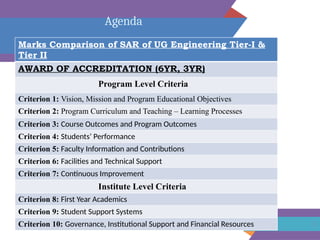
Agenda
3
Marks Comparison of SAR of UG Engineering Tier-I &
Tier II
AWARD OF ACCREDITATION (6YR, 3YR)
Program Level Criteria
Criterion 1: Vision, Mission and Program Educational Objectives
Criterion 2: Program Curriculum and Teaching – Learning Processes
Criterion 3: Course Outcomes and Program Outcomes
Criterion 4: Students’ Performance
Criterion 5: Faculty Information and Contributions
Criterion 6: Facilities and Technical Support
Criterion 7: Continuous Improvement
Institute Level Criteria
Criterion 8: First Year Academics
Criterion 9: Student Support Systems
Criterion 10: Governance, Institutional Support and Financial Resources
Marks Comparison of SAR of UG
Engineering Tier-I & Tier II
Sr.
No.
Criteria
UG Engineering
Tier-I Tier-II
1. Vision, Mission and Program Educational Objectives 50 60
2. Program Curriculum and Teaching – Learning Processes 100 120
3. Course Outcomes and Program Outcomes 175 120
4. Students’ Performance 100 150
5. Faculty Information and Contributions 200 200
6. Facilities and Technical Support 80 80
7. Continuous Improvement 75 50
8. First Year Academics 50 50
9. Student Support Systems 50 50
10. Governance, Institutional Support and Financial Resources 120 120
TOTAL 1000 1000
Tier – I Grades
 ≈75% & Above ‘Y’
 ≈ 60% and <75% ‘C’
 ≈ 40% and <60% ‘W’
 <40% ‘D’
AWARD OF
ACCREDITATION
Full Accreditation for Six years
Sl.
No.
Parameters
Undergraduate (UG) Programs
PG Programs
TIER I TIER II
1. Maximum Marks/ Grade required # ‘Y’ shall be >=7
# ‘W’ and # ‘D’ shall be Zero (0),
Where the symbol # has been used to
indicate the count.
Scoring a minimum of 750
points in aggregate out of
1000 points with
minimum score of 60% in
mandatory fields (criteria
4 to 6)
Qualifying marks shall
be greater than 375
with 60% in each
criteria
1. Minimum percentage (%) of Ph. D. required in the department
averaged for previous two academic years including Current
Academic Year
30% 30% 30%
1. Minimum percentage (%) of admissions required in the UG program
at the program level (averaged over previous three academic years
including Current Academic Year)
75% 75% -
1. Minimum percentage (%) of admissions required in the UG program
at the institute level (averaged over previous three academic years
including Current Academic Year)
60% 50% -
1. The required Faculty Student Ratio (FSR) in the department
(averaged for the previous three academic years including current
academic year)
1:15 1:15 1:15
1. The required number of Professors & Associate Professors (on a full-
time/regular basis with Ph.D.) in the respective department for
previous two academic years including current academic year
At least 2 Professors or 1 Professor
and 1 Associate Professor
At least 2 Professors or 1
Professor and 1 Associate
Professor
At least 1 Professor
and 1 Associate
Professor
(having expertise in
the domain of the
program under
consideration)
1. Minimum percentage (%) placement ratio (Placement + higher
studies) required (averaged for the previous three academic years) 40% 40% -
1. HOD of the program under consideration shall possesses Ph.D.
degree √ √ √
Provisional Accreditation for Three years
Sl.
No.
Undergraduate (UG) Programs Postgraduate
(PG) Programs
TIER I TIER II
1. Maximum Grades/ Marks require “#Y” shall be ≥ 04
“#D” shall be ≤ 02
Where the symbol # has been used
to indicate the count.
The score for the
program is greater
than or equal to
600 points with
minimum 40% marks
in Criterion V (Faculty
Information and
Contributions).
Qualifying marks shall
be greater than or
equal to 300 with 50%
in Criteria – V (Faculty
Contribution)
1. Minimum percentage (%) of Ph. D. required in the
department averaged for previous two academic years
including Current Academic Year 20% 10%
at least
two faculty with Ph.D.
in the department
1. The required Faculty Student Ratio (FSR) in the department
(averaged for the previous three academic years including
current academic year) 1:25 1:25 1:25
1. The required number of Professors & Associate Professors
(on a full-time/regular basis with Ph.D.) in the respective
department for previous two academic years including
current academic year
At least 2 Professors or 1 Professor
and 1 Associate Professor
At least 1 Professor
or 1 Associate
Professor
At least 1 Professor in
the respective domain
1. Minimum percentage (%) placement ratio (Placement +
higher studies) required (averaged for the previous three
academic years) 40 % 40 % -
1. HOD of the program under consideration shall possesses
Ph.D. degree √ √ √
Criterion 1
Vision, Mission and Program
Educational Objectives (50)
1.1.State the Vision and Mission of
the Department and Institute(05)
▰ Availability of the Vision & Mission stateme
nts of the Department (1)
▰ Appropriateness/Relevance of the
Statements (2)
▰ Consistency of the Department statements
with the Institute statements (2)
▰ The Institute and Department of Mechatronics
Engineering are focused towards building
professional competent engineers.
Four key aspects
i. Outcome based education
ii. Skill Oriented Courses
iii. Employment, Higher studies and
Entrepreneurial Ventures
iv. Strengthen relationship with stakeholders-
1.2. State the Program Educational
Objectives (PEOs)(05)
A. Listing of the Program
Educational Objectives (3 to 5)
of the program under
consideration (5)
1.3. Indicate where and how the Vision, Mission
and PEOs are published and disseminated
among stakeholders(15)
▰ Adequacy in respect of publication & dissemination (3)
▰ Process of dissemination among stakeholders (3)
▰ Extent of awareness of Vision, Mission & PEOs among
the stakeholder (9)
a) Published and Dissemination among
external stakeholders :
• Institute website (http://www.adcet.ac.in)
• Display boards at different locations (Central Wing, Corridors, Department
Library, HOD room etc.)
• E-newsletter published by department
• Parents meet (conducted once in a year)
• Alumni meet (conducted once in a year)
• Institute information brochures
• Admission brochures and placement brochures
▰ b) Published and Dissemination among
internal stakeholders:
• Departmental Notice Board
• Class Rooms
• HOD Cabin
• Faculty Room
• Laboratories
• Meeting Room
• Departmental Library
1.4. State the process for defining the Vision and
Mission of the Department, and PEOs of the
program(15)
▰ Description of process involved in defining the
Vision, Mission of the Department (7)
▰ Description of process involved in defining the
PEOs of the program (8)
1.5.Establish consistency of PEOs
with Mission of the Department(10)
▰ Preparation of a matrix of PEOs and
elements of Mission statement (5)
▰ Consistency/justification of co-relation
parameters of the above matrix (5)
Criterion 2: Program Curriculum
and Teaching –Learning
Processes (100)
18
CRITERION 2
Program Curriculum and Teaching –
Learning Processes
100
2.1. Program Curriculum (30)
2.1.1. State the process for designing the program curriculum (10)
The department frames its program curriculum based on the vision and mission of the institution
and the department. The curriculum is revised to help students to be industry ready.
The process flow for Curriculum Design is as follows:
• Based on Institute/Department vision and mission, and the NBA / AICTE guidelines the
department formulates its PSOs.
• The HOD along with all faculty members frames the outline of the curriculum based on
norms of AICTE, UGC, DBATU.
• The course outcomes of all the courses of the curriculum are planned according to the POs
and PSOs. Then, the syllabi of various courses are framed.
• The feedback of the curriculum is obtained from various stakeholders such as academicians,
industrial experts, alumni, parents, faculty and students.
• The curriculum is presented in Program Assessment Committee and Department Advisory
Board and the necessary changes are incorporated.
• The curriculum is submitted to the Board of Studies (BOS) meeting. There commendations
and modifications suggested by BOS members are incorporated in curriculum forwarded to
Academic Council.
• After the approval from Academic Council (AC) and Governing Body, the curriculum is
finalized. The curriculum is implemented and the impact will be considered for further
implementations.
19
2.1.2. Structure of the Curriculum (5)
Course
Code
Course Title
Total number of contact hours
Credits
Lecture(L) Tutorial(T) Practical(P) Total Hours
BSH11 Engineering Mathematics- I 3 1 0 4 4
BSHA12 Engineering Physics 3 0 0 3 3
BSHA13 Communication Skills 3 0 0 3 3
BSHA14 Engineering Graphics 2 0 0 2 2
BSHA15 Basic Civil Engineering 1 0 0 1 1
BSHA16 Basic Mechanical Engineering 1 0 0 1 1
BSHA12L Engineering Physics Laboratory 0 0 2 2 1
BSHA13L Communication Skills Laboratory 0 0 2 2 1
BSHA14L Engineering Graphics Laboratory 0 0 2 2 1
BSHA17 Workshop Practices 0 0 4 4 2
BSH21 Engineering Mathematics-II 3 1 0 4 4
BSHA22 Engineering Chemistry 3 0 0 3 3
BSHA23 Engineering Mechanics 3 0 0 3 3
BSHA24 Computer Programming in C 3 0 0 3 3
BSHA25 Basic Electrical Engineering 1 0 0 1 1
BSHA26 Basic Electronics Engineering 1 0 0 1 1
BSHA22L Engineering Chemistry Laboratory 0 0 2 2 1
BSHA23L Engineering Mechanics Laboratory 0 0 2 2 1
BSHA24L Computer Programming in C Laboratory 0 0 2 2 1
BSHA25L Basic Electrical Engineering Laboratory 0 0 2 2 1
BSHA26L Basic Electronics Engineering Laboratory 0 0 2 2 1
BSHMP Mini Project-I 0 0 2 2 4
20
2.1.2. Structure of the Curriculum (5)
Course
Code
Course Title
Total number of contact hours
Credits
Lecture(L) Tutorial(T) Practical(P) Total Hours
MT301 Engineering Mathematics-III 3 1 0 4 4
MT302 Fluid Mechanics and machinery 3 0 0 3 3
MT303 Sensor & Instrumentation 3 0 0 3 3
MT304 Digital Electronics and Microprocessors 3 0 0 3 3
MT305 Material and Manufacturing Processes 3 0 0 3 3
MT306 Fluid Mechanics& machinery Laboratory 0 0 2 2 1
MT307 Sensor & Instrumentation Laboratory 0 0 2 2 1
MT308 Digital Electronics & Microprocessor Laboratory 0 0 2 2 1
MT309 Manufacturing Technology Laboratory 0 0 2 2 1
MT310 Object oriented programming Using C++Lab 0 0 2 2 1
MDC01 Constitution of India 1 0 0 1 Audit
HMS01 Aptitude Skill-I 1 0 0 1 1
HMS02 Language Skills-I 0 0 2 2 Audit
PRJ02 Mini Project 0 0 2 2 Audit
21
2.1.2. Structure of the Curriculum (5)
Course
Code
Course Title
Total number of contact hours
Credits
Lecture(L) Tutorial(T) Practical(P) Total Hours
MT401 CAD/CAM/CAE 3 0 0 3 3
MT402 Strength of Materials 3 0 0 3 3
MT403 Electrical Machines and Drives 3 0 0 3 3
MT404 Microcontrollers & Interfacing 3 0 0 3 3
MT405 Thermodynamics& Heat Transfer 3 0 0 3 3
MT406 CAD/CAM/CAE Laboratory 0 0 2 2 1
MT407 Strength of Materials Laboratory 0 0 2 2 1
MT408 Electrical Machines and Drives Laboratory 0 0 2 2 1
MT409 Microcontrollers & Interfacing Laboratory 0 0 2 2 1
MT410 Thermodynamics& Heat Transfer Laboratory 0 0 2 2 1
MDC02 Environmental Sciences 2 0 0 2 Audit
HMS03 Aptitude Skills-II 1 0 0 1 Audit
HMS04 Language Skills-II 0 0 2 2 1
PRJ03 Mini Project-III 0 0 2 2 1
IFT01 Industrial Training/Field Training - I 0 0 0 0 Audit
MT501 Kinematics and Theory ofMachines 3 0 0 3 3
MT502 Signals and Systems 3 0 0 3 3
MT503 Elective –I 3 0 0 3 3
MT504 Embedded system 3 0 0 3 3
MT505 Industrial Automationand Robotics 3 0 0 3 3
MT506 Computer organization 2 0 0 2 Audit
MT507 Kinematics and Theory ofMachines Laboratory 0 0 2 2 1
MT508 Industrial Automationand Robotics Laboratory 0 0 2 2 1
MT509 Metrology and QualityControl Laboratory 0 0 2 2 1
MT510 Embedded systemLaboratory 0 0 2 2 1
MT511 Python ProgrammingLaboratory 0 0 2 2 1
HMS05 Aptitude Skills-III 1 0 0 1 1
HMS06 Language Skills-III 0 0 2 2 Audit
PRJ04 Mini Project-IV 0 0 2 2 Audit
22
2.1.2. Structure of the Curriculum (5)
Course
Code
Course Title
Total number of contact hours
Credits
Lecture(L) Tutorial(T) Practical(P) Total Hours
MT601
Design of Machine Elements and Transmission
Systems
3 0 0 3 3
MT602 Digital Signal Processing 3 0 0 3 3
MT603 Control System 3 0 0 3 3
MT604 Elective-II 3 0 0 3 3
OE Open Elective-I 3 0 0 3 3
MT605 Machine Design Laboratory 0 0 2 2 1
MT606 Digital Signal Processing Laboratory 0 0 2 2 1
MT607 Control System Laboratory 0 0 2 2 1
MT608 Programming Techniques (MATLAB Laboratory) 0 0 2 2 1
MT609 Computer Network & Cyber Security Laboratory 0 0 2 2 1
MT610 Probability & Statistics 1 0 0 1 Audit
HMS07 Aptitude Skills-IV 1 0 0 1 1
HMS08 Language Skills-IV 0 0 2 2 Audit
IFT02 Internship/Field Training 0 0 0 0 Audit
PRJ05 Mega Project Phase-I 0 0 4 4 2
MT701 Industry 4.0 3 0 0 3 3
MT702 PLC and SCADA 3 0 0 3 3
MT703 Elective - III 3 0 0 3 3
MT704 Elective - IV 3 0 0 3 3
MT706 PLC and SCADA Laboratory 0 0 2 2 1
MT707 Simulation Laboratory 0 0 2 2 1
MT708 Robotics Laboratory 0 0 2 2 1
PRJ06 Mega Project Phase-II 0 0 8 8 4
PRJ07 Seminar 0 0 2 2 1
HMS09 Values and Ethics 2 0 0 2 Audit
23
2.1.2. Structure of the Curriculum (5)
Course
Code
Course Title
Total number of contact hours
Credits
Lecture(L) Tutorial(T) Practical(P) Total Hours
MT801 Self Learning Course 1 0 0 0 0 3
MT802 Self Learning Course 2 0 0 0 0 3
IFT03 Internship 0 0 0 0 10
MT801 Self Learning Course 1 0 0 0 0 3
MT802 Self Learning Course 2 0 0 0 0 3
IFT03 Internship 0 0 0 0 10
Course Component
Curriculum Content (% of total
number of credits of the
program)
Total number of contact
hours
Total number of credits
Basic Sciences 12% 23 20
Engineering Sciences 12% 28 20
Humanities and Social Sciences 4% 17 7
Program Core 50% 102 83
Program Electives 7% 12 12
Open Electives 2% 3 3
Project(s) 7% 22 12
Internships/Seminars 6% 0 10
Any other (Please specify) 0% 3 0
Total number of Credits 100% 210 167
2.1.3. State the components of the curriculum (5)
Curriculum Content (% of total number of credits of the program)
Basic Sciences
Engineering Sciences
Humanities and Social Sciences
Program Core
Program Electives
Open Electives
Project(s)
Internships/Seminars
2.1.4 State the process used to identify extent of compliance of the curriculum for
attaining the Program Outcomes and Program Specific Outcomes (10)
Following process is used to identify extent of compliance of the departmental
curriculum for attaining the Program Outcomes and Program Specific Outcomes.
GAPs for the curriculum are identified by:
– Identification of weakly mapped POs from all the courses of program
• At the beginning of semester each course coordinator prepares course outcomes
with PO mapping.
• Departmental Program Assessment and Quality Improvement Committee (PAQIC)
review course outcomes with PO mapping and give suggestions for the same by
which course outcome and CO-PO mapping is finalized.
• Course coordinator identify course wise gap to bridge institute and industry
requirements.
• The identified gap is categorized as knowledge, skill and attitude based.
• Brainstorming carried out to decide content beyond syllabus and methodology to
fill the course wise gap.
Teaching-Learning Processes (70)
2.2.1. Describe Processes followed to improve quality of Teaching & Learning (15)
A. Adherence to Academic Calendar (2)
Institute academic Calendar
B. Pedagogical initiatives (2)
• Following are the some instructional planning and delivery methods used to
improve quality of Teaching Learning Process.
Sr.
No.
Teaching Aid Contents
1 Classroom
teaching
Teaching in classroom using blackboard and smartboards
2 Charts Includes Diagrams, Flowcharts, Process plans, Layouts,
etc.
3 Videos Faculty videos on YouTube platform, Demo videos,
operational videos, Inspirational videos, working of
Instruments
4 PPT Faculty PPT on slide-share, Important contents, keywords,
figures, etc.
• D. Quality of classroom teaching (Observation in a
Class) (2)
• E. Conduct of experiments (Observation in Lab)
(2)
• F. Continuous Assessment in the laboratory (3)
• G. Student feedback of teaching learning process
and actions taken (2)
•
C. Methodologies to support weak students and encourage bright students(2)
Bright Student
The past semester result of student is mainly proffered for identifying the bright
student, encouraging these students is employed with different methodologies some of
which are mentioned below:
• Book Bank facility
• Motivation for participation in technical events
• Motivated to go through NPTEL courses, to appear for GATE examination
Weak Students
Weak students are identified on their past semester result, classroom observation, and
involvement in experiment performance. Criteria of identifying the weak student may
vary from course to course and also action taken on weak students are also having
following strategies as mentioned below:
• Provided question bank.
• PPT with animations of mechanisms is provided for better understanding.
• Counseling of students is done
F. Continuous assessment in lab (3)
Continuous assessment of practical’s are carried out by respective course
coordinator and recorded in academic diary.
G. Student feedback of teaching learning process and action taken (6)
• Student feedback taken on Moodle twice in a semester.
• Appreciation letter given to faculty members having excellent feedback
• For faculty having poor feedback counseling is done by academic dean, HOD and
senior faculty members.
D) Quality of classroom teaching (3)
• Well prepared lesson plan, laboratory plan
• Lecture notes
• Question bank
• Plan for six unit tests
• Self prepared PPTs by faculty members
E) Conduct of experiments (3)
• Lab Manuals
• Lab register
• Continuous assessment
• Oral questions during assessments
• Self explanatory charts
• Extra lab hour
Question
Responses
Below
Average
(1)
Average
(2)
Good
(3)
Very
Good
(4)
Excellent
(5)
Was the faculty audible?
Was the depth of Knowledge in subject?
Did the faculty provide you new Knowledge beyond curriculum?
Did the lecture make you think?
Were you encouraged to ask the questions?
Was the blackboard writing clearly and organized? Did faculty use audio visual aids?
Were notes dictated to you?
Were any assignment given to you?
Were internal test conducted?
Were the assignment and test challenging?
Were they checked promptly?
Were the faculty motivates to conduct experiments or practicals?
Was the faculty given a sufficient chance to do the practical?
Were the journals checked promptly?
Whether faculty was effective in preparing students for exams?
Whether the faculty was always accessible to the students for counselling, guidance and solving
queries off the classroom hours.
Were the books referred by faculty available?
Were you satisfied with teaching in general?
Were you satisfied with class discipline in general?
Whether practicals conducted properly?
How do you think teaching could have been made more effective? Descriptive
• Feedback questions
2.2.2 Quality of internal semester Question papers, Assignments and Evaluation (20)
A. Process to ensure quality
• Every course coordinator prepares question bank according to defined COs for each module.
Prepared question paper is guided by department exam coordinator and gives suggestion
accordingly. Course coordinator prepares a model answer paper and assesses student answer sheets
accordingly. Each question paper consist of different question types such as descriptive, MCQs,
design/derivative, drawing, programs and numerical, based on which question paper audit is done.
Schedule of internal test are planned in academic calendar before start of semester and executed
properly.
B. Process to ensure quality of question paper from outcomes/learning perspective
• Each course coordinator prepares CO-PO mapping for his course using revised Bloom Taxonomy.
Exam coordinator suggests correction regarding the use of verb for preparing questions. Each
course coordinator conduct question paper audit for internal test as well as university question
papers.
C. Evidence of COs coverage
• Question paper for each course consists of questions based on each module gives approximately
equal weightage to assigned COs.
D. Quality of assignments and relevance to COs
• At start of semester assignment questions are prepared by course coordinator. Every question in
assignment is mapped with course outcome. Self-learning assignments are also prepared by course
coordinator to initiate self-learning in student. To ensure quality of self-learning assignment,
different topics are given for a batch of students. After completion of assignments oral feedback to
the students are given.
• 2.2.3. Quality of student projects (25)
•
• A. Identification of projects and allocation methodology (3)
•
• A.1 Identification of Projects
• Department gives flexibility to the students according to their area of interest. The students are
encouraged to select industry sponsored project to solve real life problem. Each student asked to
go through literature review regarding idea about the project. These project ideas discussed
within group and with guide and check feasibility of project.
• Student prepare synopsis for their topic, which will be reviewed by project evaluation
committee and check their quality and originality. After implementation of suggestions project
will be finalized.
• A.2 Allotment of Project Groups and Guides
• A guide list is displayed according to area of specialization. At the end of Vth
semester student
forms a project group of 3 to 5 students and gives their area of interest & guide preference to
project co-ordinator. According to the area of interest and preference given for guide,
department allot project batches.
B. Types and relevance of the projects and their contribution
towards attainment of POs (5)
B.1 Type/Domain of Projects:
• Classification of Projects
• Design Engineering
• Manufacturing/Fabrication Engineering
• Control Engineering
• Instrumentation
• Environment
• Agriculture Based
• Interdisciplinary
• Application/Product Based
• Simulation and Modeling
• Research Project
Sr. No. Phase Assessment Stages Relevance to POs and PSOs
1.
Phase-I
Semester-VI
Synopsis 1,2,3,4,5,6,8,9,10,11,13,14
Phase-I 1,2,3,4,5,8,9,10,11,12,13,14
2.
Phase-II
Semester-VII
Phase-II
1,2,3,4,5,8,9,10,11,12,13,14
Final Presentation
1,2,3,4,5,6,7,8,9,10,11,12,13,14
B.2 Projects contribution towards attainment of POs and PSOs:
Project assessed in four stages through rubrics (Annexure 2.4) which
is mapped to POs and PSOs. Mapping of POs and PSOs to assessment
stages are given as below.
Project assessment mapping with POs
C. Process for monitoring and evaluation
C.1 Process of Project Monitoring:
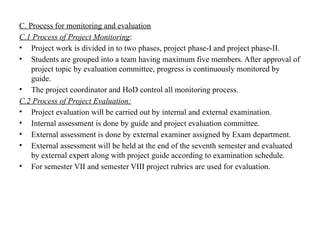
• Project work is divided in to two phases, project phase-I and project phase-II.
• Students are grouped into a team having maximum five members. After approval of
project topic by evaluation committee, progress is continuously monitored by
guide.
• The project coordinator and HoD control all monitoring process.
C.2 Process of Project Evaluation:
• Project evaluation will be carried out by internal and external examination.
• Internal assessment is done by guide and project evaluation committee.
• External assessment is done by external examiner assigned by Exam department.
• External assessment will be held at the end of the seventh semester and evaluated
by external expert along with project guide according to examination schedule.
• For semester VII and semester VIII project rubrics are used for evaluation.
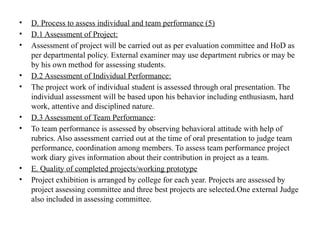
• D. Process to assess individual and team performance (5)
• D.1 Assessment of Project:
• Assessment of project will be carried out as per evaluation committee and HoD as
per departmental policy. External examiner may use department rubrics or may be
by his own method for assessing students.
• D.2 Assessment of Individual Performance:
• The project work of individual student is assessed through oral presentation. The
individual assessment will be based upon his behavior including enthusiasm, hard
work, attentive and disciplined nature.
• D.3 Assessment of Team Performance:
• To team performance is assessed by observing behavioral attitude with help of
rubrics. Also assessment carried out at the time of oral presentation to judge team
performance, coordination among members. To assess team performance project
work diary gives information about their contribution in project as a team.
• E. Quality of completed projects/working prototype
• Project exhibition is arranged by college for each year. Projects are assessed by
project assessing committee and three best projects are selected.One external Judge
also included in assessing committee.
Criterion 2: lagging points
2.2.1 b. Pedagogical initiatives- action –include simulations,
working models ,role play etc during teaching
c. Support weak students and engage bright students-
Action- Based on MSE result and subject difficulty conduct
doubt clearing students
2.2.2-Quality of assignments
Action taken –similar to Question paper conduct assignment
question audit at department level
2.2.4 Initiatives related to industry:
• Industry sponsored laboratory
• Industry involvement in partial delivery of curriculum
• Impact analysis of industry institute interaction
Criterion 3: Course Outcomes
and Program Outcomes (175)
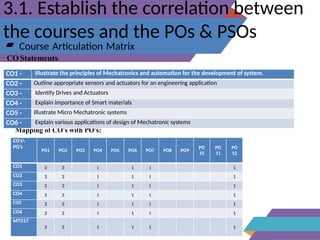
3.1. Establish the correlation between
the courses and the POs & PSOs
▰ Course Articulation Matrix
CO’s
PO’s
PO1 PO2 PO3 PO4 PO5 PO6 PO7 PO8 PO9
PO
10
PO
11
PO
12
CO1 3 3 1 1 1 1
CO2 3 3 1 1 1 1
CO3 3 3 1 1 1 1
CO4 3 3 1 1 1 1
CO5 3 3 1 1 1 1
CO6 3 3 1 1 1 1
MT517
3 3 1 1 1 1
Mapping of CO’s with PO’s:
CO1 - Illustrate the principles of Mechatronics and automation for the development of system.
CO2 - Outline appropriate sensors and actuators for an engineering application
CO3 - Identify Drives and Actuators
CO4 - Explain importance of Smart materials
CO5 - Illustrate Micro Mechatronic systems
CO6 - Explain various applications of design of Mechatronic systems
CO Statements:
▰ Program Articulation Matrix
3.2. Attainment of Course Outcomes
(75)
▰ 3.2.1. Describe the assessment tools and
processes used to gather the data upon
which the evaluation of Course Outcome is
based (10)
Attainment of course outcome is calculated by using following assessment tools.
 Continuous Assessment
 Mid Semester Examination
 Course Exit Survey.
 End Semester Examination
▰ 3.2.2. Record the attainment of Course Outcomes
of all courses with respect to set attainment levels
(65)
CO’s
PO’s
PO1 PO2 PO3 PO4 PO5 PO6 PO7 PO8 PO9 PO 10 PO 11 PO 12
CO1 2.354(3) 2.354(3) 0.784(1) 0.784(1) 0.784(1) 0.784(1)
CO2 2.373 (3) 2.373 (3) 0.791(1) 0.791(1) 0.791(1) 0.791(1)
CO3 2.358 (3) 2.358 (3) 0.786(1) 0.786(1) 0.786(1) 0.786(1)
CO4 0.854 (3) 0.854 (3) 0.284(1) 0.284(1) 0.284(1) 0.284(1)
CO5 0.863 (3) 0.863 (3) 0.287(1) 0.287(1) 0.287(1) 0.287(1)
CO6 0.882 (3) 0.882 (3) 0.294(1) 0.294(1) 0.294(1) 0.294(1)
MT505
1.614(3) 1.614(3) 0.537(1) 0.537(1) 0.537(1) 0.537(1)
Attainment of CO’s with PO’s
3.3. Attainment of Program Outcomes
and Program Specific Outcomes (75)
▰ 3.3.1. Describe assessment tools and processes
used for measuring the attainment of each
Program Outcome and Program Specific
Outcomes (10)
▰ 3.3.2. Provide results of evaluation of each PO &
PSO (65)
Criterion 3: lagging points
▰ 3.2.1. The quality /relevance of assessment
processes & tools used (8)
-include more assessment tools than
assignment, MSE & ESE
▰ 3.2.2., 3.3.2 Record the attainment of
Course Outcomes ,Pos &PSO’s of all courses
with respect to set attainment levels
Action-consider Reexam/Remedial result
Faculty orientation for target setting and co-po
mapping
Criteria 4 : Student’s Performance
(100 M)
 4.1. Enrolment Ratio (20)
 4.2. Success Rate in the stipulated period of the program (20)
4.2.1. Success rate without backlogs in any semester/year of study (15)
4.2.2. Success rate in stipulated period of study [Total of with backlog + without
backlog] (5)
 4.3. Academic Performance in Second Year (10)
 4.4. Placement, Higher Studies and Entrepreneurship (30)
 4.5. Professional Activities (20)
4.5.1. Professional societies/chapters and organizing engineering events (5)
4.5.2. Publication of technical magazines, newsletters, etc. (5)
4.5.3 Participation in inter-institute events by students of the program of study
(10)
52
4.1 Enrolment Ratio (20 M)
Item
(Students enrolled at the First Year Level on average basis during the
previous three academic years starting from current academic year)
Marks
>=90% students enrolled 20
>=80% students enrolled 18
>=70% students enrolled 16
>=60% students enrolled 14
>=50% students enrolled 12
Otherwise 0
N N1
Enrollment Ratio
[(N1/N)*100]
2022-23 (CAY) 60 52 86.95
2021-22 (CAYm1) 60 37 53.62
2020-21 (CAYm2) 60 44 63.76
Average [(ER1+ER2+ER3)/3] 68.11
Average Enrollment Ratio is
> =60% students enrolled
First Year Level on average
basis during the previous
three academic years
starting from current
academic year.
4.2 Success Rate Without Backlogs in
Stipulated Period of The Program (20 M)
4.2.1 Success Rate Without Backlogs in Stipulated Period of The Program (15 M)
Item
Latest Year of
Graduation,
LYG (2023-24)
Latest Year of
Graduation minus 1,
LYGm1 (2022-23)
Latest Year of Graduation
minus 2
LYGm2 (2021-22)
Number of students admitted in the corresponding
First Year + admitted in 2nd
year via lateral entry
and separate division, if applicable
Number of students who have graduated
without backlogs in the stipulated period
Success Index (SI)
Average SI
SI = 25 × Average SI
4.2 Success Rate Without Backlogs in
Stipulated Period of The Program (20 M)
4.2.2 Success Rate Without Backlogs in Stipulated Period of The Program (5 M)
Item
Latest Year of
Graduation,
LYG (2023-24)
Latest Year of
Graduation minus 1,
LYGm1 (2022-23)
Latest Year of Graduation
minus 2
LYGm2 (2021-22)
Number of students admitted in the corresponding
First Year + admitted in 2nd
year via lateral entry
and separate division, if applicable
Number of students who have graduated
without backlogs in the stipulated period
Success Index (SI)
Average SI
SI = 25 × Average SI
4.3. Academic Performance in
Second Year (10 M)
Academic Performance CAYm2 (2023-24) CAYm3 (2022-23) LYG (2021-22)
Mean of CGPA or Mean Percentage of all successful students (X) 6.52 5.32
Result Awating
(Second Year)
Total no. of successful students (Y) 70 69
Total no. of students appeared in the examination (Z) 73 72
API = X* (Y/Z) 6.25 5.09
Average API [(AP1+AP2+AP3)/3] 5.67
Academic Performance= 1.5 × Average API 8.5
4.4. Placement, Higher Studies and
Entrepreneurship (30 M)
Item 2022-23 CAYm1 2021-22 CAYm2 2020-21 CAYm3
Total No. of Final Year Students (N)
No. of students placed in companies or Government Sector (x)
No. of students admitted to higher studies with valid qualifying scores (GATE or
equivalent State or National Level Tests, GRE, GMAT etc.) (y)
No. of students turned entrepreneur in engineering/technology (z)
x + y + z =
Placement Index : (x + y + z )/N
Average placement= (P1 + P2 + P3)/3
Assessment Points = 40 × average placement
4.5. Professional Activities (20)
4.5.1 Professional societies/chapters and organizing engineering events (5)
ISTE (Indian Society for Technical Education):
MTESA (Mechatronics Engineering Students Association):
4.5. Professional Activities (20)
4.5.2 Publication of technical magazines, newsletters, etc. (5)
4.5. Professional Activities (20)
4.5.3 Participation in inter-institute events by students of the program of study (10)
Criterion 4: Lagging points
▰ 4.1. Enrolment Ratio -60%
Action taken more counseling and awareness
among students, focus on placement, advertize
▰ 4.4. Placement, Higher studies and
Entrepreneurship
Action –placement initiative from first year, gate
coaching in TY, Career guidance lectures.
4.5.3. B. Participation in inter-institute events
Outside state
Action Taken-motivate students
Criterion 5: Faculty Information
and Contributions (200)
63
Criterion 5: Faculty Information
Sr.
No
.
Name of faculty
member
Designation Qualification Date of Joining Experience in Years
Academic Industrial
01 Prof. (Dr) Dr. S.
K. Shikalgar
Associate Professor
Ph.D. 01/09/2020 18 00
02 Prof. (Dr)
Krishnkant Sahu
Assistant Professor
Ph.D. 06/10/2022 04 01
03 Mrs. Rupali S.
Sajane
Assistant Professor
ME 01/07/2022 10 00
04 Mrs. Kalyani
Vaibhav Joshi
Assistant Professor
ME 10/07/2014 3 01
05 Mr. P. J. Patil Assistant Professor ME 01/07/2022 10 01
06 Mr. S.S. Sajane Assistant Professor ME 01/09/2014 10 0
07 Mr. S. S. Jugale Assistant Professor ME 09/02/2012 13 01
08 Mr. V. B.
Nalawade
Assistant Professor M.Tech 10/08/2015 11 01
09 Mrs. P. S. Patil Assistant Professor 24/07/2023 01 00
10 Mr. K. J. Awati Assistant Professor ME 11/01/2023 09 07
11 Mr. A. M.
Pandhare
Assistant Professor ME 11/01/2023 08 0.3
Faculty List (2023-24)
64
Criterion 5: Faculty Information
YEAR
CAY CAY CAYM1 CAYM1 CAYM2 CAYM2
(2023-2024)
(SEM I)
(2023-2024)
(SEM II)
(2022- 2023)
(SEM I)
(2022-
2023)
(SEM II)
(2021- 2022)
(SEM I)
(2021-2022)
(SEM II)
UG1.1(SE-A)
Total UG1 78 78
UG2.1(TE-A)
Total UG2 72 72
UG3.1(BE-A)
Total UG3 70 70
Total No. of
Students in the
Department (S)
220 220
No. of Faculty
in the
Department
(F)
11 11
Student Faculty
Ration (SFR) 20 20
Average SFR 20
Claim =16
5.1 Student-Faculty Ratio (SFR) (20)
Year
Professors Associate Professors Assistant Professors
Required F1 Available Required F2 Available Required F3 Available
CAY
(2023-24)
1 0 2 1 10 10
CAY
(2022-23)
1 0 2 1 10 10
CAY
(2021-22)
1 0 2 1 10 10
Average
Numbers
RF1=0 AF1=0 RF2=2 AF2=1 RF3=10 AF3=12
Cadre Ratio Marks = 19.56
Criterion 5: Faculty Information
5.2 Faculty Cadre Proportion (20)
Year X Y F FQ=2.0*[(10X+4Y)/F]
2023-24 2 9 11 12.72
2022-23 2 9 11 12.72
2021-22 2 9 11 12.72
Average Assessment 12.72
Claim= 12.72
5.3 Faculty Qualification (20)
Year No. of regular faculty No. of faculty retained
from previous year
Faculties retention (%)
CAY [2023-24] 11 11 100%
CAYm1 [2022-23] 11 11 100%
CAYm2 [2021-22] 11 11 100%
Avg. retention of faculty is 100% during the period of assessment keeping CAYm2 as base year
Claim Marks = 10
Criterion 5: Faculty Information
5.4 Faculty Retention (10)
Sr.no
.
Name of faculty Title of Paper Name of Conference
1 Dr. Shikalgar S. K.
Improving Smart Home Safety
with Face Recognition using
Machine Learning (ML)
40th GISFI standardization series meeting jointly with
International Conference on 6G and Wireless Network
Technologies
2 Mr. Khandare V V
Performance Evaluation of
Automatic Suspicious Activity
Detection Method
IEEE Explore 2023 International Conference for
Advancement in Technology (ICONAT)
3 Mrs. K. V. Joshi
Adaptive Coronavirus Mask
Protection Algorithm enabled deep
learning for Brain tumor detection
and classification
IACC 2023 International Advanced Computing Conference
4 Mrs.R.S.Sajane
A Review: Additive
Manufacturing Process,
Classification, Post Process,
Porosity and Fatigue Fracture.
International Conference on technologies and
innovationsfor Sustainable development, MNIT Allahabad,
Prayagraj.
Criterion 5: Faculty Information
5.5 faculty competencies in correlation to program specific criteria
Research publication by faculty (10)
Conference Academic Year 2023-24
A. Specialization
B. Research Publications
C. Course Developments
D. Other relevant points
Sr.no. Name of faculty Title of Paper Name of Conference
1 Krishnkant Sahu
Analysis of MR fluid lubricated slot entry hybrid conical
journal bearing with texturing arrangements
Tribology International, Elsevier
2 Krishnkant Sahu
Performance Analysis of Textured Spherical Hybrid Journal
Bearings Operated With Magnetorheological Fluid
Journal of Tribology, ASME
3 Krishnkant Sahu
Effect of bearing shell deformation and ER fluid behavior
on two-lobed slot-entry hybrid journal bearing
Part J: Journal of Engineering Tribology
4 V V Khandare
Smart Energy Meter for Data Reading and Energy
Monitoring System
IJRPR International Journal
Criterion 5: Faculty Information
5.5 faculty competencies in correlation to program specific criteria
Research publication by faculty
Journal Academic Year 2023-24
69
Criterion 5: Faculty Information
5.6 Innovations by the Faculty in Teaching and
Learning(10)
Use of ICT tools
 Power Point
Presentation
 Demonstration
videos and Lectures
 FTP
 Moodle
 Webinars
Instructional delivery
 Subject notes
 Laboratory manuals
 Industrial site visits
 Laboratory Charts
 Formulae book
 Workshops and
Training Program
Assessment
 Continuous Assessment
in Academic diary
 Mid-term and end-term
test and results.
 Presentations.
 Seminars.
 Project- Submission of
Synopsis
A. Statement of clear goals, use of appropriate methods, significance of results, effective
presentation (4)
B. Availability of work on the Institute Website (2)
C. Availability of work for peer review and critique (2)
D. Reproducibility and Reusability by other scholars for further development (2)
70
Criterion 5: Faculty Information
5.6 Innovations by the Faculty in Teaching and Learning
S
r.
N
o
.
Name of faculty Slide share link You Tube channel link
0
1
Prof. (Dr) Dr. S. K. Shikalgar
https://www.slideshare.net/Sh
abanamTamboli1/edit_my_upl
oads
https://www.youtube.c
om/channel/UCOAqC2
3jRPVQIHzWL4PnVTw
0
2
Prof. (Dr) Krishnkant Sahu
https://www.slideshare.net/se
cret/2Sasoor8rYEyC2
0
3
Mrs. Rupali S. Sajane
https://youtu.be/UyB5
cdrcfJ8
0
4
Mrs. Kalyani Vaibhav Joshi
https://www.slideshare.net/sli
deshows/ooppptx/266097700
https://youtu.be/BLeLb
TlILvc?si=juUD88PRaNA
gTNnT
0
5
Mr. P. J. Patil https://youtu.be/ja10
mJDFbwQ?si=CXxo3Ld
20u3P23PK
71
Criterion 5: Faculty Information
5.6 Innovations by the Faculty in Teaching and Learning
Mr. S.S. Sajane https://www.slideshare.net/sl
ideshows/thermodyanamics-f
ormation-of-steam-introducti
on-to-boilerpdf/266616766
https://youtu.be/Swt5
-k2GK0Q
Mr. S. S. Jugale https://youtu.be/20dD
nrTMhiM
Mr. V. B. Nalawade https://www.slideshare.net/sli
deshow/smart-materialspptx/2
63225541
Mrs. P. S. Patil https://youtu.be/Tcv0v
j5RGNo?si=6EAO0Nmv
esoOZCkp
Mr. K. J. Awati
Mr. A. M. Pandhare
CAY(2023-24) CAYm1(2022-23) CAYm2(2021-22)
Sem 1 Sem 2 Sem 1 Sem 2 Sem 1 Sem 2
2/5 Days 5/1 Week 2/5 Days 5/1Week 2/5 Days 5/1Week
SUM 00 55 00 55 00 55
RF= Number of Faculty
required to comply
with 20:1 Student-Faculty
ratio as per 5.1
11 11 11
Assessment = 3 ×
(Sum/0.5RF)
(Marks limited to 15)
15 15 15
Average assessment over three years (Marks limited to 15) = 15
5.7 Faculty as participants in Faculty development/training activities/STTPs( 15)
Criterion 5: Faculty Information
For each year: Assessment = 3×Sum/0.5RF
Average assessment over last three years starting from CAYm1
(Marks limited to 15)
 No of Faculty Appearing Ph.D. - 06
 Number of quality publications in
refereed/SCI Journals, citations,
Books/Book Chapters etc. -
Faculty citations through Google Scholar
Sr. No. Name of Faculty Citation h-index i10index
1 Prof. (Dr) Dr. S. K.
Shikalgar
132 5 2
2 Prof. (Dr)
Krishnkant Sahu
141 06 05
3 Mrs. Rupali S.
Sajane
- - -
4 Mrs. Kalyani
Vaibhav Joshi
- - -
5 Mr. P. J. Patil - - -
6 Mr. S.S. Sajane - - -
7 Mr. S. S. Jugale 6 - -
8 Mr. V. B. Nalawade - - -
9 Mrs. P. S. Patil - - -
10 Mr. K. J. Awati - - -
11 Mr. A. M. Pandhare - - -
Criterion 5: Faculty Information
5.8 Research and Development
5.8.1 Academic Research (20)
A. Number of quality publications in
refereed/SCI Journals, citations,
Books/Book Chapters
etc. (15)
B. PhD awarded during the
assessment period while working in
the institute (5
Criterion 5: Faculty Information
5.8.2 Sponsored Project (20)
Research Funding
Funded research from outside; Cumulative during CAYm1, CAYm2 and
CAYm3
Amount > 50 Lakh – 20 Marks,
Amount >40 and < 50 Lakh – 15 Marks,
Amount >30 and < 40 Lakh – 10 Marks,
Amount >15 and < 30 Lakh – 5 Marks,
Amount< 15 Lakh – 0 Marks
Development activities (15)
Criterion 5: Faculty Information
A. Product Development
B. Research laboratories
C. Instructional materials
D. Working models/charts/monograms etc.
Criterion 5: Faculty Information
• Consultancy; Cumulative during CAYm1,
CAYm2 and CAYm3
• Amount >10 Lakh – 20 Marks,
• Amount <10 and > 8 Lakh – 15 Marks,
• Amount < 8 and > 6 Lakh – 10 Marks,
• Amount < 6 and > 4 Lakh – 5 Marks,
• Amount < 4 and > 2 Lakh – 2 Marks,
• Amount < 2 Lakh – 0 Mark
5.8.4. Consultancy (From Industry ) (20))
Name of the Project Name of the Industry Associate Faculty Date
Approxima
te Amount
(Rs)
2023-24
IoT based smart agriculture system Eagalelectronics aviation
pvt.ltd.
Dr. Shikalgar S.
K, Dr. Sahu
28/03/2024 35000/-
Development of ladder diagram for
PLCs application
DS automation pvt. ltd Mr. sajane S. S 28/03/2024 20000/-
Design and development of nozzle
for resin print
Urja engineering , kolhapur Mr. Patil P.J 28/03/2024 20000/-
CNC coading and appplication Versatech industries ,
ichalkaranji
Mr. S.S. Jugale 28/03/2024 25000/-
5.8.4 Consultancy (from Industry)
Criterion 5: Faculty Information
5.9 Faculty Performance Appraisal and Development System (FPADS)
(10)
Key Performance Indicators in the Self-
Appraisal
• Teaching and practical load details of
Curricular,
Co-curricular responsibilities.
• Course Result Analysis.
• Trainings / Workshops Organized/attended.
• Conferences / Guest lecture’s Organized/
attended.
• Conference Papers presented.
• Journal Papers/ Books published.
• Membership of Professional bodies.
• Awards, Innovative Projects.
• Skill Upgrades.
• Student feedback
Its implementation and effectiveness (20)
Criterion 5: Faculty Information
• Provision of Visiting /Adjunct/Emeritus faculty
etc.(1)
• Minimum 50 hours per year interaction (per
year to obtain three marks : 3 x 3 = 9)
5.10 Visiting/Adjunct/Emeritus Faculty (10)
Sr. No Name of faculty Name of industry
1 Mr. Gadgil HEM Electronics
2
3
Criterion 5: Lagging points
▰ 5.1. Student-Faculty Ratio (SFR)
Action : For PG addition professor & associate professor
5.8.2 Sponsored Research (>15Lakh)
-more collaboration with industries, NGO’s, sending proposals
to different agencies
5.8.3 Development Activities-
Research laboratory, Product Development
Action- Select projects useful to society/ industry. Convert mini
project/project prototypes into actual products
5.8.4. Consultancy (From Industry>10Lakh)
Action- identifying consultancy area , equipments related to it
and develop expertise in it.
Criterion 6: FACILITIES AND
TECHNICAL SUPPORT (80M)
6.1 Adequate and well equipped
laboratory & technical manpower (40M)
6.2 Lab Maintenance & Overall
Ambience(10M)
6.3 Safety Measurements in laboratories
(10M)
6.4 Project Laboratory/Facilities(20M)
6.1 Adequate and well equipped
laboratory & technical manpower(40M)
SR.
NO.
NAME OF THE
LABORATORY
NAME OF TECHNICAL
STAFF
DESIGNATION QUALIFICATION
1
Engineering Material
Science
(455)
Mr.. Nitin Altekar Technical Assistant Diploma(Electrical)
2
Sensors &
Instrumentation
(402)
3
Programming Logic
Control
(449)
4
Programming
Laboratory
(407)
5
Digital Electronics &
Microcontroller
(430)
6
Fluid Mechanics
(408)
 Need one more Technical Assistant
6.2 Laboratories maintenance
and overall ambience(10M)
Laboratory documents and records are well maintained
Network administrator and technical staff take cares of minor repairs
Major repairs are outsourced
Effective lighting system and good ventilation gives pleasant ambiance
Cleanliness of labs done regularly
Racks are available for students to place their belongings
 Calibration of instruments need to be done
6.3 Safety Measurements in
laboratories (10M)
6.4 : Project Laboratory /Facilities
(20M)
Criteria
No.
Criteria Name Total Marks Expected Marks
6.1 Adequate and well equipped
laboratory & technical
manpower
40 30
6.2 Lab Maintenance & Overall Ambience 10 08
6.3 Safety Measurements in laboratories 10 10
6.4 Project Laboratory/Facilities 20 -
Total = 80 48
Criterion 7: Continuous
Improvement (75)
7.1. Actions taken based on the results of evaluation of
each of the COs, Pos & PSOs (30)
▰ A. Documentary evidences of
POs and PSOs attainment levels
(15)
▰ B. Identification of
gaps/shortfalls (05)
▰ C. Plan of action to bridge the
gap and its Implementation (10)
POs Target Level Attainment Level Observations
PO1: Engineering Knowledge: Apply the knowledge of mathematics, science, engineering
fundamentals, and an engineering specialization to the solution of complex engineering problems.
PO1:
Action 1:
Action 2:
PO2: Problem Analysis: Identify, formulate, review research literature, and analyze complex
engineering problems reaching substantiated conclusions using first principles of mathematics,
natural sciences and engineering sciences.
PO2:
Action 1:
Action 2:
PO3: Design/Development of Solutions: Design solutions for complex engineering problems and
design system components or processes that meet the specified needs with appropriate
consideration for the public health and safety, and the cultural, societal, and environmental
considerations.
PO3:
Action 1:
Action 2:
7.1. Actions taken based on the results of evaluation of each of the COs, POs
& PSOs (30)
7.2. Academic Audit and actions taken there of
during the period of Assessment (15)
A) External audit:
i) ISO 9001:2015
• Management records
• Academics
• Admission
• Library
• Examination
• Laboratories
• Administration
• Placement
▰ B) Internal Audit:
▰ i) Department Level
▰ ii) Institute Level
▰ C) External Academic audit
7.3. Improvement in Placement, Higher
Studies and Entrepreneurship (10)
▰ A. Improvement in Placement numbers, quality,
core hiring industry and pay packages (5)
▰ B. Improvement in Higher Studies admissions for
pursuing PhD. in premier institutions(3)
▰ C. Improvement in number of Entrepreneurs (2)
▰ (Marks to be given proportionately considering
nos. in the base year CAYm3)
7.4. Improvement in the quality of students admitted to the program (20)
Item CAY 2020 Batch
Admission
(2023-24)
CAYm1 2020
Batch Admission
(2022-23)
CAYm2 2020
Batch Admission
(2021-22)
CAYm3 2020
Batch Admission
(2020-2122)
National Level Entrance
Examination (Name of the
Entrance Examination)
No. of Students
admitted
2 9 3 7
Opening
Score/Rank
41.02/55863 48.39/35048 27.86/49761 86.88/6884
Closing
Score/Rank
1.12/76645 13.30/55661 8.98/56409 13.76/53537
State/Institute/Level Entrance
Examination/Others (Name of
the Entrance Examination)
No. of Students
admitted
38 52 36 38
Opening
Score/Rank
82.46/41348 94.24/10542 75.71/36090 84.24/22825
Closing
Score/Rank
1.12/76645 3.12/121066 2.02/99806 5.33/86515
Name of the Entrance
Examination for Lateral Entry
or lateral entry details
No. of Students
admitted
21 39 30 NA
Opening
Score/Rank
93.63 82.92/11683 89.9 NA
Closing
Score/Rank
74.96 65.6/43791 52.27 NA
Average percentage of marks in CBSE/Any other
Board Result of admitted students (Physics,
Chemistry & Mathematics)
157.07 225.44 134.56
52.36 75.15 44.85
75.96 80.374 NA
Criterion 9
Student Support Systems
(50)
▰ 9.1. Mentoring system to help at individual
level(5)
▰ 9.2. Feedback analysis and reward /corrective
measures taken, if any(10)
▰ 9.3. Feedback on facilities(5)
▰ 9.4. Self – Learning(5)
▰ 9.5. Career Guidance, Training, Placement (10)
▰ 9.6. Entrepreneurship Cell(5)
▰ 9.7. Co-curricular and Extracurricular
Activities(10)
Criterion 10
Governance, Institutional
Support and Financial
Resources (120)
10.1. Organization, Governance
and Transparency (55)
10.1.1.State the Vision and Mission
of the Institute(5)
▰ Availability of the Vision &
Mission statements of the
Institute (2)
▰ Appropriateness/ Relevance of
the Statements (3)
10.1.2. Availability of the Institutional
Strategic Plan and its Effective
Implementation and Monitoring (25)
Availability of a 5 year
Strategic Plan(25)
10.1.3. Governing body, administrative setup,
functions of various bodies, service rules
procedures, recruitment and promotional policies
(10)
▰ List the Governing Body Composition and its Sub
Committees, senate, and all other academic and
administrative bodies; their memberships,
functions, and responsibilities; frequency of the
meetings; participation details of external members
and attendance therein (4)
▰ The published service rules, policies and procedures
with year of publication (3)
▰ Minutes of the meetings and action-taken reports
(3)
10.1.4. Decentralization in working and grievance
redressal mechanism (05)
▰ Organizational Structure, List of aministrative
Committees and Administrative Heads who
have been delegated powers for taking
administrative decisions (1)
Specify the mechanism and composition of
grievance redressal cell (1)
Action taken report of representations
(sample) (3)
10.1.5. Delegation of financial
powers (05)
▰ Financial powers delegated to the
Principal, Heads of Departments and
relevant in-charges (2)
▰ Demonstrate the utilization of financial
powers for each of the assessment
years (3)
10.1.6. Transparency and availability of
correct/unambiguous
information in public domain (05)
▰ Information on the policies, rules, processes is
to be made available on web site (2)
▰ Dissemination of the information about
student, faculty and staff (2)
▰ Mandatory disclosure as per AICTE/AISHE on
the website. (1)
10.2. Budget Allocation, Utilization, and
Public Accounting at Institute level (15)
▰ 10.2.1. Adequacy of Budget
allocation (05)
Quantum of budget allocation
for three years (3)
Justification of budget allocated
for three years (2)
10.2.2. Utilization of allocated funds
(5)
▰ A. Budget utilization for three
years (5)
10.2.3. Availability of the audited
statements on the institute’s
website(05)
▰ A. Availability of Audited
statements on website (5)
10.3. Program Specific Budget
Allocation, Utilization
10.3.1. Adequacy of budget
allocation(10)
▰ Quantum of budget allocation
for three years (5)
▰ Justification of budget allocated
for three years (5)
▰ 10.3.2. Utilization of allocated
funds(20)
▰ A. Budget utilization for three
years (20)
10.4. Library and Internet (20)
10.4.1. Quality of learning
resources (hard/soft) (10)
▰ Availability of relevant learning
resources including e-resources
and Digital Library (7)
▰ Accessibility to students (3)
10.4.2. Internet (10)
▰ Available bandwidth (4)
▰ Wi Fi availability (2)
▰ Internet access in labs, classrooms, library
and offices of all Departments (2)
▰ Security mechanism (2)

NBA presentation Mechatronics department.pptx

  • 1.
    Department of MechatronicsEngineering shri. ShamraoPatil (Yadravkar) Educational & Charitable Trust’s SHARAD INSTIUTE OF TECHNOLOGY COLLEGE OF ENGINEERING, YADRAV An Autonomous Institute
  • 2.
    “NBA Presentation’’ 29/05/2024 A Heartyand Warm Welcome to one and all PROGRAM MECHATRONICS ENGINEERING Program Head- Dr. S. K. Shikalgar
  • 3.
    Agenda 3 Marks Comparison ofSAR of UG Engineering Tier-I & Tier II AWARD OF ACCREDITATION (6YR, 3YR) Program Level Criteria Criterion 1: Vision, Mission and Program Educational Objectives Criterion 2: Program Curriculum and Teaching – Learning Processes Criterion 3: Course Outcomes and Program Outcomes Criterion 4: Students’ Performance Criterion 5: Faculty Information and Contributions Criterion 6: Facilities and Technical Support Criterion 7: Continuous Improvement Institute Level Criteria Criterion 8: First Year Academics Criterion 9: Student Support Systems Criterion 10: Governance, Institutional Support and Financial Resources
  • 4.
    Marks Comparison ofSAR of UG Engineering Tier-I & Tier II Sr. No. Criteria UG Engineering Tier-I Tier-II 1. Vision, Mission and Program Educational Objectives 50 60 2. Program Curriculum and Teaching – Learning Processes 100 120 3. Course Outcomes and Program Outcomes 175 120 4. Students’ Performance 100 150 5. Faculty Information and Contributions 200 200 6. Facilities and Technical Support 80 80 7. Continuous Improvement 75 50 8. First Year Academics 50 50 9. Student Support Systems 50 50 10. Governance, Institutional Support and Financial Resources 120 120 TOTAL 1000 1000
  • 5.
    Tier – IGrades  ≈75% & Above ‘Y’  ≈ 60% and <75% ‘C’  ≈ 40% and <60% ‘W’  <40% ‘D’
  • 6.
    AWARD OF ACCREDITATION Full Accreditationfor Six years Sl. No. Parameters Undergraduate (UG) Programs PG Programs TIER I TIER II 1. Maximum Marks/ Grade required # ‘Y’ shall be >=7 # ‘W’ and # ‘D’ shall be Zero (0), Where the symbol # has been used to indicate the count. Scoring a minimum of 750 points in aggregate out of 1000 points with minimum score of 60% in mandatory fields (criteria 4 to 6) Qualifying marks shall be greater than 375 with 60% in each criteria 1. Minimum percentage (%) of Ph. D. required in the department averaged for previous two academic years including Current Academic Year 30% 30% 30% 1. Minimum percentage (%) of admissions required in the UG program at the program level (averaged over previous three academic years including Current Academic Year) 75% 75% - 1. Minimum percentage (%) of admissions required in the UG program at the institute level (averaged over previous three academic years including Current Academic Year) 60% 50% - 1. The required Faculty Student Ratio (FSR) in the department (averaged for the previous three academic years including current academic year) 1:15 1:15 1:15 1. The required number of Professors & Associate Professors (on a full- time/regular basis with Ph.D.) in the respective department for previous two academic years including current academic year At least 2 Professors or 1 Professor and 1 Associate Professor At least 2 Professors or 1 Professor and 1 Associate Professor At least 1 Professor and 1 Associate Professor (having expertise in the domain of the program under consideration) 1. Minimum percentage (%) placement ratio (Placement + higher studies) required (averaged for the previous three academic years) 40% 40% - 1. HOD of the program under consideration shall possesses Ph.D. degree √ √ √
  • 7.
    Provisional Accreditation forThree years Sl. No. Undergraduate (UG) Programs Postgraduate (PG) Programs TIER I TIER II 1. Maximum Grades/ Marks require “#Y” shall be ≥ 04 “#D” shall be ≤ 02 Where the symbol # has been used to indicate the count. The score for the program is greater than or equal to 600 points with minimum 40% marks in Criterion V (Faculty Information and Contributions). Qualifying marks shall be greater than or equal to 300 with 50% in Criteria – V (Faculty Contribution) 1. Minimum percentage (%) of Ph. D. required in the department averaged for previous two academic years including Current Academic Year 20% 10% at least two faculty with Ph.D. in the department 1. The required Faculty Student Ratio (FSR) in the department (averaged for the previous three academic years including current academic year) 1:25 1:25 1:25 1. The required number of Professors & Associate Professors (on a full-time/regular basis with Ph.D.) in the respective department for previous two academic years including current academic year At least 2 Professors or 1 Professor and 1 Associate Professor At least 1 Professor or 1 Associate Professor At least 1 Professor in the respective domain 1. Minimum percentage (%) placement ratio (Placement + higher studies) required (averaged for the previous three academic years) 40 % 40 % - 1. HOD of the program under consideration shall possesses Ph.D. degree √ √ √
  • 8.
    Criterion 1 Vision, Missionand Program Educational Objectives (50)
  • 9.
    1.1.State the Visionand Mission of the Department and Institute(05) ▰ Availability of the Vision & Mission stateme nts of the Department (1) ▰ Appropriateness/Relevance of the Statements (2) ▰ Consistency of the Department statements with the Institute statements (2)
  • 10.
    ▰ The Instituteand Department of Mechatronics Engineering are focused towards building professional competent engineers. Four key aspects i. Outcome based education ii. Skill Oriented Courses iii. Employment, Higher studies and Entrepreneurial Ventures iv. Strengthen relationship with stakeholders-
  • 11.
    1.2. State theProgram Educational Objectives (PEOs)(05) A. Listing of the Program Educational Objectives (3 to 5) of the program under consideration (5)
  • 12.
    1.3. Indicate whereand how the Vision, Mission and PEOs are published and disseminated among stakeholders(15) ▰ Adequacy in respect of publication & dissemination (3) ▰ Process of dissemination among stakeholders (3) ▰ Extent of awareness of Vision, Mission & PEOs among the stakeholder (9)
  • 13.
    a) Published andDissemination among external stakeholders : • Institute website (http://www.adcet.ac.in) • Display boards at different locations (Central Wing, Corridors, Department Library, HOD room etc.) • E-newsletter published by department • Parents meet (conducted once in a year) • Alumni meet (conducted once in a year) • Institute information brochures • Admission brochures and placement brochures
  • 14.
    ▰ b) Publishedand Dissemination among internal stakeholders: • Departmental Notice Board • Class Rooms • HOD Cabin • Faculty Room • Laboratories • Meeting Room • Departmental Library
  • 15.
    1.4. State theprocess for defining the Vision and Mission of the Department, and PEOs of the program(15) ▰ Description of process involved in defining the Vision, Mission of the Department (7) ▰ Description of process involved in defining the PEOs of the program (8)
  • 16.
    1.5.Establish consistency ofPEOs with Mission of the Department(10) ▰ Preparation of a matrix of PEOs and elements of Mission statement (5) ▰ Consistency/justification of co-relation parameters of the above matrix (5)
  • 17.
    Criterion 2: ProgramCurriculum and Teaching –Learning Processes (100)
  • 18.
    18 CRITERION 2 Program Curriculumand Teaching – Learning Processes 100 2.1. Program Curriculum (30) 2.1.1. State the process for designing the program curriculum (10) The department frames its program curriculum based on the vision and mission of the institution and the department. The curriculum is revised to help students to be industry ready. The process flow for Curriculum Design is as follows: • Based on Institute/Department vision and mission, and the NBA / AICTE guidelines the department formulates its PSOs. • The HOD along with all faculty members frames the outline of the curriculum based on norms of AICTE, UGC, DBATU. • The course outcomes of all the courses of the curriculum are planned according to the POs and PSOs. Then, the syllabi of various courses are framed. • The feedback of the curriculum is obtained from various stakeholders such as academicians, industrial experts, alumni, parents, faculty and students. • The curriculum is presented in Program Assessment Committee and Department Advisory Board and the necessary changes are incorporated. • The curriculum is submitted to the Board of Studies (BOS) meeting. There commendations and modifications suggested by BOS members are incorporated in curriculum forwarded to Academic Council. • After the approval from Academic Council (AC) and Governing Body, the curriculum is finalized. The curriculum is implemented and the impact will be considered for further implementations.
  • 19.
    19 2.1.2. Structure ofthe Curriculum (5) Course Code Course Title Total number of contact hours Credits Lecture(L) Tutorial(T) Practical(P) Total Hours BSH11 Engineering Mathematics- I 3 1 0 4 4 BSHA12 Engineering Physics 3 0 0 3 3 BSHA13 Communication Skills 3 0 0 3 3 BSHA14 Engineering Graphics 2 0 0 2 2 BSHA15 Basic Civil Engineering 1 0 0 1 1 BSHA16 Basic Mechanical Engineering 1 0 0 1 1 BSHA12L Engineering Physics Laboratory 0 0 2 2 1 BSHA13L Communication Skills Laboratory 0 0 2 2 1 BSHA14L Engineering Graphics Laboratory 0 0 2 2 1 BSHA17 Workshop Practices 0 0 4 4 2 BSH21 Engineering Mathematics-II 3 1 0 4 4 BSHA22 Engineering Chemistry 3 0 0 3 3 BSHA23 Engineering Mechanics 3 0 0 3 3 BSHA24 Computer Programming in C 3 0 0 3 3 BSHA25 Basic Electrical Engineering 1 0 0 1 1 BSHA26 Basic Electronics Engineering 1 0 0 1 1 BSHA22L Engineering Chemistry Laboratory 0 0 2 2 1 BSHA23L Engineering Mechanics Laboratory 0 0 2 2 1 BSHA24L Computer Programming in C Laboratory 0 0 2 2 1 BSHA25L Basic Electrical Engineering Laboratory 0 0 2 2 1 BSHA26L Basic Electronics Engineering Laboratory 0 0 2 2 1 BSHMP Mini Project-I 0 0 2 2 4
  • 20.
    20 2.1.2. Structure ofthe Curriculum (5) Course Code Course Title Total number of contact hours Credits Lecture(L) Tutorial(T) Practical(P) Total Hours MT301 Engineering Mathematics-III 3 1 0 4 4 MT302 Fluid Mechanics and machinery 3 0 0 3 3 MT303 Sensor & Instrumentation 3 0 0 3 3 MT304 Digital Electronics and Microprocessors 3 0 0 3 3 MT305 Material and Manufacturing Processes 3 0 0 3 3 MT306 Fluid Mechanics& machinery Laboratory 0 0 2 2 1 MT307 Sensor & Instrumentation Laboratory 0 0 2 2 1 MT308 Digital Electronics & Microprocessor Laboratory 0 0 2 2 1 MT309 Manufacturing Technology Laboratory 0 0 2 2 1 MT310 Object oriented programming Using C++Lab 0 0 2 2 1 MDC01 Constitution of India 1 0 0 1 Audit HMS01 Aptitude Skill-I 1 0 0 1 1 HMS02 Language Skills-I 0 0 2 2 Audit PRJ02 Mini Project 0 0 2 2 Audit
  • 21.
    21 2.1.2. Structure ofthe Curriculum (5) Course Code Course Title Total number of contact hours Credits Lecture(L) Tutorial(T) Practical(P) Total Hours MT401 CAD/CAM/CAE 3 0 0 3 3 MT402 Strength of Materials 3 0 0 3 3 MT403 Electrical Machines and Drives 3 0 0 3 3 MT404 Microcontrollers & Interfacing 3 0 0 3 3 MT405 Thermodynamics& Heat Transfer 3 0 0 3 3 MT406 CAD/CAM/CAE Laboratory 0 0 2 2 1 MT407 Strength of Materials Laboratory 0 0 2 2 1 MT408 Electrical Machines and Drives Laboratory 0 0 2 2 1 MT409 Microcontrollers & Interfacing Laboratory 0 0 2 2 1 MT410 Thermodynamics& Heat Transfer Laboratory 0 0 2 2 1 MDC02 Environmental Sciences 2 0 0 2 Audit HMS03 Aptitude Skills-II 1 0 0 1 Audit HMS04 Language Skills-II 0 0 2 2 1 PRJ03 Mini Project-III 0 0 2 2 1 IFT01 Industrial Training/Field Training - I 0 0 0 0 Audit MT501 Kinematics and Theory ofMachines 3 0 0 3 3 MT502 Signals and Systems 3 0 0 3 3 MT503 Elective –I 3 0 0 3 3 MT504 Embedded system 3 0 0 3 3 MT505 Industrial Automationand Robotics 3 0 0 3 3 MT506 Computer organization 2 0 0 2 Audit MT507 Kinematics and Theory ofMachines Laboratory 0 0 2 2 1 MT508 Industrial Automationand Robotics Laboratory 0 0 2 2 1 MT509 Metrology and QualityControl Laboratory 0 0 2 2 1 MT510 Embedded systemLaboratory 0 0 2 2 1 MT511 Python ProgrammingLaboratory 0 0 2 2 1 HMS05 Aptitude Skills-III 1 0 0 1 1 HMS06 Language Skills-III 0 0 2 2 Audit PRJ04 Mini Project-IV 0 0 2 2 Audit
  • 22.
    22 2.1.2. Structure ofthe Curriculum (5) Course Code Course Title Total number of contact hours Credits Lecture(L) Tutorial(T) Practical(P) Total Hours MT601 Design of Machine Elements and Transmission Systems 3 0 0 3 3 MT602 Digital Signal Processing 3 0 0 3 3 MT603 Control System 3 0 0 3 3 MT604 Elective-II 3 0 0 3 3 OE Open Elective-I 3 0 0 3 3 MT605 Machine Design Laboratory 0 0 2 2 1 MT606 Digital Signal Processing Laboratory 0 0 2 2 1 MT607 Control System Laboratory 0 0 2 2 1 MT608 Programming Techniques (MATLAB Laboratory) 0 0 2 2 1 MT609 Computer Network & Cyber Security Laboratory 0 0 2 2 1 MT610 Probability & Statistics 1 0 0 1 Audit HMS07 Aptitude Skills-IV 1 0 0 1 1 HMS08 Language Skills-IV 0 0 2 2 Audit IFT02 Internship/Field Training 0 0 0 0 Audit PRJ05 Mega Project Phase-I 0 0 4 4 2 MT701 Industry 4.0 3 0 0 3 3 MT702 PLC and SCADA 3 0 0 3 3 MT703 Elective - III 3 0 0 3 3 MT704 Elective - IV 3 0 0 3 3 MT706 PLC and SCADA Laboratory 0 0 2 2 1 MT707 Simulation Laboratory 0 0 2 2 1 MT708 Robotics Laboratory 0 0 2 2 1 PRJ06 Mega Project Phase-II 0 0 8 8 4 PRJ07 Seminar 0 0 2 2 1 HMS09 Values and Ethics 2 0 0 2 Audit
  • 23.
    23 2.1.2. Structure ofthe Curriculum (5) Course Code Course Title Total number of contact hours Credits Lecture(L) Tutorial(T) Practical(P) Total Hours MT801 Self Learning Course 1 0 0 0 0 3 MT802 Self Learning Course 2 0 0 0 0 3 IFT03 Internship 0 0 0 0 10 MT801 Self Learning Course 1 0 0 0 0 3 MT802 Self Learning Course 2 0 0 0 0 3 IFT03 Internship 0 0 0 0 10
  • 24.
    Course Component Curriculum Content(% of total number of credits of the program) Total number of contact hours Total number of credits Basic Sciences 12% 23 20 Engineering Sciences 12% 28 20 Humanities and Social Sciences 4% 17 7 Program Core 50% 102 83 Program Electives 7% 12 12 Open Electives 2% 3 3 Project(s) 7% 22 12 Internships/Seminars 6% 0 10 Any other (Please specify) 0% 3 0 Total number of Credits 100% 210 167 2.1.3. State the components of the curriculum (5) Curriculum Content (% of total number of credits of the program) Basic Sciences Engineering Sciences Humanities and Social Sciences Program Core Program Electives Open Electives Project(s) Internships/Seminars
  • 25.
    2.1.4 State theprocess used to identify extent of compliance of the curriculum for attaining the Program Outcomes and Program Specific Outcomes (10) Following process is used to identify extent of compliance of the departmental curriculum for attaining the Program Outcomes and Program Specific Outcomes. GAPs for the curriculum are identified by: – Identification of weakly mapped POs from all the courses of program
  • 26.
    • At thebeginning of semester each course coordinator prepares course outcomes with PO mapping. • Departmental Program Assessment and Quality Improvement Committee (PAQIC) review course outcomes with PO mapping and give suggestions for the same by which course outcome and CO-PO mapping is finalized. • Course coordinator identify course wise gap to bridge institute and industry requirements. • The identified gap is categorized as knowledge, skill and attitude based. • Brainstorming carried out to decide content beyond syllabus and methodology to fill the course wise gap.
  • 28.
    Teaching-Learning Processes (70) 2.2.1.Describe Processes followed to improve quality of Teaching & Learning (15) A. Adherence to Academic Calendar (2)
  • 29.
  • 30.
    B. Pedagogical initiatives(2) • Following are the some instructional planning and delivery methods used to improve quality of Teaching Learning Process. Sr. No. Teaching Aid Contents 1 Classroom teaching Teaching in classroom using blackboard and smartboards 2 Charts Includes Diagrams, Flowcharts, Process plans, Layouts, etc. 3 Videos Faculty videos on YouTube platform, Demo videos, operational videos, Inspirational videos, working of Instruments 4 PPT Faculty PPT on slide-share, Important contents, keywords, figures, etc.
  • 31.
    • D. Qualityof classroom teaching (Observation in a Class) (2) • E. Conduct of experiments (Observation in Lab) (2) • F. Continuous Assessment in the laboratory (3) • G. Student feedback of teaching learning process and actions taken (2) •
  • 32.
    C. Methodologies tosupport weak students and encourage bright students(2) Bright Student The past semester result of student is mainly proffered for identifying the bright student, encouraging these students is employed with different methodologies some of which are mentioned below: • Book Bank facility • Motivation for participation in technical events • Motivated to go through NPTEL courses, to appear for GATE examination Weak Students Weak students are identified on their past semester result, classroom observation, and involvement in experiment performance. Criteria of identifying the weak student may vary from course to course and also action taken on weak students are also having following strategies as mentioned below: • Provided question bank. • PPT with animations of mechanisms is provided for better understanding. • Counseling of students is done
  • 34.
    F. Continuous assessmentin lab (3) Continuous assessment of practical’s are carried out by respective course coordinator and recorded in academic diary. G. Student feedback of teaching learning process and action taken (6) • Student feedback taken on Moodle twice in a semester. • Appreciation letter given to faculty members having excellent feedback • For faculty having poor feedback counseling is done by academic dean, HOD and senior faculty members.
  • 35.
    D) Quality ofclassroom teaching (3) • Well prepared lesson plan, laboratory plan • Lecture notes • Question bank • Plan for six unit tests • Self prepared PPTs by faculty members E) Conduct of experiments (3) • Lab Manuals • Lab register • Continuous assessment • Oral questions during assessments • Self explanatory charts • Extra lab hour
  • 36.
    Question Responses Below Average (1) Average (2) Good (3) Very Good (4) Excellent (5) Was the facultyaudible? Was the depth of Knowledge in subject? Did the faculty provide you new Knowledge beyond curriculum? Did the lecture make you think? Were you encouraged to ask the questions? Was the blackboard writing clearly and organized? Did faculty use audio visual aids? Were notes dictated to you? Were any assignment given to you? Were internal test conducted? Were the assignment and test challenging? Were they checked promptly? Were the faculty motivates to conduct experiments or practicals? Was the faculty given a sufficient chance to do the practical? Were the journals checked promptly? Whether faculty was effective in preparing students for exams? Whether the faculty was always accessible to the students for counselling, guidance and solving queries off the classroom hours. Were the books referred by faculty available? Were you satisfied with teaching in general? Were you satisfied with class discipline in general? Whether practicals conducted properly? How do you think teaching could have been made more effective? Descriptive • Feedback questions
  • 37.
    2.2.2 Quality ofinternal semester Question papers, Assignments and Evaluation (20) A. Process to ensure quality • Every course coordinator prepares question bank according to defined COs for each module. Prepared question paper is guided by department exam coordinator and gives suggestion accordingly. Course coordinator prepares a model answer paper and assesses student answer sheets accordingly. Each question paper consist of different question types such as descriptive, MCQs, design/derivative, drawing, programs and numerical, based on which question paper audit is done. Schedule of internal test are planned in academic calendar before start of semester and executed properly. B. Process to ensure quality of question paper from outcomes/learning perspective • Each course coordinator prepares CO-PO mapping for his course using revised Bloom Taxonomy. Exam coordinator suggests correction regarding the use of verb for preparing questions. Each course coordinator conduct question paper audit for internal test as well as university question papers. C. Evidence of COs coverage • Question paper for each course consists of questions based on each module gives approximately equal weightage to assigned COs. D. Quality of assignments and relevance to COs • At start of semester assignment questions are prepared by course coordinator. Every question in assignment is mapped with course outcome. Self-learning assignments are also prepared by course coordinator to initiate self-learning in student. To ensure quality of self-learning assignment, different topics are given for a batch of students. After completion of assignments oral feedback to the students are given.
  • 38.
    • 2.2.3. Qualityof student projects (25) • • A. Identification of projects and allocation methodology (3) • • A.1 Identification of Projects • Department gives flexibility to the students according to their area of interest. The students are encouraged to select industry sponsored project to solve real life problem. Each student asked to go through literature review regarding idea about the project. These project ideas discussed within group and with guide and check feasibility of project. • Student prepare synopsis for their topic, which will be reviewed by project evaluation committee and check their quality and originality. After implementation of suggestions project will be finalized. • A.2 Allotment of Project Groups and Guides • A guide list is displayed according to area of specialization. At the end of Vth semester student forms a project group of 3 to 5 students and gives their area of interest & guide preference to project co-ordinator. According to the area of interest and preference given for guide, department allot project batches.
  • 39.
    B. Types andrelevance of the projects and their contribution towards attainment of POs (5) B.1 Type/Domain of Projects: • Classification of Projects • Design Engineering • Manufacturing/Fabrication Engineering • Control Engineering • Instrumentation • Environment • Agriculture Based • Interdisciplinary • Application/Product Based • Simulation and Modeling • Research Project
  • 40.
    Sr. No. PhaseAssessment Stages Relevance to POs and PSOs 1. Phase-I Semester-VI Synopsis 1,2,3,4,5,6,8,9,10,11,13,14 Phase-I 1,2,3,4,5,8,9,10,11,12,13,14 2. Phase-II Semester-VII Phase-II 1,2,3,4,5,8,9,10,11,12,13,14 Final Presentation 1,2,3,4,5,6,7,8,9,10,11,12,13,14 B.2 Projects contribution towards attainment of POs and PSOs: Project assessed in four stages through rubrics (Annexure 2.4) which is mapped to POs and PSOs. Mapping of POs and PSOs to assessment stages are given as below. Project assessment mapping with POs
  • 41.
    C. Process formonitoring and evaluation C.1 Process of Project Monitoring: • Project work is divided in to two phases, project phase-I and project phase-II. • Students are grouped into a team having maximum five members. After approval of project topic by evaluation committee, progress is continuously monitored by guide. • The project coordinator and HoD control all monitoring process. C.2 Process of Project Evaluation: • Project evaluation will be carried out by internal and external examination. • Internal assessment is done by guide and project evaluation committee. • External assessment is done by external examiner assigned by Exam department. • External assessment will be held at the end of the seventh semester and evaluated by external expert along with project guide according to examination schedule. • For semester VII and semester VIII project rubrics are used for evaluation.
  • 42.
    • D. Processto assess individual and team performance (5) • D.1 Assessment of Project: • Assessment of project will be carried out as per evaluation committee and HoD as per departmental policy. External examiner may use department rubrics or may be by his own method for assessing students. • D.2 Assessment of Individual Performance: • The project work of individual student is assessed through oral presentation. The individual assessment will be based upon his behavior including enthusiasm, hard work, attentive and disciplined nature. • D.3 Assessment of Team Performance: • To team performance is assessed by observing behavioral attitude with help of rubrics. Also assessment carried out at the time of oral presentation to judge team performance, coordination among members. To assess team performance project work diary gives information about their contribution in project as a team. • E. Quality of completed projects/working prototype • Project exhibition is arranged by college for each year. Projects are assessed by project assessing committee and three best projects are selected.One external Judge also included in assessing committee.
  • 43.
    Criterion 2: laggingpoints 2.2.1 b. Pedagogical initiatives- action –include simulations, working models ,role play etc during teaching c. Support weak students and engage bright students- Action- Based on MSE result and subject difficulty conduct doubt clearing students 2.2.2-Quality of assignments Action taken –similar to Question paper conduct assignment question audit at department level 2.2.4 Initiatives related to industry: • Industry sponsored laboratory • Industry involvement in partial delivery of curriculum • Impact analysis of industry institute interaction
  • 44.
    Criterion 3: CourseOutcomes and Program Outcomes (175)
  • 45.
    3.1. Establish thecorrelation between the courses and the POs & PSOs ▰ Course Articulation Matrix CO’s PO’s PO1 PO2 PO3 PO4 PO5 PO6 PO7 PO8 PO9 PO 10 PO 11 PO 12 CO1 3 3 1 1 1 1 CO2 3 3 1 1 1 1 CO3 3 3 1 1 1 1 CO4 3 3 1 1 1 1 CO5 3 3 1 1 1 1 CO6 3 3 1 1 1 1 MT517 3 3 1 1 1 1 Mapping of CO’s with PO’s: CO1 - Illustrate the principles of Mechatronics and automation for the development of system. CO2 - Outline appropriate sensors and actuators for an engineering application CO3 - Identify Drives and Actuators CO4 - Explain importance of Smart materials CO5 - Illustrate Micro Mechatronic systems CO6 - Explain various applications of design of Mechatronic systems CO Statements:
  • 46.
  • 47.
    3.2. Attainment ofCourse Outcomes (75) ▰ 3.2.1. Describe the assessment tools and processes used to gather the data upon which the evaluation of Course Outcome is based (10) Attainment of course outcome is calculated by using following assessment tools.  Continuous Assessment  Mid Semester Examination  Course Exit Survey.  End Semester Examination
  • 48.
    ▰ 3.2.2. Recordthe attainment of Course Outcomes of all courses with respect to set attainment levels (65) CO’s PO’s PO1 PO2 PO3 PO4 PO5 PO6 PO7 PO8 PO9 PO 10 PO 11 PO 12 CO1 2.354(3) 2.354(3) 0.784(1) 0.784(1) 0.784(1) 0.784(1) CO2 2.373 (3) 2.373 (3) 0.791(1) 0.791(1) 0.791(1) 0.791(1) CO3 2.358 (3) 2.358 (3) 0.786(1) 0.786(1) 0.786(1) 0.786(1) CO4 0.854 (3) 0.854 (3) 0.284(1) 0.284(1) 0.284(1) 0.284(1) CO5 0.863 (3) 0.863 (3) 0.287(1) 0.287(1) 0.287(1) 0.287(1) CO6 0.882 (3) 0.882 (3) 0.294(1) 0.294(1) 0.294(1) 0.294(1) MT505 1.614(3) 1.614(3) 0.537(1) 0.537(1) 0.537(1) 0.537(1) Attainment of CO’s with PO’s
  • 49.
    3.3. Attainment ofProgram Outcomes and Program Specific Outcomes (75) ▰ 3.3.1. Describe assessment tools and processes used for measuring the attainment of each Program Outcome and Program Specific Outcomes (10)
  • 50.
    ▰ 3.3.2. Provideresults of evaluation of each PO & PSO (65)
  • 51.
    Criterion 3: laggingpoints ▰ 3.2.1. The quality /relevance of assessment processes & tools used (8) -include more assessment tools than assignment, MSE & ESE ▰ 3.2.2., 3.3.2 Record the attainment of Course Outcomes ,Pos &PSO’s of all courses with respect to set attainment levels Action-consider Reexam/Remedial result Faculty orientation for target setting and co-po mapping
  • 52.
    Criteria 4 :Student’s Performance (100 M)  4.1. Enrolment Ratio (20)  4.2. Success Rate in the stipulated period of the program (20) 4.2.1. Success rate without backlogs in any semester/year of study (15) 4.2.2. Success rate in stipulated period of study [Total of with backlog + without backlog] (5)  4.3. Academic Performance in Second Year (10)  4.4. Placement, Higher Studies and Entrepreneurship (30)  4.5. Professional Activities (20) 4.5.1. Professional societies/chapters and organizing engineering events (5) 4.5.2. Publication of technical magazines, newsletters, etc. (5) 4.5.3 Participation in inter-institute events by students of the program of study (10) 52
  • 53.
    4.1 Enrolment Ratio(20 M) Item (Students enrolled at the First Year Level on average basis during the previous three academic years starting from current academic year) Marks >=90% students enrolled 20 >=80% students enrolled 18 >=70% students enrolled 16 >=60% students enrolled 14 >=50% students enrolled 12 Otherwise 0 N N1 Enrollment Ratio [(N1/N)*100] 2022-23 (CAY) 60 52 86.95 2021-22 (CAYm1) 60 37 53.62 2020-21 (CAYm2) 60 44 63.76 Average [(ER1+ER2+ER3)/3] 68.11 Average Enrollment Ratio is > =60% students enrolled First Year Level on average basis during the previous three academic years starting from current academic year.
  • 54.
    4.2 Success RateWithout Backlogs in Stipulated Period of The Program (20 M) 4.2.1 Success Rate Without Backlogs in Stipulated Period of The Program (15 M) Item Latest Year of Graduation, LYG (2023-24) Latest Year of Graduation minus 1, LYGm1 (2022-23) Latest Year of Graduation minus 2 LYGm2 (2021-22) Number of students admitted in the corresponding First Year + admitted in 2nd year via lateral entry and separate division, if applicable Number of students who have graduated without backlogs in the stipulated period Success Index (SI) Average SI SI = 25 × Average SI
  • 55.
    4.2 Success RateWithout Backlogs in Stipulated Period of The Program (20 M) 4.2.2 Success Rate Without Backlogs in Stipulated Period of The Program (5 M) Item Latest Year of Graduation, LYG (2023-24) Latest Year of Graduation minus 1, LYGm1 (2022-23) Latest Year of Graduation minus 2 LYGm2 (2021-22) Number of students admitted in the corresponding First Year + admitted in 2nd year via lateral entry and separate division, if applicable Number of students who have graduated without backlogs in the stipulated period Success Index (SI) Average SI SI = 25 × Average SI
  • 56.
    4.3. Academic Performancein Second Year (10 M) Academic Performance CAYm2 (2023-24) CAYm3 (2022-23) LYG (2021-22) Mean of CGPA or Mean Percentage of all successful students (X) 6.52 5.32 Result Awating (Second Year) Total no. of successful students (Y) 70 69 Total no. of students appeared in the examination (Z) 73 72 API = X* (Y/Z) 6.25 5.09 Average API [(AP1+AP2+AP3)/3] 5.67 Academic Performance= 1.5 × Average API 8.5
  • 57.
    4.4. Placement, HigherStudies and Entrepreneurship (30 M) Item 2022-23 CAYm1 2021-22 CAYm2 2020-21 CAYm3 Total No. of Final Year Students (N) No. of students placed in companies or Government Sector (x) No. of students admitted to higher studies with valid qualifying scores (GATE or equivalent State or National Level Tests, GRE, GMAT etc.) (y) No. of students turned entrepreneur in engineering/technology (z) x + y + z = Placement Index : (x + y + z )/N Average placement= (P1 + P2 + P3)/3 Assessment Points = 40 × average placement
  • 58.
    4.5. Professional Activities(20) 4.5.1 Professional societies/chapters and organizing engineering events (5) ISTE (Indian Society for Technical Education): MTESA (Mechatronics Engineering Students Association):
  • 59.
    4.5. Professional Activities(20) 4.5.2 Publication of technical magazines, newsletters, etc. (5)
  • 60.
    4.5. Professional Activities(20) 4.5.3 Participation in inter-institute events by students of the program of study (10)
  • 61.
    Criterion 4: Laggingpoints ▰ 4.1. Enrolment Ratio -60% Action taken more counseling and awareness among students, focus on placement, advertize ▰ 4.4. Placement, Higher studies and Entrepreneurship Action –placement initiative from first year, gate coaching in TY, Career guidance lectures. 4.5.3. B. Participation in inter-institute events Outside state Action Taken-motivate students
  • 62.
    Criterion 5: FacultyInformation and Contributions (200)
  • 63.
    63 Criterion 5: FacultyInformation Sr. No . Name of faculty member Designation Qualification Date of Joining Experience in Years Academic Industrial 01 Prof. (Dr) Dr. S. K. Shikalgar Associate Professor Ph.D. 01/09/2020 18 00 02 Prof. (Dr) Krishnkant Sahu Assistant Professor Ph.D. 06/10/2022 04 01 03 Mrs. Rupali S. Sajane Assistant Professor ME 01/07/2022 10 00 04 Mrs. Kalyani Vaibhav Joshi Assistant Professor ME 10/07/2014 3 01 05 Mr. P. J. Patil Assistant Professor ME 01/07/2022 10 01 06 Mr. S.S. Sajane Assistant Professor ME 01/09/2014 10 0 07 Mr. S. S. Jugale Assistant Professor ME 09/02/2012 13 01 08 Mr. V. B. Nalawade Assistant Professor M.Tech 10/08/2015 11 01 09 Mrs. P. S. Patil Assistant Professor 24/07/2023 01 00 10 Mr. K. J. Awati Assistant Professor ME 11/01/2023 09 07 11 Mr. A. M. Pandhare Assistant Professor ME 11/01/2023 08 0.3 Faculty List (2023-24)
  • 64.
    64 Criterion 5: FacultyInformation YEAR CAY CAY CAYM1 CAYM1 CAYM2 CAYM2 (2023-2024) (SEM I) (2023-2024) (SEM II) (2022- 2023) (SEM I) (2022- 2023) (SEM II) (2021- 2022) (SEM I) (2021-2022) (SEM II) UG1.1(SE-A) Total UG1 78 78 UG2.1(TE-A) Total UG2 72 72 UG3.1(BE-A) Total UG3 70 70 Total No. of Students in the Department (S) 220 220 No. of Faculty in the Department (F) 11 11 Student Faculty Ration (SFR) 20 20 Average SFR 20 Claim =16 5.1 Student-Faculty Ratio (SFR) (20)
  • 65.
    Year Professors Associate ProfessorsAssistant Professors Required F1 Available Required F2 Available Required F3 Available CAY (2023-24) 1 0 2 1 10 10 CAY (2022-23) 1 0 2 1 10 10 CAY (2021-22) 1 0 2 1 10 10 Average Numbers RF1=0 AF1=0 RF2=2 AF2=1 RF3=10 AF3=12 Cadre Ratio Marks = 19.56 Criterion 5: Faculty Information 5.2 Faculty Cadre Proportion (20) Year X Y F FQ=2.0*[(10X+4Y)/F] 2023-24 2 9 11 12.72 2022-23 2 9 11 12.72 2021-22 2 9 11 12.72 Average Assessment 12.72 Claim= 12.72 5.3 Faculty Qualification (20)
  • 66.
    Year No. ofregular faculty No. of faculty retained from previous year Faculties retention (%) CAY [2023-24] 11 11 100% CAYm1 [2022-23] 11 11 100% CAYm2 [2021-22] 11 11 100% Avg. retention of faculty is 100% during the period of assessment keeping CAYm2 as base year Claim Marks = 10 Criterion 5: Faculty Information 5.4 Faculty Retention (10)
  • 67.
    Sr.no . Name of facultyTitle of Paper Name of Conference 1 Dr. Shikalgar S. K. Improving Smart Home Safety with Face Recognition using Machine Learning (ML) 40th GISFI standardization series meeting jointly with International Conference on 6G and Wireless Network Technologies 2 Mr. Khandare V V Performance Evaluation of Automatic Suspicious Activity Detection Method IEEE Explore 2023 International Conference for Advancement in Technology (ICONAT) 3 Mrs. K. V. Joshi Adaptive Coronavirus Mask Protection Algorithm enabled deep learning for Brain tumor detection and classification IACC 2023 International Advanced Computing Conference 4 Mrs.R.S.Sajane A Review: Additive Manufacturing Process, Classification, Post Process, Porosity and Fatigue Fracture. International Conference on technologies and innovationsfor Sustainable development, MNIT Allahabad, Prayagraj. Criterion 5: Faculty Information 5.5 faculty competencies in correlation to program specific criteria Research publication by faculty (10) Conference Academic Year 2023-24 A. Specialization B. Research Publications C. Course Developments D. Other relevant points
  • 68.
    Sr.no. Name offaculty Title of Paper Name of Conference 1 Krishnkant Sahu Analysis of MR fluid lubricated slot entry hybrid conical journal bearing with texturing arrangements Tribology International, Elsevier 2 Krishnkant Sahu Performance Analysis of Textured Spherical Hybrid Journal Bearings Operated With Magnetorheological Fluid Journal of Tribology, ASME 3 Krishnkant Sahu Effect of bearing shell deformation and ER fluid behavior on two-lobed slot-entry hybrid journal bearing Part J: Journal of Engineering Tribology 4 V V Khandare Smart Energy Meter for Data Reading and Energy Monitoring System IJRPR International Journal Criterion 5: Faculty Information 5.5 faculty competencies in correlation to program specific criteria Research publication by faculty Journal Academic Year 2023-24
  • 69.
    69 Criterion 5: FacultyInformation 5.6 Innovations by the Faculty in Teaching and Learning(10) Use of ICT tools  Power Point Presentation  Demonstration videos and Lectures  FTP  Moodle  Webinars Instructional delivery  Subject notes  Laboratory manuals  Industrial site visits  Laboratory Charts  Formulae book  Workshops and Training Program Assessment  Continuous Assessment in Academic diary  Mid-term and end-term test and results.  Presentations.  Seminars.  Project- Submission of Synopsis A. Statement of clear goals, use of appropriate methods, significance of results, effective presentation (4) B. Availability of work on the Institute Website (2) C. Availability of work for peer review and critique (2) D. Reproducibility and Reusability by other scholars for further development (2)
  • 70.
    70 Criterion 5: FacultyInformation 5.6 Innovations by the Faculty in Teaching and Learning S r. N o . Name of faculty Slide share link You Tube channel link 0 1 Prof. (Dr) Dr. S. K. Shikalgar https://www.slideshare.net/Sh abanamTamboli1/edit_my_upl oads https://www.youtube.c om/channel/UCOAqC2 3jRPVQIHzWL4PnVTw 0 2 Prof. (Dr) Krishnkant Sahu https://www.slideshare.net/se cret/2Sasoor8rYEyC2 0 3 Mrs. Rupali S. Sajane https://youtu.be/UyB5 cdrcfJ8 0 4 Mrs. Kalyani Vaibhav Joshi https://www.slideshare.net/sli deshows/ooppptx/266097700 https://youtu.be/BLeLb TlILvc?si=juUD88PRaNA gTNnT 0 5 Mr. P. J. Patil https://youtu.be/ja10 mJDFbwQ?si=CXxo3Ld 20u3P23PK
  • 71.
    71 Criterion 5: FacultyInformation 5.6 Innovations by the Faculty in Teaching and Learning Mr. S.S. Sajane https://www.slideshare.net/sl ideshows/thermodyanamics-f ormation-of-steam-introducti on-to-boilerpdf/266616766 https://youtu.be/Swt5 -k2GK0Q Mr. S. S. Jugale https://youtu.be/20dD nrTMhiM Mr. V. B. Nalawade https://www.slideshare.net/sli deshow/smart-materialspptx/2 63225541 Mrs. P. S. Patil https://youtu.be/Tcv0v j5RGNo?si=6EAO0Nmv esoOZCkp Mr. K. J. Awati Mr. A. M. Pandhare
  • 72.
    CAY(2023-24) CAYm1(2022-23) CAYm2(2021-22) Sem1 Sem 2 Sem 1 Sem 2 Sem 1 Sem 2 2/5 Days 5/1 Week 2/5 Days 5/1Week 2/5 Days 5/1Week SUM 00 55 00 55 00 55 RF= Number of Faculty required to comply with 20:1 Student-Faculty ratio as per 5.1 11 11 11 Assessment = 3 × (Sum/0.5RF) (Marks limited to 15) 15 15 15 Average assessment over three years (Marks limited to 15) = 15 5.7 Faculty as participants in Faculty development/training activities/STTPs( 15) Criterion 5: Faculty Information For each year: Assessment = 3×Sum/0.5RF Average assessment over last three years starting from CAYm1 (Marks limited to 15)
  • 73.
     No ofFaculty Appearing Ph.D. - 06  Number of quality publications in refereed/SCI Journals, citations, Books/Book Chapters etc. - Faculty citations through Google Scholar Sr. No. Name of Faculty Citation h-index i10index 1 Prof. (Dr) Dr. S. K. Shikalgar 132 5 2 2 Prof. (Dr) Krishnkant Sahu 141 06 05 3 Mrs. Rupali S. Sajane - - - 4 Mrs. Kalyani Vaibhav Joshi - - - 5 Mr. P. J. Patil - - - 6 Mr. S.S. Sajane - - - 7 Mr. S. S. Jugale 6 - - 8 Mr. V. B. Nalawade - - - 9 Mrs. P. S. Patil - - - 10 Mr. K. J. Awati - - - 11 Mr. A. M. Pandhare - - - Criterion 5: Faculty Information 5.8 Research and Development 5.8.1 Academic Research (20) A. Number of quality publications in refereed/SCI Journals, citations, Books/Book Chapters etc. (15) B. PhD awarded during the assessment period while working in the institute (5
  • 74.
    Criterion 5: FacultyInformation 5.8.2 Sponsored Project (20) Research Funding Funded research from outside; Cumulative during CAYm1, CAYm2 and CAYm3 Amount > 50 Lakh – 20 Marks, Amount >40 and < 50 Lakh – 15 Marks, Amount >30 and < 40 Lakh – 10 Marks, Amount >15 and < 30 Lakh – 5 Marks, Amount< 15 Lakh – 0 Marks
  • 75.
    Development activities (15) Criterion5: Faculty Information A. Product Development B. Research laboratories C. Instructional materials D. Working models/charts/monograms etc.
  • 76.
    Criterion 5: FacultyInformation • Consultancy; Cumulative during CAYm1, CAYm2 and CAYm3 • Amount >10 Lakh – 20 Marks, • Amount <10 and > 8 Lakh – 15 Marks, • Amount < 8 and > 6 Lakh – 10 Marks, • Amount < 6 and > 4 Lakh – 5 Marks, • Amount < 4 and > 2 Lakh – 2 Marks, • Amount < 2 Lakh – 0 Mark 5.8.4. Consultancy (From Industry ) (20))
  • 77.
    Name of theProject Name of the Industry Associate Faculty Date Approxima te Amount (Rs) 2023-24 IoT based smart agriculture system Eagalelectronics aviation pvt.ltd. Dr. Shikalgar S. K, Dr. Sahu 28/03/2024 35000/- Development of ladder diagram for PLCs application DS automation pvt. ltd Mr. sajane S. S 28/03/2024 20000/- Design and development of nozzle for resin print Urja engineering , kolhapur Mr. Patil P.J 28/03/2024 20000/- CNC coading and appplication Versatech industries , ichalkaranji Mr. S.S. Jugale 28/03/2024 25000/- 5.8.4 Consultancy (from Industry) Criterion 5: Faculty Information
  • 78.
    5.9 Faculty PerformanceAppraisal and Development System (FPADS) (10) Key Performance Indicators in the Self- Appraisal • Teaching and practical load details of Curricular, Co-curricular responsibilities. • Course Result Analysis. • Trainings / Workshops Organized/attended. • Conferences / Guest lecture’s Organized/ attended. • Conference Papers presented. • Journal Papers/ Books published. • Membership of Professional bodies. • Awards, Innovative Projects. • Skill Upgrades. • Student feedback Its implementation and effectiveness (20) Criterion 5: Faculty Information
  • 79.
    • Provision ofVisiting /Adjunct/Emeritus faculty etc.(1) • Minimum 50 hours per year interaction (per year to obtain three marks : 3 x 3 = 9) 5.10 Visiting/Adjunct/Emeritus Faculty (10) Sr. No Name of faculty Name of industry 1 Mr. Gadgil HEM Electronics 2 3
  • 80.
    Criterion 5: Laggingpoints ▰ 5.1. Student-Faculty Ratio (SFR) Action : For PG addition professor & associate professor 5.8.2 Sponsored Research (>15Lakh) -more collaboration with industries, NGO’s, sending proposals to different agencies 5.8.3 Development Activities- Research laboratory, Product Development Action- Select projects useful to society/ industry. Convert mini project/project prototypes into actual products 5.8.4. Consultancy (From Industry>10Lakh) Action- identifying consultancy area , equipments related to it and develop expertise in it.
  • 81.
    Criterion 6: FACILITIESAND TECHNICAL SUPPORT (80M) 6.1 Adequate and well equipped laboratory & technical manpower (40M) 6.2 Lab Maintenance & Overall Ambience(10M) 6.3 Safety Measurements in laboratories (10M) 6.4 Project Laboratory/Facilities(20M)
  • 82.
    6.1 Adequate andwell equipped laboratory & technical manpower(40M) SR. NO. NAME OF THE LABORATORY NAME OF TECHNICAL STAFF DESIGNATION QUALIFICATION 1 Engineering Material Science (455) Mr.. Nitin Altekar Technical Assistant Diploma(Electrical) 2 Sensors & Instrumentation (402) 3 Programming Logic Control (449) 4 Programming Laboratory (407) 5 Digital Electronics & Microcontroller (430) 6 Fluid Mechanics (408)  Need one more Technical Assistant
  • 83.
    6.2 Laboratories maintenance andoverall ambience(10M) Laboratory documents and records are well maintained Network administrator and technical staff take cares of minor repairs Major repairs are outsourced Effective lighting system and good ventilation gives pleasant ambiance Cleanliness of labs done regularly Racks are available for students to place their belongings  Calibration of instruments need to be done
  • 84.
    6.3 Safety Measurementsin laboratories (10M)
  • 85.
    6.4 : ProjectLaboratory /Facilities (20M) Criteria No. Criteria Name Total Marks Expected Marks 6.1 Adequate and well equipped laboratory & technical manpower 40 30 6.2 Lab Maintenance & Overall Ambience 10 08 6.3 Safety Measurements in laboratories 10 10 6.4 Project Laboratory/Facilities 20 - Total = 80 48
  • 86.
  • 87.
    7.1. Actions takenbased on the results of evaluation of each of the COs, Pos & PSOs (30) ▰ A. Documentary evidences of POs and PSOs attainment levels (15) ▰ B. Identification of gaps/shortfalls (05) ▰ C. Plan of action to bridge the gap and its Implementation (10)
  • 88.
    POs Target LevelAttainment Level Observations PO1: Engineering Knowledge: Apply the knowledge of mathematics, science, engineering fundamentals, and an engineering specialization to the solution of complex engineering problems. PO1: Action 1: Action 2: PO2: Problem Analysis: Identify, formulate, review research literature, and analyze complex engineering problems reaching substantiated conclusions using first principles of mathematics, natural sciences and engineering sciences. PO2: Action 1: Action 2: PO3: Design/Development of Solutions: Design solutions for complex engineering problems and design system components or processes that meet the specified needs with appropriate consideration for the public health and safety, and the cultural, societal, and environmental considerations. PO3: Action 1: Action 2: 7.1. Actions taken based on the results of evaluation of each of the COs, POs & PSOs (30)
  • 89.
    7.2. Academic Auditand actions taken there of during the period of Assessment (15) A) External audit: i) ISO 9001:2015 • Management records • Academics • Admission • Library • Examination • Laboratories • Administration • Placement
  • 90.
    ▰ B) InternalAudit: ▰ i) Department Level ▰ ii) Institute Level ▰ C) External Academic audit
  • 91.
    7.3. Improvement inPlacement, Higher Studies and Entrepreneurship (10) ▰ A. Improvement in Placement numbers, quality, core hiring industry and pay packages (5) ▰ B. Improvement in Higher Studies admissions for pursuing PhD. in premier institutions(3) ▰ C. Improvement in number of Entrepreneurs (2) ▰ (Marks to be given proportionately considering nos. in the base year CAYm3)
  • 92.
    7.4. Improvement inthe quality of students admitted to the program (20) Item CAY 2020 Batch Admission (2023-24) CAYm1 2020 Batch Admission (2022-23) CAYm2 2020 Batch Admission (2021-22) CAYm3 2020 Batch Admission (2020-2122) National Level Entrance Examination (Name of the Entrance Examination) No. of Students admitted 2 9 3 7 Opening Score/Rank 41.02/55863 48.39/35048 27.86/49761 86.88/6884 Closing Score/Rank 1.12/76645 13.30/55661 8.98/56409 13.76/53537 State/Institute/Level Entrance Examination/Others (Name of the Entrance Examination) No. of Students admitted 38 52 36 38 Opening Score/Rank 82.46/41348 94.24/10542 75.71/36090 84.24/22825 Closing Score/Rank 1.12/76645 3.12/121066 2.02/99806 5.33/86515 Name of the Entrance Examination for Lateral Entry or lateral entry details No. of Students admitted 21 39 30 NA Opening Score/Rank 93.63 82.92/11683 89.9 NA Closing Score/Rank 74.96 65.6/43791 52.27 NA Average percentage of marks in CBSE/Any other Board Result of admitted students (Physics, Chemistry & Mathematics) 157.07 225.44 134.56 52.36 75.15 44.85 75.96 80.374 NA
  • 93.
  • 94.
    ▰ 9.1. Mentoringsystem to help at individual level(5) ▰ 9.2. Feedback analysis and reward /corrective measures taken, if any(10) ▰ 9.3. Feedback on facilities(5) ▰ 9.4. Self – Learning(5) ▰ 9.5. Career Guidance, Training, Placement (10) ▰ 9.6. Entrepreneurship Cell(5) ▰ 9.7. Co-curricular and Extracurricular Activities(10)
  • 95.
  • 96.
    10.1. Organization, Governance andTransparency (55) 10.1.1.State the Vision and Mission of the Institute(5) ▰ Availability of the Vision & Mission statements of the Institute (2) ▰ Appropriateness/ Relevance of the Statements (3)
  • 97.
    10.1.2. Availability ofthe Institutional Strategic Plan and its Effective Implementation and Monitoring (25) Availability of a 5 year Strategic Plan(25)
  • 98.
    10.1.3. Governing body,administrative setup, functions of various bodies, service rules procedures, recruitment and promotional policies (10) ▰ List the Governing Body Composition and its Sub Committees, senate, and all other academic and administrative bodies; their memberships, functions, and responsibilities; frequency of the meetings; participation details of external members and attendance therein (4) ▰ The published service rules, policies and procedures with year of publication (3) ▰ Minutes of the meetings and action-taken reports (3)
  • 99.
    10.1.4. Decentralization inworking and grievance redressal mechanism (05) ▰ Organizational Structure, List of aministrative Committees and Administrative Heads who have been delegated powers for taking administrative decisions (1) Specify the mechanism and composition of grievance redressal cell (1) Action taken report of representations (sample) (3)
  • 100.
    10.1.5. Delegation offinancial powers (05) ▰ Financial powers delegated to the Principal, Heads of Departments and relevant in-charges (2) ▰ Demonstrate the utilization of financial powers for each of the assessment years (3)
  • 101.
    10.1.6. Transparency andavailability of correct/unambiguous information in public domain (05) ▰ Information on the policies, rules, processes is to be made available on web site (2) ▰ Dissemination of the information about student, faculty and staff (2) ▰ Mandatory disclosure as per AICTE/AISHE on the website. (1)
  • 102.
    10.2. Budget Allocation,Utilization, and Public Accounting at Institute level (15) ▰ 10.2.1. Adequacy of Budget allocation (05) Quantum of budget allocation for three years (3) Justification of budget allocated for three years (2)
  • 103.
    10.2.2. Utilization ofallocated funds (5) ▰ A. Budget utilization for three years (5)
  • 104.
    10.2.3. Availability ofthe audited statements on the institute’s website(05) ▰ A. Availability of Audited statements on website (5)
  • 105.
    10.3. Program SpecificBudget Allocation, Utilization 10.3.1. Adequacy of budget allocation(10) ▰ Quantum of budget allocation for three years (5) ▰ Justification of budget allocated for three years (5)
  • 106.
    ▰ 10.3.2. Utilizationof allocated funds(20) ▰ A. Budget utilization for three years (20)
  • 107.
    10.4. Library andInternet (20) 10.4.1. Quality of learning resources (hard/soft) (10) ▰ Availability of relevant learning resources including e-resources and Digital Library (7) ▰ Accessibility to students (3)
  • 108.
    10.4.2. Internet (10) ▰Available bandwidth (4) ▰ Wi Fi availability (2) ▰ Internet access in labs, classrooms, library and offices of all Departments (2) ▰ Security mechanism (2)