1
INTERIOR DESIGN UNDERGRADUATE PORTFOLIO
2
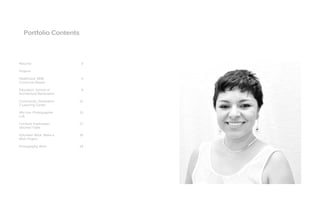
Portfolio Contents
Resume
Projects
Healthcare: 2035
Consumer Based
Education: School of
Architecture Renovation
Community: Generation
Z Learning Center
Mix-Use: Photographer
Loft
Furniture Exploration:
Stitched Table
Volunteer Work: Make a
Wish Project
Photography Work
	
3
4
9
12
15
17
18
19
3
ABOUT ME
Design and technology interest. Joy for
the arts, especially photography. Love for
coffee, chocolate and bike riding.
AWARDS
2015 Annual SES Student Healthcare
Design Intervention: Future (2035) of
Healthcare Design. 1st Place UTSA in-
house competition.
2014 UTSA Scholarship and Awards. Bill
and Diane Hays Endowed Scholarship
Recipient.
2014 UTSA College of Architecture
Interior Design Studio Award.
2014 UTSA College of Architecture
Dean’s Honor List
2013 UTSA College of Architecture
Dean’s Honor List
	
EDUCATION
University of Texas at San Antonio
Bachelor of Science in Interior Design.
Expected Graduation: May 2015.
INVOLVEMENT
December 2014- March 2015
Make a Wish Project Participant.
2015
May 2014-Apr 2015. IIDA UTSA CC President,
Make a Wish Foundation, volunteer
Dec 2014 -Mar 2015. IIDA Student Mentoring
Week participant.
IIDA Student Conference attendee.
AIA SES Student Healthcare Design
Intervention UTSA team competitor.
2014
AIA LIA Architecture Exhibition,
participant
Donghia Design Competition, UTSA
ambassador.
IIDA Student Charette at Neocon, UTSA
ambassador.
IIDA Student Mentoring Week participant.
IIDA Student Conference Charette
participant.
2013
IIDA UTSA CC Historian Leader.
IIDA Student Conference atendee
IIDA Student Mentoring Week participant.
SOFTWARE SKILLS
Autodesk: Autocad, Revit
Adobe: Photoshop, Illustrator, InDesign
3D Modeling: SketchUp, Rhino
Microsoft Office: Word, Excel, Power
Point
QUALITIES
Strong organizational skills and
multitasking.
Bilingual proficiency in English and
Spanish.
Understanding of architectural drawings.
Understanding of architectural
specifications.
Problem solver and generalist.
Self motivated and fast learner.
210.910.7589
nayreyes1@hotmail.com
linkedin.com/nayreyes
4
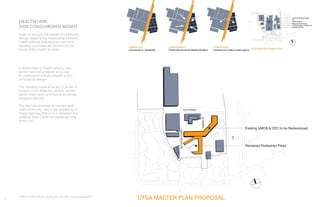
A researched in health delivery was
performed and analyzed as a way
to understand and developed a new
conceptual design.
The existing medical facility in Austin is
located in the Waterloo district, school,
government and commercial buildings
neighbor the site.
The site has potential to connect both
sides of the city, which are divided by a
major highway that runs in between the
medical district and the residential side
of the city.
Bottom: UTSA Master proposal. Top: Site analysis diagrams.
Existing UMCB & CEC to be Redeveloped
Recessed Pedestrian Plaza
REDRIVERSTREET
I-35
SABINEST
15TH STREET
UTSA MASTER PLAN PROPOSAL
HEALTHCARE:
2035 CONSUMERED BASED
Goal: To analyze the trends in healthcare
design, explore the relationship between
health and the built environment and
develop a conceptual scheme for the
future of the health facilities.
5
In 2035 health services, will be
consumer-based since the advances in
technology will extend the options for
all patients.
The accessibility to the internet and
wearable technology will change the
way the medical facilities operate
Furthermore, medical records will be
able to quickly synchronize by scanning
and uploading patient’s information into
the cloud, and a new patient journey will
emerge in the healthcare field.
Technologies will reduce the inpatient
traffic and will also accelerete the
process and steps during a patient’s
doctor visit.
Bottom: Building section showing the
communal open spaces created by the sunken
garden. Top: Austin’s population dempographic
information health problems diagrams.
6
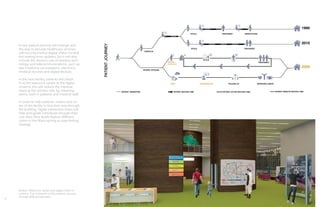
A new patient journey will emerge and
the way to provide healthcare services
will not only involve digital check ins and
live waiting time updates, but it will also
include the doctor’s use of wireless tech-
nology and telecommunications, such as
tele-medicine consultations, electronic
medical records and digital devices.
In the new facility, patients will check
in at the welcome center at the digital
screens, this will reduce the medical
steps at the doctors visit, by releasing
stress, both in patients and medical staff.
In order to help patients, visitors and us-
ers of the facility to find their way through
the building. Digital interactive maps will
help and guide individuals through their
visit. Also, floor levels feature different
colors in the floors acting as way-finding
strategy.
Bottom: Welcome center and digital check in
screens. Top: Evolution of the patient’s journey
through different decades.
7
Relaxing and lounge spaces are
incorporated trough out the facility
to release the tension and stress in
patient’s and medical staff.
Art galleries activate a faster healing
process in patients and outdoor
lounges serve for relaxation and
entertainment for their guests.
Not only relaxing spaces accelerate the
healing process, but also active spaces
promote a more suitable healing and
learning environment.
Top left:Typical floor plan. Bottom left: Level one floor plan. Top
right: Patient check in screens. Bottom right: Outdoor lounge.
8
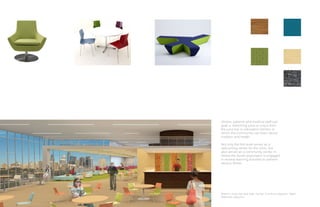
Visitors, patients and medical staff can
grab a refreshing juice or snack from
the juice bar or education kitchen, in
which the community can learn about
nutrition and health.
Not only the first level serves as a
welcoming center for the clinic, but
also serves as a community center in
where the Austin population is engaged
in several learning activities to prevent
serious illness.
Bottom: Juice bar and cafe. Center: Furniture selection. Right:
Materials selection.
9
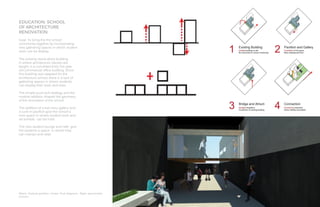
EDUCATION: SCHOOL
OF ARCHITECTURE
RENOVATION
Goal: To bring the the school
community together by incorporating
new gathering spaces in which student
work can be display.
The existing stand-alone building
in where architecture classes are
taught, is a converted thirty five year
old commercial office building. Since
this building was adapted for the
architecture school, there is a lack of
gathering spaces in where students
can display their work and relax.
The simple push-pull strategy and the
module addition shaped the geometry
of the renovation of the school.
The addition of a two story gallery and
a sunk-in pavilion give the school a
new space in where student work and
art exhibits can be hold.
The new student lounge and cafe give
the students a space in where they
can interact and relax.
Below: Outdoor pavillion. Center: Parti diagrams. Right: axonometric
process.
10
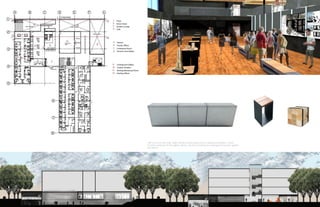
Left: Level one floor plan. Right: Student presenting work at underground gallery. Center:
Furniture selection for the gallery. Below. Sections showing the underground pavilion, gallery
and atrium.
11
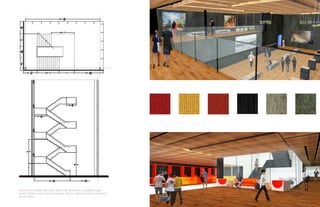
Above: Stair design drawings. Right top: Mezzanine at gallery. Right
center: Fabrics and surface materials. Bottom right: Student lounge and
atrium stairs.
12
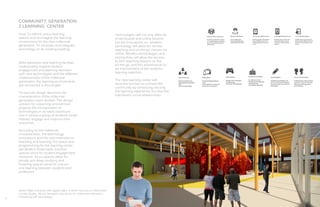
COMMUNITY: GENERATION
Z LEARNING CENTER
Goal: To rethink active learning
spaces and re-imagine the learning
environment for the new millennial
generation. To renovate and integrate
technology on an existing building.
Most education and learning facilities
inadequately support student
engagement and learning retention,
with new technologies and the different
characteristics of the millennial
generation, the learning environments
are reinvented in this project.
To execute design decisions the
characteristics of the millennial
generation were studied. The design
solution for a learning environment
propose the incorporation of
technologies in an ideal classroom
size in where a group of students could
interact, engage and improve their
outcomes.
According to the millennial
characteristics, the technology
innovations and the new methods on
teaching and learning; the space and
programming for the learning center
are dived in three types. Enclave
spaces serve for student engagement,
moreover, focus spaces allow for
private and deep studying and
fostering spaces serve for one-on-
one learning between students and
professors.
Below: Main entrance with digital walls, in which lectures or information
can be display. Above: Research key points for millennials behaviors
interacting with technology
Technologies will not only allow for
smart boards and online lessons,
but the innovations on wireless
technology will allow for remote
teaching and on-the-go classes via
online. Wireless technologies and
connectivity will allow the access
to 24/7 teaching lessons on the
on-the-go, and this would result on
an improvement of the student’s
learning retention.
The new learning center will
have the function to connect the
community by enhancing not only
the learning experience, but also the
individual’s social relationships.
13
14
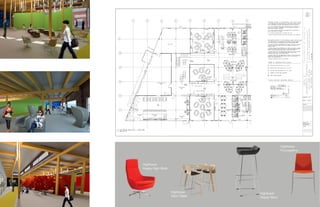
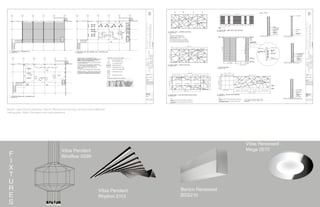
Below: Light fixture selection. Above: Mezzanine framing, furniture and reflected
ceiling plan. Right: Elevation and wall partitions.
15
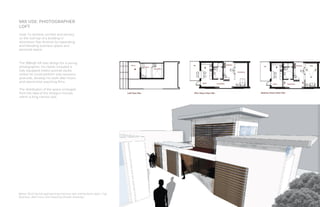
MIX USE: PHOTOGRAPHER
LOFT
Goal: To achieve comfort and privacy
on the roof top of a building in
downtown San Antonio by separating
and blending business space and
personal space.
The 300sqft loft was design for a young
photographer, his needs included a
fully equipped indoor portrait studio
where he could perform solo sessions,
post-edit, develop his work after hours
and spend time watching films.
The distribution of the space emerged
from the idea of the shotgun houses
within a long-narrow axis.
Below: Roof top loft approaching entrance with sliding doors open. Top:
Business, after hours and sleeping loft plan drawings.
16
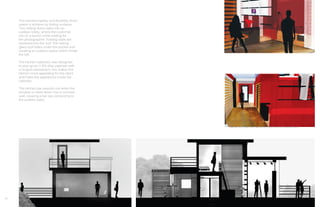
The transformability and flexibility of the
space is achieve by sliding surfaces.
Two sliding doors open into an
outdoor lobby, where the customer
sits on a bench while waiting for
the photographer. Folding walls are
recessed into the roof. The sliding
glass roof hides under the pocket roof
creating an outdoor space within inside
the loft.
The kitchen cabinetry was designed
to pop-up as in the ship cabinets with
a hinged mechanism, this makes the
kitchen more appealing for the client
and hides the appliances inside the
cabinets.
The kitchen bar extends out when the
window is rolled down into a concave
wall, creating a bar top connecting to
the outdoor patio.
Below: Roof top Loft Sections. Top: Interior Perspectives.
17
FURNITURE EXPLORATION:
STITCHED TABLE
Objective: To use half of a pallet’s
wood to build a side table. Explore
wood assembly methods, and material
finishes.
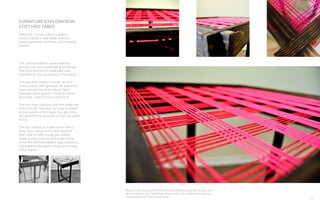
Above: Pallet wood and the frame assembled through the tongue and
grove method. Top: Table final construction, top surface was weaved
and stitched with heavy duty string.
The stitched table is assembled by
groove cuts and wood fitting bondings.
The least amount of hardware was
intended for the assembly of this piece.
The top wide frame is made out of 4
wood pieces with grooves. Its assembly
was intended to be pressure fitted
between each groove, however some
glue was used to have a tighter fit.
The slim legs contrast with the wider top
of the frame. They are not only screwed
to the bottom of the base, but also they
are glued to the grooves on the top wider
frame.
The top surface is made out of heavy
duty nylon string and it was stitched
from side to side trough per-drilled
holes on the very top of the top frame.
Once the stitched pattern was created a
transparent plexi glass sheet sits on top
of the frame.
18
VOLUNTEER WORK: MAKE
A WISH PROJECT
Project in partnership with the Make a
Wish Foundation, Objective: To design
a little girl’s dream room where she can
spend time with her friends by remod-
eling her family’s garage.
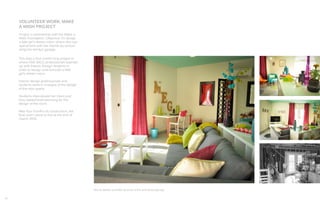
Above: Before and after pictures of the unfinished garage.
This was a four month long project in
where IIDA SACC professionals teamed
up with Interior Design students in
order to design and remodel a little
girl’s dream room.
Interior design professionals and
students were in charged of the design
of the new space.
Students interviewed her client and
they started brainstorming for the
design of the room.
After four months of construction, the
final room came to live at the end of
march 2015.
19
PHOTOGRAPHY
WORK
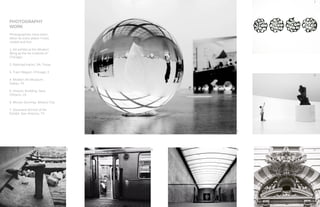
Photographies have been
taken at every place I have
visited and live.
1. Art exhibit at the Modern
Wing at the Art Institute of
Chicago.
2. Railroad tracks. SA, Texas
3. Train Wagon. Chicago, Il
4. Modern Art Museum.
Dallas, TX
5. Historic Building. New
Orleans, LA
6. Museo Soumay. Mexico City
7. Soutwest School of Art
Exhibit. San Antonio, TX
2
1
3 4 5
6
7
20
INTERIOR
DESIGN
MAJOR
2015
UNIVERSITYOFTEXASSA
IIDA UTSA
CAMPUS CENTER
PRESIDENT
210.910.7589
nayreyes1@hotmail.com
linkedin.com/in/nayreyes
nayelly reyes
h hh

NayReyes Portfolio

  • 1.
  • 2.
    2 Portfolio Contents Resume Projects Healthcare: 2035 ConsumerBased Education: School of Architecture Renovation Community: Generation Z Learning Center Mix-Use: Photographer Loft Furniture Exploration: Stitched Table Volunteer Work: Make a Wish Project Photography Work 3 4 9 12 15 17 18 19
  • 3.
    3 ABOUT ME Design andtechnology interest. Joy for the arts, especially photography. Love for coffee, chocolate and bike riding. AWARDS 2015 Annual SES Student Healthcare Design Intervention: Future (2035) of Healthcare Design. 1st Place UTSA in- house competition. 2014 UTSA Scholarship and Awards. Bill and Diane Hays Endowed Scholarship Recipient. 2014 UTSA College of Architecture Interior Design Studio Award. 2014 UTSA College of Architecture Dean’s Honor List 2013 UTSA College of Architecture Dean’s Honor List EDUCATION University of Texas at San Antonio Bachelor of Science in Interior Design. Expected Graduation: May 2015. INVOLVEMENT December 2014- March 2015 Make a Wish Project Participant. 2015 May 2014-Apr 2015. IIDA UTSA CC President, Make a Wish Foundation, volunteer Dec 2014 -Mar 2015. IIDA Student Mentoring Week participant. IIDA Student Conference attendee. AIA SES Student Healthcare Design Intervention UTSA team competitor. 2014 AIA LIA Architecture Exhibition, participant Donghia Design Competition, UTSA ambassador. IIDA Student Charette at Neocon, UTSA ambassador. IIDA Student Mentoring Week participant. IIDA Student Conference Charette participant. 2013 IIDA UTSA CC Historian Leader. IIDA Student Conference atendee IIDA Student Mentoring Week participant. SOFTWARE SKILLS Autodesk: Autocad, Revit Adobe: Photoshop, Illustrator, InDesign 3D Modeling: SketchUp, Rhino Microsoft Office: Word, Excel, Power Point QUALITIES Strong organizational skills and multitasking. Bilingual proficiency in English and Spanish. Understanding of architectural drawings. Understanding of architectural specifications. Problem solver and generalist. Self motivated and fast learner. 210.910.7589 nayreyes1@hotmail.com linkedin.com/nayreyes
  • 4.
    4 A researched inhealth delivery was performed and analyzed as a way to understand and developed a new conceptual design. The existing medical facility in Austin is located in the Waterloo district, school, government and commercial buildings neighbor the site. The site has potential to connect both sides of the city, which are divided by a major highway that runs in between the medical district and the residential side of the city. Bottom: UTSA Master proposal. Top: Site analysis diagrams. Existing UMCB & CEC to be Redeveloped Recessed Pedestrian Plaza REDRIVERSTREET I-35 SABINEST 15TH STREET UTSA MASTER PLAN PROPOSAL HEALTHCARE: 2035 CONSUMERED BASED Goal: To analyze the trends in healthcare design, explore the relationship between health and the built environment and develop a conceptual scheme for the future of the health facilities.
  • 5.
    5 In 2035 healthservices, will be consumer-based since the advances in technology will extend the options for all patients. The accessibility to the internet and wearable technology will change the way the medical facilities operate Furthermore, medical records will be able to quickly synchronize by scanning and uploading patient’s information into the cloud, and a new patient journey will emerge in the healthcare field. Technologies will reduce the inpatient traffic and will also accelerete the process and steps during a patient’s doctor visit. Bottom: Building section showing the communal open spaces created by the sunken garden. Top: Austin’s population dempographic information health problems diagrams.
  • 6.
    6 A new patientjourney will emerge and the way to provide healthcare services will not only involve digital check ins and live waiting time updates, but it will also include the doctor’s use of wireless tech- nology and telecommunications, such as tele-medicine consultations, electronic medical records and digital devices. In the new facility, patients will check in at the welcome center at the digital screens, this will reduce the medical steps at the doctors visit, by releasing stress, both in patients and medical staff. In order to help patients, visitors and us- ers of the facility to find their way through the building. Digital interactive maps will help and guide individuals through their visit. Also, floor levels feature different colors in the floors acting as way-finding strategy. Bottom: Welcome center and digital check in screens. Top: Evolution of the patient’s journey through different decades.
  • 7.
    7 Relaxing and loungespaces are incorporated trough out the facility to release the tension and stress in patient’s and medical staff. Art galleries activate a faster healing process in patients and outdoor lounges serve for relaxation and entertainment for their guests. Not only relaxing spaces accelerate the healing process, but also active spaces promote a more suitable healing and learning environment. Top left:Typical floor plan. Bottom left: Level one floor plan. Top right: Patient check in screens. Bottom right: Outdoor lounge.
  • 8.
    8 Visitors, patients andmedical staff can grab a refreshing juice or snack from the juice bar or education kitchen, in which the community can learn about nutrition and health. Not only the first level serves as a welcoming center for the clinic, but also serves as a community center in where the Austin population is engaged in several learning activities to prevent serious illness. Bottom: Juice bar and cafe. Center: Furniture selection. Right: Materials selection.
  • 9.
    9 EDUCATION: SCHOOL OF ARCHITECTURE RENOVATION Goal:To bring the the school community together by incorporating new gathering spaces in which student work can be display. The existing stand-alone building in where architecture classes are taught, is a converted thirty five year old commercial office building. Since this building was adapted for the architecture school, there is a lack of gathering spaces in where students can display their work and relax. The simple push-pull strategy and the module addition shaped the geometry of the renovation of the school. The addition of a two story gallery and a sunk-in pavilion give the school a new space in where student work and art exhibits can be hold. The new student lounge and cafe give the students a space in where they can interact and relax. Below: Outdoor pavillion. Center: Parti diagrams. Right: axonometric process.
  • 10.
    10 Left: Level onefloor plan. Right: Student presenting work at underground gallery. Center: Furniture selection for the gallery. Below. Sections showing the underground pavilion, gallery and atrium.
  • 11.
    11 Above: Stair designdrawings. Right top: Mezzanine at gallery. Right center: Fabrics and surface materials. Bottom right: Student lounge and atrium stairs.
  • 12.
    12 COMMUNITY: GENERATION Z LEARNINGCENTER Goal: To rethink active learning spaces and re-imagine the learning environment for the new millennial generation. To renovate and integrate technology on an existing building. Most education and learning facilities inadequately support student engagement and learning retention, with new technologies and the different characteristics of the millennial generation, the learning environments are reinvented in this project. To execute design decisions the characteristics of the millennial generation were studied. The design solution for a learning environment propose the incorporation of technologies in an ideal classroom size in where a group of students could interact, engage and improve their outcomes. According to the millennial characteristics, the technology innovations and the new methods on teaching and learning; the space and programming for the learning center are dived in three types. Enclave spaces serve for student engagement, moreover, focus spaces allow for private and deep studying and fostering spaces serve for one-on- one learning between students and professors. Below: Main entrance with digital walls, in which lectures or information can be display. Above: Research key points for millennials behaviors interacting with technology Technologies will not only allow for smart boards and online lessons, but the innovations on wireless technology will allow for remote teaching and on-the-go classes via online. Wireless technologies and connectivity will allow the access to 24/7 teaching lessons on the on-the-go, and this would result on an improvement of the student’s learning retention. The new learning center will have the function to connect the community by enhancing not only the learning experience, but also the individual’s social relationships.
  • 13.
  • 14.
    14 Below: Light fixtureselection. Above: Mezzanine framing, furniture and reflected ceiling plan. Right: Elevation and wall partitions.
  • 15.
    15 MIX USE: PHOTOGRAPHER LOFT Goal:To achieve comfort and privacy on the roof top of a building in downtown San Antonio by separating and blending business space and personal space. The 300sqft loft was design for a young photographer, his needs included a fully equipped indoor portrait studio where he could perform solo sessions, post-edit, develop his work after hours and spend time watching films. The distribution of the space emerged from the idea of the shotgun houses within a long-narrow axis. Below: Roof top loft approaching entrance with sliding doors open. Top: Business, after hours and sleeping loft plan drawings.
  • 16.
    16 The transformability andflexibility of the space is achieve by sliding surfaces. Two sliding doors open into an outdoor lobby, where the customer sits on a bench while waiting for the photographer. Folding walls are recessed into the roof. The sliding glass roof hides under the pocket roof creating an outdoor space within inside the loft. The kitchen cabinetry was designed to pop-up as in the ship cabinets with a hinged mechanism, this makes the kitchen more appealing for the client and hides the appliances inside the cabinets. The kitchen bar extends out when the window is rolled down into a concave wall, creating a bar top connecting to the outdoor patio. Below: Roof top Loft Sections. Top: Interior Perspectives.
  • 17.
    17 FURNITURE EXPLORATION: STITCHED TABLE Objective:To use half of a pallet’s wood to build a side table. Explore wood assembly methods, and material finishes. Above: Pallet wood and the frame assembled through the tongue and grove method. Top: Table final construction, top surface was weaved and stitched with heavy duty string. The stitched table is assembled by groove cuts and wood fitting bondings. The least amount of hardware was intended for the assembly of this piece. The top wide frame is made out of 4 wood pieces with grooves. Its assembly was intended to be pressure fitted between each groove, however some glue was used to have a tighter fit. The slim legs contrast with the wider top of the frame. They are not only screwed to the bottom of the base, but also they are glued to the grooves on the top wider frame. The top surface is made out of heavy duty nylon string and it was stitched from side to side trough per-drilled holes on the very top of the top frame. Once the stitched pattern was created a transparent plexi glass sheet sits on top of the frame.
  • 18.
    18 VOLUNTEER WORK: MAKE AWISH PROJECT Project in partnership with the Make a Wish Foundation, Objective: To design a little girl’s dream room where she can spend time with her friends by remod- eling her family’s garage. Above: Before and after pictures of the unfinished garage. This was a four month long project in where IIDA SACC professionals teamed up with Interior Design students in order to design and remodel a little girl’s dream room. Interior design professionals and students were in charged of the design of the new space. Students interviewed her client and they started brainstorming for the design of the room. After four months of construction, the final room came to live at the end of march 2015.
  • 19.
    19 PHOTOGRAPHY WORK Photographies have been takenat every place I have visited and live. 1. Art exhibit at the Modern Wing at the Art Institute of Chicago. 2. Railroad tracks. SA, Texas 3. Train Wagon. Chicago, Il 4. Modern Art Museum. Dallas, TX 5. Historic Building. New Orleans, LA 6. Museo Soumay. Mexico City 7. Soutwest School of Art Exhibit. San Antonio, TX 2 1 3 4 5 6 7
  • 20.