An in-depth conversation with American voters
MARCH 26, 2020
Navigating COVID-19
MARCH 26, 2020
2
There’s a lot of public opinion data out
there right now about COVID-19, but less
qualitative insight into what is behind the
polling numbers.
• The Glover Park Group’s Research and
Insights practice conducted a 30-minute
online caucus on March 23, 2020 among
210 news attentive and civically engaged
voters nationwide.
The Glover Park Group hosted a
conversation with Americans to see how
they are feeling and how institutions,
specifically brands, can help.
• A caucus session functions similarly to an
online focus group at scale, providing a
space for in-depth discussion with
traditional polling questions to quantify
key topics.
AN IN-DEPTH CONVERSATION WITH AMERICAN VOTERS
Key Insights
AN IN-DEPTH CONVERSATION WITH AMERICAN VOTERS MARCH 26, 2020
MARCH 26, 2020
4
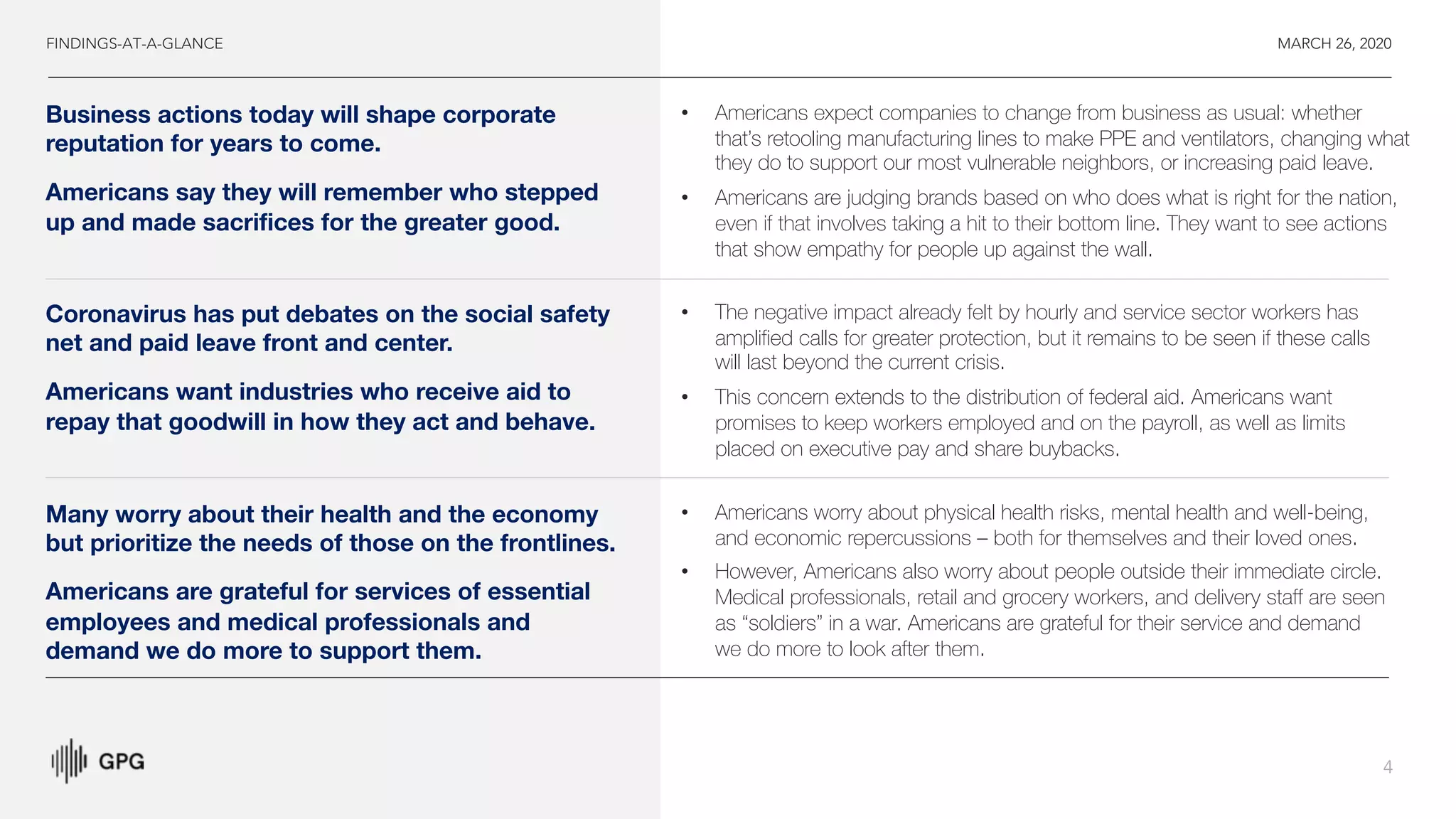
Many worry about their health and the economy
but prioritize the needs of those on the frontlines.
Americans are grateful for services of essential
employees and medical professionals and
demand we do more to support them.
• Americans worry about physical health risks, mental health and well-being,
and economic repercussions – both for themselves and their loved ones.
• However, Americans also worry about people outside their immediate circle.
Medical professionals, retail and grocery workers, and delivery staff are seen
as “soldiers” in a war. Americans are grateful for their service and demand
we do more to look after them.
Business actions today will shape corporate
reputation for years to come.
Americans say they will remember who stepped
up and made sacrifices for the greater good.
• Americans expect companies to change from business as usual: whether
that’s retooling manufacturing lines to make PPE and ventilators, changing what
they do to support our most vulnerable neighbors, or increasing paid leave.
• Americans are judging brands based on who does what is right for the nation,
even if that involves taking a hit to their bottom line. They want to see actions
that show empathy for people up against the wall.
Coronavirus has put debates on the social safety
net and paid leave front and center.
Americans want industries who receive aid to
repay that goodwill in how they act and behave.
• The negative impact already felt by hourly and service sector workers has
amplified calls for greater protection, but it remains to be seen if these calls
will last beyond the current crisis.
• This concern extends to the distribution of federal aid. Americans want
promises to keep workers employed and on the payroll, as well as limits
placed on executive pay and share buybacks.
FINDINGS-AT-A-GLANCE
MARCH 26, 2020
5
Be deeply empathetic. Many Americans are anxious as they worry about loved ones and finances
while dealing with the stress of social isolation. Always put yourself in their
shoes.
It’s not business as usual, so don’t communicate
as if it is.
This is a moment of crisis. Americans want to hear how businesses are doing
what they can to protect those on the frontlines and keep their employees safe
and secure.
Identify what relevant capability or area of
expertise you can deploy to play your part.
Americans praise ingenuity and champion businesses that are retooling their supply
chains or changing protocol to protect lives.
Pass the loyalty test. Americans will measure you on how well you stick by your employees and
customers – and reward those who give people a further hand up in these most
challenging of times. Failure to show empathy will reverberate.
Remember the lessons of 2008. Reactions to 2008 drove populism on the left and right. Americans understand the
need to pass a major stimulus bill but expect supported industries to figuratively
repay that trust in how they act and behave in the coming years.
KEY CONSIDERATIONS FOR COMMUNICATIONS AND ENGAGEMENT
MARCH 26, 2020
6
In their own words:
“This is your chance to make or break your company.
It doesn't matter how successful it's been all this
time. If you do the right thing you will be remembered
positively, and the business will have the trust of the
people after all of this is over.”
AN IN-DEPTH CONVERSATION WITH AMERICAN VOTERS
Detailed Insights
MARCH 26, 2020AN IN-DEPTH CONVERSATION WITH AMERICAN VOTERS
MARCH 26, 2020
8
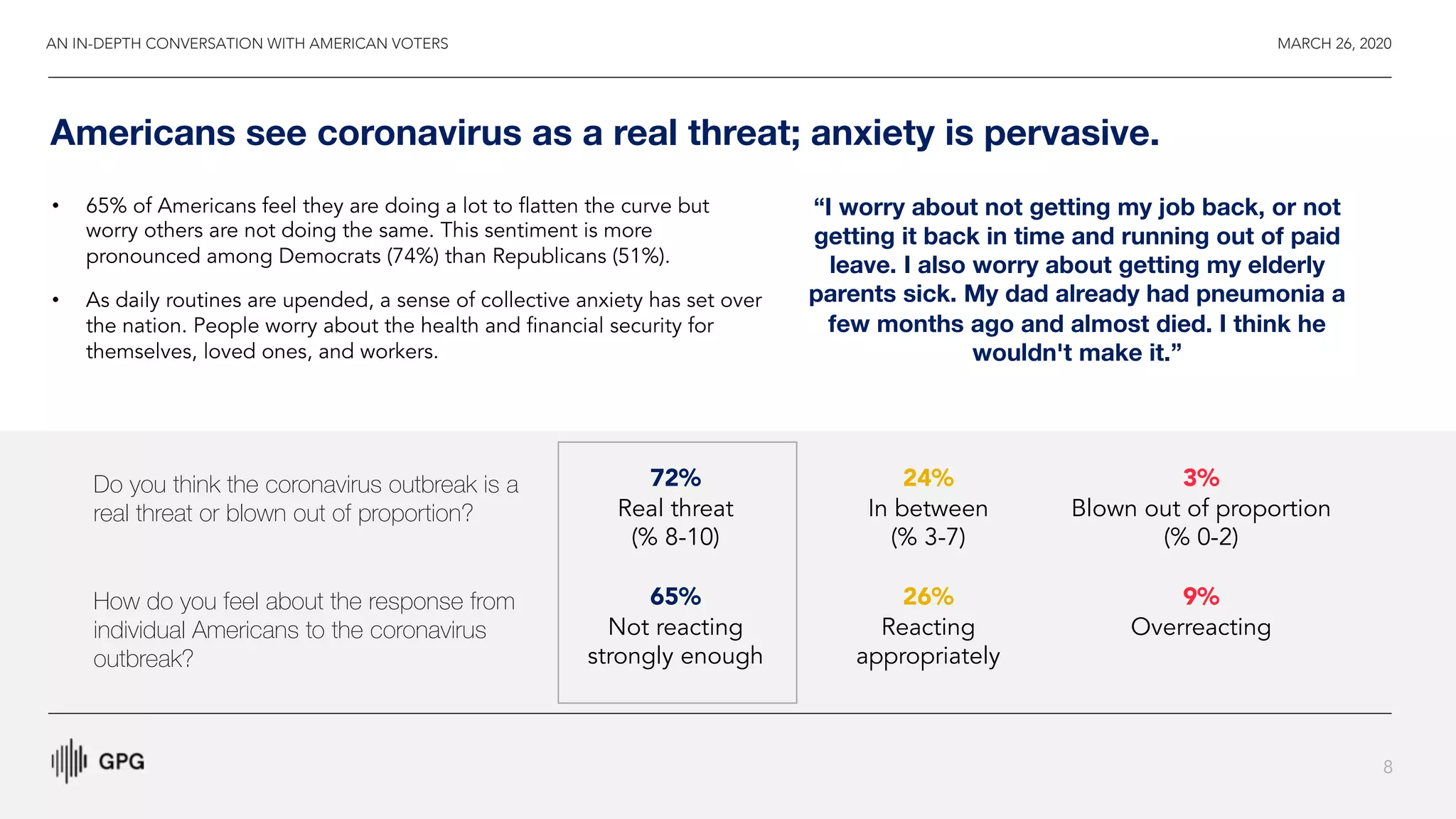
Americans see coronavirus as a real threat; anxiety is pervasive.
• 65% of Americans feel they are doing a lot to flatten the curve but
worry others are not doing the same. This sentiment is more
pronounced among Democrats (74%) than Republicans (51%).
• As daily routines are upended, a sense of collective anxiety has set over
the nation. People worry about the health and financial security for
themselves, loved ones, and workers.
Do you think the coronavirus outbreak is a
real threat or blown out of proportion?
How do you feel about the response from
individual Americans to the coronavirus
outbreak?
65%
Not reacting
strongly enough
26%
Reacting
appropriately
9%
Overreacting
72%
Real threat
(% 8-10)
24%
In between
(% 3-7)
3%
Blown out of proportion
(% 0-2)
“I worry about not getting my job back, or not
getting it back in time and running out of paid
leave. I also worry about getting my elderly
parents sick. My dad already had pneumonia a
few months ago and almost died. I think he
wouldn't make it.”
AN IN-DEPTH CONVERSATION WITH AMERICAN VOTERS
MARCH 26, 2020
9
People shared candid concerns about friends, family.
“My mother is a nurse in her
late sixties so I am very
concerned about her becoming
infected and the health
implications that would come
with that.”
“I am worried about my
mental health. I am lucky. I
am in a good economic
situation. I have health care
and a safety net. But
staying home is hard. I live
alone and my family is
2000+ miles away.”
• Roughly seven-in-ten list the risk of getting sick or losing friends or family as a top concern.
• Most talk about their concerns in the third-person, describing the potential of losing parents
and grandparents, or worrying about whether workers who lose their jobs will be able to
make ends meet.
• Others worry that the dual stress of social isolation and financial uncertainty will lead to
mental health issues for people across the country.
The risk of getting sick or losing a friend or family member to the virus 72%
Damage to the U.S. economy as businesses are forced to shut down 72%
Rising unemployment rates as businesses are forced to shut down 59%
People struggling to make mortgage and rent payments next month 48%
Rising financial insecurity among minimum wage and hourly workers 47%
Limited access to essential medical supplies for physicians 45%
Limited access to basic services and goods at stores 41%
Limited access to testing and medical support for patients 33%
The toll that social isolation will have on Americans’ mental health 26%
Rising pressure on workers to balance remote work and childcare 20%
AN IN-DEPTH CONVERSATION WITH AMERICAN VOTERS
MARCH 26, 2020
10
Equal concern over health risks and the economy.
“I worry about not being able
to bounce back financially. I
have 3 kids and need to
provide for them, and my
industry segment is basically
shut down.”
”I worry the most about
hourly employees making
minimum wage. They were
struggling enough as it was
before the virus. Now, their
hours have been reduced if
not eliminated.”
• Anxiety for small businesses, the unemployed and hourly workers also rank high among
concerns related to the outbreak.
• Concern for the wellbeing of others, especially the underserved and vulnerable, is particularly
top-of-mind as Americans see businesses closing and people around them losing jobs.
• Fears of long-term economic consequences are real.
The risk of getting sick or losing a friend or family member to the virus 72%
Damage to the U.S. economy as businesses are forced to shut down 72%
Rising unemployment rates as businesses are forced to shut down 59%
People struggling to make mortgage and rent payments next month 48%
Rising financial insecurity among minimum wage and hourly workers 47%
Limited access to essential medical supplies for physicians 45%
Limited access to basic services and goods at stores 41%
Limited access to testing and medical support for patients 33%
The toll that social isolation will have on Americans’ mental health 26%
Rising pressure on workers to balance remote work and childcare 20%
52% Anticipate an economic recession
30% Anticipate an economic depression
AN IN-DEPTH CONVERSATION WITH AMERICAN VOTERS
MARCH 26, 2020
11
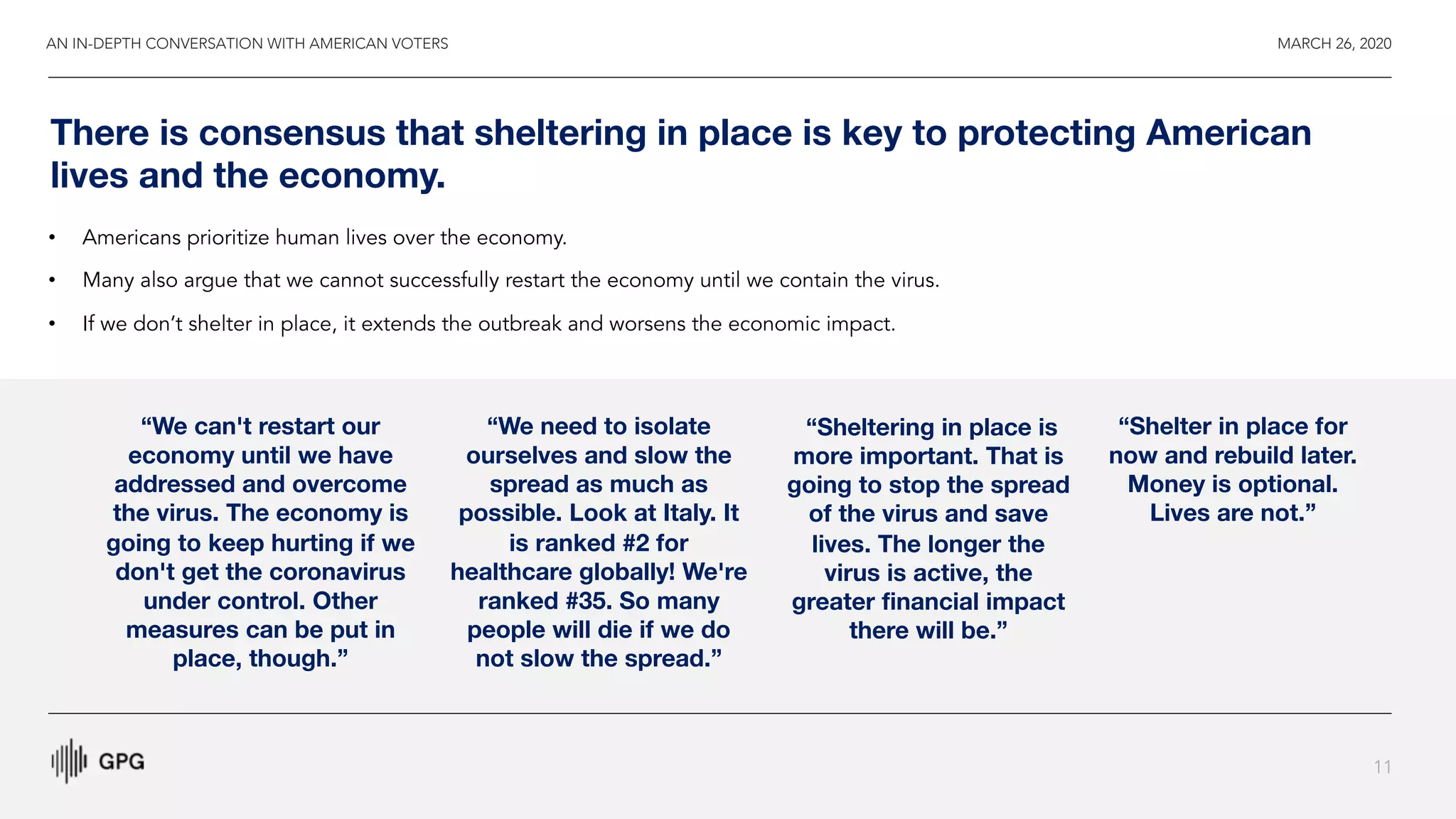
There is consensus that sheltering in place is key to protecting American
lives and the economy.
“We can't restart our
economy until we have
addressed and overcome
the virus. The economy is
going to keep hurting if we
don't get the coronavirus
under control. Other
measures can be put in
place, though.”
• Americans prioritize human lives over the economy.
• Many also argue that we cannot successfully restart the economy until we contain the virus.
• If we don’t shelter in place, it extends the outbreak and worsens the economic impact.
“We need to isolate
ourselves and slow the
spread as much as
possible. Look at Italy. It
is ranked #2 for
healthcare globally! We're
ranked #35. So many
people will die if we do
not slow the spread.”
“Shelter in place for
now and rebuild later.
Money is optional.
Lives are not.”
AN IN-DEPTH CONVERSATION WITH AMERICAN VOTERS
“Sheltering in place is
more important. That is
going to stop the spread
of the virus and save
lives. The longer the
virus is active, the
greater financial impact
there will be.”
MARCH 26, 2020
12
Americans share gratitude for workers of all kinds standing on the front lines.
“The minimum and low
wage workers at grocery
stores, gas stations, and
similar places of work are at
higher risk and not getting
help. They need financial
grants at least.”
• As the rest of the country stays home, gratitude runs deep for doctors and nurses, grocery store workers, mail and delivery workers, and
others that deliver essential services. Essential employees are seen as “soldiers” on the frontlines of a war, putting themselves at risk to
support their communities.
• But people worry we are not going far enough to support essential workers in return. Americans call on businesses and the government to
ramp up production of medical supplies, N95 masks, and other personal protective equipment (PPE) – terms that are now part of our
national vocabulary.
“The needs of medical
workers, our doctors and
nurses who are risking
everything [are getting
overlooked].”
“They need masks, hand
sanitizer, more breaks to deal
with hygiene, support from the
supervisors, and just anything
that will make having to be on
the front lines a little easier.”
AN IN-DEPTH CONVERSATION WITH AMERICAN VOTERS
• Paid leave and worker pay top the list of actions Americans want to see businesses take to ease the crisis, but many support this out of
circumstance and it remains to be seen if this support will extend beyond the current crisis.
MARCH 26, 2020
13
Americans are paying close attention to worker protections and paid leave.
Provide paid sick leave to their employees 82%
Continue to pay their workers (even if normal operations and business shuts down) 81%
Require all employees who are able to work from home to protect their personal health and help slow the curve 72%
Make immediate payments to suppliers and smaller companies they rely on to maintain operations and supplies 50%
Retool their factories and supply chains to meet new needs like medical masks and ventilators 43%
Give workers cash bonuses 40%
Give customers more time to make large payments 39%
Use their voice in the media and social platforms to educate the public about stopping the spread of coronavirus 27%
Protect profitability for shareholders that own their stock in 401ks and other investment vehicles 16%
“I think [the paid leave legislation passed by Congress] is a vital
step to protect physically and economically vulnerable people in
American society. It should be the new standard for our social
safety net which has always been inadequate.”
“This idea [for paid leave] is fine
but only for the COVID-19 crisis. It
should not stay if the company did
not offer the benefit [before].”
AN IN-DEPTH CONVERSATION WITH AMERICAN VOTERS
MARCH 26, 2020
14
Big businesses get a passing grade in how they
have responded, but many want to see more.
Coronavirus response:
42%
give an
A or B grade
24%
give a
C grade
27%
give a
D or F grade
Credit given for positive changes:
✓ Instituting remote work policies and shifting away from business as usual
✓ Easing financial stress through paid leave, bonuses, delayed payments, and refunds
✓ Retooling manufacturing facilities to make lifesaving medical equipment and supplies for
health care workers and hospitals
Biggest concerns include:
✓ Refusing to close shop
✓ Denying workers paid sick days
✓ Financial institutions not offering mortgage, loan or credit relief
AN IN-DEPTH CONVERSATION WITH AMERICAN VOTERS
MARCH 26, 2020
15
Businesses’ responses today will shape brand perceptions for years to come.
“They should work in an altruistic
manner, balancing the welfare of
their employees and stakeholders
with the country as a
whole. Economic losses can be
recovered from fairly quickly, but
a horrendous reputation is very
tough to recover from.”
“Leverage your economies of
scale and do what’s right now. By
doing so, you build brand trust
which will benefit your business
after this is over. You benefit from
the community. Now it’s time to
give back to those who gave so
much to you.”
“We are in a time of crisis.
What they do now will have
long-lasting results for their
brand identity. Do not
overprice things. Help those
as much as you can. You
may take a financial hit now,
but it will pay off.”
• Put people and the nation first. Americans expect big businesses to empathize with the public and contribute to the greater good, even if
it means taking temporary hits to their bottom lines.
• Now is seen as a time for unity and sacrifice, not corporate self-interest.
• Americans talk about remembering not only those who step up during times of crisis, but also those who fall short.
AN IN-DEPTH CONVERSATION WITH AMERICAN VOTERS
MARCH 26, 2020
16
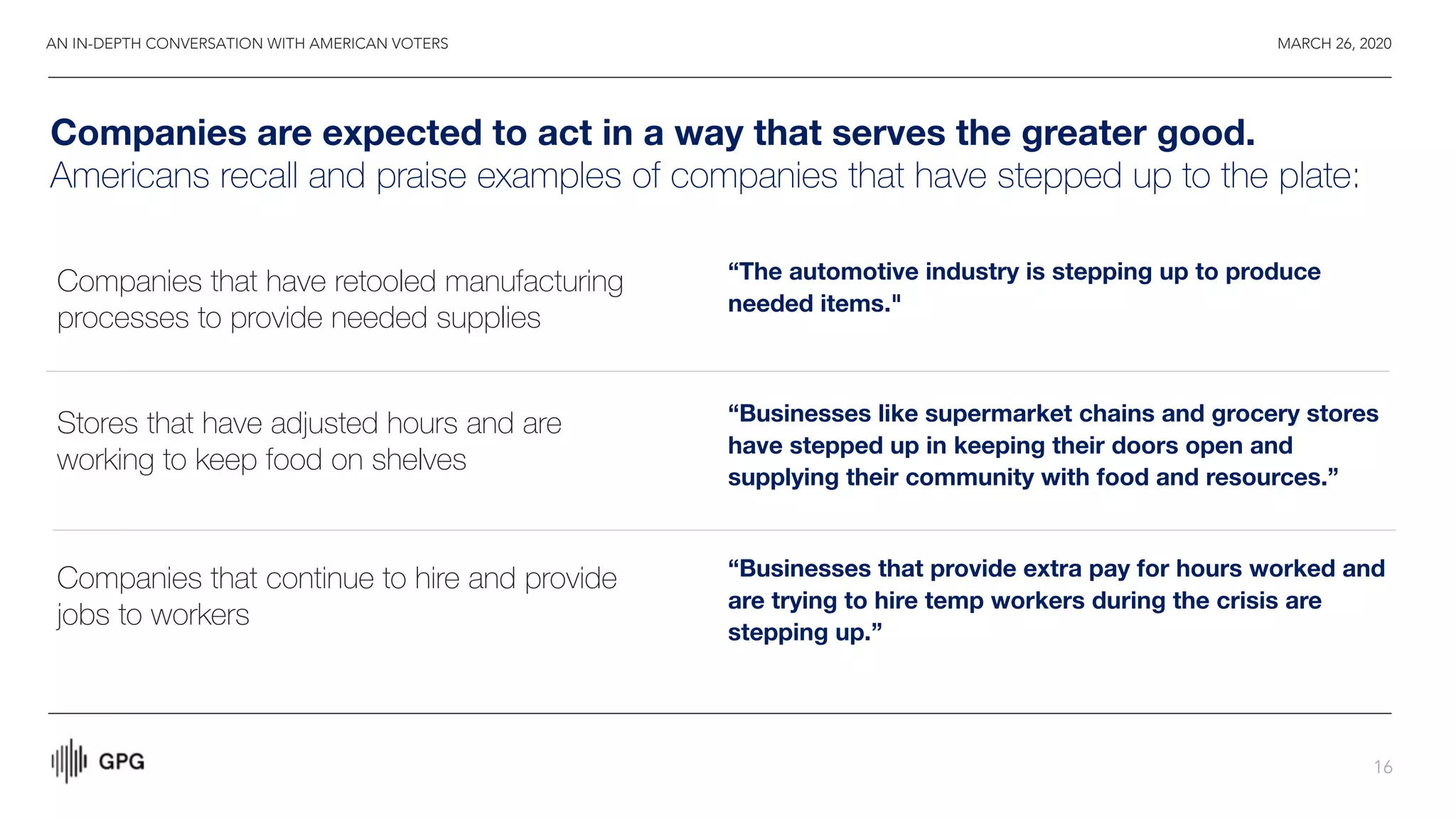
Companies are expected to act in a way that serves the greater good.
Americans recall and praise examples of companies that have stepped up to the plate:
Companies that have retooled manufacturing
processes to provide needed supplies
Stores that have adjusted hours and are
working to keep food on shelves
“Businesses like supermarket chains and grocery stores
have stepped up in keeping their doors open and
supplying their community with food and resources.”
“The automotive industry is stepping up to produce
needed items."
Companies that continue to hire and provide
jobs to workers
“Businesses that provide extra pay for hours worked and
are trying to hire temp workers during the crisis are
stepping up.”
AN IN-DEPTH CONVERSATION WITH AMERICAN VOTERS
MARCH 26, 2020
17
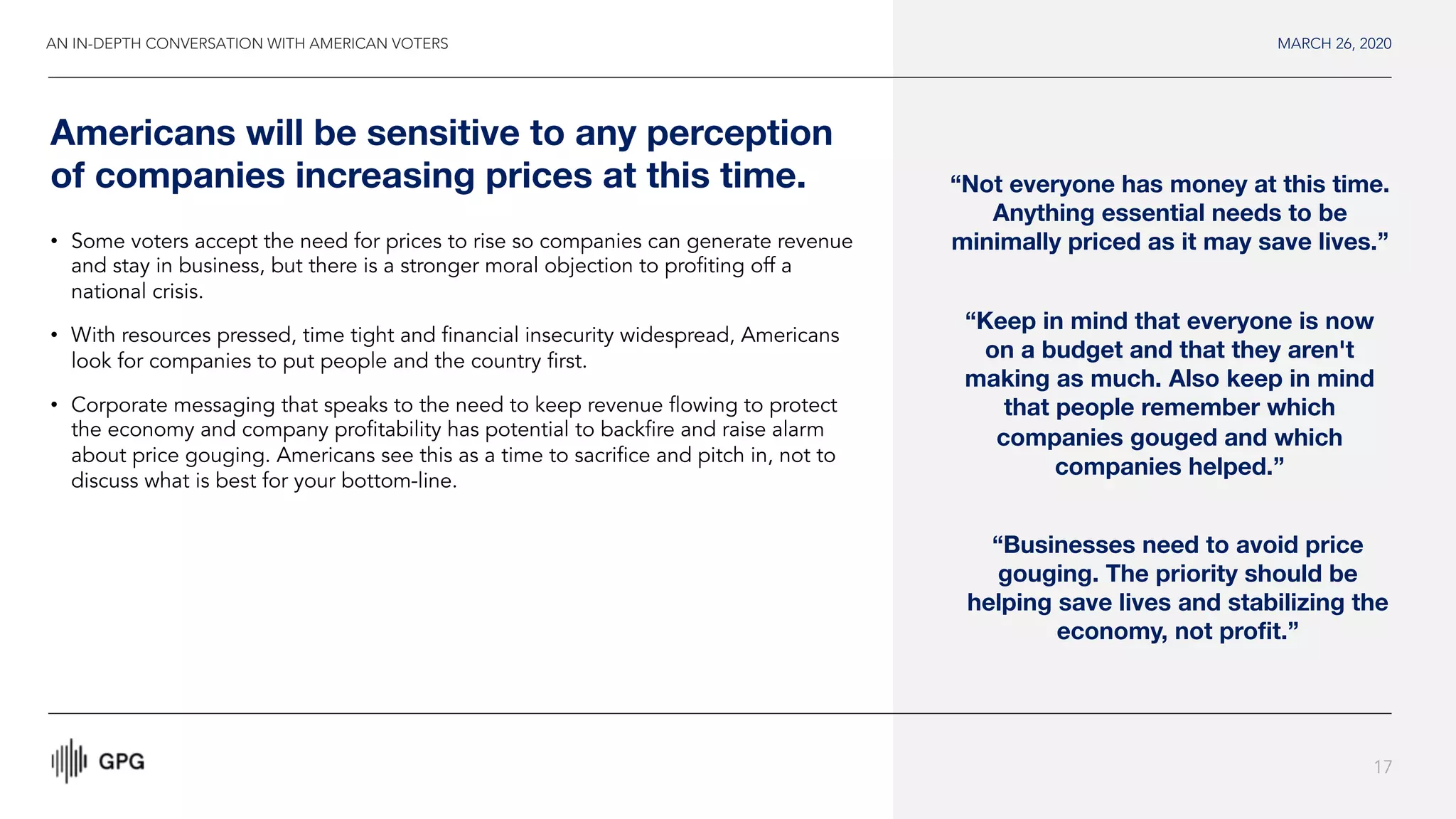
Americans will be sensitive to any perception
of companies increasing prices at this time. “Not everyone has money at this time.
Anything essential needs to be
minimally priced as it may save lives.”
“Keep in mind that everyone is now
on a budget and that they aren't
making as much. Also keep in mind
that people remember which
companies gouged and which
companies helped.”
• Some voters accept the need for prices to rise so companies can generate revenue
and stay in business, but there is a stronger moral objection to profiting off a
national crisis.
• With resources pressed, time tight and financial insecurity widespread, Americans
look for companies to put people and the country first.
• Corporate messaging that speaks to the need to keep revenue flowing to protect
the economy and company profitability has potential to backfire and raise alarm
about price gouging. Americans see this as a time to sacrifice and pitch in, not to
discuss what is best for your bottom-line.
“Businesses need to avoid price
gouging. The priority should be
helping save lives and stabilizing the
economy, not profit.”
AN IN-DEPTH CONVERSATION WITH AMERICAN VOTERS
MARCH 26, 2020
18
Federal government’s response falls short,
but views vary by political persuasion.
• Americans do not believe the Administration has done enough to shore
up the health care system, leaving hospitals without ventilators and beds,
and health care professionals without PPE.
• But the partisan divide endures: Negative views are predominantly held
by Democrats. Republicans express more confidence in the President’s
staff to guide him to the right decisions and some blame Democrats for
blocking the stimulus package.
• Among all Americans, roughly seven-in-ten (69%) want to see the
government use its authority to direct businesses to increase production
of supplies and resources that are in short supply.
“The government knew the threat to our country and did the
minimal amount to prepare. Now we have PPE shortages and
overrun hospitals. We could have changed that.”
AN IN-DEPTH CONVERSATION WITH AMERICAN VOTERS
48%
give the federal
government a
D or F grade
81%
rank supporting
hospitals and doctors
as a top priority for
the government to
address
Coronavirus response:
66% among
Democrats
15% among
Republicans
MARCH 26, 2020
19
Debates in Congress about the stimulus package are viewed through the
prism of 2008 and partisan loyalties.
• A plurality of Democrats and Republicans want to ban buybacks, limit CEO pay, and require
businesses to maintain payrolls.
• Both parties also prioritize federal aid for hospitals (78%), small businesses (60%) and restaurants
(53%). Airlines are next in line.
Want to ensure a stimulus package includes stronger
protections for workers and more restrictions on how
businesses use federal funds
Think there is no time to debate the details of an aid
package and we need to pass legislation immediately to
support American workers and companies
59%
41%
68%
32%
41%
59%
VS VS VS
Despite partisanship, some
points of consensus emerge
on the details of federal aid:
All Voters Democrats Republicans
AN IN-DEPTH CONVERSATION WITH AMERICAN VOTERS
MARCH 26, 2020
20
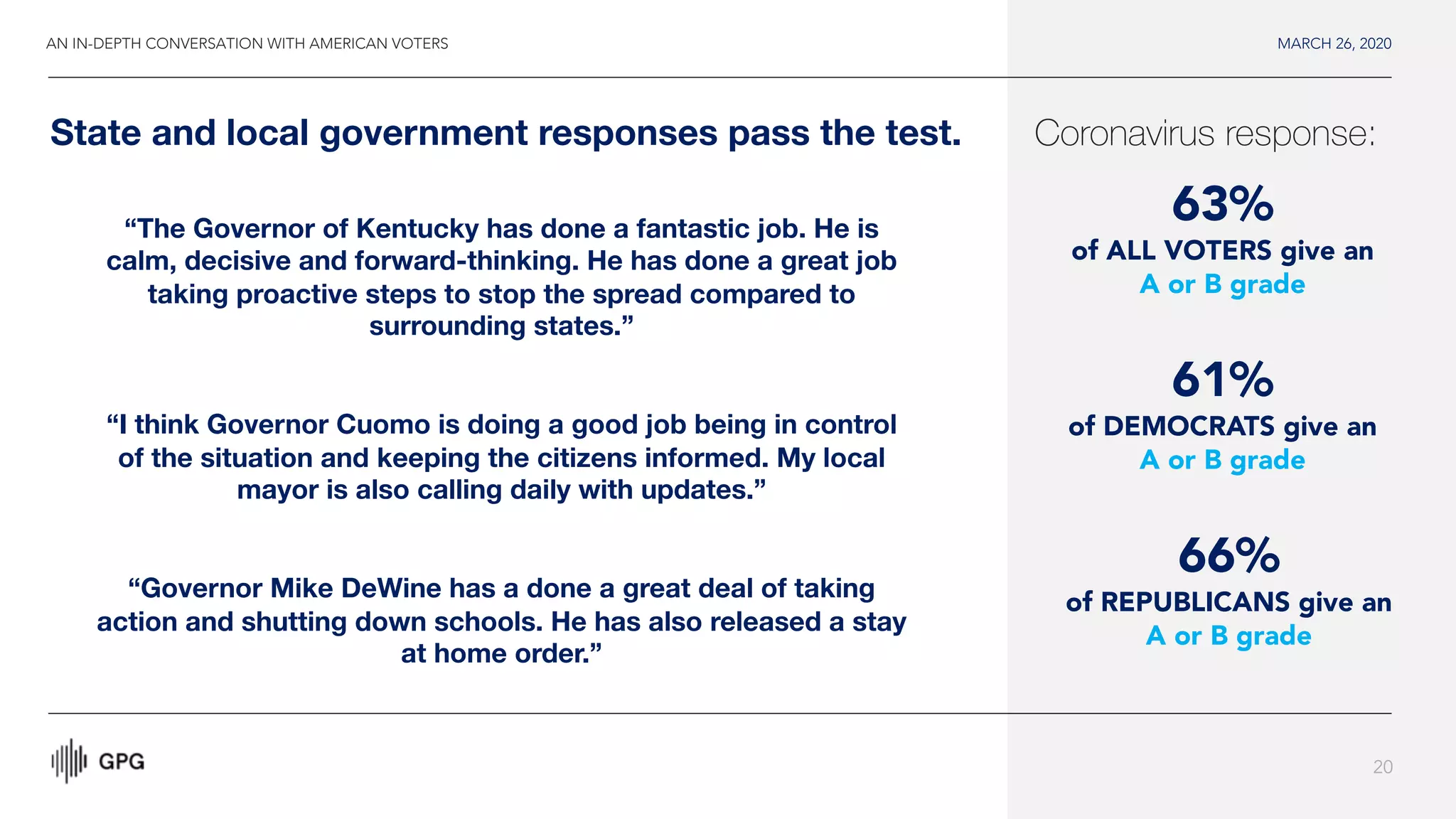
State and local government responses pass the test. Coronavirus response:
63%
of ALL VOTERS give an
A or B grade
61%
of DEMOCRATS give an
A or B grade
66%
of REPUBLICANS give an
A or B grade
“The Governor of Kentucky has done a fantastic job. He is
calm, decisive and forward-thinking. He has done a great job
taking proactive steps to stop the spread compared to
surrounding states.”
“I think Governor Cuomo is doing a good job being in control
of the situation and keeping the citizens informed. My local
mayor is also calling daily with updates.”
“Governor Mike DeWine has a done a great deal of taking
action and shutting down schools. He has also released a stay
at home order.”
AN IN-DEPTH CONVERSATION WITH AMERICAN VOTERS
MARCH 26, 2020
21
Research reveals emerging issues that could rise in the national agenda.
• The current environment makes some think about increasing our manufacturing
presence and American-only supply chains.
Manufacturing
• Parents express fear about the long-term impact on education and widening the
achievement gap.
• School closures shine a light on the important role of technology in education and
inequities related to access.
Education
• As more Americans endure isolation, concerns about mental health and community
ties have surfaced.
Mental health
AN IN-DEPTH CONVERSATION WITH AMERICAN VOTERS
1025 F Street NW, 9th Floor
Washington, DC 20004
202.337.0808 | GPG.COM3 Columbus Circle, Floor 18
New York, NY 10019
Email research@gpg.com for more insights specific to your organization, company, or
industry, or how our Caucus platform can provide a read on Americans’ attitudes.

Navigating COVID-19

  • 1.
    An in-depth conversationwith American voters MARCH 26, 2020 Navigating COVID-19
  • 2.
    MARCH 26, 2020 2 There’sa lot of public opinion data out there right now about COVID-19, but less qualitative insight into what is behind the polling numbers. • The Glover Park Group’s Research and Insights practice conducted a 30-minute online caucus on March 23, 2020 among 210 news attentive and civically engaged voters nationwide. The Glover Park Group hosted a conversation with Americans to see how they are feeling and how institutions, specifically brands, can help. • A caucus session functions similarly to an online focus group at scale, providing a space for in-depth discussion with traditional polling questions to quantify key topics. AN IN-DEPTH CONVERSATION WITH AMERICAN VOTERS
  • 3.
    Key Insights AN IN-DEPTHCONVERSATION WITH AMERICAN VOTERS MARCH 26, 2020
  • 4.
    MARCH 26, 2020 4 Manyworry about their health and the economy but prioritize the needs of those on the frontlines. Americans are grateful for services of essential employees and medical professionals and demand we do more to support them. • Americans worry about physical health risks, mental health and well-being, and economic repercussions – both for themselves and their loved ones. • However, Americans also worry about people outside their immediate circle. Medical professionals, retail and grocery workers, and delivery staff are seen as “soldiers” in a war. Americans are grateful for their service and demand we do more to look after them. Business actions today will shape corporate reputation for years to come. Americans say they will remember who stepped up and made sacrifices for the greater good. • Americans expect companies to change from business as usual: whether that’s retooling manufacturing lines to make PPE and ventilators, changing what they do to support our most vulnerable neighbors, or increasing paid leave. • Americans are judging brands based on who does what is right for the nation, even if that involves taking a hit to their bottom line. They want to see actions that show empathy for people up against the wall. Coronavirus has put debates on the social safety net and paid leave front and center. Americans want industries who receive aid to repay that goodwill in how they act and behave. • The negative impact already felt by hourly and service sector workers has amplified calls for greater protection, but it remains to be seen if these calls will last beyond the current crisis. • This concern extends to the distribution of federal aid. Americans want promises to keep workers employed and on the payroll, as well as limits placed on executive pay and share buybacks. FINDINGS-AT-A-GLANCE
  • 5.
    MARCH 26, 2020 5 Bedeeply empathetic. Many Americans are anxious as they worry about loved ones and finances while dealing with the stress of social isolation. Always put yourself in their shoes. It’s not business as usual, so don’t communicate as if it is. This is a moment of crisis. Americans want to hear how businesses are doing what they can to protect those on the frontlines and keep their employees safe and secure. Identify what relevant capability or area of expertise you can deploy to play your part. Americans praise ingenuity and champion businesses that are retooling their supply chains or changing protocol to protect lives. Pass the loyalty test. Americans will measure you on how well you stick by your employees and customers – and reward those who give people a further hand up in these most challenging of times. Failure to show empathy will reverberate. Remember the lessons of 2008. Reactions to 2008 drove populism on the left and right. Americans understand the need to pass a major stimulus bill but expect supported industries to figuratively repay that trust in how they act and behave in the coming years. KEY CONSIDERATIONS FOR COMMUNICATIONS AND ENGAGEMENT
  • 6.
    MARCH 26, 2020 6 Intheir own words: “This is your chance to make or break your company. It doesn't matter how successful it's been all this time. If you do the right thing you will be remembered positively, and the business will have the trust of the people after all of this is over.” AN IN-DEPTH CONVERSATION WITH AMERICAN VOTERS
  • 7.
    Detailed Insights MARCH 26,2020AN IN-DEPTH CONVERSATION WITH AMERICAN VOTERS
  • 8.
    MARCH 26, 2020 8 Americanssee coronavirus as a real threat; anxiety is pervasive. • 65% of Americans feel they are doing a lot to flatten the curve but worry others are not doing the same. This sentiment is more pronounced among Democrats (74%) than Republicans (51%). • As daily routines are upended, a sense of collective anxiety has set over the nation. People worry about the health and financial security for themselves, loved ones, and workers. Do you think the coronavirus outbreak is a real threat or blown out of proportion? How do you feel about the response from individual Americans to the coronavirus outbreak? 65% Not reacting strongly enough 26% Reacting appropriately 9% Overreacting 72% Real threat (% 8-10) 24% In between (% 3-7) 3% Blown out of proportion (% 0-2) “I worry about not getting my job back, or not getting it back in time and running out of paid leave. I also worry about getting my elderly parents sick. My dad already had pneumonia a few months ago and almost died. I think he wouldn't make it.” AN IN-DEPTH CONVERSATION WITH AMERICAN VOTERS
  • 9.
    MARCH 26, 2020 9 Peopleshared candid concerns about friends, family. “My mother is a nurse in her late sixties so I am very concerned about her becoming infected and the health implications that would come with that.” “I am worried about my mental health. I am lucky. I am in a good economic situation. I have health care and a safety net. But staying home is hard. I live alone and my family is 2000+ miles away.” • Roughly seven-in-ten list the risk of getting sick or losing friends or family as a top concern. • Most talk about their concerns in the third-person, describing the potential of losing parents and grandparents, or worrying about whether workers who lose their jobs will be able to make ends meet. • Others worry that the dual stress of social isolation and financial uncertainty will lead to mental health issues for people across the country. The risk of getting sick or losing a friend or family member to the virus 72% Damage to the U.S. economy as businesses are forced to shut down 72% Rising unemployment rates as businesses are forced to shut down 59% People struggling to make mortgage and rent payments next month 48% Rising financial insecurity among minimum wage and hourly workers 47% Limited access to essential medical supplies for physicians 45% Limited access to basic services and goods at stores 41% Limited access to testing and medical support for patients 33% The toll that social isolation will have on Americans’ mental health 26% Rising pressure on workers to balance remote work and childcare 20% AN IN-DEPTH CONVERSATION WITH AMERICAN VOTERS
  • 10.
    MARCH 26, 2020 10 Equalconcern over health risks and the economy. “I worry about not being able to bounce back financially. I have 3 kids and need to provide for them, and my industry segment is basically shut down.” ”I worry the most about hourly employees making minimum wage. They were struggling enough as it was before the virus. Now, their hours have been reduced if not eliminated.” • Anxiety for small businesses, the unemployed and hourly workers also rank high among concerns related to the outbreak. • Concern for the wellbeing of others, especially the underserved and vulnerable, is particularly top-of-mind as Americans see businesses closing and people around them losing jobs. • Fears of long-term economic consequences are real. The risk of getting sick or losing a friend or family member to the virus 72% Damage to the U.S. economy as businesses are forced to shut down 72% Rising unemployment rates as businesses are forced to shut down 59% People struggling to make mortgage and rent payments next month 48% Rising financial insecurity among minimum wage and hourly workers 47% Limited access to essential medical supplies for physicians 45% Limited access to basic services and goods at stores 41% Limited access to testing and medical support for patients 33% The toll that social isolation will have on Americans’ mental health 26% Rising pressure on workers to balance remote work and childcare 20% 52% Anticipate an economic recession 30% Anticipate an economic depression AN IN-DEPTH CONVERSATION WITH AMERICAN VOTERS
  • 11.
    MARCH 26, 2020 11 Thereis consensus that sheltering in place is key to protecting American lives and the economy. “We can't restart our economy until we have addressed and overcome the virus. The economy is going to keep hurting if we don't get the coronavirus under control. Other measures can be put in place, though.” • Americans prioritize human lives over the economy. • Many also argue that we cannot successfully restart the economy until we contain the virus. • If we don’t shelter in place, it extends the outbreak and worsens the economic impact. “We need to isolate ourselves and slow the spread as much as possible. Look at Italy. It is ranked #2 for healthcare globally! We're ranked #35. So many people will die if we do not slow the spread.” “Shelter in place for now and rebuild later. Money is optional. Lives are not.” AN IN-DEPTH CONVERSATION WITH AMERICAN VOTERS “Sheltering in place is more important. That is going to stop the spread of the virus and save lives. The longer the virus is active, the greater financial impact there will be.”
  • 12.
    MARCH 26, 2020 12 Americansshare gratitude for workers of all kinds standing on the front lines. “The minimum and low wage workers at grocery stores, gas stations, and similar places of work are at higher risk and not getting help. They need financial grants at least.” • As the rest of the country stays home, gratitude runs deep for doctors and nurses, grocery store workers, mail and delivery workers, and others that deliver essential services. Essential employees are seen as “soldiers” on the frontlines of a war, putting themselves at risk to support their communities. • But people worry we are not going far enough to support essential workers in return. Americans call on businesses and the government to ramp up production of medical supplies, N95 masks, and other personal protective equipment (PPE) – terms that are now part of our national vocabulary. “The needs of medical workers, our doctors and nurses who are risking everything [are getting overlooked].” “They need masks, hand sanitizer, more breaks to deal with hygiene, support from the supervisors, and just anything that will make having to be on the front lines a little easier.” AN IN-DEPTH CONVERSATION WITH AMERICAN VOTERS
  • 13.
    • Paid leaveand worker pay top the list of actions Americans want to see businesses take to ease the crisis, but many support this out of circumstance and it remains to be seen if this support will extend beyond the current crisis. MARCH 26, 2020 13 Americans are paying close attention to worker protections and paid leave. Provide paid sick leave to their employees 82% Continue to pay their workers (even if normal operations and business shuts down) 81% Require all employees who are able to work from home to protect their personal health and help slow the curve 72% Make immediate payments to suppliers and smaller companies they rely on to maintain operations and supplies 50% Retool their factories and supply chains to meet new needs like medical masks and ventilators 43% Give workers cash bonuses 40% Give customers more time to make large payments 39% Use their voice in the media and social platforms to educate the public about stopping the spread of coronavirus 27% Protect profitability for shareholders that own their stock in 401ks and other investment vehicles 16% “I think [the paid leave legislation passed by Congress] is a vital step to protect physically and economically vulnerable people in American society. It should be the new standard for our social safety net which has always been inadequate.” “This idea [for paid leave] is fine but only for the COVID-19 crisis. It should not stay if the company did not offer the benefit [before].” AN IN-DEPTH CONVERSATION WITH AMERICAN VOTERS
  • 14.
    MARCH 26, 2020 14 Bigbusinesses get a passing grade in how they have responded, but many want to see more. Coronavirus response: 42% give an A or B grade 24% give a C grade 27% give a D or F grade Credit given for positive changes: ✓ Instituting remote work policies and shifting away from business as usual ✓ Easing financial stress through paid leave, bonuses, delayed payments, and refunds ✓ Retooling manufacturing facilities to make lifesaving medical equipment and supplies for health care workers and hospitals Biggest concerns include: ✓ Refusing to close shop ✓ Denying workers paid sick days ✓ Financial institutions not offering mortgage, loan or credit relief AN IN-DEPTH CONVERSATION WITH AMERICAN VOTERS
  • 15.
    MARCH 26, 2020 15 Businesses’responses today will shape brand perceptions for years to come. “They should work in an altruistic manner, balancing the welfare of their employees and stakeholders with the country as a whole. Economic losses can be recovered from fairly quickly, but a horrendous reputation is very tough to recover from.” “Leverage your economies of scale and do what’s right now. By doing so, you build brand trust which will benefit your business after this is over. You benefit from the community. Now it’s time to give back to those who gave so much to you.” “We are in a time of crisis. What they do now will have long-lasting results for their brand identity. Do not overprice things. Help those as much as you can. You may take a financial hit now, but it will pay off.” • Put people and the nation first. Americans expect big businesses to empathize with the public and contribute to the greater good, even if it means taking temporary hits to their bottom lines. • Now is seen as a time for unity and sacrifice, not corporate self-interest. • Americans talk about remembering not only those who step up during times of crisis, but also those who fall short. AN IN-DEPTH CONVERSATION WITH AMERICAN VOTERS
  • 16.
    MARCH 26, 2020 16 Companiesare expected to act in a way that serves the greater good. Americans recall and praise examples of companies that have stepped up to the plate: Companies that have retooled manufacturing processes to provide needed supplies Stores that have adjusted hours and are working to keep food on shelves “Businesses like supermarket chains and grocery stores have stepped up in keeping their doors open and supplying their community with food and resources.” “The automotive industry is stepping up to produce needed items." Companies that continue to hire and provide jobs to workers “Businesses that provide extra pay for hours worked and are trying to hire temp workers during the crisis are stepping up.” AN IN-DEPTH CONVERSATION WITH AMERICAN VOTERS
  • 17.
    MARCH 26, 2020 17 Americanswill be sensitive to any perception of companies increasing prices at this time. “Not everyone has money at this time. Anything essential needs to be minimally priced as it may save lives.” “Keep in mind that everyone is now on a budget and that they aren't making as much. Also keep in mind that people remember which companies gouged and which companies helped.” • Some voters accept the need for prices to rise so companies can generate revenue and stay in business, but there is a stronger moral objection to profiting off a national crisis. • With resources pressed, time tight and financial insecurity widespread, Americans look for companies to put people and the country first. • Corporate messaging that speaks to the need to keep revenue flowing to protect the economy and company profitability has potential to backfire and raise alarm about price gouging. Americans see this as a time to sacrifice and pitch in, not to discuss what is best for your bottom-line. “Businesses need to avoid price gouging. The priority should be helping save lives and stabilizing the economy, not profit.” AN IN-DEPTH CONVERSATION WITH AMERICAN VOTERS
  • 18.
    MARCH 26, 2020 18 Federalgovernment’s response falls short, but views vary by political persuasion. • Americans do not believe the Administration has done enough to shore up the health care system, leaving hospitals without ventilators and beds, and health care professionals without PPE. • But the partisan divide endures: Negative views are predominantly held by Democrats. Republicans express more confidence in the President’s staff to guide him to the right decisions and some blame Democrats for blocking the stimulus package. • Among all Americans, roughly seven-in-ten (69%) want to see the government use its authority to direct businesses to increase production of supplies and resources that are in short supply. “The government knew the threat to our country and did the minimal amount to prepare. Now we have PPE shortages and overrun hospitals. We could have changed that.” AN IN-DEPTH CONVERSATION WITH AMERICAN VOTERS 48% give the federal government a D or F grade 81% rank supporting hospitals and doctors as a top priority for the government to address Coronavirus response: 66% among Democrats 15% among Republicans
  • 19.
    MARCH 26, 2020 19 Debatesin Congress about the stimulus package are viewed through the prism of 2008 and partisan loyalties. • A plurality of Democrats and Republicans want to ban buybacks, limit CEO pay, and require businesses to maintain payrolls. • Both parties also prioritize federal aid for hospitals (78%), small businesses (60%) and restaurants (53%). Airlines are next in line. Want to ensure a stimulus package includes stronger protections for workers and more restrictions on how businesses use federal funds Think there is no time to debate the details of an aid package and we need to pass legislation immediately to support American workers and companies 59% 41% 68% 32% 41% 59% VS VS VS Despite partisanship, some points of consensus emerge on the details of federal aid: All Voters Democrats Republicans AN IN-DEPTH CONVERSATION WITH AMERICAN VOTERS
  • 20.
    MARCH 26, 2020 20 Stateand local government responses pass the test. Coronavirus response: 63% of ALL VOTERS give an A or B grade 61% of DEMOCRATS give an A or B grade 66% of REPUBLICANS give an A or B grade “The Governor of Kentucky has done a fantastic job. He is calm, decisive and forward-thinking. He has done a great job taking proactive steps to stop the spread compared to surrounding states.” “I think Governor Cuomo is doing a good job being in control of the situation and keeping the citizens informed. My local mayor is also calling daily with updates.” “Governor Mike DeWine has a done a great deal of taking action and shutting down schools. He has also released a stay at home order.” AN IN-DEPTH CONVERSATION WITH AMERICAN VOTERS
  • 21.
    MARCH 26, 2020 21 Researchreveals emerging issues that could rise in the national agenda. • The current environment makes some think about increasing our manufacturing presence and American-only supply chains. Manufacturing • Parents express fear about the long-term impact on education and widening the achievement gap. • School closures shine a light on the important role of technology in education and inequities related to access. Education • As more Americans endure isolation, concerns about mental health and community ties have surfaced. Mental health AN IN-DEPTH CONVERSATION WITH AMERICAN VOTERS
  • 22.
    1025 F StreetNW, 9th Floor Washington, DC 20004 202.337.0808 | GPG.COM3 Columbus Circle, Floor 18 New York, NY 10019 Email research@gpg.com for more insights specific to your organization, company, or industry, or how our Caucus platform can provide a read on Americans’ attitudes.