Download to read offline
![LETTER RESEARCH
1.000
0.0001
2
5 7 10
Metal mass fraction, Z
20
50
78
97
1
Cloud-top pressure (mbar)
Relative flux
0.995
0.990
0.01
0.7
0.6
1
68%
0.5
10
0.4
100
0.3
68%
1
0.00
0.05
Time from predicted transit centre
Figure 1 | White-light transit curves for the four individual visits. Data are
vertically offset for clarity. Transits were observed on the following dates (from
top to bottom): 26 October 2012 UT, 29 November 2012 UT, 10 December 2012
UT and 2 January 2013 UT. Normalized data with the first orbit trimmed and
instrumental effects removed are shown as black filled circles. Best-fit model
transit light curves are shown as black lines. The data consist of three spacecraft
orbits with durations of approximately 1.5 hours each; there is a gap during
each orbit where the spacecraft passes behind the Earth and the target is no
longer visible.
good candidate for having these cloud species, indicates that a solarcomposition atmosphere would not have sufficient amounts of condensable material to form optically thick clouds. If the atmospheric
metallicity (defined as the abundances of elements heavier than hydrogen and helium, H and He) is enhanced above this level, then such
clouds could easily explain this planet’s flat transmission spectrum20.
Alternatively, photochemical haze production could lead to an opaque
cloud layer at the millibar level, although these models probably also
require an enhanced atmospheric metallicity.
Transit depth (parts per million)
7,400
7,200
7,000
6,800
1.0
1.2
1.4
1.6
1.8
Wavelength (μm)
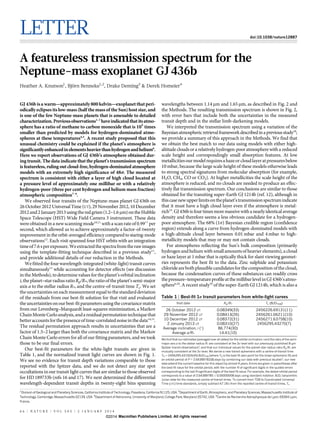
Figure 2 | Averaged transmission spectrum for GJ 436b. Black filled circles
indicate the error-weighted mean transit depth in each bandpass, with the
plotted uncertainties calculated as the sum in quadrature of the 1s standard
deviation measurement errors and the systematic uncertainties from stellar
limb-darkening models. We show three models for comparison, including a
solar-metallicity cloud-free model (red line), a hydrogen-poor 1,900-timessolar model (blue line) and a solar-metallicity model with optically thick clouds
at 1 mbar (green line).
0.2
95%
99.7%
10,000
–0.05
0.8
0.1
1,000
0.985
95%
68%
10
100
1,000
Metallicity, [Fe/H] / [Fe/H]solar
0.1
10,000
Posterior probability density (normalized)
0.9
0.001
0
Figure 3 | Joint constraints on cloud-top pressure versus atmospheric
metallicity. The coloured shading indicates the normalized probability density
as a function of metallicity (defined as the relative abundance of elements
heavier than H and He) and cloud top pressure derived using our Bayesian
atmosphere retrieval framework18,30. The black contours show the 68%, 95%
and 99.7% Bayesian credible regions. We rule out a hydrogen-dominated,
cloud-free, solar-metallicity atmosphere with a significance of 48s. Colourmatching markers indicate the three models plotted in Fig. 2, and vertical
dashed lines indicate constraints on the planet’s composition from
measurements of its average density.
Previous studies have placed constraints on the possible bulk compositions for GJ 436b using the planet’s measured mass and radius, the
estimated age of the system, and models of planet formation and
migration7–9,21–23. A recent survey of the published literature for this
planet indicated that current models are consistent with bulk metallicities between 230 and 2,000 times solar, depending on the assumed
ratio of rock to ice, the distribution of metals between the core and the
envelope, the interior temperature of the planet, and other related
factors6. This corresponds to a H/He mass fraction of approximately
3%–22%. On the basis of this analysis we conclude that an atmospheric
metallicity of 1,900 times solar is consistent with current constraints
for the planet’s bulk composition, although it is very close to the upper
end of this range. Mass loss appears to be minimal for GJ 436b under
present conditions24–26, but it is possible that the higher ultraviolet and
X-ray fluxes expected for young stars could have resulted in the loss of
some atmospheric hydrogen very early in the planet’s history27,28.
Although a recent study29 argued that such mass loss is unlikely to result
in significant depletion of hydrogen relative to other elements, additional modelling work is still needed to provide a more definitive
resolution to this question.
There are several potential ways to distinguish between cloudy and
high-atmospheric-metallicity scenarios for GJ 436b’s atmosphere. An
unambiguous solution would be to obtain more precise, moderateresolution transmission spectroscopy30 capable of detecting near-infrared
absorption features and directly constraining the mean molecular weight.
We emphasize, however, that the apparent variations in the planet’s
measured transit depth from one epoch to the next (see Methods) make
simultaneous measurements essential for robust constraints on this
planet’s transmission spectrum. A hydrogen-dominated atmosphere
with a high cloud or haze layer should exhibit attenuated water absorption features, which could be distinguished from the intrinsically weaker
features of high-metallicity atmospheres on the basis of the steepness of
the wings of the absorption lines. Similarly, a detection of the Rayleigh
scattering slope in the planet’s visible-light transmission spectrum could
directly constrain both the mean molecular weight and the amount of
spectrally inactive gas (that is, H and He or haze particles) present in
2 J A N U A RY 2 0 1 4 | VO L 5 0 5 | N AT U R E | 6 7
©2014 Macmillan Publishers Limited. All rights reserved](https://image.slidesharecdn.com/nature12887-140104071303-phpapp01/85/Nature12887-2-320.jpg)


![LETTER RESEARCH
Observed minus calculated (min)
3
2
1
0
-1
-2
-3
4,500
5,000
5,500
Transit centre [BJD-2450000]
Extended Data Figure 5 | Observed minus calculated transit times using the
new best-fit ephemeris. The solid line denotes observed minus calculated
equal to zero. Transit times from this paper are plotted as filled stars, and
previously published observations are shown as filled circles, with 1s
6,000
uncertainties overplotted for both. The colour of the points denotes the
wavelength of the observations (blue for visible, red for infrared). Transits
shown include all previously published observations for this planet3,39–45. The
figure is adapted from figure 8 of our previous study3.
©2014 Macmillan Publishers Limited. All rights reserved](https://image.slidesharecdn.com/nature12887-140104071303-phpapp01/85/Nature12887-10-320.jpg)


This study analyzed transit observations of the Neptune-mass exoplanet GJ 436b taken with the Hubble Space Telescope. The transmission spectrum was found to be featureless, ruling out cloud-free hydrogen-dominated atmosphere models with high significance. The flat transmission spectrum is consistent with either an atmosphere containing high-altitude clouds located at a pressure of around 1 millibar, or a relatively hydrogen-poor atmosphere with 3% hydrogen and helium by mass. Bayesian atmospheric modeling showed that cloudy hydrogen-dominated or high-metallicity hydrogen-poor atmospheres provide the best fits to the data. Further observations are needed to distinguish between these scenarios.


