Language Models
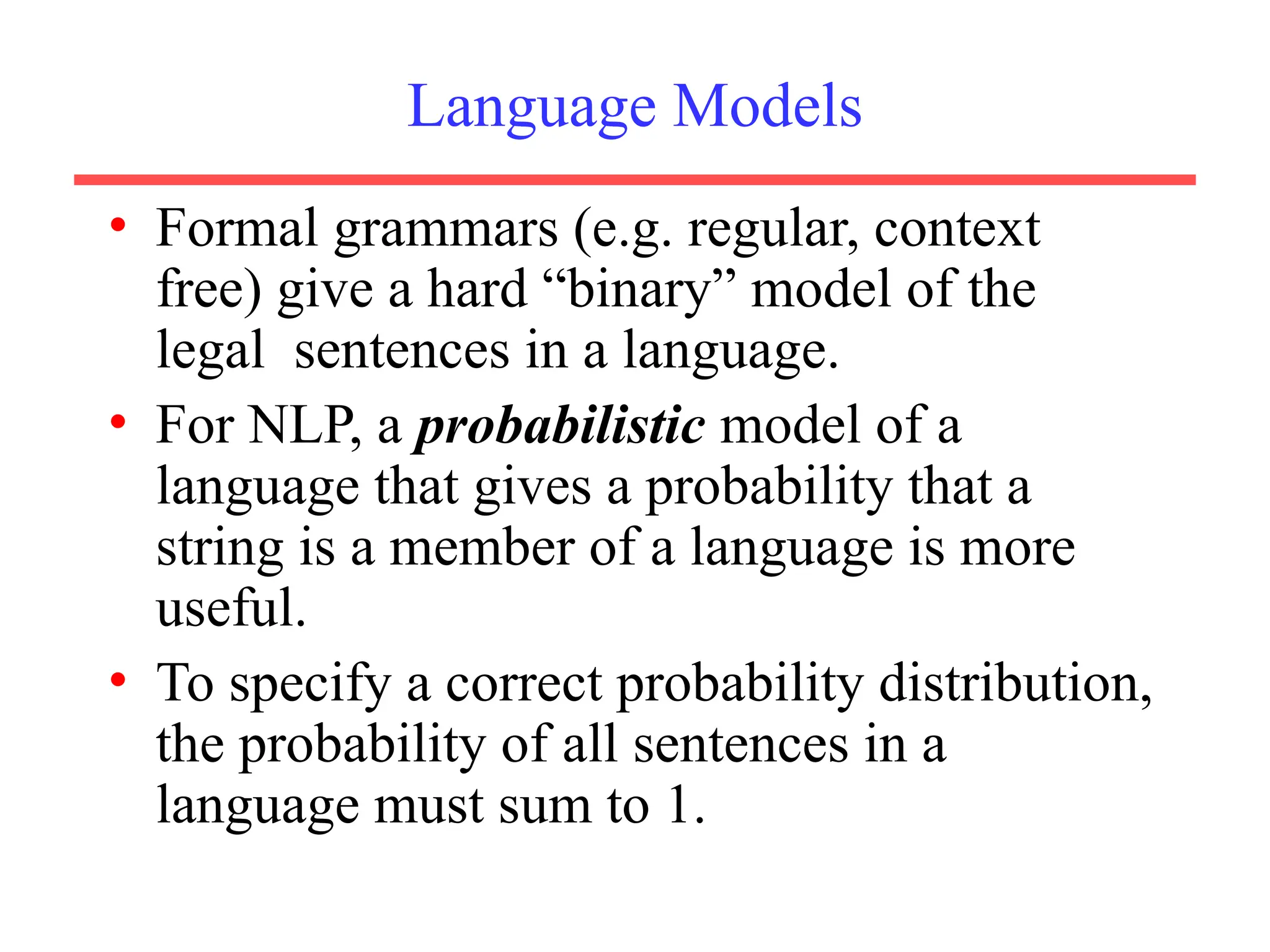
• Formalgrammars (e.g. regular, context
free) give a hard “binary” model of the
legal sentences in a language.
• For NLP, a probabilistic model of a
language that gives a probability that a
string is a member of a language is more
useful.
• To specify a correct probability distribution,
the probability of all sentences in a
language must sum to 1.
2.
Uses of LanguageModels
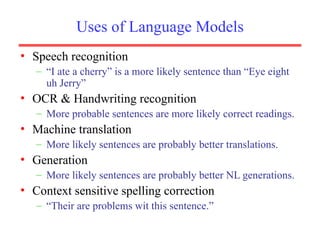
• Speech recognition
– “I ate a cherry” is a more likely sentence than “Eye eight
uh Jerry”
• OCR & Handwriting recognition
– More probable sentences are more likely correct readings.
• Machine translation
– More likely sentences are probably better translations.
• Generation
– More likely sentences are probably better NL generations.
• Context sensitive spelling correction
– “Their are problems wit this sentence.”
3.
Completion Prediction
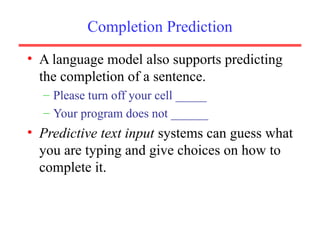
• Alanguage model also supports predicting
the completion of a sentence.
– Please turn off your cell _____
– Your program does not ______
• Predictive text input systems can guess what
you are typing and give choices on how to
complete it.
4.
N-Gram Models
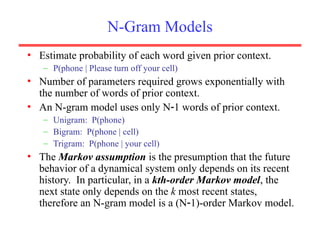
• Estimateprobability of each word given prior context.
– P(phone | Please turn off your cell)
• Number of parameters required grows exponentially with
the number of words of prior context.
• An N-gram model uses only N1 words of prior context.
– Unigram: P(phone)
– Bigram: P(phone | cell)
– Trigram: P(phone | your cell)
• The Markov assumption is the presumption that the future
behavior of a dynamical system only depends on its recent
history. In particular, in a kth-order Markov model, the
next state only depends on the k most recent states,
therefore an N-gram model is a (N1)-order Markov model.
5.
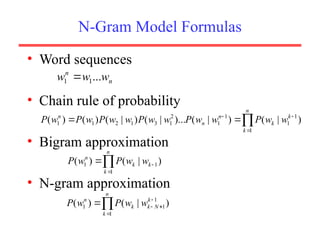
N-Gram Model Formulas
•Word sequences
• Chain rule of probability
• Bigram approximation
• N-gram approximation
n
n
w
w
w ...
1
1
)
|
(
)
|
(
)...
|
(
)
|
(
)
(
)
( 1
1
1
1
1
2
1
3
1
2
1
1
k
n
k
k
n
n
n
w
w
P
w
w
P
w
w
P
w
w
P
w
P
w
P
)
|
(
)
( 1
1
1
1
k
N
k
n
k
k
n
w
w
P
w
P
)
|
(
)
( 1
1
1
k
n
k
k
n
w
w
P
w
P
6.
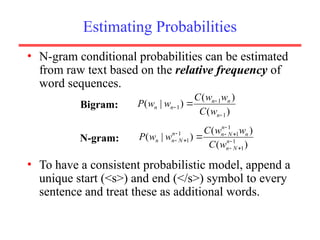
Estimating Probabilities
• N-gramconditional probabilities can be estimated
from raw text based on the relative frequency of
word sequences.
• To have a consistent probabilistic model, append a
unique start (<s>) and end (</s>) symbol to every
sentence and treat these as additional words.
)
(
)
(
)
|
(
1
1
1
n
n
n
n
n
w
C
w
w
C
w
w
P
)
(
)
(
)
|
( 1
1
1
1
1
1
n
N
n
n
n
N
n
n
N
n
n
w
C
w
w
C
w
w
P
Bigram:
N-gram:
7.
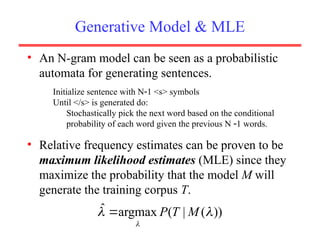
Generative Model &MLE
• An N-gram model can be seen as a probabilistic
automata for generating sentences.
• Relative frequency estimates can be proven to be
maximum likelihood estimates (MLE) since they
maximize the probability that the model M will
generate the training corpus T.
Initialize sentence with N1 <s> symbols
Until </s> is generated do:
Stochastically pick the next word based on the conditional
probability of each word given the previous N 1 words.
))
(
|
(
argmax
ˆ
M
T
P
8.
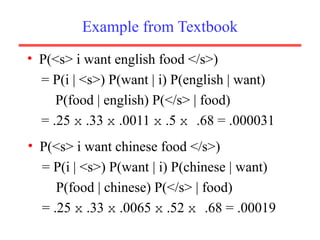
Example from Textbook
•P(<s> i want english food </s>)
= P(i | <s>) P(want | i) P(english | want)
P(food | english) P(</s> | food)
= .25 x .33 x .0011 x .5 x .68 = .000031
• P(<s> i want chinese food </s>)
= P(i | <s>) P(want | i) P(chinese | want)
P(food | chinese) P(</s> | food)
= .25 x .33 x .0065 x .52 x .68 = .00019
9.
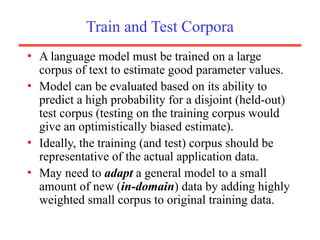
Train and TestCorpora
• A language model must be trained on a large
corpus of text to estimate good parameter values.
• Model can be evaluated based on its ability to
predict a high probability for a disjoint (held-out)
test corpus (testing on the training corpus would
give an optimistically biased estimate).
• Ideally, the training (and test) corpus should be
representative of the actual application data.
• May need to adapt a general model to a small
amount of new (in-domain) data by adding highly
weighted small corpus to original training data.
10.
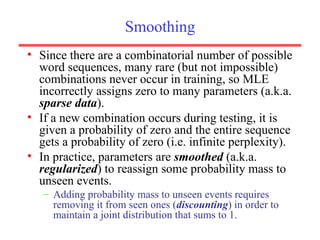
Smoothing
• Since thereare a combinatorial number of possible
word sequences, many rare (but not impossible)
combinations never occur in training, so MLE
incorrectly assigns zero to many parameters (a.k.a.
sparse data).
• If a new combination occurs during testing, it is
given a probability of zero and the entire sequence
gets a probability of zero (i.e. infinite perplexity).
• In practice, parameters are smoothed (a.k.a.
regularized) to reassign some probability mass to
unseen events.
– Adding probability mass to unseen events requires
removing it from seen ones (discounting) in order to
maintain a joint distribution that sums to 1.
11.
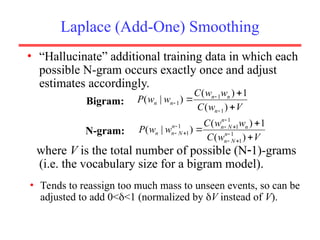
Laplace (Add-One) Smoothing
•“Hallucinate” additional training data in which each
possible N-gram occurs exactly once and adjust
estimates accordingly.
where V is the total number of possible (N1)-grams
(i.e. the vocabulary size for a bigram model).
V
w
C
w
w
C
w
w
P
n
n
n
n
n
)
(
1
)
(
)
|
(
1
1
1
V
w
C
w
w
C
w
w
P n
N
n
n
n
N
n
n
N
n
n
)
(
1
)
(
)
|
( 1
1
1
1
1
1
Bigram:
N-gram:
• Tends to reassign too much mass to unseen events, so can be
adjusted to add 0<<1 (normalized by V instead of V).
12.
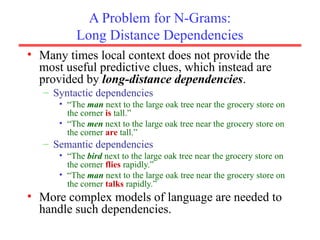
A Problem forN-Grams:
Long Distance Dependencies
• Many times local context does not provide the
most useful predictive clues, which instead are
provided by long-distance dependencies.
– Syntactic dependencies
• “The man next to the large oak tree near the grocery store on
the corner is tall.”
• “The men next to the large oak tree near the grocery store on
the corner are tall.”
– Semantic dependencies
• “The bird next to the large oak tree near the grocery store on
the corner flies rapidly.”
• “The man next to the large oak tree near the grocery store on
the corner talks rapidly.”
• More complex models of language are needed to
handle such dependencies.
13.
Summary
• Language modelsassign a probability that a
sentence is a legal string in a language.
• They are useful as a component of many NLP
systems, such as ASR, OCR, and MT.
• Simple N-gram models are easy to train on
unsupervised corpora and can provide useful
estimates of sentence likelihood.
• MLE gives inaccurate parameters for models
trained on sparse data.
• Smoothing techniques adjust parameter estimates
to account for unseen (but not impossible) events.