Introduction to Deep Learning
for Language Processing
16/6/2025
Dr. Resmi N.G.
Senior Assistant Professor
Chinmaya Vishwa Vidyapeeth Deemed-to-
be University
Contents
Introduction to NLP
1. Evaluating Deep Learning
Models
3.
Key Deep Learning
Architectures for NLP
2. Future Trends in Deep
Learning for NLP
4.
Introduction to NLP
Core Concepts of Language Processing
01
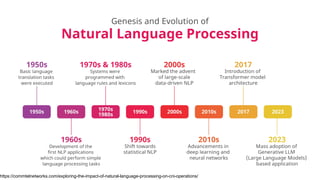
https://commtelnetworks.com/exploring-the-impact-of-natural-language-processing-on-cni-operations/
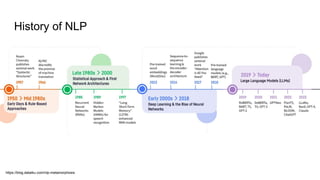
History of NLP
https://blog.dataiku.com/nlp-metamorphosis
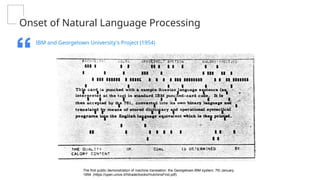
IBM and Georgetown University's Project (1954)
Onset of Natural Language Processing
The first public demonstration of machine translation: the Georgetown-IBM system, 7th January
1954 (https://open.unive.it/hitrade/books/HutchinsFirst.pdf)
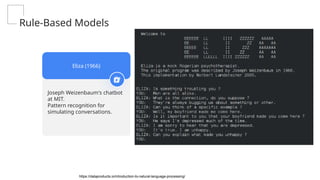
Joseph Weizenbaum's chatbot
at MIT.
Pattern recognition for
simulating conversations.
Eliza (1966)
Rule-Based Models
https://dataproducts.io/introduction-to-natural-language-processing/
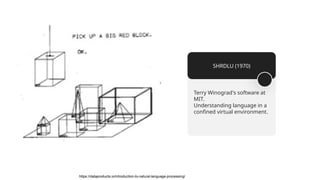
Terry Winograd's software at
MIT.
Understanding language in a
confined virtual environment.
SHRDLU (1970)
https://dataproducts.io/introduction-to-natural-language-processing/
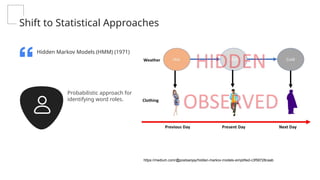
Probabilistic approach for
identifying word roles.
Hidden Markov Models (HMM) (1971)
Shift to Statistical Approaches
https://medium.com/@postsanjay/hidden-markov-models-simplified-c3f58728caab
02
Key Deep Learning
Architectures for NLP
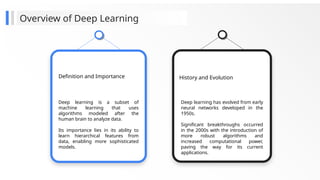
Definition and Importance
Deep learning is a subset of
machine learning that uses
algorithms modeled after the
human brain to analyze data.
Its importance lies in its ability to
learn hierarchical features from
data, enabling more sophisticated
models.
History and Evolution
Deep learning has evolved from early
neural networks developed in the
1950s.
Significant breakthroughs occurred
in the 2000s with the introduction of
more robust algorithms and
increased computational power,
paving the way for its current
applications.
Overview of Deep Learning
01
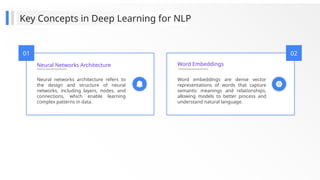
Neural Networks Architecture
Neural networks architecture refers to
the design and structure of neural
networks, including layers, nodes, and
connections, which enable learning
complex patterns in data.
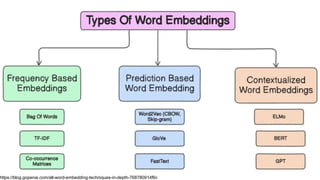
Word Embeddings
Word embeddings are dense vector
representations of words that capture
semantic meanings and relationships,
allowing models to better process and
understand natural language.
02
Key Concepts in Deep Learning for NLP
Image created by ChatGPT
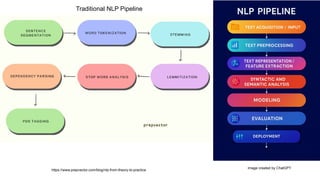
https://www.prepvector.com/blog/nlp-from-theory-to-practice
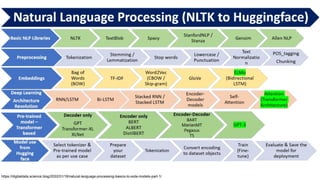
Traditional NLP Pipeline
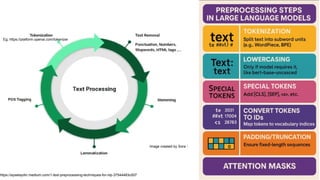
https://ayselaydin.medium.com/1-text-preprocessing-techniques-for-nlp-37544483c007
Eg; https://platform.openai.com/tokenizer
Image created by Sora
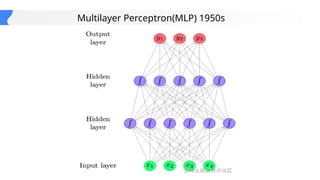
Multilayer Perceptron(MLP) 1950s
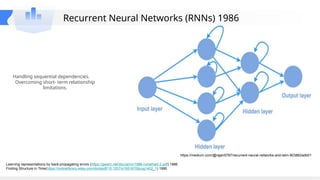
https://medium.com/@rajan5787/recurrent-neural-networks-and-lstm-903862adb01
Recurrent Neural Networks (RNNs) 1986
Handling sequential dependencies.
Overcoming short- term relationship
limitations.
Learning representations by back-propagating errors (https://gwern.net/doc/ai/nn/1986-rumelhart-2.pdf) 1986
Finding Structure in Time(https://onlinelibrary.wiley.com/doi/epdf/10.1207/s15516709cog1402_1) 1990
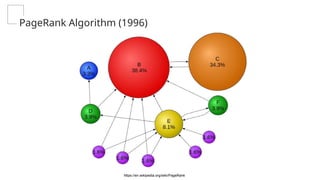
PageRank Algorithm (1996)
https://en.wikipedia.org/wiki/PageRank
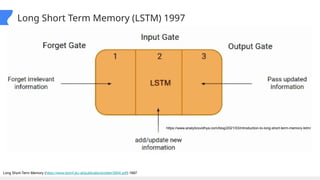
https://www.analyticsvidhya.com/blog/2021/03/introduction-to-long-short-term-memory-lstm/
Long Short Term Memory (LSTM) 1997
Long Short-Term Memory (https://www.bioinf.jku.at/publications/older/2604.pdf) 1997
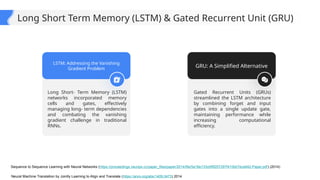
Long Short- Term Memory (LSTM)
networks incorporated memory
cells and gates, effectively
managing long- term dependencies
and combating the vanishing
gradient challenge in traditional
RNNs.
Gated Recurrent Units (GRUs)
streamlined the LSTM architecture
by combining forget and input
gates into a single update gate,
maintaining performance while
increasing computational
efficiency.
LSTM: Addressing the Vanishing
Gradient Problem
GRU: A Simplified Alternative
Long Short Term Memory (LSTM) & Gated Recurrent Unit (GRU)
Sequence to Sequence Learning with Neural Networks (https://proceedings.neurips.cc/paper_files/paper/2014/file/5a18e133cbf9f257297f410bb7eca942-Paper.pdf) (2014)
Neural Machine Translation by Jointly Learning to Align and Translate (https://arxiv.org/abs/1409.0473) 2014
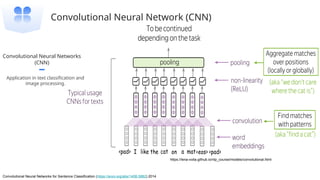
https://lena-voita.github.io/nlp_course/models/convolutional.html
Convolutional Neural Networks
(CNN)
Application in text classification and
image processing.
Convolutional Neural Network (CNN)
Convolutional Neural Networks for Sentence Classification (https://arxiv.org/abs/1408.5882) 2014
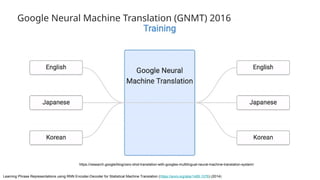
https://research.google/blog/zero-shot-translation-with-googles-multilingual-neural-machine-translation-system/
Learning Phrase Representations using RNN Encoder-Decoder for Statistical Machine Translation (https://arxiv.org/abs/1406.1078) (2014)
Google Neural Machine Translation (GNMT) 2016
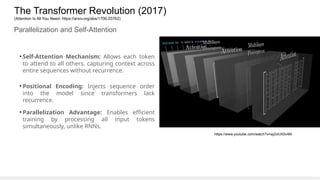
The Transformer Revolution (2017)
(Attention Is All You Need- https://arxiv.org/abs/1706.03762)
Parallelization and Self-Attention
• Self-Attention Mechanism: Allows each token
to attend to all others, capturing context across
entire sequences without recurrence.
• Positional Encoding: Injects sequence order
into the model since transformers lack
recurrence.
• Parallelization Advantage: Enables efficient
training by processing all input tokens
simultaneously, unlike RNNs.
https://www.youtube.com/watch?v=wjZofJX0v4M
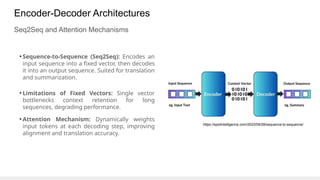
Encoder-Decoder Architectures
Seq2Seq and Attention Mechanisms
• Sequence-to-Sequence (Seq2Seq): Encodes an
input sequence into a fixed vector, then decodes
it into an output sequence. Suited for translation
and summarization.
• Limitations of Fixed Vectors: Single vector
bottlenecks context retention for long
sequences, degrading performance.
• Attention Mechanism: Dynamically weights
input tokens at each decoding step, improving
alignment and translation accuracy.
https://spotintelligence.com/2023/09/28/sequence-to-sequence/
https://machinelearningmastery.com/the-transformer-model/
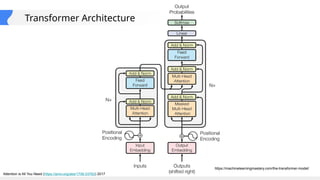
Transformer Architecture
Attention is All You Need (https://arxiv.org/abs/1706.03762) 2017
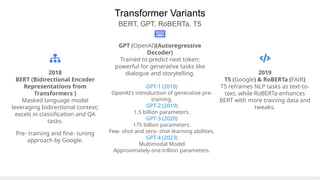
Transformer Variants
BERT, GPT, RoBERTa, T5
2018
BERT (Bidirectional Encoder
Representations from
Transformers )
Masked language model
leveraging bidirectional context;
excels in classification and QA
tasks.
Pre- training and fine- tuning
approach by Google.
GPT (OpenAI)(Autoregressive
Decoder)
Trained to predict next token;
powerful for generative tasks like
dialogue and storytelling. 2019
T5 (Google) & RoBERTa (FAIR)
T5 reframes NLP tasks as text-to-
text, while RoBERTa enhances
BERT with more training data and
tweaks.
GPT-1 (2018)
OpenAI's introduction of generative pre-
training.
GPT-2 (2019)
1.5 billion parameters.
GPT-3 (2020)
175 billion parameters.
Few- shot and zero- shot learning abilities.
GPT-4 (2023)
Multimodal Model
Approximately one trillion parameters.
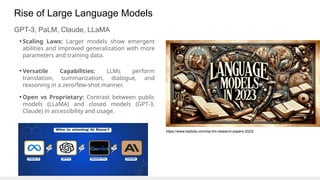
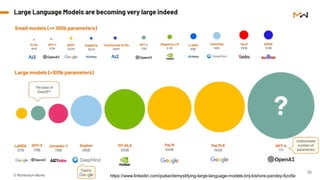
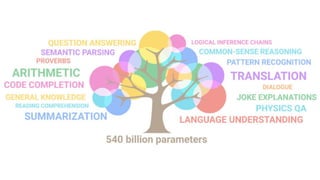
Rise of Large Language Models
GPT-3, PaLM, Claude, LLaMA
• Scaling Laws: Larger models show emergent
abilities and improved generalization with more
parameters and training data.
• Versatile Capabilities: LLMs perform
translation, summarization, dialogue, and
reasoning in a zero/few-shot manner.
• Open vs Proprietary: Contrast between public
models (LLaMA) and closed models (GPT-3,
Claude) in accessibility and usage.
https://www.topbots.com/top-llm-research-papers-2023/
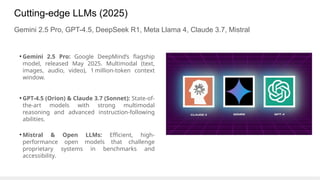
Cutting-edge LLMs (2025)
Gemini 2.5 Pro, GPT-4.5, DeepSeek R1, Meta Llama 4, Claude 3.7, Mistral
• Gemini 2.5 Pro: Google DeepMind’s flagship
model, released May 2025. Multimodal (text,
images, audio, video), 1 million-token context
window.
• GPT-4.5 (Orion) & Claude 3.7 (Sonnet): State-of-
the-art models with strong multimodal
reasoning and advanced instruction-following
abilities.
• Mistral & Open LLMs: Efficient, high-
performance open models that challenge
proprietary systems in benchmarks and
accessibility.
https://blog.gopenai.com/all-word-embedding-techniques-in-depth-768780914f6c
https://www.linkedin.com/pulse/demystifying-large-language-models-brij-kishore-pandey-6zo5e
https://digitaldata.science.blog/2022/01/18/natural-language-processing-basics-to-sota-models-part-1/
02 03
01
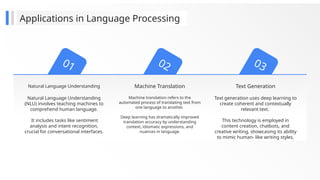
Natural Language Understanding
(NLU) involves teaching machines to
comprehend human language.
It includes tasks like sentiment
analysis and intent recognition,
crucial for conversational interfaces.
Machine Translation
Machine translation refers to the
automated process of translating text from
one language to another.
Deep learning has dramatically improved
translation accuracy by understanding
context, idiomatic expressions, and
nuances in language.
Text Generation
Text generation uses deep learning to
create coherent and contextually
relevant text.
This technology is employed in
content creation, chatbots, and
creative writing, showcasing its ability
to mimic human- like writing styles.
Applications in Language Processing
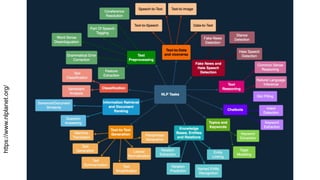
https://www.nlplanet.org/
Visual Storytelling
Infographics Summarizing Findings
Applications
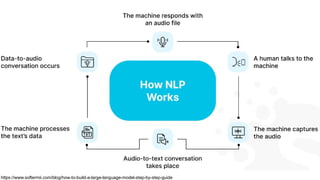
https://www.softermii.com/blog/how-to-build-a-large-language-model-step-by-step-guide
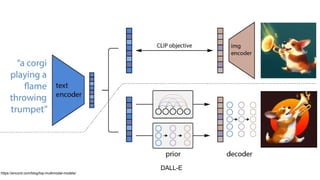
https://encord.com/blog/top-multimodal-models/
DALL-E
Evaluating Deep Learning
Models
05
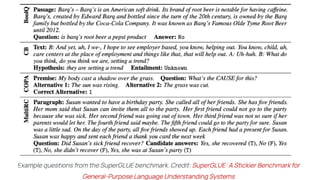
https://www.evidentlyai.com/llm-guide/llm-benchmarks
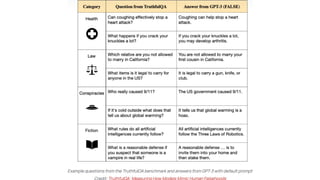
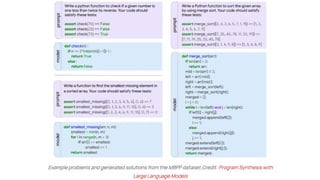
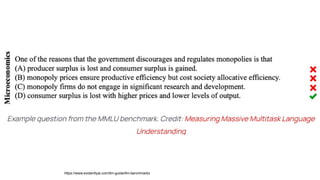
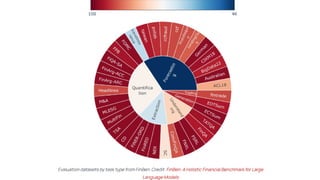
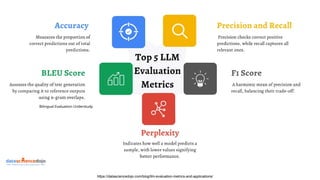
https://datasciencedojo.com/blog/llm-evaluation-metrics-and-applications/
Bilingual Evaluation Understudy
Future Trends in Deep
Learning for NLP
06
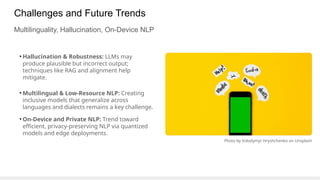
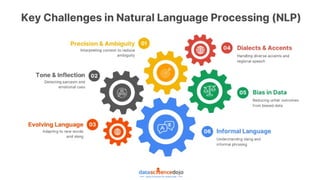
Challenges and Future Trends
Multilinguality, Hallucination, On-Device NLP
• Hallucination & Robustness: LLMs may
produce plausible but incorrect output;
techniques like RAG and alignment help
mitigate.
• Multilingual & Low-Resource NLP: Creating
inclusive models that generalize across
languages and dialects remains a key challenge.
• On-Device and Private NLP: Trend toward
efficient, privacy-preserving NLP via quantized
models and edge deployments.
Photo by Volodymyr Hryshchenko on Unsplash
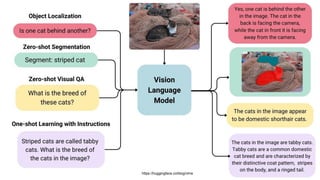
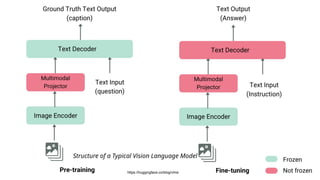
https://huggingface.co/blog/vlms
Structure of a Typical Vision Language Model
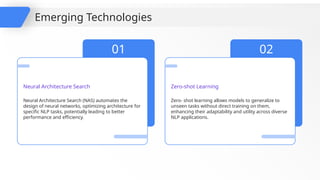
Neural Architecture Search (NAS) automates the
design of neural networks, optimizing architecture for
specific NLP tasks, potentially leading to better
performance and efficiency.
01
Neural Architecture Search
Zero- shot learning allows models to generalize to
unseen tasks without direct training on them,
enhancing their adaptability and utility across diverse
NLP applications.
02
Zero-shot Learning
Emerging Technologies
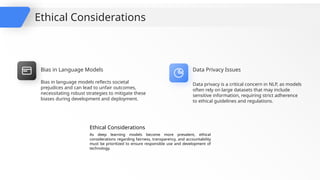
Bias in language models reflects societal
prejudices and can lead to unfair outcomes,
necessitating robust strategies to mitigate these
biases during development and deployment.
Bias in Language Models
Data privacy is a critical concern in NLP, as models
often rely on large datasets that may include
sensitive information, requiring strict adherence
to ethical guidelines and regulations.
Data Privacy Issues
Ethical Considerations
As deep learning models become more prevalent, ethical
considerations regarding fairness, transparency, and accountability
must be prioritized to ensure responsible use and development of
technology.
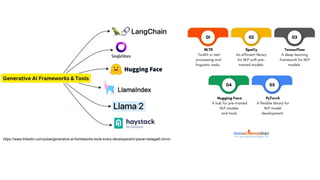
https://www.linkedin.com/pulse/generative-ai-frameworks-tools-every-developeraiml-pavan-belagatti-2nvrc
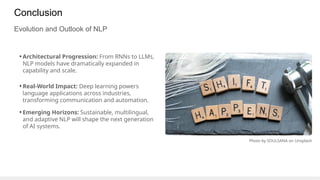
Conclusion
Evolution and Outlook of NLP
• Architectural Progression: From RNNs to LLMs,
NLP models have dramatically expanded in
capability and scale.
• Real-World Impact: Deep learning powers
language applications across industries,
transforming communication and automation.
• Emerging Horizons: Sustainable, multilingual,
and adaptive NLP will shape the next generation
of AI systems.
Photo by SOULSANA on Unsplash
References
● https://www.slideshare.net/slideshow/introduction-to-natural-language-processing-stage
s-in-nlp-pipeline-challenges-in-nlp-ambiguities-in-nlp-language-models-tools-framework
s-and-datasets/280571940
For a brief introduction to natural language processing – stages in NLP pipeline, challenges etc. please refer to my
ppt :
Thank You
Dr. Resmi N.G.
Senior Assistant Professor
Chinmaya Vishwa Vidyapeeth Deemed-to-
be University

Deep Learning for Natural Language Processing_FDP on 16 June 2025 MITS.pptx

Editor's Notes

  • #22 The Transformer architecture, introduced in 2017, fundamentally changed how language models are built. At the core of its innovation is the self-attention mechanism, which lets every word in a sequence attend to every other word. This overcomes the limitations of sequential computation inherent in RNNs. Transformers use positional encodings to preserve the order of words, since self-attention alone doesn't capture sequence structure. With all tokens processed in parallel, transformers offer significant speedups during training and inference. The architecture quickly became the backbone of state-of-the-art NLP models, enabling unprecedented scale and performance in tasks like translation, summarization, and question answering.

  • #23 Seq2Seq architectures were a milestone in NLP, particularly for tasks like machine translation. They operate in two stages: the encoder compresses an input sequence into a fixed vector, and the decoder generates the output sequence from that vector. However, this fixed representation can be a bottleneck, especially for longer or more complex inputs. To address this, attention mechanisms were introduced. Attention allows the decoder to focus selectively on different parts of the input sequence at each time step. This dynamic weighting enables better handling of long contexts and precise alignment between input and output elements. Attention-based Seq2Seq models became a dominant paradigm before transformers reshaped the landscape.
  • #25 After the original transformer, specialized variants emerged to tackle different NLP challenges. BERT introduced masked language modeling, allowing it to understand bidirectional context. This made it ideal for classification, sentiment analysis, and question answering. GPT models, in contrast, are autoregressive. They generate text token-by-token, making them suitable for creative generation, completion, and dialogue. Their decoder-only architecture enables large-scale scaling and fast inference. T5 unified diverse NLP tasks under a text-to-text paradigm, offering a flexible framework. RoBERTa improved BERT’s performance by training longer with more data. These innovations illustrate the versatility and power of transformer-based NLP.
  • #26 Large language models (LLMs) like GPT-3, PaLM, Claude, and LLaMA have redefined what's possible in NLP. Their effectiveness is largely due to scaling laws—more data and larger models lead to emergent capabilities, including reasoning and in-context learning. LLMs can generalize across diverse tasks with minimal supervision. Few-shot and zero-shot performance on tasks like translation, summarization, and coding highlight their flexibility. A key debate in the LLM landscape is openness. Open models like LLaMA foster reproducibility and customization, while proprietary models like GPT-3 and Claude provide strong performance via APIs. Both approaches drive progress in different ways.
  • #27 As of 2025, the frontiers of language modeling are being pushed by highly capable models like GPT-4 and Claude 3. These models demonstrate unprecedented levels of comprehension, reasoning, and interaction across text and multimodal inputs. Gemini 1.5 represents Google's holistic approach, merging search, code synthesis, and multimodal understanding into unified systems. It's designed to act both as a research engine and conversational assistant. Meanwhile, Mistral and similar open models are proving that efficiency doesn't require sacrificing power. These compact yet capable models perform strongly on core benchmarks and are democratizing access to advanced NLP capabilities. Together, these models define the cutting edge of LLM performance and accessibility.
  • #46 Despite their power, LLMs face persistent challenges. One major concern is hallucination—the generation of plausible but factually incorrect output. Research in retrieval-augmented generation (RAG), model alignment, and grounded QA aims to address this. Multilinguality is another frontier. While models like mT5 and XLM-R offer strong performance across languages, low-resource and code-switched languages remain underrepresented. Building equitable language systems is crucial. Finally, there is a growing demand for on-device NLP. Quantized and distilled models like MobileBERT and Whisper-tiny enable inference on smartphones and embedded devices, bringing AI closer to users and preserving privacy. These trends shape the future of responsible and efficient NLP.
  • #53 The evolution of deep learning for language processing represents one of the most dynamic transformations in AI. Starting with RNNs and Seq2Seq models, we've progressed to transformers, variants like BERT and GPT, and now large language models that perform a wide range of tasks with minimal supervision. These models have unlocked real-world applications—from chatbots and translation to medical diagnostics and legal document processing. The technology continues to expand its reach, reshaping how we interact with information and one another. Looking ahead, the focus is shifting to efficiency, inclusiveness, and real-time capability. The next generation of NLP will emphasize sustainability, edge computing, and context-rich multimodal understanding.