End-of-School Year
National Mathematics
Program (EOSY-NMP) for
Grades 1 to 3
MARIA ASUNCION H. DONATO
MASTER TEACHER I
Related Issuances
a) DepEd Order No. 13, s. 2023: Adoption of the
National Learning Recovery Program in
the Department of Education
b) DepEd Order No. 14, s. 2023: Policy Guidelines
on the Implementation of the National
Learning Camp
DepEd is committed
to learning
recovery
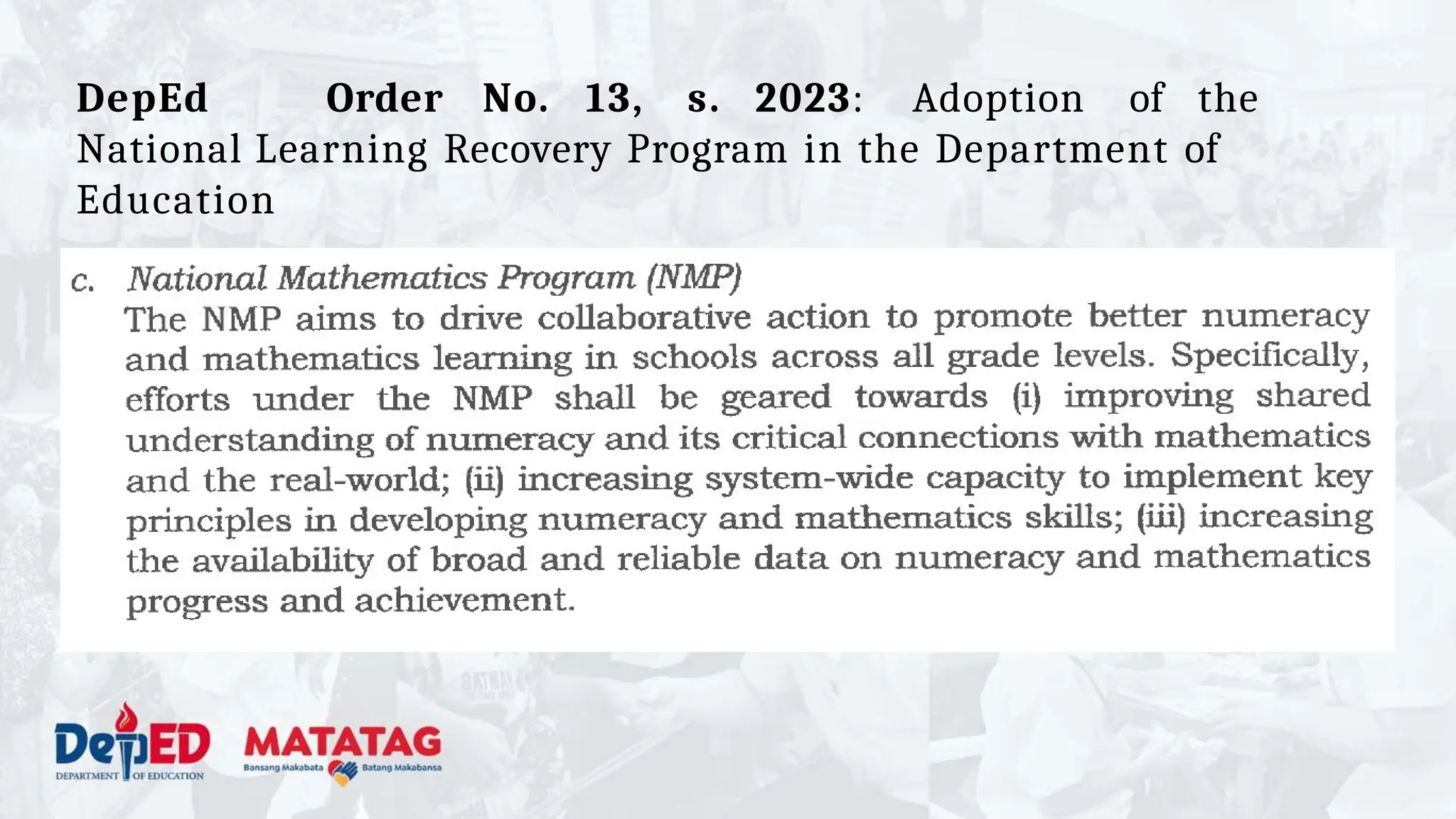
DepEd Order No. 13, s. 2023: Adoption of the
National Learning Recovery Program in the Department of
Education
DepEd Order No. 13, s. 2023: Adoption of the
National Learning Recovery Program in the Department of
Education
DepEd Order No. 13, s. 2023: Adoption of the
National Learning Recovery Program in the Department of
Education
DepEd Order No. 13, s. 2023: Adoption of the
National Learning Recovery Program in the Department of
Education
DepEd Order No. 13, s. 2023: Adoption of the
National Learning Recovery Program in the Department of
Education
• Prioritizing on building foundational skills and
improving learning outcomes, the End-of-
Schoolyear (EOSY) National Mathematics Program
(NMP) aims
accelerate learning progress on
to strategically support and
the
and
mathematical fundamental skills
numeracy among key stage 1 learners.
National Mathematics Program (NMP)
• EOSY-NMP aims to provide intensive,
explicit, and learner-centered instruction
aligned with the curriculum supported with
assessment and learning resources.
Rapid Mathematics Assessment
• The EOSY-NMP begins with a rapid assessment
phase for all learners who will voluntarily
participate in
EOSY-NMP.
• RMA refers to the set of carefully crafted
assessment
tasks aligned with MELC that aim to identify
the strengths and recognize the current mathematical
knowledge and skills of key stage 1.
Implementation Guidelines of EOSY-NMP
Rapid Mathematics Assessment
• This assessment resource package contains a
teacher’s booklet, learner’s assessment materials, and
scoring sheets that will be used as pre- and post-
assessment tools.
• This oral assessment will gauge learners' current
mathematical abilities based on the Most Essential
Learning Competencies (MELC) and identify their
strengths and areas that need improvement.
Implementation Guidelines of EOSY-NMP
Rapid Mathematics Assessment
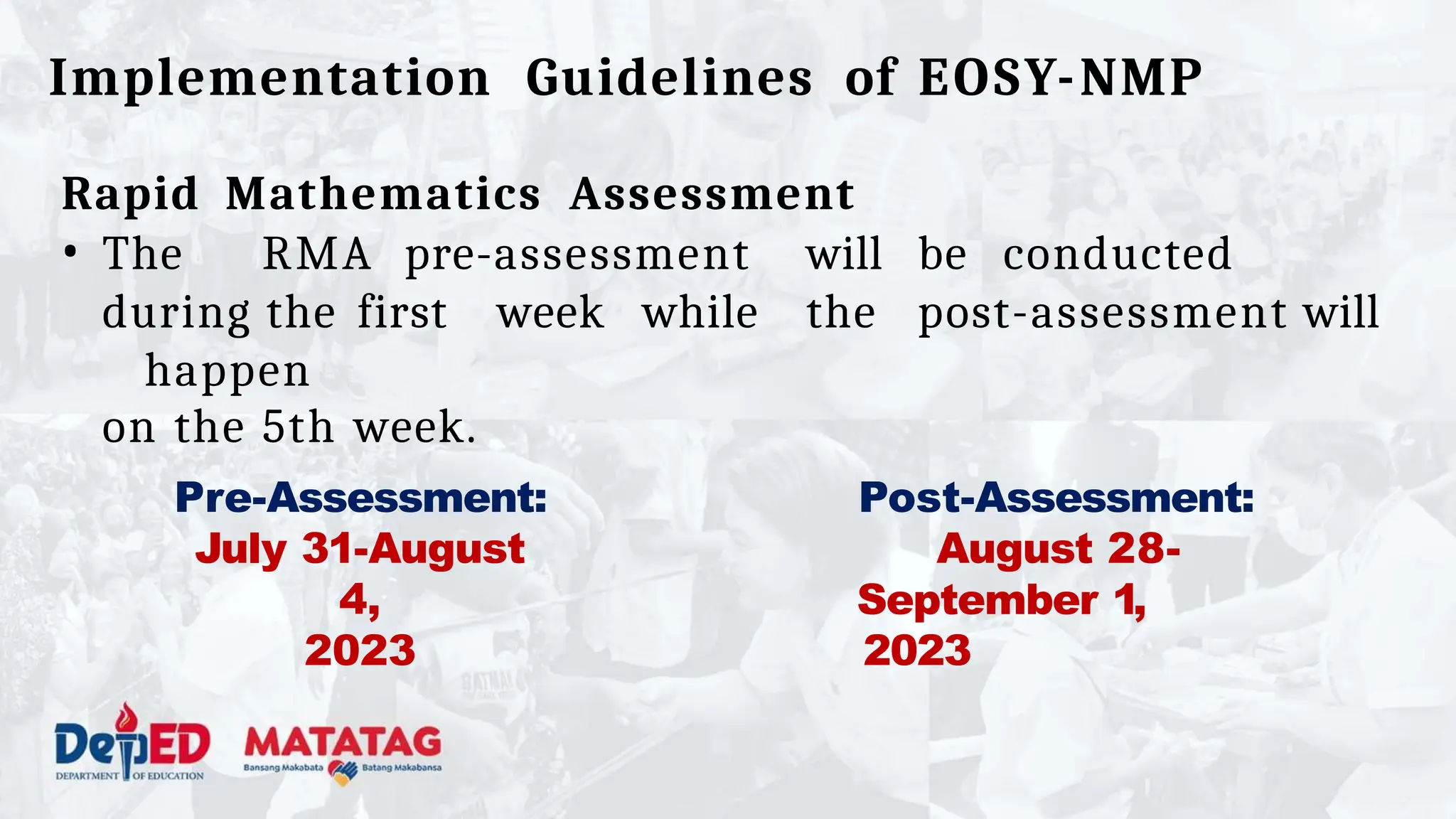
• The RMA pre-assessment will be conducted
during the first week while the post-assessment will
happen
on the 5th week.
Implementation Guidelines of EOSY-NMP
Pre-Assessment:
July 31-August
4,
2023
Post-Assessment:
August 28-
September 1,
2023
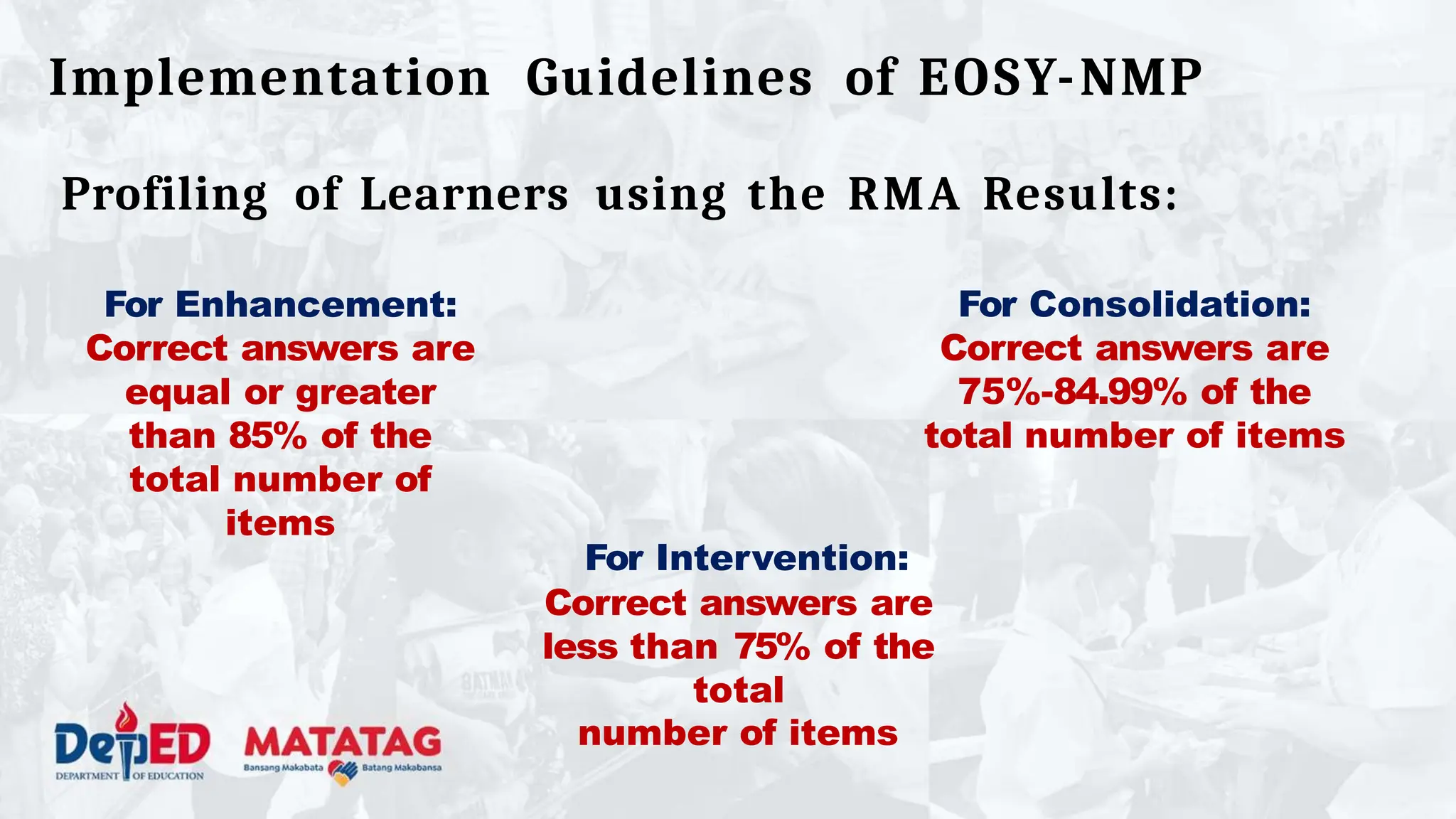
Profiling of Learners using the RMA Results:
Implementation Guidelines of EOSY-NMP
For Enhancement:
Correct answers are
equal or greater
than 85% of the
total number of
items
For Consolidation:
Correct answers are
75%-84.99% of the
total number of items
For Intervention:
Correct answers are
less than 75% of the
total
number of items
National Mathematics
Program Pre-and Post
Assessment for EOSY Grades 1
to 3
Rapid Math Assessment (RMA)
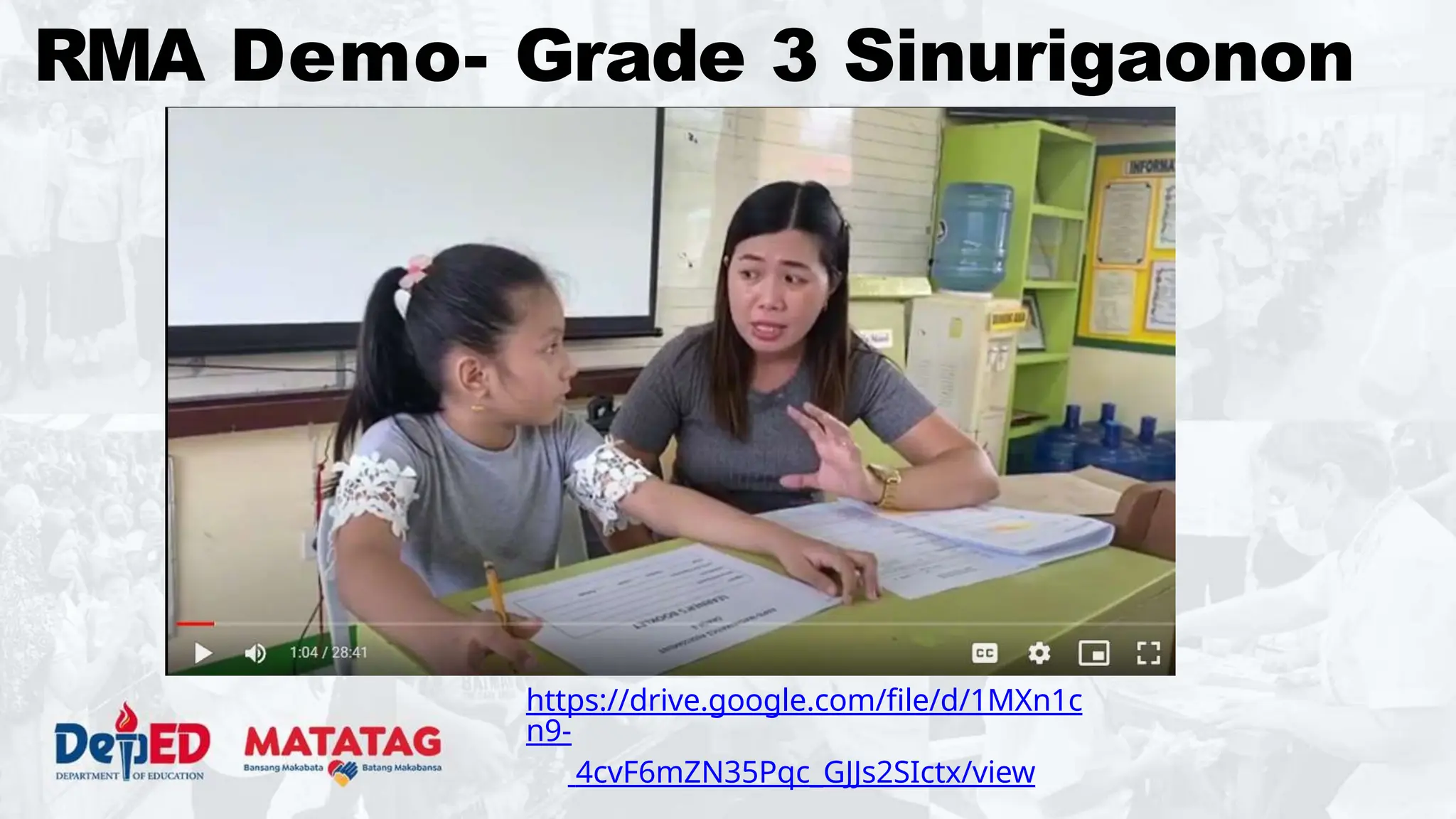
RMA Demo- Grade 3 Sinurigaonon
https://drive.google.com/file/d/1MXn1c
n9-
4cvF6mZN35Pqc_GJJs2SIctx/view
Math Learning Experience
(MLE)
MLE
MELCs
.
Explicit and
Active
Learning
Experienc
e
Math
Foundatio
n al Skills
Play-based
Collaborat
i ve
Hands-on
learning
approache
s
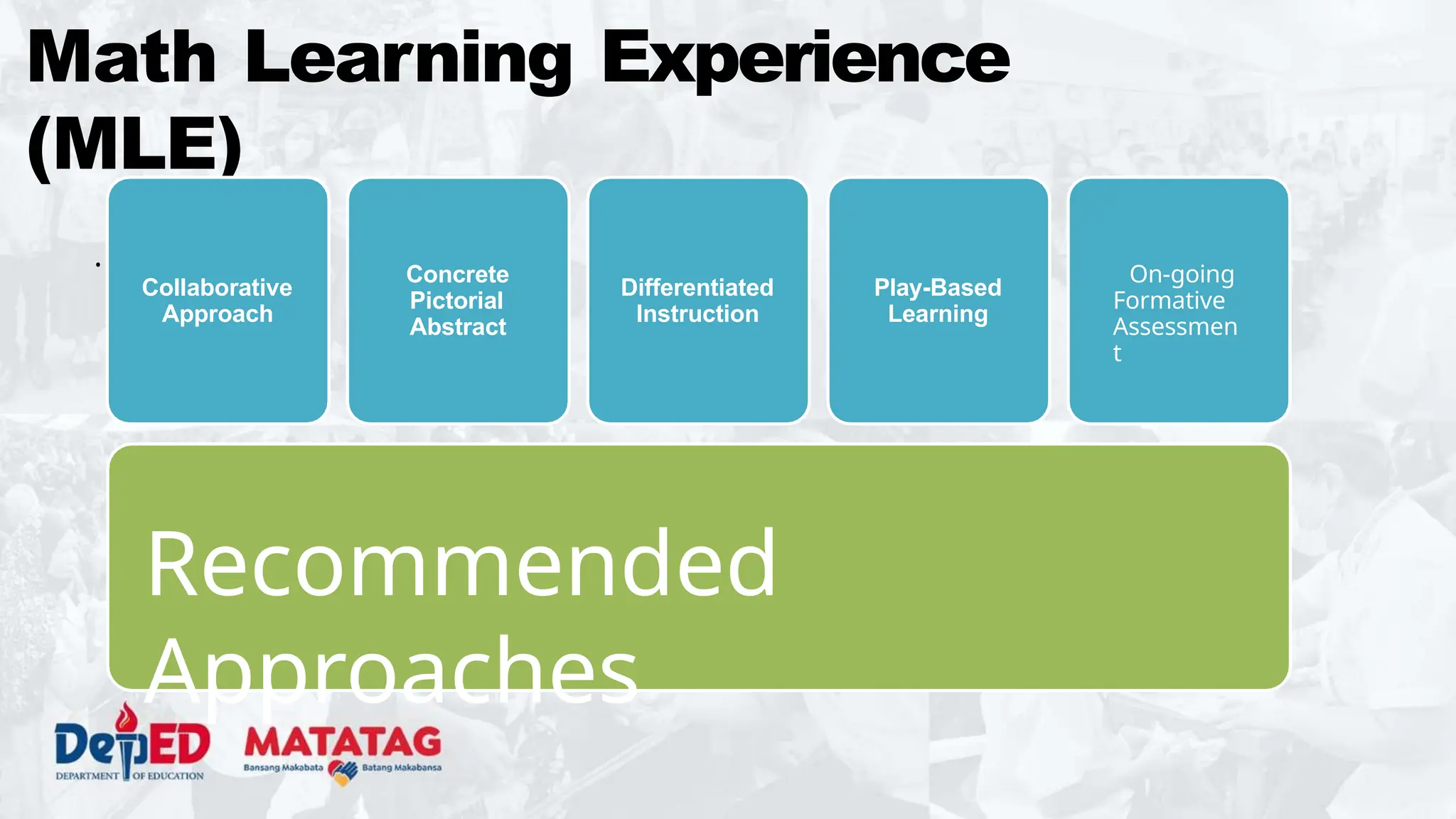
Math Learning Experience
(MLE)
.
Recommended
Approaches
Collaborative
Approach
Concrete
Pictorial
Abstract
Differentiated
Instruction
Play-Based
Learning
On-going
Formative
Assessmen
t
Math Learning Experience Material (MLEM)
.
set of contextualized teaching and learning
materials that contain a teaching plan,
academic games, worksheets, stories, and
fun math activities target to cater to all
types of learners and developed in line with
the Concrete Pictorial Abstract (CPA)
approach.
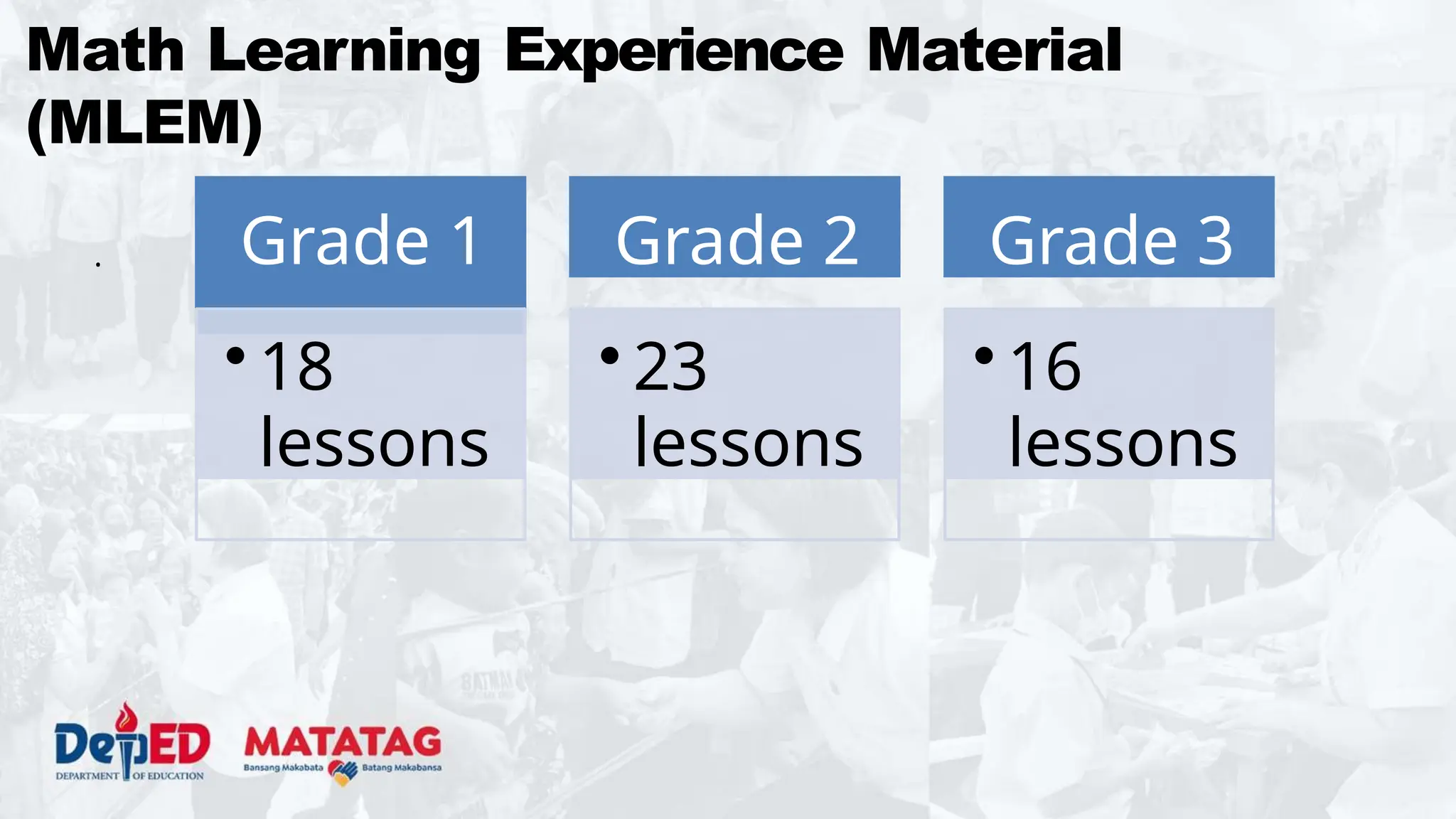
Math Learning Experience Material
(MLEM)
. Grade 1
• 18
lessons
Grade 2
• 23
lessons
Grade 3
• 16
lessons
Teacher
Selection
Select teachers who possess a strong
.mathematical inclination and are well-
versed in the recommended instructional
approaches
for delivering math concepts. They should
demonstrate
mathematical skills
a deep understanding of
and
foundational
numeracy.
Learners
Placement
To gain valuable insights into each learner's
mathematical abilities, strengths, and areas
.
that require improvement must be identified
based on the results
Mathematics Assessment.
of the Rapid
The assessment
results will help teachers to identify individual
accordingly, and
needs, tailor instruction
provide targeted support to enhance
mathematical skills and understanding.
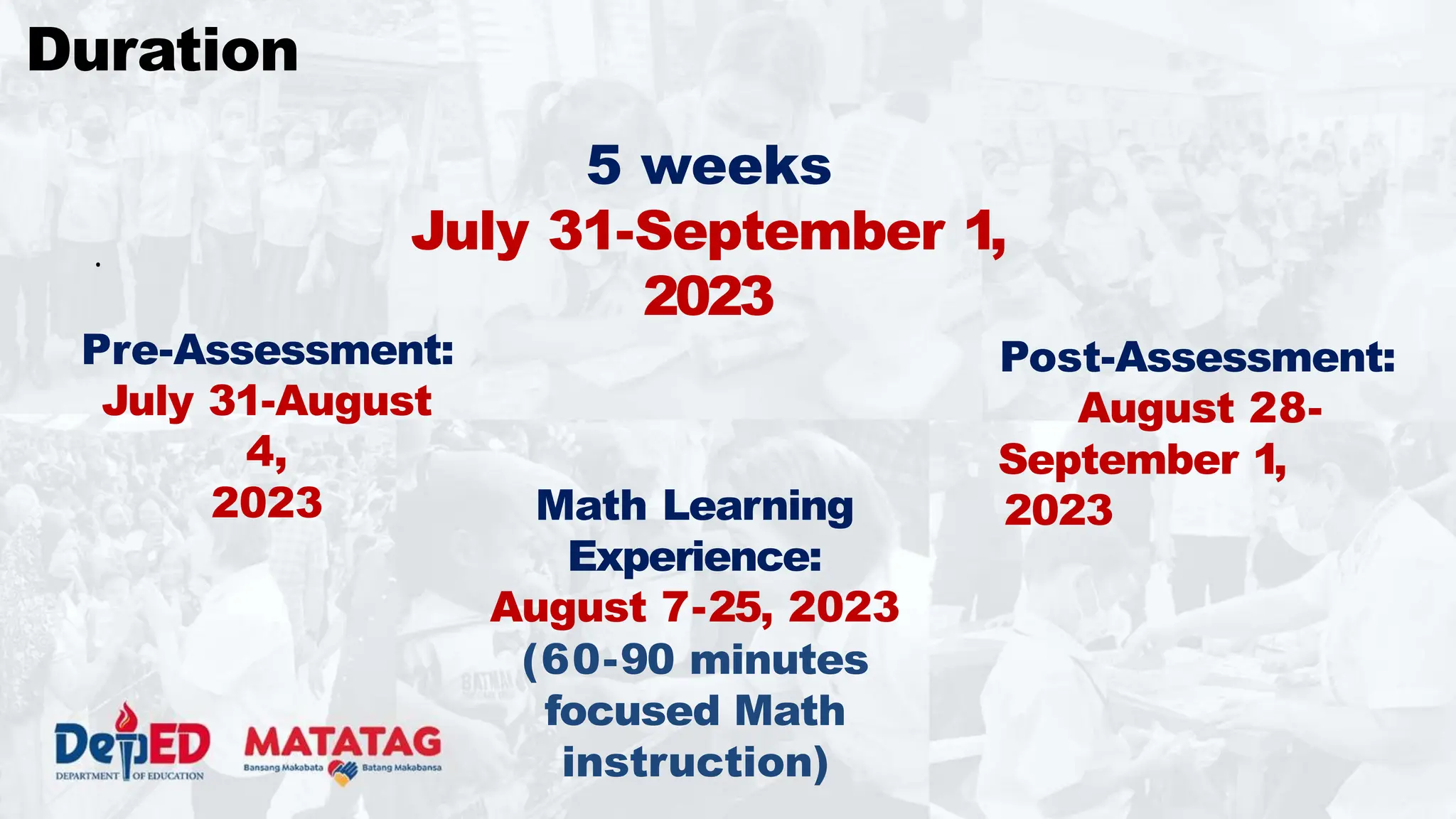
Duration
.
5 weeks
July 31-September 1,
2023
Pre-Assessment:
July 31-August
4,
2023
Post-Assessment:
August 28-
September 1,
2023
Math Learning
Experience:
August 7-25, 2023
(60-90 minutes
focused Math
instruction)
Classroom Delivery
.
• Fun
• Engaging
• Collaborative
• Interactive
• Technology
Integration
Class Size
. Maximum of 25
learners
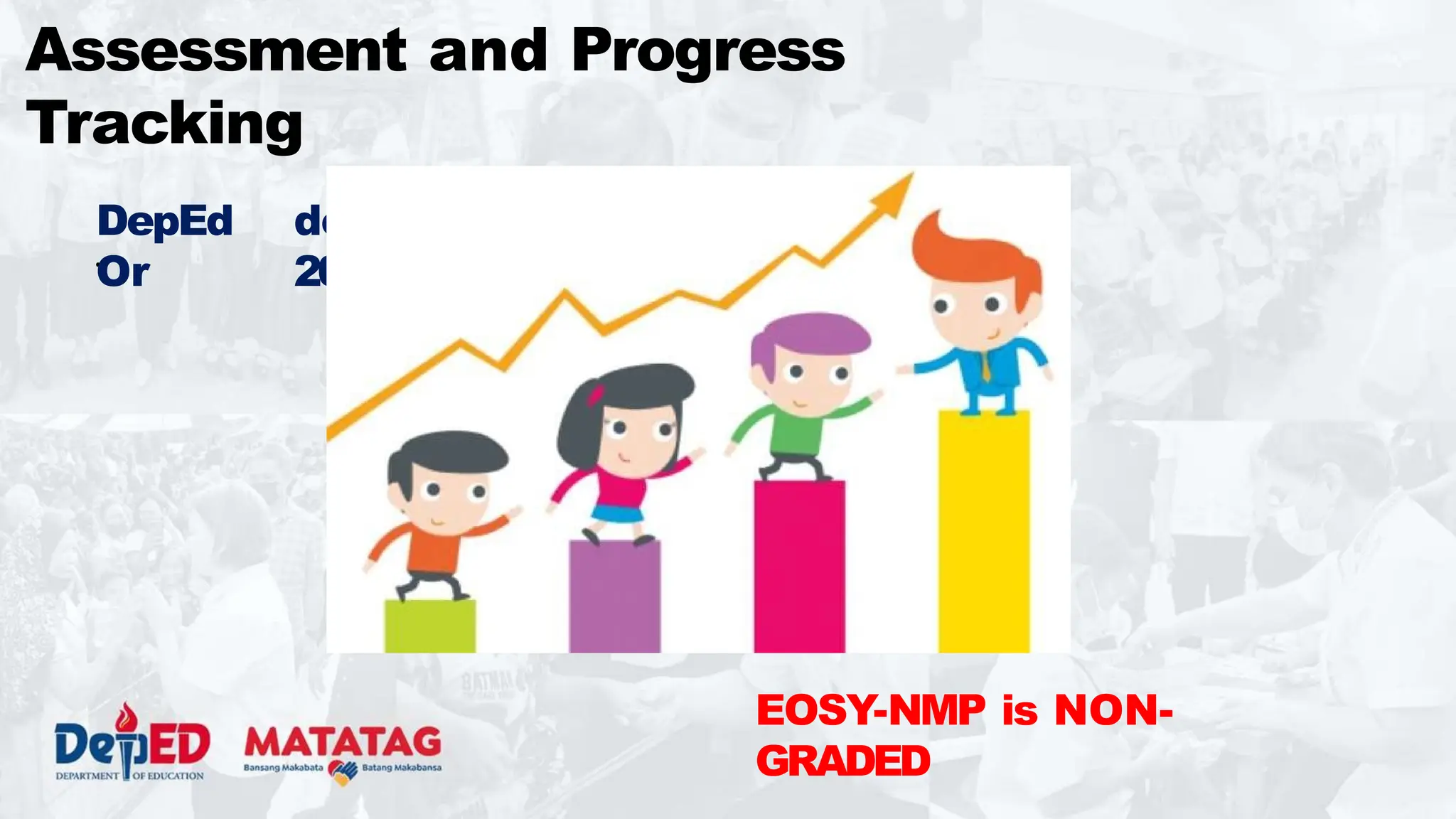
Assessment and Progress
Tracking
.
DepEd
Or
der No. 8, s.
2015
EOSY-NMP is NON-
GRADED
Supplementary Materials
.Available learning resources developed and validated in
regions, divisions, and schools that are parallel with the
scope of MLEM and aligned with the teaching
approaches in the MLEM framework may be used by
teachers toreinforce their
additional references, formative assessments,
delivery and serve as
and
learning tasks.
Scope of RMA and MLEM
Grade
1
Most Essential Learning Competencies CG Code (MELCs)
Number Reads and writes numbers up to 100 in symbols • M1NS-If-9.1
Identification
a.nd Discrimination
and in words
• Compares numbers up to 100 using relational • M1NS – no code •
symbols and orders them in increasing or
decreasing order M1NS-Ib-3
• Identifies the number that is one more or one • M1NS – no code
less than a given number
• Identifies, reads, and writes ordinal
numbers:
1s t , 2nd , 3rd, up to 10th object in a given set from
a given point of reference
Fractions • Visualizes, represents, and divides a whole into
halves and fourths and identifies ½ and ¼ of
a whole object
• Visualizes and draws the whole region or
set given its ½ and/or ¼
• M1NS- no code •
M1NS-IIId-75
Grade
1
.
Most Essential Learning Competencies CG Code (MELCs)
Addition • Illustrates addition as “putting together or combining
or joining sets”
• Visualizes and adds the following numbers using
appropriate techniques:
a. two 1-digit numbers with sums up to 18
b. three 1-digit numbers
c.numbers with sums through 99 without and
with regrouping
• M1NS-IIa-23
• M1NS – no code
Subtraction • Illustrates subtraction as “taking away” or “comparing”
elements of sets
• Visualizes, represents, and subtracts
the following numbers:
a) one-digit numbers with minuends through 18 (basic facts)
b) one- to two-digit numbers with minuends up to 99 without
regrouping
c) one- to two-digit numbers with minuends up to 99
with regrouping
• M1NS-IIf-24
• M1NS – no
code
Grade 1
. Most Essential Learning Competencies CG Code (MELCs)
Geometric
Representation
• identifies, names, and describes the four
basic shapes (square, rectangle,
triangle, and circle) in 2- dimensional
(flat/plane) and 3-
dimensional (solid objects)
• M1GE-IIIe-1
• M1GE-IIIe-2
(K-12 Curriculum)
• compares and classifies 2-
dimensional
(flat/plane0 and 3-dimensional
(solid) figures according to
common attributes
Grade 1
Task/Item Most Essential Learning Competencies CG Code (MELCs)
M.issing
Shapes
in Patterns
• Determines the missing terms using one
attribute in a given continuous pattern and in a
given repeating pattern
• M1AL – no code
Time
Measurement
• Tells the days in a week, months in a year in
the right order
• Determines the day of the month using a
calendar
• tells and writes time by the hour, half-hour,
and quarter-hour using an analog clock
• M1ME-Iva-1
• M1ME-Iva-2
• M1ME-IVb-3
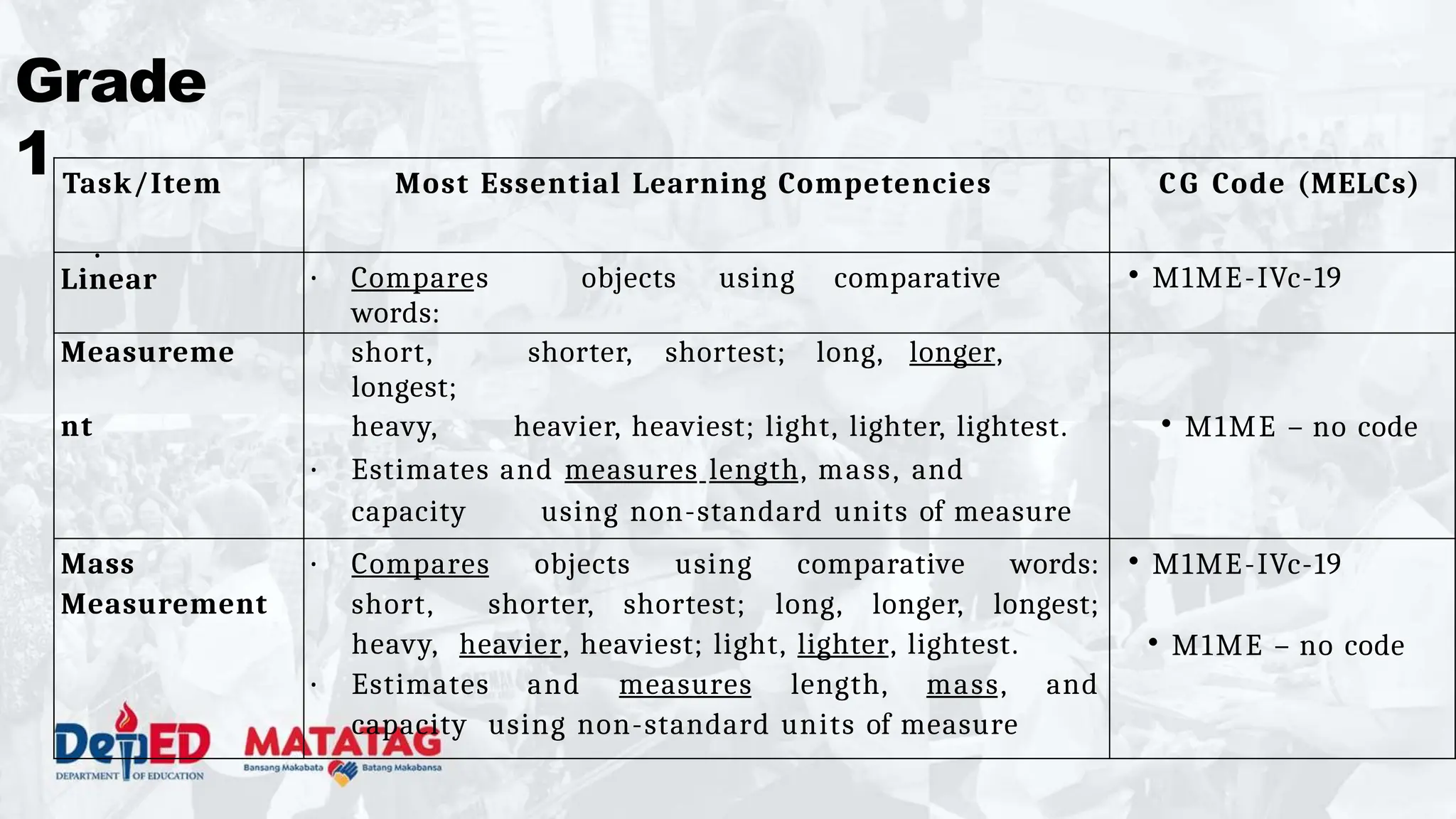
Grade
1Task/Item Most Essential Learning Competencies CG Code (MELCs)
.
Linear • Compares objects using comparative
words:
• M1ME-IVc-19
Measureme short, shorter, shortest; long, longer,
longest;
nt heavy, heavier, heaviest; light, lighter, lightest. • M1ME – no code
• Estimates and measures length, mass, and
capacity using non-standard units of measure
Mass
Measurement
• Compares objects using comparative words:
short, shorter, shortest; long, longer, longest;
heavy, heavier, heaviest; light, lighter, lightest.
• Estimates and measures length, mass, and
capacity using non-standard units of measure
• M1ME-IVc-19
• M1ME – no code
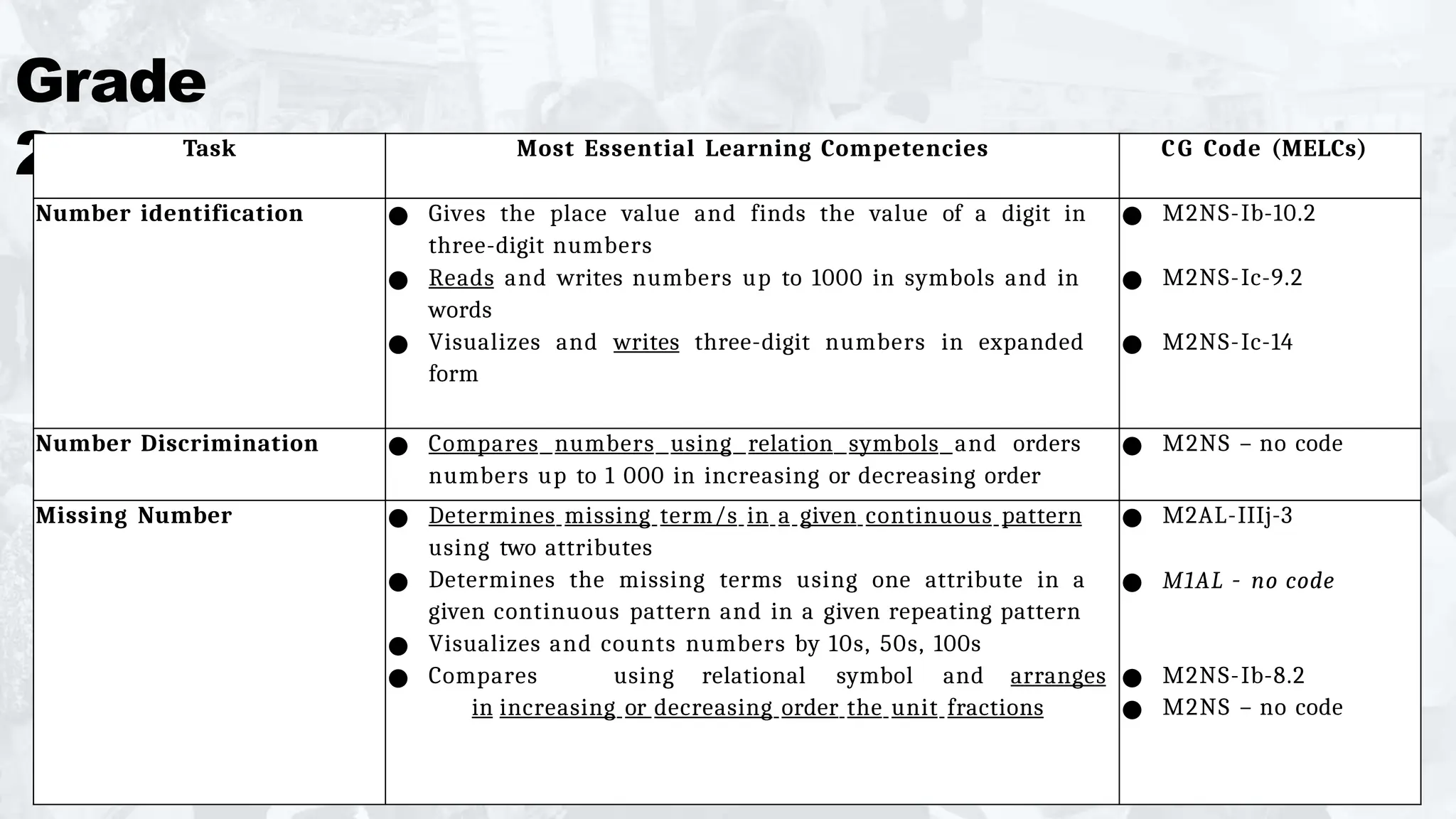
Grade
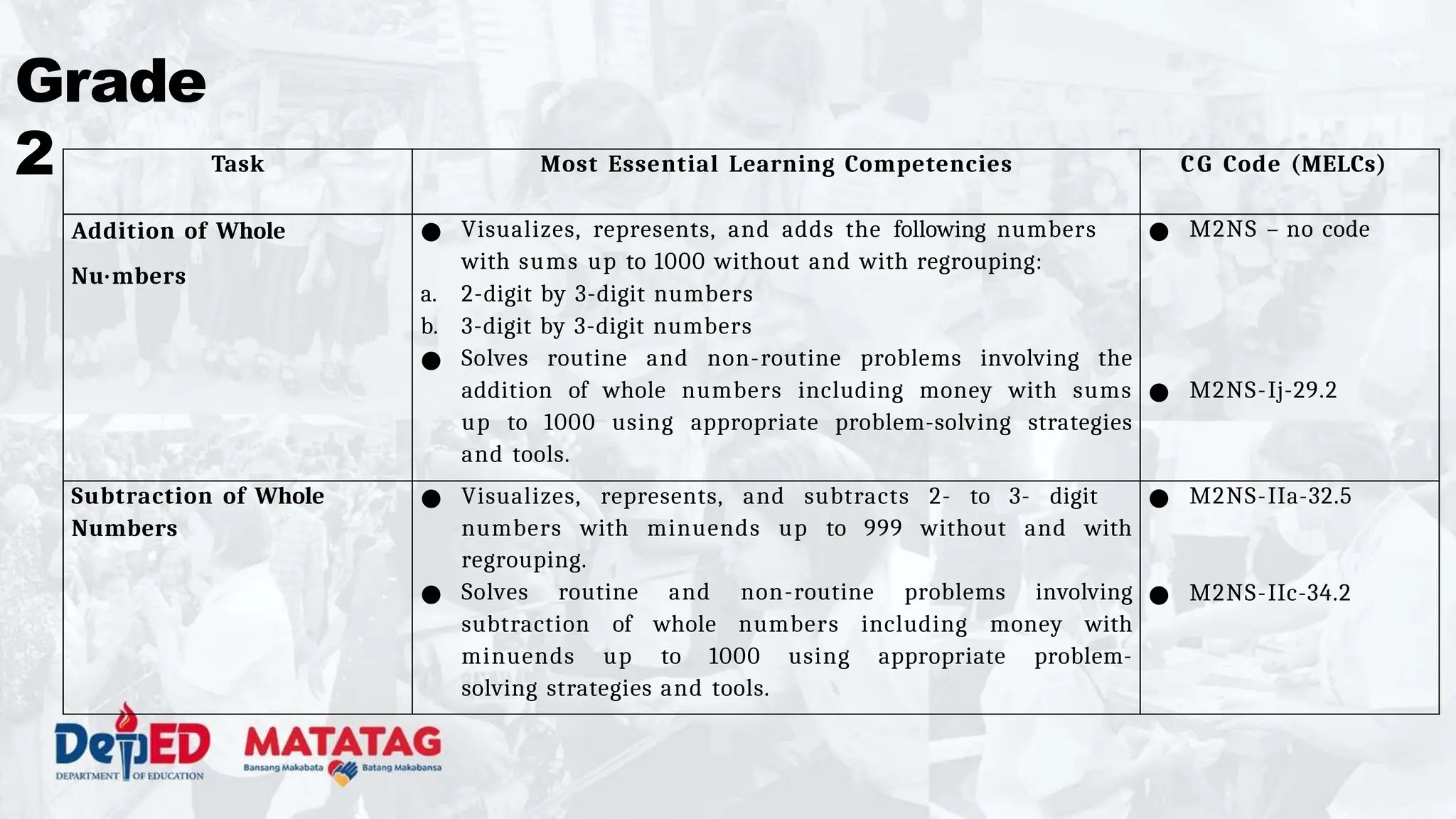
2
.
Task Most Essential Learning Competencies CG Code (MELCs)
Number identification ● Gives the place value and finds the value of a digit in
three-digit numbers
● Reads and writes numbers up to 1000 in symbols and in
words
● Visualizes and writes three-digit numbers in expanded
form
● M2NS-Ib-10.2
● M2NS-Ic-9.2
● M2NS-Ic-14
Number Discrimination ● Compares numbers using relation symbols and orders
numbers up to 1 000 in increasing or decreasing order
● M2NS – no code
Missing Number ● Determines missing term/s in a given continuous pattern
using two attributes
● Determines the missing terms using one attribute in a
given continuous pattern and in a given repeating pattern
● Visualizes and counts numbers by 10s, 50s, 100s
● Compares using relational symbol and arranges
in increasing or decreasing order the unit fractions
● M2AL-IIIj-3
● M1AL – no code
● M2NS-Ib-8.2
● M2NS – no code
Grade
2 Task Most Essential Learning Competencies CG Code (MELCs)
Addition of Whole
Nu.mbers
● Visualizes, represents, and adds the following numbers
with sums up to 1000 without and with regrouping:
a. 2-digit by 3-digit numbers
b. 3-digit by 3-digit numbers
● Solves routine and non-routine problems involving the
addition of whole numbers including money with sums
up to 1000 using appropriate problem-solving strategies
and tools.
● M2NS – no code
● M2NS-Ij-29.2
Subtraction of Whole
Numbers
● Visualizes, represents, and subtracts 2- to 3- digit
numbers with minuends up to 999 without and with
regrouping.
● Solves routine and non-routine problems involving
subtraction of whole numbers including money with
minuends up to 1000 using appropriate problem-
solving strategies and tools.
● M2NS-IIa-32.5
● M2NS-IIc-34.2
Grade
2
.
Task Most Essential Learning Competencies CG Code (MELCs)
Multiplication of Whole
Numbers
● Illustrates and writes a related equation for each type of
multiplication: repeated addition, array, counting
by
multiples, and equal jumps on the number line.
● Illustrates the following properties of multiplication and
apply each in a relevant situation: (a) identity, (b) zero, and
(c) commutative.
● Visualizes multiplication of numbers 1 to 10 by 2, 3, 4, 5,
and 10.
● M2NS – no code
● M2NS – no code
● M2NS-IIh-41.1
Division of Whole Numbers ● Visualizes and represents division, and writes a related
equation for each type of situation: equal sharing, repeated
subtraction, equal jumps on the number line, and
formation of equal groups of objects.
● Visualizes division of numbers up to 100 by 2,3,4,5, and
10 (multiplication table of 2, 3, 4, 5, and 10)
● Solves routine and non-routine problems involving the
division of numbers by 2,3,4,5 and 10 and with any of the
other operations of whole numbers including money using
appropriate problem-solving strategies and tools.
● M2NS – no code
● M2NS-IIIb-51.1
● M2NS-IIIc-56.1
Grade
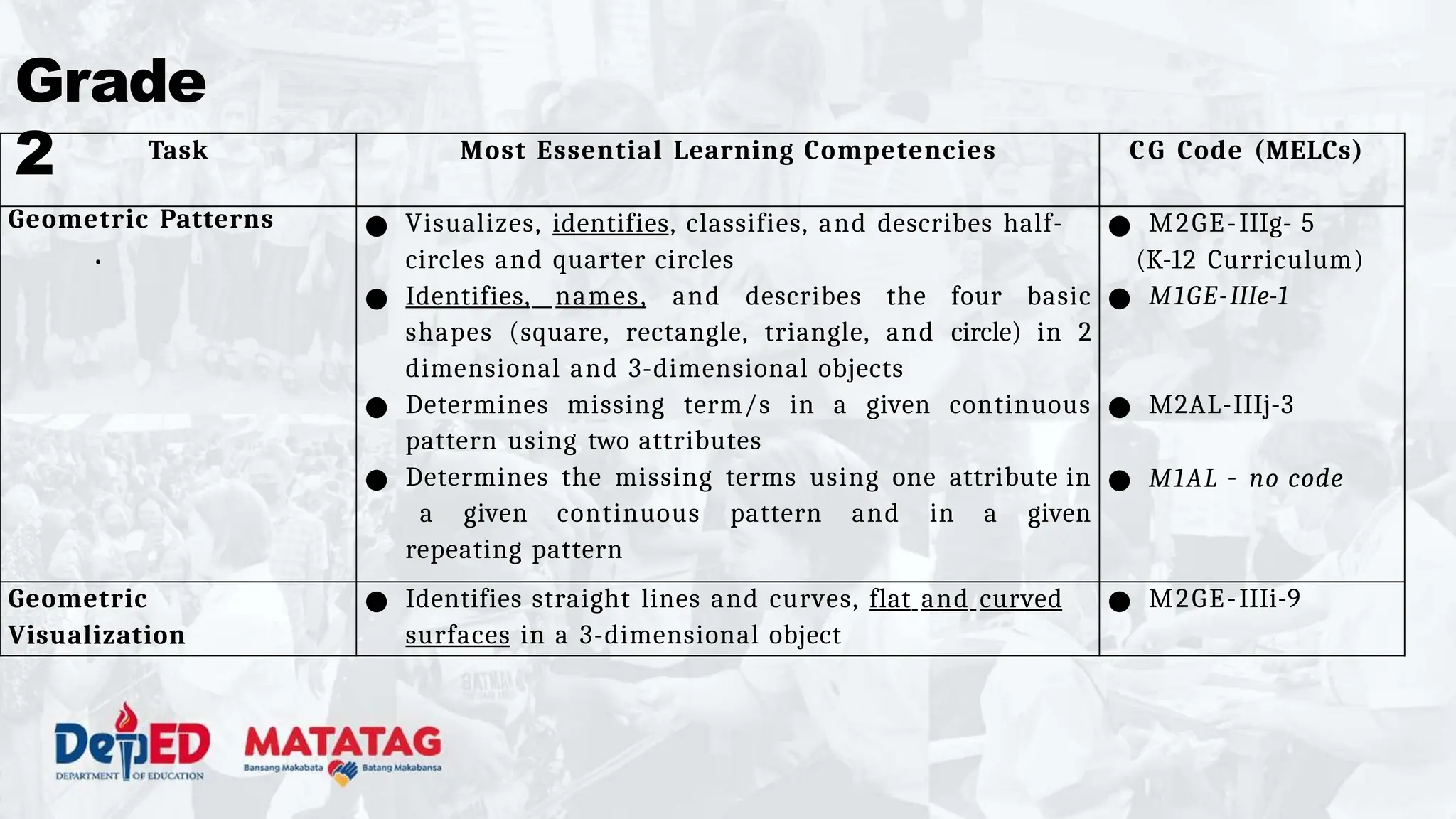
2 Task Most Essential Learning Competencies CG Code (MELCs)
Geometric Patterns
.
● Visualizes, identifies, classifies, and describes half-
circles and quarter circles
● Identifies, names, and describes the four basic
shapes (square, rectangle, triangle, and circle) in 2
dimensional and 3-dimensional objects
● Determines missing term/s in a given continuous
pattern using two attributes
● Determines the missing terms using one attribute in
a given continuous pattern and in a given
repeating pattern
● M2GE-IIIg- 5
(K-12 Curriculum)
● M1GE-IIIe-1
● M2AL-IIIj-3
● M1AL – no code
Geometric
Visualization
● Identifies straight lines and curves, flat and curved
surfaces in a 3-dimensional object
● M2GE-IIIi-9
Grade
3 Task Most Essential Learning Competencies CG Code (MELCs)
Number
Iden. tification
● Identifies odd and even numbers ● M3NS-IIIa-63
Number
Discrimination
● Represents, compares, and arranges dissimilar
fractions in increasing or decreasing order
● M3NS – no code
Missing Number ● Visualizes and represents fractions that
are
equal to one and greater than one
using regions, sets, and number line
● Reads and writes fractions that are equal
to
one and greater than one in symbols and words
● Determines missing term/s in a given
combination of a continuous and repeating
pattern
● M3NS - no code
● M3NS-IIIb-76.3
● M3AL-IIIj-4
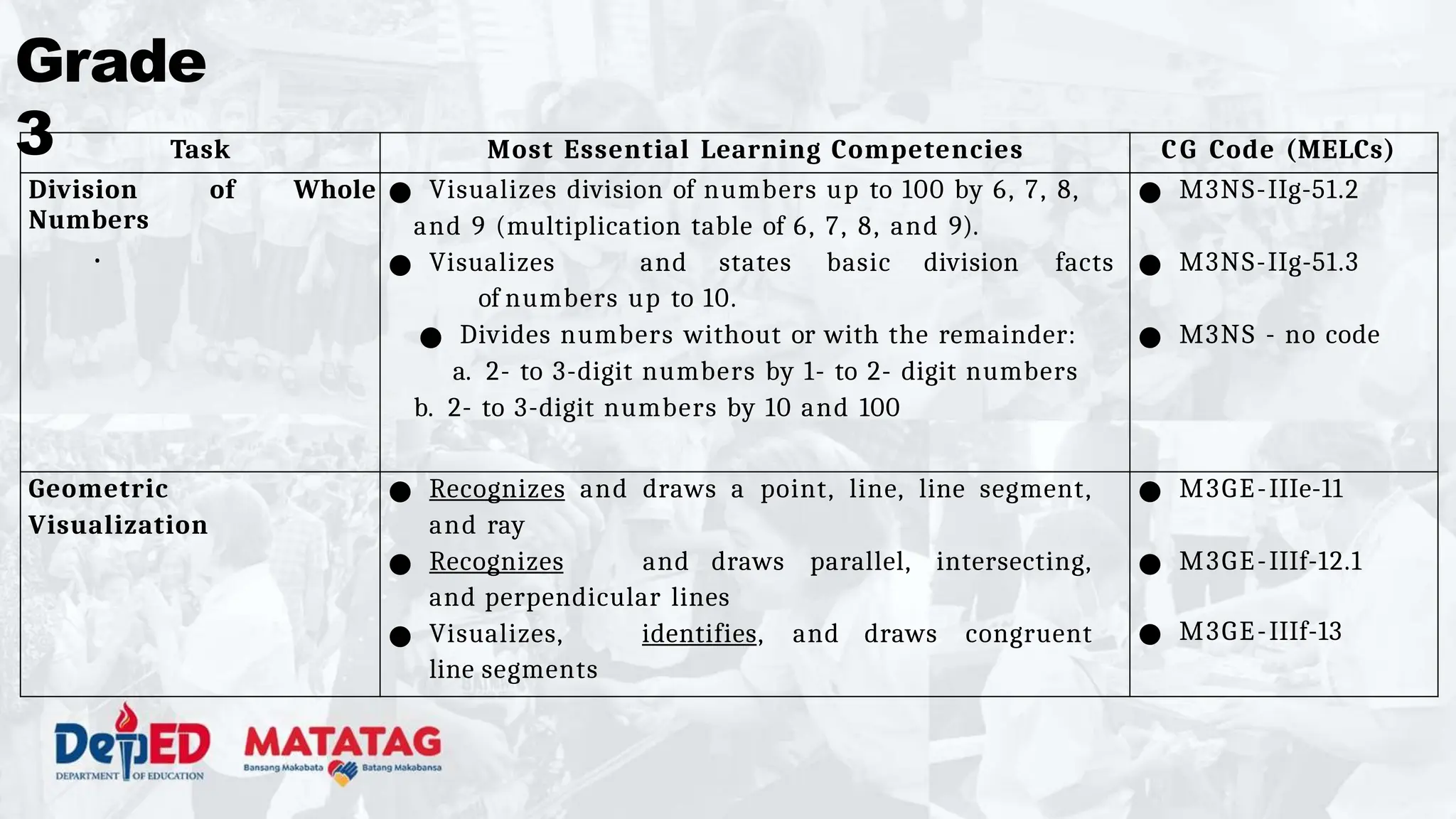
Grade
3 Task Most Essential Learning Competencies CG Code (MELCs)
Addition of Whole Numbers ● Adds 3- to 4-digit numbers up to three addends with sums
up to 10 000 without and with regrouping
● M3NS-Id-27.6
Subtraction of Whole
Numb.ers
● Subtracts 3- to 4-digit numbers from 3- to 4-digit
numbers without and with regrouping
● Solves routine and non-routine problems involving
subtraction without or with the addition of whole
numbers including money using appropriate problem-
solving strategies and tools
● M3NS-Ig-32.6
● M3NS - Ii -34.5
Multiplication
Numbers
of Whole ● Multiplies numbers:
a. 2- to 3-digit numbers by 1-digit numbers without or with
regrouping
b. 2-digit number by 2-digit numbers with regrouping
c. 2- to 3-digit numbers by multiples of 10 and 100
● Solves routine and non-routine problems involving
multiplication without or with addition and subtraction
of whole numbers including money using
appropriate problem-solving strategies and tools.
● M2NS – no code
● M3NS-IIe-45.3
Grade
3 Task Most Essential Learning Competencies CG Code (MELCs)
Division of Whole
Numbers
.
● Visualizes division of numbers up to 100 by 6, 7, 8,
and 9 (multiplication table of 6, 7, 8, and 9).
● Visualizes and states basic division facts
of numbers up to 10.
● Divides numbers without or with the remainder:
a. 2- to 3-digit numbers by 1- to 2- digit numbers
b. 2- to 3-digit numbers by 10 and 100
● M3NS-IIg-51.2
● M3NS-IIg-51.3
● M3NS - no code
Geometric
Visualization
● Recognizes and draws a point, line, line segment,
and ray
● Recognizes and draws parallel, intersecting,
and perpendicular lines
● Visualizes, identifies, and draws congruent
line segments
● M3GE-IIIe-11
● M3GE-IIIf-12.1
● M3GE-IIIf-13
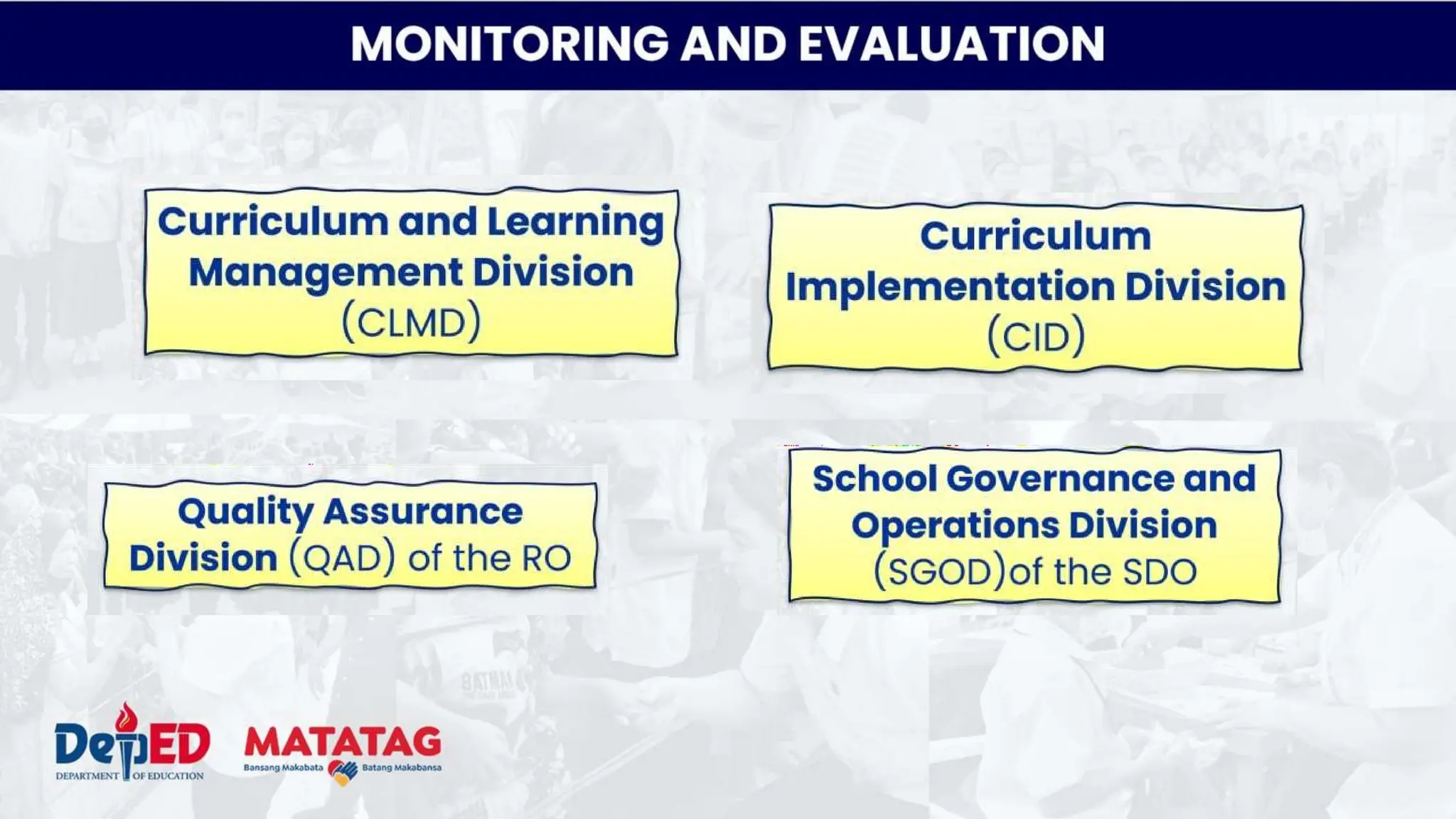
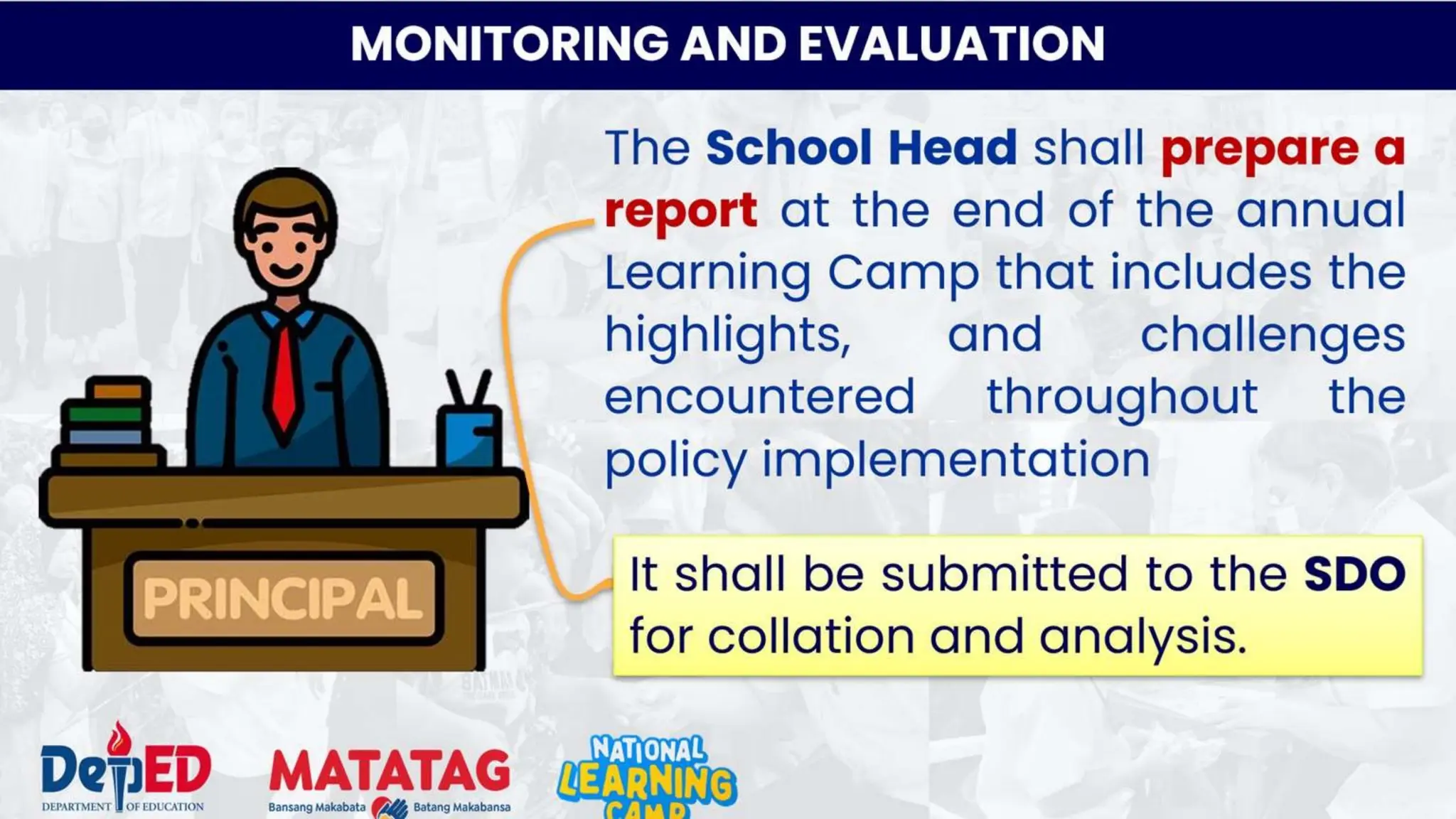
School heads
supervise the
implementation and
ensures that the
Policy is
communicated to
stakeholders
ROs and SDOs
monitor school’s
compliance with the
Policy and
consolidate M&E
reports
CO utilizes M&E
results for policy
evaluation
MONITORING AND
EVALUATION
MONITORING AND EVALUATION
Reports
ANNEX 1: Report on
Enrolment No. of Learners Enrolled in EOSY-NMP
Schools
Division
Grade 1 Grade 2 Grade 3 Total
M F T M F T M F T M F T
.
Total
ANNEX 2: RMA Results
(Average) Grade 1 Grade 2 Grade 3
Schools
Division
Average
Pretest
Score
Average
Posttest
Score
Learning
Gains
Average
Pretest
Score
Average
Posttest
Score
Learning
Gains
Average
Pretest
Score
Average
Posttest
Score
Learning
Gains
SDO1 5 7 2
SDO2 3 7 4
SDO3 7 9 2
Avergae 5 7.67 2.67
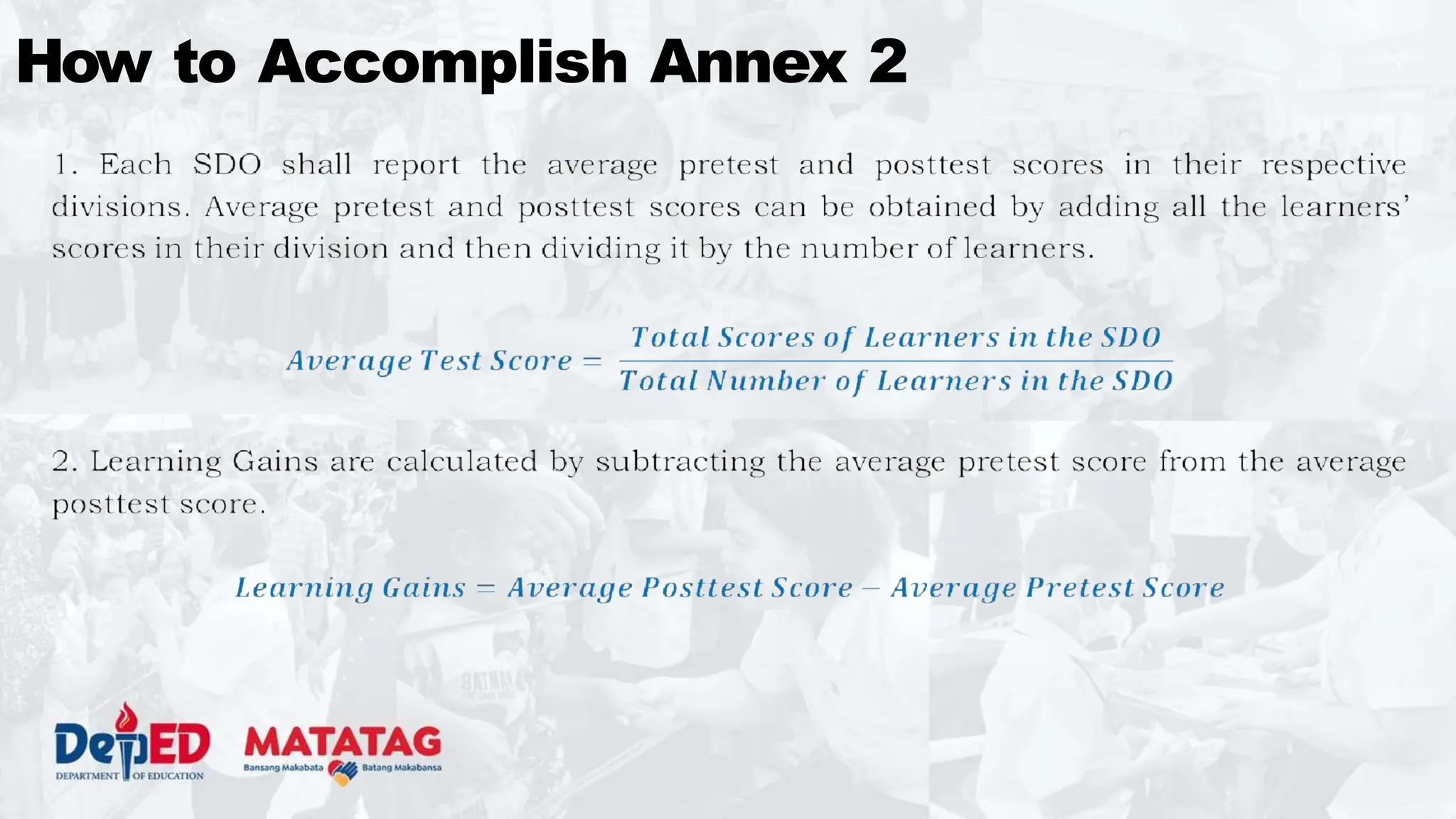
How to Accomplish Annex 2
ANNEX 3: (PRETEST)- Determining Least
Mastered Skills
Total Number of Learners/Enrollees:
Task/Item
(copy the all the subskills in the scoring sheet)
Frequency
(number of learners)
Percentage of Learners Who
Met Expectations
Pass Failed
Task A: Number Identification and Discrimination 19
A1a. Reading numb
A1a. Reading number #1
A1b. Reading number #2
A1c. Reading number #3
Instructions for Annex 3
ANNEX 4: (POSTTEST)- Validation of Least
Mastered Skills
Total Number of Learners/Enrollees:
Task/Item
(copy the all the subskills in the scoring sheet)
Frequency
(number of learners)
Percentage of Learners
Who Met Expectations
Pass Failed
Task A: Number Identification and
Discrimination 19 A1a. Reading numb
A1a. Reading number #1
A1b. Reading number #2
A1c. Reading number #3
**
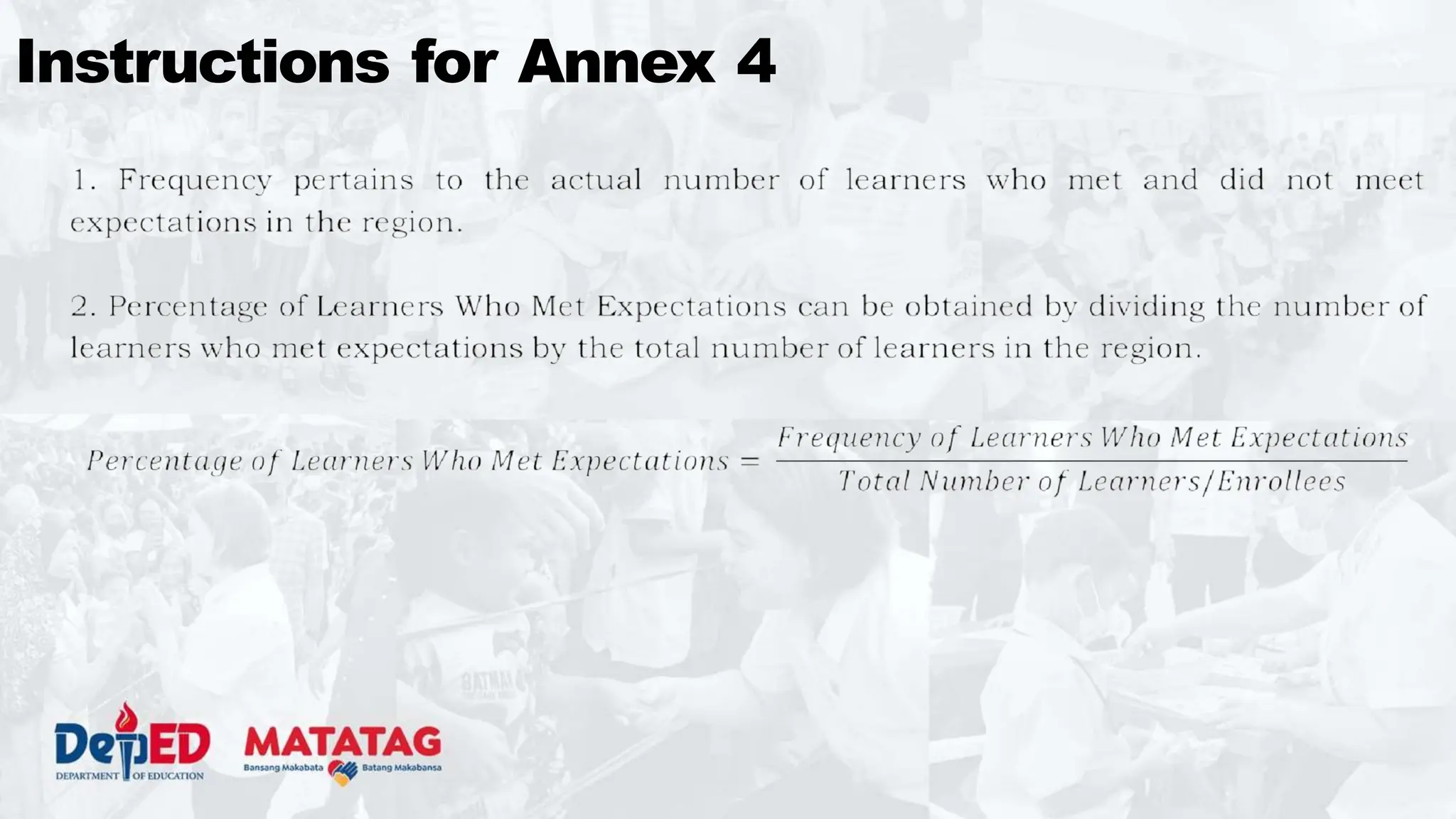
Instructions for Annex 4
ANNEX 5: Learning
Gains Grade Level:
Task/Item
(copy the all the subskills in the scoring sheet)
Mean Score per Subtask Learning Gains
Pretest Posttest
Task A: Number Identification and
Discrimination 19 A1a. Reading numb (19
pts)
A1a. Reading number #1
A1b. Reading number #2
A1c. Reading number #3
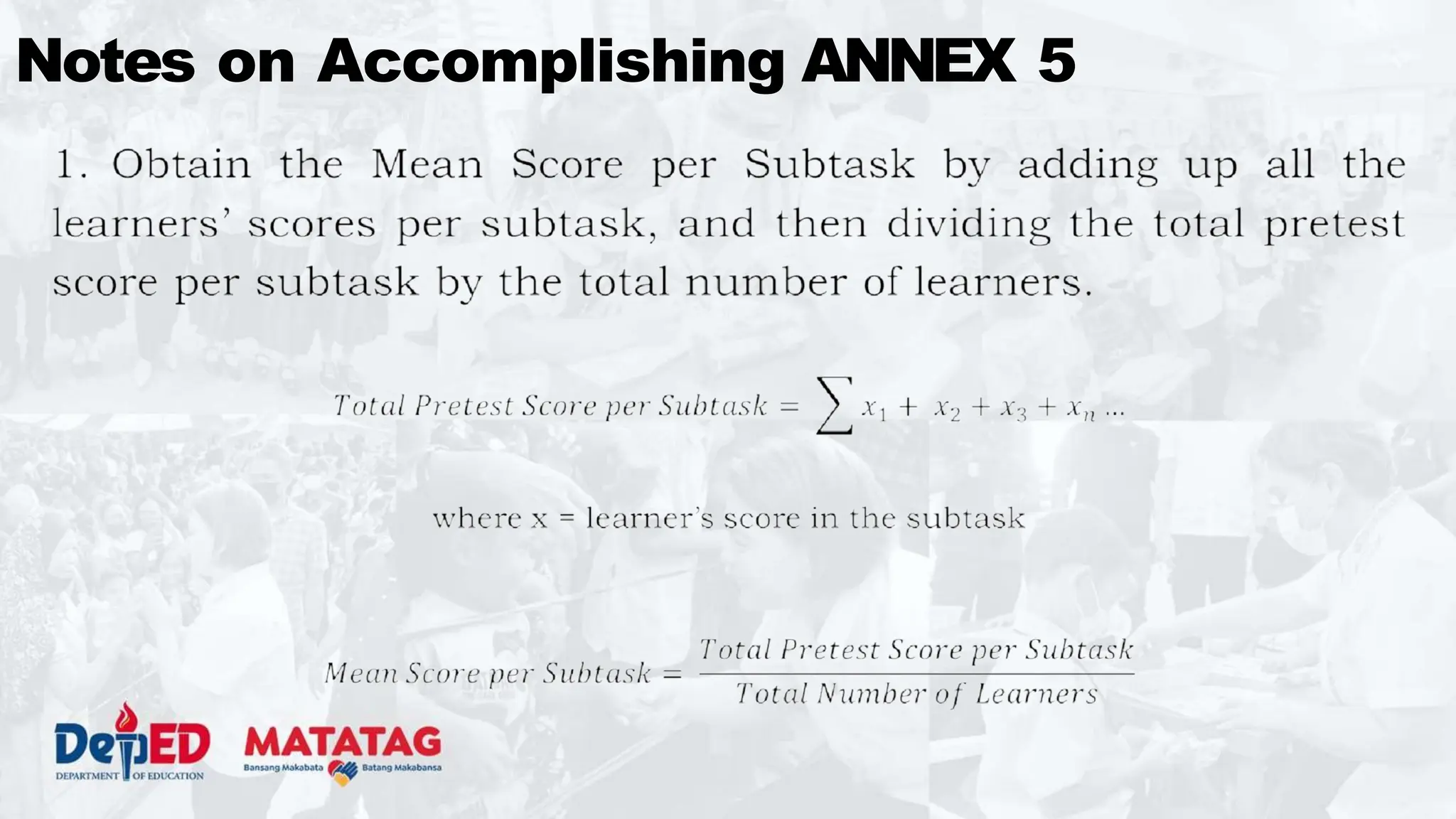
Notes on Accomplishing ANNEX 5
EOSY-NMP Learner’s Profile
https://tinyurl.com/EOSYNMPRegionalReports
Reports for Submission to the
CO

National-Mathematics-Program for Elementary and Secondarypptx

  • 1.
    End-of-School Year National Mathematics Program(EOSY-NMP) for Grades 1 to 3 MARIA ASUNCION H. DONATO MASTER TEACHER I
  • 2.
    Related Issuances a) DepEdOrder No. 13, s. 2023: Adoption of the National Learning Recovery Program in the Department of Education b) DepEd Order No. 14, s. 2023: Policy Guidelines on the Implementation of the National Learning Camp
  • 3.
    DepEd is committed tolearning recovery
  • 4.
    DepEd Order No.13, s. 2023: Adoption of the National Learning Recovery Program in the Department of Education
  • 5.
    DepEd Order No.13, s. 2023: Adoption of the National Learning Recovery Program in the Department of Education
  • 6.
    DepEd Order No.13, s. 2023: Adoption of the National Learning Recovery Program in the Department of Education
  • 7.
    DepEd Order No.13, s. 2023: Adoption of the National Learning Recovery Program in the Department of Education
  • 8.
    DepEd Order No.13, s. 2023: Adoption of the National Learning Recovery Program in the Department of Education
  • 9.
    • Prioritizing onbuilding foundational skills and improving learning outcomes, the End-of- Schoolyear (EOSY) National Mathematics Program (NMP) aims accelerate learning progress on to strategically support and the and mathematical fundamental skills numeracy among key stage 1 learners. National Mathematics Program (NMP)
  • 10.
    National Mathematics Program(NMP) • EOSY-NMP aims to provide intensive, explicit, and learner-centered instruction aligned with the curriculum supported with assessment and learning resources.
  • 11.
    Rapid Mathematics Assessment •The EOSY-NMP begins with a rapid assessment phase for all learners who will voluntarily participate in EOSY-NMP. • RMA refers to the set of carefully crafted assessment tasks aligned with MELC that aim to identify the strengths and recognize the current mathematical knowledge and skills of key stage 1. Implementation Guidelines of EOSY-NMP
  • 12.
    Rapid Mathematics Assessment •This assessment resource package contains a teacher’s booklet, learner’s assessment materials, and scoring sheets that will be used as pre- and post- assessment tools. • This oral assessment will gauge learners' current mathematical abilities based on the Most Essential Learning Competencies (MELC) and identify their strengths and areas that need improvement. Implementation Guidelines of EOSY-NMP
  • 13.
    Rapid Mathematics Assessment •The RMA pre-assessment will be conducted during the first week while the post-assessment will happen on the 5th week. Implementation Guidelines of EOSY-NMP Pre-Assessment: July 31-August 4, 2023 Post-Assessment: August 28- September 1, 2023
  • 14.
    Profiling of Learnersusing the RMA Results: Implementation Guidelines of EOSY-NMP For Enhancement: Correct answers are equal or greater than 85% of the total number of items For Consolidation: Correct answers are 75%-84.99% of the total number of items For Intervention: Correct answers are less than 75% of the total number of items
  • 15.
    National Mathematics Program Pre-andPost Assessment for EOSY Grades 1 to 3
  • 16.
  • 17.
    RMA Demo- Grade3 Sinurigaonon https://drive.google.com/file/d/1MXn1c n9- 4cvF6mZN35Pqc_GJJs2SIctx/view
  • 18.
    Math Learning Experience (MLE) MLE MELCs . Explicitand Active Learning Experienc e Math Foundatio n al Skills Play-based Collaborat i ve Hands-on learning approache s
  • 19.
  • 20.
    Math Learning ExperienceMaterial (MLEM) . set of contextualized teaching and learning materials that contain a teaching plan, academic games, worksheets, stories, and fun math activities target to cater to all types of learners and developed in line with the Concrete Pictorial Abstract (CPA) approach.
  • 21.
    Math Learning ExperienceMaterial (MLEM) . Grade 1 • 18 lessons Grade 2 • 23 lessons Grade 3 • 16 lessons
  • 22.
    Teacher Selection Select teachers whopossess a strong .mathematical inclination and are well- versed in the recommended instructional approaches for delivering math concepts. They should demonstrate mathematical skills a deep understanding of and foundational numeracy.
  • 23.
    Learners Placement To gain valuableinsights into each learner's mathematical abilities, strengths, and areas . that require improvement must be identified based on the results Mathematics Assessment. of the Rapid The assessment results will help teachers to identify individual accordingly, and needs, tailor instruction provide targeted support to enhance mathematical skills and understanding.
  • 24.
    Duration . 5 weeks July 31-September1, 2023 Pre-Assessment: July 31-August 4, 2023 Post-Assessment: August 28- September 1, 2023 Math Learning Experience: August 7-25, 2023 (60-90 minutes focused Math instruction)
  • 26.
    Classroom Delivery . • Fun •Engaging • Collaborative • Interactive • Technology Integration
  • 27.
    Class Size . Maximumof 25 learners
  • 28.
    Assessment and Progress Tracking . DepEd Or derNo. 8, s. 2015 EOSY-NMP is NON- GRADED
  • 29.
    Supplementary Materials .Available learningresources developed and validated in regions, divisions, and schools that are parallel with the scope of MLEM and aligned with the teaching approaches in the MLEM framework may be used by teachers toreinforce their additional references, formative assessments, delivery and serve as and learning tasks.
  • 30.
    Scope of RMAand MLEM
  • 31.
    Grade 1 Most Essential LearningCompetencies CG Code (MELCs) Number Reads and writes numbers up to 100 in symbols • M1NS-If-9.1 Identification a.nd Discrimination and in words • Compares numbers up to 100 using relational • M1NS – no code • symbols and orders them in increasing or decreasing order M1NS-Ib-3 • Identifies the number that is one more or one • M1NS – no code less than a given number • Identifies, reads, and writes ordinal numbers: 1s t , 2nd , 3rd, up to 10th object in a given set from a given point of reference Fractions • Visualizes, represents, and divides a whole into halves and fourths and identifies ½ and ¼ of a whole object • Visualizes and draws the whole region or set given its ½ and/or ¼ • M1NS- no code • M1NS-IIId-75
  • 32.
    Grade 1 . Most Essential LearningCompetencies CG Code (MELCs) Addition • Illustrates addition as “putting together or combining or joining sets” • Visualizes and adds the following numbers using appropriate techniques: a. two 1-digit numbers with sums up to 18 b. three 1-digit numbers c.numbers with sums through 99 without and with regrouping • M1NS-IIa-23 • M1NS – no code Subtraction • Illustrates subtraction as “taking away” or “comparing” elements of sets • Visualizes, represents, and subtracts the following numbers: a) one-digit numbers with minuends through 18 (basic facts) b) one- to two-digit numbers with minuends up to 99 without regrouping c) one- to two-digit numbers with minuends up to 99 with regrouping • M1NS-IIf-24 • M1NS – no code
  • 33.
    Grade 1 . MostEssential Learning Competencies CG Code (MELCs) Geometric Representation • identifies, names, and describes the four basic shapes (square, rectangle, triangle, and circle) in 2- dimensional (flat/plane) and 3- dimensional (solid objects) • M1GE-IIIe-1 • M1GE-IIIe-2 (K-12 Curriculum) • compares and classifies 2- dimensional (flat/plane0 and 3-dimensional (solid) figures according to common attributes
  • 34.
    Grade 1 Task/Item MostEssential Learning Competencies CG Code (MELCs) M.issing Shapes in Patterns • Determines the missing terms using one attribute in a given continuous pattern and in a given repeating pattern • M1AL – no code Time Measurement • Tells the days in a week, months in a year in the right order • Determines the day of the month using a calendar • tells and writes time by the hour, half-hour, and quarter-hour using an analog clock • M1ME-Iva-1 • M1ME-Iva-2 • M1ME-IVb-3
  • 35.
    Grade 1Task/Item Most EssentialLearning Competencies CG Code (MELCs) . Linear • Compares objects using comparative words: • M1ME-IVc-19 Measureme short, shorter, shortest; long, longer, longest; nt heavy, heavier, heaviest; light, lighter, lightest. • M1ME – no code • Estimates and measures length, mass, and capacity using non-standard units of measure Mass Measurement • Compares objects using comparative words: short, shorter, shortest; long, longer, longest; heavy, heavier, heaviest; light, lighter, lightest. • Estimates and measures length, mass, and capacity using non-standard units of measure • M1ME-IVc-19 • M1ME – no code
  • 36.
    Grade 2 . Task Most EssentialLearning Competencies CG Code (MELCs) Number identification ● Gives the place value and finds the value of a digit in three-digit numbers ● Reads and writes numbers up to 1000 in symbols and in words ● Visualizes and writes three-digit numbers in expanded form ● M2NS-Ib-10.2 ● M2NS-Ic-9.2 ● M2NS-Ic-14 Number Discrimination ● Compares numbers using relation symbols and orders numbers up to 1 000 in increasing or decreasing order ● M2NS – no code Missing Number ● Determines missing term/s in a given continuous pattern using two attributes ● Determines the missing terms using one attribute in a given continuous pattern and in a given repeating pattern ● Visualizes and counts numbers by 10s, 50s, 100s ● Compares using relational symbol and arranges in increasing or decreasing order the unit fractions ● M2AL-IIIj-3 ● M1AL – no code ● M2NS-Ib-8.2 ● M2NS – no code
  • 37.
    Grade 2 Task MostEssential Learning Competencies CG Code (MELCs) Addition of Whole Nu.mbers ● Visualizes, represents, and adds the following numbers with sums up to 1000 without and with regrouping: a. 2-digit by 3-digit numbers b. 3-digit by 3-digit numbers ● Solves routine and non-routine problems involving the addition of whole numbers including money with sums up to 1000 using appropriate problem-solving strategies and tools. ● M2NS – no code ● M2NS-Ij-29.2 Subtraction of Whole Numbers ● Visualizes, represents, and subtracts 2- to 3- digit numbers with minuends up to 999 without and with regrouping. ● Solves routine and non-routine problems involving subtraction of whole numbers including money with minuends up to 1000 using appropriate problem- solving strategies and tools. ● M2NS-IIa-32.5 ● M2NS-IIc-34.2
  • 38.
    Grade 2 . Task Most EssentialLearning Competencies CG Code (MELCs) Multiplication of Whole Numbers ● Illustrates and writes a related equation for each type of multiplication: repeated addition, array, counting by multiples, and equal jumps on the number line. ● Illustrates the following properties of multiplication and apply each in a relevant situation: (a) identity, (b) zero, and (c) commutative. ● Visualizes multiplication of numbers 1 to 10 by 2, 3, 4, 5, and 10. ● M2NS – no code ● M2NS – no code ● M2NS-IIh-41.1 Division of Whole Numbers ● Visualizes and represents division, and writes a related equation for each type of situation: equal sharing, repeated subtraction, equal jumps on the number line, and formation of equal groups of objects. ● Visualizes division of numbers up to 100 by 2,3,4,5, and 10 (multiplication table of 2, 3, 4, 5, and 10) ● Solves routine and non-routine problems involving the division of numbers by 2,3,4,5 and 10 and with any of the other operations of whole numbers including money using appropriate problem-solving strategies and tools. ● M2NS – no code ● M2NS-IIIb-51.1 ● M2NS-IIIc-56.1
  • 39.
    Grade 2 Task MostEssential Learning Competencies CG Code (MELCs) Geometric Patterns . ● Visualizes, identifies, classifies, and describes half- circles and quarter circles ● Identifies, names, and describes the four basic shapes (square, rectangle, triangle, and circle) in 2 dimensional and 3-dimensional objects ● Determines missing term/s in a given continuous pattern using two attributes ● Determines the missing terms using one attribute in a given continuous pattern and in a given repeating pattern ● M2GE-IIIg- 5 (K-12 Curriculum) ● M1GE-IIIe-1 ● M2AL-IIIj-3 ● M1AL – no code Geometric Visualization ● Identifies straight lines and curves, flat and curved surfaces in a 3-dimensional object ● M2GE-IIIi-9
  • 40.
    Grade 3 Task MostEssential Learning Competencies CG Code (MELCs) Number Iden. tification ● Identifies odd and even numbers ● M3NS-IIIa-63 Number Discrimination ● Represents, compares, and arranges dissimilar fractions in increasing or decreasing order ● M3NS – no code Missing Number ● Visualizes and represents fractions that are equal to one and greater than one using regions, sets, and number line ● Reads and writes fractions that are equal to one and greater than one in symbols and words ● Determines missing term/s in a given combination of a continuous and repeating pattern ● M3NS - no code ● M3NS-IIIb-76.3 ● M3AL-IIIj-4
  • 41.
    Grade 3 Task MostEssential Learning Competencies CG Code (MELCs) Addition of Whole Numbers ● Adds 3- to 4-digit numbers up to three addends with sums up to 10 000 without and with regrouping ● M3NS-Id-27.6 Subtraction of Whole Numb.ers ● Subtracts 3- to 4-digit numbers from 3- to 4-digit numbers without and with regrouping ● Solves routine and non-routine problems involving subtraction without or with the addition of whole numbers including money using appropriate problem- solving strategies and tools ● M3NS-Ig-32.6 ● M3NS - Ii -34.5 Multiplication Numbers of Whole ● Multiplies numbers: a. 2- to 3-digit numbers by 1-digit numbers without or with regrouping b. 2-digit number by 2-digit numbers with regrouping c. 2- to 3-digit numbers by multiples of 10 and 100 ● Solves routine and non-routine problems involving multiplication without or with addition and subtraction of whole numbers including money using appropriate problem-solving strategies and tools. ● M2NS – no code ● M3NS-IIe-45.3
  • 42.
    Grade 3 Task MostEssential Learning Competencies CG Code (MELCs) Division of Whole Numbers . ● Visualizes division of numbers up to 100 by 6, 7, 8, and 9 (multiplication table of 6, 7, 8, and 9). ● Visualizes and states basic division facts of numbers up to 10. ● Divides numbers without or with the remainder: a. 2- to 3-digit numbers by 1- to 2- digit numbers b. 2- to 3-digit numbers by 10 and 100 ● M3NS-IIg-51.2 ● M3NS-IIg-51.3 ● M3NS - no code Geometric Visualization ● Recognizes and draws a point, line, line segment, and ray ● Recognizes and draws parallel, intersecting, and perpendicular lines ● Visualizes, identifies, and draws congruent line segments ● M3GE-IIIe-11 ● M3GE-IIIf-12.1 ● M3GE-IIIf-13
  • 43.
    School heads supervise the implementationand ensures that the Policy is communicated to stakeholders ROs and SDOs monitor school’s compliance with the Policy and consolidate M&E reports CO utilizes M&E results for policy evaluation MONITORING AND EVALUATION MONITORING AND EVALUATION
  • 50.
  • 51.
    ANNEX 1: Reporton Enrolment No. of Learners Enrolled in EOSY-NMP Schools Division Grade 1 Grade 2 Grade 3 Total M F T M F T M F T M F T . Total
  • 52.
    ANNEX 2: RMAResults (Average) Grade 1 Grade 2 Grade 3 Schools Division Average Pretest Score Average Posttest Score Learning Gains Average Pretest Score Average Posttest Score Learning Gains Average Pretest Score Average Posttest Score Learning Gains SDO1 5 7 2 SDO2 3 7 4 SDO3 7 9 2 Avergae 5 7.67 2.67
  • 53.
  • 54.
    ANNEX 3: (PRETEST)-Determining Least Mastered Skills Total Number of Learners/Enrollees: Task/Item (copy the all the subskills in the scoring sheet) Frequency (number of learners) Percentage of Learners Who Met Expectations Pass Failed Task A: Number Identification and Discrimination 19 A1a. Reading numb A1a. Reading number #1 A1b. Reading number #2 A1c. Reading number #3
  • 55.
  • 56.
    ANNEX 4: (POSTTEST)-Validation of Least Mastered Skills Total Number of Learners/Enrollees: Task/Item (copy the all the subskills in the scoring sheet) Frequency (number of learners) Percentage of Learners Who Met Expectations Pass Failed Task A: Number Identification and Discrimination 19 A1a. Reading numb A1a. Reading number #1 A1b. Reading number #2 A1c. Reading number #3 **
  • 57.
  • 58.
    ANNEX 5: Learning GainsGrade Level: Task/Item (copy the all the subskills in the scoring sheet) Mean Score per Subtask Learning Gains Pretest Posttest Task A: Number Identification and Discrimination 19 A1a. Reading numb (19 pts) A1a. Reading number #1 A1b. Reading number #2 A1c. Reading number #3
  • 59.
  • 60.
  • 61.
  • 62.
  • 63.