Monitoring and Evaluation, Types and different strategies for ME
1.
Measurable aspects ofhealth programs and services can be categorized into several
key dimensions. Here's a breakdown of these aspects and their differentiation:
1. Effectiveness
Definition: Refers to the extent to which a health program achieves its intended
outcomes.
Measurable Indicators: Improvement in health outcomes (e.g., reduction in
disease prevalence), patient satisfaction scores, and achievement of health
goals.
2. Efficiency
Definition: Measures the relationship between the resources used and the
outcomes achieved.
Measurable Indicators: Cost per patient served, resource utilization rates, and
time taken to deliver services.
3. Accessibility
Definition: The ease with which individuals can obtain health services.
Measurable Indicators: Wait times for services, geographic distribution of
services, and the percentage of the population with access to care.
4. Quality
Definition: The degree to which health services meet established standards and
patient expectations.
Measurable Indicators: Adherence to clinical guidelines, error rates, and
patient-reported outcomes.
5. Sustainability
Definition: The capacity of a health program to maintain its operations and
benefits over time.
Measurable Indicators: Funding stability, retention rates of staff, and
continuation of services after initial funding ends.
6. Equity
Definition: The fairness in the distribution of health services and outcomes
across different populations.
2.
Measurable Indicators:Disparities in health outcomes among different
demographic groups, and accessibility of services for marginalized populations.
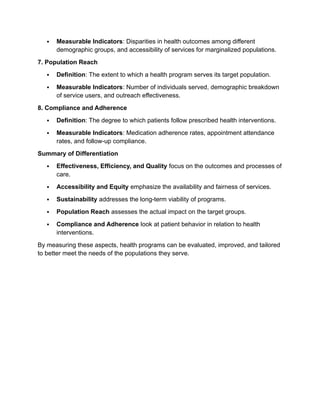
7. Population Reach
Definition: The extent to which a health program serves its target population.
Measurable Indicators: Number of individuals served, demographic breakdown
of service users, and outreach effectiveness.
8. Compliance and Adherence
Definition: The degree to which patients follow prescribed health interventions.
Measurable Indicators: Medication adherence rates, appointment attendance
rates, and follow-up compliance.
Summary of Differentiation
Effectiveness, Efficiency, and Quality focus on the outcomes and processes of
care.
Accessibility and Equity emphasize the availability and fairness of services.
Sustainability addresses the long-term viability of programs.
Population Reach assesses the actual impact on the target groups.
Compliance and Adherence look at patient behavior in relation to health
interventions.
By measuring these aspects, health programs can be evaluated, improved, and tailored
to better meet the needs of the populations they serve.
3.
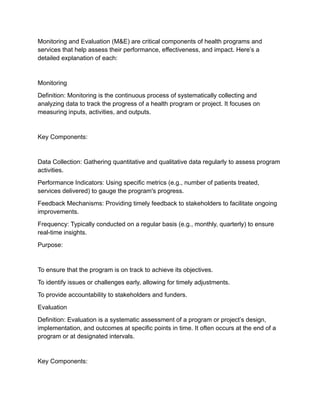
Monitoring and Evaluation(M&E) are critical components of health programs and
services that help assess their performance, effectiveness, and impact. Here’s a
detailed explanation of each:
Monitoring
Definition: Monitoring is the continuous process of systematically collecting and
analyzing data to track the progress of a health program or project. It focuses on
measuring inputs, activities, and outputs.
Key Components:
Data Collection: Gathering quantitative and qualitative data regularly to assess program
activities.
Performance Indicators: Using specific metrics (e.g., number of patients treated,
services delivered) to gauge the program's progress.
Feedback Mechanisms: Providing timely feedback to stakeholders to facilitate ongoing
improvements.
Frequency: Typically conducted on a regular basis (e.g., monthly, quarterly) to ensure
real-time insights.
Purpose:
To ensure that the program is on track to achieve its objectives.
To identify issues or challenges early, allowing for timely adjustments.
To provide accountability to stakeholders and funders.
Evaluation
Definition: Evaluation is a systematic assessment of a program or project’s design,
implementation, and outcomes at specific points in time. It often occurs at the end of a
program or at designated intervals.
Key Components:
4.
Types of Evaluation:
FormativeEvaluation: Conducted during program development to improve the design
and implementation.
Summative Evaluation: Conducted after program completion to assess its overall
effectiveness and impact.
Methods: Utilizing various methodologies, such as surveys, interviews, focus groups,
and statistical analysis to gather data.
Impact Assessment: Determining the extent to which a program has achieved its
intended outcomes and any unintended consequences.
Purpose:
To assess the overall effectiveness of a program in achieving its goals.
To determine the program's impact on the target population and community.
To provide insights for future program design and policy decisions.
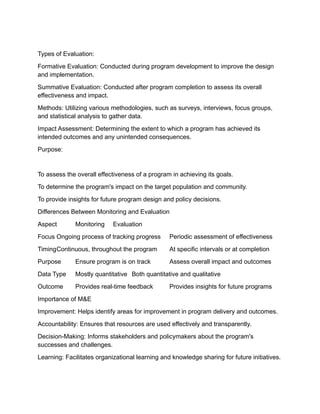
Differences Between Monitoring and Evaluation
Aspect Monitoring Evaluation
Focus Ongoing process of tracking progress Periodic assessment of effectiveness
TimingContinuous, throughout the program At specific intervals or at completion
Purpose Ensure program is on track Assess overall impact and outcomes
Data Type Mostly quantitative Both quantitative and qualitative
Outcome Provides real-time feedback Provides insights for future programs
Importance of M&E
Improvement: Helps identify areas for improvement in program delivery and outcomes.
Accountability: Ensures that resources are used effectively and transparently.
Decision-Making: Informs stakeholders and policymakers about the program's
successes and challenges.
Learning: Facilitates organizational learning and knowledge sharing for future initiatives.
5.
In summary, Monitoringand Evaluation are essential for ensuring that health programs
are effective, efficient, and responsive to the needs of the populations they serve.
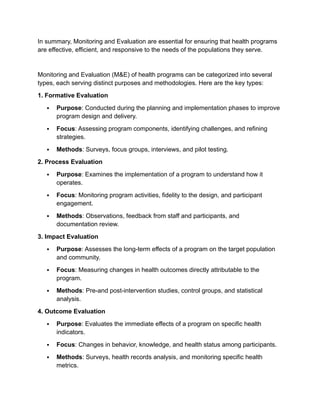
Monitoring and Evaluation (M&E) of health programs can be categorized into several
types, each serving distinct purposes and methodologies. Here are the key types:
1. Formative Evaluation
Purpose: Conducted during the planning and implementation phases to improve
program design and delivery.
Focus: Assessing program components, identifying challenges, and refining
strategies.
Methods: Surveys, focus groups, interviews, and pilot testing.
2. Process Evaluation
Purpose: Examines the implementation of a program to understand how it
operates.
Focus: Monitoring program activities, fidelity to the design, and participant
engagement.
Methods: Observations, feedback from staff and participants, and
documentation review.
3. Impact Evaluation
Purpose: Assesses the long-term effects of a program on the target population
and community.
Focus: Measuring changes in health outcomes directly attributable to the
program.
Methods: Pre-and post-intervention studies, control groups, and statistical
analysis.
4. Outcome Evaluation
Purpose: Evaluates the immediate effects of a program on specific health
indicators.
Focus: Changes in behavior, knowledge, and health status among participants.
Methods: Surveys, health records analysis, and monitoring specific health
metrics.
6.
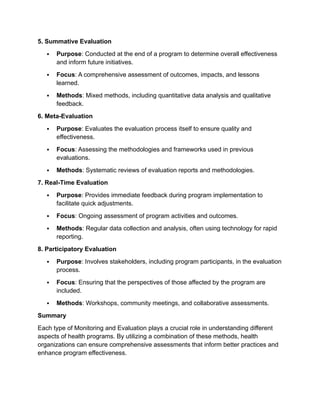
5. Summative Evaluation
Purpose: Conducted at the end of a program to determine overall effectiveness
and inform future initiatives.
Focus: A comprehensive assessment of outcomes, impacts, and lessons
learned.
Methods: Mixed methods, including quantitative data analysis and qualitative
feedback.
6. Meta-Evaluation
Purpose: Evaluates the evaluation process itself to ensure quality and
effectiveness.
Focus: Assessing the methodologies and frameworks used in previous
evaluations.
Methods: Systematic reviews of evaluation reports and methodologies.
7. Real-Time Evaluation
Purpose: Provides immediate feedback during program implementation to
facilitate quick adjustments.
Focus: Ongoing assessment of program activities and outcomes.
Methods: Regular data collection and analysis, often using technology for rapid
reporting.
8. Participatory Evaluation
Purpose: Involves stakeholders, including program participants, in the evaluation
process.
Focus: Ensuring that the perspectives of those affected by the program are
included.
Methods: Workshops, community meetings, and collaborative assessments.
Summary
Each type of Monitoring and Evaluation plays a crucial role in understanding different
aspects of health programs. By utilizing a combination of these methods, health
organizations can ensure comprehensive assessments that inform better practices and
enhance program effectiveness.
7.
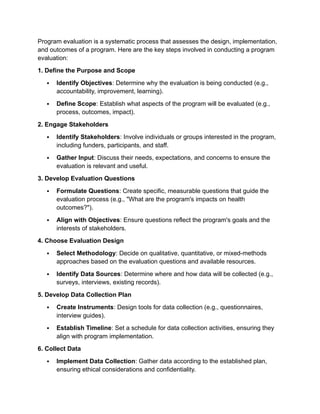
Program evaluation isa systematic process that assesses the design, implementation,
and outcomes of a program. Here are the key steps involved in conducting a program
evaluation:
1. Define the Purpose and Scope
Identify Objectives: Determine why the evaluation is being conducted (e.g.,
accountability, improvement, learning).
Define Scope: Establish what aspects of the program will be evaluated (e.g.,
process, outcomes, impact).
2. Engage Stakeholders
Identify Stakeholders: Involve individuals or groups interested in the program,
including funders, participants, and staff.
Gather Input: Discuss their needs, expectations, and concerns to ensure the
evaluation is relevant and useful.
3. Develop Evaluation Questions
Formulate Questions: Create specific, measurable questions that guide the
evaluation process (e.g., "What are the program's impacts on health
outcomes?").
Align with Objectives: Ensure questions reflect the program's goals and the
interests of stakeholders.
4. Choose Evaluation Design
Select Methodology: Decide on qualitative, quantitative, or mixed-methods
approaches based on the evaluation questions and available resources.
Identify Data Sources: Determine where and how data will be collected (e.g.,
surveys, interviews, existing records).
5. Develop Data Collection Plan
Create Instruments: Design tools for data collection (e.g., questionnaires,
interview guides).
Establish Timeline: Set a schedule for data collection activities, ensuring they
align with program implementation.
6. Collect Data
Implement Data Collection: Gather data according to the established plan,
ensuring ethical considerations and confidentiality.
8.
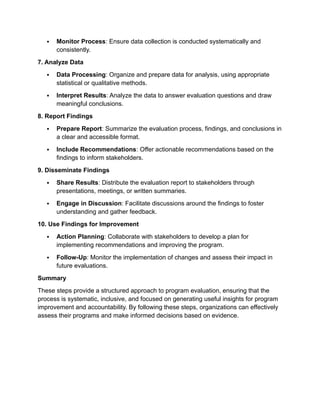
Monitor Process:Ensure data collection is conducted systematically and
consistently.
7. Analyze Data
Data Processing: Organize and prepare data for analysis, using appropriate
statistical or qualitative methods.
Interpret Results: Analyze the data to answer evaluation questions and draw
meaningful conclusions.
8. Report Findings
Prepare Report: Summarize the evaluation process, findings, and conclusions in
a clear and accessible format.
Include Recommendations: Offer actionable recommendations based on the
findings to inform stakeholders.
9. Disseminate Findings
Share Results: Distribute the evaluation report to stakeholders through
presentations, meetings, or written summaries.
Engage in Discussion: Facilitate discussions around the findings to foster
understanding and gather feedback.
10. Use Findings for Improvement
Action Planning: Collaborate with stakeholders to develop a plan for
implementing recommendations and improving the program.
Follow-Up: Monitor the implementation of changes and assess their impact in
future evaluations.
Summary
These steps provide a structured approach to program evaluation, ensuring that the
process is systematic, inclusive, and focused on generating useful insights for program
improvement and accountability. By following these steps, organizations can effectively
assess their programs and make informed decisions based on evidence.
9.
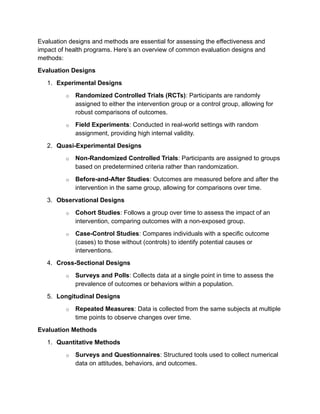
Evaluation designs andmethods are essential for assessing the effectiveness and
impact of health programs. Here’s an overview of common evaluation designs and
methods:
Evaluation Designs
1. Experimental Designs
o Randomized Controlled Trials (RCTs): Participants are randomly
assigned to either the intervention group or a control group, allowing for
robust comparisons of outcomes.
o Field Experiments: Conducted in real-world settings with random
assignment, providing high internal validity.
2. Quasi-Experimental Designs
o Non-Randomized Controlled Trials: Participants are assigned to groups
based on predetermined criteria rather than randomization.
o Before-and-After Studies: Outcomes are measured before and after the
intervention in the same group, allowing for comparisons over time.
3. Observational Designs
o Cohort Studies: Follows a group over time to assess the impact of an
intervention, comparing outcomes with a non-exposed group.
o Case-Control Studies: Compares individuals with a specific outcome
(cases) to those without (controls) to identify potential causes or
interventions.
4. Cross-Sectional Designs
o Surveys and Polls: Collects data at a single point in time to assess the
prevalence of outcomes or behaviors within a population.
5. Longitudinal Designs
o Repeated Measures: Data is collected from the same subjects at multiple
time points to observe changes over time.
Evaluation Methods
1. Quantitative Methods
o Surveys and Questionnaires: Structured tools used to collect numerical
data on attitudes, behaviors, and outcomes.
10.
o Statistical Analysis:Utilizing software to analyze data, including
descriptive and inferential statistics to identify trends and relationships.
2. Qualitative Methods
o Interviews: In-depth conversations with participants to gather detailed
insights into their experiences and perceptions.
o Focus Groups: Group discussions that explore participants' views and
attitudes regarding a program or issue.
o Observations: Directly watching program implementation to gather
contextual information and participant interactions.
3. Mixed Methods
o Combination of Qualitative and Quantitative: Integrating both types of
data to provide a comprehensive understanding of the program’s impact
and context.
4. Secondary Data Analysis
o Utilizing Existing Data: Analyzing data collected for other purposes (e.g.,
health records, national surveys) to evaluate program outcomes.
5. Case Studies
o In-Depth Examination: Detailed exploration of a single program or case
to understand its complexity and contextual factors.
Summary
Choosing the appropriate evaluation design and method depends on the program's
objectives, available resources, and the nature of the intervention. By employing a
combination of these designs and methods, evaluators can obtain a more
comprehensive understanding of the program's effectiveness and impact.
11.
The Monitoring andEvaluation (M&E) system in the Ethiopian health sector is designed
to assess the performance and impact of health programs and services. Here are key
distinctions regarding this system:
1. Framework and Structure
Ethiopian Health Sector M&E Framework: The M&E system is integrated into
the broader health policy framework, focusing on achieving national health goals,
such as universal health coverage and the Sustainable Development Goals
(SDGs).
Hierarchy of Data Collection: The system operates at various levels (national,
regional, and local), with clear guidelines on data flow and reporting.
2. Data Sources
Health Management Information System (HMIS): A primary data source that
collects routine health service delivery information, including patient records,
treatment outcomes, and service utilization.
Surveys and Assessments: Periodic surveys (e.g., Demographic and Health
Surveys, Health Facility Assessments) are conducted to gather data on health
indicators and population health status.
3. Indicators and Metrics
Standardized Indicators: The M&E system utilizes standardized health
indicators aligned with national priorities, such as maternal and child health,
infectious diseases, and nutrition.
Disaggregation: Data is often disaggregated by gender, age, and geographic
location to identify disparities and target interventions effectively.
4. Stakeholder Engagement
Multisectoral Collaboration: The Ethiopian M&E system emphasizes
collaboration among government sectors, NGOs, and international partners to
enhance data quality and use.
Community Involvement: Local communities are engaged in the data collection
process and in evaluating health service delivery, fostering ownership and
accountability.
5. Capacity Building
12.
Training Programs:Continuous training and capacity-building initiatives are
implemented to enhance the skills of health workers and data managers in M&E
practices.
Technical Support: Support is provided to regions and districts to improve data
collection, analysis, and reporting processes.
6. Use of Technology
Digital Health Tools: The Ethiopian health sector increasingly utilizes digital
tools for data collection, reporting, and analysis, such as mobile health
applications and electronic health records.
Data Dashboards: Visualization tools and dashboards are used to present M&E
data, making it more accessible for decision-makers.
7. Reporting and Feedback Mechanisms
Regular Reporting: Health facilities report data regularly to district health offices,
which consolidate the information for regional and national reports.
Feedback Loops: The system emphasizes feedback mechanisms to ensure that
data collected is used to inform program adjustments and policy decisions.
Summary
The M&E system in the Ethiopian health sector is characterized by its structured
framework, reliance on standardized indicators, stakeholder collaboration, and a focus
on capacity building and technology integration. This system aims to improve health
outcomes and enhance the efficiency and effectiveness of health services across the
country.




![Evaluation[1].pdf from planning and evaluation PHD](https://cdn.slidesharecdn.com/ss_thumbnails/evaluation1-251009132927-a22029fb-thumbnail.jpg?width=640&height=640&fit=bounds)


