Philippine Culture,
Tourism & Geography
National Capital Region
By: Prof. Mary Kristine Laurilla, MBA
LEARNING OBJECTIVES
• Identify the location of
the provinces where
tourist attractions are
located on the
Philippine map.
• Identify the major
gateways or entry points
into different
provinces.
• Understand the political
structures, cultural,
historical, religious,
GEOGRAPHICAL LOCATION
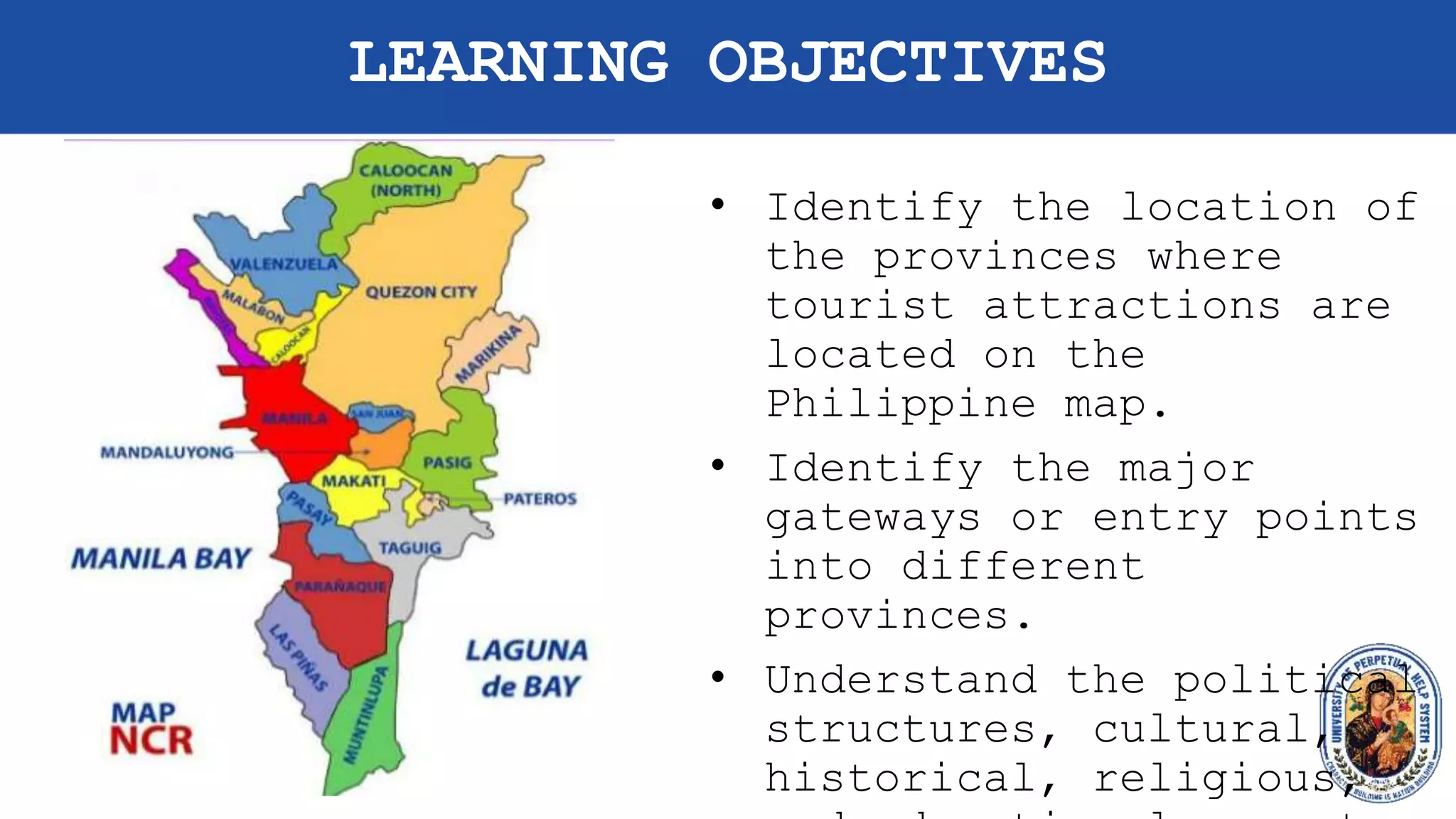
The National Capital
Region or NCR is the
center of Luzon and the
capital region of the
Philippines. The
Cordillera Mountains
form its boundary on the
east, Laguna de Bay on
the southeast, Central
Luzon on the north and
Southern Tagalog region
on the south.
It is composed of
the cities of:
1. Manila
2. Kalookan
3. Las Pinas
4. Makati
5. Mandaluyong
6. Marikina
7. Paranaque
8. Muntinlupa
9. Pasay
10.Pasig
11.Quezon City
GEOGRAPHICAL LOCATION
Pending ratification
for city hood through
plebiscites by their
respective residents
are the municipalities
of:
1. Taguig
2. Valenzuela
3. Novaliches in
Quezon City
4. Navotas
5. Malabon
6. Pateros
GEOGRAPHICAL LOCATION
Its total land area of 636,100 square
kilometers includes residential, industrial,
institutional, and agricultural areas and an
unclassified public forest. Metro Manila is
divided into 6 (six) zones:
1. Manila Bay
2. Coastal Margin
3. Laguna de Bay
4. Guadalupe Plateau
5. Marikina Valley
6. Laguna Lowland
POPULATION
In the year 2000, the region’s population was
10,492,000 which increases to more than 13
million during the daytime due to a large
workforce residing in the areas adjoining the
metropolis but working in the City.
CULTURAL GROUPS
Metro Manila is composed of almost all the
cultural groups of the Philippines. The
principal language used is Tagalog with
English as the secondary language.
CLIMATE
The dry season
is from November
to May and the
rainy season is
from June to
October.
April and May
are normally its
warmest months.
FACILITIES
The metropolis has one of the first-class
harbors in Asia. The Manila bay opens out
into the South China Sea and is a gateway to
Asia.
Metro Manila is considered the country’s
premier business region with adequate
facilities and services in transportation,
housing, and commercial infrastructure,
communications, power supply, and
recreational facilities. It has world-class
malls and commercial centers.
FACILITIES
It has excellent seaport facilities and an
international airport supplemented by the
seaports of international standards in
Batangas City and Subic Bay, Olongapo, and by
the Clark International Airport in Angeles
City. The government has envisioned an
integrated road network and mass-based rail
transport system within the metropolis.
Makati City is the premier business and
financial district, although other areas are
being developed such as the Ortigas Center in
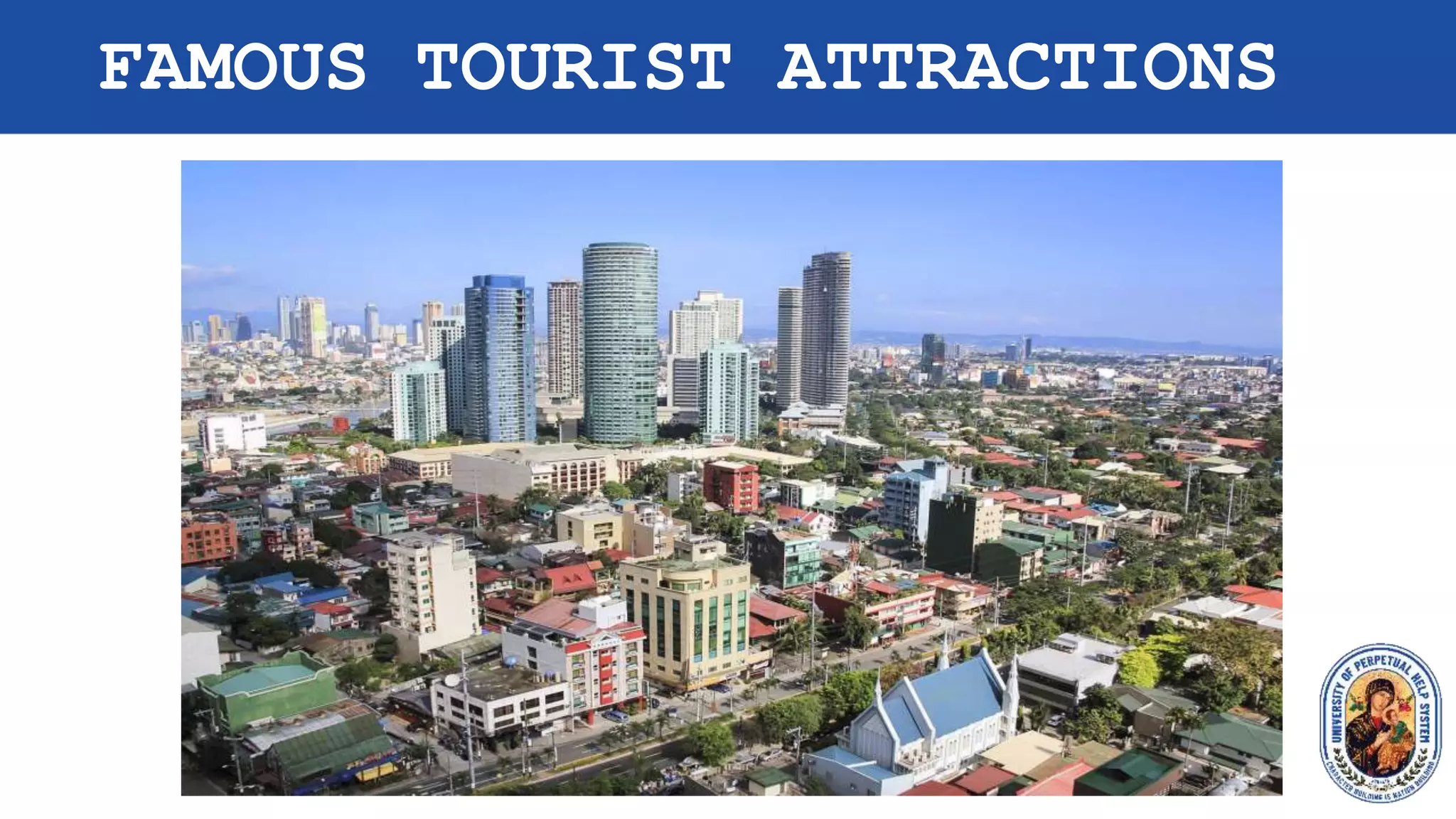
FAMOUS TOURIST ATTRACTIONS
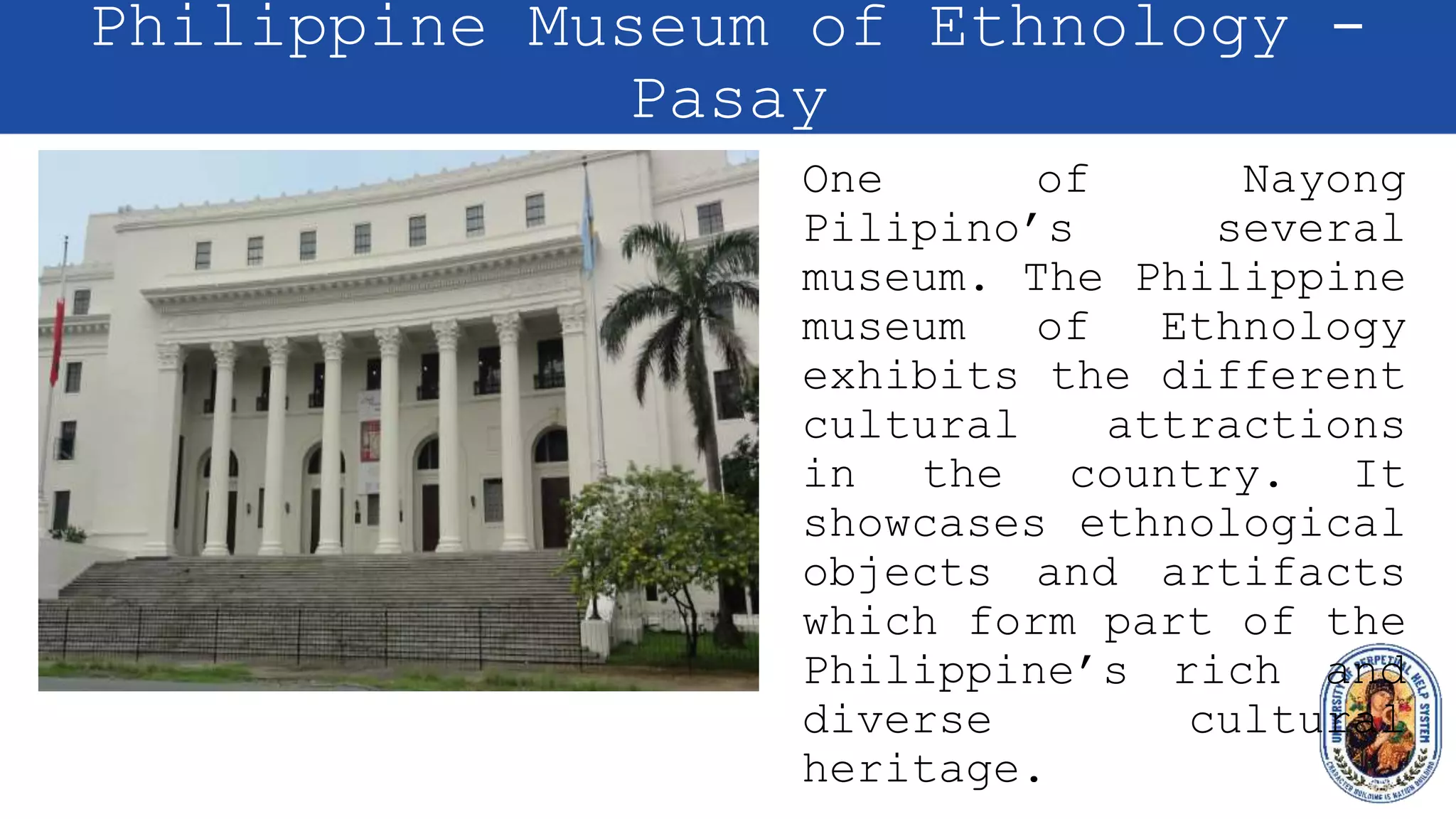
Philippine Museum of Ethnology -
Pasay
One of Nayong
Pilipino’s several
museum. The Philippine
museum of Ethnology
exhibits the different
cultural attractions
in the country. It
showcases ethnological
objects and artifacts
which form part of the
Philippine’s rich and
diverse cultural
heritage.
Cultural Center of the Philippines
- Pasay
Built to symbolize the
country’s national
cultural development,
the CCP is an
institution mandated by
Philippine laws to
preserve and enhance the
Filipino people’s
cultural heritage. Built
on reclaimed land in
Manila Bay, the CCP was
designed by leading
Filipino architect
Leandro Locsin. It
houses the main theater,
little theater, and
Folk Arts Theater - Pasay
The theater was built in
90 days and was designed
by Leandro V. Locsin in
1974. The building was
officially authorized by
First Lady Imelda Marcos
for the Miss Universe
Beauty Pageant in 1974,
which was to be held in
Manila in the same year.
The theater, named after
Filipino poet Francisco
Balagtas, has a seating
capacity of 8,458 in 10
sections and features a
broad fascia with a
Coconut Palace
The Coconut
Palace showcases
Filipino artistry
in the use of
coconut tree.
Over 70% of the
structure is made
from different
parts of the
coconut tree. The
Palace consists
of 7 suites with
each unit
Makati Shangri-la Manila
Is a 5-star hotel
located in Makati
City, Philippines and
one of the three
hotels managed by
Shangri-la Hotels and
Resorts located in
Metro Manila,
Philippines. It is
also the largest
Shangri-la hotel in
terms of room number
with 699 guest rooms
New World Hotel – Makati City
A luxurious 4-star
property set in a
prime location in
the centre of
Manila. Located in
the financial and
commercial hub of
Manila, nearby the
fashionable
Glorietta and
Greenbelt Lifestyle
shopping complexes,
the hotel is a
Philippine Army Museum – Taguig
City
It is a repository
of antique guns,
cannons, tanks,
and other relics
of WWII as well as
captured
paraphernalia,
ammunition, and
weapons of the New
People’s Army
(NPA). A special
feature is a
tunnel with
Museo ng Makati
Primarily a
municipal museum,
it is the
reservoir of the
artifacts,
treasures, and
relics of the
town’s glorious
past. It is also
a venue for
various exhibits
showcasing the
Ayala Museum
The museum is a unique
show window of
Philippine History and
Culture. It features 60
dioramas (tri-
dimensional portraits)
depicting significant
events of Philippine
history and scaled-down
reproductions of native
boats and foreign
ships.
Thomas Jefferson Cultural Center –
Makati City
Established in 1945,
this library provides
accurate, up-to-date,
and comprehensive
information about the
United States. It is a
place where lecturers
and seminars are held.
Film screenings and
videotape recordings
are done here as well.
It is likewise a venue
for visiting
Makati Park and Garden
Considered the city’s
main garden park, it has
well-lighted park walks
around fully landscaped
gardens, a man-made
lagoon and waterfalls, a
gazebo and ornamental
islet lighted fence,
adjoining park spaces,
and an amphitheater for
cultural shows like the
performing arts of
ballet, folk dances,
Dambanang Kawayan – Taguig City
A century old church
with altar, wall
sidings, ceiling and
benches that are made of
pure, native bamboo.
This symbol of Filipino
design and artistry
stood in history as the
site where over 500 men
were gathered and
brutalized during the
tragic “sons” of
December 1, 1944
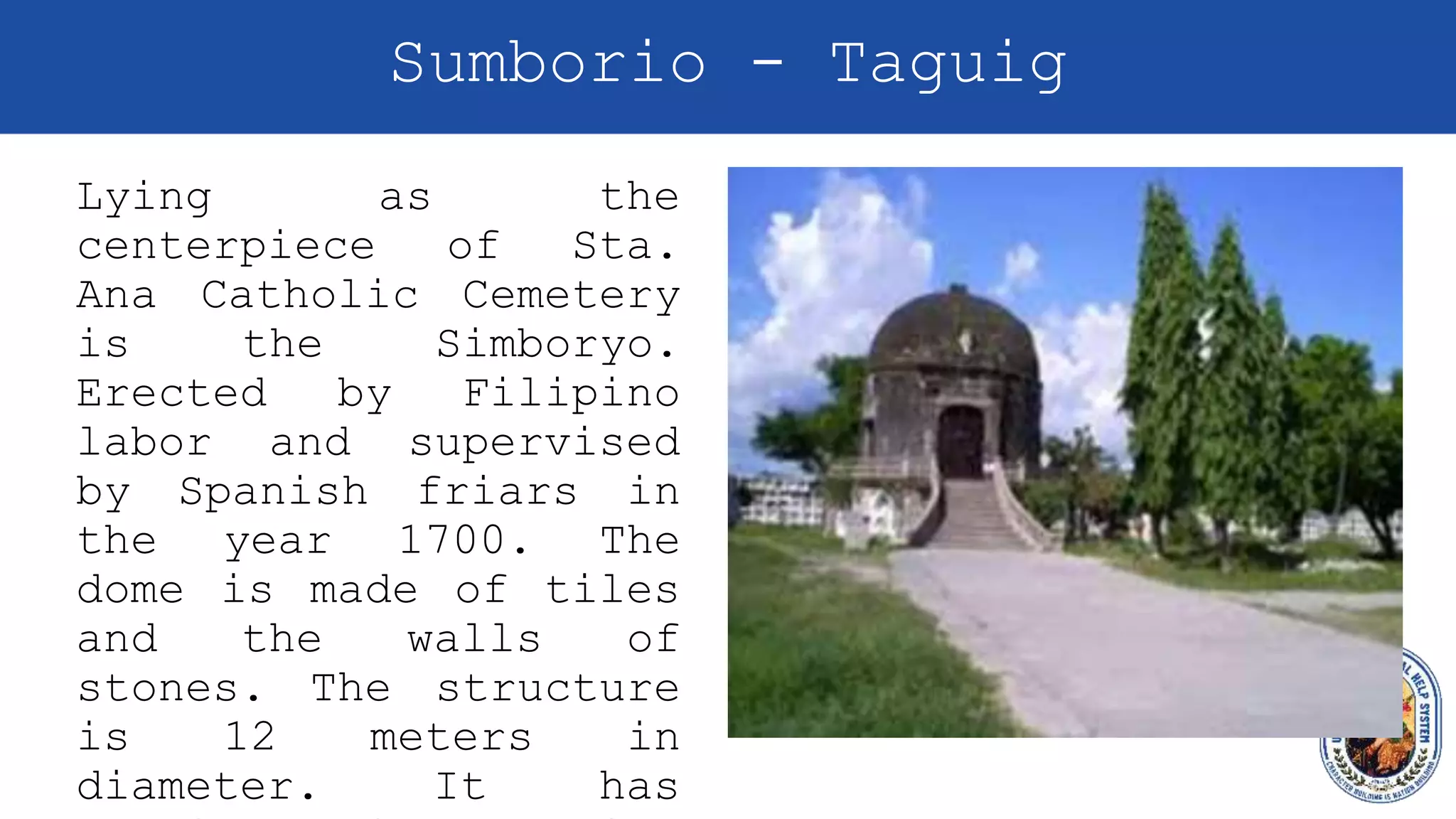
Sumborio - Taguig
Lying as the
centerpiece of Sta.
Ana Catholic Cemetery
is the Simboryo.
Erected by Filipino
labor and supervised
by Spanish friars in
the year 1700. The
dome is made of tiles
and the walls of
stones. The structure
is 12 meters in
diameter. It has
The Blue Mosque – Taguig City
This religious center,
designed by renowned
architect Angel Nakpil,
is also a socio-civic
meeting place for both
Filipino and foreign
Muslims. It houses a
conference room, three
madrasa classrooms, a
library, clinic, a
secretariat and Imam’s
office. The geometrical
design of this building
The Bantayog ng mga Bayani ng Tipas
– Taguig City
This is an
endearing monument
in memory of
hundreds of men
from Tipas who were
captured, brought
to, and killed by
the Japanese in the
prison cells in
Intramuros, Manila.
Names of the
victims are carved
on the statue.
DOST Mini Forest and Eco Park –
Taguig City
Located within
the National
headquarters
and office of
the Secretary
of the
Department of
Science and
Technology,
this mini
forest is
suitable for
camping and
Libingan ng mga Bayani – Taguig
City
The memorial ground of
33,520 Filipino
soldiers who were
killed in Bataan,
Corregidor, and on
other battlefields
throughout the
Philippines during the
latest World War. It
lies side by side with
the American War
Memorial. War widows
and orphans come here
Church of the Immaculate Conception
– Pasig City
The parish was
established on 30 March
1575, in a tri-annual
meeting held in Manila.
The Philippine province
of the most Holy Name of
Jesus of the order of
Saint Agustine accepted
the convent of Pasig
under the title
“Conventus Visitationis
Maria de Pasi”. During
this meeting, the
Bahay na Tisa – Pasig City
For more than 150
years, the Bahay na
Tisa in Pasig City
has literally
withstood the test
of time – from two
world wars to
hundreds of natural
disasters.
SM Megamall – Ortigas City
Asia’s
largest,
with over
400 shops.
Our Lady of EDSA Shrine
Known as the
Shrine of Mary,
Queen of Peace
(Our Lady of
EDSA). It is
dedicated to our
lady who has
miraculously
interceded to
oust the
dictatorship in
a peaceful and
bloodless
San Felipe Neri Church –
Mandaluyong City
One of the oldest
churches in the
metropolis. It was
run by hostile
Spanish friars. For
sometime, it was the
site of bloody
encounters between
Filipino
revolutionaries and
Spanish soldiers.
Its façade has a
Camp Crame – San Juan City
San Juan is home to Camp Crame, the
headquarters of the Philippine National
Police.
REFERENCES
Department of Tourism. (2018). Tourism Guidebook and
Manual.
Retrieved from
http://www.tourism.gov.ph/Guidebook_Manual/TourismGuideboo
k.pdf
So, P. L. (2018). Philippine Tourist Destinations. Manila,
Philippines: Accumicro I.T. Solutions.
Domingo, B. B. (2017). Philippine Tourism. Foreign Service
Institute.
Libosada, C. M. (2017). Domestic Tourism. Pasig City,

National Capital Region.pptx

  • 1.
    Philippine Culture, Tourism &Geography National Capital Region By: Prof. Mary Kristine Laurilla, MBA
  • 2.
    LEARNING OBJECTIVES • Identifythe location of the provinces where tourist attractions are located on the Philippine map. • Identify the major gateways or entry points into different provinces. • Understand the political structures, cultural, historical, religious,
  • 3.
    GEOGRAPHICAL LOCATION The NationalCapital Region or NCR is the center of Luzon and the capital region of the Philippines. The Cordillera Mountains form its boundary on the east, Laguna de Bay on the southeast, Central Luzon on the north and Southern Tagalog region on the south.
  • 4.
    It is composedof the cities of: 1. Manila 2. Kalookan 3. Las Pinas 4. Makati 5. Mandaluyong 6. Marikina 7. Paranaque 8. Muntinlupa 9. Pasay 10.Pasig 11.Quezon City GEOGRAPHICAL LOCATION Pending ratification for city hood through plebiscites by their respective residents are the municipalities of: 1. Taguig 2. Valenzuela 3. Novaliches in Quezon City 4. Navotas 5. Malabon 6. Pateros
  • 5.
    GEOGRAPHICAL LOCATION Its totalland area of 636,100 square kilometers includes residential, industrial, institutional, and agricultural areas and an unclassified public forest. Metro Manila is divided into 6 (six) zones: 1. Manila Bay 2. Coastal Margin 3. Laguna de Bay 4. Guadalupe Plateau 5. Marikina Valley 6. Laguna Lowland
  • 6.
    POPULATION In the year2000, the region’s population was 10,492,000 which increases to more than 13 million during the daytime due to a large workforce residing in the areas adjoining the metropolis but working in the City.
  • 7.
    CULTURAL GROUPS Metro Manilais composed of almost all the cultural groups of the Philippines. The principal language used is Tagalog with English as the secondary language.
  • 8.
    CLIMATE The dry season isfrom November to May and the rainy season is from June to October. April and May are normally its warmest months.
  • 9.
    FACILITIES The metropolis hasone of the first-class harbors in Asia. The Manila bay opens out into the South China Sea and is a gateway to Asia. Metro Manila is considered the country’s premier business region with adequate facilities and services in transportation, housing, and commercial infrastructure, communications, power supply, and recreational facilities. It has world-class malls and commercial centers.
  • 10.
    FACILITIES It has excellentseaport facilities and an international airport supplemented by the seaports of international standards in Batangas City and Subic Bay, Olongapo, and by the Clark International Airport in Angeles City. The government has envisioned an integrated road network and mass-based rail transport system within the metropolis. Makati City is the premier business and financial district, although other areas are being developed such as the Ortigas Center in
  • 11.
  • 12.
    Philippine Museum ofEthnology - Pasay One of Nayong Pilipino’s several museum. The Philippine museum of Ethnology exhibits the different cultural attractions in the country. It showcases ethnological objects and artifacts which form part of the Philippine’s rich and diverse cultural heritage.
  • 13.
    Cultural Center ofthe Philippines - Pasay Built to symbolize the country’s national cultural development, the CCP is an institution mandated by Philippine laws to preserve and enhance the Filipino people’s cultural heritage. Built on reclaimed land in Manila Bay, the CCP was designed by leading Filipino architect Leandro Locsin. It houses the main theater, little theater, and
  • 14.
    Folk Arts Theater- Pasay The theater was built in 90 days and was designed by Leandro V. Locsin in 1974. The building was officially authorized by First Lady Imelda Marcos for the Miss Universe Beauty Pageant in 1974, which was to be held in Manila in the same year. The theater, named after Filipino poet Francisco Balagtas, has a seating capacity of 8,458 in 10 sections and features a broad fascia with a
  • 15.
    Coconut Palace The Coconut Palaceshowcases Filipino artistry in the use of coconut tree. Over 70% of the structure is made from different parts of the coconut tree. The Palace consists of 7 suites with each unit
  • 16.
    Makati Shangri-la Manila Isa 5-star hotel located in Makati City, Philippines and one of the three hotels managed by Shangri-la Hotels and Resorts located in Metro Manila, Philippines. It is also the largest Shangri-la hotel in terms of room number with 699 guest rooms
  • 17.
    New World Hotel– Makati City A luxurious 4-star property set in a prime location in the centre of Manila. Located in the financial and commercial hub of Manila, nearby the fashionable Glorietta and Greenbelt Lifestyle shopping complexes, the hotel is a
  • 18.
    Philippine Army Museum– Taguig City It is a repository of antique guns, cannons, tanks, and other relics of WWII as well as captured paraphernalia, ammunition, and weapons of the New People’s Army (NPA). A special feature is a tunnel with
  • 19.
    Museo ng Makati Primarilya municipal museum, it is the reservoir of the artifacts, treasures, and relics of the town’s glorious past. It is also a venue for various exhibits showcasing the
  • 20.
    Ayala Museum The museumis a unique show window of Philippine History and Culture. It features 60 dioramas (tri- dimensional portraits) depicting significant events of Philippine history and scaled-down reproductions of native boats and foreign ships.
  • 21.
    Thomas Jefferson CulturalCenter – Makati City Established in 1945, this library provides accurate, up-to-date, and comprehensive information about the United States. It is a place where lecturers and seminars are held. Film screenings and videotape recordings are done here as well. It is likewise a venue for visiting
  • 22.
    Makati Park andGarden Considered the city’s main garden park, it has well-lighted park walks around fully landscaped gardens, a man-made lagoon and waterfalls, a gazebo and ornamental islet lighted fence, adjoining park spaces, and an amphitheater for cultural shows like the performing arts of ballet, folk dances,
  • 23.
    Dambanang Kawayan –Taguig City A century old church with altar, wall sidings, ceiling and benches that are made of pure, native bamboo. This symbol of Filipino design and artistry stood in history as the site where over 500 men were gathered and brutalized during the tragic “sons” of December 1, 1944
  • 24.
    Sumborio - Taguig Lyingas the centerpiece of Sta. Ana Catholic Cemetery is the Simboryo. Erected by Filipino labor and supervised by Spanish friars in the year 1700. The dome is made of tiles and the walls of stones. The structure is 12 meters in diameter. It has
  • 25.
    The Blue Mosque– Taguig City This religious center, designed by renowned architect Angel Nakpil, is also a socio-civic meeting place for both Filipino and foreign Muslims. It houses a conference room, three madrasa classrooms, a library, clinic, a secretariat and Imam’s office. The geometrical design of this building
  • 26.
    The Bantayog ngmga Bayani ng Tipas – Taguig City This is an endearing monument in memory of hundreds of men from Tipas who were captured, brought to, and killed by the Japanese in the prison cells in Intramuros, Manila. Names of the victims are carved on the statue.
  • 27.
    DOST Mini Forestand Eco Park – Taguig City Located within the National headquarters and office of the Secretary of the Department of Science and Technology, this mini forest is suitable for camping and
  • 28.
    Libingan ng mgaBayani – Taguig City The memorial ground of 33,520 Filipino soldiers who were killed in Bataan, Corregidor, and on other battlefields throughout the Philippines during the latest World War. It lies side by side with the American War Memorial. War widows and orphans come here
  • 29.
    Church of theImmaculate Conception – Pasig City The parish was established on 30 March 1575, in a tri-annual meeting held in Manila. The Philippine province of the most Holy Name of Jesus of the order of Saint Agustine accepted the convent of Pasig under the title “Conventus Visitationis Maria de Pasi”. During this meeting, the
  • 30.
    Bahay na Tisa– Pasig City For more than 150 years, the Bahay na Tisa in Pasig City has literally withstood the test of time – from two world wars to hundreds of natural disasters.
  • 31.
    SM Megamall –Ortigas City Asia’s largest, with over 400 shops.
  • 32.
    Our Lady ofEDSA Shrine Known as the Shrine of Mary, Queen of Peace (Our Lady of EDSA). It is dedicated to our lady who has miraculously interceded to oust the dictatorship in a peaceful and bloodless
  • 33.
    San Felipe NeriChurch – Mandaluyong City One of the oldest churches in the metropolis. It was run by hostile Spanish friars. For sometime, it was the site of bloody encounters between Filipino revolutionaries and Spanish soldiers. Its façade has a
  • 34.
    Camp Crame –San Juan City San Juan is home to Camp Crame, the headquarters of the Philippine National Police.
  • 36.
    REFERENCES Department of Tourism.(2018). Tourism Guidebook and Manual. Retrieved from http://www.tourism.gov.ph/Guidebook_Manual/TourismGuideboo k.pdf So, P. L. (2018). Philippine Tourist Destinations. Manila, Philippines: Accumicro I.T. Solutions. Domingo, B. B. (2017). Philippine Tourism. Foreign Service Institute. Libosada, C. M. (2017). Domestic Tourism. Pasig City,