Siva Nataraja
       by
 Dr.R.Nagaswamy
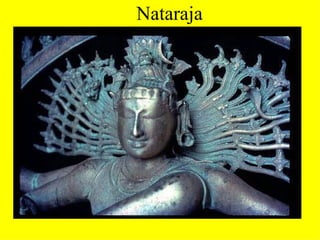
Nataraja

• The concept of
  Nataraja has
  always been a
  fascinating
  subject among
  Indologists
Tanjore
     Nataraja
• Wasted are the days that
  are spent
• Without singing the
  beauty of Nataraja of
  Chidambaram
• Who remains in the
  thoughts of the learned,
• Who is the inner
  meaning of the Vedas,
• Whose reality none can
  fathom,
• Who is sweet like the
  honey and milk
Nataraja
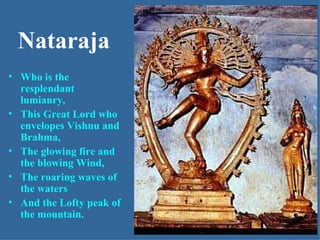
• Who is the
  resplendant
  lumianry,
• This Great Lord who
  envelopes Vishnu and
  Brahma,
• The glowing fire and
  the blowing Wind,
• The roaring waves of
  the waters
• And the Lofty peak of
  the mountain.
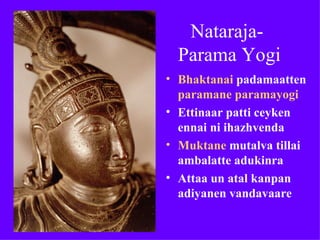
Nataraja-
  Parama Yogi
• Bhaktanai padamaatten
  paramane paramayogi
• Ettinaar patti ceyken
  ennai ni ihazhvenda
• Muktane mutalva tillai
  ambalatte adukinra
• Attaa un atal kanpan
  adiyanen vandavaare
This form of Dancing Siva is
    mainly worshipped in
   Tamilnadu and is called
Nataraja in every temple of Siva
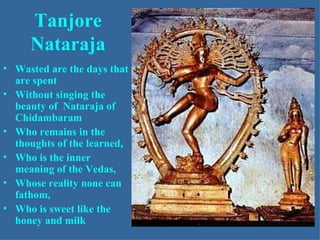
In most cases this image is in
  metal and is four armed,
 dancing in the middle of a
  circular halo of prabha-
 mandala called Thiruvaci
Hands
• In this form Nataraja holds a little drum
  –damaru and fire in the rear pair of
  arms and abhaya gesture and gaja hasta
  gesture in the front arms. The left arm
  thrown across the body swings like the
  trunk of an elephant and so is called
  gaja hasta (also called kari hasta- kari
  means elephant)
Almost every Siva temple in
Tamilnadu has a Nataraja image
 in bronze under worship that is
  taken out in procession during
    festivals. Nataraja is always
   accompanied by the image of
   Parvathi called Sivakami or
          Sivakama sundari
Nataraja and Sivakami are
 kept in a separate sub-shrine
 and worshipped daily in Siva
 temples. His Sub-shrine will
always face southern direction
     Dakshinabhimukha
The Chidambaram temple is
  the sacred place where this
form is said to have originated
 for the sake of sage Patanjali.
So Chidambaram is considered
   the holy of holies by all the
         Saivite people.
While in all other temples
   Sivalinga is the main deity,
 Nataraja is the main deity in the
   Chidambaram temple which
faces south and is in the form of a
       hut called Amabalam
There are five Siva temples as
khsetra of one of the five basic
 elements –Earth, Air, Water,
 Fire or Akasa (Space) which
    are called Panca Bhuta
  Khsetras. Chidambaram is
   worshipped as the Akasa-
kshetra as Siva dances here in
             Akasa.
Worship in Chidambaram is
 done according to Vedic
tradition said to have been
codified by Sage Patanjali.

  Siva performs five sacred
acts through his dance which
  are called Panca-krityas
Panca-krityas
•   Srishti – creation
•   Sthiti – Protection
•   Samhara – Dissolution
•   Tirodhana – Concealment and
•   Anugraha – grace
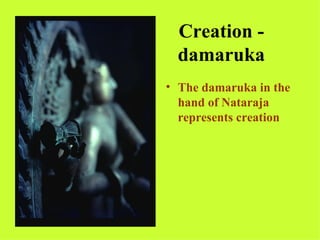
Creation -
  damaruka
• The damaruka in the
  hand of Nataraja
  represents creation
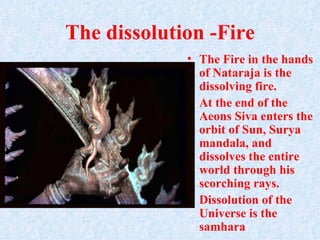
The dissolution -Fire
             • The Fire in the hands
               of Nataraja is the
               dissolving fire.
             • At the end of the
               Aeons Siva enters the
               orbit of Sun, Surya
               mandala, and
               dissolves the entire
               world through his
               scorching rays.
             • Dissolution of the
               Universe is the
               samhara
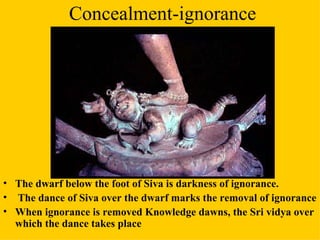
Concealment-ignorance


• The dwarf below the foot of Siva is darkness of ignorance.
• The dance of Siva over the dwarf marks the removal of ignorance
• When ignorance is removed Knowledge dawns, the Sri vidya over
  which the dance takes place
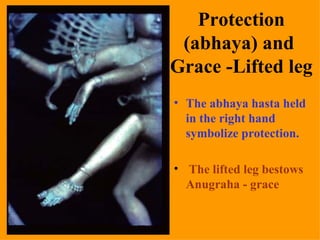
Protection
 (abhaya) and
Grace -Lifted leg
• The abhaya hasta held
  in the right hand
  symbolize protection.

• The lifted leg bestows
  Anugraha - grace
Nataraja


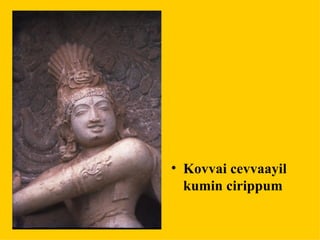
• The benign smile
• Kovvai cevvaayil
  kumin cirippum
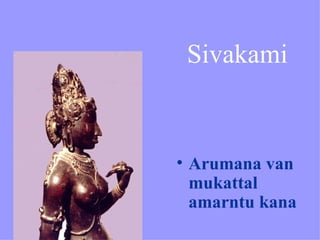
Sivakami


• Arumana van
  mukattal
  amarntu kana
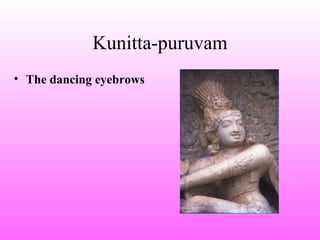
Kunitta-puruvam
• The dancing eyebrows
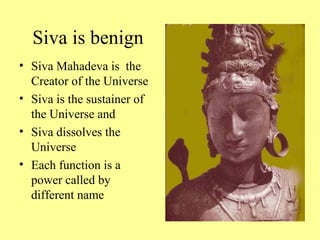
Siva is benign
• Siva Mahadeva is the
  Creator of the Universe
• Siva is the sustainer of
  the Universe and
• Siva dissolves the
  Universe
• Each function is a
  power called by
  different name
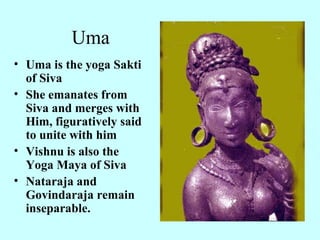
Uma
• Uma is the yoga Sakti
  of Siva
• She emanates from
  Siva and merges with
  Him, figuratively said
  to unite with him
• Vishnu is also the
  Yoga Maya of Siva
• Nataraja and
  Govindaraja remain
  inseparable.
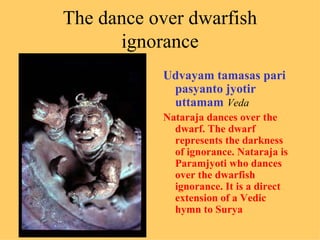
The dance over dwarfish
      ignorance
           Udvayam tamasas pari
            pasyanto jyotir
            uttamam Veda
           Nataraja dances over the
             dwarf. The dwarf
             represents the darkness
             of ignorance. Nataraja is
             Paramjyoti who dances
             over the dwarfish
             ignorance. It is a direct
             extension of a Vedic
             hymn to Surya
Two aspects of Nataraja
   that are most attractive
• The physical dancing pose by itself
  is charming and attractive and

• The metaphysical concepts that are
  reflected in these poses are far more
  absorbing.
This dancing form appears
 from the Chola period – 9th
            cent.

The Nataraja form is thus the
 creation of the Chola genius
It was Ananda Coomaraswamy
the great Art historian of India
  who interpreted this form to
    the Western world most
    effectively and ever since
    Nataraja has become an
  outstanding art of the world.
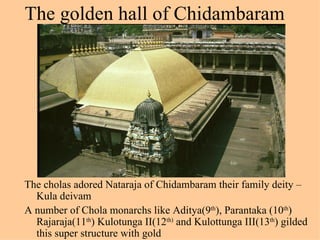
The golden hall of Chidambaram


The cholas adored Nataraja of Chidambaram their family deity –
  Kula deivam
A number of Chola monarchs like Aditya(9th), Parantaka (10th)
  Rajaraja(11th) Kulotunga II(12th) and Kulottunga III(13th) gilded
  this super structure with gold
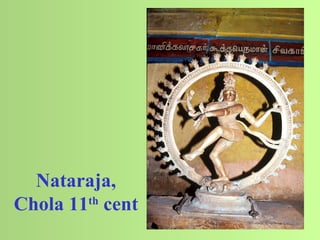
Nataraja,
Chola 11 cent
        th
Nataraja
                                   Tanjore

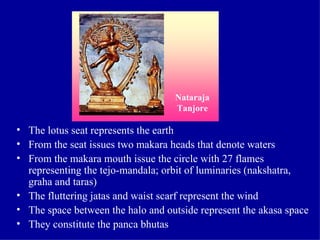
• The lotus seat represents the earth
• From the seat issues two makara heads that denote waters
• From the makara mouth issue the circle with 27 flames
  representing the tejo-mandala; orbit of luminaries (nakshatra,
  graha and taras)
• The fluttering jatas and waist scarf represent the wind
• The space between the halo and outside represent the akasa space
• They constitute the panca bhutas
NATARAJA

• By the term Nataraja we generally mean
  the Metal Image of Dancing Siva with four
  hands and dancing on the back of a dwarf
  called Apasmara, mainly in Tamil nadu
  temples. However Scholars now use this
  term for all forms of Dancing Siva.

• What is this Dance of the Supreme ?
• The Sun, Moon, planets and
  other celestials forces and
  the earth which remain
  suspended in the outer space
  Paramakasa- revolve in
  absolute rhythm which is
  poetically called the Dance
  of the Supreme dancer
• The place where this
  Supreme dance takes place
  is called Chid-ambaram in
  Tamilnad which is called the
  Ambalam by the Saivite.
  Ambalam means Akasa
• The worship of Nataraja
  carried out according to
  Vedic Tradition in the
  Chidambaram temple, clearly
  indicates the Vedic roots of
  the concept of Nataraja
• This form of Dancing Siva
  Nataraja is essentially a
  Procssional deity taken out on
  festive occassions especially in
  the month of Mriga sira
  -Margali
Though this is essentially a metal
 image we do come across stone
 sculptures of this form from the
             9th cent
• This form has multiple
  layers of meaning

•   Poetical
•   Philosophical
•   Ritual
•   Yogic
•   Physical
•   Artistic and others
• The origin, and development of this
  theme has fascinated Sages, Poets,
  Philosophers, artists and art
  historians down through the centuries
• Two most outstanding works on this theme during
  recent times are by

• 1. Ananda Coomaraswamy “The Dance of
  Siva” and
• 2.Sri.C.Sivaramamurthi, “Nataraja in Art,
  Thought and Literature”

It is impossible to surpass these two Masters.
This dance is called

    Ananda tandava
Jnana-Ananda Tandavam
Yoga-Ananda tandavam
   Chidambara natam
       and so on.
A detailed description of this
dance is given in the Agamic text
Kamikagama, which is followed
  in most Nataraja images. The
   Kamikagama calls this form
    Bhujanga trasa Nrittam.
The Kamikagama gives three
    types of Siva’s dance
      Bhujanga Trasa
       Bhujanga lalita
     Bhujanga Bhairava
Combining the movements of upper
and the lower parts of his body Siva
  danced in the evening 108 poses
   that are called Nritta karanas
• Bharata’ Natya sastra difines these
  Nrittakaranas as
• Hasta pada samayogah
  Nrittasya karanam bhavet
• By hasta –hand the whole of upper body above
  the waist is meant
• By pada the lower part of the body below the
  waist is meant says Abhinava gupta
• Among the 108 poses of dance one pose is
  called Bhujanga trasa nritta
• The pose is “Fear of Snake”
• Dance is of remote antiquity says Abhinava
  gupta
• On seeing a snake by the side of the leg lifting
  the leg hurriedly and turning away of the body
  is reflected in this pose and hence the name
  derived from natural reaction
• The position of the lower part of the body
  (Pada ) has given the name Bhujanga Trasa,
• It has been noted that
  Agamic name for Nataraja
  is Bhujanga trasa nritta
• So the origin of this dance
  pose is at least two thousand
  years old.
• One of the most remarkable sculpture
  that portrays this situation very clearly
  is a 7th cent Pallava sculpture from
  Siyamangalam
• The lower part of the body is exactly in
  the same position as defined in Natya
  sastra
• A snake is portrayed beneath the leg
  indicating that it Bhujanga trasa nritta.
The following deserve notice

• Lalita dance Catura Tandava
• Dance of Siva portrayed in the ceilings
  of mandapas
• Dance of Siva portrayed on the
  sikhara
• Dance in Vyoma ranga
• Most of the early
  representations of Nataraja
  in sculpture and bronze
  portray the Sandhya
  tandava or what is called
  Catura or Bhujanga Lalita
  form found through out
  India
• The Dance of Siva surrounded by his
  Mandala –the dikpalas and grahas in
  squares around is seen in the ceilings
  of the Mandapa in early Chalukya,
  Rashtrakuta and Nolamba temples of
  Western India.
• The ceiling is suggestive of Akasa,
  the Macrocosm, where Siva’s dance
  takes place
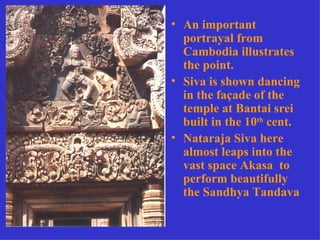
• An important
  portrayal from
  Cambodia illustrates
  the point.
• Siva is shown dancing
  in the façade of the
  temple at Bantai srei
  built in the 10th cent.
• Nataraja Siva here
  almost leaps into the
  vast space Akasa to
  perform beautifully
  the Sandhya Tandava
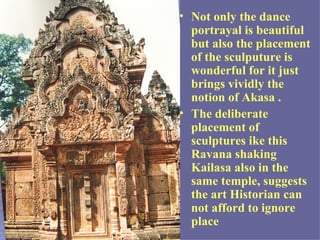
• Not only the dance
  portrayal is beautiful
  but also the placement
  of the sculputure is
  wonderful for it just
  brings vividly the
  notion of Akasa .
• The deliberate
  placement of
  sculptures ike this
  Ravana shaking
  Kailasa also in the
  same temple, suggests
  the art Historian can
  not afford to ignore
  place
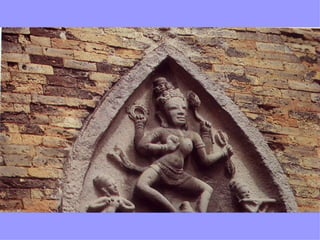
• There is a beautiful sculpture of Siva
  as Ardhanarisvara dancing on the
  sikhara of a temple of Ancient
  Champa Now Vietnam.
• The concept that the dance of Siva
  takes place in the Akasa is
  figuratively adopted all ober.
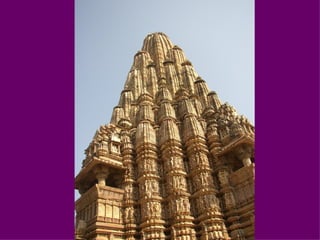
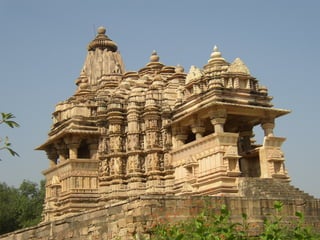
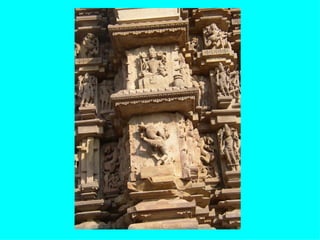
• Siva dancing on the façade of the Sikhara
  high up in the air is found in a number of
  temples in India in the Eastern India,
  MadhyaPradesh, Western India and
  Deccan.
• Jambukesvara temple Pattadakkal
• Surya Brahma temple Alampur
• Ramalingesvara temple Satyavolu
• Parasuramesvara temple at Bhuvanesvar
• Somesvara temple Mukhalingam
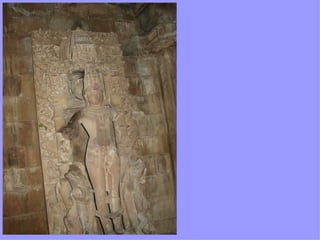
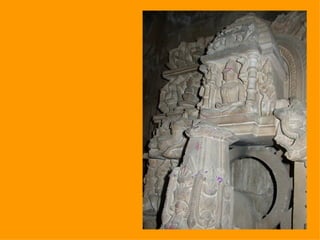
• An Important point that has escaped the attention of
  Scholars is the presence of Surya below the Dancing Siva
  on the Sikhara of the façade.
• It indicates the connection between the two concepts -
  Siva Surya
• More important is the depiction of this Surya as Hari-
  Hara- Hiranya garbha- Surya The Trinity in One
• Such portarayal may be seen in Vaital Daul Bhuvanesvar,
• Udayesvar temple of Udaipur
• oscillation of Sun in the Cosmos. He is the Primordial
  Agnavishnu
• The 108 poses of Nritta karanas
  performed by Siva Nataraja are
  portrayed in the upper floor of
  the Great Temple of Tanjore
  around the garbha graha which
  is empty representning Akasa.
• The poses are created by Siva
  out of his own body-which is
  Akasa Sariram Brahma
• That brings me to a fascinating
  Sanskrit poem quoted by
  Abhinavagupta, the great
  visionary
Deities are Forces of Nature
• Adi Sankara the Advaita exponent
  held that
• “ the Vedic deities represent
  personification of forces of Nature
  and not individual entities ”
• Radhakrishnan. S. The Vedanta , p.217, London
  -1928,
Vedic
 hymn
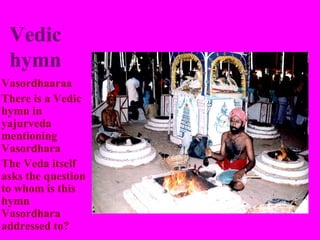
Vasordhaaraa
There is a Vedic
hymn in
yajurveda
mentioning
Vasordhara
The Veda itself
asks the question
to whom is this
hymn
Vasordhara
addressed to?
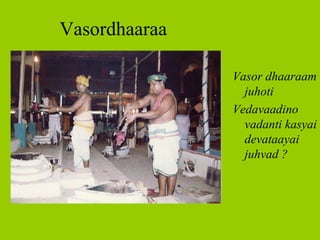
Vasordhaaraa

               Vasor dhaaraam
                 juhoti
               Vedavaadino
                 vadanti kasyai
                 devataayai
                 juhvad ?
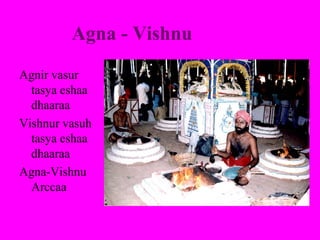
Agna - Vishnu
Agnir vasur
  tasya eshaa
  dhaaraa
Vishnur vasuh
  tasya eshaa
  dhaaraa
Agna-Vishnu
  Arccaa
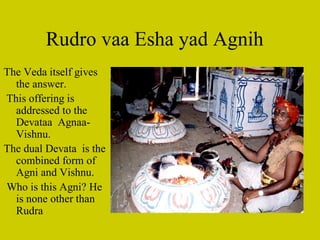
Rudro vaa Esha yad Agnih
The Veda itself gives
  the answer.
This offering is
  addressed to the
  Devataa Agnaa-
  Vishnu.
The dual Devata is the
  combined form of
  Agni and Vishnu.
Who is this Agni? He
  is none other than
  Rudra
• Agni has two inherent inseparable powers
• The consuming or destructive power and
• Benign heat that shines, pervades, and
  supports life energy
• These two natural phenomenon are called
  Agna-Vishnu or Rudra-Vishnu
Rudra is Agni
• Rudro va esha yad Agnih
• Tasya ete Tanuvau
• Ghoraa anyaa Sivaa anyaa
• Yaa asya Ghoraa tanuh
  satarudriyam juhoti tena taam
  samayati
• Yaa asya Sivaa tanuh vasor dharam
  juhoti tena taam prinati
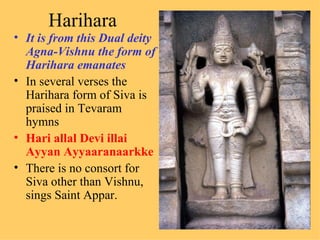
Harihara
• It is from this Dual deity
  Agna-Vishnu the form of
  Harihara emanates
• In several verses the
  Harihara form of Siva is
  praised in Tevaram
  hymns
• Hari allal Devi illai
  Ayyan Ayyaaranaarkke
• There is no consort for
  Siva other than Vishnu,
  sings Saint Appar.
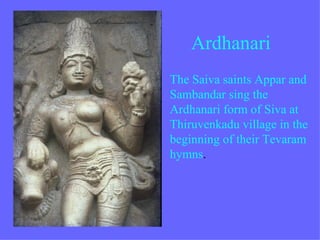
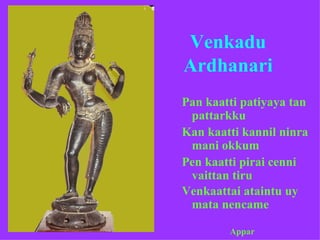
Ardhanari
• The Saiva saints Appar and
  Sambandar sing the
  Ardhanari form of Siva at
  Thiruvenkadu village in the
  beginning of their Tevaram
  hymns.
Venkadu
Ardhanari
Pan kaatti patiyaya tan
 pattarkku
Kan kaatti kannil ninra
 mani okkum
Pen kaatti pirai cenni
 vaittan tiru
Venkaattai ataintu uy
 mata nencame

        Appar
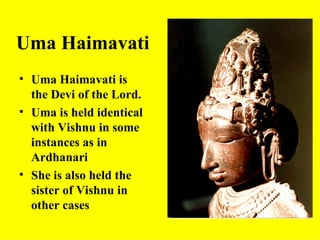
Uma Haimavati
• Uma Haimavati is
  the Devi of the Lord.
• Uma is held identical
  with Vishnu in some
  instances as in
  Ardhanari
• She is also held the
  sister of Vishnu in
  other cases
Surya is Heavenly
      Agni
The Rudra-Surya is Siva
the Dancer says Kurma Purana-
Nataraja and Govindaraja are
inseparable and are the totality-
Harihara and Ardhanari.
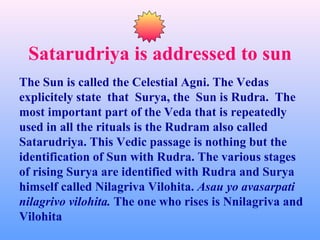
Satarudriya is addressed to sun
The Sun is called the Celestial Agni. The Vedas
explicitely state that Surya, the Sun is Rudra. The
most important part of the Veda that is repeatedly
used in all the rituals is the Rudram also called
Satarudriya. This Vedic passage is nothing but the
identification of Sun with Rudra. The various stages
of rising Surya are identified with Rudra and Surya
himself called Nilagriva Vilohita. Asau yo avasarpati
nilagrivo vilohita. The one who rises is Nnilagriva and
Vilohita
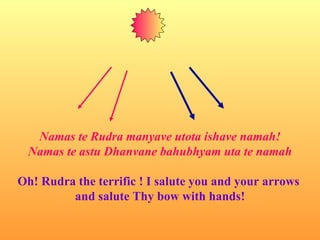
Namas te Rudra manyave utota ishave namah!
 Namas te astu Dhanvane bahubhyam uta te namah

Oh! Rudra the terrific ! I salute you and your arrows
         and salute Thy bow with hands!
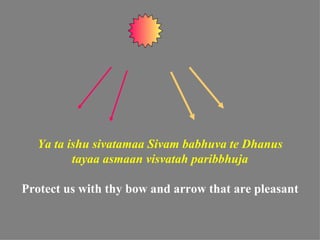
Ya ta ishu sivatamaa Sivam babhuva te Dhanus
         tayaa asmaan visvatah paribbhuja

Protect us with thy bow and arrow that are pleasant
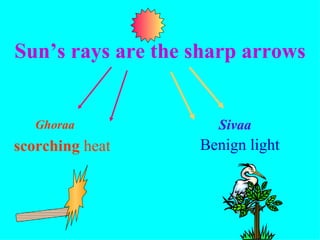
Sun’s rays are the sharp arrows


   Ghoraa            Sivaa
scorching heat     Benign light
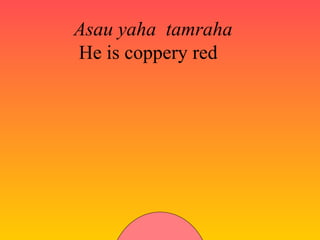
Asau yaha tamraha
He is coppery red
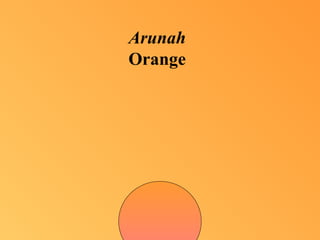
Arunah
Orange
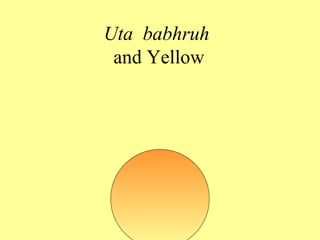
Uta babhruh
 and Yellow
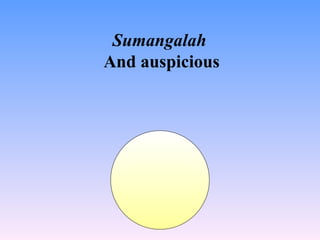
Sumangalah
And auspicious
Udvayam tamasapari pasyanto
       jyotiruttamam
 They beheld the luminary
 driving away the darkness
Namah Sivaaya ca
      Sivataraaya ca
salutations to the Auspicious

    and more auspicious
Kalakala the Great destroyer of time, engulfs and reduces as a
sweeping forest fire, the entire world to ashes. It is the Supreme Lord
Mahadeva who enters his own body and energizing himself, burns
this great world. He enters the orbit of the Sun as Suryamandala and
burns down this world in his solar form. This act is the Loka
samhara. He throws the sharp rays on all the celestial bodies and
throws them out of existanc like a devastating mountain fire.The
terrifying rays are his thousand eyes or sights, or thousand hands and
feet. Sahasraksha, Sahasra nayana, Sahasra hastas. And Sahasra
caranas says the Kurma-purana
The earth is submerged in oceanic waters. The
waters are dried up in fire. The fire is swept
away by the wind. And the wind is lost in
space. In this process all the elements are dried
up.


                                      Kurma Purana
This Paramesvara drinks the immortal elixir of
bliss, Ananda Yoga Amrita, and dances, glancing at
his own power, the Sakti , who stands as the sole
witness at the end. That is the revealed poetry – Vedic
Sruti.

The Devi having tasted the nectar of dance,
Nrtyamrita of her lord, unites with his body in Yoga.
                                          Kurma Purana
This ultimate destruction is caused by Sankara who is none
other than Rudra. The Mohini Sakti of Sankara is Narayana,
who protects the world. His other Power is Hiranyagarbha who
creates this Universe. Brahma, Vishnu and Rudra are Powers,
Saktis of the Supreme Sankara. It is the same immutable
Supreme power that is called by many names because of its
Greatness. Beyond all these powers is Paramatma.


Some people call him Agni. Others call him Narayana, Others
call him Indra, And yet others call him Prana. The Ultimate
Power is only one. He enters the World and functions in
different names. Kurma purana
Sage Mankanaka saw the dance of Siva at Saptsaraswat tirtha.
As the Lord danced, a beautiful Goddess appeared witnessing
the dance. Siva told the sage She was his own Yogic power, the
Yoga Sakti, the inherent Maya, identical with Purushottama
Narayana, from whom the world emanated. Siva’s Yogic
power is Narayana. The Creator Brahma, the Sustainer Vishnu
and the Destroyer Rudra are one and the same, said Siva. He
also told the Sage that the Goddess he saw was his Vidya Deha,
the body of knowledge. This is identical with Supreme
happiness, Parama ananda, otherwise called Chinmatra
identical with Akasa.                      Kurma Purana.
While the earthly Agni is seen
here in a limited sphere Surya
 the heavenly Agni in the Sky
   rythmically moving and
 making all other luminaries
like planets, stars, milky way
  etc revolve beautifully and
     rhythmically and also
          continuosly.
Surya is likened to dancing god
        in many poems
   Surya is called Brahma,
  Vishnu, Siva and all other
  gods.He is called Hari hara
        Hiranyagarbha

  Esha Brahma ca Vishnusca
 Sivah Skandhah Prajapatih
                   -Ramayana
So dance of Siva appears in the
  sky as Nataraja. Nataraja
 appears in the Sikhara of the
 temples representing Akasa.
   Nataraja is also shown as
  Ardhanari dancing on the
           sikhara.
It is the movement of the
  celestial bodies, with Surya
acting as the central force, that
   are visualized in Nataraja
  form. That is how Nataraja
combines himself Science, Art
           and Poetry

Nataraja

  • 1.
    Siva Nataraja by Dr.R.Nagaswamy
  • 2.
    Nataraja • The conceptof Nataraja has always been a fascinating subject among Indologists
  • 3.
    Tanjore Nataraja • Wasted are the days that are spent • Without singing the beauty of Nataraja of Chidambaram • Who remains in the thoughts of the learned, • Who is the inner meaning of the Vedas, • Whose reality none can fathom, • Who is sweet like the honey and milk
  • 4.
    Nataraja • Who isthe resplendant lumianry, • This Great Lord who envelopes Vishnu and Brahma, • The glowing fire and the blowing Wind, • The roaring waves of the waters • And the Lofty peak of the mountain.
  • 5.
    Nataraja- ParamaYogi • Bhaktanai padamaatten paramane paramayogi • Ettinaar patti ceyken ennai ni ihazhvenda • Muktane mutalva tillai ambalatte adukinra • Attaa un atal kanpan adiyanen vandavaare
  • 6.
    This form ofDancing Siva is mainly worshipped in Tamilnadu and is called Nataraja in every temple of Siva
  • 7.
    In most casesthis image is in metal and is four armed, dancing in the middle of a circular halo of prabha- mandala called Thiruvaci
  • 8.
    Hands • In thisform Nataraja holds a little drum –damaru and fire in the rear pair of arms and abhaya gesture and gaja hasta gesture in the front arms. The left arm thrown across the body swings like the trunk of an elephant and so is called gaja hasta (also called kari hasta- kari means elephant)
  • 9.
    Almost every Sivatemple in Tamilnadu has a Nataraja image in bronze under worship that is taken out in procession during festivals. Nataraja is always accompanied by the image of Parvathi called Sivakami or Sivakama sundari
  • 10.
    Nataraja and Sivakamiare kept in a separate sub-shrine and worshipped daily in Siva temples. His Sub-shrine will always face southern direction Dakshinabhimukha
  • 11.
    The Chidambaram templeis the sacred place where this form is said to have originated for the sake of sage Patanjali. So Chidambaram is considered the holy of holies by all the Saivite people.
  • 12.
    While in allother temples Sivalinga is the main deity, Nataraja is the main deity in the Chidambaram temple which faces south and is in the form of a hut called Amabalam
  • 13.
    There are fiveSiva temples as khsetra of one of the five basic elements –Earth, Air, Water, Fire or Akasa (Space) which are called Panca Bhuta Khsetras. Chidambaram is worshipped as the Akasa- kshetra as Siva dances here in Akasa.
  • 14.
    Worship in Chidambaramis done according to Vedic tradition said to have been codified by Sage Patanjali. Siva performs five sacred acts through his dance which are called Panca-krityas
  • 15.
    Panca-krityas • Srishti – creation • Sthiti – Protection • Samhara – Dissolution • Tirodhana – Concealment and • Anugraha – grace
  • 16.
    Creation - damaruka • The damaruka in the hand of Nataraja represents creation
  • 17.
    The dissolution -Fire • The Fire in the hands of Nataraja is the dissolving fire. • At the end of the Aeons Siva enters the orbit of Sun, Surya mandala, and dissolves the entire world through his scorching rays. • Dissolution of the Universe is the samhara
  • 18.
    Concealment-ignorance • The dwarfbelow the foot of Siva is darkness of ignorance. • The dance of Siva over the dwarf marks the removal of ignorance • When ignorance is removed Knowledge dawns, the Sri vidya over which the dance takes place
  • 19.
    Protection (abhaya) and Grace-Lifted leg • The abhaya hasta held in the right hand symbolize protection. • The lifted leg bestows Anugraha - grace
  • 20.
  • 21.
    • Kovvai cevvaayil kumin cirippum
  • 22.
    Sivakami • Arumana van mukattal amarntu kana
  • 23.
  • 24.
    Siva is benign •Siva Mahadeva is the Creator of the Universe • Siva is the sustainer of the Universe and • Siva dissolves the Universe • Each function is a power called by different name
  • 25.
    Uma • Uma isthe yoga Sakti of Siva • She emanates from Siva and merges with Him, figuratively said to unite with him • Vishnu is also the Yoga Maya of Siva • Nataraja and Govindaraja remain inseparable.
  • 26.
    The dance overdwarfish ignorance Udvayam tamasas pari pasyanto jyotir uttamam Veda Nataraja dances over the dwarf. The dwarf represents the darkness of ignorance. Nataraja is Paramjyoti who dances over the dwarfish ignorance. It is a direct extension of a Vedic hymn to Surya
  • 27.
    Two aspects ofNataraja that are most attractive • The physical dancing pose by itself is charming and attractive and • The metaphysical concepts that are reflected in these poses are far more absorbing.
  • 28.
    This dancing formappears from the Chola period – 9th cent. The Nataraja form is thus the creation of the Chola genius
  • 29.
    It was AnandaCoomaraswamy the great Art historian of India who interpreted this form to the Western world most effectively and ever since Nataraja has become an outstanding art of the world.
  • 30.
    The golden hallof Chidambaram The cholas adored Nataraja of Chidambaram their family deity – Kula deivam A number of Chola monarchs like Aditya(9th), Parantaka (10th) Rajaraja(11th) Kulotunga II(12th) and Kulottunga III(13th) gilded this super structure with gold
  • 31.
  • 32.
    Nataraja Tanjore • The lotus seat represents the earth • From the seat issues two makara heads that denote waters • From the makara mouth issue the circle with 27 flames representing the tejo-mandala; orbit of luminaries (nakshatra, graha and taras) • The fluttering jatas and waist scarf represent the wind • The space between the halo and outside represent the akasa space • They constitute the panca bhutas
  • 33.
    NATARAJA • By theterm Nataraja we generally mean the Metal Image of Dancing Siva with four hands and dancing on the back of a dwarf called Apasmara, mainly in Tamil nadu temples. However Scholars now use this term for all forms of Dancing Siva. • What is this Dance of the Supreme ?
  • 34.
    • The Sun,Moon, planets and other celestials forces and the earth which remain suspended in the outer space Paramakasa- revolve in absolute rhythm which is poetically called the Dance of the Supreme dancer
  • 35.
    • The placewhere this Supreme dance takes place is called Chid-ambaram in Tamilnad which is called the Ambalam by the Saivite. Ambalam means Akasa
  • 36.
    • The worshipof Nataraja carried out according to Vedic Tradition in the Chidambaram temple, clearly indicates the Vedic roots of the concept of Nataraja
  • 37.
    • This formof Dancing Siva Nataraja is essentially a Procssional deity taken out on festive occassions especially in the month of Mriga sira -Margali
  • 38.
    Though this isessentially a metal image we do come across stone sculptures of this form from the 9th cent
  • 39.
    • This formhas multiple layers of meaning • Poetical • Philosophical • Ritual • Yogic • Physical • Artistic and others
  • 40.
    • The origin,and development of this theme has fascinated Sages, Poets, Philosophers, artists and art historians down through the centuries
  • 41.
    • Two mostoutstanding works on this theme during recent times are by • 1. Ananda Coomaraswamy “The Dance of Siva” and • 2.Sri.C.Sivaramamurthi, “Nataraja in Art, Thought and Literature” It is impossible to surpass these two Masters.
  • 42.
    This dance iscalled Ananda tandava Jnana-Ananda Tandavam Yoga-Ananda tandavam Chidambara natam and so on.
  • 43.
    A detailed descriptionof this dance is given in the Agamic text Kamikagama, which is followed in most Nataraja images. The Kamikagama calls this form Bhujanga trasa Nrittam.
  • 44.
    The Kamikagama givesthree types of Siva’s dance Bhujanga Trasa Bhujanga lalita Bhujanga Bhairava
  • 45.
    Combining the movementsof upper and the lower parts of his body Siva danced in the evening 108 poses that are called Nritta karanas
  • 46.
    • Bharata’ Natyasastra difines these Nrittakaranas as • Hasta pada samayogah Nrittasya karanam bhavet • By hasta –hand the whole of upper body above the waist is meant • By pada the lower part of the body below the waist is meant says Abhinava gupta
  • 47.
    • Among the108 poses of dance one pose is called Bhujanga trasa nritta • The pose is “Fear of Snake” • Dance is of remote antiquity says Abhinava gupta • On seeing a snake by the side of the leg lifting the leg hurriedly and turning away of the body is reflected in this pose and hence the name derived from natural reaction • The position of the lower part of the body (Pada ) has given the name Bhujanga Trasa,
  • 48.
    • It hasbeen noted that Agamic name for Nataraja is Bhujanga trasa nritta • So the origin of this dance pose is at least two thousand years old.
  • 49.
    • One ofthe most remarkable sculpture that portrays this situation very clearly is a 7th cent Pallava sculpture from Siyamangalam • The lower part of the body is exactly in the same position as defined in Natya sastra • A snake is portrayed beneath the leg indicating that it Bhujanga trasa nritta.
  • 50.
    The following deservenotice • Lalita dance Catura Tandava • Dance of Siva portrayed in the ceilings of mandapas • Dance of Siva portrayed on the sikhara • Dance in Vyoma ranga
  • 51.
    • Most ofthe early representations of Nataraja in sculpture and bronze portray the Sandhya tandava or what is called Catura or Bhujanga Lalita form found through out India
  • 52.
    • The Danceof Siva surrounded by his Mandala –the dikpalas and grahas in squares around is seen in the ceilings of the Mandapa in early Chalukya, Rashtrakuta and Nolamba temples of Western India. • The ceiling is suggestive of Akasa, the Macrocosm, where Siva’s dance takes place
  • 53.
    • An important portrayal from Cambodia illustrates the point. • Siva is shown dancing in the façade of the temple at Bantai srei built in the 10th cent. • Nataraja Siva here almost leaps into the vast space Akasa to perform beautifully the Sandhya Tandava
  • 54.
    • Not onlythe dance portrayal is beautiful but also the placement of the sculputure is wonderful for it just brings vividly the notion of Akasa . • The deliberate placement of sculptures ike this Ravana shaking Kailasa also in the same temple, suggests the art Historian can not afford to ignore place
  • 55.
    • There isa beautiful sculpture of Siva as Ardhanarisvara dancing on the sikhara of a temple of Ancient Champa Now Vietnam. • The concept that the dance of Siva takes place in the Akasa is figuratively adopted all ober.
  • 57.
    • Siva dancingon the façade of the Sikhara high up in the air is found in a number of temples in India in the Eastern India, MadhyaPradesh, Western India and Deccan. • Jambukesvara temple Pattadakkal • Surya Brahma temple Alampur • Ramalingesvara temple Satyavolu • Parasuramesvara temple at Bhuvanesvar • Somesvara temple Mukhalingam
  • 59.
    • An Importantpoint that has escaped the attention of Scholars is the presence of Surya below the Dancing Siva on the Sikhara of the façade. • It indicates the connection between the two concepts - Siva Surya • More important is the depiction of this Surya as Hari- Hara- Hiranya garbha- Surya The Trinity in One • Such portarayal may be seen in Vaital Daul Bhuvanesvar, • Udayesvar temple of Udaipur • oscillation of Sun in the Cosmos. He is the Primordial Agnavishnu
  • 64.
    • The 108poses of Nritta karanas performed by Siva Nataraja are portrayed in the upper floor of the Great Temple of Tanjore around the garbha graha which is empty representning Akasa. • The poses are created by Siva out of his own body-which is Akasa Sariram Brahma
  • 65.
    • That bringsme to a fascinating Sanskrit poem quoted by Abhinavagupta, the great visionary
  • 66.
    Deities are Forcesof Nature • Adi Sankara the Advaita exponent held that • “ the Vedic deities represent personification of forces of Nature and not individual entities ” • Radhakrishnan. S. The Vedanta , p.217, London -1928,
  • 67.
    Vedic hymn Vasordhaaraa There isa Vedic hymn in yajurveda mentioning Vasordhara The Veda itself asks the question to whom is this hymn Vasordhara addressed to?
  • 68.
    Vasordhaaraa Vasor dhaaraam juhoti Vedavaadino vadanti kasyai devataayai juhvad ?
  • 69.
    Agna - Vishnu Agnirvasur tasya eshaa dhaaraa Vishnur vasuh tasya eshaa dhaaraa Agna-Vishnu Arccaa
  • 70.
    Rudro vaa Eshayad Agnih The Veda itself gives the answer. This offering is addressed to the Devataa Agnaa- Vishnu. The dual Devata is the combined form of Agni and Vishnu. Who is this Agni? He is none other than Rudra
  • 71.
    • Agni hastwo inherent inseparable powers • The consuming or destructive power and • Benign heat that shines, pervades, and supports life energy • These two natural phenomenon are called Agna-Vishnu or Rudra-Vishnu
  • 72.
    Rudra is Agni •Rudro va esha yad Agnih • Tasya ete Tanuvau • Ghoraa anyaa Sivaa anyaa • Yaa asya Ghoraa tanuh satarudriyam juhoti tena taam samayati • Yaa asya Sivaa tanuh vasor dharam juhoti tena taam prinati
  • 73.
    Harihara • It isfrom this Dual deity Agna-Vishnu the form of Harihara emanates • In several verses the Harihara form of Siva is praised in Tevaram hymns • Hari allal Devi illai Ayyan Ayyaaranaarkke • There is no consort for Siva other than Vishnu, sings Saint Appar.
  • 74.
    Ardhanari • The Saivasaints Appar and Sambandar sing the Ardhanari form of Siva at Thiruvenkadu village in the beginning of their Tevaram hymns.
  • 75.
    Venkadu Ardhanari Pan kaatti patiyayatan pattarkku Kan kaatti kannil ninra mani okkum Pen kaatti pirai cenni vaittan tiru Venkaattai ataintu uy mata nencame Appar
  • 76.
    Uma Haimavati • UmaHaimavati is the Devi of the Lord. • Uma is held identical with Vishnu in some instances as in Ardhanari • She is also held the sister of Vishnu in other cases
  • 77.
  • 78.
    The Rudra-Surya isSiva the Dancer says Kurma Purana- Nataraja and Govindaraja are inseparable and are the totality- Harihara and Ardhanari.
  • 79.
    Satarudriya is addressedto sun The Sun is called the Celestial Agni. The Vedas explicitely state that Surya, the Sun is Rudra. The most important part of the Veda that is repeatedly used in all the rituals is the Rudram also called Satarudriya. This Vedic passage is nothing but the identification of Sun with Rudra. The various stages of rising Surya are identified with Rudra and Surya himself called Nilagriva Vilohita. Asau yo avasarpati nilagrivo vilohita. The one who rises is Nnilagriva and Vilohita
  • 80.
    Namas te Rudramanyave utota ishave namah! Namas te astu Dhanvane bahubhyam uta te namah Oh! Rudra the terrific ! I salute you and your arrows and salute Thy bow with hands!
  • 81.
    Ya ta ishusivatamaa Sivam babhuva te Dhanus tayaa asmaan visvatah paribbhuja Protect us with thy bow and arrow that are pleasant
  • 82.
    Sun’s rays arethe sharp arrows Ghoraa Sivaa scorching heat Benign light
  • 83.
    Asau yaha tamraha Heis coppery red
  • 84.
  • 85.
  • 86.
  • 87.
    Udvayam tamasapari pasyanto jyotiruttamam They beheld the luminary driving away the darkness
  • 88.
    Namah Sivaaya ca Sivataraaya ca salutations to the Auspicious and more auspicious
  • 89.
    Kalakala the Greatdestroyer of time, engulfs and reduces as a sweeping forest fire, the entire world to ashes. It is the Supreme Lord Mahadeva who enters his own body and energizing himself, burns this great world. He enters the orbit of the Sun as Suryamandala and burns down this world in his solar form. This act is the Loka samhara. He throws the sharp rays on all the celestial bodies and throws them out of existanc like a devastating mountain fire.The terrifying rays are his thousand eyes or sights, or thousand hands and feet. Sahasraksha, Sahasra nayana, Sahasra hastas. And Sahasra caranas says the Kurma-purana
  • 90.
    The earth issubmerged in oceanic waters. The waters are dried up in fire. The fire is swept away by the wind. And the wind is lost in space. In this process all the elements are dried up. Kurma Purana
  • 91.
    This Paramesvara drinksthe immortal elixir of bliss, Ananda Yoga Amrita, and dances, glancing at his own power, the Sakti , who stands as the sole witness at the end. That is the revealed poetry – Vedic Sruti. The Devi having tasted the nectar of dance, Nrtyamrita of her lord, unites with his body in Yoga. Kurma Purana
  • 92.
    This ultimate destructionis caused by Sankara who is none other than Rudra. The Mohini Sakti of Sankara is Narayana, who protects the world. His other Power is Hiranyagarbha who creates this Universe. Brahma, Vishnu and Rudra are Powers, Saktis of the Supreme Sankara. It is the same immutable Supreme power that is called by many names because of its Greatness. Beyond all these powers is Paramatma. Some people call him Agni. Others call him Narayana, Others call him Indra, And yet others call him Prana. The Ultimate Power is only one. He enters the World and functions in different names. Kurma purana
  • 93.
    Sage Mankanaka sawthe dance of Siva at Saptsaraswat tirtha. As the Lord danced, a beautiful Goddess appeared witnessing the dance. Siva told the sage She was his own Yogic power, the Yoga Sakti, the inherent Maya, identical with Purushottama Narayana, from whom the world emanated. Siva’s Yogic power is Narayana. The Creator Brahma, the Sustainer Vishnu and the Destroyer Rudra are one and the same, said Siva. He also told the Sage that the Goddess he saw was his Vidya Deha, the body of knowledge. This is identical with Supreme happiness, Parama ananda, otherwise called Chinmatra identical with Akasa. Kurma Purana.
  • 94.
    While the earthlyAgni is seen here in a limited sphere Surya the heavenly Agni in the Sky rythmically moving and making all other luminaries like planets, stars, milky way etc revolve beautifully and rhythmically and also continuosly.
  • 95.
    Surya is likenedto dancing god in many poems Surya is called Brahma, Vishnu, Siva and all other gods.He is called Hari hara Hiranyagarbha Esha Brahma ca Vishnusca Sivah Skandhah Prajapatih -Ramayana
  • 96.
    So dance ofSiva appears in the sky as Nataraja. Nataraja appears in the Sikhara of the temples representing Akasa. Nataraja is also shown as Ardhanari dancing on the sikhara.
  • 97.
    It is themovement of the celestial bodies, with Surya acting as the central force, that are visualized in Nataraja form. That is how Nataraja combines himself Science, Art and Poetry