Recap- narrative
 Write down one question you would ask
someone else in the class about narrative.
Narrative Theory
Learning Objectives
 To gain understanding of how to apply
narrative theory to different media texts.
Todorov’s Equlibrium Theory
• Todorov’s theory is based on all narratives having a 3 act structure.
• Equilibrium
• Disruption of equilibrium
• An attempt at a resolution.
• Of course, modern narratives often play with this idea. Not all
narratives would necessarily begin with an equilibrium.
• Tasks:
• Watch this trailer: how could apply Todorov it? Does it conform to 3
act structure? https://www.youtube.com/watch?v=gRY3L5DjeK0
• Think about the narrative of your trailer. Can you apply Todorov to
it?
Propp’s Spheres of Action Theory
 Propp’s theory is based on the idea of 8 recurring characters, or
‘spheres of action’.
 These characters ‘drive the narrative’ and form the basis of most
narrative plots.
 Hero: Individual(s) who's quest is to restore the equilibrium.
 Villain: Individual(s) who's task is to disrupt the equilibrium.
 Donor: Individual(s) who gives the hero(s) something, advice, information or an
object.
 Helper: Individual(s) who aids the hero(s) with their set task.
 Princess (Prince): Individual(s) which need help, protecting and saving.
 The King: Who rewards the hero.
 Dispatcher: Individual(s) who send the hero(s) on their quest.
 False Hero: Individual(s) who set out to undermine the hero's quest by pretending to
aid them. Often unmasked at the end of the film.
 Watch this trailer and apply Propp.
Levi-Strauss: Binary Oppositions
Argued that meaning in narrative is based upon binary
oppositions. He observed that all narratives are organised
around the conflict between such binary opposites. E.g:
 Good Vs Evil
 Human Vs Nature
 Protagonist Vs Antagonist
 Humanity Vs Technology
 Man Vs Woman
 Human Vs Alien
 Can you apply binary opposites theory to your trailer?
Roland Barthes: Enigma Code
• Barthes’ theory refers to any element of the
story that is not fully explained and hence
becomes a mystery to the audience.
• The audience then begins to ask a series of
questions of the narrative?
• What questions would ask of the trailers we have
watched?
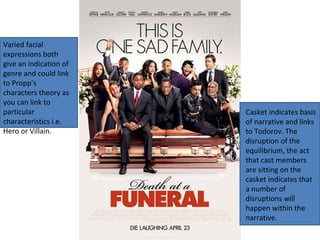
Varied facial
expressions both
give an indication of
genre and could link
to Propp’s
characters theory as
you can link to
particular
characteristics i.e.
Hero or Villain.
Casket indicates basis
of narrative and links
to Todorov. The
disruption of the
equilibrium, the act
that cast members
are sitting on the
casket indicates that
a number of
disruptions will
happen within the
narrative.
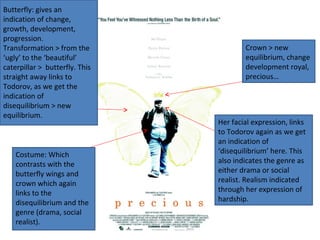
Butterfly: gives an
indication of change,
growth, development,
progression.
Transformation > from the
‘ugly’ to the ‘beautiful’
caterpillar > butterfly. This
straight away links to
Todorov, as we get the
indication of
disequilibrium > new
equilibrium.
Her facial expression, links
to Todorov again as we get
an indication of
‘disequilibrium’ here. This
also indicates the genre as
either drama or social
realist. Realism indicated
through her expression of
hardship.
Costume: Which
contrasts with the
butterfly wings and
crown which again
links to the
disequilibrium and the
genre (drama, social
realist).
Crown > new
equilibrium, change
development royal,
precious…
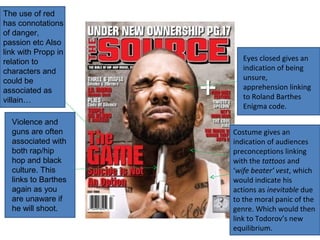
Eyes closed gives an
indication of being
unsure,
apprehension linking
to Roland Barthes
Enigma code.
Costume gives an
indication of audiences
preconceptions linking
with the tattoos and
‘wife beater’ vest, which
would indicate his
actions as inevitable due
to the moral panic of the
genre. Which would then
link to Todorov’s new
equilibrium.
Violence and
guns are often
associated with
both rap/hip
hop and black
culture. This
links to Barthes
again as you
are unaware if
he will shoot.
The use of red
has connotations
of danger,
passion etc Also
link with Propp in
relation to
characters and
could be
associated as
villain…
What have we learned?
 What is Propp’s theory?
 How could we apply Propp to one of the media texts?
 What is Todorov’s Theory?
 How could we apply it to one of the film trailers?
 What is Levi-Strauss’s Theory?
 How would we apply this to one of the media texts?
 What is Roland Barthes Theory?
 How would we apply this to one of the media texts?
 Task: Can you apply these theories to your work?

Narrative theory[2]

  • 1.
    Recap- narrative  Writedown one question you would ask someone else in the class about narrative.
  • 2.
  • 3.
    Learning Objectives  Togain understanding of how to apply narrative theory to different media texts.
  • 4.
    Todorov’s Equlibrium Theory •Todorov’s theory is based on all narratives having a 3 act structure. • Equilibrium • Disruption of equilibrium • An attempt at a resolution. • Of course, modern narratives often play with this idea. Not all narratives would necessarily begin with an equilibrium. • Tasks: • Watch this trailer: how could apply Todorov it? Does it conform to 3 act structure? https://www.youtube.com/watch?v=gRY3L5DjeK0 • Think about the narrative of your trailer. Can you apply Todorov to it?
  • 5.
    Propp’s Spheres ofAction Theory  Propp’s theory is based on the idea of 8 recurring characters, or ‘spheres of action’.  These characters ‘drive the narrative’ and form the basis of most narrative plots.  Hero: Individual(s) who's quest is to restore the equilibrium.  Villain: Individual(s) who's task is to disrupt the equilibrium.  Donor: Individual(s) who gives the hero(s) something, advice, information or an object.  Helper: Individual(s) who aids the hero(s) with their set task.  Princess (Prince): Individual(s) which need help, protecting and saving.  The King: Who rewards the hero.  Dispatcher: Individual(s) who send the hero(s) on their quest.  False Hero: Individual(s) who set out to undermine the hero's quest by pretending to aid them. Often unmasked at the end of the film.  Watch this trailer and apply Propp.
  • 6.
    Levi-Strauss: Binary Oppositions Arguedthat meaning in narrative is based upon binary oppositions. He observed that all narratives are organised around the conflict between such binary opposites. E.g:  Good Vs Evil  Human Vs Nature  Protagonist Vs Antagonist  Humanity Vs Technology  Man Vs Woman  Human Vs Alien  Can you apply binary opposites theory to your trailer?
  • 7.
    Roland Barthes: EnigmaCode • Barthes’ theory refers to any element of the story that is not fully explained and hence becomes a mystery to the audience. • The audience then begins to ask a series of questions of the narrative? • What questions would ask of the trailers we have watched?
  • 8.
    Varied facial expressions both givean indication of genre and could link to Propp’s characters theory as you can link to particular characteristics i.e. Hero or Villain. Casket indicates basis of narrative and links to Todorov. The disruption of the equilibrium, the act that cast members are sitting on the casket indicates that a number of disruptions will happen within the narrative.
  • 9.
    Butterfly: gives an indicationof change, growth, development, progression. Transformation > from the ‘ugly’ to the ‘beautiful’ caterpillar > butterfly. This straight away links to Todorov, as we get the indication of disequilibrium > new equilibrium. Her facial expression, links to Todorov again as we get an indication of ‘disequilibrium’ here. This also indicates the genre as either drama or social realist. Realism indicated through her expression of hardship. Costume: Which contrasts with the butterfly wings and crown which again links to the disequilibrium and the genre (drama, social realist). Crown > new equilibrium, change development royal, precious…
  • 10.
    Eyes closed givesan indication of being unsure, apprehension linking to Roland Barthes Enigma code. Costume gives an indication of audiences preconceptions linking with the tattoos and ‘wife beater’ vest, which would indicate his actions as inevitable due to the moral panic of the genre. Which would then link to Todorov’s new equilibrium. Violence and guns are often associated with both rap/hip hop and black culture. This links to Barthes again as you are unaware if he will shoot. The use of red has connotations of danger, passion etc Also link with Propp in relation to characters and could be associated as villain…
  • 11.
    What have welearned?  What is Propp’s theory?  How could we apply Propp to one of the media texts?  What is Todorov’s Theory?  How could we apply it to one of the film trailers?  What is Levi-Strauss’s Theory?  How would we apply this to one of the media texts?  What is Roland Barthes Theory?  How would we apply this to one of the media texts?  Task: Can you apply these theories to your work?