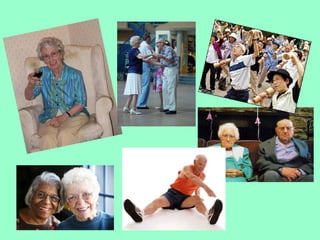
• Look at the media figures you have been
given.
• Place adjectives on a media celebrity that you
feel describes their age.
• How old are they?
Do Now!
Age-when are we happiest?
• http://www.telegraph.co.uk/health/healthnews/5645800/W
Representation of Age
in TV Drama
Learning Objective:
To explore how different age groups
are represented in the media,
specifically TV Drama.
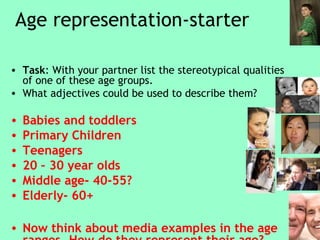
Age representation-starter
• Task: With your partner list the stereotypical qualities
of one of these age groups.
• What adjectives could be used to describe them?
• Babies and toddlers
• Primary Children
• Teenagers
• 20 – 30 year olds
• Middle age- 40-55?
• Elderly- 60+
• Now think about media examples in the age
The elderly
• Discussion point: The elderly are
often represented in the media as
being weak, vulnerable and needy?
Age construction
• Remember all fictional characters presented in the media
are ‘re-presentations!
• They have been constructed as a product of someone's
imagination.
• They all offer a certain view of what it is to be that
particular age.
• Question: Which age are most commonly seen
on TV?
• 35-45
• Why?
• Because that is the age group that make most of the
decisions in power!
Teenagers
in the media
• List some stereotypes of teenagers.
• Lazy
• Moody
• Argumentative
• Immature
• Irresponsible
• Confused
• Aggressive
• Rebellious
• Ignorant
• Threatening
• Creative
• Ambitious
• Focussed
• Formative development into adulthood- ‘finding yourselves’
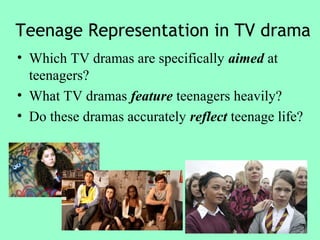
Teenage Representation in TV drama
• Which TV dramas are specifically aimed at
teenagers?
• What TV dramas feature teenagers heavily?
• Do these dramas accurately reflect teenage life?
Analysis
Watch this clip from Waterloo Road and make
notes on the following:
• How the different age groups are constructed.
• The relationships between age groups
• The way the technical aspects assist our
understanding of age.
• https://www.youtube.com/watch?v=YHj9aavgpvQ&index=11&list=
‘Eastenders’- a wide audience
• Eastenders more than any other show on UK TV feels it has a responsibility to
represent everyone. Why?
• Because it is a BBC programme and therefore funded by our licence fee. The
BBC must be seen to fairly represent all of us regardless of gender, ethnicity,
age etc.
• Therefore Eastenders has a variety of characters to appeal to a variety of
demographics. The spin off show ‘E20’ was an attempt to win back the youth
market who were said to be not as interested in the show.
• It is one of the few programmes that gives elderly characters a prominent voice.
• Task: Watch this clip and write down two adjectives to describe the elderly
characters.
• http://www.youtube.com/watch?v=oshePdbkk2Y
• Feedback to class in groups.
• Homework:
• ‘How is age constructed in the scene from
Waterloo Road and how are stereotypes
conformed or subverted to’.
• 400 words min.
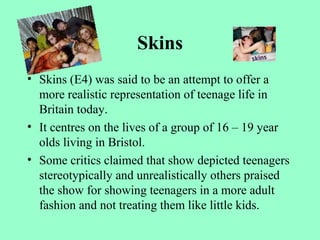
Skins
• Skins (E4) was said to be an attempt to offer a
more realistic representation of teenage life in
Britain today.
• It centres on the lives of a group of 16 – 19 year
olds living in Bristol.
• Some critics claimed that show depicted teenagers
stereotypically and unrealistically others praised
the show for showing teenagers in a more adult
fashion and not treating them like little kids.

5 age representation 1

  • 1.
    • Look atthe media figures you have been given. • Place adjectives on a media celebrity that you feel describes their age. • How old are they? Do Now!
  • 2.
    Age-when are wehappiest? • http://www.telegraph.co.uk/health/healthnews/5645800/W
  • 3.
    Representation of Age inTV Drama Learning Objective: To explore how different age groups are represented in the media, specifically TV Drama.
  • 4.
    Age representation-starter • Task:With your partner list the stereotypical qualities of one of these age groups. • What adjectives could be used to describe them? • Babies and toddlers • Primary Children • Teenagers • 20 – 30 year olds • Middle age- 40-55? • Elderly- 60+ • Now think about media examples in the age
  • 6.
    The elderly • Discussionpoint: The elderly are often represented in the media as being weak, vulnerable and needy?
  • 7.
    Age construction • Rememberall fictional characters presented in the media are ‘re-presentations! • They have been constructed as a product of someone's imagination. • They all offer a certain view of what it is to be that particular age. • Question: Which age are most commonly seen on TV? • 35-45 • Why? • Because that is the age group that make most of the decisions in power!
  • 8.
    Teenagers in the media •List some stereotypes of teenagers. • Lazy • Moody • Argumentative • Immature • Irresponsible • Confused • Aggressive • Rebellious • Ignorant • Threatening • Creative • Ambitious • Focussed • Formative development into adulthood- ‘finding yourselves’
  • 9.
    Teenage Representation inTV drama • Which TV dramas are specifically aimed at teenagers? • What TV dramas feature teenagers heavily? • Do these dramas accurately reflect teenage life?
  • 10.
    Analysis Watch this clipfrom Waterloo Road and make notes on the following: • How the different age groups are constructed. • The relationships between age groups • The way the technical aspects assist our understanding of age. • https://www.youtube.com/watch?v=YHj9aavgpvQ&index=11&list=
  • 11.
    ‘Eastenders’- a wideaudience • Eastenders more than any other show on UK TV feels it has a responsibility to represent everyone. Why? • Because it is a BBC programme and therefore funded by our licence fee. The BBC must be seen to fairly represent all of us regardless of gender, ethnicity, age etc. • Therefore Eastenders has a variety of characters to appeal to a variety of demographics. The spin off show ‘E20’ was an attempt to win back the youth market who were said to be not as interested in the show. • It is one of the few programmes that gives elderly characters a prominent voice. • Task: Watch this clip and write down two adjectives to describe the elderly characters. • http://www.youtube.com/watch?v=oshePdbkk2Y
  • 12.
    • Feedback toclass in groups. • Homework: • ‘How is age constructed in the scene from Waterloo Road and how are stereotypes conformed or subverted to’. • 400 words min.
  • 13.
    Skins • Skins (E4)was said to be an attempt to offer a more realistic representation of teenage life in Britain today. • It centres on the lives of a group of 16 – 19 year olds living in Bristol. • Some critics claimed that show depicted teenagers stereotypically and unrealistically others praised the show for showing teenagers in a more adult fashion and not treating them like little kids.