Narrative theory 
Nick Aldous
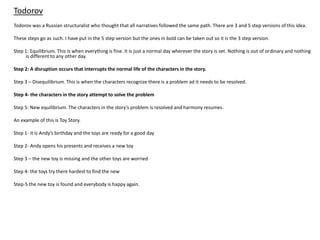
Todorov 
Todorov was a Russian structuralist who thought that all narratives followed the same path. There are 3 and 5 step versions of this idea. 
These steps go as such. I have put in the 5 step version but the ones in bold can be taken out so it is the 3 step version. 
Step 1: Equilibrium. This is when everything is fine. It is just a normal day wherever the story is set. Nothing is out of ordinary and nothing 
is different to any other day. 
Step 2: A disruption occurs that interrupts the normal life of the characters in the story. 
Step 3 – Disequilibrium. This is when the characters recognize there is a problem ad it needs to be resolved. 
Step 4- the characters in the story attempt to solve the problem 
Step 5: New equilibrium. The characters in the story’s problem is resolved and harmony resumes. 
An example of this is Toy Story. 
Step 1- it is Andy’s birthday and the toys are ready for a good day 
Step 2- Andy opens his presents and receives a new toy 
Step 3 – the new toy is missing and the other toys are worried 
Step 4- the toys try there hardest to find the new 
Step-5 the new toy is found and everybody is happy again.
Todorov continued…. 
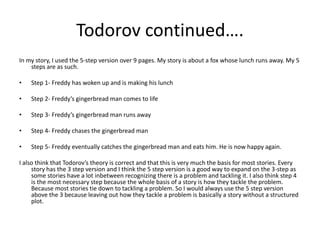
In my story, I used the 5-step version over 9 pages. My story is about a fox whose lunch runs away. My 5 
steps are as such. 
• Step 1- Freddy has woken up and is making his lunch 
• Step 2- Freddy’s gingerbread man comes to life 
• Step 3- Freddy’s gingerbread man runs away 
• Step 4- Freddy chases the gingerbread man 
• Step 5- Freddy eventually catches the gingerbread man and eats him. He is now happy again. 
I also think that Todorov’s theory is correct and that this is very much the basis for most stories. Every 
story has the 3 step version and I think the 5 step version is a good way to expand on the 3-step as 
some stories have a lot inbetween recognizing there is a problem and tackling it. I also think step 4 
is the most necessary step because the whole basis of a story is how they tackle the problem. 
Because most stories tie down to tackling a problem. So I would always use the 5 step version 
above the 3 because leaving out how they tackle a problem is basically a story without a structured 
plot.
Vladimir Propp 
Vladimir Propp was a Russian and soviet formalist scholar. 
He analyzed 100 folk tales and came to the conclusion that out of all of the tales there are only 31 plot elements. He named them 
functions. 
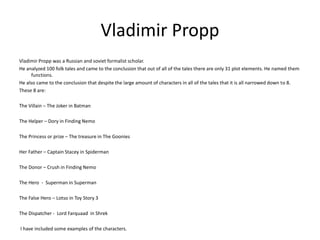
He also came to the conclusion that despite the large amount of characters in all of the tales that it is all narrowed down to 8. 
These 8 are: 
The Villain – The Joker in Batman 
The Helper – Dory in Finding Nemo 
The Princess or prize – The treasure in The Goonies 
Her Father – Captain Stacey in Spiderman 
The Donor – Crush in Finding Nemo 
The Hero - Superman in Superman 
The False Hero – Lotso in Toy Story 3 
The Dispatcher - Lord Farquaad in Shrek 
I have included some examples of the characters.
Vladimir Propp continued… 
I am undecided as to whether I agree with this statement as I have lots of evidence to 
support both sides. 
Firstly, I could believe this theory as I cannot think of a story that includes a character 
that doesn’t apply to one of these basis’s. Therefore I think the theory is correct but 
then again, I think that all of the characters in the whole fictitious universe cannot be 
narrowed down to just 8 formats. The whole point of characters are that they are 
deep, interesting and strange individuals and narrowing them down to 8 kinds of 
people just puts a whole negative aspect on the point of fiction and waters down the 
fun by a lot. 
By no means am I saying that propp is daft, negative and a kill-joy. I am saying that It 
is an interesting theory but I don’t see how it can be correct as the only information I 
have supporting it is that I cannot beat it. But then I think that narrowing thousands 
of people into 8 groups is just impossible. There are similarities but nothing can fill 
the same gap. 
In my children’s book i only have 2 characters and these do not apply to Propp’s 
theory. 
I have a fox who has cooked his lunch but his lunch runs away, and a gingerbread man 
who runs away from the fox. Although the gingerbread man shouldn’t have run away, 
he isn’t exactly a villain. And the fox isn’t a hero either cause all he wants is his lunch.

Narrative Theory

  • 1.
  • 2.
    Todorov Todorov wasa Russian structuralist who thought that all narratives followed the same path. There are 3 and 5 step versions of this idea. These steps go as such. I have put in the 5 step version but the ones in bold can be taken out so it is the 3 step version. Step 1: Equilibrium. This is when everything is fine. It is just a normal day wherever the story is set. Nothing is out of ordinary and nothing is different to any other day. Step 2: A disruption occurs that interrupts the normal life of the characters in the story. Step 3 – Disequilibrium. This is when the characters recognize there is a problem ad it needs to be resolved. Step 4- the characters in the story attempt to solve the problem Step 5: New equilibrium. The characters in the story’s problem is resolved and harmony resumes. An example of this is Toy Story. Step 1- it is Andy’s birthday and the toys are ready for a good day Step 2- Andy opens his presents and receives a new toy Step 3 – the new toy is missing and the other toys are worried Step 4- the toys try there hardest to find the new Step-5 the new toy is found and everybody is happy again.
  • 3.
    Todorov continued…. Inmy story, I used the 5-step version over 9 pages. My story is about a fox whose lunch runs away. My 5 steps are as such. • Step 1- Freddy has woken up and is making his lunch • Step 2- Freddy’s gingerbread man comes to life • Step 3- Freddy’s gingerbread man runs away • Step 4- Freddy chases the gingerbread man • Step 5- Freddy eventually catches the gingerbread man and eats him. He is now happy again. I also think that Todorov’s theory is correct and that this is very much the basis for most stories. Every story has the 3 step version and I think the 5 step version is a good way to expand on the 3-step as some stories have a lot inbetween recognizing there is a problem and tackling it. I also think step 4 is the most necessary step because the whole basis of a story is how they tackle the problem. Because most stories tie down to tackling a problem. So I would always use the 5 step version above the 3 because leaving out how they tackle a problem is basically a story without a structured plot.
  • 4.
    Vladimir Propp VladimirPropp was a Russian and soviet formalist scholar. He analyzed 100 folk tales and came to the conclusion that out of all of the tales there are only 31 plot elements. He named them functions. He also came to the conclusion that despite the large amount of characters in all of the tales that it is all narrowed down to 8. These 8 are: The Villain – The Joker in Batman The Helper – Dory in Finding Nemo The Princess or prize – The treasure in The Goonies Her Father – Captain Stacey in Spiderman The Donor – Crush in Finding Nemo The Hero - Superman in Superman The False Hero – Lotso in Toy Story 3 The Dispatcher - Lord Farquaad in Shrek I have included some examples of the characters.
  • 5.
    Vladimir Propp continued… I am undecided as to whether I agree with this statement as I have lots of evidence to support both sides. Firstly, I could believe this theory as I cannot think of a story that includes a character that doesn’t apply to one of these basis’s. Therefore I think the theory is correct but then again, I think that all of the characters in the whole fictitious universe cannot be narrowed down to just 8 formats. The whole point of characters are that they are deep, interesting and strange individuals and narrowing them down to 8 kinds of people just puts a whole negative aspect on the point of fiction and waters down the fun by a lot. By no means am I saying that propp is daft, negative and a kill-joy. I am saying that It is an interesting theory but I don’t see how it can be correct as the only information I have supporting it is that I cannot beat it. But then I think that narrowing thousands of people into 8 groups is just impossible. There are similarities but nothing can fill the same gap. In my children’s book i only have 2 characters and these do not apply to Propp’s theory. I have a fox who has cooked his lunch but his lunch runs away, and a gingerbread man who runs away from the fox. Although the gingerbread man shouldn’t have run away, he isn’t exactly a villain. And the fox isn’t a hero either cause all he wants is his lunch.